


Northern Mockingbird
Mockingbird · Mimus polyglottos
By the Birdfact teamChecked by Nathan Cope
On this page15 sections
How to recognise it
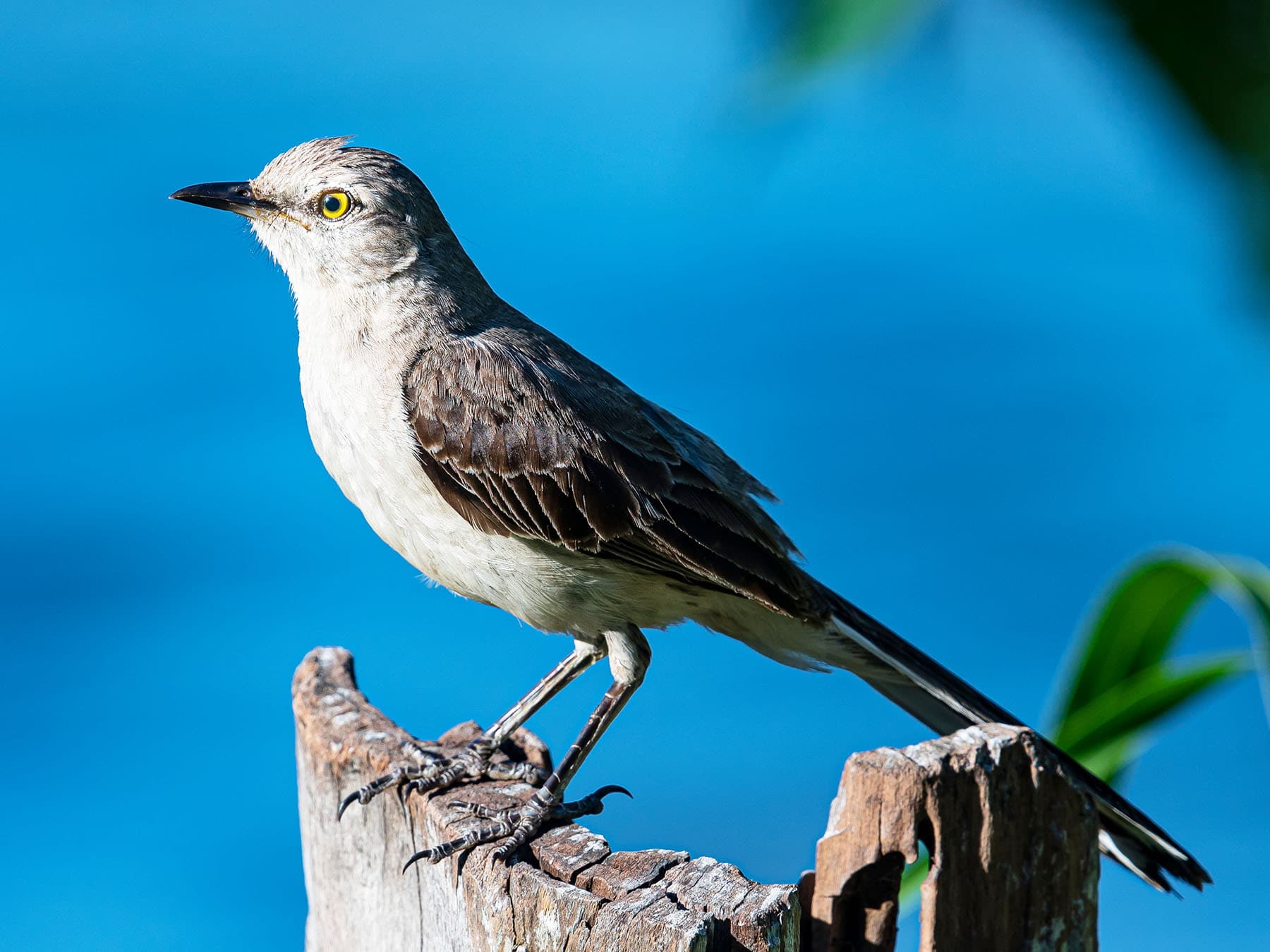
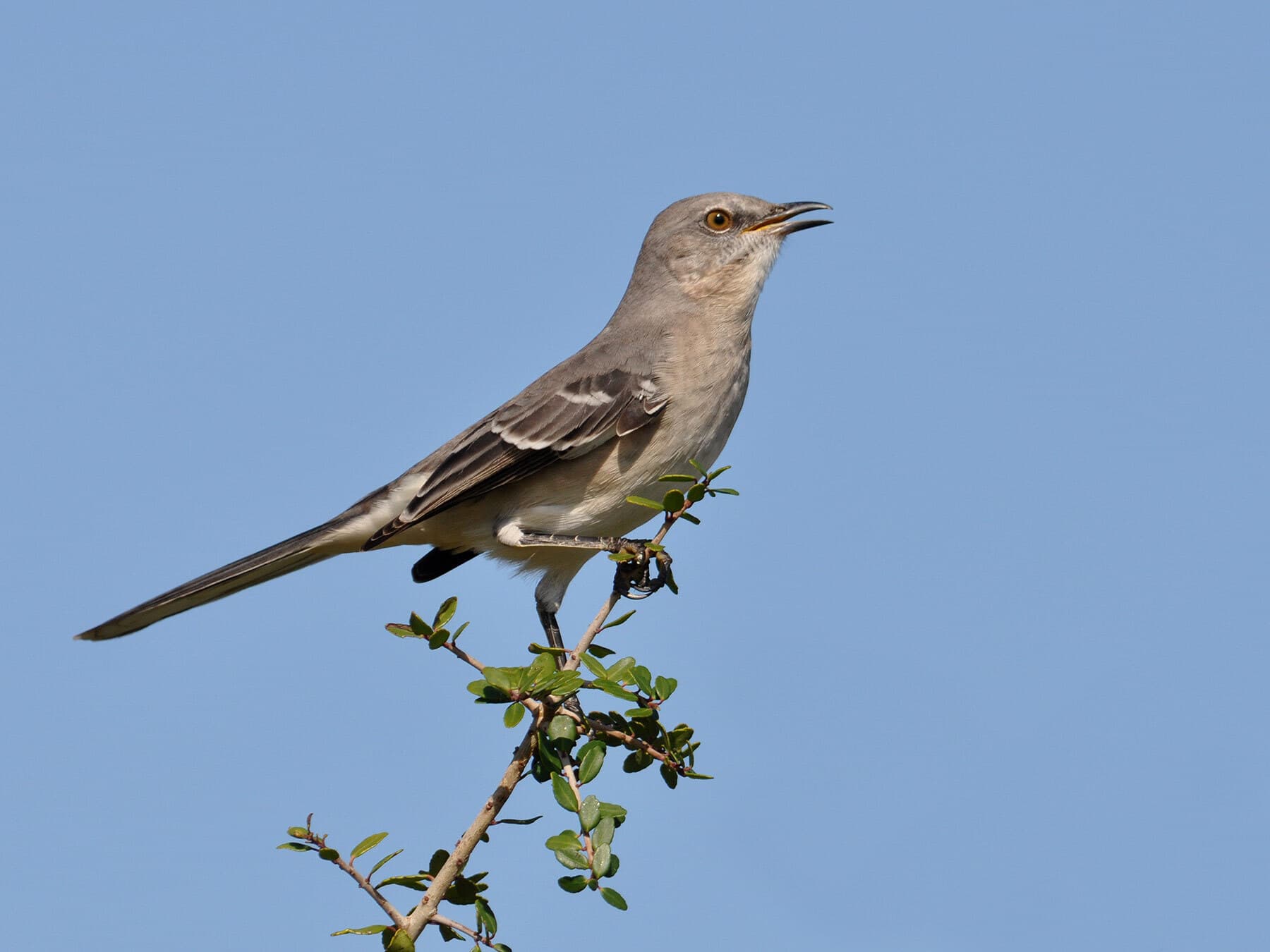
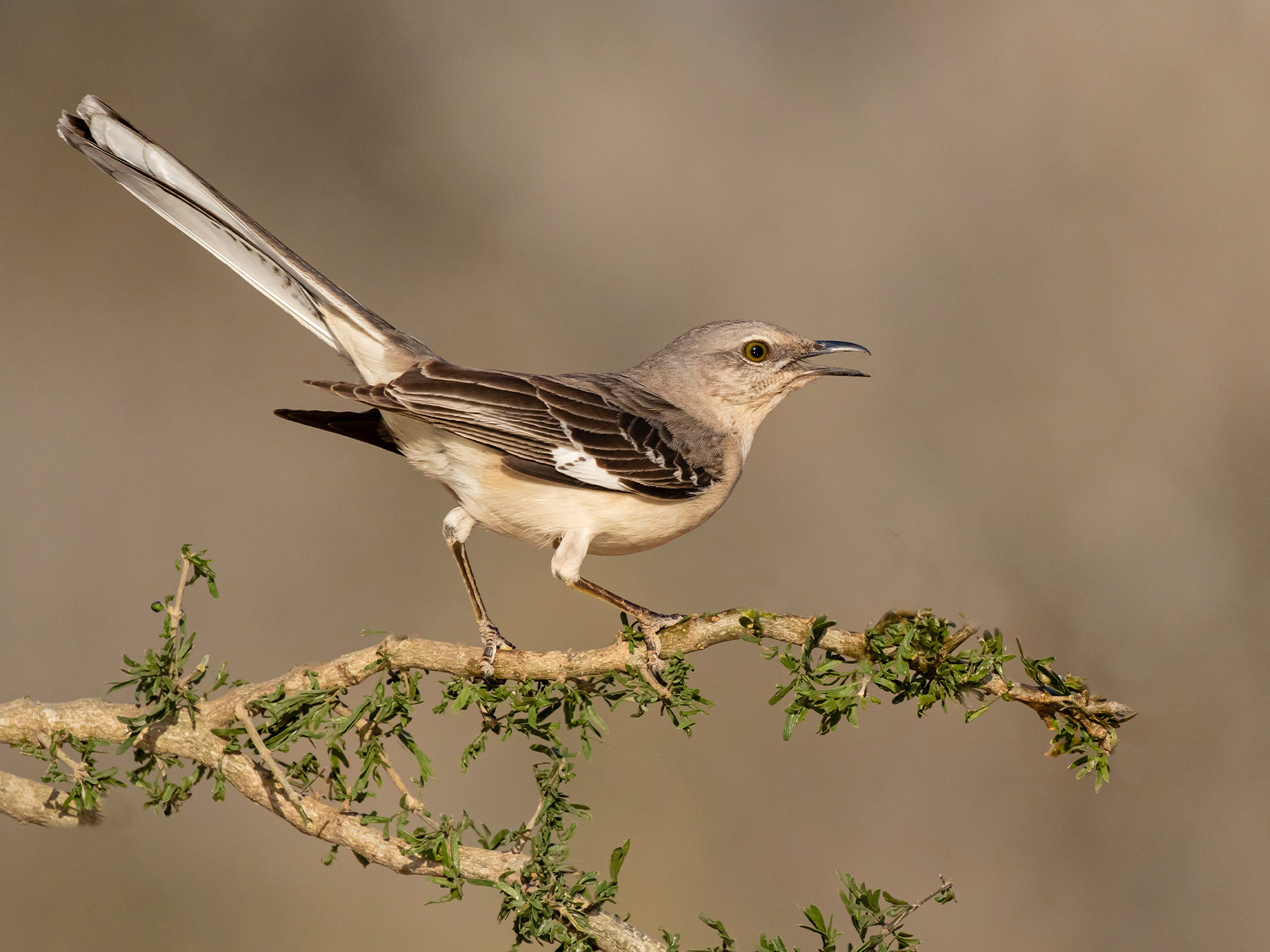
A Northern Mockingbird is a slender, medium-sized songbird, about 8 to 10 inches (21-26 cm) long and 1.6 to 2.0 ounces (45-58 g),1 a little bigger than a Gray Catbird. It has a small head, a long, thin bill with a slight downward curve, long legs, short rounded wings and a long tail.
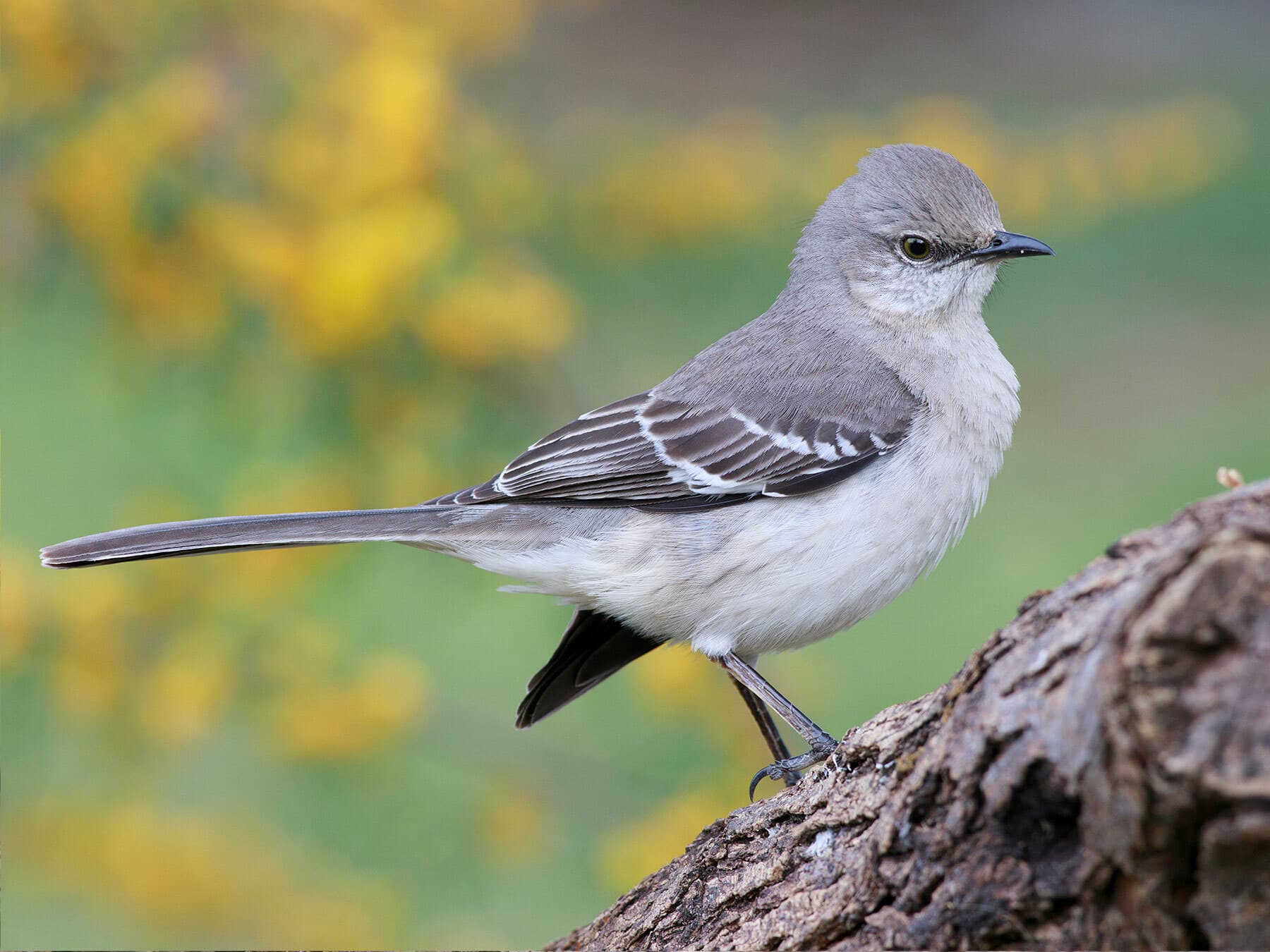
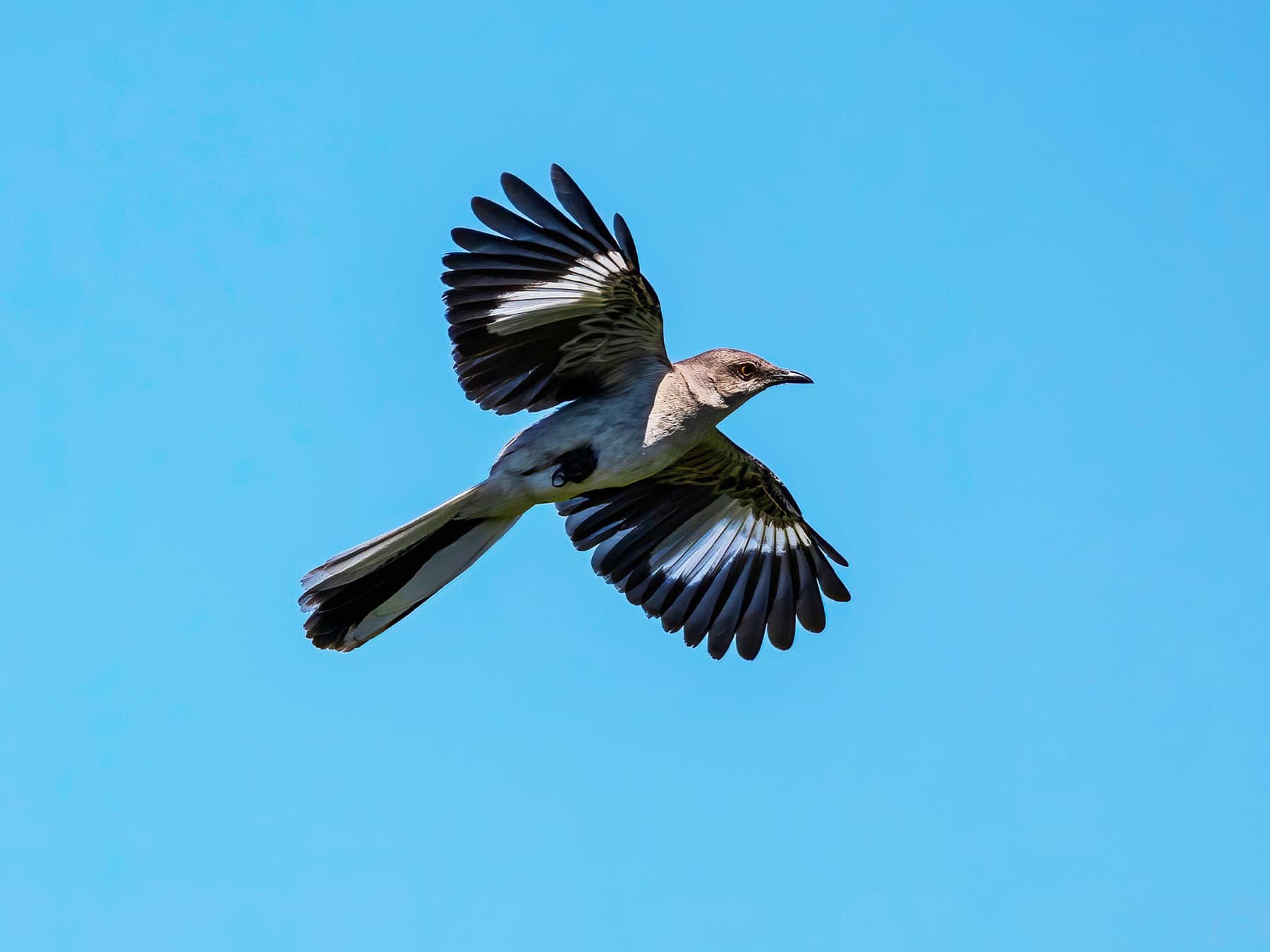
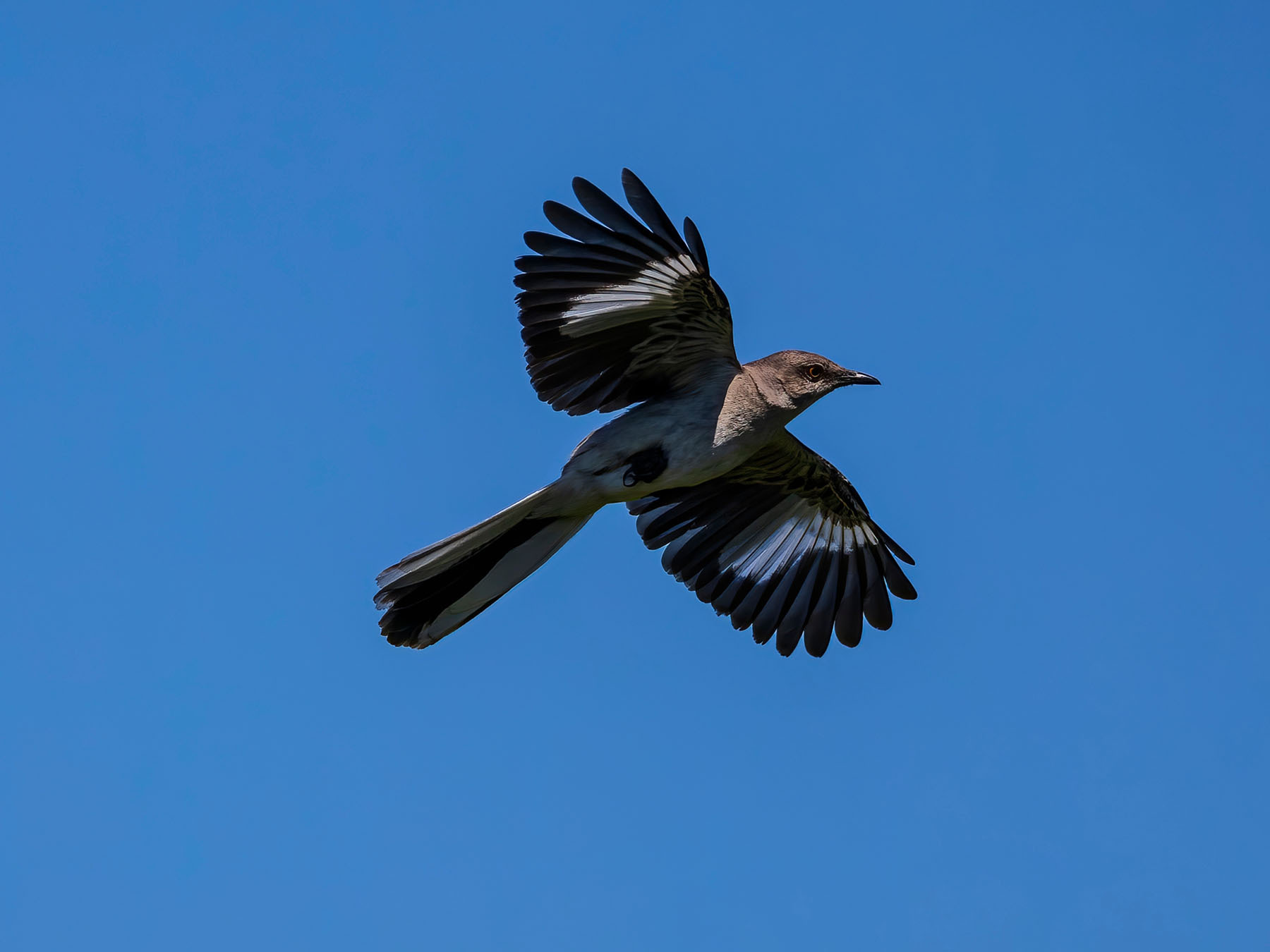
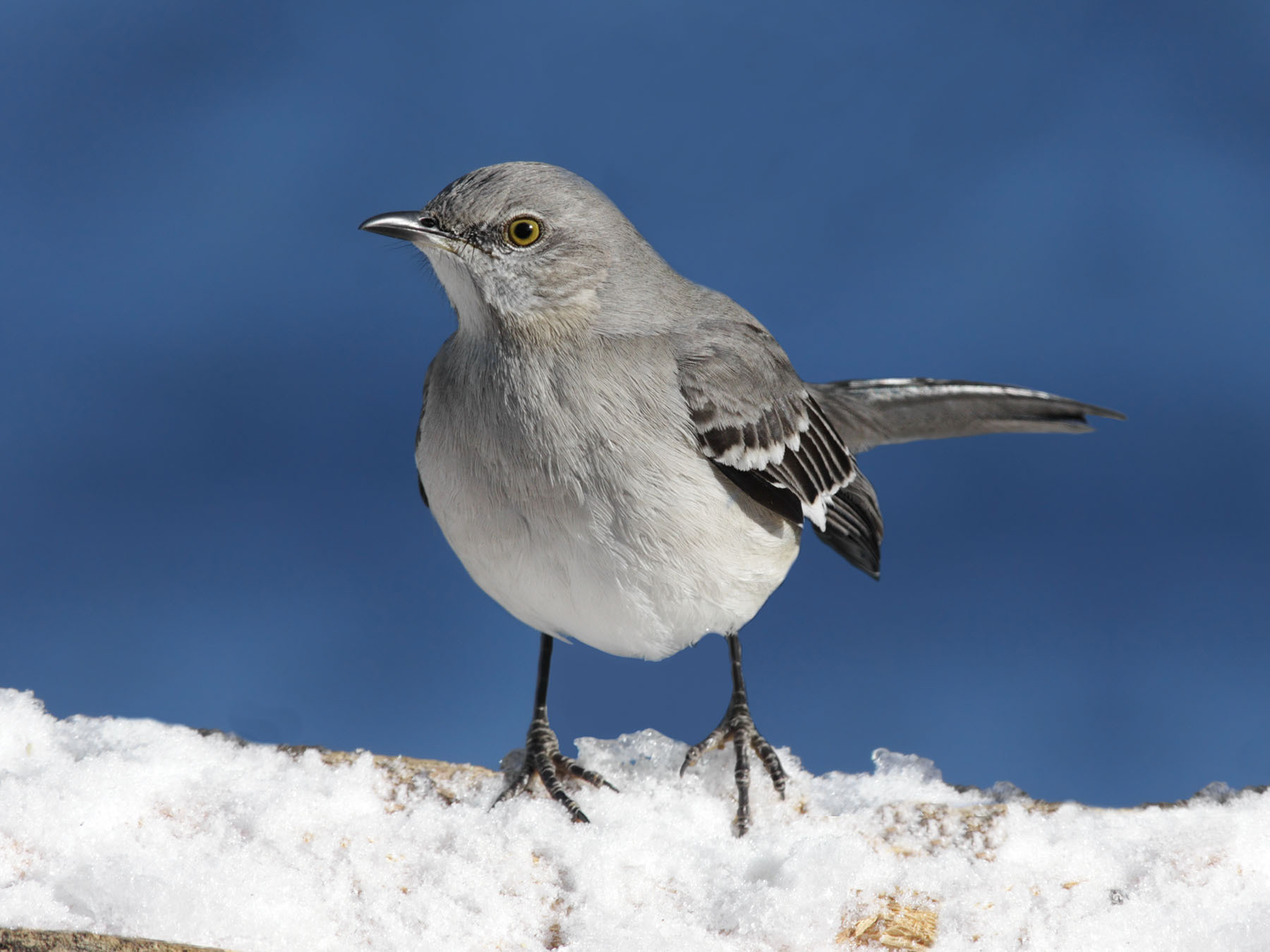
It is gray to gray-brown above and white to pale gray below, with a thin dark line through a yellow eye. The folded wing is blackish, with two narrow white wing bars and a white patch at the base of the long flight feathers. On a perched bird that patch is a small white mark; when the bird flies it opens into a big white flash, and the long dark tail shows white outer feathers.2 Those white flashes are the quickest way to know one.
Male, female and young
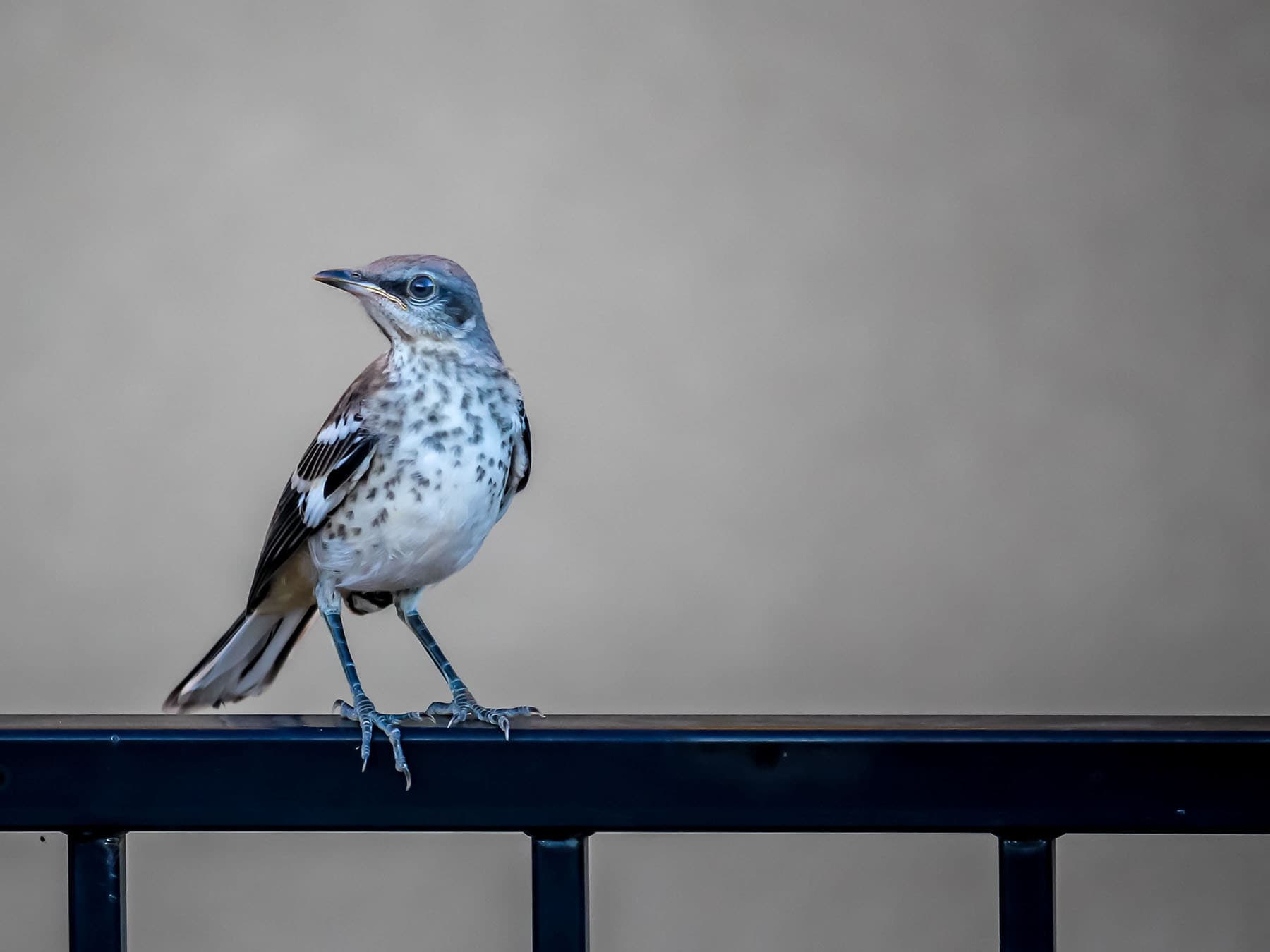
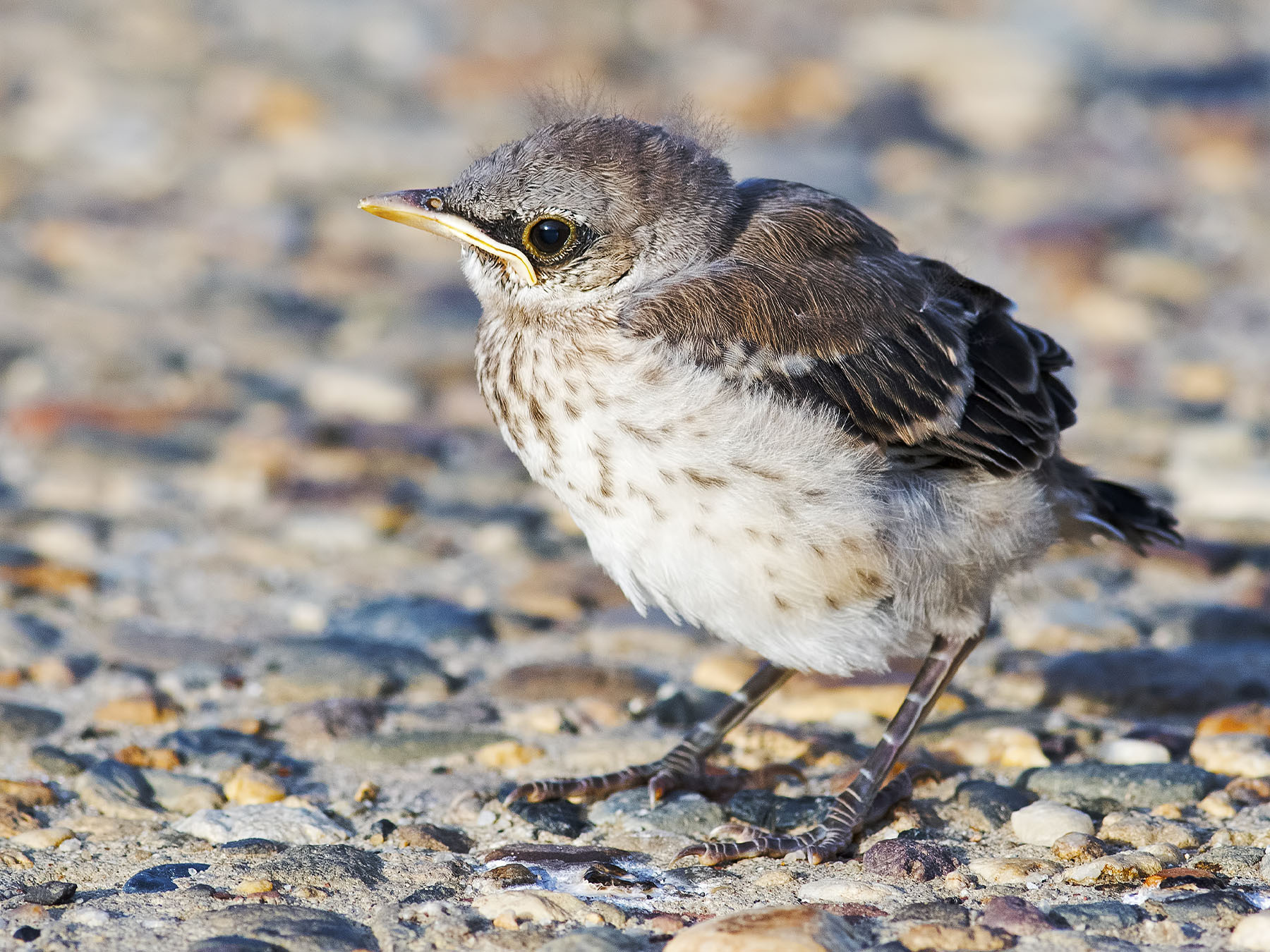
Males and females look the same. Males average a little larger and heavier (about 1.8 against 1.65 ounces, or 51 g against 47 g), but the sexes cannot be told apart safely by size or plumage; behavior gives them away, since the loud singer in spring is almost always the male and only the female incubates. Young birds are easier: a juvenile has brownish to blackish spots and streaks on the breast and a gray or gray-green eye, and most look like adults by their first fall. More: male vs female mockingbirds.
Identification: similar birds
Gray Catbird. A slightly smaller relative that also mimics, but it is plain dark gray with a black crown and rusty-chestnut feathers under the tail, and it has no white in the wings or tail.3
Loggerhead and Northern Shrikes. Similar gray, black and white birds that perch on wires and treetops, but a shrike has a black mask through the eye, a bigger head and a stout, hooked bill, and shows less white in the wings and tail. The Northern Shrike is a winter visitor in the north.
Townsend's Solitaire. A gray bird of the western mountains with white outer tail feathers, but it has a white eye-ring and buff wing patches, and perches upright; a mockingbird sits more horizontally and has no eye-ring.
Sage Thrasher. A western bird with a streaked breast and no big white wing patches. Spotted young mockingbirds are the likelier mix-up.4, 5, 6, 7
Its size
Adults- Length
- 21–26 cm
- Wingspan
- 31–35 cm
- Weight
- 45–58 g
Its song and calls
The song is a long, rambling run of phrases, each repeated several times before the bird switches to the next: whistles, trills, harsh notes and copies of other birds, other animals and mechanical sounds. A male's repertoire often holds more than 150 distinct song types, and estimates for single males run from 45 to over 200; he keeps adding new ones through life. In a study of nine males, mimicry made up about 61% of song in late spring and 48% outside the breeding season.8
Both sexes sing, the female more quietly and less often. Mockingbirds sing for about three-quarters of the year, from February to August and again from late September to early November, when birds set up fall territories. The calls are a harsh, rasping "hew" at predators and rivals and short, explosive "chat" notes, often given in bursts in fall.
Hear recordings, see the song drawn as spectrograms, and find out what mockingbirds copy and how well: Mockingbird sounds.
Night song
The bird singing in the dark is usually an unmated male. In spring and summer, unmated males sing far more than mated ones, by night as well as by day, and in one study only unmated males sang extensively at night under natural lighting. Near streetlights and other bright lights, mated males sometimes sing at night too, and night singing seems commoner around the full moon. There is no night song in fall. More, with a 2 a.m. recording: why mockingbirds sing at night.
- Song0:00 / 0:30
Recorded in California, United States · April 2019
- Chat calls0:00 / 0:12
Recorded in Maryland, United States · January 2024
When and where to see it
OctoberHere all year
Most recorded in October
- 1. Alabama3.6%
- 2. Mississippi3.5%
- 3. Texas3.1%
- 4. Louisiana3.1%
- 5. Florida3.0%
Each dot is a county, state or province: the bigger and darker, the larger the bird’s share of that place’s bird records that month. Grey dots: no regular records. The ringed point is the centre of the bird’s records this month; the arrow shows how it moved since last month, and the dashed loop its path through the year. “Arrivals” colours places where it becomes regular this month (orange) or is in its last regular month (grey). GBIF eBird Observation Dataset, 2019–2024. Map data: Natural Earth, US Census Bureau; place centres © OpenStreetMap contributors.
In your area
See when the Northern Mockingbird is recorded in your county, state or province.
How often the Northern Mockingbird turns up in the United States and Canada through the year, from birdwatchers' records.
United States
Resident · all year · most records in October
Canada
Resident · all year · most records in January
Show as a table
| Month | United States | Canada |
|---|---|---|
| January | 1.2% (regular) | 0.083% (regular) |
| February | 1.3% (regular) | 0.060% (regular) |
| March | 1.2% (regular) | 0.046% (regular) |
| April | 1.0% (regular) | 0.038% (regular) |
| May | 0.78% (regular) | 0.037% (regular) |
| June | 0.97% (regular) | 0.029% (regular) |
| July | 1.0% (regular) | 0.035% (regular) |
| August | 0.83% (regular) | 0.022% (regular) |
| September | 0.88% (regular) | 0.017% (regular) |
| October | 1.3% (regular) | 0.036% (regular) |
| November | 1.2% (regular) | 0.052% (regular) |
| December | 1.3% (regular) | 0.072% (regular) |
Worldwide: recorded regularly in 14 countries
Countries where it was recorded in at least 3 of the 6 years 2019–2024. Linked countries have their own bird list.
North America (14)
- Bahamas
- Bermuda
- British Virgin Islands
- Canada
- Cayman Islands
- Cuba
- Dominican Republic
- Haiti
- Jamaica
- Mexico
- Puerto Rico
- Turks & Caicos Islands
- United States
- US Virgin Islands
Data: EOD – eBird Observation Dataset (Cornell Lab of Ornithology), accessed via GBIF.org, CC BY 4.0. Records from 2019–2024, aggregated and filtered by Birdfact. How these lists are made
Northern Mockingbirds live across the lower 48 states, most commonly in the South; Breeding Bird Survey counts are highest in the brushlands of South Texas and across Texas.9 They also breed in southern Ontario and Quebec, south through Mexico, and in the Bahamas and the Greater Antilles, and were introduced to Hawaii in the 1920s.
They like open ground with scattered shrubs and small trees: parks, farmland and forest edges in the East, desert scrub and chaparral in the West, and above all towns, suburbs and yards, especially mowed lawns next to bare ground with shrubs or hedges nearby. They avoid the inside of forests.
Over the last two centuries they spread north. The 1903 edition of Elliott Coues's Key to North American Birds called them uncommon north of latitude 38 degrees; by 2001 they were uncommon to fairly common even in northern Ohio, the first known nest in Ontario was in 1960, and in California, probably first confined to the southeastern deserts, they were common in most counties by the 1970s. Birds of the World puts this down mostly to suburbs, farms and planted shrubs such as multiflora rose.
Spotting tips
Look for a mockingbird on the highest perch around, a treetop, eave, utility wire or fence post, or running across a lawn, stopping, and lifting its wings. In spring, listen for a bird that repeats each phrase several times before changing tune.
Do they migrate?
Mostly not. Over most of their range mockingbirds stay all year, though some move between a breeding territory and a separate winter one. At the northern edge, some leave for the winter while others stay; in Quebec, for example, birds have bred regularly since 1960 but do not spend the winter. Banded birds have been found up to 500 miles (800 km) away.2
Range: records in Britain
A few have crossed the Atlantic. The British list has three accepted records: Saltash, Cornwall, in August 1982; Horsey Island, Essex, in May 1988; and a bird found at Exmouth, Devon, in 2021, which turned up again in southern England in April and at Newbiggin-by-the-Sea, Northumberland, in May. Earlier birds were not accepted because they may have escaped from captivity or ridden ships across.10, 11
What it eats
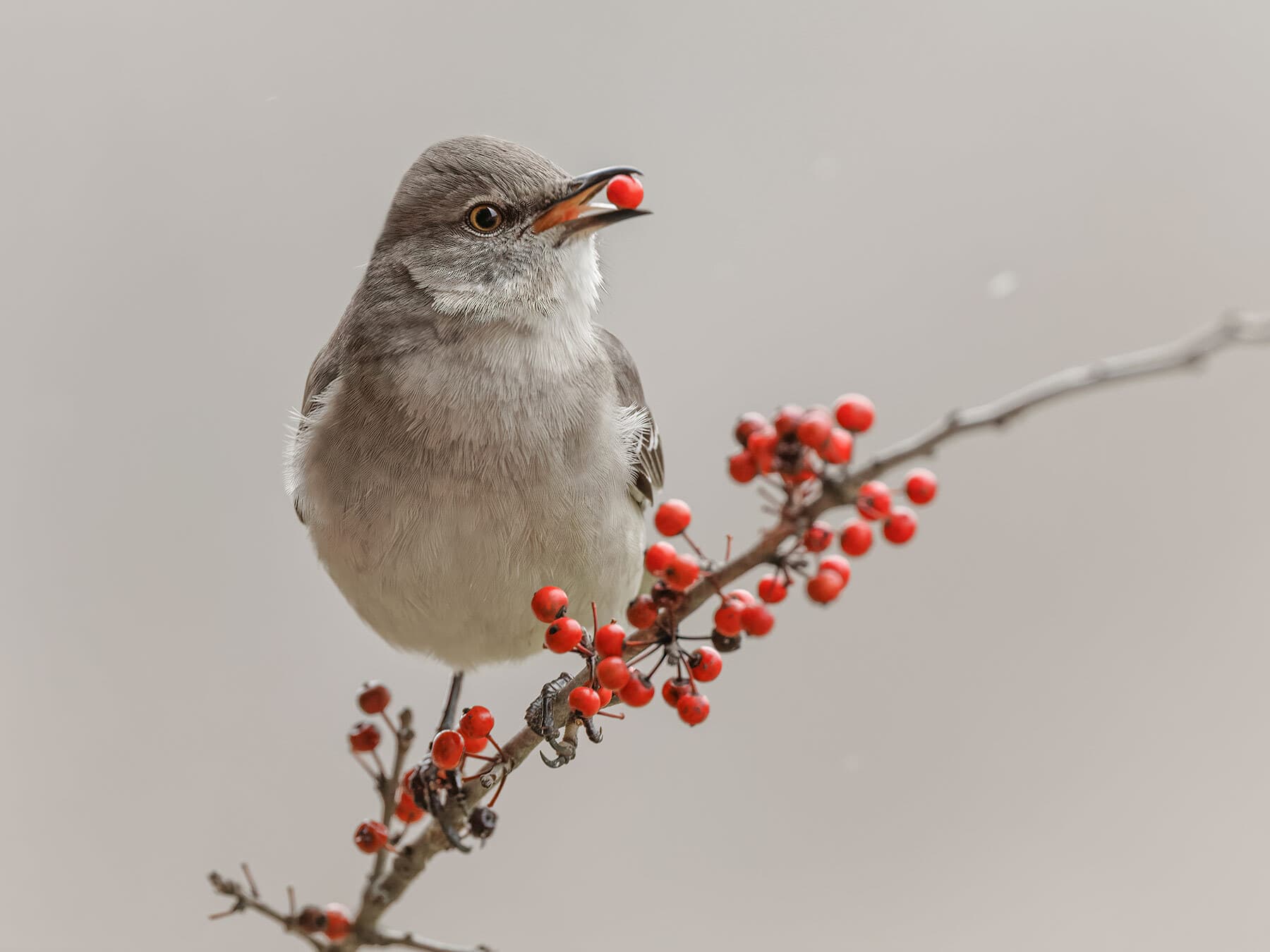
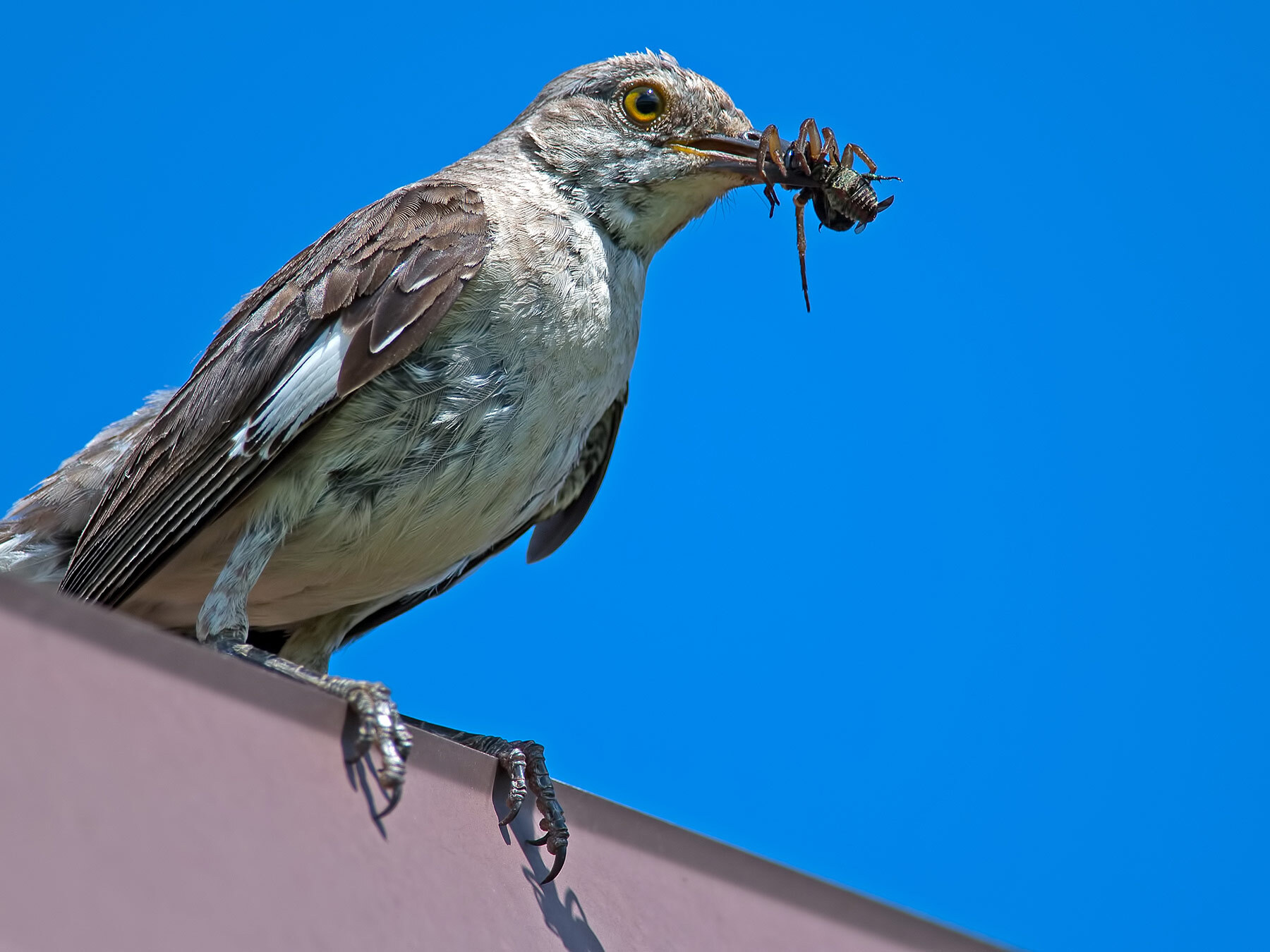
Insects in summer, fruit in winter. Over the year their food is about half animal and half fruit; in the breeding season, insects and other small animals make up nearly 85% of what they eat, and in winter only about 13%. They take beetles, ants, bees, wasps and grasshoppers, as well as earthworms, spiders and the occasional small lizard, and in fall and winter berries and fruit of all kinds, wild and planted.2
They hunt on short grass or bare ground: run a few steps, stop, and lunge. Some chase flying insects, and they can knock big cicadas to the ground with a blow of the wings and chest. In winter they live largely on fruit, chasing Cedar Waxwings from fruiting trees, and they probably spread the seeds of many plants. More: what mockingbirds eat through the year.
Feeding them in your yard
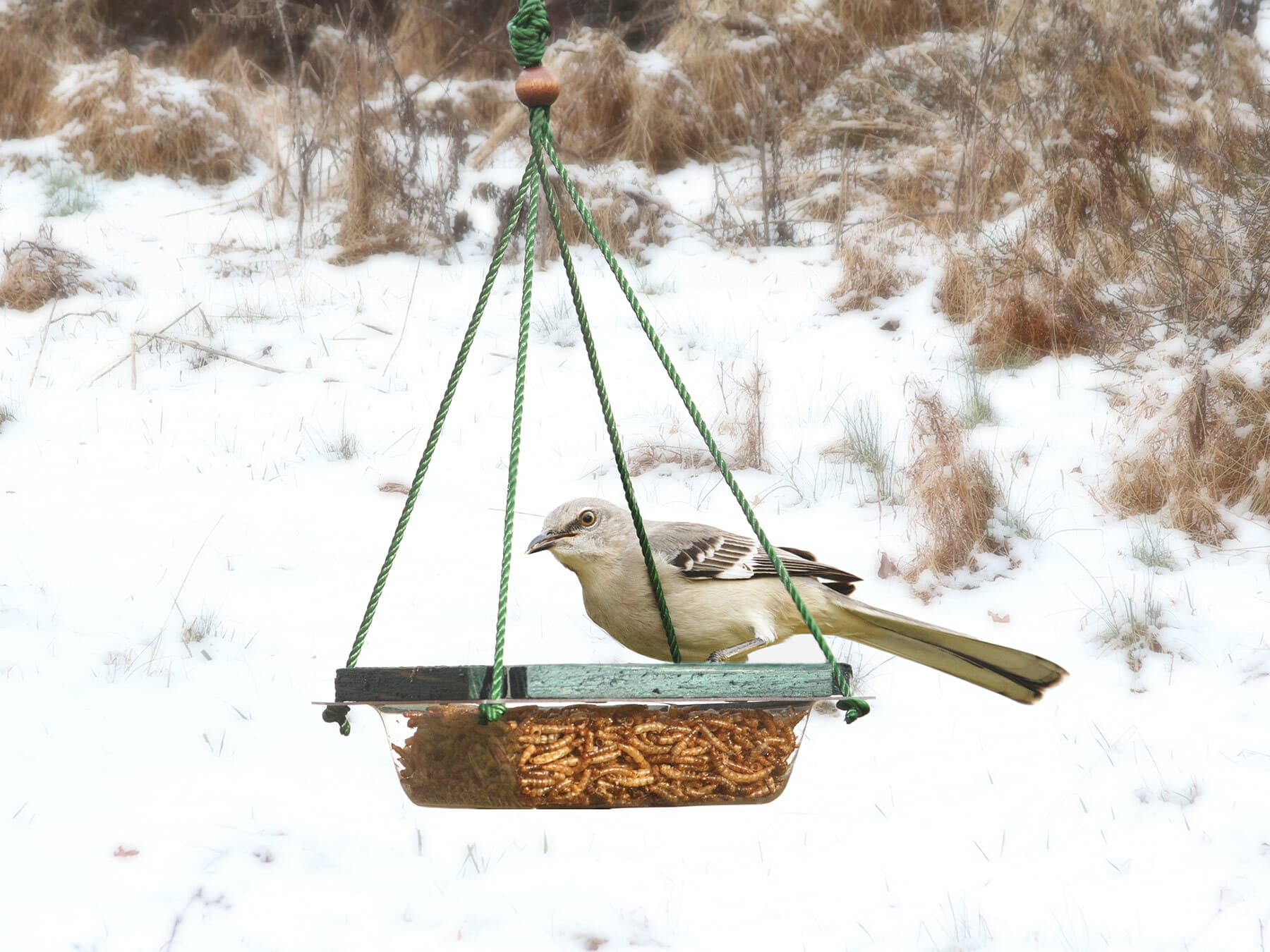
Mockingbirds are common in backyards but do not often visit feeders. All About Birds suggests keeping an open lawn and planting fruiting trees and bushes such as mulberries, hawthorns and blackberry brambles. When they do come to feeders, Project FeederWatch lists fruit, mealworms, suet, hulled sunflower seeds and peanut hearts, at ground and platform feeders.12 More: feeding mockingbirds.
Nesting and breeding
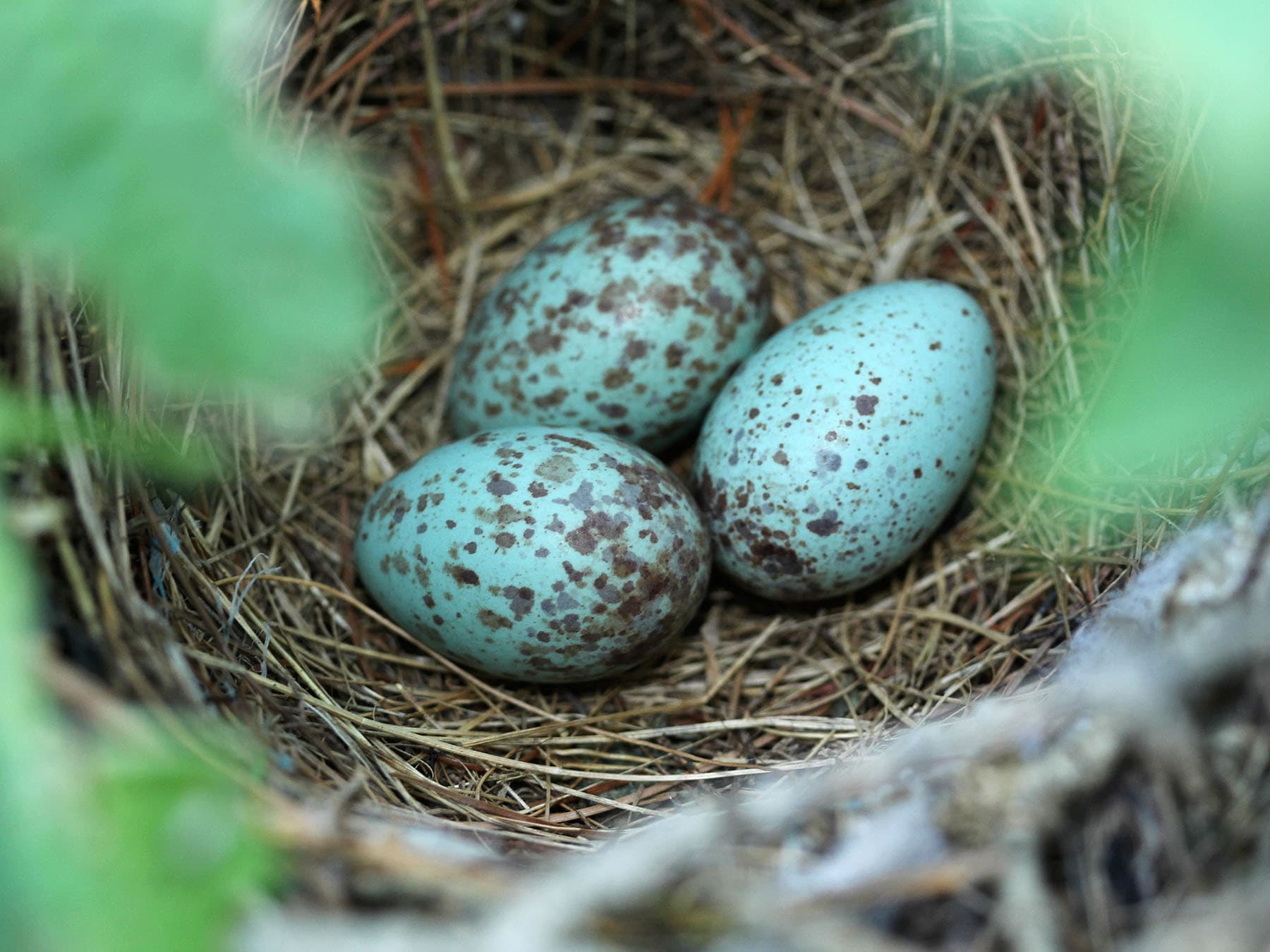
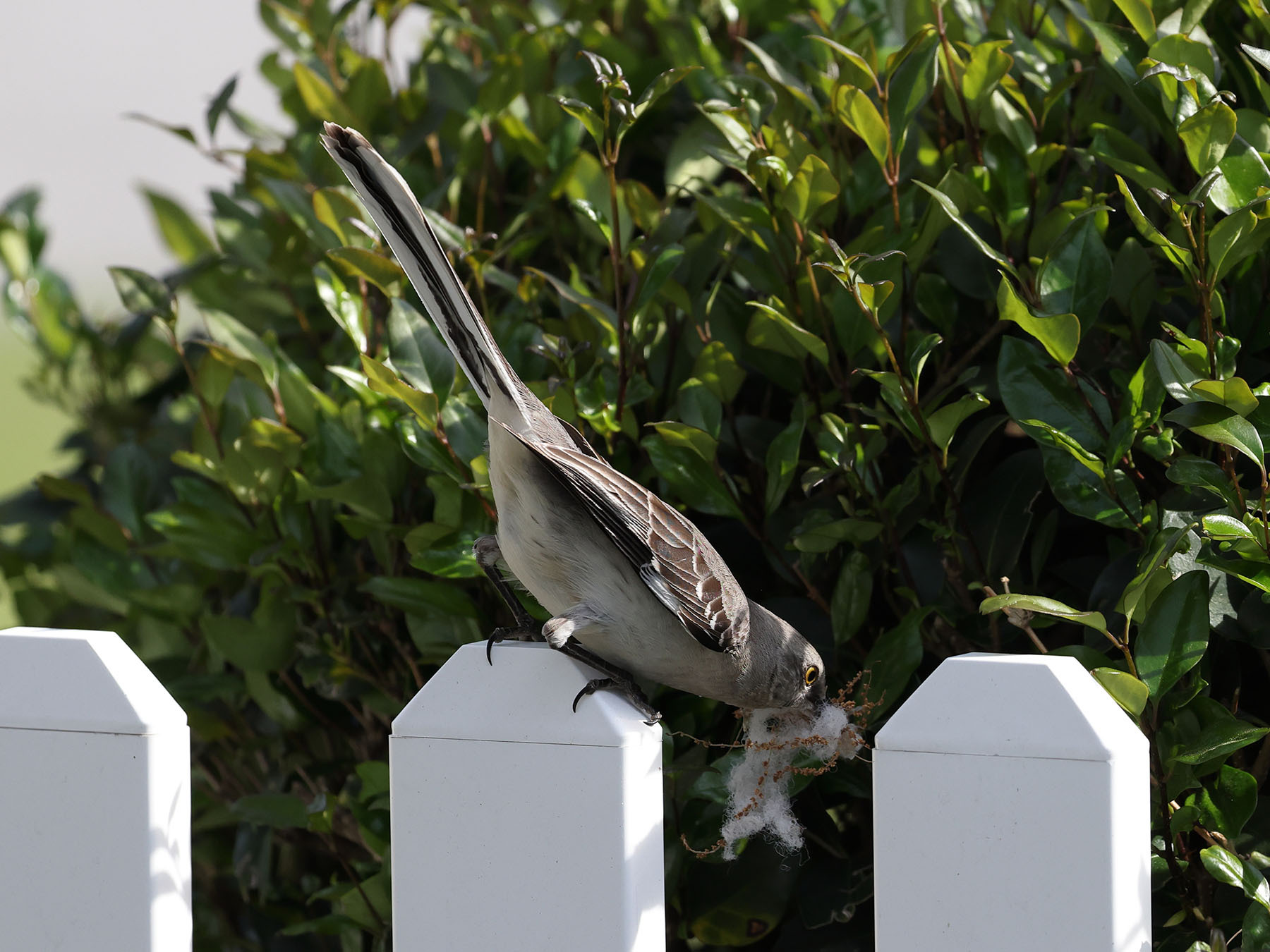
Mockingbirds nest in shrubs and small trees, usually 3 to 10 feet (1-3 m) off the ground. The male does most of the work on the twig base of the open cup and the female most of the lining of grasses, rootlets and, often, litter. She lays 2 to 6 pale blue-green eggs with brown spots, usually 3 or 4, and incubates them alone for 12 to 13 days.13 The young leave the nest at about 12 days old, and the male may feed them on his own for up to three weeks while the female nests again.2 Two or three broods a season are common, and up to four are possible.2 More: mockingbird nesting, eggs and young.
Behaviour
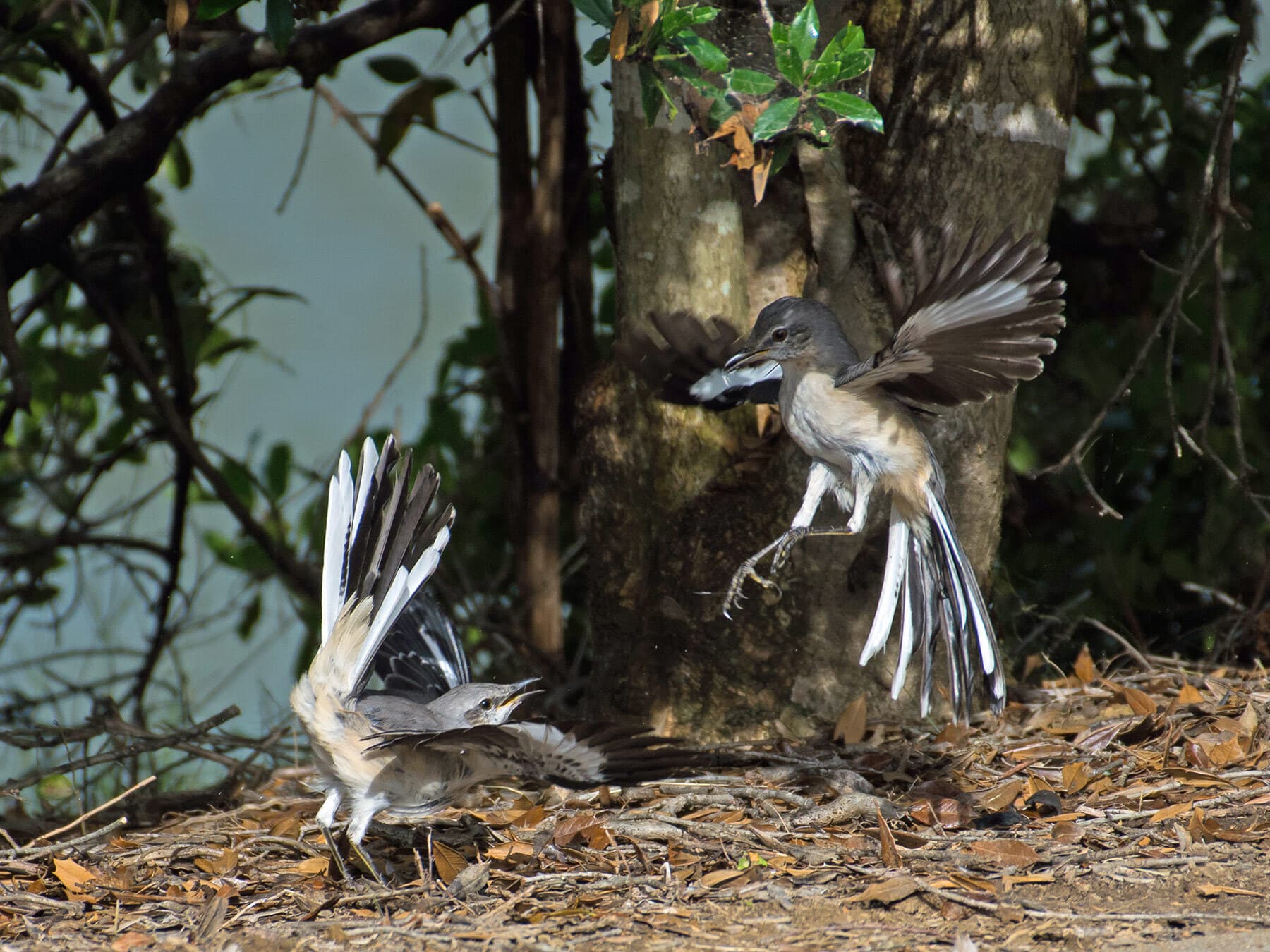
Mockingbirds are found alone or in pairs all year, and they are territorial all year too. Pairs defend their ground together, each bird driving off intruders of its own sex. Neighboring males settle borders with a "boundary dance": they face each other on the ground and hop from side to side until one backs off, and sometimes they fight. In spring an unmated male advertises with a flight display, jumping up from a high perch with wings spread and parachuting back down, singing all the while.
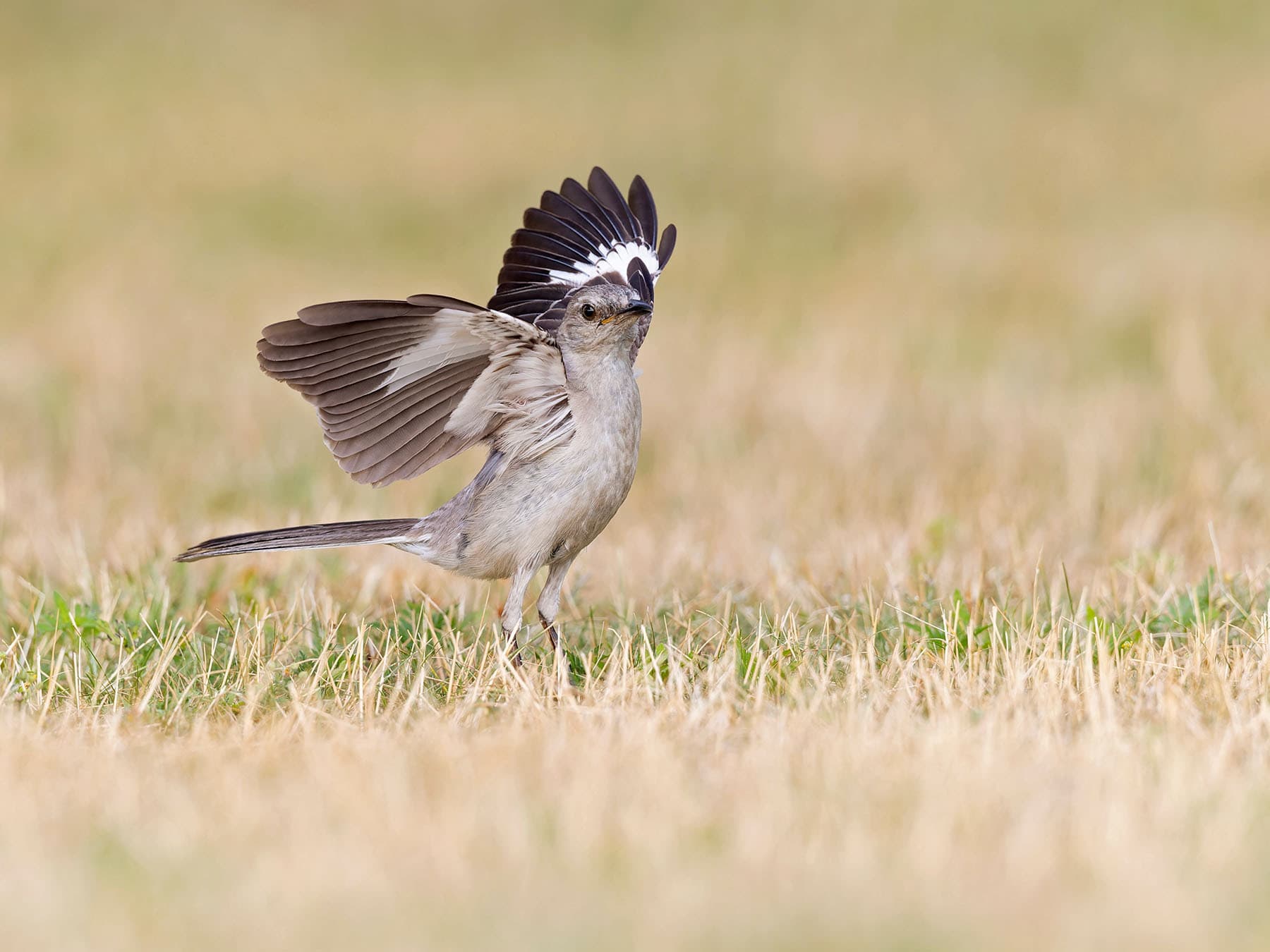
On the ground, a mockingbird often lifts its wings in jerky steps to flash the white patches. Nobody is sure why. One idea is that it startles insects, but in an Alabama study, when birds wing-flashed more they attacked prey less often,14 and later studies suggest it is aimed at predators near the nest.15
Nesting mockingbirds are famously bold. Both parents mob and chase hawks, crows, cats and dogs, and they dive at people who come too close. They learn individual people, too: in a University of Florida study, birds learned to recognize a person after just two 30-second visits to their nest, and flushed from the nest sooner each time that person returned, while a newcomer got only the wary response the first person had met on day one.16
Lifespan and predators
Most mockingbirds are probably short-lived: about a third of adults survive from one year to the next, based on the capture histories of 377 birds. Birds that hold a territory have lived as long as 8 years in studied populations.2 The oldest on the US Bird Banding Laboratory's list had reached an age of at least 14 years 10 months: banded as an adult in Texas in May 1986, it was found dead in Texas in April 2000.17
Predators and other dangers
Likely predators of eggs and nestlings include Blue Jays, crows, snakes, squirrels and cats, and fledglings are taken by cats and hawks. Adults are taken by Sharp-shinned Hawks and screech-owls, though their pugnacity may make them less common prey than other songbirds their size. Hard winters probably kill many in the north, and urban mockingbirds can carry high levels of lead: around Washington, DC and Baltimore, more than ten times as much in their blood as rural birds.
Conservation
The Northern Mockingbird is common and of Least Concern, but it is declining. The Breeding Bird Survey shows a fall of about 1% a year from 1966 to 2025, with significant declines in many states, among them Florida (about 1.5% a year) and Texas (1.2%). A few northern states such as New York gained birds over the long term, but numbers across the Northeast have fallen since 1993. Partners in Flight estimates about 43 million breeding birds, 34 million of them in the US and Canada, and gives it a low Continental Concern Score of 9 out of 20.18 BirdLife notes the cause of the decline is uncertain, possibly pesticides and other contaminants.19
From the late 18th century into the early 20th, mockingbirds were trapped and taken from nests to be sold as cage birds for their song; in 1828 good singers fetched up to $50. Trapping nearly wiped them out around Philadelphia, and trapping, keeping and killing them as crop pests did the same around St. Louis. Today they are protected under the Migratory Bird Treaty Act,20 and in Canada under the Migratory Birds Convention Act.21
Similar birds
Often mistaken for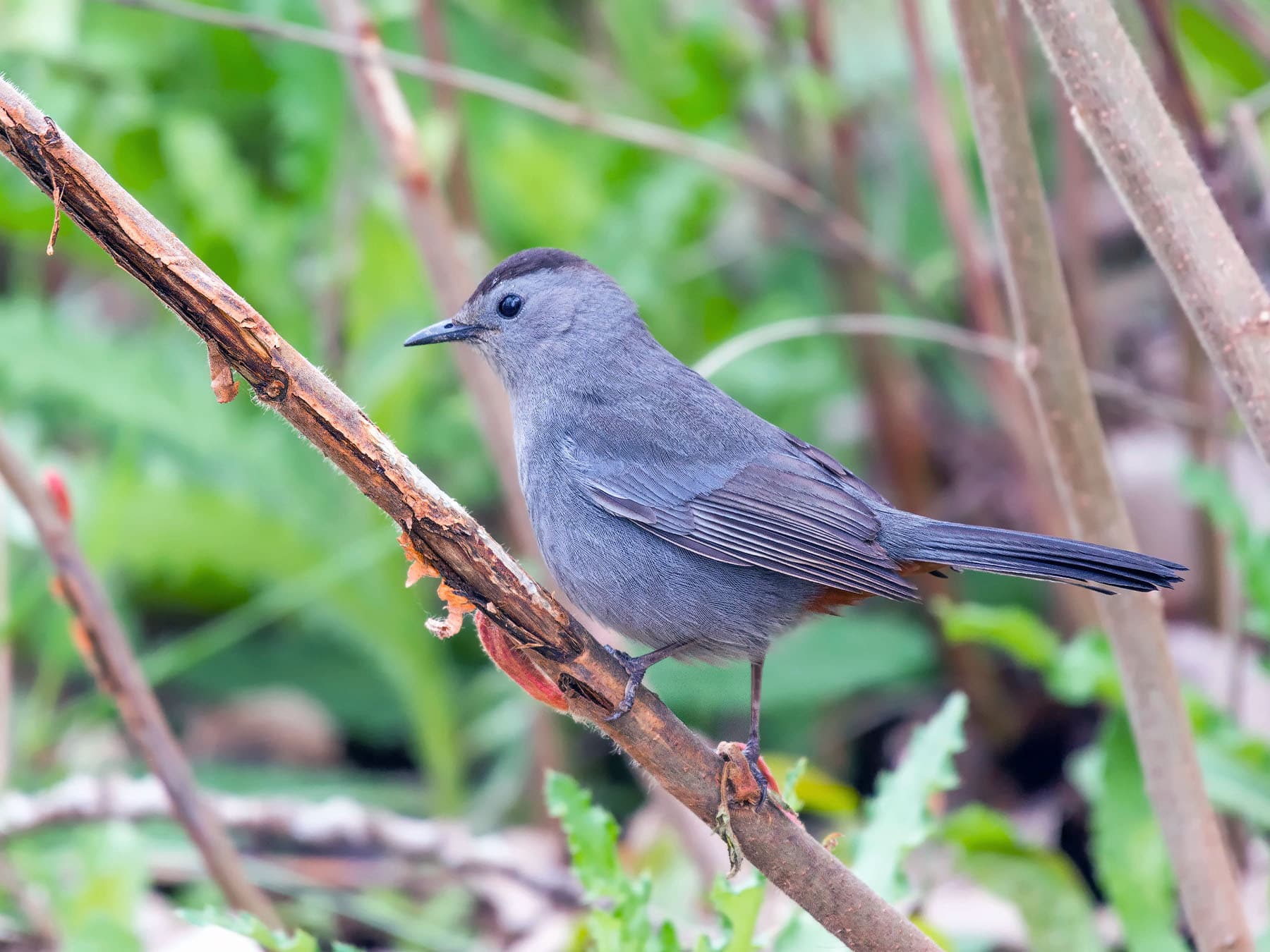
More photos
6 photos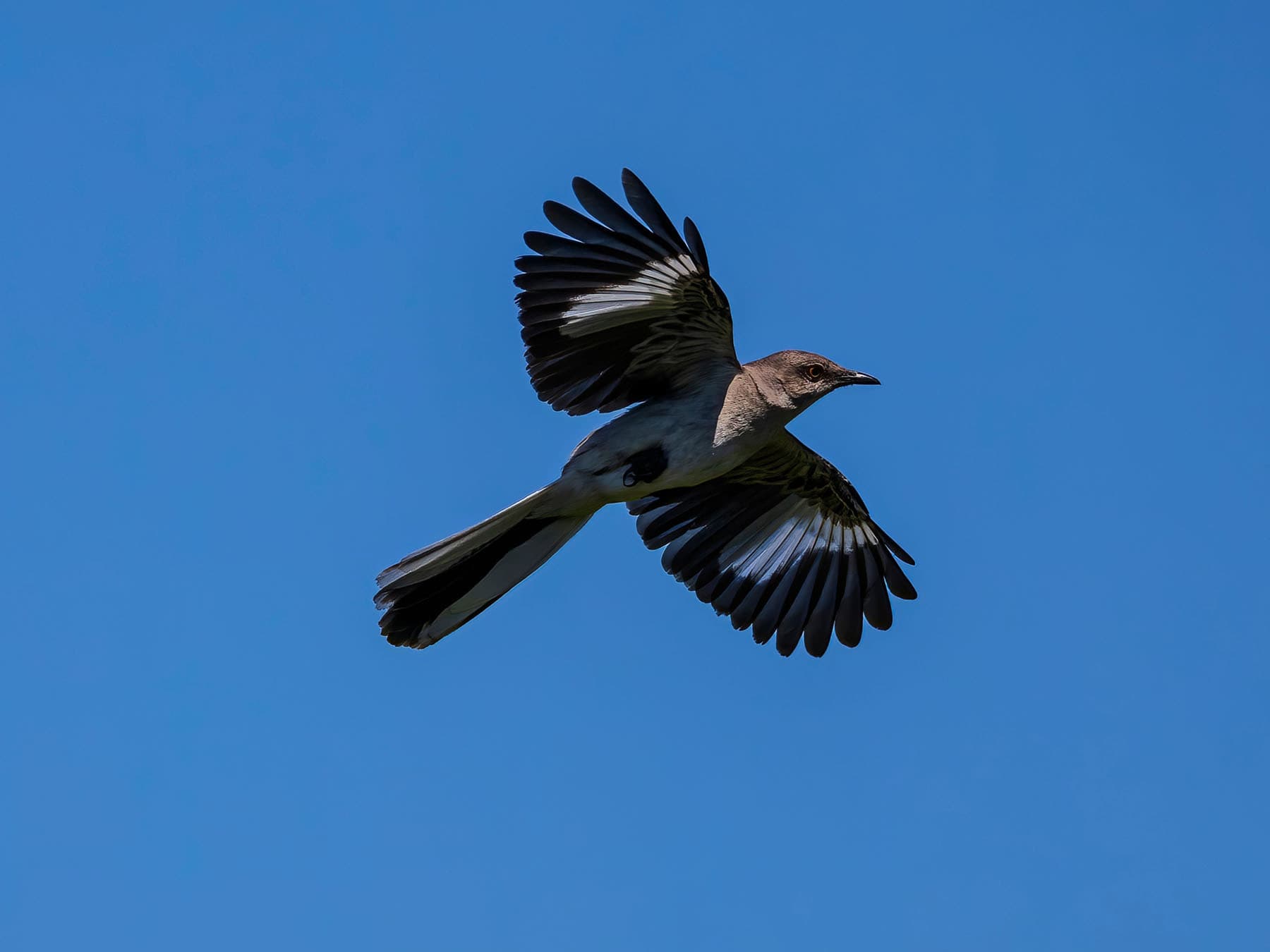 A Northern Mockingbird in flight, its white wing patches open
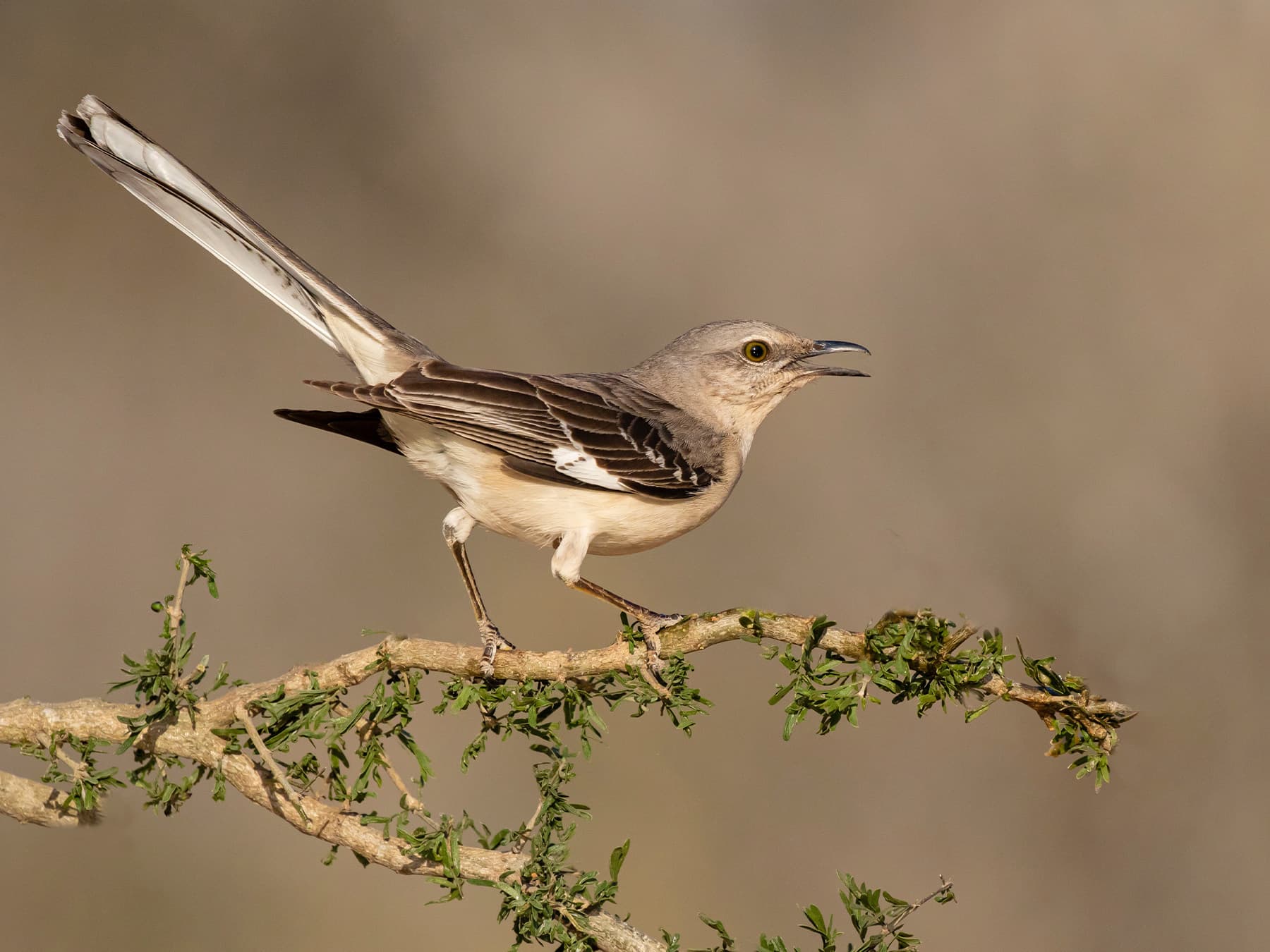 A Northern Mockingbird singing, tail raised
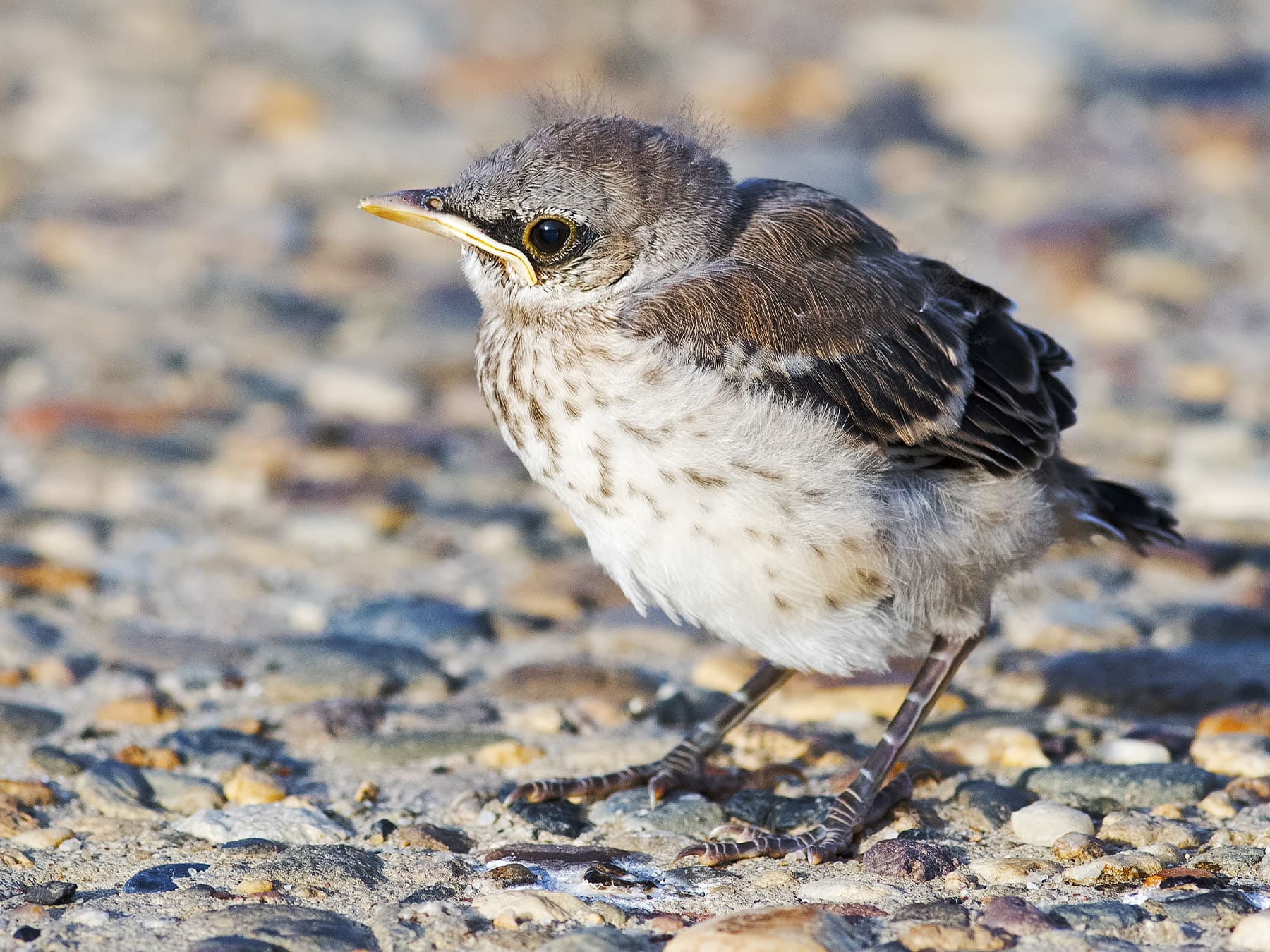 A young Northern Mockingbird out of the nest, with a spotted breast and a stubby tail
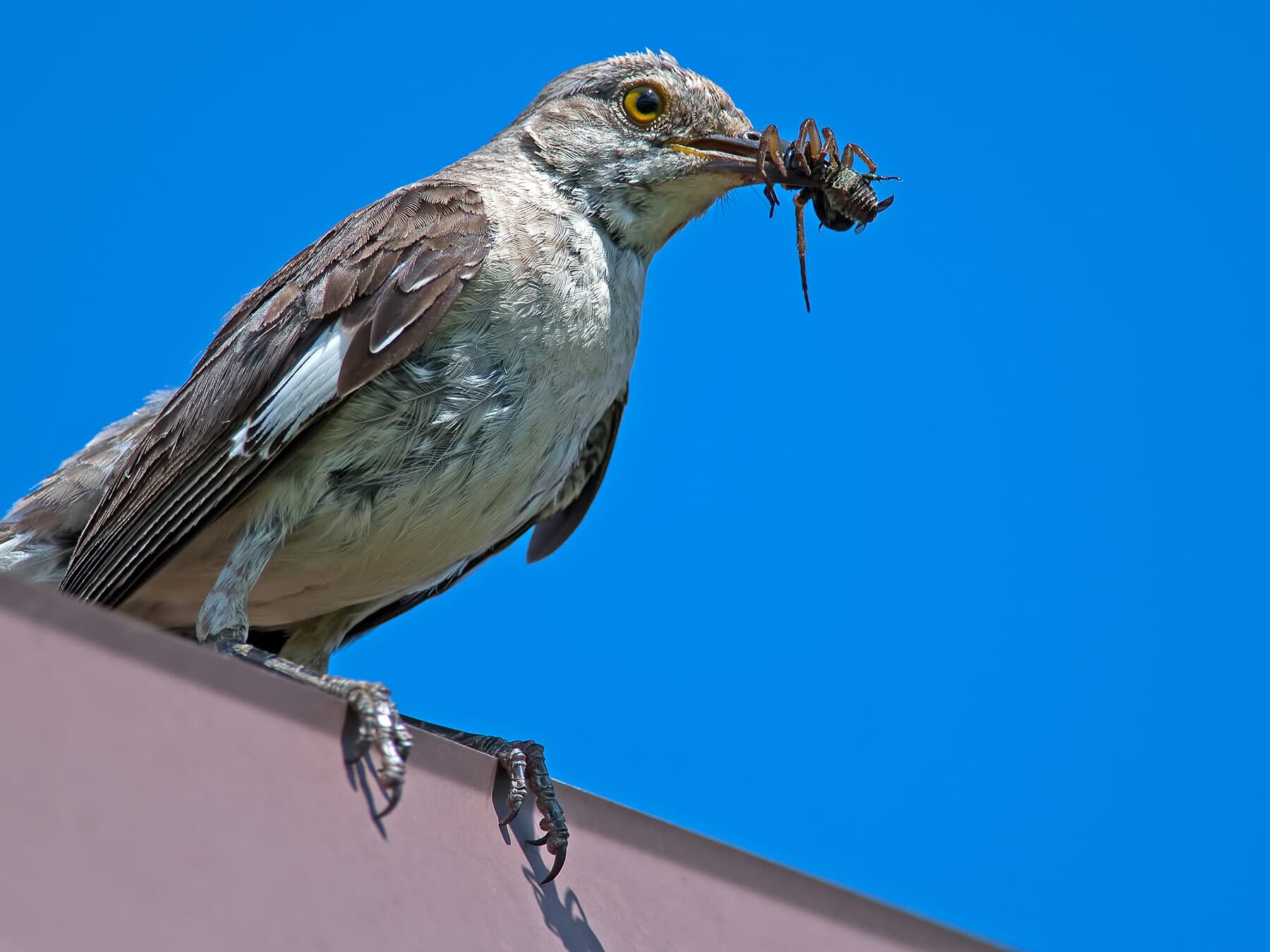 A Northern Mockingbird with prey in its bill
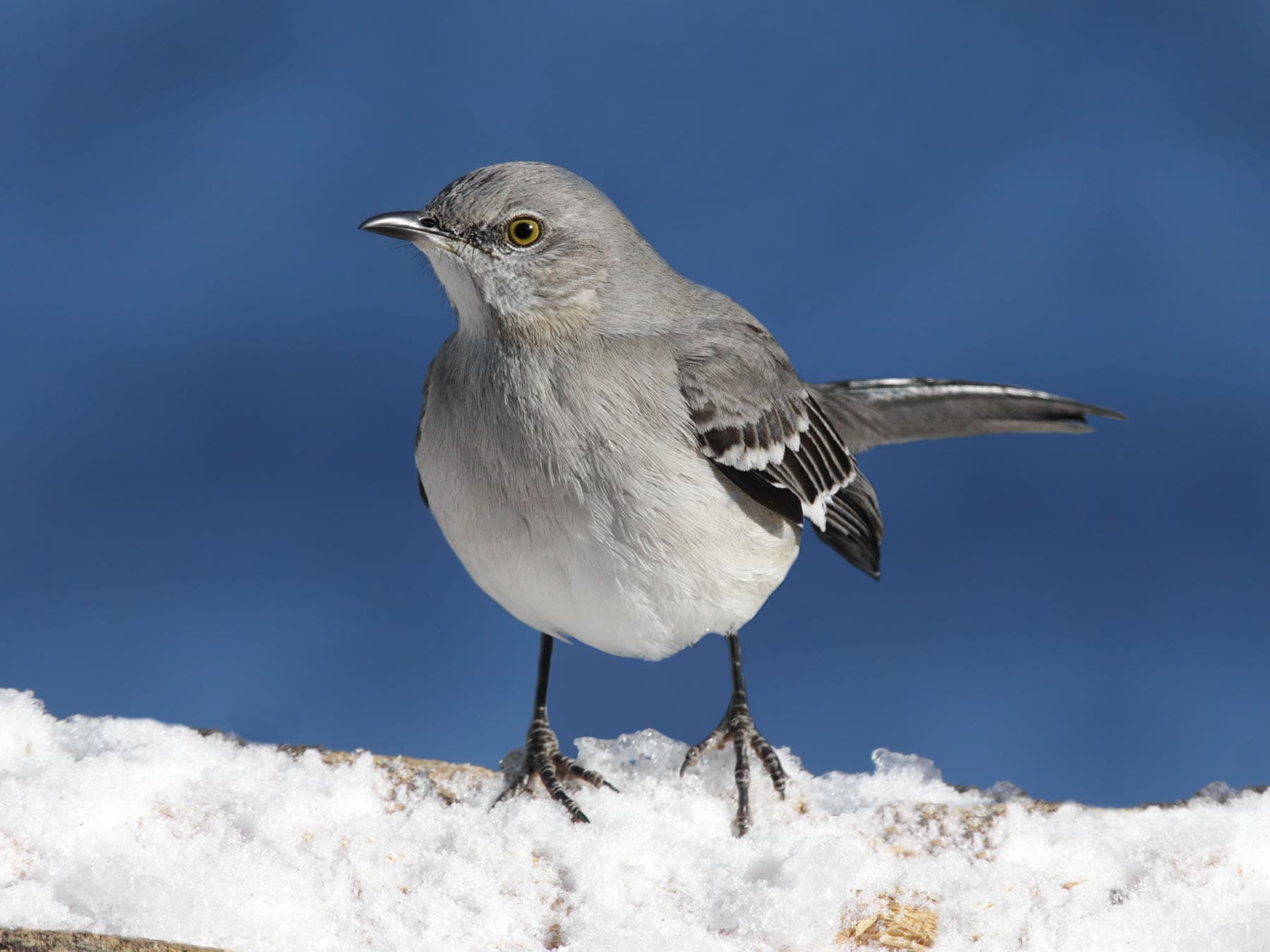 A Northern Mockingbird on a snowy ledge
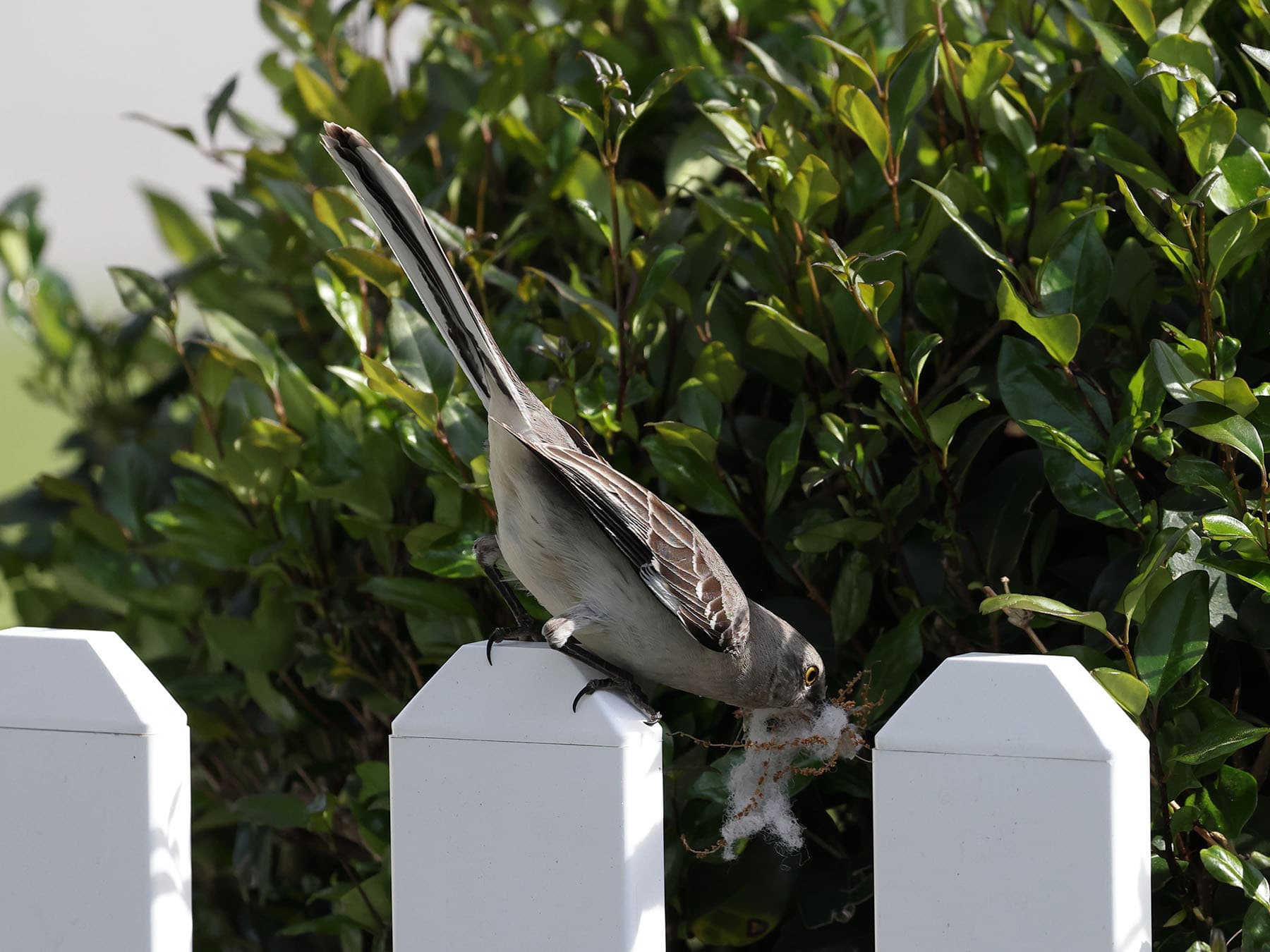 A Northern Mockingbird on a fence post with nest material
Northern Mockingbird guides
4 guidesQuick facts
- Length
- 21–26 cm
- Wingspan
- 31–35 cm
- Weight
- 45–58 g
- Lifespan
- oldest recorded 14 years 10 months
- Family
- Mockingbirds & Thrashers
- Migration
- Resident
- Global status (IUCN)
- Least Concern
- World population
- About 43 million breeding birds (Partners in Flight)
- Population trend
- Breeding Bird Survey counts show a long-term decline of about 1% a year since 1966, with significant declines in many states including Florida and Texas (USGS BBS 1966-2025)
- Also called
- Mockingbird
- Scientific name
- Mimus polyglottos
Questions
4What is the mockingbird the state bird of?
Do mockingbirds mate for life?
Sometimes. They are usually monogamous for a breeding season, and some pairs stay together for years: banded pairs have lasted at least 8 years in south Florida. More: male vs female mockingbirds.
Are mockingbirds nocturnal?
No. They are active by day, but unmated males often sing at night in spring and summer, and in brightly lit towns some feed late into the evening.
Why is it called a mockingbird?
For its mimicry. In 1731 Mark Catesby wrote that "we call it ... the mock-bird" for its imitations of other birds. The scientific name says the same thing: Mimus means "mimic", and polyglottos comes from the Greek for "many" and "tongue".27
Sources
32- 1Cornell Lab of Ornithology. Northern Mockingbird. All About Birds. Accessed 12 October 2026. Source (opens in a new tab)
- 2Farnsworth, G. et al. (2020). Northern Mockingbird (Mimus polyglottos), version 1.0. Birds of the World (A. F. Poole, editor). Cornell Lab of Ornithology. doi:10.2173/bow.normoc.01 (opens in a new tab)
- 3National Audubon Society. Gray Catbird. Guide to North American Birds. Accessed 12 October 2026. Source (opens in a new tab)
- 4National Audubon Society. Loggerhead Shrike. Guide to North American Birds. Accessed 12 October 2026. Source (opens in a new tab)
- 5National Audubon Society. Northern Shrike. Guide to North American Birds. Accessed 12 October 2026. Source (opens in a new tab)
- 6National Audubon Society. Townsend's Solitaire. Guide to North American Birds. Accessed 12 October 2026. Source (opens in a new tab)
- 7National Audubon Society. Sage Thrasher. Guide to North American Birds. Accessed 12 October 2026. Source (opens in a new tab)
- 8Gammon, D. E. (2014). Seasonal patterns of vocal mimicry in northern mockingbirds Mimus polyglottos. Journal of Avian Biology 45(6): 545-550. doi:10.1111/jav.00414 (opens in a new tab)
- 9USGS Eastern Ecological Science Center (2026). North American Breeding Bird Survey: trend estimates 1966-2025. USGS. Accessed 12 October 2026. Source (opens in a new tab)
- 10British Trust for Ornithology. Northern Mockingbird. BTO BirdFacts. Accessed 12 October 2026. Source (opens in a new tab)
- 11Naylor, K. A.. Northern Mockingbird. Historical Rare Birds. Accessed 12 October 2026. Source (opens in a new tab)
- 12Project FeederWatch (Cornell Lab of Ornithology and Birds Canada). Common Feeder Birds: Northern Mockingbird. Project FeederWatch. Accessed 12 October 2026. Source (opens in a new tab)
- 13National Audubon Society. Northern Mockingbird. Guide to North American Birds (text adapted from Kaufman 1996). Accessed 12 October 2026. Source (opens in a new tab)
- 14Hayslette, S. E. (2003). A test of the foraging function of wing-flashing in Northern Mockingbirds. Southeastern Naturalist 2(1): 93-98. doi:10.1656/1528-7092(2003)002[0093:ATOTFF]2.0.CO;2 (opens in a new tab)
- 15Peltier, S. K., Wilson, C. M. and Godard, R. D. (2019). Wing-flashing by Northern Mockingbirds while foraging and in response to a predator model. Northeastern Naturalist 26(2): 251. doi:10.1656/045.026.0202 (opens in a new tab)
- 16Levey, D. J. et al. (2009). Urban mockingbirds quickly learn to identify individual humans. Proceedings of the National Academy of Sciences 106(22): 8959-8962. doi:10.1073/pnas.0811422106 (opens in a new tab)
- 17USGS Bird Banding Laboratory. Longevity records of North American birds. USGS Patuxent Wildlife Research Center, Bird Banding Laboratory. Accessed 12 October 2026. Source (opens in a new tab)
- 18Partners in Flight (2024). Avian Conservation Assessment Database and Population Estimates Database. Bird Conservancy of the Rockies. Accessed 12 October 2026. Source (opens in a new tab)
- 19BirdLife International. Northern Mockingbird Mimus polyglottos: species factsheet (IUCN Red List assessment 2025). BirdLife DataZone. Accessed 12 October 2026. Source (opens in a new tab)
- 20U.S. Fish and Wildlife Service (2023). 50 CFR 10.13: List of Birds Protected by the Migratory Bird Treaty Act. Electronic Code of Federal Regulations. Accessed 12 October 2026. Source (opens in a new tab)
- 21Environment and Climate Change Canada. List of Birds Protected in Canada Under the Migratory Birds Convention Act, 1994. Government of Canada (2024). Accessed 12 October 2026. Source (opens in a new tab)
- 22Texas State Library and Archives Commission. Texas State Symbols. Texas State Library and Archives Commission. Accessed 12 October 2026. Source (opens in a new tab)
- 23Florida Department of State. State Bird. Florida Facts: Florida State Symbols. Accessed 12 October 2026. Source (opens in a new tab)
- 24Spurgeon, J.. Official State Bird. CALS Encyclopedia of Arkansas (Central Arkansas Library System). Accessed 12 October 2026. Source (opens in a new tab)
- 25Mississippi Secretary of State. Mississippi Official and Statistical Register (Blue Book) 2024-2028: General Information. Mississippi Secretary of State. Accessed 12 October 2026. Source (opens in a new tab)
- 26Tennessee Secretary of State. Tennessee State Symbols. Tennessee Secretary of State. Accessed 12 October 2026. Source (opens in a new tab)
- 27Jobling, J. A.. The Key to Scientific Names: Mimus; polyglottos. Birds of the World, Cornell Lab of Ornithology. Accessed 12 October 2026. Source (opens in a new tab)
- 28Derrickson, K. C. (1987). Yearly and situational changes in the estimate of repertoire size in Northern Mockingbirds (Mimus polyglottos). The Auk 104(2): 198-207. doi:10.1093/auk/104.2.198 (opens in a new tab)
- 29Derrickson, K. C. (1988). Variation in repertoire presentation in Northern Mockingbirds. The Condor 90(3): 592. doi:10.2307/1368348 (opens in a new tab)
- 30British Ornithologists' Union (2026). The British List (10th edition, 58th update; AviList v2025). BOU. Accessed 12 October 2026. Source (opens in a new tab)
- 31Means, L. L. and Goertz, J. W. (1983). Nesting activities of Northern Mockingbirds in northern Louisiana. The Southwestern Naturalist 28(1): 61. doi:10.2307/3670593 (opens in a new tab)
- 32Tennessee Wildlife Resources Agency. Northern Mockingbird. Tennessee Wildlife Resources Agency. Accessed 12 October 2026. Source (opens in a new tab)

Checked by
Nathan Cope, founder and editor
Nathan founded Birdfact and leads its writers and contributors in the UK, the US and Canada. He has watched and studied birds for more than ten years, and checks every article and species guide before it’s published.