Facts · Updated 12 Oct 2026
Female Mockingbirds: Male vs Female Northern Mockingbird
By the Birdfact teamChecked by Nathan Cope
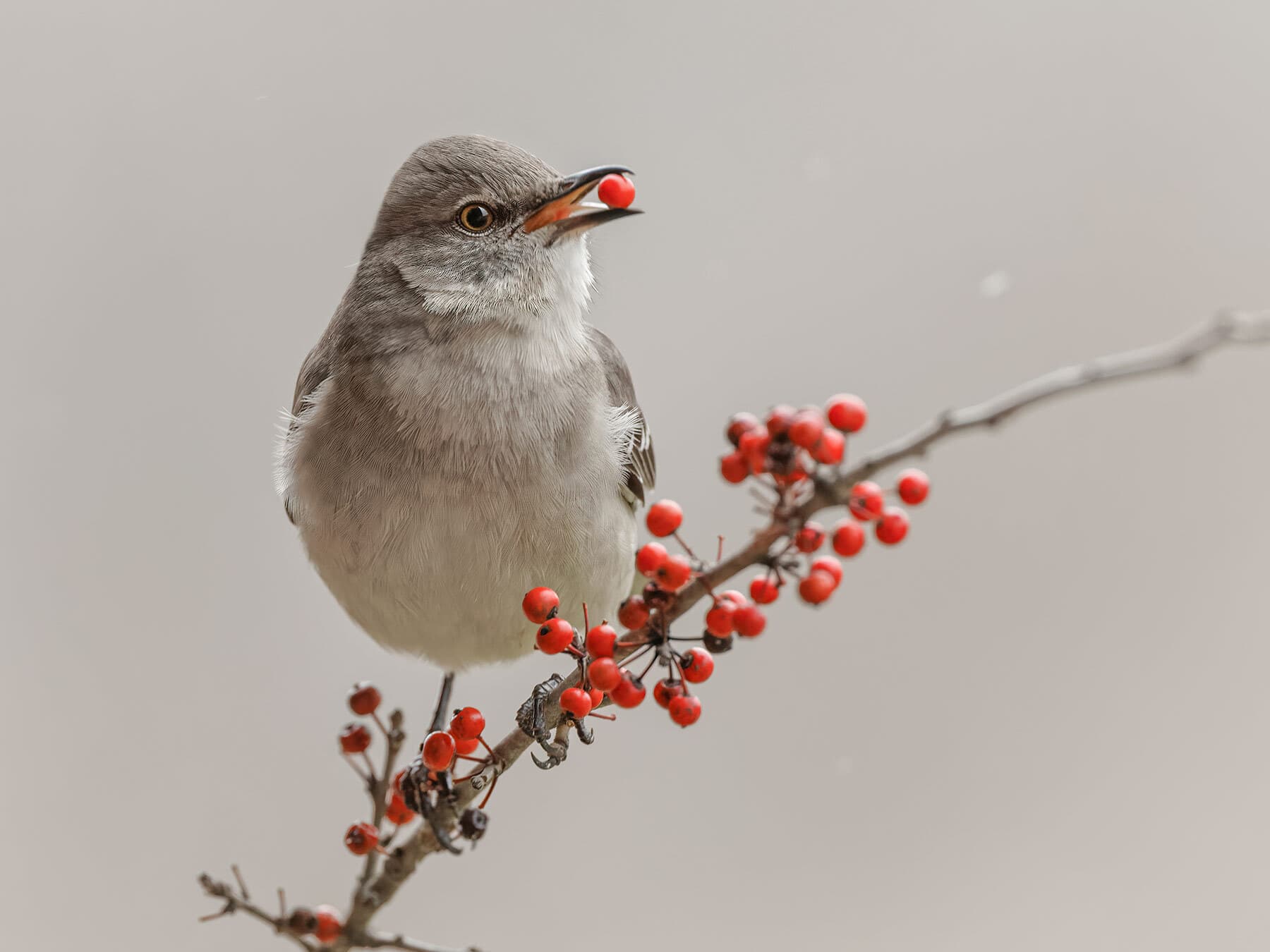
Male and female Northern Mockingbirds look the same. Males average slightly bigger and females a touch less white in the wings and tail, but neither is reliable. Behavior is the clue: the bird singing loudly from a high perch in spring is almost always the male, and only the female incubates the eggs.
On this page12 sections
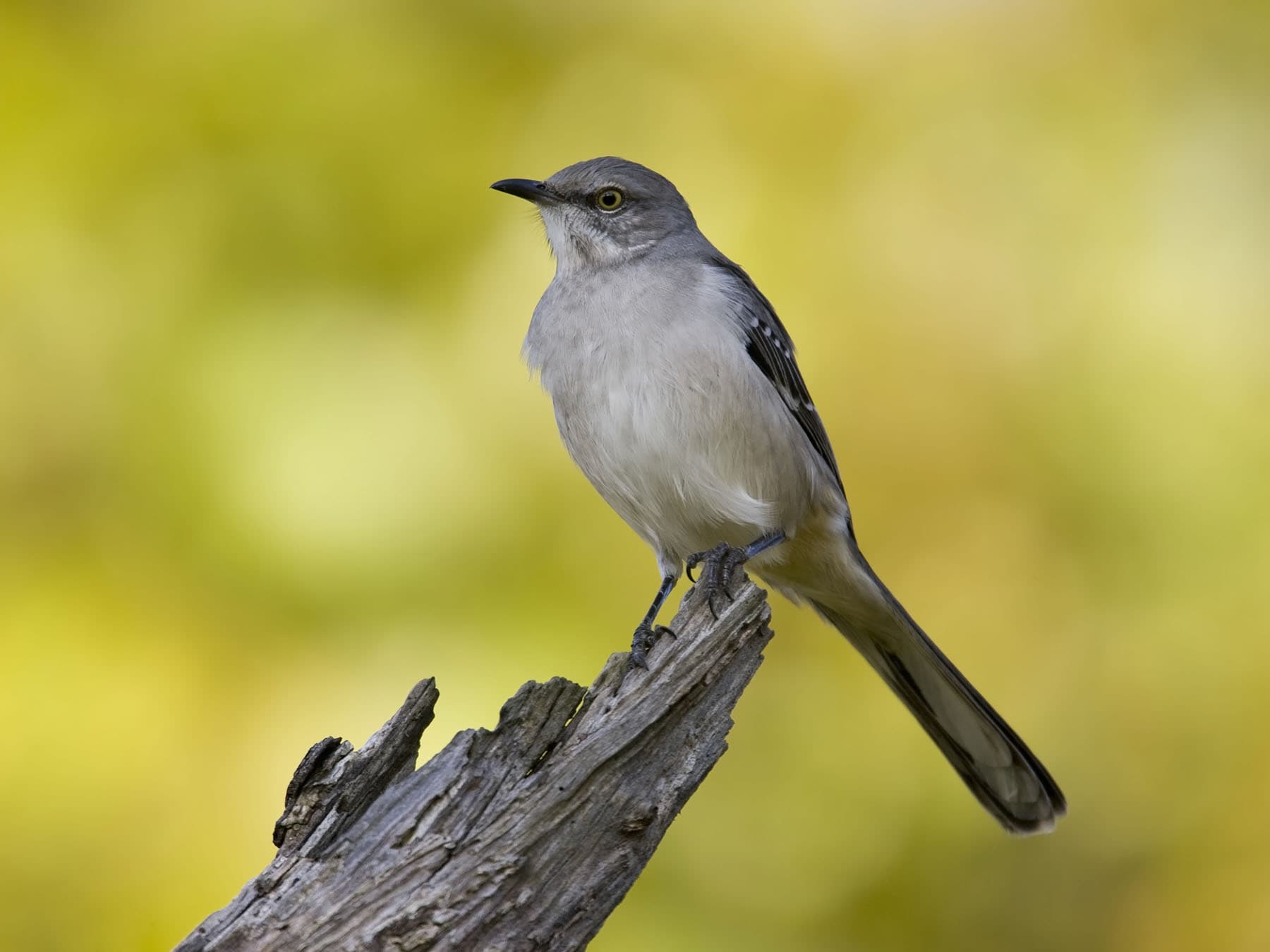
This page is about the Northern Mockingbird, the gray, long-tailed mockingbird of North American yards and towns. Males and females look the same, so telling them apart comes down to small average differences in size and, above all, to behavior. For the bird as a whole, see our Northern Mockingbird guide; for nests, eggs and young, see mockingbird nesting.
Can you tell male and female mockingbirds apart?
Not by their feathers. Males and females have the same-looking plumage at every age, and Birds of the World says the sexes cannot be safely separated by size or plumage.1 What gives a bird away is what it is doing, mostly in spring and summer. A mockingbird singing loudly from a treetop or a utility pole, or leaping into the air in a song flight, is almost certainly a male, because females rarely sing in summer and the flight display is the male's. A bird sitting on eggs is almost always the female.
What a female mockingbird looks like
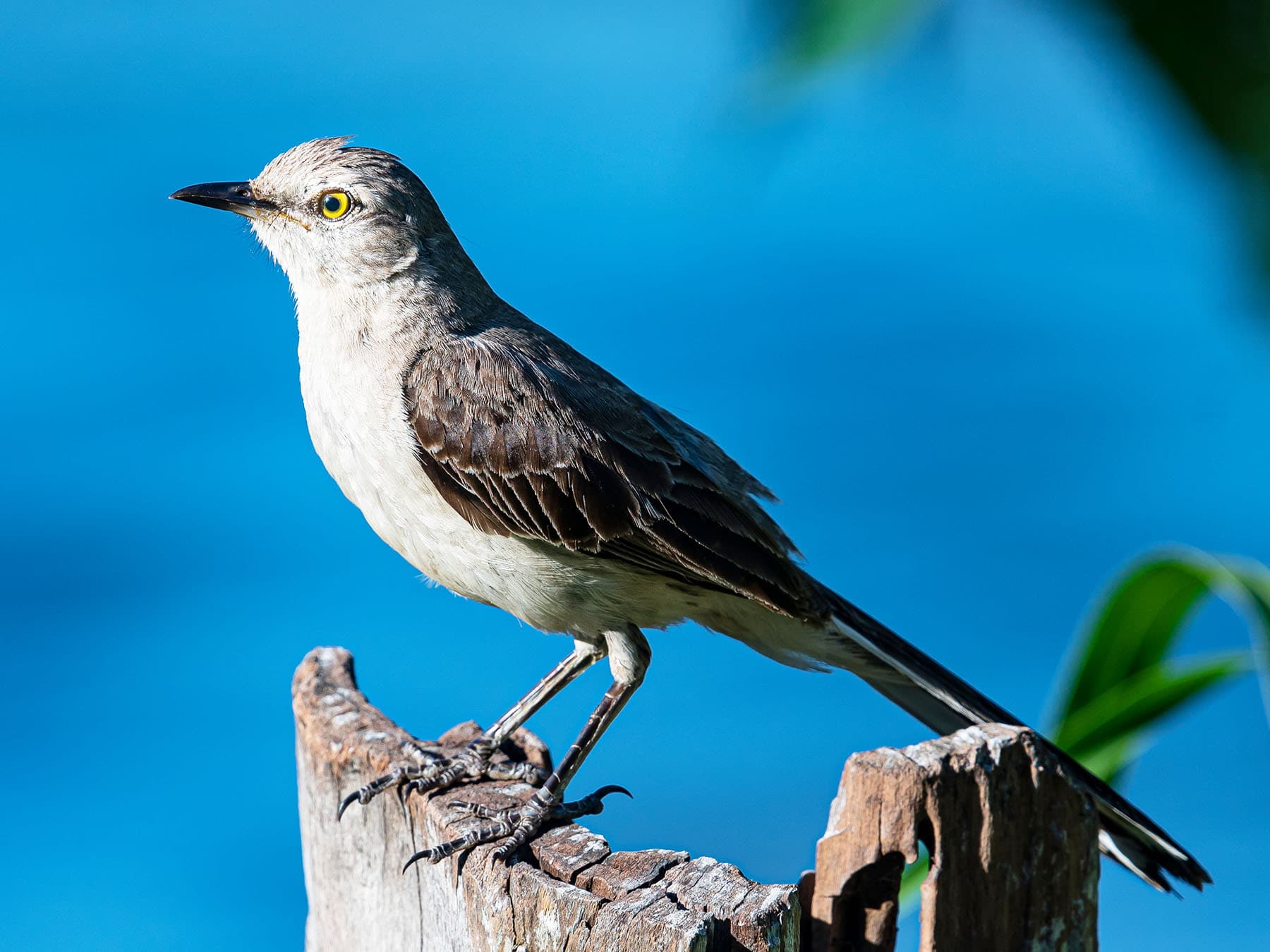
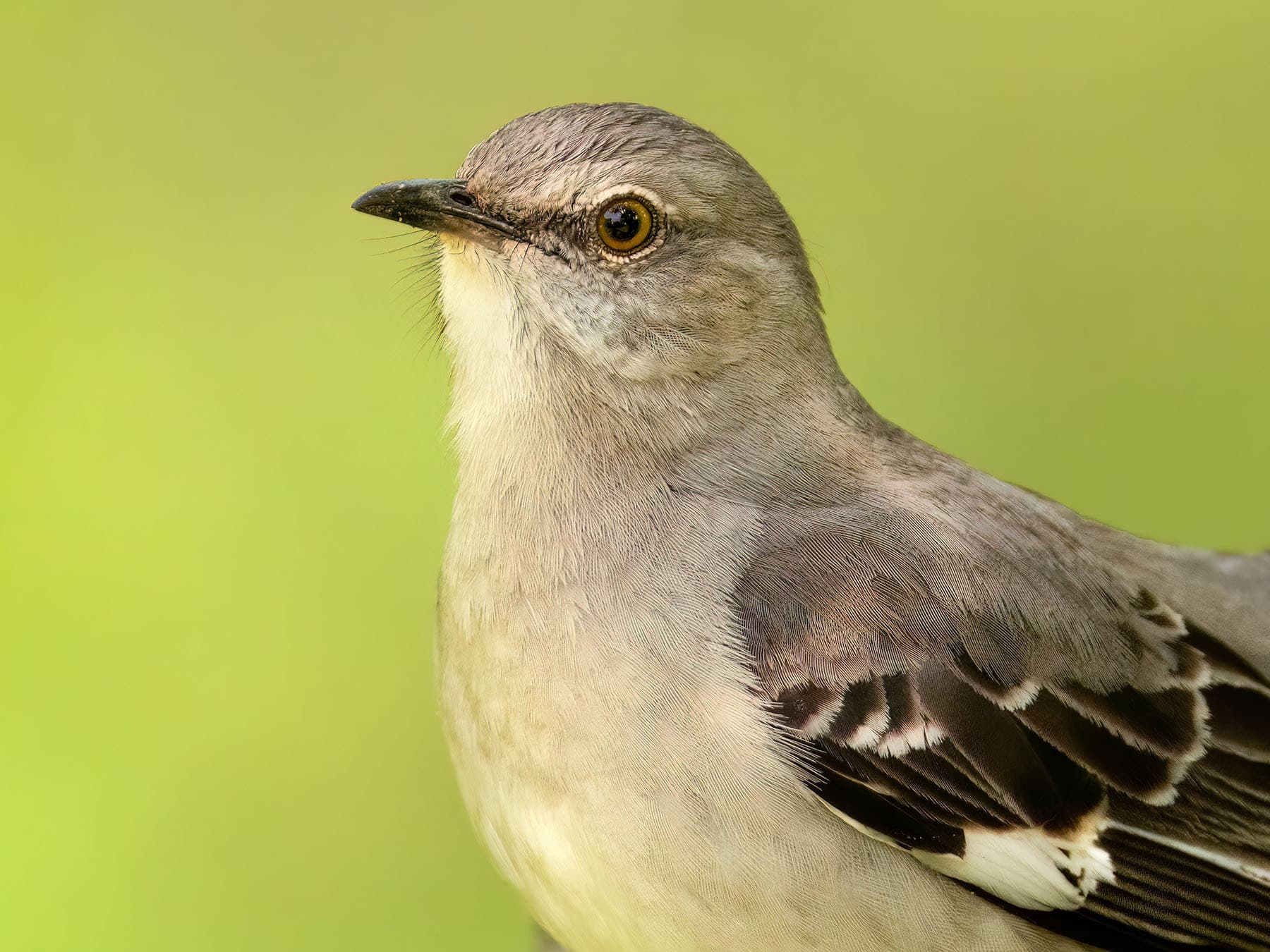
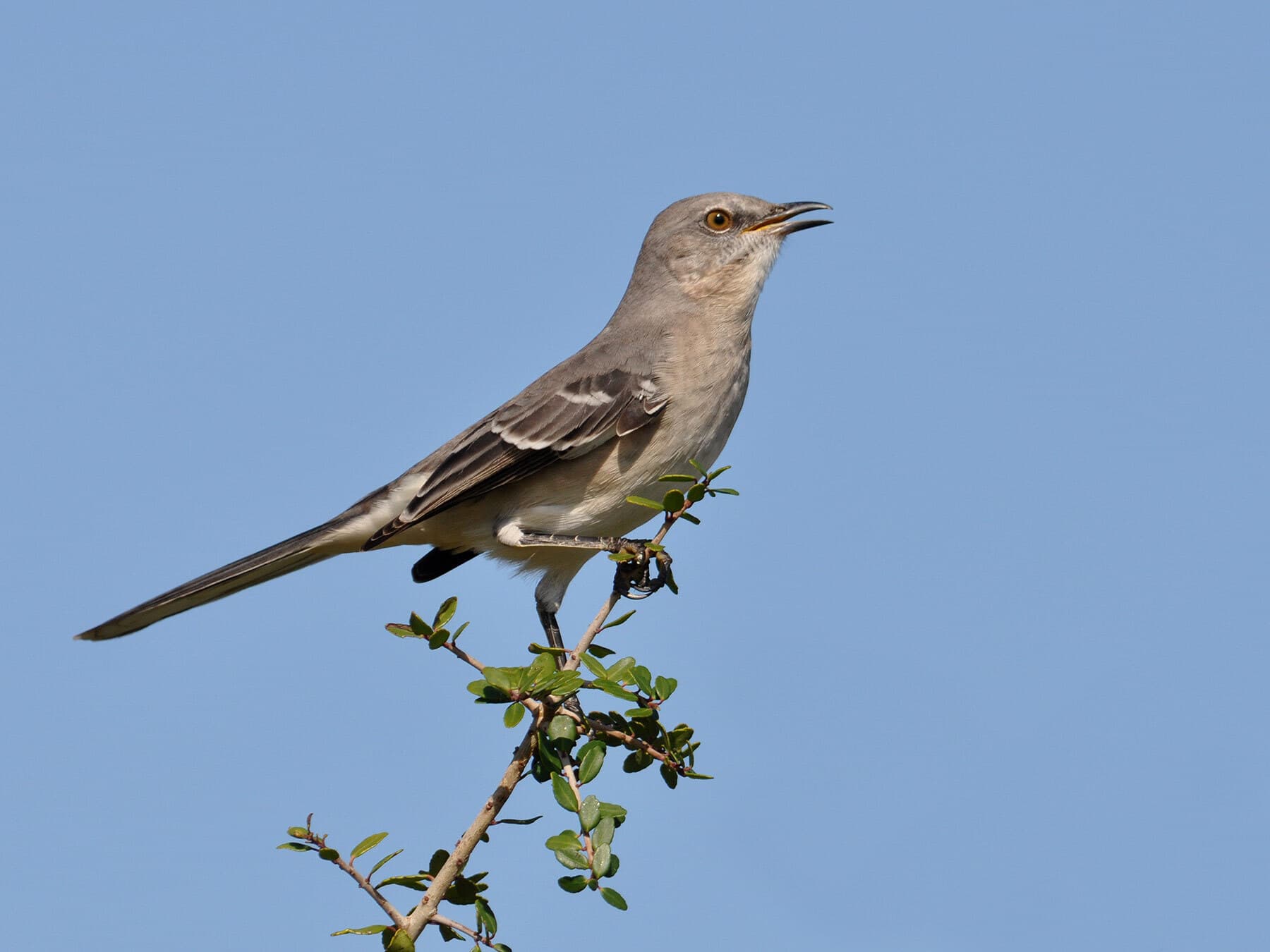
Just like a male. She is gray to gray-brown above and white to pale gray below, with a faint buff wash on the sides, a thin dark line through a yellow eye, a black bill and long dark legs. The folded wing is blackish, with two narrow white wing bars and a white patch at the base of the long flight feathers, which opens into a big white flash in flight. The long dark tail has white outer feathers that show as she flies or fans it.1, 2
Size
Males are bigger on average in every measurement, but only a little, and the ranges overlap. Ridgway's measurements, quoted in Birds of the World, give males 8.7 to 10.0 inches (220-255 mm) long and females 8.2 to 9.3 inches (208-235 mm). Weights and wing lengths from two large samples show the same small gap:
| Where measured | Male weight | Female weight | Male wing length | Female wing length |
|---|---|---|---|---|
| South Florida | 50.5 g (1.8 oz), 83 birds | 46.4 g (1.6 oz), 44 birds | 111.5 mm (4.4 in) | 103.7 mm (4.1 in) |
| North Carolina | 51.5 g (1.8 oz), 43 birds | 47.2 g (1.7 oz), 27 birds | 110.1 mm (4.3 in) | 103.2 mm (4.1 in) |
Averages from Birds of the World, Appendix 1 (unpublished data of R. Breitwisch and P. Merritt, and C. Logan). On a single bird in the field a difference of a few grams and a few millimeters of wing cannot be seen.
White in the wings and tail
Birds of the World notes one plumage difference on average: an adult female tends to have a little less white at the base of the primaries and on the outer tail feathers, so her wing patches and tail show slightly less contrast. It adds that the tail difference is of limited use, because the amount of white varies so much from bird to bird. Young birds also average less white than adults of the same sex.
Do female mockingbirds sing?
Yes, though less than males and more quietly. In spring and summer a female rarely sings, and usually only when her mate is away from the territory. Females sing more in fall, from about mid-September into November, when mockingbirds set up territories for the winter, but at a lower volume than males, and nobody has measured what share of females sing.1 Singing may be commoner among northern females, more of which hold a winter territory of their own.
Female song is better known than it was. Birds of the World's account, written in 2011, says females had not been heard singing while incubating; a 2022 study recorded females singing on the nest, and found that they mimic other birds too, though less often and with less variety than males.3
Night singing is a male habit. It comes mostly from unmated males in spring and summer, more often around the full moon, and there is no night song at all in fall. Hear the song and calls: Mockingbird sounds.
Roles at the nest
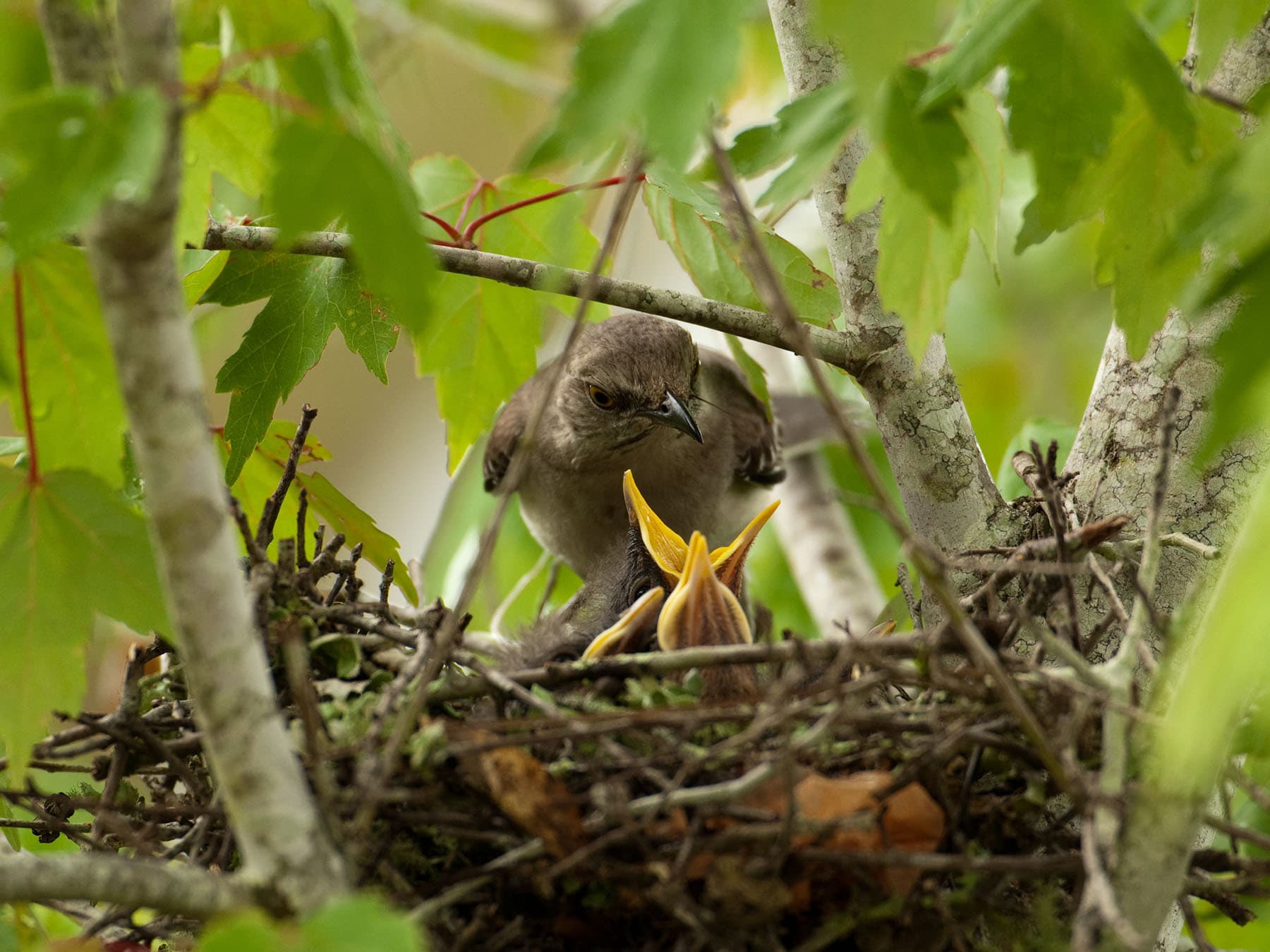
The male probably chooses the nest site, and he may start up to three nests before the female settles on one for the first brood. Most of the twig base is his work, sometimes singing quietly from the nest after adding a twig, while the female adds few twigs but most of the soft lining.1, 2
Incubation is the female's job, for about 12 to 13 days (Birds of the World records males sitting on eggs only very rarely), and the male rarely brings her food. She also does nearly all the brooding of the small chicks, 97% of brooding bouts in one study. In the first week or so after hatching, the male may give a quiet, high call from a nearby shrub or tree before flying in to the nest.
Both parents feed the nestlings at similar rates4: in south Florida the female brought 52% of the food, and in north Florida females made about 58% of the feeding trips. After the young leave the nest, both feed them for a day or more; then the male pauses for a few days to start the next nest before taking over the feeding while the female finishes it, lays and incubates. For up to three weeks after the young leave, the male may be feeding them on his own.1 More: nests, eggs and young.
Display, territory and defense
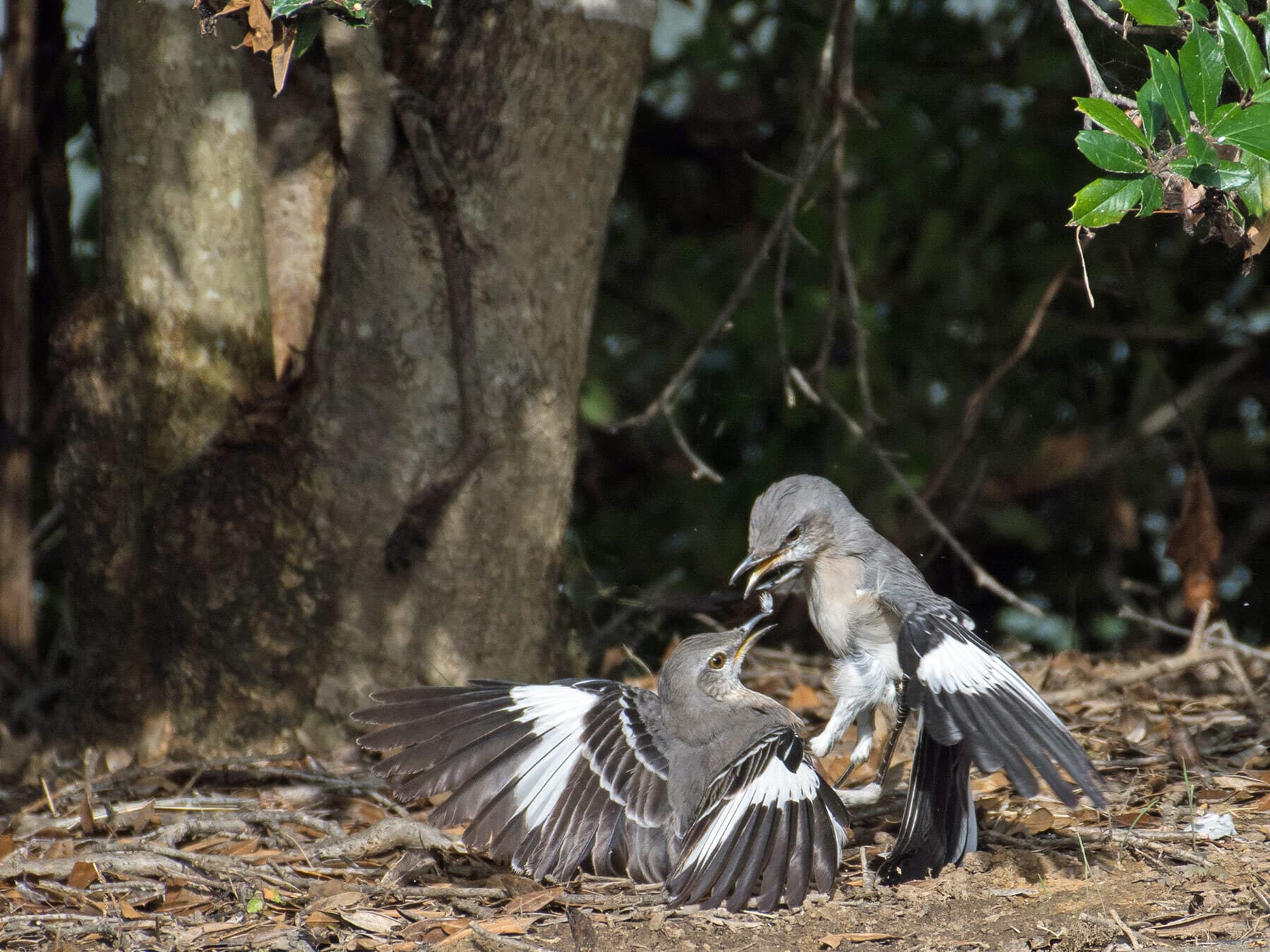
Two behaviors belong mostly to males. In the flight display, a singing male jumps up from a high perch, flaps up 3 to 7 feet (1-2 m) with his white wing patches showing, and parachutes back down, singing all the while; unmated males do it about ten times as often as mated ones. In the "boundary dance", two neighbors face each other on the ground at their shared border and hop from side to side until one gives way. That is almost always two males, although females have been seen dancing in North Carolina and Florida.
A pair defends its territory together, each bird driving off intruders of its own sex. Both parents attack predators near the nest, with the male taking the bigger part; in a south Florida study the strength of the male's attacks, but not the female's, went with nesting success.1 Females are sharp judges of people too: a 2023 study found that nesting females learn to tell familiar people apart, flushing from the nest sooner for those who had posed a greater threat.5
Winter territories
In the South, pairs often stay together over winter and defend one territory between them. Farther north, many mockingbirds hold a separate fall and winter territory, and a female may defend one on her own, sometimes next door to her mate of the summer. Females holding their own winter territory become more common northward along the East Coast, and are the usual situation in Pennsylvania.1
Do mockingbirds mate for life?
Sometimes. Northern Mockingbirds are monogamous, usually for a breeding season and occasionally for life: banded pairs have stayed together for at least 8 years in south Florida and at least 6 years in Pennsylvania and north Florida. Most pairs that nest successfully stay together through the season, often over winter as well, and a split after a failed nest becomes less likely the longer a pair has been together.1
Not every pairing lasts. Some banded females have left one male for a neighbor while both males kept their territories, and in north Florida several changed mates after two failed nests in a row. Fewer than 5% of territorial males have two mates at once, and unpublished genetic work from north Florida, reported in Birds of the World, suggests that many broods there have more than one father.1
Young mockingbirds
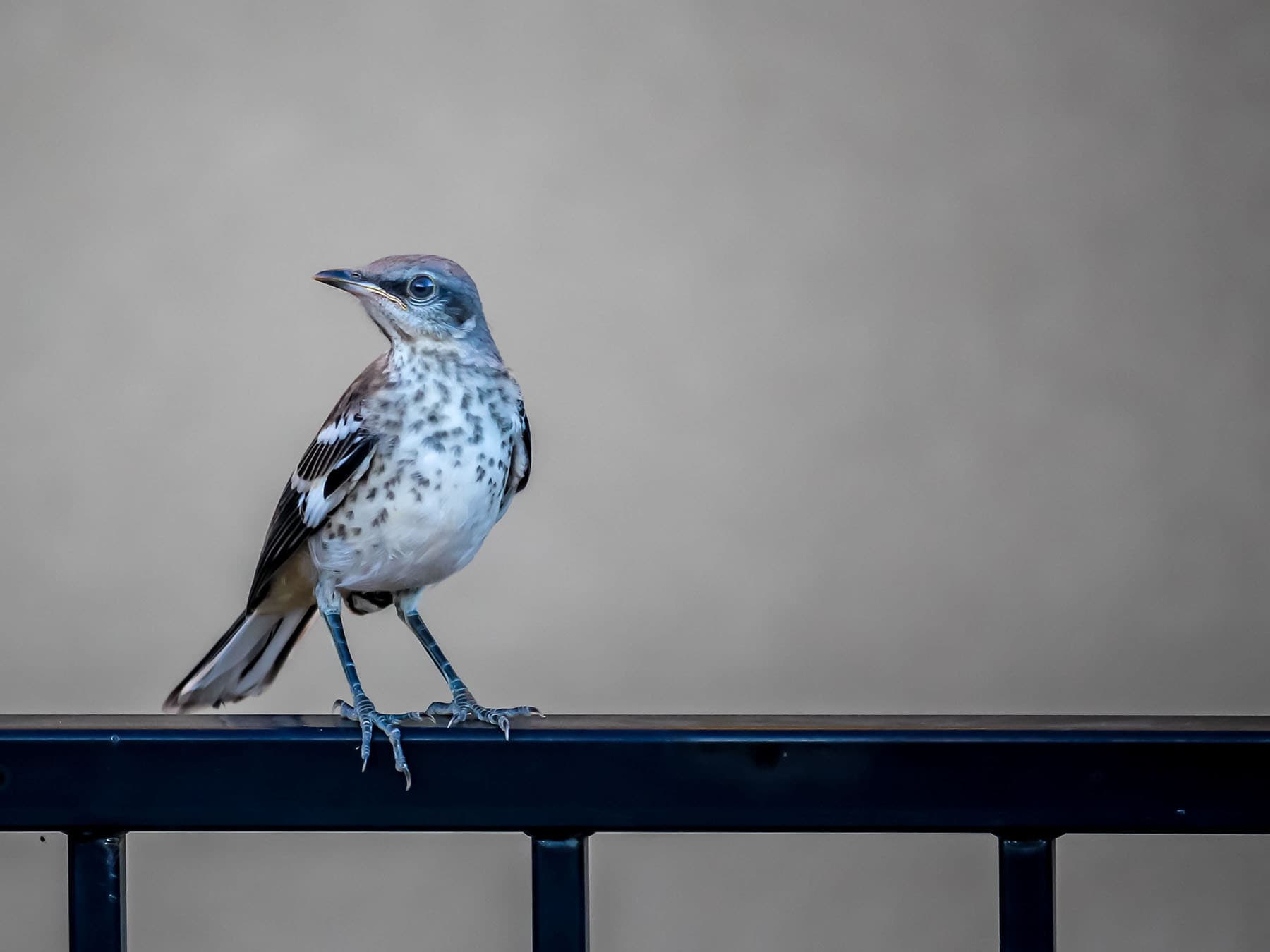
Juveniles look the same whichever their sex: like adults, but with brownish to blackish spots and streaks on the breast and a gray or gray-green eye instead of a yellow one. Most look like adults by their first fall. Nestlings cannot be sexed by plumage either. Genetic tests have found more males than females in early-season nests in Cincinnati, Ohio, but more females in Raleigh, North Carolina, and male nestlings were heavier at about 10 days old.1
Sexing a bird in the hand
Bird banders face the same problem. Wing length and weight overlap, but in the breeding season one feature settles it: only females develop a brood patch, an area of bare, featherless skin on the belly used to warm the eggs.
Sources
- Farnsworth, G., Londono, G. A., Martin, J. U., Derrickson, K. C., Breitwisch, R. (2020). Northern Mockingbird (Mimus polyglottos), version 1.0. Birds of the World (A. F. Poole, editor). Cornell Lab of Ornithology. doi:10.2173/bow.normoc.01
- Cornell Lab of Ornithology. Northern Mockingbird. All About Birds. Accessed October 12, 2026. Source
- Gammon, D. E., Stracey, C. M. (2022). First documentation of vocal mimicry in female northern mockingbirds. Journal of Ornithology 163(3): 749-756. doi:10.1007/s10336-022-01980-7
- Breitwisch, R., Merritt, P. G., Whitesides, G. H. (1986). Parental investment by the Northern Mockingbird: male and female roles in feeding nestlings. The Auk 103(1): 152-159. doi:10.1093/auk/103.1.152
- Levey, D. J., Poulsen, J. R., Schaeffer, A. P., Deochand, M. E., Oswald, J. A., Robinson, S. K., Londoño, G. A. (2023). Wild mockingbirds distinguish among familiar humans. Scientific Reports 13: 10259. doi:10.1038/s41598-023-36225-x
- National Audubon Society. Northern Mockingbird. Guide to North American Birds (text adapted from Kaufman 1996). Accessed October 12, 2026. Source