Facts · Updated 12 Oct 2026
Mockingbird Nesting: Nests, Eggs and Baby Mockingbirds
By the Birdfact teamChecked by Nathan Cope
Northern Mockingbirds build an open twig cup, usually 3 to 10 feet up, in a shrub or tree, lay 2 to 6 spotted blue-green eggs, and the female incubates them for 12 to 13 days. The young leave the nest at about 12 days old, and the male feeds them for up to three weeks while the female nests again: two or three broods a season are common.
On this page14 sections
- When do mockingbirds nest?
- Nest sites
- The nest
- Mockingbird eggs
- Incubation and hatching
- Baby mockingbirds in the nest
- How long do baby mockingbirds stay in the nest?
- Fledglings on the ground
- Care after leaving the nest
- Broods and nesting attempts
- Nest defense
- Predators, parasites and cowbirds
- Helping nesting mockingbirds
- Sources
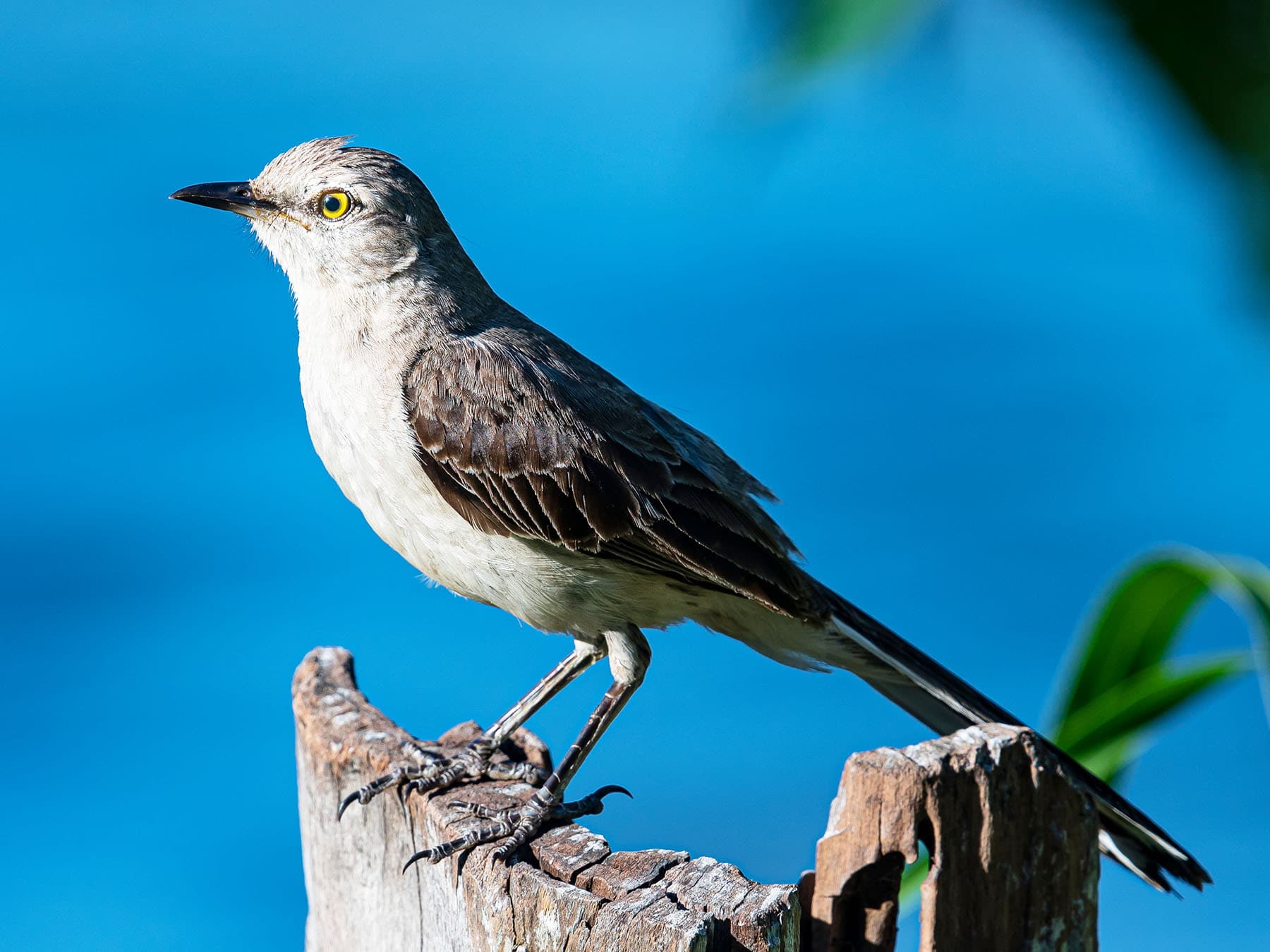
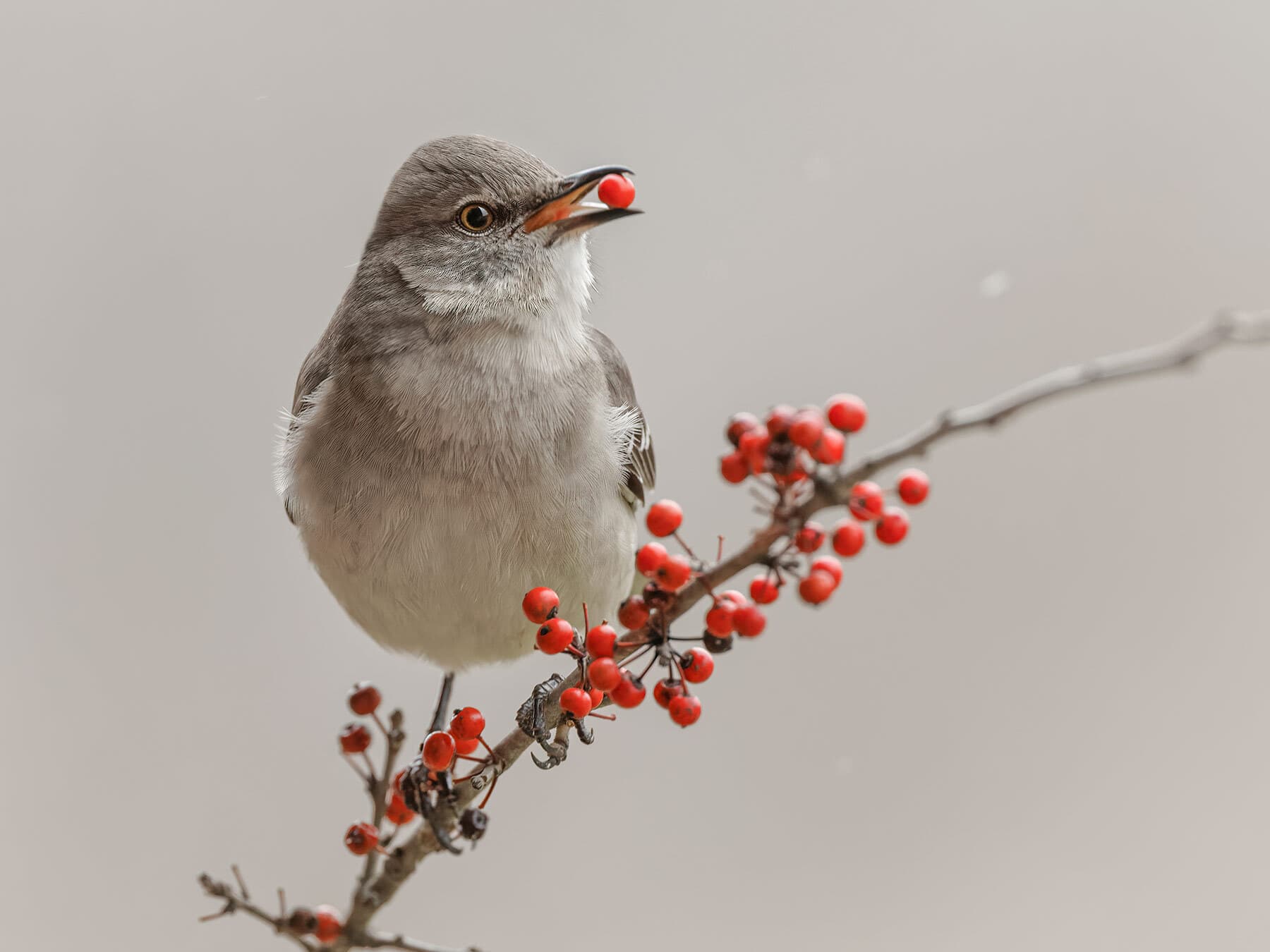
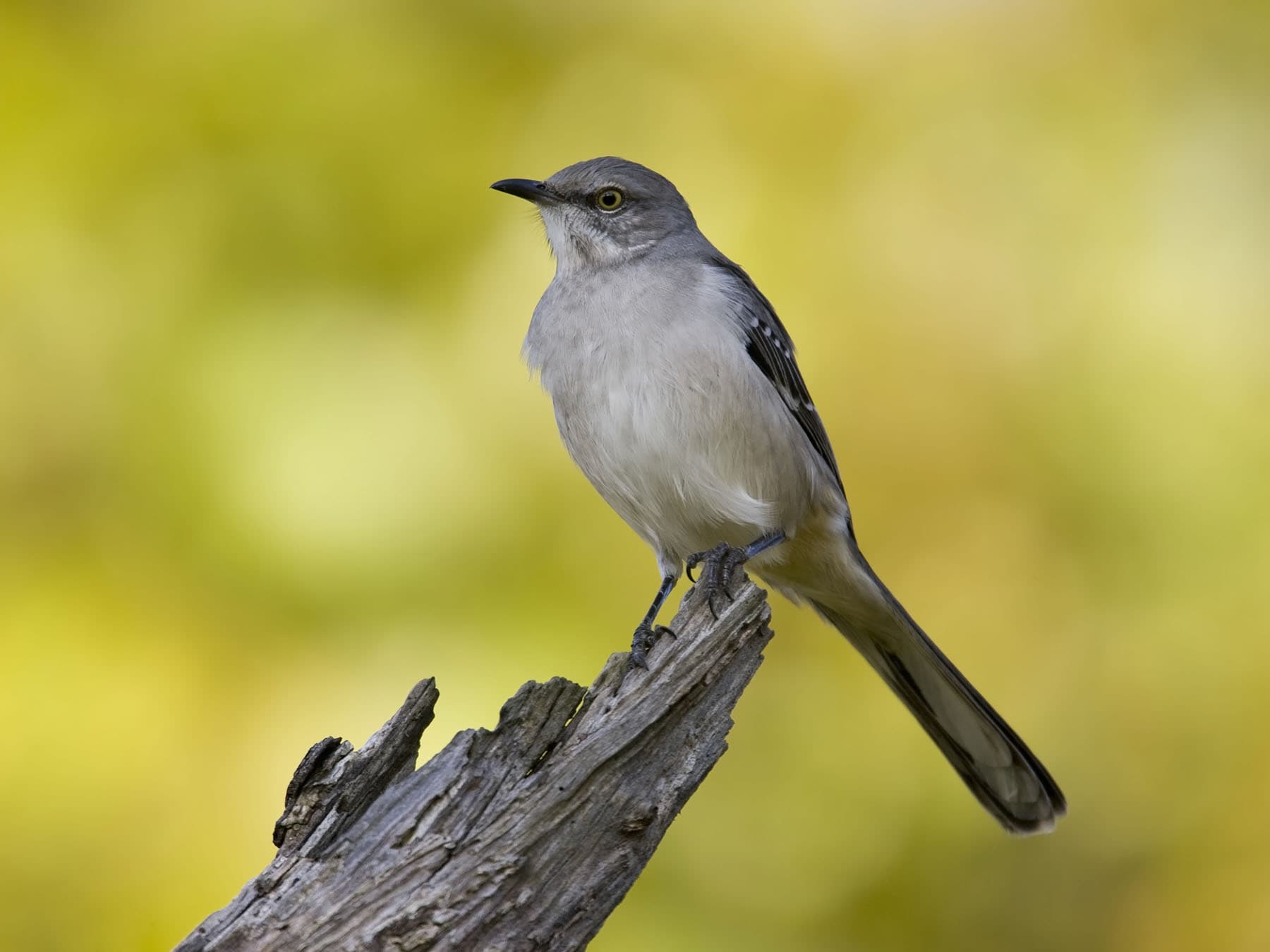
Northern Mockingbirds nest in shrubs and small trees across the US, often in yards, and commonly raise two or three broods a season. This page follows a nest from the first twig to the young bird's independence. For the bird as a whole, see our Northern Mockingbird guide; for who does what, see male vs female mockingbirds.
When do mockingbirds nest?
Earlier in the South. In Florida and North Carolina, nest building can start in late February, though March is more usual, and in north Florida complete nests have been found by February 19 and eggs by March 2. Northern birds start three to five weeks later, from about mid-April; in Pennsylvania and Maryland, nesting can begin in late March but more often in mid-April. Across the range, nesting goes on into August.1
Nest sites
Mockingbirds nest in shrubs and trees, usually 3 to 10 feet (1-3 m) off the ground, occasionally as low as about 1.6 feet (0.5 m) or as high as about 60 feet (19 m).2 They are not fussy about the plant: studies counted 42 species of nest trees and shrubs in north Louisiana and 33 in Florida, native and introduced. Now and then they nest on buildings, in eaves and rafters.
Placement matters. In north Louisiana, nests in low, dense shrubs fledged the most young, and in south Florida, successful nests were lower than failed ones, and nests where a branch joins the trunk did better than nests out on a branch or among twigs.1
The nest
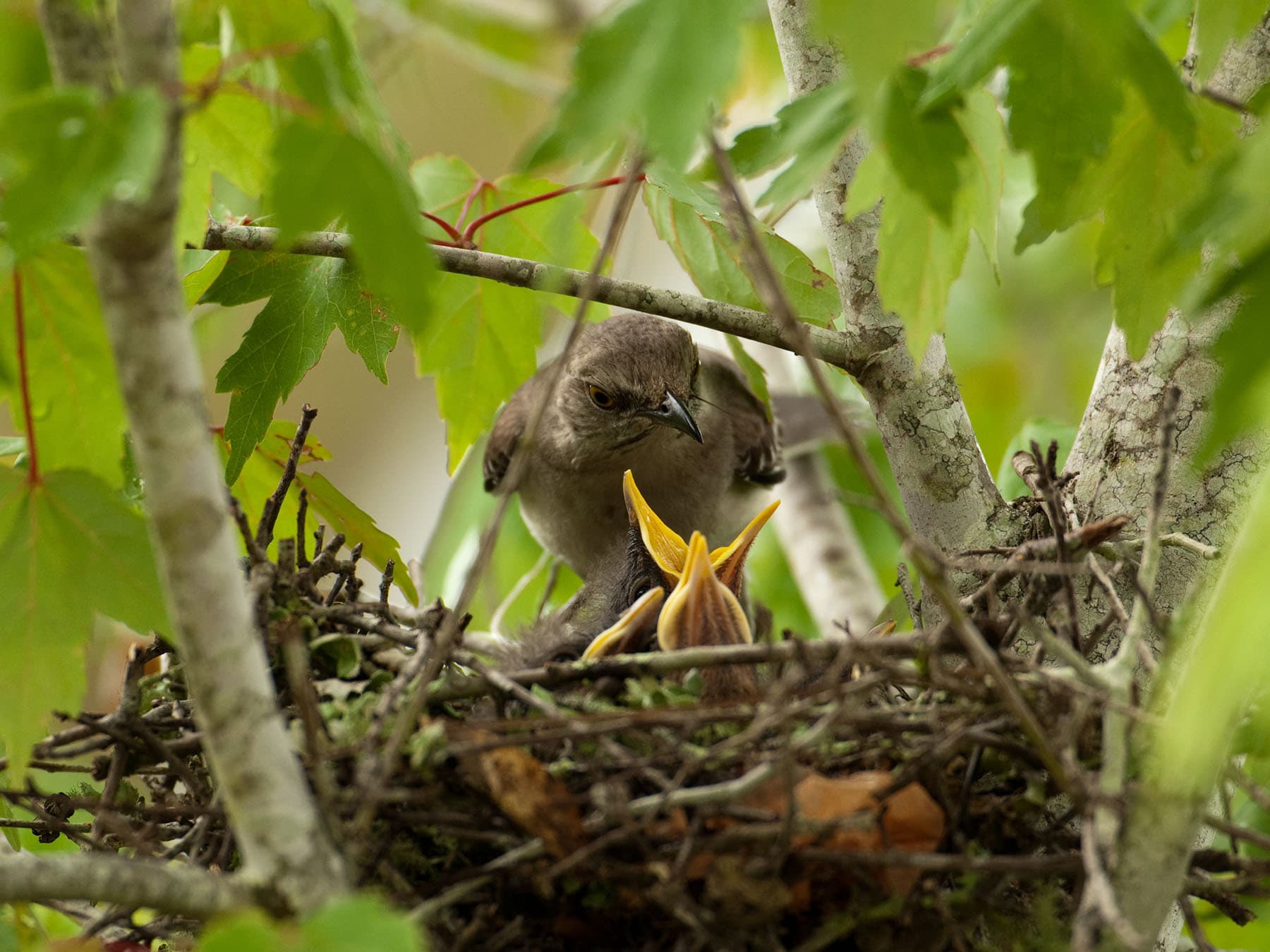
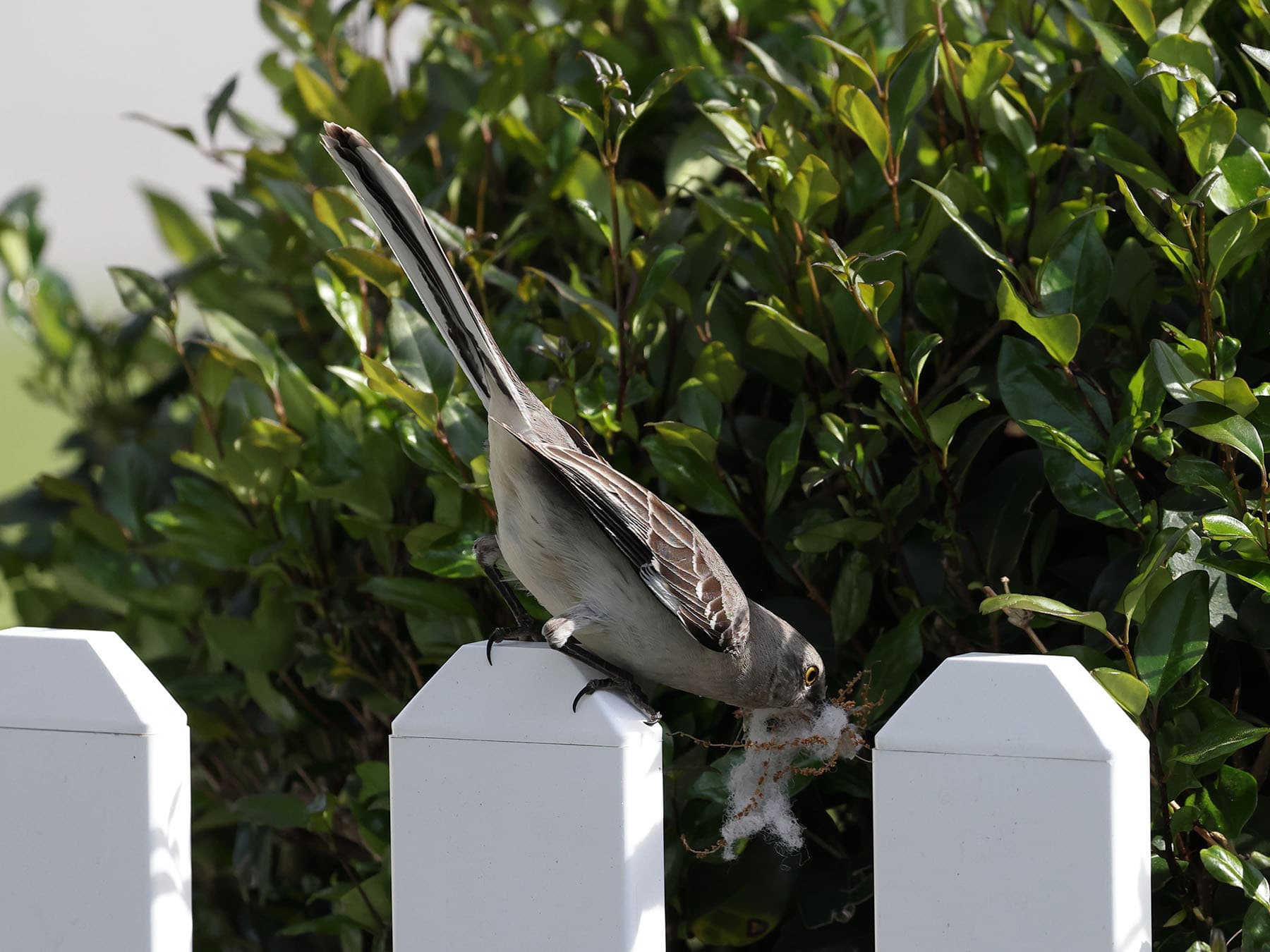
The nest is an open cup: a base of dead twigs with a lining of grass, rootlets and dead leaves, and often whatever people drop: Birds of the World lists plastic, aluminum foil, shredded cigarette filters, dental floss, twine, laundry lint and Easter grass. The male probably picks the site and does most of the work on the twig base; the female adds most of the lining. Early in the season a pair may need over two weeks to complete a nest; later on, a pair can build one in as little as three days, and the female may lay on the day it is finished.
Nests are almost never reused. A male may start up to three nests before the female lays in one, and a south Florida pair may build as many as six nests in one season, a Pennsylvania pair as many as eight, though not all of them get eggs. Now and then a new nest is built on top of an old one.
Mockingbird eggs
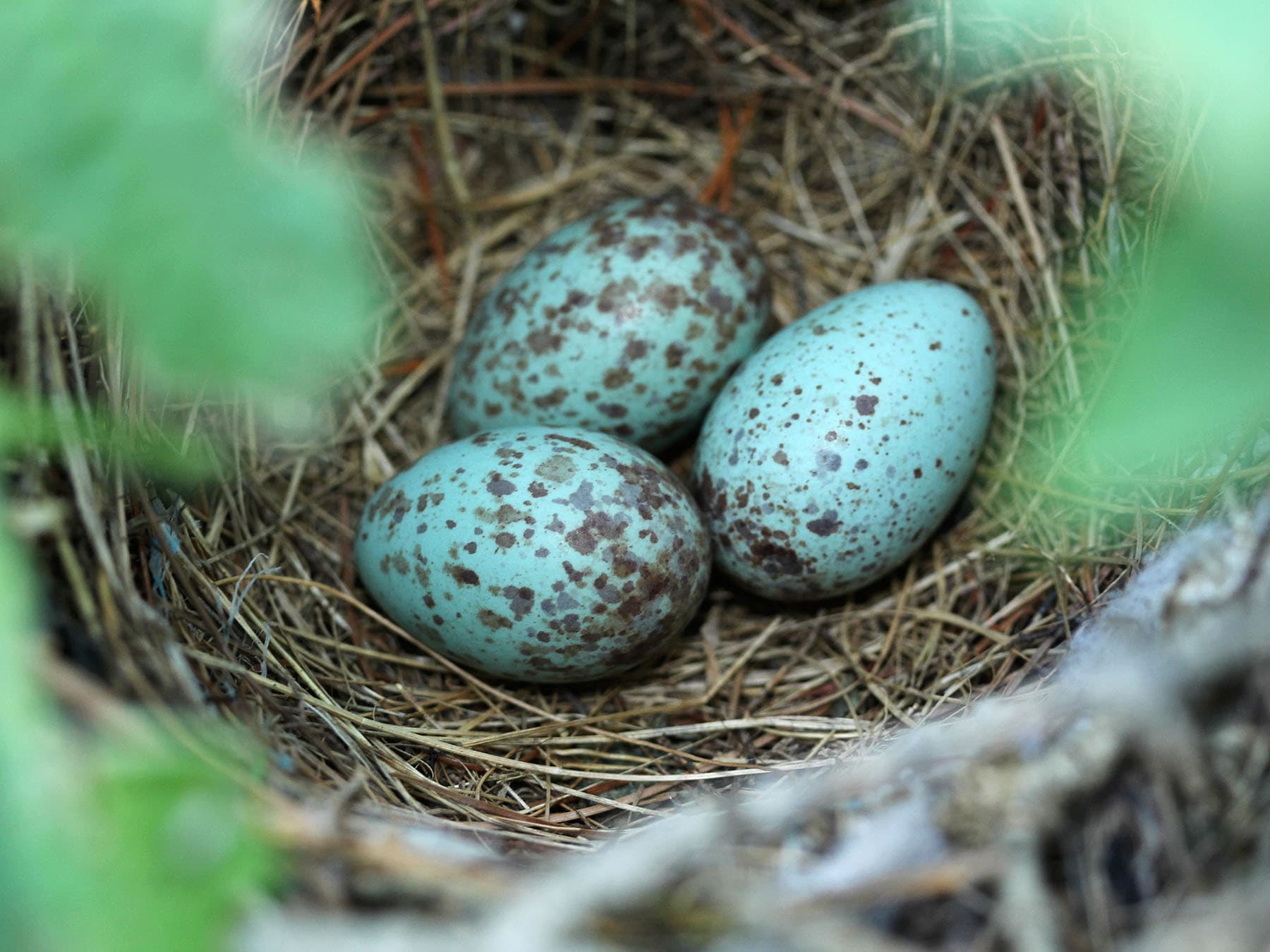
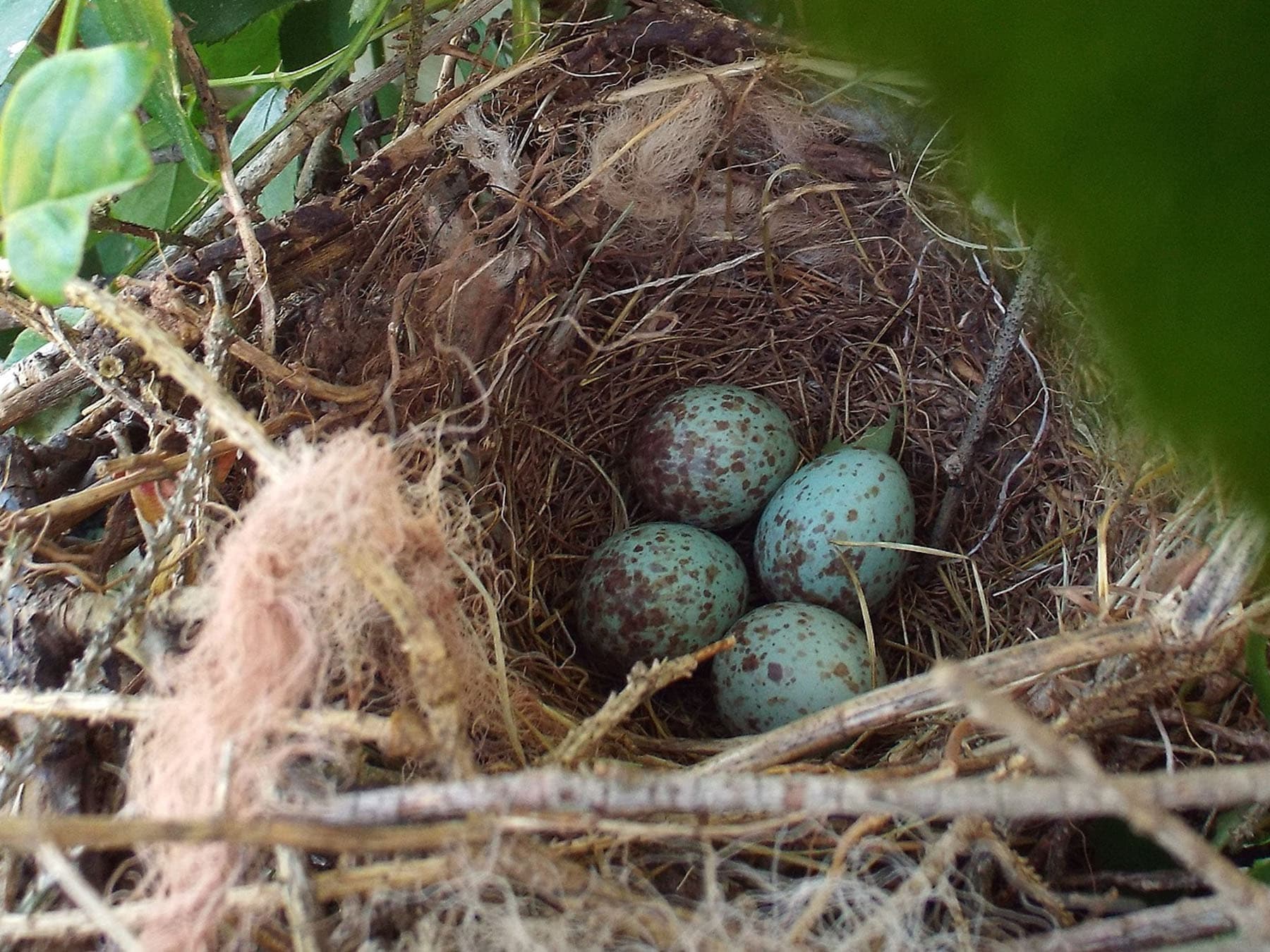
The eggs are pale blue or greenish white to blue-green, and most are heavily marked with spots and blotches of brown and reddish brown, often thickest at the larger end. Each female keeps laying eggs of much the same look, while different females' eggs vary a lot. A few are plain light blue. An egg is about an inch long and three-quarters of an inch wide (on average 24.5 x 18.5 mm in a Pennsylvania-Maryland sample of 246) and weighs about 0.15 oz (4.2 g), roughly 9% of the female's weight.1
A clutch holds 2 to 6 eggs, usually 3 or 4: average clutches in six studies, from Florida to Pennsylvania, ran from 3.4 to 3.9 eggs. The female lays one egg a day, usually in mid-morning.
Incubation and hatching
Only the female incubates, usually for 12 to 13 days, though periods from 9 to 15 days have been recorded; in 675 north Louisiana nests, eggs usually hatched after 13 days.3 She sits only now and then until the clutch is nearly complete, then steadily: in north Florida her trips off the nest averaged 10 minutes and her spells on it 32 minutes. She stays on the eggs at night, and the male rarely feeds her.
The eggs usually hatch in the early to mid-morning, all within about 24 hours, and the female carries away the shells the same day. In studies, from under 2% to 6% of eggs were infertile.
Baby mockingbirds in the nest
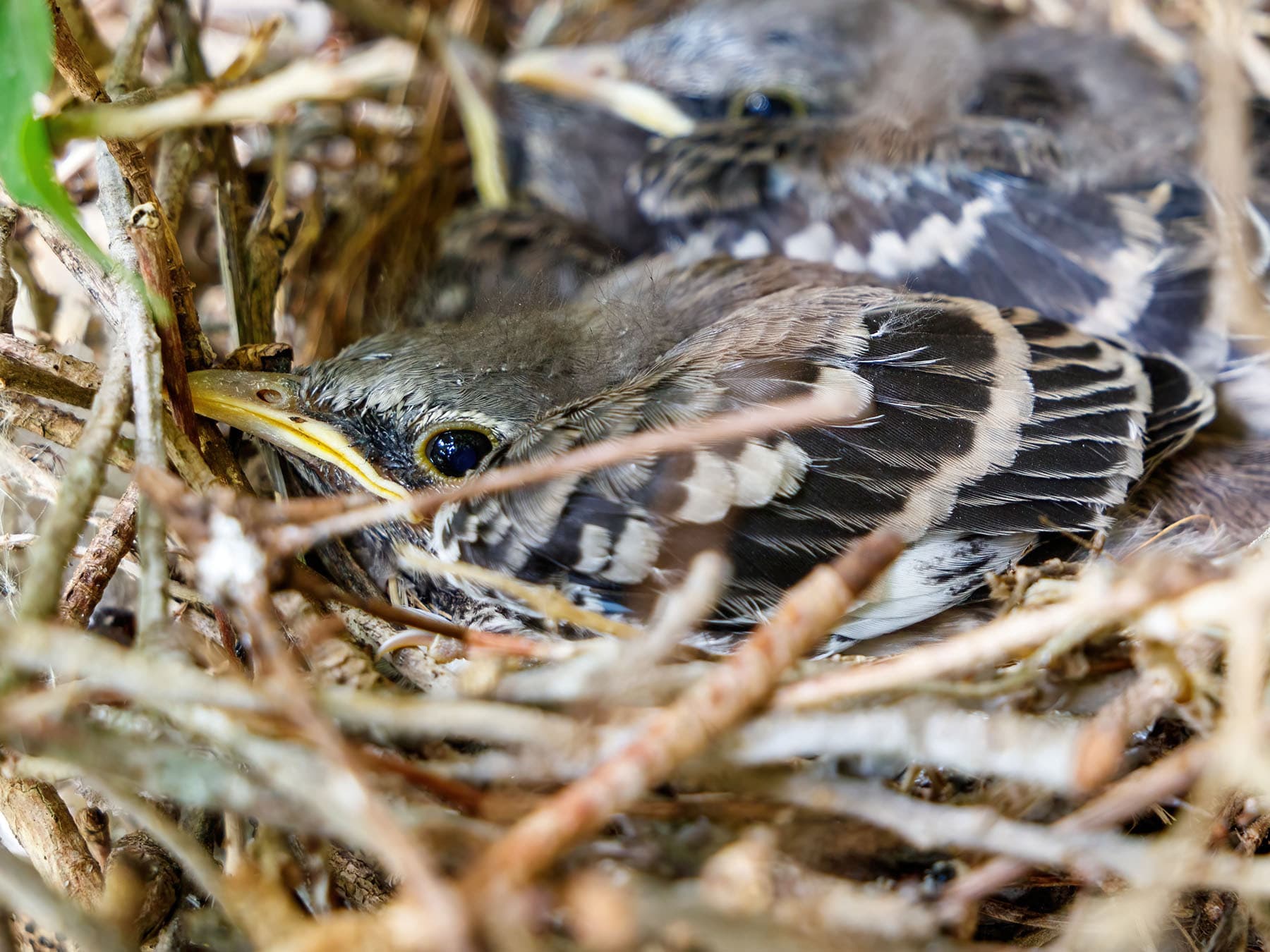
The chicks hatch blind and helpless, with a little light gray down and a yellowish gape, weighing 0.12 to 0.17 oz (3.5-4.75 g). They grow fast. In one study, nestlings averaged about half an ounce (13 g) at 3 days old, when their eyes begin to open and pin feathers show on every feather tract; about three-quarters of an ounce (21 g) at 5 days, with their eyes fully open; and about 1.3 oz (36 g) when they left the nest. Breast feathers streaked with dark brown cover the belly by about day 9. From about 6 days old they beg loudly, but after about day 10 they tend to sink into the nest and stay quiet when their parents give alarm calls.
Both parents feed them, usually one item per trip, up to 3 to 5 deliveries per chick each hour in small broods. Small chicks get almost nothing but spiders and insects, from grasshoppers and beetles to moths and ants; older nestlings also get fruit, 25 to 30% of their food by volume. In Florida, parents also bring small anole lizards. The female broods the chicks during the day for about their first week and at night until they are about 10 days old, and both parents carry away the droppings, which come in tidy fecal sacs.
How long do baby mockingbirds stay in the nest?
About 12 days. Most young leave on the 12th day after hatching, usually in the early morning. Chicks that are disturbed may leave as early as day 10, and some stay until day 15.1
Fledglings on the ground
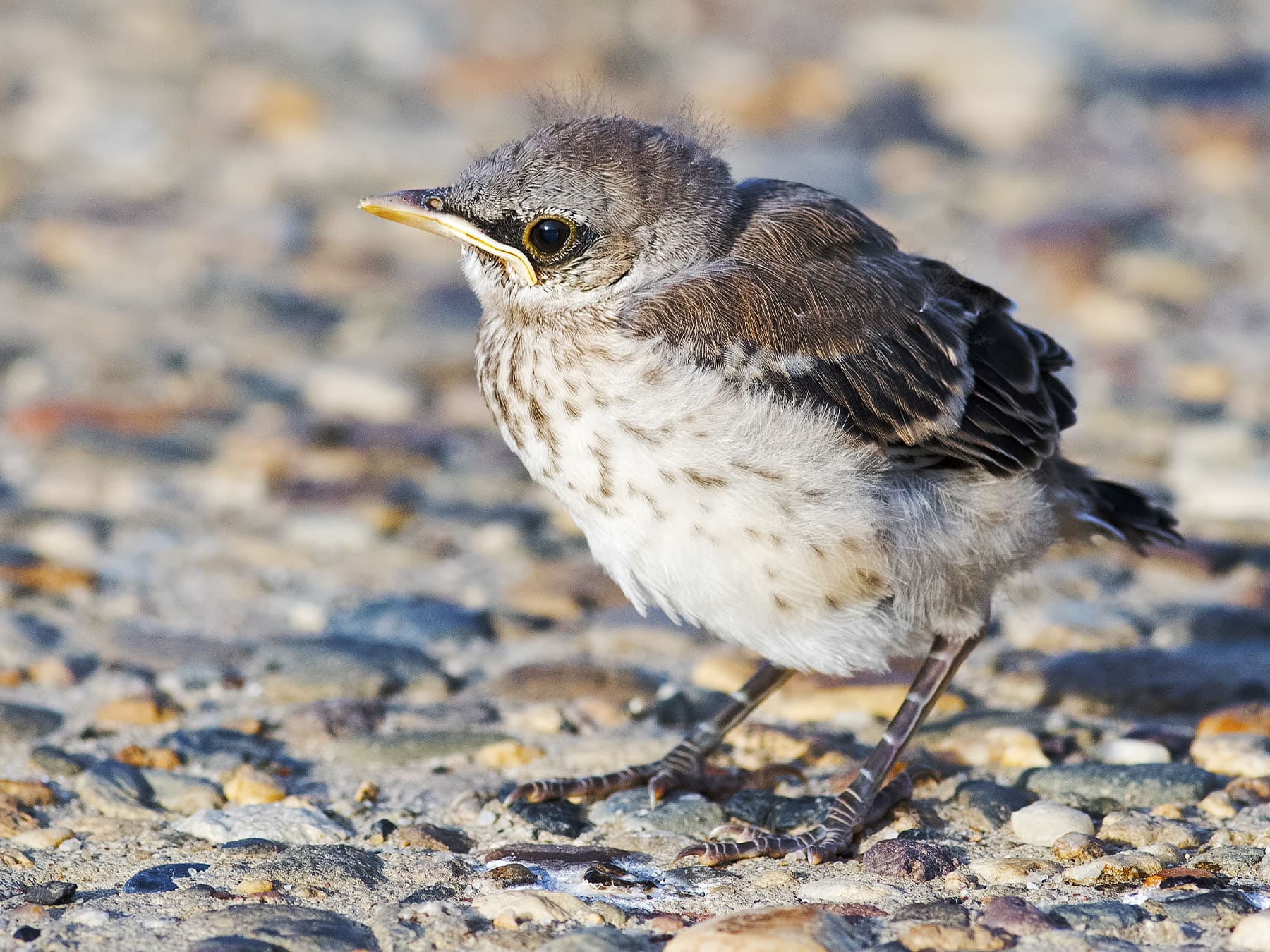
A spotted young mockingbird with a stubby tail, hopping about on a lawn or in a hedge, is probably a fledgling. Young mockingbirds often run as soon as they leave and only take to the shrubs after a day or two; nearly all can fly within 8 days. They weigh only 60 to 70% as much as an adult, and their parents keep feeding them nearby.
NestWatch's advice for any fledgling is to leave it alone: the parents are likely close by, and they will stay away if you hover. If a young bird is injured, call a licensed wildlife rehabilitator, and do not try to feed it or give it water.4 Mockingbirds are protected under the Migratory Bird Treaty Act, which makes it illegal to take or keep one, or its nest or eggs, without a permit.5
Care after leaving the nest
Both parents feed the fledglings for a day or more. Then the male stops for a few days to start the foundation of the next nest, before taking over the feeding while the female finishes that nest, lays and incubates. For up to three weeks after the young leave, the male may be feeding them on his own. The young become independent two to three weeks after leaving the nest, when the male stops feeding them. In south Florida, fewer than one fledgling per brood died before then on average, almost all in the first four days.
The season's final brood may linger on their parents' territory for two to four weeks longer. Once on their own, young mockingbirds gather in the gaps between adults' territories, foraging on the ground and squabbling.
Broods and nesting attempts
Two or three broods a season are common, even in the north, and pairs can raise up to four. They manage it by overlapping: a new nest is started while the last brood is still being fed. In north Florida, with its long season, some females make up to six nesting attempts, three or four being typical. Females in Pennsylvania-Maryland and south Florida laid about 10 eggs a season on average, and one laid 27 in a single season, about 240% of her own weight.
Many nests fail. In Pennsylvania-Maryland and south Florida, about 36 to 39% of nests succeeded; in Illinois, 61%, with late nests doing far better than early ones (32% in April-May against 85% in June-August). In Pennsylvania-Maryland a female raised 2.5 young to leaving the nest in a year on average, and 30% raised none.1
Nest defense
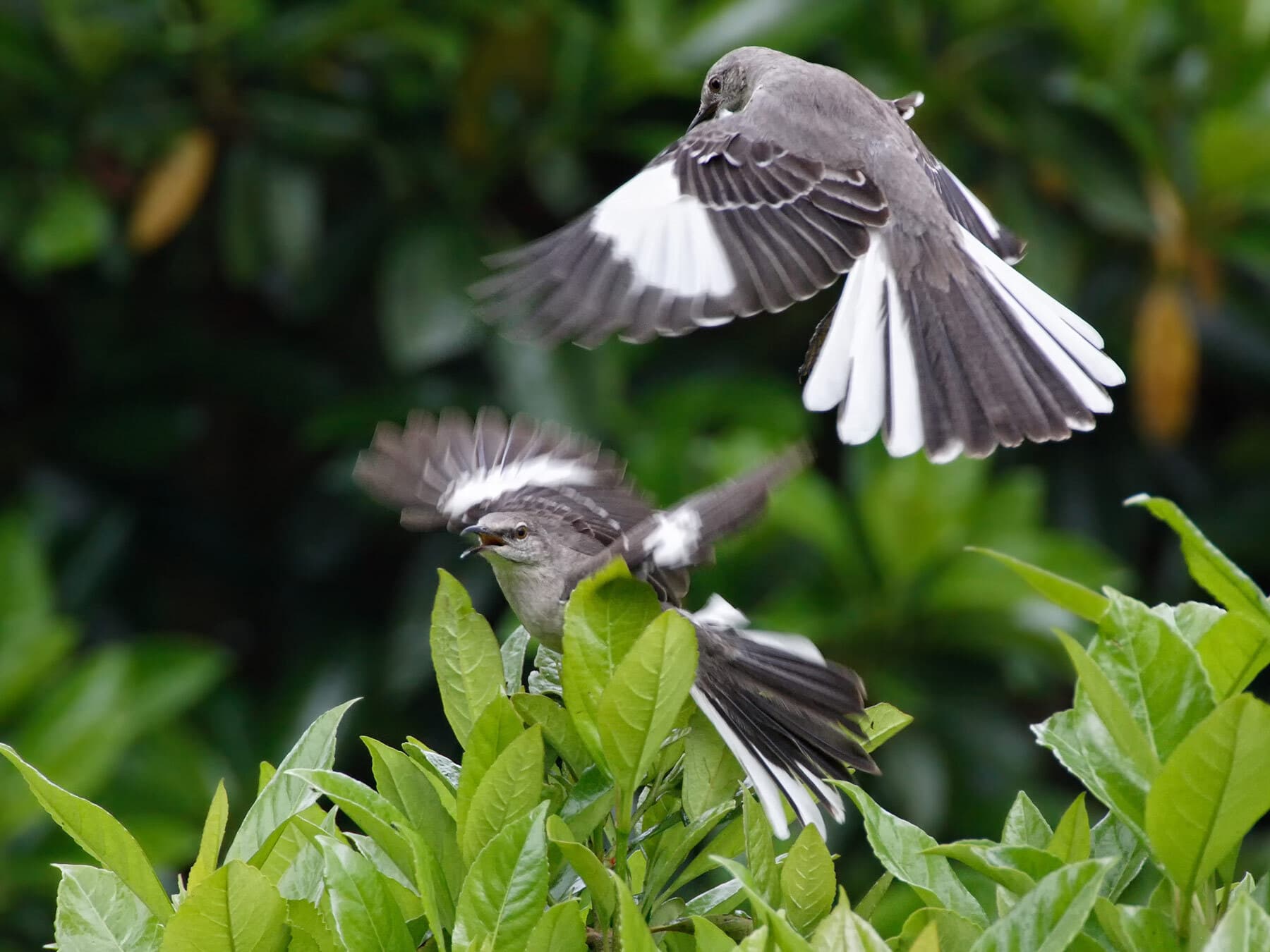
Nesting mockingbirds are fierce. Both parents give harsh alarm calls at predators, mob them and chase them, sometimes striking them, and the male takes the bigger part: while the female incubates he keeps watch from a high perch and chases off any animal, people included, that comes near the nest. Males chase crows and hawks that fly over, and neighbors may join in; up to six mockingbirds have been seen attacking crows together in north Florida. Nesting adults also learn to recognize individual people who keep coming near the nest, and mob those people while ignoring others.1 In a University of Florida study, birds learned a person after just two 30-second visits to the nest.6
Predators, parasites and cowbirds
Eggs and nestlings are often lost to predators. Likely culprits include Blue Jays, crows, Red-tailed Hawks and Swallow-tailed Kites, as well as snakes, squirrels and cats; fledglings are taken by cats, Red-tailed Hawks and even crows. In south Florida, nestlings late in the season are often infested with blowfly larvae, and badly affected, emaciated chicks almost always die. Building a fresh nest each time may help keep parasites down.
Brown-headed Cowbirds lay in mockingbird nests only now and then, and the mockingbirds often reject the eggs: in experiments they rejected 60% of Brown-headed Cowbird eggs and 69% of Bronzed Cowbird eggs. A female sometimes lays in another pair's nest; the owner may crack the egg, and such eggs have been found buried in nest linings.1
Helping nesting mockingbirds
Mockingbirds nest in shrubs and small trees, and dense shrubs give them places to build. To bring them to a yard at all, All About Birds suggests keeping an open lawn and planting fruiting trees or bushes such as mulberries, hawthorns and blackberry brambles.2 If a pair nests in your yard, watch from a distance and give the nest a wide berth until the young are flying.
Sources
- Farnsworth, G., Londono, G. A., Martin, J. U., Derrickson, K. C., Breitwisch, R. (2020). Northern Mockingbird (Mimus polyglottos), version 1.0. Birds of the World (A. F. Poole, editor). Cornell Lab of Ornithology. doi:10.2173/bow.normoc.01
- Cornell Lab of Ornithology. Northern Mockingbird. All About Birds. Accessed October 12, 2026. Source
- Means, L. L., Goertz, J. W. (1983). Nesting activities of Northern Mockingbirds in northern Louisiana. The Southwestern Naturalist 28(1): 61. doi:10.2307/3670593
- NestWatch (Cornell Lab of Ornithology). What should I do if I see a young bird out of the nest? NestWatch FAQ. Accessed October 12, 2026. Source
- United States Congress (1918). Migratory Bird Treaty Act, 16 U.S.C. 703. United States Code, Title 16, section 703 (Legal Information Institute). Accessed October 12, 2026. Source
- Levey, D. J., Londoño, G. A., Ungvari-Martin, J., Hiersoux, M. R., Jankowski, J. E., Poulsen, J. R., Stracey, C. M., Robinson, S. K. (2009). Urban mockingbirds quickly learn to identify individual humans. Proceedings of the National Academy of Sciences 106(22): 8959-8962. doi:10.1073/pnas.0811422106
- U.S. Fish and Wildlife Service (2023). 50 CFR 10.13: List of Birds Protected by the Migratory Bird Treaty Act. Electronic Code of Federal Regulations. Accessed October 12, 2026. Source
- National Audubon Society. Northern Mockingbird. Guide to North American Birds (text adapted from Kaufman 1996). Accessed October 12, 2026. Source
- Tennessee Wildlife Resources Agency. Northern Mockingbird. Tennessee Wildlife Resources Agency. Accessed October 12, 2026. Source