Facts · Updated 14 Oct 2026
Baby Blue Jays: Nestlings, Fledglings and What to Do
By the Birdfact teamChecked by Nathan Cope
Baby Blue Jays hatch naked after 17 to 18 days and leave the nest at 17 to 21 days, before they can fly well. Their parents feed them for one to two months. A young jay hopping on the ground is usually a healthy fledgling being looked after: leave it be.
On this page10 sections
This page follows young Blue Jays from hatching to independence: what they look like, what they eat, when they leave the nest, and what to do if you find one. For nests and eggs, see Blue Jay nesting; for the bird as a whole, our Blue Jay guide.
What does a baby Blue Jay look like?
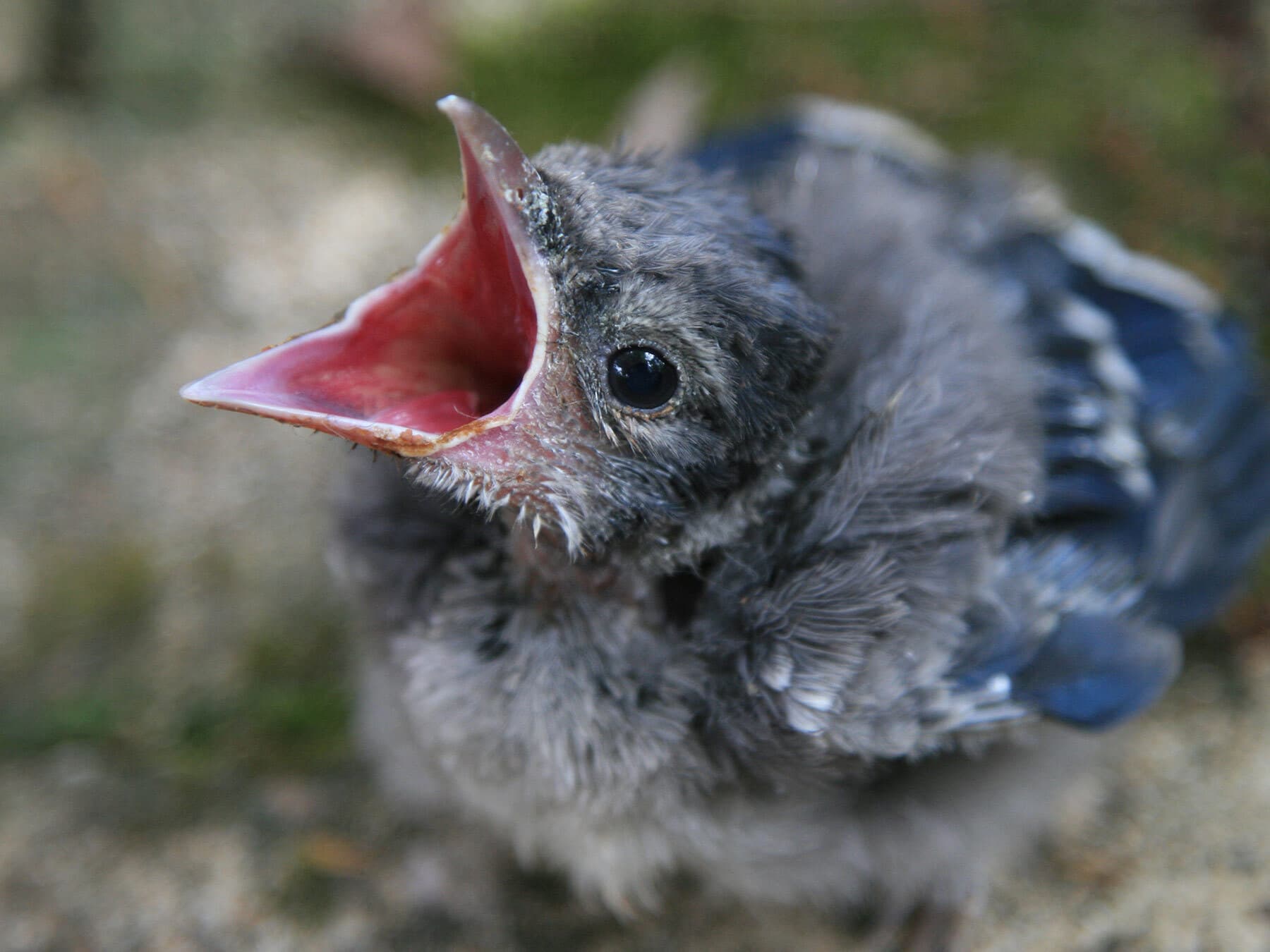
At hatching, nothing like its parents. A newly hatched Blue Jay is naked and helpless, with its eyes closed; its skin is pink tinged with gray above and pink with a yellowish tinge below, and the inside of its mouth is red.1 In a New York sample, hatchlings weighed about 0.2 ounces (5.5 g) and were about 2 inches (51 mm) long, yet within three hours it can lift its head to the rim of the nest.2
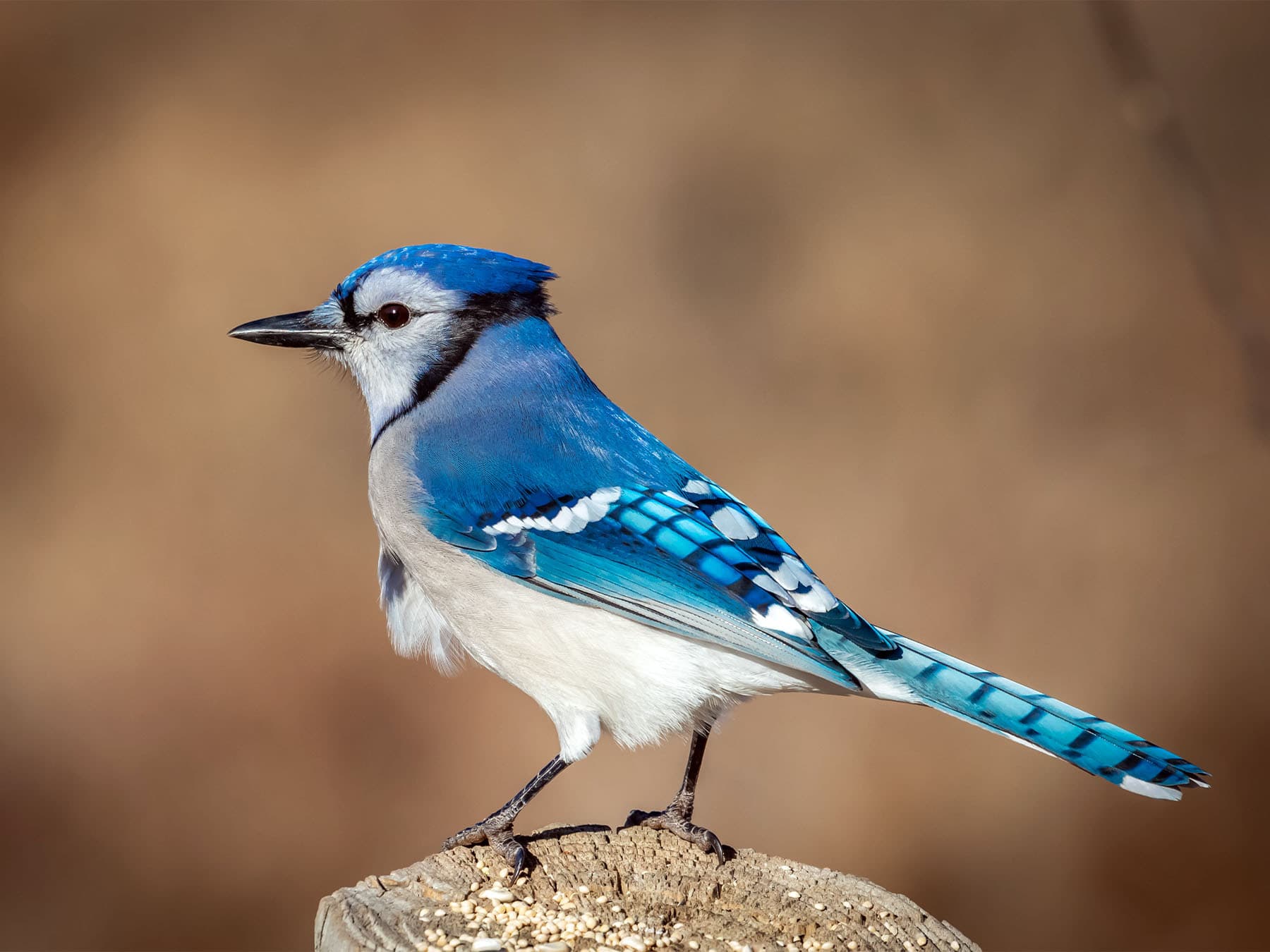
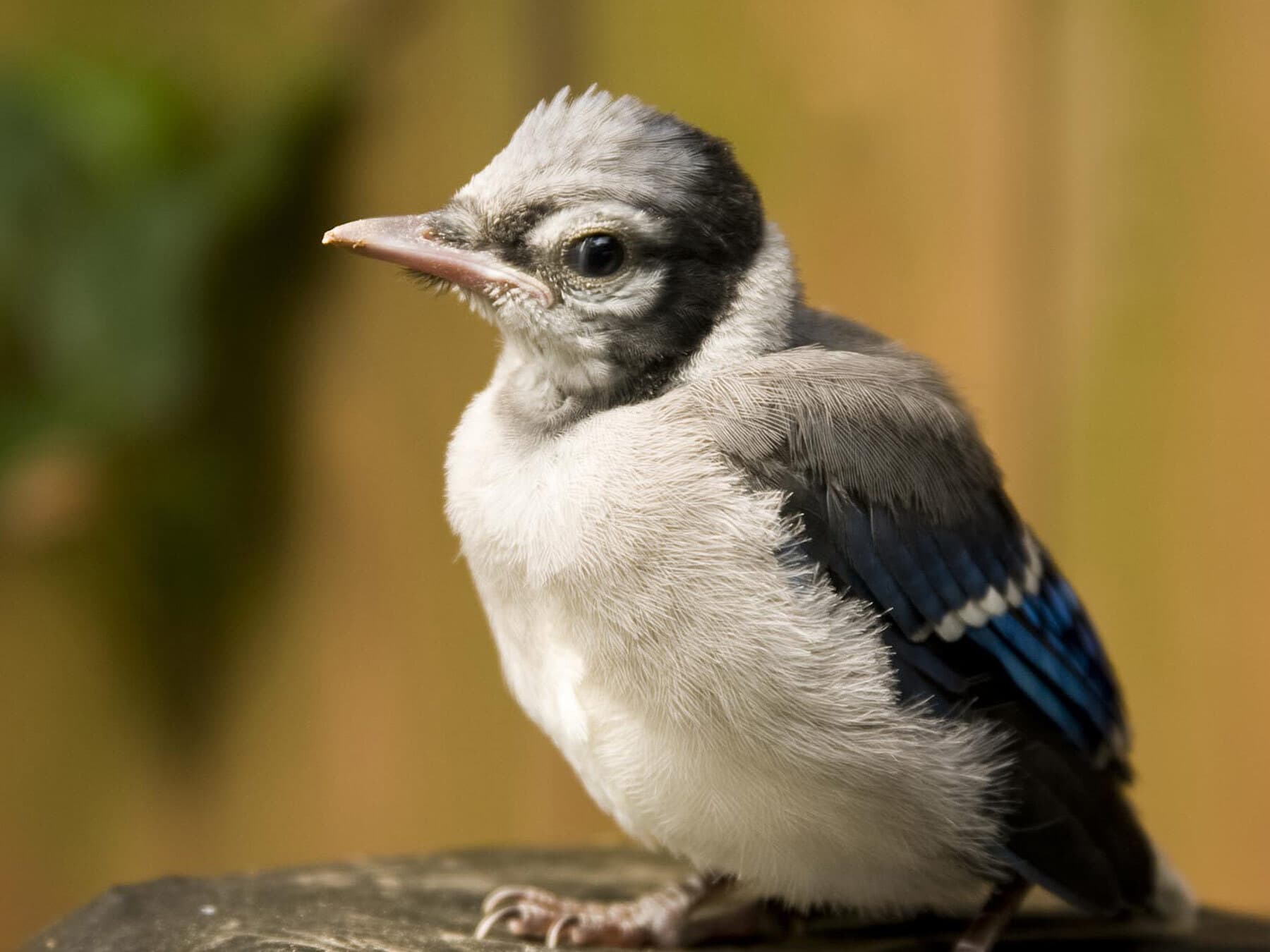
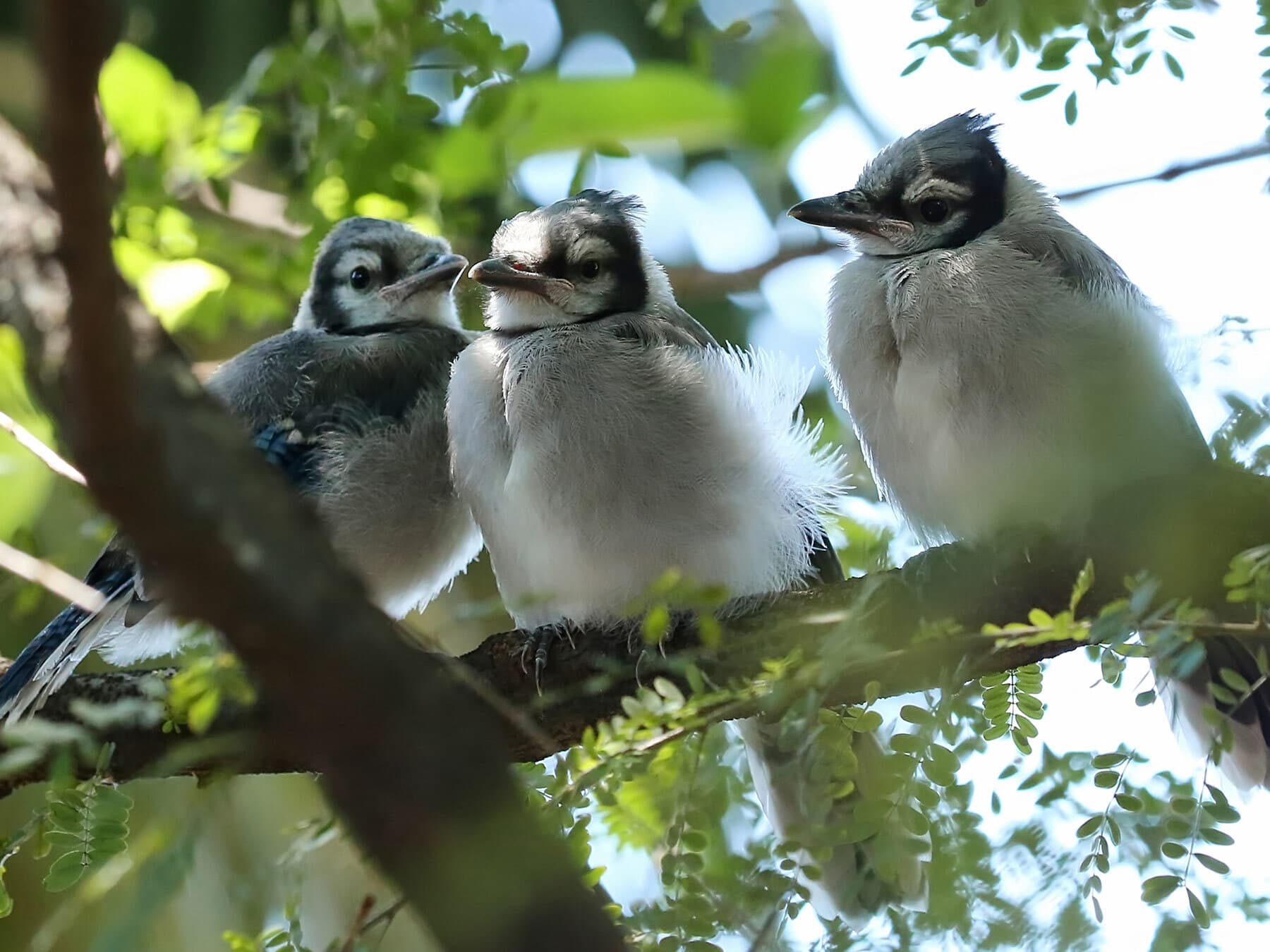
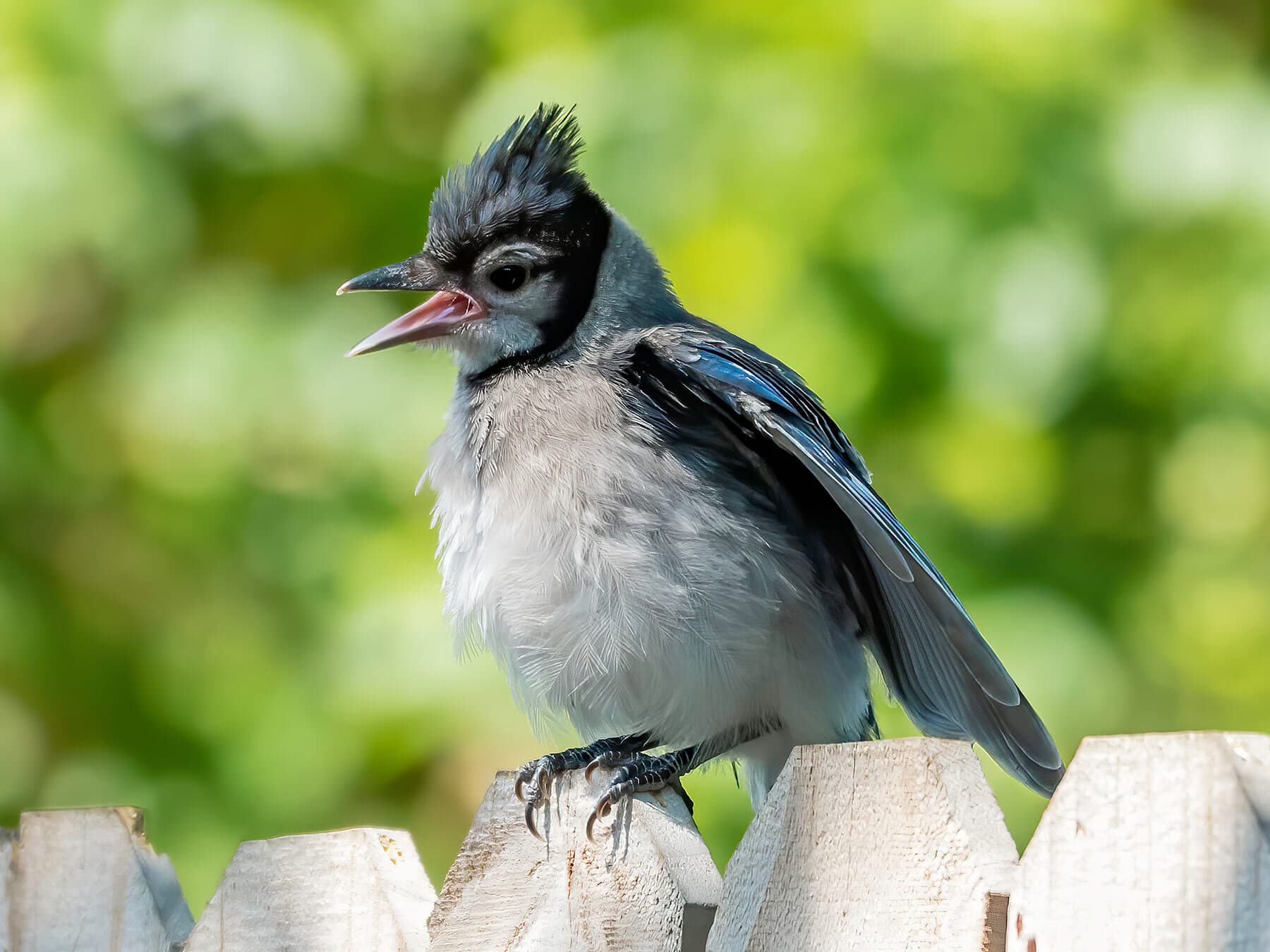
A young bird that has just left the nest looks like a duller, fluffier adult. Its head is grayer, its crest short, its black necklace a soft brownish gray with blurred edges, and its bill grayish, yellowish toward the corners of the mouth. The blue on its back and wings is grayer, the blue patches on the folded wing are plain rather than barred, and its tail is a stub, only 10 to 25% grown.
How they grow
Growth is fast. On their third day nestlings weigh about half an ounce (13.5 g); by the fifth day they weigh 0.7 to 1 ounce (20-28 g), their eyes have opened to thin slits, and dark pin feathers show under the skin. Pin feathers break through around day 7, the feathers of the back and belly are out of their sheaths by day 11, when the eyes are fully open, and those of the head and throat follow by about day 14.2
What do baby Blue Jays eat?
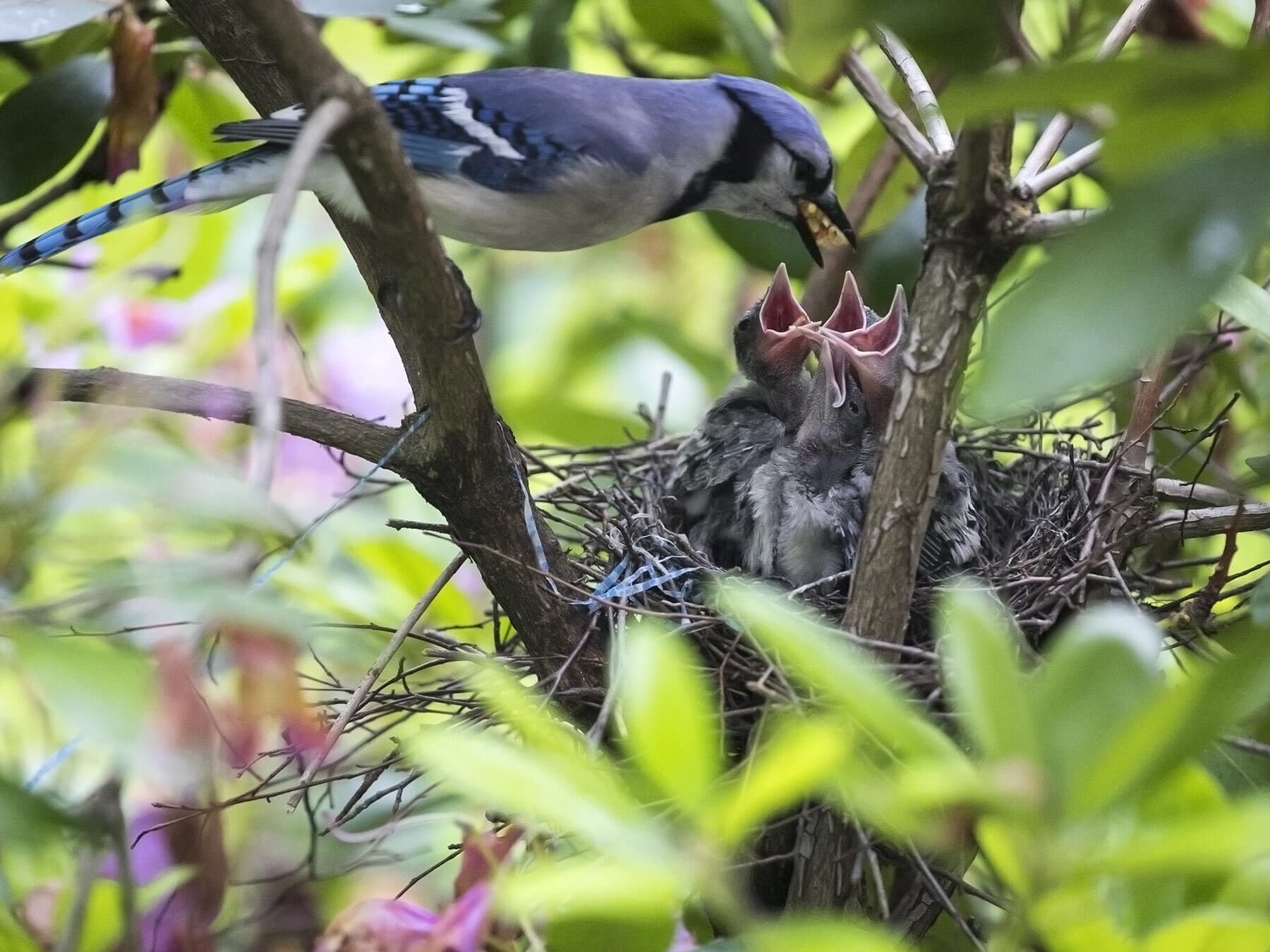
Whatever their parents bring. Little is published on what nestlings are fed, but Birds of the World describes who brings it: for the first 8 to 12 days the female broods the chicks while the male provides virtually all the food for them and for her. Midway through the nestling period she starts foraging too, though the male still brings more. Near the end, the parents often arrive at the nest together. Both parents remove the chicks' droppings, usually by swallowing them.
Adult Blue Jays eat a mix of nuts, seeds, fruit and insects; in a classic study of their stomachs, caterpillars made up about a tenth of their food in July and August, and grasshoppers nearly a fifth in August. If you find a young jay, do not try to feed it: an incorrect diet can cause deformities, disease or death, and young birds need feeding several times an hour, all day.3
Leaving the nest
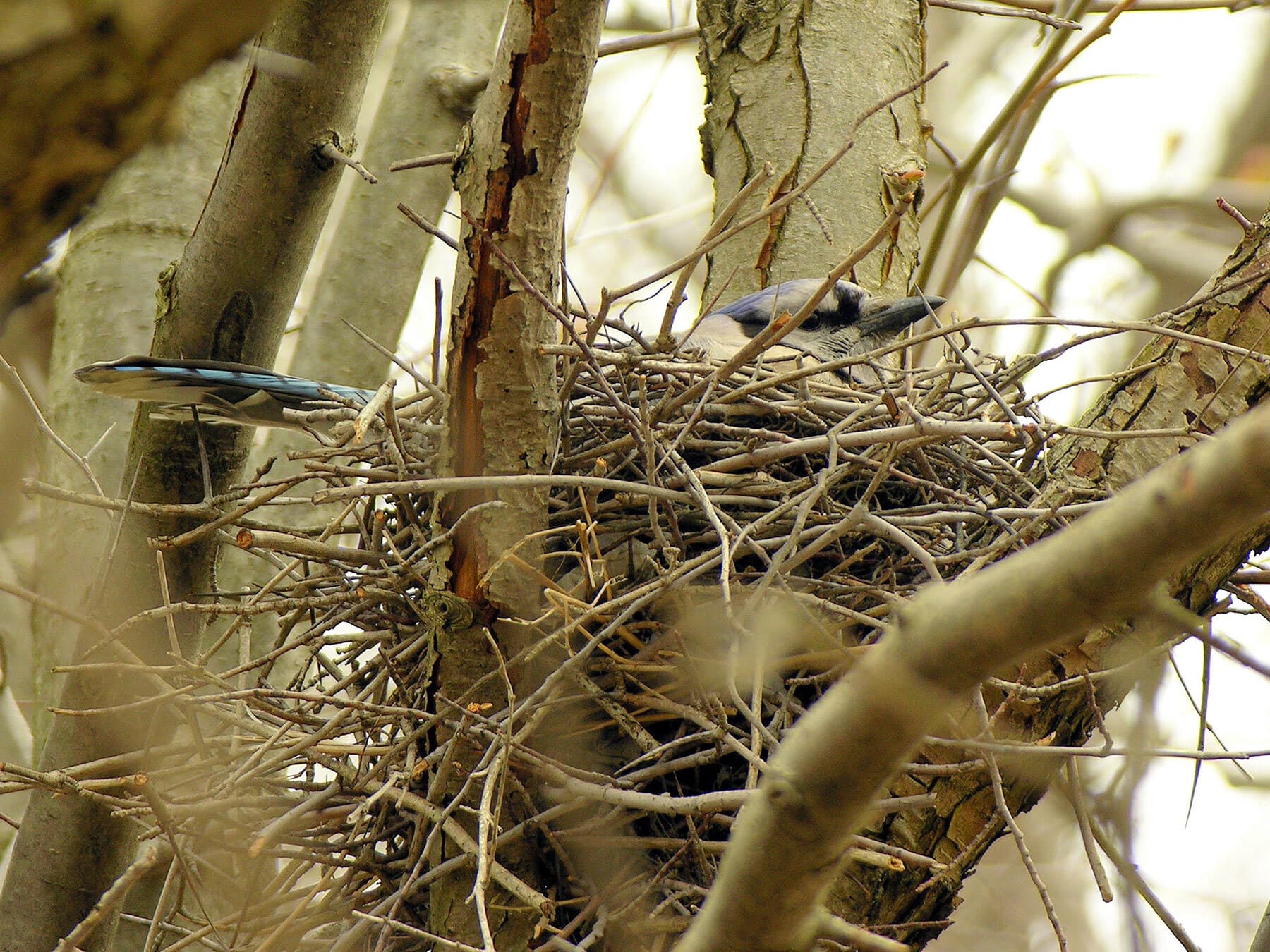
Young Blue Jays usually leave the nest at 17 to 21 days old, all together.1 For a day or three before that, some nestlings climb out and perch beside the nest, wandering as far as about 15 feet (5 m) before going back. A nestling that wanders out early may not be fed until it returns, and All About Birds notes that "this is the stage at which many people find an 'abandoned baby jay'". Returned to the nest or close to it, such a nestling will be fed by its parents again. (Once a whole brood has fledged, it is different: see below.)
Once they fledge, the young can run and flutter, hop up to perches about 3 feet (1 m) high and fly short distances. The family usually moves 30 to 80 feet (10-25 m) from the nest tree, and by the end of the second day the young are usually more than 82 feet (25 m) away. Within a few days they can fly several feet but land badly; by the end of the first week they fly tens of yards and choose their perches well.2
If you find a young jay
First work out whether it is a fledgling or a nestling. Most young birds people find are fledglings: fully feathered and alert, able to hop and grip a finger or twig tightly, with a stubby tail. A fledgling does not need help. Its parents are likely nearby and still feeding it; at most, move it onto a nearby perch out of harm's way, keep pets indoors, and watch from a distance.4 Fledglings do not fly strongly at first and often hop on the ground or through shrubs while their parents keep feeding them.3
A nestling, sparsely feathered and unable to hop or grip, needs to go back. Put it back in the nest if you can find it: the parents will not abandon it. If the bird is injured, or you are sure it is orphaned, call a wildlife rehabilitator.4 Don't feed it or force water into it: young birds get their water from their food.3 And don't keep it: in the United States the Migratory Bird Treaty Act makes it unlawful to possess a Blue Jay except as regulations allow.5
How long do young Blue Jays stay with their parents?
Parents feed their young for at least a month after they leave the nest, and sometimes two.2 Young jays apparently leave the family about two months after fledging, though how fast they become independent varies a lot.
After that, young from different families may flock and roam together, though the evidence is thin. Where they go is poorly known. In Florida, 12 of 17 young jays followed into their second year had moved, 7 of them less than 1.2 miles (2 km) and the other 5 between 1.2 and 1.9 miles (2-3 km), some as early as mid-July and others in fall, winter or later. Farther north, migration makes these moves hard to follow.
Turning blue
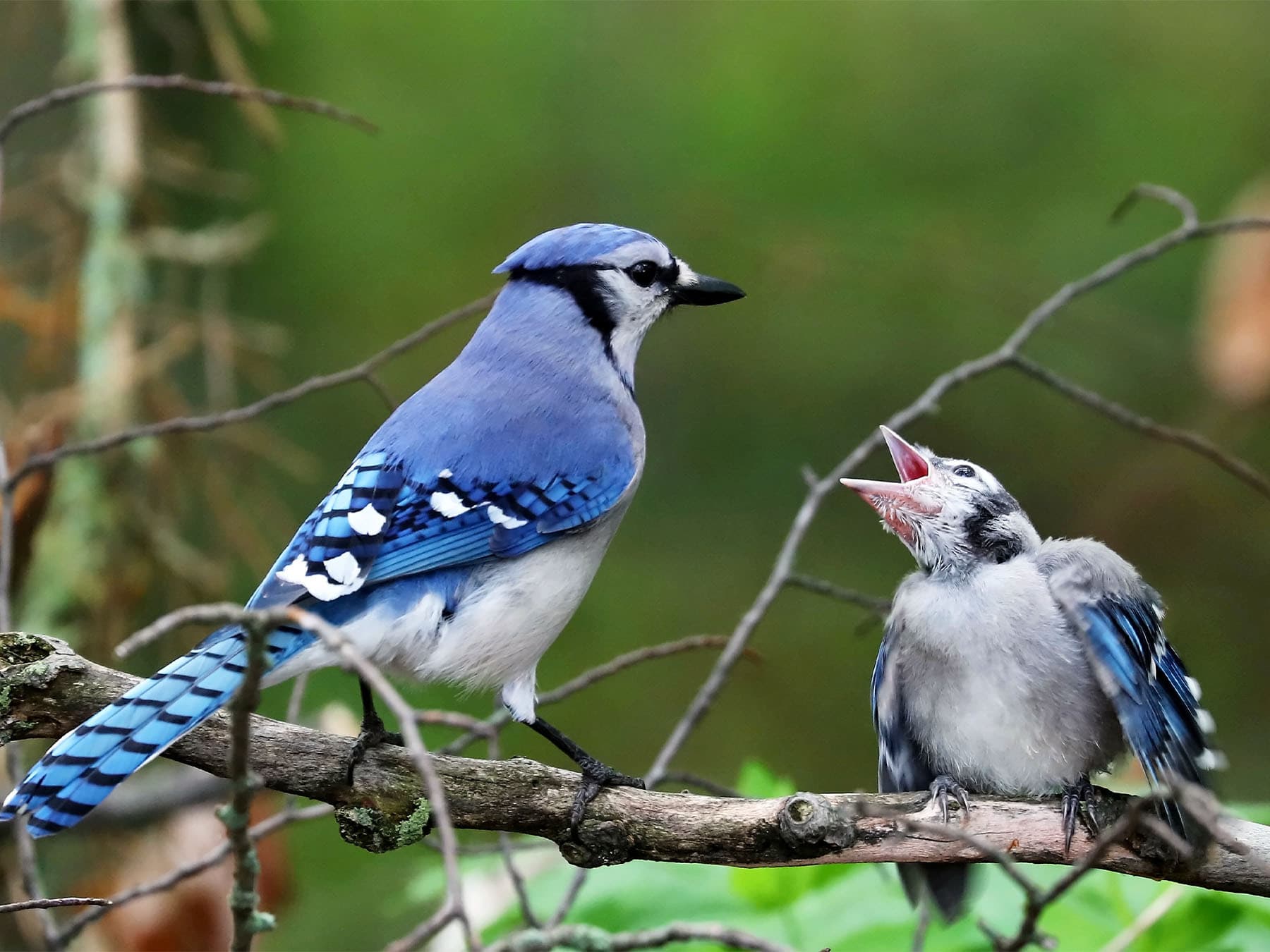
A young jay keeps its juvenile feathers through the summer. From June it begins a partial molt that replaces its body feathers and some of its wing feathers, and that takes about 140 to 170 days; most young birds look like adults by mid- to late fall. During the molt the head feathers drop almost at once, and a young jay can be nearly bald for about a week. After the first fall, young and old can be told apart only in the hand.
Helpers at the nest
Blue Jays hardly ever have helpers: they do not breed cooperatively. There are four reports of an extra adult at a Blue Jay nest, and in each the help was rare, secretive or unwelcome to the pair; in one, two males at the same nest fought in 9 of their 10 meetings there.2 Young jays leave the family before the next breeding season instead of staying to help.
Survival
Many nests fail, mostly to predators such as crows, squirrels and snakes, and a successful nest in Florida fledged between 1 and 3 young on average, depending on the habitat. Fledglings are taken by gray and fox squirrels and coachwhip snakes. Over a year, about 45% of young birds in a Wisconsin study survived. More: nest success and predators.
Sources
- Cornell Lab of Ornithology. Blue Jay. All About Birds. Accessed October 14, 2026. Source
- Smith, K. G., Tarvin, K. A., Woolfenden, G. E. (2020). Blue Jay (Cyanocitta cristata), version 1.0. Birds of the World (A. F. Poole, editor). Cornell Lab of Ornithology. doi:10.2173/bow.blujay.01
- NestWatch (Cornell Lab of Ornithology). What should I do if I see a young bird out of the nest? NestWatch FAQ. Accessed October 14, 2026. Source
- Cornell Lab of Ornithology. I Found A Baby Bird. What Do I Do? All About Birds. Accessed October 14, 2026. Source
- United States Congress (1918). Migratory Bird Treaty Act, 16 U.S.C. 703. United States Code, Title 16, section 703 (Legal Information Institute). Accessed October 14, 2026. Source