Facts · Updated 14 Oct 2026
Blue Jay Nesting: Nest, Eggs and Incubation
By the Birdfact teamChecked by Nathan Cope
Blue Jays nest in trees, usually 10 to 25 feet up, in an open cup of twigs lined with rootlets. The female lays 2 to 7 bluish, olive or buff eggs spotted with brown and incubates them alone for 17 to 18 days while the male feeds her. Most pairs raise one brood a year.
On this page12 sections
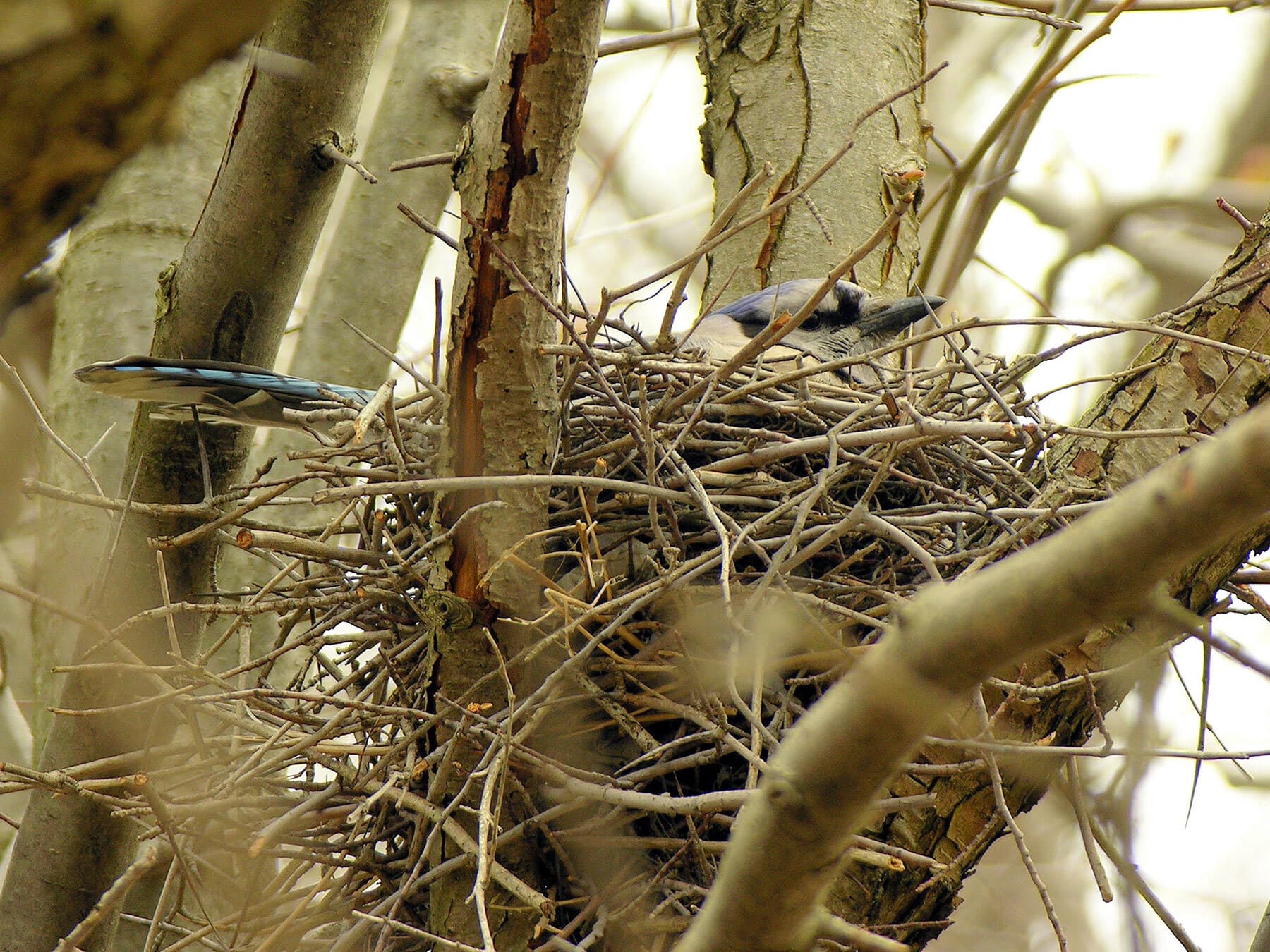
This page covers the Blue Jay's nest and eggs, from the first twigs in March to hatching. For the chicks and fledglings, see baby Blue Jays; for the bird as a whole, our Blue Jay guide.
When do Blue Jays nest?
In spring. Nest building usually starts around mid-March, earlier in the far South, and eggs may not follow for several weeks.1 The first eggs come earliest in the South: about 7 March in Florida, 17 March in Alabama and 30 March in Arkansas, then 10 April in Kansas, 14 April in Kentucky, 24 April in Minnesota and 5 May in Michigan. Laying peaks in early April in the South and in mid-May in the north. A pair whose nest fails often tries again, and replacement clutches can be started into July.
Where they build
Blue Jays nest in trees, deciduous or coniferous, usually 10 to 25 feet up2, though nests have been found from about 3 feet to over 100 feet (1 to 30 m) above the ground. The nest sits in a crotch of the trunk, midway along a big horizontal branch (often under a tuft of leaves), out toward the end of a branch, or near the top of a conifer. Some nest in evergreen vines such as ivy on a trunk, a few on buildings, and they rarely use shrubs. In northwest Arkansas, jays have been seen nesting in eastern red cedars first and moving to deciduous trees once the leaves are out.1
In a study of suburban nests in Arkansas, nests did better when the nest tree stood among similar trees and when it was close to a building, but the tree species, the height of the nest and how well it was hidden made no difference to success, in Arkansas or in Florida.
The nest
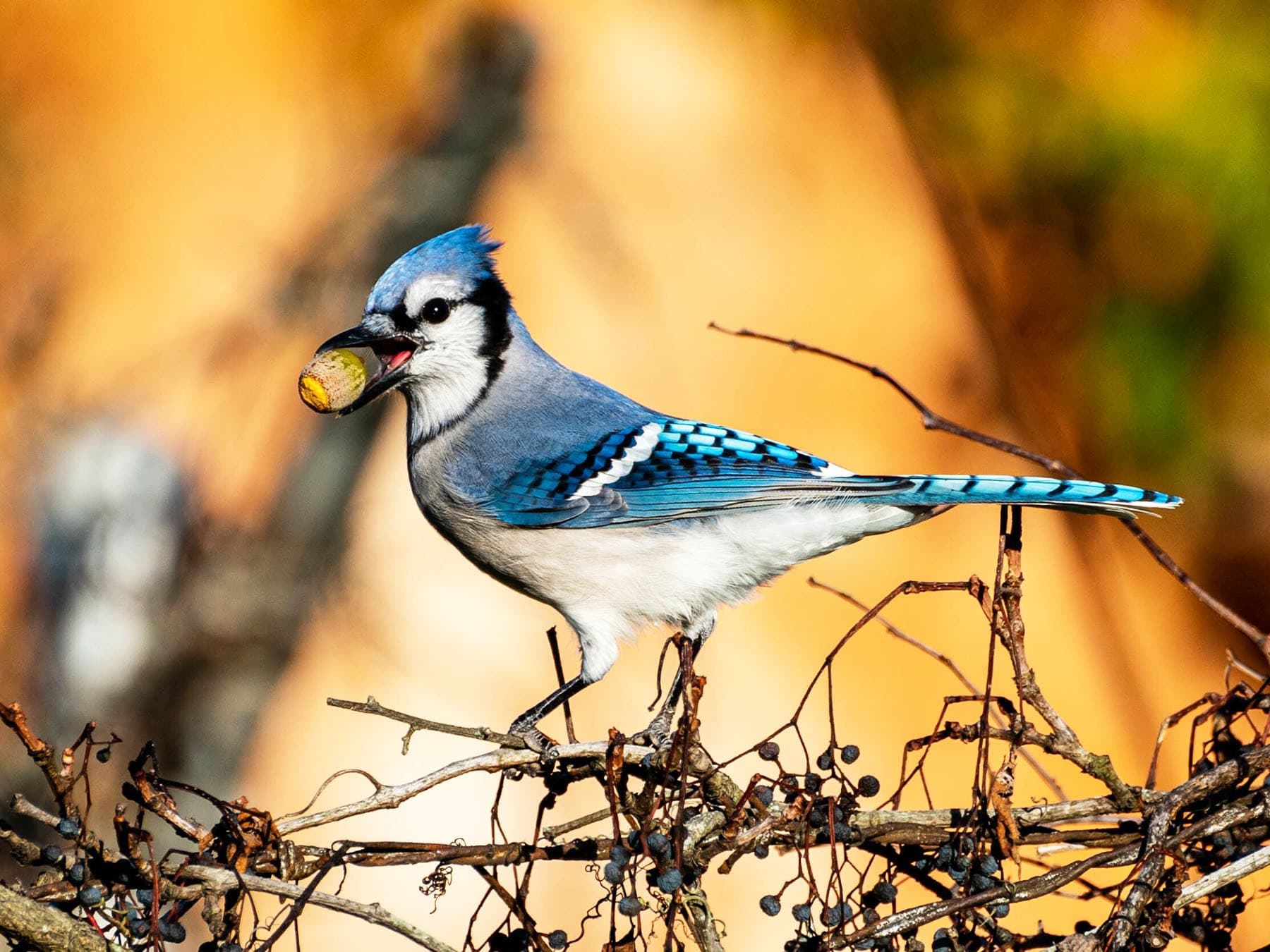
A Blue Jay nest is an open cup, sometimes bulky and sometimes neat. The outside is a basket of strong, fresh twigs, sometimes thorny, usually broken off living trees, often with a struggle. Bark, moss, lichen, dry leaves and grass go in with them, and often mud. Near houses they add bits of paper, tissue, cloth, string, wool and plastic, and in many areas they have a strong habit of adding plastic six-pack rings. The cup is lined with tough rootlets, and jays will fly a long way to find them where the soil has just been dug, in a new ditch or a fresh grave in a cemetery.1
Outside, the nest measures about 6.7 to 8.3 inches (17-21 cm) across and 4 to 4.7 inches (10-12 cm) deep; the cup inside is about 3.3 to 4.1 inches (8.5-10.5 cm) wide and 2.4 inches (6 cm) deep.
Who builds it
Both birds gather material and build, but the male does more of the collecting and the female more of the building, 2 Males often pass twigs to their mates.1 Building can take a few days or as long as several weeks. A pair may abandon a nest if disturbed or after seeing a predator: one pair left at once when a cat climbed the tree. That may explain the "false nests" once thought to be part of courtship, which Birds of the World doubts.
Pairs build a new nest most years, but they occasionally fix up and reuse an old one, sometimes one that another pair built. One nest was used in 5 of 6 years.
Blue Jay eggs
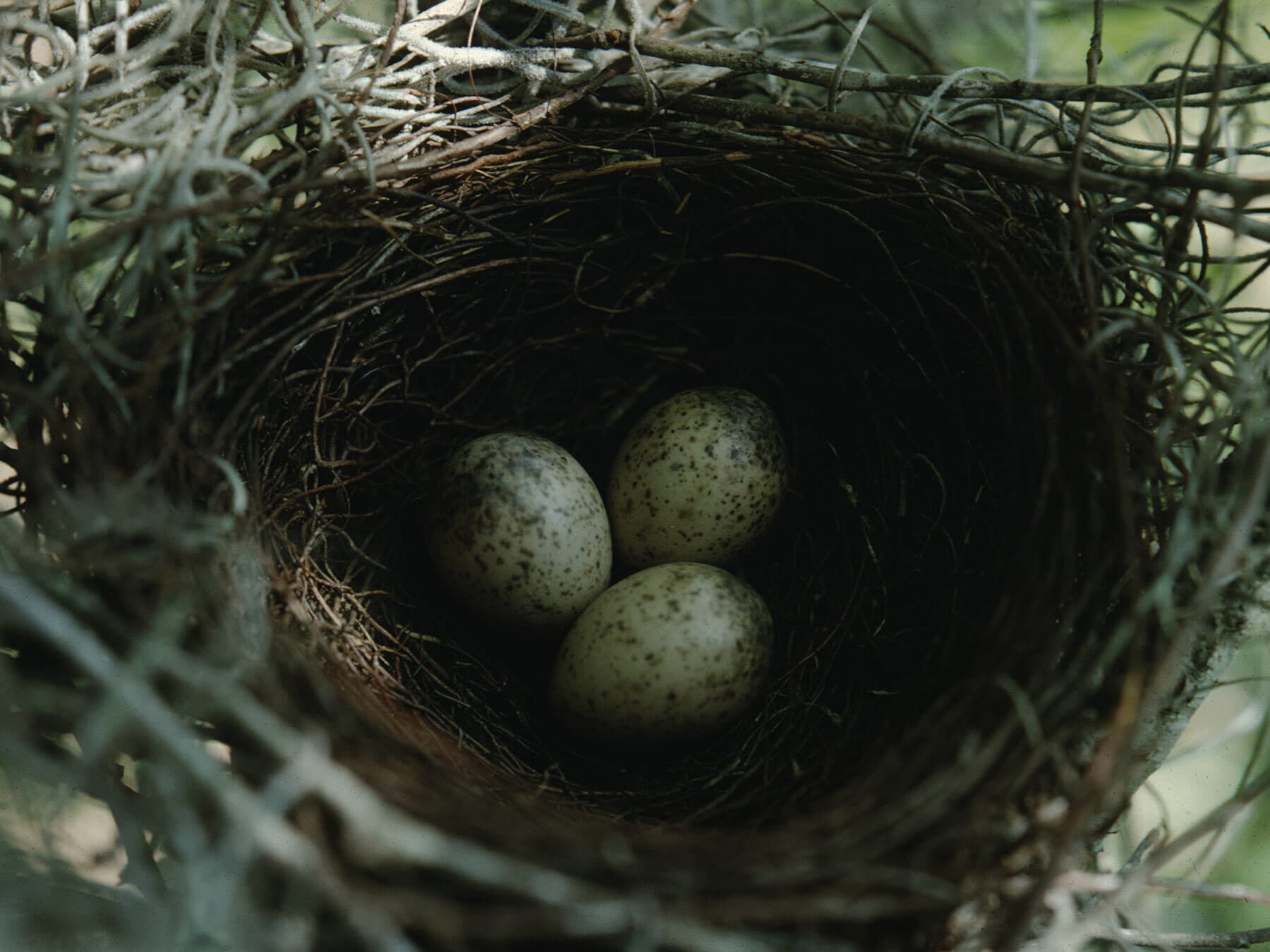
The eggs are oval and smooth, with little or no gloss, and they vary a lot in color: bluish, olive, buff or light brown, spotted with shades of brown, usually most thickly at the larger end. They average about 1.1 by 0.8 inches (28.0 by 20.4 mm).1
A clutch holds 2 to 7 eggs, typically 4 to 6 in the north and 3 to 4 in Florida. Average clutches were 4.0 eggs in southern Ontario (253 nests), 4.7 in Illinois (141 nests) and 3.4 to 3.7 in Florida samples. Clutches started early in the season are larger. The female probably lays one egg a day.
Incubation
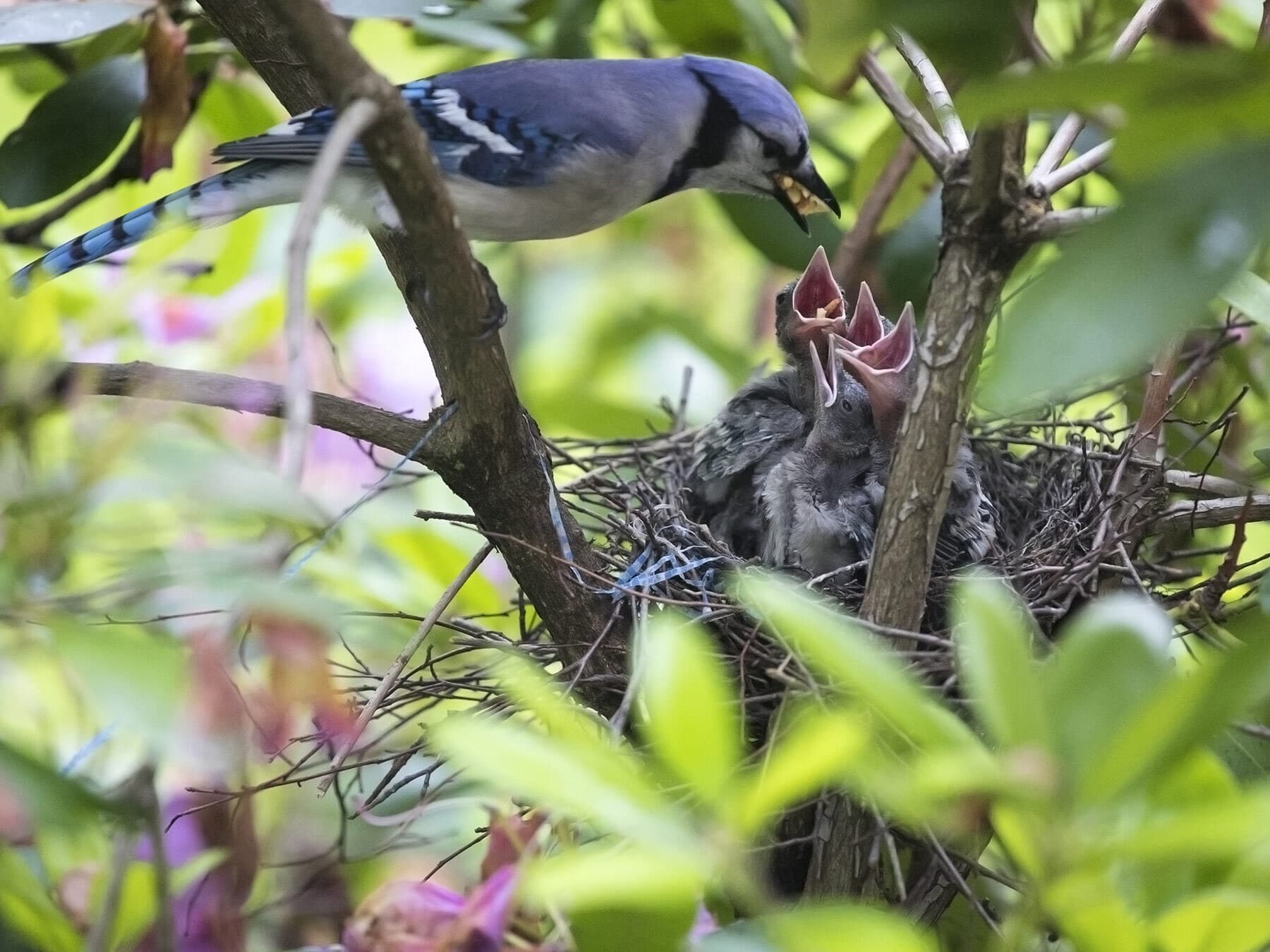
Only the female incubates, and she has the brood patch, a bare patch of skin on the belly that warms the eggs. The eggs take 17 to 18 days to hatch.2 She sits at least 40 minutes in every hour at first and almost all the time near hatching, and the male brings her all her food. All the eggs usually hatch on the same day, so daytime incubation probably starts with the next-to-last egg, although she seems to sit on the nest from the first.1 What happens next: baby Blue Jays.
How many broods?
Usually one a year.2 Raising a brood takes about 40 days, not counting building, and in natural habitats fewer than 40% of nests typically succeed, so few pairs are likely to raise more than one brood. Second broods have been reported in suburbs, where nests may do better, but there is little direct evidence from banded birds, and in natural habitat in south-central Florida no pair was found to raise two. Replacement clutches after a failure are common.1
Nest success and predators
Many nests fail, mostly to predators. In studies listed by Birds of the World, the share of nests that fledged at least one young was 54% in a small riparian sample in Iowa (12 nests), 52% in suburban Arkansas, 39% in suburban Florida and 66% statewide in Illinois, and ranged from 8% to 63% across seven Florida habitats. Nest predators include American and Fish Crows, other Blue Jays, squirrels, rat snakes, racers, coachwhips and Swallow-tailed Kites, and probably raccoons and opossums.
Blue Jays are rarely parasitized by cowbirds: a 1963 review found only 3 or 4 records of Brown-headed Cowbirds laying in their nests, and jays reject cowbird eggs.
Defending the nest
Many nesting Blue Jays defend the nest hard. Both birds chase squirrels and people that come within several meters, and they mob hawks, owls, snakes, raccoons and cats. When a person checks a nest, the parents usually swoop and sometimes strike, calling loudly, while other pairs only call or slip away. A male often gives a soft bell-like call when a person approaches the nest tree; if the person climbs it, he and often the female switch to loud jeers.1 Disturbed often enough, a pair may desert the nest.
Nest boxes
Blue Jay nests and the law
Blue Jays are on the U.S. Fish and Wildlife Service's list of birds protected by the Migratory Bird Treaty Act,4 and the Act makes it unlawful, except as regulations allow, to take or possess a migratory bird or any part, nest or egg of one.5 In Canada, the crow family, which includes jays, is not covered by the federal Migratory Birds Convention Act, but Environment and Climate Change Canada notes that such birds may be protected under provincial or territorial law.6
Sources
- Smith, K. G., Tarvin, K. A., Woolfenden, G. E. (2020). Blue Jay (Cyanocitta cristata), version 1.0. Birds of the World (A. F. Poole, editor). Cornell Lab of Ornithology. doi:10.2173/bow.blujay.01
- Cornell Lab of Ornithology. Blue Jay. All About Birds. Accessed October 14, 2026. Source
- NestWatch (Cornell Lab of Ornithology). All About Birdhouses: nest box and nest structure plans by species. NestWatch. Accessed October 14, 2026. Source
- U.S. Fish and Wildlife Service (2023). 50 CFR 10.13: List of Birds Protected by the Migratory Bird Treaty Act. Electronic Code of Federal Regulations. Accessed October 14, 2026. Source
- United States Congress (1918). Migratory Bird Treaty Act, 16 U.S.C. 703. United States Code, Title 16, section 703 (Legal Information Institute). Accessed October 14, 2026. Source
- Environment and Climate Change Canada. Birds protected under the Migratory Birds Convention Act. Government of Canada. Accessed October 14, 2026. Source
- Parliament of Canada (1994). Migratory Birds Convention Act, 1994 (S.C. 1994, c. 22), Schedule: Convention and Protocol, Article I. Justice Laws Website. Accessed October 14, 2026. Source