Facts · Updated 14 Oct 2026
What Do Blue Jays Eat? Diet, Acorns, Insects and Feeders
By the Birdfact teamChecked by Nathan Cope
Blue Jays eat nuts more than anything else, above all acorns, plus insects, corn and fruit, and a little of almost everything else. Here is what stomach studies found month by month, why jays are so choosy about acorns, what they take at feeders, and how often they really eat other birds.
On this page12 sections
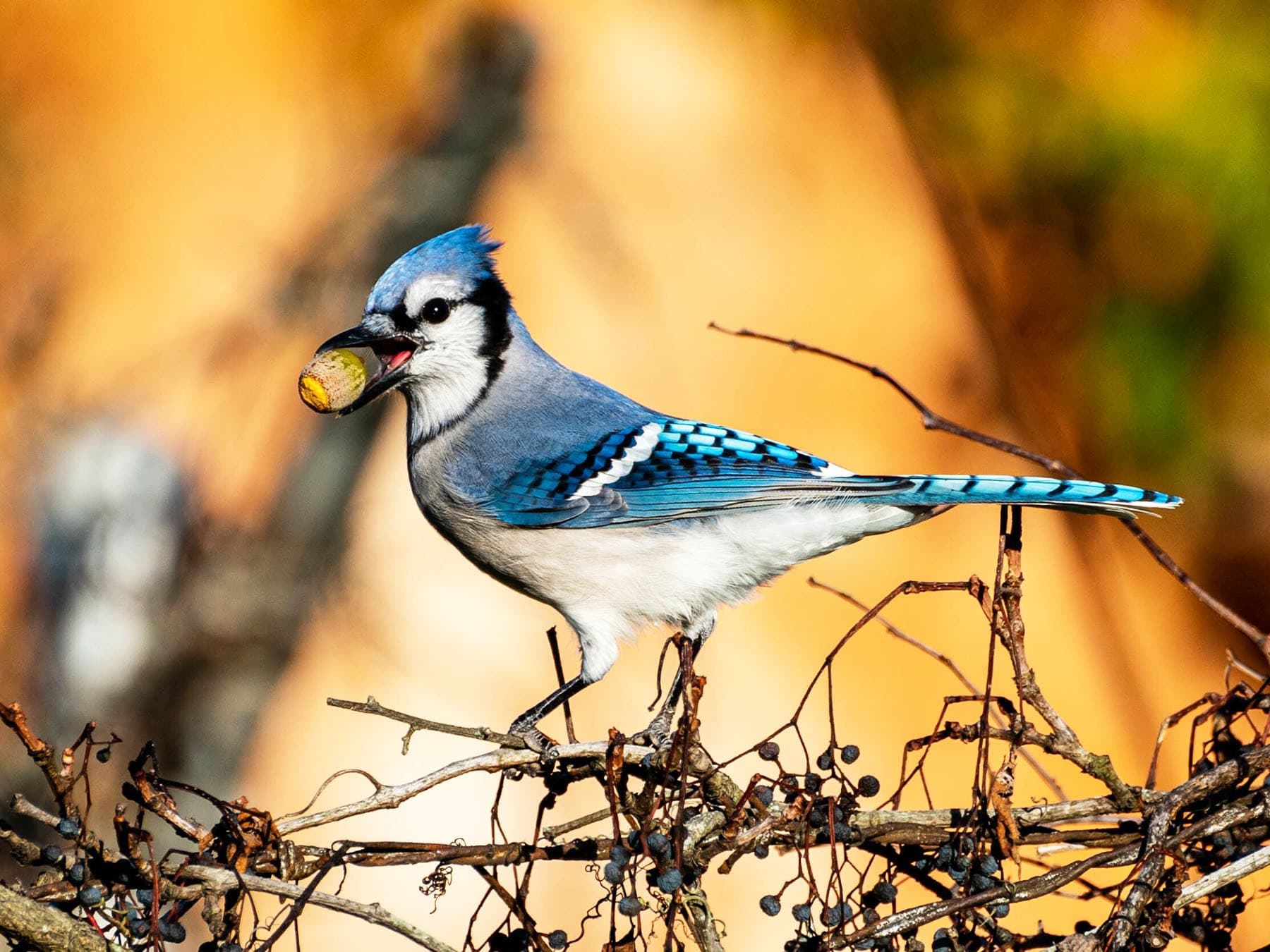
Blue Jays eat almost anything, but nuts more than anything else. This page goes through what they eat over a year, from the stomach studies that measured it to what they take at feeders, and what that means for anyone who feeds them. For the bird itself, see our Blue Jay guide.
What do Blue Jays eat?
Acorns and other nuts above all, then insects, grain and fruit. The best measure is still a federal study of 530 Blue Jay stomachs collected through the year in 30 eastern states and Canada, published by F. E. L. Beal in 1915 with the jay section written by E. R. Kalmbach. Nuts, mostly acorns but also beechnuts, chestnuts and hazelnuts, were over 43% of the year's food and about two-thirds from October to March. Insects were about 22%, corn about 18% and wild fruit about 7%; the rest included cultivated fruit.1
That makes the Blue Jay an omnivore that leans heavily on plants. Alongside the main foods, jays also take spiders, millipedes, snails, other birds' eggs and nestlings, mice, bats, tree frogs, lizards and carrion; Birds of the World says it takes small vertebrates occasionally, perhaps frequently.2
A year of food
The menu changes with the seasons. Beal's earlier study of 292 stomachs, published in 1897, tracked it month by month.3
| Season | What the stomachs held |
|---|---|
| Winter | Insects under 1% of food in January; nuts and corn. |
| Spring | Insects rising: 28% in May. |
| Summer | Insects 44% in June, 46% in July and 66% in August, when grasshoppers (19.5%) and caterpillars (11.4%) peaked; fresh fruit over 39% in July. |
| Fall and early winter | Nuts take over: over 64% of food in October, nearly 82% in November, almost 83% in December. |
Corn looked big in the January stomachs, nearly 56%, but Beal noted that about a third of them came from jays shot at a corncrib when snow lay 3 feet deep. In October and November, when corn and nuts were equally easy to reach, the jays took nuts: corn was 1.1% of October food. Nuts were a quarter to three-quarters of the food in every month except July and August.3
Acorns and other nuts
Each fall a Blue Jay probably harvests and eats or buries several thousand acorns, beechnuts, hazelnuts or hickory nuts. It is choosy. Wild jays prefer pin oak and willow oak acorns and generally leave red oak and white oak acorns alone; they pick nuts free of weevils, usually take the smaller acorns, and may eat only the base of a willow oak acorn, which holds less tannin. A jay usually carries 1 to 5 acorns a trip, or up to 15 beechnuts, held in its throat, mouth and bill tip, and to open one it pins it under a foot and hammers it with its bill.2 For the burying, and how it helps oaks spread, see the acorn section of our Blue Jay guide.
Acorns are not a complete diet. In a captive study summarized by Birds of the World, jays fed only acorns lost weight, perhaps because acorn tannins interfere with protein digestion; they kept their weight when about 110 weevil larvae a day were added.2 Burying did not help: red and bur oak acorns that had spent a simulated winter in the ground were just as rich in tannin, and jays lost weight on them too.4 In a Virginia acorn harvest, 19 of 23 jay stomachs held acorn and 20 held insects or spiders.4
Insects and other small animals
Insects are the summer food. In the 530-stomach study grasshoppers were nearly a fifth of the food in August and caterpillars about a tenth in July and August; beetles, wasps and ants added smaller shares. In winter jays hunt out tent caterpillar eggs and, in New England, the overwintering larvae of the brown-tail moth.1 Beal also passed on an early report that jays ate the eggs, pupae and larvae of the gypsy moth.3
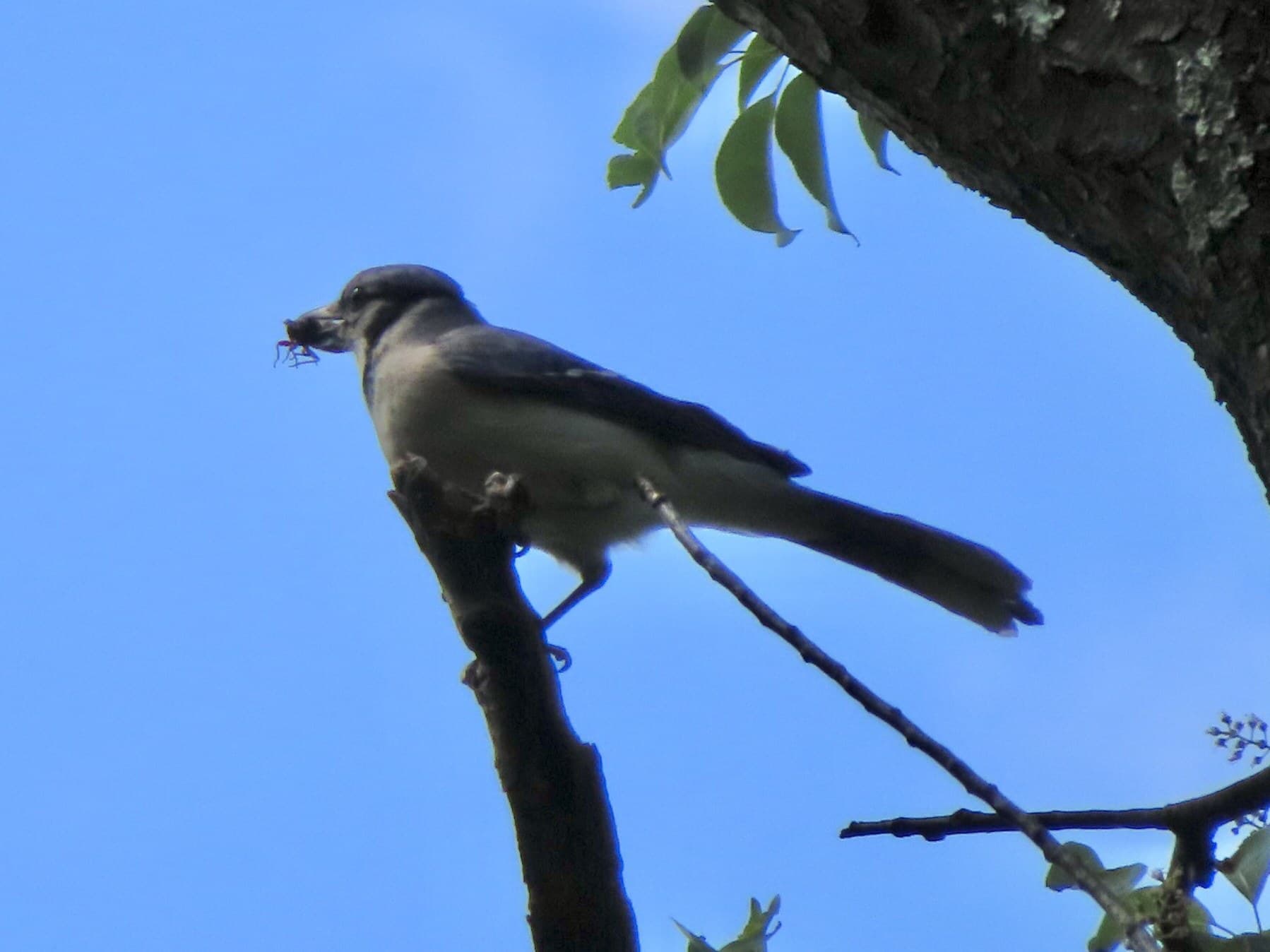
In Florida, Blue Jays seem especially fond of cicadas and dragonflies, sometimes caught in the air, and jays will even pull a small paper-wasp nest off its stalk, hold it under one foot and eat the larvae cell by cell. They learn fast to avoid prey that tastes bad: jays fed monarch butterflies raised on milkweed vomited and then refused monarchs.2 Big cicada years show up in their numbers too: Blue Jays increased 1 to 3 years after periodical cicada emergences, then fell back.5
Fruit, seeds and grain
Corn is the jay's main grain, about 18% of the year's food, eaten mostly in winter and early spring, much of it waste grain.1 Cultivated fruit is a small share, though the 1915 bulletin thought July's 15% justified some complaints.1 Beal's 1897 study listed fruits such as blueberries, wild cherries, wild grapes, elderberries and pokeberries (and blackberries, probably mostly wild), and noted that jays eat sumac seeds but not the seeds of poison ivy or poison sumac.3
City jays and country jays
What a jay eats depends on where it lives. In Kansas in 1907, L. L. Dyche compared September stomachs: jays from wooded country ate over 60% acorns and barely touched corn, while jays in the city of Lawrence ate over 50% grain, mostly corn. Town jays in winter had eaten cooked meat, bread, rice, boiled eggs, apples and bananas, and their gizzards occasionally held beads, buttons and bits of broken china.6
At the feeder
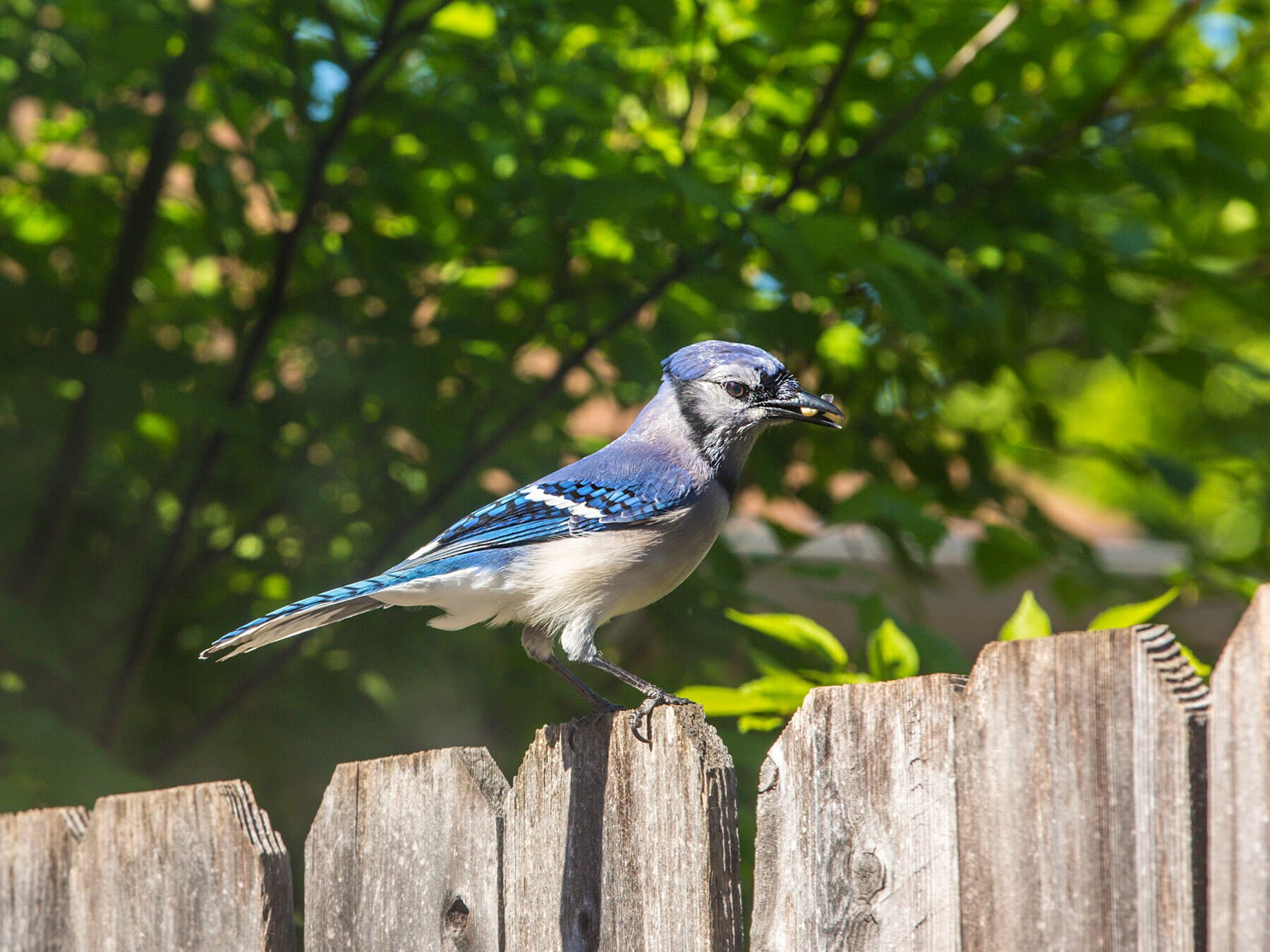
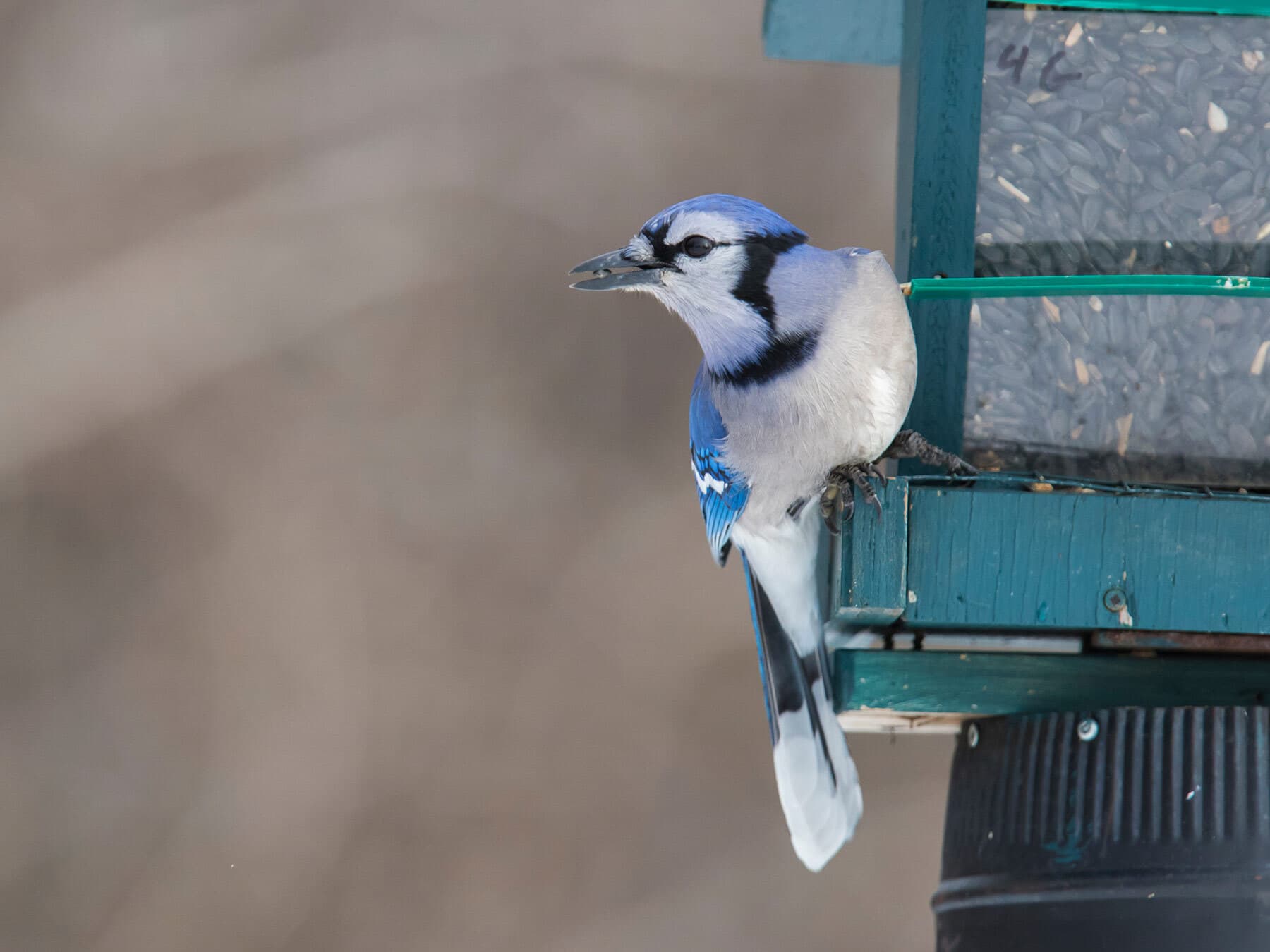
Blue Jays come to feeders most in winter, and they like big foods. In a federal feeder study in Maryland, with over 179,000 bird visits recorded, whole peanut kernels were the jay's favorite, followed by black-striped and gray-striped sunflower seeds; no other food came close, and small oil-type sunflower seed was less than a fifth as attractive.7 They largely ignore small seeds like millet and milo.
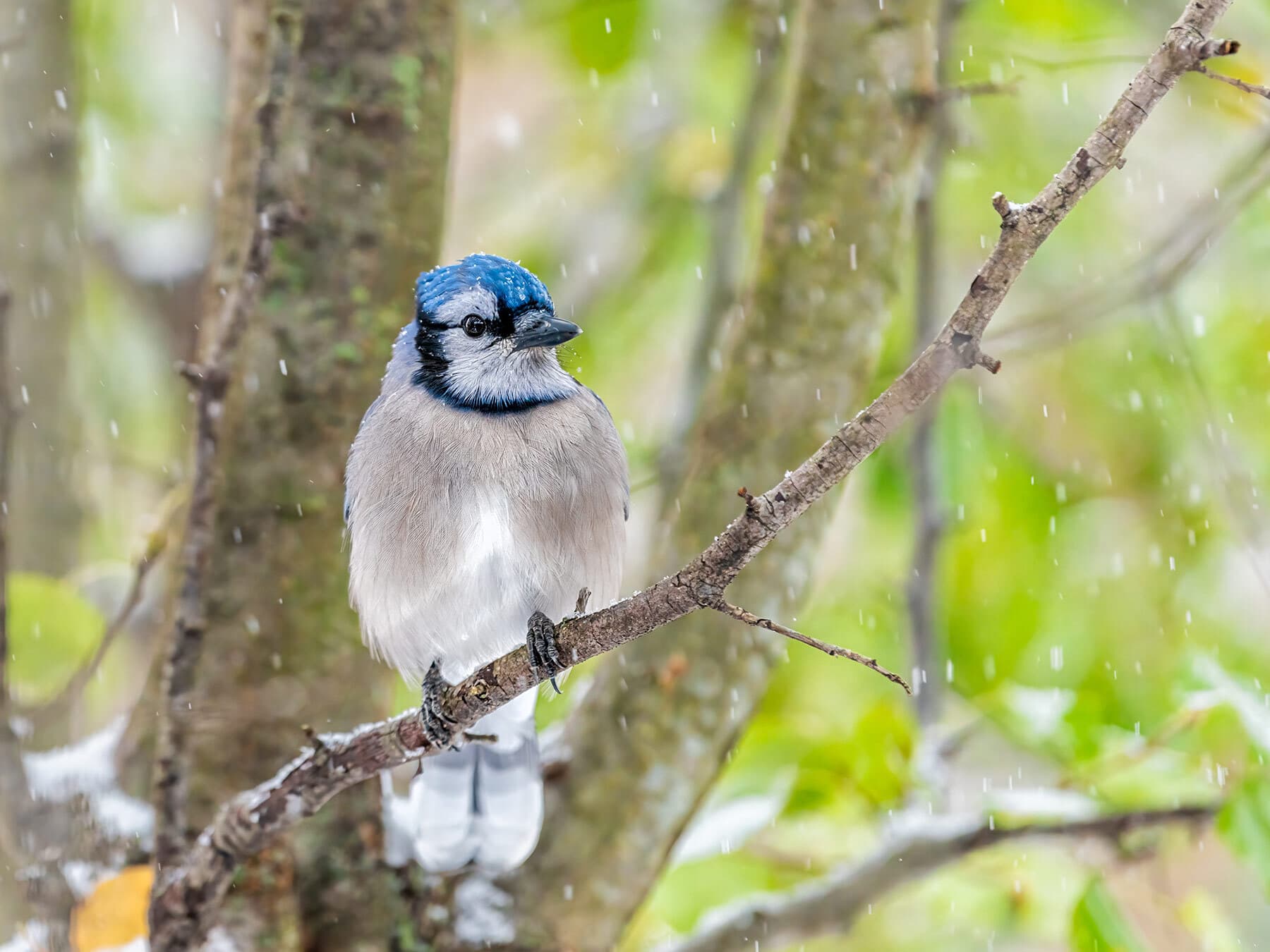
All About Birds recommends platform or hopper feeders mounted on posts over hanging ones, stocked with peanuts, sunflower seeds and suet, and planting oaks.8 Project FeederWatch adds cracked corn, safflower, mealworms and fruit.9 Jays use calcium put out at feeders very often, and may store it in fall.10 More on jays in cold weather: Blue Jays in winter.
How Blue Jays handle food
A jay holds a hard item, such as an acorn, a big insect or a piece of dog food, against a branch with one foot (sometimes both) and hammers it with its bill; a strengthened lower jaw takes the shock. Soft foods such as bread or fruit are held the same way while pieces are pulled off. It can carry several nuts at once in a stretchy throat, and it buries what it does not eat, usually covering each nut with a dead leaf or a pebble.2
Do Blue Jays eat other birds?
Sometimes, but much less than their reputation suggests. In the 530-stomach study, special searches turned up remains of wild birds or their eggs in just 6 stomachs, and 39 jays had eaten hen's eggs, much of it picked up at rubbish heaps.1 Cameras at real nests have filmed jays making anywhere from none to about 15% of the raids. The full evidence: do Blue Jays eat other birds?
Water and grit
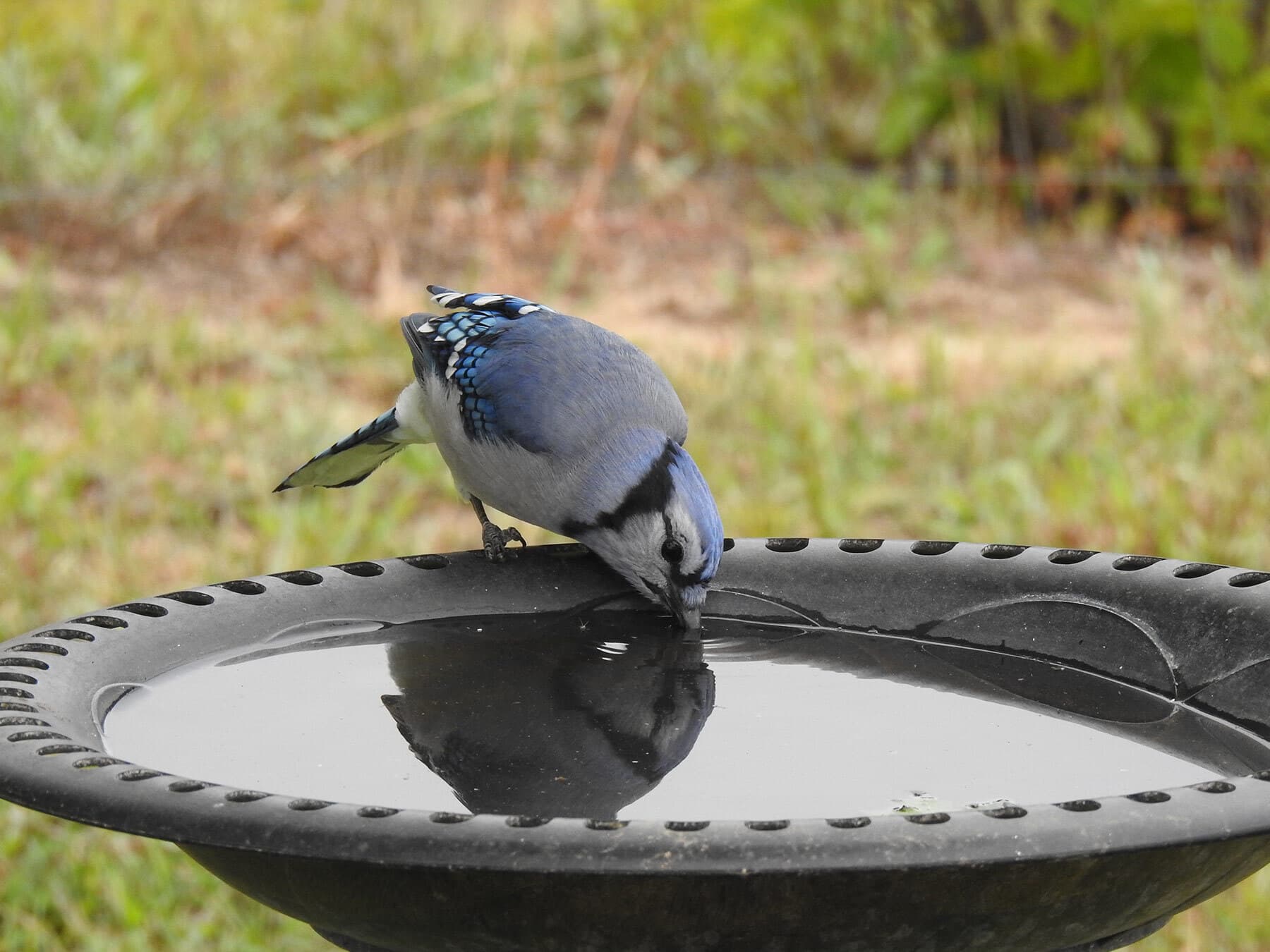
Blue Jays drink by dipping the bill and tipping the head back, sometimes lap drops from leaves, and have been reported eating snow when no water is available. They swallow grit, which presumably helps grind food, and cough up pellets of what they cannot digest.2
Feeding the young
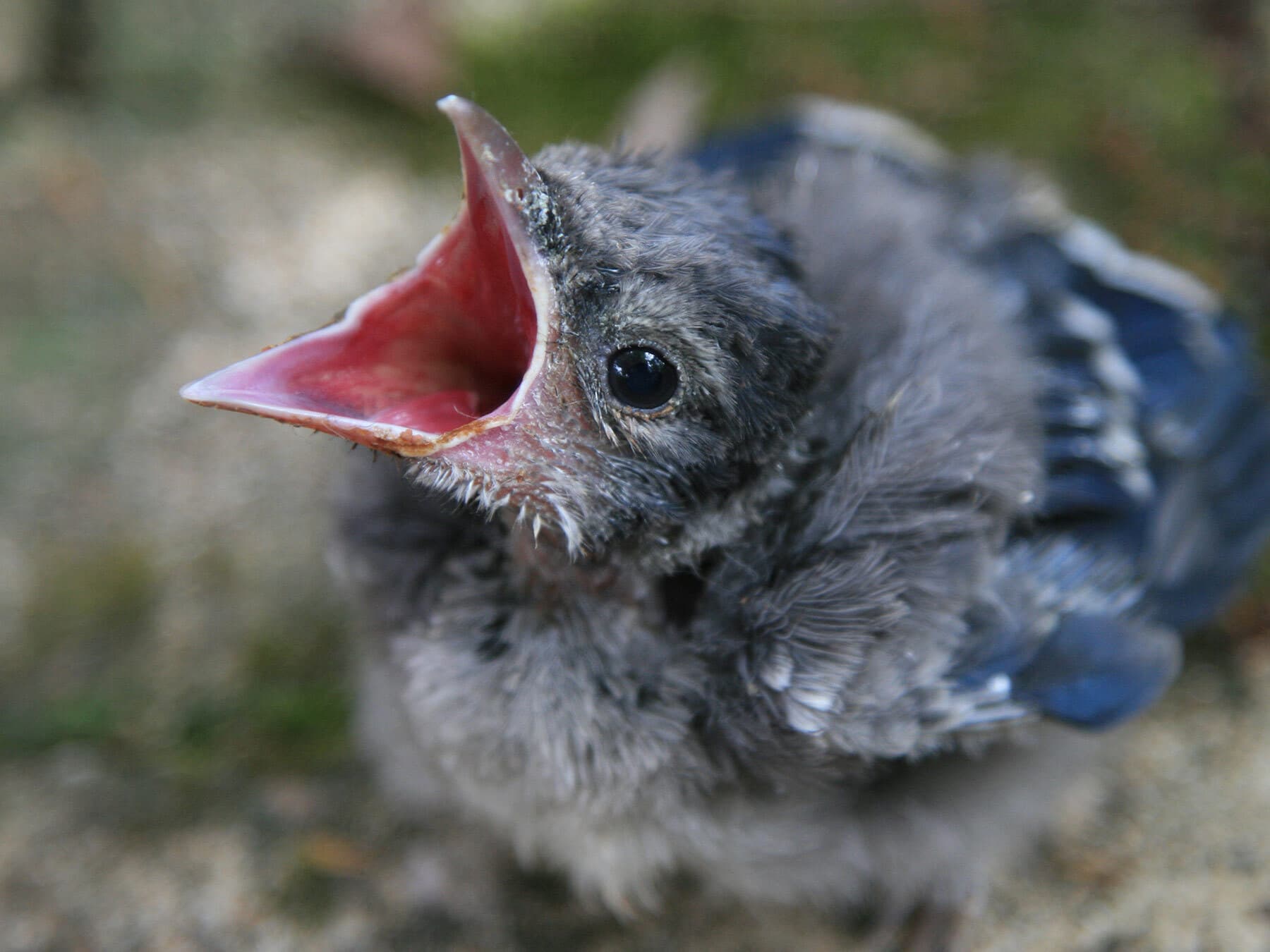
We found no modern study of what nestling Blue Jays are fed. Beal passed on an early report of jays carrying gypsy moth caterpillars, apparently to their young.3 At first the male brings virtually all the food for the young and the brooding female; midway through the nestling period the female starts to forage too.2 The parents keep feeding the young for at least a month after they leave the nest, sometimes two.8 What to do if you find one: baby Blue Jays.
Sources
- Beal, F. E. L., Kalmbach, E. R. (1915). Some Common Birds Useful to the Farmer (Farmers' Bulletin 630; revised 1923). U.S. Department of Agriculture. Accessed October 14, 2026. Source
- Smith, K. G., Tarvin, K. A., Woolfenden, G. E. (2020). Blue Jay (Cyanocitta cristata), version 1.0. Birds of the World (A. F. Poole, editor). Cornell Lab of Ornithology. doi:10.2173/bow.blujay.01
- Beal, F. E. L. (1897). The Blue Jay and its food. Yearbook of the United States Department of Agriculture, 1896: 197-206. Accessed October 14, 2026. Source
- Dixon, M. D., Johnson, W. C., Adkisson, C. S. (1997). Effects of Caching on Acorn Tannin Levels and Blue Jay Dietary Performance. The Condor 99(3): 756-764. doi:10.2307/1370486
- Koenig, W. D., Liebhold, A. M. (2005). Effects of periodical cicada emergences on abundance and synchrony of avian populations. Ecology 86(7): 1873-1882. doi:10.1890/04-1175
- Dyche, L. L. (1907). Some Observations on the Food Habits of the Blue Jay (Cyanocitta cristata). Transactions of the Kansas Academy of Science 21: 130-135. doi:10.2307/3624527
- Geis, A. D. (1980). Relative Attractiveness of Different Foods at Wild Bird Feeders (Special Scientific Report, Wildlife 233). U.S. Fish and Wildlife Service. Accessed October 14, 2026. Source
- Cornell Lab of Ornithology. Blue Jay. All About Birds. Accessed October 14, 2026. Source
- Project FeederWatch (Cornell Lab of Ornithology and Birds Canada). Common Feeder Birds: Blue Jay. Project FeederWatch. Accessed October 14, 2026. Source
- Dhondt, A. A., Hochachka, W. M. (2001). Variations in Calcium Use by Birds During the Breeding Season. The Condor 103(3): 592-598. doi:10.1093/condor/103.3.592