Facts · Updated 14 Oct 2026
Blue Jays in Winter: Do They Migrate, and Where Do They Go?
By the Birdfact teamChecked by Nathan Cope
Most Blue Jays stay put in winter, but some migrate, by day and in loose flocks, mostly to the south and southwest. Here is what banding shows about which jays go and where, the huge flights along the Great Lakes, why some migrate, and how the ones that stay survive the cold.
On this page11 sections
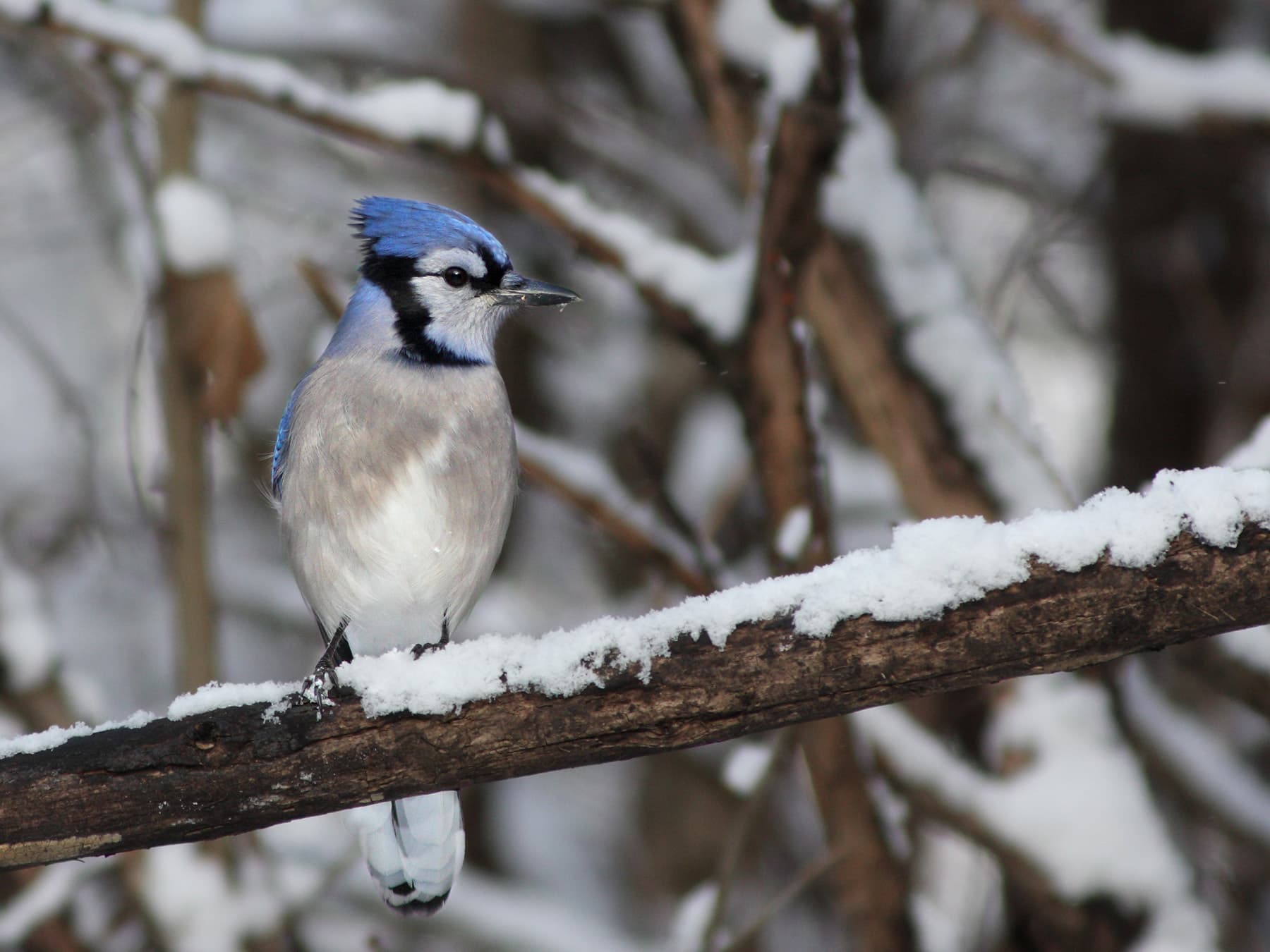
You can see Blue Jays all year across most of eastern North America, yet every fall thousands stream south along lakeshores and coasts. This page explains which jays migrate, where they go, how the ones that stay get through the cold, and what they do at feeders in winter. For the bird itself, see our Blue Jay guide.
Do Blue Jays migrate?
Some do, but most don't. The Blue Jay is the only jay in the Americas that migrates north and south, yet in almost every part of its range some birds stay all year, and Birds of the World puts the share that migrates at probably no more than 20%, even in the north.1 One large banding study, of 101,903 jays banded in Florida, Massachusetts, New Jersey and New York, followed the jays banded in the nesting season that someone else later found: about 11% (74 of 680) had left the state where they were banded, from 18% in New Jersey and 6% in Massachusetts to just 1 of 154 in Florida.2 Wenger's 1975 analysis of all North American banding recoveries put the truly migratory share under 10%.3
Local numbers can be very different. In Nashville, Tennessee, Amelia Laskey, who banded about 1,000 jays over 25 years, found that most of her summer jays left in September and came back in late March and April, while a few older birds stayed.4
Where do Blue Jays go in the winter?
South, though not all in the same direction: eastern jays head southwest, western jays southeast.1 Banding shows that Massachusetts jays winter along the coast as far as Georgia and inland to Alabama, while New York jays winter farther west, as far as Kentucky, Tennessee and West Virginia, though 7 of the 17 recovered were in neighboring Pennsylvania. One Massachusetts jay was in Maryland at most 18 days after it was banded, and one adult banded in New Jersey in July was found in Georgia in June three years later, about 1,225 km (760 miles) away.2 On the western Great Plains and farther west, beyond the 100th meridian, jays move southeast in winter: in one study the birds recovered at a distance had moved an average of 462 km (287 miles), three of them more than 1,200 km (745 miles).5
Florida's breeding jays stay put,2 and in winter some northern jays join them in the north of the state.1 In the West, winter records jumped in the 1970s, from a handful before 1972 to over 220 in the winter of 1976-77, many of them at feeders,3 and Birds of the World says the jay is apparently becoming a regular migrant in small numbers in southern British Columbia, Washington, Oregon and northern Utah.1
Young and old migrants
Migrants are not just the young. Banding analyses found no clear age difference: of 23 Massachusetts and New York jays recovered in other states, 10 had traveled as young birds and 13 as adults.2 At Whitefish Point on Lake Superior, though, Birds of the World reports that 72% of 1,271 spring migrants caught over several years were aged as second-year birds, about a year old. The share swung from 2% to 90% between years, not every bird could be aged, and age ratios at one site are muddied by dispersal and by good and bad breeding years.1
The same bird can migrate one year and stay the next. Laskey's banded female "Blink" migrated in her first winter, stayed with her parents the second, and migrated again the third.4 Birds of the World notes that an adult that presumably bred in one place may spend a later summer much farther south.1
Timing and flight
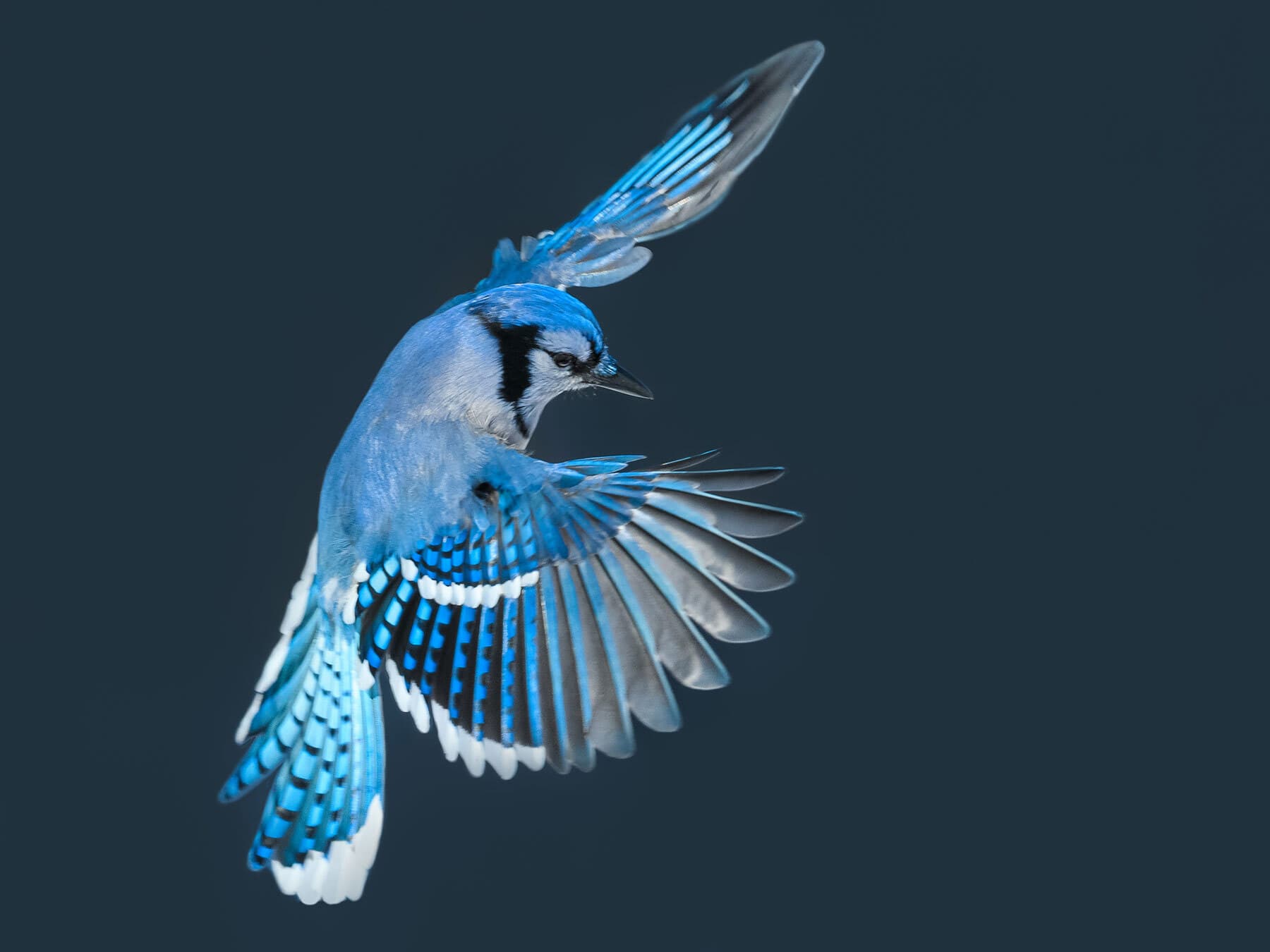
Fall migration runs mostly from mid-September to late October, peaking in late September and early October; in spring, mostly from late April to late May, later in the north. Jays travel by day, starting about an hour after sunrise and usually stopping by noon, in loose strings, probably most often of 10 to 30 birds, anywhere from treetop height to about 300 m (1,000 feet) up, typically 175 to 200 m (about 575 to 660 feet). Before crossing a big lake they often circle up, hesitate, turn back and try again. They are usually silent in the air.1 At Hawk Mountain, Pennsylvania, Maurice Broun noted that as a rule they kept just above the treetops.6 Audubon noticed the daytime habit in 1842: the Blue Jay "migrates from one part to another during the day only."7
Once, a flight went badly wrong. In 1972 thousands of jays flew west along barrier islands about 17 km (11 miles) off the Gulf Coast, and more than 900 dead jays per kilometer (about 1,450 per mile) washed up on at least two islands in the Mississippi Sound.1
The big flights
Where migrants are funneled along a shoreline, the numbers are spectacular. At Holiday Beach on the north shore of Lake Erie, counters logged 264,410 Blue Jays on September 28, 2001, have averaged at least 292,126 a fall over 28 years, and counted at least 934,592 in 2009.8 At Hawk Ridge above Lake Superior in Duluth, Minnesota, the fall of 2023 set a season record for Blue Jays,9 and on September 10, 2025, counters tallied 15,280 in a day, a Minnesota high count.10 Back in 1939, Broun counted about 7,350 jays passing Hawk Mountain in 16 days.6
Why some jays migrate
Why only some jays migrate is still unclear. A popular idea is food: big fall flights seem to follow poor acorn and beechnut crops in the north.8 At Holiday Beach, the two biggest flights from 2006 to 2010 came in years of poor beech crops (in 2009 the oak and hazel crops were poor too), though that is only five seasons,8 and Broun guessed in 1939 at a shortage of nuts.6 But the evidence is mixed. Across 17 Missouri counties, acorn crops did not predict winter jay numbers,11 while winter counts in the Ozarks did follow the nut crop in some places.12 One banding researcher pointed out that jays start moving when food is plentiful and saw migration as an urge to disperse,2 and another suggested a genetic basis.3
Bird feeders may play a part. Researchers have suggested that winter feeding helps more jays stay farther north and west,3 but Birds of the World says that has not been clearly shown.1
How do Blue Jays survive the winter?
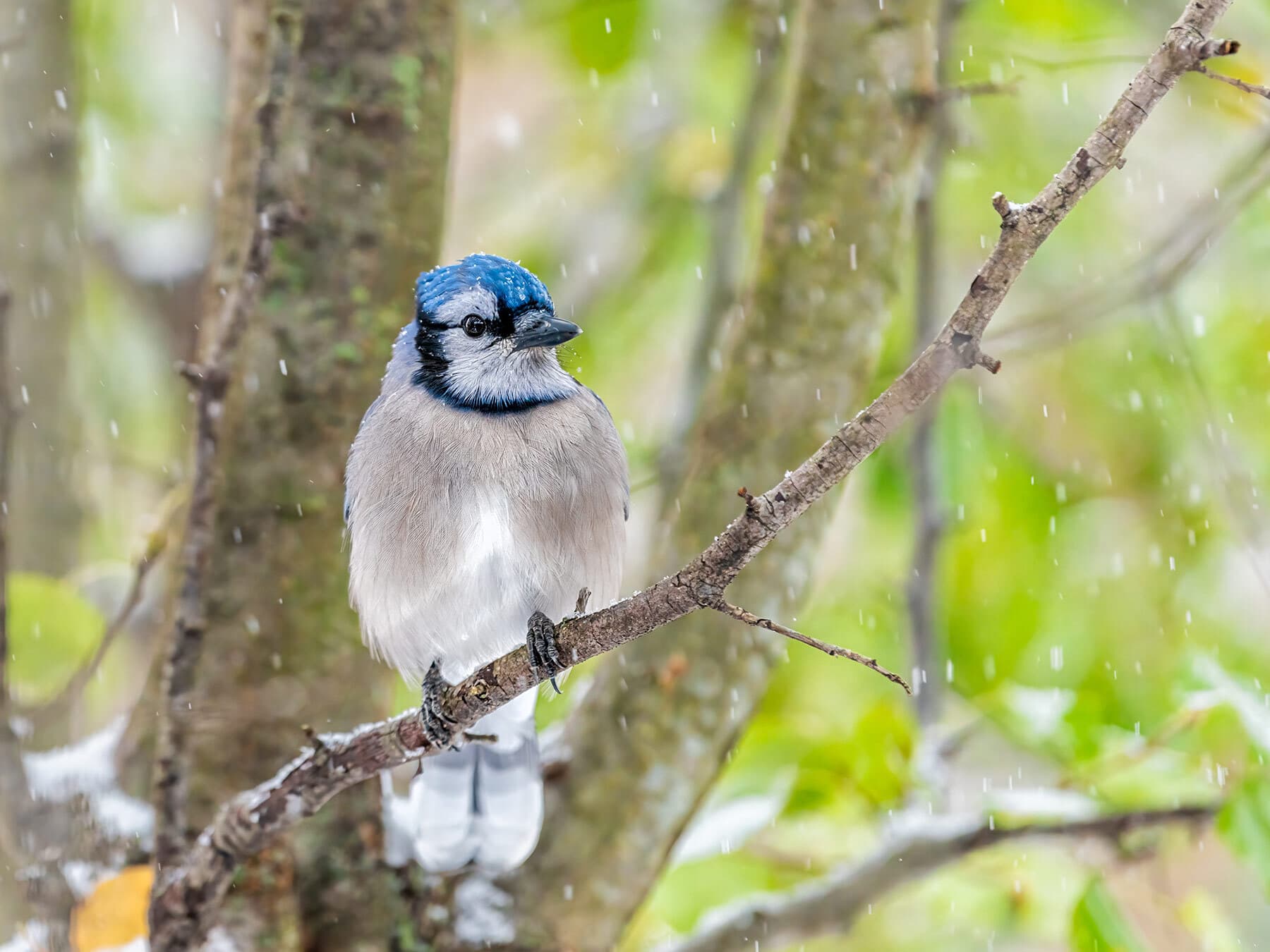
With a cold-hardy body, a sheltered roost and a varied diet. In tests on Illinois jays acclimated to winter, half survived temperatures as low as -22°F (-30°C); a jay's feathers more than halve the heat it loses, and in the cold its legs may run at half the body's temperature.1
Some go to bed very early. In January 1963 in Silver Spring, Maryland, Cynthia Turner watched two to five jays roost among the dead leaves that small oaks keep through winter. They arrived shortly before 1 p.m., more than four hours before sunset, and stayed until just before sunrise, leaving less than six hours a day to feed.13
Stored food probably helps, though how much jays recover has not been studied in the wild. Jays bury acorns in fall,1 and at feeders they carry off seed and bread to bury in the ground or in snow, finding some of it later.4 When water freezes, jays have been reported eating snow, and they eat carrion, perhaps most often in winter.1 More on winter food: what Blue Jays eat.
Winter flocks
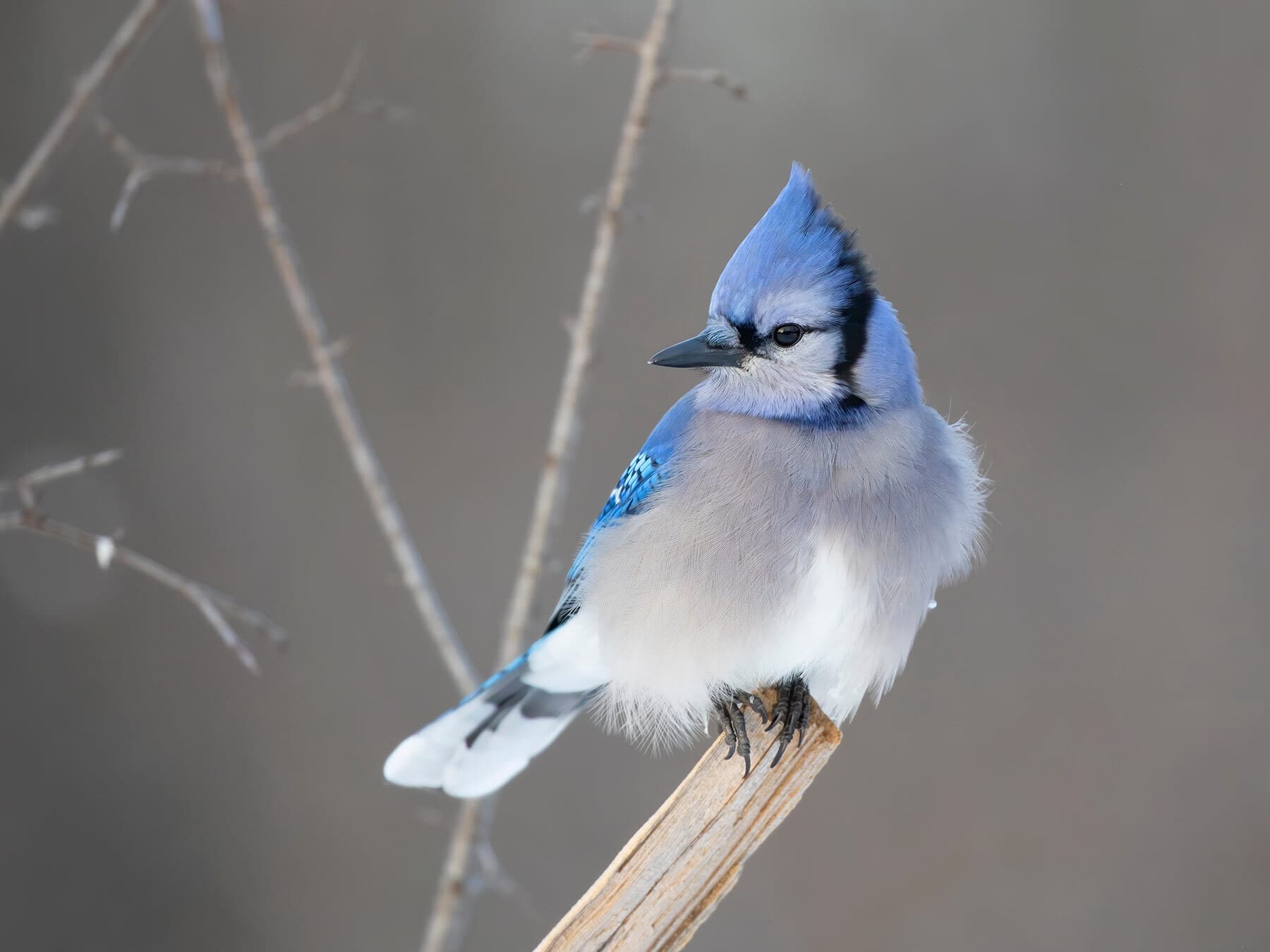
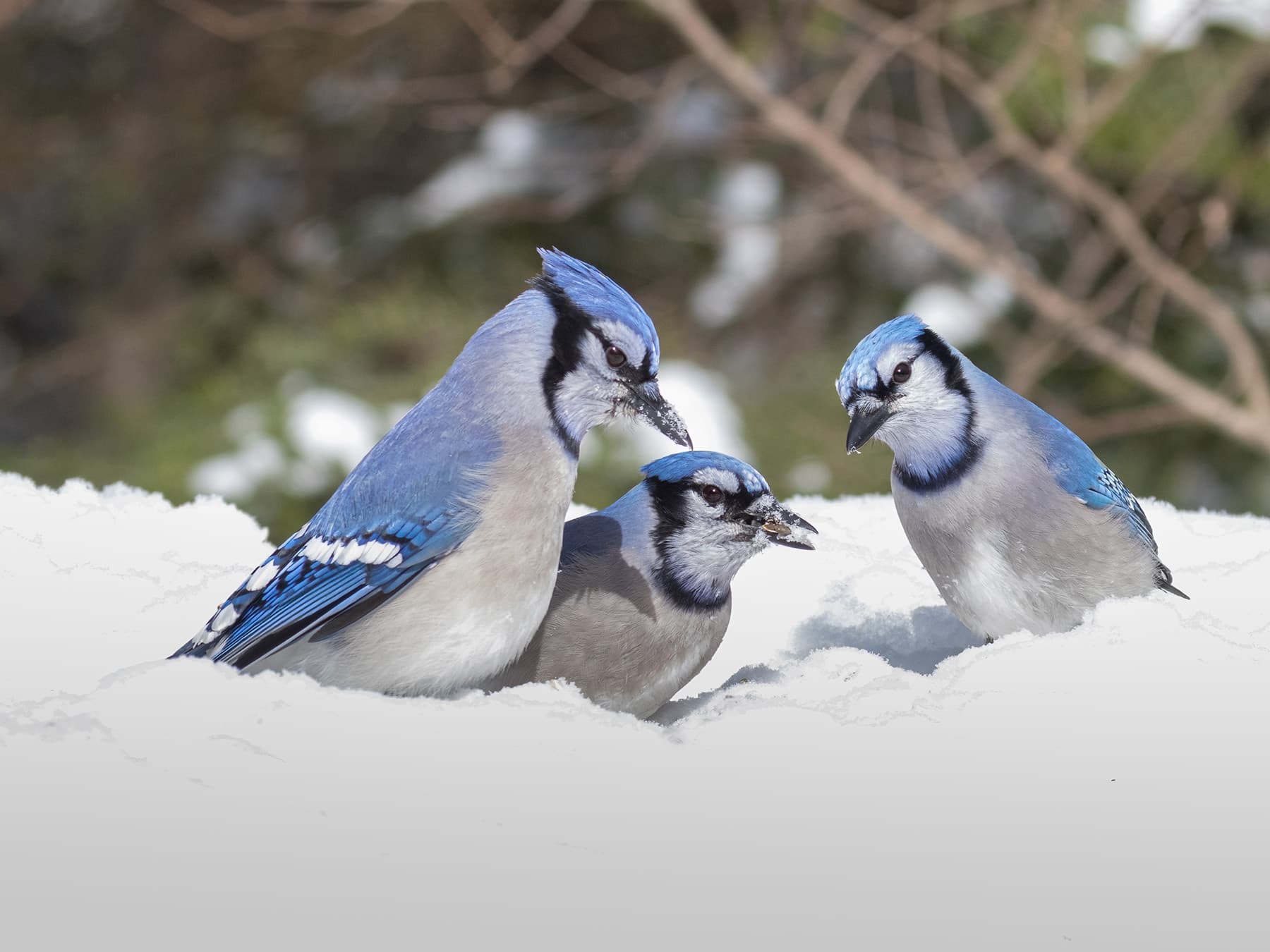
Winter jays often live in loose groups. In central Massachusetts, a group of jays spent each winter around one backyard feeder, kept apart from the neighboring group, and had a stable pecking order; many birds came back in later winters, and the groups' bell calls differed enough to tell them apart.14 Elsewhere groups are looser: in Michigan, winter jays shared a range and a night roost but never moved as a unit.1 Along the East Coast, numbers shift between New England and the Mid-Atlantic in some winters, but jays almost never abandon a wintering area altogether.15
Winter jays are quieter, too. Tyler wrote that after "his burst of noise in the autumn" the jay uses mainly its jeer in the cold months, but on mild mornings in January and February whistles a sweet "Tea-cup, tea-cup."16 More: Blue Jay sounds.
Do Blue Jays nest in winter?
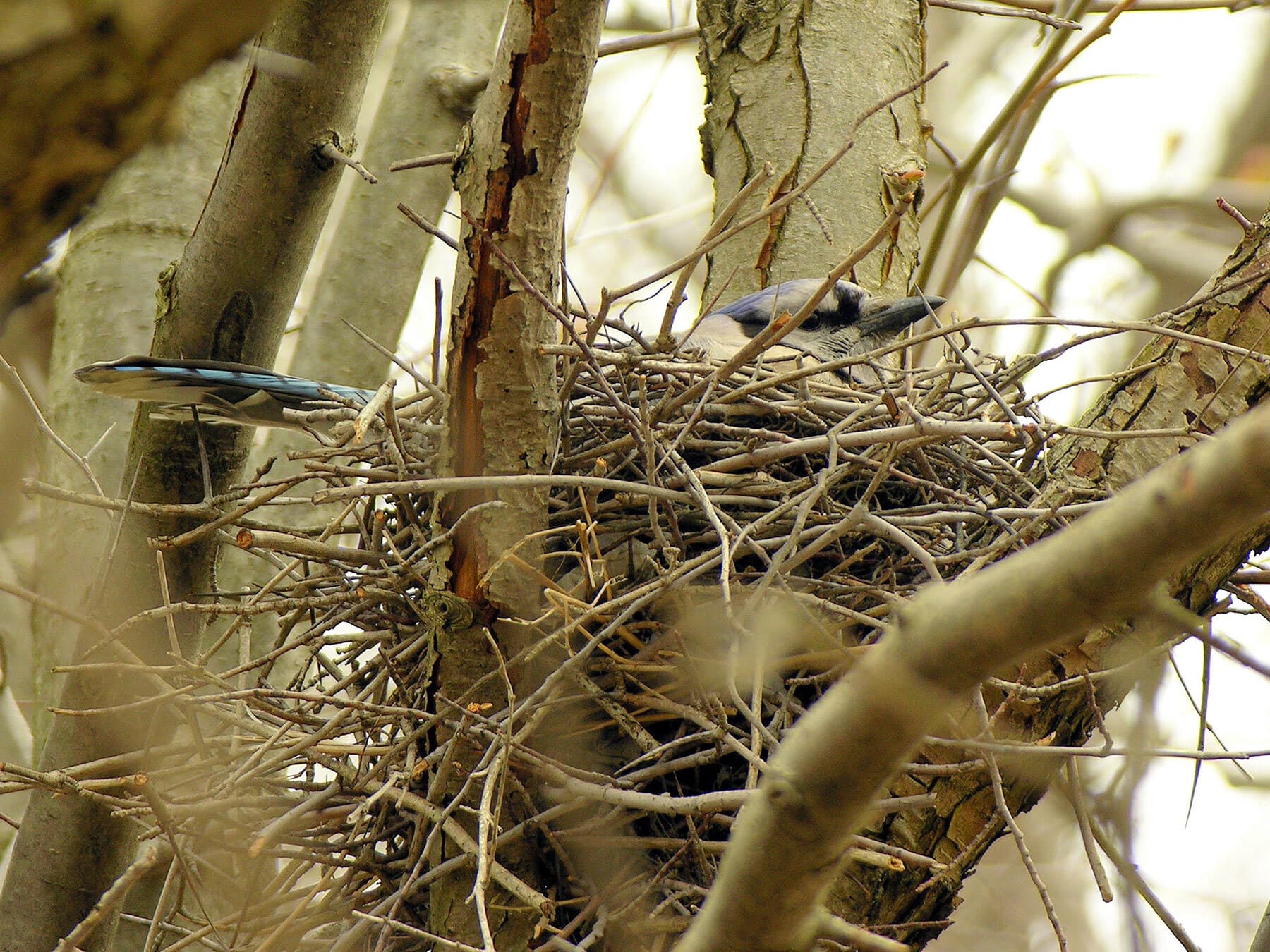
No. Nest building usually starts in mid-March,1 and the earliest Florida egg date in Bent's records is March 17.16 Pairs probably stay together through the winter, though (they do in Florida, where jays don't migrate),1 and what may be courtship feeding has been seen in midwinter.17 More: Blue Jay nesting.
At winter feeders
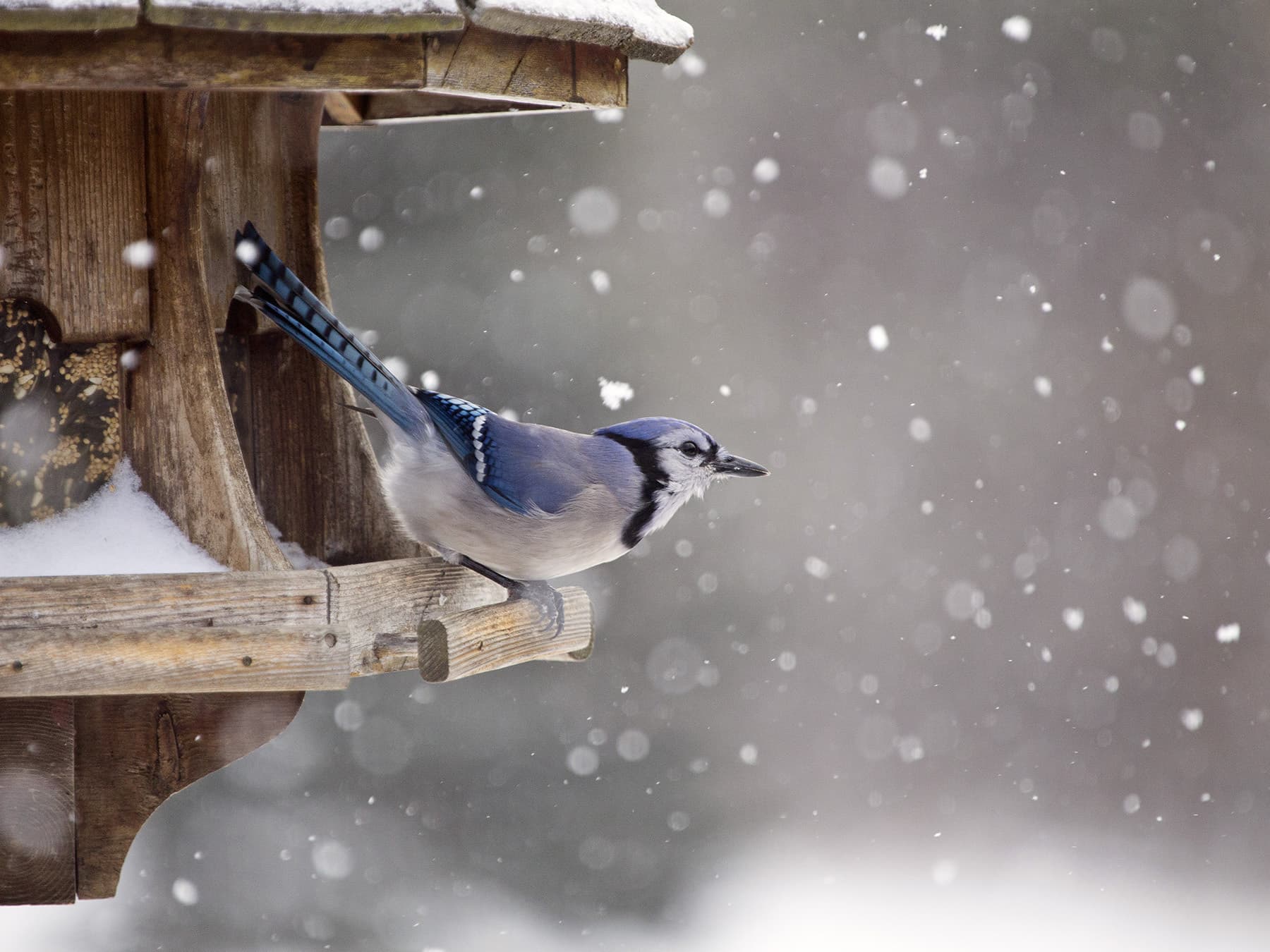
In winter, Blue Jays are among the commonest feeder birds in the East. In the 2024-25 Project FeederWatch season they were reported at 86.26% of sites in the Northeast (fifth of all species), 82.02% in the Central region (fourth) and 72.27% in the Southeast (sixth); they are not in the Southwest's top 25.18
Offer what they like best: shelled peanuts and large striped sunflower seeds.19 All About Birds recommends a platform or hopper feeder mounted on a post over a hanging one.20 Expect them to fill up and fly off: jays often carry feeder seed away to hide it.4
Sources
- Smith, K. G., Tarvin, K. A., Woolfenden, G. E. (2020). Blue Jay (Cyanocitta cristata), version 1.0. Birds of the World (A. F. Poole, editor). Cornell Lab of Ornithology. doi:10.2173/bow.blujay.01
- Stewart, P. A. (1982). Migration of Blue Jays in eastern North America. North American Bird Bander 7(3): 107-112. Accessed October 14, 2026.
- Smith, K. G. (1978). Range Extension of the Blue Jay into Western North America. Bird-Banding 49(3): 208-214. doi:10.2307/4512360
- Laskey, A. R. (1958). Blue Jays at Nashville, Tennessee: Movements, Nesting, Age. Bird-Banding 29(4): 211-218. doi:10.2307/4510709
- Smith, K. G. (1979). Migrational movements of Blue Jays west of the 100th meridian. North American Bird Bander 4(2): 49-52. Accessed October 14, 2026.
- Broun, M. (1941). Migration of Blue Jays. The Auk 58(2): 262-263. doi:10.2307/4079132
- Audubon, J. J. (1842). The Birds of America, vol. IV (octavo edition). J. J. Audubon and J. B. Chevalier, New York and Philadelphia. Accessed October 14, 2026. Source
- Carpentier, G. (2010). The autumn Blue Jay migration in Ontario. Ontario Birds 28(3): 135-143. Accessed October 14, 2026.
- Hawk Ridge Bird Observatory. 2023 Hawk Ridge Annual Highlights. Hawk Ridge Bird Observatory, Duluth, Minnesota. Accessed October 14, 2026. Source
- Hawk Ridge Bird Observatory. Hawk Ridge 2025 Annual Highlights. Hawk Ridge Bird Observatory, Duluth, Minnesota. Accessed October 14, 2026. Source
- Smith, K. G., Scarlett, T. L. (1987). Mast Production and Winter Populations of Red-Headed Woodpeckers and Blue Jays. The Journal of Wildlife Management 51(2): 459-467. doi:10.2307/3801034
- Smith, K. G. (1986). Winter Population Dynamics of Blue Jays, Red-Headed Woodpeckers, and Northern Mockingbirds in the Ozarks. American Midland Naturalist 115(1): 52. doi:10.2307/2425836
- Turner, C. G. (1965). Roosting behavior of the Blue Jay. The Auk 82(2): 285. Accessed October 14, 2026. Source
- Racine, R. N., Thompson, N. S. (1983). Social Organization of Wintering Blue Jays. Behaviour 87(3-4): 237-255. doi:10.1163/156853983x00444
- Smith, K. G. (1986). Winter population dynamics of three species of mast-eating birds in the eastern United States. The Wilson Bulletin 98(3): 407-418. Accessed October 14, 2026.
- Tyler, W. M. (1946). Northern Blue Jay. In A. C. Bent, Life Histories of North American Jays, Crows, and Titmice. United States National Museum Bulletin 191. Accessed October 14, 2026. Source
- Graber, J. W., Graber, R. R., Kirk, E. L. (1987). Illinois Birds: Corvidae (Biological Notes 126). Illinois Natural History Survey. Accessed October 14, 2026. Source
- Project FeederWatch (Cornell Lab of Ornithology and Birds Canada). Top 25 Feeder Birds, 2024-25 season. Project FeederWatch. Accessed October 14, 2026. Source
- Geis, A. D. (1980). Relative Attractiveness of Different Foods at Wild Bird Feeders (Special Scientific Report, Wildlife 233). U.S. Fish and Wildlife Service. Accessed October 14, 2026. Source
- Cornell Lab of Ornithology. Blue Jay. All About Birds. Accessed October 14, 2026. Source