Published 14 Oct 2026
Do Blue Jays Eat Other Birds? What the Evidence Shows
By the Birdfact teamChecked by Nathan Cope
Blue Jays do take eggs, nestlings and, occasionally, adult birds, but much less than their reputation suggests. Here is the evidence: stomach studies, what nest cameras have filmed, why fake-nest studies blamed jays, the few written-up cases of adult birds killed, and whether jays are mean.
On this page11 sections
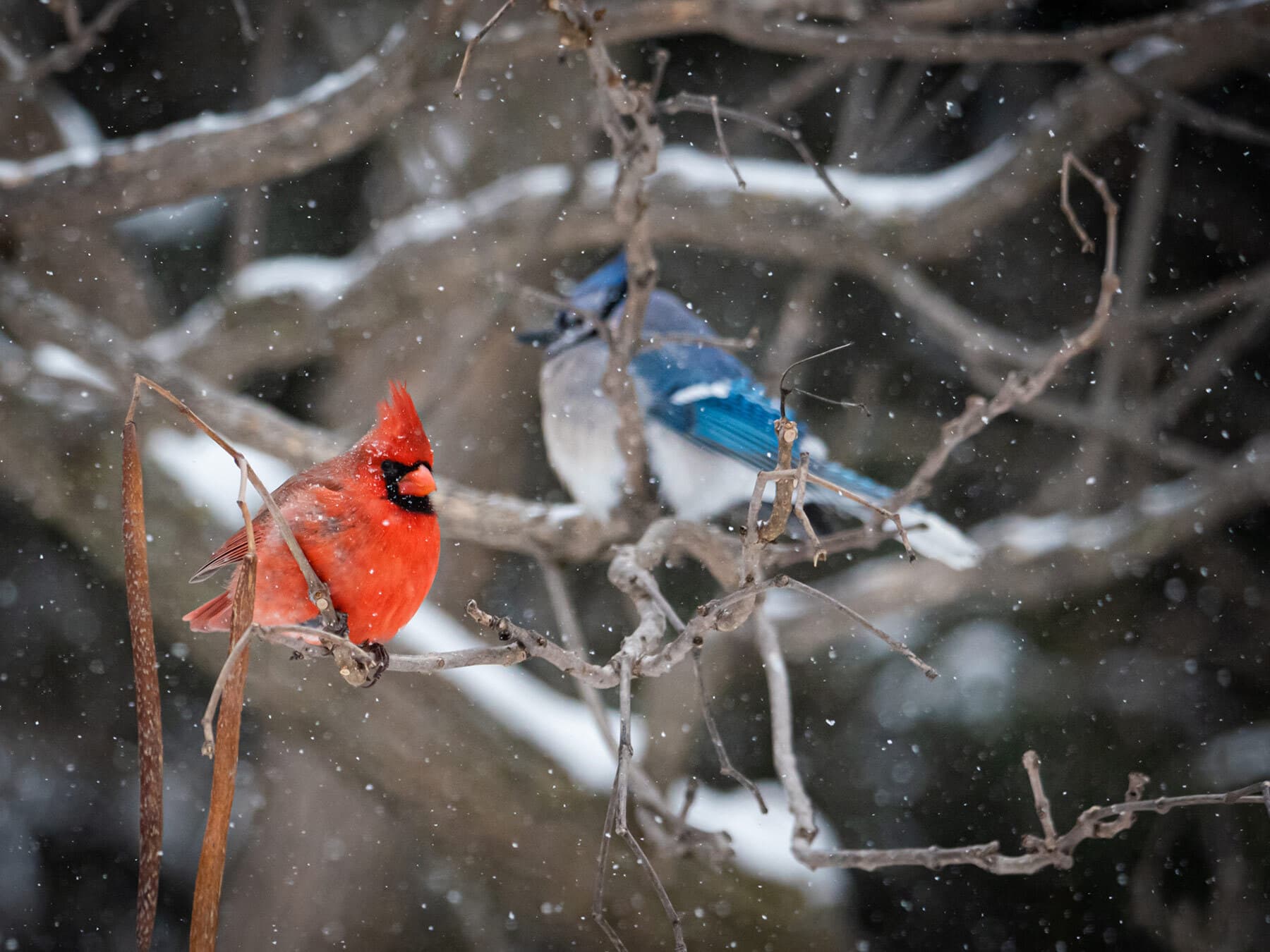
Blue Jays have a bad name as nest robbers. This page sets out what the evidence actually shows: what jays' stomachs held, what cameras at nests have filmed, why some studies made jays look worse than others, whether they kill adult birds, and whether any of it harms songbird numbers. For everything else they eat, see what Blue Jays eat.
Do Blue Jays eat other birds?
Yes, sometimes: eggs and nestlings, now and then a fledgling, and occasionally an adult bird. But it is a small part of their diet. In a federal study of 530 Blue Jay stomachs collected through the year, a special search turned up remains of wild birds or their eggs in only 6, about 1 stomach in 90.1 Cameras at real nests have filmed jays making anywhere from none to about 15% of the raids; in most of those studies, snakes or mammals took far more.
Where the reputation comes from
Early naturalists were blunt. John James Audubon painted three jays sucking stolen eggs and wrote that the jay "robs every nest it can find, sucks the eggs like the crow, or tears to pieces and devours the young birds."2 Alexander Wilson called it "the very tyrant he detested", plundering nests as the owls it mobbed did.3 By 1946 Winsor Tyler summed up the opinion of his day: "In its relation to small birds, consensus classes the blue jay as an outlaw and robber."4
Much of this rested on things people saw, and some of it is real: from 1905 to 1907, in L. L. Dyche's Kansas yard, he and his young sons saw jays take dove and robin eggs and kill young catbirds and robins.5 But when the U.S. Department of Agriculture opened jays' stomachs to test the charge, the picture was different.
What the stomachs showed
F. E. L. Beal examined 292 stomachs in the 1890s and found bird remains in 2 and eggshells of small birds in 3. One stomach had been sent in labeled "Eating robins' eggs" and held no egg at all. To check that an eaten egg would leave shell in the stomach, he gave a captive jay House Sparrow eggs and watched it pick up and swallow every piece of shell.6
The bigger study of 530 stomachs, published in 1915, turned up remains of wild birds or eggs in 6. Its author listed them: in February two jays had each killed a small bird; one had robbed a nest of eggs in May; in June one had taken a small bird and another a clutch of eggs; and one had robbed a nest in August. Another 39 jays had eaten hen's eggs, much of it picked up at rubbish heaps. Even so, the bulletin's verdict was stern: "The severest criticism against the species is the destruction of other birds and their eggs."1
A stomach is a snapshot of a bird's last meal or so, and these birds were collected more than a century ago. But two large samples taken through the year agree that birds and eggs are an occasional food, not a staple.
What nest cameras have filmed
Video cameras at songbird nests show who actually takes eggs and chicks. At real nests, Blue Jays turn up, but usually not at the top of the list:
| Study | Where | Predation events recorded | By Blue Jays |
|---|---|---|---|
| Thompson & Burhans 19997 | Missouri old fields | 24 identified | 0 |
| Thompson & Burhans 20038 | Missouri fields and forest | 61 identified | 2 (both in forest) |
| DeGregorio et al. 20149 | South Carolina | 137 | 3 |
| Rodewald et al. 201110 | Ohio forests | 67 | under 7% |
| Cox et al. 201211 | Missouri and Illinois forests | 126 | 19 (about 15%) |
The two Thompson & Burhans studies probably share some nests, since both include Missouri old fields in 1997. The strongest case against jays is the last: in Midwestern forests jays were the single commonest predator species caught raiding Acadian Flycatcher and Indigo Bunting nests, just ahead of Broad-winged Hawks, though snakes as a group took more. Across North America, a review of 53 camera studies covering more than 4,000 nests found snakes and mammals were the main nest predators, with crows and their relatives leading only in the Southwest.12 A jay can raid quietly: in one Pennsylvania study a jay raided a Hooded Warbler nest without visibly damaging it.13
Why some studies blame jays more
Several well-known studies that named jays as leading nest predators used artificial nests: fake nests baited with eggs, such as quail eggs. In an industrial forest in Maine, red squirrels and Blue Jays made more than half of the identified raids on such nests,14 and at suburban and rural forest edges, jays, raccoons and black bears made virtually all the raids.15
Artificial nests are a poor guide to who raids real ones. In Missouri, snakes were the main predator at real nests but raccoons at artificial ones,16 and a 2004 study found that fake and real nests differ in unpredictable ways, attracting different predators.17 Birds of the World warns that artificial nests may greatly overestimate how many nests jays take.18
Do Blue Jays kill adult birds?
Sometimes, but documented cases are few, and each was written up as unusual. In Texas in 1975 a jay pecked a Yellow-rumped Warbler to death and carried it off;19 in Pennsylvania in 1977 one pounced on a healthy-looking female House Sparrow as it dust-bathed;20 and in Texas in 2009 a jay attacked and ate an adult Cedar Waxwing, "the first reported account" of that.21 Jays also occasionally take fledglings21 and eat birds stunned or killed by windows: in Winnipeg, jays fed on a thrush that had apparently hit a window, and another carried off a stunned young House Sparrow, which was rescued alive.22
Do Blue Jays harm songbird numbers?
We found no study showing it. Birds of the World says jays have been implicated in the decline of some migrant songbirds,18 but the two studies it names do not show that jays caused it. One used artificial nests, and its summary names no predator;23 the other, in Texas in 1994, reported a negative correlation between Blue Jays and Golden-cheeked Warblers near a growing city,24 and a correlation does not show cause. A review of studies of crows, ravens and magpies, close relatives of the jay, found that they seldom reduced other birds' numbers, though they more often cut their nest success.25 And as the 1915 bulletin noted, many birds that lose an early nest can still raise another brood later in the season.1
How other birds react to jays
Small birds treat jays as a threat. Field Sparrows reacted to a model Blue Jay more than to a harmless control, most strongly when they had chicks,26 and Acadian Flycatchers that defended their nests hardest against jay models fared better while they had eggs.27 In Illinois, Wood Thrush nests guarded by males did better, presumably because the males chased away Blue Jays, there the main nest predator, Birds of the World reports.18
Are Blue Jays mean?
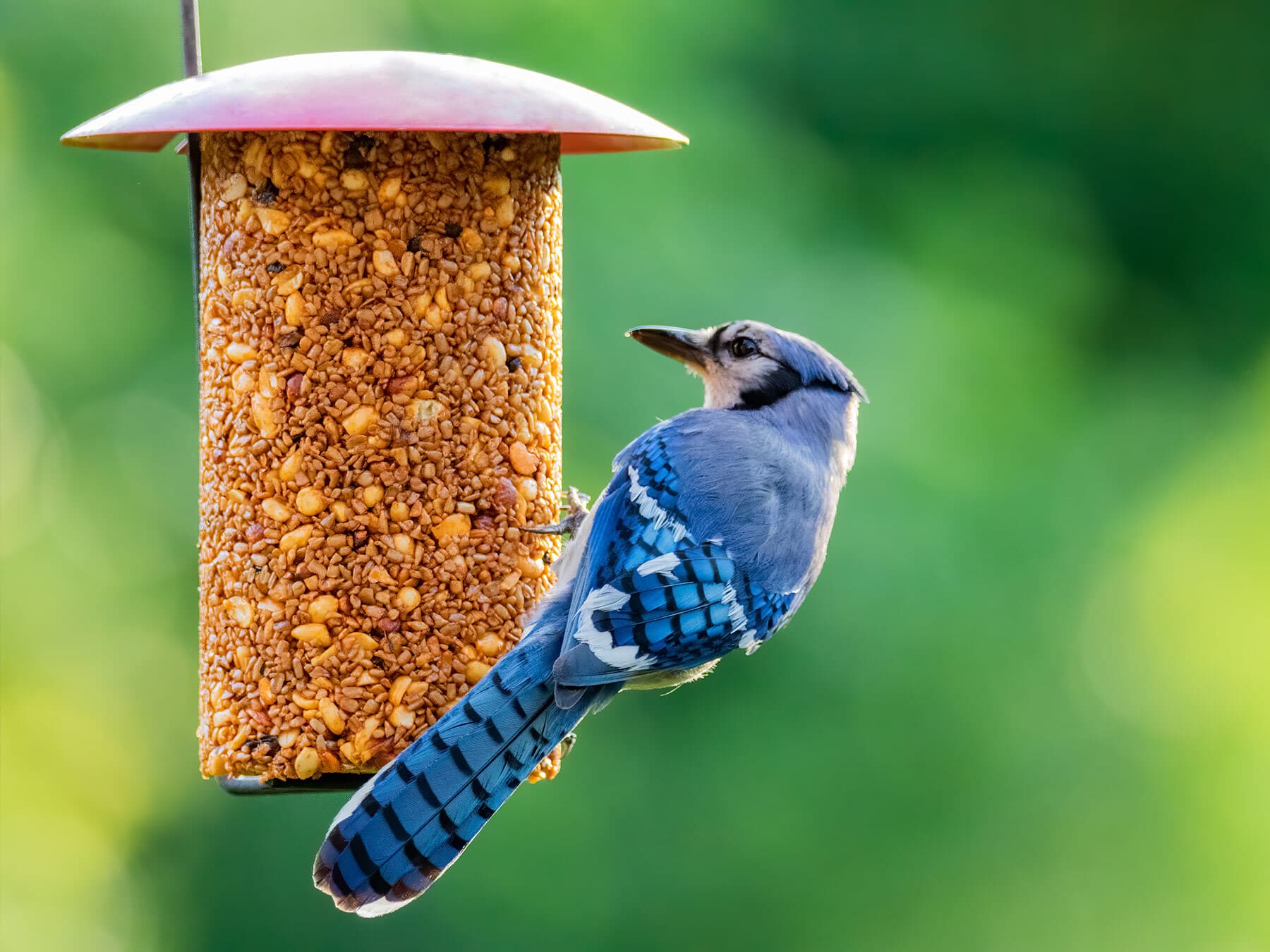
They are bold rather than mean. At feeders across North America, Project FeederWatch data put jays high in the pecking order, as they do woodpeckers, crows and ravens;28 FeederWatch says jays, like crows, woodpeckers and blackbirds, are more dominant than their size would suggest. One of the researchers, Eliot Miller, reported in a comment that jays chased off Northern Cardinals 118 times for every 8 the other way.29 Yet at Florida feeders, Red-bellied and Red-headed Woodpeckers, Common Grackles and gray squirrels strongly dominated jays,18 and All About Birds calls them "far less aggressive than many other species".30 Audubon, who thought the jay "domineers over the feeble", also noted that it backs down from stronger birds: a Northern Cardinal "will challenge him, and beat him off the ground."2
Much of the noise is aimed at predators. Jays mob hawks, large snakes, raccoons, large owls and cats.18 More: Blue Jay sounds.
The jay's side
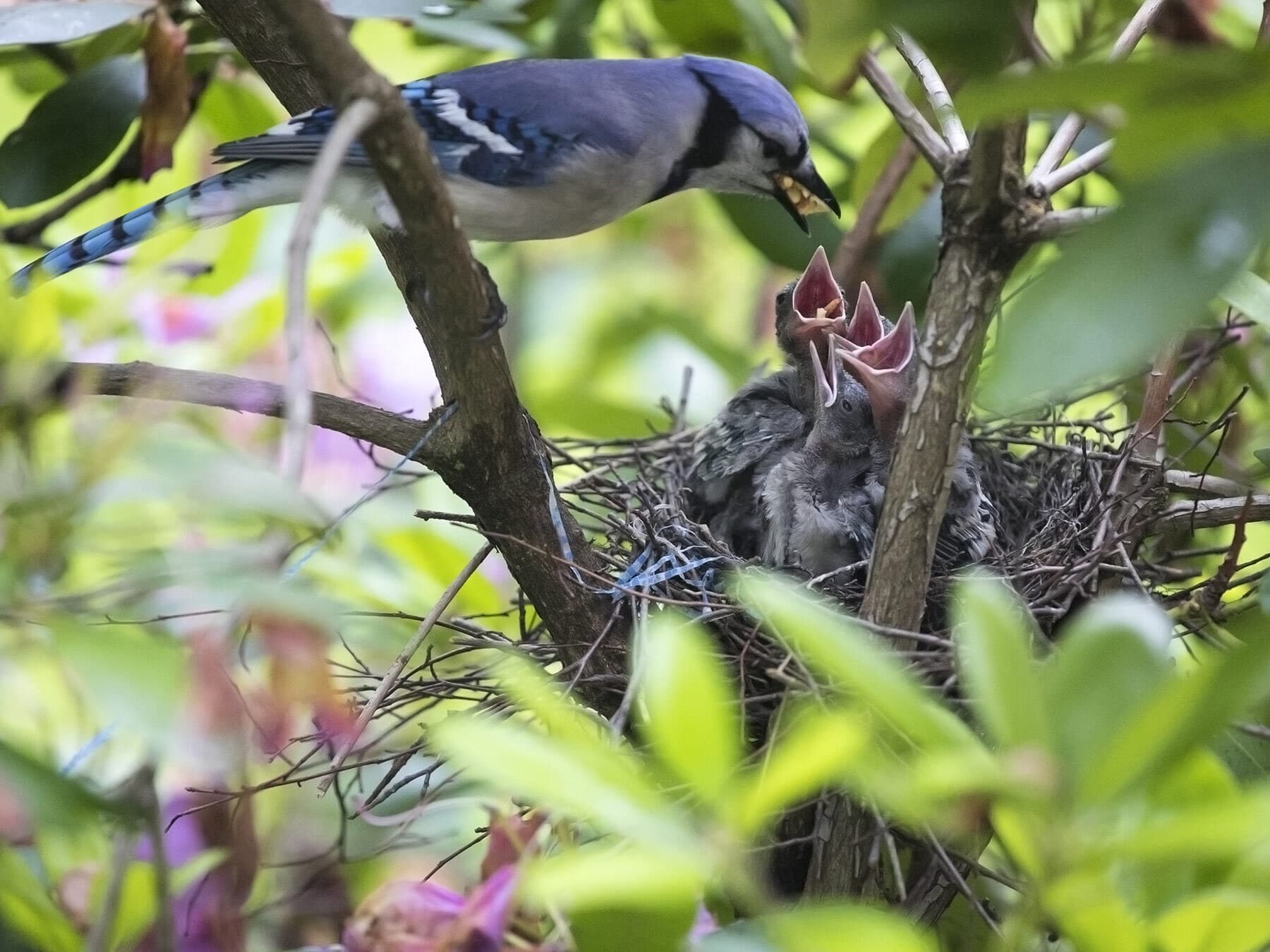
Blue Jays are prey too. Hawks, falcons and owls take adults, and jays' own eggs and chicks are taken by crows, squirrels, snakes and other jays; predators cause most of their nest failures.18 More: Blue Jay nesting.
Sources
- Beal, F. E. L., Kalmbach, E. R. (1915). Some Common Birds Useful to the Farmer (Farmers' Bulletin 630; revised 1923). U.S. Department of Agriculture. Accessed October 14, 2026. Source
- Audubon, J. J. (1834). Ornithological Biography, vol. 2. Adam & Charles Black, Edinburgh. Accessed October 14, 2026. Source
- Wilson, A., Bonaparte, C. L. (1831). American Ornithology; or, the Natural History of the Birds of the United States, vol. 1. Constable, Edinburgh. Accessed October 14, 2026. Source
- Tyler, W. M. (1946). Northern Blue Jay. In A. C. Bent, Life Histories of North American Jays, Crows, and Titmice. United States National Museum Bulletin 191. Accessed October 14, 2026. Source
- Dyche, L. L. (1907). Some Observations on the Food Habits of the Blue Jay (Cyanocitta cristata). Transactions of the Kansas Academy of Science 21: 130-135. doi:10.2307/3624527
- Beal, F. E. L. (1897). The Blue Jay and its food. Yearbook of the United States Department of Agriculture, 1896: 197-206. Accessed October 14, 2026. Source
- Thompson, F. R., Burhans, D. E. (1999). Video Identification of Predators at Songbird Nests in Old Fields. The Auk 116(1): 259-264. doi:10.2307/4089477
- Thompson, F. R., Burhans, D. E. (2003). Predation of Songbird Nests Differs by Predator and between Field and Forest Habitats. The Journal of Wildlife Management 67(2): 408-416. doi:10.2307/3802781
- DeGregorio, B. A., Weatherhead, P. J., Sperry, J. H. (2014). Power lines, roads, and avian nest survival: effects on predator identity and predation intensity. Ecology and Evolution 4(9): 1589-1600. doi:10.1002/ece3.1049
- Rodewald, A. D., Kearns, L. J., Shustack, D. P. (2011). Anthropogenic resource subsidies decouple predator-prey relationships. Ecological Applications 21(3): 936-943. doi:10.1890/10-0863.1
- Cox, W. A., Thompson, F. R., Faaborg, J. (2012). Species and temporal factors affect predator-specific rates of nest predation for forest songbirds in the Midwest. The Auk 129(1): 147-155. doi:10.1525/auk.2012.11169
- DeGregorio, B. A., Chiavacci, S. J., Benson, T. J., Sperry, J. H., Weatherhead, P. J. (2016). Nest Predators of North American Birds: Continental Patterns and Implications. BioScience 66(8): 655-665. doi:10.1093/biosci/biw071
- Howlett, J. S., Stutchbury, B. J. (1996). Nest Concealment and Predation in Hooded Warblers: Experimental Removal of Nest Cover. The Auk 113(1): 1-9. doi:10.2307/4088930
- Vander Haegen, W. M., DeGraaf, R. M. (1996). Predation on Artificial Nests in Forested Riparian Buffer Strips. The Journal of Wildlife Management 60(3): 542-550. doi:10.2307/3802071
- Danielson, W. R., DeGraaf, R. M., Fuller, T. K. (1997). Rural and suburban forest edges: effect on egg predators and nest predation rates. Landscape and Urban Planning 38(1-2): 25-36. doi:10.1016/s0169-2046(97)00016-9
- Thompson, F. R., Burhans, D. E. (2004). Differences in Predators of Artificial and Real Songbird Nests: Evidence of Bias in Artificial Nest Studies. Conservation Biology 18(2): 373-380. doi:10.1111/j.1523-1739.2004.00167.x
- Moore, R. P., Robinson, W. D. (2004). Artificial bird nests, external validity, and bias in ecological field studies. Ecology 85(6): 1562-1567. doi:10.1890/03-0088
- Smith, K. G., Tarvin, K. A., Woolfenden, G. E. (2020). Blue Jay (Cyanocitta cristata), version 1.0. Birds of the World (A. F. Poole, editor). Cornell Lab of Ornithology. doi:10.2173/bow.blujay.01
- Johnson, K. W., Johnson, J. E. (1976). An incident of Blue Jay predation on a Yellow-rumped Warbler. The Wilson Bulletin 88(3): 509. Accessed October 14, 2026.
- Master, T. L. (1979). An incident of Blue Jay predation on a House Sparrow. The Wilson Bulletin 91(3): 470. Accessed October 14, 2026.
- Saenz, D., Pierce, J. B. (2009). Blue Jay attacks and consumes Cedar Waxwing. Bulletin of the Texas Ornithological Society 42(1-2): 99-100. Accessed October 14, 2026. Source
- Nero, R. W. (1991). Blue Jays Scavenging Window-Kills. Blue Jay 49(2): 98. Accessed October 14, 2026.
- Wilcove, D. S. (1985). Nest Predation in Forest Tracts and the Decline of Migratory Songbirds. Ecology 66(4): 1211-1214. doi:10.2307/1939174
- Engels, T. M., Sexton, C. W. (1994). Negative Correlation of Blue Jays and Golden-cheeked Warblers near an Urbanizing Area. Conservation Biology 8(1): 286-290. doi:10.1046/j.1523-1739.1994.08010286.x
- Madden, C. F., Arroyo, B., Amar, A. (2015). A review of the impacts of corvids on bird productivity and abundance. Ibis 157(1): 1-16. doi:10.1111/ibi.12223
- Burhans, D. E. (2001). Enemy recognition by Field Sparrows. The Wilson Bulletin 113(2): 189-193. doi:10.1676/0043-5643(2001)113[0189:ERBFS]2.0.CO;2
- Olendorf, R., Robinson, S. K. (2000). Effectiveness of nest defence in the Acadian Flycatcher Empidonax virescens. Ibis 142(3): 365-371. doi:10.1111/j.1474-919x.2000.tb04432.x
- Miller, E. T., Bonter, D. N., Eldermire, C., Freeman, B. G., Greig, E. I., Harmon, L. J., Lisle, C., Hochachka, W. M. (2017). Fighting over food unites the birds of North America in a continental dominance hierarchy. Behavioral Ecology 28(6): 1454-1463. doi:10.1093/beheco/arx108
- Project FeederWatch (Cornell Lab of Ornithology and Birds Canada). Who is the toughest bird? Project FeederWatch. Accessed October 14, 2026. Source
- Cornell Lab of Ornithology. Blue Jay. All About Birds. Accessed October 14, 2026. Source