


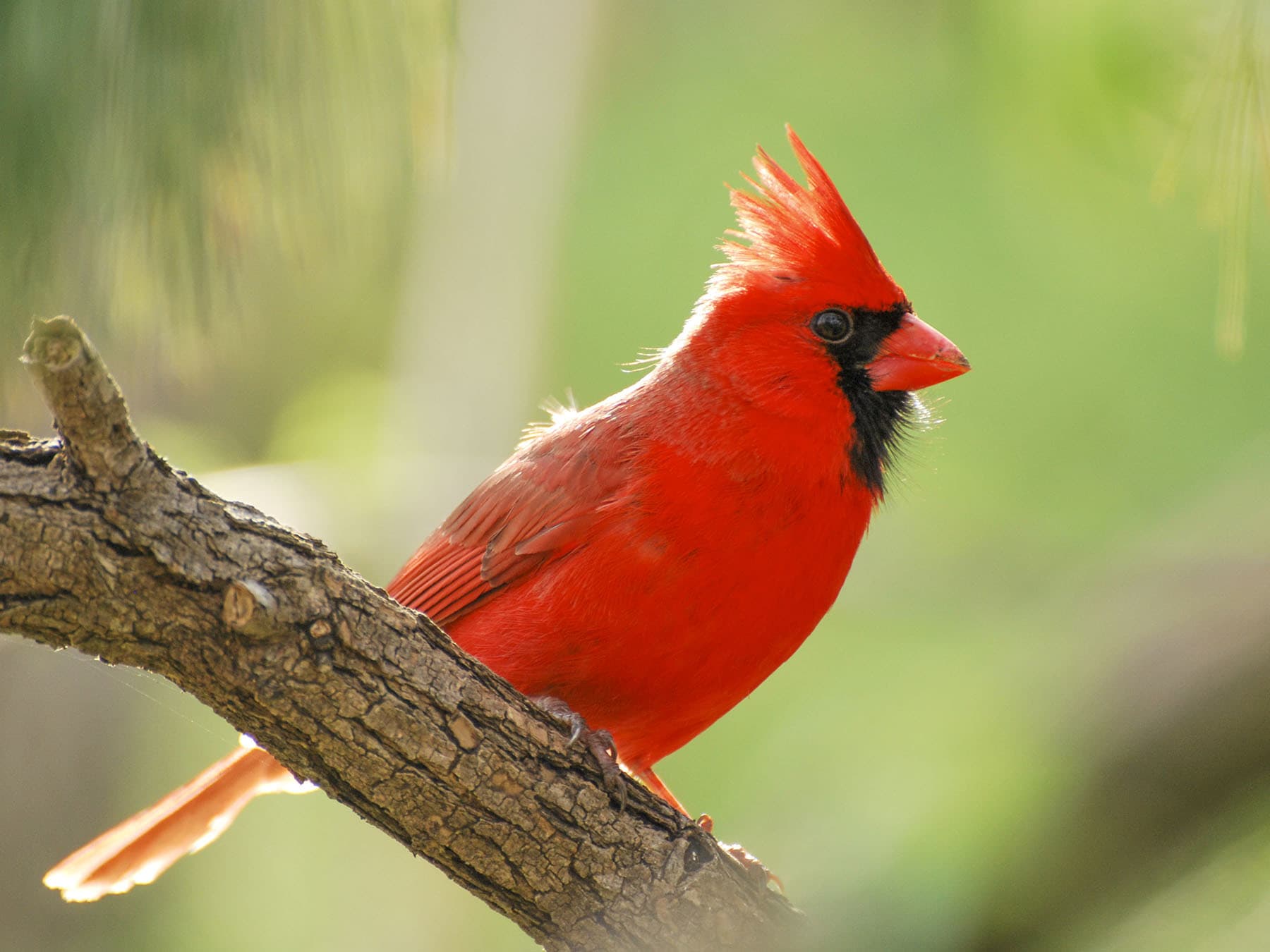
Northern Cardinal
Redbird, Common Cardinal · Cardinalis cardinalis
By the Birdfact teamChecked by Nathan Cope
See it in 3D
3 plumages 3D model
A Northern Cardinal is 8.5–9 in (21–23 cm) long, bill to tail.
3D model · Male · Length 8.5–9 in (21–23 cm) · How we make our birds · Report a problem
© 2026 NC Digital Limited (Birdfact). All rights reserved. This 3D model may be viewed on this page and shared by link only. Downloading, extracting, copying or reusing it, or using it to train machine-learning models, is not permitted without our written permission. Using our models
On this page16 sections
How to recognise it
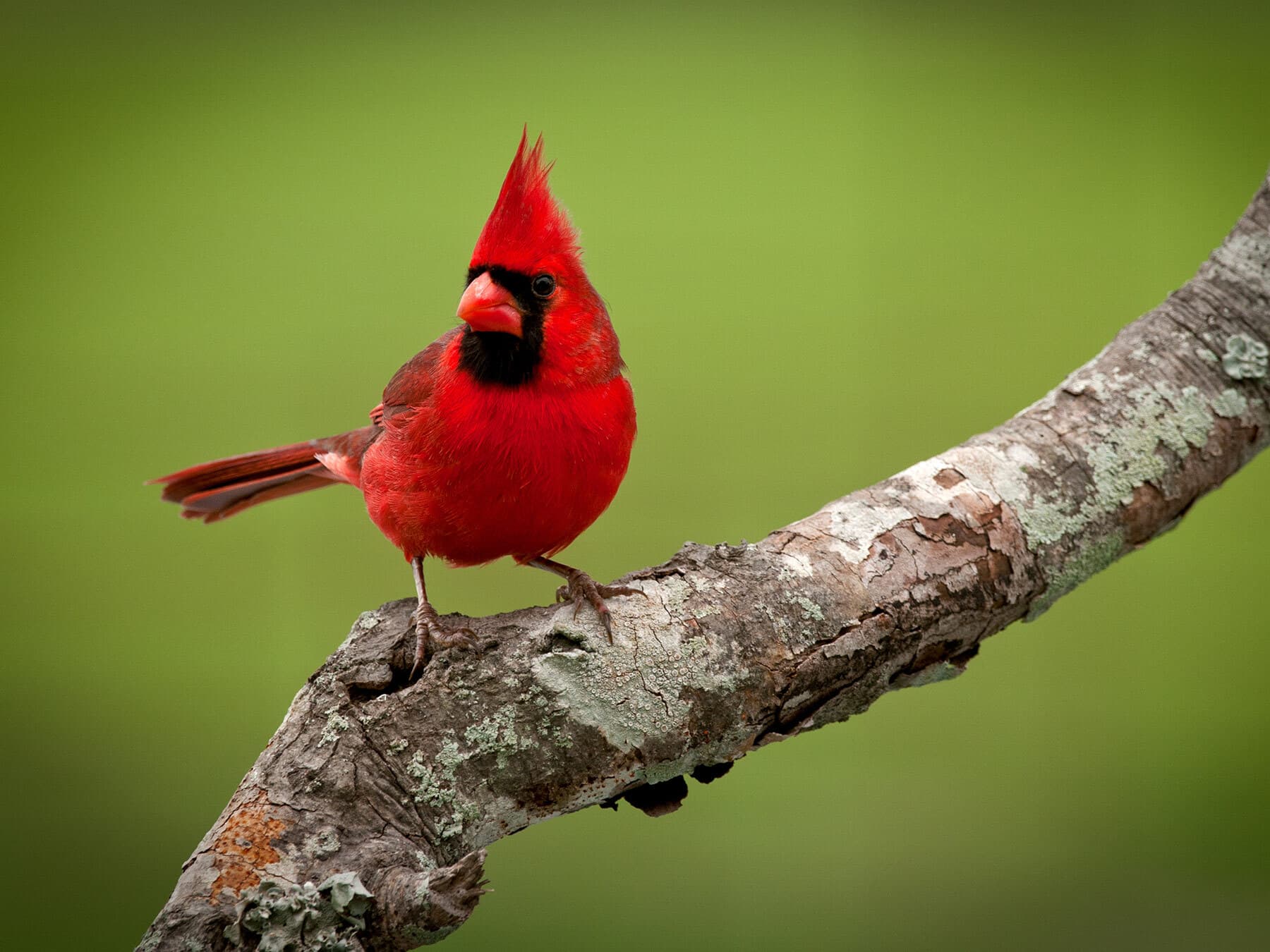
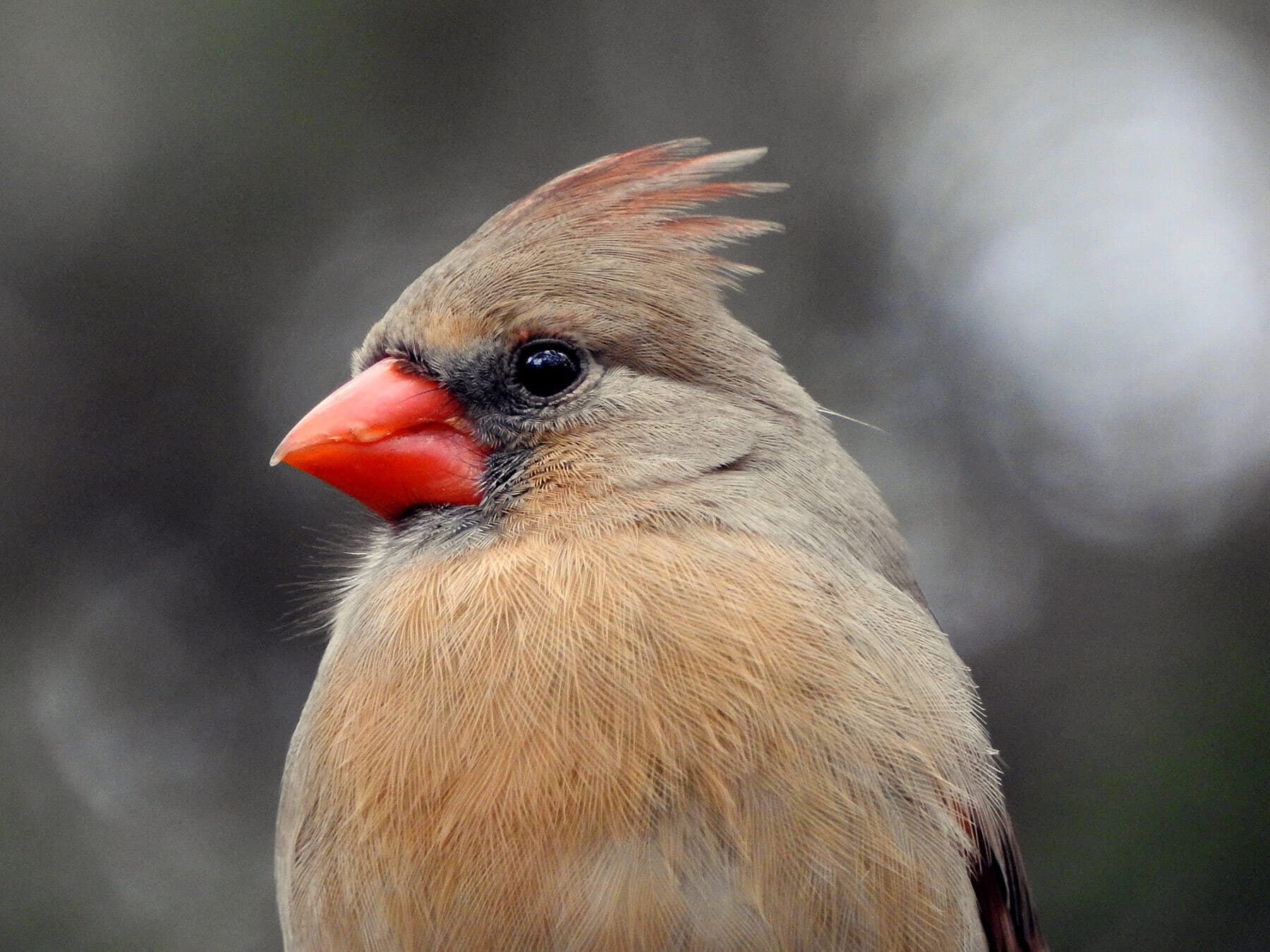
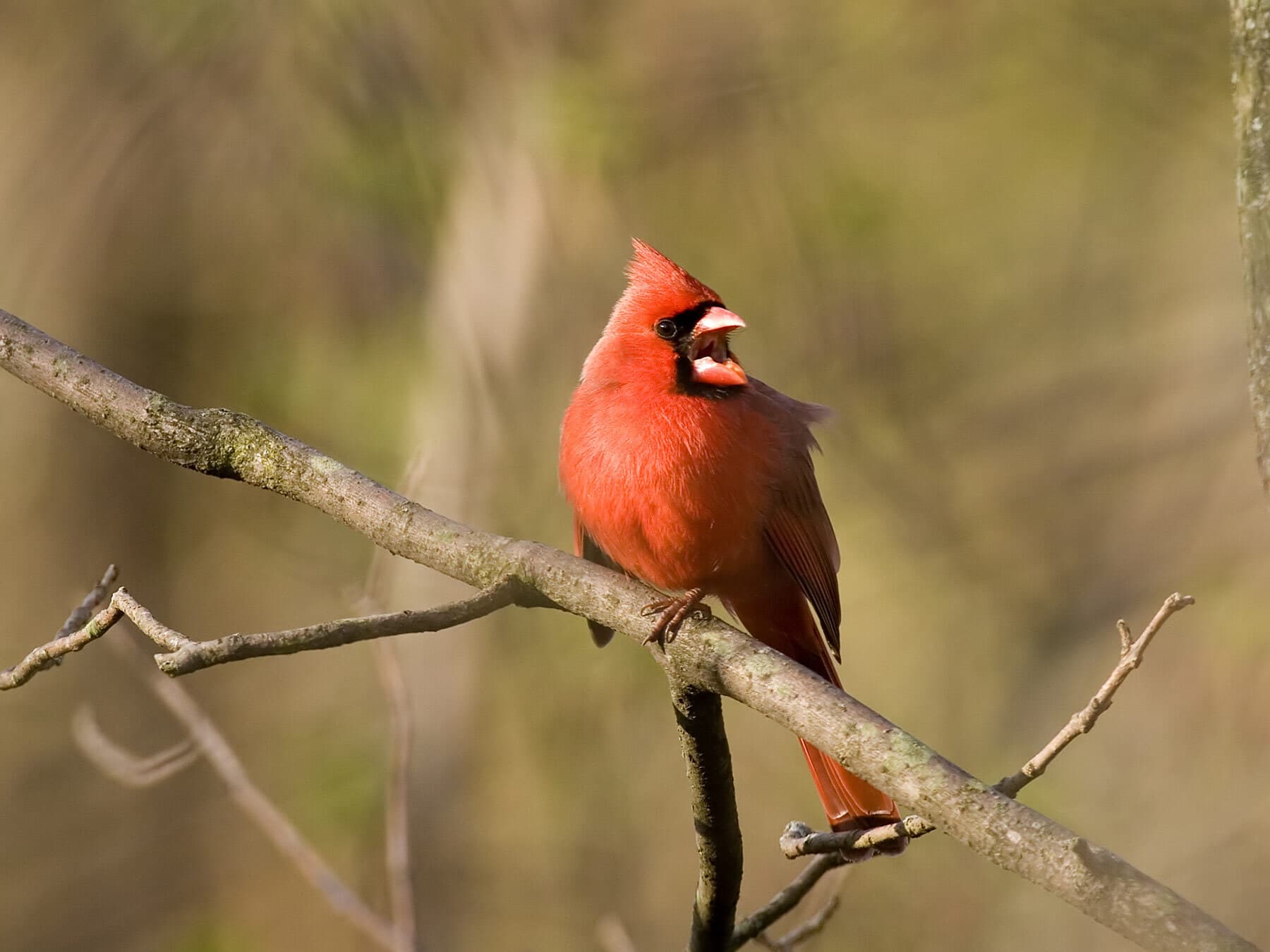
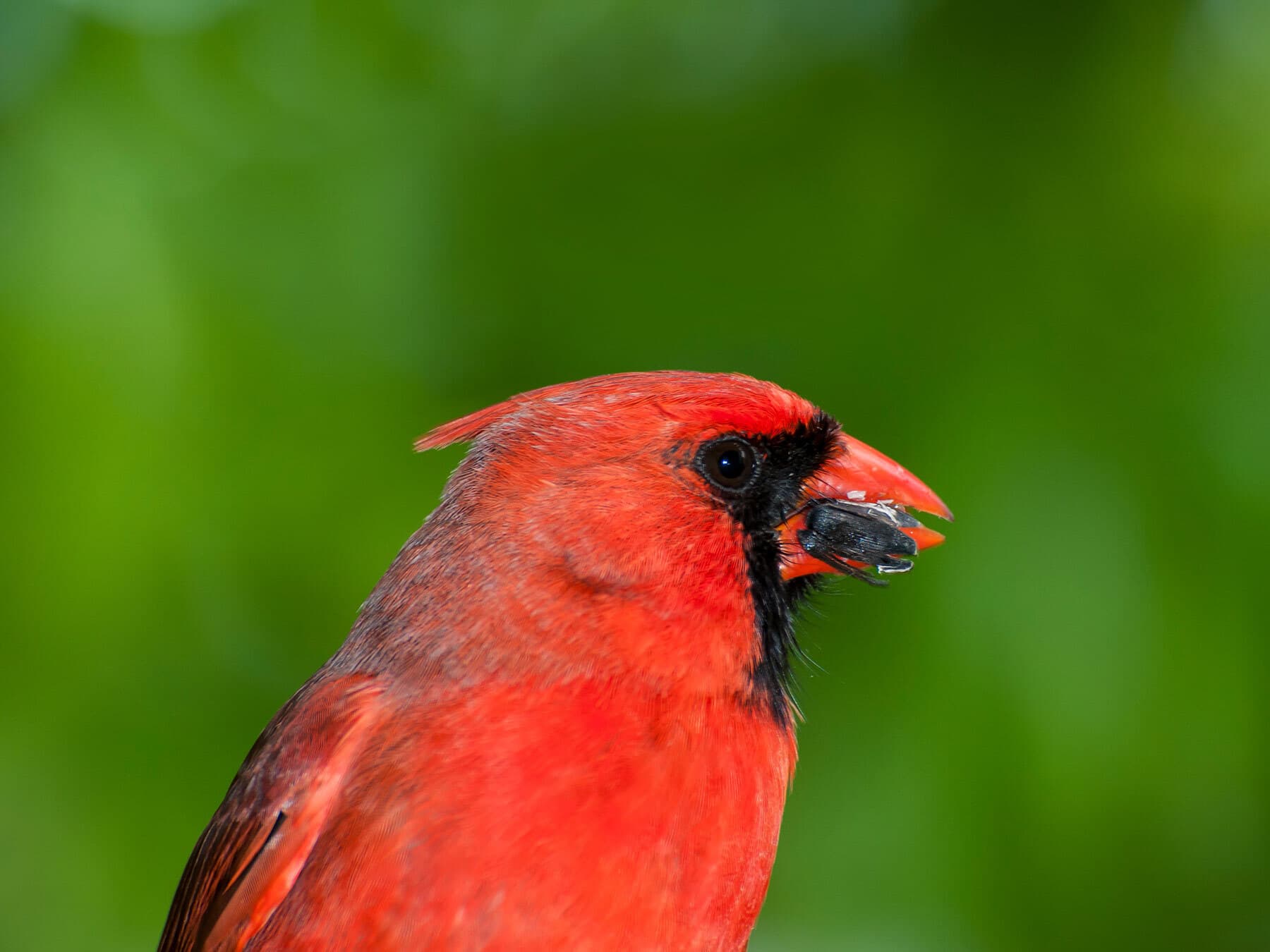
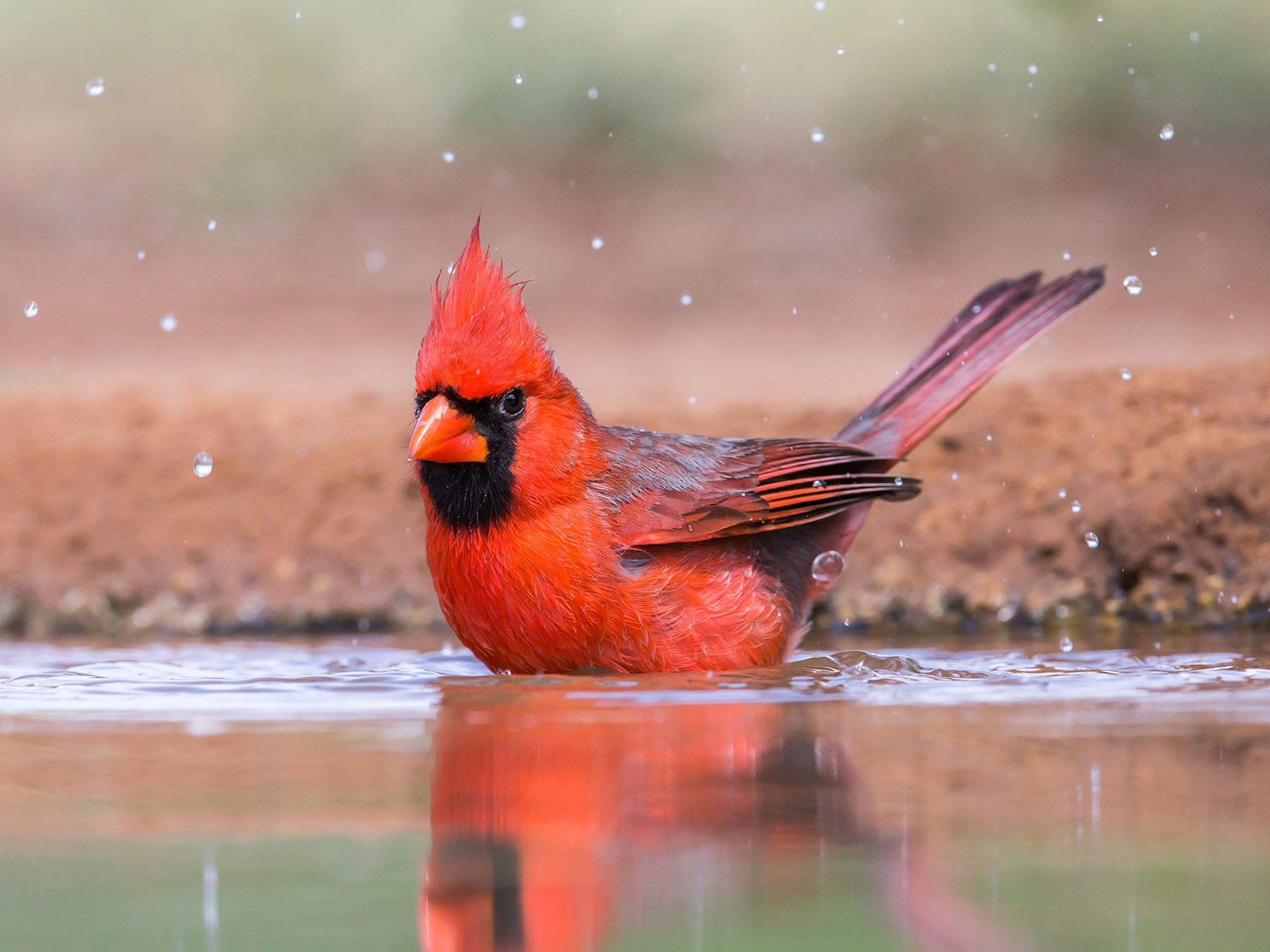
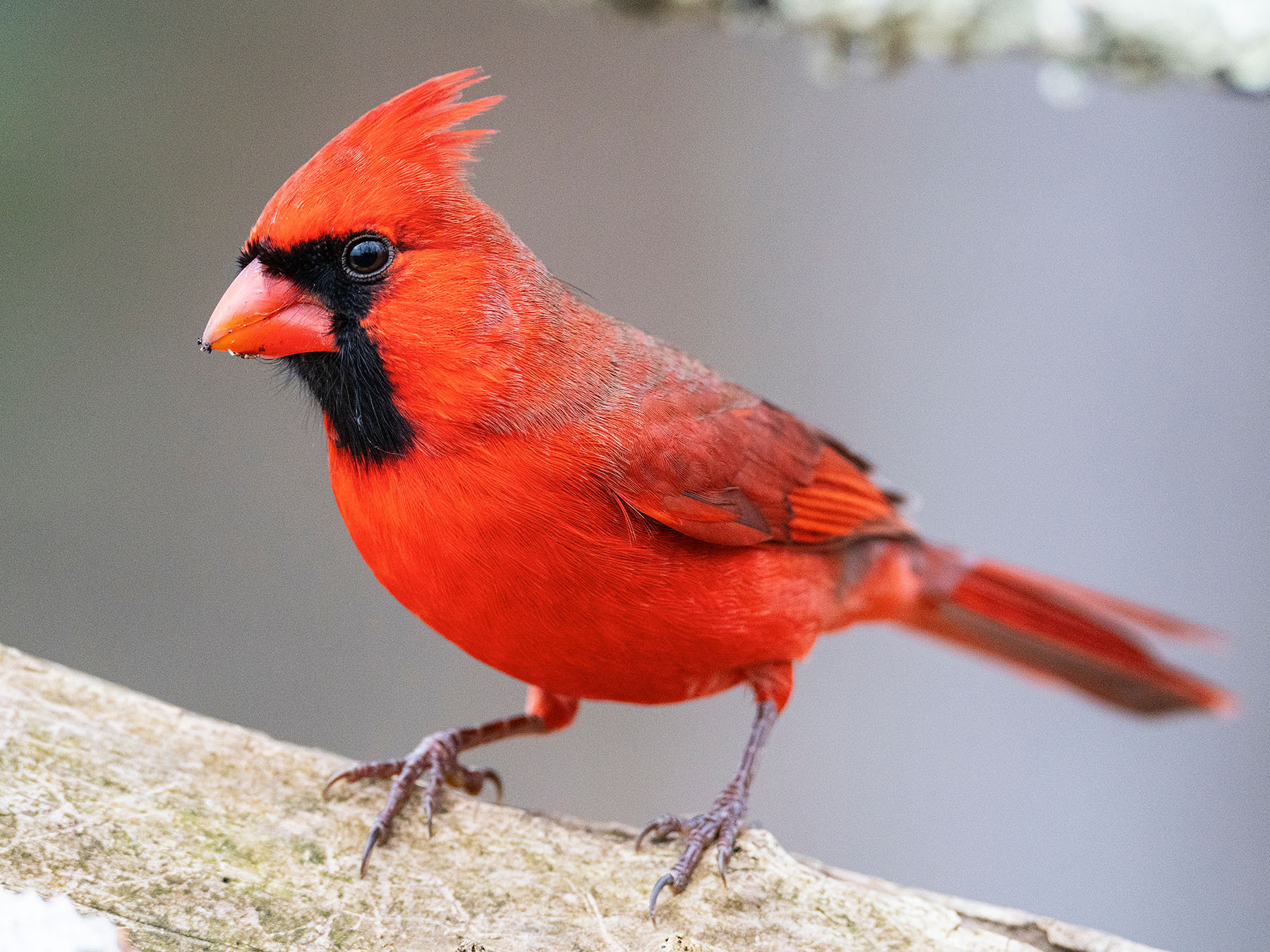
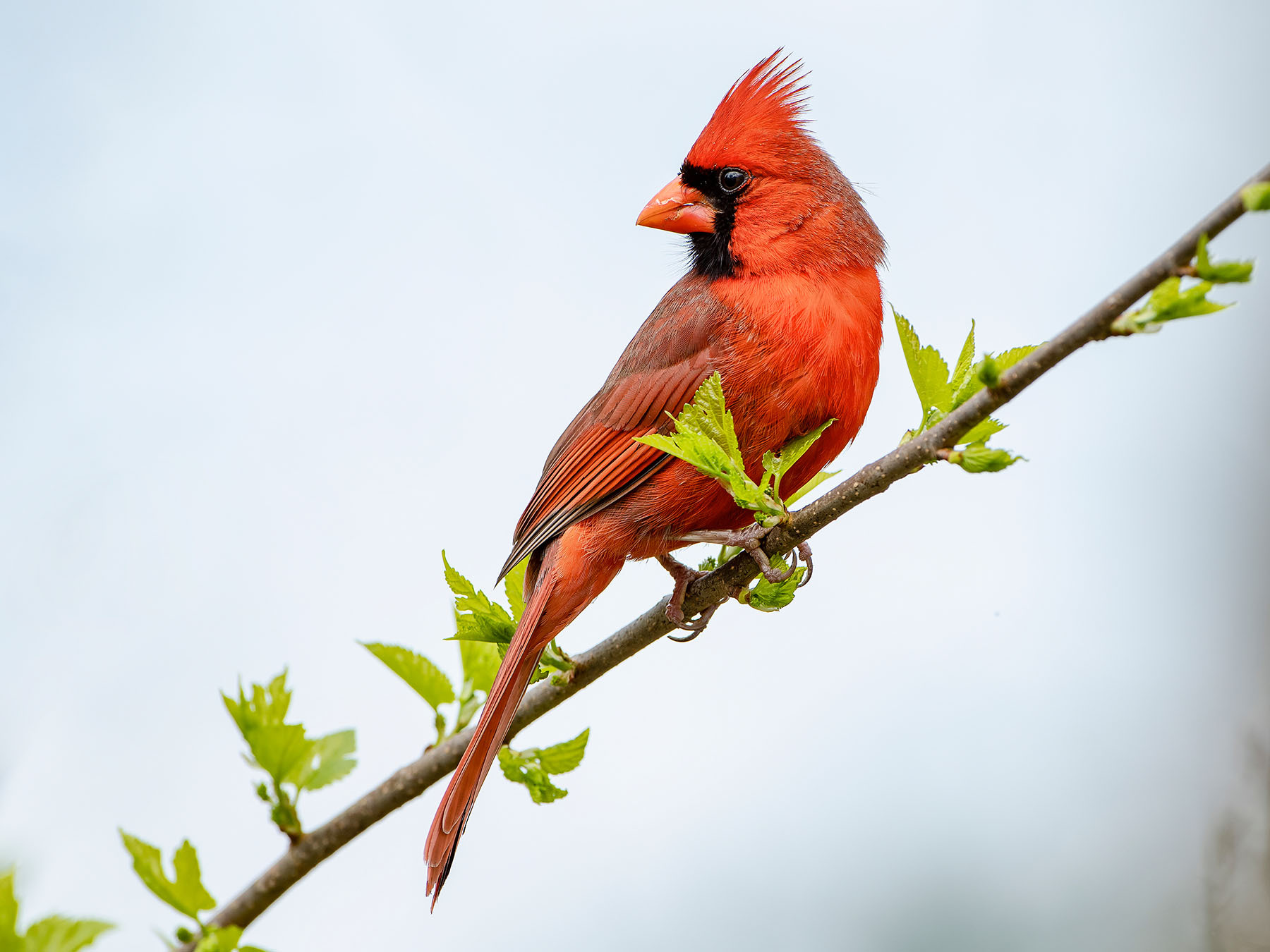
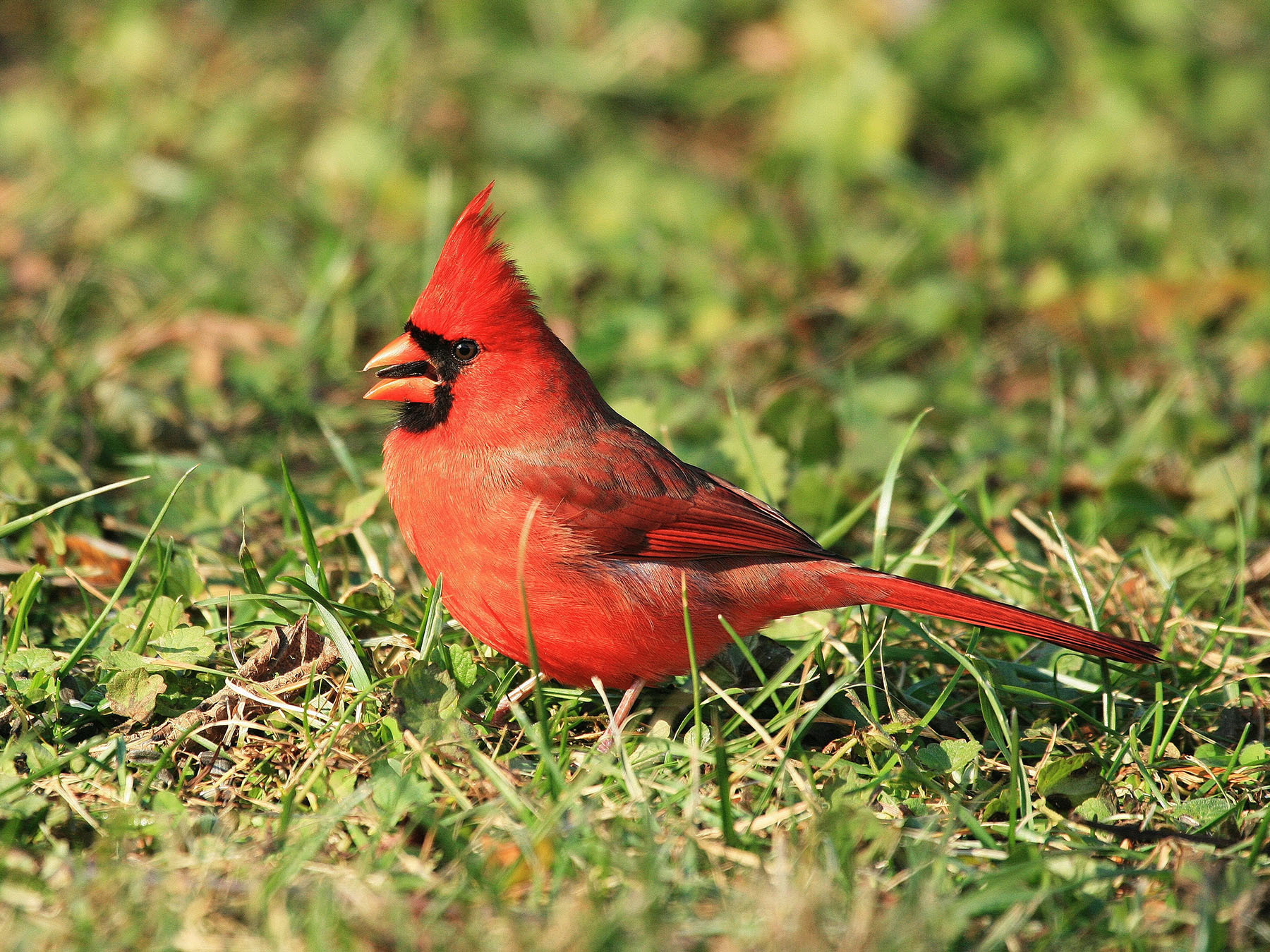
A fairly large songbird with a long tail, a pointed crest and a short, very thick bill for cracking seeds. The male is red all over, brightest on the face and breast, with a black mask around his red-orange bill. The female is pale tan-brown with warm red in her wings, tail and crest, and the same red-orange bill. Cardinals often sit hunched, with the tail pointing down.
A cardinal is 8.3 to 9.1 in (21 to 23 cm) long, with a wingspan of 9.8 to 12.2 in (25 to 31 cm), and weighs 1.5 to 1.7 oz (42 to 48 g): slightly smaller than an American Robin.1 Males average a little larger than females, but their sizes overlap.
The red comes from food. Cardinals build it from carotenoid pigments they eat and lay it down as new feathers grow in the late-summer molt, and fruit is a rich source: in an Ohio study, wild grapes and other fruit made up more than half of what males ate while molting.2 The black mask is a different pigment, melanin, and does not depend on diet.
Male, female and young
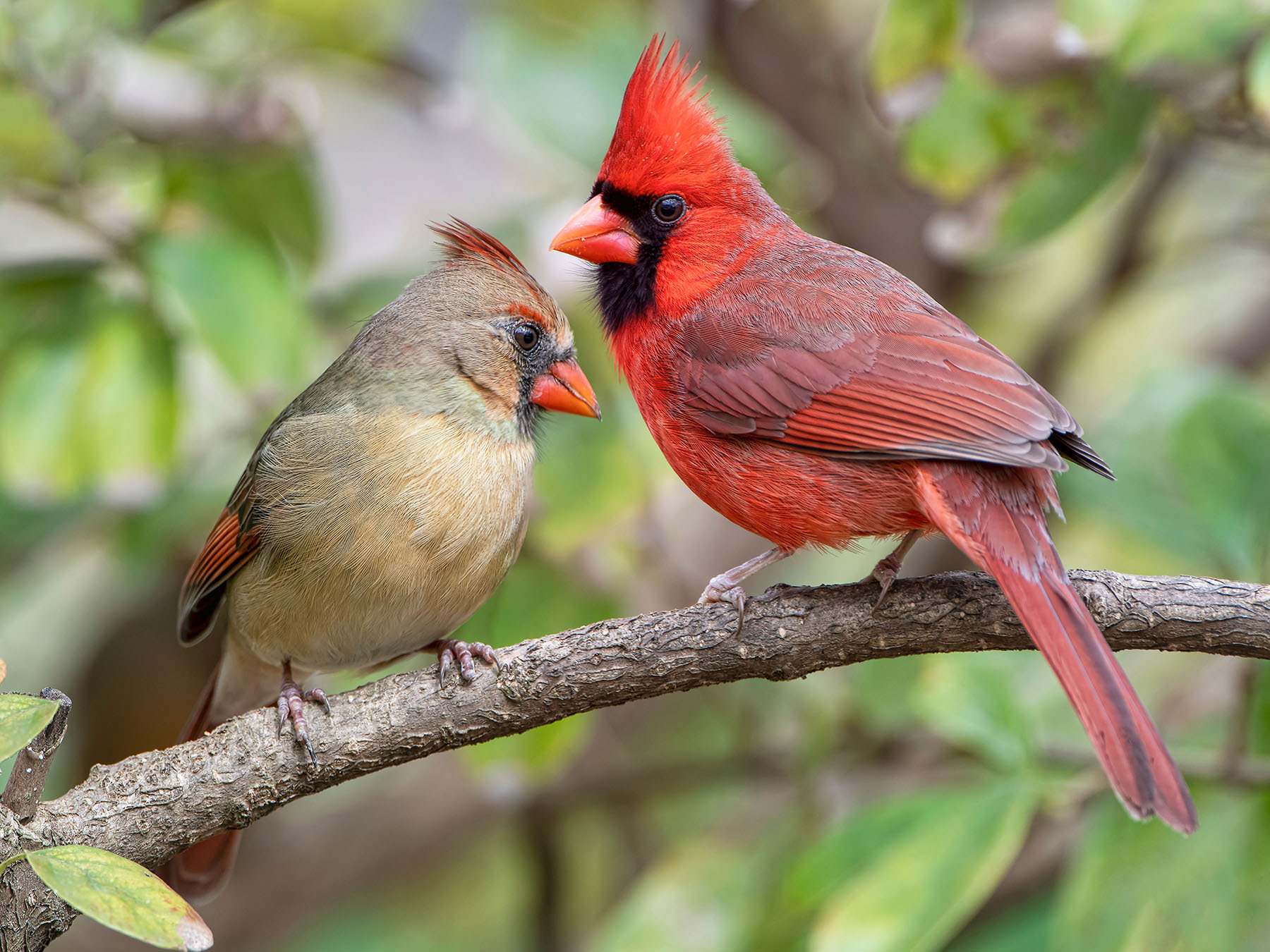
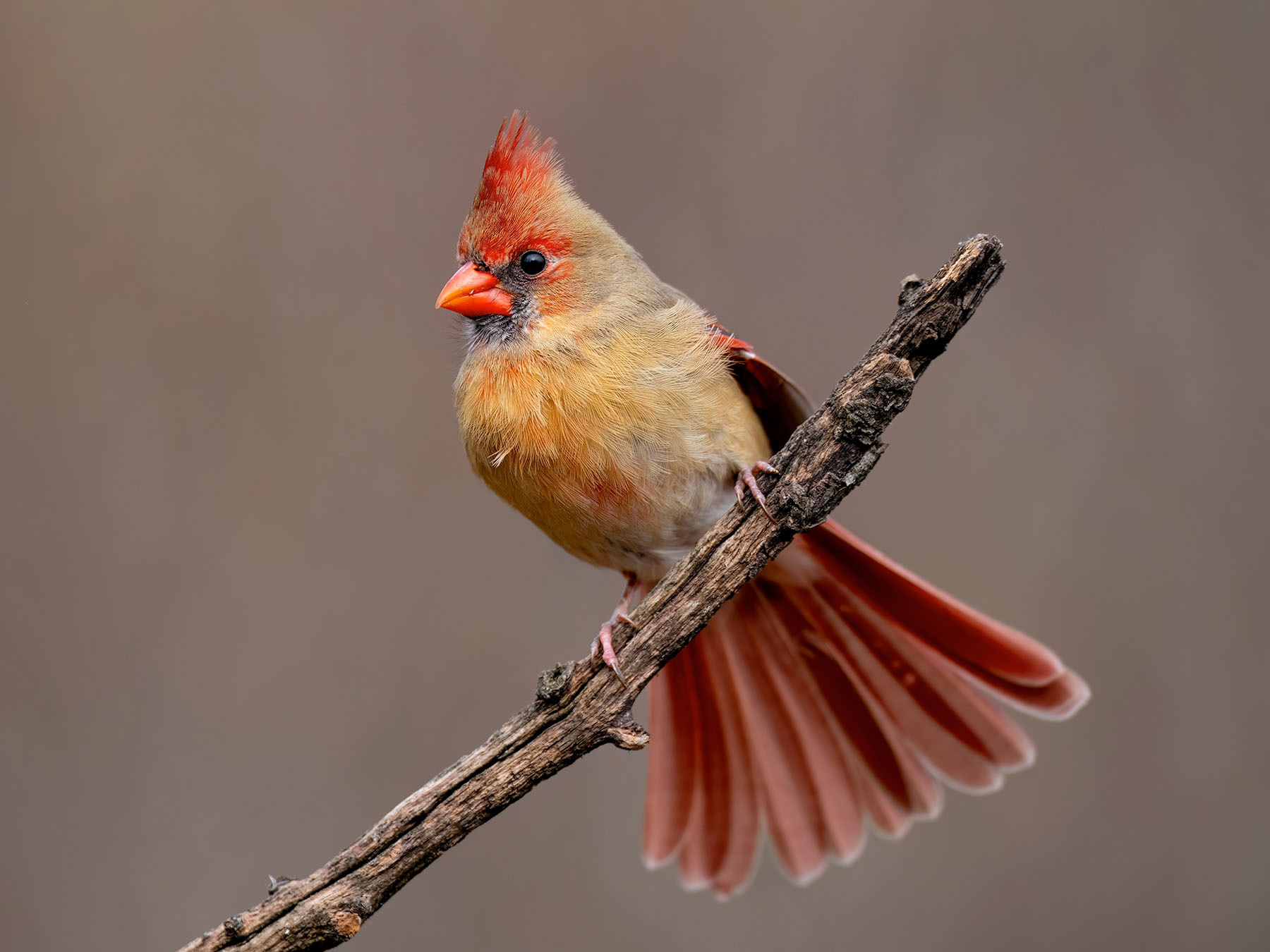
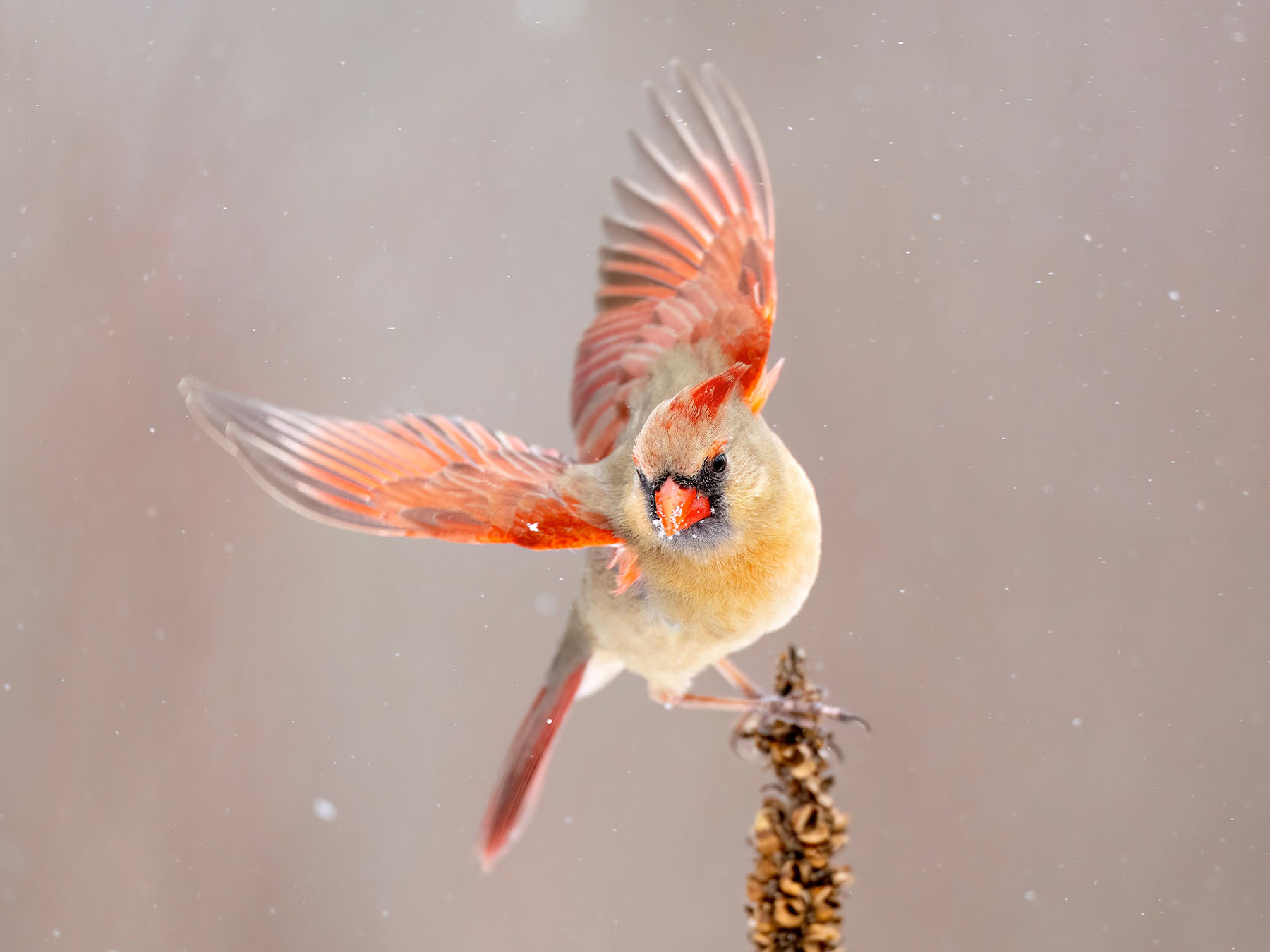
Males and females are easy to tell apart: a red male, a tan female. A female's mask varies from nearly as dark as a male's to small and grayish, many have a few red feathers on the face and upper breast, and the undersides of her wings are orange-red. More: female cardinals and how to tell male from female.
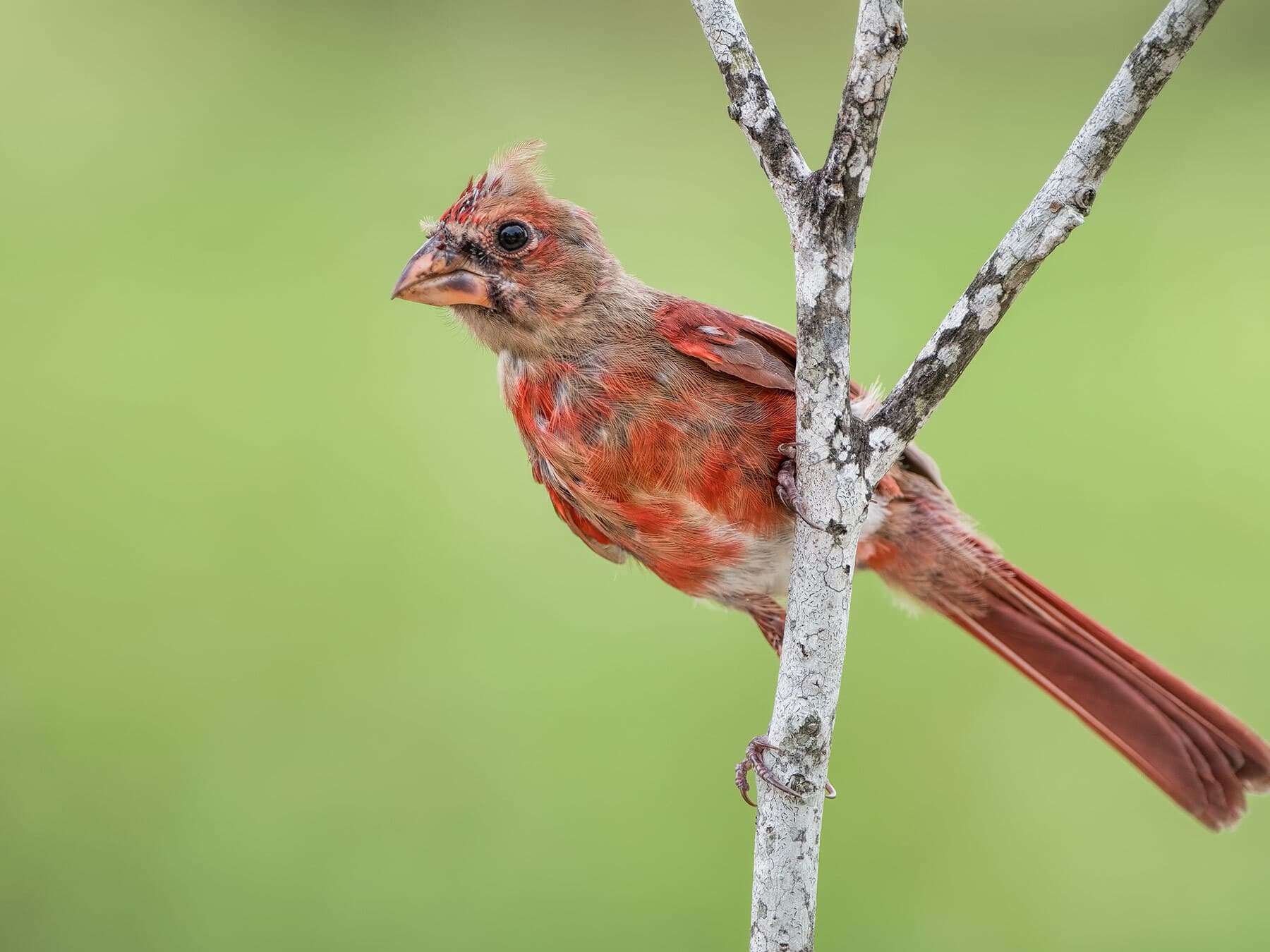
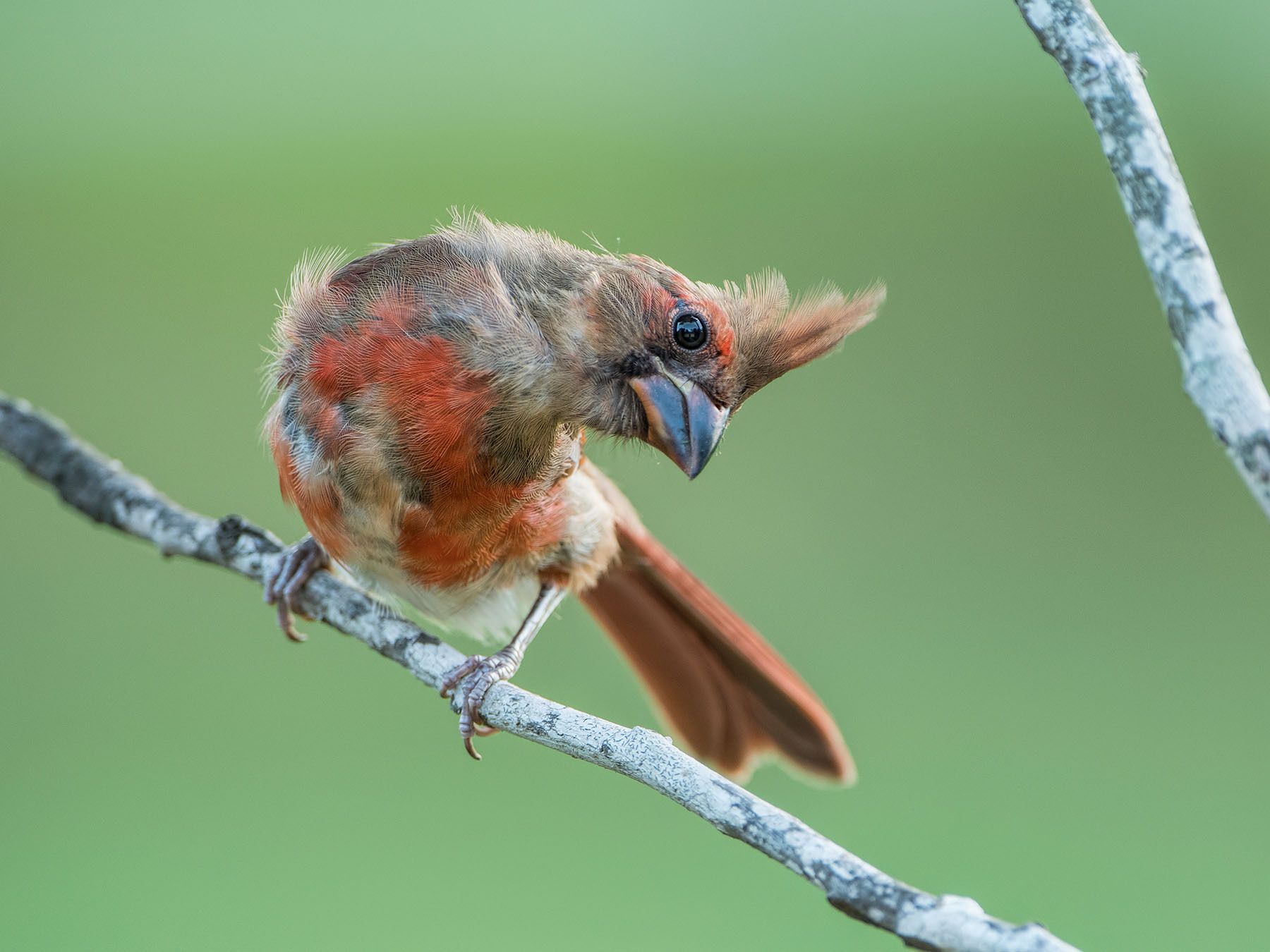
Young cardinals look like dull females with a dark gray to black bill, a shorter crest and loose, fluffy feathers. Young males and females look alike at first. Over late summer and fall the young males show patches of red as they molt, and the bill reaches its adult color 65 to 80 days after hatching. More: juvenile cardinals and baby cardinals.
Fresh feathers on a male's back and neck have gray-olive tips in the fall. They wear off over the winter, so males look their brightest in late winter and spring.
Bald cardinals: plumage through the year
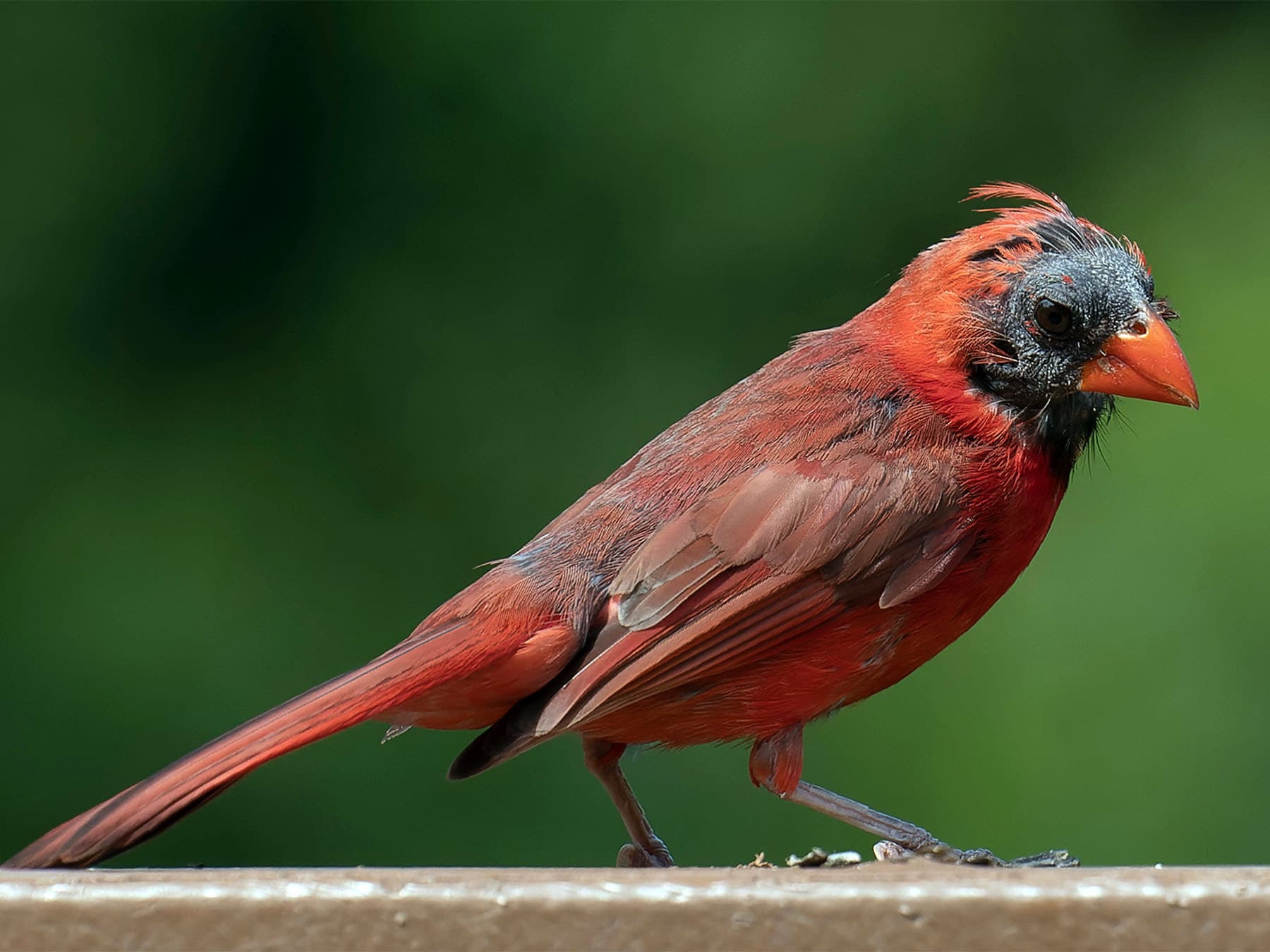
Adults replace all their feathers once a year, mainly from July to October. Every so often a cardinal loses most or all of its head feathers at once and shows dark bare skin. The cause is usually unknown; the skin looks normal, and the feathers grow back at the next molt. In a banding study in Tennessee, 7 of 1,621 cardinals caught had missing head feathers.3
Rarely, a cardinal is yellow instead of red. A yellow male that was studied had only yellow pigments in its feathers, which suggests it lacked the enzymes that turn yellow pigments red.4
Identification: similar birds
Across most of its range nothing else has red plumage, a crest and a thick orange-red bill together: Audubon calls the male the only red bird with a crest.5
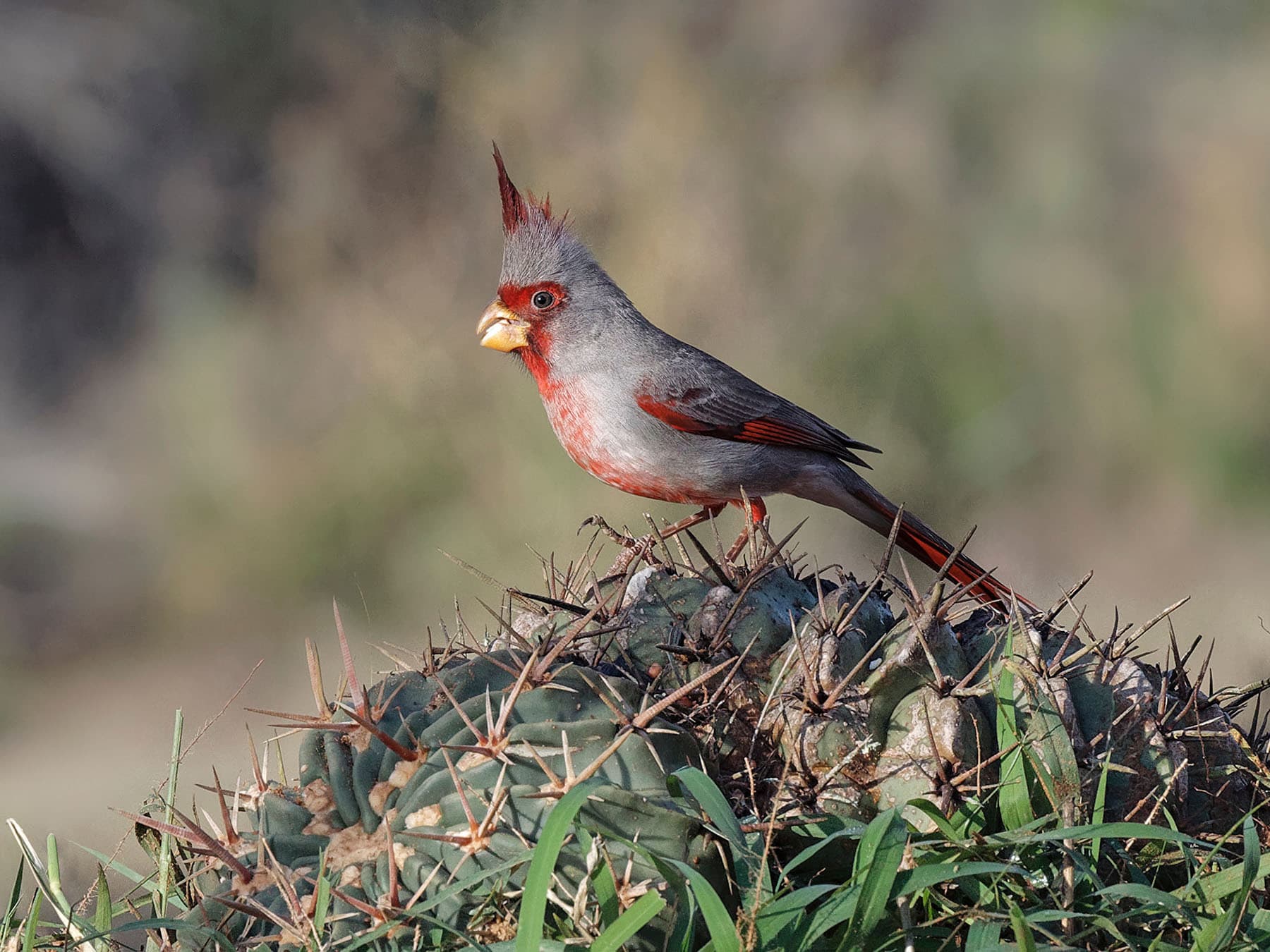
In the Southwest and Mexico, look out for the Pyrrhuloxia, a close relative. It is grayer than a female cardinal, and its short, stubby bill is yellow with a strongly curved top edge. Males have red on the face and down the middle of the belly.
Red male tanagers have no crest and no black mask. A male Scarlet Tanager has black wings and tail; a male Summer Tanager is red all over with a pale bill. Both tanagers are smaller, keep to the tops of trees and migrate, so neither is around in winter.
Its size
Adults- Length
- 21–23 cm
- Wingspan
- 25–31 cm
- Weight
- 42–48 g
Its song and calls
Both males and females sing: loud, clear, whistled phrases repeated in a series, often written as what-cheer, cheer, cheer or birdie, birdie, birdie, sometimes ending in a low, dry chirr. Many songs last 2 to 5 seconds.
The call you will hear most is a sharp, metallic chip, given in alarm, in squabbles at feeders and before going to roost. Learn it, and you can find cardinals hidden in a thicket.
Males sing in every month, most from February to September and least in November and December. Females sing less, often from the nest.
Songs are learned, so neighbors share most of their songs and each area has its own dialect. A female's song from the nest seems to tell her mate when to bring food: in a Wisconsin study, males came to the nest 80% of the time when the female answered their chips with song, and 45% of the time when she stayed silent.6
- Song0:00 / 0:20
Recorded in North Carolina, United States · May 2023
- Call0:00 / 0:26
Recorded in Minnesota, United States · May 2011
When and where to see it
OctoberHere all year
Most recorded in October
- 1. Kentucky4.3%
- 2. Georgia4.2%
- 3. Arkansas4.1%
- 4. Tennessee4.1%
- 5. Alabama4.0%
Each dot is a county, state or province: the bigger and darker, the larger the bird’s share of that place’s bird records that month. Grey dots: no regular records. The ringed point is the centre of the bird’s records this month; the arrow shows how it moved since last month, and the dashed loop its path through the year. “Arrivals” colours places where it becomes regular this month (orange) or is in its last regular month (grey). GBIF eBird Observation Dataset, 2019–2024. Map data: Natural Earth, US Census Bureau; place centres © OpenStreetMap contributors.
In your area
See when the Northern Cardinal is recorded in your county, state or province.
How often the Northern Cardinal turns up in the United States and Canada through the year, from birdwatchers' records.
United States
Resident · all year · most records in February
Canada
Resident · all year · most records in February
Show as a table
| Month | United States | Canada |
|---|---|---|
| January | 2.5% (regular) | 2.4% (regular) |
| February | 2.9% (regular) | 2.8% (regular) |
| March | 2.9% (regular) | 2.5% (regular) |
| April | 2.7% (regular) | 1.9% (regular) |
| May | 2.3% (regular) | 1.4% (regular) |
| June | 2.2% (regular) | 0.98% (regular) |
| July | 2.4% (regular) | 1.2% (regular) |
| August | 2.3% (regular) | 1.2% (regular) |
| September | 2.2% (regular) | 1.1% (regular) |
| October | 2.3% (regular) | 1.4% (regular) |
| November | 2.2% (regular) | 1.8% (regular) |
| December | 2.4% (regular) | 2.2% (regular) |
Worldwide: recorded regularly in 6 countries
Countries where it was recorded in at least 3 of the 6 years 2019–2024. Linked countries have their own bird list.
Data: EOD – eBird Observation Dataset (Cornell Lab of Ornithology), accessed via GBIF.org, CC BY 4.0. Records from 2019–2024, aggregated and filtered by Birdfact. How these lists are made
Wherever there are dense shrubs and small trees: yards, parks, towns, woodland edges, hedgerows, overgrown fields and thickets by water, and mesquite and desert scrub in the Southwest. Cardinals need thick cover to nest in and a few high perches to sing from.
They live across the eastern and central US and southeastern Canada, west to the Great Plains, and in Arizona, New Mexico and Texas, and south through Mexico to northern Guatemala and Belize. People introduced them to Hawaii and the Los Angeles area, and they have lived on Bermuda since at least the early 1800s. West of the Great Plains, away from the desert Southwest, they are mostly absent. More: where cardinals live and cardinals in Hawaii.
Cardinals have been spreading north since at least the mid-1800s, helped by milder winters, the shrubby edges people create and bird feeders. Birds of the World notes that in New York they were found in only 2 counties around 1900, and in 59 of the state's 62 counties by 1970.
Do cardinals migrate?
No. Cardinals live in the same area all year. Nearly 90% of banded cardinals that were later found dead were within the same small block of latitude and longitude where they had been banded, with no sign of a seasonal direction.7 Young birds move a mile or two from where they hatched, and adults may wander more widely in winter to find food. More: cardinals in winter.
Spotting tips
Watch feeders and the edges of thickets around dawn and dusk, when cardinals visit most. Away from yards, listen for the metallic chip; in winter, look for small groups feeding on the ground near cover.
What it eats
Mostly seeds and fruit, plus insects. In a classic study of 498 stomachs, plants made up about 71% of the year's diet and animals 29%.8 The plant share climbs to about 88% in winter. Nestlings are different: their parents feed them almost nothing but insects.3
Wild foods include weed and grass seeds, wild grapes, dogwood, mulberry, sumac, blackberry and hackberry; beetles, grasshoppers, crickets, caterpillars and cicadas; and spiders and snails. In spring cardinals feed on the ground for seeds, then move up into trees and shrubs for buds and caterpillars once the leaves open. More: what cardinals eat.
Feeding them in your yard
Black-oil sunflower seed is the favorite. In an 18-month study of 22 kinds of seed at feeders in Maryland, sunflower came out on top, and black-oil was the best liked of the sunflowers.9 Project FeederWatch also lists hulled sunflower, safflower, cracked corn, millet, milo and peanut hearts for cardinals, offered on the ground, on a platform, or in a large hopper or tube feeder.10
Cardinals do eat safflower, but in a feeder test with no other cardinals around, they chose sunflower over it.11 Feeders near dense shrubs suit them: cardinals use feeders in the open less when a hawk is about.
Nesting and breeding
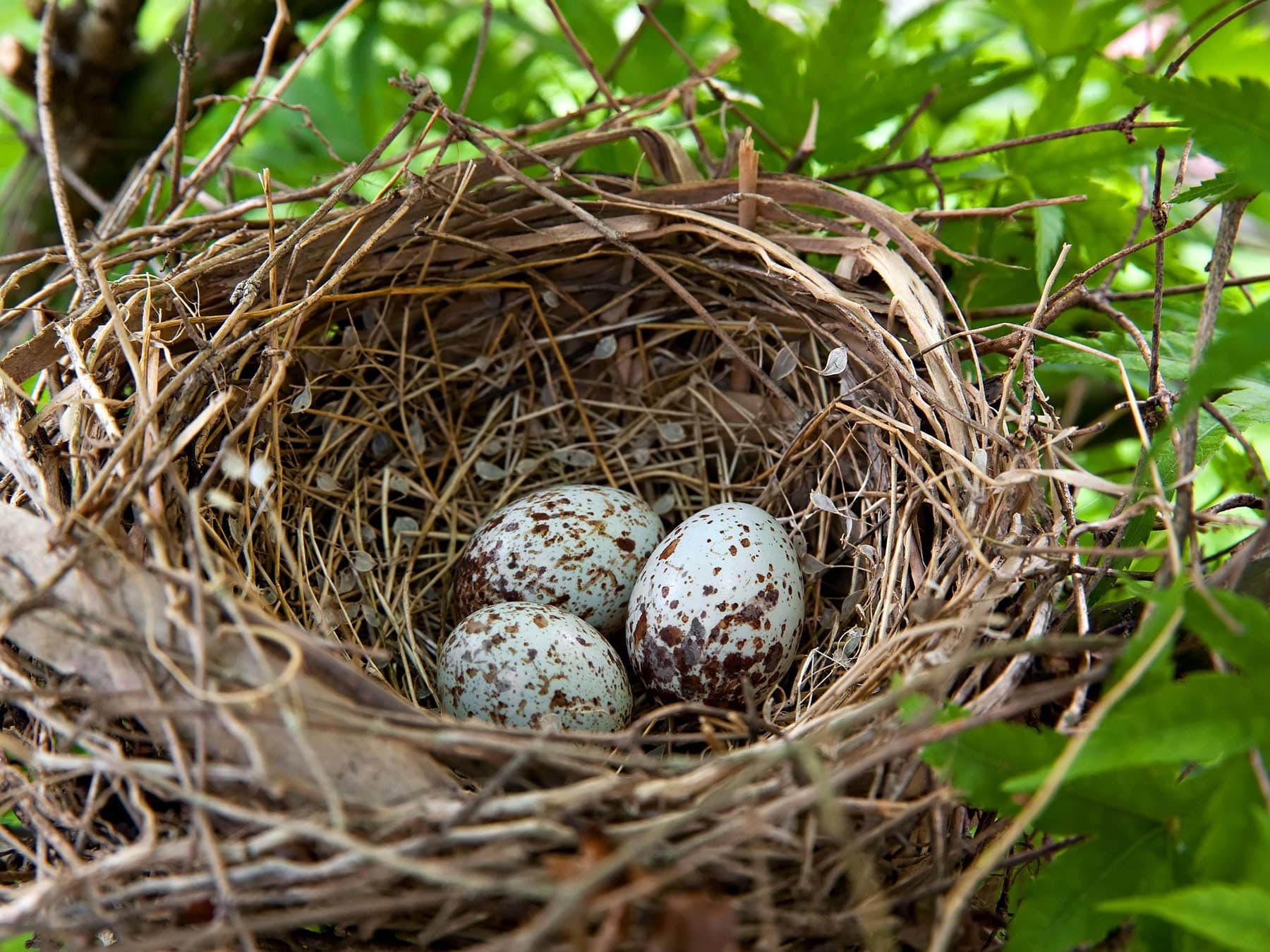
The female builds a cup of twigs, leaves, grapevine bark and grass, wedged into a fork in a dense shrub, small tree or vine tangle, 1 to 15 ft up. She lays 2 to 5 eggs, usually 2 or 3, grayish to greenish white with brown speckles, and incubates them alone for 11 to 13 days. Both parents feed the chicks, which leave the nest at 7 to 13 days old, most often at 9 or 10.12
First eggs are laid in March or April, and nesting runs into late summer. Pairs try again and again, because about 70% of nests are lost to predators: a pair may start 8 to 10 nests in a season, though seldom more than 2 or 3 succeed.3
Cardinals do not use nest boxes; dense shrubs and vine tangles are the way to help them.13 An active nest is protected: under the Migratory Bird Treaty Act it is illegal to destroy a nest with eggs or young in it.14 More: cardinal nesting and eggs and baby cardinals.
Behaviour
Cardinals hop on the ground and through bushes and make short, undulating flights between cover. The crest goes up when a bird is excited and lies flatter when it is relaxed.
Both sexes defend a territory in the breeding season, about 0.5 to 6.4 acres (0.21 to 2.6 ha), with song, chases and, rarely, fights that last a few seconds. Boundary defense stops in late summer and starts again between January and March.
That drive explains the cardinal that fights your window. In spring and early summer, males and females attack their own reflection in windows and car mirrors, sometimes for hours, day after day. It is usually harmless to the bird. To stop it, remove the reflection from the outside of the glass, with a sheet, an exterior screen or decals, and fold car mirrors in.15 More: are cardinals territorial?
Social behavior: pairs and winter flocks
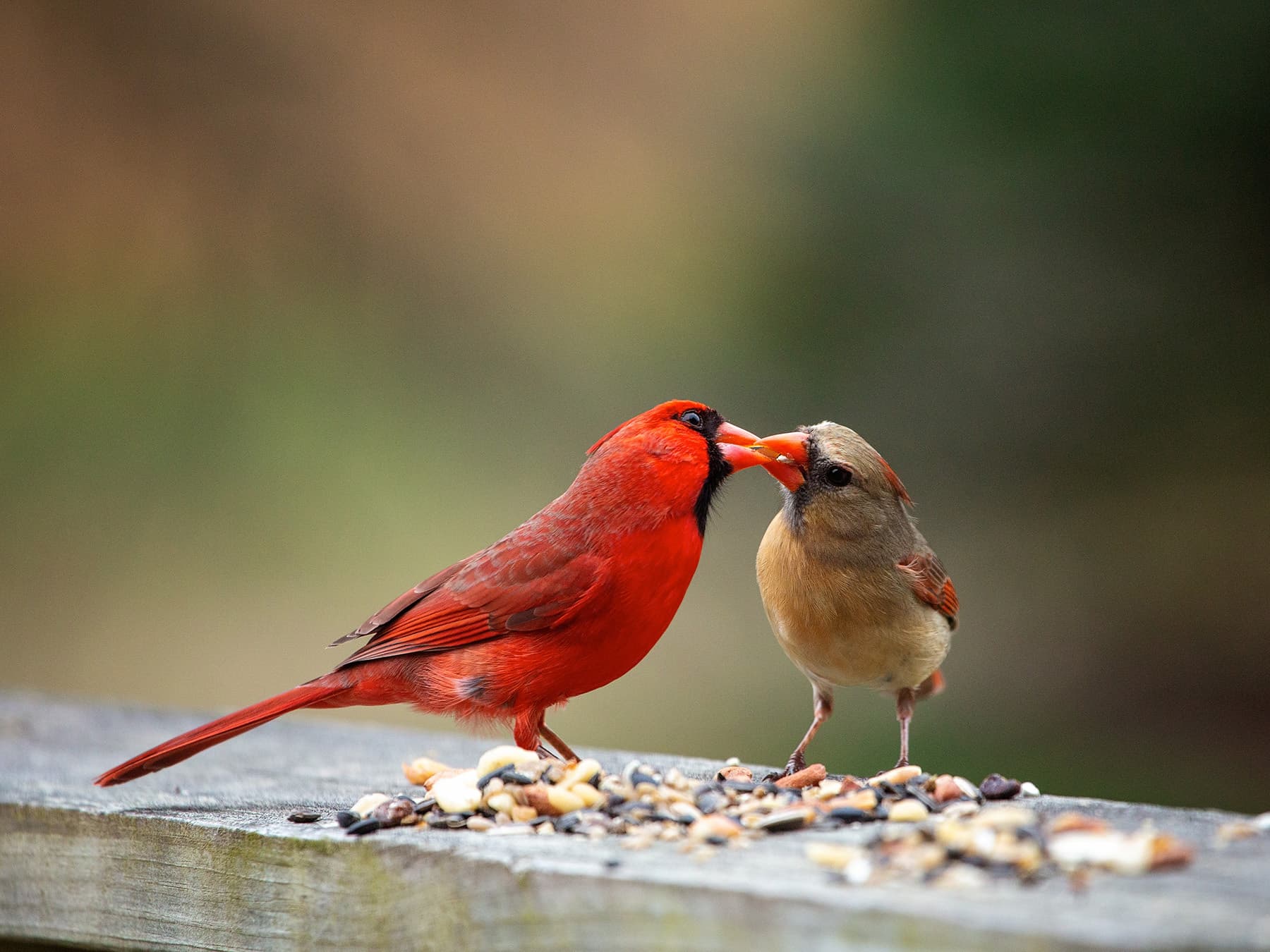
Do cardinals mate for life? Often for more than one season, but not always. Pairs can stay together through the winter, yet in an Ohio study 2 of 10 banded pairs split up between seasons, and All About Birds puts it at up to 20% of pairs.12 Males feed their mates beak to beak during courtship and while she sits on the eggs. DNA studies found that 9 to 35% of nestlings were fathered by a male other than the mate.3
In fall and winter cardinals gather in loose flocks, usually a dozen to several dozen birds and occasionally more than 100, and roost together in thickets and conifers. The flocks break up between January and March as pairs claim territories. More: what a group of cardinals is called.
Lifespan and predators
Most cardinals live only a few years. Between half and three-quarters of adults survive from one year to the next: estimates range from 50.5% to 78.3% across 14 study sites in Ohio. In a 12-year banding study in Tennessee, many cardinals were last found at 2 to 3 years old, and 30 of 1,621 were known to have lived 3 to 6 years.3
Predators and other dangers
Domestic cats, Cooper's Hawks, shrikes and owls take adults. Snakes, Blue Jays, squirrels, chipmunks, raccoons and grackles raid nests, and Brown-headed Cowbirds lay their eggs in cardinal nests. Some cardinals die hitting windows.
Lifespan records
The oldest known wild cardinal was a female at least 15 years and 9 months old, found in Pennsylvania.1 The oldest known male was at least 13 years and 2 months old.
Conservation
The Northern Cardinal is of Least Concern, with a stable population.16 Partners in Flight estimates about 130 million birds.12 On the North American Breeding Bird Survey, numbers in the US and Canada rose by an estimated 17% between 1970 and 2014. They are increasing in the north, but falling slightly in the coastal plain of the Southeast and in peninsular Florida.
Cardinals have done well alongside people: suburbs, farmland and feeders gave them more nesting cover and winter food. Like other native songbirds, they are protected under the Migratory Bird Treaty Act.
Similar birds
Often mistaken for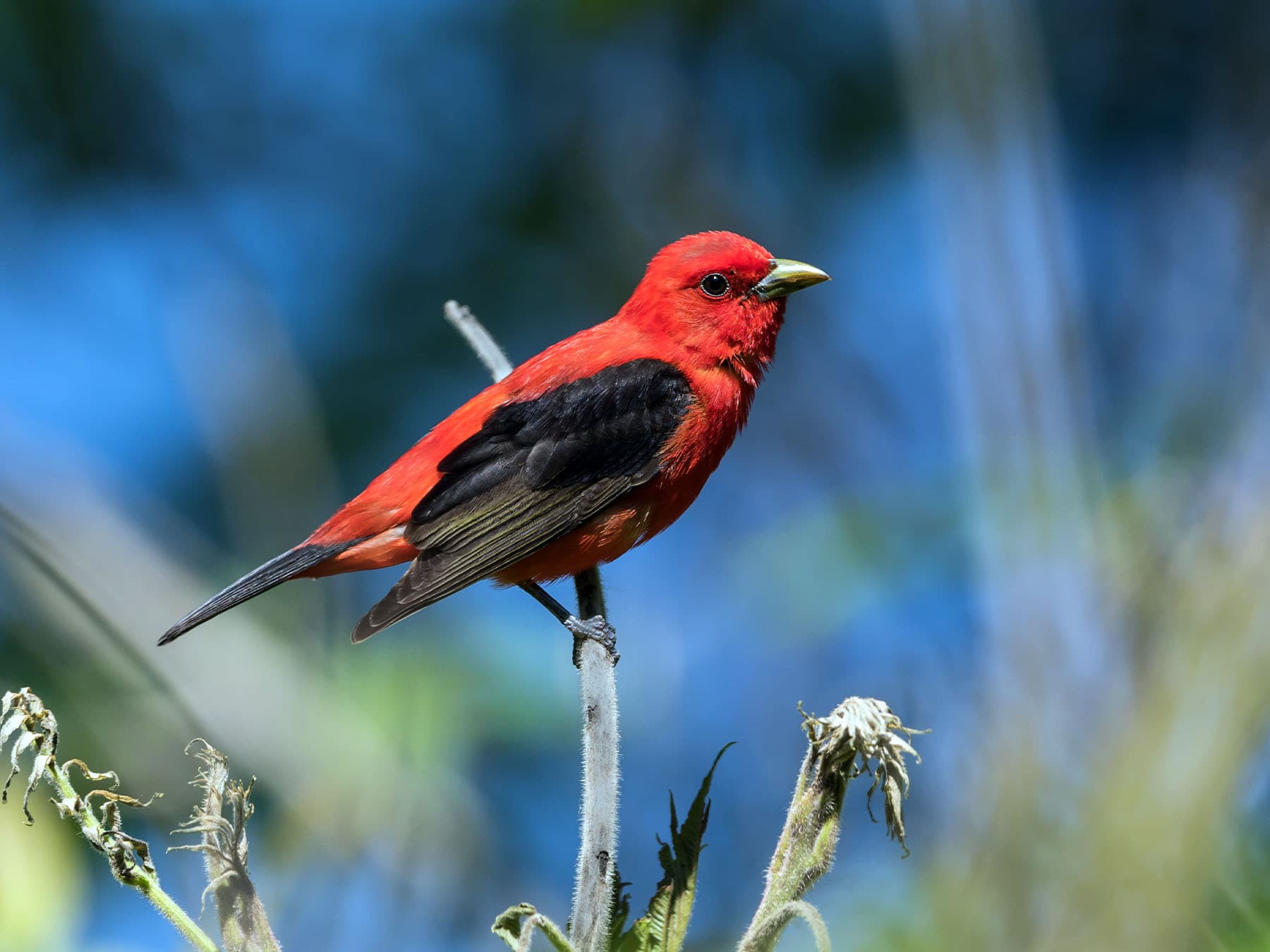
More photos
12 photos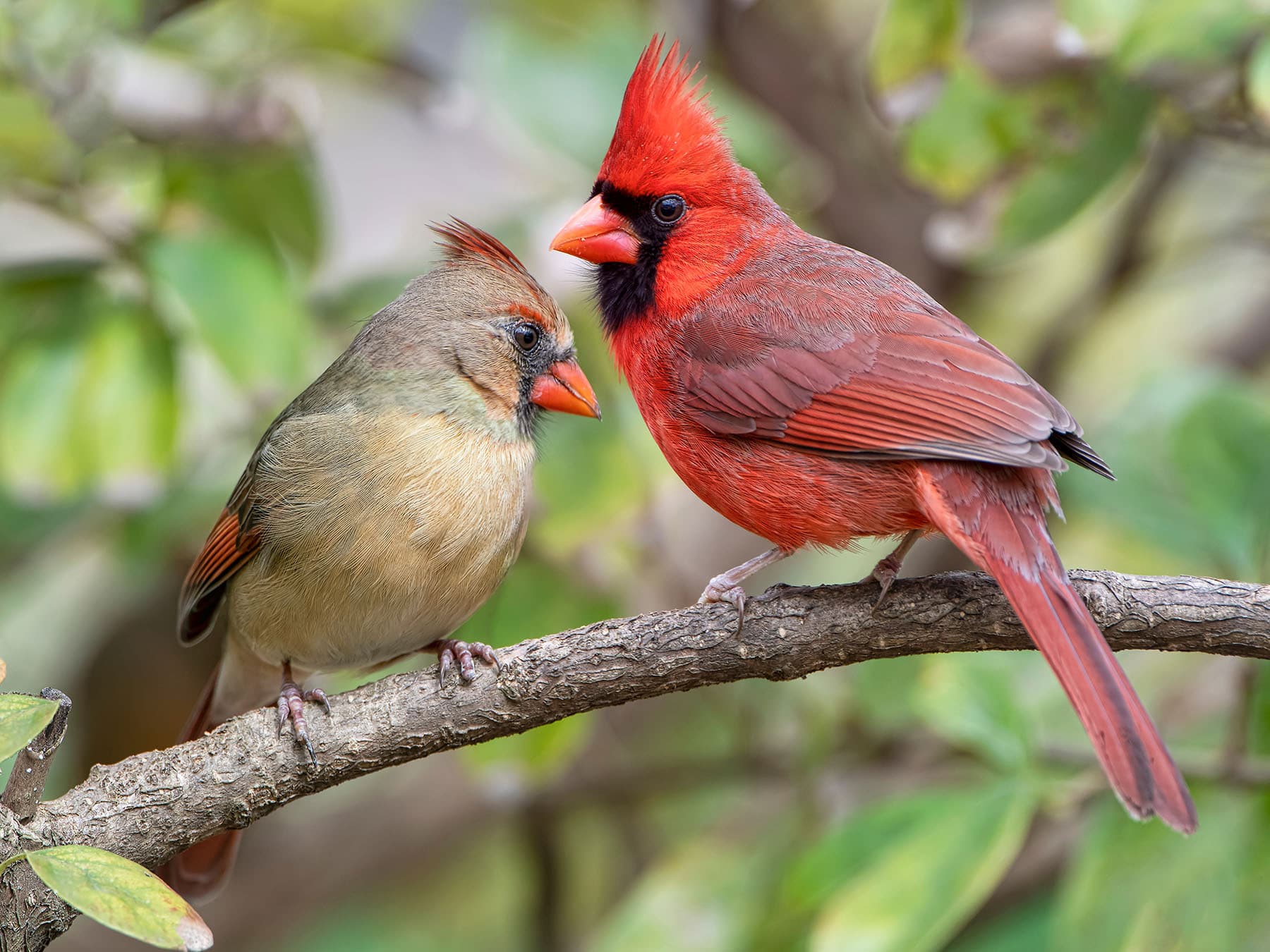 Female left, and male right, Northern Cardinal pair
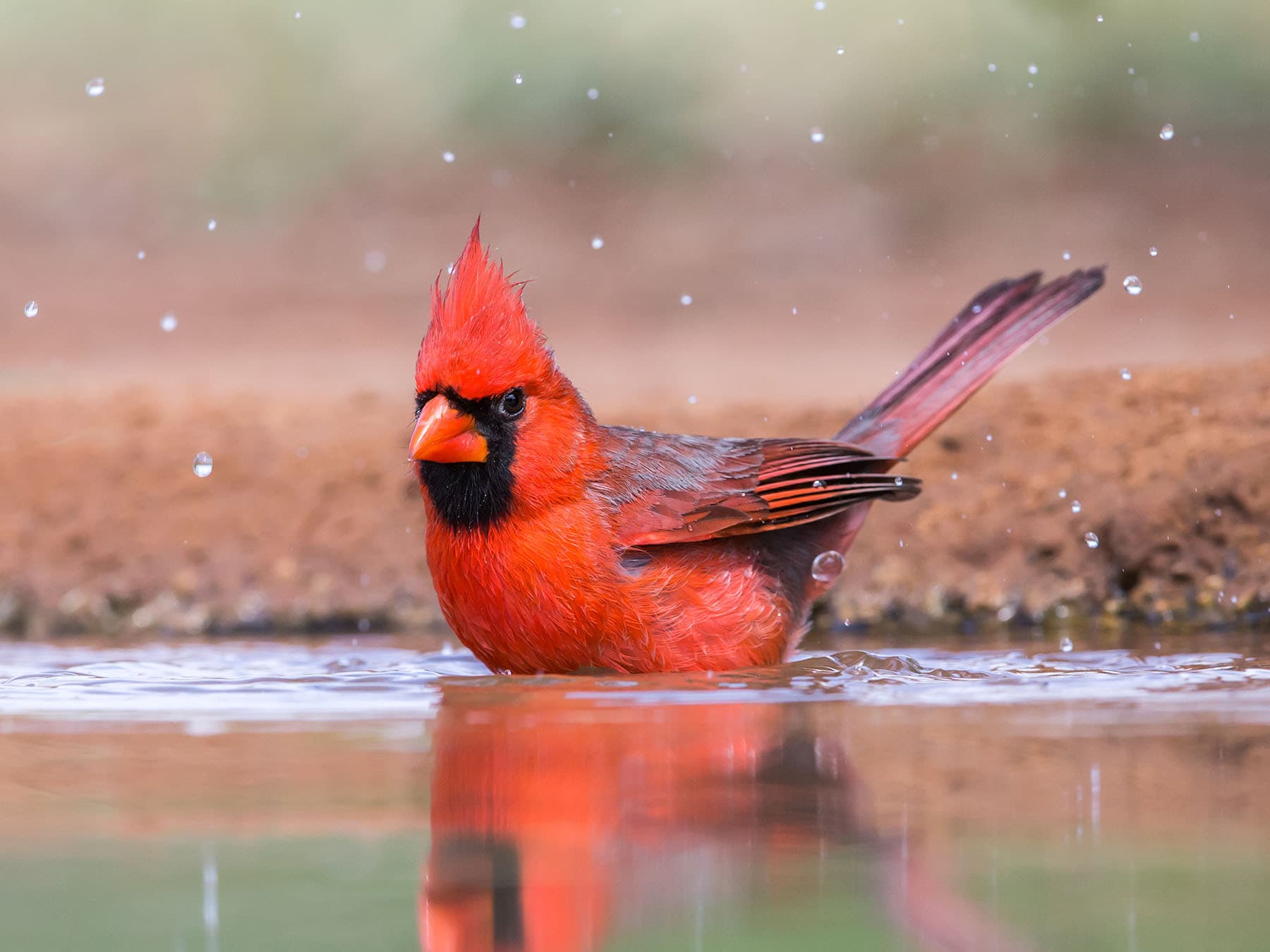 Northern Cardinal bathing in water
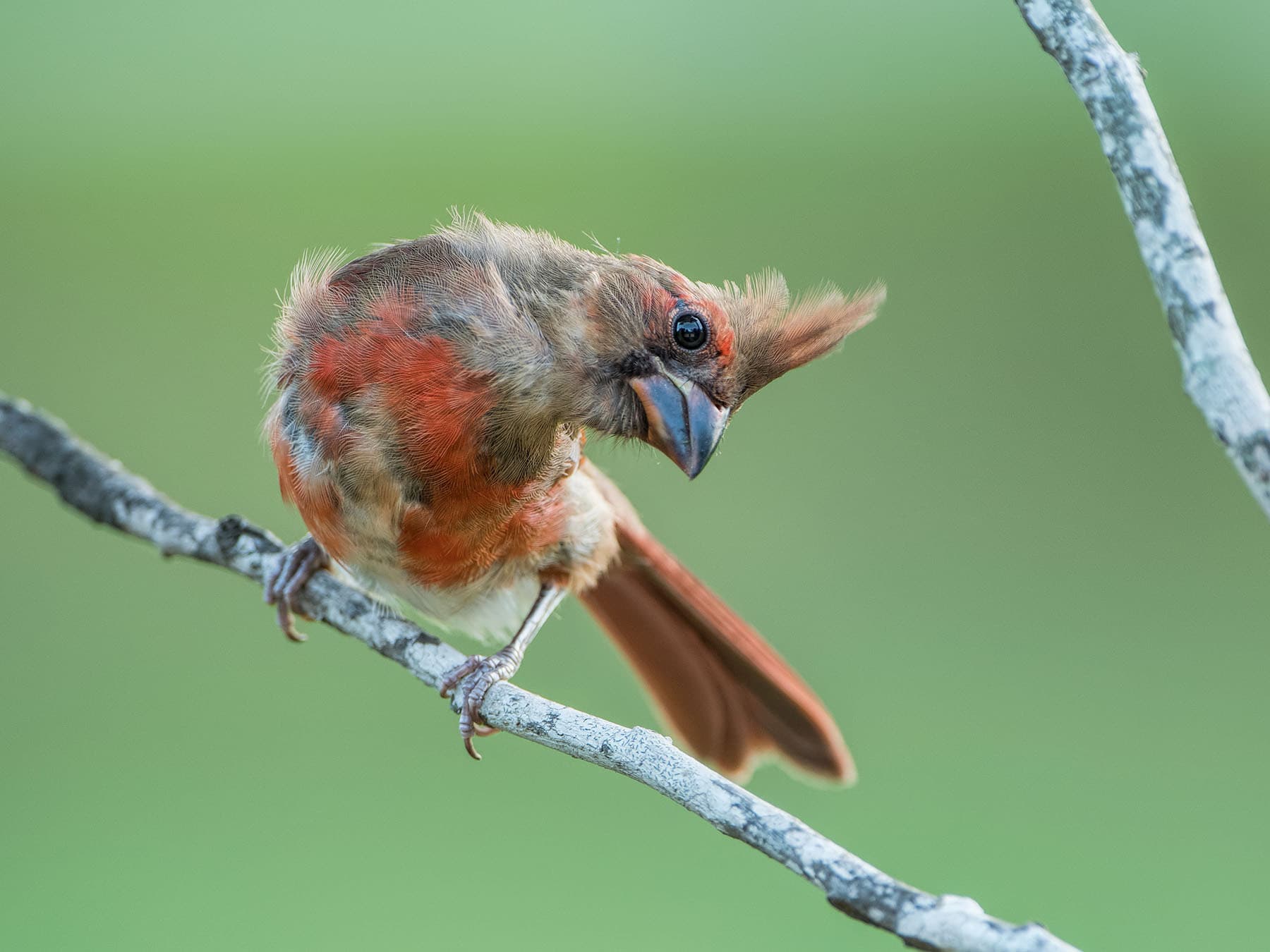 Juvenile Northern Cardinal (male)
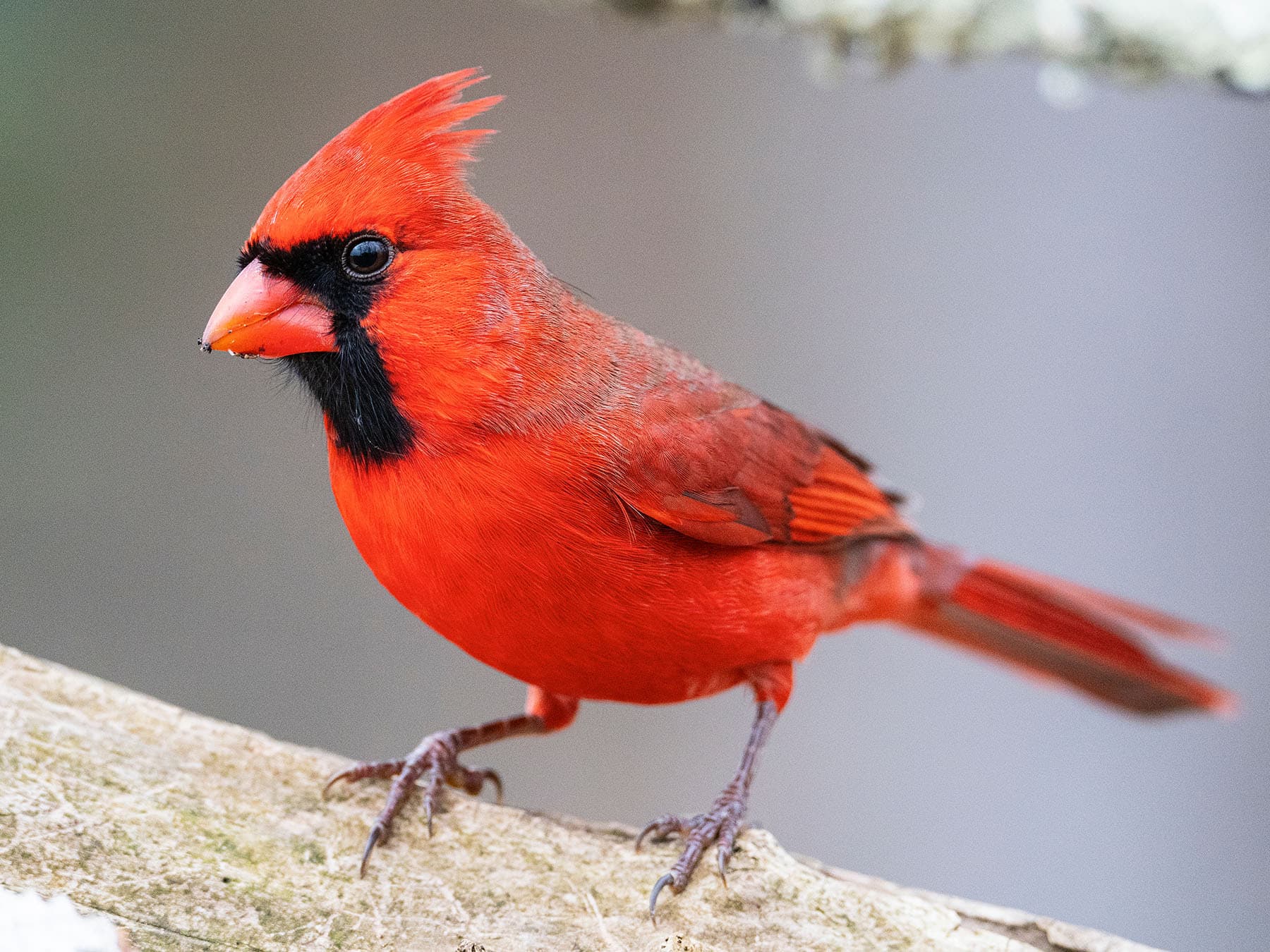 Male Northern Cardinal
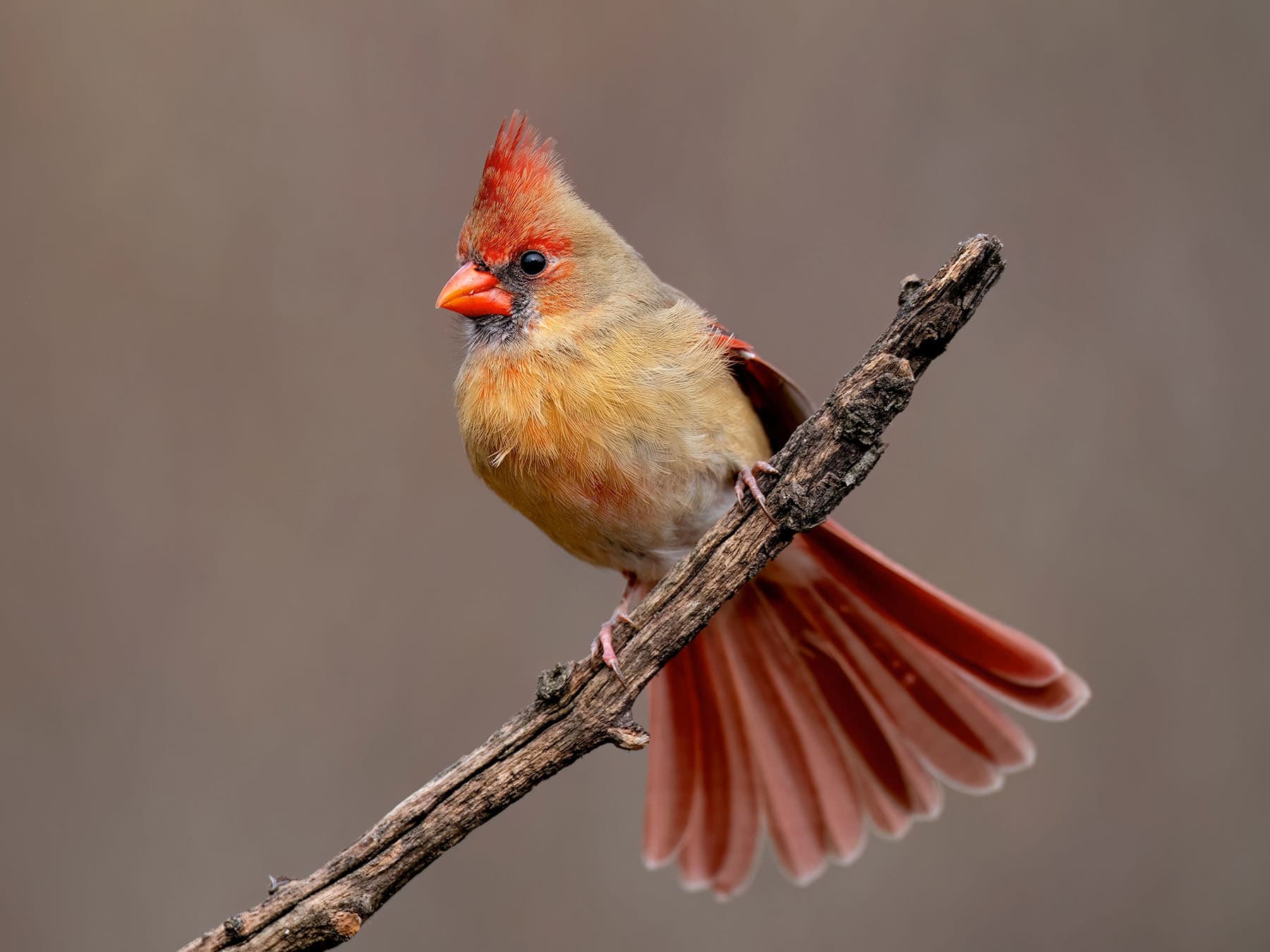 Female Northern Cardinal
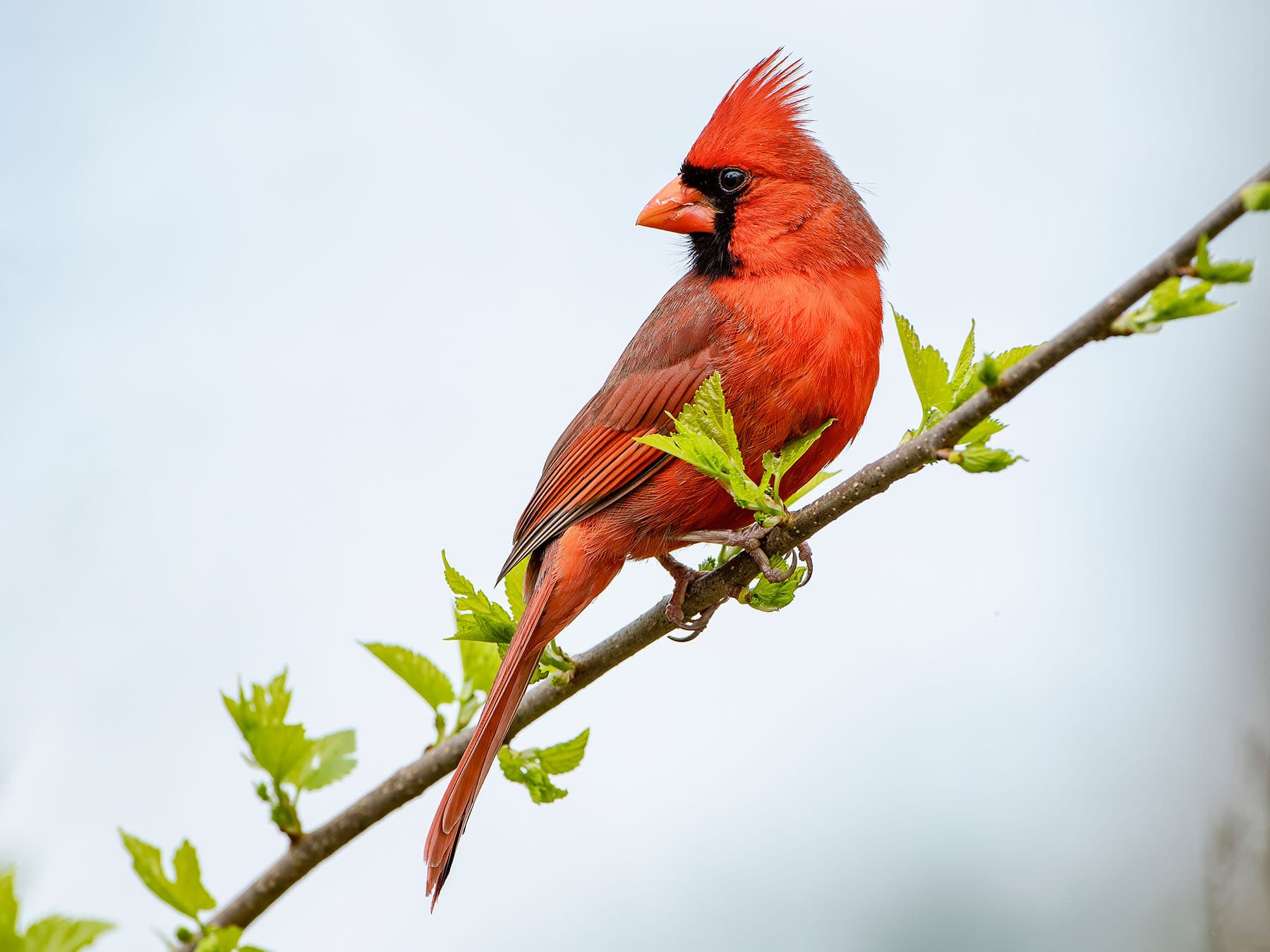 Northern Cardinal perched on a branch
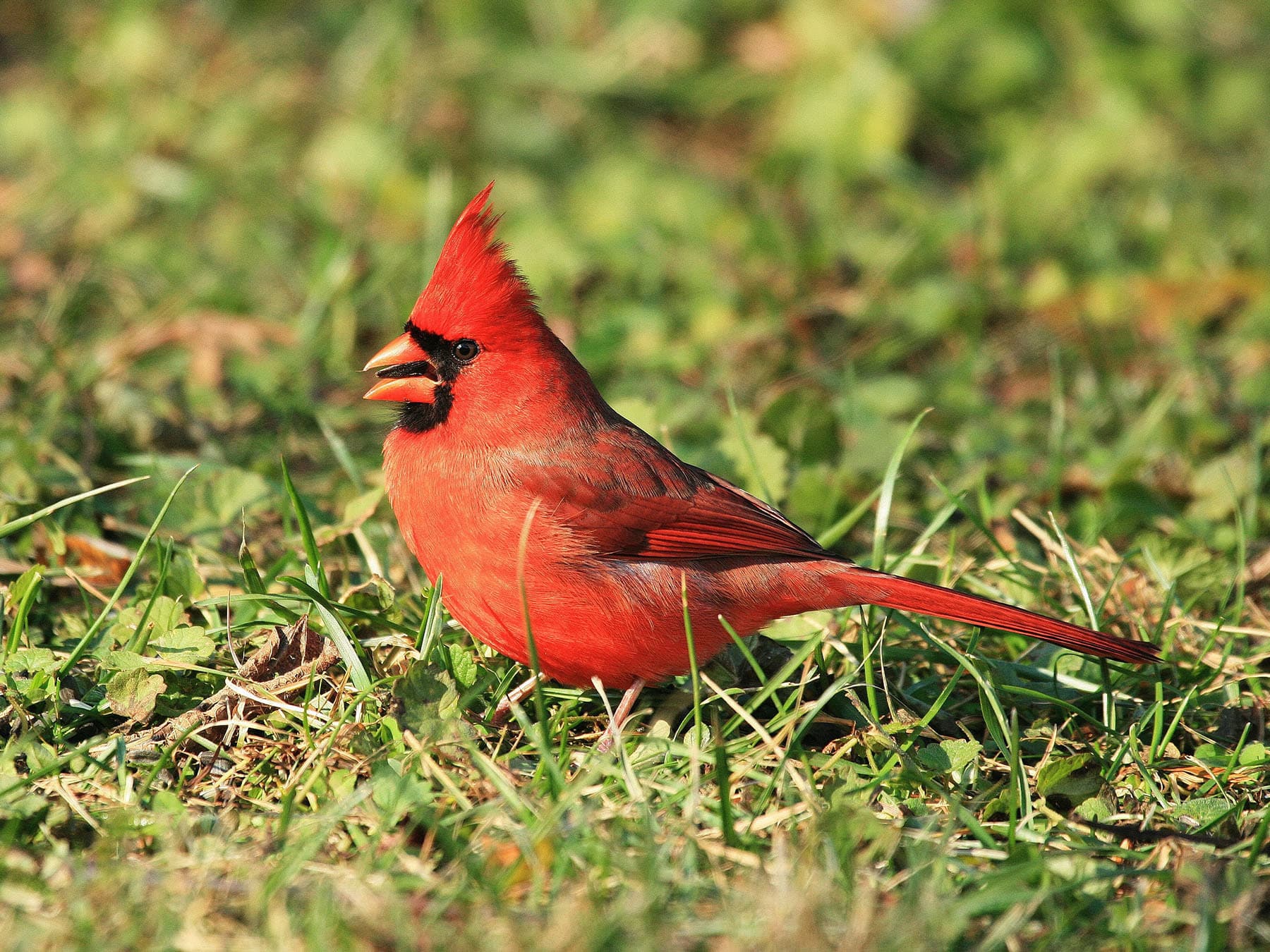 Cardinal feeding on seeds
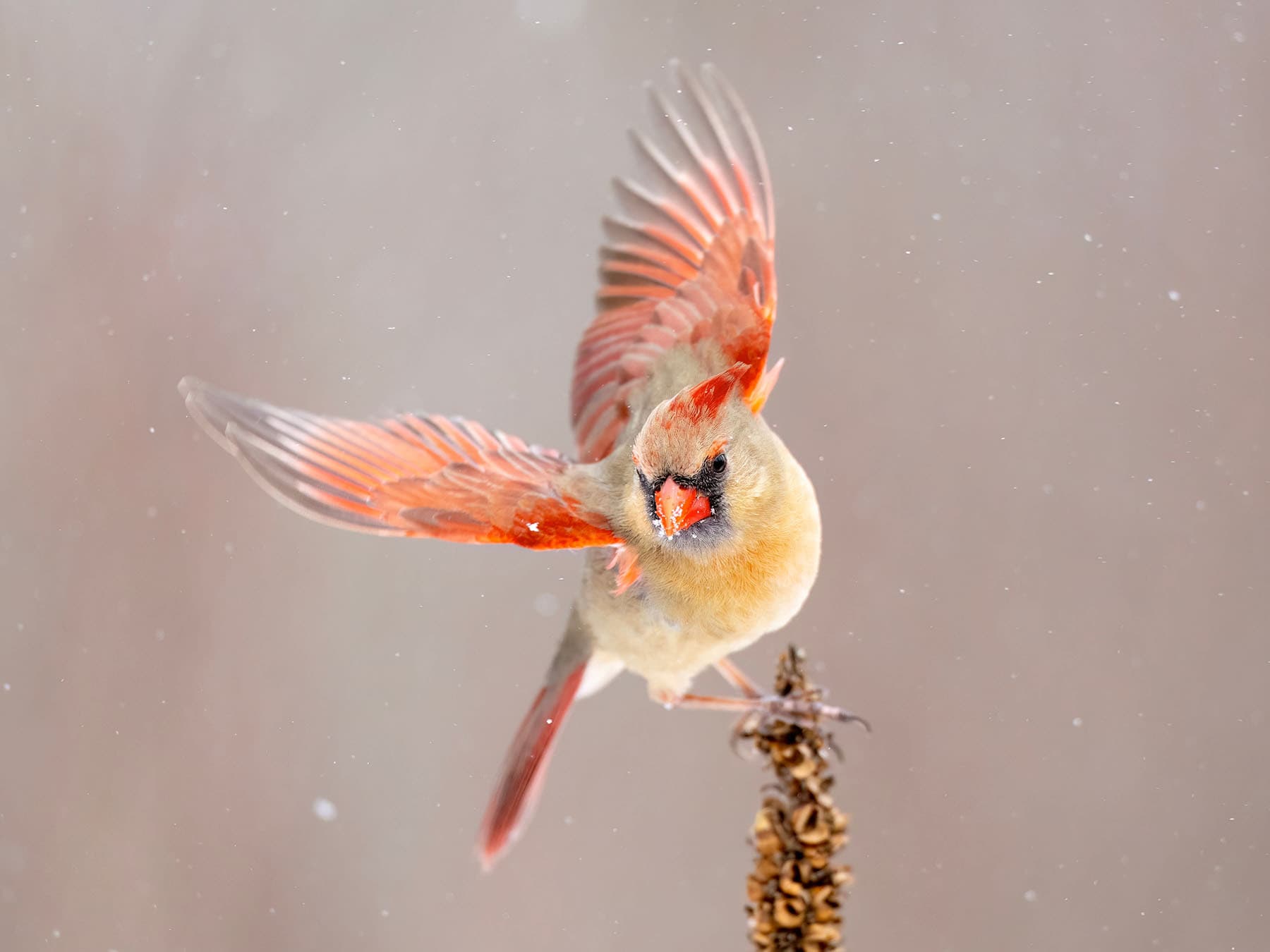 Female Cardinal taking off in the snow
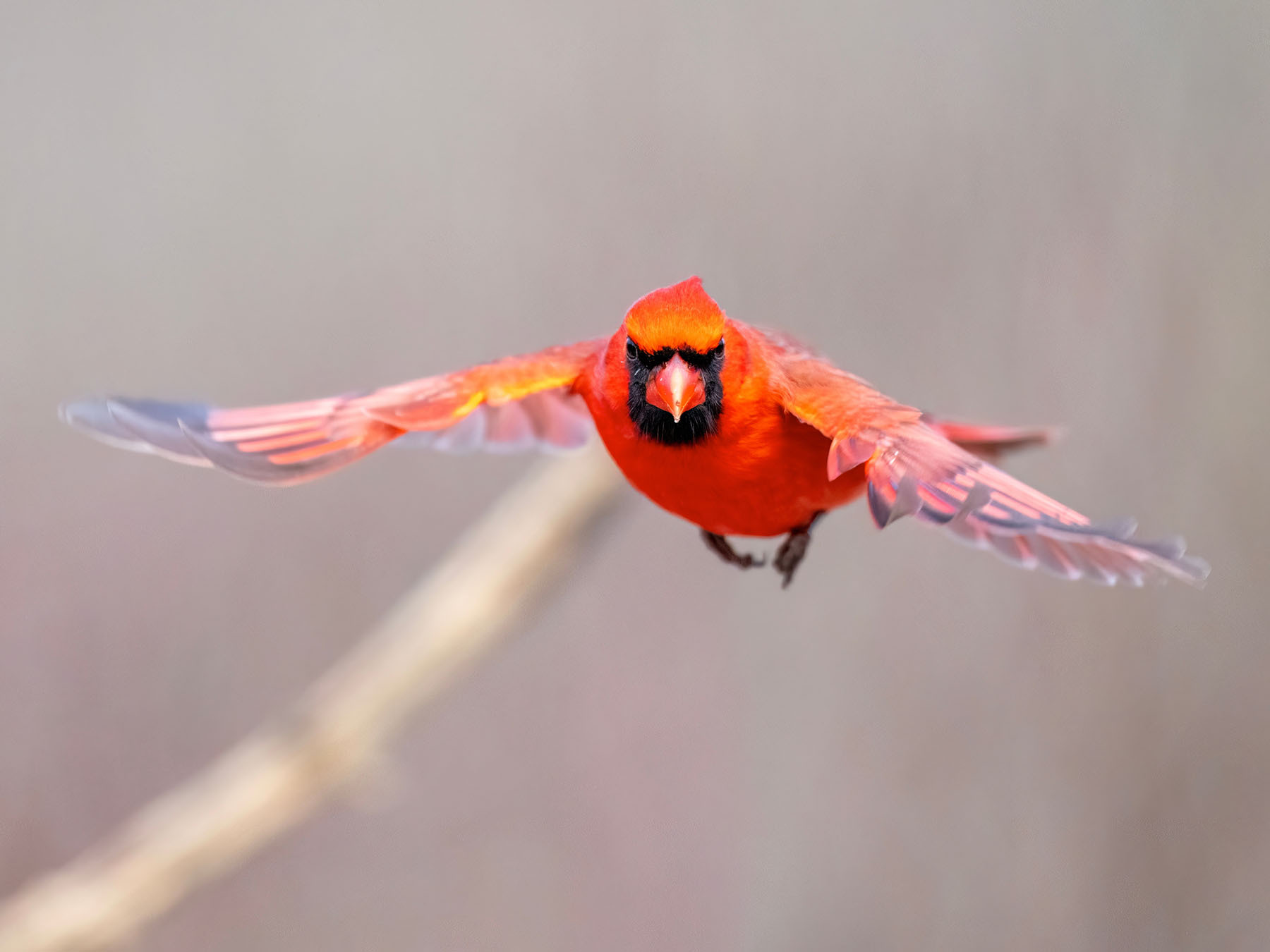
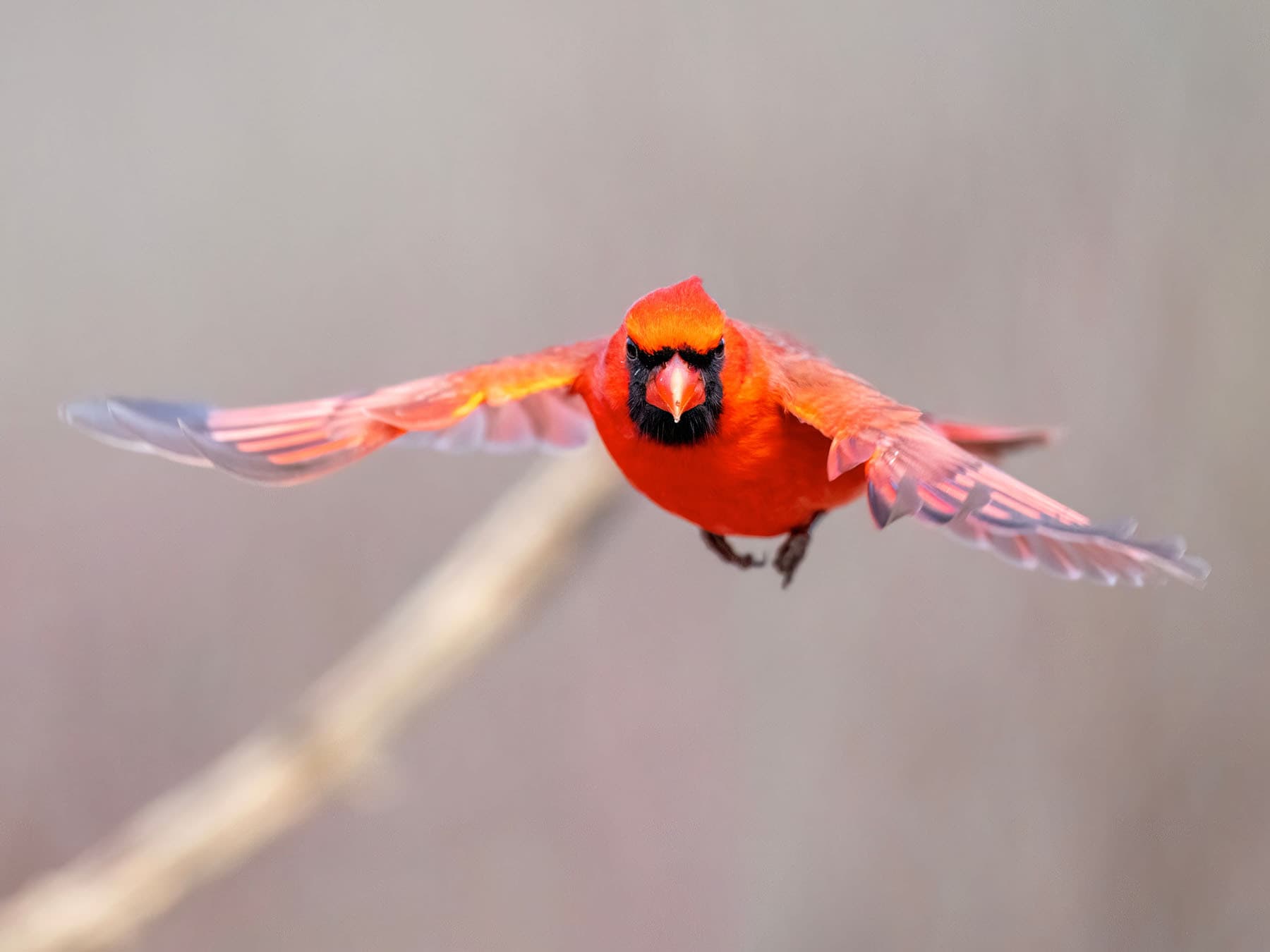 Cardinal in flight, looking forward
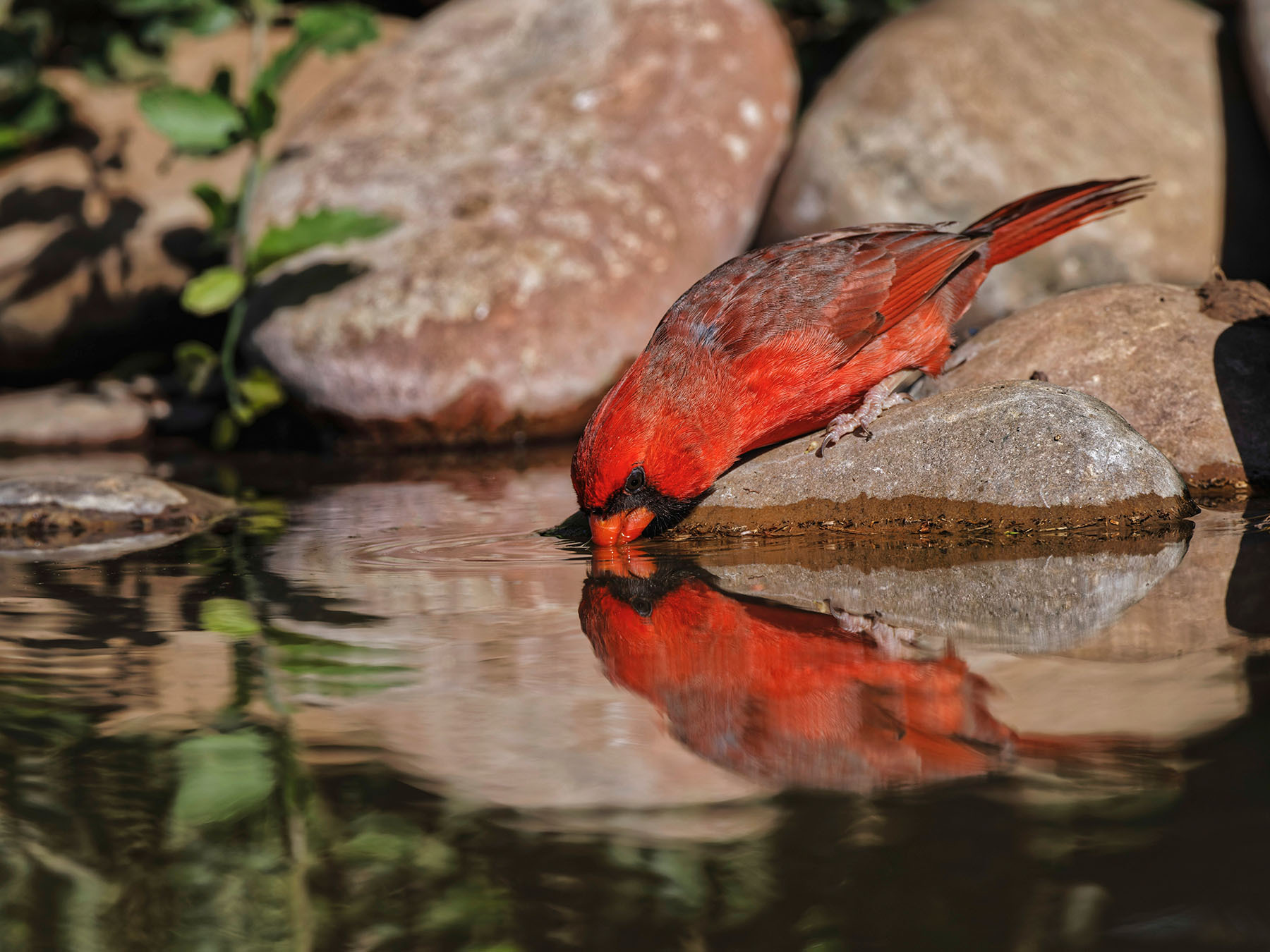
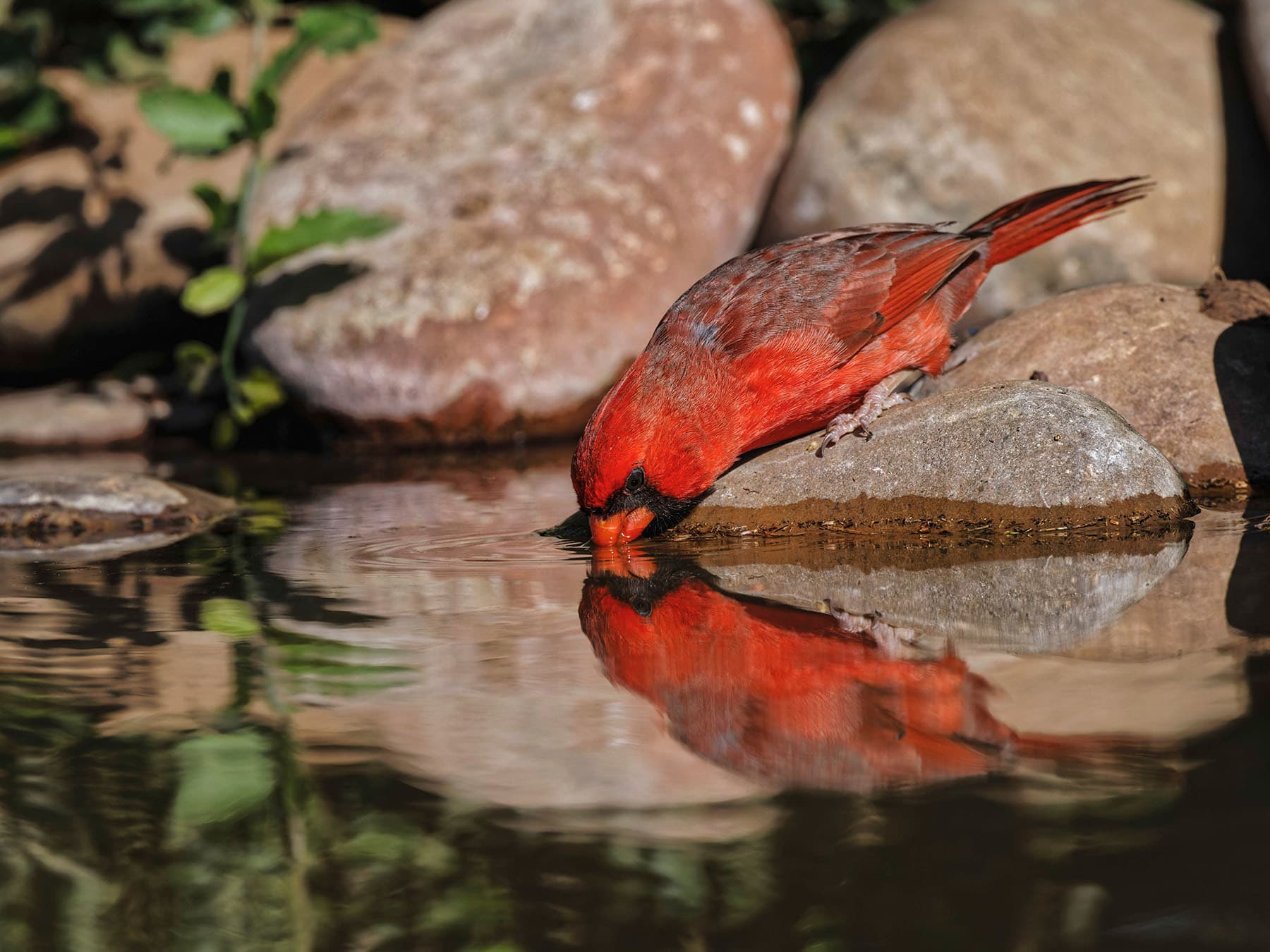 Northern Cardinal taking a drink of water
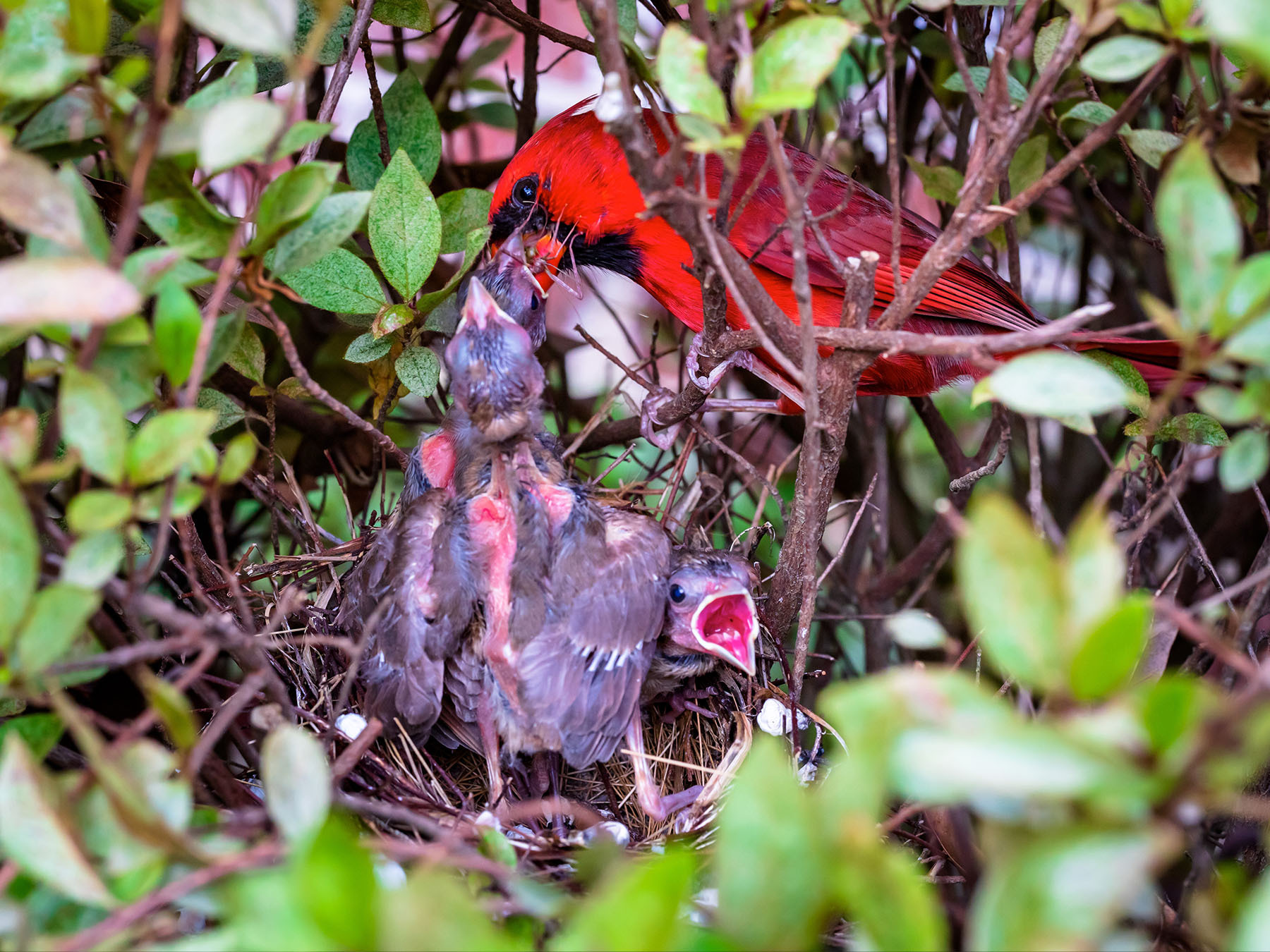
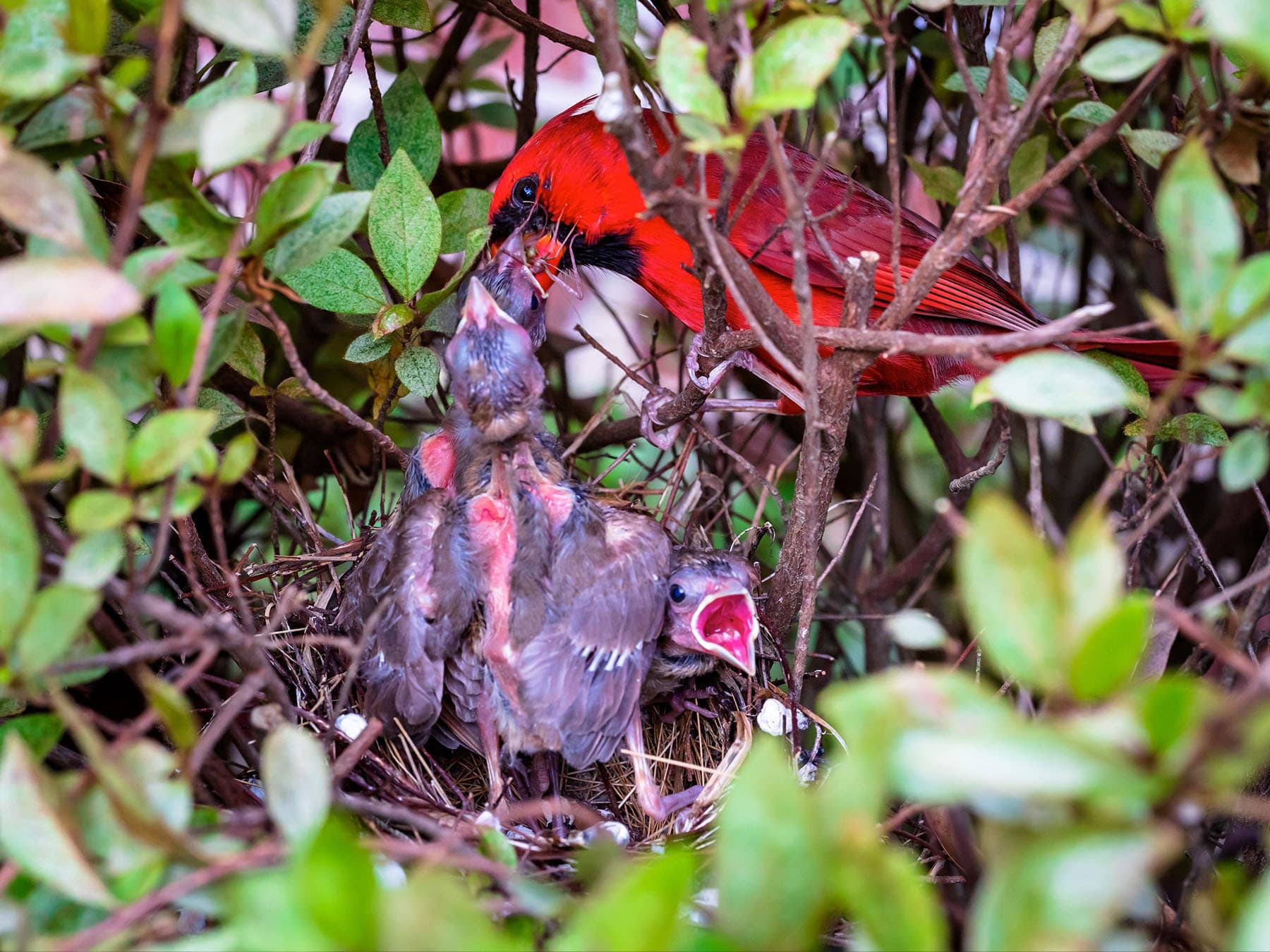 Male Cardinal feeding hungry hungry chicks in the nest
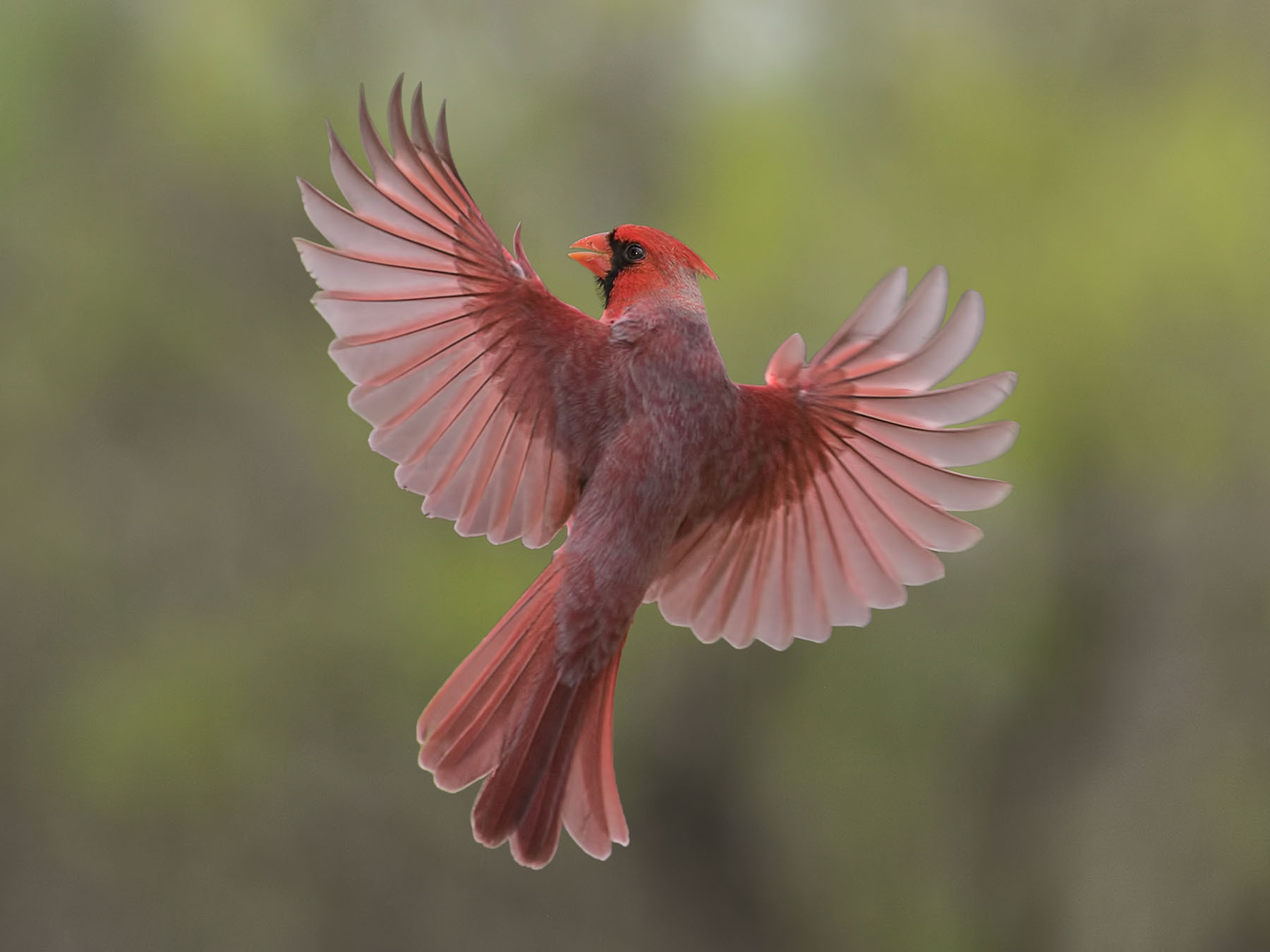
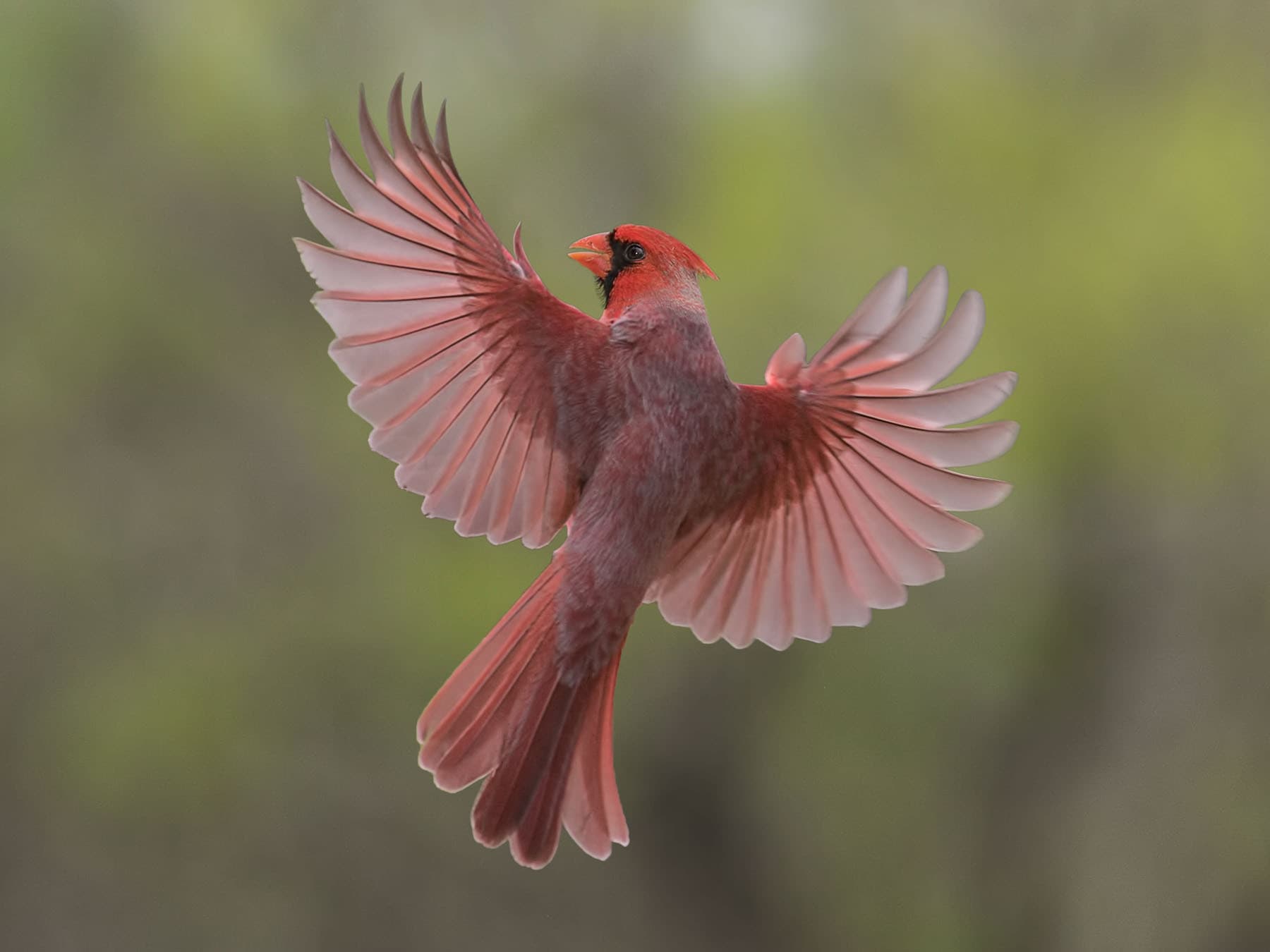 Northern Cardinal with spread wings, preparing to land
Northern Cardinal guides
5 guidesQuick facts
- Length
- 21–23 cm
- Wingspan
- 25–31 cm
- Weight
- 42–48 g
- Lifespan
- 2–3 years · oldest recorded 15 years 9 months
- Family
- Cardinals & Grosbeaks
- Migration
- Resident
- Global status (IUCN)
- Least Concern
- World population
- 130,000,000 (Partners in Flight)
- Population trend
- Stable
- Also called
- Redbird, Common Cardinal
- Scientific name
- Cardinalis cardinalis
Questions
8How big is a Northern Cardinal?
About 8.3 to 9.1 in (21 to 23 cm) long and 1.5 to 1.7 oz (42 to 48 g): slightly smaller than an American Robin. See how to recognize it.
Do female cardinals sing?
Yes. Females sing the same songs as males, though less often, and often from the nest. See female cardinals.
Do cardinals mate for life?
Many pairs stay together for more than one season, but up to 20% split up by the next season. See behavior.
Why is a cardinal attacking my window?
It sees its reflection as a rival on its territory. Cover the outside of the glass. See are cardinals territorial?
Why does a cardinal have a bald head?
Now and then a cardinal loses its head feathers all at once. The cause is usually unknown, and the feathers grow back at the next molt.
Is it rare to see a female cardinal?
No. Among banded adult cardinals there are slightly more females than males, about 1.1 to 1. Females are just harder to spot than red males.
Are there Northern Cardinals in the UK?
Not in the wild. Escaped cage birds have been reported in the United Kingdom, but no population has become established.
Which states have the cardinal as their state bird?
Seven: Illinois, Indiana, Kentucky, North Carolina, Ohio, Virginia and West Virginia. See state birds and cardinal symbolism.
Sources
18- 1Cornell Lab of Ornithology. Northern Cardinal: Overview and Identification. All About Birds. Accessed 6 October 2026. Source (opens in a new tab)
- 2Linville, S. U. and Breitwisch, R. (1997). Carotenoid availability and plumage coloration in a wild population of Northern Cardinals. The Auk 114(4): 796-800. doi:10.2307/4089305 (opens in a new tab)
- 3Halkin, S. L. et al. (2021). Northern Cardinal (Cardinalis cardinalis), version 2.0. Birds of the World (P. G. Rodewald and B. K. Keeney, editors). Cornell Lab of Ornithology. doi:10.2173/bow.norcar.02 (opens in a new tab)
- 4McGraw, K. J., Hill, G. E. and Parker, R. S. (2003). Carotenoid pigments in a mutant cardinal: implications for the genetic and enzymatic control mechanisms of carotenoid metabolism in birds. The Condor 105: 587-592. doi:10.1093/condor/105.3.587 (opens in a new tab)
- 5Kaufman, K.. Northern Cardinal. Audubon Guide to North American Birds (text adapted from Lives of North American Birds, 1996). Accessed 6 October 2026. Source (opens in a new tab)
- 6Halkin, S. L. (1997). Nest-vicinity song exchanges may coordinate biparental care of Northern Cardinals. Animal Behaviour 54(1): 189-198. doi:10.1006/anbe.1996.0415 (opens in a new tab)
- 7Dow, D. D. and Scott, D. M. (1971). Dispersal and range expansion by the cardinal: an analysis of banding records. Canadian Journal of Zoology 49(2): 185-198. doi:10.1139/z71-028 (opens in a new tab)
- 8McAtee, W. L. (1908). Food habits of the grosbeaks. U.S. Department of Agriculture, Biological Survey, Bulletin 32. Accessed 6 October 2026.
- 9Geis, A. D. (1980). Relative attractiveness of different foods at wild bird feeders. U.S. Fish and Wildlife Service, Special Scientific Report: Wildlife 233. Accessed 6 October 2026.
- 10Project FeederWatch. Common Feeder Birds: Northern Cardinal. Project FeederWatch, Cornell Lab of Ornithology and Birds Canada. Accessed 6 October 2026. Source (opens in a new tab)
- 11Millican, D. M., McGovern, P. G. and Stanback, M. T. (2012). Effects of conspecifics on feeder choice by Northern Cardinals. The Wilson Journal of Ornithology 124(4): 808-811. doi:10.1676/1559-4491-124.4.808 (opens in a new tab)
- 12Cornell Lab of Ornithology. Northern Cardinal: Life History. All About Birds. Accessed 6 October 2026. Source (opens in a new tab)
- 13NestWatch. Common Nesting Birds: Northern Cardinal. NestWatch, Cornell Lab of Ornithology. Accessed 6 October 2026. Source (opens in a new tab)
- 14U.S. Fish and Wildlife Service. Bird nests. U.S. Fish and Wildlife Service. Accessed 6 October 2026. Source (opens in a new tab)
- 15McGlashen, A. (2026). Why Birds Attack Windows and Mirrors, and How You Can Stop Them. Audubon magazine. Accessed 6 October 2026. Source (opens in a new tab)
- 16BirdLife International (2018). Cardinalis cardinalis. The IUCN Red List of Threatened Species 2018: e.T22723819A132024136. doi:10.2305/IUCN.UK.2018-2.RLTS.T22723819A132024136.en (opens in a new tab)
- 17U.S. Government. 50 CFR 10.13: List of Birds Protected by the Migratory Bird Treaty Act. Electronic Code of Federal Regulations. Accessed 6 October 2026. Source (opens in a new tab)
- 18USGS Bird Banding Laboratory. Longevity records of North American birds. Accessed 9 October 2026. Source (opens in a new tab)

Checked by
Nathan Cope, founder and editor
Nathan founded Birdfact and leads its writers and contributors in the UK, the US and Canada. He has watched and studied birds for more than ten years, and checks every article and species guide before it’s published.