
Cliff Swallow
Petrochelidon pyrrhonota
By the Birdfact teamChecked by Nathan Cope
On this page13 sections
How to recognise it
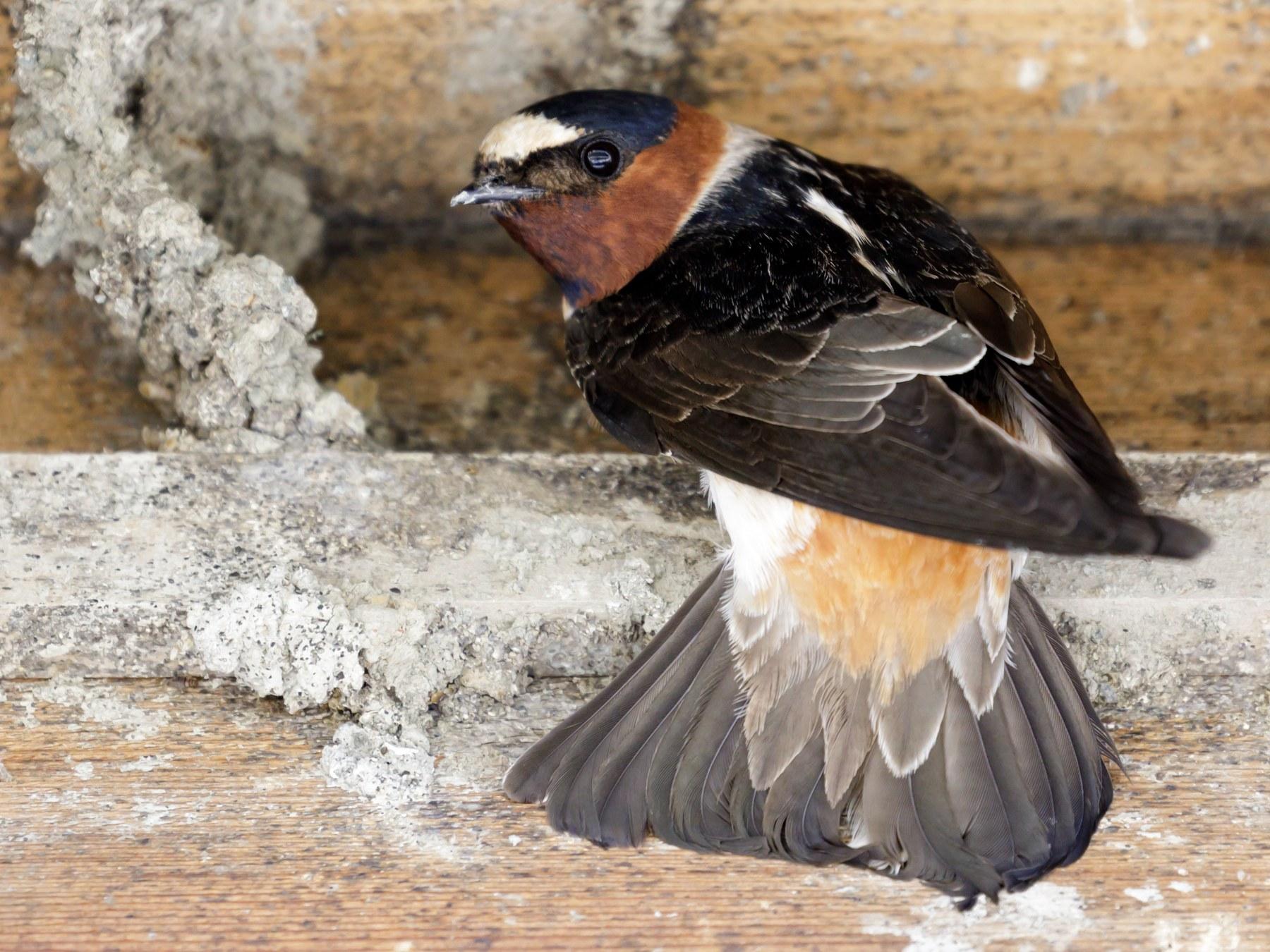
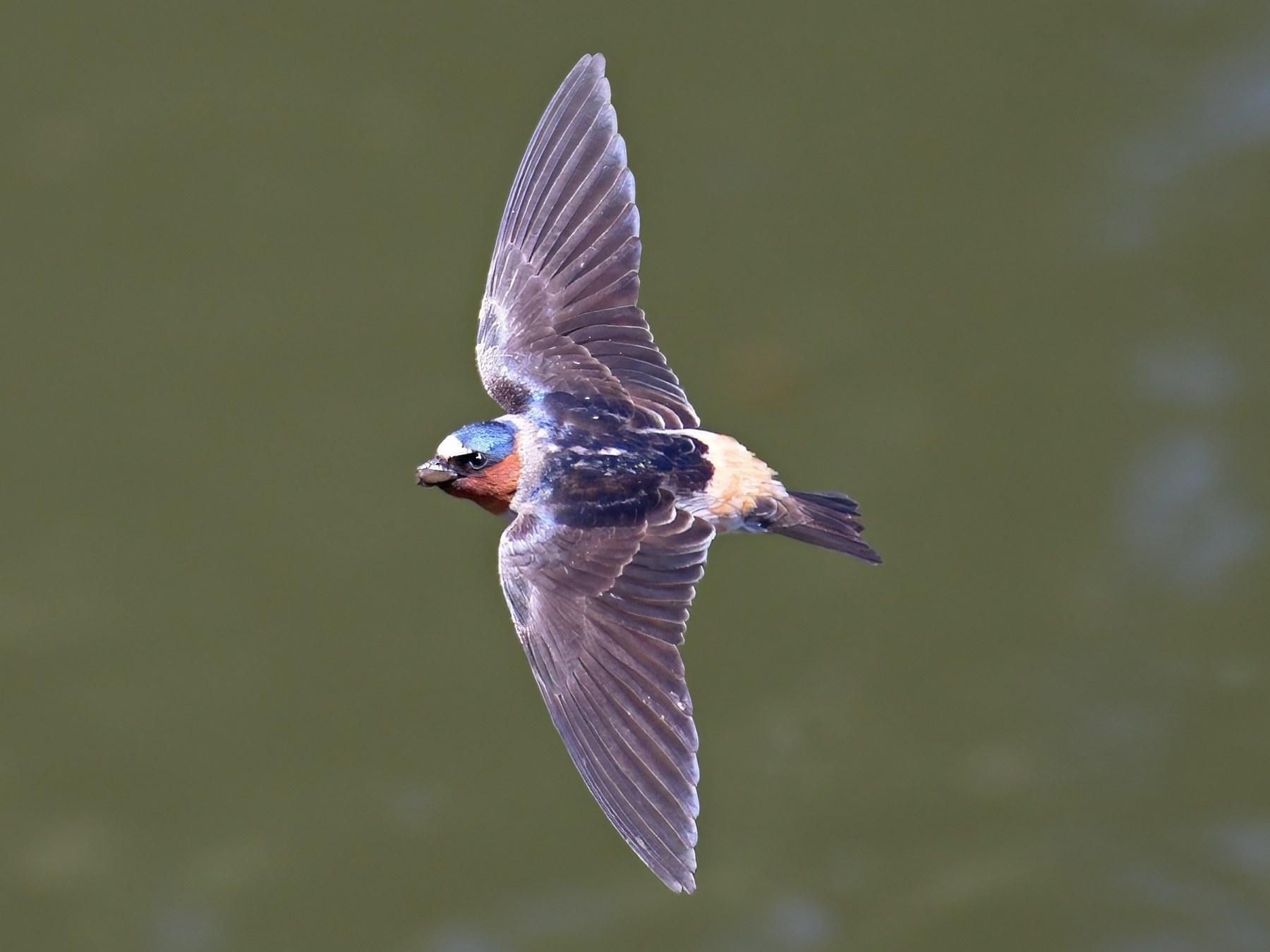
Watch for the rump as it banks away. A pale buff patch shows between the dark back and the square-ended tail, and among North American swallows only the Cave Swallow shares that pairing.
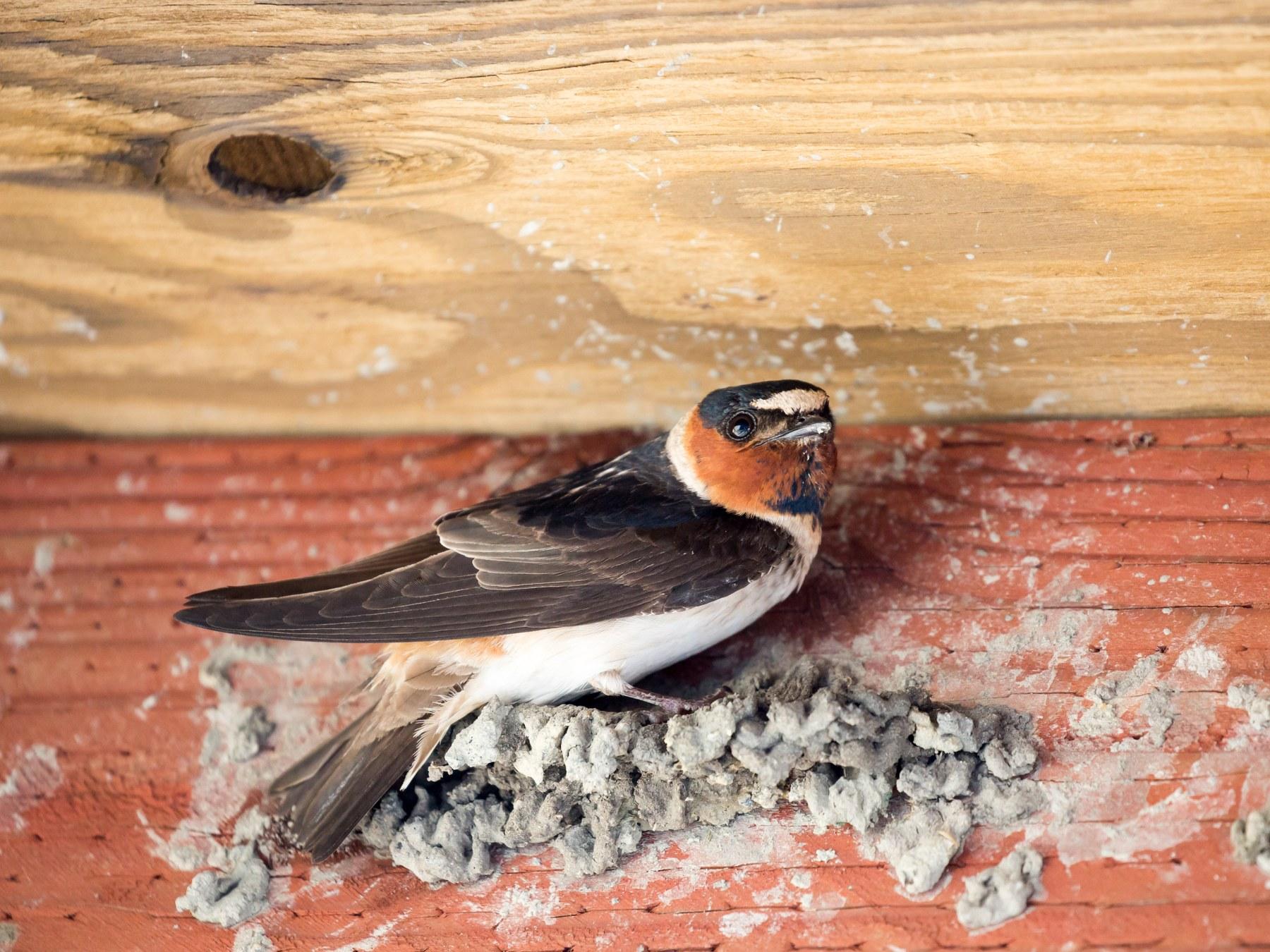
Closer up, an adult has a glossy blue-black crown and back, the back marked with a few thin whitish streaks. The cheeks and throat are chestnut, with a dark, glossy blue-black patch where the throat meets the breast, and a narrow buff collar crosses the nape. Most birds have a cream to buff triangle on the forehead, which stands out when a bird looks out of a dark nest entrance. Below, it is whitish with a buff wash across the breast.
In poor light its colors are lost, and it can look like a brown bird with a dark throat and a white belly. It is a compact swallow in the air, its wings broad at the base and rounded at the tips, and when it turns, the spread tail can show a slightly rounded tip.
Size and shape
It is 5.1–5.9 in (13–15 cm) long, with a wingspan of 11–11.8 in (28–30 cm), and weighs 0.7–1.0 oz (20–28 g). That makes it slightly larger than a Bank Swallow and smaller than a Purple Martin. It is heavier than a Barn Swallow but has a much shorter, square tail.1
In a nine-year Nebraska sample of thousands of birds, adults averaged about 0.85 oz (24 g) during nest building and laying and about 0.78 oz (22 g) while feeding young, males and females alike, as their fat ran down through the season.2
Four subspecies are recognized. Northern birds are larger, with whiter rumps and underparts; southern birds have darker, more chestnut forehead patches and paler throats, by a 1976 analysis. The Mexican race, which reaches southeastern Arizona and southwestern New Mexico, has a dark chestnut forehead, so its head looks all dark, and its rump is a darker chestnut. Both forms have been found in the same Arizona colony.2
Male, female and young
Males and females look alike. They can be told apart for certain only in the hand, though males average a larger dark blue patch at the base of the throat.
Juveniles, this year's young, are seen from July to December. They are much duller, with no gloss: dark brownish-black above with pale edges to the back feathers, a light cinnamon rump and a dull brown wash on the breast. Their faces look messy. The forehead is dull rusty to gray, often flecked with white, and the throat is a variable mix of white, gray, dark and rusty tones. Some keep pale buff or whitish throats into the fall.
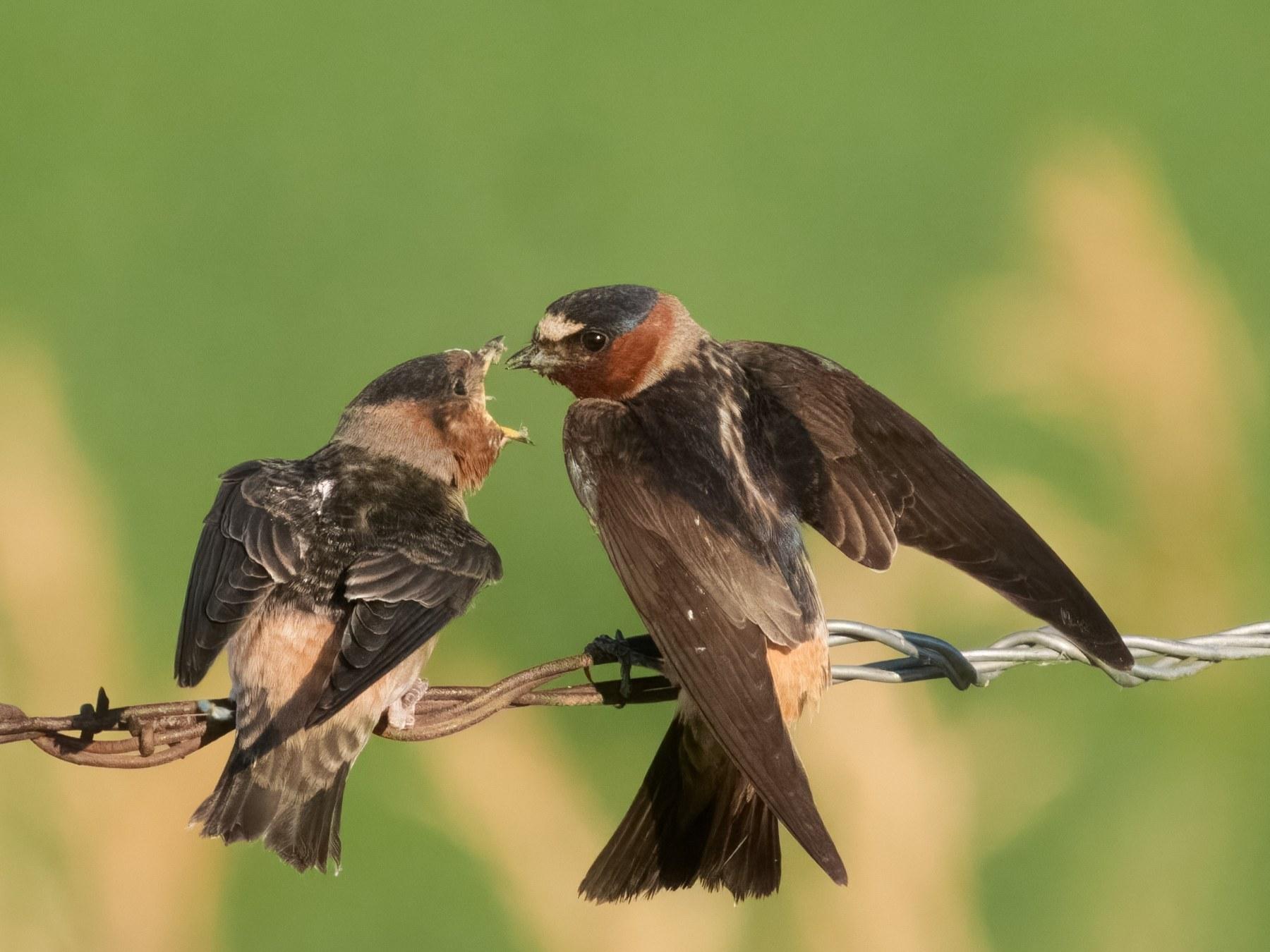
Few North American birds have juveniles as variable as these. Related young look more alike, and parents probably use these face patterns, as well as calls, to find their own chicks. Adults replace all their feathers once a year, mostly on the wintering grounds between September and March.
Identification: similar birds
The Barn Swallow is the swallow most often compared with it. A Barn Swallow has a long, forked tail and a longer, slimmer body. Its back is dark blue all the way to the tail, with no pale rump or collar, and an adult's forehead is rusty, not pale. Young Barn Swallows have paler foreheads, so with young birds go by the tail and rump.
A Cave Swallow has a pale buff throat and face, so at a distance it shows a small dark cap above a broad pale collar, and its forehead is deep cinnamon. The two often share culvert colonies in south-central Texas. An adult Cliff Swallow looks dark-headed, but its young can have pale throats into the fall.
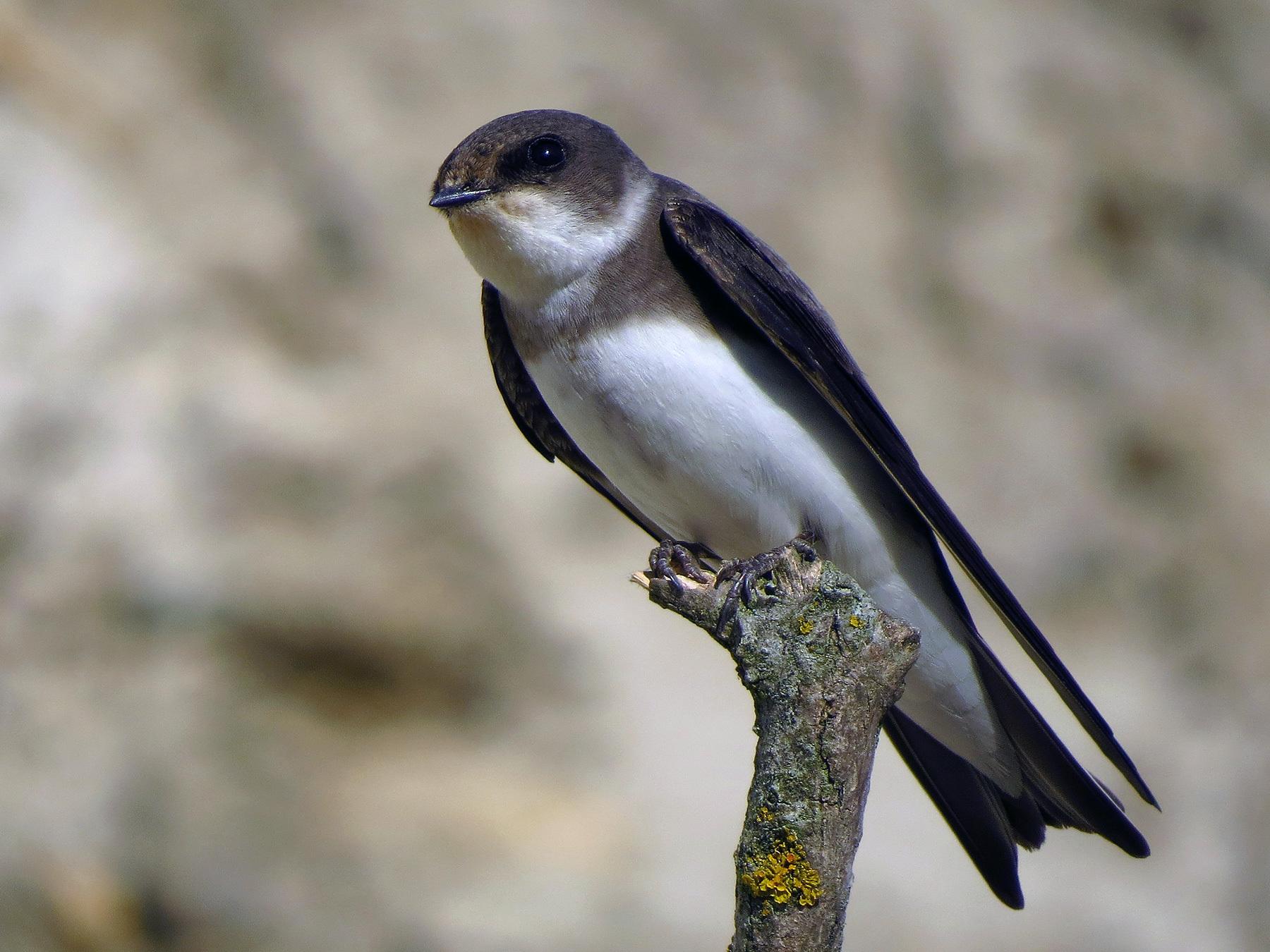
A Bank Swallow is a little smaller and plain gray-brown above, rump included, with a white throat and a sharp brown band across the breast. A Northern Rough-winged Swallow is plain gray-brown above with no pale rump, and its pale throat runs into a gray-brown wash across the breast.
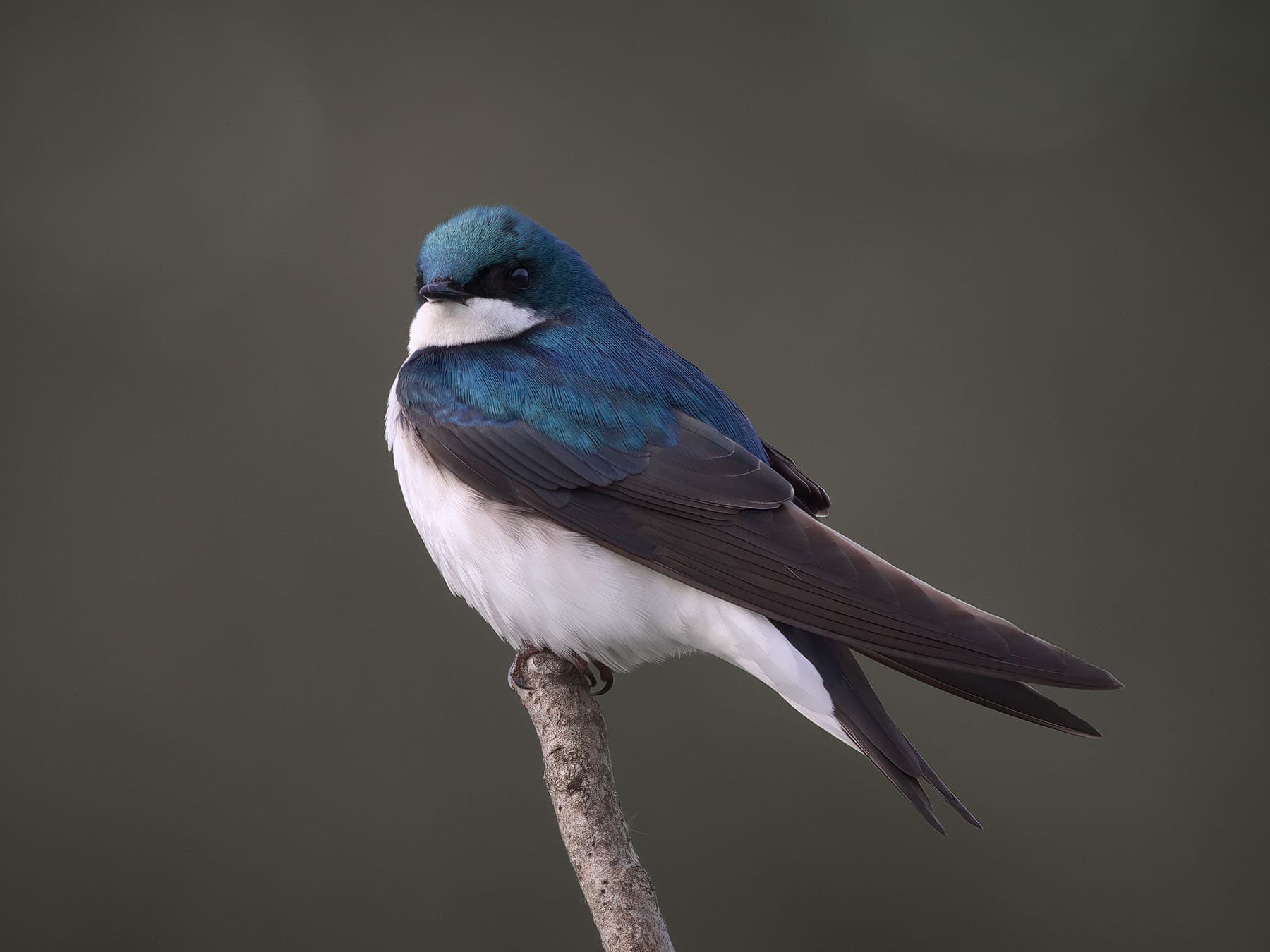
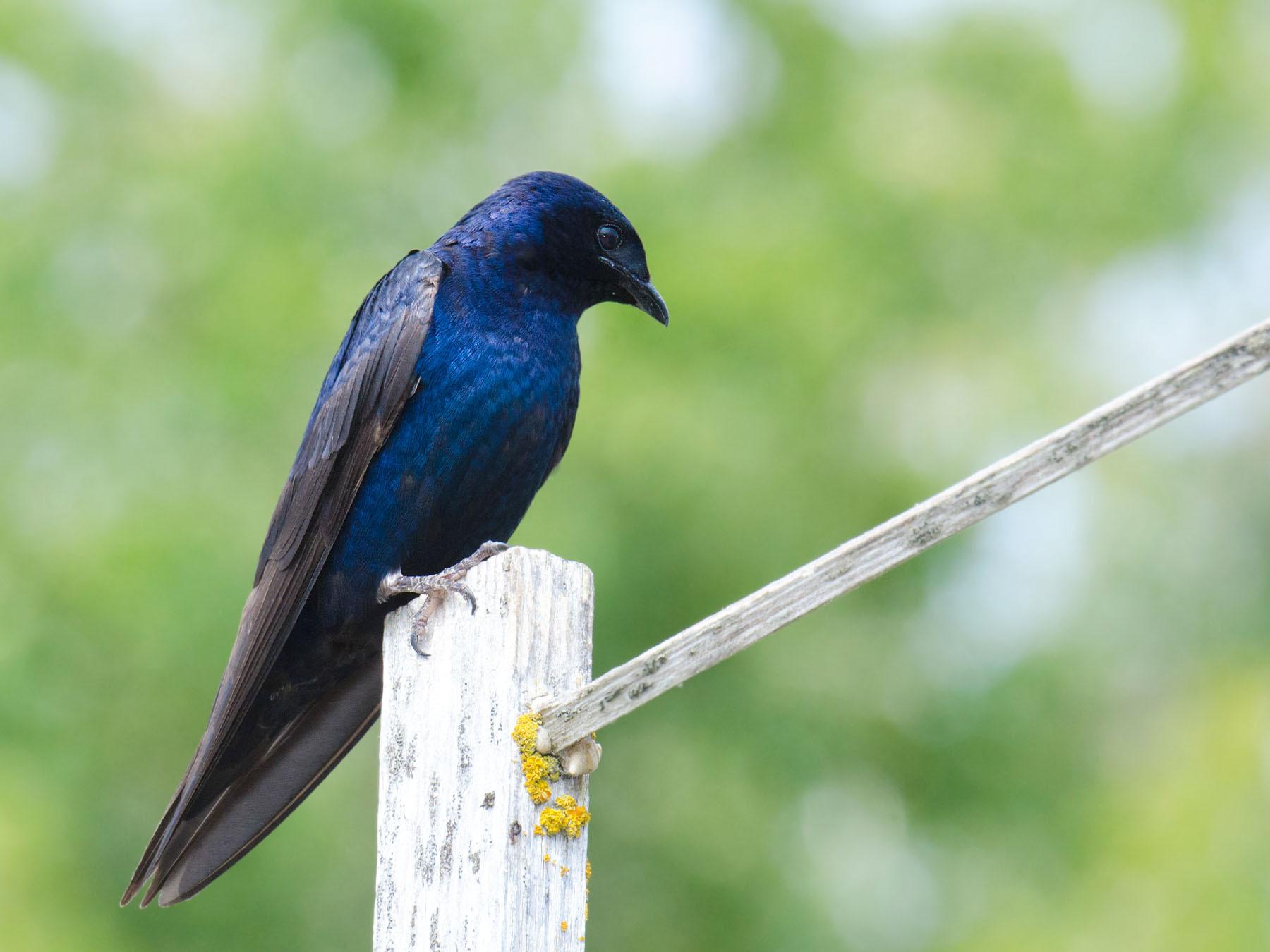
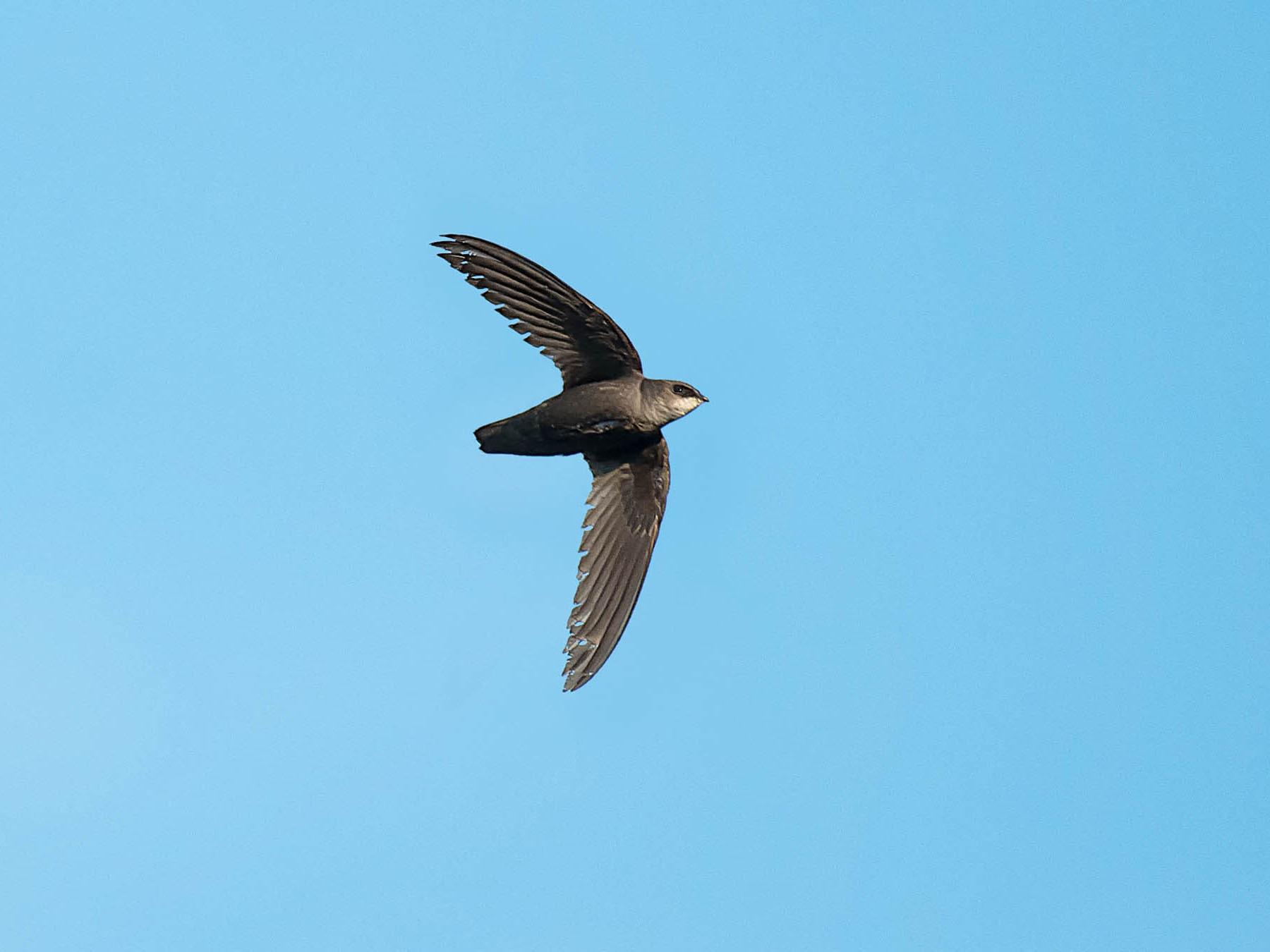
An adult male Tree Swallow is steely blue above and clean white below, throat included; one-year-old females are brown above and young birds sooty gray. A Purple Martin is the biggest North American swallow, with a short, slightly to moderately forked tail: the adult male is glossy blue-black all over, and the female has a pale forehead and a grayish or brownish collar. A Chimney Swift is dark all over, and its wings are narrower and more curved, beating far more stiffly.
Not sure it’s a Cliff Swallow? Check your photo: Birdfact names the bird and shows the look-alike side by side.
Its size
Adults- Length
- 13–15 cm
- Wingspan
- 28–30 cm
- Weight
- 20–28 g
Its song and calls
A busy colony keeps up a steady chatter of squeaky, twittering notes. The repertoire is small, about five sounds in all.
The everyday call is the chur, given at the nest and in flight. The purr is the alarm: when a hawk, heron or snake comes near, the residents swirl above it giving bursts of purrs. The song, a twitter-squeak of grating notes lasting up to about 6 seconds, is heard mainly in spring, during courtship and while birds claim nests, and briefly again in late summer. Presumably only males sing, but no study of marked birds has checked.2
A squeak call tells other swallows where food is. In southwestern Nebraska it was given mostly by birds feeding away from the colony on cool, dull days without strong wind, when food was presumably hard to find. Such days made up about a quarter (24.5%) of each breeding season on average.3
Each chick's call becomes individually distinctive by about 15 days old,2 and playback showed that parents can find their chicks by these calls alone.4 The young learn their parents' voices too: in playback tests, 18-day-old chicks gave 78% of their answering calls to their parents' calls.5
In Nebraska, begging calls, chur calls and song are given at night, from about 10 p.m. to 4 a.m., from inside the nests. On the wintering grounds birds seem to call only rarely.2
- Colony calls0:00 / 0:08
Recorded in Oregon, United States · June 2025
- Colony calls0:00 / 0:16
Recorded in Illinois, United States · June 2025
John · iNaturalist · CC BY 4.0
Heard one and not sure? Let the bird song identifier listen.
When and where to see it
November
Mostly absent
The year across North America
Choose a place on the map to see its year, or find yours.
Not regularly recorded in November
Up to 1.3% of a place’s bird records that monthHere in other months
How this map is made
Each county, state or province is shaded by the Cliff Swallow’s share of all the bird records there that month: the darker, the larger the share. A place with only a trace of records in a month is left unshaded. Shades compare places on this map with each other, not one bird with another. Records: GBIF eBird Observation Dataset, 2019–2024. Map: Natural Earth; place centres © OpenStreetMap contributors.
How often the Cliff Swallow turns up in the United States and Canada through the year, from birdwatchers' records.
United States
Summer visitor · regularly Mar–Sep · most records in June
Canada
Summer visitor · regularly Apr–Sep · most records in July
Show as a table
| Month | United States | Canada |
|---|---|---|
| January | <0.001% | – |
| February | 0.008% | – |
| March | 0.063% (regular) | <0.001% |
| April | 0.21% (regular) | 0.039% (regular) |
| May | 0.32% (regular) | 0.20% (regular) |
| June | 0.45% (regular) | 0.26% (regular) |
| July | 0.44% (regular) | 0.27% (regular) |
| August | 0.26% (regular) | 0.14% (regular) |
| September | 0.059% (regular) | 0.018% (regular) |
| October | 0.009% | 0.002% |
| November | <0.001% | <0.001% |
| December | <0.001% | – |
Worldwide: recorded regularly in 38 countries
Countries where it was recorded in at least 3 of the 6 years 2019–2024. Linked countries have their own bird list.
Europe (1)
North America (27)
- Aruba
- Bahamas
- Barbados
- Belize
- Bermuda
- Canada
- Caribbean Netherlands
- Cayman Islands
- Costa Rica
- Cuba
- Curaçao
- El Salvador
- Grenada
- Guadeloupe
- Guatemala
- Honduras
- Martinique
- Mexico
- Nicaragua
- Panama
- Puerto Rico
- St Lucia
- St Martin
- St Pierre & Miquelon
- Trinidad & Tobago
- Turks & Caicos Islands
- United States
Data: EOD – eBird Observation Dataset (Cornell Lab of Ornithology), accessed via GBIF.org, CC BY 4.0. Records from 2019–2024, aggregated and filtered by Birdfact. How these lists are made
It breeds across most of North America, from western and central Alaska and northern Canada south through the US into Mexico. Look for it in open country near something to nest on: bridges and highway culverts, barns and other buildings, dams, and the cliffs and canyons it once relied on. Most colonies have fields or pastures nearby for feeding, and often water. It avoids heavy forest, desert and alpine country.
Its strongholds are the Great Plains, from Texas up to southern Manitoba, and the West, above all California. It breeds more thinly in the Gulf states and across the east-central and northeastern US.
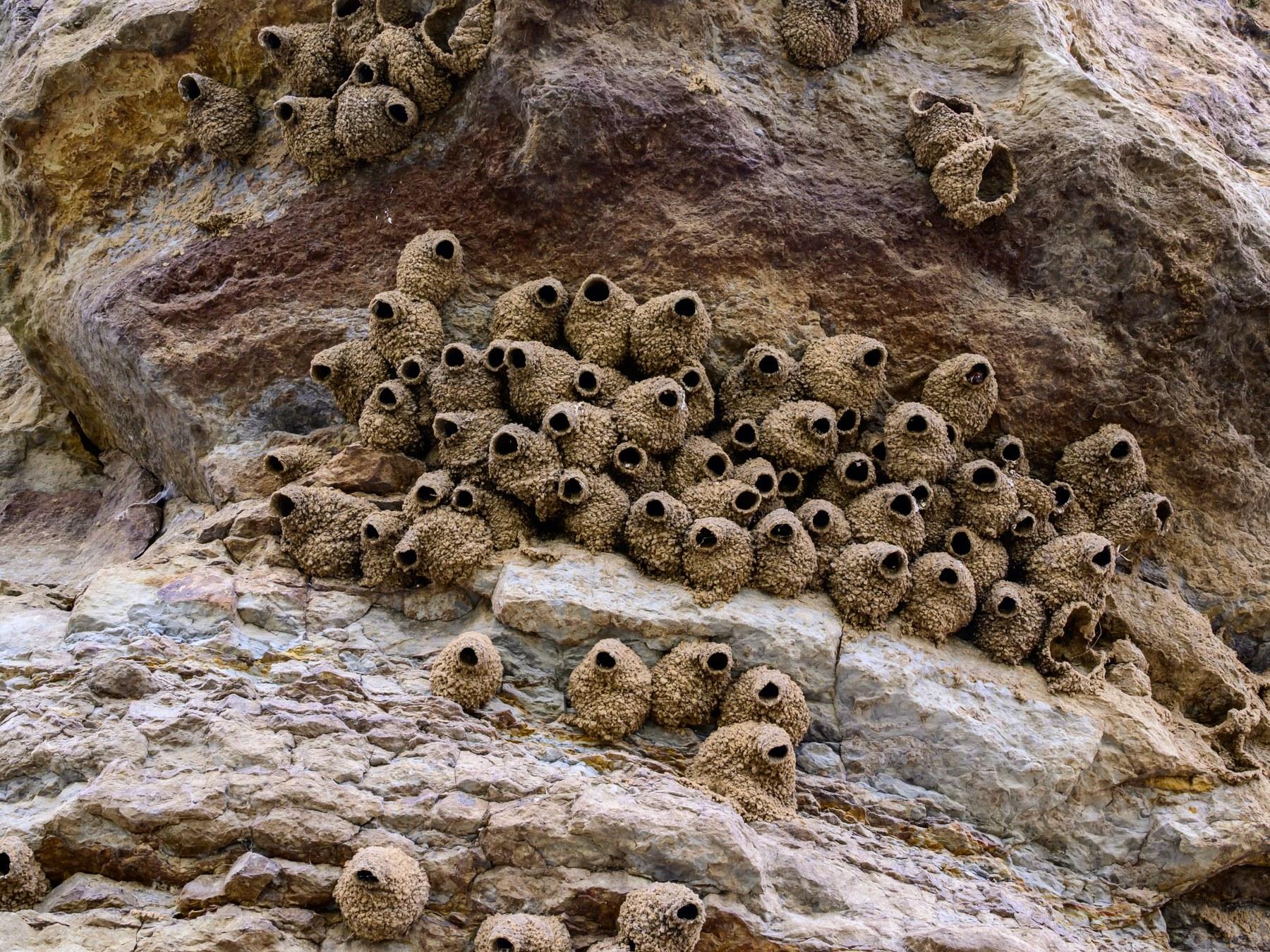
It was once a bird of western mountains and canyons. Over the past 100 to 150 years it has spread east over the Great Plains and on to the eastern side of the continent, as highway culverts, bridges and buildings gave it new places to nest. In the Southeast it first nested in Alabama in 1951, Georgia and the Carolina piedmont in 1965, Florida in 1975 and Louisiana in 1980. Birds of the World's account, last revised in 2017, says new colonies still appear each year where it had not bred before.
It nests from sea level to about 9,100 ft (2,770 m), and rarely to 9,800 ft (3,000 m). The highest colony known to the account's authors held 50–100 nests at 10,500 ft (3,200 m) on Rendezvous Mountain in Wyoming's Teton Range. In the far north, colonies have been recorded on the Brooks Range's north side in Alaska, some within about 19 miles (30 km) of the Arctic Ocean.2
When do they migrate?
It is a long-distance migrant that travels by day in flocks, feeding as it goes. The first spring birds reach southern California in early February and Arizona and Texas in early March, but Nebraska usually not until mid-April, Minnesota and the Yukon in late April, and Alaska in mid-May, on first-arrival dates gathered from state bird books.
Fall migration starts as soon as the young fledge and a colony empties, so departures are staggered: in southwestern Nebraska some leave in early July and most are gone by early August. Passage through the US apparently peaks in August and early September, in flocks of thousands. On the way, birds gather over water and marshes when bad weather cuts the supply of flying insects. The dark-fronted Mexican race reaches its southeastern Arizona breeding grounds about 6–8 weeks after other Cliff Swallows arrive in northern Arizona, with the summer monsoon.2
We found one tracking study of birds from the US breeding population: 29 birds were fitted with geolocators, and one usable track came back. It showed stopovers, faster travel in spring than in fall, and significant travel over water in spring. Tagged birds survived far worse than birds that were only banded (0.07 against 0.60 a year), and the authors urge caution with so small a sample.6
Where do they go in winter?
To South America, east of the Andes. It apparently winters from southern Brazil, and possibly southeastern Paraguay, to south-central Argentina, mostly in the lowlands along the Paraná and Uruguay rivers north and northwest of Buenos Aires. The winter range is poorly known. It gets there through Mexico, Central America and the north of South America.
In winter it roosts in marshes, up to 50,000 birds at one roost in wetlands along the Paraná about 31 miles (50 km) north of Buenos Aires. A few winter with Barn Swallows in Panama, and stragglers turn up in December in southern California, Arizona and on Christmas Bird Counts along the Pacific and Gulf coasts. It has strayed to Wrangel Island in Siberia and southern Greenland, and at least six times to the British Isles by 1997.2
In 2015 a small population began breeding in Argentina, more than 5,000 miles (8,000 km) from the nearest potential source.7 At the first documented colony, under a concrete bridge at Villa María in Córdoba, at least 8 of 33 finished nests raised young that fledged in late December.8 Geolocators on birds from there showed their yearly calendar had switched to the southern seasons, and they did not breed twice a year.7
Tips for seeing it
What it eats
Flying insects, caught in the air at every season, especially kinds that swarm. No source we read recommends any feeder food for it.
In Nebraska, 84 insect families turned up in its diet. The commonest were leafhoppers, several families of flies including black flies, midges and mosquitoes, and ants, with grasshoppers taken in mid- to late summer. Early stomach studies, published in 1907 and 1918, found bees, wasps and ants the largest share: 28.7% of the food in a North American sample and 39% in California, with beetles, true bugs and flies making up most of the rest. It sometimes swallows small gravel, probably to help grind the hard parts of insects.2
Audubon's guide says it occasionally eats berries. Birds of the World counts seed fragments in stomachs as accidental or grit, and says an early report of stomachs full of juniper berries was likely based on misidentified Tree Swallows.9, 2
How they feed
It feeds on the wing, usually in groups over insect swarms; in Nebraska, feeding groups ranged from 2 to more than 1,000 birds. It often feeds high, at 160 ft (50 m) or more, and often higher than other swallows in mixed flocks. In cold, rainy weather it drops low over water and picks insects off the surface. It drinks in flight too, skimming the water and scooping with its lower bill, often in groups that start and stop together.2
Colonies may work as information centers. In a 1986 study, a bird that had failed to find food returned to the colony, spotted a neighbor that had succeeded and followed it out, possibly because neighbors can see the food carried to nestlings.10 The birds seem to pass on what they know unintentionally, simply by watching one another; in Nebraska, birds feeding in groups took food faster than lone birds, and those in larger colonies fed more efficiently and brought more food to their young.2
Nesting and breeding
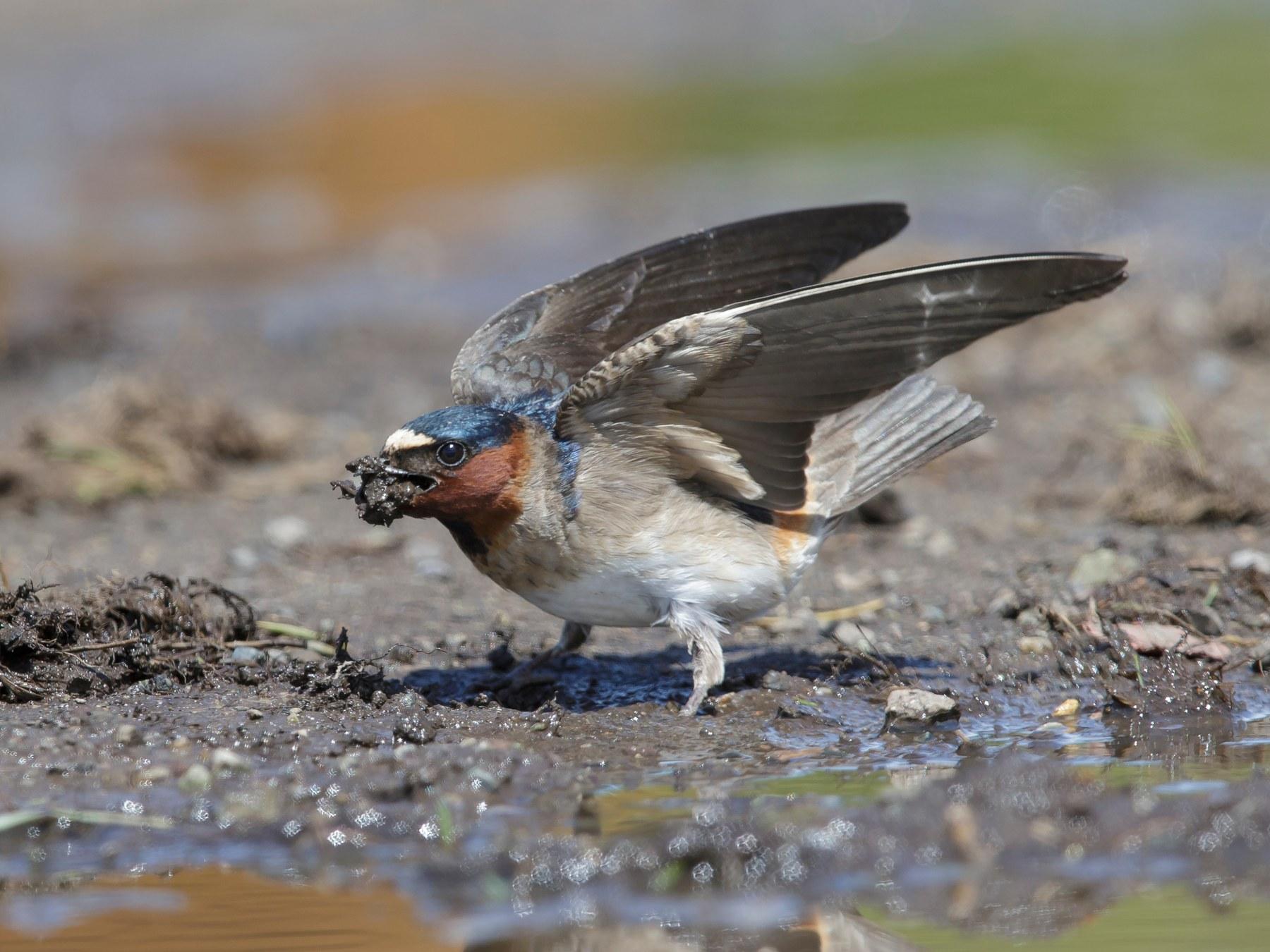
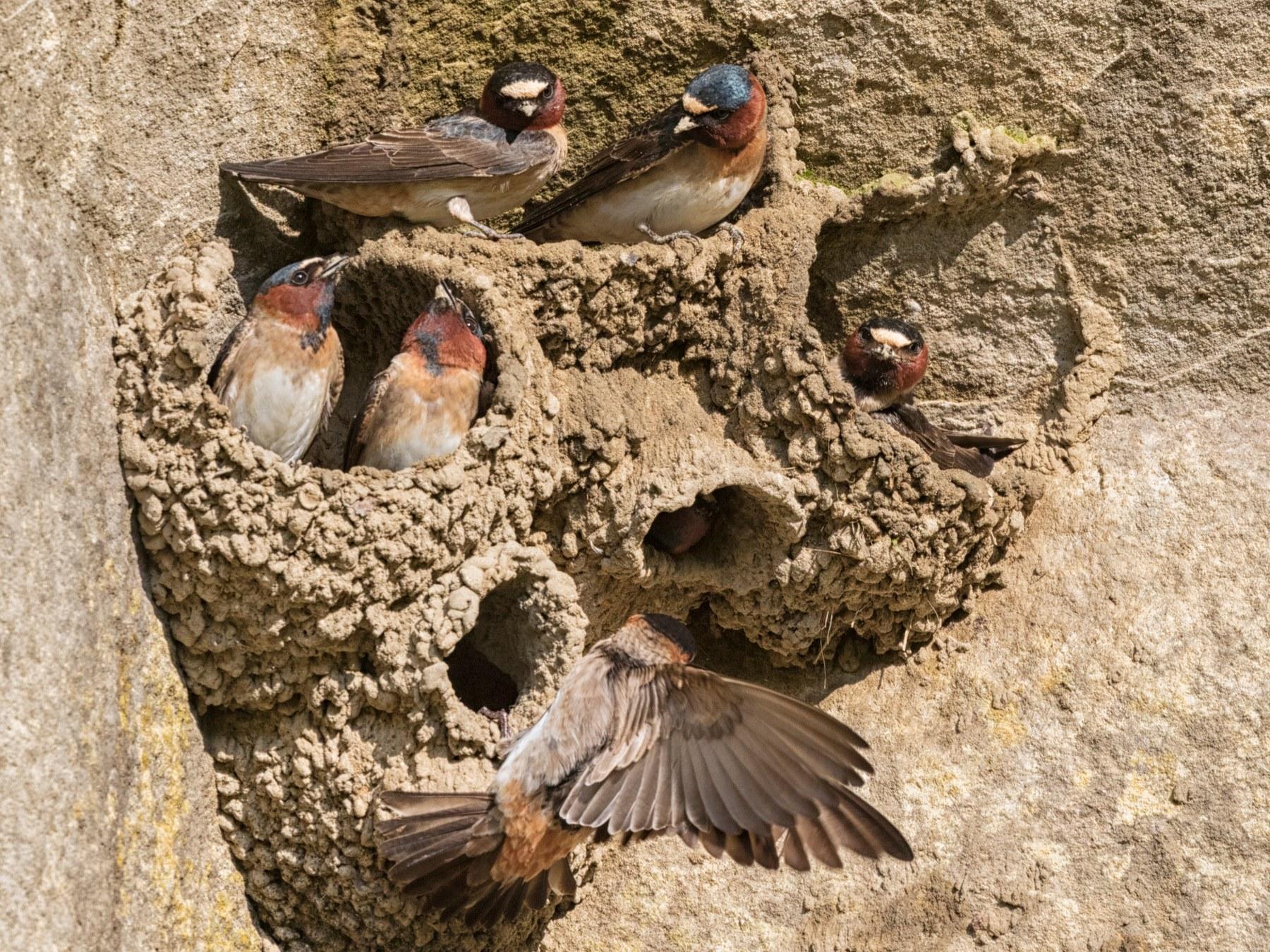
Cliff Swallows build closed, gourd-shaped nests of mud, packed side by side in colonies under an overhang. Both sexes build, carrying the mud as pellets in the bill. A nest starts as a ledge, grows into a cup and is roofed over into a bottle shape that juts 6–8 in (15–20 cm) from the wall, with an entrance tunnel that points down. Inside, it is lined with dry grass.
It nests where a vertical wall meets an overhang: cliff faces, cave mouths, building eaves, bridges, highway culverts and dams, from about 5 to 33 ft (1.5–10 m) up or higher, often in tiers. In Nebraska, only 8.3% of 239 colony sites in 1982–2016 were on buildings; most were bridges and culverts. Buildings matter more in parts of the Northeast, the Pacific Northwest and California. In Nebraska it strongly prefers concrete bridges, where mud sticks better, to wooden or metal ones.2
How the nest is built
Mud comes from stream banks, lake shores or puddles, usually within about 0.3 mile (0.5 km) of the colony but sometimes much farther. Unlike the Barn Swallow, it does not mix grass into the mud. An average nest holds 900–1,200 pellets. A pair can bring 44 pellets in half an hour, but building too fast makes the wet mud slump, and cool, wet or windy weather stops mud gathering. A new nest took about a week in Wyoming, 3–27 days (10 on average) in Nebraska and 8–18 days in Quebec. It also takes over Barn Swallow nests, active or not, and can roof them over into its own closed type.
Do they return to the same nest?
They commonly reuse old nests, though not necessarily their own. They prefer sound old nests and repair them, but avoid old nests still infested with swallow bugs. Returning birds show no preference for their own nest of the previous year, and reuse is more common in small colonies.2
Knowing a site pays: in southwestern Nebraska, birds returning to a colony site they knew had 8.6% higher monthly survival than newcomers, though in colonies of more than 750 nests newcomers paid no cost.11
Eggs and young
The earliest eggs on record were laid on April 1 in Texas and April 5 in California, but not until May 3 in Nebraska, May 20–21 in Illinois and Massachusetts and June 3 in southeastern Arizona; most clutches start later. In Nebraska laying peaks from May 20 to June 5, and over 30 years laying there became earlier, along with warmer and drier conditions. The Mexican race in Arizona lays in July, with the monsoon. In most populations the young have fledged by the end of July.2
A clutch is typically 1–6 eggs, white, creamy or pinkish white and speckled or blotched with brown, about 0.8 by 0.6 in (20 by 14 mm). First clutches averaged from 3.3 eggs in West Virginia, Virginia and New York to 3.6–4.3, by colony and year, in east-central Texas; across all 8,094 Nebraska clutches in 1982–1991, first and replacement, the average was 3.48. Clutches of more than six probably include eggs laid by other females.
Both sexes incubate, about equally. Incubation averaged 13.5 days in Virginia, 13.6 in Nebraska (usually 10–19) and 15 in West Virginia. Both parents brood and feed the young, which leave the nest at about 20–26 days old, from 20–21 days in New York to usually 23–26 in Nebraska. They are fed for 3–5 days after that. Soon after fledging, young gather in groups called creches on wires, trees and cliffs, up to 1,000 birds in Nebraska, and parents find their own chicks there mainly by voice.
It raises one brood a year throughout its range, laying again only if an early nest fails. True second broods are known only from Nebraska, mostly at colonies where researchers had removed nest parasites by fumigation. Both sexes usually breed first at a year old.
Females also lay eggs in their neighbors' nests, and even carry their own eggs in the bill into another nest. In Nebraska up to 22%, perhaps 43%, of nests held such an egg, more in bigger colonies, against 3.7% in the Sierra Nevada and 10.7–11.9% in south Texas. The host pair cannot recognize the added eggs.2
Behaviour
It is sociable all year: it nests in colonies, and migrates and winters in flocks. It walks on the ground but comes down mainly to gather mud or grass, pick up grit, sunbathe or now and then catch insects. It sleeps in its nest once the nest is half to three-quarters built, and in trees before that.
Old Cliff Swallow nests are used by other birds, including House Sparrows, House Finches, House Wrens, Eastern Bluebirds and Say's Phoebes, and by roosting bats.
Colony behavior
No swallow in the world is more colonial. Colonies often hold 200–400 nests and routinely up to 1,000, and the largest recorded held about 6,000 nests in Nebraska and 5,000 in Kansas. Some pairs nest alone. Colonies are smallest in the East, where they are newer, and in parts of the Southwest.
Colonial nesting probably evolved to make feeding together more efficient, and the dense clusters of nests may have brought other benefits later. Colonies are not likely to result from a shortage of nest sites. The costs include parasites, which increase with colony size.2
Over 30 years at more than 200 sites in western Nebraska, colony size at most sites varied greatly from year to year, with no long-term trend overall, and colonies on bridges tended to be larger and used more often.12 Birds visit several colonies before settling. Colony size is part of what guides the choice, and the choice is heritable: first-year birds tended to pick colonies of a size like the one they were raised in.2
Only the nest itself is defended: owners attack birds trying to build within about 3–5 in (8–12 cm) below their entrance, which gives a colony its honeycomb pattern. Pairs are socially monogamous, but both sexes routinely mate with other birds. In Nebraska, genetic tests found that up to 43% of nests held at least one chick not related to one or both of the adults tending it.
The alarm purr is occasionally given with no predator about. Some birds then flush from their nests and others slip into the empty nests, which might be a deceptive use of alarm calls. In Nebraska, groups of up to 75–100 adults, and later young, crowd onto a short stretch of wire and jostle to knock each other off for 10–15 minutes, which the researchers suggest is a form of play.2
Flight
Its glides are short and frequent, usually 2–3 seconds, and it changes height more often than other swallows. By a 1948 account, it is the only North American swallow that habitually slants its wings downward when gliding. Typical flight speed was estimated at about 19 mph (8.7 m/s), and birds commuting to the colony from mud holes were clocked at about 35 mph (15.5 m/s), close to the apparent maximum.2
Lifespan and predators
The oldest in the US Bird Banding Laboratory's records was a male at least 11 years 10 months old. He was banded in Nebraska in July 1993 as a bird hatched in an earlier year, and caught and released alive in California in April 2004. The banding lab's earlier list also holds an 11-year 1-month male from Indiana and an 11-year female from Iowa.13 The researchers who study the Nebraska population give a maximum of 12 years from their own birds.2
We found no source that gives a typical lifespan. In the Nebraska population, adult yearly survival ranged from 0.20 to 0.80 between years and colonies, with no difference between the sexes.2 In one Nebraska sample of 412 birds, apparent yearly survival was about 0.51–0.52, a measure that counts birds that moved away as lost.14
Predators and other dangers
Its predators are mainly birds and snakes, and snakes are probably the most important: hawks, owls, herons, grackles, magpies and Blue Jays, bull snakes and rat snakes among them. Adults are relatively rarely taken in the breeding season.
Starvation in bad weather is the most important cause of adult deaths in the breeding season: when a late-spring cold snap lasts four days or more, many adults can starve. A cold spell on May 24–29, 1996, killed thousands in Nebraska: about 53% of the study population, by the researchers' 1998 paper, while Birds of the World puts the loss at 53–73%.15, 2 That spell favored birds with shorter wings and tails, larger skeletons and more symmetrical feathers; selection ran the same way in 2004 but partly reversed in 2017.16 Swallows that starved in cold snaps had smaller brains than those dying of other causes.17
Swallow bugs, blood-feeding insects that overwinter in old nests, are the greatest cause of nestling deaths. One nest can hold 2,600 of them, their numbers rise with colony size, and late nests may lose every chick. The bugs pose little threat to people and cannot persist on mammals.2 In a 35-year study, the bugs' harm to nestlings lessened, which the authors say probably reflects growing tolerance.18
Introduced House Sparrows take over nests and destroy eggs and young, and the swallows seem not to defend against them. Sparrows cut nesting success by 31–54% at Arkansas colonies.2 In western Massachusetts, nesting success was significantly lower where sparrows were present.19
In Nebraska, road deaths fell sharply over 30 years relative to numbers, which probably reflects selection for wing length that helps birds dodge cars, or for behavior that keeps them away from roads.2 In western Kansas, a 2024 note reported four hanging or entanglement events. In one, three birds hung together on fishing line at a nest under a bridge; in another, a bird was hanged by baling twine built into a nest on a rock formation. Two more single birds died at bridges, one hanging from a nest by an unknown material and one from an unknown cause.20
Conservation
It is not rare. It is rated Least Concern on the IUCN Red List21 and globally secure by NatureServe.22 Partners in Flight puts the population at about 83 million breeding-age birds worldwide, 78 million of them in the US and Canada, with a reference year of about 2010, and gives it a low concern score of 5.23
Overall, numbers are stable but shifting. Across the whole North American Breeding Bird Survey area there is no statistically significant change from 1966 to 2025 (+0.71% a year, 95% credible interval −0.13 to +1.15). That hides a significant rise of 0.97% a year in the US and a significant fall of 1.82% a year in Canada. Over the last ten years, 2015–2025, no change is significant survey-wide, in the US or in Canada.24
Long-term gains are significant through the Great Plains and south-central states, such as Texas, Oklahoma, Kansas, Nebraska and the Dakotas, and in Midwest states such as Iowa, Illinois and Missouri. Falls are significant in the Northeast (Maine, New York), on the Pacific side (California, Washington) and in most Canadian provinces. The survey's US index rose about 77% from 1966 to 2025, while Canada's fell about 66%.24
Conservation: what is known
In the northeastern US, where it was likely never common, numbers rose in the early to mid-1800s with land clearance and new barns, then fell after House Sparrows arrived in the late 1800s and took over its nests.2 It is in decline in parts of its range, northeastern North America above all,19 where the decline of birds that feed on flying insects has been suggested to be linked to falling numbers of insects.2
Overall, people have probably helped it: bridges, culverts and buildings have probably let it spread across its range, and it is very tolerant of people. Nests on houses are sometimes removed, and bridge work can cause nests to be lost.2
Legal status
In the US it is a protected migratory bird under the Migratory Bird Treaty Act,25 and the protection covers the bird and its parts, nests and eggs: taking or possessing them needs a permit.26, 27 The US Fish and Wildlife Service says a nest that holds eggs or chicks must not be touched or destroyed unless it has issued a permit.28 It is not listed under the Endangered Species Act.29
In Canada it is protected under the Migratory Birds Convention Act, 1994. Under the 2022 regulations, nobody may damage, destroy, remove or disturb its nest without a permit while the nest holds a live bird or a viable egg.30, 31, 32
It is not on Mexico's 2010 list of species at risk.33
Similar birds
Often mistaken for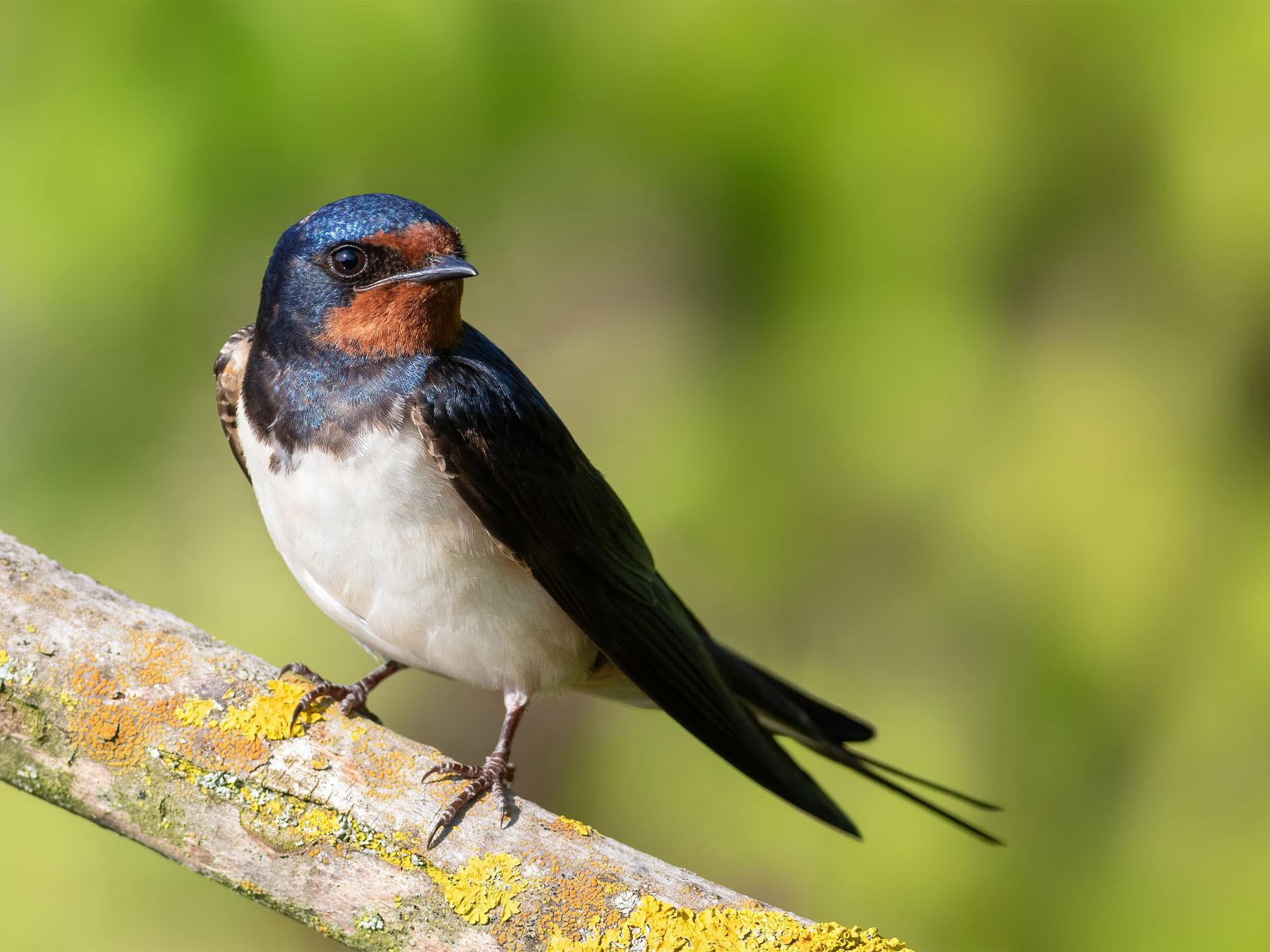
Quick facts
- Length
- 13–15 cm
- Wingspan
- 28–30 cm
- Weight
- 20–28 g
- Lifespan
- oldest recorded 11 years 10 months
- Family
- Swallows & Martins
- Migration
- Long-distance Migrant
- Global status (IUCN)
- Least Concern
- World population
- About 83 million breeding-age birds worldwide, 78 million in the US and Canada (Partners in Flight, reference year about 2010)
- Population trend
- Stable overall but shifting: across the whole survey area the Breeding Bird Survey shows no statistically significant change since 1966, because a significant rise in the US (about 1% a year, significant across the Great Plains, the Midwest and the south-central states) is offset by a significant fall in Canada (about 1.8% a year) and the Northeast; over the last ten years (2015–2025) there is no significant change survey-wide, in the US or in Canada
- Scientific name
- Petrochelidon pyrrhonota
Questions
2Do the swallows really return to Capistrano on March 19?
The Cliff Swallows of Mission San Juan Capistrano in California are traditionally celebrated on March 19, but Birds of the World calls the date mythical, and the birds actually come back to the area in late February.2, 9 Attempts to get them to nest in plaster nests at the mission had not worked by 2017.2
What does the scientific name mean?
The genus name Petrochelidon comes from the Greek for a kind of swallow that lived on cliffs, and the bird once nested almost only in caves and on cliffs.34 The species name pyrrhonota joins Greek words for flame-colored or red and for back.35 The global checklist AviList calls it the American Cliff Swallow.36
Sources
53- 1Tobias, J. A. et al. (2022). AVONET: morphological, ecological and geographical data for all birds. Ecology Letters 25: 581-597. Accessed 28 November 2026. Source (opens in a new tab)
- 2Brown, C. R., Brown, M. B., Pyle, P. and Patten, M. A. (2020). Cliff Swallow (Petrochelidon pyrrhonota), version 1.0. Birds of the World (P. G. Rodewald, editor). Cornell Lab of Ornithology. doi:10.2173/bow.cliswa.01 (opens in a new tab)
- 3Brown, Charles R., Brown, Mary Bomberger and Shaffer, Martin L. (1991). Food-sharing signals among socially foraging cliff swallows. Animal Behaviour 42(4): 551-564. doi:10.1016/s0003-3472(05)80239-8 (opens in a new tab)
- 4Stoddard, Philip K. and Beecher, Michael D. (1983). Parental Recognition of Offspring in the Cliff Swallow. The Auk 100(4): 795-799. doi:10.1093/auk/100.4.795 (opens in a new tab)
- 5Beecher, Michael D., Stoddard, Philip K. and Loesche, Patricia (1985). Recognition of Parents' Voices by Young Cliff Swallows. The Auk 102(3): 600-605. doi:10.1093/auk/102.3.600 (opens in a new tab)
- 6West, Amy C., Bridge, Eli S. and Brown, Charles R. (2024). Migratory track from the United States breeding population of Cliff Swallows (Petrochelidon pyrrhonota) and effects of geolocators on annual survival. The Wilson Journal of Ornithology 136(3): 387-392. doi:10.1676/24-00029 (opens in a new tab)
- 7Areta, Juan I. et al. (2021). Rapid adjustments of migration and life history in hemisphere-switching cliff swallows. Current Biology 31(13): 2914-2919.e2. doi:10.1016/j.cub.2021.04.019 (opens in a new tab)
- 8Salvador, Sergio A., Salvador, Lucio A., Gandoy, Facundo A. and Areta, Juan Ignacio (2016). LA GOLONDRINA RABADILLA CANELA (PETROCHELIDON PYRRHONOTA) CRÍA EN SUDAMÉRICA. Ornitología Neotropical 27: 163-168. doi:10.58843/ornneo.v27i0.105 (opens in a new tab)
- 9National Audubon Society. Cliff Swallow. Guide to North American Birds. Accessed 28 November 2026. Source (opens in a new tab)
- 10Brown, Charles R. (1986). Cliff Swallow Colonies as Information Centers. Science 234(4772): 83-85. doi:10.1126/science.234.4772.83 (opens in a new tab)
- 11Brown, Charles R., Brown, Mary Bomberger and Brazeal, Kathleen R. (2008). Familiarity with breeding habitat improves daily survival in colonial cliff swallows. Animal Behaviour 76(4): 1201-1210. doi:10.1016/j.anbehav.2008.03.028 (opens in a new tab)
- 12Brown, Charles R., Brown, Mary Bomberger and Roche, Erin A. (2013). Spatial and temporal unpredictability of colony size in Cliff Swallows across 30 years. Ecological Monographs 83(4): 511-530. doi:10.1890/12-2001.1 (opens in a new tab)
- 13USGS Bird Banding Laboratory. Longevity Records of North American Birds, Version 2025.1 (last updated December 2025). USGS Eastern Ecological Science Center, Bird Banding Laboratory. Accessed 28 November 2026. Source (opens in a new tab)
- 14Page, Catherine E. and Brown, Charles R. (2025). Minor mist-net injuries do not affect apparent annual survival in Cliff Swallows (Petrochelidon pyrrhonota). The Wilson Journal of Ornithology 137(3): 463-468. doi:10.1080/15594491.2025.2481739 (opens in a new tab)
- 15Brown, Charles R. and Brown, Mary Bomberger (1998). INTENSE NATURAL SELECTION ON BODY SIZE AND WING AND TAIL ASYMMETRY IN CLIFF SWALLOWS DURING SEVERE WEATHER. Evolution 52(5): 1461-1475. doi:10.1111/j.1558-5646.1998.tb02027.x (opens in a new tab)
- 16Brown, Charles R. et al. (2018). Changing patterns of natural selection on morphology of Cliff Swallows during severe weather. The Wilson Journal of Ornithology 130(3): 755-762. doi:10.1676/17-00057.1 (opens in a new tab)
- 17Wagnon, Gigi S. and Brown, Charles R. (2020). Smaller brained cliff swallows are more likely to die during harsh weather. Biology Letters 16(7): 20200264. doi:10.1098/rsbl.2020.0264 (opens in a new tab)
- 18Brown, Charles R. et al. (2021). The cost of ectoparasitism in Cliff Swallows declines over 35 years. Ecological Monographs 91(2). doi:10.1002/ecm.1446 (opens in a new tab)
- 19Silver, Mara, Merry, Linda L. and Brown, Charles R. (2021). Conservation Measures to Increase Breeding Success of Cliff Swallows (Petrochelidon pyrrhonota) in Massachusetts. Northeastern Naturalist 28(2): 211-219. doi:10.1656/045.028.0212 (opens in a new tab)
- 20Schukman, John M. et al. (2024). Entanglement mortality of multiple Cliff Swallows (Petrochelidon pyrrhonota) in western Kansas. The Wilson Journal of Ornithology 136(3): 360-363. doi:10.1676/23-00055 (opens in a new tab)
- 21BirdLife International (2025). Petrochelidon pyrrhonota. The IUCN Red List of Threatened Species 2025 (via the GBIF IUCN Red List checklist). GBIF dataset 19491596-35ae-4a91-9a98-85cf505f1bd3. Accessed 28 November 2026. Source (opens in a new tab)
- 22NatureServe (2026). Petrochelidon pyrrhonota (NatureServe Explorer record, ELEMENT_GLOBAL.2.101677). NatureServe Explorer. Accessed 28 November 2026. Source (opens in a new tab)
- 23Partners in Flight (2024). Avian Conservation Assessment Database, version 2024.05.23 (global). Partners in Flight / Bird Conservancy of the Rockies. Accessed 28 November 2026. Source (opens in a new tab)
- 24Hostetler, J. A. et al. (2026). The North American Breeding Bird Survey, Analysis Results 1966-2025. U.S. Geological Survey data release. doi:10.5066/P1OSNSFC (opens in a new tab)
- 25U.S. Fish and Wildlife Service. 50 CFR 10.13 List of Migratory Birds. Electronic Code of Federal Regulations (version of 2026-11-17). Accessed 28 November 2026. Source (opens in a new tab)
- 26U.S. Fish and Wildlife Service. 50 CFR 10.12 Definitions. Electronic Code of Federal Regulations (version of 2026-11-17). Accessed 28 November 2026. Source (opens in a new tab)
- 27U.S. Fish and Wildlife Service. 50 CFR Part 21 Migratory bird permits (whole part, including 21.10 and 21.14). Electronic Code of Federal Regulations (version of 2026-11-17). Accessed 28 November 2026. Source (opens in a new tab)
- 28U.S. Fish and Wildlife Service. Nuisance swallows. U.S. Fish & Wildlife Service (story). Accessed 28 November 2026. Source (opens in a new tab)
- 29U.S. Fish and Wildlife Service. 50 CFR 17.11 Endangered and threatened wildlife. Electronic Code of Federal Regulations (version of 2026-11-17). Accessed 28 November 2026. Source (opens in a new tab)
- 30Environment and Climate Change Canada. Birds protected in Canada under the Migratory Birds Convention Act, 1994. Canada.ca (Wayback capture 4 Oct 2026). Accessed 28 November 2026. Source (opens in a new tab)
- 31Government of Canada. Migratory Birds Convention Act, 1994 (S.C. 1994, c. 22). Justice Laws Website (current to 2026-11-12). Accessed 28 November 2026. Source (opens in a new tab)
- 32Government of Canada. Migratory Birds Regulations, 2022 (SOR/2022-105). Justice Laws Website (current to 2026-11-12). Accessed 28 November 2026. Source (opens in a new tab)
- 33SEMARNAT. NOM-059-SEMARNAT-2010 (DOF 30/12/2010). Diario Oficial de la Federacion. Accessed 28 November 2026.
- 34Jobling, J. A.. Petrochelidon. The Key to Scientific Names (Birds of the World). Accessed 28 November 2026. Source (opens in a new tab)
- 35Jobling, J. A.. pyrrhonota / pyrrhonotha / pyrrhonotus. The Key to Scientific Names (Birds of the World). Accessed 28 November 2026. Source (opens in a new tab)
- 36AviList Core Team (2025). AviList: The Global Avian Checklist, v2025b. AviList. Accessed 28 November 2026. Source (opens in a new tab)
- 37Cornell Lab of Ornithology. Cliff Swallow. All About Birds. Accessed 28 November 2026. Source (opens in a new tab)
- 38Cornell Lab of Ornithology. Cliff Swallow Similar Species Comparison. All About Birds. Accessed 28 November 2026. Source (opens in a new tab)
- 39Kaufman, K. and Kaufman, K. (2022). Cliff Swallow vs Barn Swallow: Spot the Differences. Birds & Blooms. Accessed 28 November 2026. Source (opens in a new tab)
- 40Tern and Plover Conservation Partnership, University of Nebraska-Lincoln. Cliff Swallows - Nest & Reproduction. Tern and Plover Conservation Partnership. Accessed 28 November 2026. Source (opens in a new tab)
- 41Myhrvold, N. P. et al. (2015). An amniote life-history database to perform comparative analyses with birds, mammals, and reptiles. Ecology 96: 3109. Accessed 28 November 2026. Source (opens in a new tab)
- 42United States Congress. 16 U.S. Code 703 (Migratory Bird Treaty Act, taking, killing or possessing migratory birds unlawful). Legal Information Institute, Cornell Law School. Accessed 28 November 2026. Source (opens in a new tab)
- 43Brown, M. B. and Brown, C. R. (2020). Barn Swallow (Hirundo rustica), version 1.0. Birds of the World (P. G. Rodewald, editor). Cornell Lab of Ornithology. doi:10.2173/bow.barswa.01 (opens in a new tab)
- 44Strickler, S. and West, S. (2020). Cave Swallow (Petrochelidon fulva), version 1.0. Birds of the World (A. F. Poole, editor). Cornell Lab of Ornithology. doi:10.2173/bow.cavswa.01 (opens in a new tab)
- 45Garrison, B. A. and Turner, A. (2020). Bank Swallow (Riparia riparia), version 1.0. Birds of the World (S. M. Billerman, editor). Cornell Lab of Ornithology. doi:10.2173/bow.banswa.01 (opens in a new tab)
- 46Winkler, D. W. et al. (2020). Tree Swallow (Tachycineta bicolor), version 1.0. Birds of the World (A. F. Poole, editor). Cornell Lab of Ornithology. doi:10.2173/bow.treswa.01 (opens in a new tab)
- 47De Jong, M. J. (2020). Northern Rough-winged Swallow (Stelgidopteryx serripennis), version 1.0. Birds of the World (A. F. Poole and F. B. Gill, editors). Cornell Lab of Ornithology. doi:10.2173/bow.nrwswa.01 (opens in a new tab)
- 48Brown, C. R., Airola, D. A. and Tarof, S. (2021). Purple Martin (Progne subis), version 2.0. Birds of the World (P. G. Rodewald, editor). Cornell Lab of Ornithology. doi:10.2173/bow.purmar.02 (opens in a new tab)
- 49Brown, Charles R., Roche, Erin A. and O’Brien, Valerie A. (2014). Costs and benefits of late nesting in cliff swallows. Oecologia 177(2): 413-421. doi:10.1007/s00442-014-3095-3 (opens in a new tab)
- 50Brown, C. R., Brown, M. B. and Roche, E. A. (2013). Fluctuating viability selection on morphology of cliff swallows is driven by climate. Journal of Evolutionary Biology 26(5): 1129-1142. doi:10.1111/jeb.12130 (opens in a new tab)
- 51Weaver, Heath B. and Brown, Charles R. (2004). Brood Parasitism and Egg Transfer in Cave Swallows (Petrochelidon Fulva) and Cliff Swallows (P. Pyrrhonota) in South Texas. The Auk 121(4): 1122-1129. doi:10.1093/auk/121.4.1122 (opens in a new tab)
- 52Maielua, H. K.. iNaturalist observation 293915263, sound 1547751 (Cliff Swallow colony calls). iNaturalist. Accessed 28 November 2026. Source (opens in a new tab)
- 53Schmidt, J. (iNaturalist user yetiuprising; attribution 'John'). iNaturalist observation 289156921, sound 1520913 (Cliff Swallow colony chatter). iNaturalist. Accessed 28 November 2026. Source (opens in a new tab)

Checked by
Nathan Cope, founder and editor
Nathan founded Birdfact and leads its writers and contributors in the UK, the US and Canada. He has watched and studied birds for more than ten years, and checks every article and species guide before it’s published.