Facts · Updated 9 Oct 2026
Raven vs Crow: How to Tell Them Apart
By the Birdfact teamChecked by Nathan Cope
A raven is bigger than a crow, with a wedge-shaped tail and a deep croak. A crow caws
Size alone misleads, because a lone crow can look huge. Listen first, then watch it fly: a raven soars and tumbles on long, pointed wings and its tail spreads into a wedge; a crow flaps steadily and its tail fans out square or rounded.
On this page15 sections
- What's the difference between a raven and a crow?
- Five clues, in order
- How much bigger is a raven than a crow?
- The tail and wings in flight
- Head, bill and throat
- How a raven and a crow sound
- When a raven sounds like a crow
- How they behave
- Where do ravens live?
- Other birds that cause confusion
- Is a raven a crow?
- How their lives compare
- Which is smarter, a raven or a crow?
- Myths
- Sources
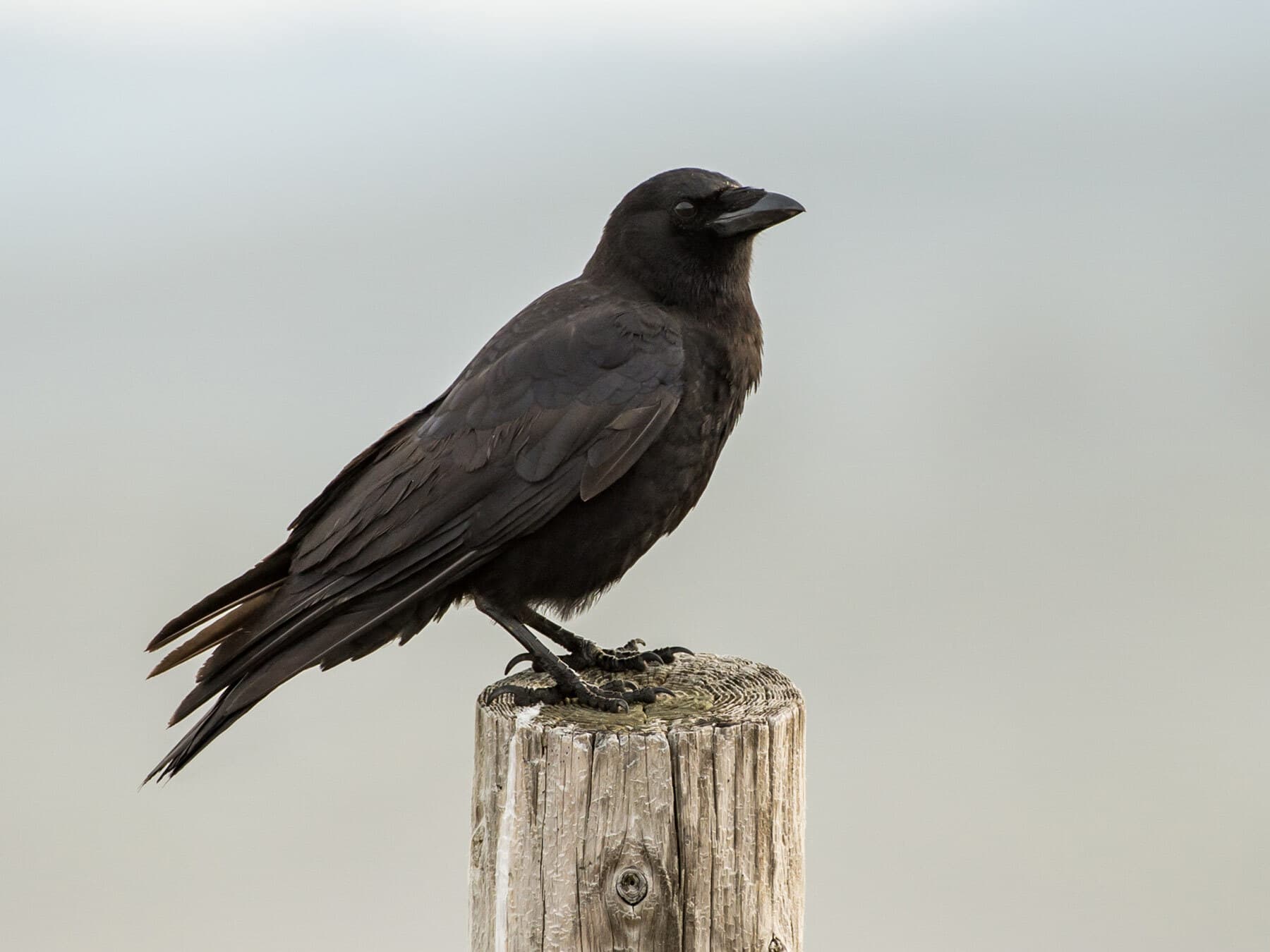
Raven or crow? Look at the tail
| Feature | Raven | Crow |
|---|---|---|
| Tail in flightDecisive | Raven: Long, spreading into a wedge or diamond | Crow: Shorter, fanning out square or rounded |
| Call | Raven: A deep, hoarse croak | Crow: A caw |
| Length | Raven: About a third longer: 56-69 cm (22-27 in) | Crow: 40-53 cm (American Crow); 45-47 cm (Carrion Crow) |
| Wings | Raven: Long and pointed, with long, separated fingers | Crow: Broader and blunter |
| Head | Raven: Huge bill, shaggy throat feathers | Crow: Slimmer bill, smooth throat |
| Flight | Raven: Soars for long stretches, rolls and tumbles | Crow: Flaps steadily; soars only briefly |
The same raven lives in North America and Britain. The crow is the American Crow in North America and the Carrion Crow in Britain and Europe; the two look alike.
Seen one and not sure which? Identify it from a photo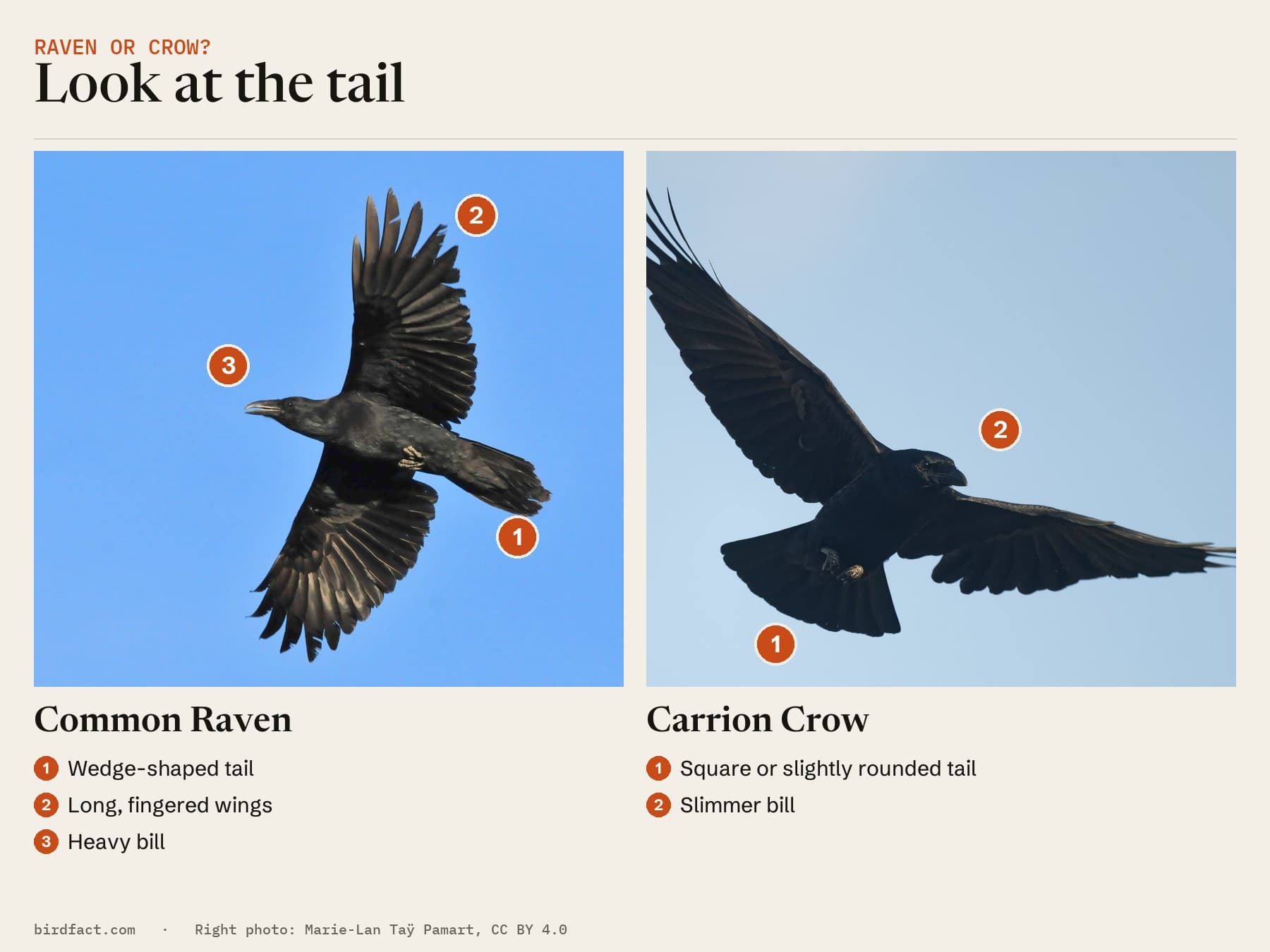
Which crow you are comparing with depends on where you are. In North America it is usually the American Crow (or the smaller Fish Crow in the South-east); in Britain and Europe it is the Carrion Crow (the grey-and-black Hooded Crow in Ireland and north-west Scotland). The raven is the same bird on both sides of the Atlantic: the Common Raven, simply "the Raven" in Britain.
This guide covers size (with a to-scale figure), the tail and wings in flight, the head, the calls (with recordings and spectrograms), where each bird lives in the US and Britain, how they behave, and the other black birds that cause most confusion.
What's the difference between a raven and a crow?
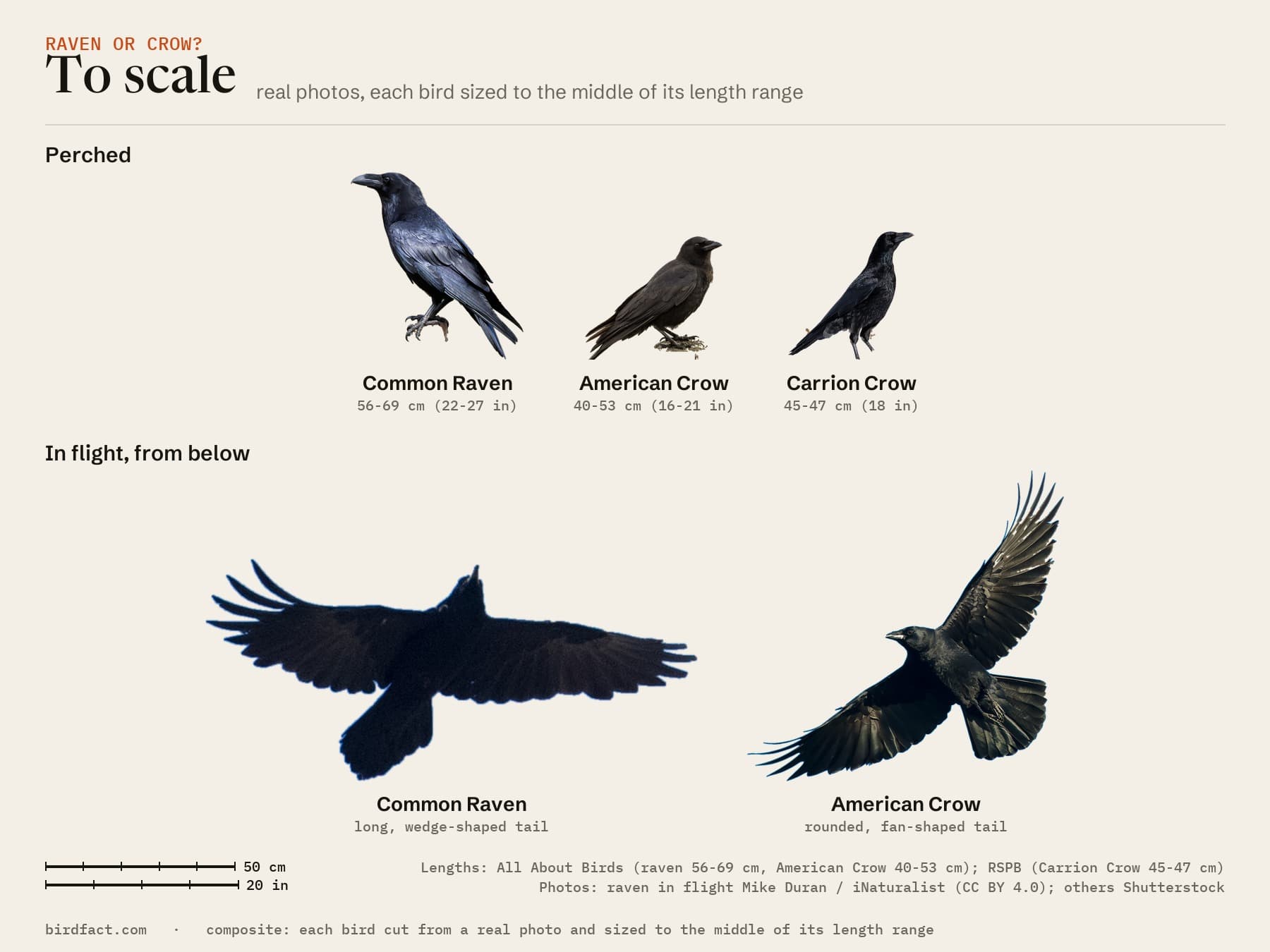
A raven is a bigger, heavier bird: about a third longer than a crow and two to two and a half times its weight, with a longer, wedge-shaped tail, longer and more pointed wings, a huge bill and shaggy throat feathers. A crow caws; a raven gives a deep, hoarse croak. Ravens soar and tumble in the air; crows mostly flap.1, 2
| Common Raven | American Crow | Carrion Crow | |
|---|---|---|---|
| Length | 56-69 cm (22-27 in) | 40-53 cm (16-21 in) | 45-47 cm (18 in) |
| Weight | 689-1,625 g (1.5-3.6 lb) | 316-620 g (11-22 oz) | 370-650 g (13-23 oz) |
| Wingspan | 116-150 cm (46-59 in) | 85-100 cm (33-39 in) | 93-104 cm (37-41 in) |
| Tail in flight | Long, wedge- or diamond-shaped | Shorter, square or rounded fan | Shorter, square or slightly rounded |
| Wings | Long, pointed hand, long separated "fingers" | Broader and blunter | |
| Bill and throat | Huge bill; shaggy throat feathers | Slimmer bill; smooth throat | |
| Call | Deep, hoarse croak | Caw | |
| Flight | Soars, glides, rolls | Steady flapping; soars only briefly | |
Sizes from All About Birds (Common Raven, American Crow), the RSPB (Raven, Carrion Crow) and Birds of the World (raven wingspans to 150 cm).
Five clues, in order
- Listen. A caw means a crow. A deep, croaking "gronk" means a raven. American Crows never make anything like it; a Carrion Crow very occasionally gives a raven-like "konk", usually mixed in with ordinary caws.3
- Watch it fly. A raven soars on flat wings for long stretches, and often rolls or tumbles; its head and neck stick out further in front of the wings. An American Crow flaps steadily, soars only briefly and never somersaults. (In Britain the much smaller Jackdaw tumbles too.)4
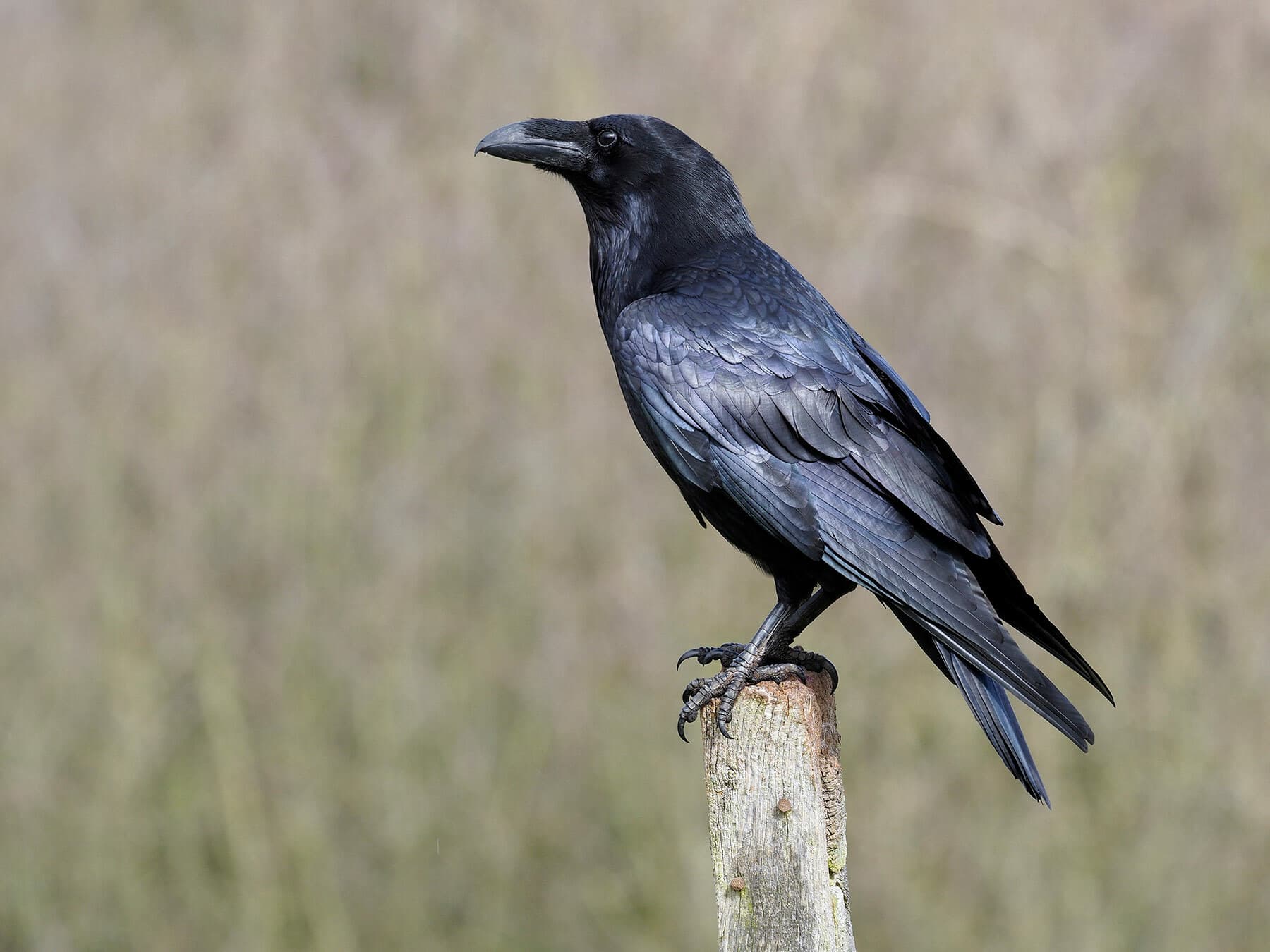
- Look at the tail when it is spread. Wedge- or diamond-shaped on a raven; square or rounded like a fan on a crow.
- Look at the head. A raven's bill is massive, its throat shaggy; a crow's bill is slimmer and its throat smooth.
- Judge size only beside something you know. A lone bird always looks big. A raven is as big as a Red-tailed Hawk in North America; side by side with a crow, the difference is obvious, but on its own it is not. If you see "a really big crow" where ravens are scarce, it is probably a crow.
How much bigger is a raven than a crow?
About a third longer and two to two and a half times as heavy. All About Birds puts the Common Raven at 56-69 cm (22-27 in) and 689-1,625 g (1.5-3.6 lb), "about half again larger" than an American Crow at 40-53 cm (16-21 in) and 316-620 g (11-22 oz).5 In Britain the RSPB gives the Raven 60-68 cm and 800-1,500 g against the Carrion Crow's 45-47 cm and 370-650 g.6 In North America, ravens of the far north are the biggest and those of the south-western deserts the smallest.7
That size is surprisingly hard to judge. A single crow can look bigger or smaller simply by fluffing or sleeking its feathers, and Cornell's crow researcher Kevin McGowan points out that the difference between crow and raven, though huge, only helps with something else to compare.
The tail and wings in flight
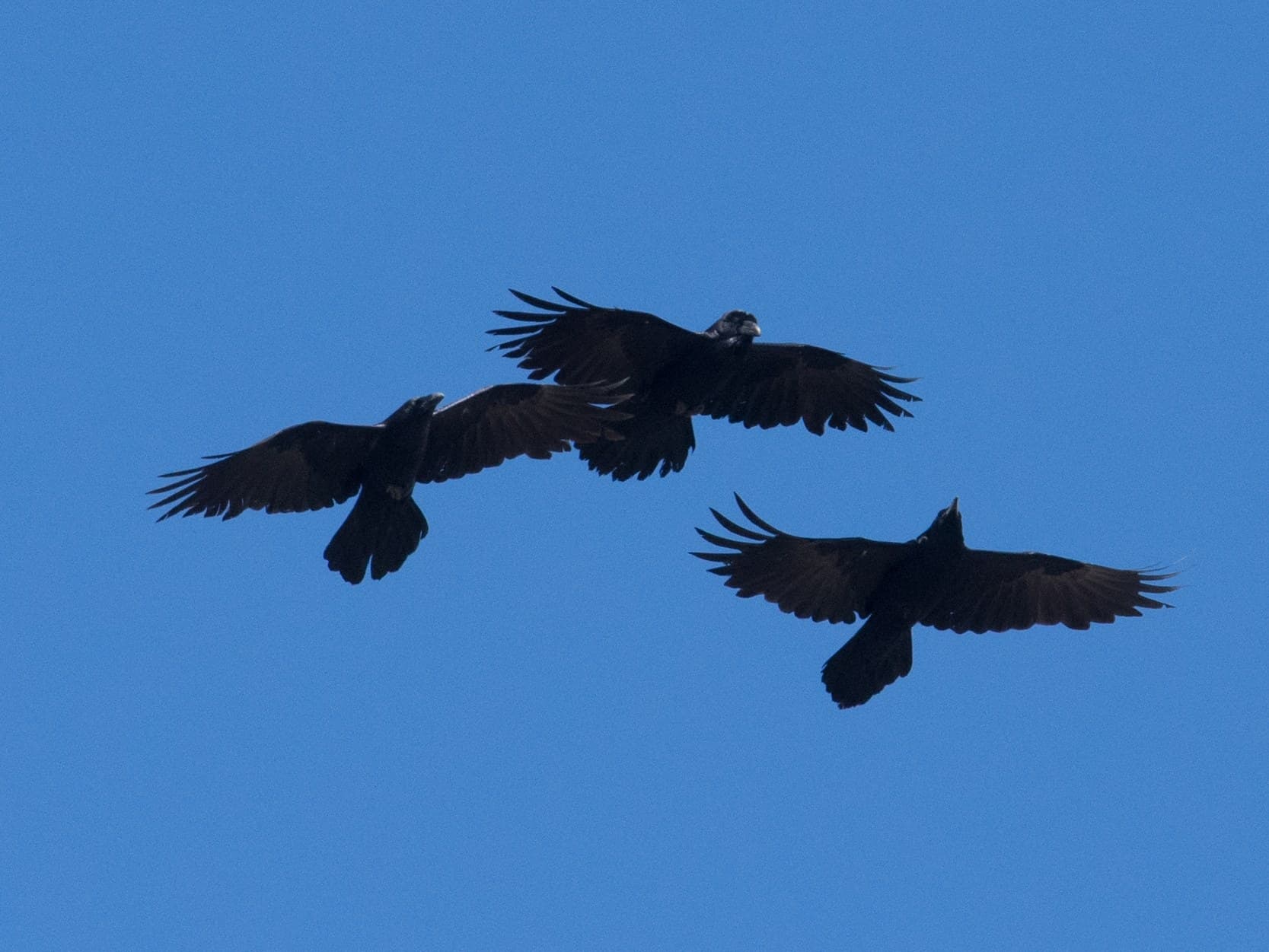
In flight a raven's long tail is graduated, the middle feathers longest, so when it is spread it forms a wedge or diamond.7 A crow's shorter tail fans into a square or slightly rounded end.8 Two traps: a crow's tail can look wedge-shaped when it is partly closed, and for a short time in summer when it is moulting; it almost never does when fanned as the crow soars or banks.1
The wings differ too. A raven's are longer and narrower towards the tip, with long, separated "fingers", so the hand looks almost pointed and bent back at the wrist. As one of McGowan's neighbours put it, "Ravens are the ones whose wings you can see through." A crow's wings are broader and blunter.
Head, bill and throat
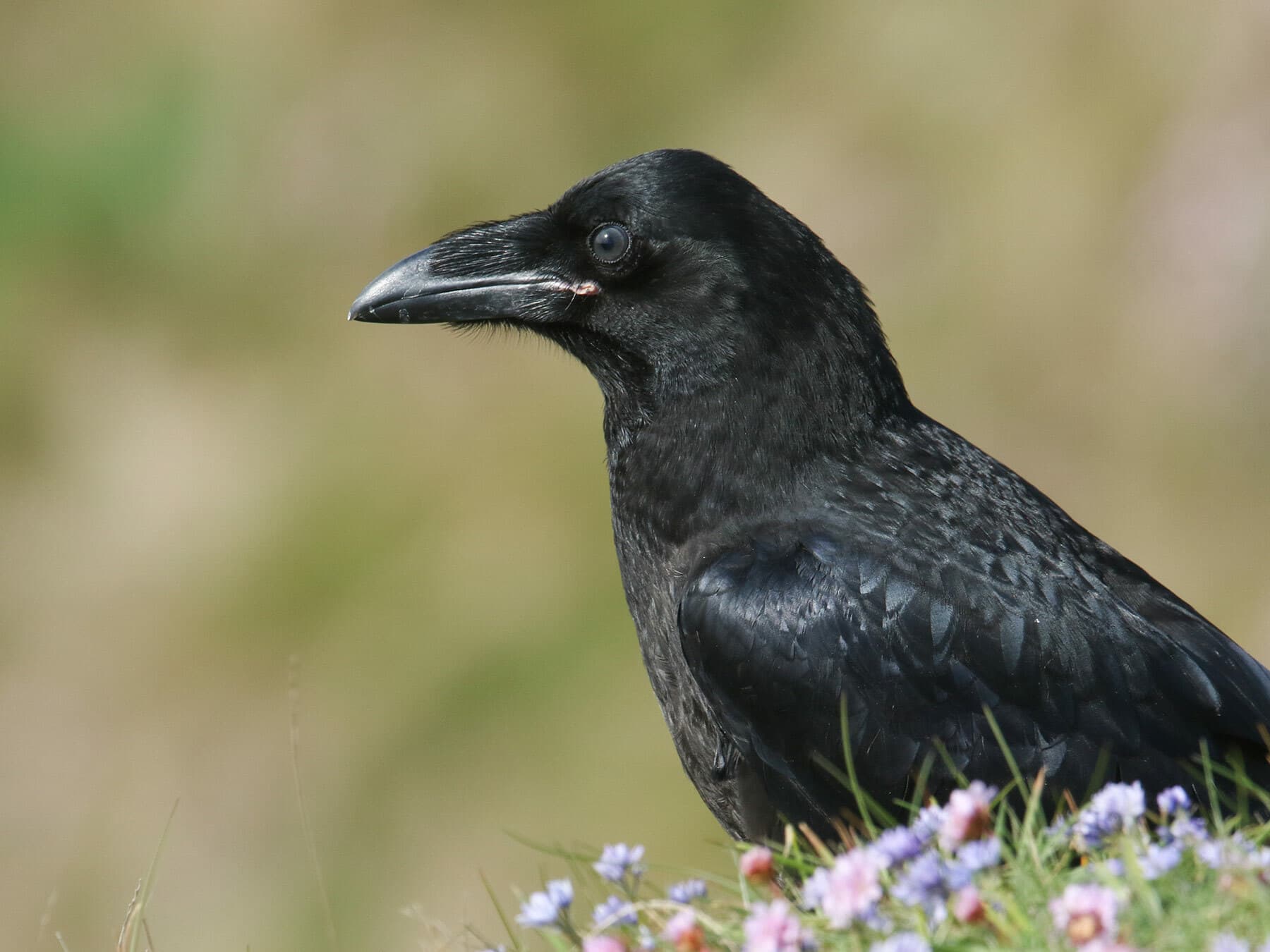
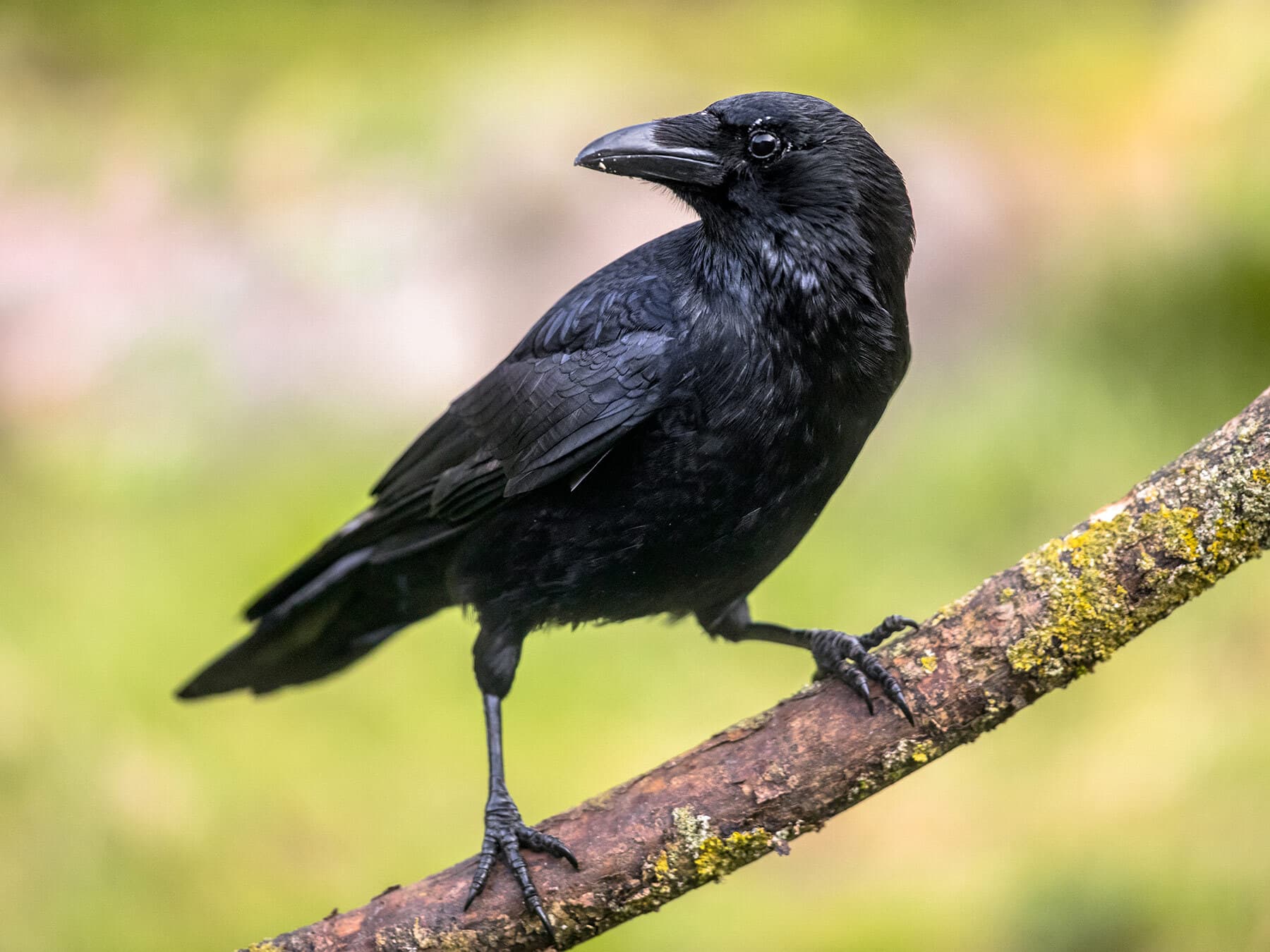
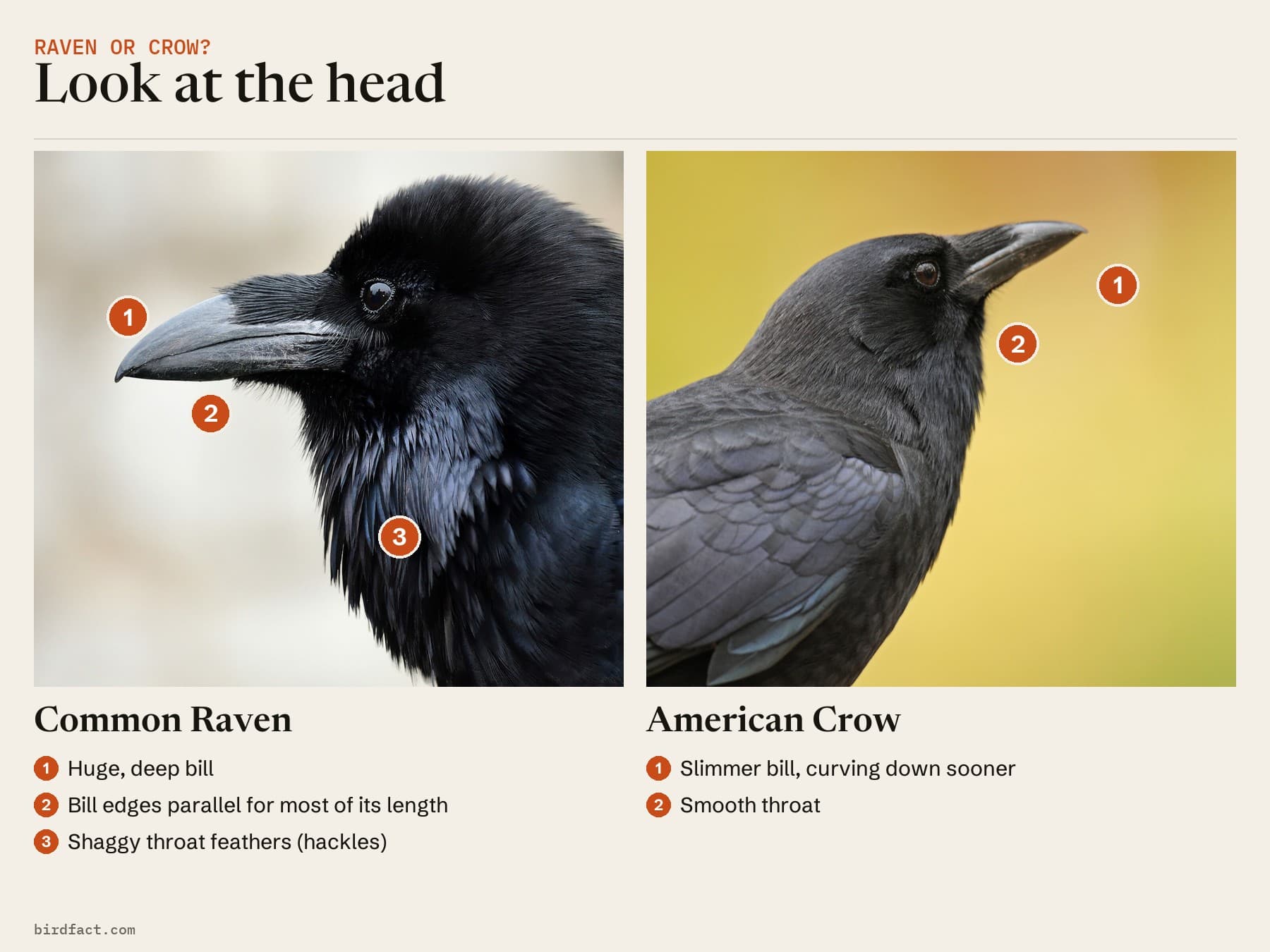
Perched, a raven shows a massive, deep bill, the upper and lower edges running parallel for most of their length, and shaggy, pointed throat feathers (hackles), which it puffs out when it calls or displays. A crow's bill is slimmer, curving down from about half to two-thirds of the way along, and its throat is smooth.1 Both have bristly feathers over the base of the bill, so that is no help, and young ravens have not grown their hackles yet.7
How a raven and a crow sound
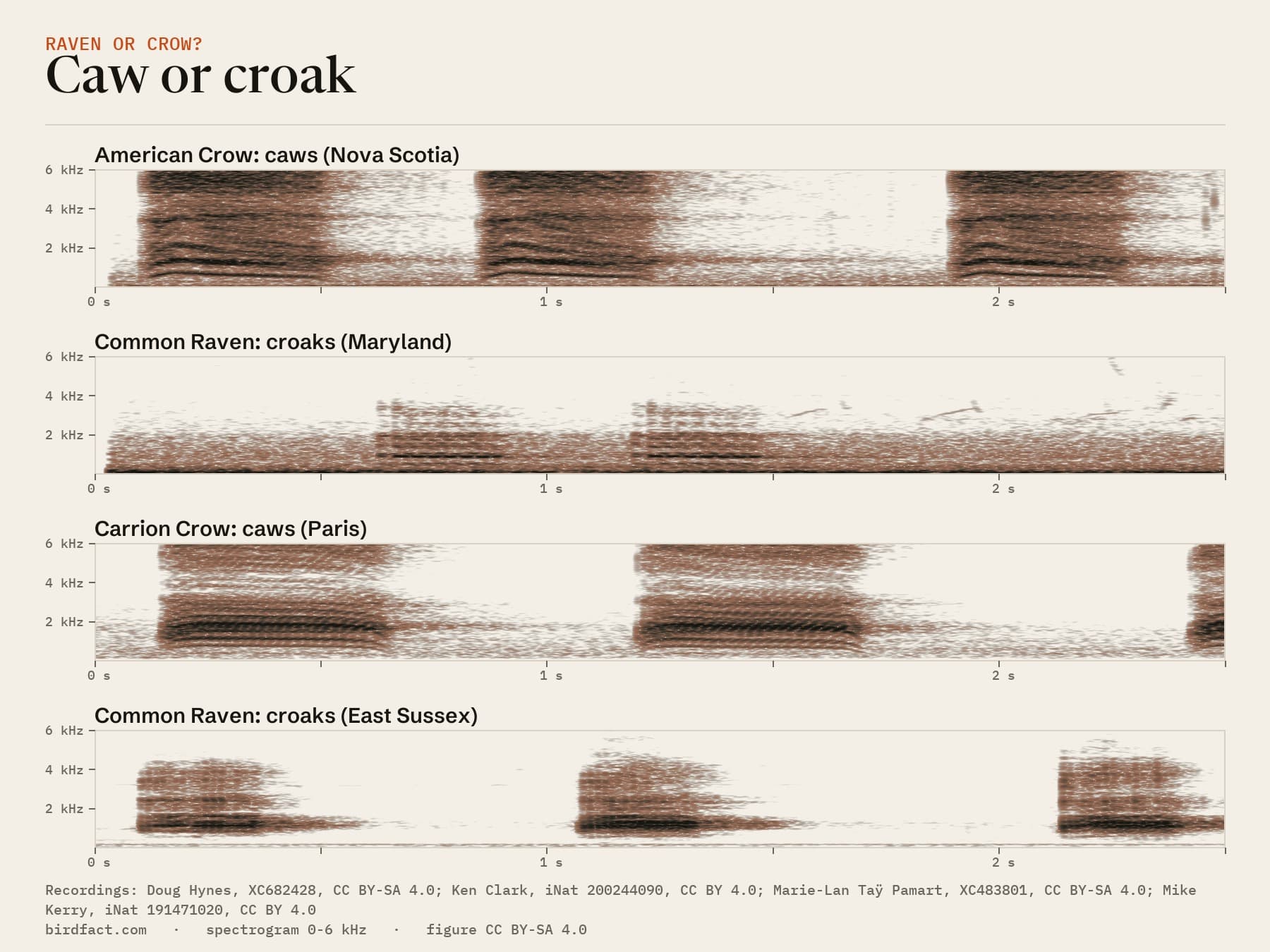
The calls are often the quickest way to tell them apart. A crow caws: a harsh, flat "caw" or "kraa", repeated. A raven's commonest calls are a deep, hoarse croak, "rrock" or "gronk", often in a series of three or four, and a long, rising call; it also makes knocking, bell-like and gurgling sounds. Birds of the World lists at least 20 calls of known function.7 Only occasionally does a raven give a caw-like call, and even then it is deep and hoarse.1
For every sound a crow makes, from rattles to begging calls, see crow sounds.
When a raven sounds like a crow
How they behave
In North America ravens are more often seen alone or in pairs and American Crows in family groups; in Britain both ravens and Carrion Crows are usually seen alone or in pairs.4 Neither rule holds all the time. Raven pairs stay together all year, while young ravens and birds without territories gather at food and in communal night roosts: 50 to 100 birds in Maine, more than 2,000 in parts of the West.7 Crows gather in winter roosts of thousands.9
In the air, ravens play: in one study, aerial rolls were seen in up to 16% of observations of flying birds, mostly half-rolls onto the back, and ravens have been seen flying upside down for as far as a kilometre. Crows flick their wings; ravens do not. On the ground both walk, and a raven occasionally bounds forward with two-footed hops.2
Where the two meet, crows often chase and mob ravens. One to one at food, the raven usually wins: in Virginia and Nova Scotia one raven displaced 3 to 11 feeding crows, though in Maine crows chase ravens and the reverse is rarely seen.
Where do ravens live?
Across much of the northern hemisphere: North America, Europe, Asia and North Africa, from deserts to Arctic tundra. Crows are more tied to farmland and towns. Ravens had gone from much of eastern North America by the early 1900s, and after three centuries of persecution from much of lowland Europe; they have been returning since the mid-20th century, now even into cities.7
In the United States, our records show three broad zones:
| Ravens common, alongside crows | Ravens local or uncommon | Ravens rare or absent in most of the state |
|---|---|---|
| Alaska and the West (Arizona, California, Colorado, Idaho, Montana, Nevada, New Mexico, Oregon, Utah, Washington, Wyoming); the upper Midwest (Michigan, Minnesota, Wisconsin); New York and New England (except Rhode Island); Pennsylvania, Virginia and West Virginia | Maryland, New Jersey, North Carolina, Oklahoma, Rhode Island, Tennessee and Texas (in parts); winter visitors to North Dakota, Delaware and Washington DC | Florida, Georgia, South Carolina, Alabama, Mississippi, Louisiana, Arkansas, Missouri, Kentucky, Ohio, Indiana, Illinois, Iowa, Kansas, Nebraska and South Dakota |
Ravens also nest in the mountains at the edges of Georgia, South Carolina and Kentucky, and the Chihuahuan Raven reaches Kansas. In the deserts and mountains of the West the balance tips the other way: in Arizona there are about 14 raven records for every American Crow record, and in Nevada and Utah about four.
In Britain, ravens nest mostly in the west and north, and are spreading east.10 In our records they are common in Cornwall, Devon, Cumbria and the Highlands (in Cornwall there is one raven record for every three or four Carrion Crow records) but still scarce in much of eastern England: in London there are about 70 Carrion Crow records for every raven record, and in Norfolk about 58.
Other birds that cause confusion
In North America. The Fish Crow of the South-east and the Atlantic coast is a little smaller than an American Crow and is best told by its nasal "uh-uh".1 The Chihuahuan Raven of the south-western deserts and grasslands sits between the two in size, with a shorter, blunter bill and a less hoarse voice; side by side with a Common Raven it looks smaller.7 The Common Grackle is glossy and dark but much smaller, about the size of a Mourning Dove.11
In Britain. An adult Rook has a bare, greyish-white face and a pointed, pale bill, and is rarely alone. A Jackdaw is much smaller (34 cm), with a grey nape and pale eyes. A Hooded Crow is a Carrion Crow's size and shape but grey and black.4, 8 See also crows in the UK.
Is a raven a crow?
Yes and no. Ravens and crows belong to the same genus, Corvus, and in English the names follow size more than family trees: the biggest black species, usually with shaggy throats, are called ravens, the smaller ones crows. Australia's "ravens", for example, are more closely related to Australia's "crows" than to the Common Raven.1 Even within the Common Raven, birds of the western United States may be closer to the Chihuahuan Raven than to ravens in Alaska or Europe. The Common Raven is the largest of all perching birds, or songbirds.7
How their lives compare
The oldest wild ravens on record lived 22 years 7 months in Nova Scotia12, 21 years 10 months in Norway13 and 17 years 11 months in Britain14; for crows, see how long crows live. A raven lays 3 to 7 eggs, usually on a cliff ledge, a tall tree or a pylon, often using the same site for years. Established pairs stay together all year; the RSPB says they usually mate for life, though as of Birds of the World's 2020 account no study of marked birds had tested it.7 See raven nesting and crow nesting.
The law treats them differently too. In the United States both are protected under the Migratory Bird Treaty Act15, 16, but states may set hunting seasons for crows, and there is no hunting season for ravens.17 In England, the general licences that allow people to kill certain birds to protect wildlife, livestock and crops cover the Carrion Crow but not the Raven.18, 19
Which is smarter, a raven or a crow?
Both are among the cleverest birds there are, and no single test ranks them. McGowan's short answer is that crows are "smarter than many undergraduates, but probably not as smart as ravens". Ravens have certainly done some remarkable things in experiments. Faced for the first time with meat hanging on a string, five of six young ravens worked out how to pull it up loop by loop, standing on each loop as they went.20 In another study, ravens planned ahead, keeping a tool or a token for up to 17 hours before they could use it.21 Ravens hiding food fly further away when other ravens are watching, and remember where they have seen others hide food.7 For crows, see do crows remember faces?
Myths
- "A raven is twice the size of a crow." By weight, roughly yes: two to two and a half times as heavy. But it is only about a third longer, so it never looks twice as big.
- "Ravens are always alone; crows are always in groups." Both nest in pairs, and both gather in big roosts.
- "Crows never soar." They do, briefly; ravens soar for much longer.
- "Ravens live only in the wilderness." In the eastern US they mostly do, but in the West they thrive at landfills, farms and roadsides and in some cities, and in Britain they sometimes nest in big cities.7, 10
- "Any very big black bird is a raven." Where ravens are scarce, a big black bird is almost always a crow.1
Sources
- McGowan, K. J. Frequently asked questions about crows. Cornell Lab of Ornithology. Accessed 8 October 2026. Source
- Cornell Lab of Ornithology. Common Raven identification. All About Birds. Accessed 8 October 2026. Source
- Madge, S., Goodman, D. D., Kirwan, G. M. (2026). Carrion Crow (Corvus corone), version 1.1. Birds of the World (R. Ahmed and B. K. Keeney, editors). Cornell Lab of Ornithology. doi:10.2173/bow.carcro1.01.1
- RSPB. Corvids: how to identify the crow family. RSPB, Identifying birds. Accessed 8 October 2026. Source
- Cornell Lab of Ornithology. American Crow. All About Birds. Accessed 8 October 2026. Source
- RSPB. Carrion Crow. RSPB Birds A-Z. Accessed 8 October 2026. Source
- Boarman, W. I., Heinrich, B. (2020). Common Raven (Corvus corax), version 1.0. Birds of the World (S. M. Billerman, editor). Cornell Lab of Ornithology. doi:10.2173/bow.comrav.01
- BTO. Identification: corvids. Bird Table (BTO Garden BirdWatch magazine). Accessed 8 October 2026. Source
- Caffrey, C., Verbeek, N. A., Clark, A. B., McGowan, K. J., Pyle, P. (2026). American Crow (Corvus brachyrhynchos), version 1.6. Birds of the World (A. F. Poole, F. B. Gill and M. G. Smith, editors). Cornell Lab of Ornithology. doi:10.2173/bow.amecro.01.6
- RSPB. Raven. RSPB, Birds and wildlife. Accessed 8 October 2026. Source
- Cornell Lab of Ornithology. Common Grackle identification. All About Birds. Accessed 8 October 2026. Source
- USGS Bird Banding Laboratory. Longevity records of North American birds. USGS Patuxent Wildlife Research Center. Accessed 8 October 2026. Source
- Fransson, T., Kolehmainen, T., Moss, D., Robinson, R. (2023). EURING list of longevity records for European birds (1 September 2023). EURING. Accessed 8 October 2026. Source
- BTO. Longevity records for Britain & Ireland in 2024. BTO Online Ringing and Nest Recording Report. Accessed 8 October 2026. Source
- U.S. Congress (1918). Migratory Bird Treaty Act, 16 U.S.C. 703. Accessed 8 October 2026. Source
- U.S. Fish and Wildlife Service (2026). 50 CFR 10.13: List of Migratory Birds. Accessed 8 October 2026. Source
- U.S. Fish and Wildlife Service (2026). 50 CFR 20.133: Hunting regulations for crows. Accessed 8 October 2026. Source
- Natural England (2026). GL40: general licence to kill or take certain species of wild birds to conserve wild birds, flora or fauna. Accessed 8 October 2026. Source
- Natural England (2026). GL42: general licence to kill or take certain species of wild birds to prevent serious damage. Accessed 8 October 2026. Source
- Heinrich, B., Bugnyar, T. (2005). Testing problem solving in ravens: string-pulling to reach food. Ethology 111(10): 962-976. doi:10.1111/j.1439-0310.2005.01133.x
- Kabadayi, C., Osvath, M. (2017). Ravens parallel great apes in flexible planning for tool-use and bartering. Science 357(6347): 202-204. doi:10.1126/science.aam8138