


Hooded Crow
Scotch Crow, Hoodie Crow, Hoodie Bird · Corvus cornix
By the Birdfact teamChecked by Nathan Cope
On this page15 sections
How to recognise it
What do Hooded Crows look like?
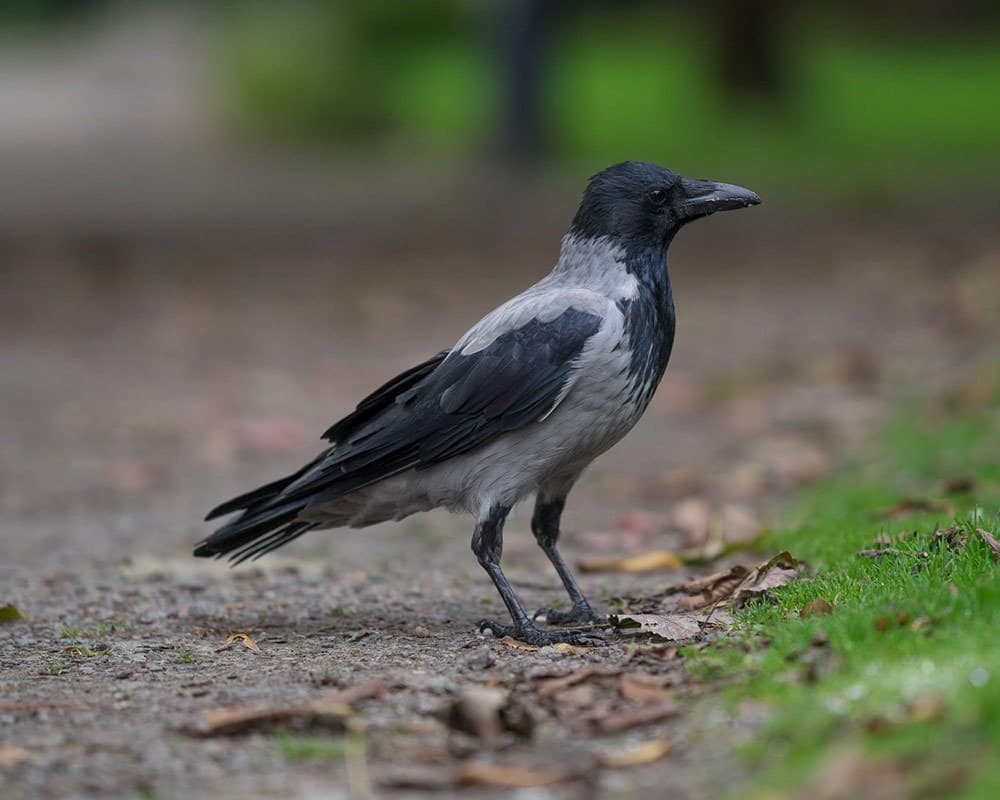
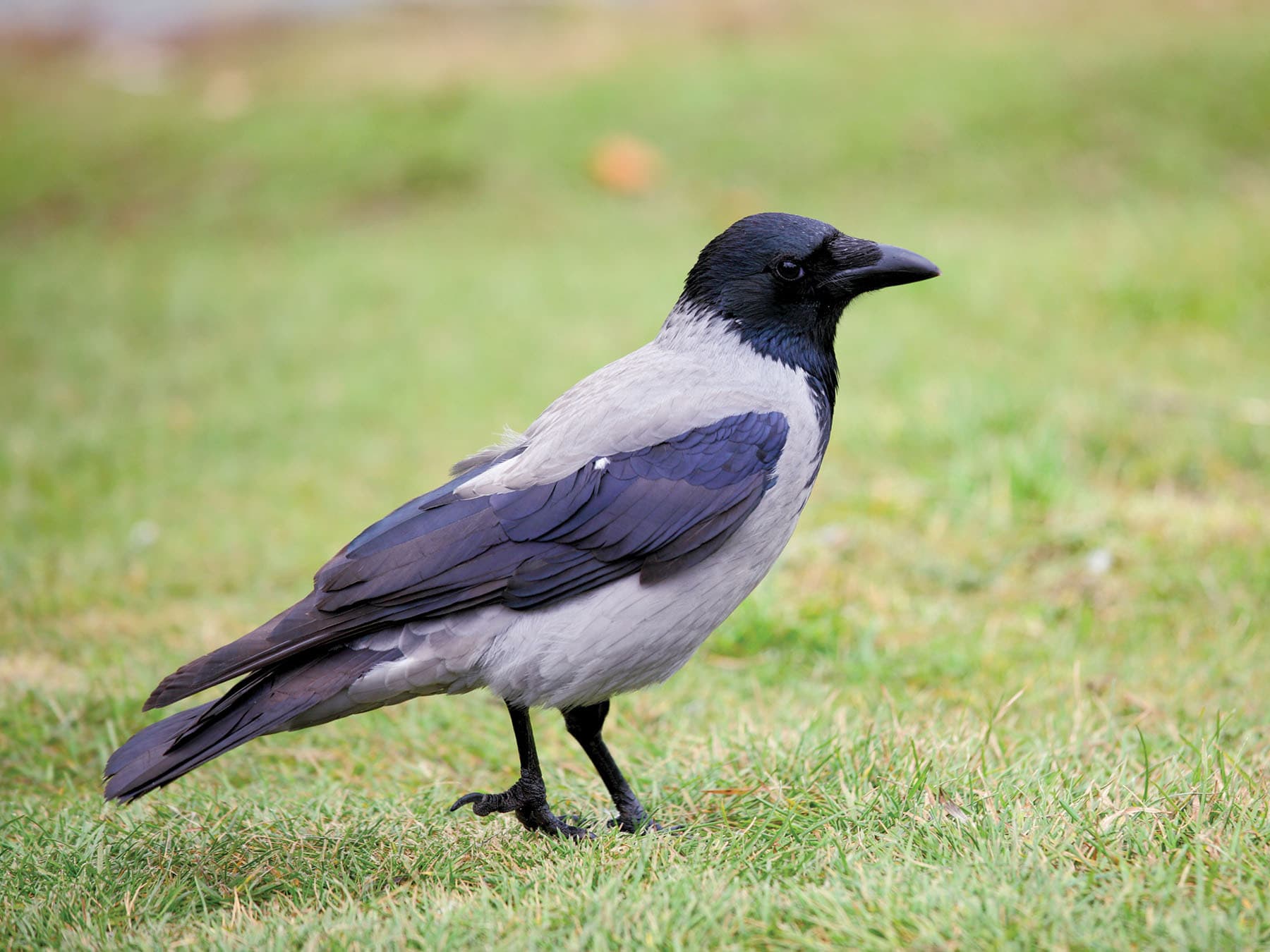
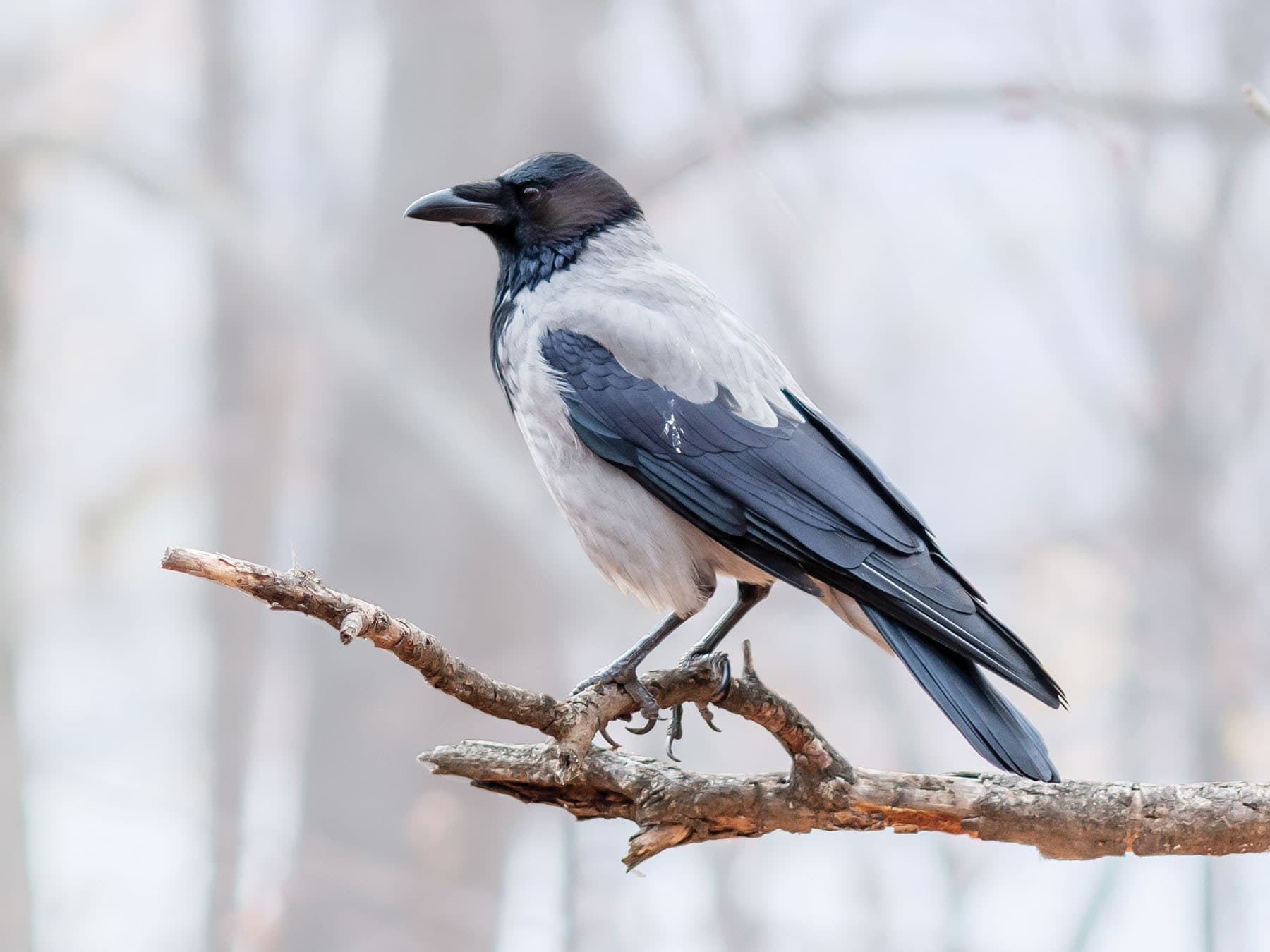
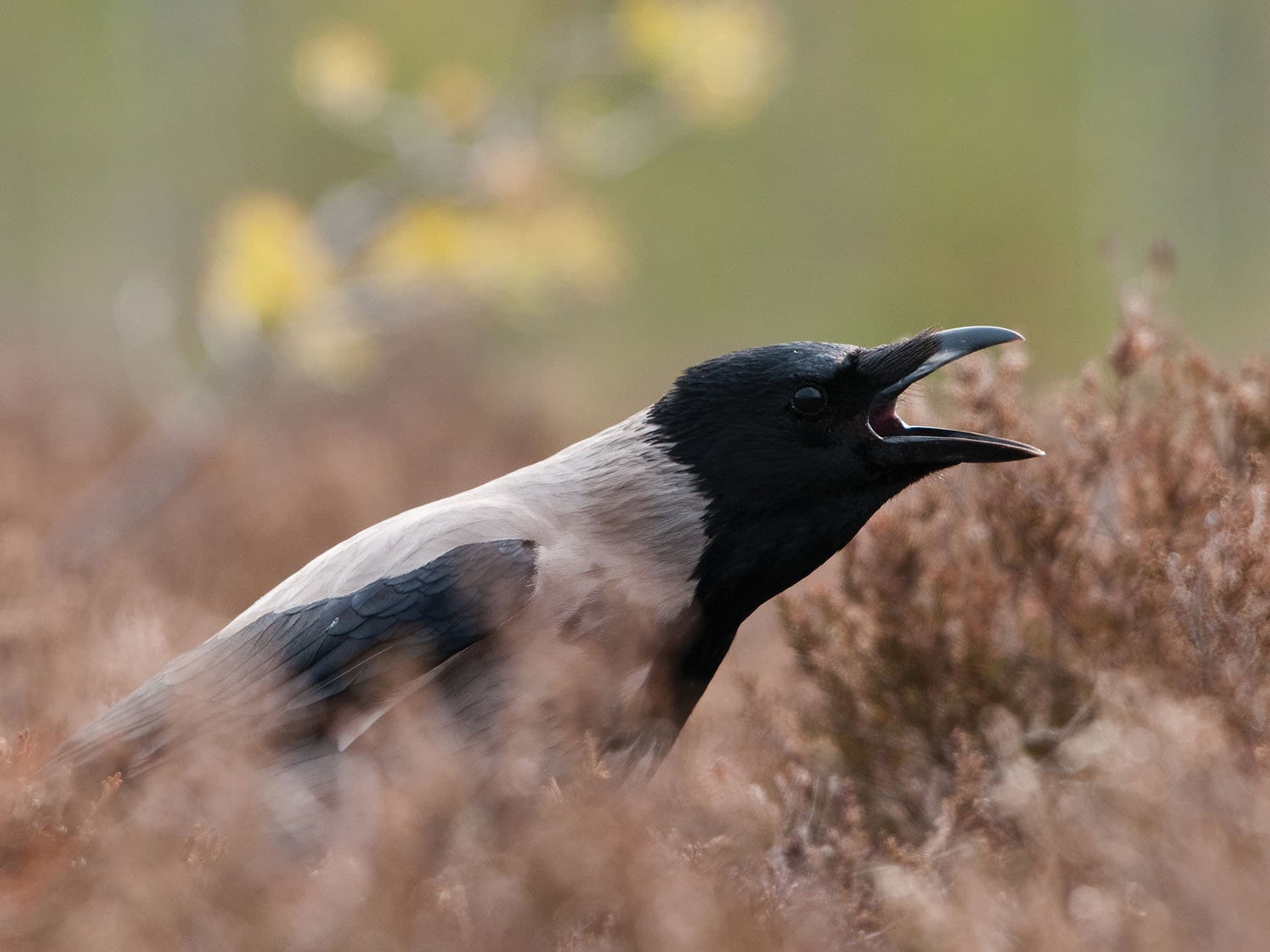
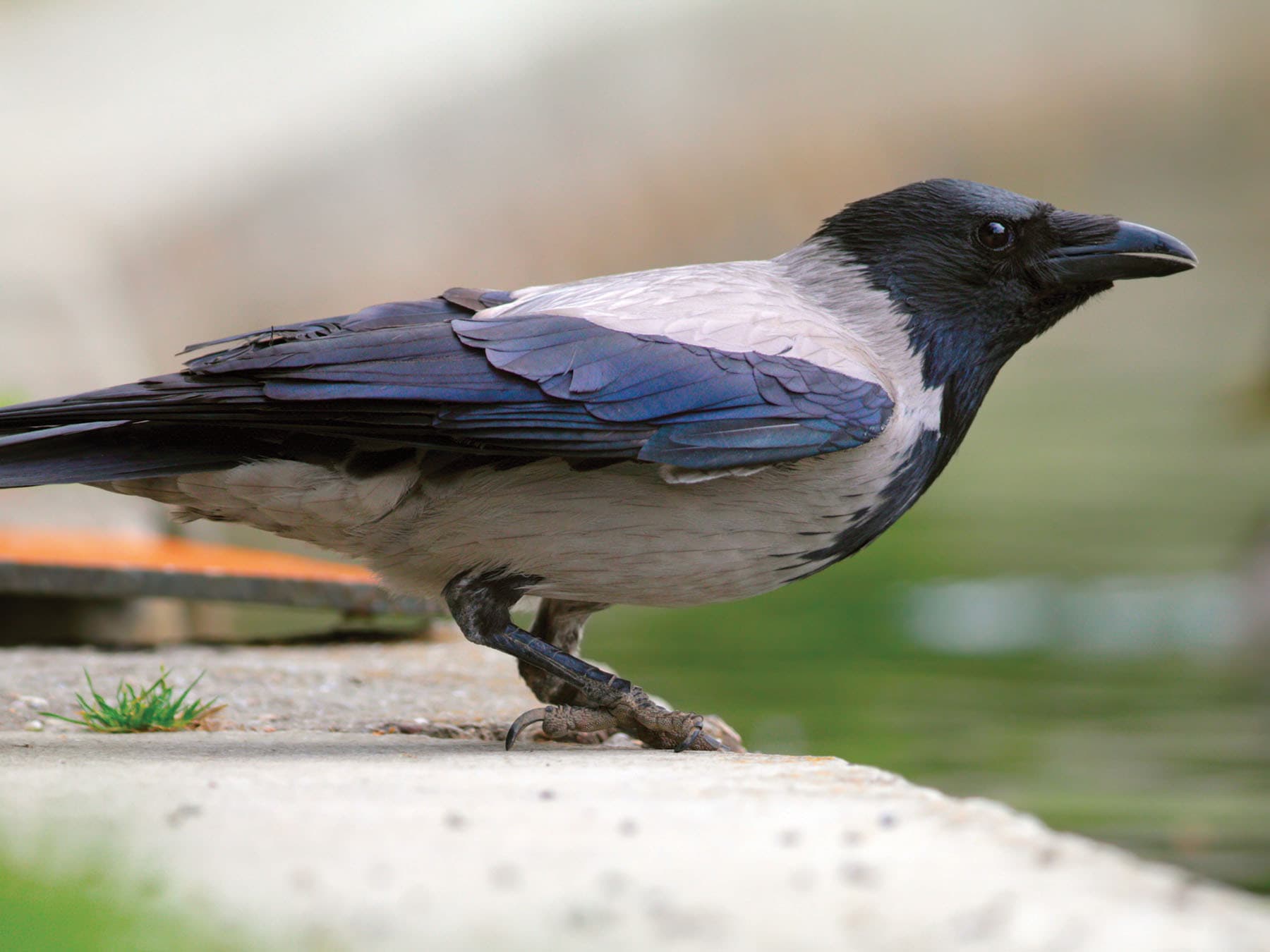
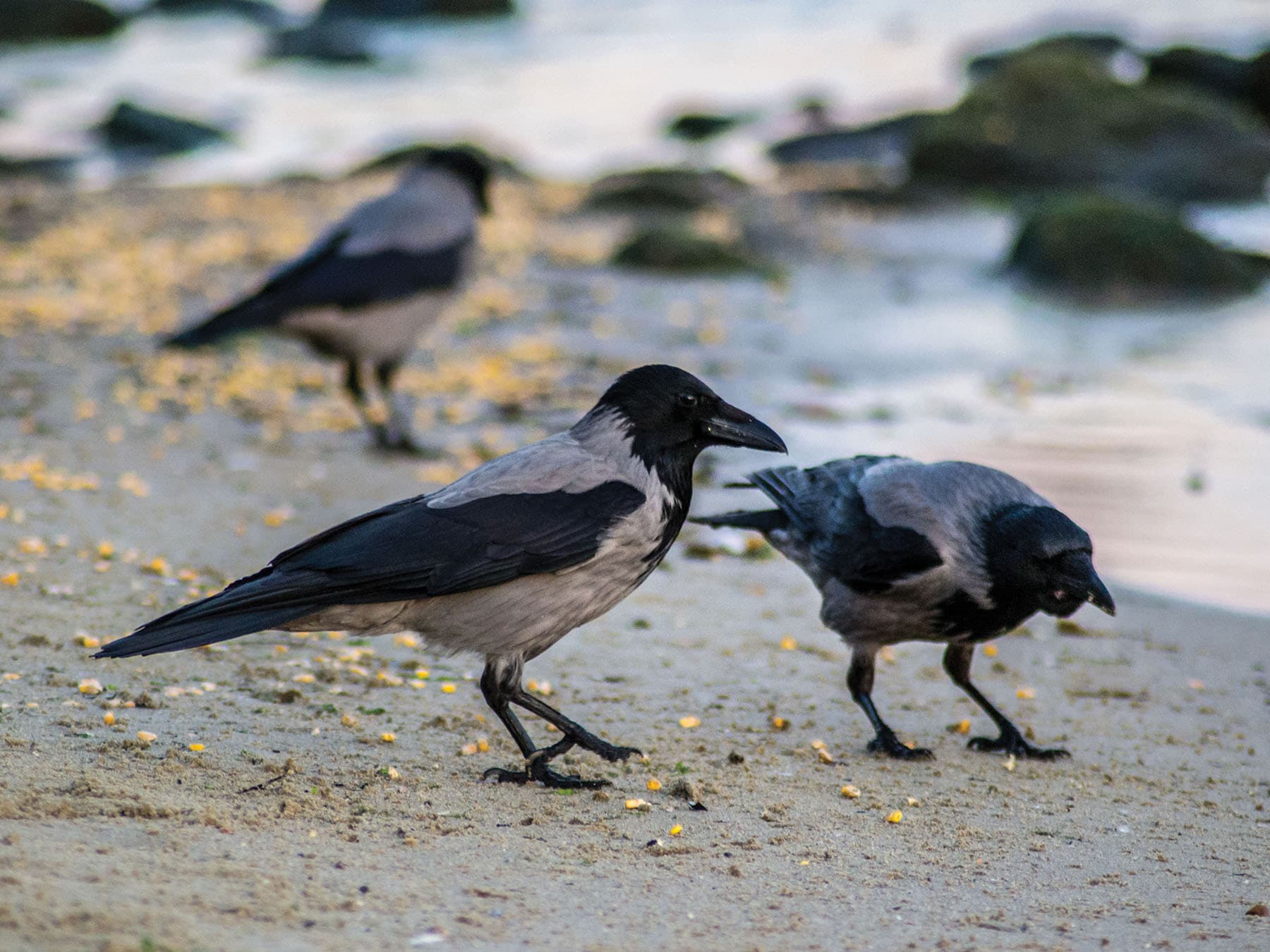
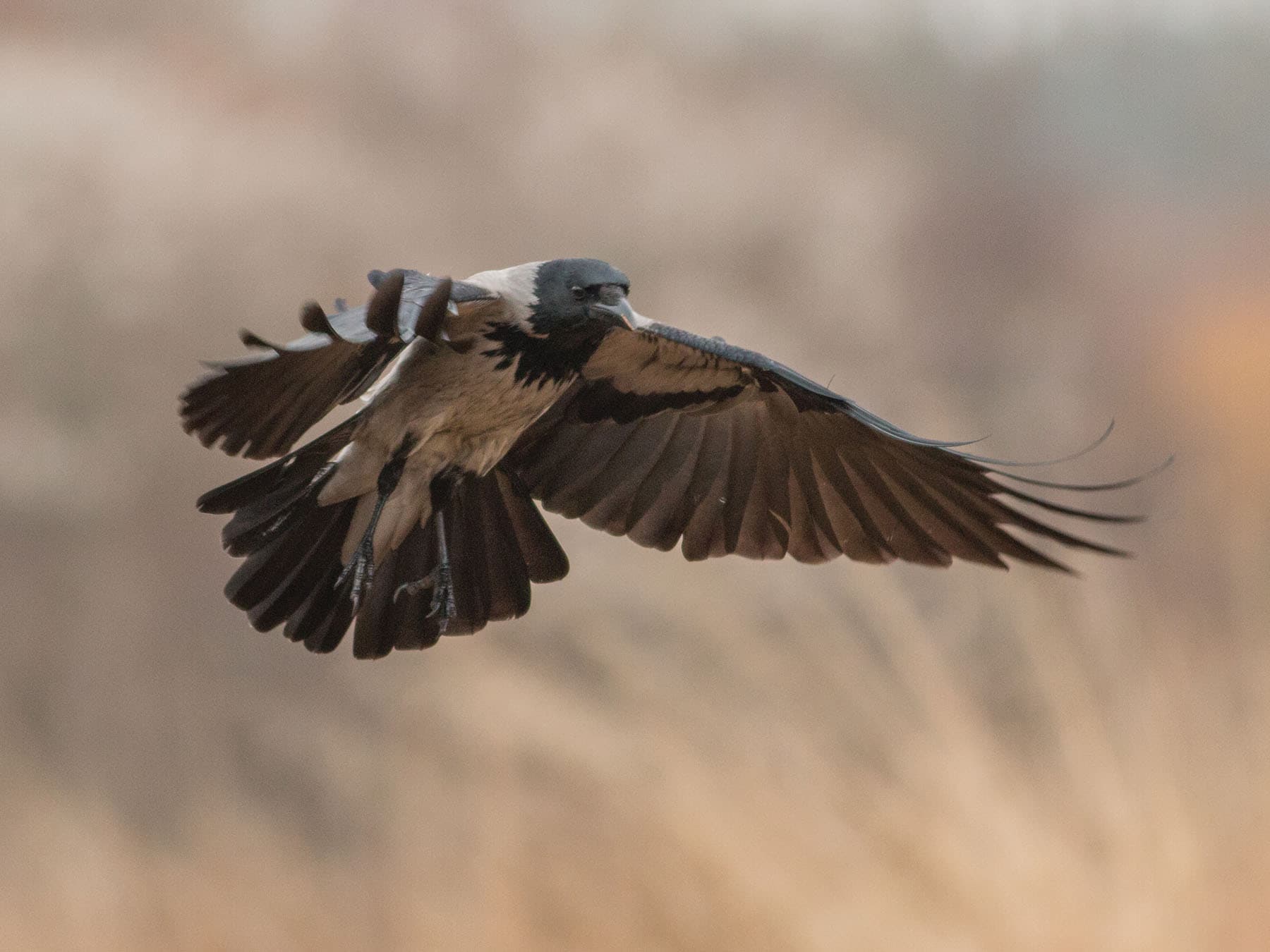
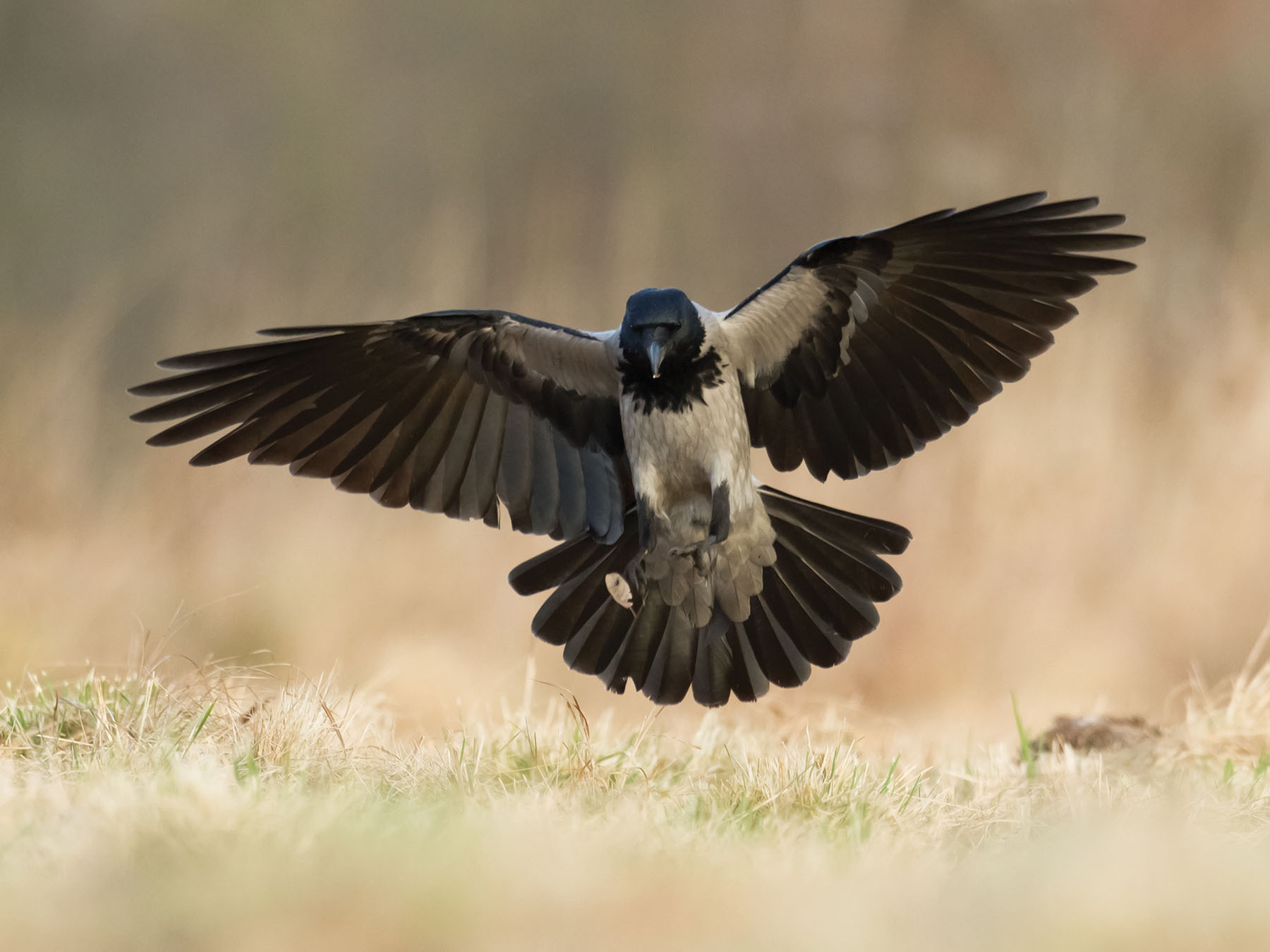
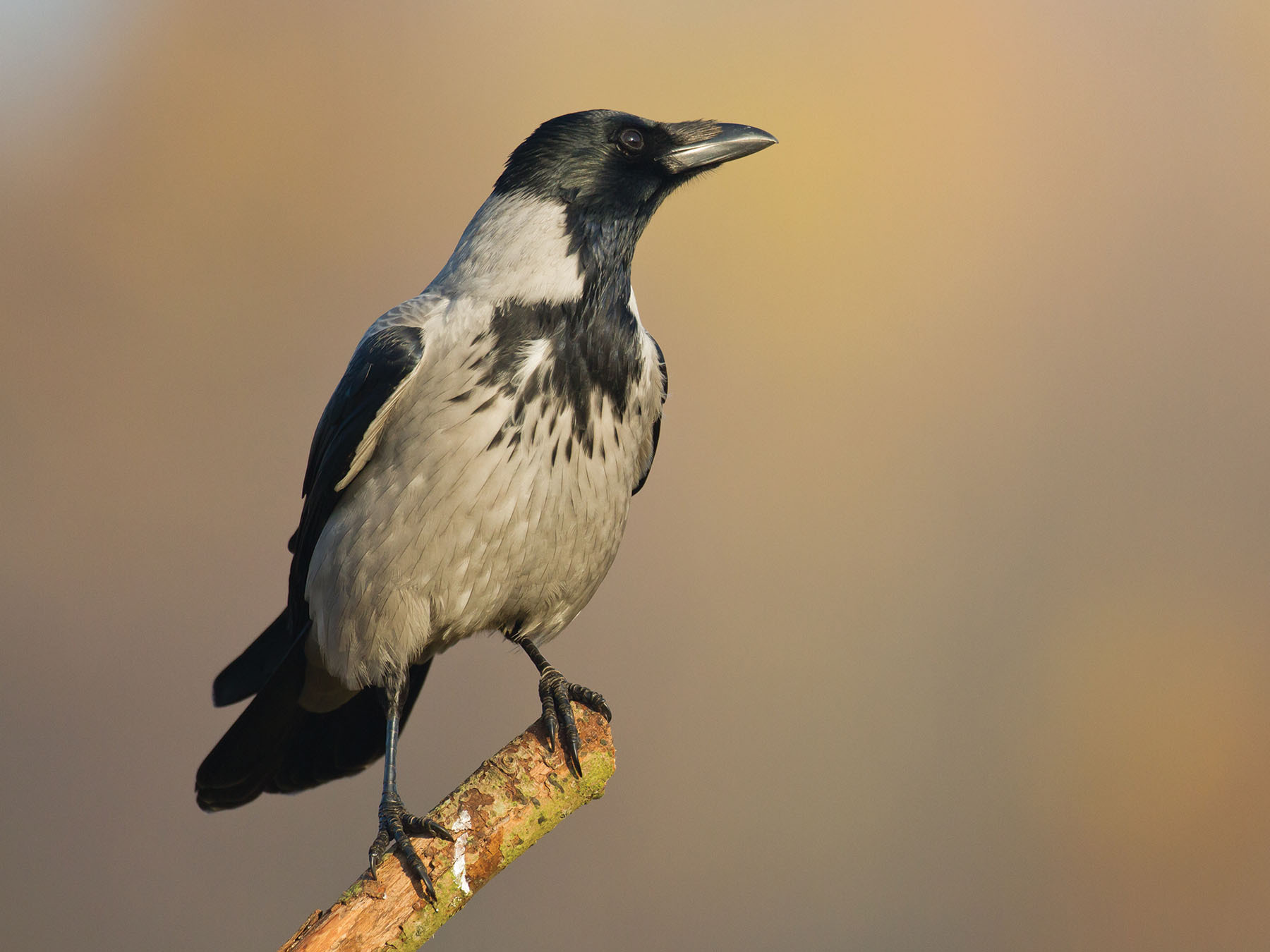
Hooded crows are large corvids, the same size as their close relative the carrion crow. They can be easily identified with their contrasting plumage, with a black head, bib, wings and tail, boldly standing out against an ash-grey body, belly, nape and rump. Their legs are dark grey and irises are dark brown.
Female hooded crows are identical to males in terms of colouring and plumage, and can only be told apart visually by their size (females are marginally smaller than males) and their behaviour.
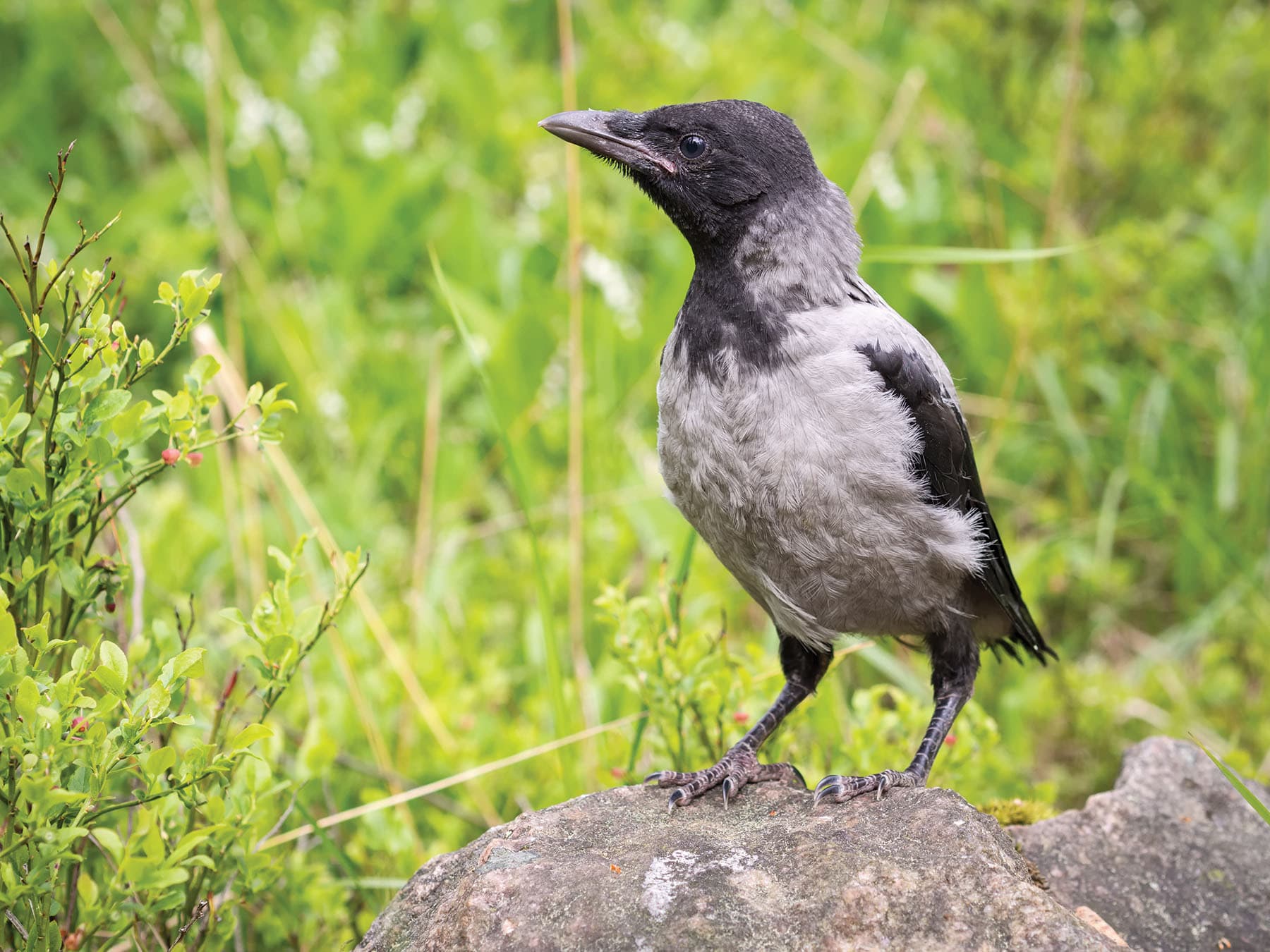
Juvenile hooded crows are duller than adults, with a browner tinge to their grey plumage. Immature birds have blue-grey eyes, and the inside of their beaks is pinkish-red rather than the dark grey of adult birds.
How big are Hooded Crows?
Male hooded crows are usually noticeably larger than females in both length and weight.
- Length: 48 cm to 54 cm (18.9 in to 21.3 in)
- Wingspan: 93 cm to 105 cm (36.7 in to 41 in)
- Weight: 396 g to 602 g (14 oz to 21 oz)
Its size
Adults- Length
- 44–51 cm
- Wingspan
- 84–100 cm
- Weight
- 430–650 g
Its song and calls
What sound does a Hooded Crow make?
The call of the hooded crow is similar to the familiar harsh cawing of a carrion crow, although slightly softer and less hoarse.
- Song and calls0:00 / 0:28
Recorded in Kalmar County, Sweden · May 2024
- Call0:00 / 0:03
Recorded in Sofiyska oblast, Bulgaria · April 2017
When and where to see it
OctoberHere all year
Most recorded in October
- 1. Meath4.8%
- 2. Belfast4.6%
- 3. Kerry4.3%
- 4. Tipperary4.3%
- 5. Longford4.2%
Each dot is a county, state or province: the bigger and darker, the larger the bird’s share of that place’s bird records that month. Grey dots: no regular records. The ringed point is the centre of the bird’s records this month; the arrow shows how it moved since last month, and the dashed loop its path through the year. “Arrivals” colours places where it becomes regular this month (orange) or is in its last regular month (grey). GBIF eBird Observation Dataset, 2019–2024. Map data: Natural Earth, US Census Bureau; place centres © OpenStreetMap contributors.
In your area
See when the Hooded Crow is recorded in your county, state or province.
How often the Hooded Crow turns up in the UK and Ireland through the year, from birdwatchers' records.
United Kingdom
Resident · all year · most records in June
Ireland
Resident · all year · most records in March
Show as a table
| Month | United Kingdom | Ireland |
|---|---|---|
| January | 0.062% (regular) | 3.3% (regular) |
| February | 0.070% (regular) | 3.4% (regular) |
| March | 0.070% (regular) | 3.5% (regular) |
| April | 0.073% (regular) | 3.3% (regular) |
| May | 0.14% (regular) | 3.3% (regular) |
| June | 0.18% (regular) | 3.2% (regular) |
| July | 0.13% (regular) | 3.4% (regular) |
| August | 0.13% (regular) | 3.2% (regular) |
| September | 0.16% (regular) | 3.3% (regular) |
| October | 0.17% (regular) | 3.4% (regular) |
| November | 0.073% (regular) | 3.5% (regular) |
| December | 0.068% (regular) | 3.4% (regular) |
Recorded regularly in
Worldwide: recorded regularly in 64 countries
Countries where it was recorded in at least 3 of the 6 years 2019–2024. Linked countries have their own bird list.
Europe (44)
- Åland Islands
- Albania
- Austria
- Belarus
- Belgium
- Bosnia & Herzegovina
- Bulgaria
- Croatia
- Czechia
- Denmark
- Estonia
- Faroe Islands
- Finland
- France
- Germany
- Greece
- Hungary
- Iceland
- Ireland
- Isle of Man
- Italy
- Kosovo
- Latvia
- Lithuania
- Moldova
- Monaco
- Montenegro
- Netherlands
- North Macedonia
- Norway
- Poland
- Portugal
- Romania
- Russia
- San Marino
- Serbia
- Slovakia
- Slovenia
- Spain
- Sweden
- Switzerland
- Ukraine
- United Kingdom
- Vatican City
Africa (1)
Asia (19)
- Armenia
- Azerbaijan
- China
- Cyprus
- Georgia
- Iran
- Iraq
- Israel
- Jordan
- Kazakhstan
- Kyrgyzstan
- Lebanon
- Mongolia
- Palestinian Territories
- Syria
- Tajikistan
- Turkey
- Turkmenistan
- Uzbekistan
Data: EOD – eBird Observation Dataset (Cornell Lab of Ornithology), accessed via GBIF.org, CC BY 4.0. Records from 2019–2024, aggregated and filtered by Birdfact. How these lists are made
What is the habitat of a Hooded Crow?
Hooded crows thrive in mixed farmland landscapes, with open land and some sparse tree cover. Parks and gardens are popular in urban areas, and the species is equally common in coastal areas as in expanses of moorland.
Hooded crows are also relatively tolerant of human presence and are frequently spotted scavenging on streets in busy city centres.
What is the range of a Hooded Crow?
Ireland and western Scotland form the western boundary of the range of hooded crows, which extends eastwards across northern Europe to western Russia.
To the south, the species is present across Mediterranean Europe, and into Egypt, throughout the Middle East and into Iran and Azerbaijan.
Where do Hooded Crows live?
Countries with the largest hooded crow populations include Norway, Sweden, and Finland in northern Europe, and Italy, Greece, Bulgaria and Turkey in the south. Russia has between 1 and 10 million resident hooded crows.
How rare are Hooded Crows?
Across their entire range (including Northern Ireland, western Scotland and the Isle of Man), hooded crows are common and widespread, and spotting one would not be considered an unusual or rare event. However, across England and Wales, the species is not well-established or numerous at all.
Out of breeding season, some migratory birds may be seen along the northern and eastern coast of England, but these sightings would be considered scarce.
Where can you see Hooded Crows in the UK?
In the northwest of Scotland and throughout Northern Ireland, hooded crows are far more prevalent than carrion crows, with the latter considered a rare vagrant species in these locations.
During winter months, the UK’s resident population of hooded crows increases with the arrival of overwintering birds that migrate from Scandinavia after the breeding season. These temporary residents may be spotted along the eastern coast of Scotland and England.
Migration
Do Hooded Crows migrate?
Most UK hooded crows are sedentary and resident in their territories all year round. The native population, found mainly in Ireland and northern Scotland, is joined in autumn by migratory hooded crows that leave their breeding grounds in Scandinavia in search of less harsh conditions until spring.
Such birds are not limited to the usual British breeding spots favoured by our resident hooded crows, meaning sightings may be recorded along the eastern coast of England.
Are Hooded Crows native to the UK?
Parts of the UK do have resident hooded crows all year round, including the Isle of Man, the whole of Northern Ireland and large areas of western and north-western Scotland. In these regions, hooded crows replace carrion crows.
Tips for seeing it
- Look for Hooded Crows in open landscapes, parks, and urban areas
- Listen for their distinctive harsh 'kraa' call
- Observe their intelligent behaviour, such as tool use or problem-solving
- In the UK, focus on northern and eastern Scotland, where they are more common
What it eats
What do Hooded Crows eat?
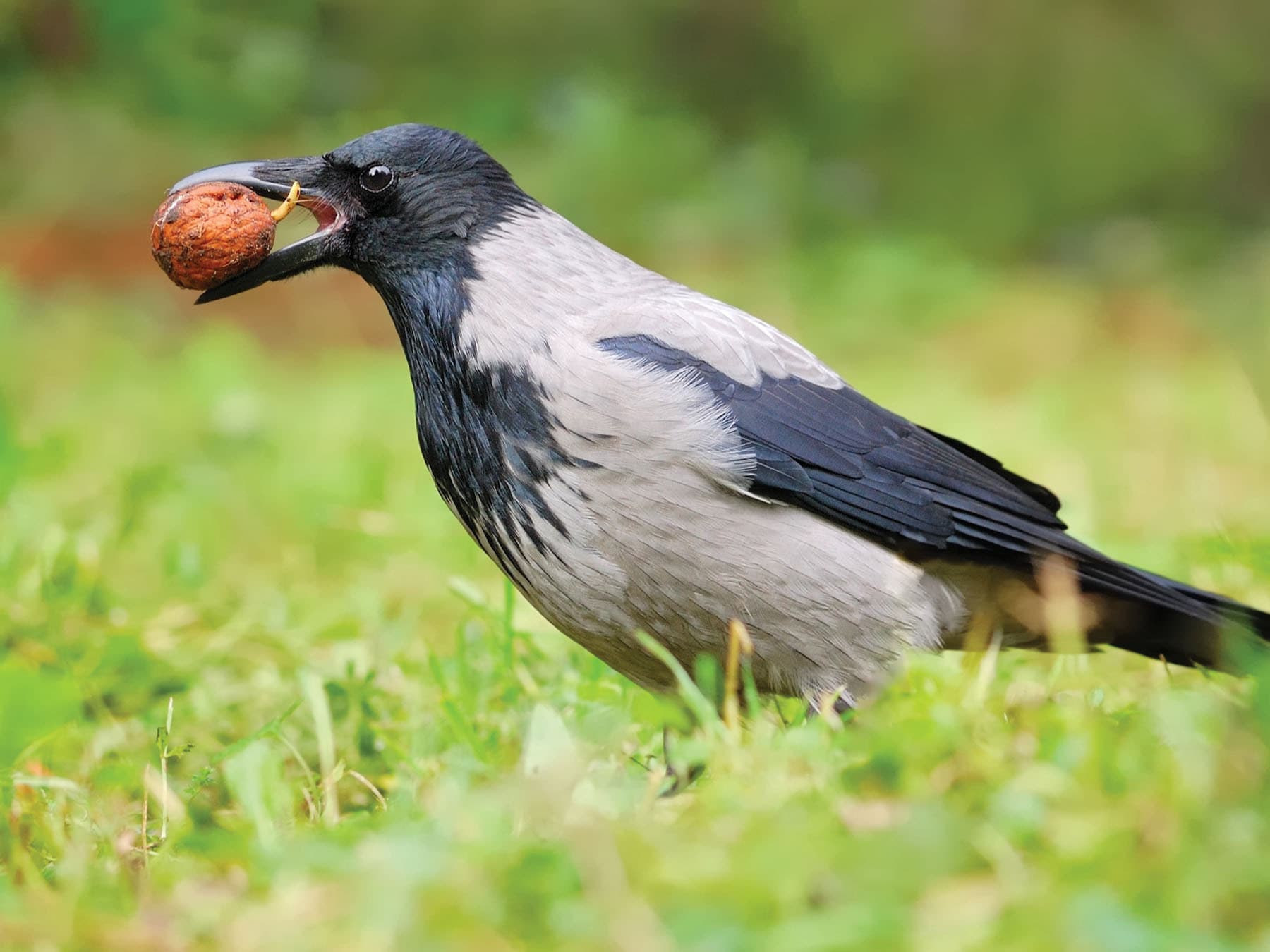
Hooded crows are ominvores, although their diet is primarily carnivorous. They scavenge for carrion, roadkill, scraps, small mammals, birds’ eggs and young nestlings.
At coastal locations, molluscs, crabs and sea urchins are frequently eaten. Small quantities of weeds, seeds and grain are also eaten.
What do Hooded Crow chicks eat?
Young hooded crows are fed almost entirely on insects in their first few weeks of life, adding grains, weeds and seeds as autumn approaches.
Nesting and breeding
Where do Hooded Crows nest?
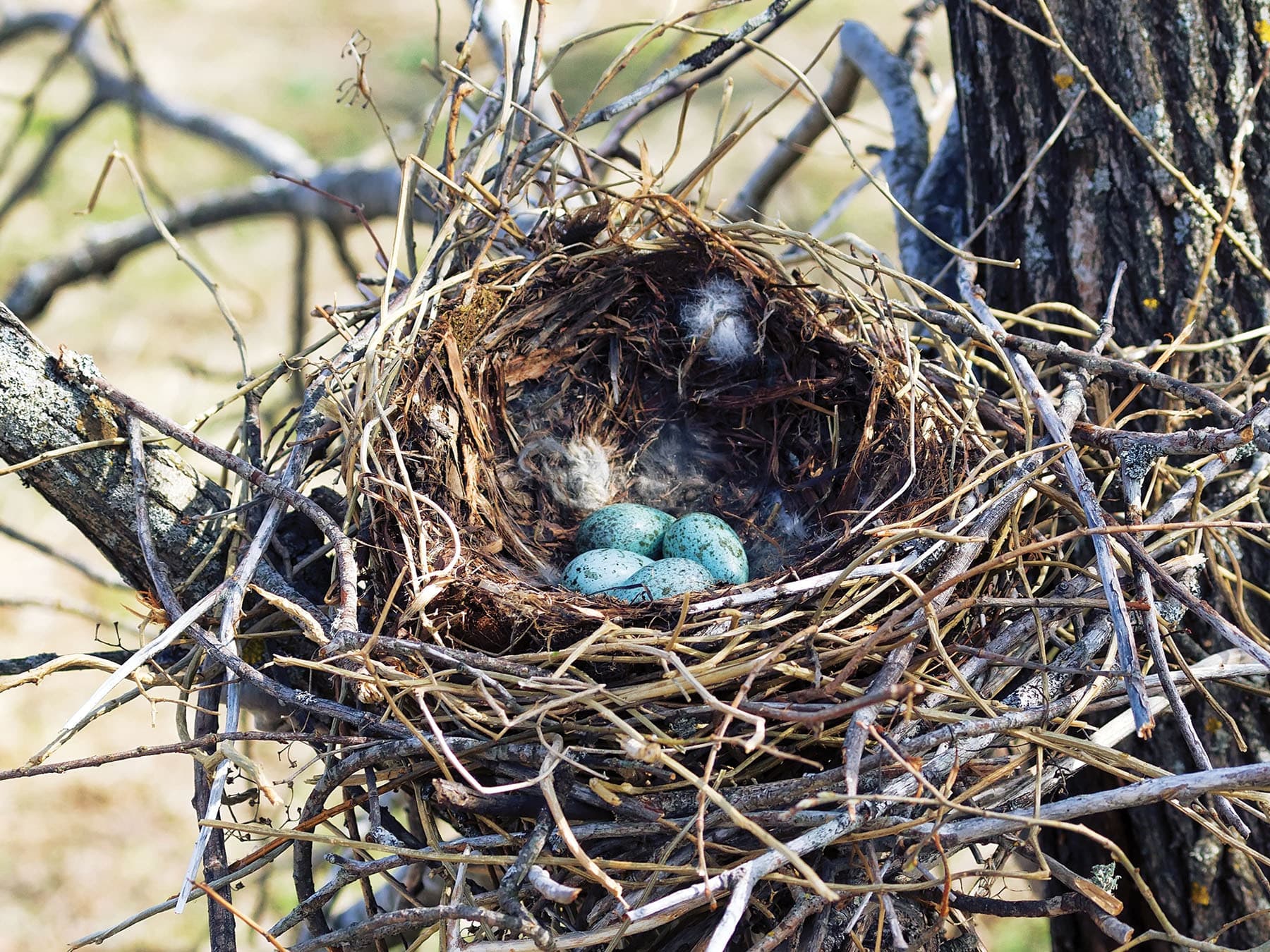
Hooded crows, like carrion crows, build bulky stick nests mostly in the upper branches of mature trees, but in the absence of suitable trees, they may get a bit more inventive, using electricity pylons or rocky ledges and clifftops.
Nests are usually at least 20 m (66 ft) from other birds and are formed from sticks and twigs, which are collected by the male and crafted into a nest structure by the female.
Construction usually takes between 7 and 8 days. Occasionally an existing nest may be repaired and reused. Moss, mud, animal fur and bones, and soft grasses are added as a rough lining, and hooded crows in coastal locations may incorporate seaweed into their nest structures.
What do Hooded Crow eggs look like?
A typical clutch contains 4 to 6 pale blue eggs, streaked heavily with dark brown mottled markings. Eggs are relatively large, measuring 4.3 cm × 3.0 cm (1.75 in by 1 in) and weighing 19.1 g (0.7 oz).
Incubation lasts for between 17 and 20 days, by the female alone, and in a typical breeding season pairs will raise one brood.
Do Hooded Crows mate for life?
When hooded crows pair up, it’s usually for life - with the pair bond lasting until one mate dies. With a lifespan that regularly surpasses 15 years, these bonds certainly class as long-term.
Behaviour
Are Hooded Crows aggressive?
Although pairs of hooded crows are generally solitary during the breeding season, they are more sociable than carrion crows and more tolerant of the company of other birds of the same species nearby.
Once breeding finishes, night-time roosts tend to be communal, and may be loosely formed of dozens of birds.
Where do Hooded Crows sleep at night?
Preferred night-time roosts of hooded crows are located in the upper branches of tall trees, and at dusk large groups of birds may gather together to form a communal overnight roost.
Lifespan and predators
How long do Hooded Crows live?
The lifespan of a hooded crow is unknown, but is estimated to be around 4 years, with the oldest known individual to have reached 16.8 years. Breeding takes place for the first time in either the second or third year.
What are the predators of Hooded Crows?
A species with few natural predators, hooded crows are preyed on by very few other birds in the wild. These include golden eagles, Eurasian eagle owls, and northern goshawks. Occasionally buzzards will also prey on hooded crows.
Are Hooded Crows protected?
Hooded crows are protected under the Wildlife and Countryside Act, 1981, meaning that they cannot knowingly be killed, injured or caught and taken into captivity.
Are Hooded Crows endangered?
In the UK, hooded crows are classified as a Green species on the Birds of Conservation Concern list. Their population is currently stable, with losses in Scotland balanced out by increases in numbers in Northern Ireland. The British Isles are home to an estimated 285,000 pairs.
Conservation
While the Hooded Crow is listed as Least Concern by the IUCN, local populations may face threats from habitat loss and persecution. In some areas, they are considered agricultural pests, leading to control measures. Conservation efforts focus on maintaining suitable habitats and educating the public about their ecological role.
Similar birds
Often mistaken for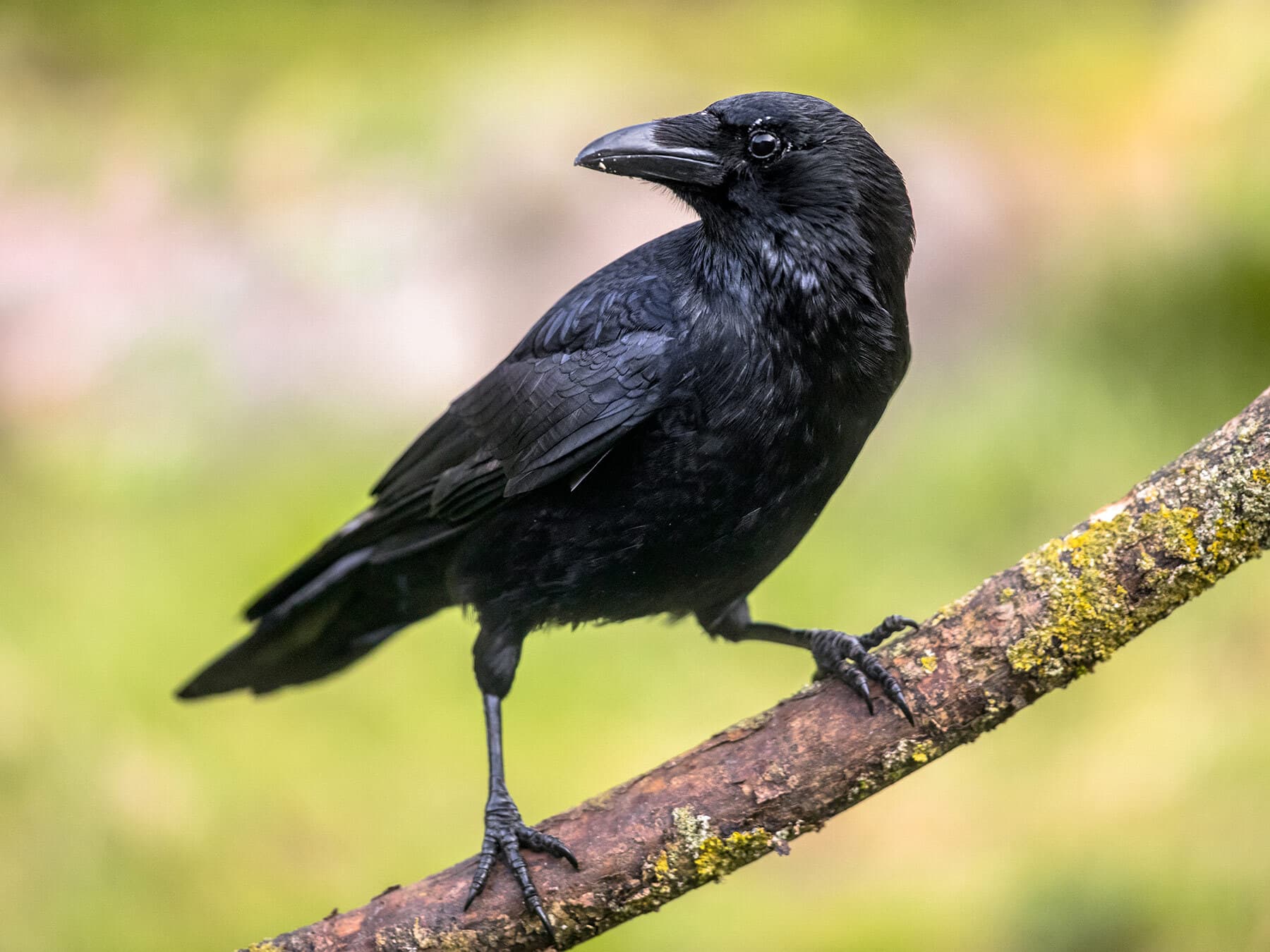
More photos
3 photos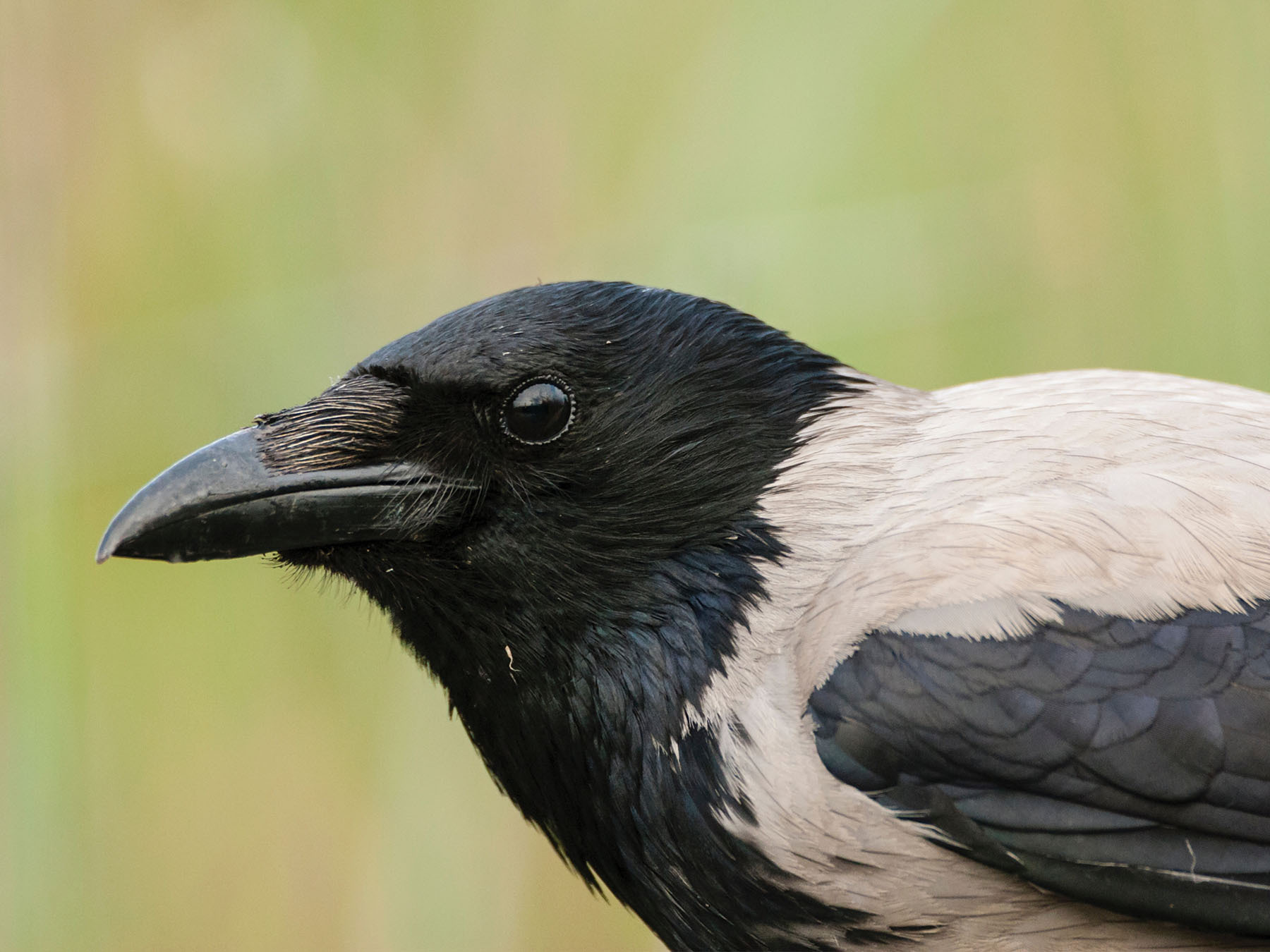
Hooded Crow guides
6 guidesQuick facts
- Length
- 44–51 cm
- Wingspan
- 84–100 cm
- Weight
- 430–650 g
- Lifespan
- 4–16 years · oldest recorded 10 years
- Family
- Crows & Jays
- Migration
- Partial migrant
- Global status (IUCN)
- Least Concern
- World population
- Unknown
- Population trend
- Stable
- Also called
- Scotch Crow, Hoodie Crow, Hoodie Bird
- Scientific name
- Corvus cornix
Questions
2Can you befriend a Hooded Crow?
The Internet is full of anecdotes of “friendships” being established between hooded crows and humans, and as corvids in general have a reputation as being highly intelligent, and having the ability to recognize human faces, it’s no surprise that with a bit of preparation, a crow may be trained to gradually feel more comfortable around an individual human.
By offering food in the same spot at the same time of day on a regular basis, and keeping calm and a fair distance away, after a while, you may begin to gain a hooded crow’s trust. Hooded crows have long memories, so consistency, patience and a calm environment are key.
How smart are Hooded Crows?
Long-since ranked as one of nature’s most intelligent bird species, hooded crows are known to be able to recognize faces, use tools to access food and even design and construct “tools” to solve problems.
They have also been observed to demonstrate awareness of their own body size, using this knowledge to their advantage to feed safely.
Sources
1- 1BTO longevity records: maximum age from a ringed bird, 10 years, 5 days (set in 2017), BirdFacts: Hooded Crow (2017) Source (opens in a new tab)

Checked by
Nathan Cope, founder and editor
Nathan founded Birdfact and leads its writers and contributors in the UK, the US and Canada. He has watched and studied birds for more than ten years, and checks every article and species guide before it’s published.