


Carrion Crow
Eurasian Crow · Corvus corone
By the Birdfact teamChecked by Nathan Cope
See it in 3D
3D model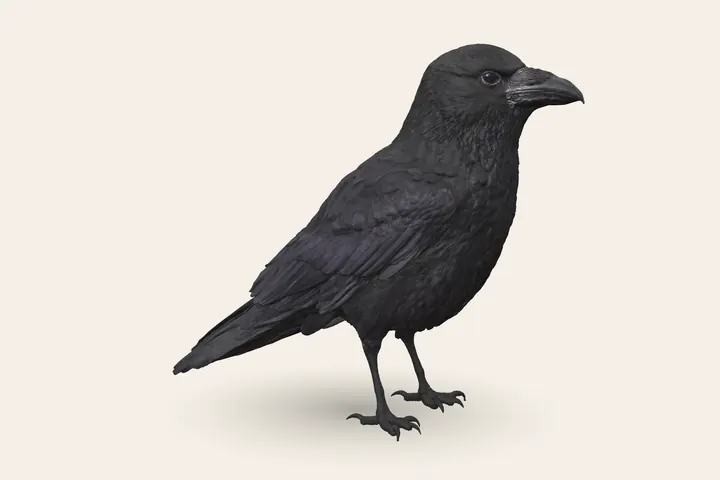 3D model
A Carrion Crow is 45–47 cm (17.5–18.5 in) long, bill to tail.
3D model · Adult · Length 45–47 cm (17.5–18.5 in) · How we make our birds · Report a problem
© 2026 NC Digital Limited (Birdfact). All rights reserved. This 3D model may be viewed on this page and shared by link only. Downloading, extracting, copying or reusing it, or using it to train machine-learning models, is not permitted without our written permission. Using our models
On this page16 sections
How to recognise it
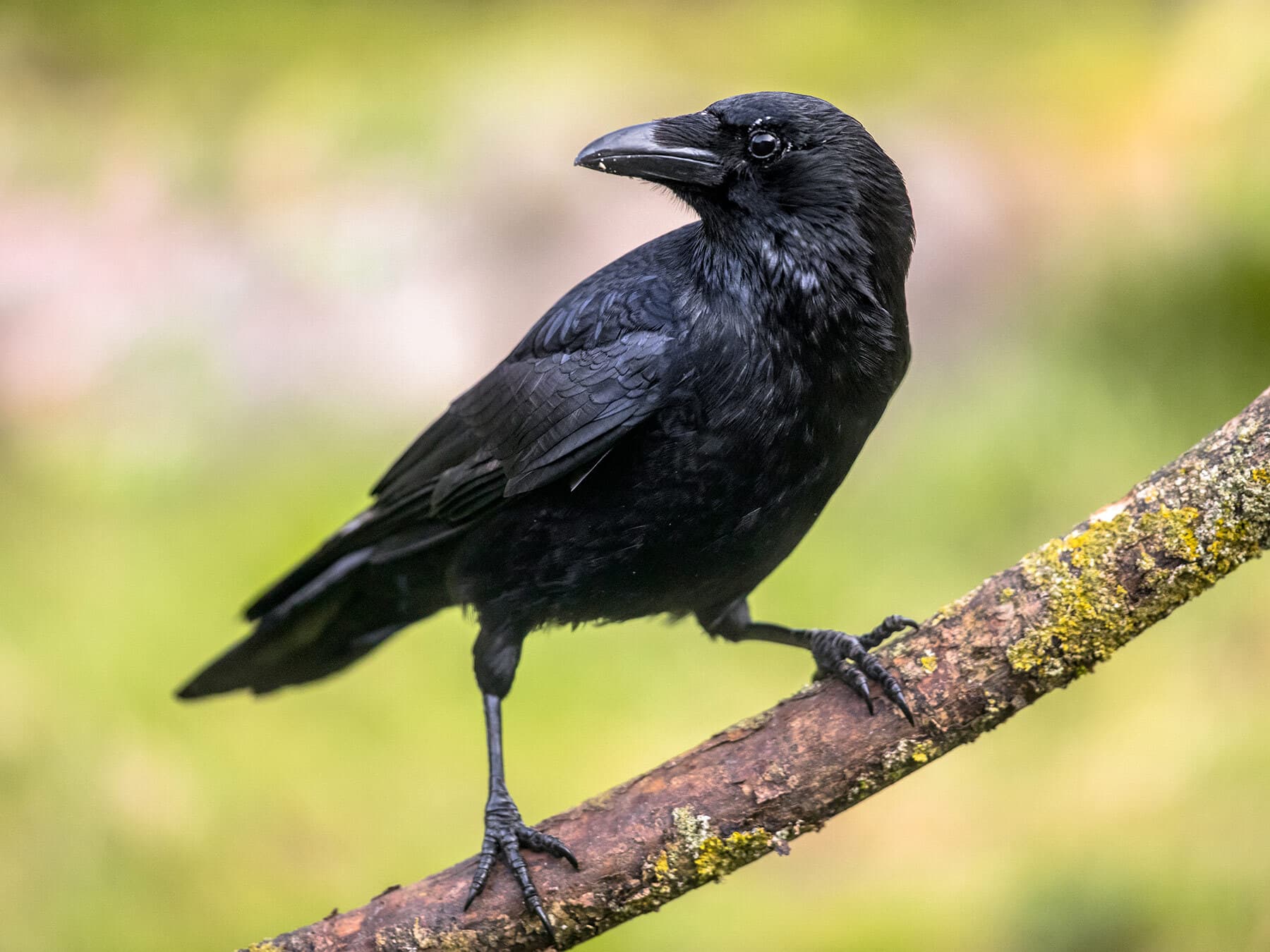
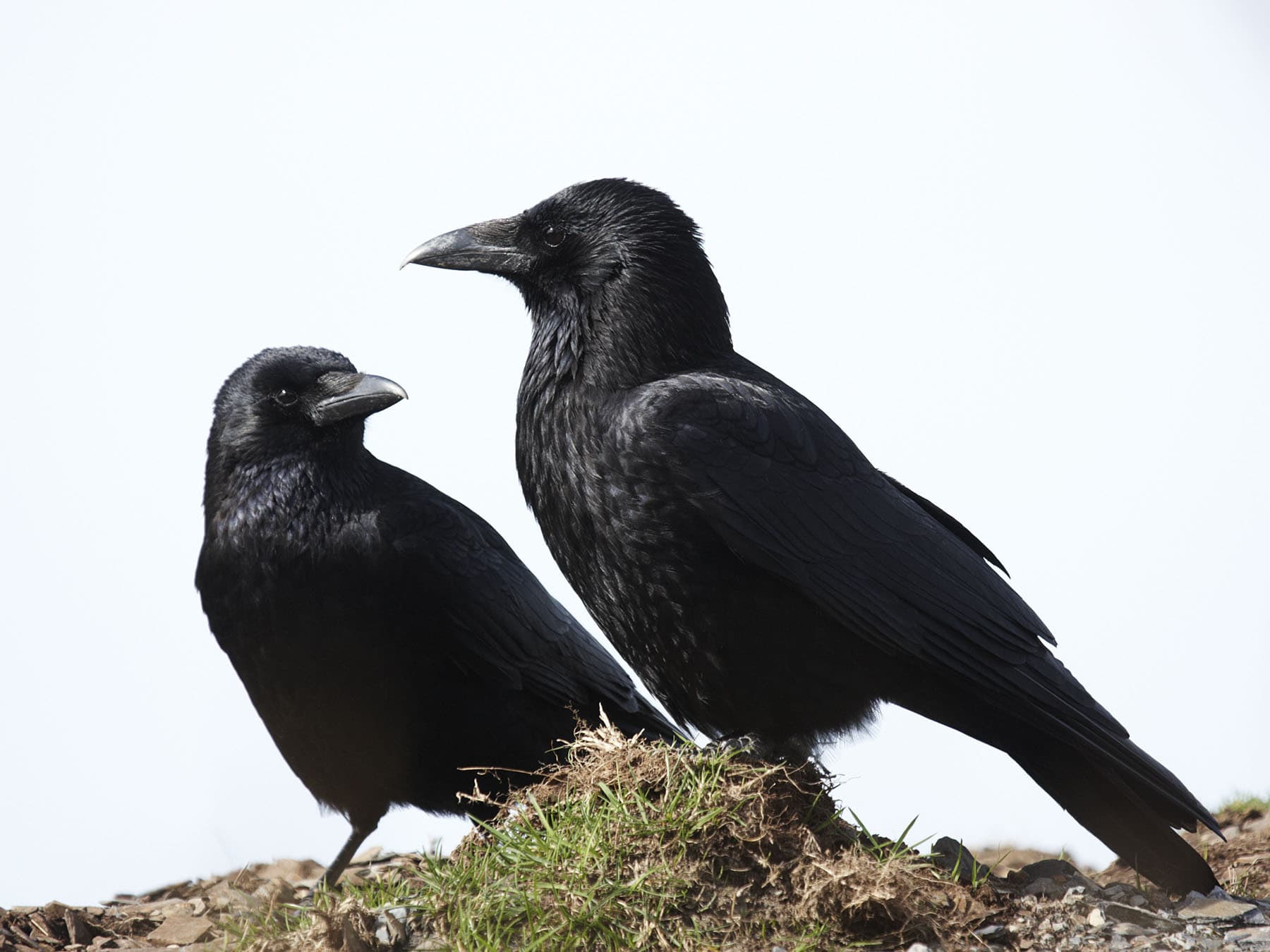
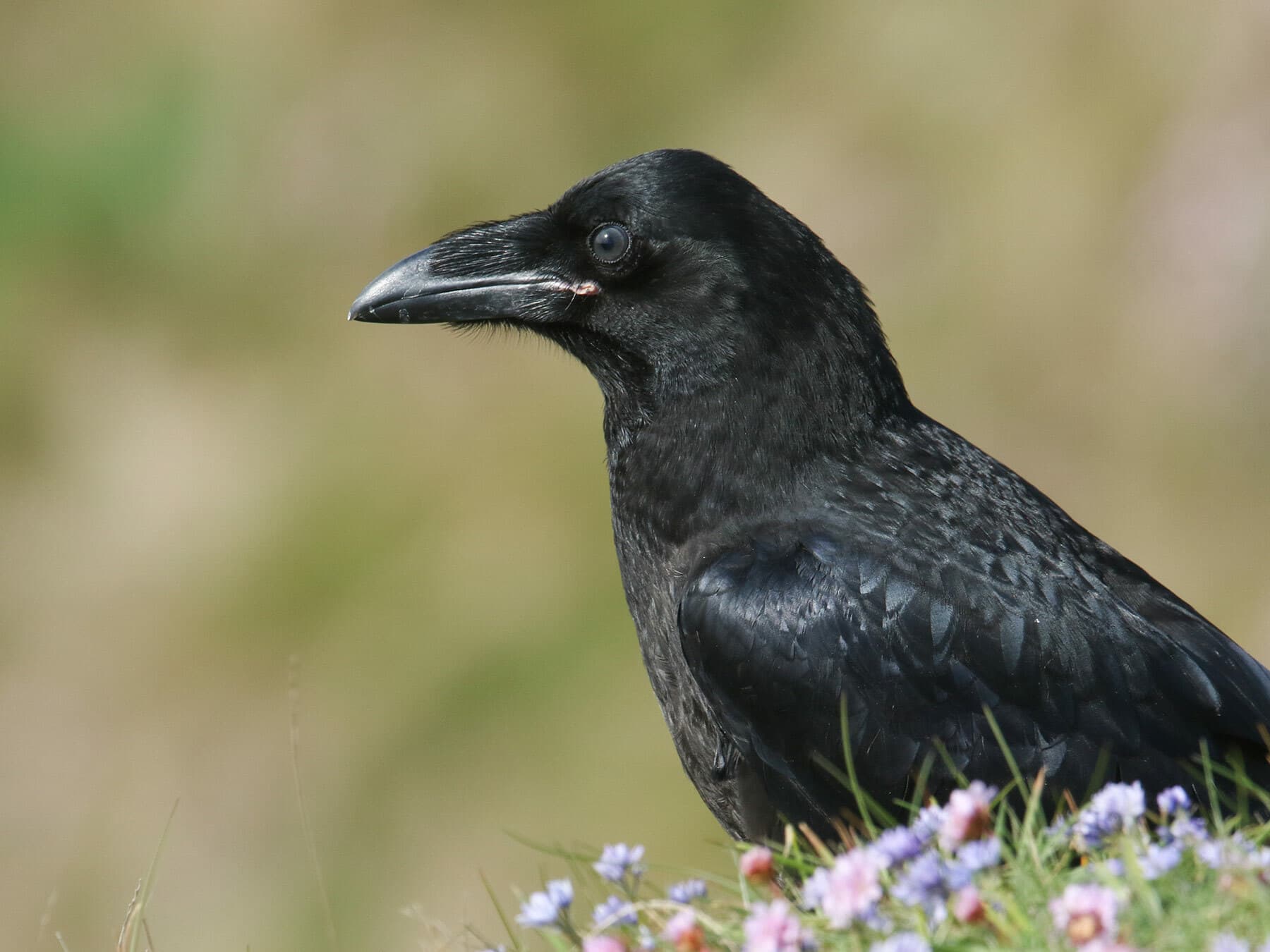
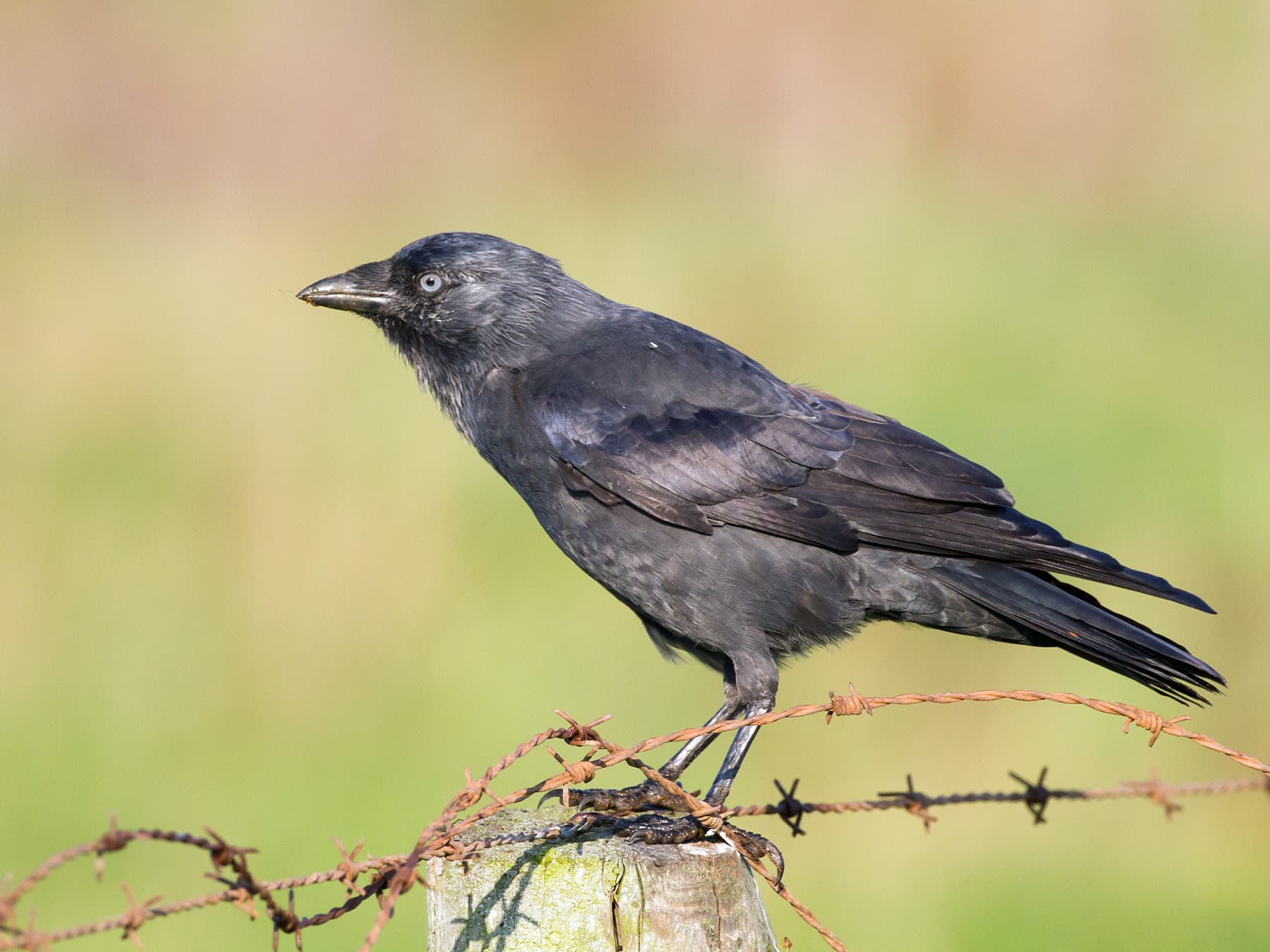
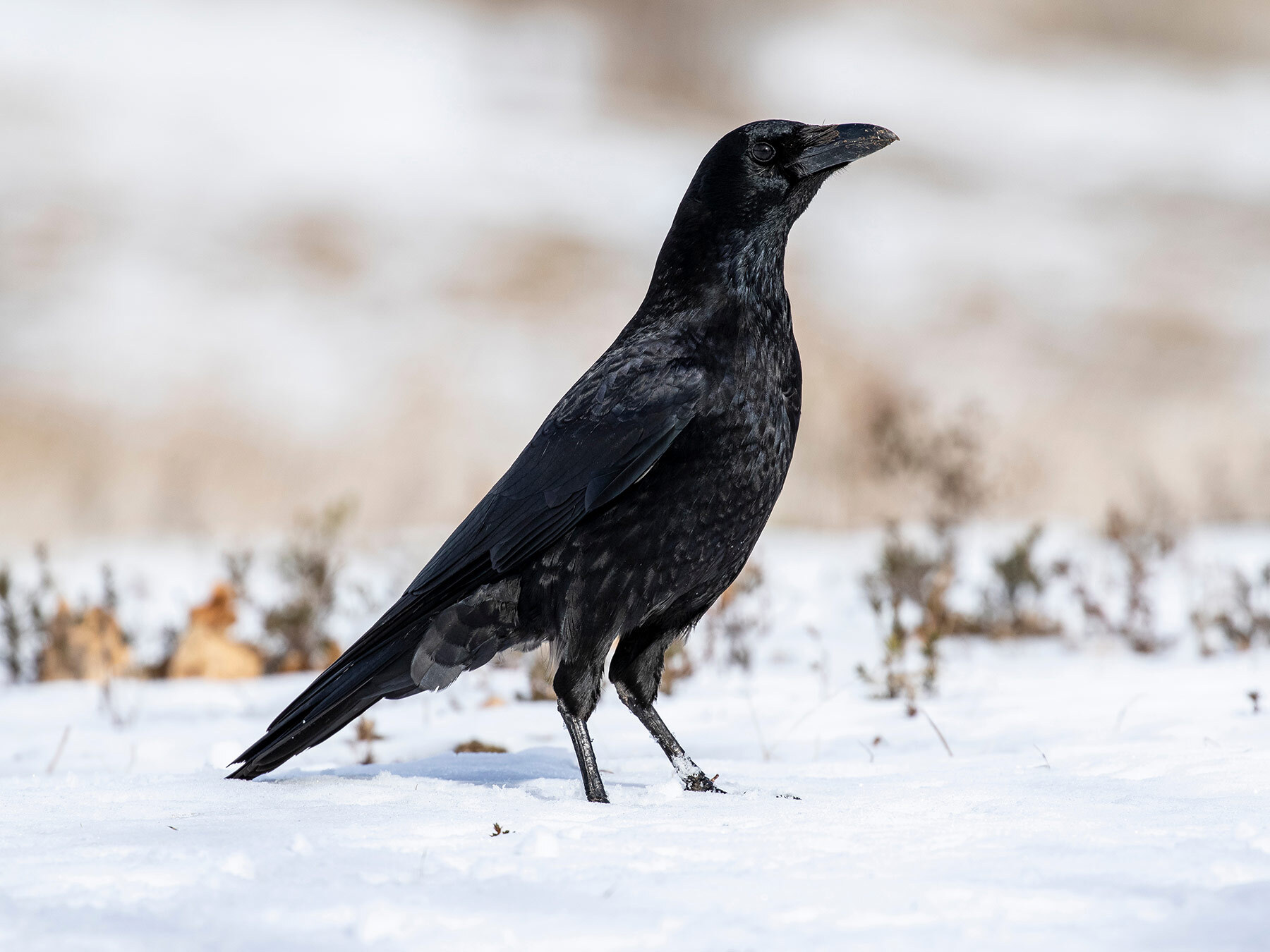
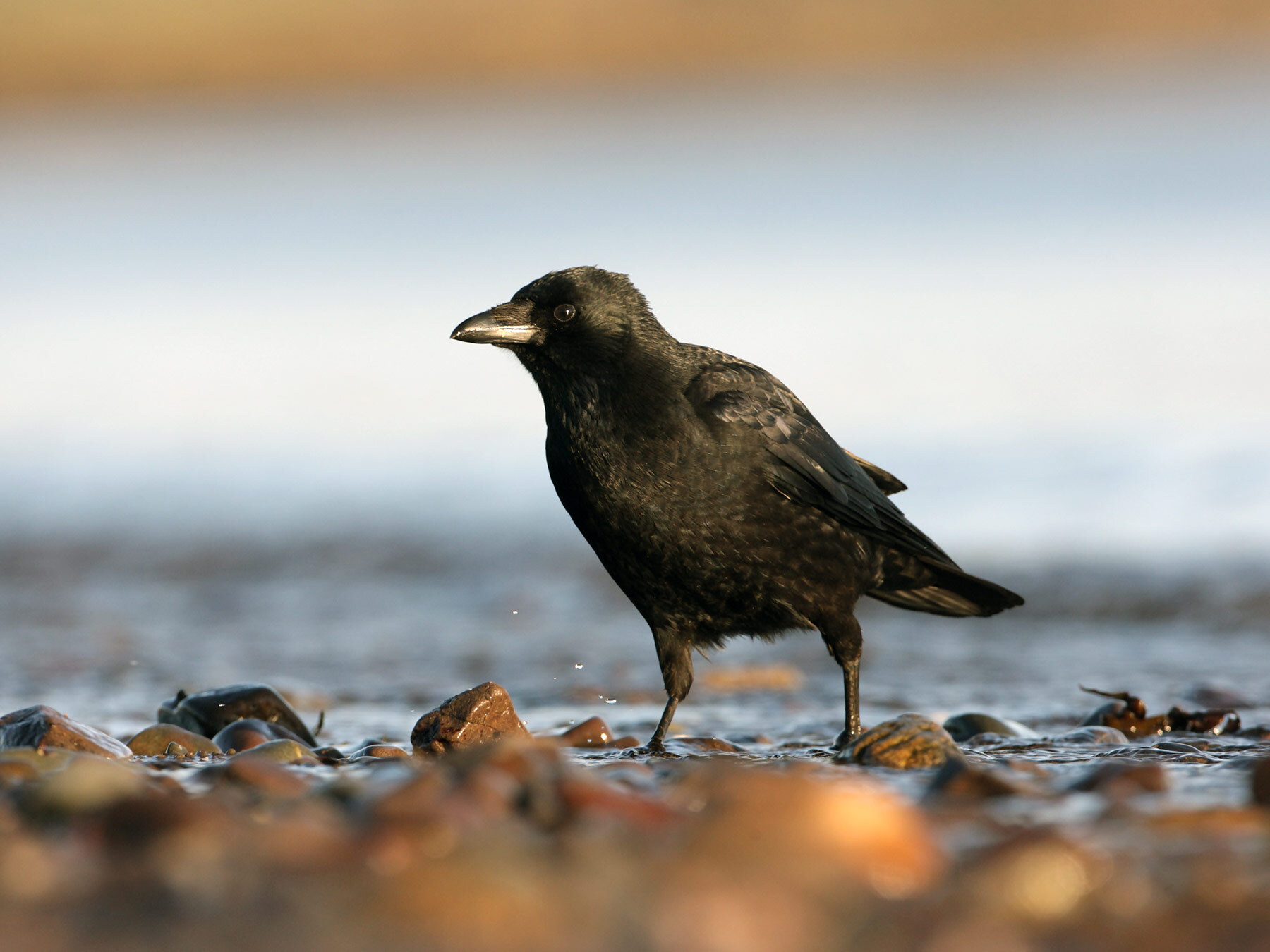
A big, heavy crow, 45 to 47 cm long and 370 to 650 g, black all over: plumage, bill, legs and feet.1 The bill is stout and blunt, with feathers covering its base, and the crown is rather flat. In good light the black has a gloss, greenish on the head and wings and more purple on the back, and a bird in worn plumage looks dull, unglossed black.2
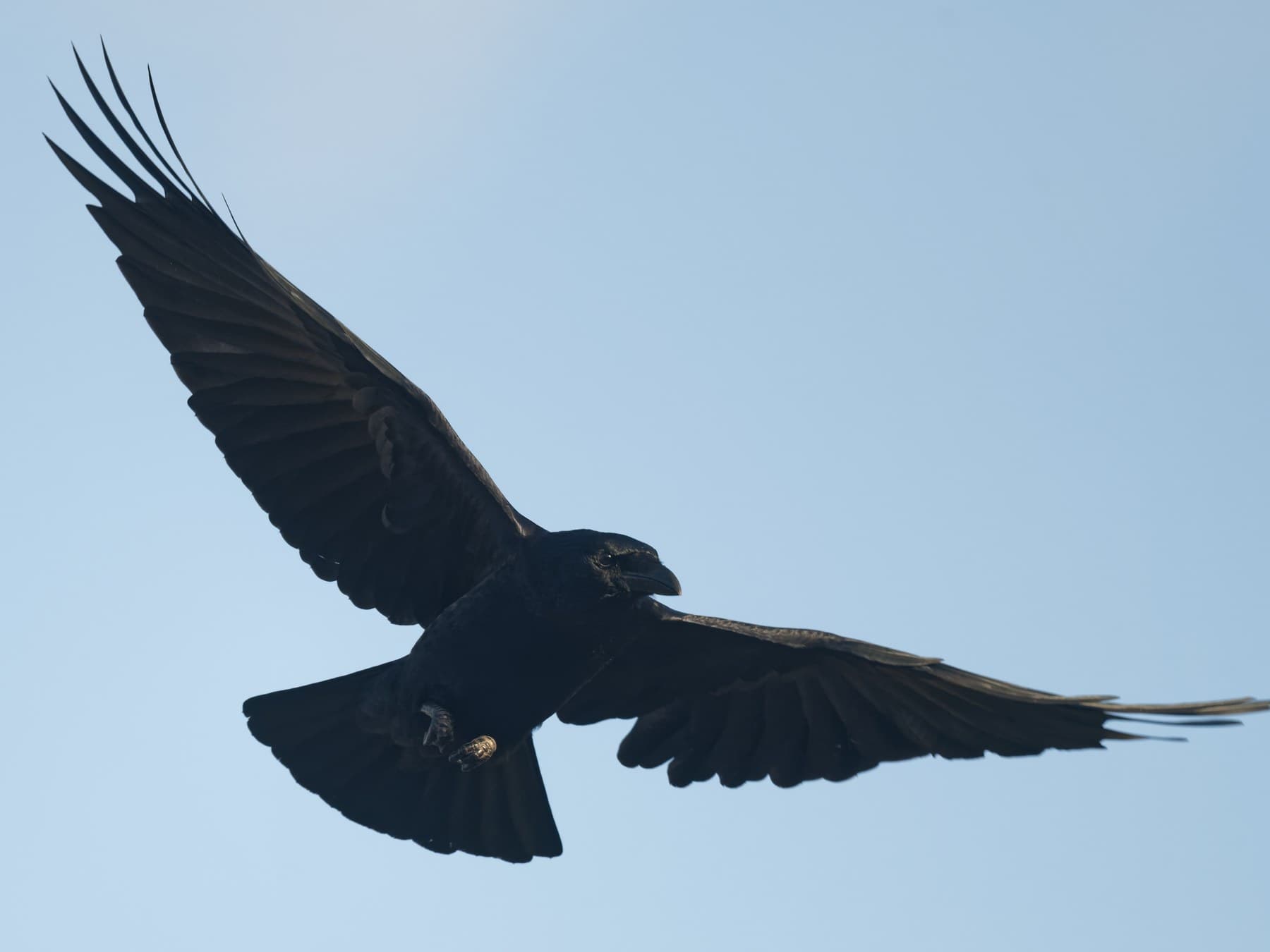
Adults weighed by BTO ringers average 509 g.3 In flight a crow is level and steady, with slow wingbeats, often low over fields and gardens; it has broad wings and a slightly rounded tail.4
Male, female and young
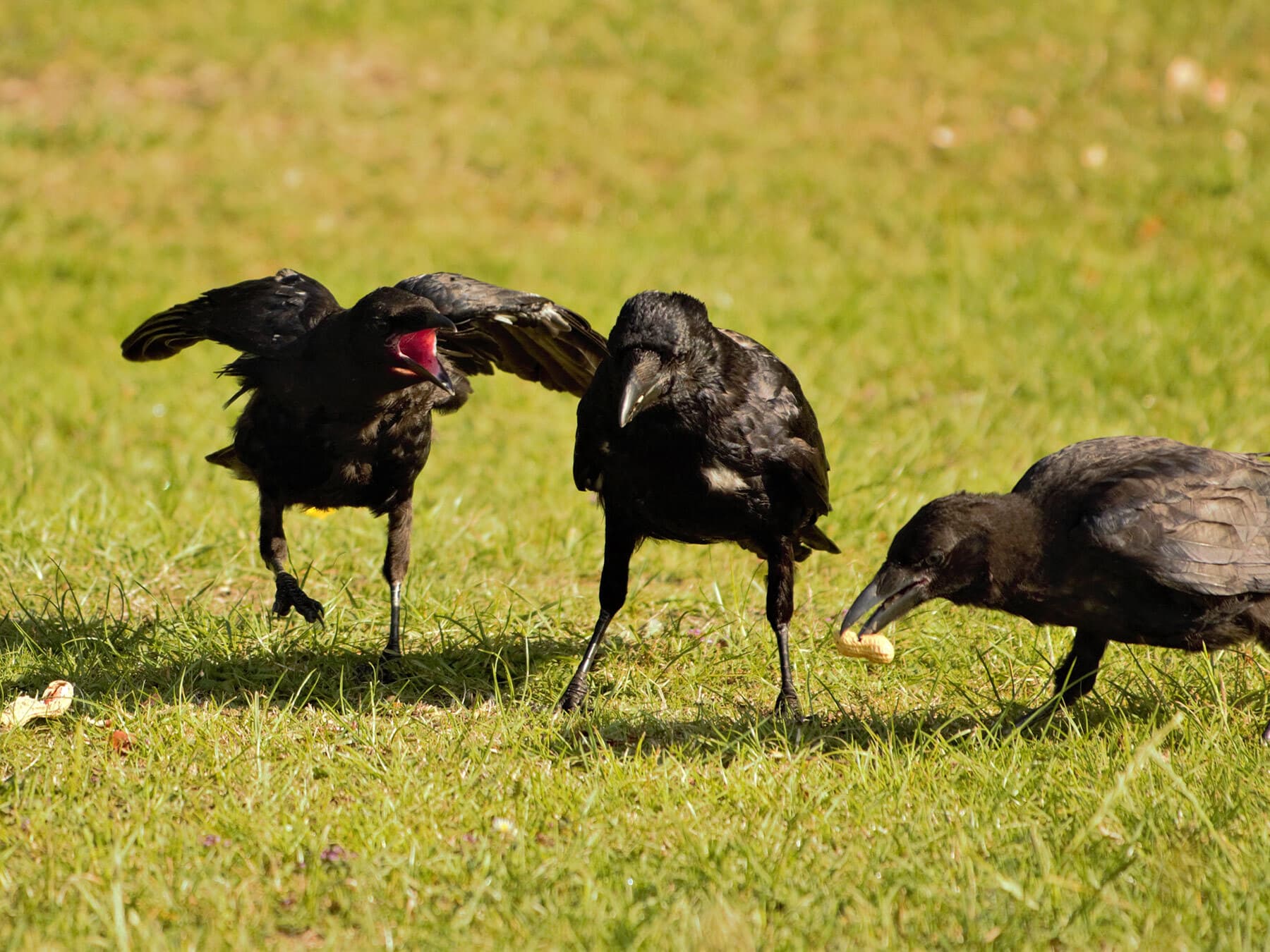
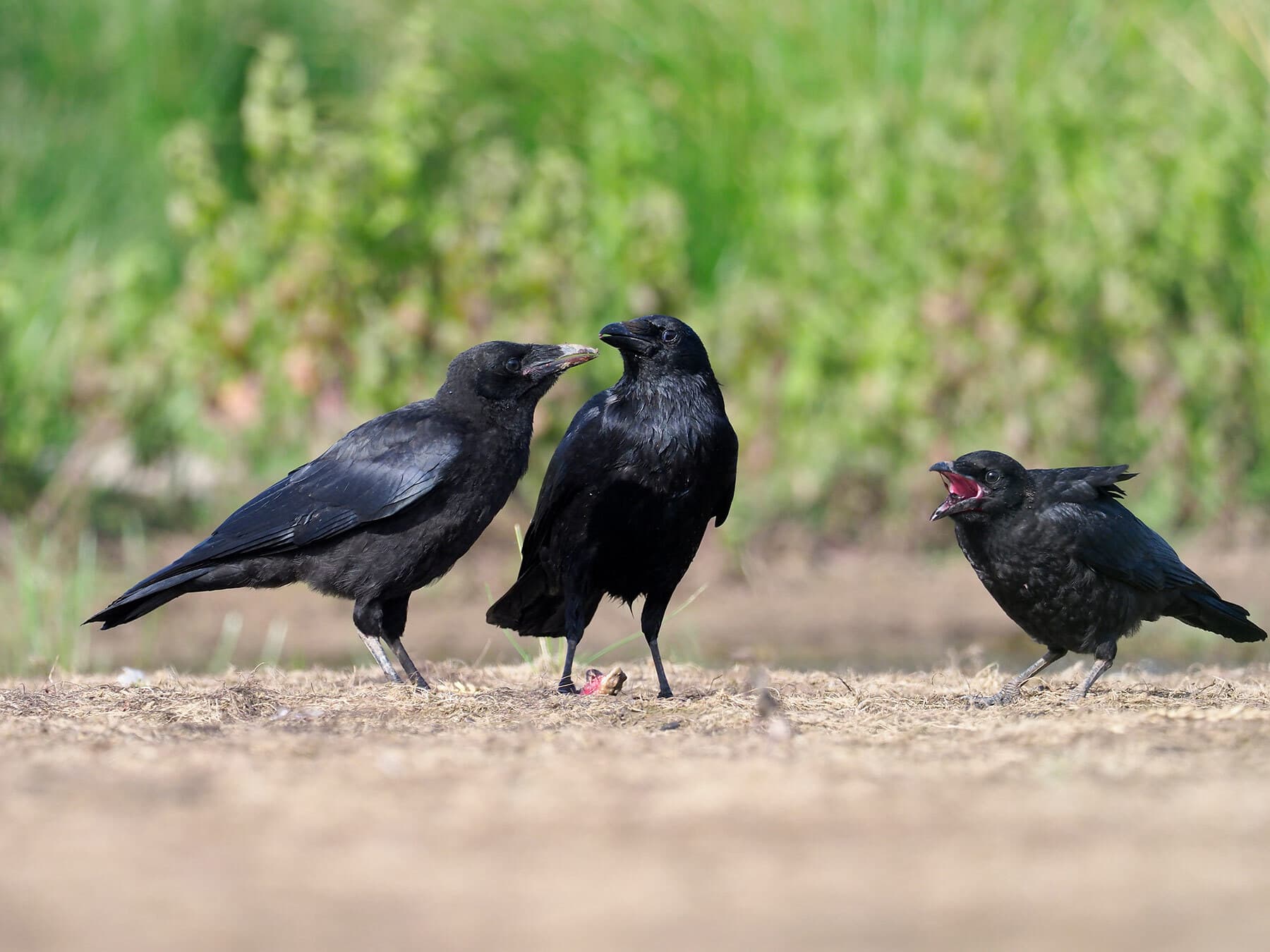
Males and females look alike, and young birds are much like them. Young crows in their first months are duller, sooty black, with looser feathers, a greyer eye and, when they open their bills, a pinkish-red mouth (an adult's is grey inside). Some first-year birds show pale patches on the wings.
Identification: similar birds
Four black birds are easily confused: the Carrion Crow, Rook, Raven and Jackdaw.5
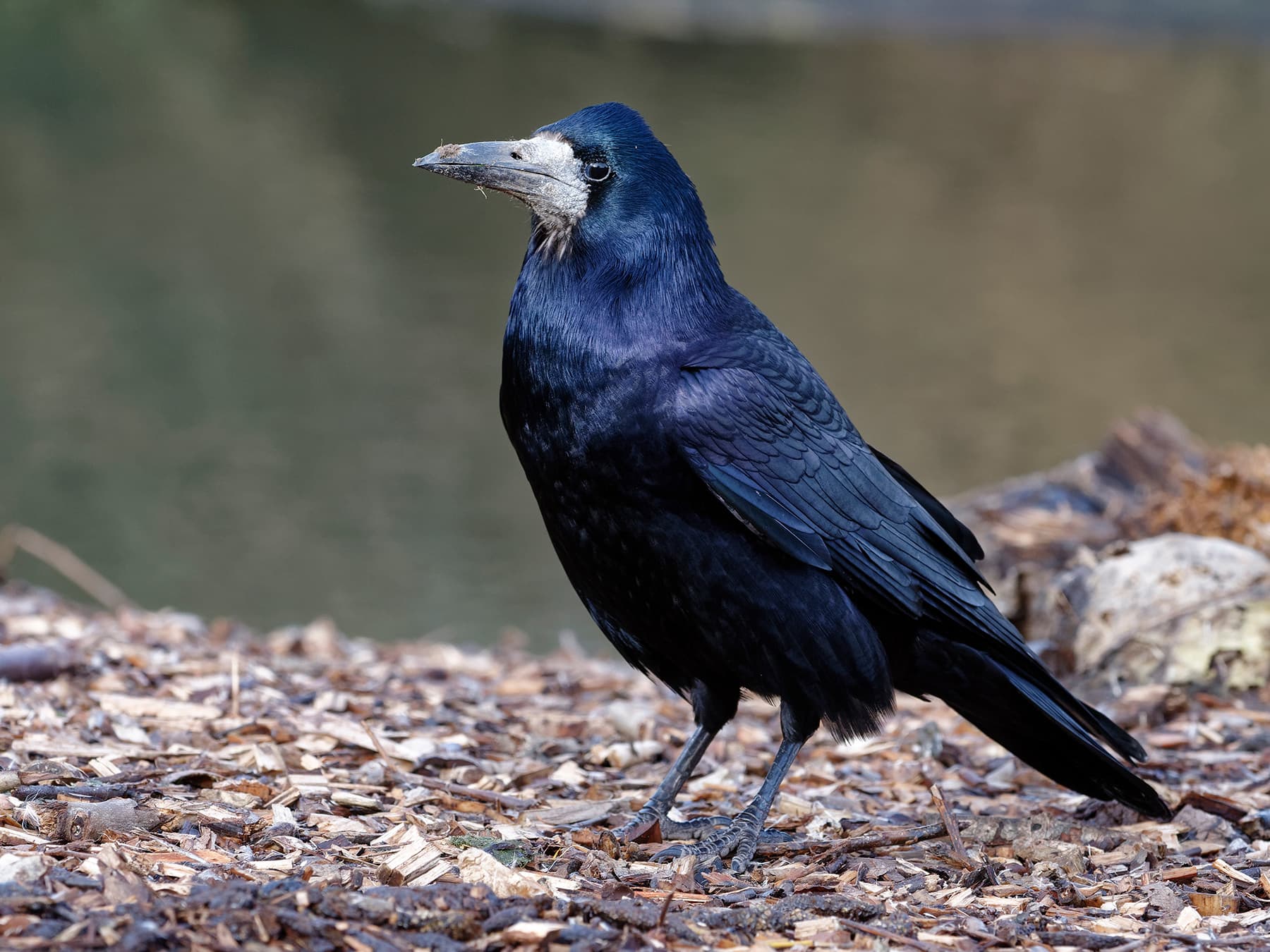
An adult Rook has a bare, greyish-white face at the base of a thinner, pointier bill, a peaked head and shaggy, feathered thighs, and it is usually seen in company.6 A young Rook's bill is all black, so it looks much more like a crow: check the bill shape and the peaked head. In flight a crow's wings look broader and less fingered than a Rook's. A Rook's call is softer and huskier than a crow's ringing caw.
A Raven is far bigger, 60 to 68 cm, with a thick, powerful bill, a shaggy throat, a diamond- or wedge-shaped tail in flight and a deep "cronk". See Raven or crow? A Jackdaw is much smaller, 34 cm, with a grey nape, pale eyes and a short "chack".
Identification: Hooded Crows and hybrids
The Hooded Crow is the same size and shape, but grey on the back and underparts. It is the commoner crow in Ireland and the Isle of Man, and replaces the Carrion Crow in most of north and west Scotland.7 Where the two overlap, in parts of Scotland, Northern Ireland and the Isle of Man, they interbreed, and the hybrids show a mix of grey and black.
Whether they are one species or two is unsettled. British ornithologists treated the Hooded Crow as a separate species from 2002, but the global checklist AviList, which the BTO adopted in January 2026, counts both as one species and says more research is needed.8 Their genes mix far beyond the hybrid zone, and almost all the fixed differences lie in one small stretch of DNA linking genes for feather colour and for vision, which may help each kind choose a mate of its own colour.9 One explanation of the two colour forms goes back to the last Ice Age, when the all-black crows sat out the cold in Iberia and the grey ones further east; where they met again, they began to interbreed.10
Its size
Adults- Length
- 45–47 cm
- Wingspan
- 93–104 cm
- Weight
- 370–650 g
Its song and calls
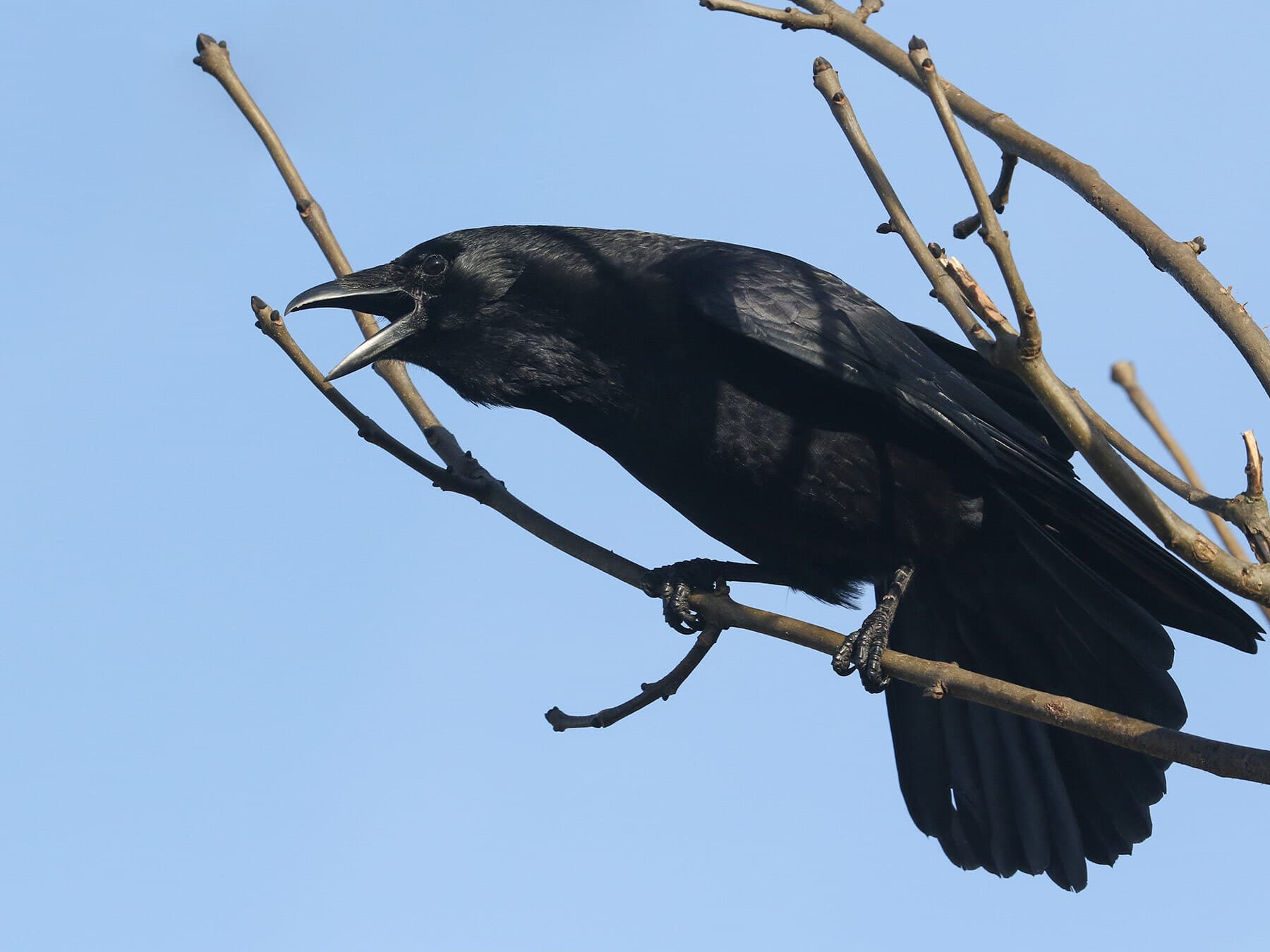
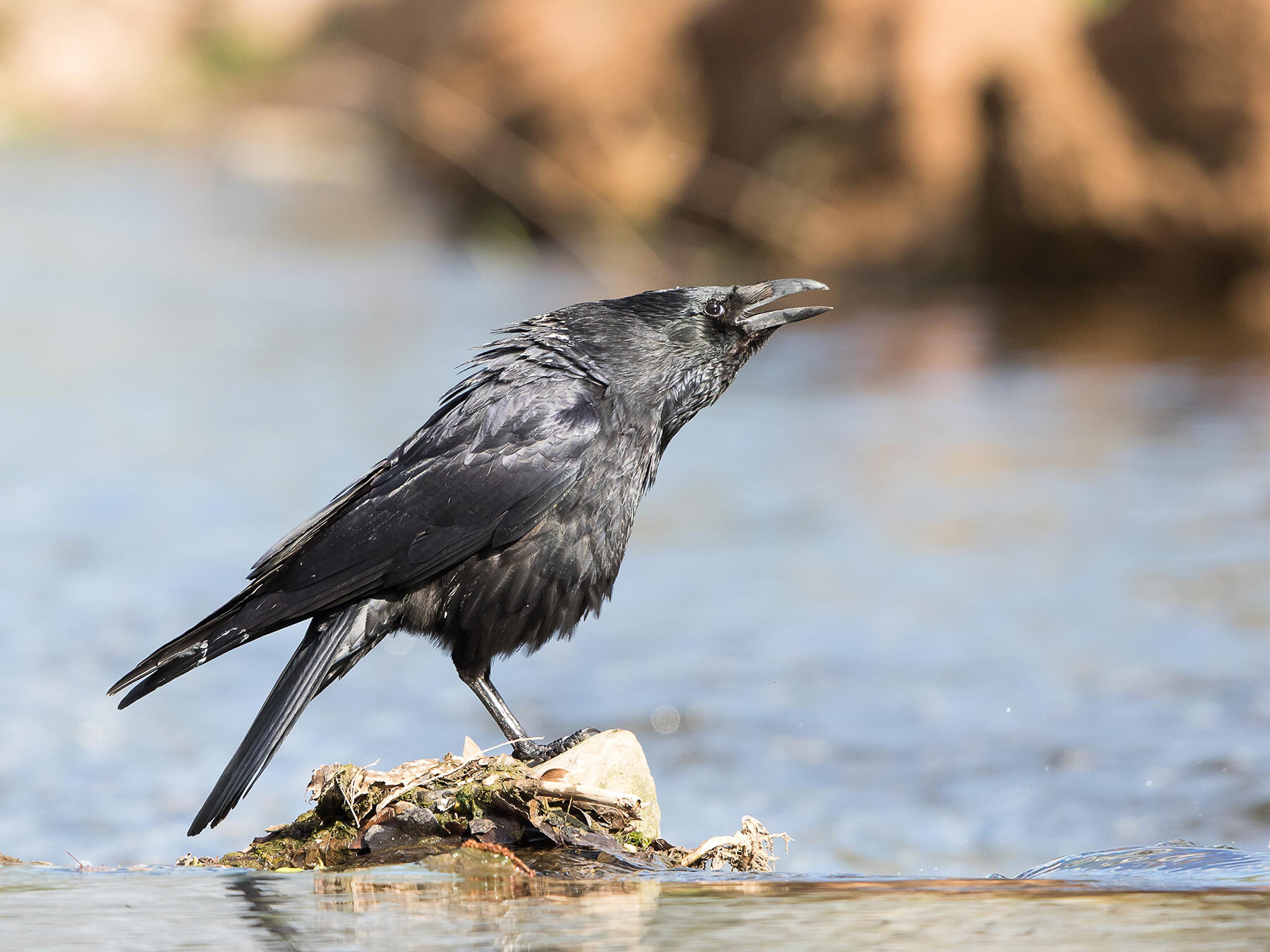
The familiar call is a harsh, flat "kraa" or "caa", usually given three to six times on one pitch. Crows sometimes give a deeper, almost Raven-like "konk".
They have a song too, though few people notice it: a bubbling mix of call notes with some mimicry.
Hear them all, with recordings and spectrograms: crow sounds and what they mean.
- Calls0:00 / 0:32
Recorded in Île-de-France, France · June 2019
When and where to see it
OctoberHere all year
Most recorded in October
- 1. Dundee8.0%
- 2. South Ayrshire7.0%
- 3. Renfrewshire6.3%
- 4. Glasgow5.8%
- 5. North Ayrshire5.5%
Each dot is a county, state or province: the bigger and darker, the larger the bird’s share of that place’s bird records that month. Grey dots: no regular records. The ringed point is the centre of the bird’s records this month; the arrow shows how it moved since last month, and the dashed loop its path through the year. “Arrivals” colours places where it becomes regular this month (orange) or is in its last regular month (grey). GBIF eBird Observation Dataset, 2019–2024. Map data: Natural Earth, US Census Bureau; place centres © OpenStreetMap contributors.
In your area
See when the Carrion Crow is recorded in your county, state or province.
How often the Carrion Crow turns up in the UK and Ireland through the year, from birdwatchers' records.
United Kingdom
Resident · all year · most records in December
Ireland
Winter visitor · all year · most records in March
Show as a table
| Month | United Kingdom | Ireland |
|---|---|---|
| January | 3.2% (regular) | 0.030% (regular) |
| February | 3.2% (regular) | 0.018% (regular) |
| March | 3.1% (regular) | 0.034% (regular) |
| April | 2.8% (regular) | 0.009% (regular) |
| May | 2.7% (regular) | 0.007% (regular) |
| June | 2.8% (regular) | 0.010% (regular) |
| July | 2.9% (regular) | 0.007% (regular) |
| August | 2.8% (regular) | 0.009% (regular) |
| September | 2.9% (regular) | 0.004% (regular) |
| October | 2.9% (regular) | 0.014% (regular) |
| November | 3.2% (regular) | 0.019% (regular) |
| December | 3.3% (regular) | 0.010% (regular) |
Recorded regularly in
Worldwide: recorded regularly in 43 countries
Countries where it was recorded in at least 3 of the 6 years 2019–2024. Linked countries have their own bird list.
Europe (31)
Asia (12)
- Afghanistan
- China
- Hong Kong SAR China
- India
- Japan
- Kazakhstan
- Kyrgyzstan
- Mongolia
- South Korea
- Taiwan
- Tajikistan
- Uzbekistan
Data: EOD – eBird Observation Dataset (Cornell Lab of Ornithology), accessed via GBIF.org, CC BY 4.0. Records from 2019–2024, aggregated and filtered by Birdfact. How these lists are made
All year, almost everywhere in England, Wales and most of Scotland, except the far north-west, where the Hooded Crow takes over. In Ireland they live only on the eastern fringes. On Breeding Bird Survey squares they are seen most often in towns, and are also common on pasture farmland, in villages and in broadleaved woods, and they also live on moorland and coasts, and along estuaries.
Beyond Britain they live across western Europe, from Spain and Portugal to Denmark, western Germany and northern Italy, and in eastern Asia from Siberia to Japan.
Spotting tips
Look for a lone crow or a pair feeding on a lawn or field, flying low and steady over the fields, or perched on a post or a treetop, and listen for the repeated "kraa". A crowd of black birds feeding together is more likely to be Rooks or Jackdaws.
Do they migrate?
Hardly. British Carrion Crows are largely sedentary: of 945 recoveries of ringed crows, none came from outside Britain and Ireland, and the longest recorded journeys are a few hundred kilometres.11 Some crows from inland continental Europe drift south and west in winter, and the eastern Asian population is partly migratory.
Ten Hooded Crows ringed in Norway, Sweden, Denmark and Germany between 1919 and 1951 have been found in Britain, from Suffolk to the Highlands, and none since.
What it eats
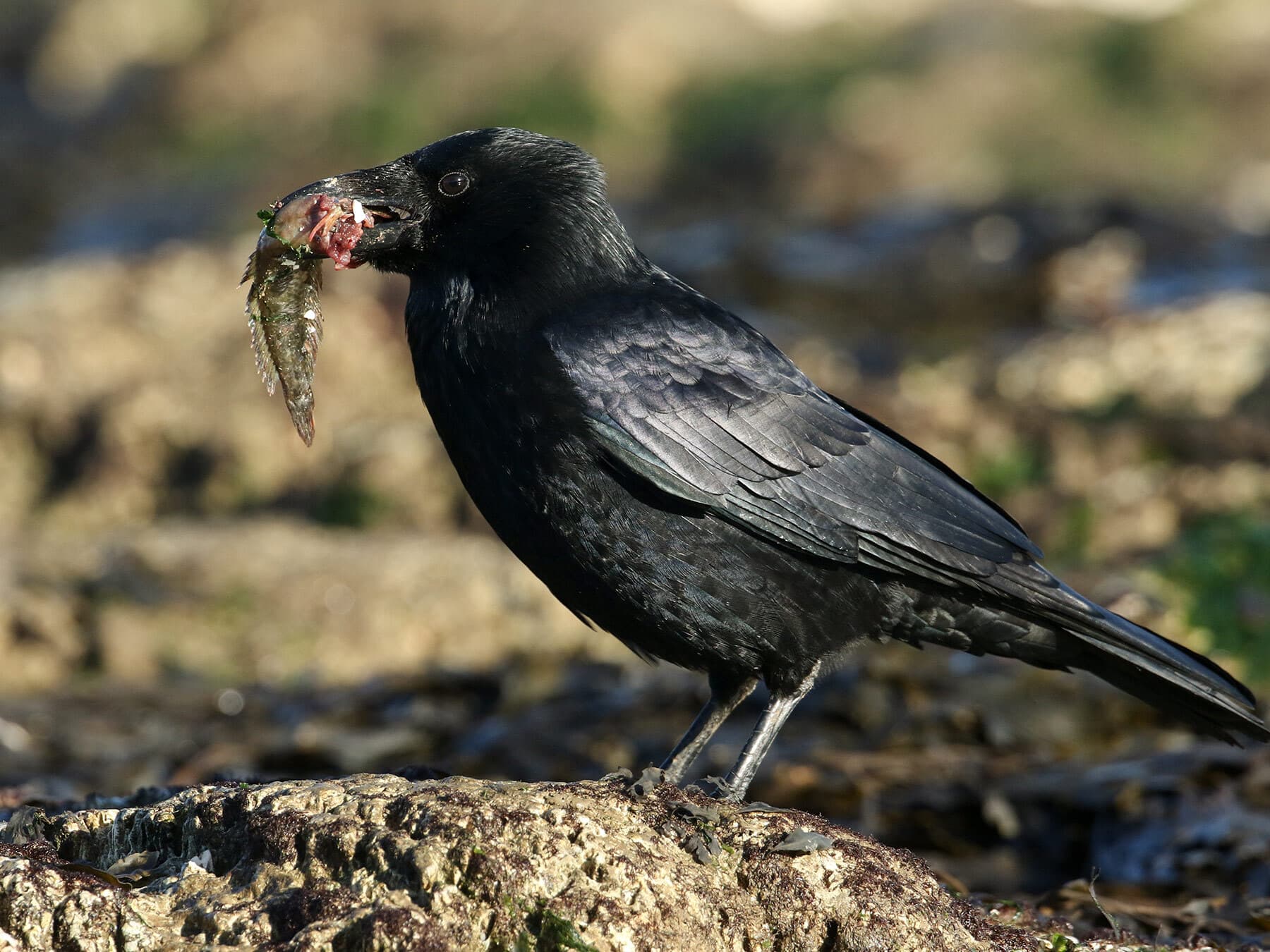
Almost anything. Carrion Crows are omnivores but mainly meat-eating scavengers: earthworms and other invertebrates, small mammals, frogs, shellfish, birds' eggs and nestlings, and carrion, the dead animals that give the crow its name, with a little grain, seeds and fruit, and scraps in towns.
They feed almost entirely on the ground. Pairs patrol roads early in the morning for roadkill, turn over dung, stones and seaweed for insects, and gather on freshly mown hay and stubble. On the shore they open shellfish by carrying them up and dropping them onto rocks, again if needed. They store surplus food to come back to later.
See what crows eat for more.
Feeding crows in the garden
Crows come to gardens for scraps, wary at first, then returning once they learn it is safe, sometimes making quick raids on a bird table. If you feed birds, the RSPB now advises against bird tables and other flat feeders, which spread disease most easily, and asks people to clean feeders weekly.12
Nesting and breeding
Carrion Crows nest early. In Britain the first clutch is laid, on average, on 7 April, and most between mid-March and the end of April. They raise one brood a year.3
The nest is big: a heap of sticks and twigs, often with bones, wire or heather worked in, set on a base of mud, with a deep cup lined thickly with wool, fur, grass and feathers. Most are high in the crown of a tall tree, but crows also nest on pylons, cliff ledges and old buildings, and even on the ground. Both birds build, the female doing most of the work, over about 20 days.
The clutch is usually 3 or 4 eggs. The female does almost all the incubating, for 18 to 20 days, and for the first nine or ten days the male brings her food; and the young leave the nest at about 29 days old. They depend on their parents for several weeks more, and some stay with them through their first winter. See crow nesting and baby crows.
Nesting with helpers
Most Carrion Crows breed as a pair, but in one long-studied population in northern Spain about three-quarters of territories were held by groups of up to nine crows, in which grown-up young helped their parents.13 Other members were immigrants, mostly males related to the breeder of the same sex, and some shared in the breeding.14 The helpers feed the chicks and defend the territory.
Behaviour
Breeding pairs hold a territory and defend their nest, mostly against other crows. Pairs are long-term and stay together all year, even in a flock. Crows without a territory roam in loose flocks. At a favourite feeding place, such as a rubbish tip or a tidal mudflat, 50 to 100 may gather, and up to 5,000 may roost together, in mixed flocks, in tall trees.
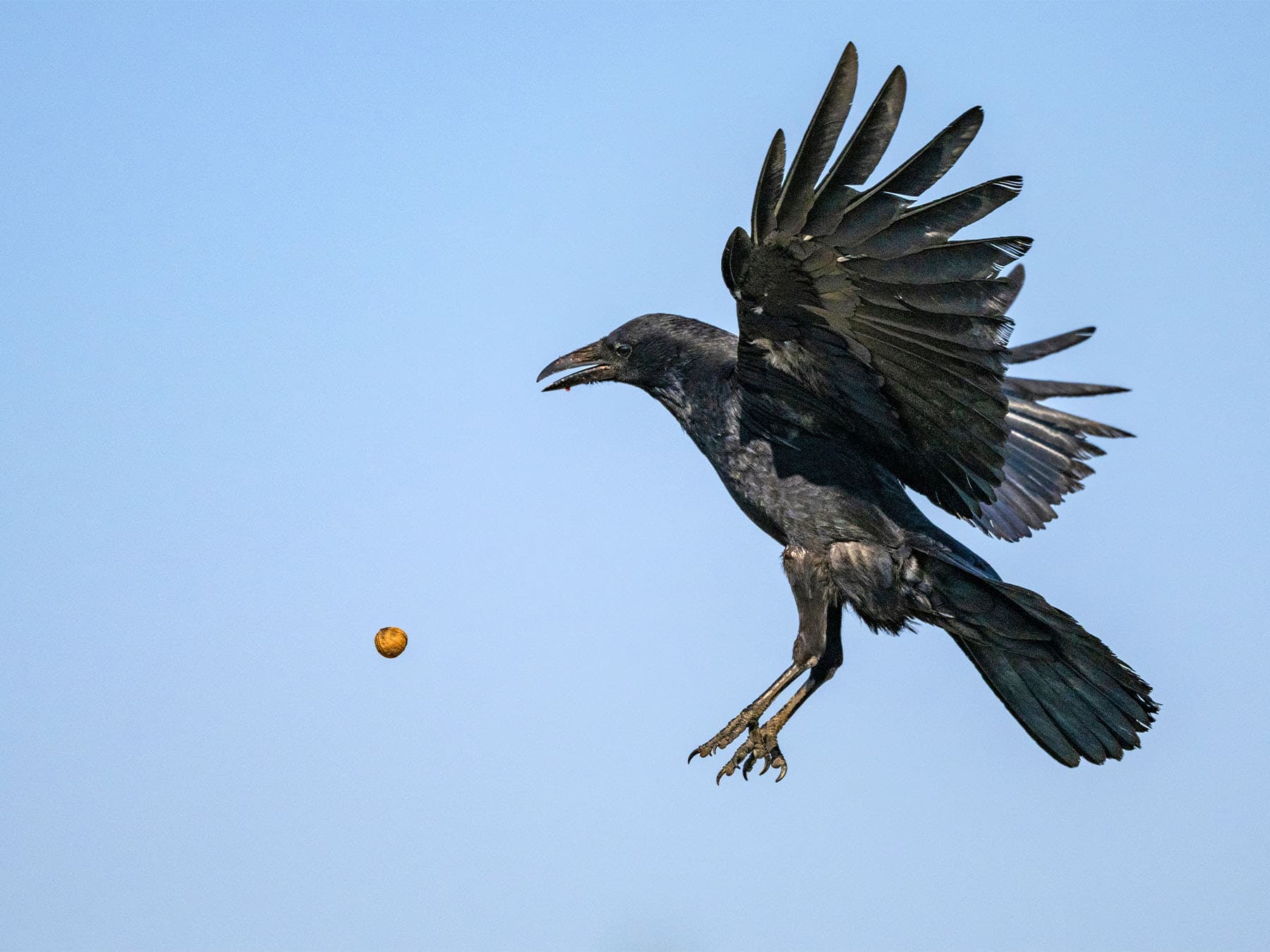
They are clever and curious. They remember how people and other animals have treated them, ignoring harmless ones and avoiding those that have been aggressive. In Japan, town crows famously drop walnuts on roads for cars to crack, then collect them when the traffic stops. Crows also seem to play: sliding down a sloping roof again and again, or hanging upside down from a washing line.
Lifespan and predators
A Carrion Crow that survives to breed typically lives about 4 years, first breeding at 2; about half of adults survive from one year to the next.3
Some live far longer. The oldest on record was ringed in its first year at Dirleton, East Lothian, in June 1996 and found dead at Gullane, 4 km away, in May 2017: 20 years 10 months 7 days later.15 That bird is also the oldest Carrion Crow on the European list.16 See how long crows live.
Conservation
The Carrion Crow is on the UK Green List and is of Least Concern worldwide. There are about 1.1 million territories in the UK (2016).3
UK numbers climbed for about three decades from the early 1970s and have changed little since the early 2000s. Breeding Bird Survey counts were up 15% between 1995 and 2024, with a rise in England but no clear change in Scotland or Wales, and down 4% between 2014 and 2024.17 Few studies have looked at why. Better breeding success has been important: nests have failed less often since 1968, and crows lay about 8 days earlier. More food and the spread of towns may have helped.
Crows were long persecuted as "vermin" by gamekeepers and farmers. Across much of Europe they have increased since gamekeeping declined after the 1920s, and faster from the 1950s, as suburban gardens and parks gave them safer homes. In Britain, though, the BTO finds little evidence that less gamekeeping explains the rise: the numbers of crows killed on shooting estates show no overall change since 1961.
Crows and other bird populations
Crows take eggs and young birds, and they are sometimes blamed for the decline of other species. The BTO's summary is that they may reduce songbird breeding locally, but an effect on whole populations is uncertain. For ground-nesting waders the studies differ: one found three of six wader species nested more successfully where crows and gulls were controlled, while another, on moorland, found predator control made no difference to wader trends.
Legal status
Like all wild birds, Carrion Crows, their eggs and their nests in use are protected by law in Great Britain18 and Northern Ireland.19 In England, Wales and Scotland, general licences allow authorised people to kill or take them for set purposes: in England to conserve wild birds of conservation concern or to prevent serious damage to livestock, their food or crops20; in Wales to protect livestock and, from February to August, to protect the eggs and chicks of listed species21; in Scotland to conserve wild birds or prevent serious damage.22 In England and Wales users must first make reasonable efforts with other lawful methods. The Carrion Crow is not named on any of Northern Ireland's three general licences for 2026.23
Similar birds
Often mistaken for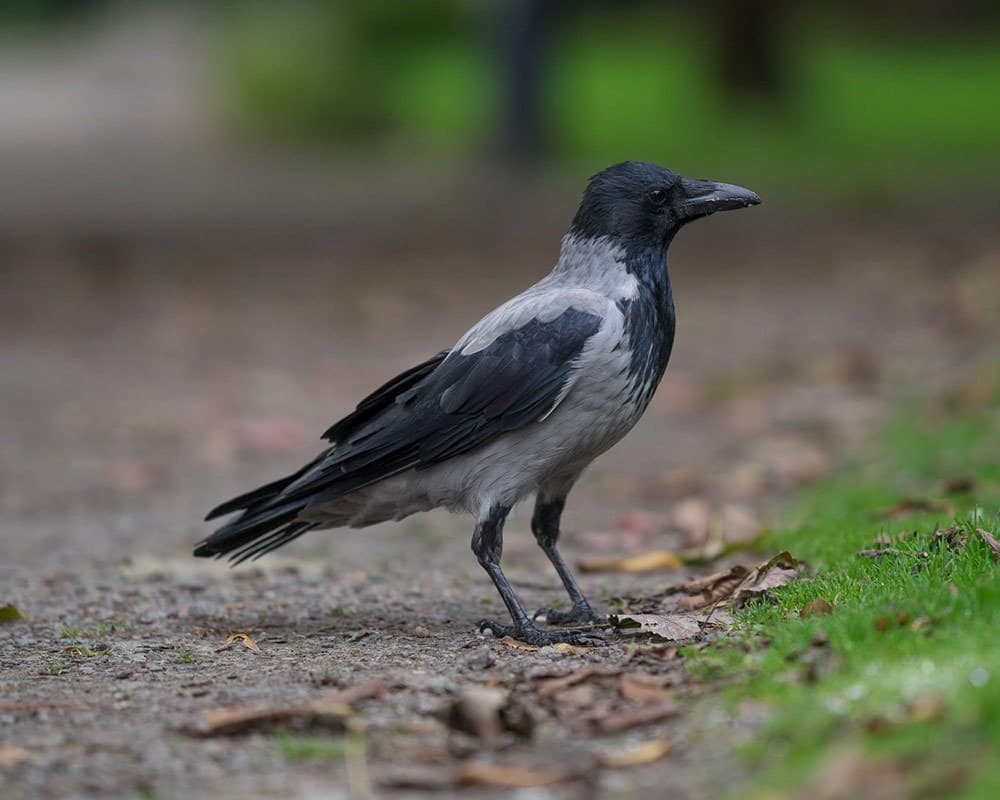
More photos
4 photos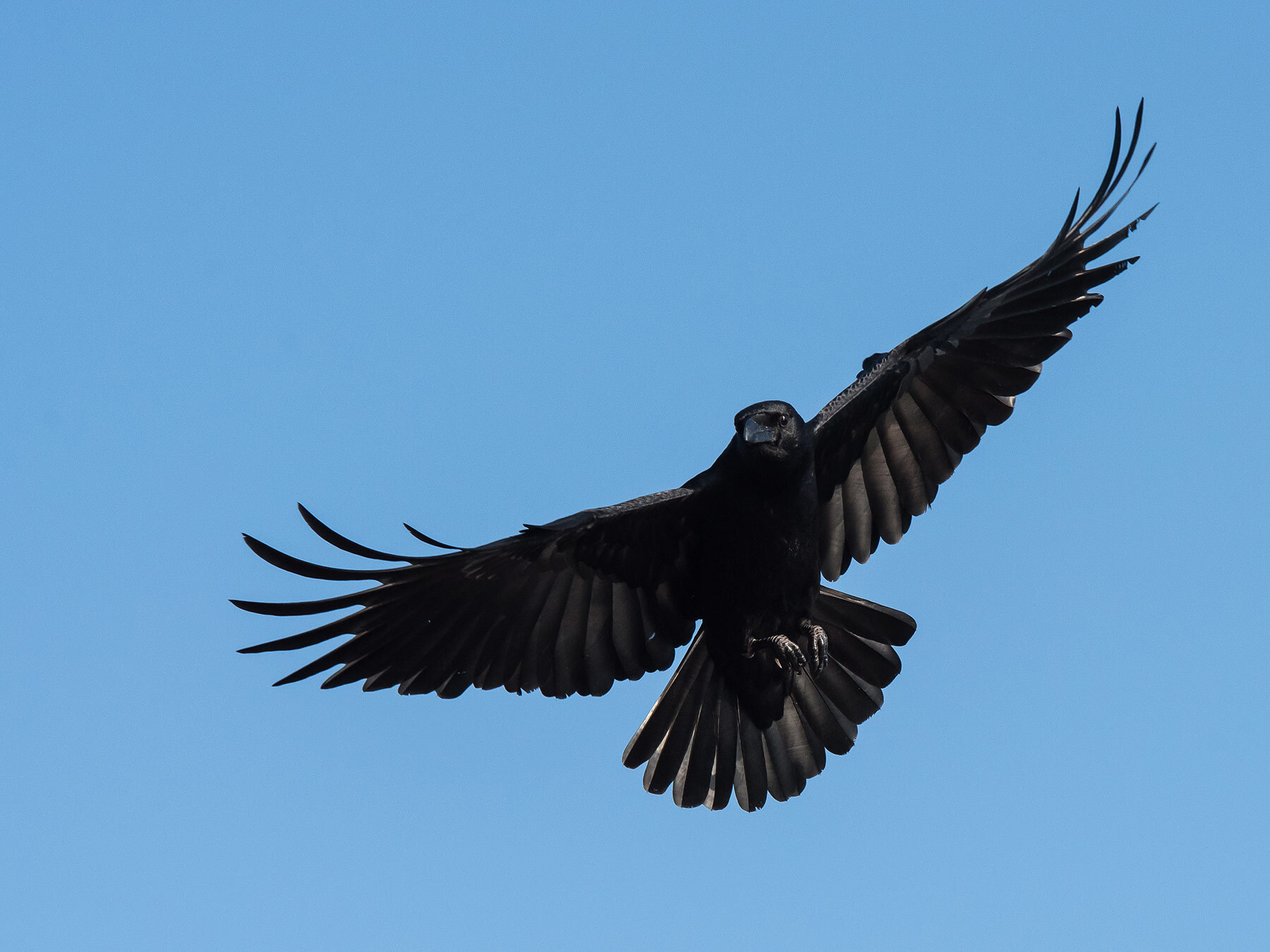
Carrion Crow guides
6 guidesQuick facts
- Length
- 45–47 cm
- Wingspan
- 93–104 cm
- Weight
- 370–650 g
- Lifespan
- 4 years · oldest recorded 20 years 10 months
- Family
- Crows & Jays
- Migration
- Resident
- Global status (IUCN)
- Least Concern
- Population trend
- UK numbers climbed for about three decades from the early 1970s and have changed little since the early 2000s (BTO), with a small dip of 4% between 2014 and 2024 (BBS)
- Also called
- Eurasian Crow
- Scientific name
- Corvus corone
Questions
4Do Carrion Crows mate for life?
They form long-term pairs: a pair stays together all year, even when feeding in a flock. The sources we read do not say whether a pair stays together for life. See behaviour.
Is a Hooded Crow the same species?
It depends whose list you follow. British ornithologists split them in 2002; the global AviList checklist (2025), now used by the BTO, joins them again. See Hooded Crows and hybrids.
Why is it called the Carrion Crow?
For its diet, which includes carrion, the flesh of dead animals, though it eats almost anything else as well.
Is the American Crow the same bird?
No. The American Crow is a separate, closely related species of North America. See also crows in the UK for the eight members of the crow family the RSPB lists for the UK.
Sources
30- 1RSPB. Carrion Crow. RSPB Birds A-Z. Accessed 8 October 2026. Source (opens in a new tab)
- 2Madge, S., Goodman, D. D. and Kirwan, G. M. (2026). Carrion Crow (Corvus corone), version 1.1. Birds of the World (R. Ahmed and B. K. Keeney, editors). Cornell Lab of Ornithology. doi:10.2173/bow.carcro1.01.1 (opens in a new tab)
- 3BTO. Carrion Crow (Corvus corone). BTO BirdFacts. Accessed 8 October 2026. Source (opens in a new tab)
- 4BTO. Identification: corvids. Bird Table (BTO Garden BirdWatch magazine). Accessed 8 October 2026. Source (opens in a new tab)
- 5RSPB. Corvids: how to identify the crow family. RSPB, Identifying birds. Accessed 8 October 2026. Source (opens in a new tab)
- 6RSPB. Rook. RSPB Birds A-Z. Accessed 8 October 2026. Source (opens in a new tab)
- 7BTO. Hooded Crow (Corvus cornix). BTO BirdFacts. Accessed 8 October 2026. Source (opens in a new tab)
- 8AviList Core Team (2025). AviList: The Global Avian Checklist, v2025b. doi:10.2173/avilist.v2025b (opens in a new tab)
- 9Poelstra, J. W., Vijay, N., Bossu, C. M. et al. (2014). The genomic landscape underlying phenotypic integrity in the face of gene flow in crows. Science 344(6190): 1410-1414. doi:10.1126/science.1253226 (opens in a new tab)
- 10Cook, A. (1975). Changes in the Carrion/Hooded Crow hybrid zone and the possible importance of climate. Bird Study 22(3): 165-168. doi:10.1080/00063657509476460 (opens in a new tab)
- 11Robinson, R. A., Leech, D. I. and Clark, J. A. (2025). Summary of all recoveries for Carrion Crow (Corvus corone). The Online Demography Report: bird ringing and nest recording in Britain & Ireland in 2024 (BTO). Accessed 8 October 2026. Source (opens in a new tab)
- 12RSPB. How to help garden birds (feeding advice). RSPB news. Accessed 8 October 2026. Source (opens in a new tab)
- 13Baglione, V., Marcos, J. M. and Canestrari, D. (2002). Cooperatively breeding groups of Carrion Crow (Corvus corone corone) in northern Spain. The Auk 119(3): 790-799. doi:10.1093/auk/119.3.790 (opens in a new tab)
- 14Baglione, V., Canestrari, D., Marcos, J. M. and Ekman, J. (2003). Kin selection in cooperative alliances of carrion crows. Science 300(5627): 1947-1949. doi:10.1126/science.1082429 (opens in a new tab)
- 15BTO. Longevity records for Britain & Ireland in 2024. BTO Online Ringing and Nest Recording Report. Accessed 8 October 2026. Source (opens in a new tab)
- 16Fransson, T., Kolehmainen, T., Moss, D. and Robinson, R. (2023). EURING list of longevity records for European birds (1 September 2023). EURING. Accessed 8 October 2026. Source (opens in a new tab)
- 17Heywood, J. J. N., Massimino, D., Baker, L., Balmer, D. E. et al. (2026). The Breeding Bird Survey 2025. BTO Research Report 802. British Trust for Ornithology, Thetford. Accessed 8 October 2026. Source (opens in a new tab)
- 18UK Parliament (1981). Wildlife and Countryside Act 1981, section 1. Accessed 7 October 2026. Source (opens in a new tab)
- 19UK Government (1985). The Wildlife (Northern Ireland) Order 1985, Article 4. Accessed 8 October 2026. Source (opens in a new tab)
- 20Natural England (2026). GL42: general licence to kill or take certain species of wild birds to prevent serious damage. Accessed 8 October 2026. Source (opens in a new tab)
- 21Natural Resources Wales (2026). General Licence 004 (WCA/GEN/004/2026): to conserve the eggs and chicks of certain wild birds. Accessed 8 October 2026. Source (opens in a new tab)
- 22NatureScot (2026). General licence for birds GL02/2026: prevention of serious damage to livestock, foodstuffs for livestock, crops, vegetables and fruit. Accessed 8 October 2026. Source (opens in a new tab)
- 23Department of Agriculture, Environment and Rural Affairs (2026). General licence TPG/2/2026 (Wildlife (Northern Ireland) Order 1985). Accessed 8 October 2026. Source (opens in a new tab)
- 24Robinson, R. A., Leech, D. I. and Clark, J. A. (2025). Summary of all recoveries for Hooded Crow (Corvus cornix). The Online Demography Report: bird ringing and nest recording in Britain & Ireland in 2024 (BTO). Accessed 8 October 2026. Source (opens in a new tab)
- 25RSPB, BTO et al. (2021). Birds of Conservation Concern 5 (leaflet). The status of all regularly occurring birds in the UK, Channel Islands and Isle of Man. Accessed 8 October 2026. Source (opens in a new tab)
- 26Natural England (2026). GL40: general licence to kill or take certain species of wild birds to conserve wild birds, flora or fauna. Accessed 8 October 2026. Source (opens in a new tab)
- 27Natural Resources Wales (2026). General Licence 001 (WCA/GEN/001/2026): prevent serious damage or spread of disease. Accessed 8 October 2026. Source (opens in a new tab)
- 28NatureScot (2026). General licence for birds GL01/2026: conservation of wild birds. Accessed 8 October 2026. Source (opens in a new tab)
- 29RSPB. Hooded Crow. RSPB Birds A-Z. Accessed 8 October 2026. Source (opens in a new tab)
- 30BirdLife International. Carrion Crow Corvus corone: species factsheet. BirdLife DataZone. Accessed 8 October 2026. Source (opens in a new tab)

Checked by
Nathan Cope, founder and editor
Nathan founded Birdfact and leads its writers and contributors in the UK, the US and Canada. He has watched and studied birds for more than ten years, and checks every article and species guide before it’s published.