Facts · Updated 8 Oct 2026
Crow Nests: Where, When and How Crows Nest
By the Birdfact teamChecked by Nathan Cope
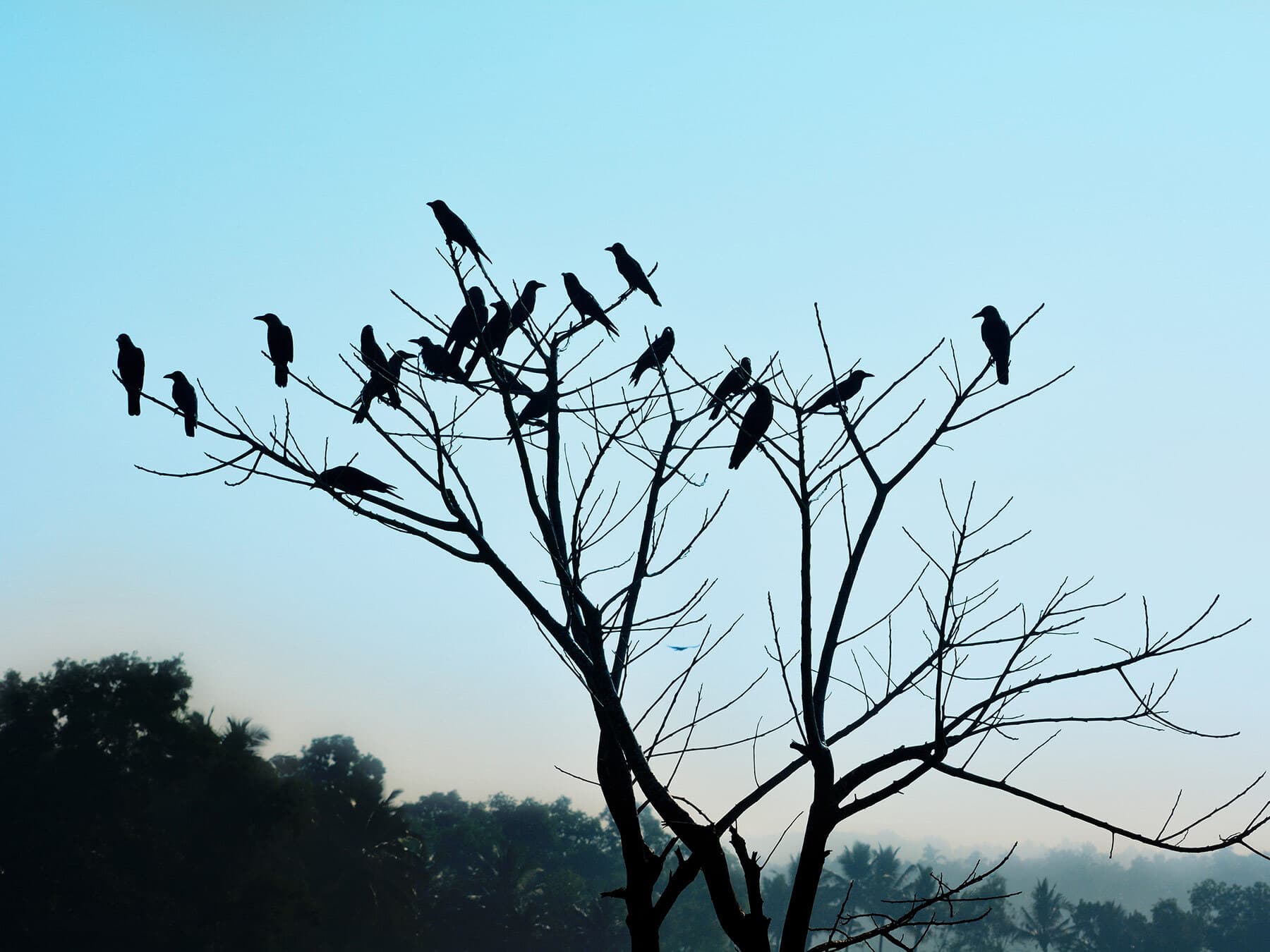
Crows build big stick nests high in trees, lined with wool, fur and grass. British Carrion Crows lay their first eggs around early April, American Crows from March; both lay 3 to 6 blotched blue-green eggs, which the female incubates for about 17 to 20 days.
On this page12 sections
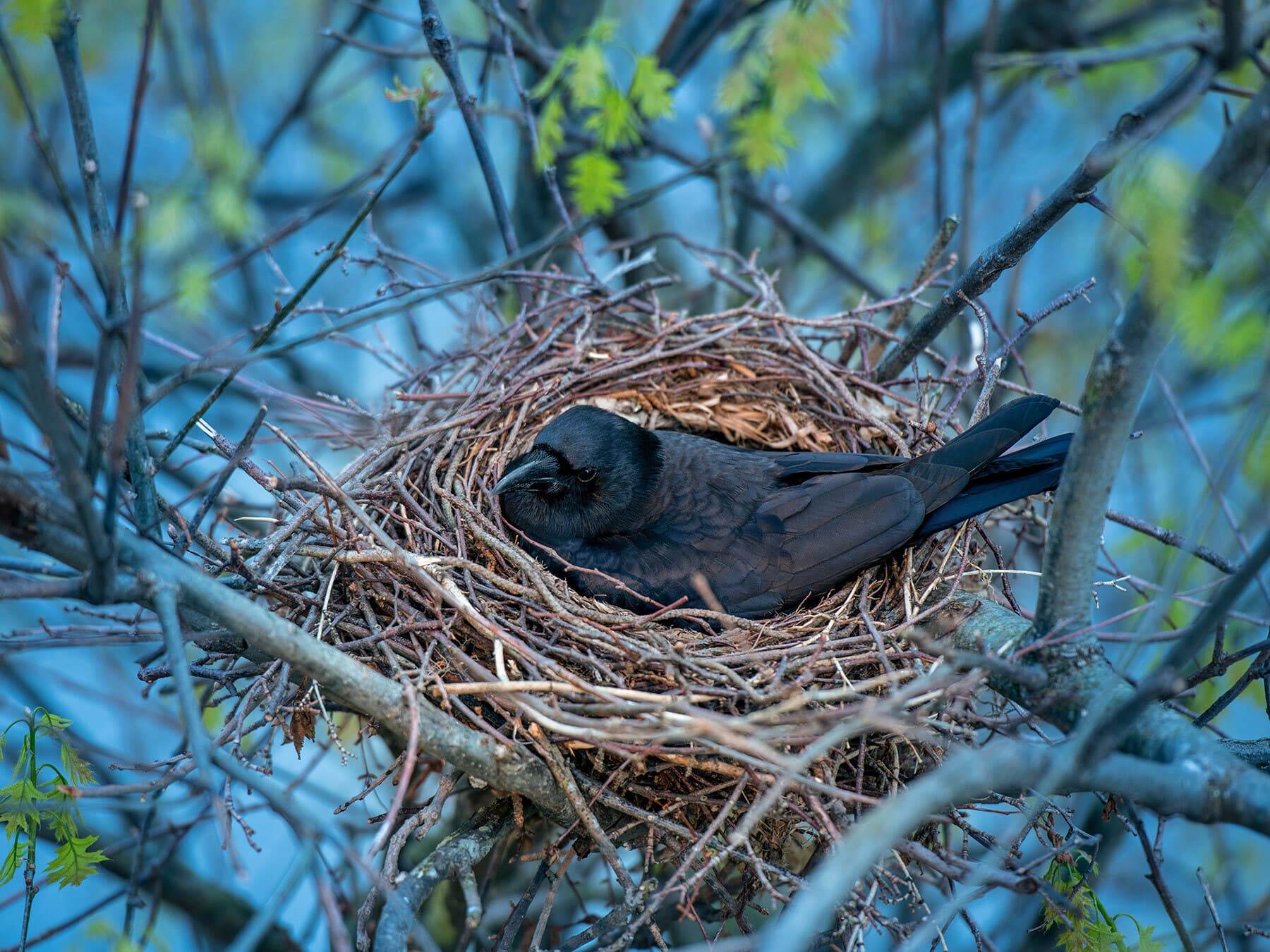
Where, when and how crows nest: the Carrion Crow in Britain and Europe and the American Crow in North America, from the nest and eggs to helpers, pairs and the law. For the chicks, see baby crows.
Where do crows nest?
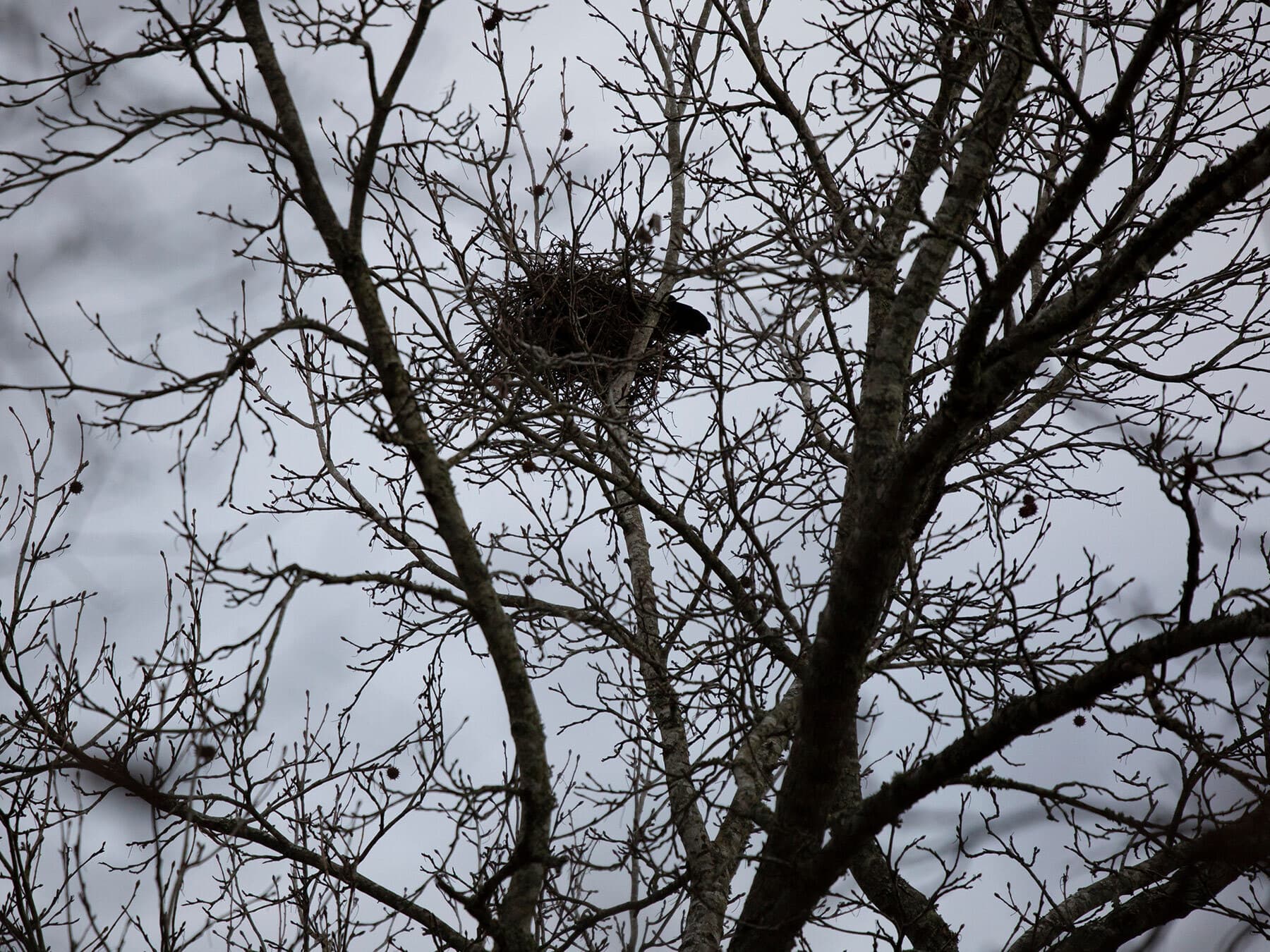
High in trees. Carrion Crows usually build in the crown of a tall tree, alone rather than in colonies, but they also nest on pylons, cliff ledges and old buildings, and occasionally in reedbeds or on the ground.1 American Crows hide the nest in a fork near the trunk or on a branch in the top third of a tree, often a conifer, from 10 to 70 feet (3 to 21 m) up.2, 3 In towns they nest higher: in Ithaca, New York, urban nests averaged 18.7 m up against 14.9 m in the countryside.
What does a crow's nest look like?
A big, untidy basket of sticks. A Carrion Crow nest is built of sticks and twigs, often with bones, wire or heather worked in, on a base of mud, with a deep cup lined thickly with wool, fur, grass and feathers. An American Crow nest has an outer basket of sticks, a filling of mud and grass, and a soft lining of bark strips, fur, grass, moss or twine. Nests measured on Cape Cod averaged 41 cm (16 in) across and 24 cm (9.5 in) deep from the rim to the base of the sticks.
Crow nests and rookeries
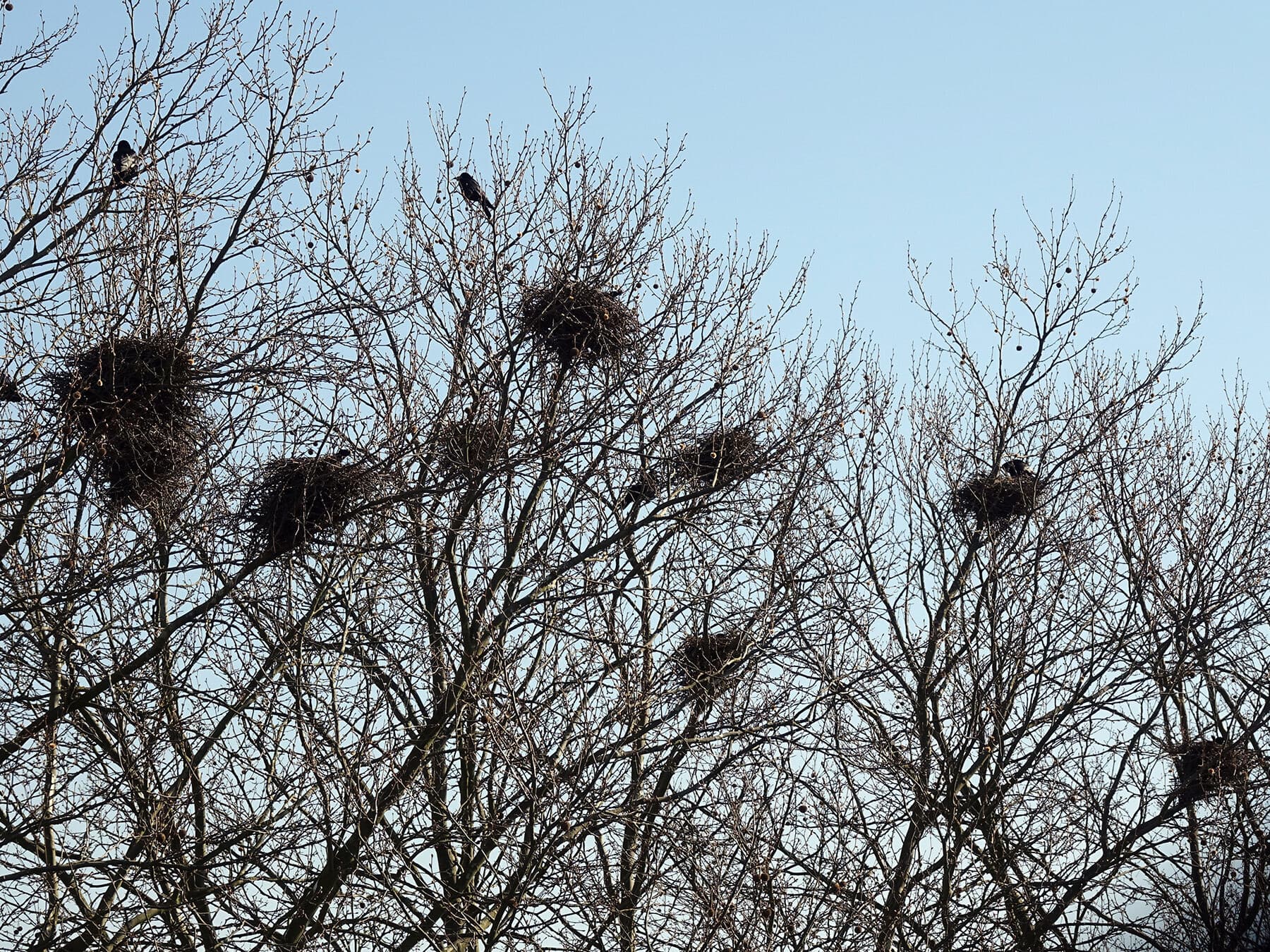
When crows nest and lay
Early in the year. In Britain the Carrion Crow's first clutch is laid, on average, on 7 April, usually between mid-March and late April.5 American Crows build from February and lay from March, earlier in the South: in Oklahoma from late February, in Virginia mostly in early April, and in Saskatchewan not until May. Both crows raise one brood a year, trying again only if the first nest fails.
Eggs
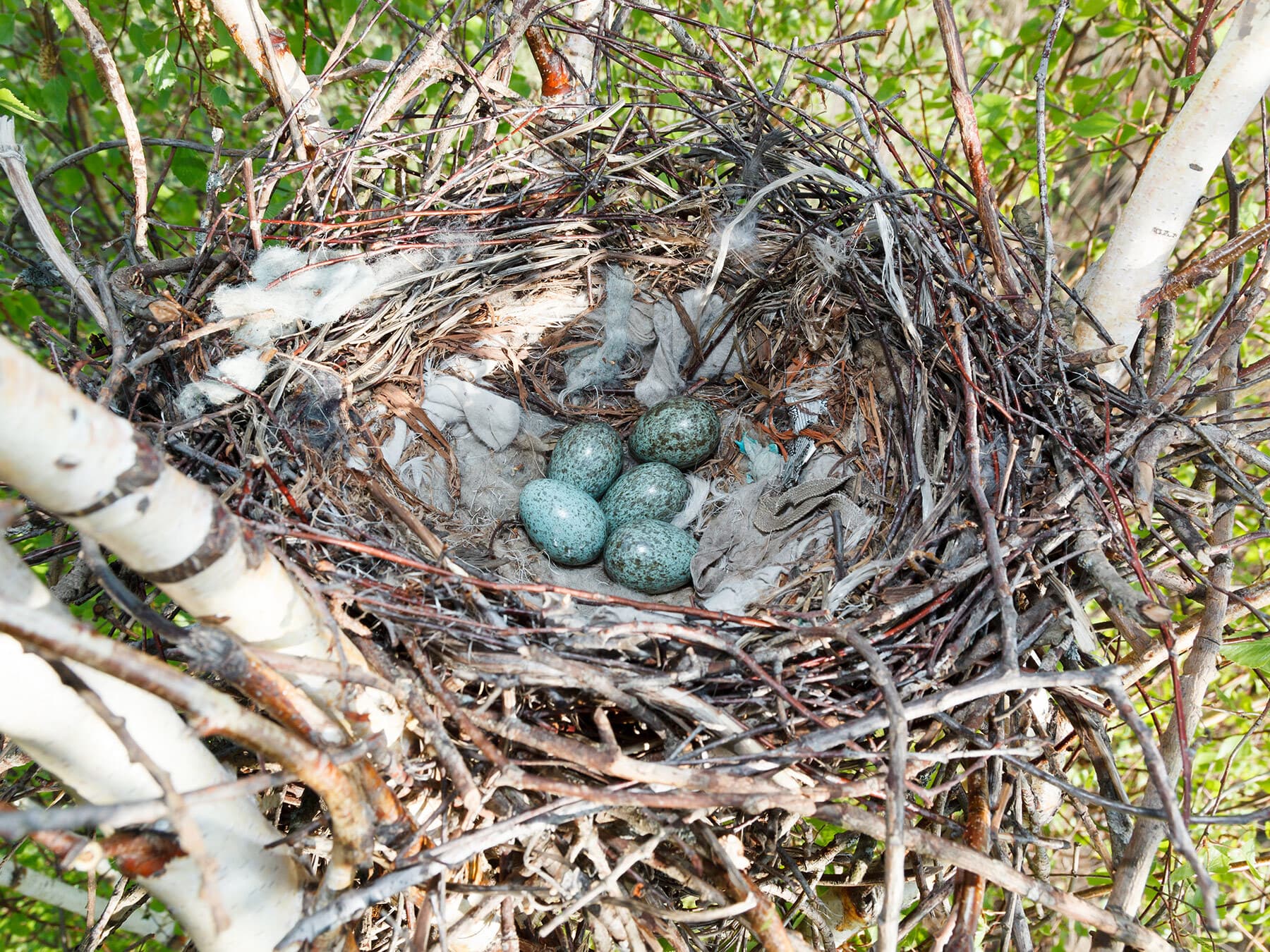
A Carrion Crow lays 3 or 4 eggs as a rule; an American Crow usually 4 to 6. The eggs are pale bluish-green to olive-green, blotched with brown and grey, and very variable: some are almost plain.6 A Carrion Crow's eggs cannot be told from a Hooded Crow's.
Incubation and chicks
The female does the incubating: a Carrion Crow sits for 18 to 20 days, an American Crow about 17 to 18, while her mate (and, in many American families, older offspring) brings her food. A Carrion Crow male sometimes takes a short turn on the eggs.1 The eggs hatch over two or three days. The young leave the nest after about 29 days (Carrion Crow) or 4 to 5 weeks (American Crow).
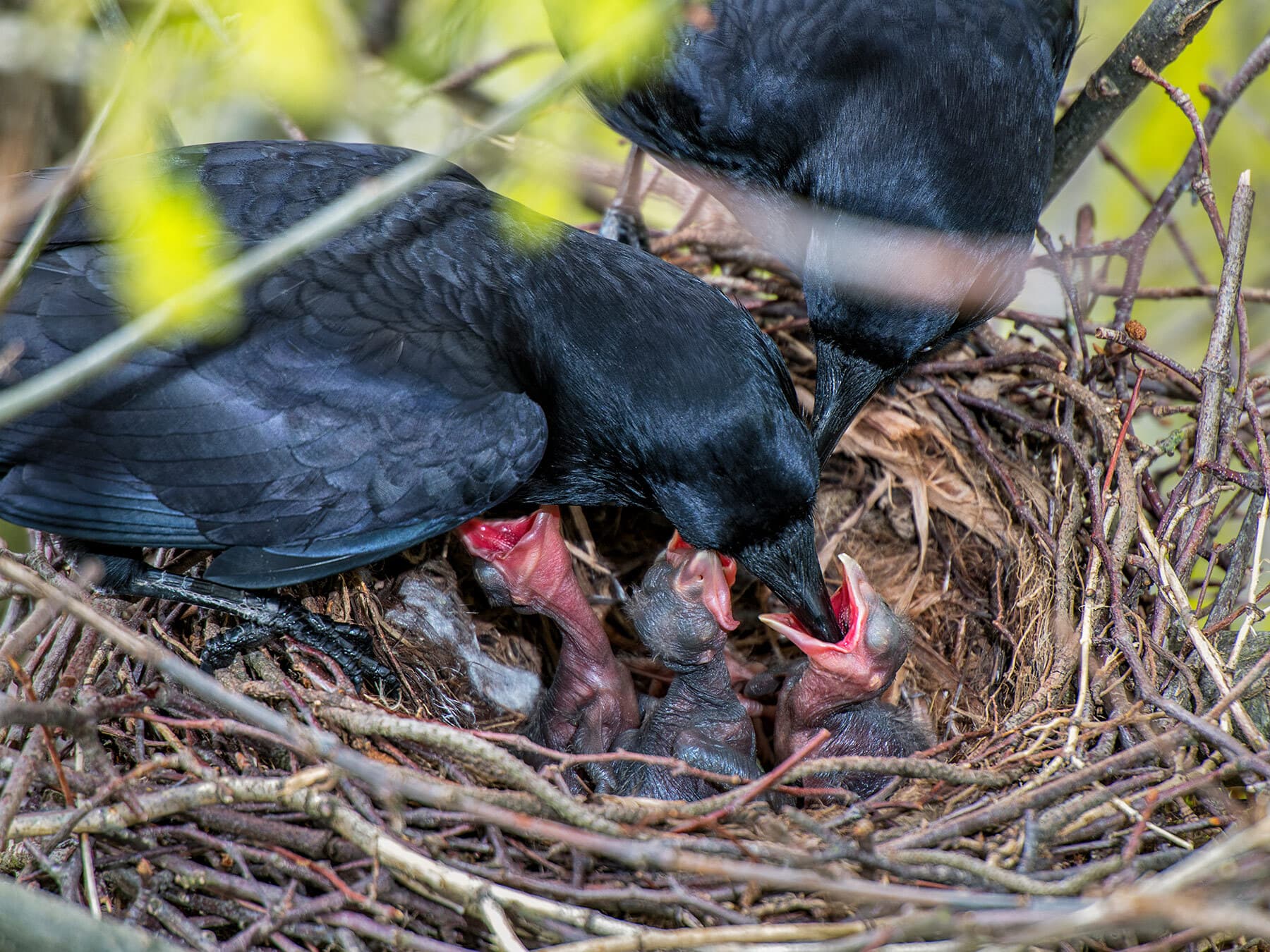
Do crows mate for life?
"More or less," in the words of Cornell's crow researcher Kevin McGowan: pairs stay together year after year unless one bird is killed or badly hurt.7 Both crows form long-term pairs that stay together all year. Among about 200 American Crow pairs watched in New York over more than 30 years, only one divorce was recorded.3 Lost mates may be replaced within days.
Helpers at the nest
In many year-round American Crow populations, the pair's grown young stay for one to several years and help: they bring food to the incubating female and the chicks, guard the nest and keep it clean. Most Carrion Crows breed as a pair, but in one population in northern Spain about three-quarters of territories were held by groups of three to nine birds, mostly relatives.8
Do crows reuse their nests?
Rarely. Both crows usually build a new nest each year, often near the old one. Their old nests are useful to others: hawks, owls and falcons lay their eggs in them.
Nest losses
Many crow nests fail. In a California study, 57% of nests fledged no young, and most failures were due to predators such as hawks and Great Horned Owls; in Ithaca, New York, raccoons were the main nest predator. British Carrion Crows have done better since the 1960s: nests fail less often, and crows lay about 8 days earlier than in 1968.
Crow nests and the law
In Great Britain it is an offence to take, damage or destroy the nest of any wild bird while it is in use or being built, or to take or destroy its eggs, crows' included (in Scotland, also to do so recklessly)9, and Northern Ireland has a similar law.10 General licences allow authorised people to act against Carrion Crows for set purposes, in some cases including their nests and eggs; see the Carrion Crow guide. In the US the Migratory Bird Treaty Act protects crows, their nests and eggs11, though states may set crow hunting seasons outside the main nesting period and a federal depredation order allows crows causing serious damage to be controlled.12, 13
Sources
- Madge, S., Goodman, D. D., Kirwan, G. M. (2026). Carrion Crow (Corvus corone), version 1.1. Birds of the World (R. Ahmed and B. K. Keeney, editors). Cornell Lab of Ornithology. doi:10.2173/bow.carcro1.01.1
- Kaufman, K. American Crow. Audubon Guide to North American Birds (text from Lives of North American Birds). Accessed 8 October 2026. Source
- Caffrey, C., Verbeek, N. A., Clark, A. B., McGowan, K. J., Pyle, P. (2026). American Crow (Corvus brachyrhynchos), version 1.6. Birds of the World (A. F. Poole, F. B. Gill and M. G. Smith, editors). Cornell Lab of Ornithology. doi:10.2173/bow.amecro.01.6
- RSPB. Rook. RSPB Birds A-Z. Accessed 8 October 2026. Source
- BTO. Carrion Crow (Corvus corone). BTO BirdFacts. Accessed 8 October 2026. Source
- Seebohm, H. (1896). Coloured Figures of the Eggs of British Birds, with Descriptive Notices. Pawson and Brailsford, Sheffield. Accessed 8 October 2026. Source
- McGowan, K. J. Frequently asked questions about crows. Cornell Lab of Ornithology. Accessed 8 October 2026. Source
- Baglione, V., Marcos, J. M., Canestrari, D. (2002). Cooperatively breeding groups of Carrion Crow (Corvus corone corone) in northern Spain. The Auk 119(3): 790-799. doi:10.1093/auk/119.3.790
- UK Parliament (1981). Wildlife and Countryside Act 1981, section 1. Accessed 7 October 2026. Source
- UK Government (1985). The Wildlife (Northern Ireland) Order 1985, Article 4. Accessed 8 October 2026. Source
- U.S. Congress (1918). Migratory Bird Treaty Act, 16 U.S.C. 703. Accessed 8 October 2026. Source
- U.S. Fish and Wildlife Service (2026). 50 CFR 20.133: Hunting regulations for crows. Accessed 8 October 2026. Source
- U.S. Fish and Wildlife Service (2026). 50 CFR 21.150: Depredation order for blackbirds, cowbirds, crows, grackles, and magpies. Accessed 8 October 2026. Source