Published 9 Oct 2026
Crow Sounds: Caws, Rattles and What They Mean
By the Birdfact teamChecked by Nathan Cope
Two crows, two markets: the American Crow across most of North America (with the Fish Crow in the South-east), and the Carrion Crow in Britain and Europe (the grey-and-black Hooded Crow in Ireland and north-west Scotland). Every sound on this page is a real recording, credited, with spectrograms drawn from the same recordings.
On this page11 sections
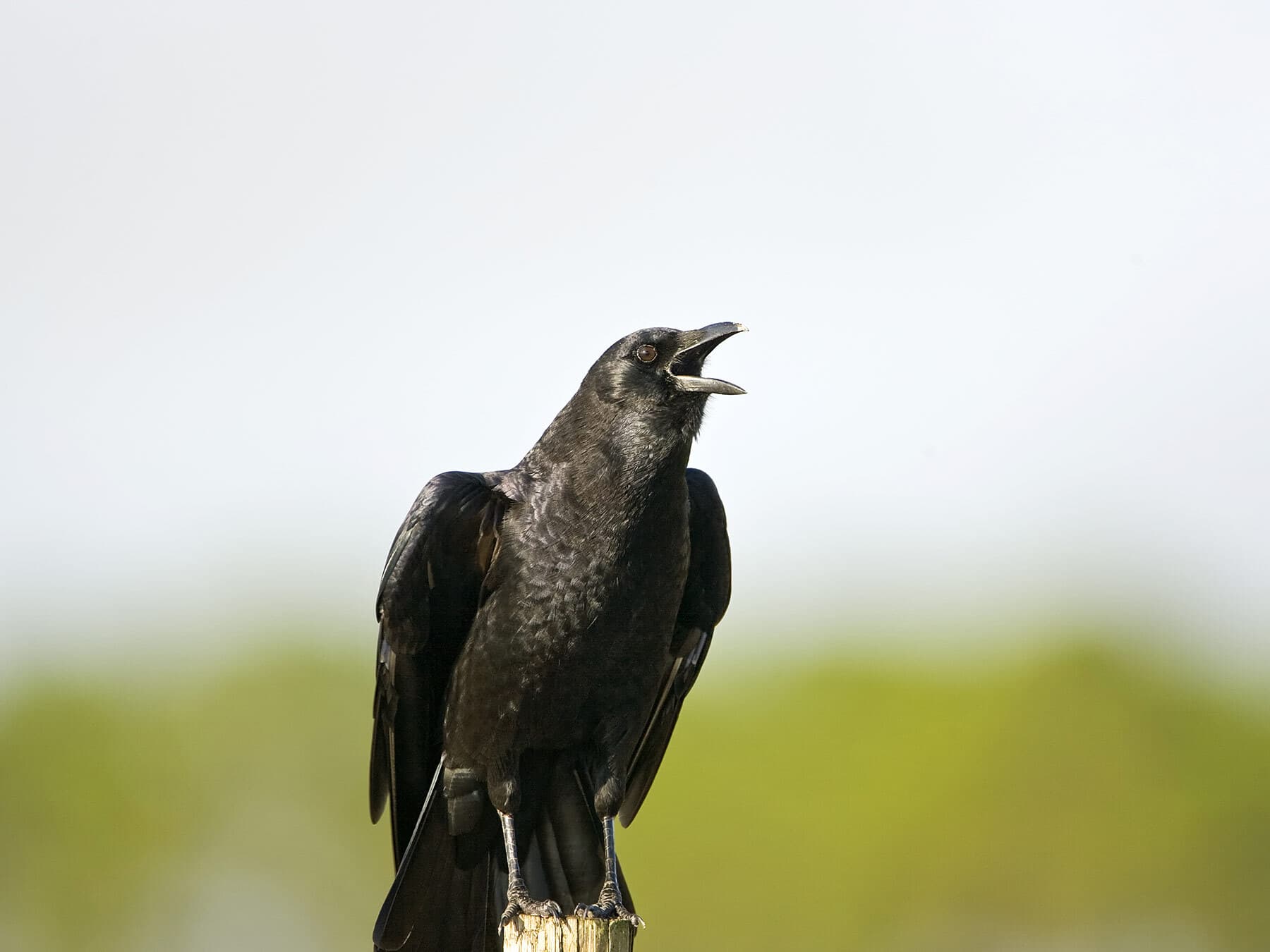
Most of the time a crow says "caw": a loud, harsh call, usually repeated a few times. But crows have far more to say than that. One classic study listed 23 American Crow sounds, counting rare ones and mimicry,1 and the Cornell Lab puts it at more than 20: from rattles and soft coos to a quiet, rambling song, and young crows beg with a nasal whine of their own.2
This guide plays real recordings of each sound, draws them as spectrograms (pictures of sound, with pitch going up and time going across), and explains what research says they mean, for the American Crow in North America and the Carrion Crow in Britain and Europe.
What does a crow sound like?
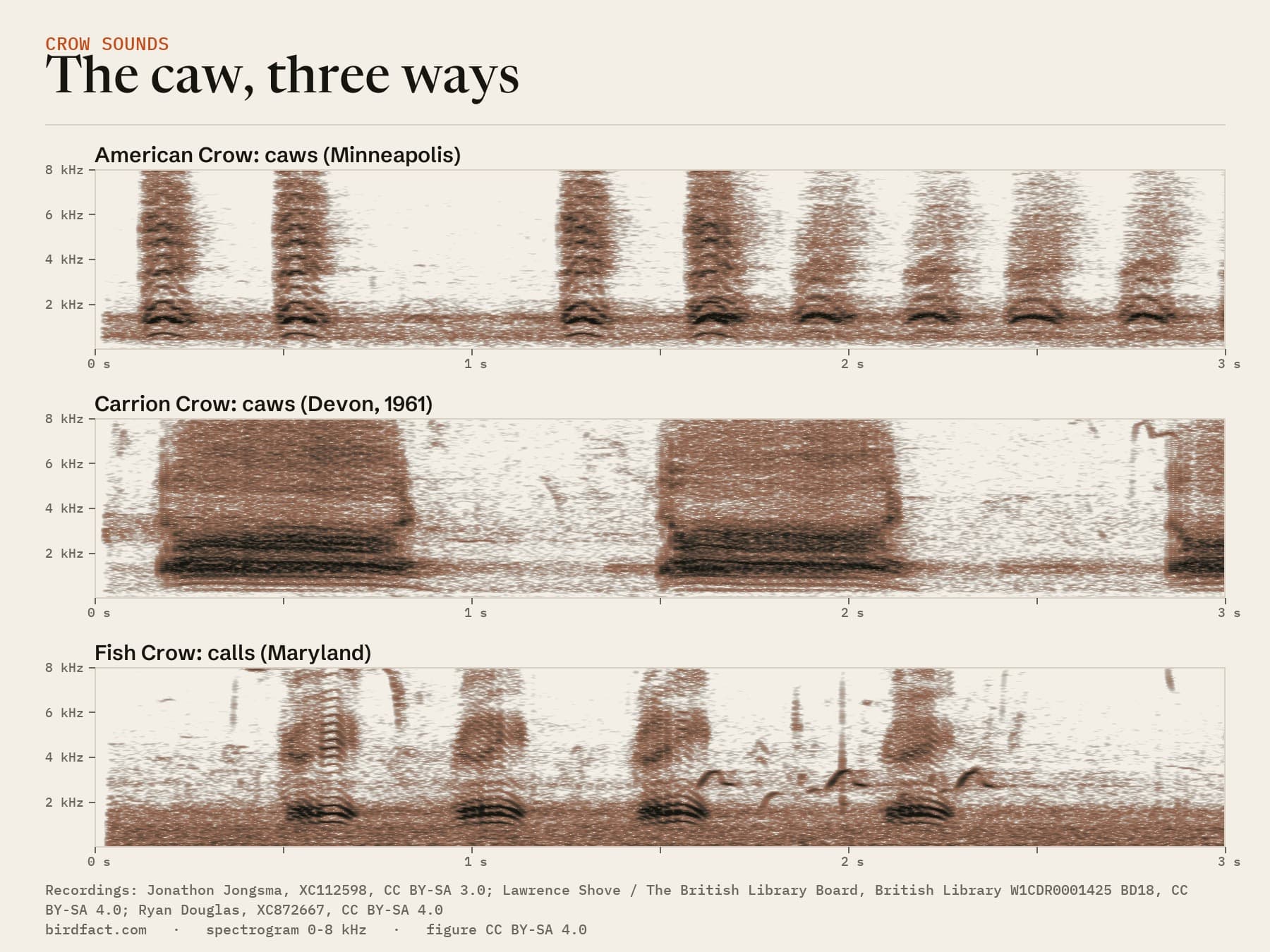
In Britain and Europe, the Carrion Crow's call is a harsh, flat "kraa" or "caa", repeated on one pitch, usually three to six times.5, 6 Next to an American Crow it sounds slower. Comparing the two, a study of Carrion Crows recorded in Somerset found longer caws, with longer pauses between them and fewer caws in each burst.7 You can see it in the spectrograms below: the American Crow's caws are short bars, the Carrion Crow's long blocks.
The words for the sound have shifted, too. In 1920 the Practical Handbook of British Birds wrote the Carrion Crow's note as a raucous croak, "varrock", and used "caw" for the Rook.8 And one rule holds for Carrion and Hooded Crows: the more calls in a string, the shorter each call. A 2025 study of 12,123 calls from captive Carrion and Hooded Crows (and hybrids) in Spain and Austria found this pattern, known from human languages as Menzerath's law, in crows for the first time.9
What a caw means
There is no simple crow dictionary. The same caw can mean different things in different situations, and crows react to it accordingly. But listening to known birds has turned up some clear patterns. One study of American Crows described 8 basic caw types: a very short caw for general alarm, especially at intruders on the territory; medium-length caws that neighbours trade back and forth from high perches, pumping their bodies, probably to advertise their territories; a harsh caw for mobbing predators; and a short "ko" alarm at a predator. A quick double caw calls the family to arms. Neighbours "countercaw", answering with the same type and number of caws.3
Following crow families in Ithaca, New York, through one summer, a later study found that the commonest call was a short caw given when a crow arrived on its territory or at food; family members then flew to the caller. A rough, wobbly caw, mostly from breeding females, was always aimed at a begging youngster, and the caller then moved away: in effect, "come here" and "leave me alone".10
Each crow has its own voice. The alarm caws of 15 wild crows in Ithaca were different enough that a computer matched about two in three calls to the right bird, and males and females differed, above all in pitch.11 In a pair, the male has the lower voice, though that is no guide to a lone bird.3 Crows pay attention to who is calling: captive Carrion Crows learned which crows' alarm calls had been played while a dead crow was in view, and later called differently when they heard those birds.12
Why crows gang up and scream
When a crowd of crows suddenly starts cawing loudly in one tree, there is usually a predator nearby: an owl, a hawk, a cat or a person they dislike. The raucous mobbing call brings other crows in. In playback experiments, mostly in Virginia, it drew crows in as predicted in 27 of 30 tests (90%), and the squalling distress call of a crow caught by a predator did so in 22 of 25 (88%).1 Crows answer recordings of the mobbing call within 1 to 5 minutes even when none are in sight, and it draws Fish Crows in too.3
The urgency is in the tempo, not in a special word for each predator. Crows shown a model owl and a model raccoon used the same calls for both, but called with longer caws, faster and with shorter gaps when the danger was greater.13 Owls get the worst of it: Great Horned Owls kill adult crows and nestlings, and probably hunt at roosts by night; that, says Cornell's Kevin McGowan, is why crows hate them.14
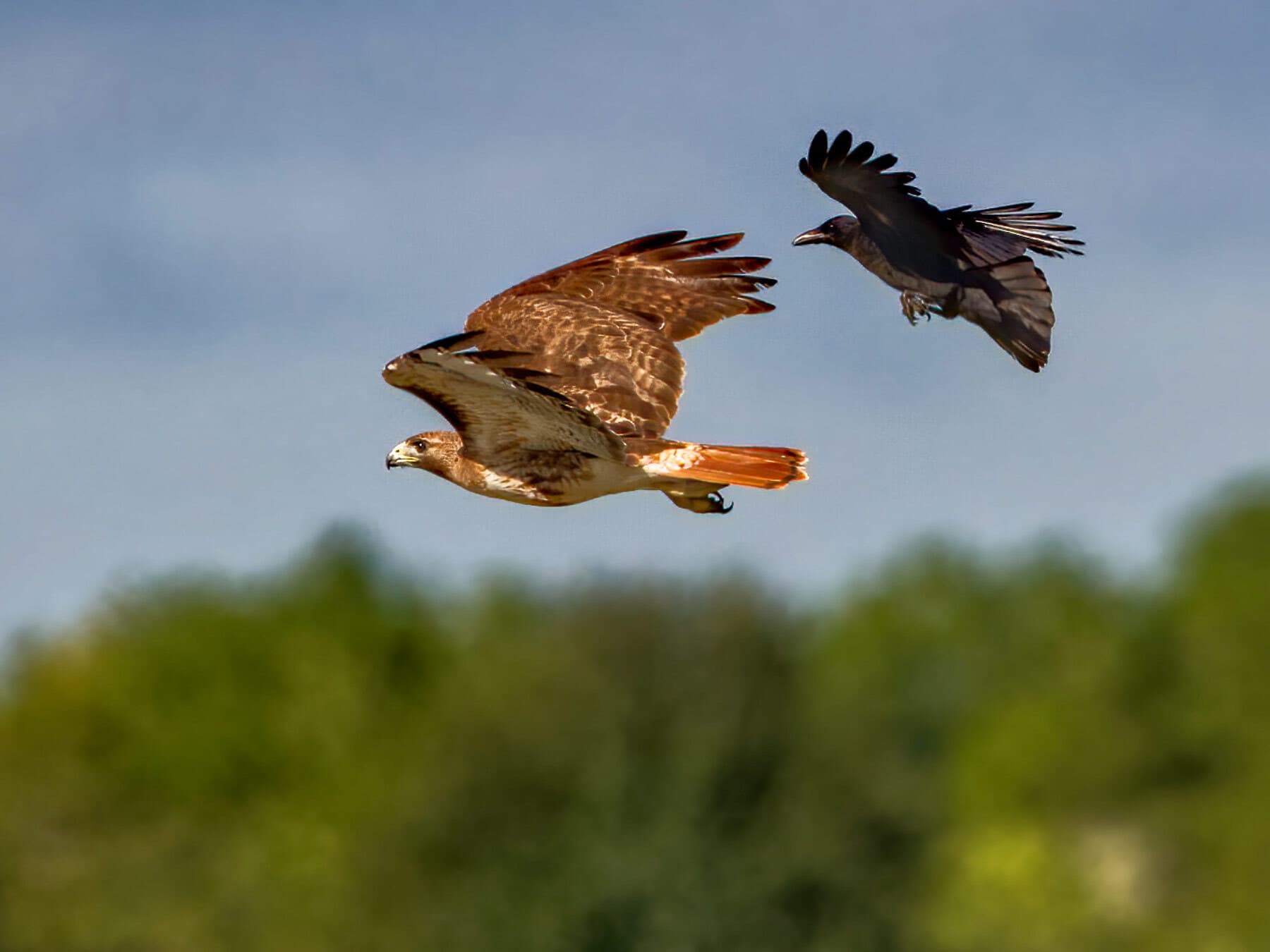
A dead crow sets off the same alarm. In experiments around Seattle, territorial crows scolded in 96% of 102 tests when a masked person stood by their food holding a dead crow, a stuffed hawk, or both, and never when only the food was there. A dead pigeon drew no such response. Once a mob had formed, the crows kept scolding for an average of 11.1 minutes at a hawk holding a dead crow, and later scolded the masked person on sight, up to 6 weeks on.15 These noisy gatherings are sometimes called crow funerals, but the researchers see them as crows learning about danger. See do crows remember faces?
Rattles, clicks, coos and a quiet song
Listen near a crow family and you may hear sounds that are not caws at all. The rattle is a run of 5 to 20 sharp notes, like a woodpecker tapping, given by a perched crow, mostly in autumn.3 In Ithaca, rattles lasted 1.5 to 2.5 seconds, about 12.5 clicks a second ending in a bell-like ring, and afterwards the family gathered close and preened. In that study it was heard from females but never from males, though others have heard it from both sexes.10, 1 In courtship, a male American Crow puffs out his feathers, opens his wings and tail part way and bows over and over, giving a short rattling song.4
The coo, the only purely tonal call in that study, is short and soft, given after tension, for example to quieten a youngster that keeps begging.10 Crows also clack their bills,2 and a Hooded Crow has been documented clapping its bill in a squabble with another.16
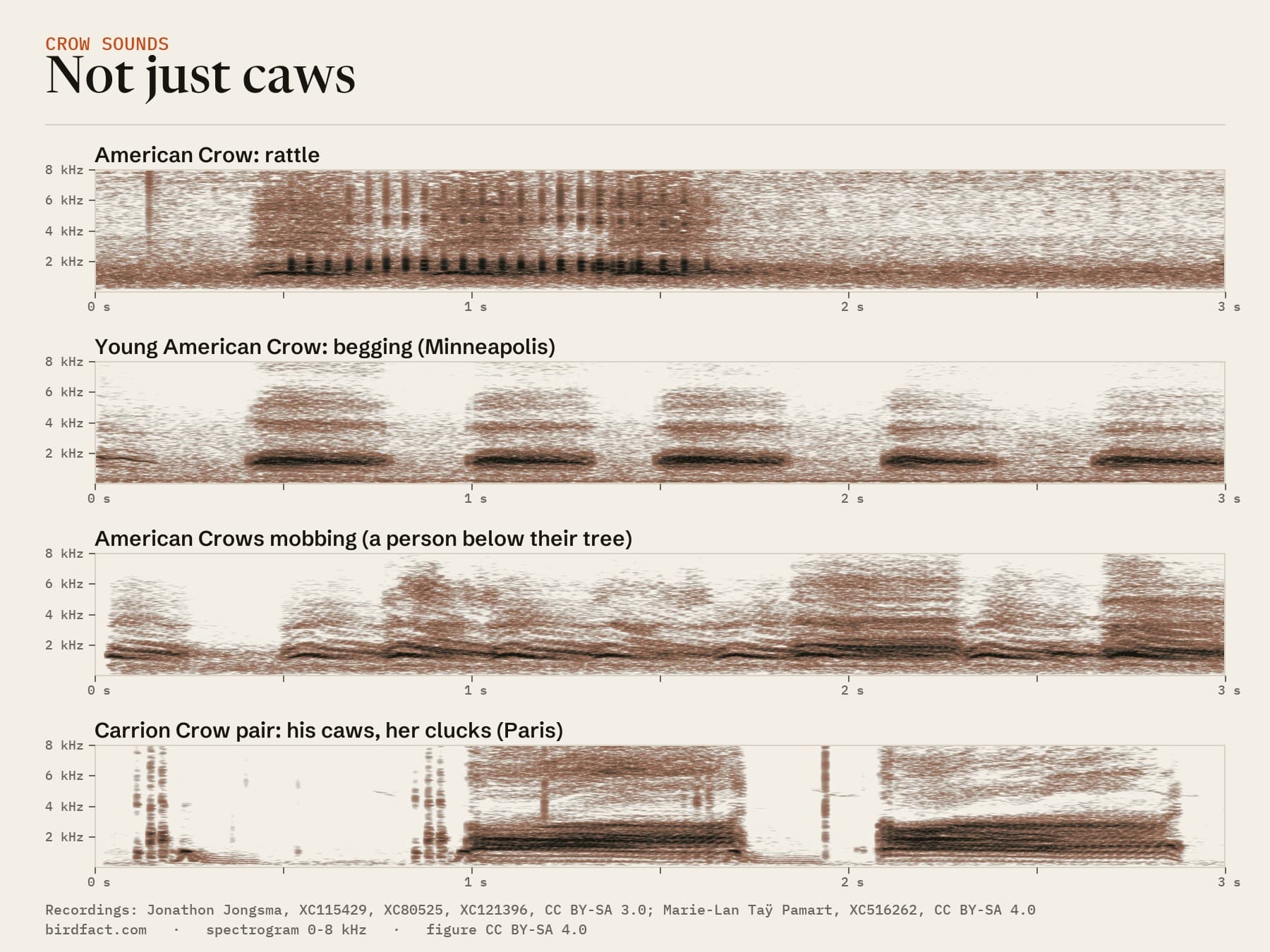
And crows sing. The American Crow's song is soft and rambling: coos and caws, with rattles, clicks and grating sounds mixed in, up to 60 sounds a minute, once kept up for nearly 40 minutes. It is meant for close company, within about 20 m (65 ft), and both sexes and all ages sing, often in groups.3 In a study of three crow groups, each had its own song repertoire, and when unfamiliar birds were put together, their repertoires grew alike by imitation.17 A very soft song has also been reported from the Rook and the Carrion Crow.3 The Carrion Crow's, rarely noticed, is a bubbling mix of call notes with some mimicry.5
Baby crow sounds
Young crows beg, and beg, and beg. Most of what is known comes from American Crows. A chick's hunger call is a squalling whine, faster, more intense and higher the closer the food. Nestlings answer almost any adult call with it, flapping their wings and showing a bright red mouth.1 They beg most once out of the nest, at about 5 weeks old, and their family keeps feeding them for a month or two, so in New York the begging goes on into July.18 In the Ithaca study, begging was by far the commonest sound young crows made, heard in 85% of watches. It rose to a gargling squall as an adult with food came near, young males begged louder and more than young females, and youngsters kept begging long after they could feed themselves.10
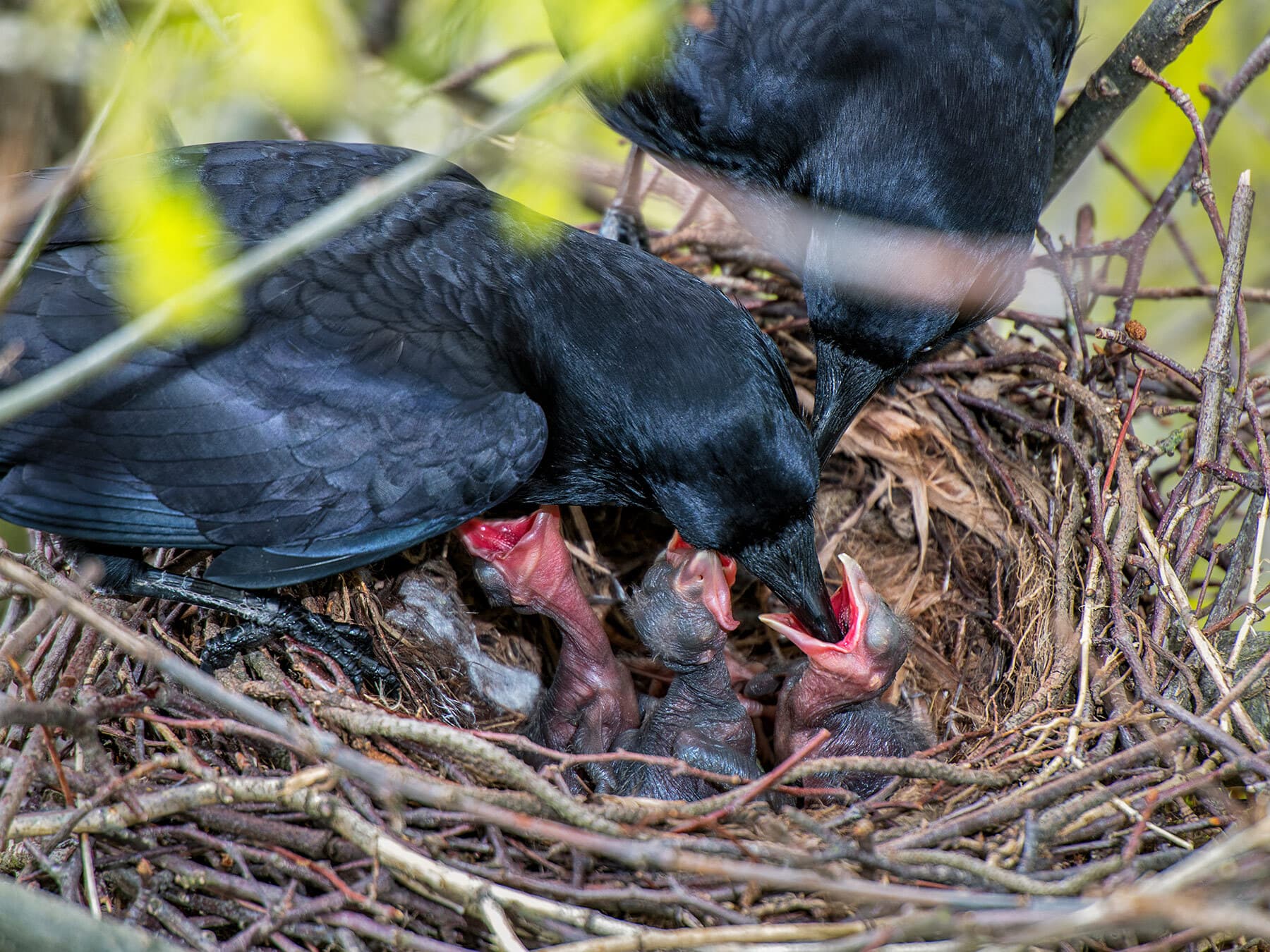
The caw comes later. Captive young American Crows babbled 2 to 3 weeks after leaving the nest and made their first caw-like sounds at 4 to 5 weeks,3 but wild juveniles start adult cawing only late in the summer, and their caws can still be told from an adult's.18 From 3 to 4 months old they practise, babbling long, rambling strings, some copying adult calls, usually when they are away from the family.10 Each chick's voice is its own from early on: in five hand-raised chicks from the Austrian zone where Carrion and Hooded Crows interbreed, each chick's calls could be told apart from the youngest age recorded, 11 days.19 For more on young crows, see baby crows.
Why do adult crows beg?
Not all begging comes from young birds. A female American Crow gives a long, drawn-out begging "caa" before she lays and while she sits on her eggs, and it can carry 300 m (about 1,000 ft) or more.3 In Ithaca it is heard from late March to mid-May, as females call from the nest for the family to bring them food.18 American Crow begging, by young birds and adults, is the sound most often mistaken for a Fish Crow (see below).18 Carrion Crows beg as adults too: in the Paris recording below, one adult begs like a fledgling, flapping its wings with its bill open, and is fed by another adult.
Why do crows caw at night?
Mostly because they are roosting together. In autumn and winter, American Crows gather at night in communal roosts, from a few hundred birds to hundreds of thousands, even millions, and big roosts are noisy; a disturbance, such as an owl, sets off alarm and mobbing calls in the dark. At night in roosts, crows "mutter and babble".3 Crows gather an hour or two before dark with much calling, chasing and fighting, and the final move into the roost is still noisy.14
On night visits to roosts in Virginia, Chamberlain and Cornwell heard mobbing and scolding calls, and alarm calls when crows spotted a Great Horned Owl. Crows flew to a distress call near the roost in the dark and mobbed over it before settling again. The commonest sounds of all came from squabbles over perches.1
Street lighting may play a part. Many city roosts are near bright lights, perhaps so the crows can watch for owls. At a lit roost in Auburn, New York, crows kept calling and moving from tree to tree well after dark, while at darker roosts they soon fell quiet.14
All of this night-time research is on American Crows. Carrion Crows roost together too, sometimes up to 5,000 in stands of large trees,5 but we found no study of their calls at night.
Mimicry and talking crows
Crows can copy sounds, probably more often than has been recorded, but the evidence from wild birds is thin. A 2025 review found mimicry recorded in 39 of 128 species of the crow family (30%): copies of other birds, mammals including human speech, frogs, insects and machines. For the Carrion Crow, the evidence is recordings on xeno-canto rather than any published study.20 American Crows have been heard imitating a Barred Owl and the human voice, and making sounds like cats, dogs and geese.3
Talking crows are real, but almost all are tame or hand-raised; reports from wild birds are rare.20 Chamberlain heard human words from eight tame crows, one of which said "hello". He thought the old idea that splitting a crow's tongue helps it talk came from the natural split at the tip of its tongue.1 See can crows talk?
Crows listen to us, too. Captive Carrion Crows reacted more to recordings of unfamiliar women saying "Hey" than to women they knew,21 and wild Carrion Crows in London and Milton Keynes flew off more often at recordings of human speech than at pigeon or parakeet sounds, though English and Vietnamese worried them equally.22
Crows that count their calls
In 2024, researchers in Tübingen, Germany, trained three Carrion Crows to give one, two, three or four calls on cue, whether the cue was a numeral they saw or a sound they heard. All three did better than chance for every number, and their mistakes were mostly one call too many or too few. The crows seemed to plan: the pause before the first call grew longer the more calls they needed, and the sound of the very first call predicted how many would follow, correctly about 55% of the time against about 25% by chance.23 The authors compare it with toddlers who say "one, one, one" to tally things before they understand what numbers mean: a possible first step towards counting, not counting itself.
It builds on earlier work showing that Carrion Crows can learn to call, or to stay silent, on cue: they control when they call, rather than calling only when excited.24 These are results from a few trained birds in a lab; they do not mean that wild crows count their caws.
Similar voices: Fish Crow, raven, Rook and Jackdaw
Fish Crow (south-eastern US and the Atlantic coast). Its call is short and nasal, "awh" or "uhn", and the giveaway is a doubled "uh-uh", which American Crows never give. Voice is the only safe way to tell the two apart.18 The catch is that young American Crows give a similar nasal "kwok" in the breeding season,25 and adults beg too. American Crow begging is longer than a Fish Crow's call, lacks its abrupt end and often drops in pitch.18
Common Raven. A deep, croaking "gronk" or "cronk-cronk", which American Crows never give; a raven's occasional caw is so deep it is easily told.14 A Carrion Crow sometimes gives a deeper, almost raven-like "konk", usually mixed in with ordinary calls.5 See raven vs crow, with recordings of both.
Rook. Softer and huskier, without the ringing clarity of a Carrion Crow's call;6 the BTO puts it the other way round: a Carrion Crow sounds more assertive.26 Jackdaw: a short "jack" or "chack".
Hooded Crow. To the ear, much the same as a Carrion Crow: both give runs of 2 to 15 caws. Where the two meet in the Alps, their calls differ measurably in timing and pitch.27
Crows of the Pacific Northwest coast (the former Northwestern Crow, now counted as an American Crow) have a lower-pitched call.3
Sources
- Chamberlain, D. R., Cornwell, G. W. (1971). Selected vocalizations of the Common Crow. The Auk 88(3): 613-634. Accessed 9 October 2026. Source
- Cornell Lab of Ornithology. American Crow: sounds. All About Birds. Accessed 9 October 2026. Source
- Caffrey, C., Verbeek, N. A., Clark, A. B., McGowan, K. J., Pyle, P. (2026). American Crow (Corvus brachyrhynchos), version 1.6. Birds of the World (A. F. Poole, F. B. Gill and M. G. Smith, editors). Cornell Lab of Ornithology. doi:10.2173/bow.amecro.01.6
- Kaufman, K. American Crow. Audubon Guide to North American Birds (text from Lives of North American Birds). Accessed 8 October 2026. Source
- Madge, S., Goodman, D. D., Kirwan, G. M. (2026). Carrion Crow (Corvus corone), version 1.1. Birds of the World (R. Ahmed and B. K. Keeney, editors). Cornell Lab of Ornithology. doi:10.2173/bow.carcro1.01.1
- RSPB. Corvids: how to identify the crow family. RSPB, Identifying birds. Accessed 8 October 2026. Source
- Thompson, N. S. (1982). A comparison of cawing in the European carrion crow (Corvus corone) and the American common crow (Corvus brachyrhynchos). Behaviour 80(1-2): 106-117. doi:10.1163/156853982X00472
- Witherby, H. F. (ed.), Hartert, E., Jackson, A. C., Jourdain, F. C. R., Oldham, C., Ticehurst, N. F. (1920). A Practical Handbook of British Birds, vol. 1. Witherby & Co., London. Accessed 9 October 2026. Source
- Wascher, C. A. F., Youngblood, M. (2025). Vocal efficiency in crows. Animal Cognition 28: 75. doi:10.1007/s10071-025-01985-8
- Tarter, R. R. (2008). The Vocal Behavior of the American Crow, Corvus brachyrhynchos. MS thesis, The Ohio State University. Accessed 9 October 2026. Source
- Yorzinski, J. L., Vehrencamp, S. L., McGowan, K. J., Clark, A. B. (2006). The inflected alarm caw of the American Crow: differences in acoustic structure among individuals and sexes. The Condor 108(3): 518-529. doi:10.1650/0010-5422(2006)108[518:TIACOT]2.0.CO;2
- Wascher, C. A. F., Hillemann, F., Canestrari, D., Baglione, V. (2015). Carrion crows learn to discriminate between calls of reliable and unreliable conspecifics. Animal Cognition 18(5): 1181-1185. doi:10.1007/s10071-015-0879-8
- Yorzinski, J. L., Vehrencamp, S. L. (2009). The effect of predator type and danger level on the mob calls of the American Crow. The Condor 111(1): 159-168. doi:10.1525/cond.2009.080057
- McGowan, K. J. Frequently asked questions about crows. Cornell Lab of Ornithology. Accessed 8 October 2026. Source
- Swift, K. N., Marzluff, J. M. (2015). Wild American crows gather around their dead to learn about danger. Animal Behaviour 109: 187-197. doi:10.1016/j.anbehav.2015.08.021
- Husby, M. (2024). Documentation of bill clapping in Hooded Crow Corvus cornix. Ornis Norvegica 47: 58-59. doi:10.15845/on.v47.4345
- Brown, E. D. (1985). The role of song and vocal imitation among Common Crows (Corvus brachyrhynchos). Zeitschrift für Tierpsychologie 68(2): 115-136. doi:10.1111/j.1439-0310.1985.tb00119.x
- McGowan, K. J. Fish Crow ID: how do you tell a Fish Crow from an American Crow? Cornell Lab of Ornithology (revised 6 April 2005). Accessed 9 October 2026. Source
- Gidl, H., Binder, S., Osiecka, A. N., Klump, B. C. (2026). The ontogeny of vocal identity in carrion crows (Corvus corone). Animal Cognition 29(1): 17. doi:10.1007/s10071-025-02021-5
- Wascher, C. A. F., Waterhouse, G., Beheim, B. A. (2025). Vocal mimicry in corvids. Animal Cognition 28: 88. doi:10.1007/s10071-025-02006-4
- Wascher, C. A. F., Szipl, G., Boeckle, M., Wilkinson, A. (2012). You sound familiar: carrion crows can differentiate between the calls of known and unknown heterospecifics. Animal Cognition 15(5): 1015-1019. doi:10.1007/s10071-012-0508-8
- Schalz, S. (2023). Wild carrion crows (Corvus corone) autonomously respond to speech but show no difference in their response to a local and a foreign language. Animal Behavior and Cognition 10(2): 144-162. doi:10.26451/abc.10.02.04.2023
- Liao, D. A., Brecht, K. F., Veit, L., Nieder, A. (2024). Crows "count" the number of self-generated vocalizations. Science 384(6698): 874-877. doi:10.1126/science.adl0984
- Brecht, K. F., Hage, S. R., Gavrilov, N., Nieder, A. (2019). Volitional control of vocalizations in corvid songbirds. PLoS Biology 17(8): e3000375. doi:10.1371/journal.pbio.3000375
- Kaufman, K. Fish Crow. Audubon Guide to North American Birds. Accessed 9 October 2026. Source
- BTO. Carrion Crow (Corvus corone). BTO BirdFacts. Accessed 8 October 2026. Source
- Palestrini, C., Rolando, A. (1996). Differential calls by Carrion and Hooded Crows (Corvus corone corone and C. c. cornix) in the Alpine hybrid zone. Bird Study 43(3): 364-370. doi:10.1080/00063659609461030
- Brown, E. D. (1985). Functional interrelationships among the mobbing and alarm caws of Common Crows (Corvus brachyrhynchos). Zeitschrift für Tierpsychologie 67(1-4): 17-33. doi:10.1111/j.1439-0310.1985.tb01375.x
- Cornell Lab of Ornithology. Fish Crow: sounds. All About Birds. Accessed 9 October 2026. Source
- xeno-canto contributors, The British Library. Recordings of crows used on the crow sounds page. xeno-canto; British Library via Wikimedia Commons. Accessed 9 October 2026. Source