
Golden Eagle
Royal Eagle, Mountain Eagle · Aquila chrysaetos
By the Birdfact teamChecked by Nathan Cope
On this page15 sections
How to recognise it
The Golden Eagle is a massive, stately bird of prey. Continue reading for more Golden Eagle identification tips.
What do Golden Eagles look like?
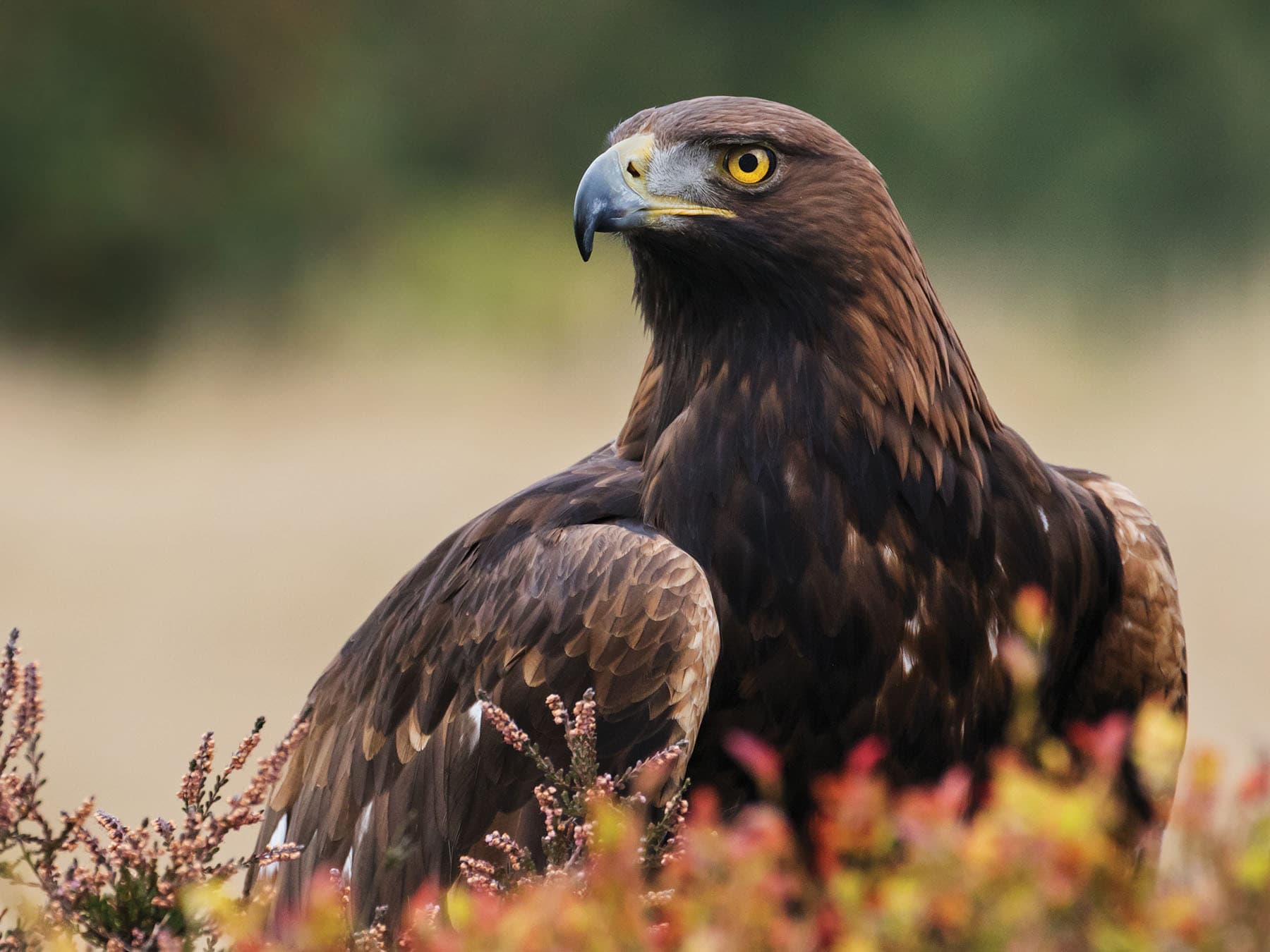
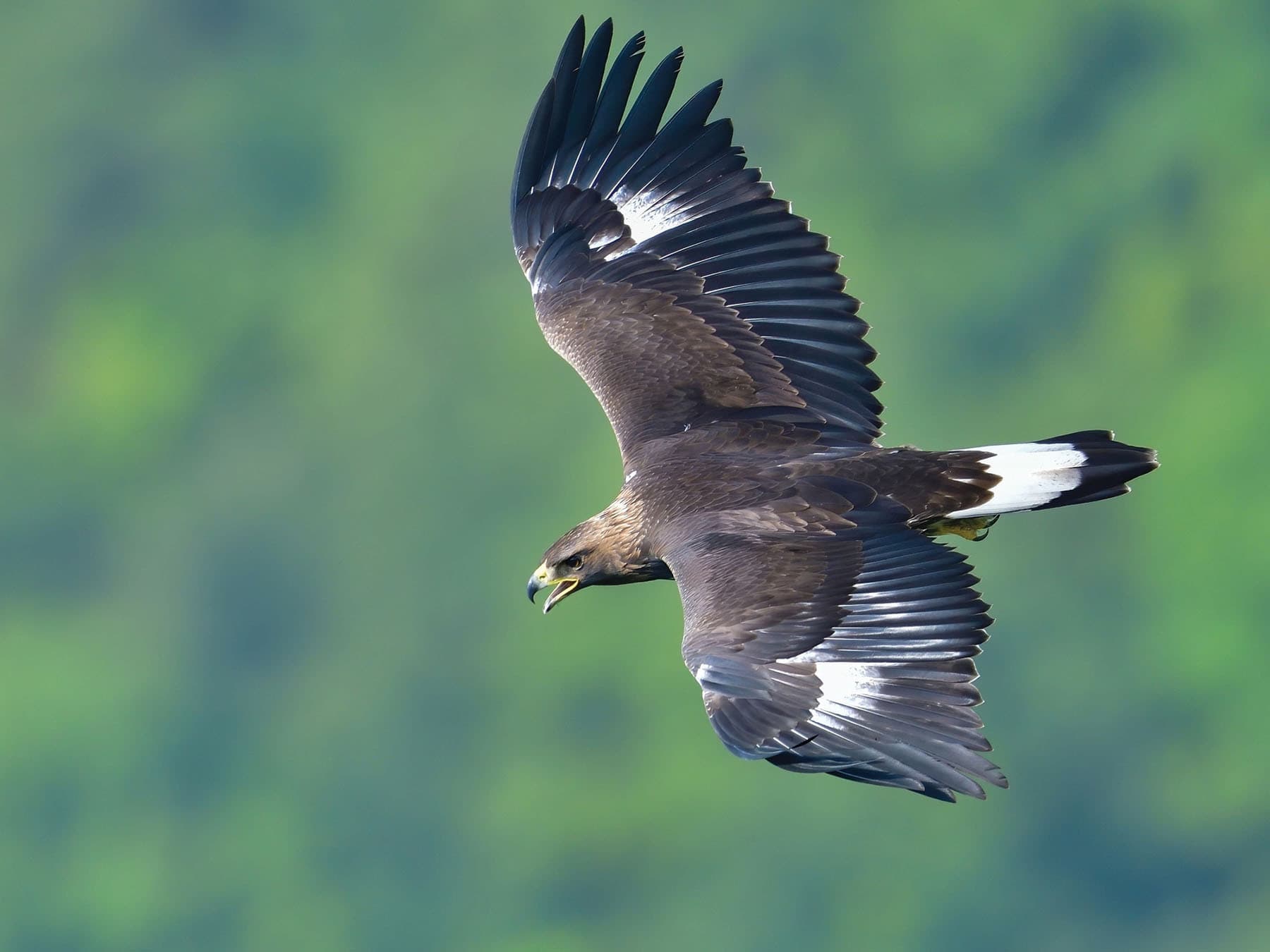
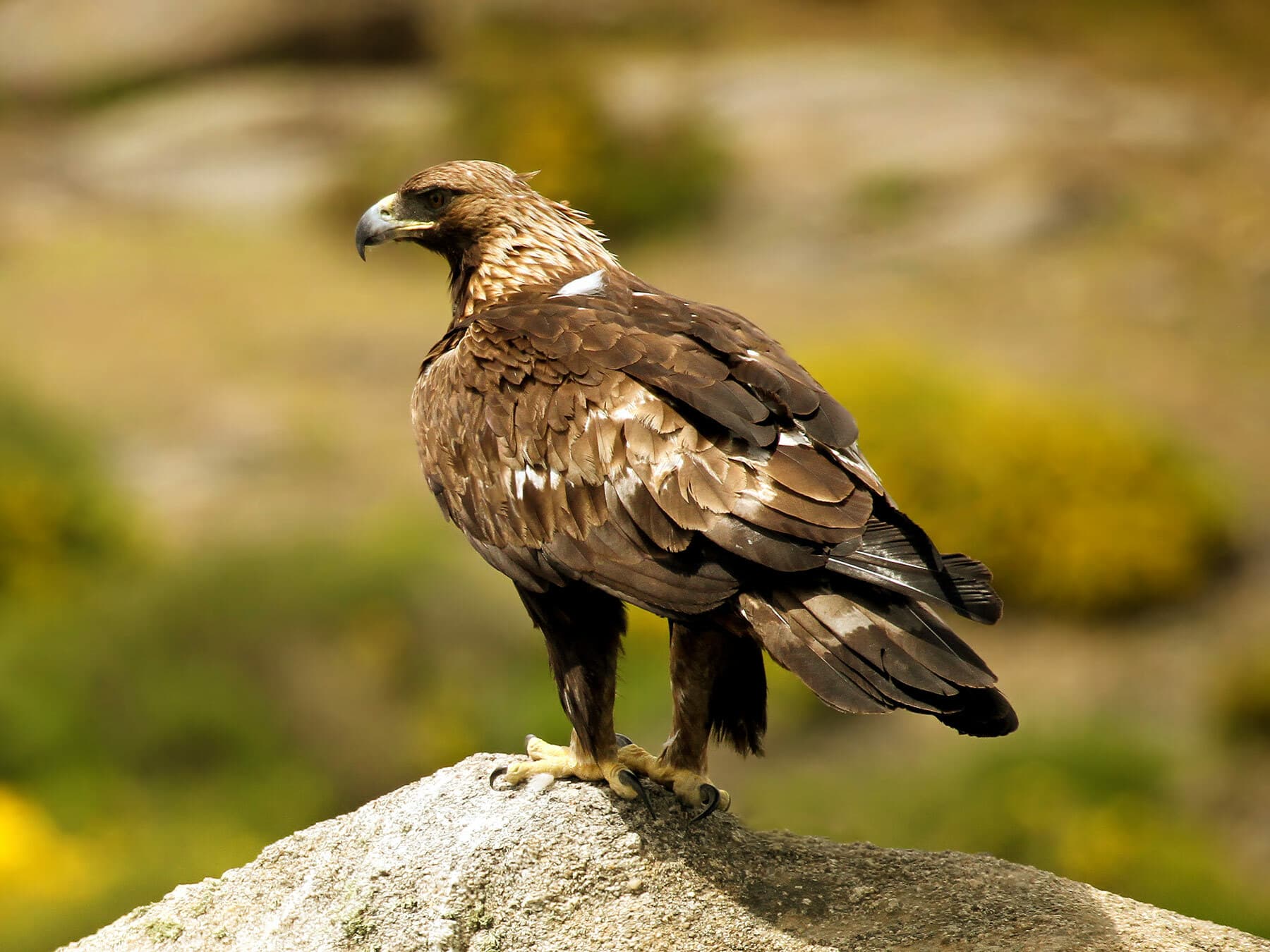
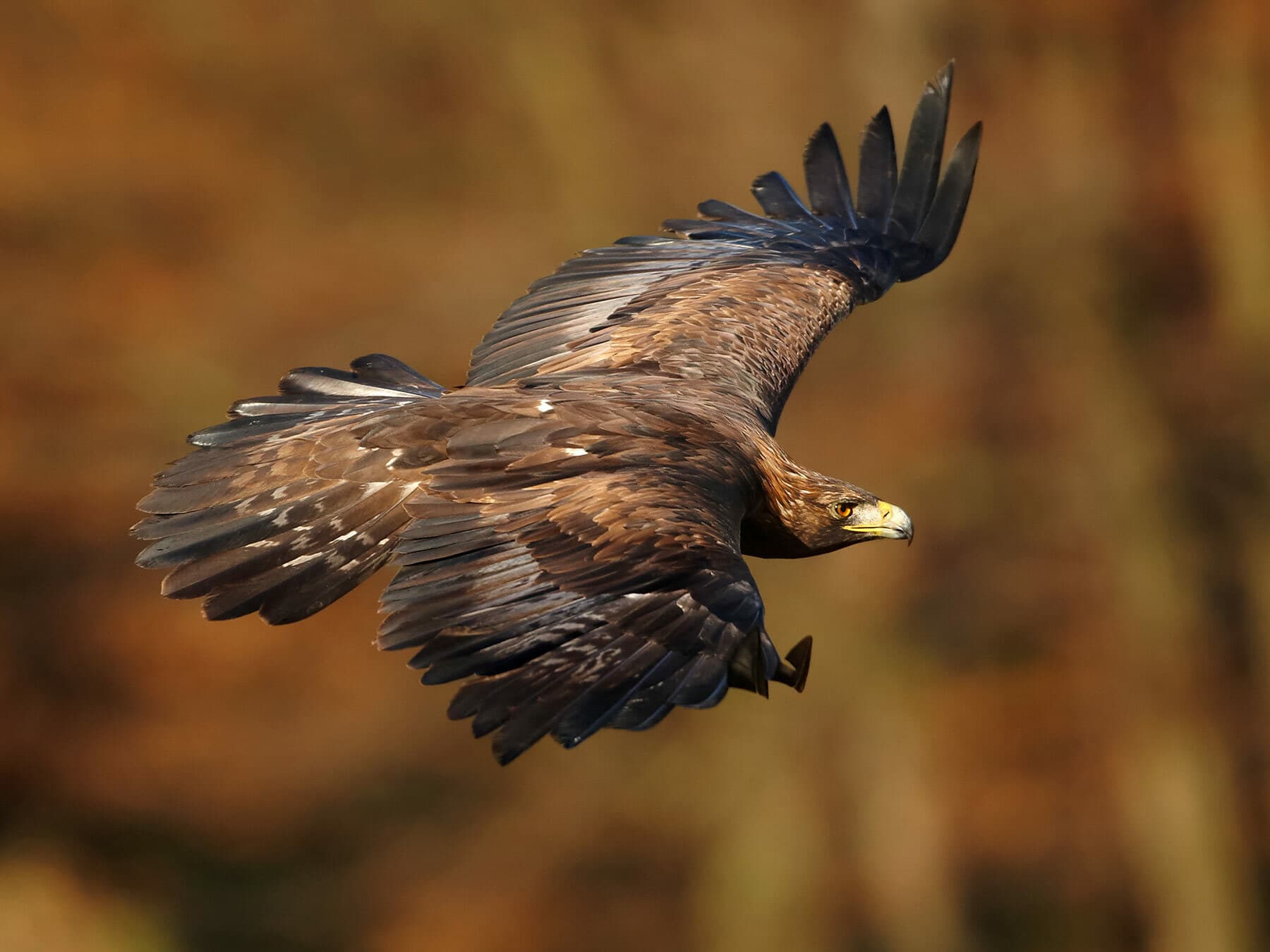
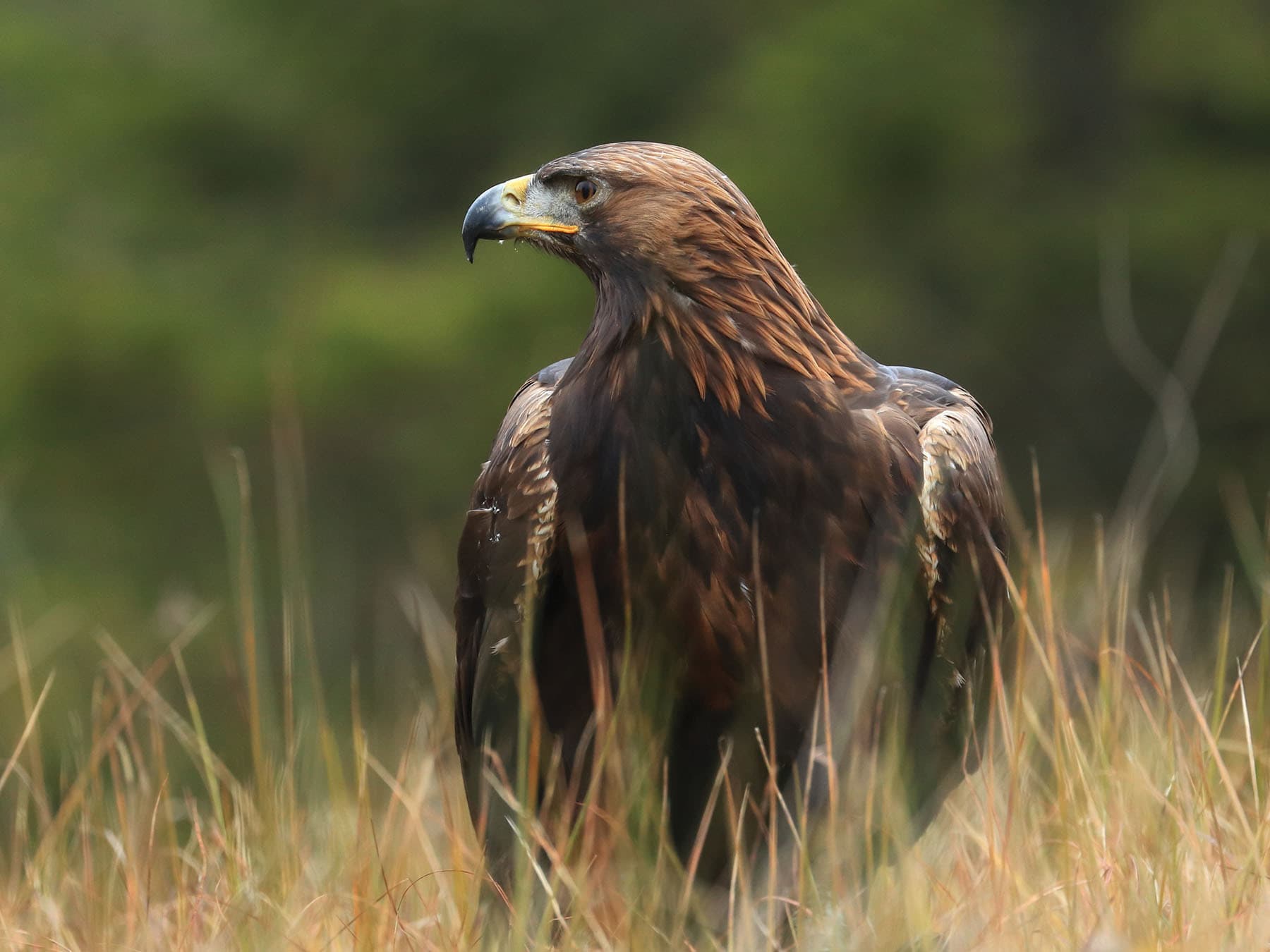
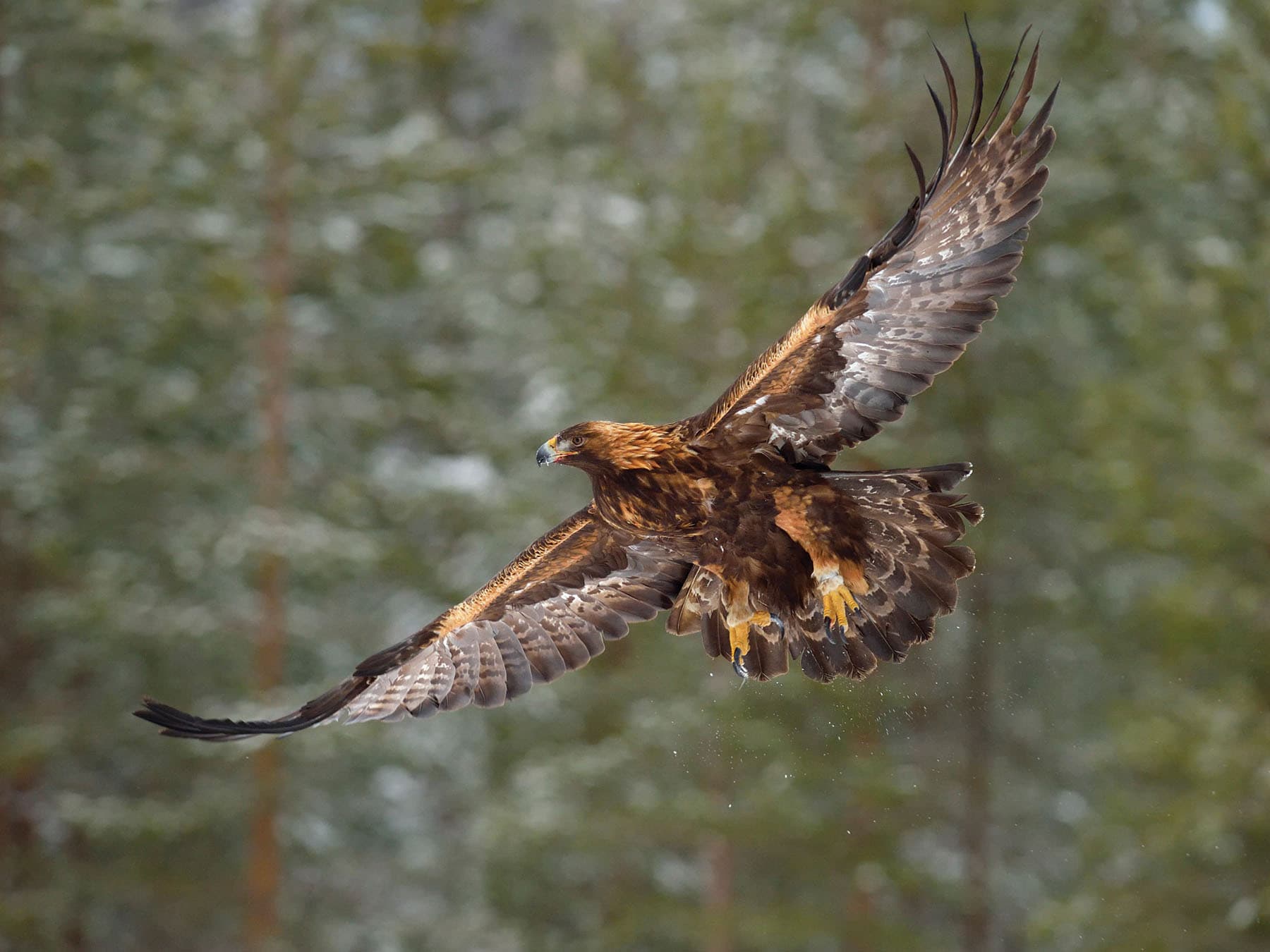
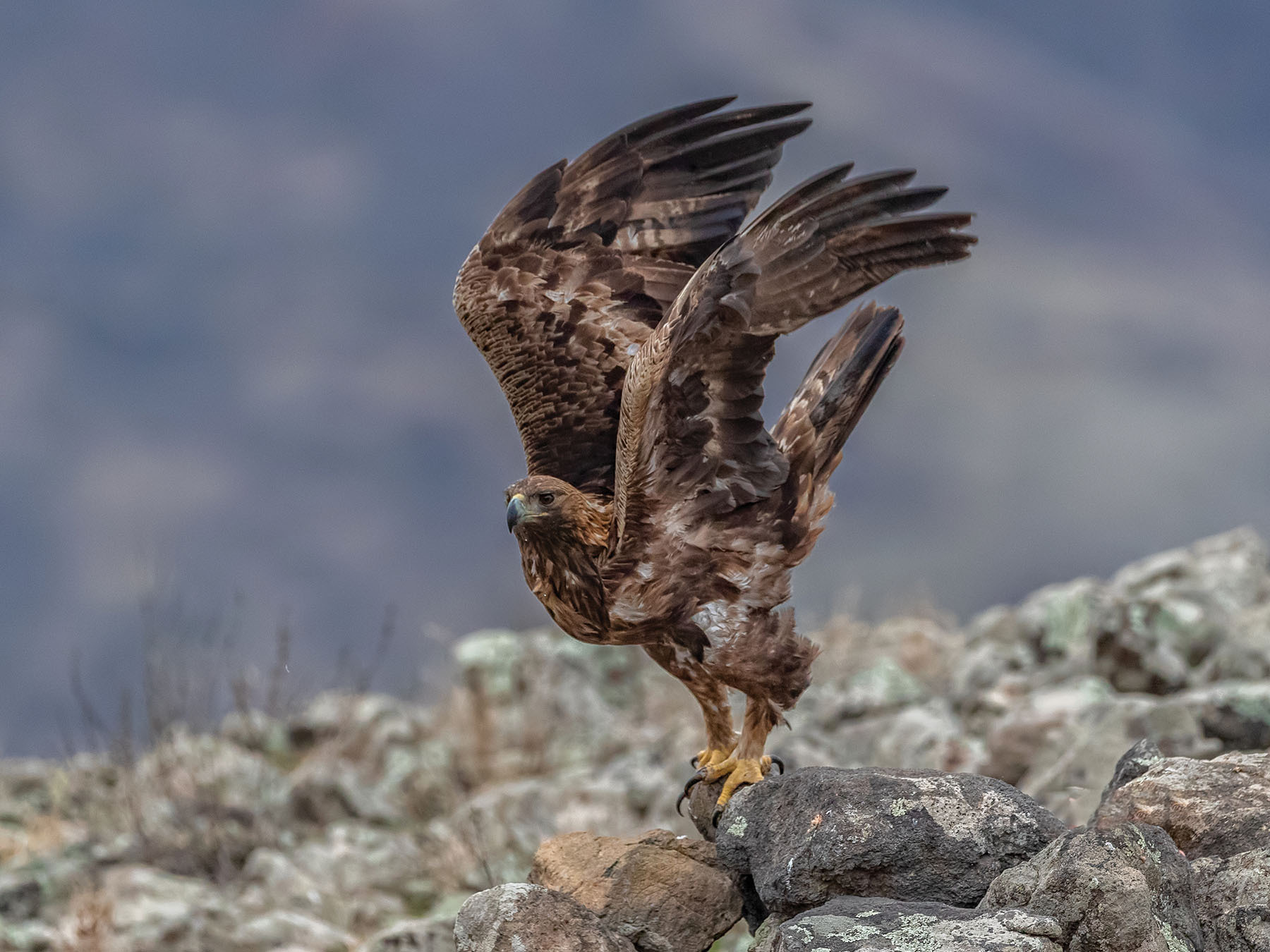
The Golden Eagle is named for the golden plumage on its nape and the back of its head, although the rest of its body is covered in chocolate-brown plumage. Soaring birds show paler flight feathers, and the under tail feathers are often a golden hue.
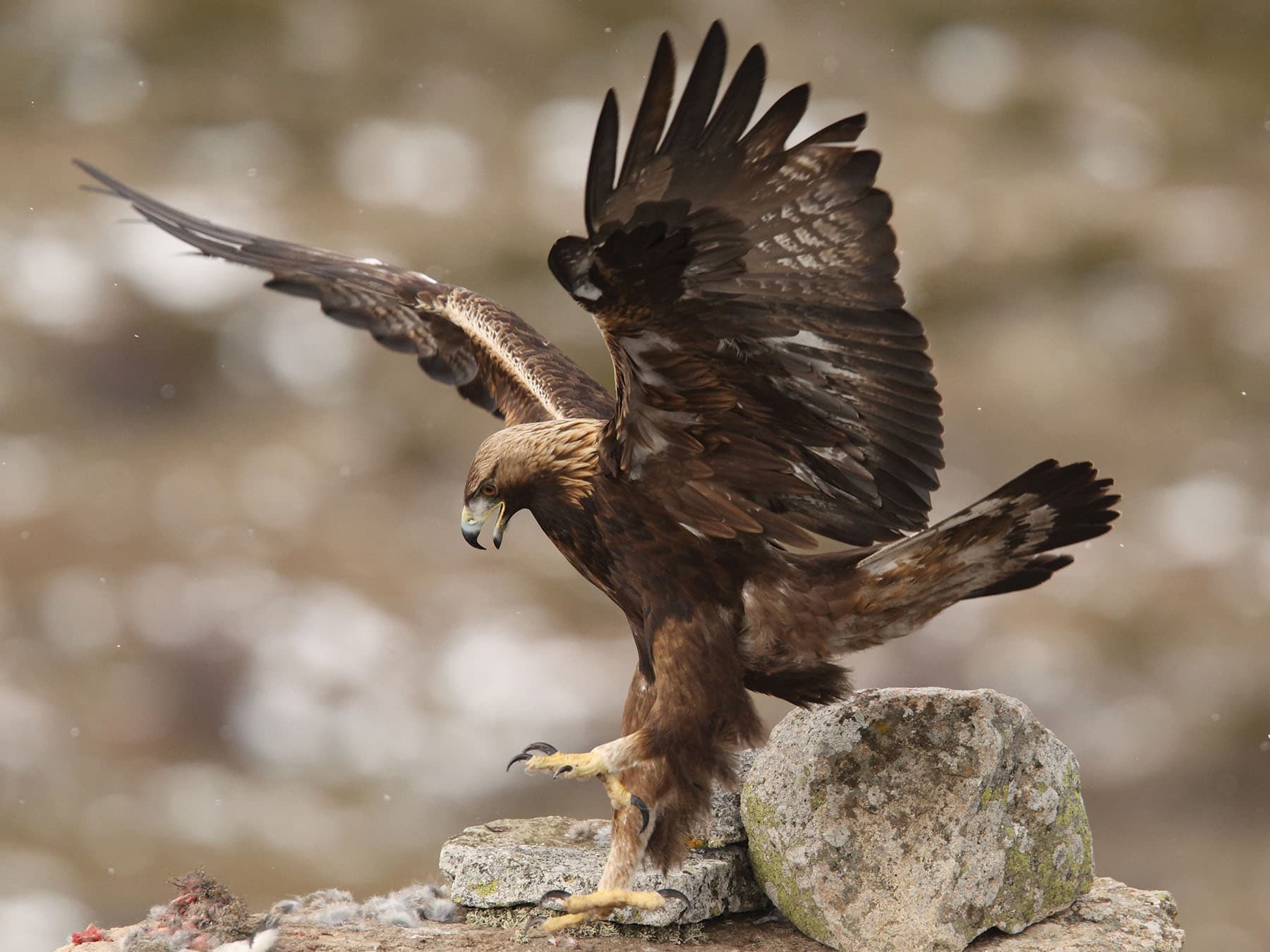
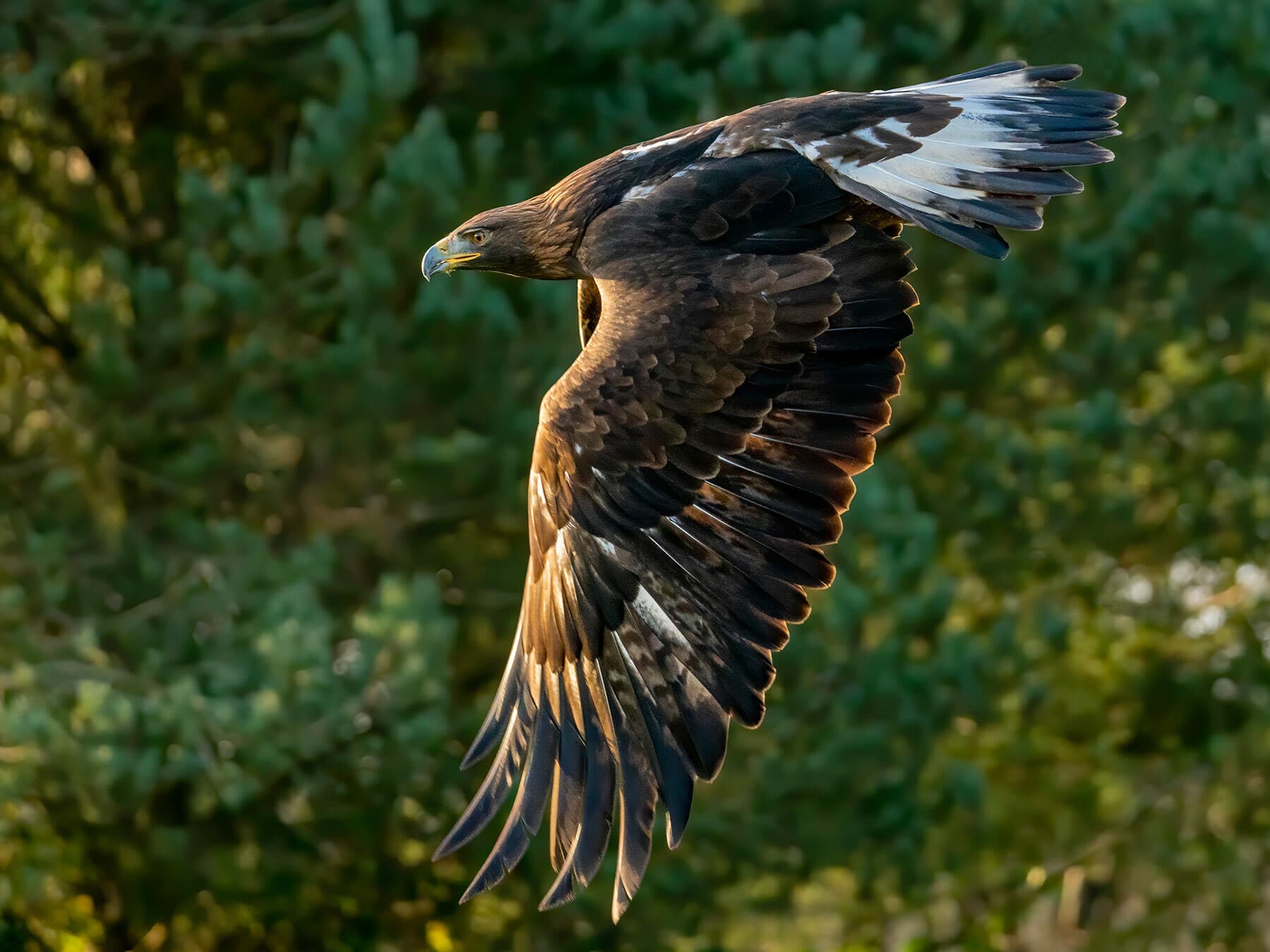
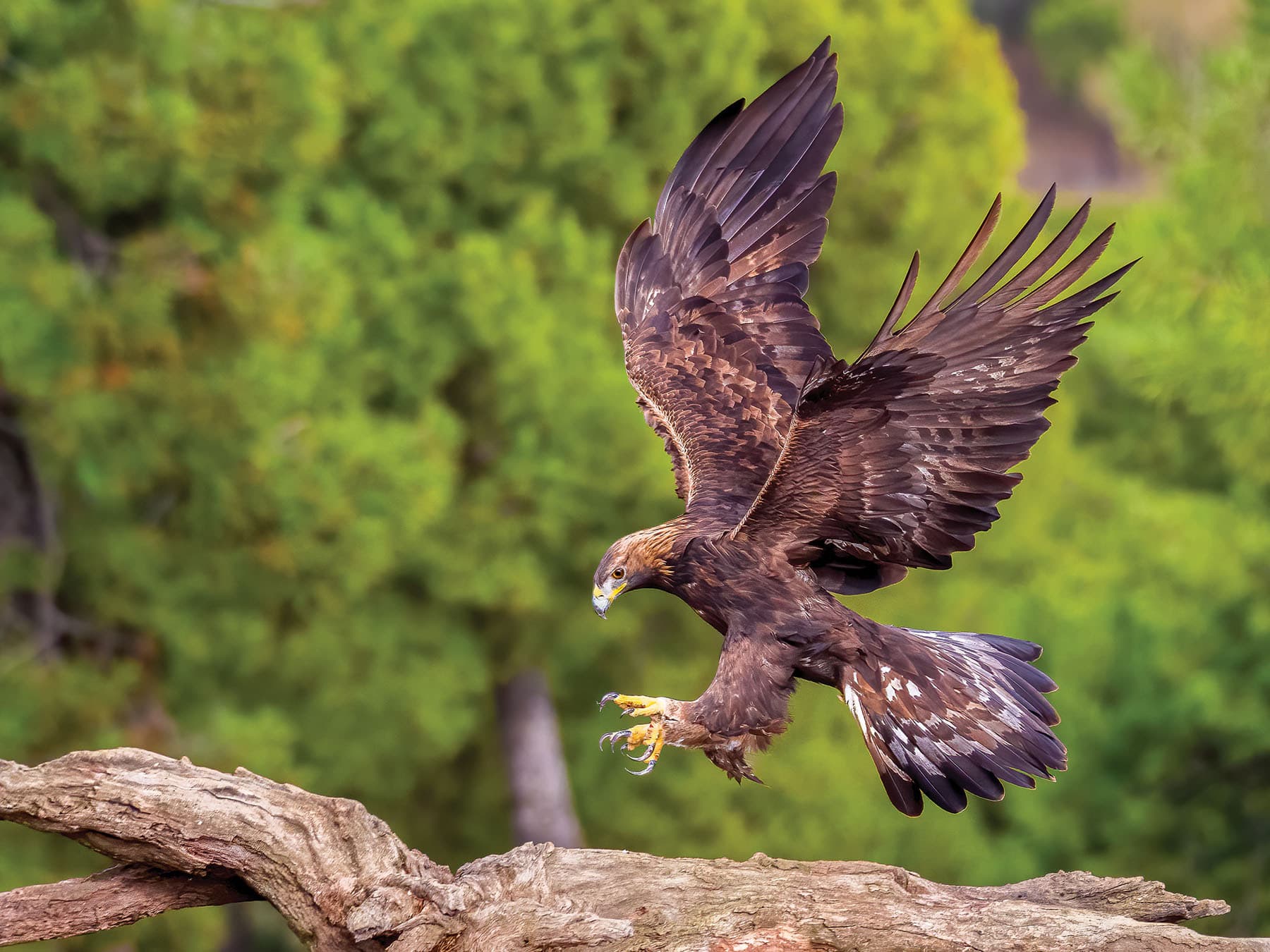
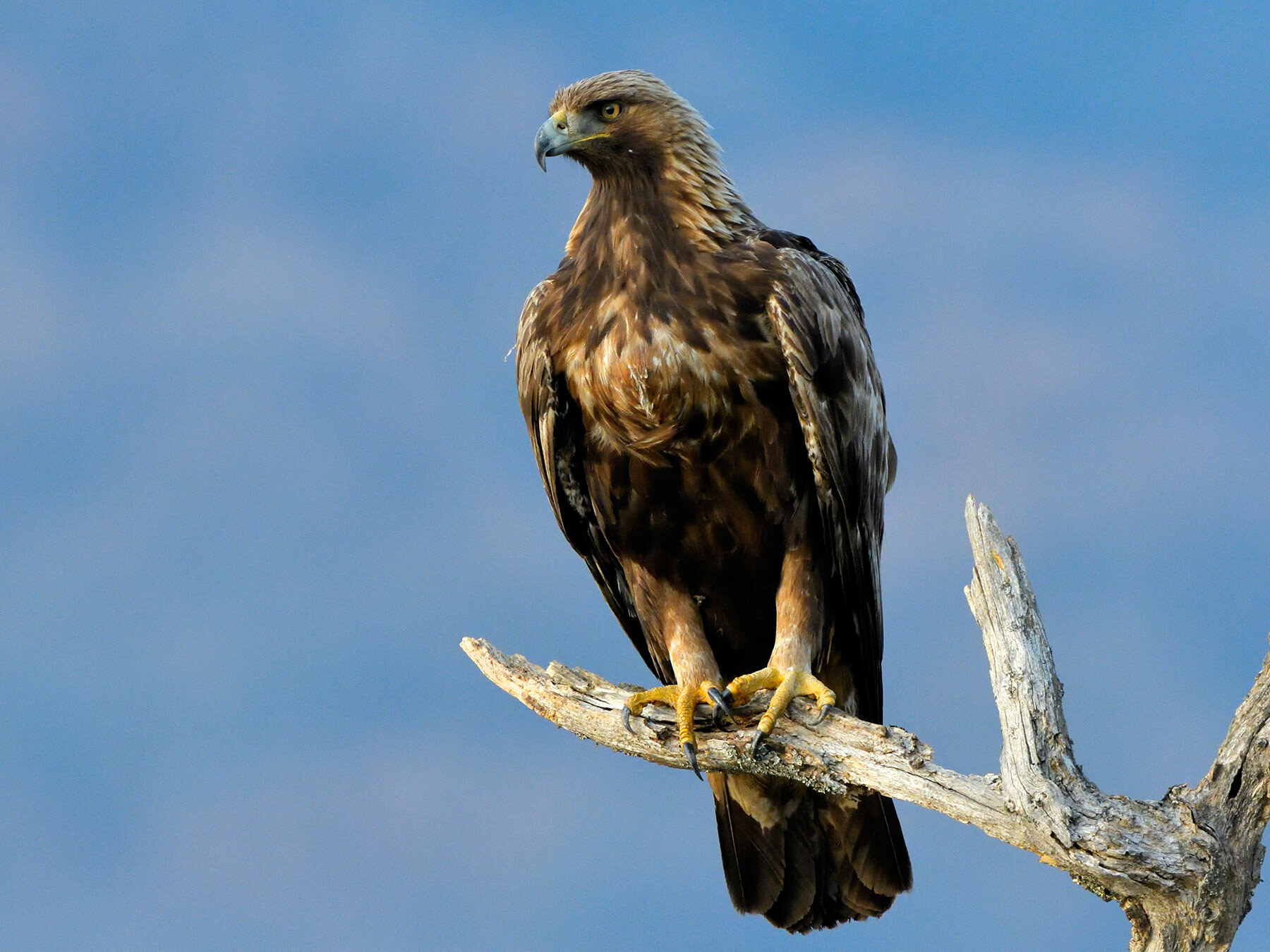
Golden Eagles have very long wings, complete with prominent, finger-like primary feathers at their tips. In flight, their heads appear much smaller than their tails. Perched birds show heavily feathered legs and bright yellow feet with impressive talons up to 6 centimetres (2½ in) long.
The tip of their bill is black, becoming lighter towards the base. The cere and gape are yellow, and the eye colour varies from yellow to dark brown. Male and female Golden Eagles have very similar plumage.
Juvenile Golden Eagles show more variable plumage than adults. They are easily identified by the white patch on each wing and the base of the tail. These distinctive markings are present for their first three or four years.
Smaller birds of prey like the Red-tailed Hawk and Eurasian Buzzard are often mistaken for the Golden Eagle. The Juvenile Bald Eagle and White-tailed Eagle could also cause some confusion.
How big are Golden Eagles?
Golden Eagles are one of the World’s largest birds of prey and an impressive sight both perched and in flight. Females are generally larger than males in all measurements.
Length
Golden Eagle body lengths vary significantly between the sexes and various subspecies. The smallest individuals measure about 70 centimetres (2 ft 3 in) long, while the largest reach nearly a meter (3 ft 4 in).
Weight
Golden Eagles reach impressive weights. Males generally weigh between 2.4 and 4.5 kilograms (5.3 - 10 lb), while the larger females weigh approximately 3 to 6.5 kilograms (6.6 - 14.3 lb).
Wingspan
A heavy body needs a large wingspan for sustained flight, and these eagles are masters of the air. Most adults have a wingspan of 1.85 to 2.2 meters (6 ft 1 in - 7 ft 2 in).
Check out this in-depth article on Golden Eagle size for more facts and figures about this impressive bird.
Its size
Adults- Length
- 66–102 cm
- Wingspan
- 180–230 cm
- Weight
- 3000–6700 g
Its song and calls
Golden Eagles produce a variety of calls, although you are more likely to see them than hear them. Continue reading to learn more about Golden Eagle vocalisations.
What sound does a Golden Eagle make?
Nestling Golden Eagles produce various calls ranging from whistles to barks. The young birds are highly vocal and can often be heard from long distances. Adults have an equally wide range of calls, including screams, chirps, barks, and even duck-like calls.
Why do Golden Eagles call?
Golden Eagle calling behaviour is understudied, although adults are known to communicate with their partners and neighbouring pairs.
Chicks call loudly to beg for food, while adults often call to announce their return to the nest. After fledging, young birds may call to maintain contact with their family.
- Call0:00 / 0:25
Recorded in Kinlochewe, Scotland
Lawrence Shove / The British Library Board · Wikimedia Commons · CC BY-SA 4.0
When and where to see it
OctoberArriving
Most recorded in October
- 1. Yukon Territory1.0%
- 2. Wyoming0.73%
- 3. Montana0.49%
- 4. Utah0.41%
- 5. South Dakota0.23%
Each dot is a county, state or province: the bigger and darker, the larger the bird’s share of that place’s bird records that month. Grey dots: no regular records. The ringed point is the centre of the bird’s records this month; the arrow shows how it moved since last month, and the dashed loop its path through the year. “Arrivals” colours places where it becomes regular this month (orange) or is in its last regular month (grey). GBIF eBird Observation Dataset, 2019–2024. Map data: Natural Earth, US Census Bureau; place centres © OpenStreetMap contributors.
In your area
See when the Golden Eagle is recorded in your county, state or province.
How often the Golden Eagle turns up in the UK, Ireland, the United States and Canada through the year, from birdwatchers' records.
Ireland
Passage migrant · regularly Apr · most records in April
United States
Resident · all year · most records in January
Canada
Winter visitor · all year · most records in November
Show as a table
| Month | Ireland | United States | Canada |
|---|---|---|---|
| January | <0.001% | 0.049% (regular) | 0.028% (regular) |
| February | – | 0.043% (regular) | 0.029% (regular) |
| March | – | 0.039% (regular) | 0.054% (regular) |
| April | 0.003% (regular) | 0.026% (regular) | 0.022% (regular) |
| May | <0.001% | 0.017% (regular) | 0.008% (regular) |
| June | – | 0.026% (regular) | 0.014% (regular) |
| July | 0.002% | 0.024% (regular) | 0.015% (regular) |
| August | 0.002% | 0.025% (regular) | 0.010% (regular) |
| September | – | 0.024% (regular) | 0.013% (regular) |
| October | <0.001% | 0.032% (regular) | 0.053% (regular) |
| November | – | 0.044% (regular) | 0.056% (regular) |
| December | – | 0.040% (regular) | 0.023% (regular) |
Recorded in United Kingdom, but eBird withholds many records of this sensitive species to protect it, so no months are shown.
Recorded regularly in
Worldwide: recorded regularly in 51 countries
Countries where it was recorded in at least 3 of the 6 years 2019–2024. Linked countries have their own bird list.
Europe (27)
Asia (18)
- Armenia
- Azerbaijan
- Bhutan
- China
- Georgia
- India
- Iran
- Iraq
- Kazakhstan
- Kyrgyzstan
- Mongolia
- Nepal
- Oman
- Pakistan
- South Korea
- Tajikistan
- Turkey
- Uzbekistan
North America (3)
Data: EOD – eBird Observation Dataset (Cornell Lab of Ornithology), accessed via GBIF.org, CC BY 4.0. Records from 2019–2024, aggregated and filtered by Birdfact. How these lists are made
The Golden Eagles' success results partly from its wide habitat tolerance. Continue reading to learn where Golden Eagles live and where you might spot these majestic raptors.
What is the habitat of a Golden Eagle?
Golden Eagles inhabit a wide range of habitats, from open plains to mountainous terrain and from sea level to over 8000 feet (2400 m). Typical habitats include grasslands, prairie, shrublands, deserts, hillsides, and mountain ranges.
What is the range of a Golden Eagle?
The Golden Eagle is the World’s most widespread Eagle species. It has a tremendously wide distribution in the Northern Hemisphere, including most of North America, Asia, and much of Europe. They also occur in parts of North Africa.
Where do Golden Eagles live?
Golden Eagles spend between 78% and 85% of their day perched on cliffs, mountainsides, and trees. Most of their remaining time is spent soaring effortlessly over their territory.
Take a look at our comprehensive guide on where Golden Eagles live.
How rare are Golden Eagles?
The Golden Eagle is not a common bird, although about 160,000 mature individuals are spread out across their vast range. This may not be a large number, but the population is stable.
Where can you see Golden Eagles in North America?
Golden Eagles have an extensive range in North America, from Alaska in the north to Mexico in the south.
They are widespread in the United States, particularly in the winter when northern breeders arrive from Canada. They are most common in the western half of the Lower 48, where they are breeding residents.
Golden Eagles are also most common in Canada’s mountainous west, although birdwatchers could see them almost anywhere in suitable habitat. They are also common in northwestern Quebec and Labrador.
Where can you see Golden Eagles in the UK?
In the UK, Golden Eagles are confined largely to the hillsides and glens of the Scottish Highlands and Islands. Birdwatchers might see these fine raptors in the following hotspots:
- The eagle observatory on the Isle of Harris
- Glen Affric
- Inverness-shire’s Findhorn Valley
- Cairngorms National Park
Signs and spotting tips
In winter and early spring, the golden eagle will perform aerial displays, with pairs cartwheeling through the air. The golden eagle will also sit in treetops for long periods on the lookout for prey.
Migration
Golden Eagles are present throughout the year where conditions permit, but harsh northern climates necessitate annual movements.
Do Golden Eagles migrate?
Golden Eagles are partial migrants. These birds are breeding residents in the western half of the USA, and along the west coast of Canada to Southern Alaska. They visit other parts of Alaska and Canada to nest each summer, returning to the eastern half of the lower 48 for the winter.
Golden Eagles are migratory, partially migratory, or sedentary in the Old World, although they are resident in Scotland and Northern Ireland.
What it eats
Golden Eagles are fearsome predators that hunt a surprising variety of animals. Continue reading to learn more about the Golden Eagle diet.
What do Golden Eagles eat?
Golden Eagles eat everything from mice to small deer, although most of their prey weighs roughly one to nine pounds. Unlike smaller birds, Golden Eagles can go a few days between meals. Hares, rabbits, ground squirrels, marmots, and gamebirds like grouse are all common prey items.
Golden Eagles will also take larger prey like the young of deer, wild sheep and goats, although they rarely hunt domestic livestock.
They are not afraid to hunt other predators and readily tackle small carnivores like foxes and even domestic cats. They readily feed on animal carcases, including those killed by other carnivores.
Check out our in-depth guide on what Golden Eagles eat, along with hunting techniques and behavior.
What do Golden Eagle chicks eat?
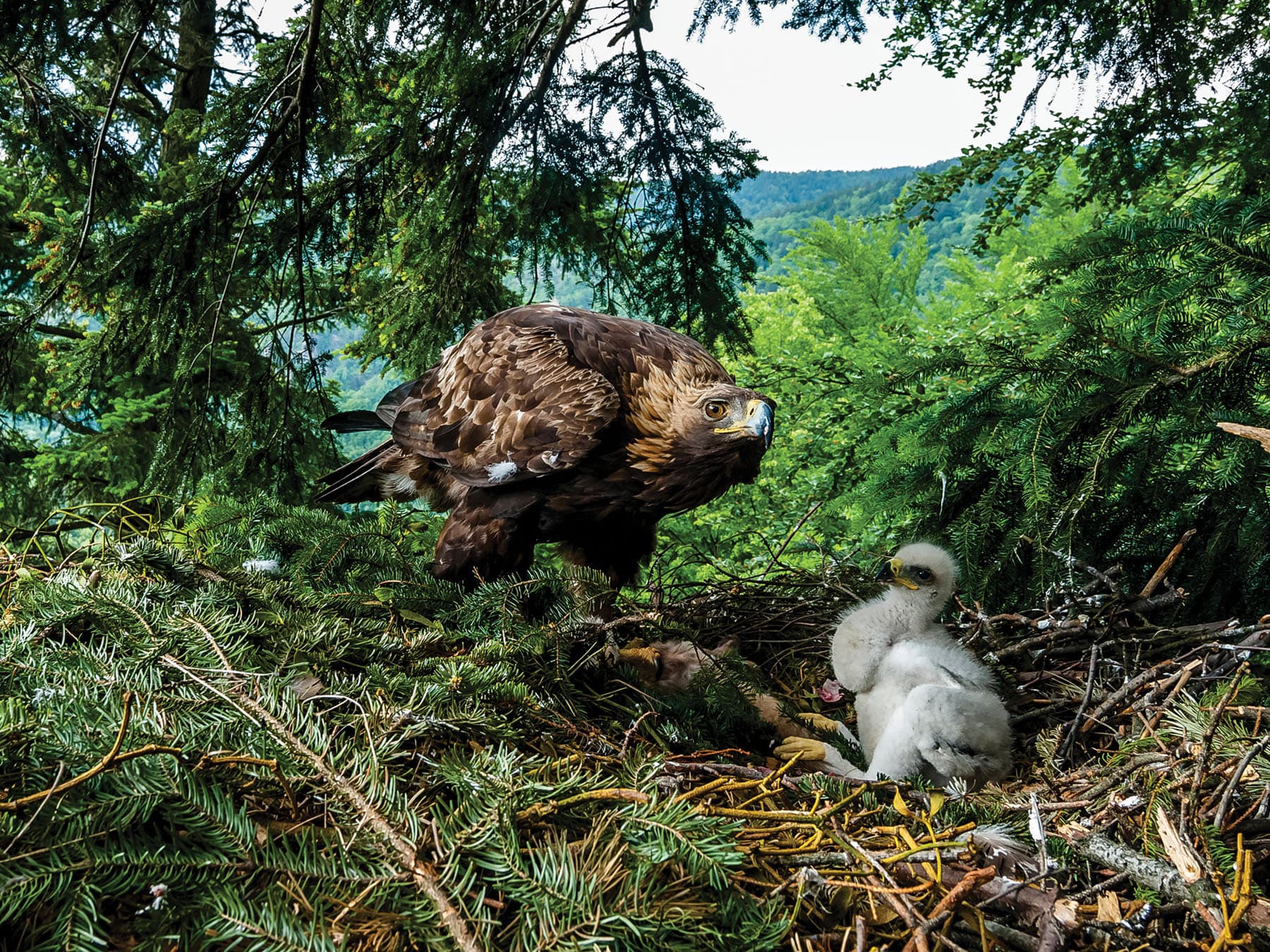
Baby Golden Eagles are fed primarily by their mother, although both parents bring food to the nest. They rely on their mother to tear small strips of meat for them until they are about five weeks old.
The young birds begin feeding themselves more and more in their second month. However, their parents will continue to provide for them for seven to twelve weeks after fledging the nest when migration begins or when the young birds disperse from their parents’ territory.
Nesting and breeding
Where do Golden Eagles nest?
Golden Eagles build their nests on cliffs and in trees where they are inaccessible to land predators. Ideal nesting locations are near good hunting grounds where the parents can catch enough prey to provide for their growing chicks.
Nest construction is a slow process that starts in the autumn/fall, although pairs often choose to refurbish old nests. There may be several nests in an established territory.
What do Golden Eagle eggs look like?
Golden Eagles lay one to three white, cream, or pinkish eggs, each measuring about 75 millimetres long and 58 millimetres wide.
Do Golden Eagles mate for life?
Golden Eagles do not necessarily mate for life, although they may form partnerships that last several years.
Behaviour
Are Golden Eagles aggressive?
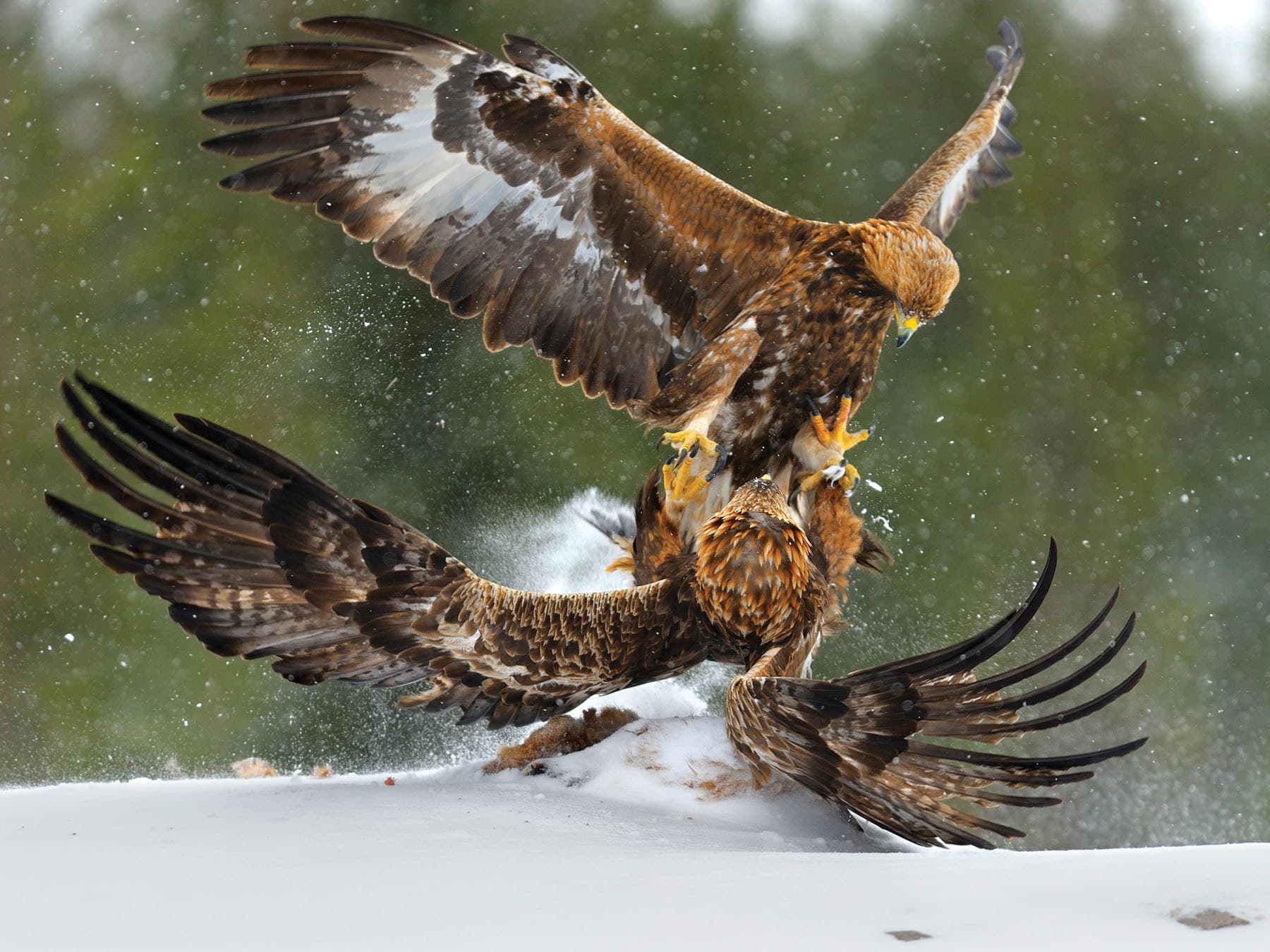
Golden Eagles are relatively aggressive eagles, and this behaviour is apparent from a young age. In fact, young eaglets may show aggression towards their parents even before they leave the nest.
Adults are aggressively territorial, especially before they lay their eggs. Both sexes will get involved in conflicts, although females are usually more willing to defend their territory.
Golden Eagles rarely show aggression toward humans, even around their nests. However, other predators like bears and coyotes are unwelcome, and these bold birds may even launch a physical attack.
They will also attack corvids and other birds of prey that might threaten their young.
Lifespan and predators
Golden Eagles are apex predators with few natural enemies. Humans are their greatest threats, although some predators are brave enough to hunt their eggs and young.
How long do Golden Eagles live?
Golden Eagles that survive to adulthood live to about 14 years on average, although they can live for over 30 years in the wild.
For more information, check out our guide on Golden Eagle lifespans.
What are the predators of Golden Eagles?
Adult Golden Eagles have no major predators. Large carnivores like wolves and bears usually cannot catch them, and no other bird would dare to challenge them.
However, their chicks are vulnerable to mammalian carnivores like wolverines at accessible sites, and unattended nests could be raided by Ravens, Gyrfalcons, and Great Horned Owls.
Are Golden Eagles protected?
Golden Eagles are a protected species. They are protected by the Wildlife and Countryside Act in the United Kingdom and the Bald and Golden Eagle Protection Act and the Migratory Bird Treaty Act in the United States.
Are Golden Eagles endangered?
Golden Eagles are not endangered. Their global conservation status is ‘Least Concern’ due to their extensive distribution and stable population.
Conservation
While listed as Least Concern globally, Golden Eagles face threats from habitat loss, collisions with wind turbines, and illegal shooting.
Conservation efforts focus on protecting nesting sites, mitigating human-wildlife conflicts, and reducing lead poisoning from ingested ammunition in carrion.
Similar birds
Often mistaken for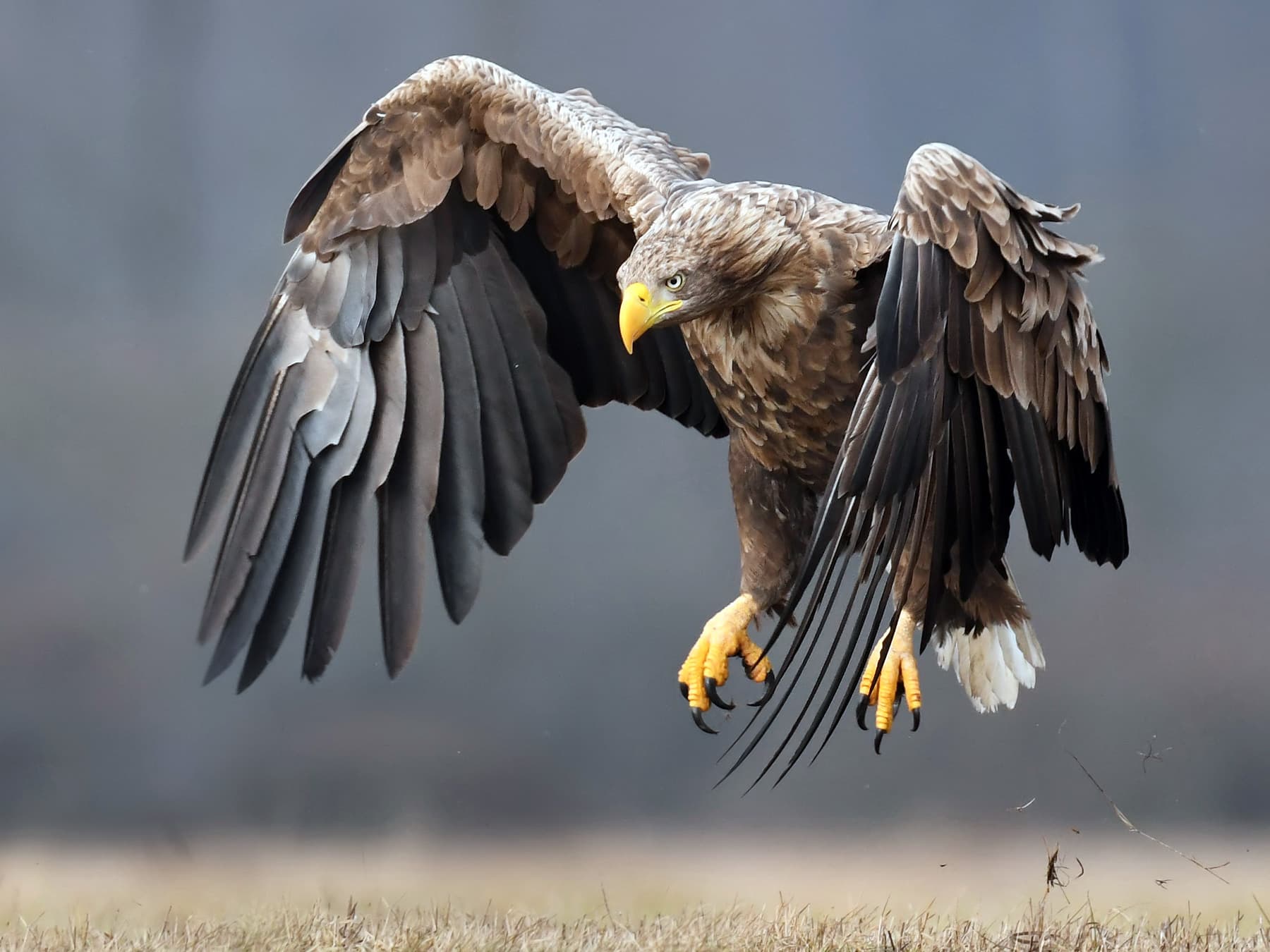

More photos
3 photos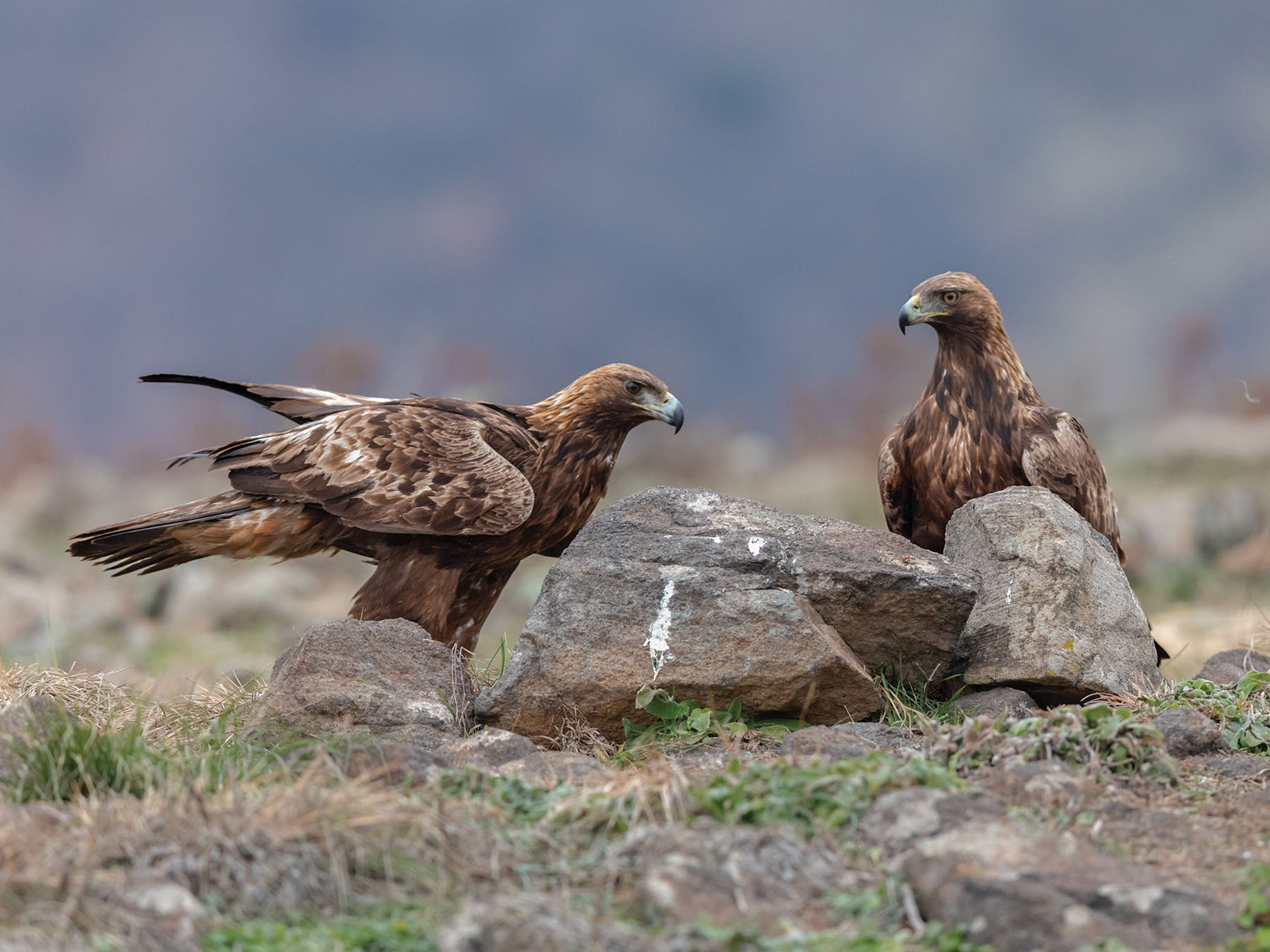
Golden Eagle guides
5 guidesQuick facts
- Length
- 66–102 cm
- Wingspan
- 180–230 cm
- Weight
- 3000–6700 g
- Lifespan
- 20–30 years · oldest recorded 16.1 years
- Family
- Hawks & Eagles
- Migration
- Partial migrant
- Global status (IUCN)
- Least Concern
- World population
- 85,000 - 160,000 mature individuals
- Population trend
- Stable
- Also called
- Royal Eagle, Mountain Eagle
- Scientific name
- Aquila chrysaetos
Questions
2How fast can Golden Eagles fly?
Golden Eagles are powerful in flight and capable of level speeds of about 80 miles per hour. Impressive as that may be, they can move much faster when stooping down to catch their prey, reaching amazing speeds of 150 to 200 miles per hour.
What is so special about the Golden Eagle?
The Golden Eagle is the world’s most widespread eagle species. It has been revered for millennia for its strength and grace and is still honoured as the national bird of Mexico and at least four other countries.
Sources
4- Conservation statusBirdLife International. 2021. Aquila chrysaetos. The IUCN Red List of Threatened Species 2021: e.T22696060A202078899. Source (opens in a new tab)
- Population trendPartners in Flight (2020)
- Population estimateBirdLife International. 2021. Aquila chrysaetos. The IUCN Red List of Threatened Species 2021: e.T22696060A202078899. Source (opens in a new tab)
- Max lifespanBTO longevity records: maximum age from a ringed bird, 16 years, 1 month, 9 days (set in 2007), BirdFacts: Golden Eagle (2007) Source (opens in a new tab)

Checked by
Nathan Cope, founder and editor
Nathan founded Birdfact and leads its writers and contributors in the UK, the US and Canada. He has watched and studied birds for more than ten years, and checks every article and species guide before it’s published.