


Buzzard
Common Buzzard, European Buzzard, Eurasian Buzzard · Buteo buteo
By the Birdfact teamChecked by Nathan Cope
On this page15 sections
How to recognise it
The Buzzard is fairly easy to identify, although the species is highly variable in plumage.
What do Buzzards look like?
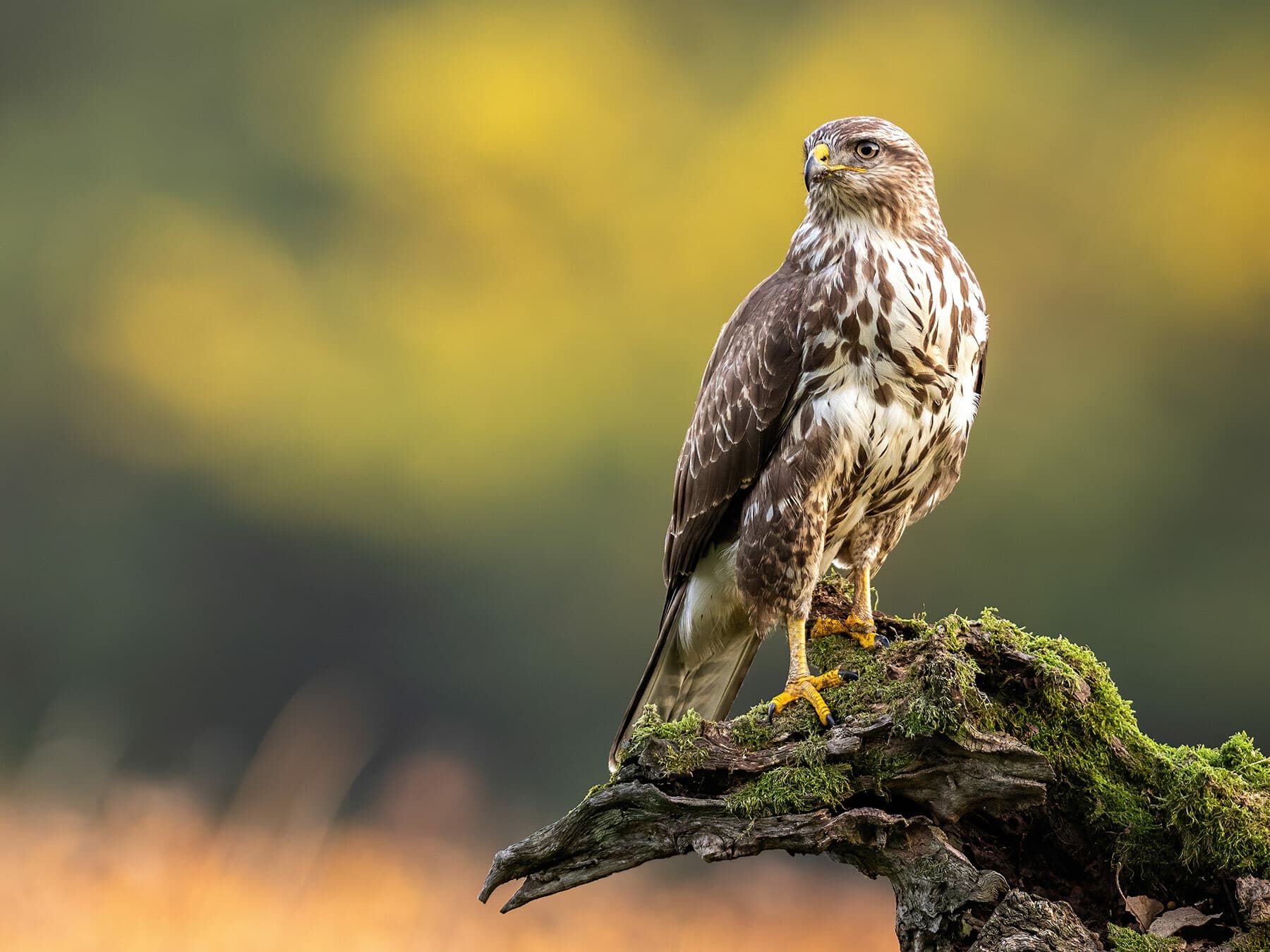
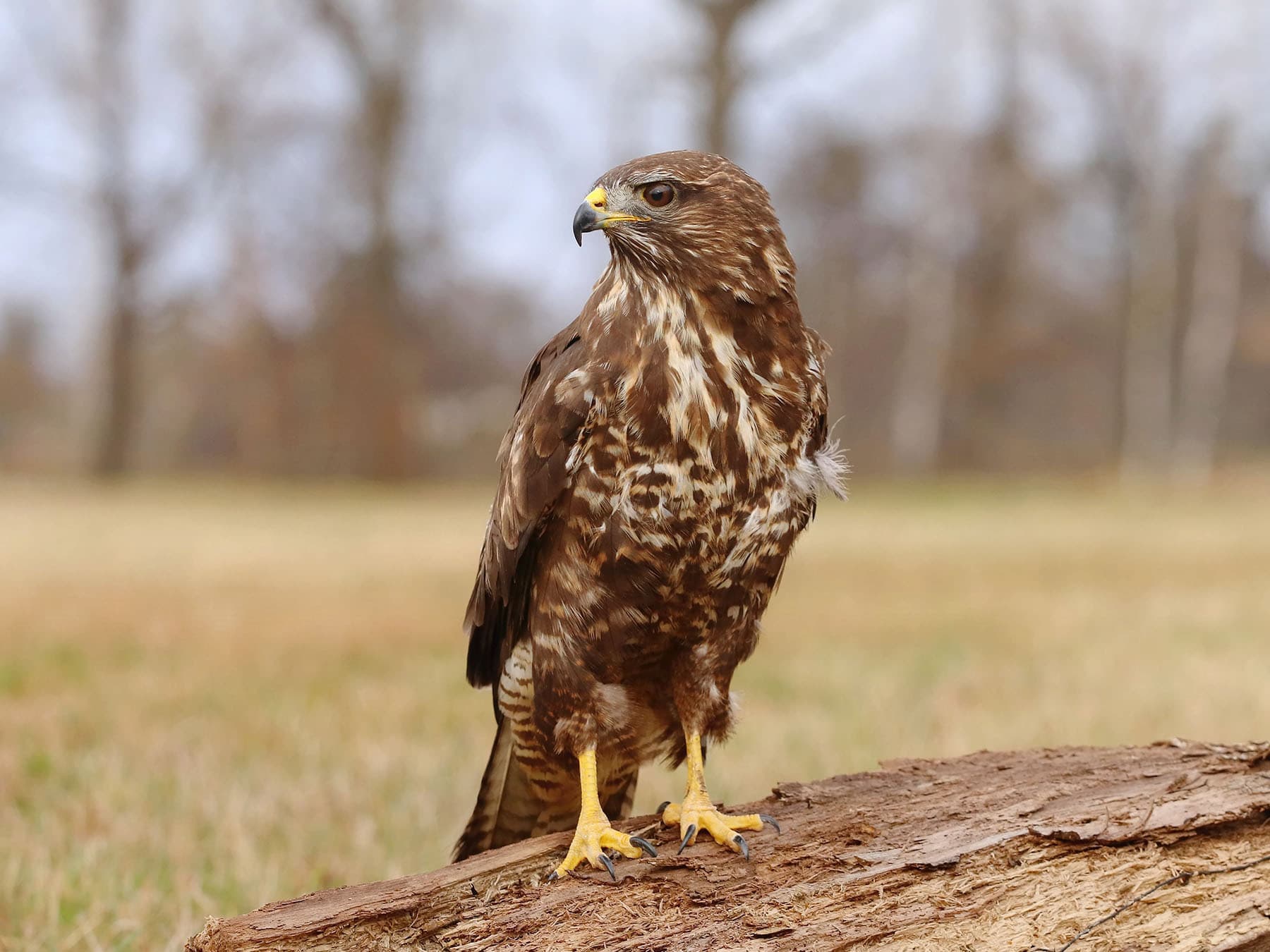
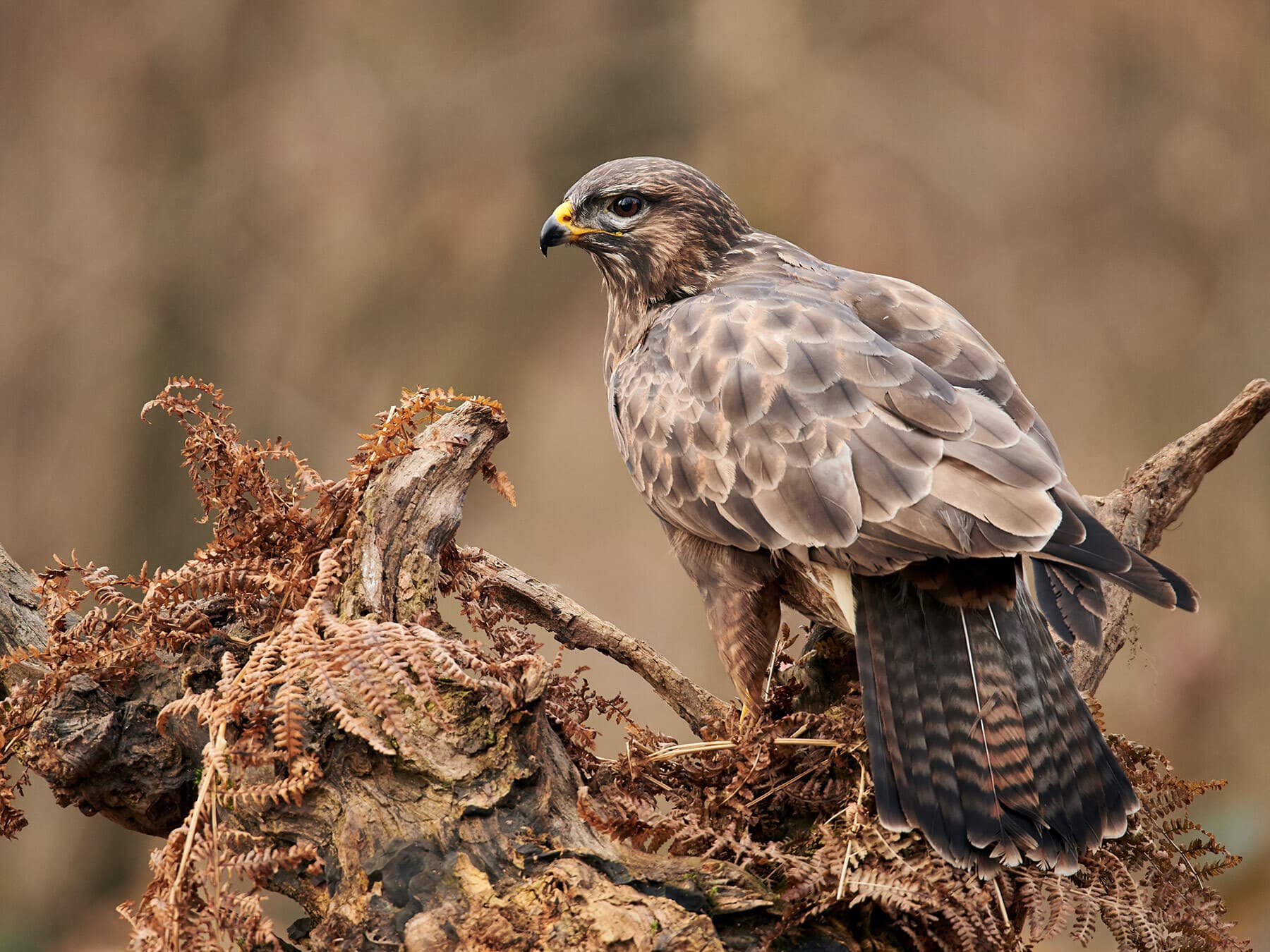
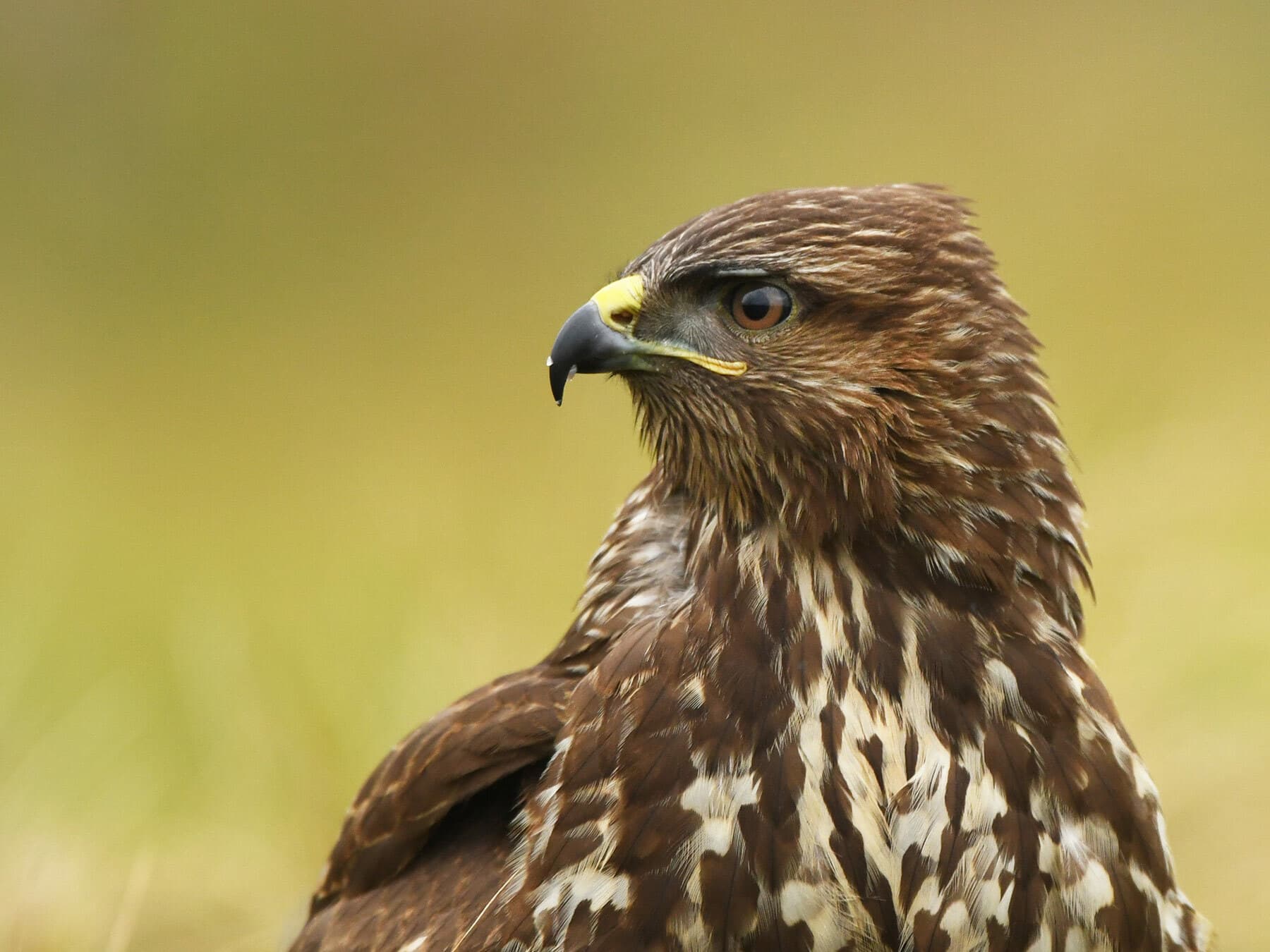
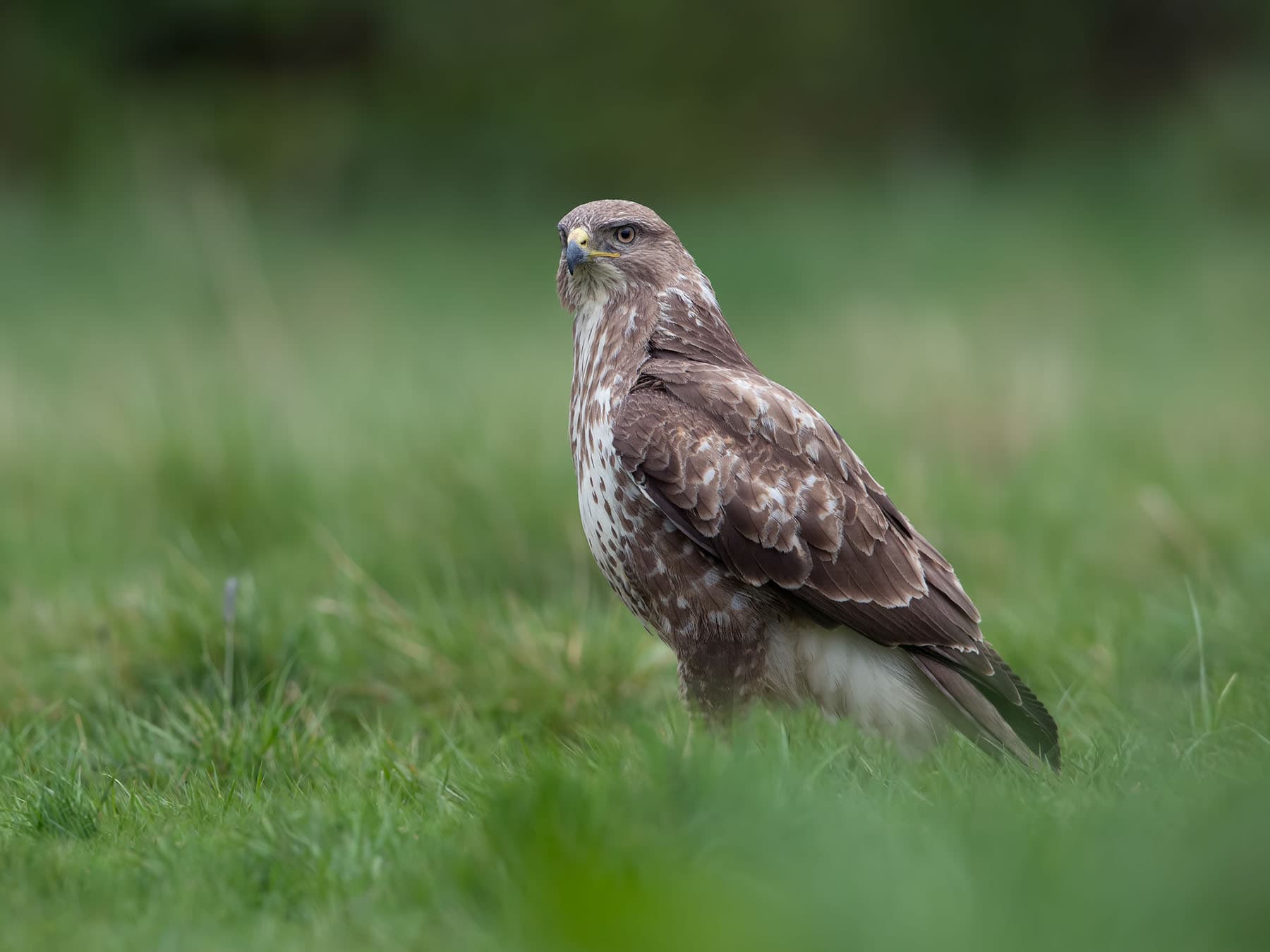
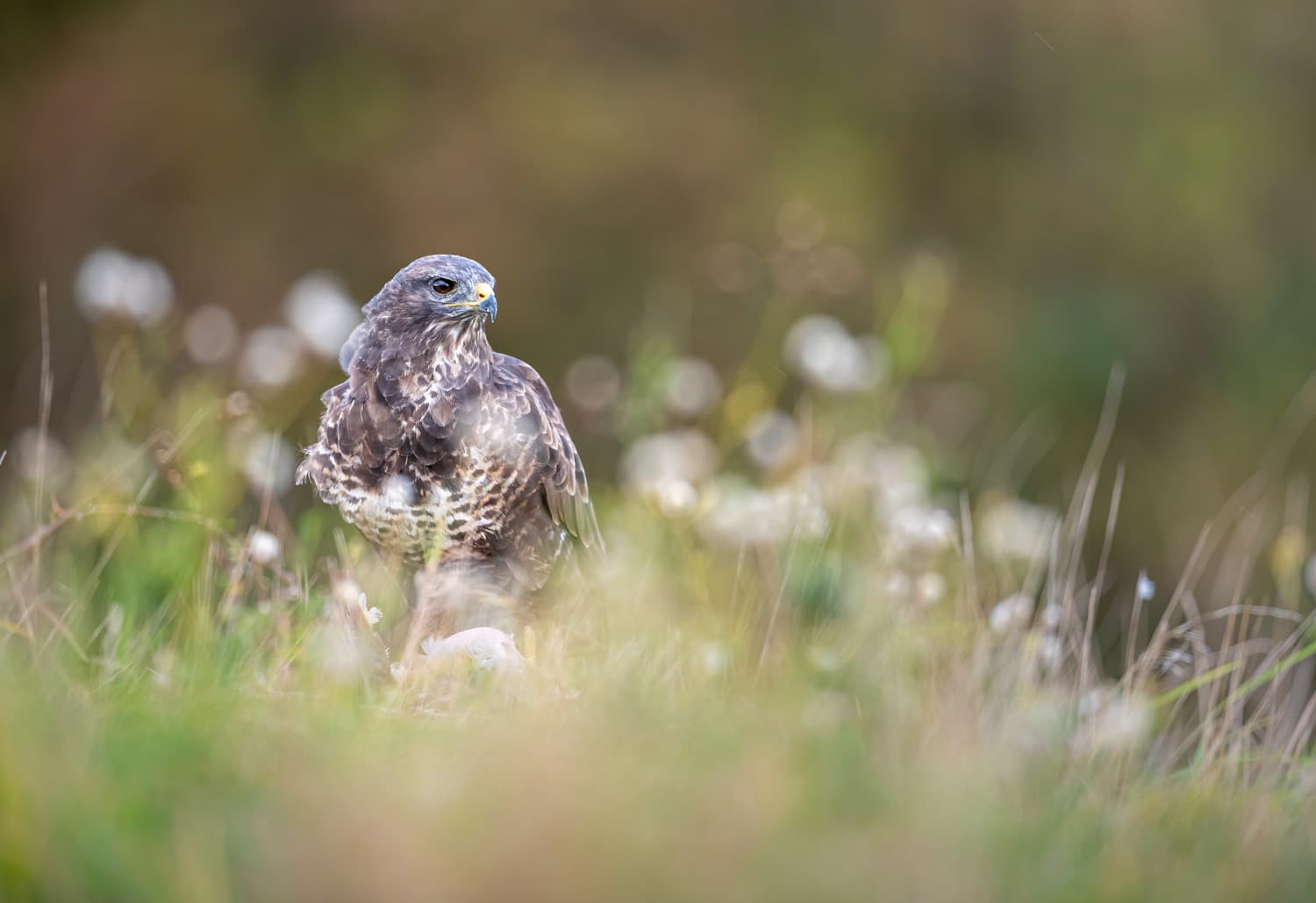
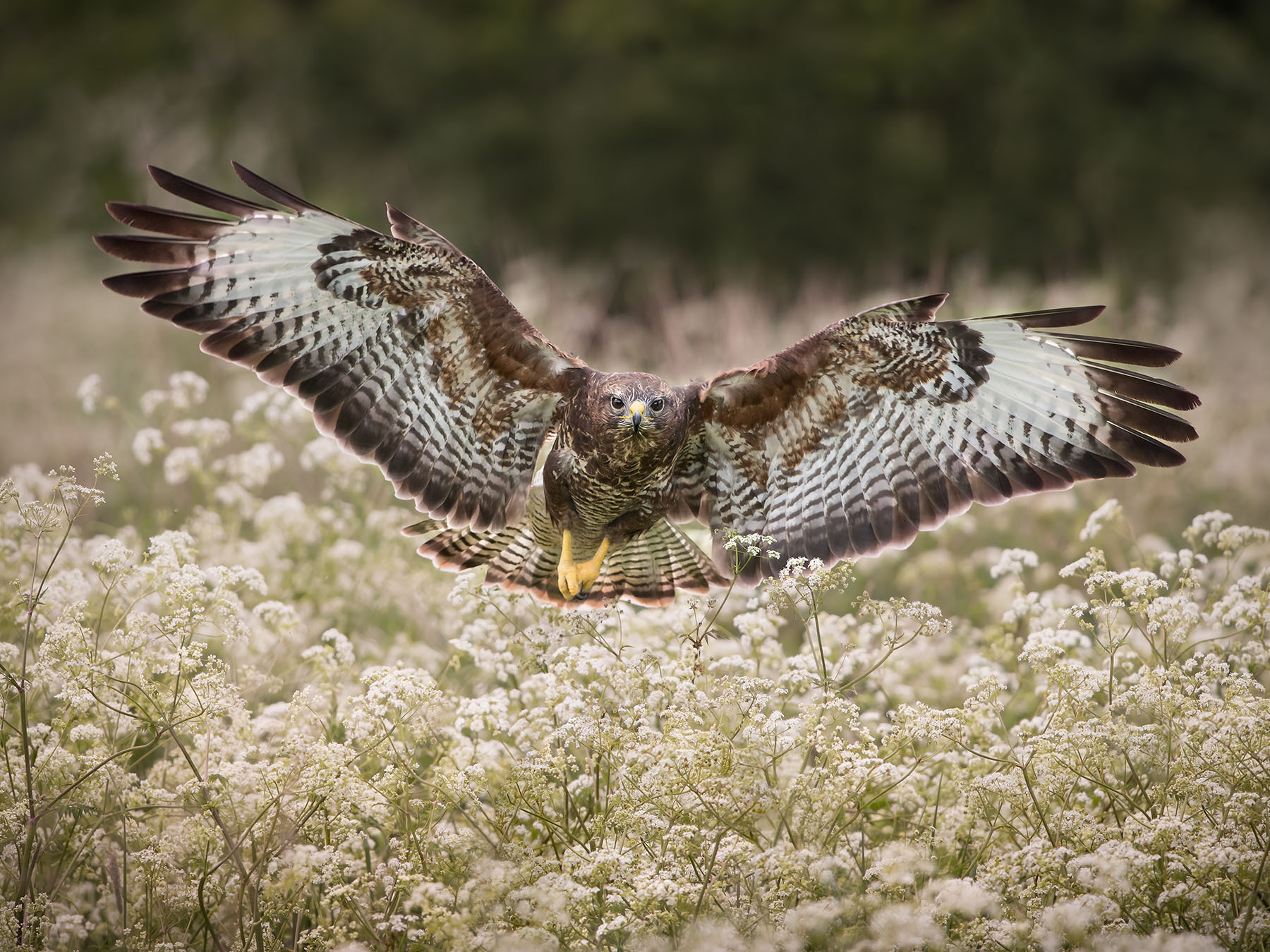
Buzzards are stocky raptors with broad wings and large feet with long talons. They are usually dark brown above, with varying amounts of paler plumage on their undersides. They have yellow legs and ceres (bill bases). The bill tip is black, and they have light to dark brown eyes.
Plumage varies considerably among individual Buzzards, and they are often classified as pale, intermediate, and dark morphs.
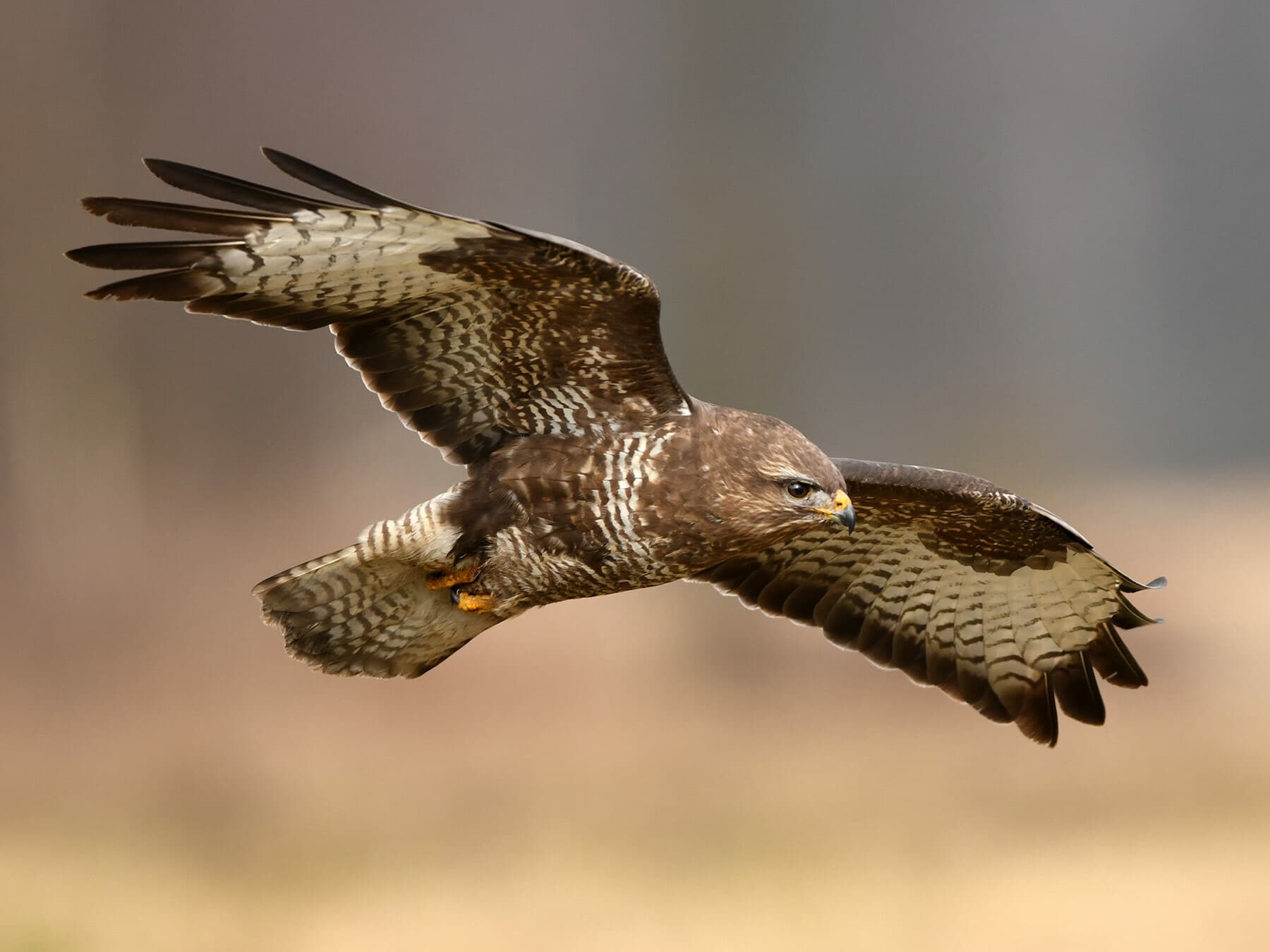
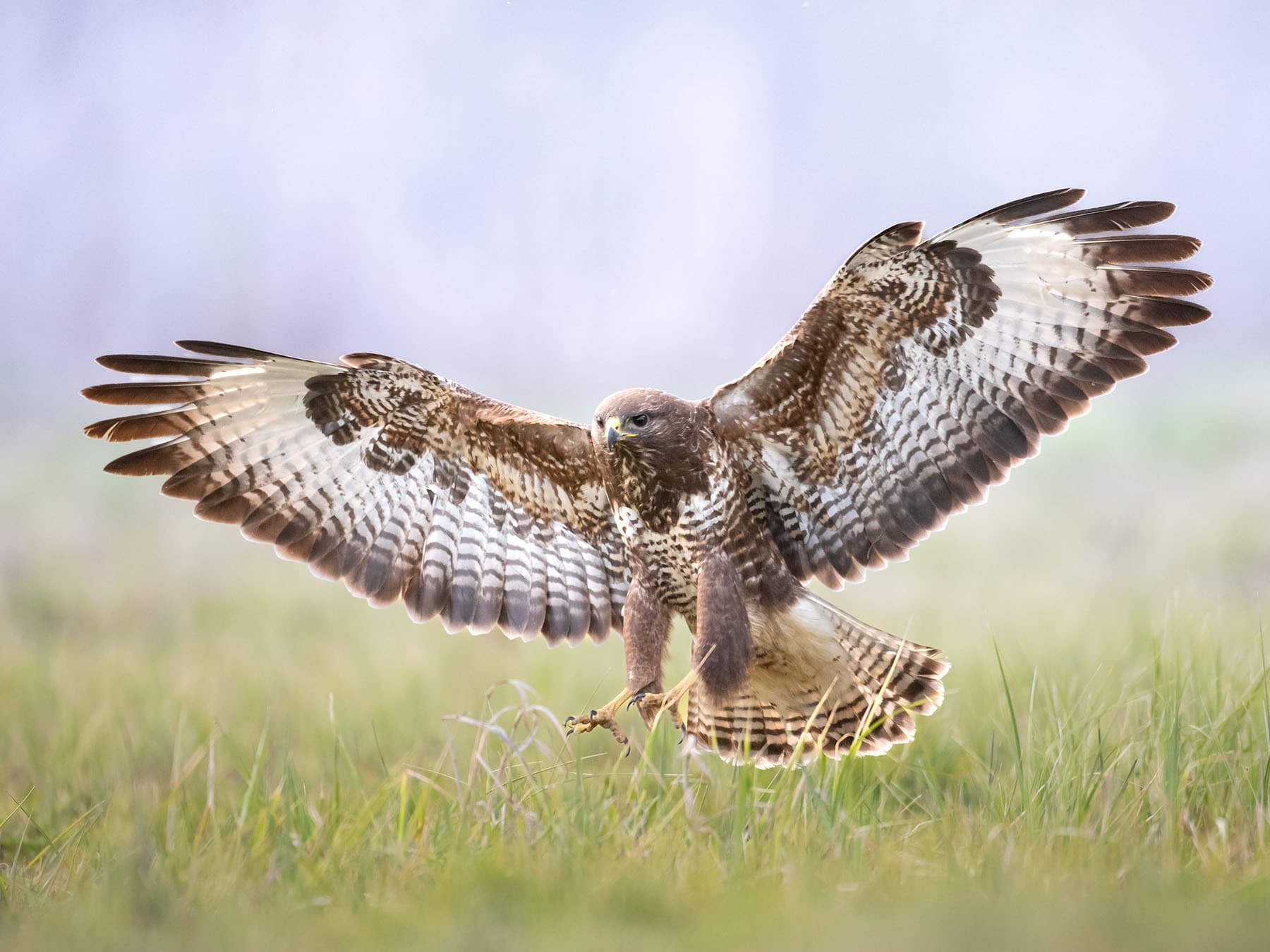
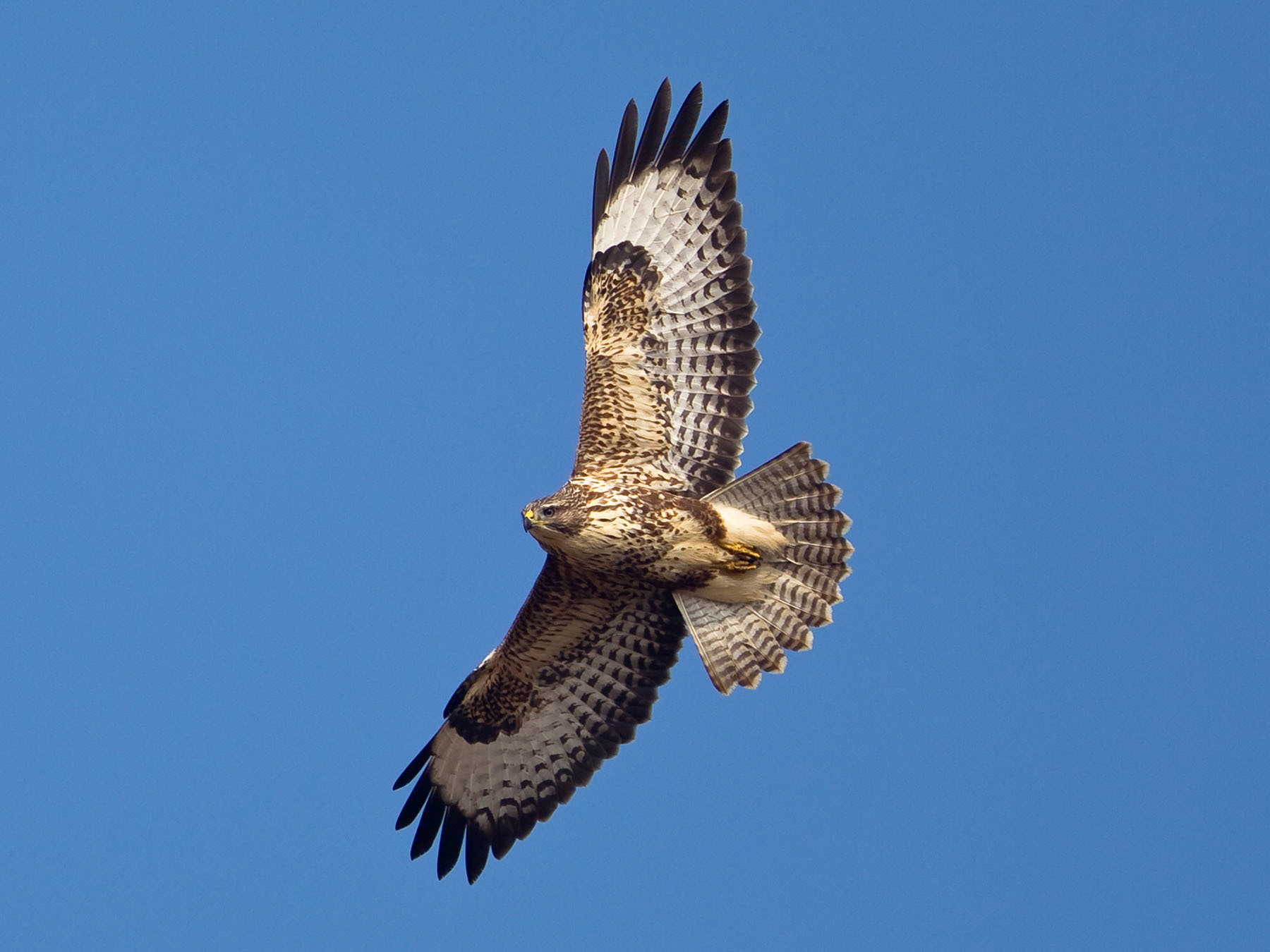
Seen from below, all flying birds have five dark primary feathers visible on each wing tip, and the trailing edge of each wing is usually dark. Their barred tail is fanned out in flight, and each wing is lifted slightly to form a 'V-shaped' profile.
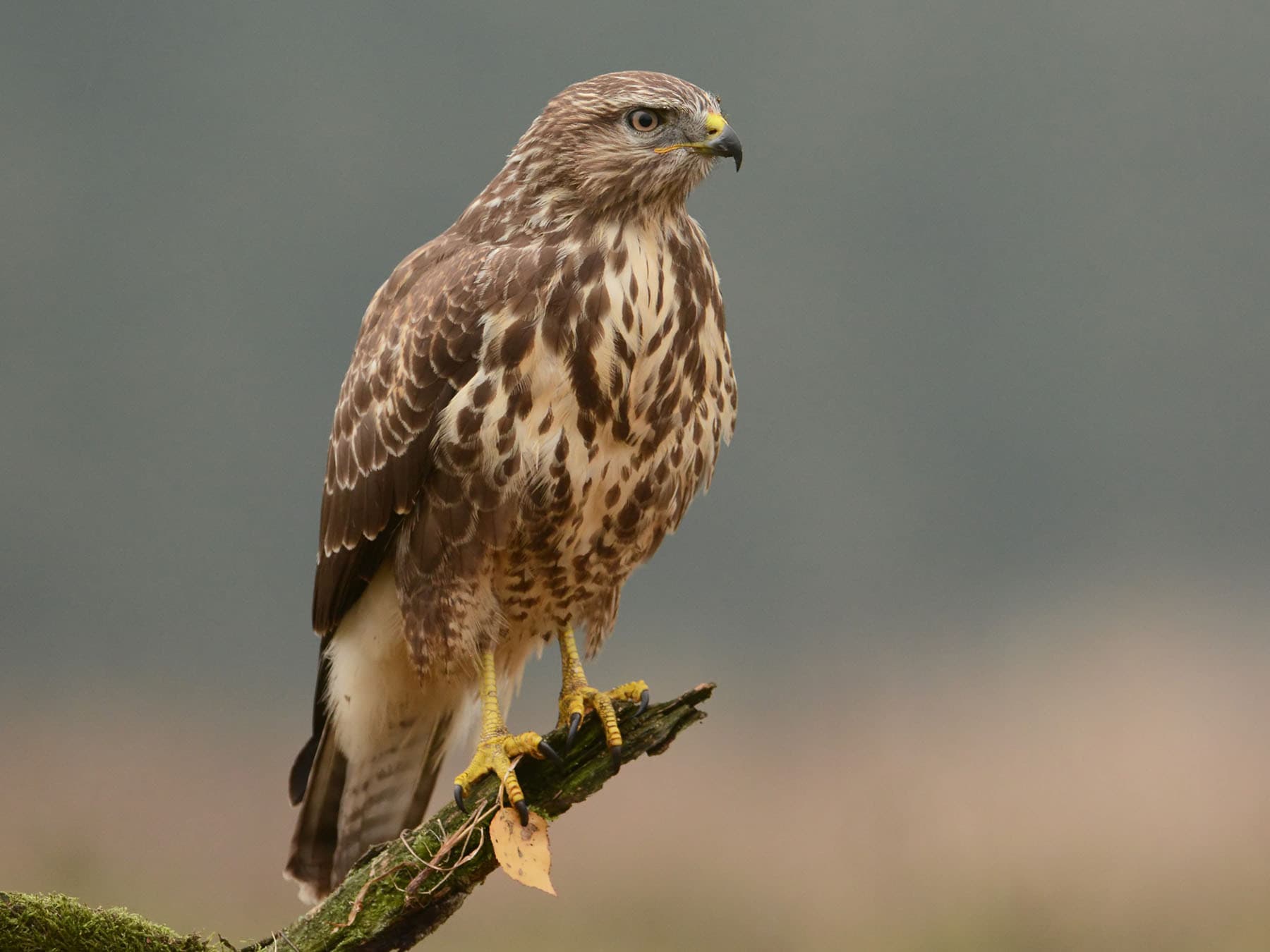
Female Buzzards are usually larger than males, although they appear very similar in other respects. You may be able to distinguish between them when a pair is perched together, but behavioural differences during nesting can be more reliable.
Juvenile Buzzards resemble adults but are paler with streaked (not barred) underparts.
These birds could be mistaken for Honey Buzzards, Marsh Harriers, and Red Kites. Read this guide to birds of prey in the UK for a closer look at those species.
How big are Buzzards?
The Buzzard is highly variable in weight, although their length and wingspans are fairly constant. These are large birds of prey, much bigger than a Kestrel but significantly smaller than a Golden Eagle.
Length
These birds have a body length of 51 to 57 centimetres. Their tails are about 21cm long, their bill is just over 2cm long, and their lower legs are approximately 7.5cm long.
Weight
Adult male Buzzards weigh 427 to 1183 grams, depending on the individual and the time of year. Females are about 15% heavier at 486 to 1364 grams.
Wingspan
The Buzzard has a wingspan of 113 to 128 centimetres. Males are smaller on average.
Its size
Adults- Length
- 51–57 cm
- Wingspan
- 113–128 cm
- Weight
- 550–1200 g
Its song and calls
What sound does a Buzzard make?
Buzzards produce a drawn-out ‘kee-aaah’ call that lasts about a second. This cat-like call is often the first sign of their presence as they soar above.
Why do Buzzards call?
Buzzards call for a variety of reasons. They vocalise when chasing other Buzzards out of their territory, when alarmed by humans or predators, and when arriving back at their nest.
- Alarm call0:00 / 0:23
Recorded in Normandie, France · June 2023
When and where to see it
OctoberHere all year
Most recorded in October
- 1. Offaly3.3%
- 2. Monmouthshire3.0%
- 3. Powys3.0%
- 4. South Lanarkshire3.0%
- 5. Longford2.8%
Each dot is a county, state or province: the bigger and darker, the larger the bird’s share of that place’s bird records that month. Grey dots: no regular records. The ringed point is the centre of the bird’s records this month; the arrow shows how it moved since last month, and the dashed loop its path through the year. “Arrivals” colours places where it becomes regular this month (orange) or is in its last regular month (grey). GBIF eBird Observation Dataset, 2019–2024. Map data: Natural Earth, US Census Bureau; place centres © OpenStreetMap contributors.
In your area
See when the Buzzard is recorded in your county, state or province.
How often the Buzzard turns up in the UK and Ireland through the year, from birdwatchers' records.
United Kingdom
Resident · all year · most records in March
Ireland
Resident · all year · most records in March
Show as a table
| Month | United Kingdom | Ireland |
|---|---|---|
| January | 1.1% (regular) | 0.81% (regular) |
| February | 1.2% (regular) | 0.83% (regular) |
| March | 1.4% (regular) | 1.0% (regular) |
| April | 1.3% (regular) | 0.93% (regular) |
| May | 1.1% (regular) | 0.77% (regular) |
| June | 1.2% (regular) | 0.83% (regular) |
| July | 1.1% (regular) | 0.78% (regular) |
| August | 1.2% (regular) | 0.70% (regular) |
| September | 1.1% (regular) | 0.72% (regular) |
| October | 1.0% (regular) | 0.84% (regular) |
| November | 0.96% (regular) | 0.89% (regular) |
| December | 1.0% (regular) | 0.80% (regular) |
Recorded regularly in
Worldwide: recorded regularly in 100 countries
Countries where it was recorded in at least 3 of the 6 years 2019–2024. Linked countries have their own bird list.
Europe (47)
- Åland Islands
- Albania
- Andorra
- Austria
- Belarus
- Belgium
- Bosnia & Herzegovina
- Bulgaria
- Croatia
- Czechia
- Denmark
- Estonia
- Finland
- France
- Germany
- Gibraltar
- Greece
- Guernsey
- Hungary
- Ireland
- Isle of Man
- Italy
- Jersey
- Kosovo
- Latvia
- Liechtenstein
- Lithuania
- Luxembourg
- Malta
- Moldova
- Montenegro
- Netherlands
- North Macedonia
- Norway
- Poland
- Portugal
- Romania
- Russia
- San Marino
- Serbia
- Slovakia
- Slovenia
- Spain
- Sweden
- Switzerland
- Ukraine
- United Kingdom
Africa (22)
Asia (31)
- Armenia
- Azerbaijan
- Bhutan
- China
- Cyprus
- Georgia
- India
- Iran
- Iraq
- Israel
- Jordan
- Kazakhstan
- Kuwait
- Kyrgyzstan
- Lebanon
- Malaysia
- Mongolia
- Myanmar (Burma)
- Oman
- Pakistan
- Palestinian Territories
- Qatar
- Saudi Arabia
- Singapore
- Sri Lanka
- Syria
- Tajikistan
- Thailand
- Turkey
- United Arab Emirates
- Uzbekistan
Data: EOD – eBird Observation Dataset (Cornell Lab of Ornithology), accessed via GBIF.org, CC BY 4.0. Records from 2019–2024, aggregated and filtered by Birdfact. How these lists are made
Buzzards are widespread and occur in several habitats. Continue reading to learn where you might spot these common raptors.
What is the habitat of a Buzzard?
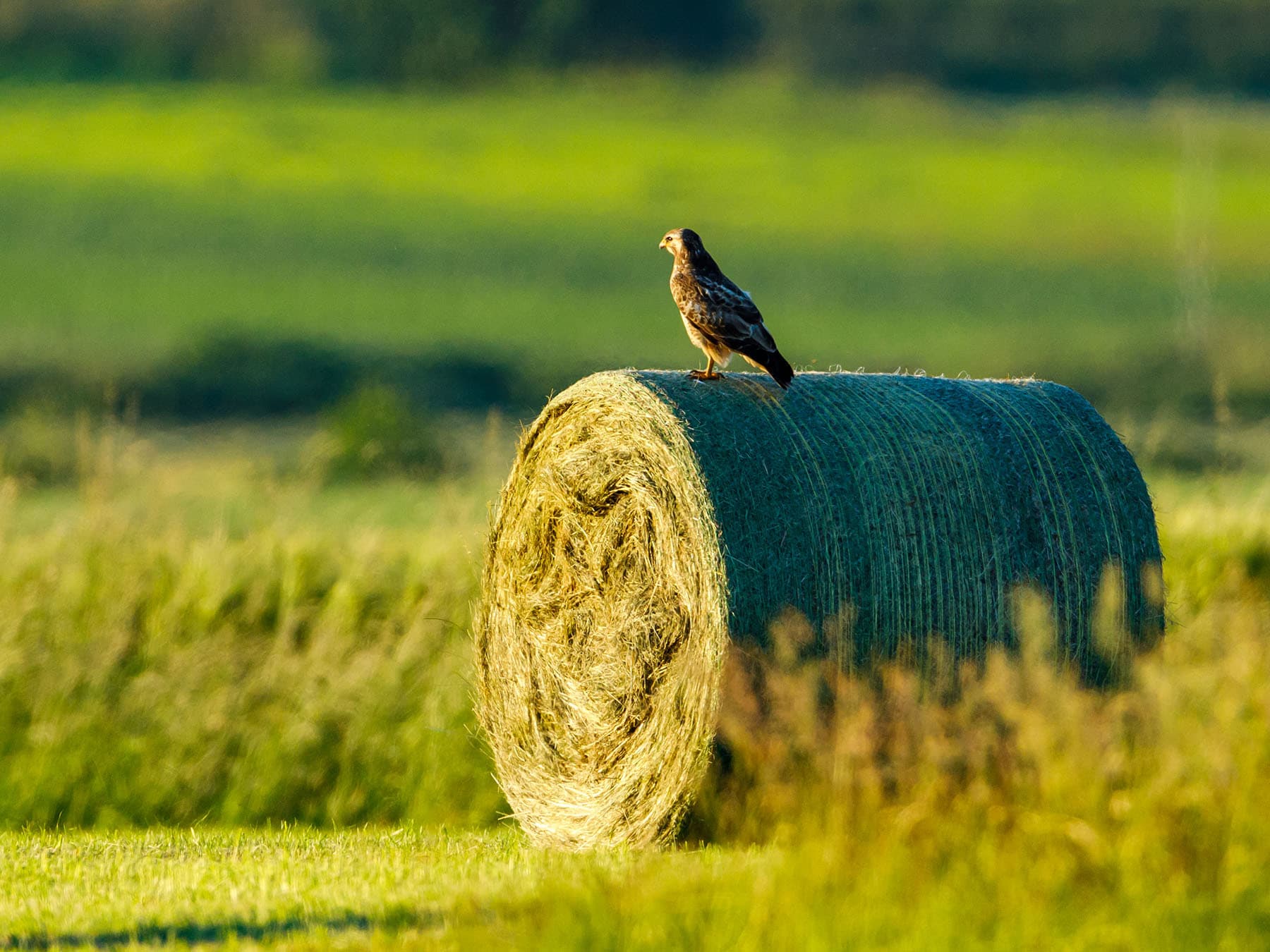
Buzzards are habitat generalists. Look out for them in farmland, woodland, moorland, and even towns and cities.
What is the range of a Buzzard?
Buzzards breed throughout the United Kingdom and the eastern half of Ireland. Elsewhere, this widespread species ranges east as far as Mongolia and south to the southern tip of Africa.
Where do Buzzards live?
Buzzards spend much time watching for prey from prominent perches like fence poles, pylons, and trees.
They are not particularly nimble on the ground, although they often perch in arable fields and meadows to feed. These birds of prey are comfortable in flight and spend extended periods soaring, often hundreds of meters above the ground.
How rare are Buzzards?
The Buzzard is not rare in the UK. In fact, they are the most common bird of prey in the region and an everyday sighting for many people. There were an estimated 63,000 breeding pairs in the UK in 2016.
Where can you see Buzzards in the UK?
You can see Buzzards throughout the United Kingdom, although they are most common in the Southwest, Wales, Scotland, and the Lake District.
Signs and spotting tips
Given their large wingspans, buzzards are adept at riding thermals and can therefore most often been seen on warm sunny days circling in the sky above.
Their wings form a shallow V-shape when soaring. Buzzards are known as lazy birds, so they will often be found perched on pylons or telephone poles, watching out for prey when they are not gliding through the air.
The unique cat-like sound of their call is also a giveaway that they are nearby.
Migration
Do Buzzards migrate?
Buzzards are highly migratory in many parts of their global range, although they are resident throughout the year in the United Kingdom. Most individuals stay within an area of a hundred kilometres.
Are Buzzards native to the UK?
Buzzards are native to the United Kingdom and are present throughout the year. They were absent from much of the eastern UK for upwards of a century, but have since made a strong comeback.
What it eats
The Buzzard is an opportunistic hunter that eats a variety of prey animals. Continue reading to learn more about their diet in the UK.
What do Buzzards eat?
Buzzards are purely carnivorous, although they are not fussy about choosing their prey. Voles and other rodents are their major prey source, but they will eat a variety of animals, including invertebrates and carrion when available.
The Buzzard is known to eat the following animals:
- Rodents and shrews
- Birds like pigeons and starlings, and up to the size of partridges and pheasants
- Young rabbits and hares
- Reptiles like lizards and snakes
- Frogs and toads
- Beetles, earthworms and other invertebrates
Check out our complete guide on the diet and feeding behaviour of a Buzzard.
What do Buzzard chicks eat?
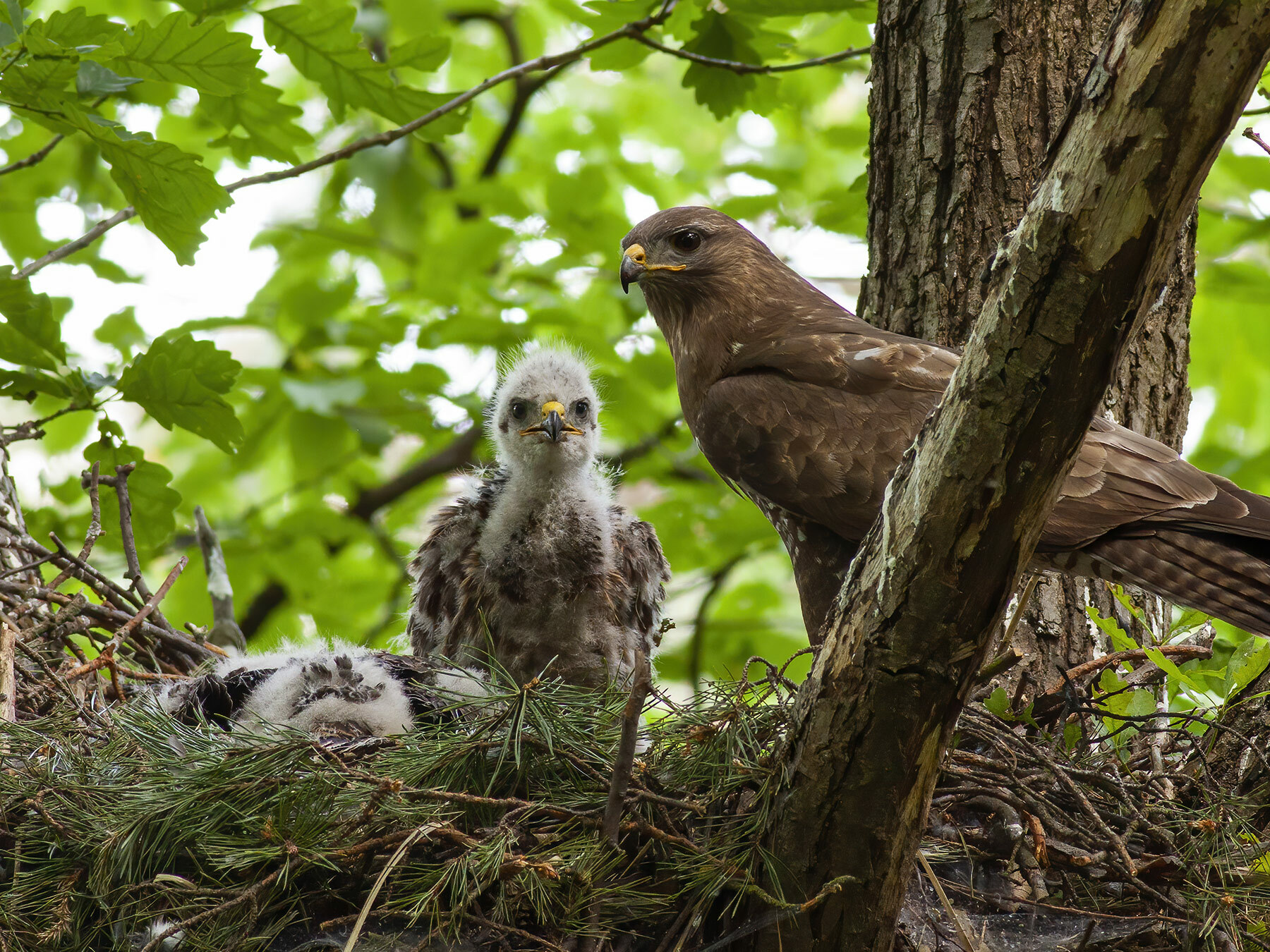
Both male and female Buzzards feed their chicks strips of meat and other manageable morsels. The male provides food for the first two weeks, but the female brings most food after the first month. The young will be fed periodically for up to two months after leaving the nest.
Nesting and breeding
Where do Buzzards nest?
Buzzards nest in every county of the UK and typically build their nests in trees and cliffs. Both males and females work together to construct the nest, which can measure up to 1.5 meters across.
Check out our comprehensive guide on Buzzard nesting for more information.
What do Buzzard eggs look like?
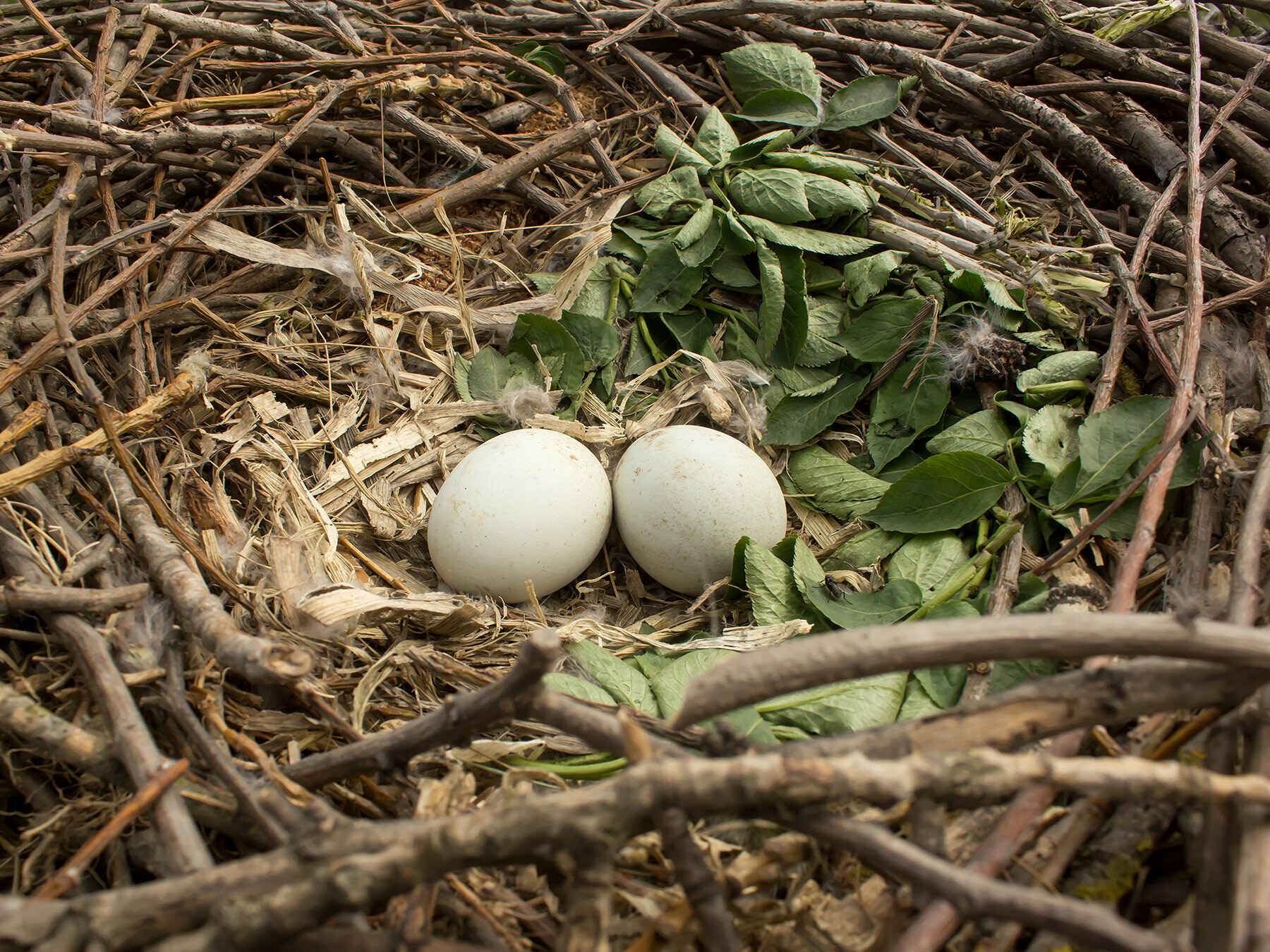
Buzzards usually lay two to four eggs that measure 55 millimetres long and 44 millimetres wide on average. Their eggs are white with red-brown markings.
Do Buzzards mate for life?
Buzzards form long-lasting pairs, and they usually mate for life. They often use alternate nests each year within their nesting territory, although there is a record of a single nest used for thirteen consecutive years.
Behaviour
Are Buzzards aggressive?
The Buzzard is generally non-aggressive, although attacks on humans have been recorded. Avoid approaching their nest during the breeding season to minimise the chance of aggressive interactions.
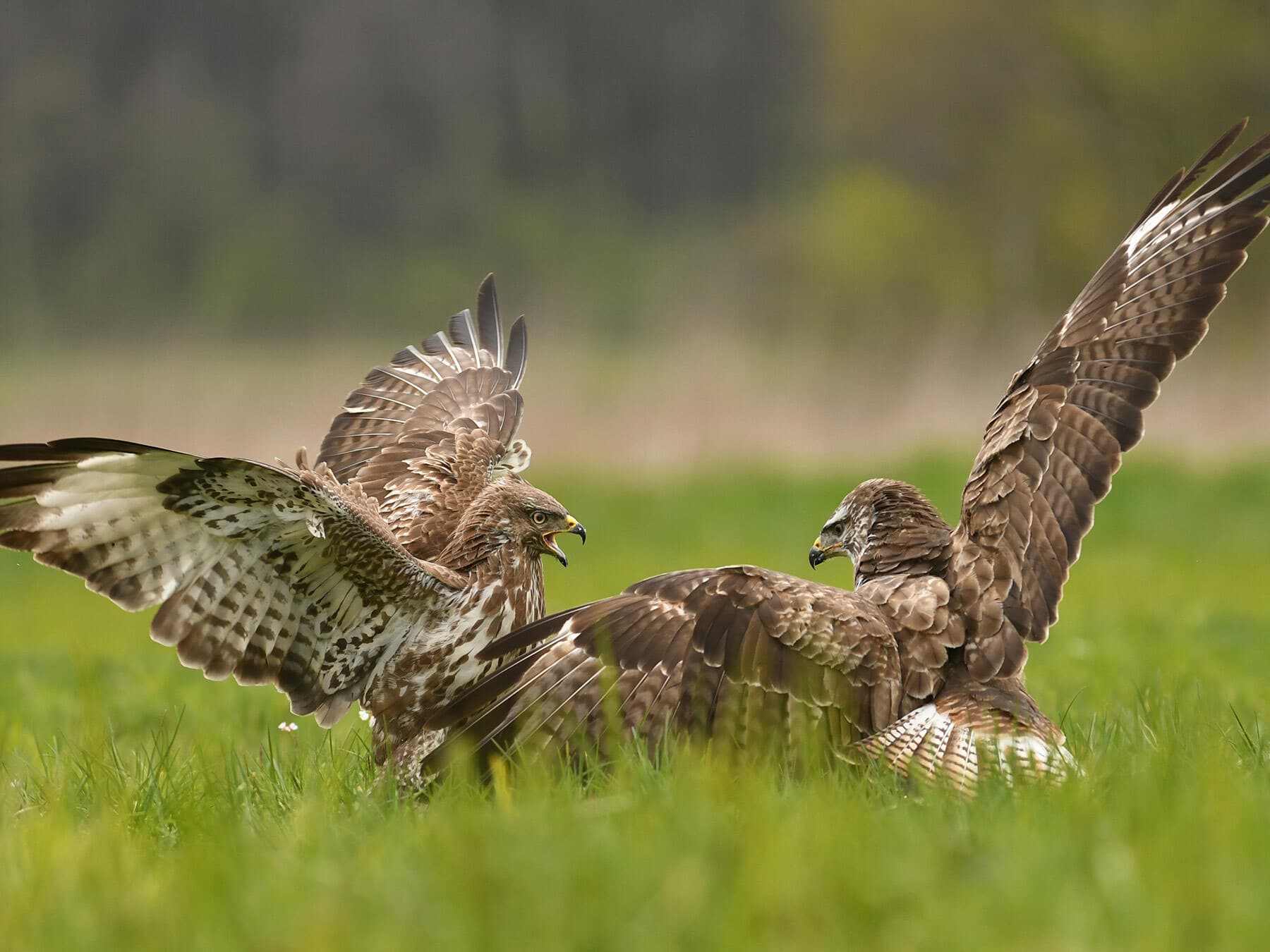
These birds may be aggressive towards their own species when chasing intruders from their territory. They will also fight with other Buzzards, Crows, Magpies, and other birds of prey like Red Kites when feeding on animal carcasses.
Where do Buzzards sleep at night?
Buzzards usually sleep in the safety of tall trees.
Why do Buzzards sit in fields?
It is not unusual to see Buzzards perched in fields, sometimes in good numbers. They are attracted by worms and other ground invertebrates, often after rain or ploughing operations.
Lifespan and predators
The Buzzard has made a remarkable comeback in the United Kingdom, with numbers rebounding from a low of just 1000 breeding pairs in the early 20th century. Keep reading to learn about their threats and conservation status.
How long do Buzzards live?
The Buzzard can live for at least 28 years, although their average life expectancy is much lower at about eight years.
What are the predators of Buzzards?
Healthy adult Buzzards have few predators. However, injured and sick individuals may fall prey to various carnivores. Animals like foxes and wild cats could potentially hunt healthy adults, and Golden Eagles would have no problem dispatching these smaller raptors.
Are Buzzards protected?
The Buzzards is protected by the Wildlife and Countryside Act of 1981.
Are Buzzards endangered?
The Buzzard is not an endangered species. They have a green conservation status in the United Kingdom and are listed as a ‘Least Concern’ species according to the IUCN (International Union for the Conservation of Nature).
Conservation
While the Buzzard is currently listed as Least Concern, it faces threats from habitat loss and illegal persecution.
In some areas, particularly in the UK, populations have recovered significantly following past declines due to pesticide use and hunting.
Similar birds
Often mistaken for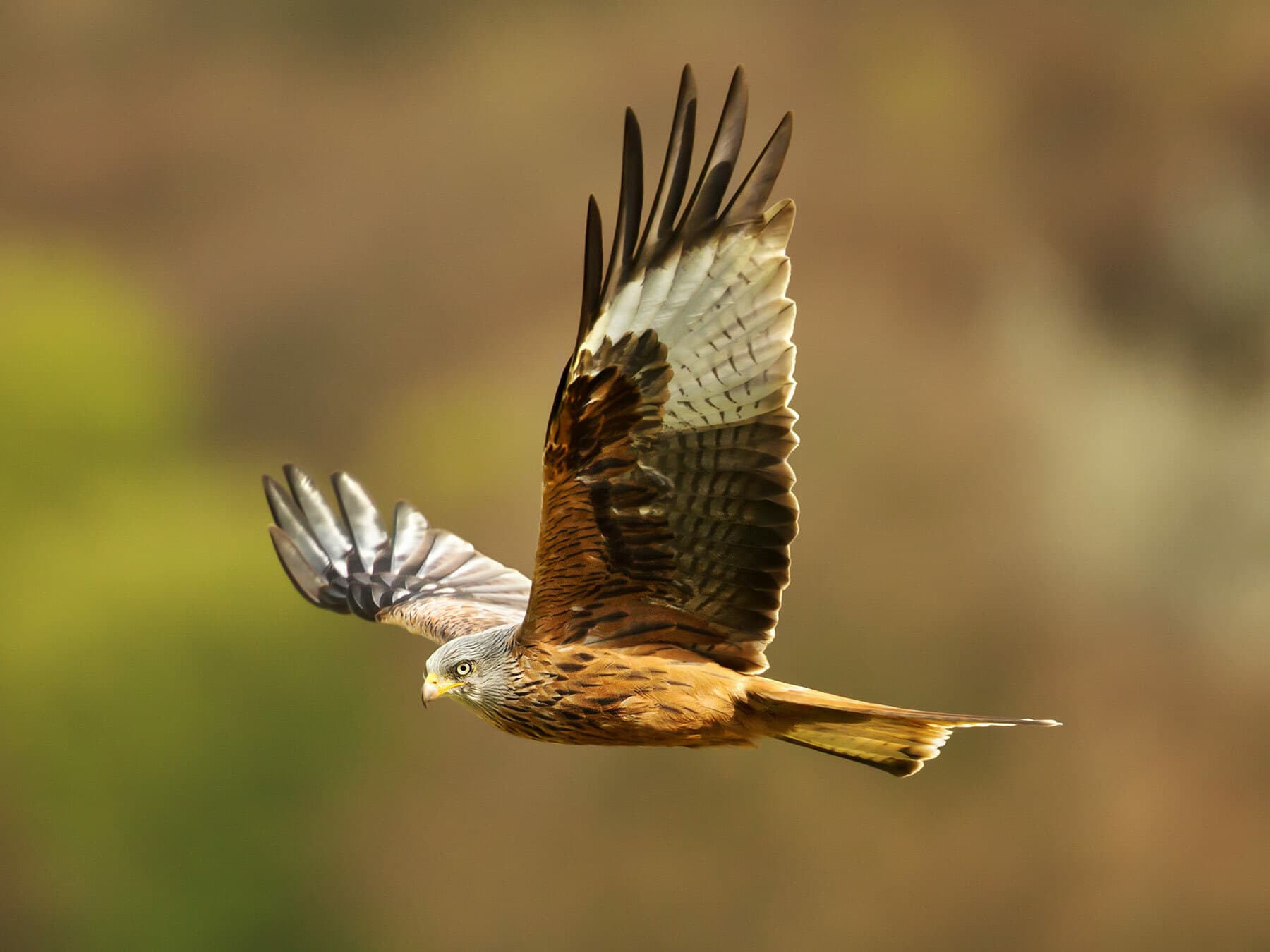
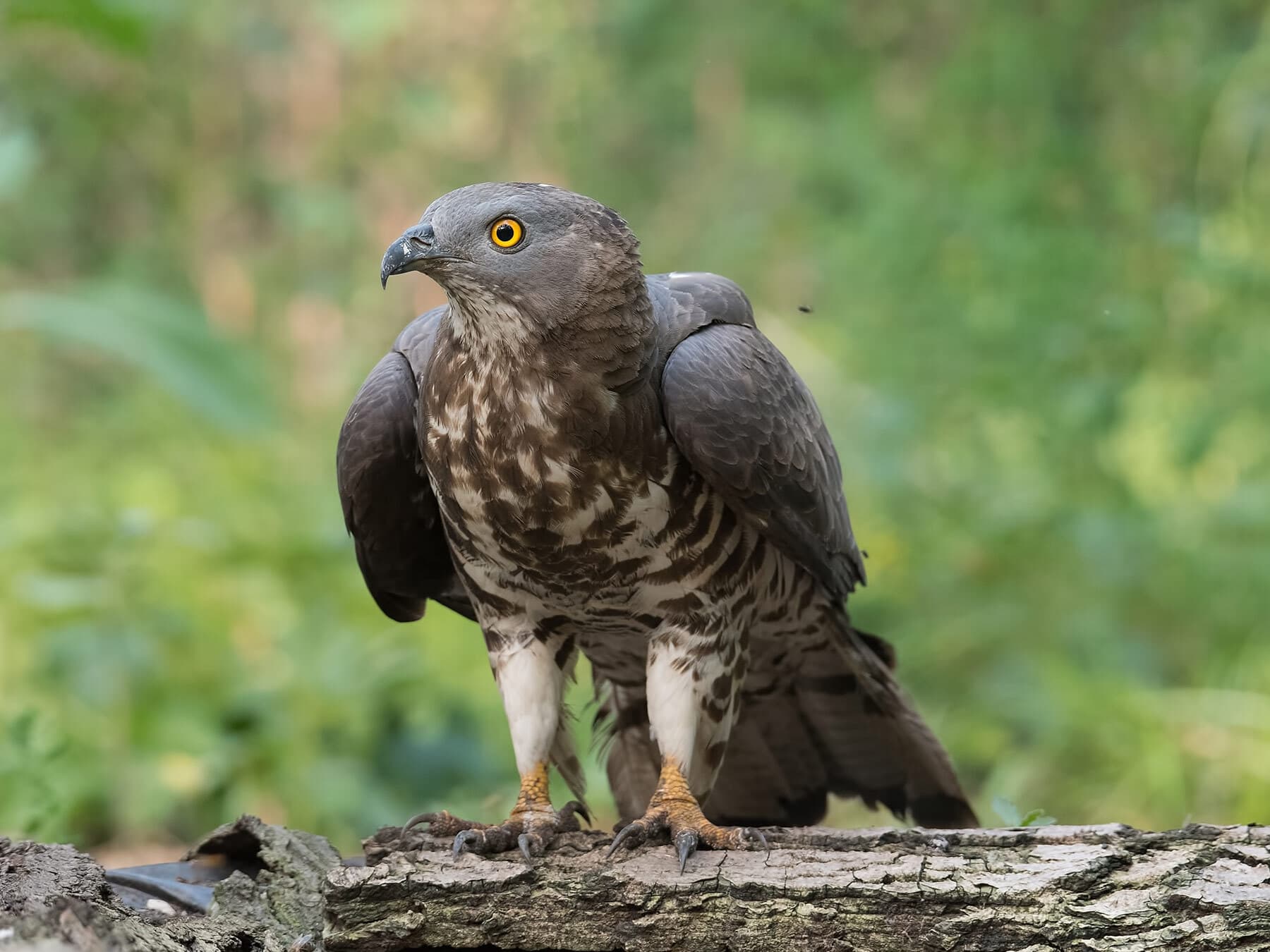
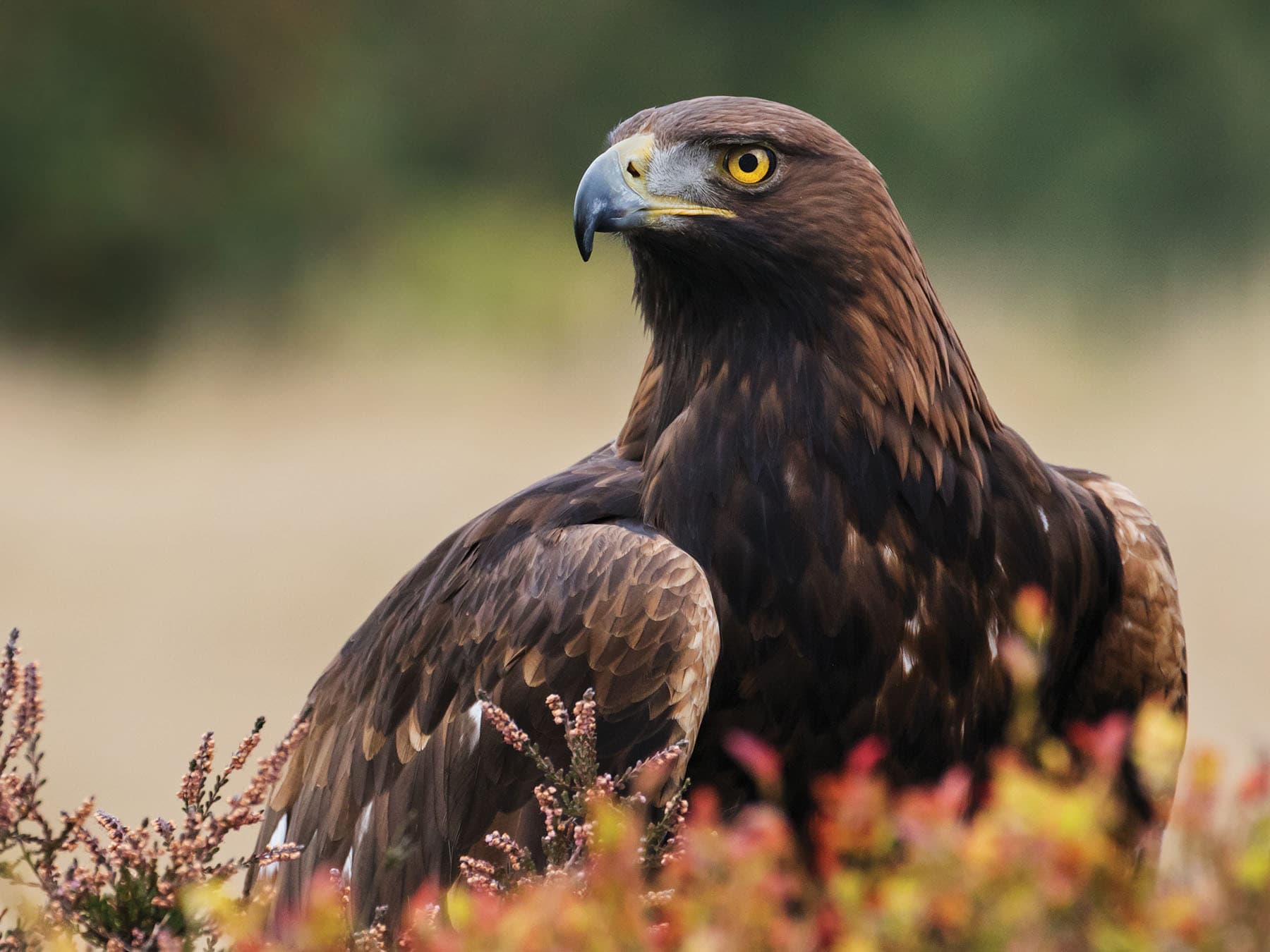
More photos
5 photos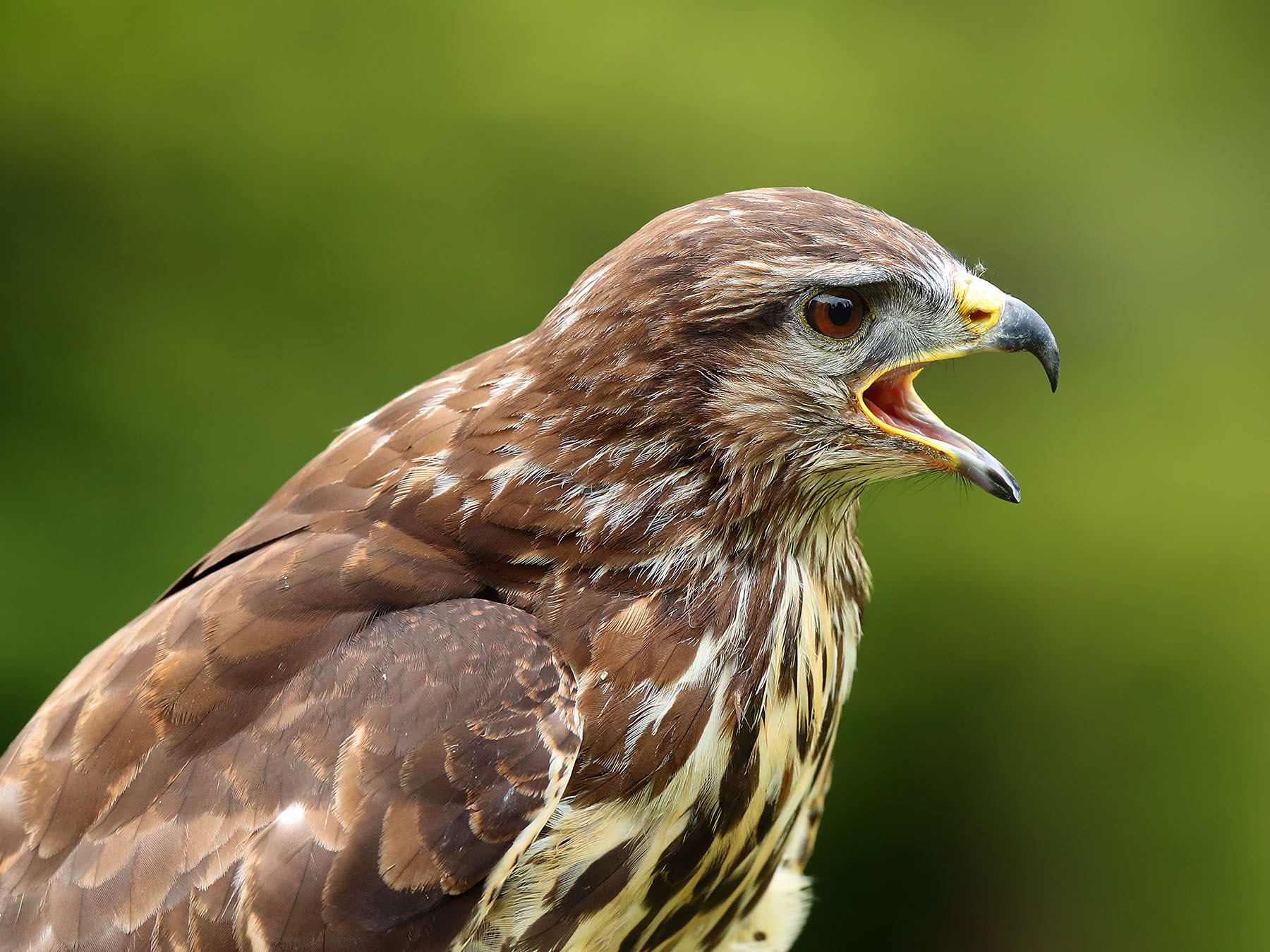
Buzzard guides
4 guidesQuick facts
- Length
- 51–57 cm
- Wingspan
- 113–128 cm
- Weight
- 550–1200 g
- Lifespan
- 8 years · oldest recorded 30.4 years
- Family
- Hawks & Eagles
- Migration
- Partial migrant
- Global status (IUCN)
- Least Concern
- World population
- 2,038,000 - 3,463,000 mature individuals
- Population trend
- Increasing
- Also called
- Common Buzzard, European Buzzard, Eurasian Buzzard
- Scientific name
- Buteo buteo
Questions
5How common are Buzzards in the UK?
The buzzard is now safely established in all parts of the UK. However, this was not always the case, and in fact, the species was nearly wiped out in the 1960s due to the use of pesticides in agriculture.
The buzzard is highly adaptable and can survive in varied habitats, from forest and farmland to mountainous landscapes. There is currently thought to be approximately 79,000 breeding pairs in the UK.
What is a group of Buzzards called?
The collective nouns to describe a group of Buzzards are as follows:
- a flock of buzzards
- a kettle of buzzards
- a wake of buzzards
Why do Buzzards fly so high?
Buzzards can soar at heights of several hundred meters while expending very little energy. They use thermal updrafts and their large, broad wings to stay airborne for long periods while flapping their wings very little.
Like so many other birds of prey, their eyesight is extraordinary and they can watch for food from such great heights while remaining barely visible to their unsuspecting victim on the ground below.
How fast can Buzzards fly?
The Buzzard may not have the speed of hunters like the Peregrine Falcon, but they are powerful in flight nonetheless. They can reach speeds of 28 miles per hour in level flight but are much faster when swooping down on their prey. The similarly built Red-Tailed Hawk of America can reach up to 120 miles per hour when diving.
Why do Crows chase Buzzards?
Crows regularly mob Buzzards and other birds of prey to drive them away from the area. However, the tables can turn as Buzzards may catch and kill crows and other birds from the corvid family.
Sources
4- 1BirdLife International. 2021. Buteo buteo. The IUCN Red List of Threatened Species 2021: e.T61695117A206634667. Source (opens in a new tab)
- 2BirdLife International. 2021. Buteo buteo. The IUCN Red List of Threatened Species 2021: e.T61695117A206634667. Source (opens in a new tab)
- 3BirdLife International. 2021. Buteo buteo. The IUCN Red List of Threatened Species 2021: e.T61695117A206634667. Source (opens in a new tab)
- 4BTO longevity records: maximum age from a ringed bird, 30 years, 5 months, 21 days (set in 2016), BirdFacts: Buzzard (2016) Source (opens in a new tab)

Checked by
Nathan Cope, founder and editor
Nathan founded Birdfact and leads its writers and contributors in the UK, the US and Canada. He has watched and studied birds for more than ten years, and checks every article and species guide before it’s published.