


European Honey-buzzard
Honey Buzzard · Pernis apivorus
By the Birdfact teamChecked by Nathan Cope
On this page14 sections
How to recognise it
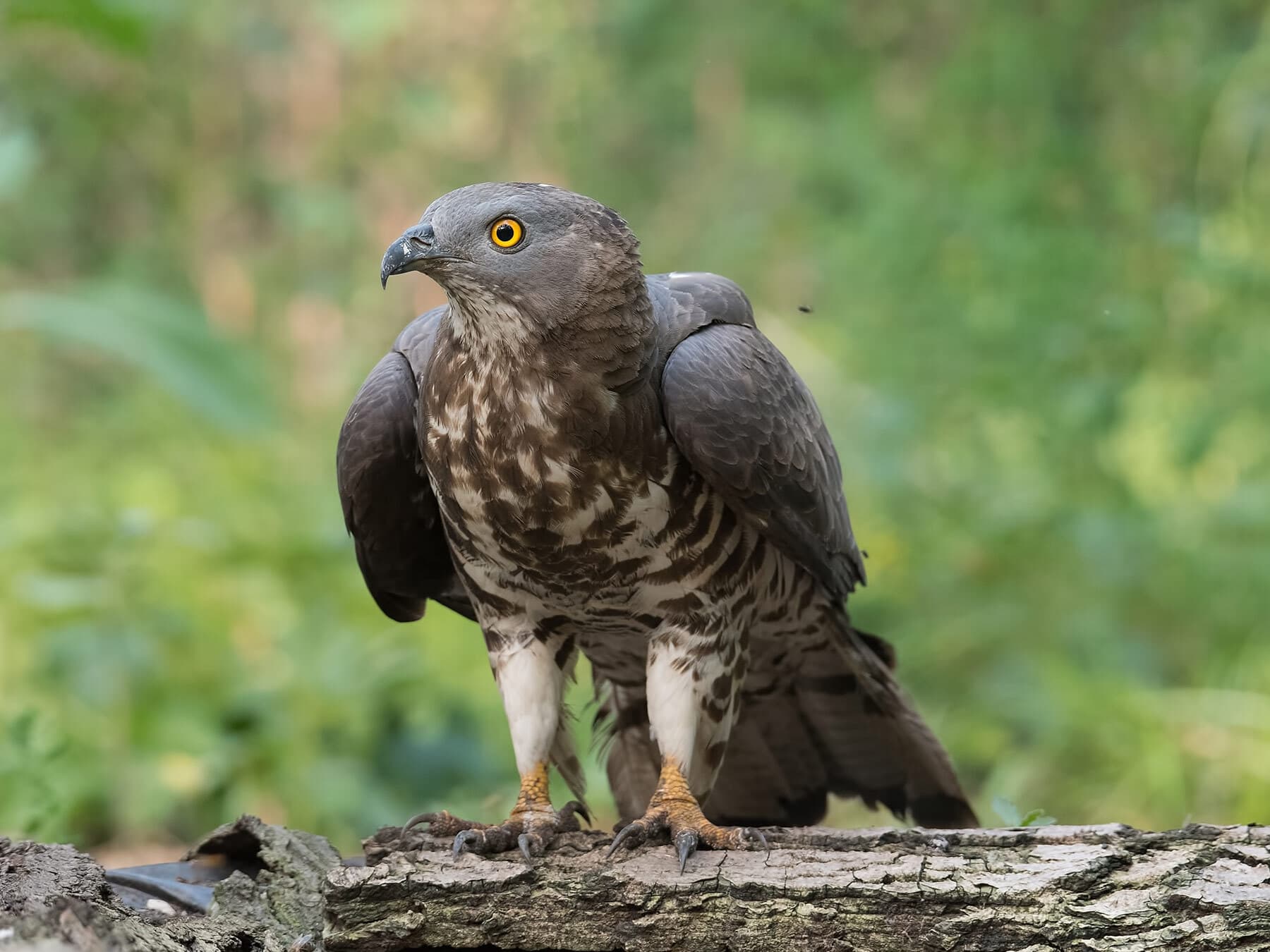
The European Honey-buzzard is a large raptor with a distinctive small head and long, broad wings. Its plumage is highly variable, typically brown or greyish-brown above with barred underparts. The long tail has three dark bands.
Males often have a blue-grey head, while females are usually browner with a less distinct head colour. Juveniles show more uniform brown plumage with less barring.
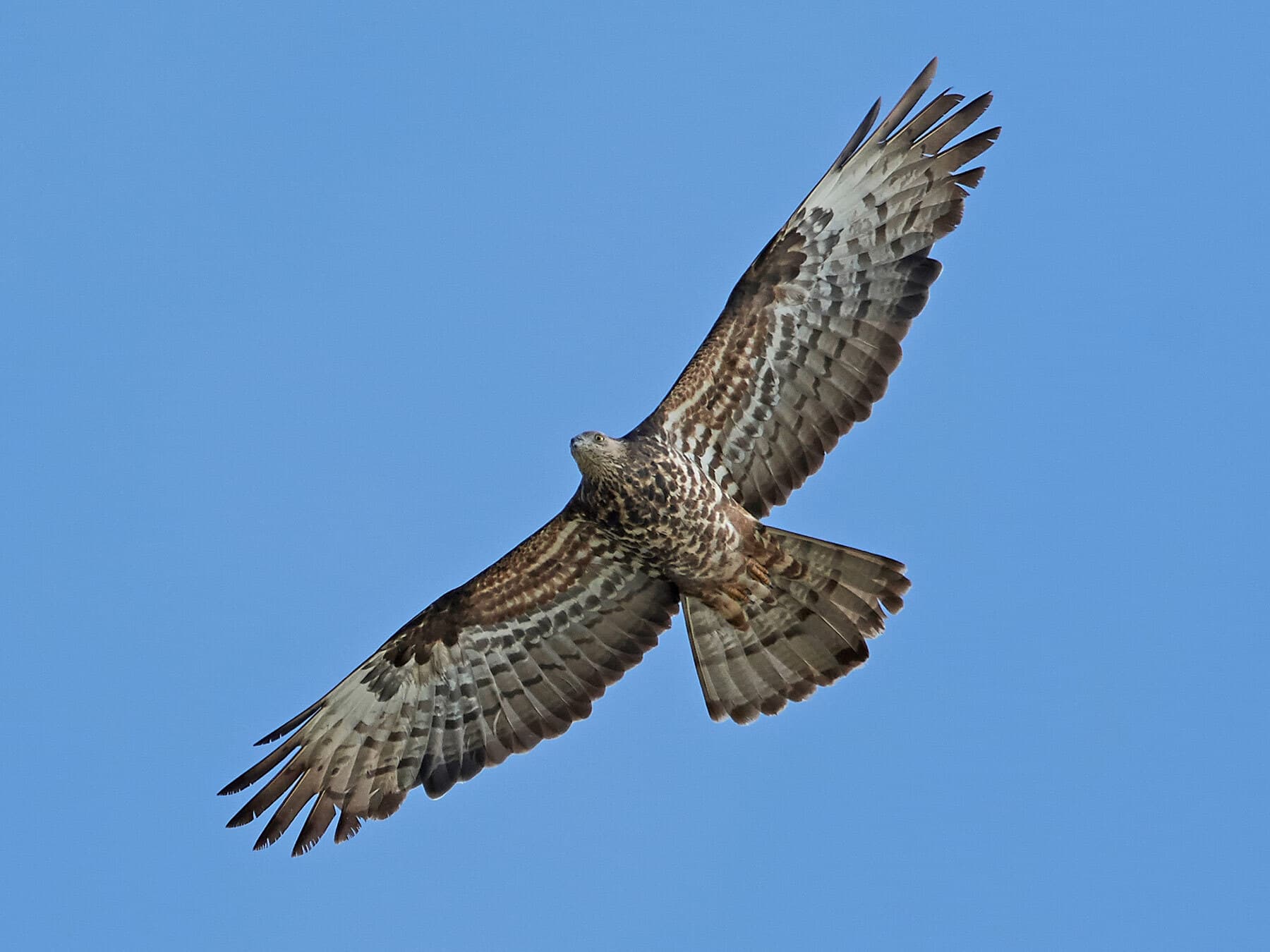
In flight, careful observation will reveal that the wings are angled towards the rear on the leading edge from the alula (bastard wing) to the tip of the primaries.
Its size
Adults- Length
- 52–60 cm
- Wingspan
- 135–150 cm
- Weight
- 600–1000 g
Its song and calls
A relatively silent bird, the European honey-buzzard confines itself to whistling noises similar to ‘pee – eee – aar’ or ‘pee – har’.
- Call0:00 / 0:30
When and where to see it
OctoberLeaving
Most recorded in October
- 1. East Sussexunder 0.1%
- 2. Wiltshireunder 0.1%
- 3. Cornwallunder 0.1%
- 4. Shetland Islandsunder 0.1%
- 5. West Sussexunder 0.1%
Each dot is a county, state or province: the bigger and darker, the larger the bird’s share of that place’s bird records that month. Grey dots: no regular records. The ringed point is the centre of the bird’s records this month; the arrow shows how it moved since last month, and the dashed loop its path through the year. “Arrivals” colours places where it becomes regular this month (orange) or is in its last regular month (grey). GBIF eBird Observation Dataset, 2019–2024. Map data: Natural Earth, US Census Bureau; place centres © OpenStreetMap contributors.
In your area
See when the European Honey-buzzard is recorded in your county, state or province.
How often the European Honey-buzzard turns up in the UK through the year, from birdwatchers' records.
United Kingdom
Passage migrant · regularly Aug–Oct · most records in September
Show as a table
| Month | United Kingdom |
|---|---|
| January | – |
| February | – |
| March | – |
| April | <0.001% |
| May | – |
| June | – |
| July | – |
| August | 0.002% (regular) |
| September | 0.006% (regular) |
| October | <0.001% (regular) |
| November | – |
| December | – |
Recorded regularly in
Worldwide: recorded regularly in 80 countries
Countries where it was recorded in at least 3 of the 6 years 2019–2024. Linked countries have their own bird list.
Europe (41)
- Åland Islands
- Albania
- Andorra
- Austria
- Belarus
- Belgium
- Bosnia & Herzegovina
- Bulgaria
- Croatia
- Czechia
- Denmark
- Estonia
- Finland
- France
- Germany
- Gibraltar
- Greece
- Guernsey
- Hungary
- Italy
- Latvia
- Lithuania
- Luxembourg
- Malta
- Moldova
- Montenegro
- Netherlands
- North Macedonia
- Norway
- Poland
- Portugal
- Romania
- Russia
- Serbia
- Slovakia
- Slovenia
- Spain
- Sweden
- Switzerland
- Ukraine
- United Kingdom
Africa (23)
Asia (16)
- Armenia
- Azerbaijan
- Cyprus
- Georgia
- Iran
- Iraq
- Israel
- Jordan
- Kazakhstan
- Kuwait
- Lebanon
- Oman
- Palestinian Territories
- Saudi Arabia
- Sri Lanka
- Turkey
Data: EOD – eBird Observation Dataset (Cornell Lab of Ornithology), accessed via GBIF.org, CC BY 4.0. Records from 2019–2024, aggregated and filtered by Birdfact. How these lists are made
The European honey-buzzard’s breeding grounds are across the northern area of the Palearctic from Scandinavia across Russia to central Western Siberia and south through France, across eastern Europe to the Balkan States and into Iran. All birds migrate south for the winter to sub-Saharan and southern Africa.
Signs and Spotting tips
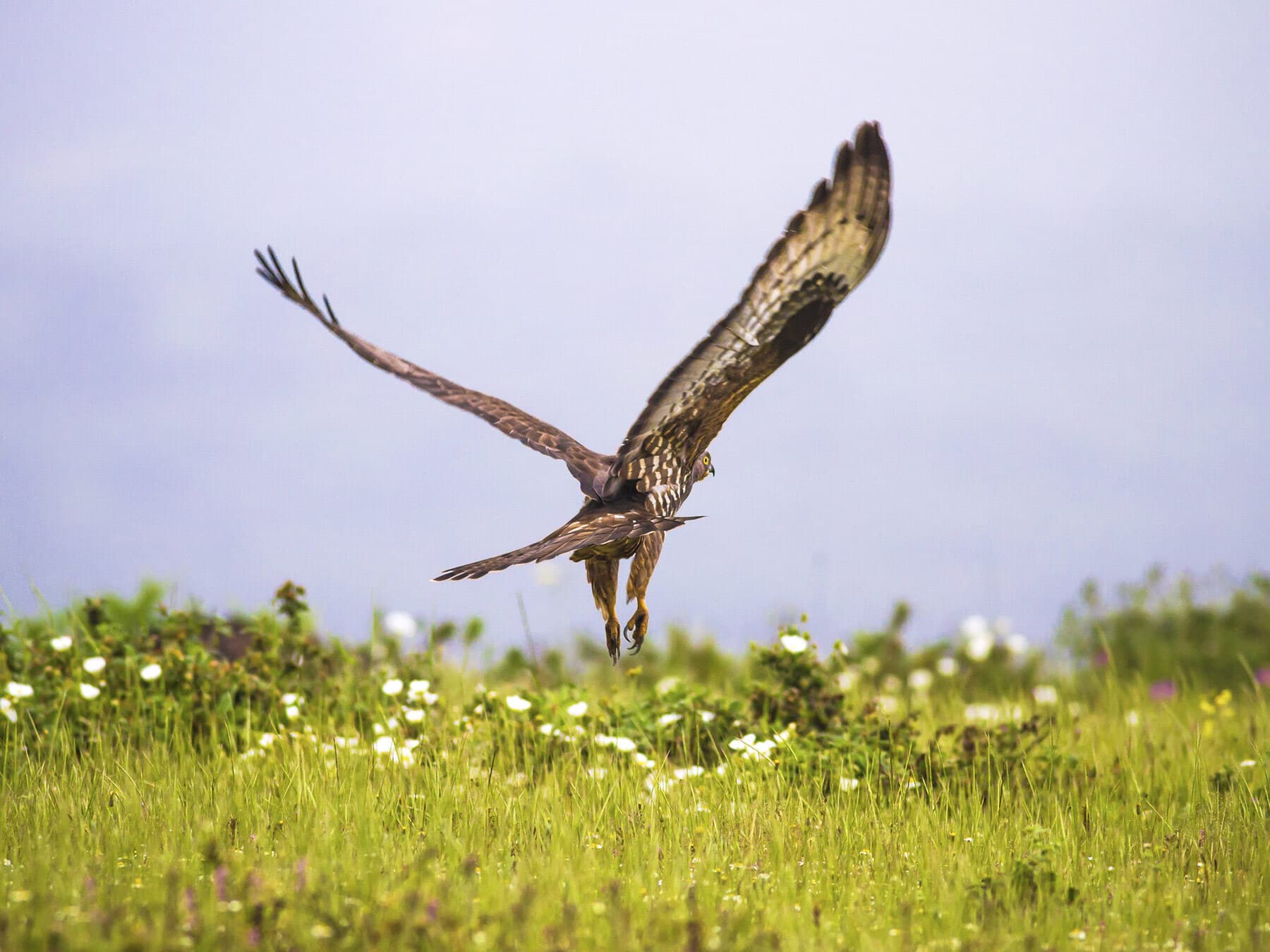
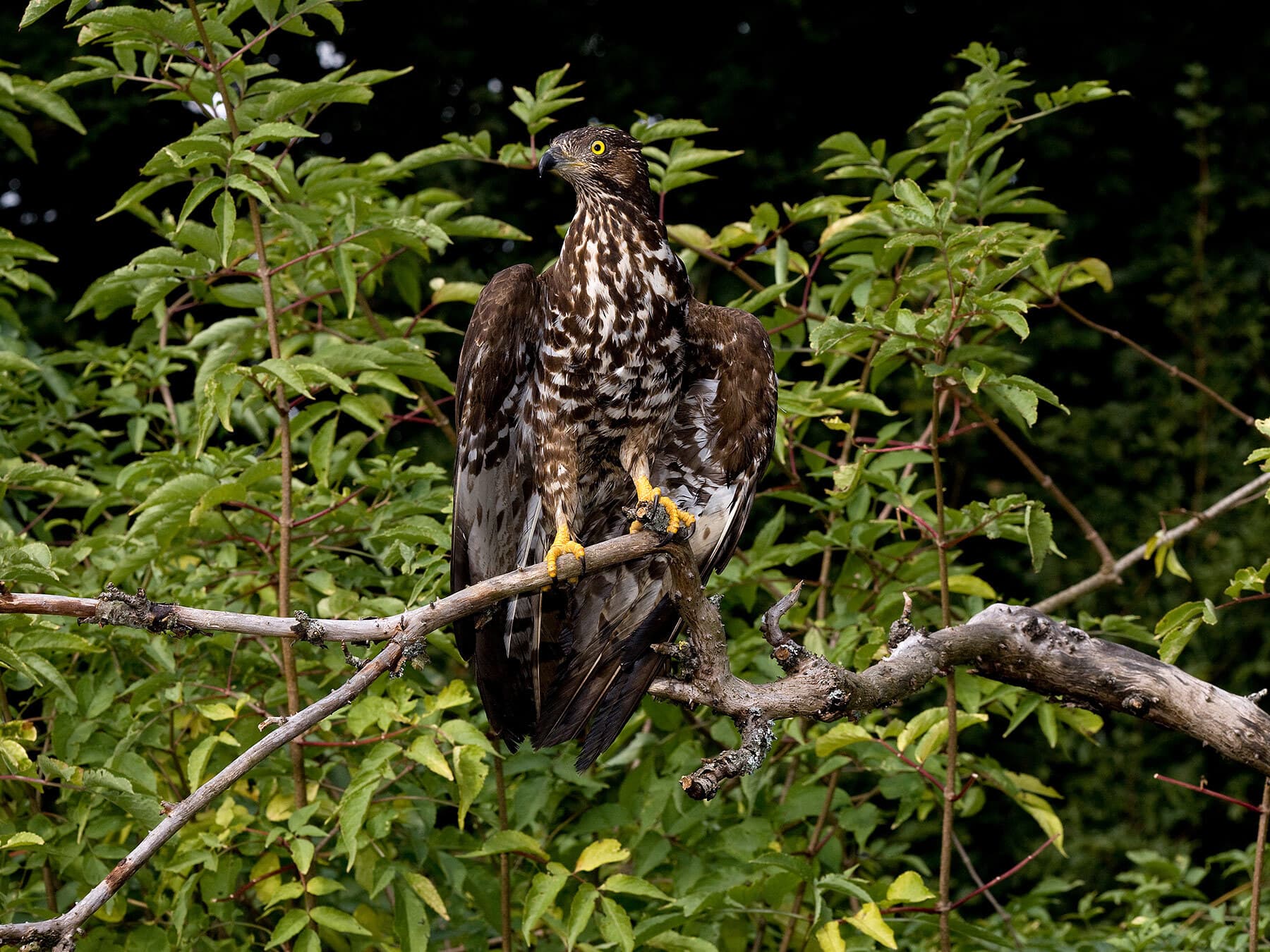
During the northern hemisphere summer these birds choose hilly country with forests and woods in which to nest and roost. They are relatively shy birds and difficult to spot as they forage on the ground under the cover of trees. Whilst they may at first resemble the common buzzard, careful observation during flight, coupled with their physical appearance and bright yellow iris aids correct identification.
What it eats
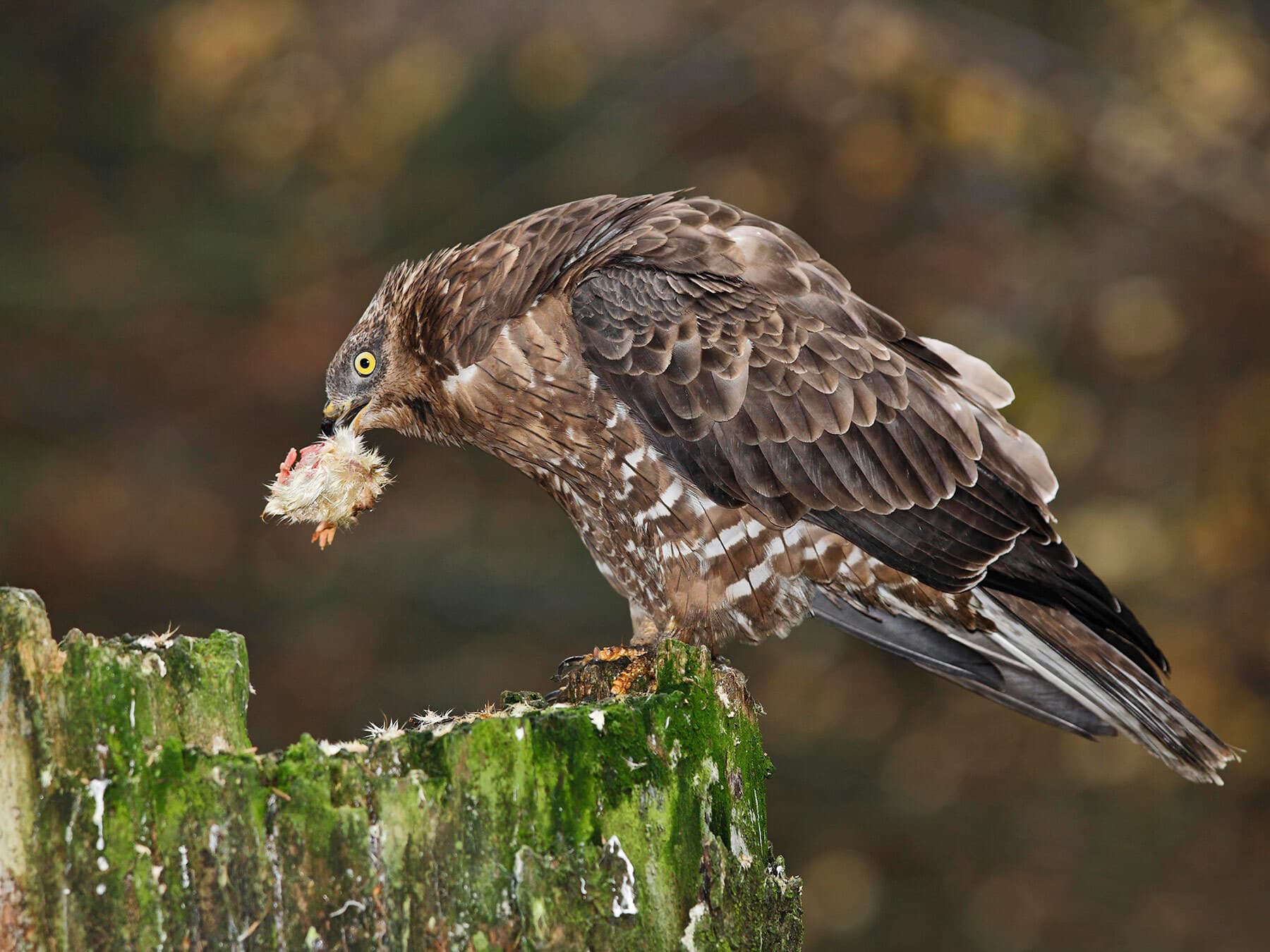
A diet of wasps, bees and hornets, together with grubs and larvae, honey, beeswax, insects and even small reptiles and mammals sustains the honey-buzzard. The bird will directly attack and forage from wasp and bee’s nests but also use its feet to search the ground and dig out grubs, beetles, termites and other larvae.
Nesting and breeding
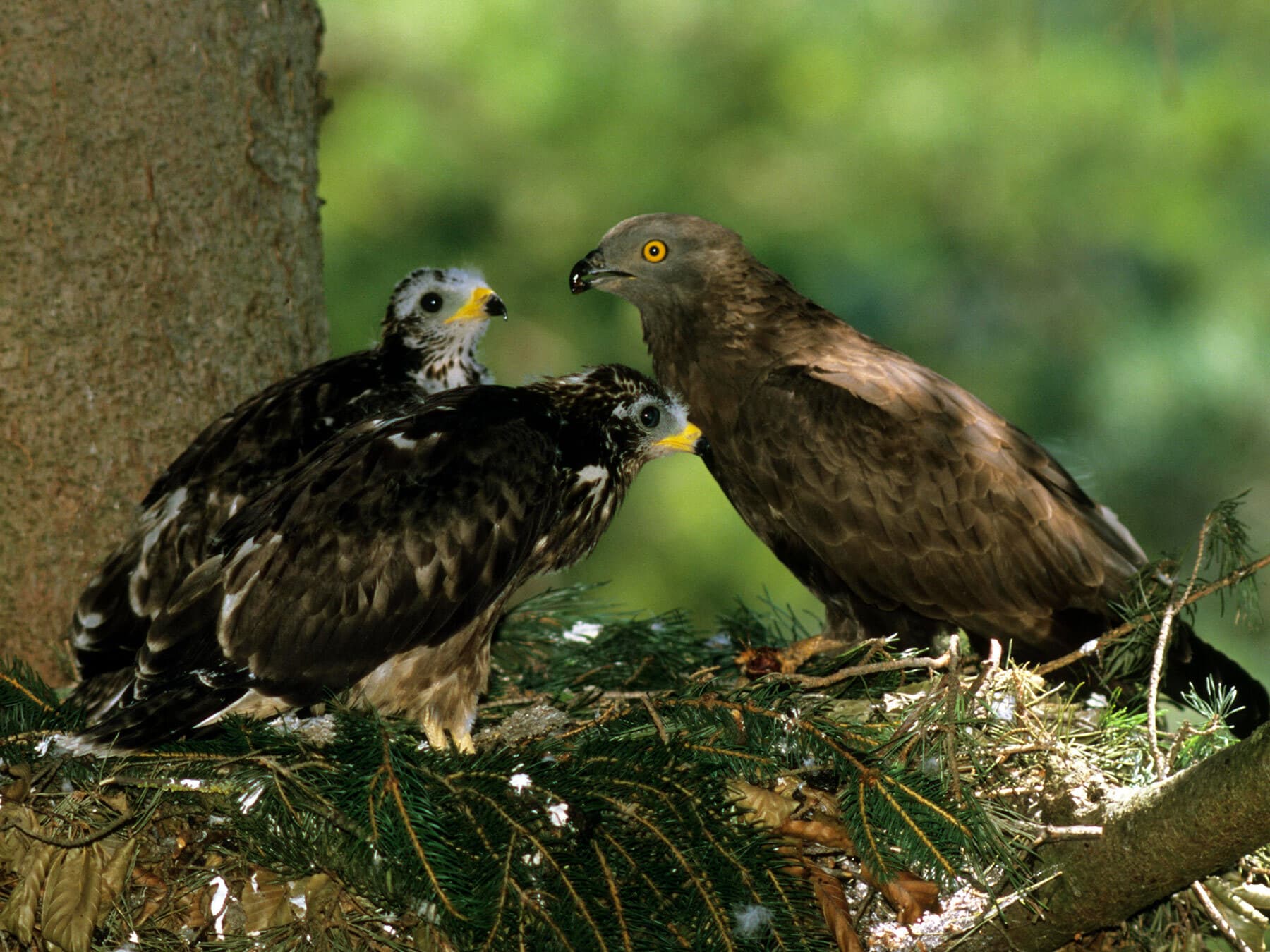
The breeding season lasts from May through to September, dependent upon geographical location, when nests constructed using twigs, sticks and tree foliage are built to form a platform located within the tree. One clutch of 1 – 3 buff coloured eggs with reddish brown markings is laid annually and incubated by both parents for up to thirty five days. Fledging occurs some forty to forty five days after hatching.
Behaviour
European Honey-buzzards are known for their unique feeding behaviour. They are often seen walking on the ground to dig out wasp nests. In flight, they exhibit a characteristic 'butterfly-like' wing flapping interspersed with glides. During the breeding season, males perform elaborate aerial displays to attract mates.
Lifespan and predators
The average life expectancy of the European honey-buzzard is up to twenty five years.
Conservation
While listed as Least Concern globally, European Honey-buzzards face threats from habitat loss and illegal hunting during migration.
Conservation efforts focus on protecting breeding habitats and migration routes, particularly in southern Europe and the Mediterranean region.
What does a European Honey-Buzzard look like?
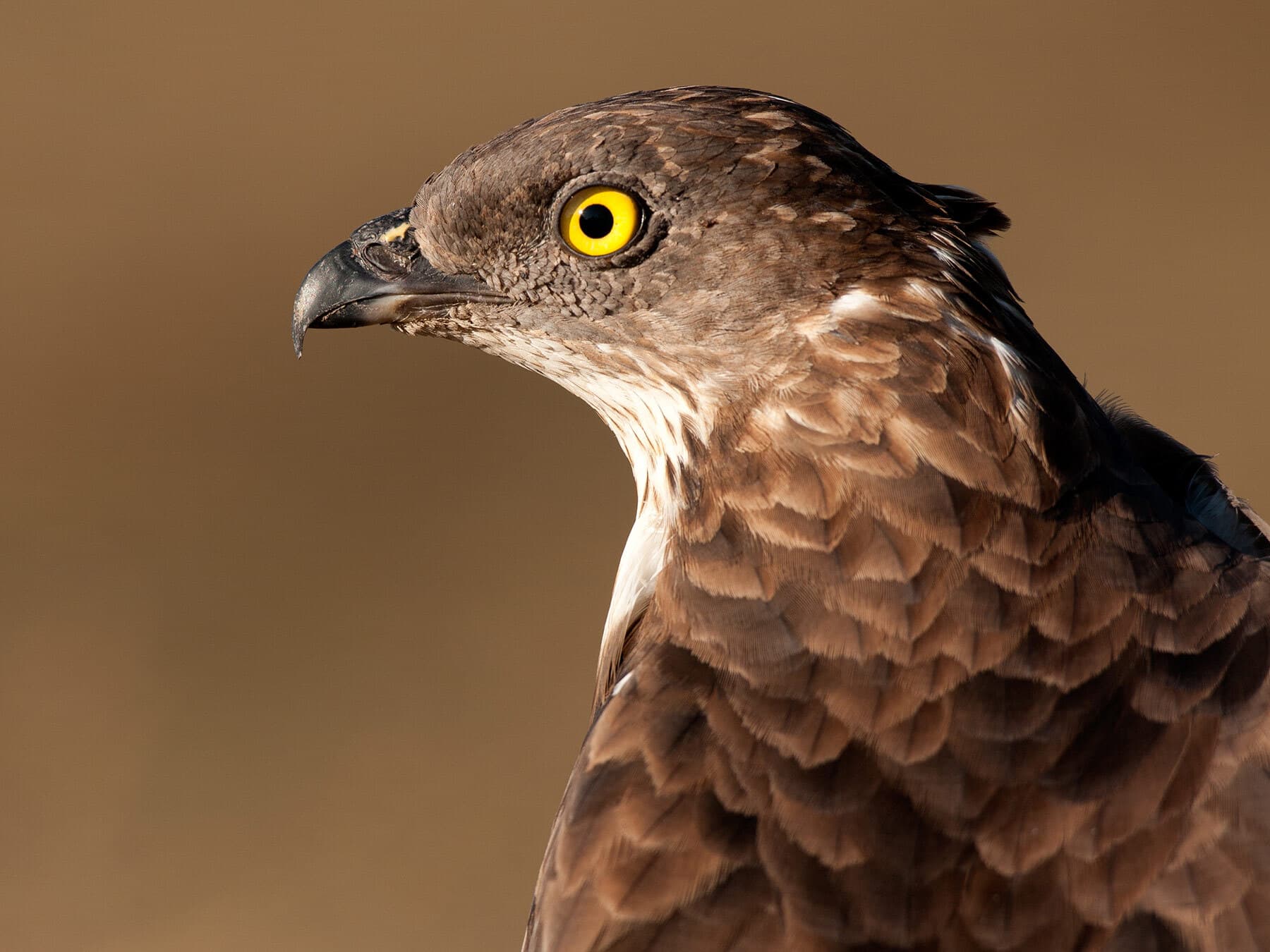
Although the European honey-buzzard is monotypic, it is also polymorphic, in that it has a wide variety of plumage patternation and colours and is not actually a true buzzard at all. The changes in plumage and appearance can vary with the bird’s age and sex as well as the season, although in general the underparts are barred and spotted, sometimes described as ‘tiger striped’ and in the adult male can vary from white to pale grey to brown. The head of the bird is relatively small compared to the rest of the body with a long neck and tail. The head of the adult male is predominantly grey, almost whitish on a juvenile, whilst that of the adult female is usually a darker brown colour. The upper and lower tail of adult birds is banded with three dark brown or blackish stripes, with that on the trailing edge being bolder and wider. Usually, the upper parts on adults are more of a mid brown hue with dark tipped primary and secondary flight feathers with the underparts and underwing areas being paler but with contrasting dark brown stripes and dark brown or black carpal patches. In flight, careful observation will reveal that the wings are angled towards the rear on the leading edge from the alula (bastard wing) to the tip of the primaries. The bill is small and slender, coloured black or dark grey with some pale yellow and the iris is a strikingly bold yellow in colour. The legs of both sexes are also yellow.
Similar birds
Often mistaken for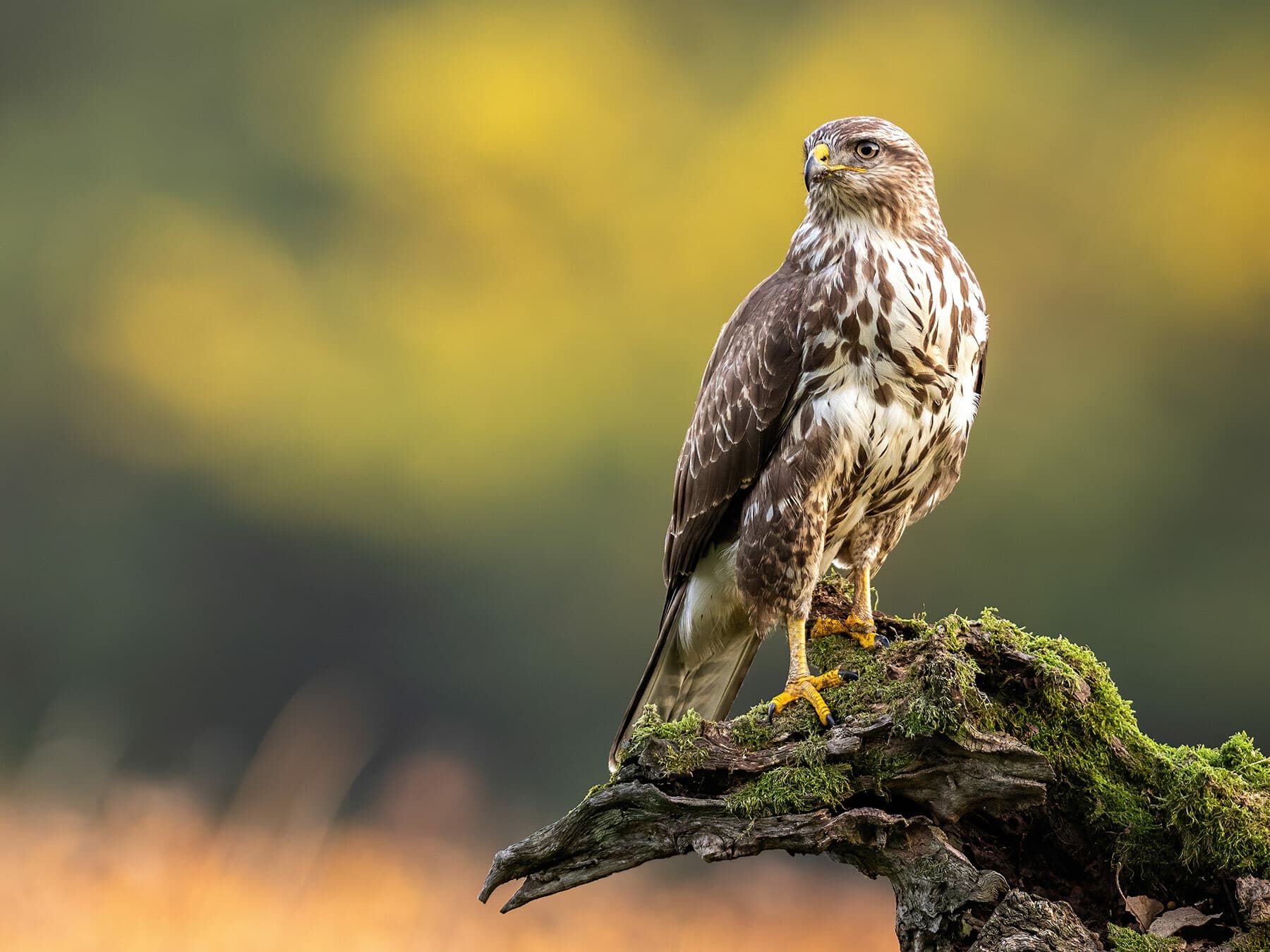
European Honey-buzzard guides
1 guidesQuick facts
- Length
- 52–60 cm
- Wingspan
- 135–150 cm
- Weight
- 600–1000 g
- Lifespan
- 12–15 years
- Family
- Hawks & Eagles
- Migration
- Long-distance Migrant
- Global status (IUCN)
- Least Concern
- World population
- 290,000 - 430,000 mature individuals
- Population trend
- Stable
- Also called
- Honey Buzzard
- Scientific name
- Pernis apivorus
Sources
3- 1BirdLife International. 2021. Pernis apivorus. The IUCN Red List of Threatened Species 2021: e.T22694989A206749274. Source (opens in a new tab)
- 2Orta et al. (2020)
- 3BirdLife International. 2021. Pernis apivorus. The IUCN Red List of Threatened Species 2021: e.T22694989A206749274. Source (opens in a new tab)

Checked by
Nathan Cope, founder and editor
Nathan founded Birdfact and leads its writers and contributors in the UK, the US and Canada. He has watched and studied birds for more than ten years, and checks every article and species guide before it’s published.