


Red Kite
Common Kite, Welsh Kite · Milvus milvus
By the Birdfact teamChecked by Nathan Cope
On this page15 sections
How to recognise it
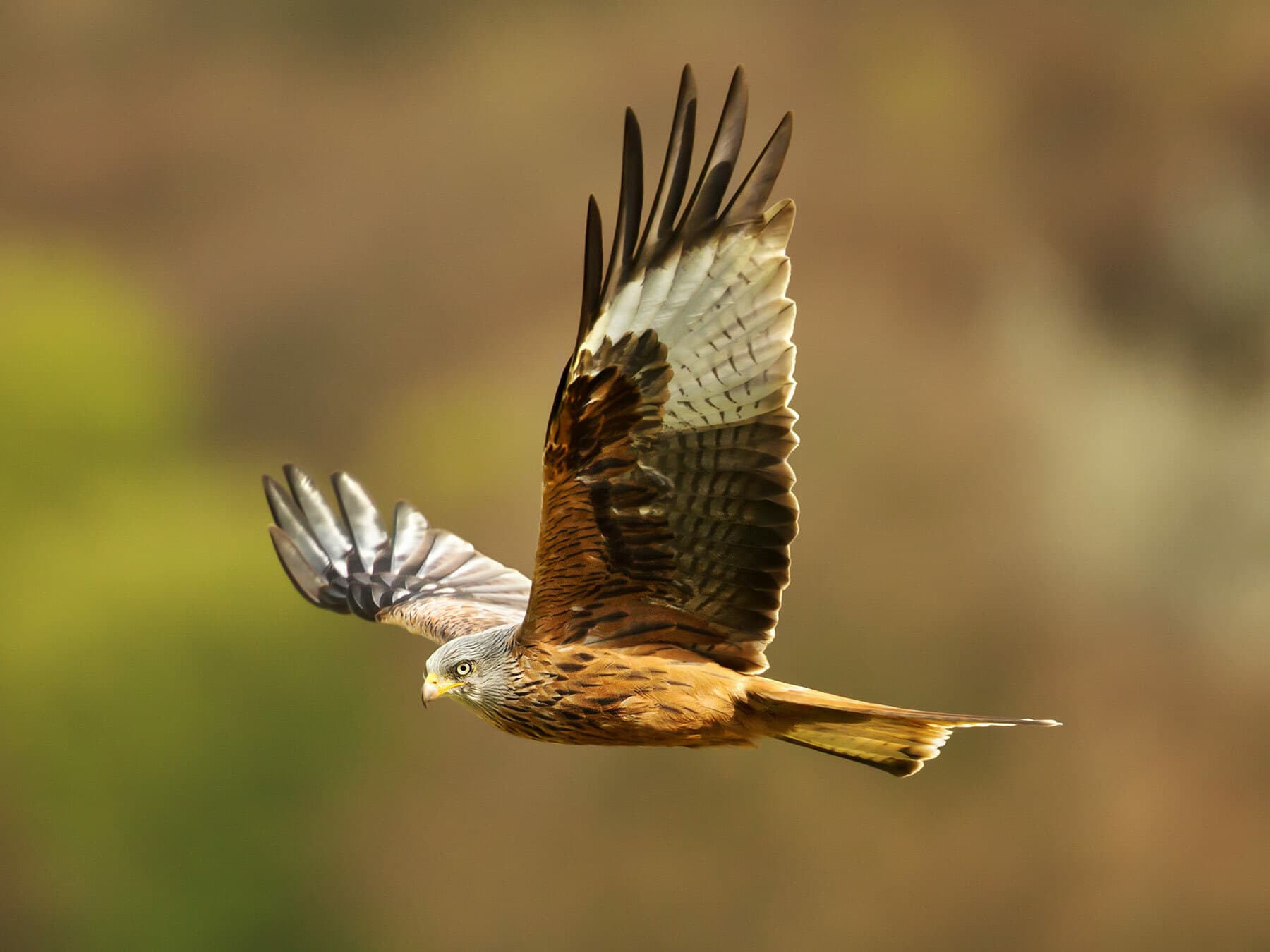
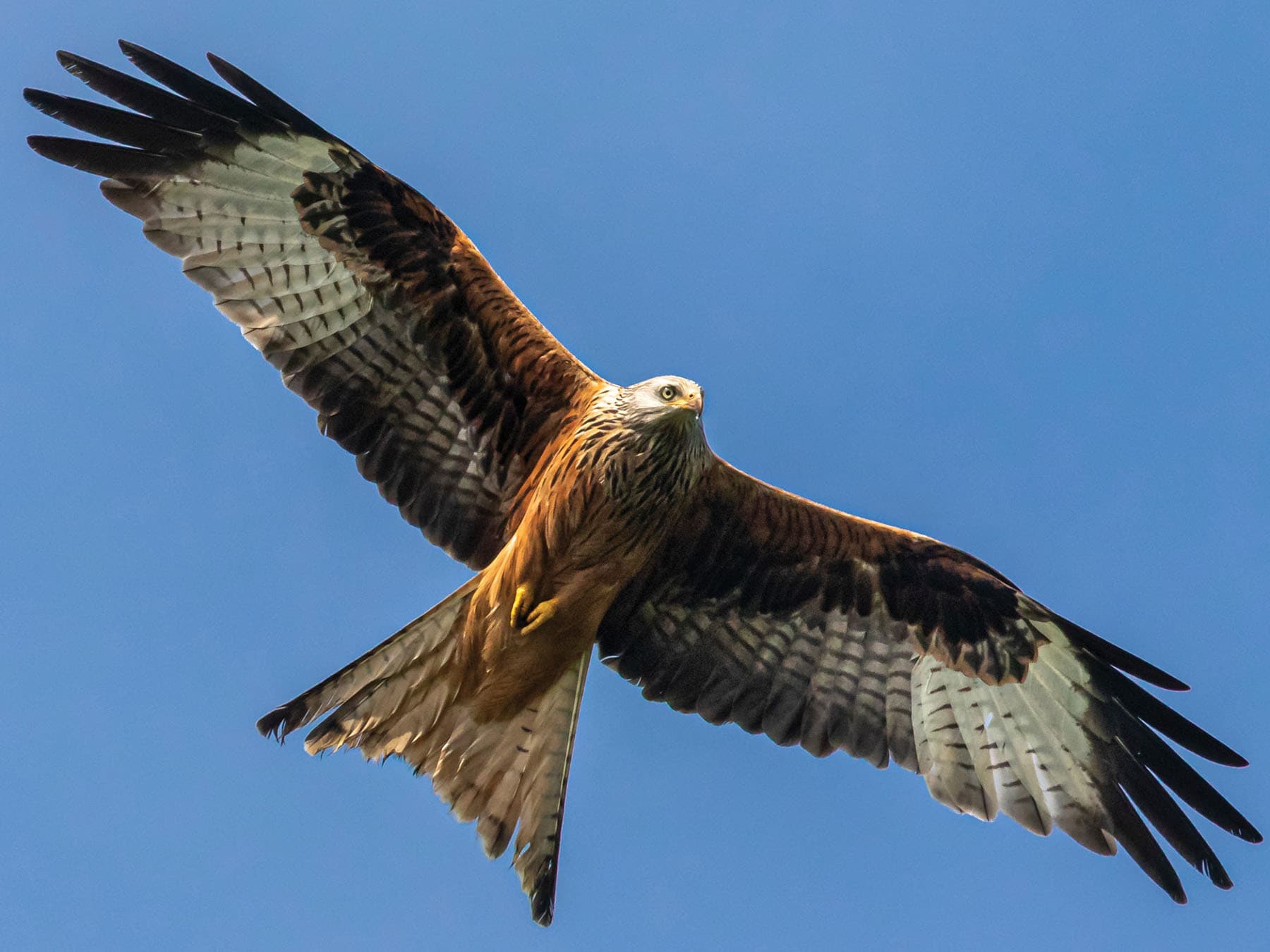
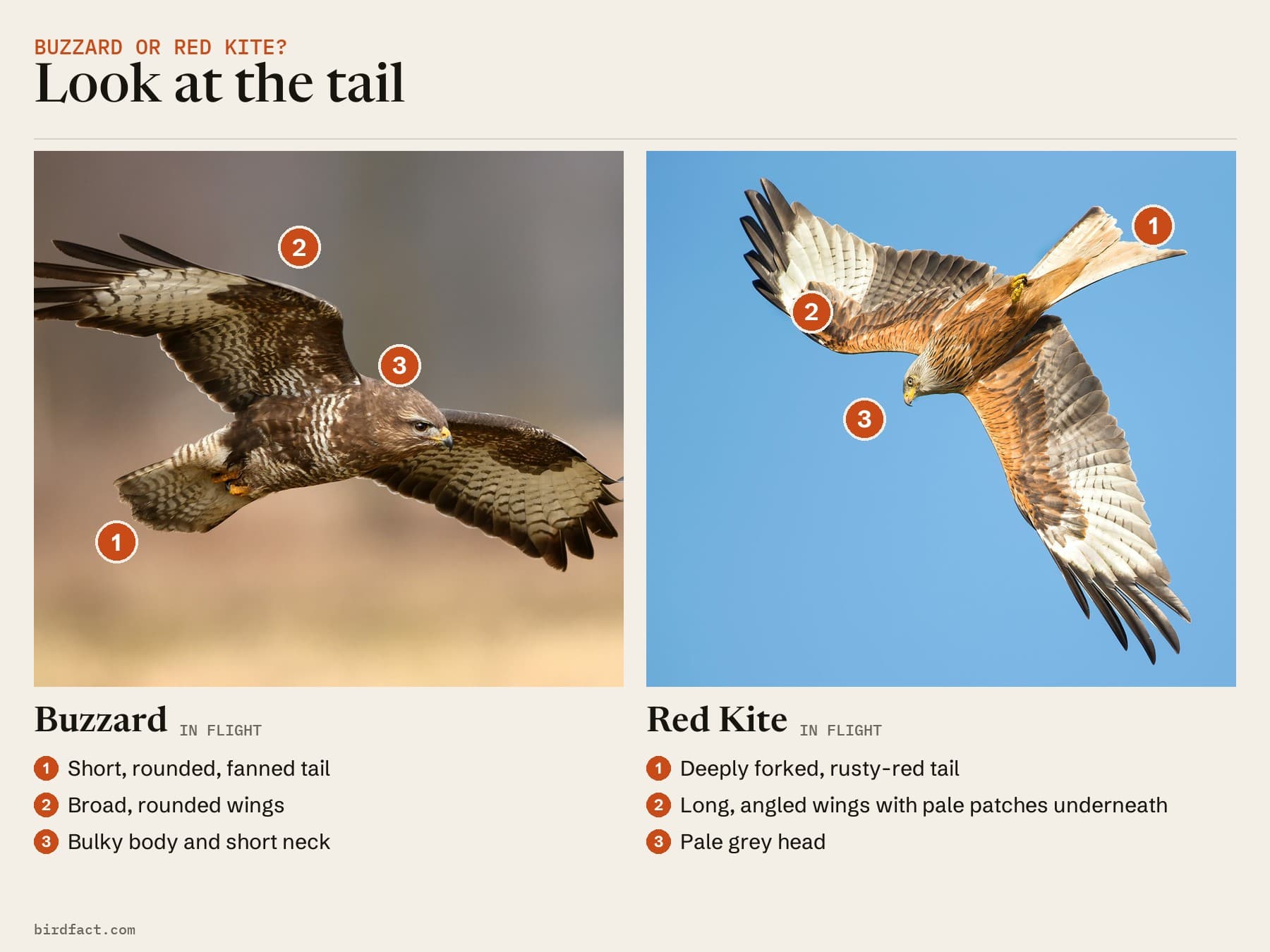
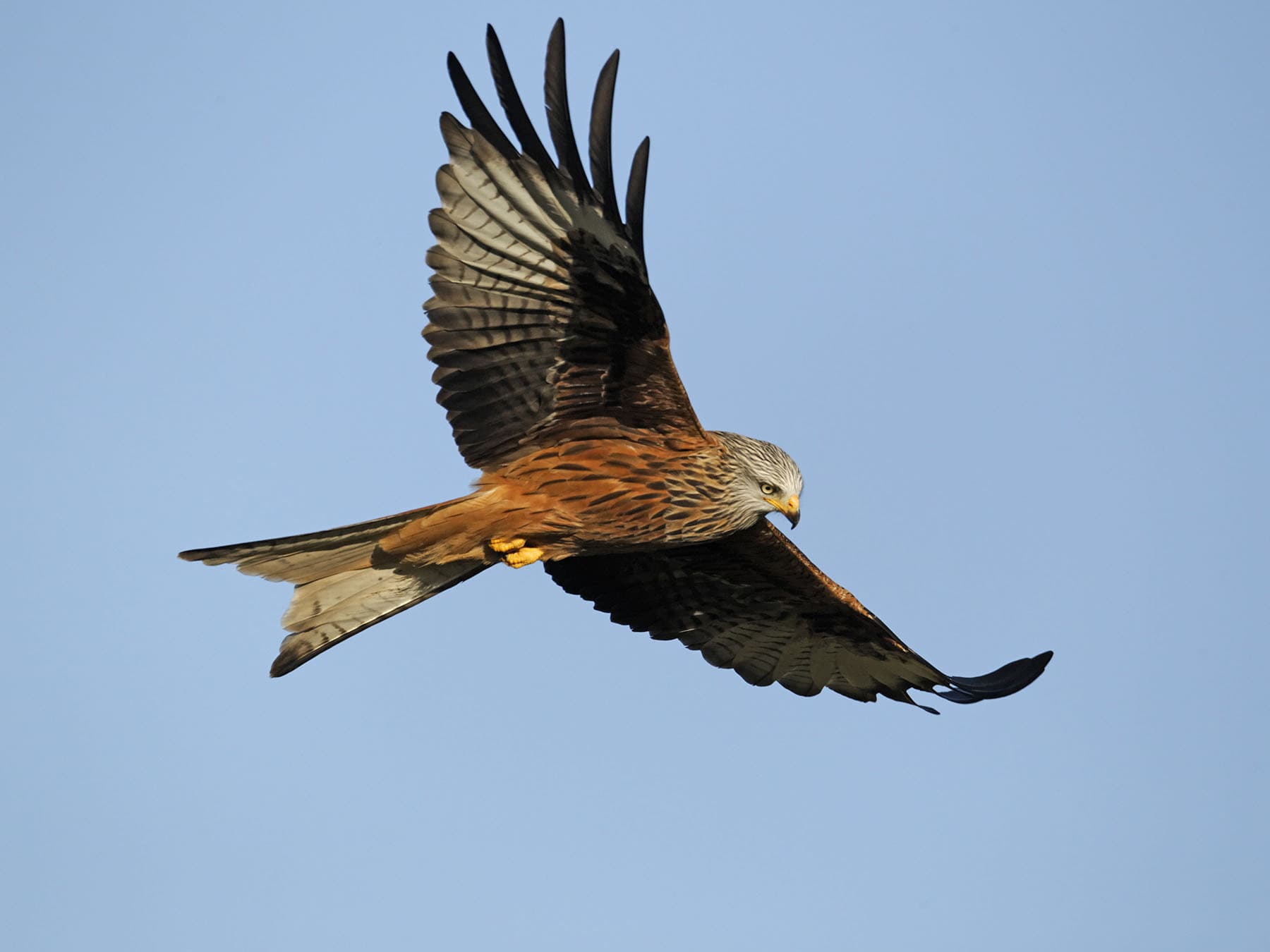
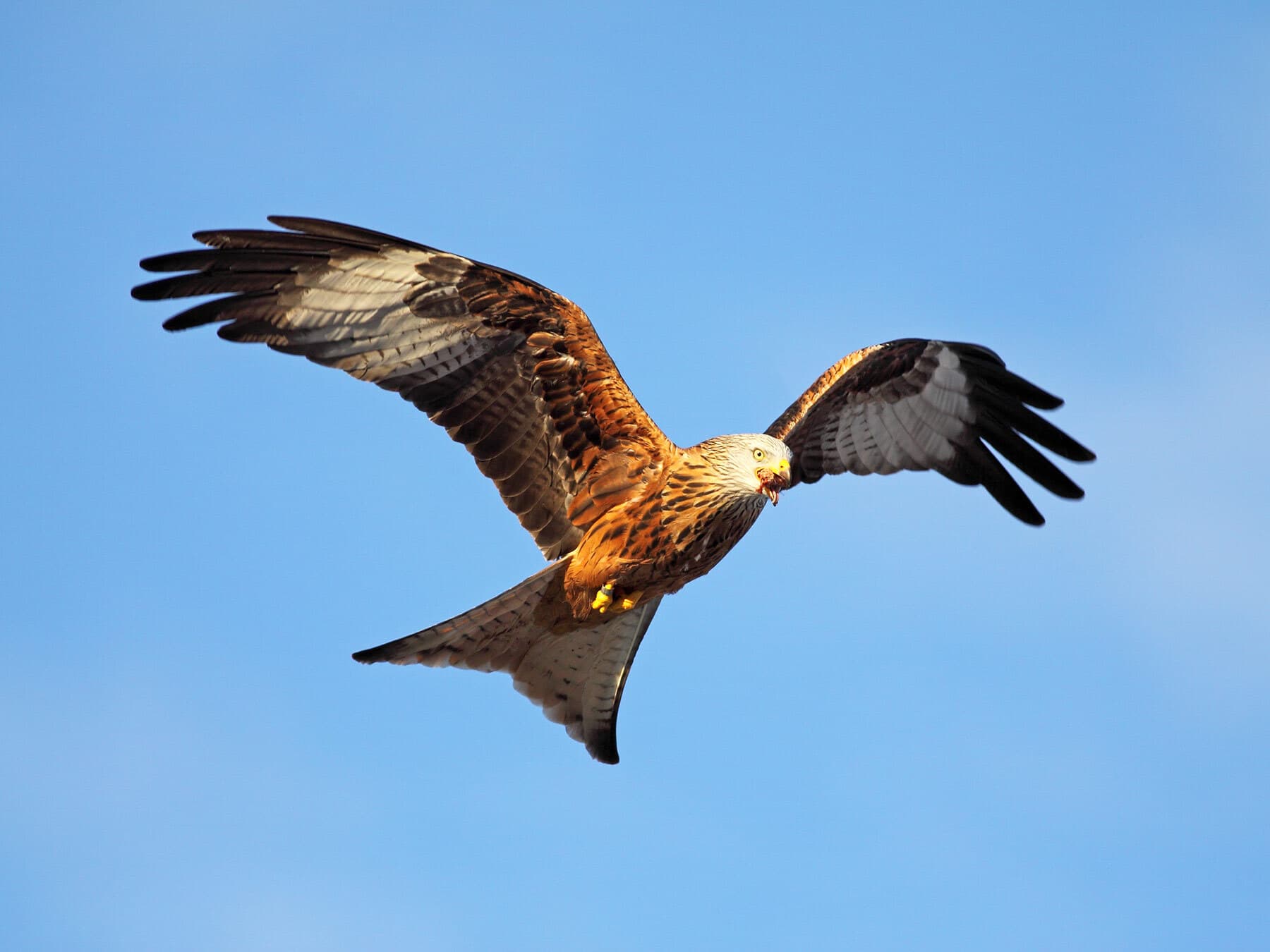
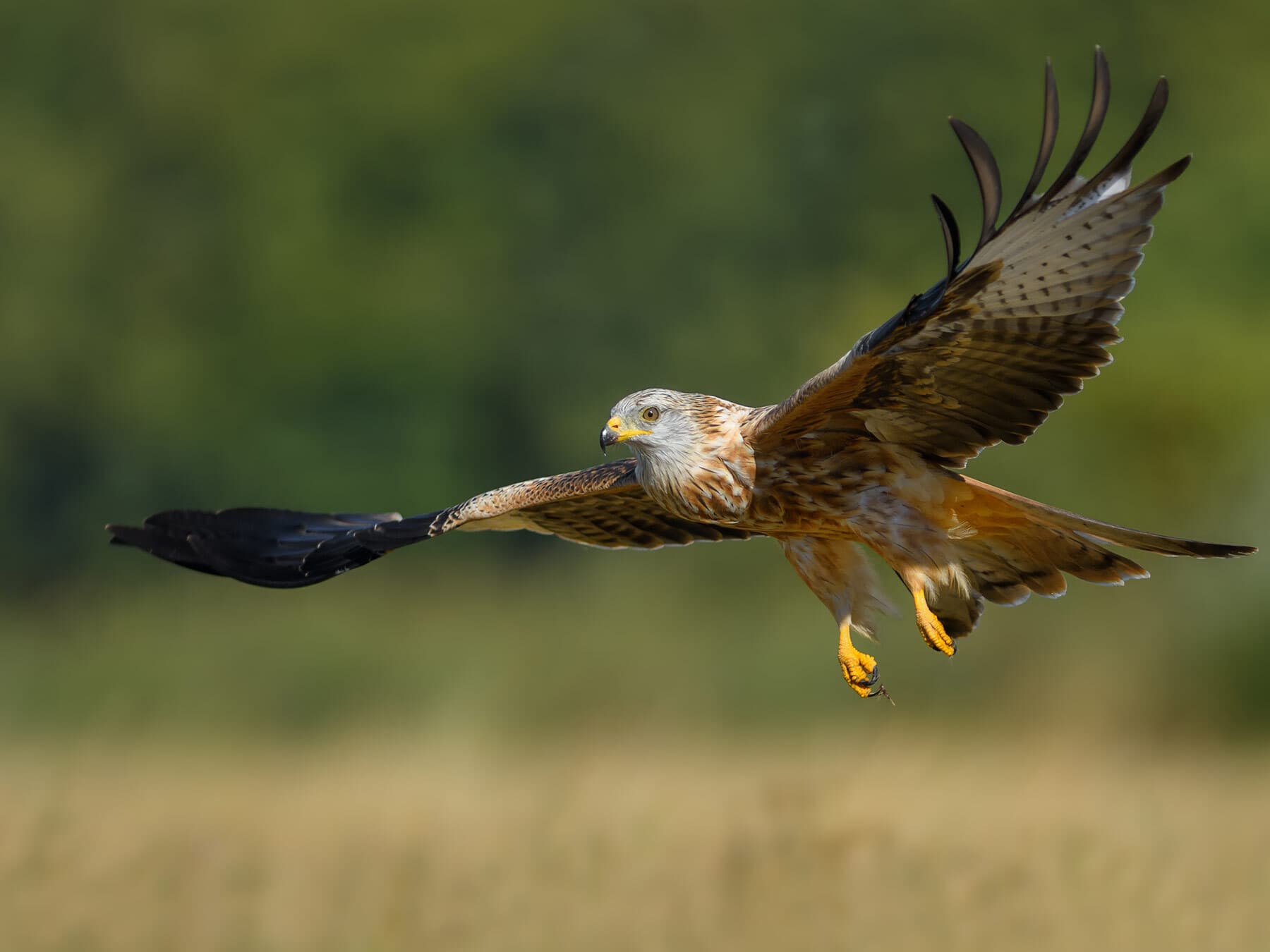
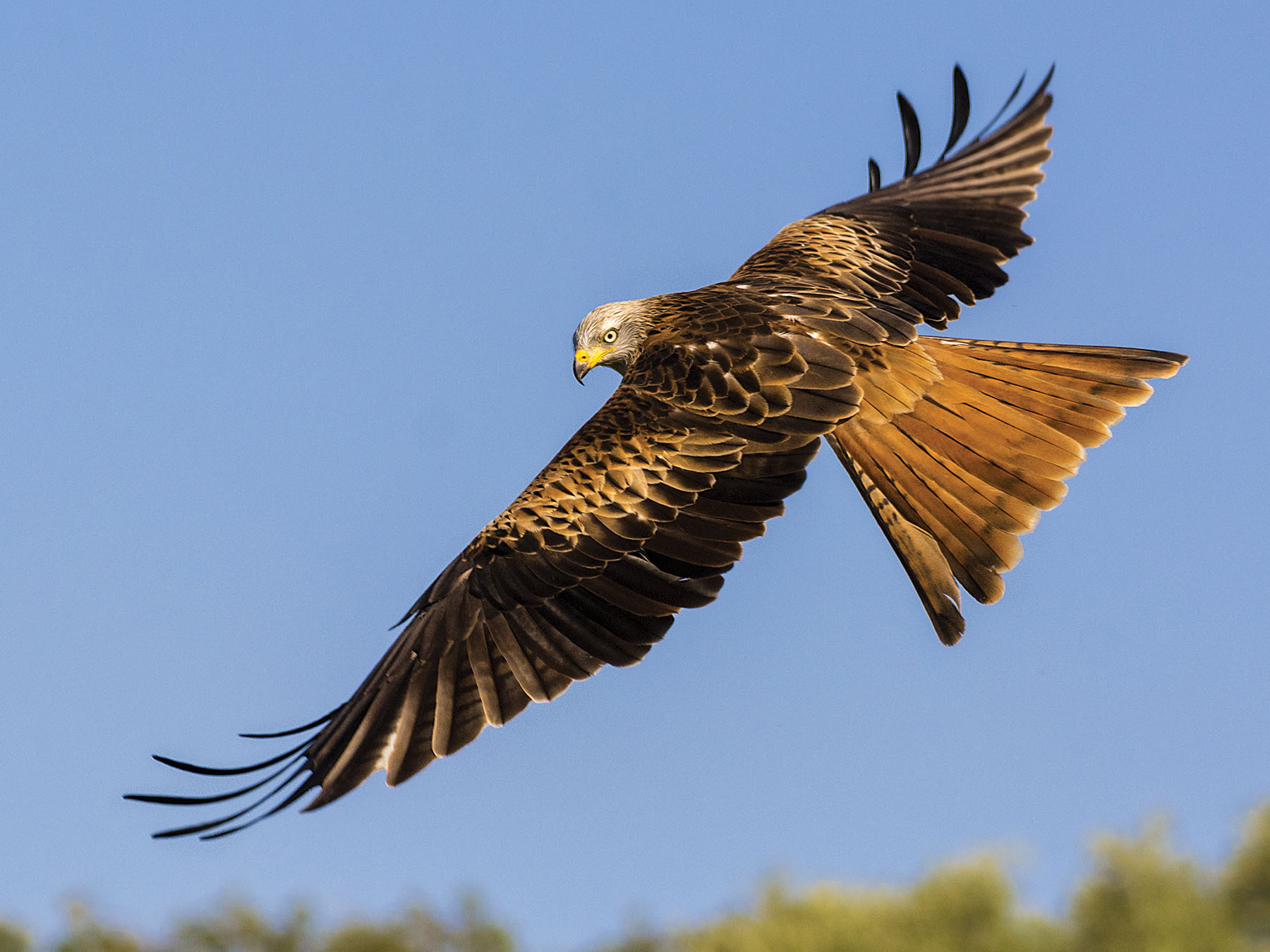
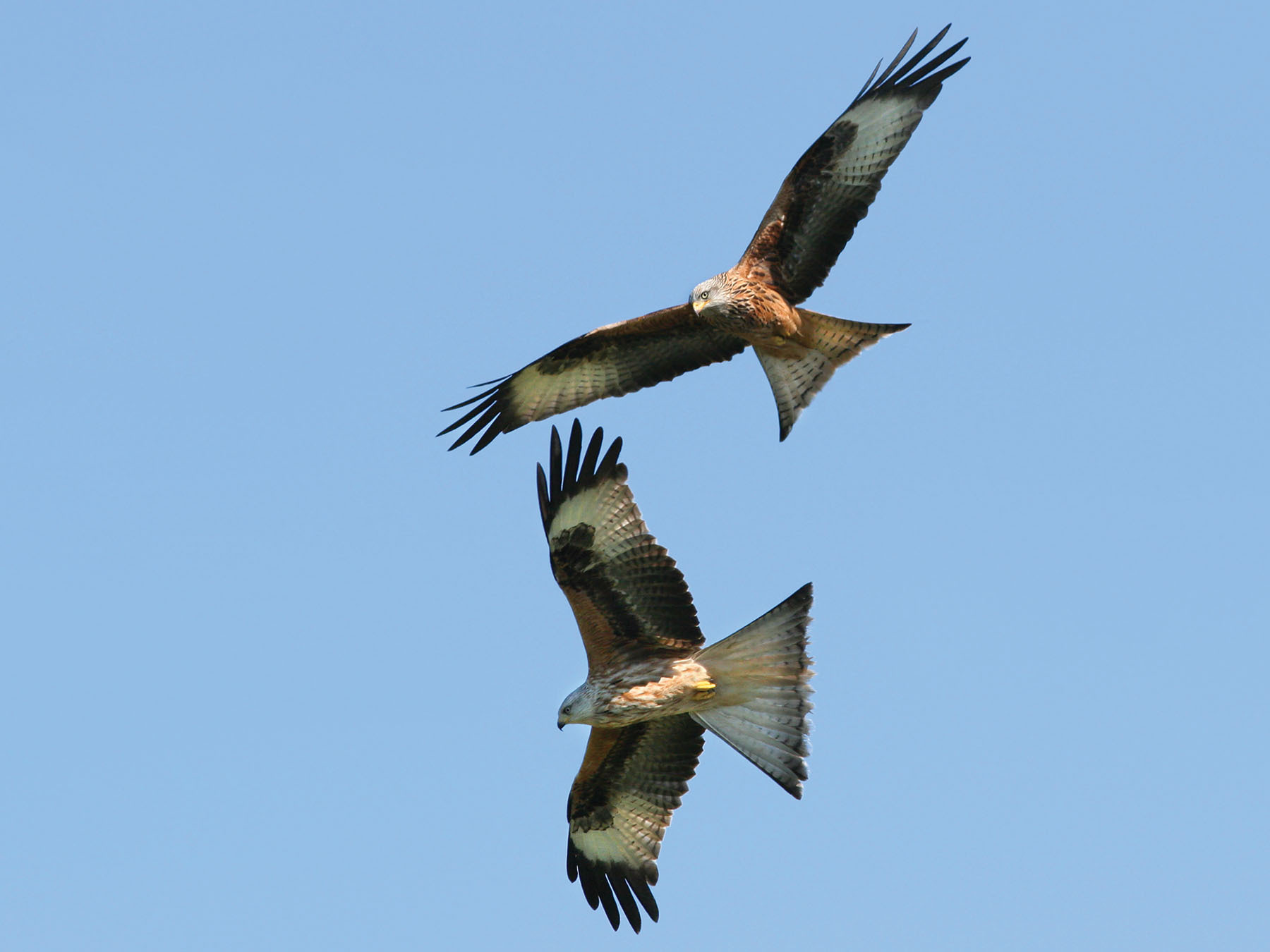
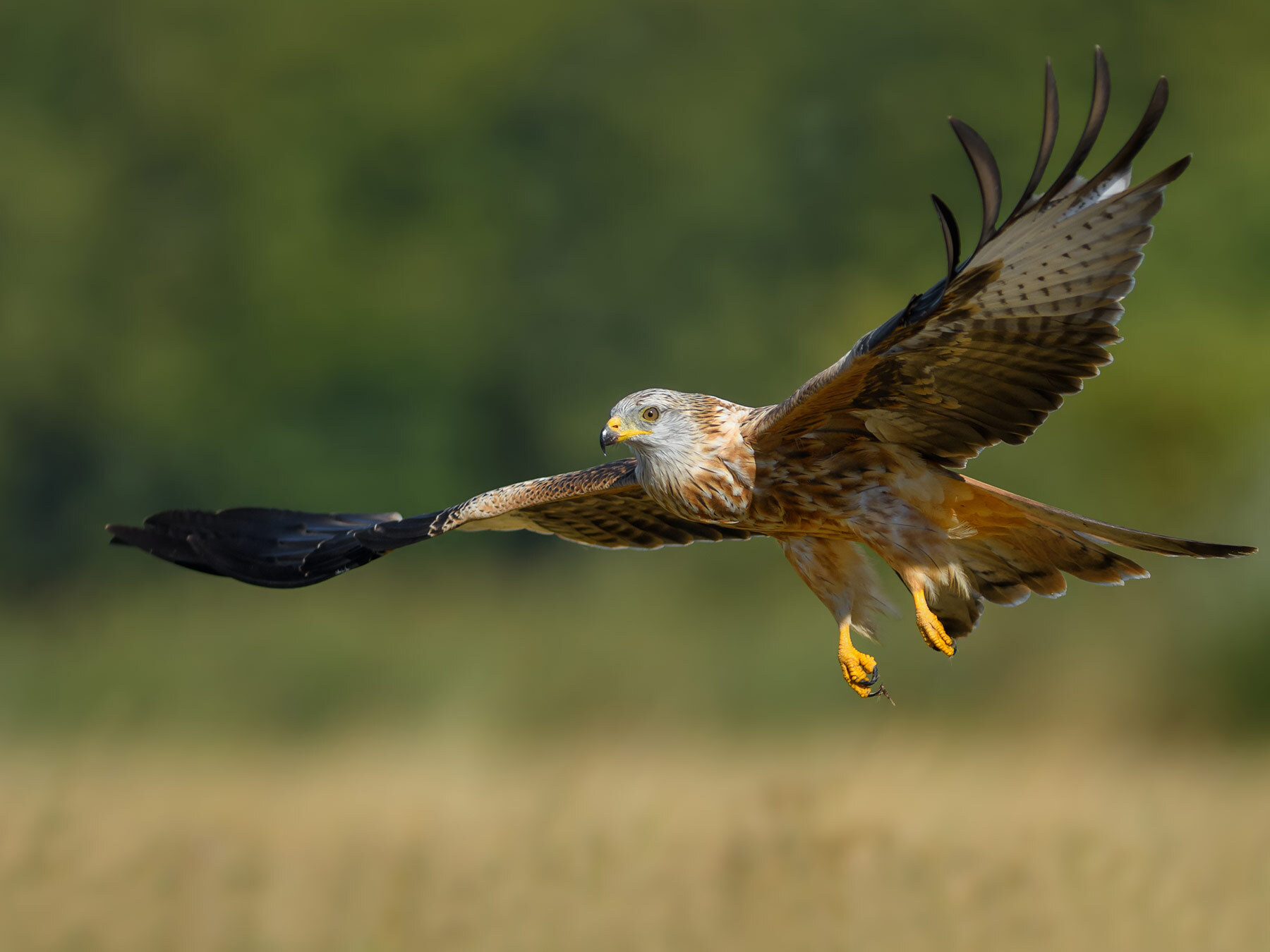
Look at the tail. A Red Kite's is long, reddish and deeply forked, and in flight the bird twists it constantly to steer while barely moving its wings. The wings are long and angled, with big white patches underneath and dark, fingered tips.1
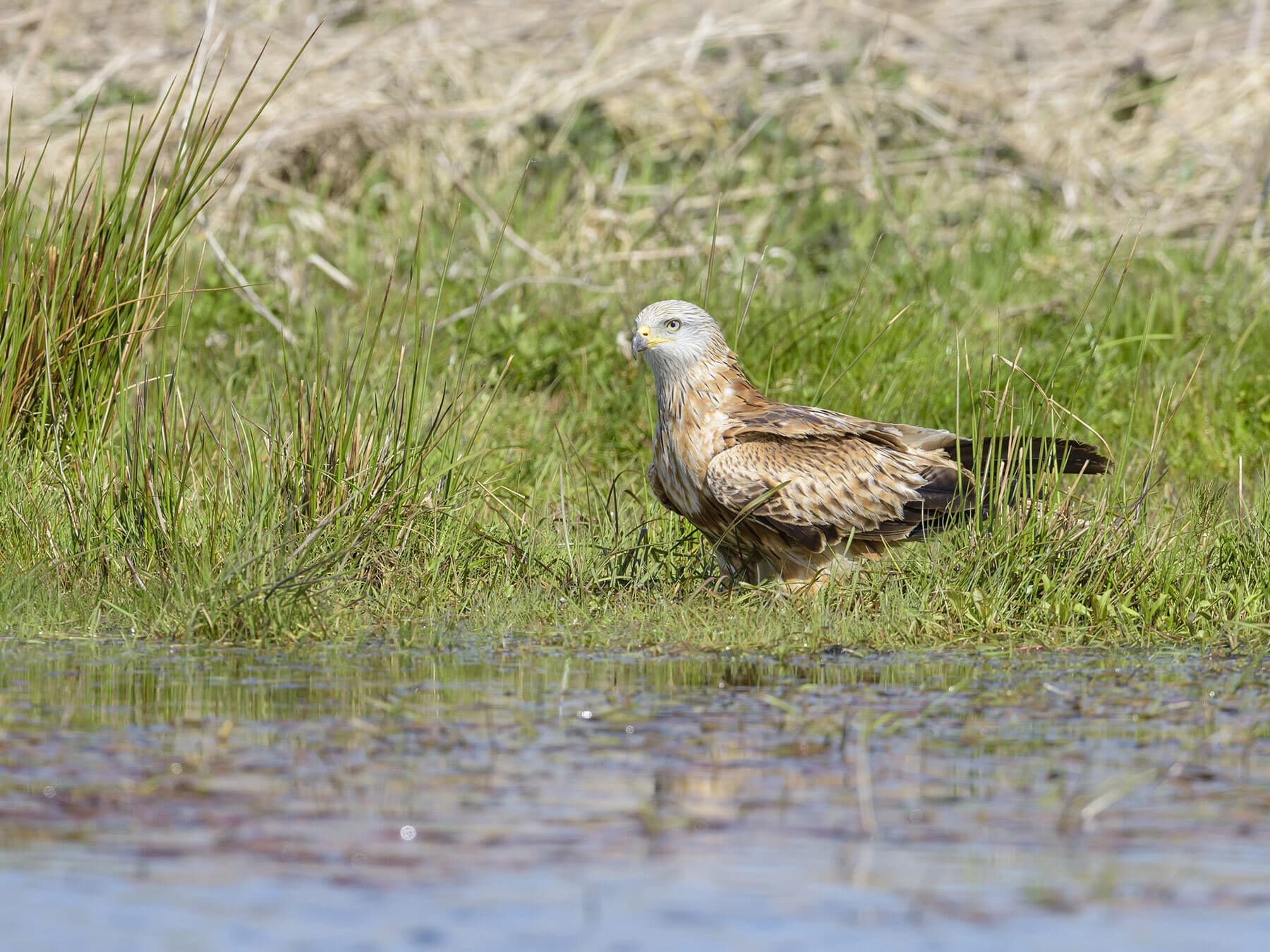
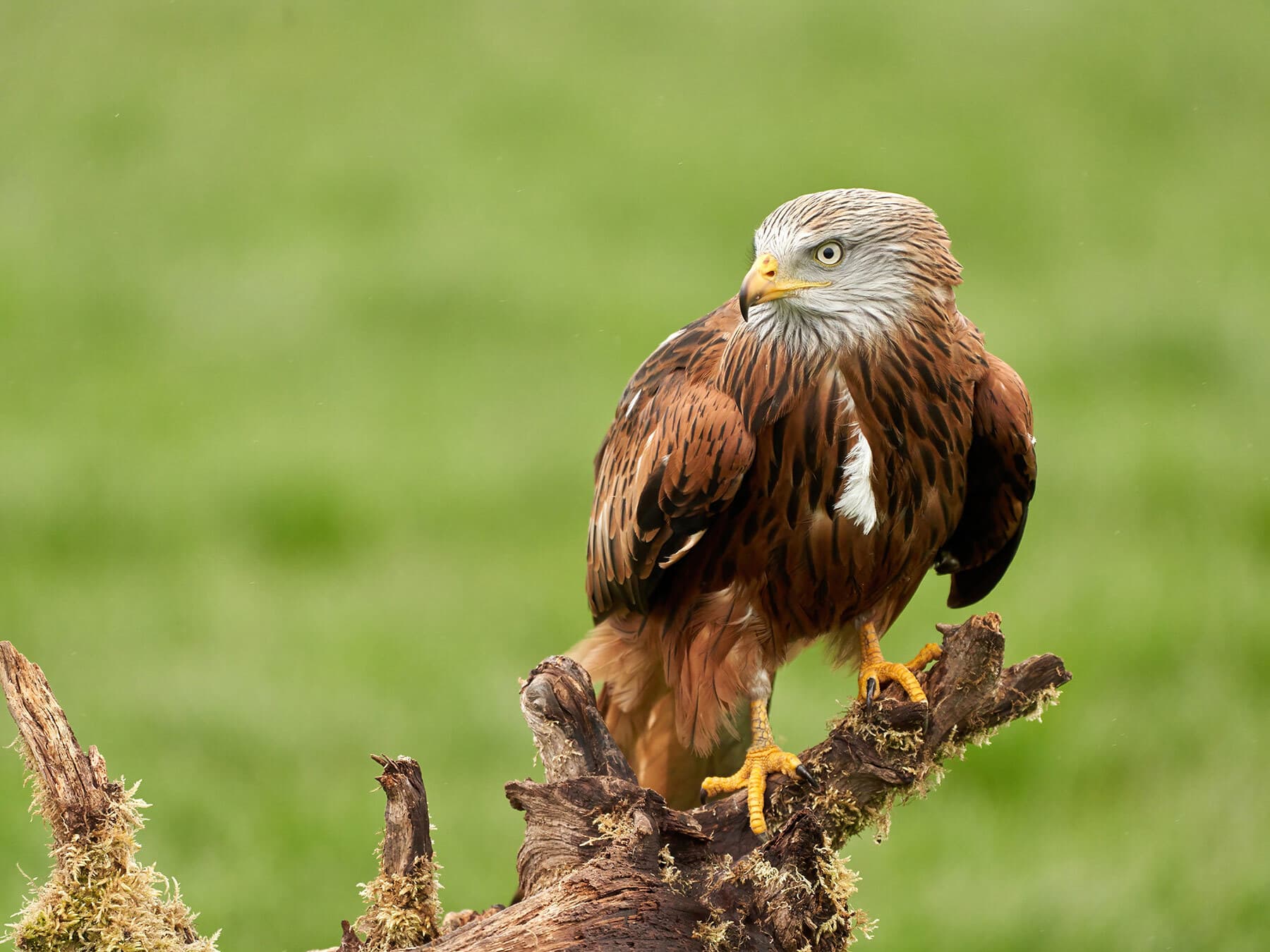
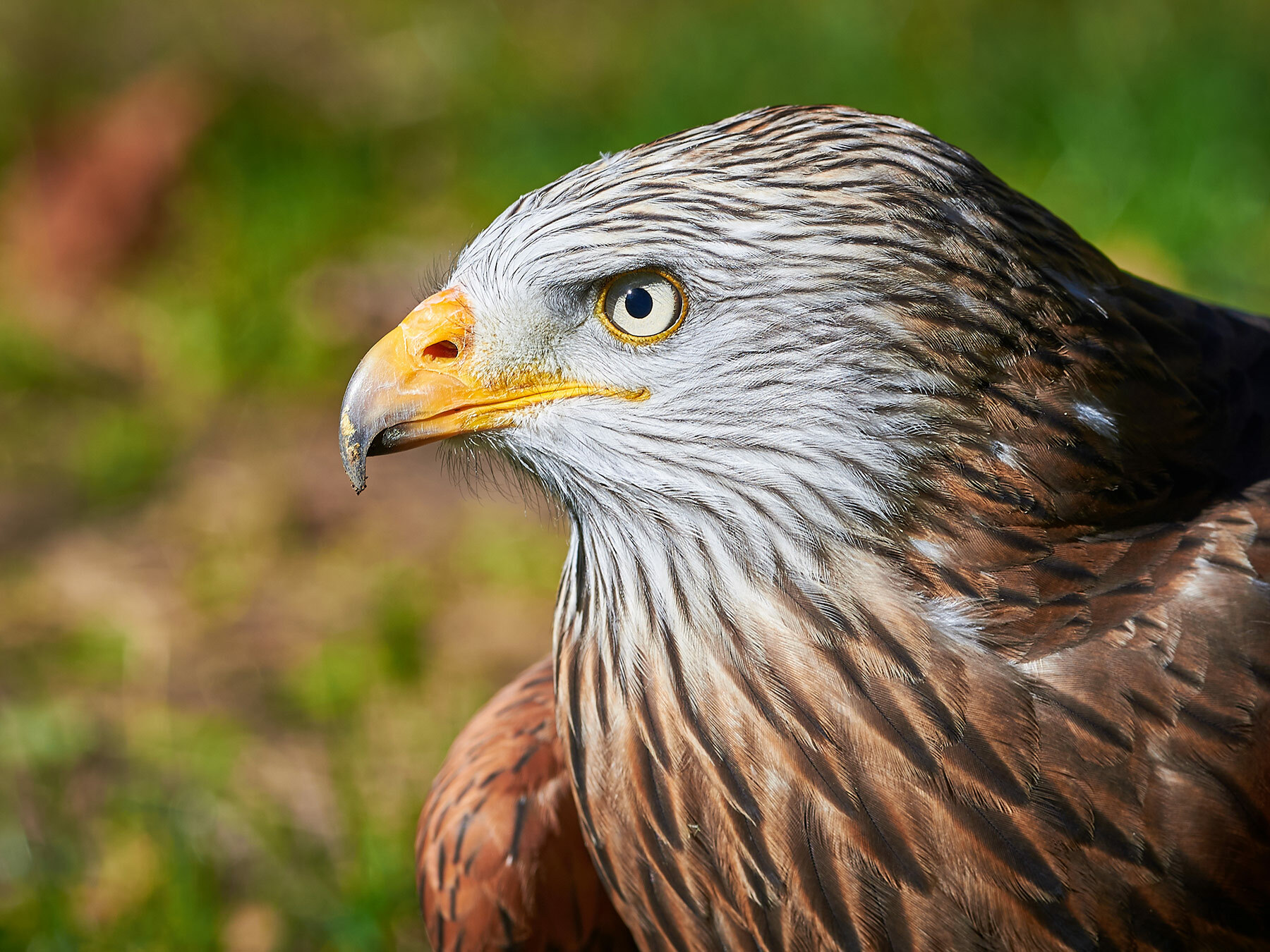
Close up, an adult has a reddish-brown body streaked with dark, a pale grey head finely streaked with black, a yellow bill with a dark hook, yellow legs and pale eyes.2 When it soars it holds its wings flat or slightly bowed down, not raised in a V like a Buzzard's.
The white patches under the wings come from the inner webs of the primaries, the long outer flight feathers, which are almost all white. Kites vary a good deal from bird to bird, for example in how much barring the tail shows.3
Size and wingspan
A Red Kite is 60-66 cm (24-26 in) long and weighs 800-1,300 g, with a wingspan of 1.75-1.95 m (5 ft 9 in to 6 ft 5 in).1 The BTO gives a typical weight of 1.1 kg.4 Birds of the World, using a different set of measurements, gives a narrower span of 1.43-1.71 m (4 ft 8 in to 5 ft 7 in) and a length of 60-72 cm.3
Females are heavier than males. Birds of the World gives males 757-1,221 g and females 960-1,600 g, so the two overlap.
Next to a Buzzard, a kite is longer and much wider-winged, though their weights overlap. Eagles are bigger again. Here are the RSPB's figures for each:5, 6, 7
| Bird | Length | Wingspan |
|---|---|---|
| Red Kite | 60-66 cm | 175-195 cm |
| Buzzard | 51-57 cm | 113-128 cm |
| Golden Eagle | 75-88 cm | 204-220 cm |
| White-tailed Eagle | 70-90 cm | 200-240 cm |
Male, female and young
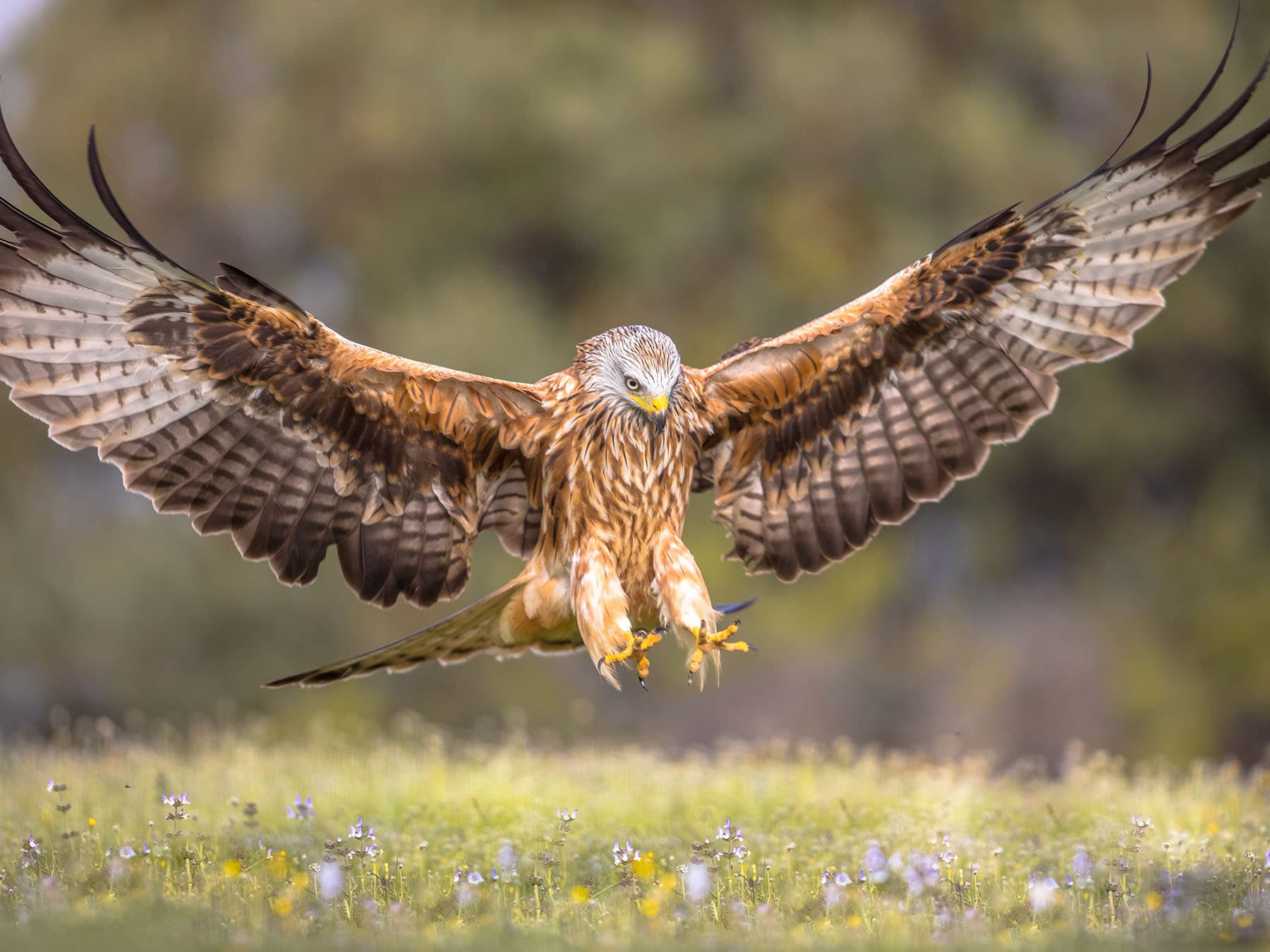
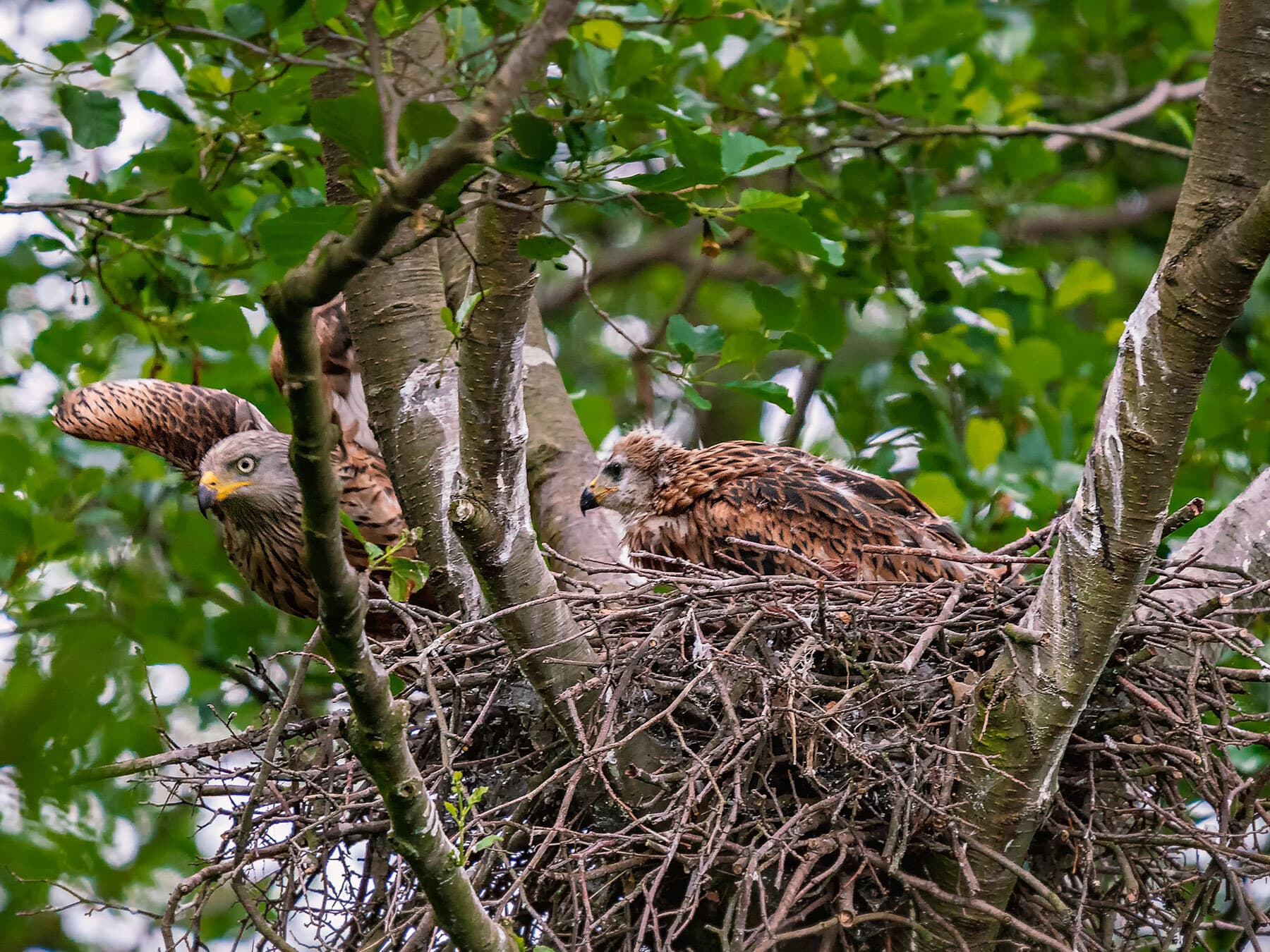
Males and females look alike. Females are slightly larger, but the sizes overlap so much that the sexes are hard to tell apart unless you can compare two side by side.8 Young birds in their first plumage have a paler body, a darker head and a less rusty tail than adults. Chicks in the nest are covered first in buff down, then in a second, reddish-tinged down.
In some areas young kites are fitted with coloured wing tags each June: the colour changes each year, so a tagged bird can be aged, and a second colour shows which part of the UK it came from.8
Identification: similar birds
Buzzard. The Buzzard, the UK's most common and widespread bird of prey, is the one to rule out. It has a short tail, often fanned, with no fork, and it soars with its wings raised in a V. Its call is a mew that could pass for a cat. Side by side, with photos: Buzzard or Red Kite?
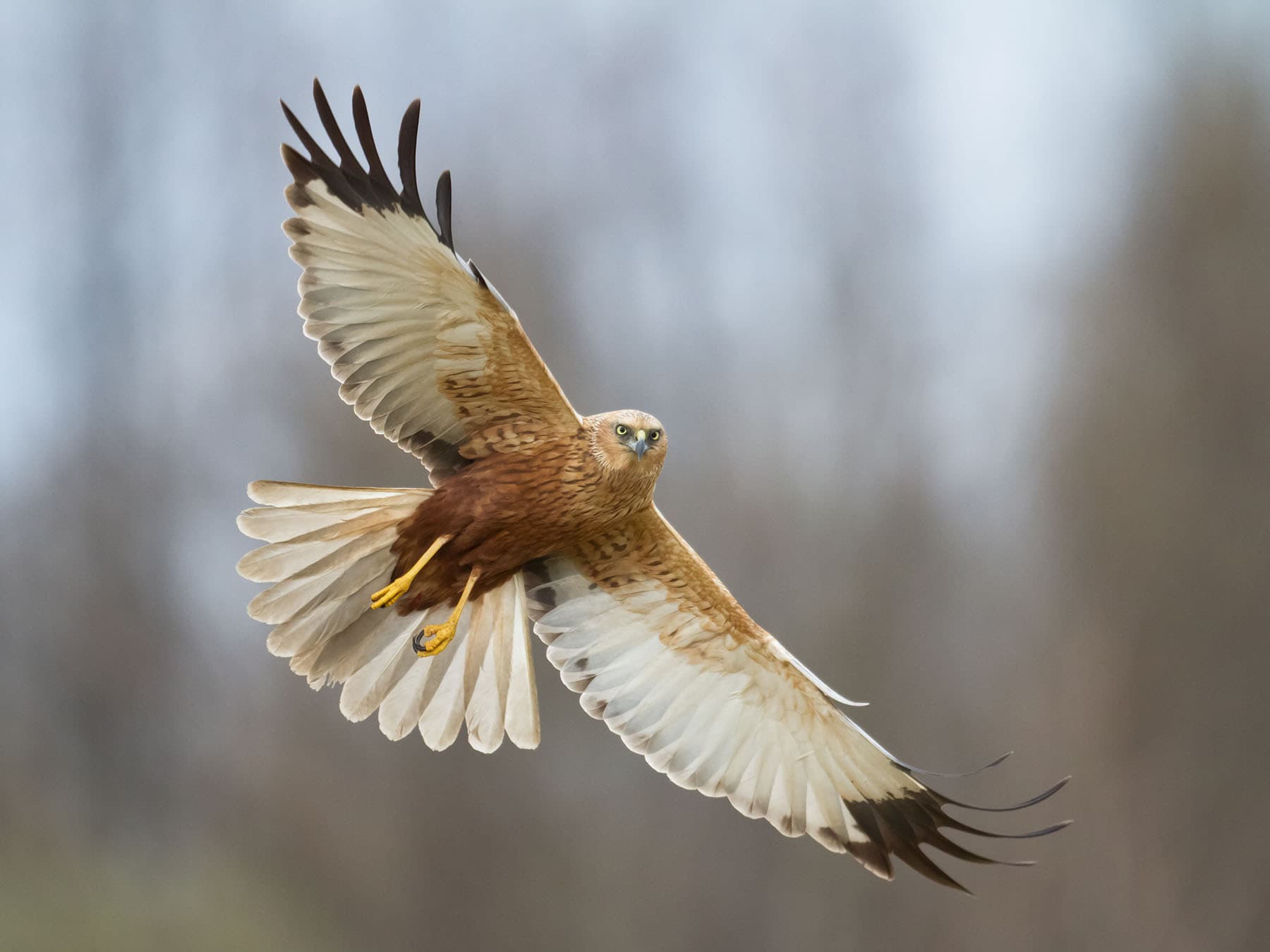
Black Kite. Its closest relative, the Black Kite, is smaller and browner, with a shallower fork to the tail, a less white head and smaller pale patches under the wing.
Its size
Adults- Length
- 60–66 cm
- Wingspan
- 175–195 cm
- Weight
- 800–1300 g
Its song and calls
The call is a whistled mew, which the RSPB writes as "peee eooo eooo". Birds of the World likens it to a Buzzard's call but higher and perhaps shriller, often given several times in a short, fast series.
It is the commonest call between the two birds of a pair, and kites are often silent away from the nest. Hear British recordings, drawn as spectrograms: Red Kite call and sounds.
- Calls0:00 / 0:08
Recorded in Dumfries and Galloway, Scotland · May 2021
South West Scotland Environmental Information Centre · iNaturalist · CC BY 4.0
- Calls0:00 / 0:18
Recorded in Hertfordshire, England · March 2021
When and where to see it
OctoberHere all year
Most recorded in October
- 1. Powys3.9%
- 2. Berkshire3.5%
- 3. Buckinghamshire3.0%
- 4. Oxfordshire2.7%
- 5. Bedfordshire2.1%
Each dot is a county, state or province: the bigger and darker, the larger the bird’s share of that place’s bird records that month. Grey dots: no regular records. The ringed point is the centre of the bird’s records this month; the arrow shows how it moved since last month, and the dashed loop its path through the year. “Arrivals” colours places where it becomes regular this month (orange) or is in its last regular month (grey). GBIF eBird Observation Dataset, 2019–2024. Map data: Natural Earth, US Census Bureau; place centres © OpenStreetMap contributors.
In your area
See when the Red Kite is recorded in your county, state or province.
How often the Red Kite turns up in the UK and Ireland through the year, from birdwatchers' records.
United Kingdom
Resident · all year · most records in March
Ireland
Resident · all year · most records in March
Show as a table
| Month | United Kingdom | Ireland |
|---|---|---|
| January | 0.57% (regular) | 0.090% (regular) |
| February | 0.60% (regular) | 0.088% (regular) |
| March | 0.65% (regular) | 0.16% (regular) |
| April | 0.55% (regular) | 0.12% (regular) |
| May | 0.52% (regular) | 0.12% (regular) |
| June | 0.58% (regular) | 0.12% (regular) |
| July | 0.53% (regular) | 0.11% (regular) |
| August | 0.41% (regular) | 0.099% (regular) |
| September | 0.39% (regular) | 0.069% (regular) |
| October | 0.44% (regular) | 0.066% (regular) |
| November | 0.47% (regular) | 0.079% (regular) |
| December | 0.55% (regular) | 0.072% (regular) |
Recorded regularly in
Worldwide: recorded regularly in 33 countries
Countries where it was recorded in at least 3 of the 6 years 2019–2024. Linked countries have their own bird list.
Data: EOD – eBird Observation Dataset (Cornell Lab of Ornithology), accessed via GBIF.org, CC BY 4.0. Records from 2019–2024, aggregated and filtered by Birdfact. How these lists are made
Today Red Kites live over most of Wales and much of central and eastern England, plus parts of Scotland, Northern Ireland and northern England. The highest numbers are in the Chilterns, Wales, Yorkshire and eastern Scotland, where kites drift over major roads, farmland and woods, even beside cities such as Gateshead. They are here all year.
In the last national atlas they bred in 723 of the UK's 10-km squares (24%) and wintered in 998 (33%). Their breeding range had grown by 2,000% since 1968-72, and they have kept spreading since.4
They like open country with woods: woodland or copses mixed with farmland, pasture or heath, where they nest in the trees and forage over the open ground. More on their range and the best places to see them: where Red Kites live.
Spotting tips
Look up on warm, sunny days, when kites soar and the forked tail is easy to see. Watch the verges of main roads, where they search for animals killed by traffic. For a close view, try a feeding site: at Gigrin Farm near Rhayader, hundreds of wild kites come in to be fed each day.9
Do they migrate?
Not in Britain. Welsh kites stay put all year, and so do the kites of the newer populations across the British Isles, though young birds wander. A few British-ringed kites have been reported abroad, in France, Belgium, Spain and Iceland, and kites ringed in Germany have been found here.10
On the continent it is different. Many kites from northern and central Europe migrate, most to southern France and Spain; some 10,000 are counted through the western Pyrenees each autumn. More of them now stay north for the winter.
What it eats
Mostly carrion and earthworms, the RSPB says. Red Kites are scavengers first: dead sheep and other livestock, animals killed on the roads, scraps from rubbish tips. They also catch small animals such as voles, mice and young birds, and pick up beetles and worms on the ground.
For a bird of their size their talons are weak, which is why they rely so much on carrion. In Wales, a study of their food found that birds were important prey in the breeding season, carrion in late winter and spring, and food waste in autumn and early winter.11 More: what Red Kites eat, including the question of feeding them in gardens.
Nesting and breeding
Red Kites build a platform of sticks in a tree, usually lined with wool and often decorated with rags or plastic. The female lays two or three eggs in spring, occasionally four. She incubates them for 31-32 days, and the chicks stay in the nest for 50-60 days. Pairs raise one brood a year.4
Kites first breed at about two years old. More: Red Kite nesting, eggs and young.
Behaviour
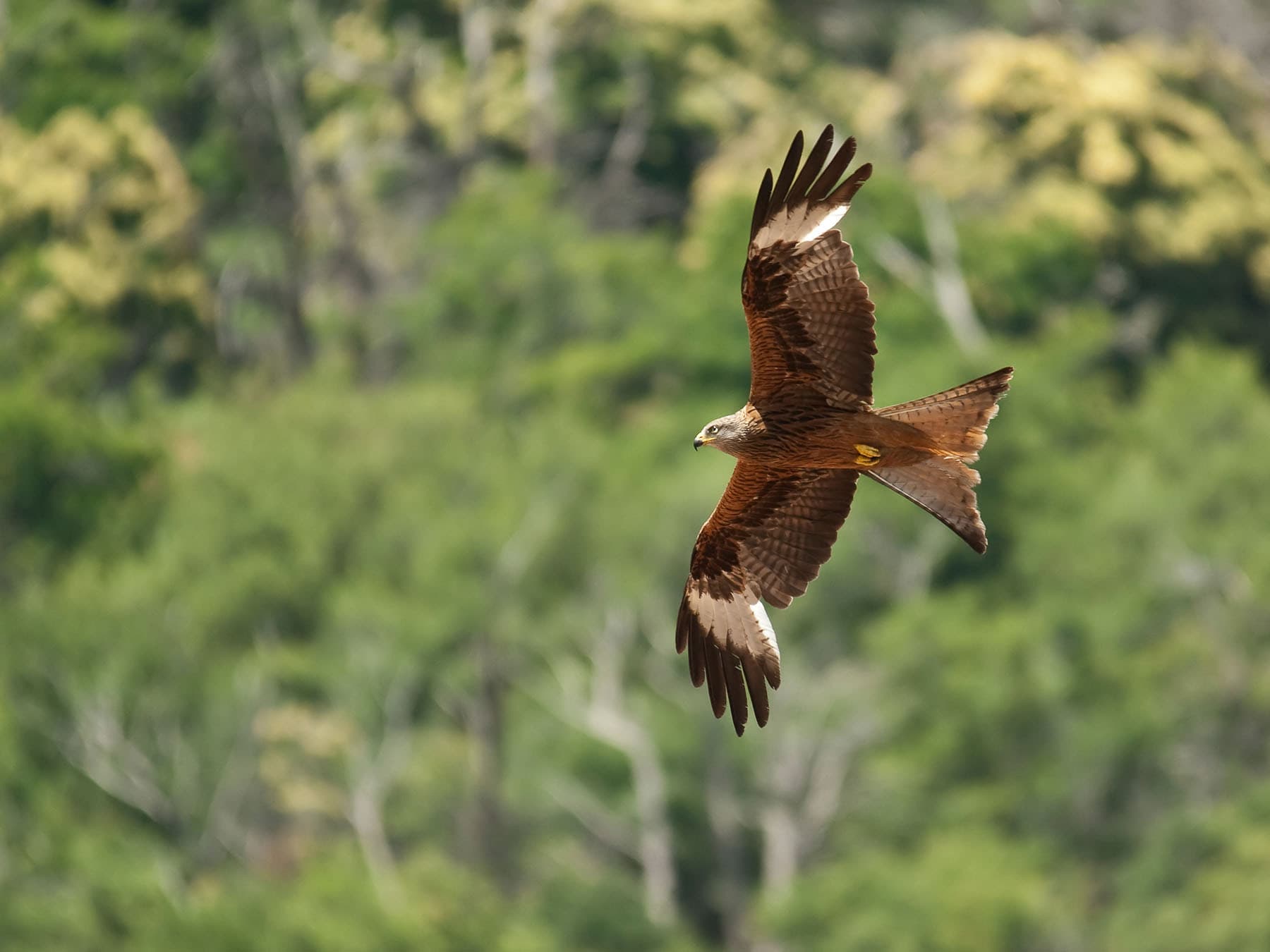
Kites soar and glide with few wingbeats. They hunt by flying low over open ground, or by dropping onto food from a soar.
In winter they gather at night in roosts, sometimes of 100 birds or more, among copses and clumps of trees that may be used year after year, though settled adults may keep roosting near their nests. Most hunt within a few kilometres of the nest, though trips of up to 20 km are known, and from a winter roost they range further.12
Kites are often seen over towns where people feed them. A study in Reading found that about 4.5% of households put out food for them: by the study's estimate, potentially enough to feed far more kites than the road kill and scraps on the main roads.
Lifespan and predators
The BTO puts the typical life expectancy of a kite that reaches breeding age at about 4 years. Some live much longer. Birds of the World says kites can live to 26 years in the wild, and gives adult survival in Wales as possibly 95% a year, far higher than the BTO's figure of 61%.3 The oldest on the BTO's ringing list was ringed as a nestling near Henley-on-Thames in June 1995 and found sick in Buckinghamshire in September 2023, 28 years 2 months 14 days later.13 The European longevity list, which estimates age, has a German bird of 29 years 10 months.14
Conservation
The Red Kite is on the UK Green List, where it moved in 2015, and has been of Least Concern worldwide since 2020; from 2005 to 2018 it was listed as Near Threatened.15 The UK had about 4,400 pairs in 2016,16 and numbers have more than doubled since 2014.17
It is one of the great conservation successes. On the Breeding Bird Survey, UK numbers rose by 2,613% between 1995 and 2024, and in England by more than any other species. The UK now holds about 13% of the world's Red Kites;1 Germany, with 14,000-16,000 pairs, has the most.15
How the population came back
Kites were once common, even in towns, where they scavenged the streets: they were a familiar sight in 16th-century London. Then came persecution: England and Scotland had lost them by 1900, with just a few pairs left in Wales.
Fewer than ten pairs survived the 1930s and 1940s, in a small area of mid Wales. Local conservationists and landowners looked after them, and the RSPB paid farmers a bounty for each successful nest from 1922 to 1990. By 1993 Wales had 100 pairs, most of them descended from a single female that had kept breeding through the worst years.
In 1989 releases began in the Chilterns and on the Black Isle in northern Scotland: 93 young kites from Spain, Sweden and Wales were let go in southern England by 1994, and 93 from Sweden in Scotland by 1993. Both groups first bred successfully in 1992.18 Releases followed in Northamptonshire, central Scotland, Yorkshire, Dumfries and Galloway, north-east England, Aberdeen and County Down.
Poisoning and the population
Kites still die from poison. Of the kites found dead in northern Scotland in 1989-2006, 40% had been poisoned, and illegal killing has held that population back. Rat poison is a problem too: all 14 dead kites sent to the monitoring schemes and analysed in 2022, all from England and Wales, carried residues of modern rat poisons, and the poisons contributed to the deaths of about one in six of the kites examined over eight years, though the sample includes birds sent in as suspected poisonings, so poisoned birds are probably over-represented.19 The BTO has found no evidence so far that rat poison is affecting numbers, and suggests clearing up poisoned rats promptly and safely.
The law gives kites extra protection. They are on Schedule 1 in Great Britain20 and in Northern Ireland,21 so disturbing a kite at or near its nest, or its dependent young, is an offence without a licence. In Scotland it is also an offence to harass a Red Kite at any time.
Similar birds
Often mistaken for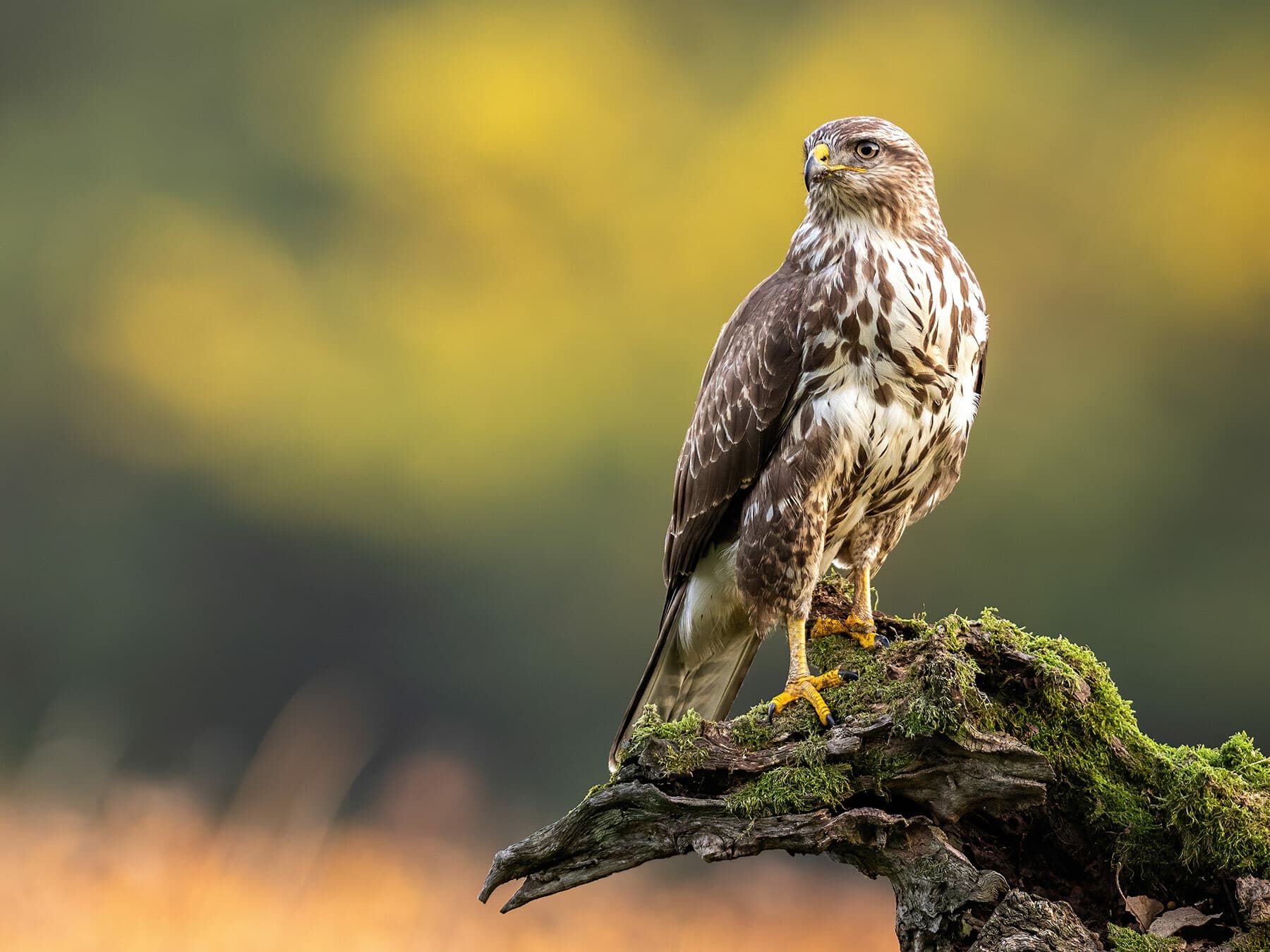
More photos
9 photos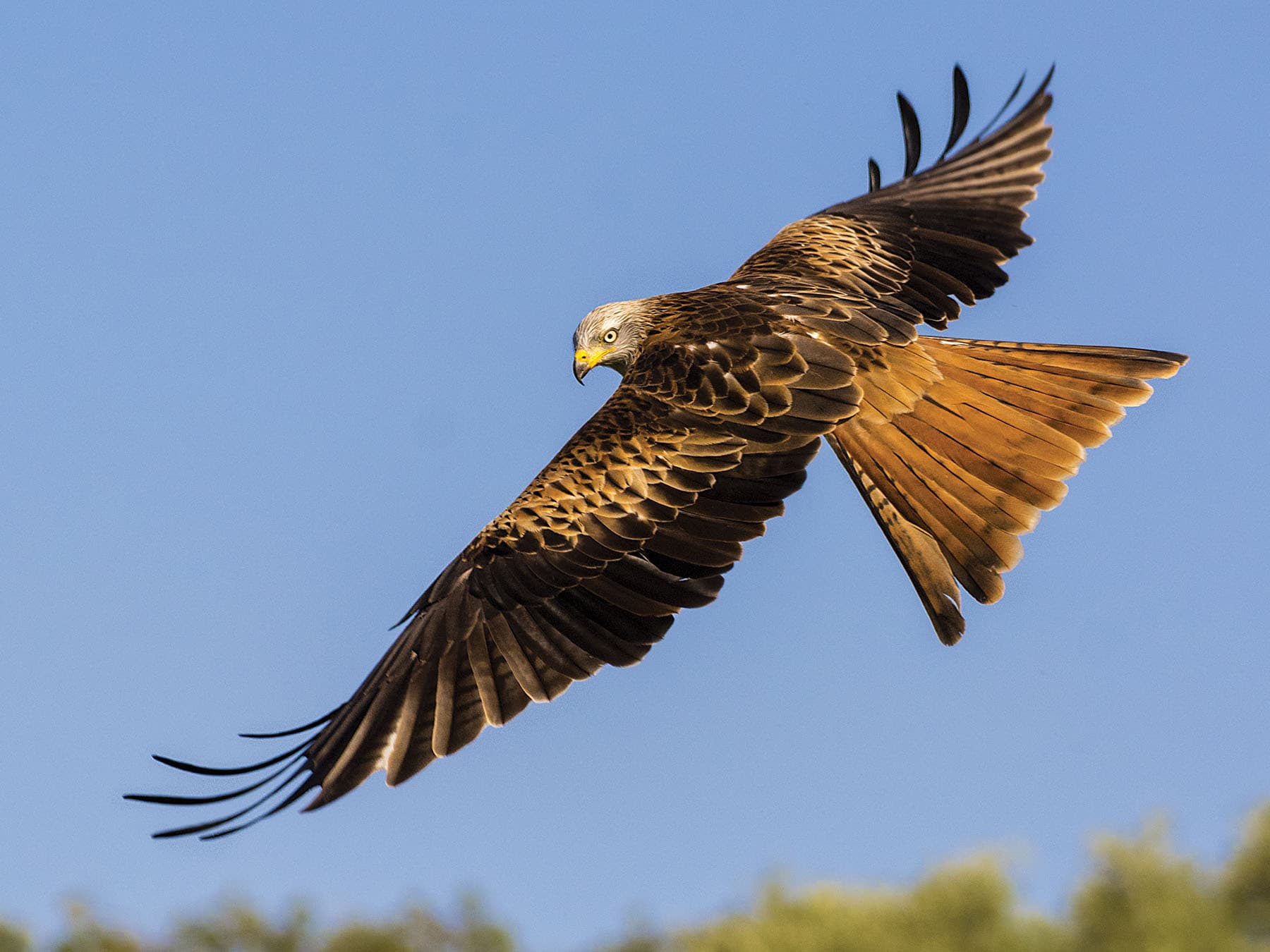 A Red Kite from above: the rufous tail and dark-tipped wings
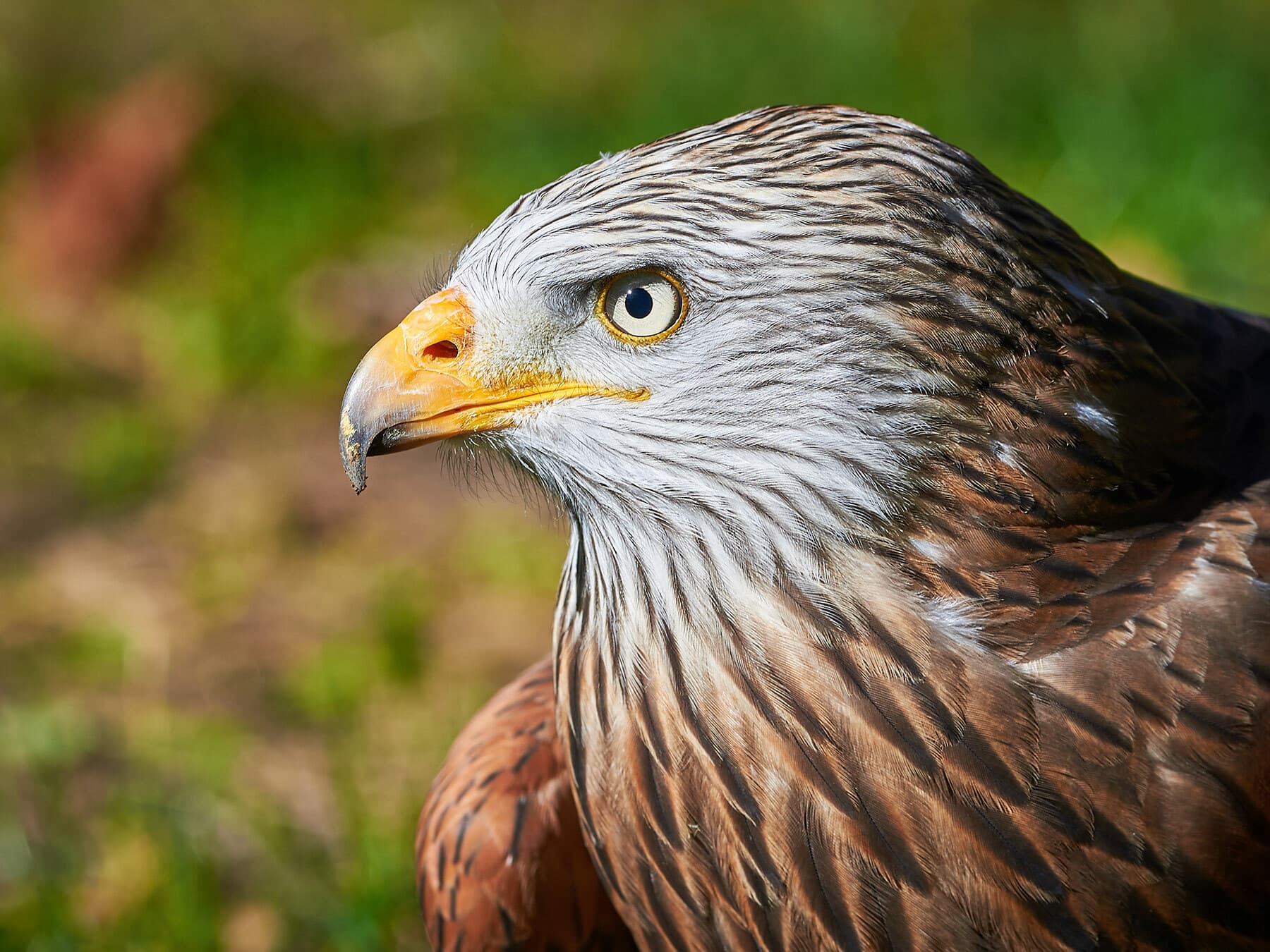 A Red Kite's head: pale grey with dark streaks, a yellow bill and a pale eye
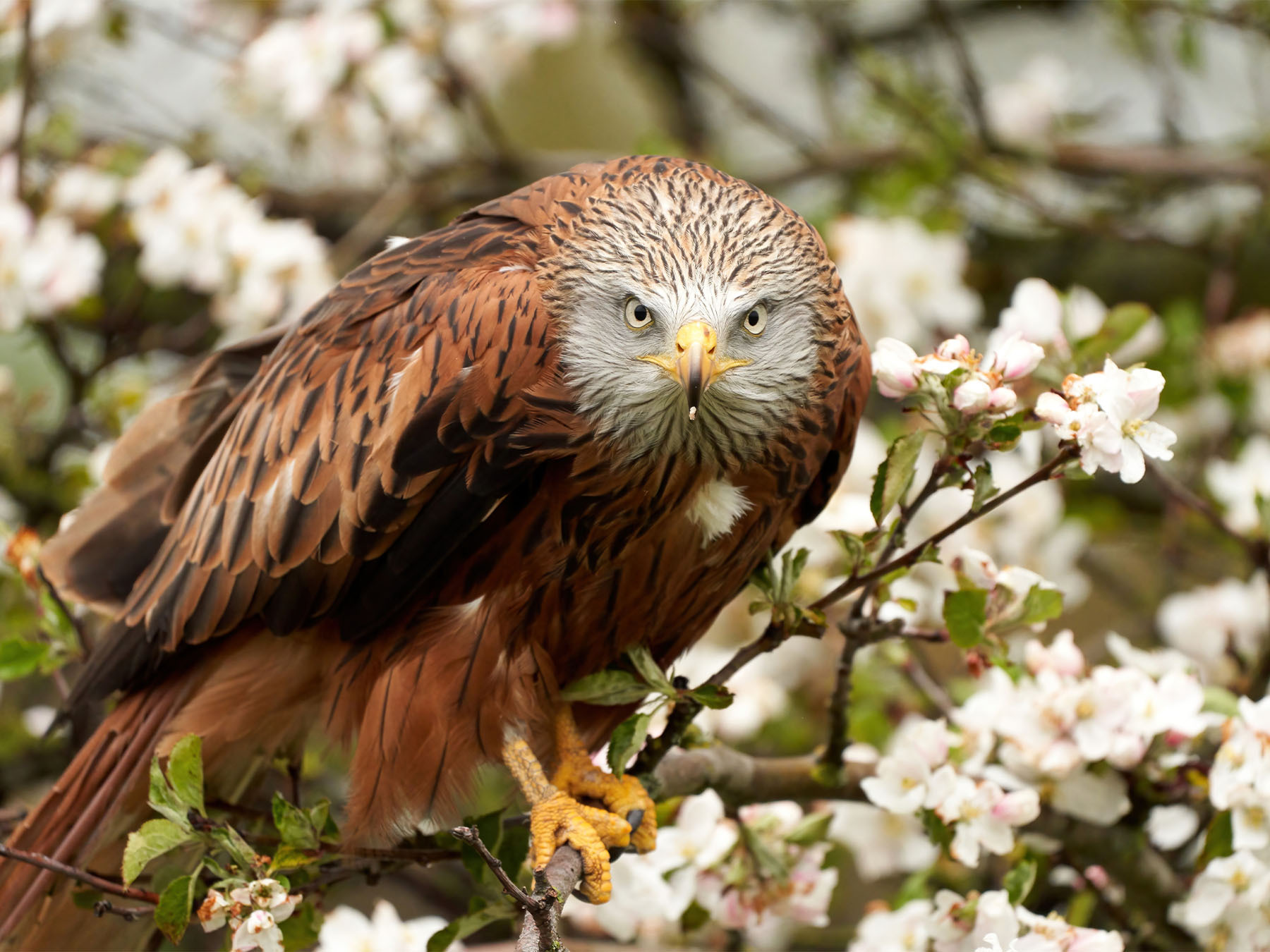
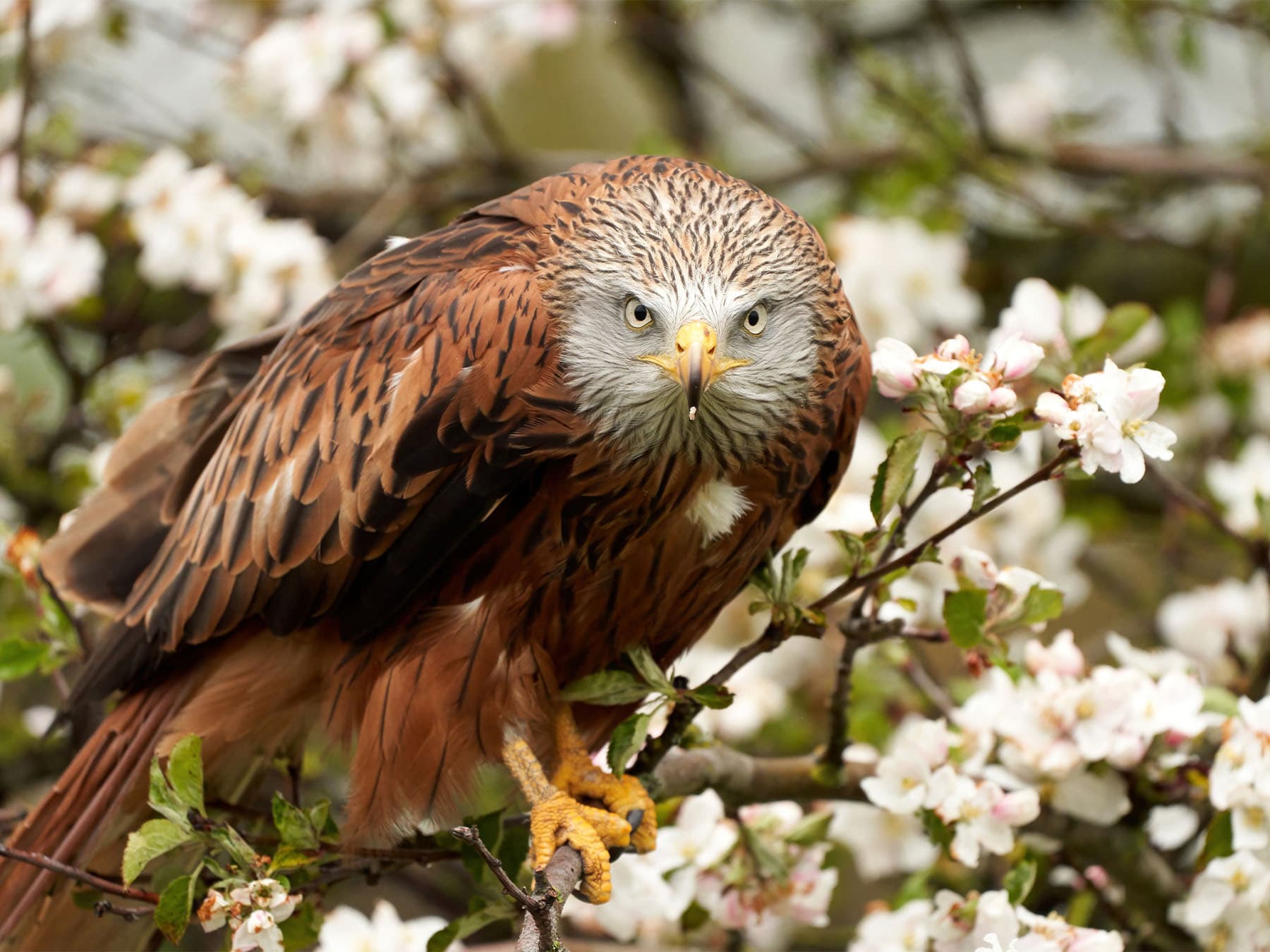 A Red Kite perched among blossom, face on
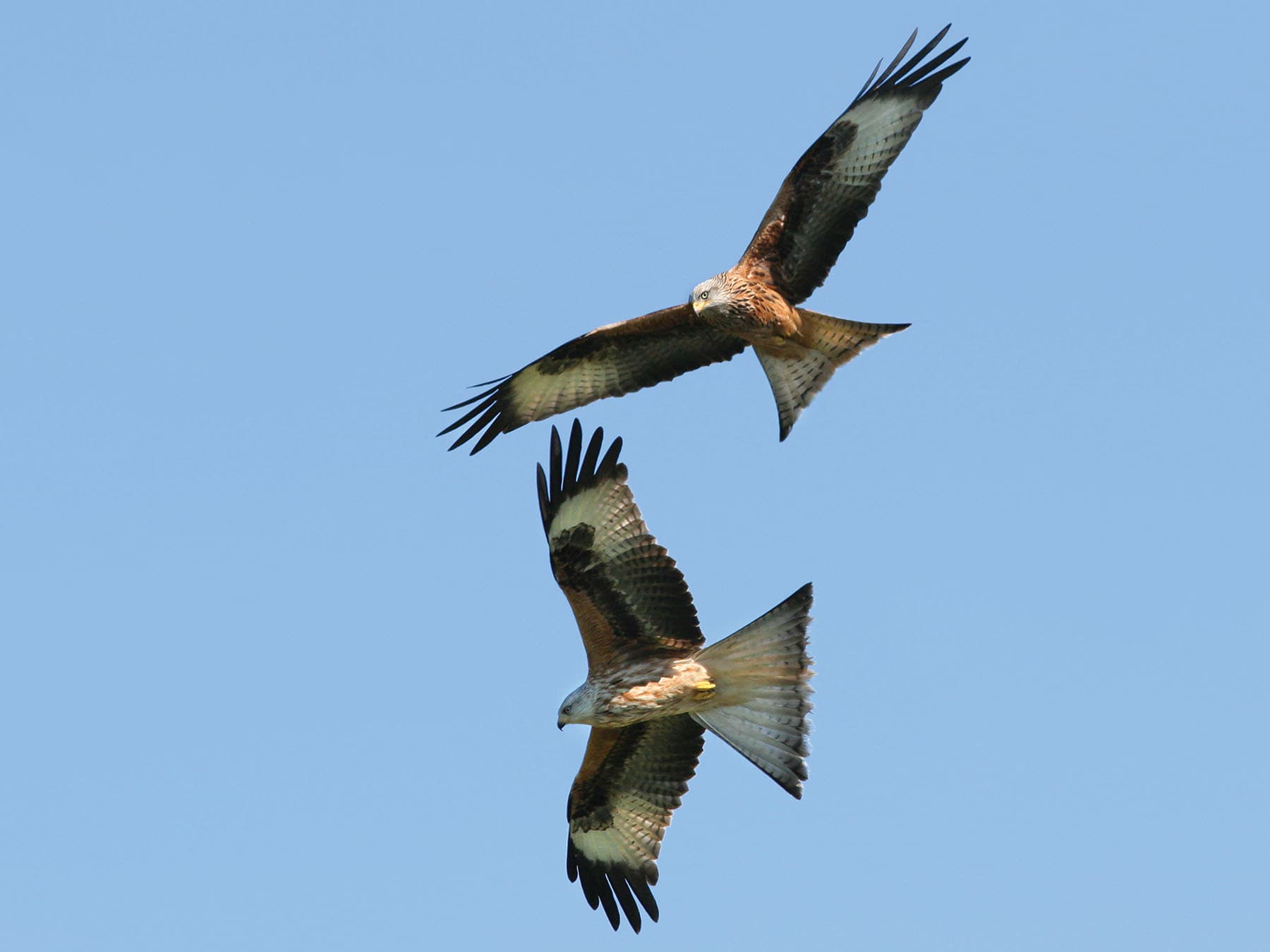 Two Red Kites in flight
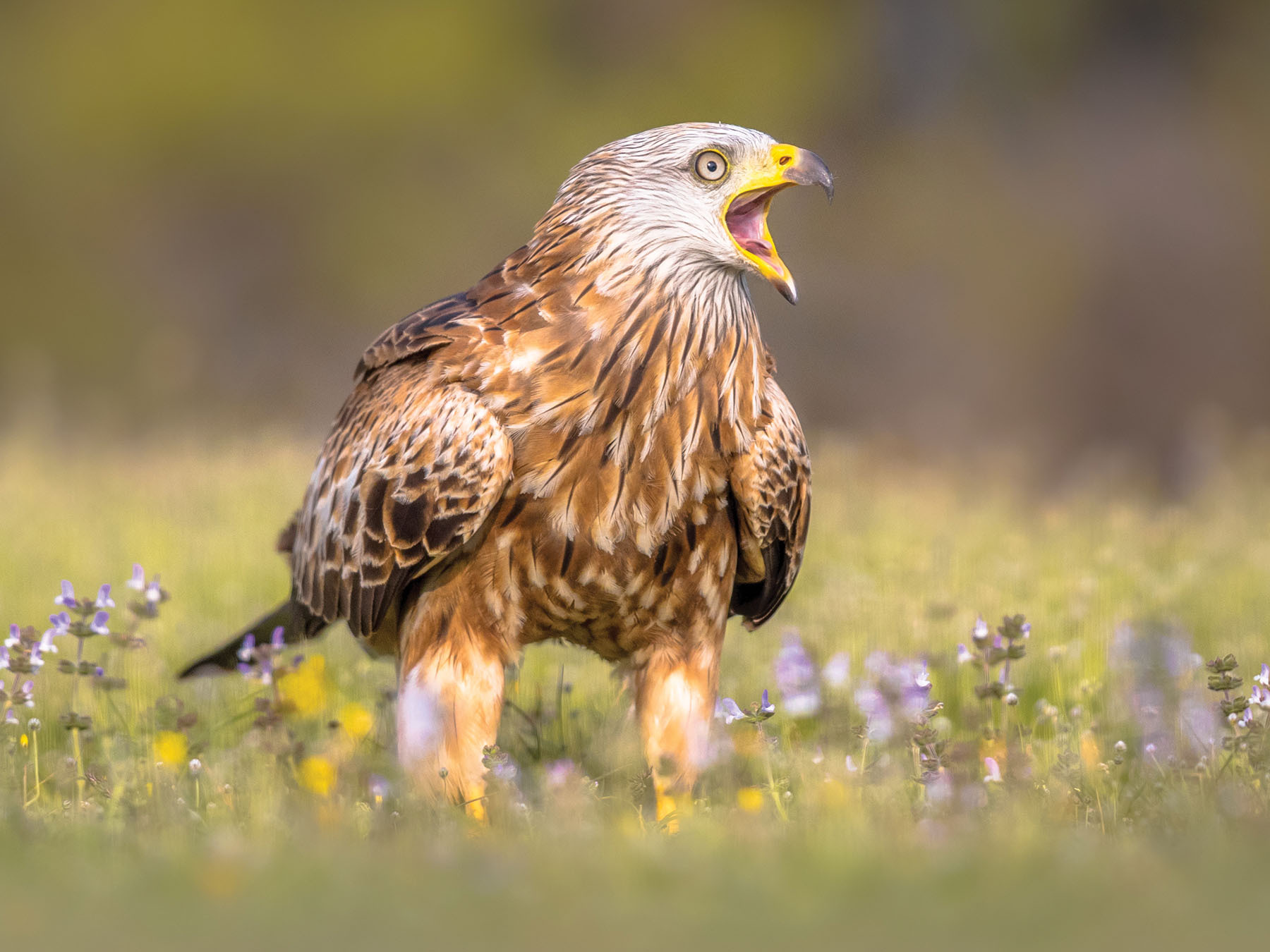
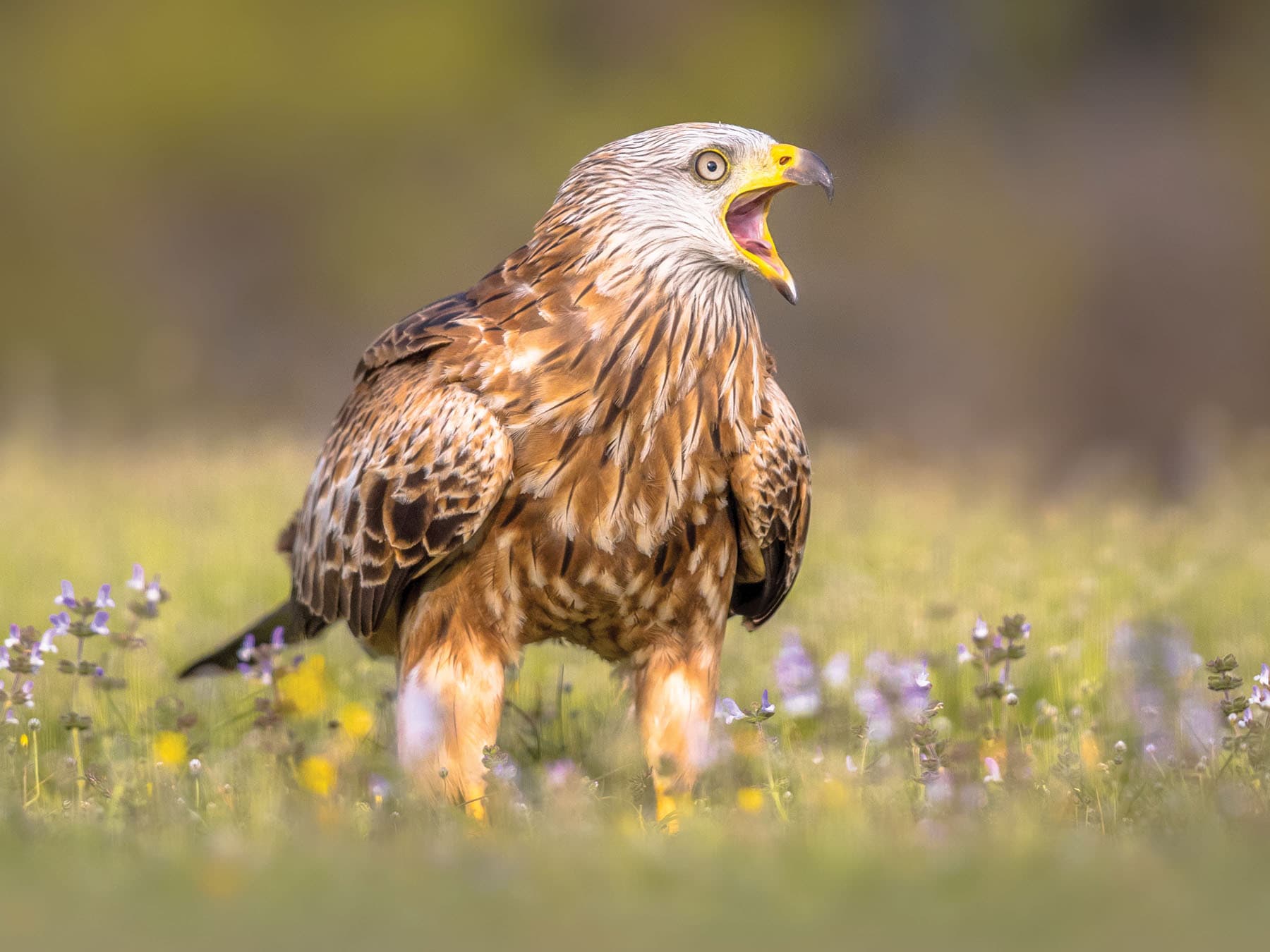 A Red Kite calling, bill open
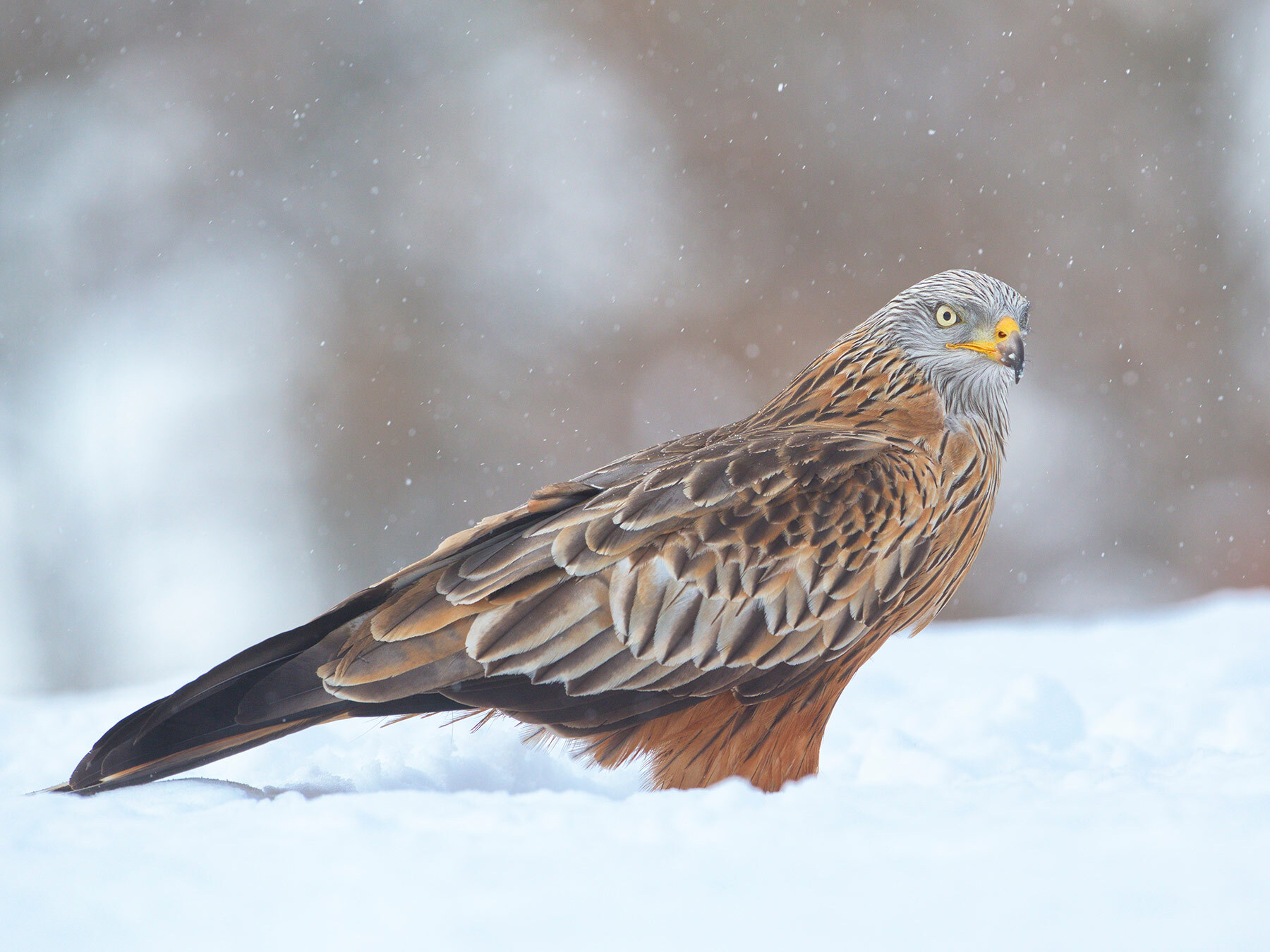
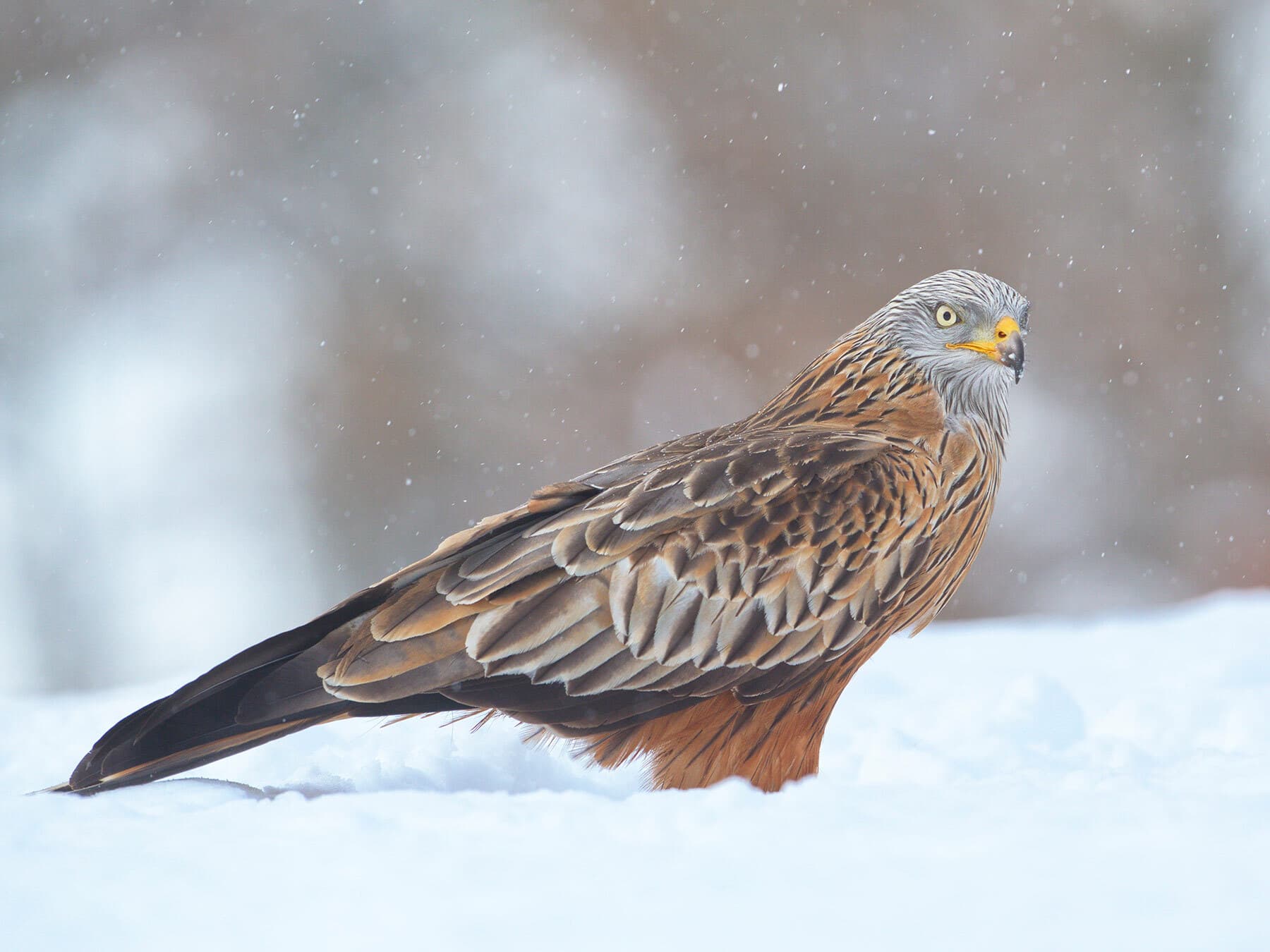 A Red Kite on snow
 A Red Kite flying low, feet lowered
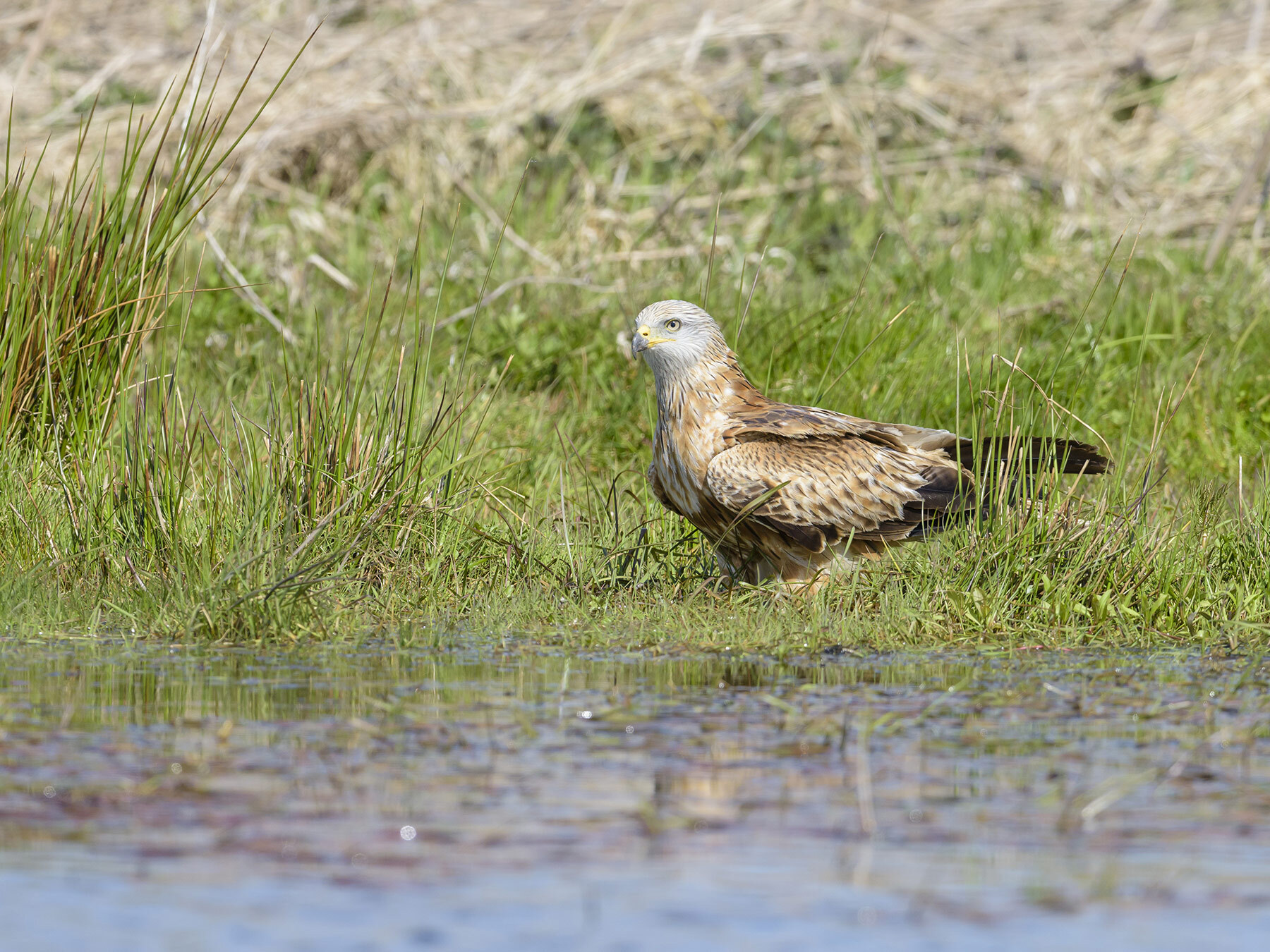
 A Red Kite at the edge of the water
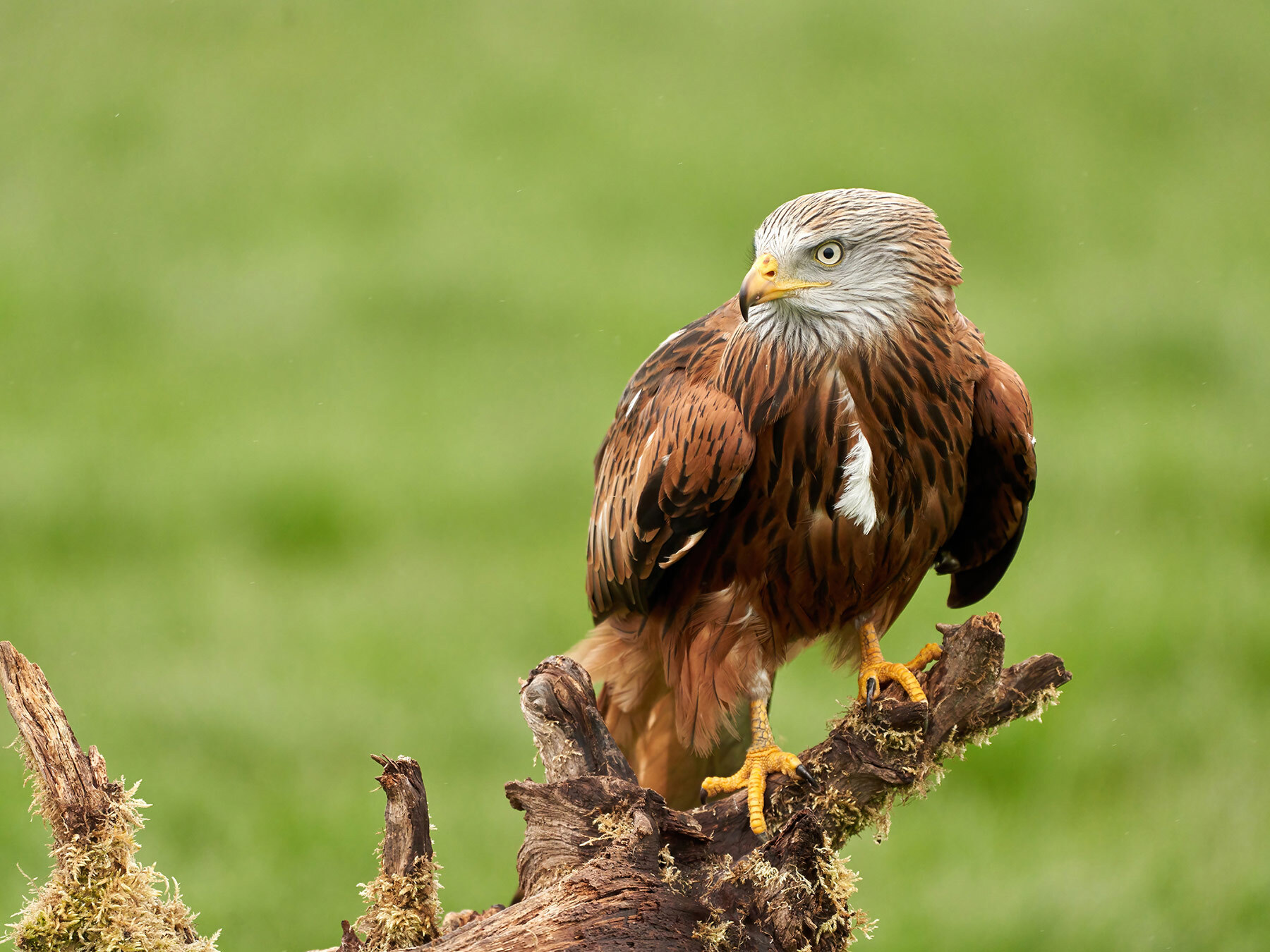
 A Red Kite perched on a mossy stump
Red Kite guides
5 guidesQuick facts
- Length
- 60–66 cm
- Wingspan
- 175–195 cm
- Weight
- 800–1300 g
- Lifespan
- 4 years · oldest recorded 29.8 years · UK record 28 years 2 months
- Family
- Hawks & Eagles
- Migration
- Partial migrant
- Global status (IUCN)
- Least Concern
- World population
- 60,000 - 70,000 mature individuals
- Population trend
- One of the fastest-growing birds in the UK: up 2,613% since 1995 on the Breeding Bird Survey, after reintroductions from 1989
- Also called
- Common Kite, Welsh Kite
- Scientific name
- Milvus milvus
Questions
4Is a Red Kite an eagle?
No, but they are related. Kites, eagles, hawks and buzzards belong to the same family, and most authors place the Red Kite's genus in a group with the sea eagles, such as the White-tailed Eagle. It is not closely related to most other birds called kites.
Are Red Kites dangerous?
Not naturally. They are mainly carrion eaters, and the Chilterns Conservation Board says they are too weak-footed to catch anything bigger than a small rabbit. Where people feed them they can grow bold: in Marlow in 2019 a kite took sandwiches from two children's hands and scratched one. The board asks people not to feed them.22
Are Red Kites rare in the UK?
Not any more. About 4,400 pairs bred in 2016, and numbers have more than doubled since 2014. See conservation status.
Should I feed Red Kites?
The Chilterns Conservation Board asks people not to, and the BTO notes that garden feeding can prop up numbers in ways that could cause problems if it stops. See feeding Red Kites in gardens.
Sources
23- 1RSPB. Red Kite. RSPB Birds A-Z. Accessed 9 October 2026. Source (opens in a new tab)
- 2Woodland Trust. Red kite (Milvus milvus). Woodland Trust, Animals. Accessed 9 October 2026. Source (opens in a new tab)
- 3David, T. S., Orta, J., Christie, D. A. and Garcia, E. (2021). Red Kite (Milvus milvus), version 1.1. Birds of the World (S. M. Billerman, editor). Cornell Lab of Ornithology. doi:10.2173/bow.redkit1.01.1 (opens in a new tab)
- 4BTO. Red Kite (Milvus milvus). BTO BirdFacts. Accessed 9 October 2026. Source (opens in a new tab)
- 5RSPB. Buzzard. RSPB Birds A-Z. Accessed 9 October 2026. Source (opens in a new tab)
- 6RSPB. Golden Eagle. RSPB Birds A-Z. Accessed 9 October 2026. Source (opens in a new tab)
- 7RSPB. White-tailed Eagle. RSPB Birds A-Z. Accessed 9 October 2026. Source (opens in a new tab)
- 8Chilterns Conservation Board. Red kites. Chilterns National Landscape. Accessed 9 October 2026. Source (opens in a new tab)
- 9Gigrin Farm. Gigrin Farm Red Kite Feeding Centre. gigrin.co.uk. Accessed 9 October 2026. Source (opens in a new tab)
- 10Robinson, R. A., Leech, D. I. and Clark, J. A. (2025). Summary of all recoveries for Red Kite (Milvus milvus). The Online Demography Report: bird ringing and nest recording in Britain & Ireland in 2024 (BTO). Accessed 9 October 2026. Source (opens in a new tab)
- 11Davis, P. E. and Davis, J. E. (1981). The food of the Red Kite in Wales. Bird Study 28: 33-40. doi:10.1080/00063658109476696 (opens in a new tab)
- 12Orros, M. E. and Fellowes, M. D. E. (2015). Widespread supplementary feeding in domestic gardens explains the return of reintroduced Red Kites Milvus milvus to an urban area. Ibis 157: 230-238. doi:10.1111/ibi.12237 (opens in a new tab)
- 13BTO. Longevity records for Britain & Ireland in 2024. BTO Online Ringing and Nest Recording Report. Accessed 9 October 2026. Source (opens in a new tab)
- 14Fransson, T., Kolehmainen, T., Moss, D. and Robinson, R. (2023). EURING list of longevity records for European birds (1 September 2023). EURING. Accessed 9 October 2026. Source (opens in a new tab)
- 15BirdLife International (2020). Species factsheet: Red Kite Milvus milvus. BirdLife DataZone. Accessed 9 October 2026. Source (opens in a new tab)
- 16Woodward, I. et al. (2020). Population estimates of birds in Great Britain and the United Kingdom. British Birds 113: 69-104. Accessed 9 October 2026. Source (opens in a new tab)
- 17Heywood, J. J. N., Massimino, D., Baker, L., Balmer, D. E. et al. (2026). The Breeding Bird Survey 2025. BTO Research Report 802. British Trust for Ornithology, Thetford. Accessed 9 October 2026. Source (opens in a new tab)
- 18Evans, I. M. et al. (1999). Evaluating the success of translocating Red Kites Milvus milvus to the UK. Bird Study 46: 129-144. doi:10.1080/00063659909461125 (opens in a new tab)
- 19Ozaki, S., Barnett, E. A., Carter, H., Chaplow, J. S., Charman, S. et al. (2024). Second generation anticoagulant rodenticide residues in red kites 2022. UKCEH contract report to Natural England. Accessed 9 October 2026. Source (opens in a new tab)
- 20UK Parliament (1981). Wildlife and Countryside Act 1981, section 1, Schedule 1 and Schedule 1A. Accessed 9 October 2026. Source (opens in a new tab)
- 21UK (1985). The Wildlife (Northern Ireland) Order 1985, article 4 and Schedule 1. Accessed 9 October 2026. Source (opens in a new tab)
- 22Chilterns Conservation Board (2022). Six reasons not to feed red kites. Chilterns National Landscape. Accessed 9 October 2026. Source (opens in a new tab)
- 23RSPB. Marsh Harrier. RSPB Birds A-Z. Accessed 9 October 2026. Source (opens in a new tab)

Checked by
Nathan Cope, founder and editor
Nathan founded Birdfact and leads its writers and contributors in the UK, the US and Canada. He has watched and studied birds for more than ten years, and checks every article and species guide before it’s published.