



Black-billed Magpie
Pica hudsonia
By the Birdfact teamChecked by Nathan Cope
On this page13 sections
How to recognise it
This page is about the Black-billed Magpie of western North America. Europe and Asia have their own magpies, among them the Eurasian Magpie: see our Eurasian Magpie guide.
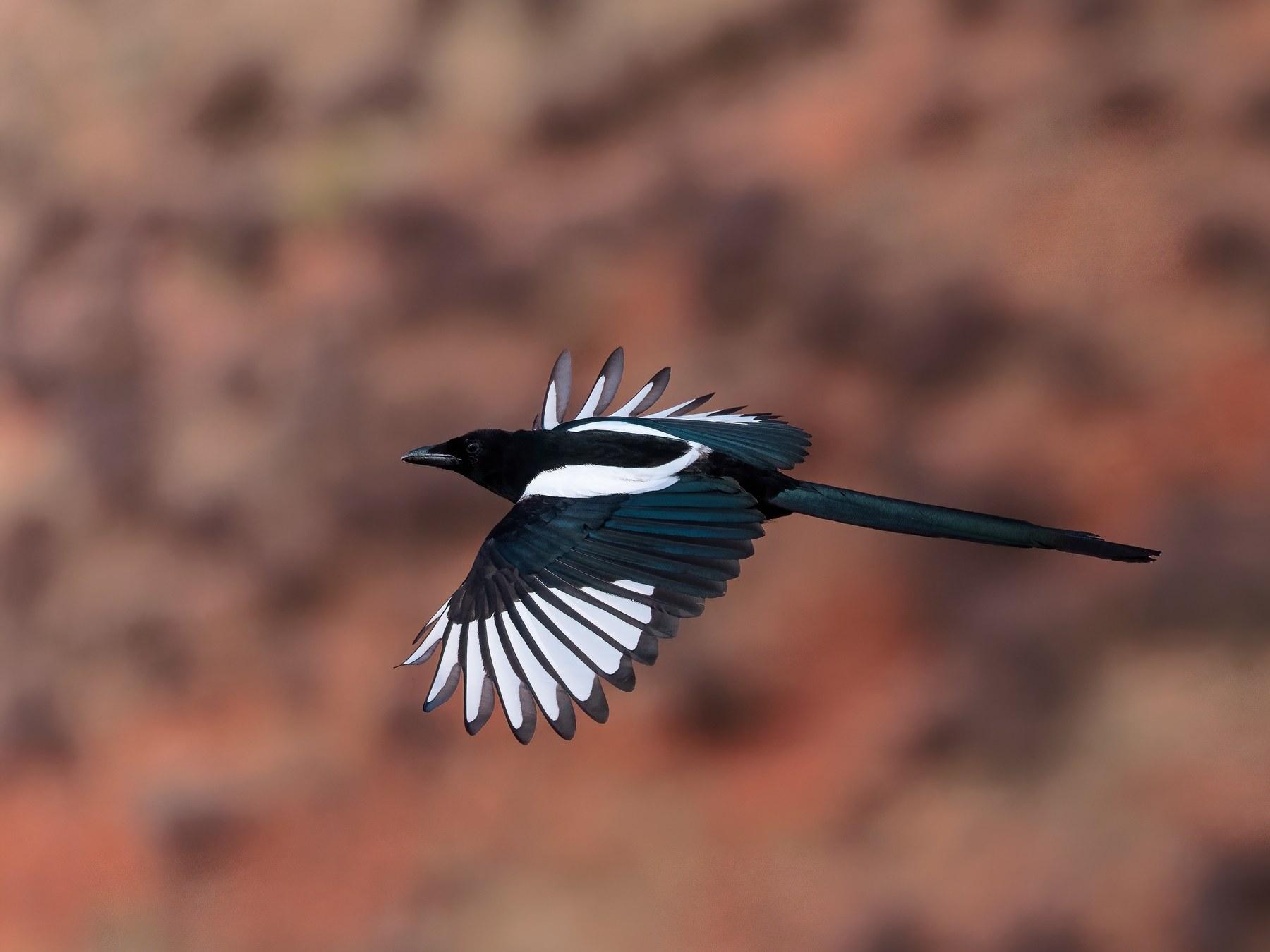
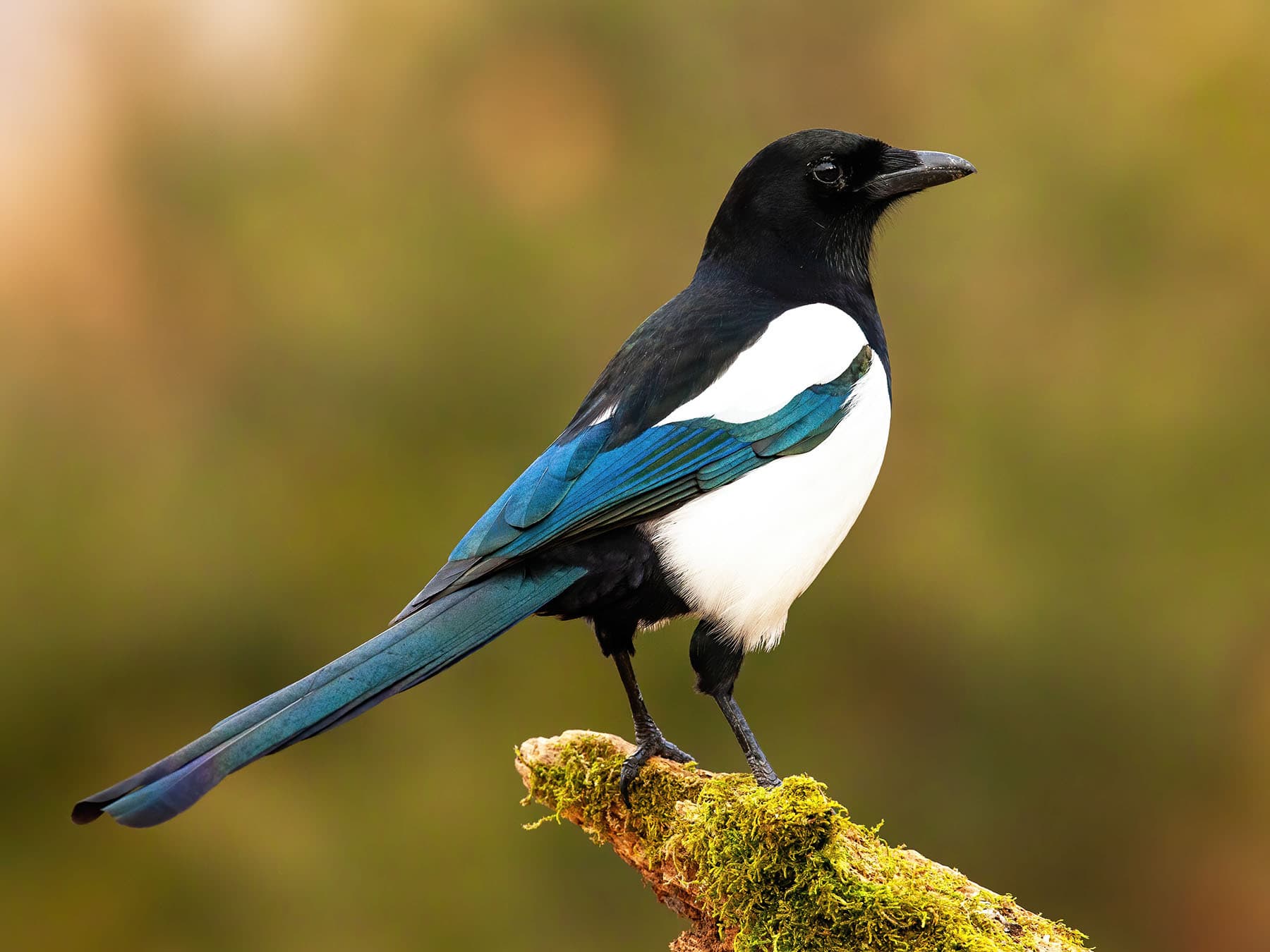
The Black-billed Magpie is a big, long-tailed, black-and-white member of the crow family. Its head, breast and back are black with a blue gloss, its belly and flanks white, and a broad white patch sits on each shoulder; from behind, the two patches look like white stripes down the back. The wings shine blue and the very long, tapering tail glows blue-green in good light. In flight, big white patches flash in the outer wings. The bill and legs are black. Males and females look alike.
Within its range it is hard to mistake. Look for it on fence posts, treetops and road signs in ranch country, along streams and in towns of the interior West, and listen for its harsh, rattling chatter.
Size and weight
A Black-billed Magpie is 18-24 in (45-60 cm) long, with a wingspan of 22-24 in (56-61 cm), and weighs 5.1-7.4 oz (145-210 g): about the size of a crow, bigger than a jay and smaller than a raven. Much of that length is tail: the tail alone measures about 10-12 in (26-30 cm) on average, roughly half the bird.
Males are larger and heavier than females, with longer wings, bills and tails. In birds caught near Pocatello, Idaho, males averaged 6.6-6.8 oz (187-193 g) across the age classes and females 5.6-5.7 oz (159-162 g).1 In a South Dakota study, breeding males averaged 7.2 oz (203.7 g) and females 5.8 oz (163.6 g).2
Adult plumage
Up close, the black is far from plain. The head, breast, back and undertail carry a blue gloss; the wings are glossed blue above, and the tail blue-green, with a band of bronze-green, then purple, before a greenish-blue tip. The white belly and flanks end sharply against the black breast, and the rump is pale gray. The outer flight feathers (primaries) are largely white on the inner web, which makes the white wing patch in flight. The throat feathers are hair-like, black with white bases that show when the bird sings or carries food in its throat pouch.
Two details are worth knowing. The third eyelid (the nictitating membrane), which magpies flash in displays, is white with a bright orange spot in adults. And the eye changes with the seasons: dark brown in winter and spring, then gray in many birds from about May. Adults also grow small bare patches of skin behind the eye in summer, so some adults in summer and fall look like young birds; that bare skin is usually dark, not yellow. Adults molt once a year, slowly, through summer and fall. Pale, washed-out birds, with tan, chocolate or gray in place of the black, turn up fairly often.
Juvenile plumage
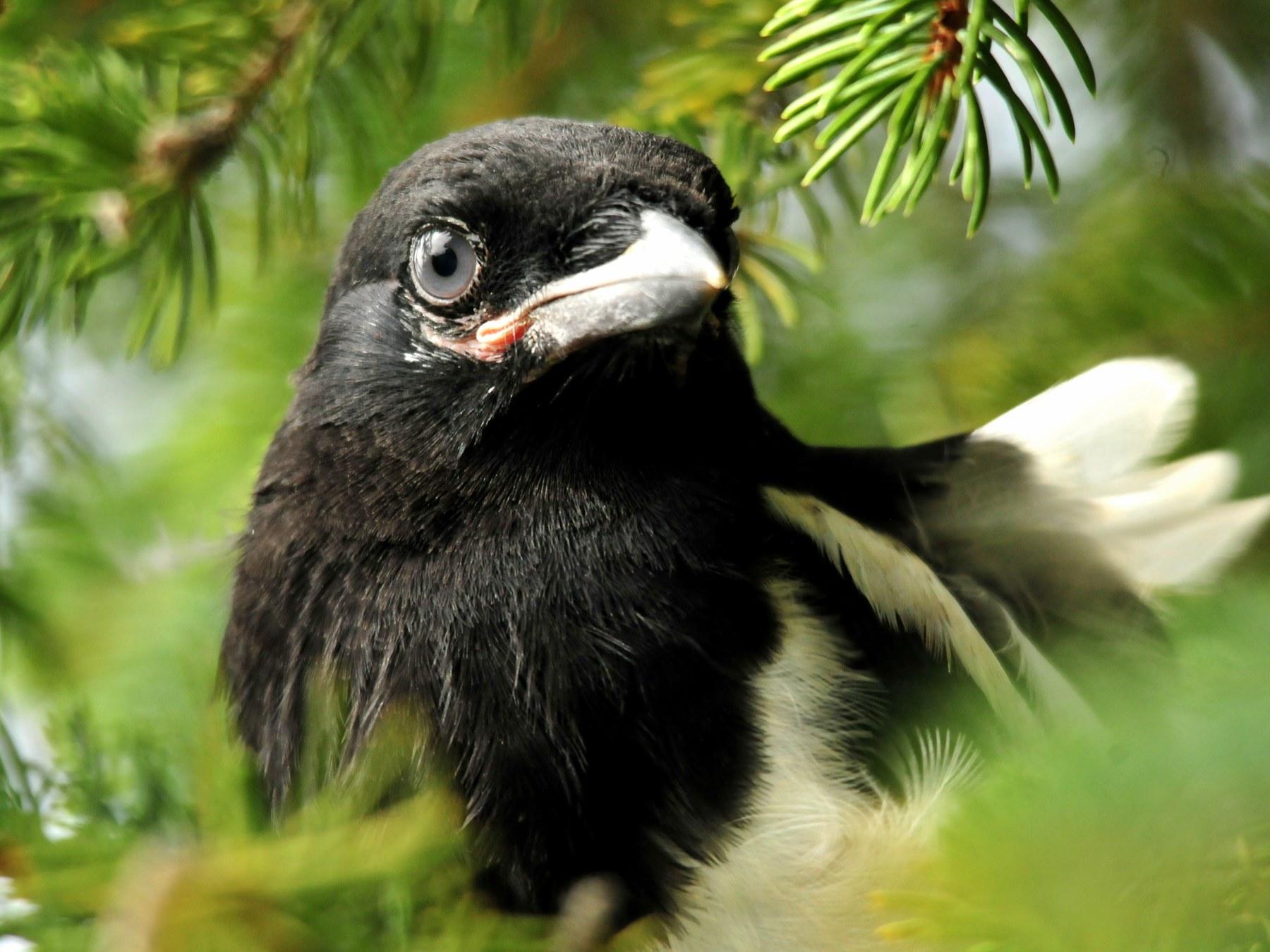
Young magpies leave the nest looking like duller copies of their parents. Their black is less glossy, their white feathers have buff tips that make them look dirty, and their tails are short: the central tail feathers keep growing for up to 8 weeks after the young fledge.1
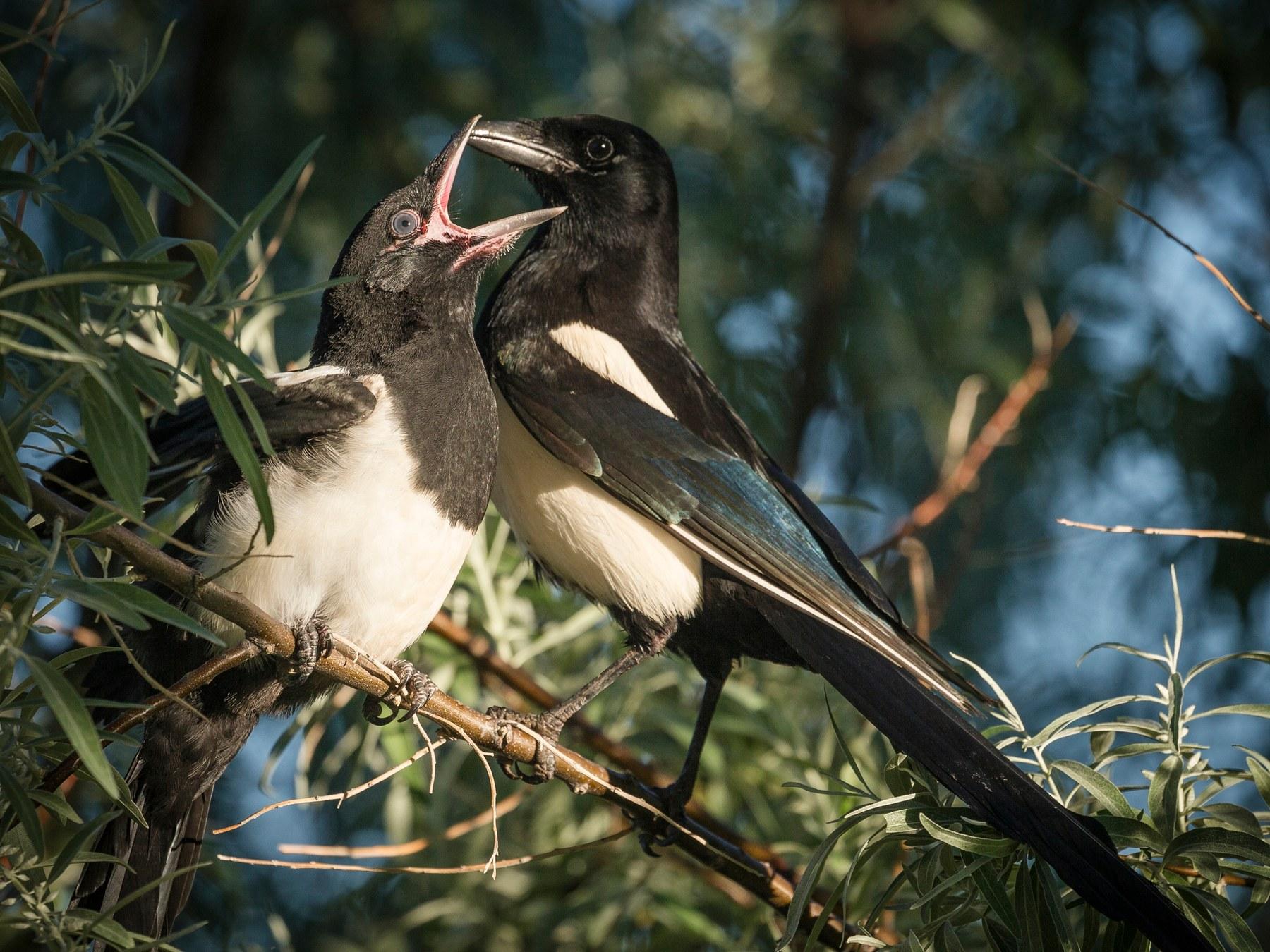
Through their first summer and fall, young birds are easiest to tell by the head. The eye is pale gray to bluish-gray, the mouth and the fleshy corners of the bill (the gape) are pink, the bill has a white tip until about November, and many have a bare patch of skin, usually dark, around and behind the eye; some look almost bald-faced. By January the eye has turned dark brown, the face is feathered and the bill tip has worn black, and from then on a young bird is hard to tell from an adult: its white wing patch is a little smaller and often spreads onto the inner flight feathers (the secondaries).
One trap: some adults also show a bare face, gray eyes and even a white bill tip in summer and fall, and adult males seem to copy these signals.1
Male and female
Males and females look the same; the only outward difference is size, and it takes measurements to be sure. No single measurement separates them, but combinations do: wing, bill and weight sexed living Utah birds correctly 95% of the time, and wing and bill depth sexed Alberta specimens 98% of the time; and at the same pitch of excitement, a female's chatter is higher than a male's.1
Identification: Yellow-billed Magpie and other lookalikes
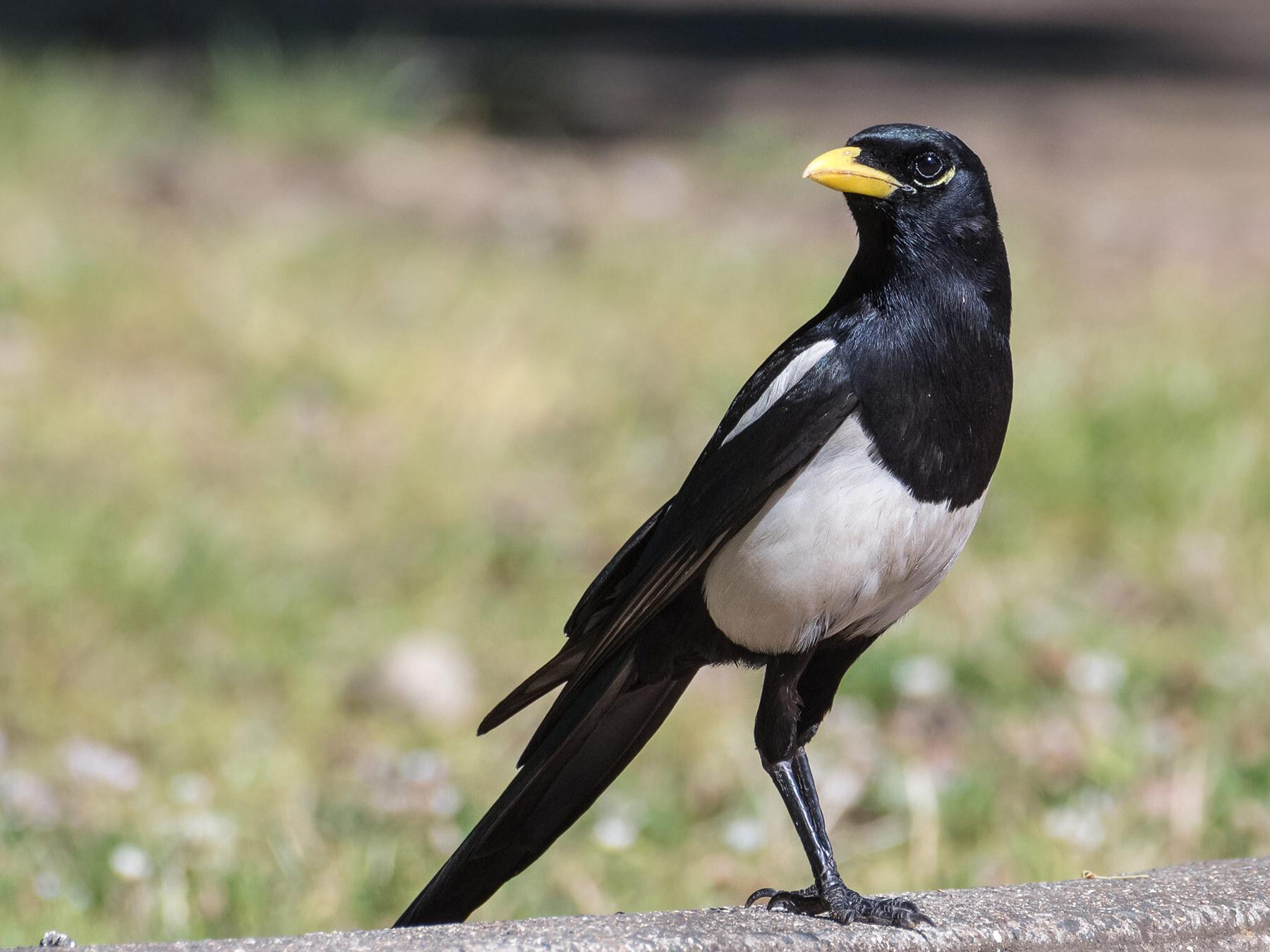
The only other magpie in North America is the Yellow-billed Magpie, which lives only in central California, mainly the Central Valley; the two ranges do not normally overlap. It has a bright yellow bill and a variable patch of yellow skin near the eye, and it is a little smaller, with a shorter tail. A Black-billed Magpie in summer may show bare skin behind the eye, but it is usually dark. A Black-billed Magpie with a yellowish bill has possibly been reported in Montana, so a yellow-billed magpie well away from central California deserves a careful look.1
The two are close relatives. In Redding, California, in 2023, a Black-billed Magpie that had turned up outside its usual range paired with a Yellow-billed Magpie, and two young seen later, with pinkish, gray-blotched bills, were judged to be their offspring: the first apparent hybrids between the two.3
The Eurasian Magpie of Europe and northern Asia looks very similar but is a separate species, and the two ranges do not meet. Compared with the Old World magpies, then treated as one species, the handbook account found the Black-billed lighter, its adult males averaging about 6.6 oz (186 g) against 7.1-8.5 oz (201-241 g) in Old World populations, and longer in wing and tail than most; the Eurasian bird's calls are lower-pitched, and the chatter of the two American magpies is so different that visitors who know the European bird hardly recognize it.1
For a long time they were counted as one species. The American Ornithologists' Union recognized the Black-billed Magpie as a species of its own in 2000, on morphological, behavioral and genetic characters.4 The genetic story is still being written. A 1995 comparison of three US and three Kamchatkan magpies found them highly distinct, though its authors, citing the small samples, recommended no change.5 Not every study agrees: a 2003 study argued for keeping all magpies as one species, and a 2018 study found the Black-billed and Yellow-billed Magpies barely differentiated by the genes it used.6, 7 Whole mitochondrial genomes of 9 Black-billed Magpies from the Aleutians to Colorado point to a single crossing of the Bering land bridge: by the authors' preliminary dates, the American line split from the Eurasian Magpie about 2.2 million years ago, and the Black-billed from the Yellow-billed only about 195,000 years ago.8
An American Crow is about the same size but entirely black, with no white belly, shoulder patches or wing patches, and a short, square-tipped tail. Magpies do belong to the crow family, though: see the questions below.
Not sure it’s a Black-billed Magpie? Check your photo: Birdfact names the bird and shows the look-alike side by side.
Its size
Adults- Length
- 45–60 cm
- Wingspan
- 56–61 cm
- Weight
- 145–210 g
Its song and calls
The sound of the Black-billed Magpie is its chatter, a harsh, rattling run of notes that both sexes give in alarm and when mobbing a predator. It grades with excitement, from a slower basic chatter, each call longer than 0.12 s, to a quicker staccato chatter, each under 0.093 s; staccato chatter is given at dangerous flying raptors such as goshawks, but in a South Dakota study never at predators on the ground, not even a person at the nest; and in playback trials, wild magpies came toward a speaker playing basic chatter and left when it played staccato chatter.1 Sometimes the chatter starts with two longer notes, written skaa skaa ka ka ka.
Black-billed and Yellow-billed Magpies sound much alike. Range-wide DNA studies put North America's magpies in a lineage of their own, and their chatter differs from other magpies' in step with it.9

Magpies also have rising calls: fertile females, for one, repeat a rising begging call loudly near the nest from up to 3 days before laying their first egg; a dozen or more other calls are described in the literature, mostly from European magpies, and are probably also given by North American birds but have not yet been described in them.1

Soft song and mimicry
Magpies do have a song, but you have to be close to hear it. It is a soft, whistled babbling, known as babble-singing or whisper song, heard only at close range and given mostly by males, often with the head raised and the white third eyelid flashing. Dominant Black-billed Magpies often walk up to a predator, or a person, and babble-sing at it, a bold habit never seen in European magpies.1
Can magpies talk? Wild magpies are apparently not mimics, though mimicry has been noted within the soft song. Hand-reared magpies that bond with a person are another matter: they copy many sounds, including their owner's voice, and captive young have been reported learning words and phrases.1, 10
- Chatter0:00 / 0:34
Recorded in Central Alberta, Canada · July 2026
- Calls0:00 / 0:45
Recorded in South Dakota, United States · June 2015
Heard one and not sure? Let the bird song identifier listen.
When and where to see it
November
Arriving
The year across North America
Choose a place on the map to see its year, or find yours.
Most recorded in November
Up to 10.5% of a place’s bird records that monthHere in other months
How this map is made
Each county, state or province is shaded by the Black-billed Magpie’s share of all the bird records there that month: the darker, the larger the share. A place with only a trace of records in a month is left unshaded. Shades compare places on this map with each other, not one bird with another. Records: GBIF eBird Observation Dataset, 2019–2024. Map: Natural Earth; place centres © OpenStreetMap contributors.
How often the Black-billed Magpie turns up in the United States and Canada through the year, from birdwatchers' records.
United States
Resident · all year · most records in January
Canada
Resident · all year · most records in February
Show as a table
| Month | United States | Canada |
|---|---|---|
| January | 0.22% (regular) | 0.88% (regular) |
| February | 0.19% (regular) | 0.88% (regular) |
| March | 0.18% (regular) | 0.71% (regular) |
| April | 0.14% (regular) | 0.47% (regular) |
| May | 0.15% (regular) | 0.30% (regular) |
| June | 0.22% (regular) | 0.37% (regular) |
| July | 0.16% (regular) | 0.32% (regular) |
| August | 0.15% (regular) | 0.33% (regular) |
| September | 0.19% (regular) | 0.48% (regular) |
| October | 0.21% (regular) | 0.69% (regular) |
| November | 0.21% (regular) | 0.79% (regular) |
| December | 0.21% (regular) | 0.85% (regular) |
Worldwide: recorded regularly in 2 countries
Countries where it was recorded in at least 3 of the 6 years 2019–2024. Linked countries have their own bird list.
North America (2)
Data: EOD – eBird Observation Dataset (Cornell Lab of Ornithology), accessed via GBIF.org, CC BY 4.0. Records from 2019–2024, aggregated and filtered by Birdfact. How these lists are made
Black-billed Magpies live all year from southern Alaska and the southwestern Yukon through British Columbia and the southern Prairie Provinces, and south through the interior West, east of the Cascades and the Sierra Nevada, to eastern California, Nevada, Utah, northeastern Arizona and northern New Mexico. To the east they reach the western Great Plains and northwestern Minnesota. On Breeding Bird Survey routes the survey's relative abundance index in 2025 was highest in Idaho, Alberta, Saskatchewan and Colorado.11
The range matches cold, dry steppe country. Heat and humidity are thought to keep the species west of about the 100th meridian, and in the south it lives only above about 1,600 ft (480 m); in a laboratory test, Black-billed Magpies died at 104°F (40°C), probably in high humidity, while Yellow-billed Magpies did not.1
Habitat
Look for them in open country with thickets and scattered trees: streamside thickets beside meadows, grassland or sagebrush, ranches and farms, and towns. They avoid unbroken forest, treeless grassland and true desert. In winter they are often common near people, at feedlots, barnyards, landfills, sewage ponds and grain elevators, and they roost in dense streamside thickets.
Do they migrate?
No. Black-billed Magpies are resident: most stay in the same area all year. Young birds disperse after breeding, though, and some birds move in fall and winter. In southern Idaho, small flocks move up into the mountains in fall, about 6 mi (10 km) from the nearest nesting areas, and stay until early spring; in northern British Columbia birds move downslope, and some inland birds spend the winter on the coast.1
A few travel much farther: a juvenile banded in Saskatchewan was found 360 mi (580 km) to the southeast four months later, and a nestling banded at Laramie, Wyoming, turned up 220 mi (354 km) away in Colorado.1 Wanderers reach the Pacific coast, Iowa, eastern Minnesota and south Texas in winter, and many records farther east may be escaped cage birds.
Young females move farther than young males. In southeastern Idaho, young females were trapped in their first summer on average about 0.6 mi (1,034 m) from the nest where they hatched, and young males about 0.35 mi (560 m),1 and a genetic study of 29 breeding adults found the males more closely related to each other than the females, as expected if females disperse farther.12
Range changes
On the Great Plains, magpies once followed bison-hunting parties and fed on the leftovers. When the bison were gone, and poisons and baited traps spread with settlement, magpies disappeared from much of the Canadian prairies for 10 to 40 years, then came back through the early 1900s. They moved into the residential streets of Edmonton and Saskatoon in the late 1960s and 1970s; in Saskatoon they were almost daily visitors from the fall of 1972.13
The edges of the range are still moving. On Breeding Bird Survey routes magpies have become scarce in Kansas and Nebraska since the 1980s, while numbers in Minnesota rose by 4.64% a year from 1967 to 2025.11
Spotting tips
Magpies are easy to find where they live: noisy, and often perched in plain view on treetops, fence posts and road signs. In flight the long tail and the flashing white wing patches make them unmistakable. In winter, check feedlots, ranch yards and landfills, and the streamside thickets where they roost.
What it eats
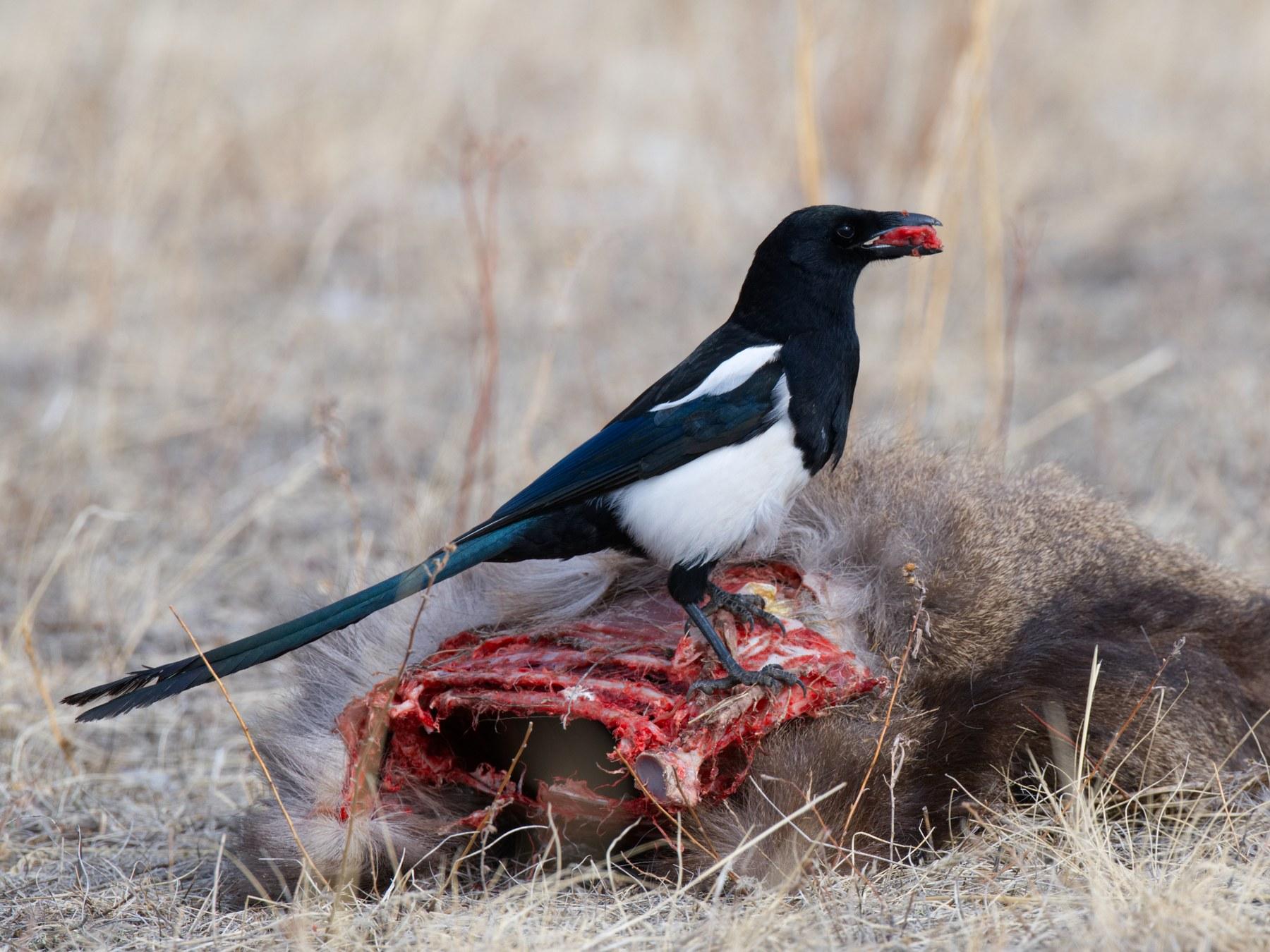
Black-billed Magpies eat almost anything they can find on the ground: insects and other small creatures, seeds and grain, wild fruit, carrion, small mammals, and the eggs and young of other birds. They take insects more consistently than most of the crow family, especially grasshoppers, beetles, caterpillars and flies.
The menu changes with the seasons. In a 1927 federal study of 547 stomachs, 313 of them from adults, nestlings had eaten more than 94% animal food, while adults' food over the year was about three-fifths animal, mainly insects, with carrion and small mammals.10 In the same study, winter food was about 60% plant matter, mostly grain and wild fruit, with carrion and small mammals; spring food was ground beetles, caterpillars and carrion, and from July to November mainly grasshoppers, wild fruit and carrion; and late-winter pellets from Alberta were 92% plant matter by volume, mostly oats, wheat and cherry seeds.1
Magpies forage by walking and turning things over. They flip dried cow dung for the insects underneath and scratch through leaf litter with their feet, and at carrion they often take the fly maggots rather than the meat. They also catch voles and other small mammals.
Feeding at carcasses
At deer and elk carcasses in a Colorado winter, magpies gave way to Bald Eagles and Common Ravens, and ate less and watched more when bigger birds or larger groups were present.14 Their numbers may tip off others: at 89 mule deer carcasses in Oregon and Washington, the more magpies there were, the sooner raptors arrived.15 They follow coyotes, foxes and raptors to steal prey or pick up scraps. In Edmonton, magpies had apparently fed on 37.3% of 668 coyote scats, more often in winter.16
Feeding on ticks
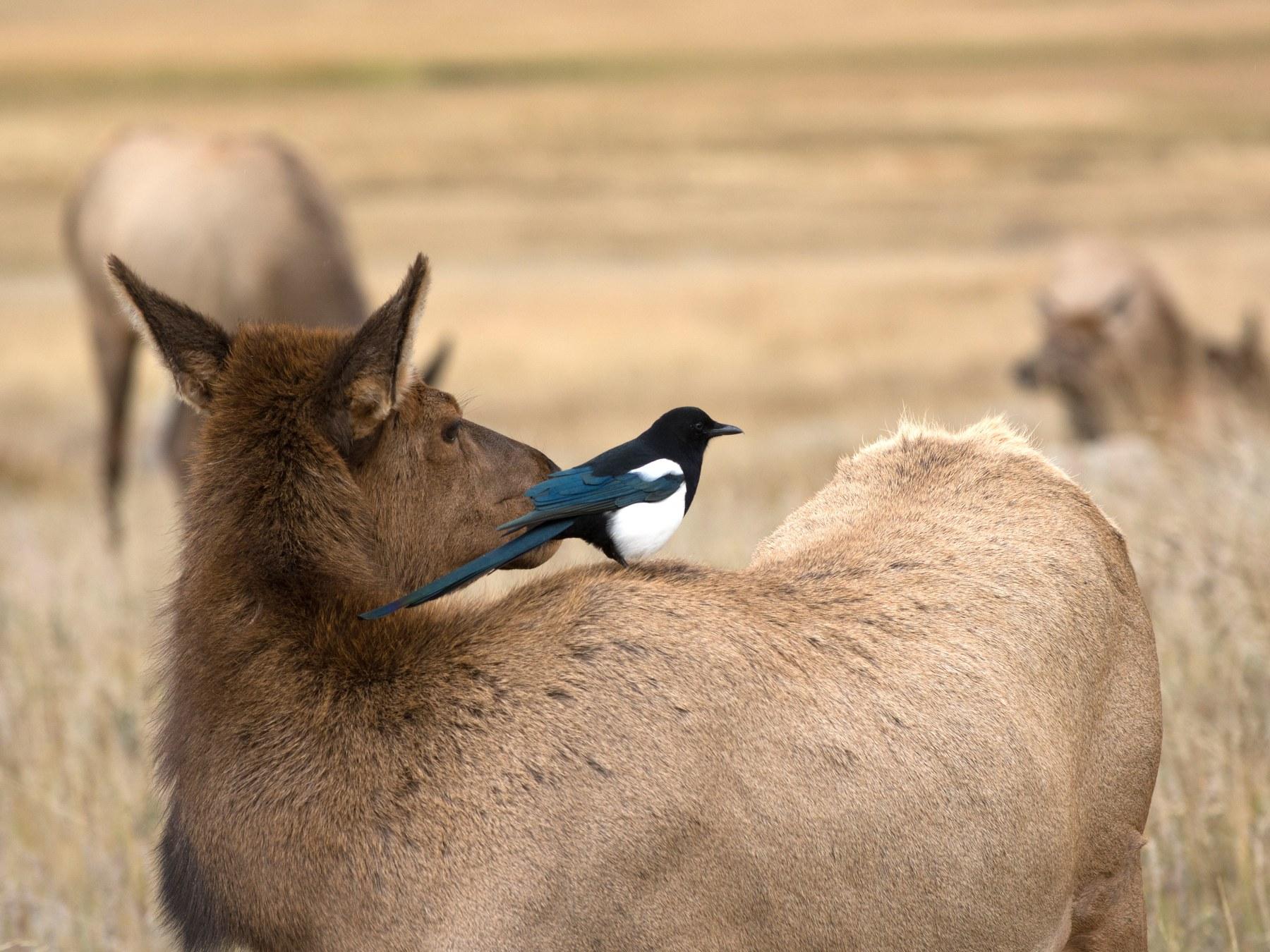
Magpies pick ticks and other parasites from deer, elk, moose and livestock. In Alberta, where a moose may carry tens of thousands of winter ticks in early spring, magpies land on moose to eat them, and they store many of the ticks alive.1 A 2023 note from Yellowstone photographed a magpie on an elk as a case of mutual benefit.17
Storing food
Magpies hide food for the short term in scattered caches on the ground, covered with a leaf or a stone, and carry it closer to the nest within a few hours. In South Dakota trials with a wild pair, 15 of the 18 hidden caches found in the first 15 hours were ones scented with cod-liver oil, though only half of the 60 caches were scented, a hint that smell may help, perhaps most in finding other birds' caches.18 In a Montana backyard, magpies cached chicken scratch, sunflower seeds, crab apples, dried mealworms and suet, some of it in snow 4-5 in (10-12 cm) deep, apparently the first report of caching in snow.19
Eggs and birds in the diet
Magpies take the eggs and nestlings of other birds, and occasionally adults, and the measured effects vary. In an Idaho field of simulated pheasant nests, magpies were the main predator.1 In a Missoula, Montana, backyard near a feeder in April 2021, a magpie killed an adult female Cassin's Finch, one of only a few such records.20 But cameras on 26 sage-grouse nests caught a magpie destroying just one, while 22 hatched,21 and long-billed curlews in the Intermountain West nested more successfully where magpies and crows were more common.22 In an unpublished Alberta trial, removing magpies and crows from a marsh for 2 years brought no significant rise in duck production compared with a marsh left alone.1
Feeders and backyards
In towns, magpies occasionally visit platform and suet feeders.
Nesting and breeding
The nest is the magpie's signature: a big dome of sticks over a cup of mud, lined with rootlets, grass and hair, usually about 30 in (75 cm) tall and 20 in (50 cm) across. Nests built on top of old ones can look several yards high. The pair builds together: the male brings most of the sticks for the dome, choosing thorny ones when he can, and the female makes the mud bowl and its lining.
In Idaho, building can start on warm days in January and February. In a Wyoming study a nest took about 43 days: 2-3 weeks for the mud base and stick frame, 9 days for the mud bowl, 4 for the lining, then about 11 more days to the first egg.1
Nests go in trees and tall shrubs, often thorny ones, usually 15-30 ft (4.5-9 m) up; some pairs use utility poles, a few build in old buildings, and some hang their nests over water. Pairs defend only the nest tree and often nest in loose groups: nests averaged 180 ft (55 m) apart in Idaho and about 1,000 ft (300 m) in South Dakota; pairs often pull the dome off an old nest to use in the new one, while fewer reuse a whole nest (12% of 91 nests in Wyoming, 25% of 56 in South Dakota), always with a completely new lining.1 Old nests can stand for years. All 136 nests found in a South Dakota study had domes.2
Eggs and incubation
Eggs are laid from late March to early June, earlier in warm springs and later at higher elevations; in Montana, egg dates run from 28 March to 26 May.23 A clutch is usually 6-7 eggs, sometimes 5-9, and studies found averages of 6.5 eggs in Utah and 6.2 in South Dakota; the eggs are smooth and glossy, tan or olive-brown with dark brown speckles (Audubon's guide calls them greenish gray, heavily spotted with brown), and in Idaho they averaged about 1.3 x 0.9 in (33.5 x 23.5 mm).1, 24
The female alone incubates, for about 18 days, while the male brings her almost all her food. Because she starts incubating before the clutch is complete, the eggs hatch over several days, and the chicks hatch naked and pink, with their eyes closed for the first week.
Nestlings and fledglings
Young magpies leave the nest at 24-30 days old and rely on their parents for food for up to 6-8 weeks, much longer than young crows.
Raising a brood takes both parents. In a South Dakota study only the females incubated and brooded the chicks, while the males did more of the feeding and of driving off predators. The young left the nest at 27.2 days on average and stayed close by for a week or two; within 9-29 days of fledging, families joined into groups of two to eight families, though parents were still feeding their own young at about 60 days old; and at least 22% of the young disappeared in the 2 weeks after fledging.2 In Alberta, when researchers removed the male during laying, the nest always failed.1
Not every chick survives. In a study in Montana in 1994, starvation caused most nestling deaths in the first 9 days, and siblicide and sibling cannibalism were seen or suspected in 5 of 22 broods when the chicks were 15-20 days old.25
Pairs raise one brood a year, but a pair whose nest is destroyed may make two or even three attempts in a season: after a late spring snowstorm killed their young, 8 of 11 Alberta pairs nested again within about two weeks, while in Utah only about 10% of nests lost at the egg stage were replaced.1 In Edmonton, pairs given extra food laid about a week earlier but no more eggs, and more of their nests survived a spring snowstorm.26
Old nests and other birds
Abandoned magpie nests make homes for other animals. Great Horned Owls and Long-eared Owls roost and lay in them and American Kestrels use them, and near Laramie, Wyoming, at least three pairs of Great Horned Owls, two Mallards and another duck nested in old magpie nests, and a raccoon family used one.27, 28 In Saskatoon, Merlins began nesting in the city in the 1970s, using old crow and magpie nests.13 The habit of nesting near raptors is old news: in April 1805 Meriwether Lewis noted that magpies seemed to like building close to Bald Eagles' nests.29
Nest predators
American Crows take many magpie eggs, and introduced fox squirrels hit eggs hard near western towns. Other nest predators include weasels, mink, cats, raccoons, Common Ravens, hawks and, above all, Great Horned Owls. Nesting in loose groups means fewer young per nest but less nest predation, because neighbors mob predators together.1
Behaviour
Magpies walk with a swagger and hop when they are in a hurry. Their level flight is slow and labored, with deep, rowing wingbeats and short glides, but the long tail lets them turn almost instantly, and they drop from a height in steep swoops. They are social and inquisitive: young birds gather in flocks in fall and winter, and adults join them.
In winter they gather at traditional communal roosts, often more than 200 birds in midwinter, in dense thickets. In Alberta, roosting magpies space themselves out and never huddle, even on the coldest nights.1
Sitting for long spells on a treetop, with the white flanks fluffed out over the wings, is thought to serve as a territorial signal, much as song does for other songbirds. In disputes a bird points its bill to the sky and flashes its white third eyelids with their orange spots. On warm days in late winter they sun themselves, back to the sun, wings drooped and tail fanned.
Social behavior: pecking order and pairs
Black-billed Magpies turn the usual pecking order upside down: young males often dominate adult males. In Idaho, young males won 80% of 519 food contests with adult males in fall, and in Alberta adult males won only 15% of 72, behavior unknown in European magpies.1
Pairs are monogamous, and some stay together for life, but many do not. Divorce was as low as 8% in South Dakota, while in Edmonton half the males and 63% of females had a new mate at some point over 7 years, even as some pairs stayed together 5-7 years.1, 30
Pairs and neighbors mob raptors together, up to 6 pairs at once in South Dakota, and near the nest they also mob crows, squirrels and coyotes; perched raptors are almost always mobbed.1, 31 Dominant young males take real risks, pulling the tails of Cooper's Hawks and goshawks, and 15 magpies once mobbed a Bald Eagle carrying a large fish and pulled its tail until it left half behind.1
Social behavior: gatherings around the dead
Magpies gather around their dead, which people call funerals. When a magpie finds a dead one, it usually starts calling excitedly, and magpies within earshot come in, up to 40 birds within minutes; some walk around the body, calling, and peck at its wings or tail, and after 10-15 minutes all fly off quietly.1 What the gatherings are for is poorly understood. We found no controlled study of them in Black-billed Magpies; the funeral experiments people often read about were done on other members of the crow family.
Intelligence and learned behavior
Magpies learn fast who is dangerous. In South Dakota, magpies mobbed a researcher the day after she visited their nest unless she wore a mask, and they recognized her car too.1 In northeastern Colorado, magpies let a person come within about 31 ft (9.4 m) in Fort Collins, 95 ft (28.9 m) in rural state parks and 210 ft (64.1 m) where they were shot.32 They also learn to steal from traplines.
In the laboratory, captive magpies have shown a knack for abstract ideas. In a study published in 2016 at the University of Manitoba, 10 captive Black-billed Magpies trained on just 8 pictures learned a same-or-different rule well enough to score 65.7% on average on new pictures, where chance was 50% (3 birds fully, 4 partly and 3 not at all): as well as Clark's Nutcrackers, and better than the primates and pigeons given the same test.33
Lifespan and predators
The oldest Black-billed Magpie on the North American banding records was at least 9 years 5 months old. It was banded in Saskatchewan on 24 October 2013, already full grown, and caught and released alive there on 11 November 2021.34 The bird it overtook as the record holder, banded as a nestling in Idaho in May 1992, was found dead in September 2001 at 9 years 4 months. In captivity, two magpies lived 20 years.1
We found no study of how long wild North American magpies usually live: the survival figures in the handbooks come from European magpies, a different species.
Predators
Adult magpies are taken by Northern Goshawks, Great Horned Owls and large falcons, and Cooper's Hawks, Golden Eagles and cats hunt near their roosts. In South Dakota, owls, hawks and falcons probably caused most deaths of fledglings and adults.31 Young birds just out of the nest often die on roads.
Conservation
The Black-billed Magpie is common and widespread, and listed as Least Concern.35 There are about 6 million breeding-age birds, all in the United States and Canada, by a Partners in Flight estimate for around 2010, which gives the species a Continental Concern Score of 10 out of 20; it is not on the Partners in Flight Watch List.36
Population trend
Numbers are falling. On the North American Breeding Bird Survey, counts fell 0.94% a year from 1967 to 2025 (95% credible interval -1.26 to -0.63), about 42% in all, a significant decline; the survey's index was highest in 1967 and lowest in 2024.11
The two countries tell different stories. In the United States most of the fall came before the mid-1990s, at 2.29% a year from the late 1960s to 1995, followed by a significant rise of 1.01% a year from 1995 to 2015. In Canada, numbers showed no significant change to the mid-1990s and have fallen since 2000, by 1.59% a year. From 2015 to 2025 they fell in both countries, by 1.39% a year in the US and 1.47% in Canada, and Alberta, with the most survey routes, shows significant declines in every period tested.11
West Nile virus and the population
West Nile virus can kill magpies quickly. In a 2003 laboratory study, all three Black-billed Magpies infected by mosquito bite died within six days, and caged magpies passed the virus to their cage mates.37 After the virus reached the West, magpie counts fell significantly in the US, most of all on the southern Great Plains, in Kansas and Nebraska; Colorado, Nevada and Idaho later showed signs of recovery, California had not recovered by 2021, and northern and high-elevation birds were little affected.38 On the Great Plains, Christmas Bird Counts from 1988 to 2017 showed magpies well below projected numbers after the virus arrived, and the authors judge that it likely played a major role.39
Conservation history: bounties and poison
Until the middle of the 20th century, many farmers and ranchers treated magpies as "vermin", and many western states paid bounties on them in the 1920s and 1930s, bounties the handbook account judges ineffective.1
Magpies sometimes peck at open sores and cuts on livestock and eat the flesh. Writing in 1946, Linsdale said this had caused "considerable losses on occasion", with attacks reported to persist until the animal died, but that magpies come to stock mainly for insects in dung and carrion, and that their reputation among stockmen was "probably far beyond justification".10 By 1999 the handbook account noted that modern husbandry, treating sores and warbles, had greatly reduced such damage.1
In the 1920s magpies also died in large numbers at poison baits set for coyotes: a 1927 federal study reported an estimated 5,000 killed along Butter Creek, Umatilla County, Oregon, in the winter of 1921-22, yet the same study, built on magpie stomachs, concluded that where the bird lives in moderate numbers, over much of its range, it is "not an outstanding agricultural pest", nor a serious danger to other wild birds, and that at times it may even do good.10
In a 1985 study in Washington State, magpies died for three months after cattle were treated with the insecticide famphur, and a Red-tailed Hawk that ate a poisoned magpie died too.40 Today magpies are tame where they are left alone and very wary where they are shot at.
Legal status
In the United States the Black-billed Magpie is protected under the Migratory Bird Treaty Act. Members of the crow family came under the Act in 1972, when the migratory bird treaty with Mexico was amended to include them.41, 42
Magpies were also added in 1972 to a federal depredation order, and since the Yellow-billed Magpie was taken off it in 2014, the Black-billed Magpie is the only magpie on it. The order lets people and government officials act without a federal permit where the birds are seriously damaging crops or livestock feed, causing a health hazard or structural damage, or threatening listed species. Non-lethal methods must be tried first each year, a report is due by 31 January, the birds may not be sold, and state, tribal and territorial laws still apply.43, 44
In Canada the Migratory Birds Convention Act does not cover the crow family, so protection is a matter for the provinces. Alberta lists the Black-billed Magpie as a "non-licence animal", and British Columbia exempts magpies, crows (but not ravens) and cowbirds from some Wildlife Act protections on a person's own property; we read these two provinces' rules only.45, 46, 47
Similar birds
Often mistaken for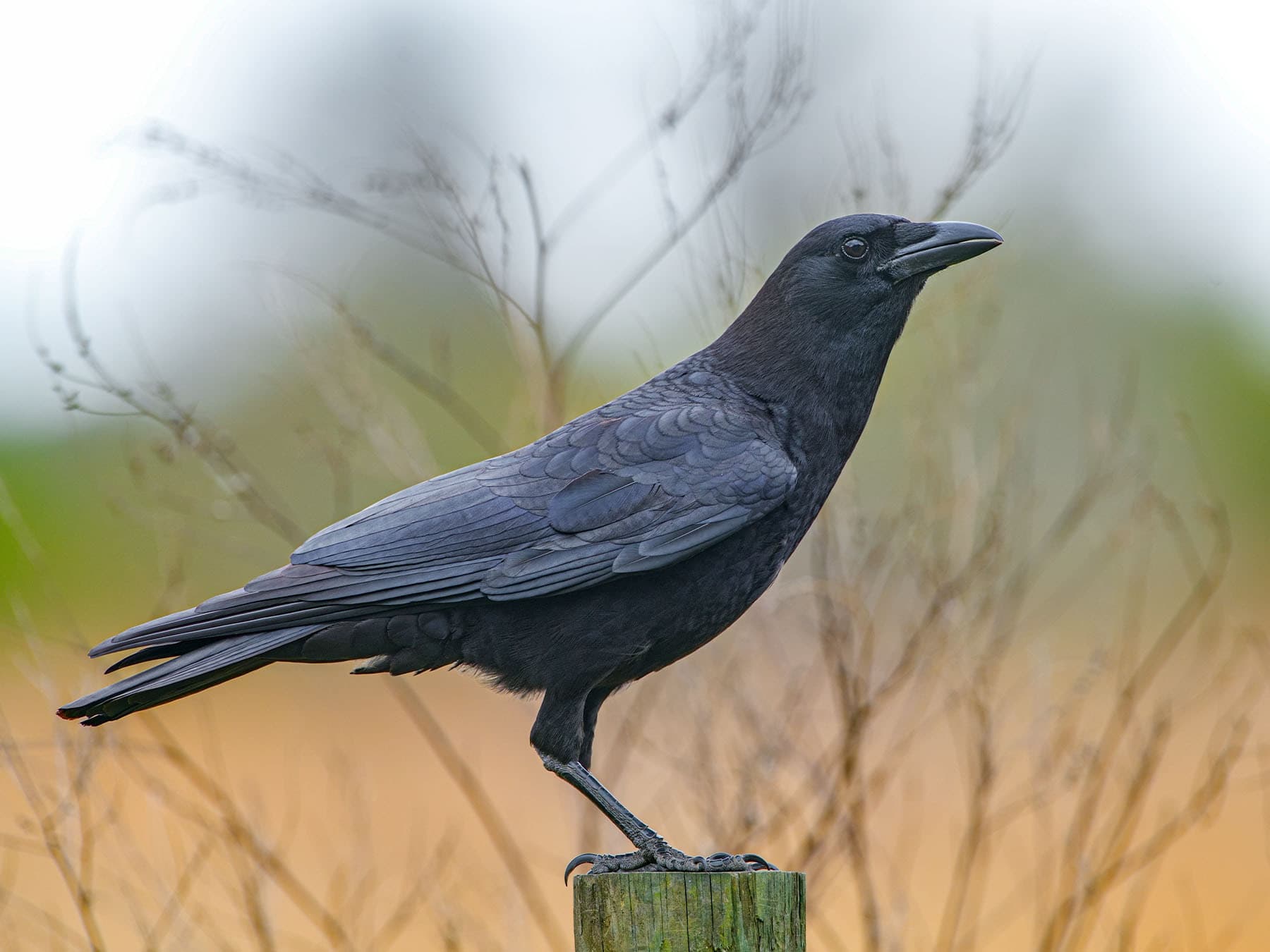
Quick facts
- Length
- 45–60 cm
- Wingspan
- 56–61 cm
- Weight
- 145–210 g
- Lifespan
- oldest recorded 9 years 5 months
- Family
- Crows & Jays
- Migration
- Resident
- Global status (IUCN)
- Least Concern
- World population
- About 6 million breeding-age birds (Partners in Flight, around 2010)
- Population trend
- Decreasing: down about 0.9% a year since 1967 on the North American Breeding Bird Survey (about 40% in all), and falling in both the US and Canada since 2015
- Scientific name
- Pica hudsonia
Questions
4Is a Black-billed Magpie a crow?
Not a crow, but a member of the crow family, Corvidae, with the crows, ravens and jays. Crows belong to the genus Corvus, magpies to the genus Pica, which has seven species. See how to tell it from an American Crow.
Can you see Black-billed Magpies in the UK?
No. The magpie of Britain is the Eurasian Magpie, a separate species; the Black-billed Magpie lives only in western North America. Until 2000 the two were counted as one species, and older books, such as a 1946 life history, call the North American bird the American Magpie. See our Eurasian Magpie guide.
Is the Black-billed Magpie rare?
No. It is common across the interior West, with about 6 million birds, though numbers have fallen by about 40% since 1967. See conservation.
Why is it called Pica hudsonia?
Pica is Latin for magpie. The bird was described in 1823, as Corvus hudsonius, from Cumberland House, in what is now Saskatchewan; the name hudsonia refers to Hudson Bay, named after the navigator Henry Hudson.
Sources
55- 1Trost, C. H. (2020). Black-billed Magpie (Pica hudsonia), version 1.0. Birds of the World (S. M. Billerman, editor). Cornell Lab of Ornithology. doi:10.2173/bow.bkbmag1.01 (opens in a new tab)
- 2Buitron, D. (1988). Female and male specialization in parental care and its consequences in Black-billed Magpies. The Condor 90(1): 29-39. doi:10.2307/1368429 (opens in a new tab)
- 3Airola, D. A. and Yutzy, B. (2025). First record of apparent hybridization between the Yellow-billed and Black-billed Magpies. Western Birds 56(1): 60-67. doi:10.21199/wb56.1.6 (opens in a new tab)
- 4NatureServe. Pica hudsonia: Black-billed Magpie. NatureServe Explorer. Accessed 15 November 2026. Source (opens in a new tab)
- 5Zink, R. M., Rohwer, S., Andreev, A. V. and Dittmann, D. L. (1995). Trans-Beringia comparisons of mitochondrial DNA differentiation in birds. The Condor 97(3): 639-649. doi:10.2307/1369173 (opens in a new tab)
- 6Lee, S.-i. et al. (2003). Phylogeny of magpies (genus Pica) inferred from mtDNA data. Molecular Phylogenetics and Evolution 29(2): 250-257. doi:10.1016/s1055-7903(03)00096-4 (opens in a new tab)
- 7Song, G. et al. (2018). Complete taxon sampling of the avian genus Pica (magpies) reveals ancient relictual populations and synchronous Late-Pleistocene demographic expansion across the Northern Hemisphere. Journal of Avian Biology 49(2). doi:10.1111/jav.01612 (opens in a new tab)
- 8Kryukov, A. P. et al. (2023). Mitogenomics clarifies the position of the Nearctic magpies (Pica hudsonia and Pica nuttalli) within the Holarctic magpie radiation. Current Zoology 70(5): 618-630. doi:10.1093/cz/zoad048 (opens in a new tab)
- 9Kryukov, A. P. et al. (2017). Deep phylogeographic breaks in magpie Pica pica across the Holarctic: concordance with bioacoustics and phenotypes. Zoological Science 34(3): 185-200. doi:10.2108/zs160119 (opens in a new tab)
- 10Linsdale, J. M. and in Bent, A. C. (1946). Life Histories of North American Jays, Crows, and Titmice: American Magpie (Pica pica hudsonia). U.S. National Museum Bulletin 191. Smithsonian Institution. Accessed 15 November 2026. Source (opens in a new tab)
- 11Hostetler, J. A. et al. (2026). The North American Breeding Bird Survey, Analysis Results 1966-2025. U.S. Geological Survey data release. doi:10.5066/P1OSNSFC (opens in a new tab)
- 12Wang, X.-h. and Trost, C. H. (2001). Dispersal pattern of Black-billed Magpies (Pica hudsonia) measured by molecular genetic (RAPD) analysis. The Auk 118(1): 137-146. doi:10.1093/auk/118.1.137 (opens in a new tab)
- 13Houston, C. S. (1977). Changing patterns of Corvidae on the prairies. Blue Jay 35(3): 149-156. doi:10.29173/bluejay4262 (opens in a new tab)
- 14McKinstry, M. C. and Knight, R. L. (1993). Foraging ecology of wintering Black-billed Magpies. The Auk 110(3): 632-635. doi:10.2307/4088428 (opens in a new tab)
- 15Orr, M. R., Nelson, J. D. and Watson, J. W. (2019). Heterospecific information supports a foraging mutualism between corvids and raptors. Animal Behaviour 153: 105-113. doi:10.1016/j.anbehav.2019.05.007 (opens in a new tab)
- 16Raymond, S. and St. Clair, C. C. (2023). Urban magpies frequently feed on coyote scats and may spread an emerging zoonotic tapeworm. EcoHealth 20(4): 441-452. doi:10.1007/s10393-023-01664-5 (opens in a new tab)
- 17Gorman, P. R. (2023). Magpie and mutualism: photographic evidence. Northwestern Naturalist 104(1): 77-78. doi:10.1898/nwn21-06 (opens in a new tab)
- 18Buitron, D. and Nuechterlein, G. L. (1985). Experiments on olfactory detection of food caches by Black-billed Magpies. The Condor 87(1): 92-95. doi:10.2307/1367139 (opens in a new tab)
- 19Hendricks, P. (2020). Black-billed Magpies (Pica hudsonia) caching food in snow. Northwestern Naturalist 101(2): 125-129. doi:10.1898/1051-1733-101.2.125 (opens in a new tab)
- 20Hendricks, P. and Hendricks, L. M. (2022). Predatory attacks by Black-billed Magpies (Pica hudsonia) on Cassin's Finch (Haemorhous cassinii) and other adult birds. Northwestern Naturalist 103(1): 76-80. doi:10.1898/1051-1733-103.1.76 (opens in a new tab)
- 21Holloran, M. J. and Anderson, S. H. (2003). Direct identification of Northern Sage-grouse, Centrocercus urophasianus, nest predators using remote sensing cameras. The Canadian Field-Naturalist 117(2): 308. doi:10.22621/cfn.v117i2.804 (opens in a new tab)
- 22Coates, S. E., Wright, B. W. and Carlisle, J. D. (2019). Long-billed curlew nest site selection and success in the Intermountain West. The Journal of Wildlife Management 83(5): 1197-1213. doi:10.1002/jwmg.21661 (opens in a new tab)
- 23Montana Natural Heritage Program and Montana Fish, Wildlife and Parks. Black-billed Magpie (Pica hudsonia). Montana Field Guide. Accessed 15 November 2026. Source (opens in a new tab)
- 24National Audubon Society. Black-billed Magpie. Guide to North American Birds. Accessed 15 November 2026. Source (opens in a new tab)
- 25Reynolds, P. S. (1996). Brood reduction and siblicide in Black-billed Magpies (Pica pica). The Auk 113(1): 189-199. doi:10.2307/4088945 (opens in a new tab)
- 26Dhindsa, M. S. and Boag, D. A. (1990). The effect of food supplementation on the reproductive success of Black-billed Magpies Pica pica. Ibis 132(4): 595-602. doi:10.1111/j.1474-919x.1990.tb00283.x (opens in a new tab)
- 27Erpino, M. J. (1968). Nest-related activities of Black-billed Magpies. The Condor 70(2): 154-165. doi:10.2307/1365958 (opens in a new tab)
- 28Rockwell, R. B. (1909). The use of magpies' nests by other birds. The Condor 11(3): 90-92. doi:10.2307/1362176 (opens in a new tab)
- 29Thwaites, R. G. (ed.) (1904). Original Journals of the Lewis and Clark Expedition, 1804-1806, volumes 1 and 7. Dodd, Mead & Company, New York. Accessed 15 November 2026. Source (opens in a new tab)
- 30Dhindsa, M. S. and Boag, D. A. (1992). Patterns of nest site, territory, and mate switching in black-billed magpies (Pica pica). Canadian Journal of Zoology 70(4): 633-640. doi:10.1139/z92-095 (opens in a new tab)
- 31Buitron, D. (1983). Variability in the responses of Black-billed Magpies to natural predators. Behaviour 87(3-4): 209-235. doi:10.1163/156853983x00435 (opens in a new tab)
- 32Kenney, S. P. and Knight, R. L. (1992). Flight distances of Black-billed Magpies in different regimes of human density and persecution. The Condor 94(2): 545-547. doi:10.2307/1369231 (opens in a new tab)
- 33Magnotti, J. F. et al. (2016). Abstract-concept learning in Black-billed magpies (Pica hudsonia). Psychonomic Bulletin & Review 24(2): 431-435. doi:10.3758/s13423-016-1132-4 (opens in a new tab)
- 34USGS Bird Banding Laboratory. Longevity records of North American birds: Black-billed Magpie. USGS Eastern Ecological Science Center, Bird Banding Laboratory. Accessed 15 November 2026. Source (opens in a new tab)
- 35BirdLife International (2025). Pica hudsonia. The IUCN Red List of Threatened Species 2025: e.T103727176A137730336. doi:10.2305/IUCN.UK.2025-2.RLTS.T103727176A137730336.en (opens in a new tab)
- 36Partners in Flight (2024). Avian Conservation Assessment Database, version 2024.05.23 (global). Partners in Flight. Accessed 15 November 2026. Source (opens in a new tab)
- 37Komar, N. et al. (2003). Experimental infection of North American birds with the New York 1999 strain of West Nile virus. Emerging Infectious Diseases 9(3): 311-322. doi:10.3201/eid0903.020628 (opens in a new tab)
- 38Taylor, D. M. and Trost, C. H. (2021). West Nile virus impacts on Black-billed Magpie populations. Northwestern Naturalist 102(3): 239-251. doi:10.1898/1051-1733-102.3.239 (opens in a new tab)
- 39Brenner, S. J. and Jorgensen, J. G. (2020). Declines of Black-billed Magpie (Pica hudsonia) and Black-capped Chickadee (Poecile atricapillus) in the north-central United States following the invasion of West Nile virus. Western North American Naturalist 80(2): 204-214. doi:10.3398/064.080.0208 (opens in a new tab)
- 40Henny, C. J., Blus, L. J., Kolbe, E. J. and Fitzner, R. E. (1985). Organophosphate insecticide (famphur) topically applied to cattle kills magpies and hawks. The Journal of Wildlife Management 49(3): 648-658. doi:10.2307/3801689 (opens in a new tab)
- 41U.S. Fish and Wildlife Service (2026). 50 CFR 10.13: List of Migratory Birds. Electronic Code of Federal Regulations. Accessed 15 November 2026. Source (opens in a new tab)
- 42U.S. Fish and Wildlife Service (2026). Process for Authorizing Seasonal Migratory Game Bird Hunting (91 FR 38543). Federal Register. Accessed 15 November 2026. Source (opens in a new tab)
- 43U.S. Fish and Wildlife Service (2026). 50 CFR 21.150: Depredation order for blackbirds, cowbirds, crows, grackles, and magpies. Electronic Code of Federal Regulations. Accessed 15 November 2026. Source (opens in a new tab)
- 44U.S. Fish and Wildlife Service (2014). Migratory Bird Permits; Removal of Yellow-billed Magpie and Other Revisions to Depredation Order (79 FR 65595). Federal Register. Accessed 15 November 2026. Source (opens in a new tab)
- 45Environment and Climate Change Canada. Birds protected in Canada under the Migratory Birds Convention Act, 1994. Government of Canada. Accessed 15 November 2026. Source (opens in a new tab)
- 46Government of Alberta (2026). Wildlife Regulation, Alta Reg 143/1997 (consolidated to 234/2026), Schedule 4, Part 6. Alberta King's Printer. Accessed 15 November 2026. Source (opens in a new tab)
- 47Government of British Columbia (2026). Designation and Exemption Regulation, B.C. Reg. 168/90, Schedule B. BC Laws. Accessed 15 November 2026. Source (opens in a new tab)
- 48Cornell Lab of Ornithology. Black-billed Magpie. All About Birds. Accessed 15 November 2026. Source (opens in a new tab)
- 49Cornell Lab of Ornithology. Yellow-billed Magpie identification. All About Birds. Accessed 15 November 2026. Source (opens in a new tab)
- 50National Audubon Society. Yellow-billed Magpie. Guide to North American Birds. Accessed 15 November 2026. Source (opens in a new tab)
- 51Kaufman, K.. American Crow. Audubon Guide to North American Birds (text from Lives of North American Birds). Accessed 8 October 2026. Source (opens in a new tab)
- 52U.S. Fish and Wildlife Service (2010). General Provisions; Revised List of Migratory Birds (75 FR 9282). Federal Register. Accessed 15 November 2026. Source (opens in a new tab)
- 53AviList Core Team (2026). AviList: The Global Avian Checklist, v2025b. doi:10.2173/avilist.v2025b (opens in a new tab)
- 54Jobling, J. A. (ed.). The Key to Scientific Names: hudsonia. Birds of the World, Cornell Lab of Ornithology. Accessed 15 November 2026. Source (opens in a new tab)
- 55Audubon, J. J. (1838). Ornithological Biography, volume 4: The Common Magpie. Adam and Charles Black, Edinburgh. Accessed 15 November 2026. Source (opens in a new tab)

Checked by
Nathan Cope, founder and editor
Nathan founded Birdfact and leads its writers and contributors in the UK, the US and Canada. He has watched and studied birds for more than ten years, and checks every article and species guide before it’s published.