


Long-eared Owl
Northern Long-eared Owl · Asio otus
By the Birdfact teamChecked by Nathan Cope
On this page13 sections
How to recognise it
What do Long-Eared Owls look like?
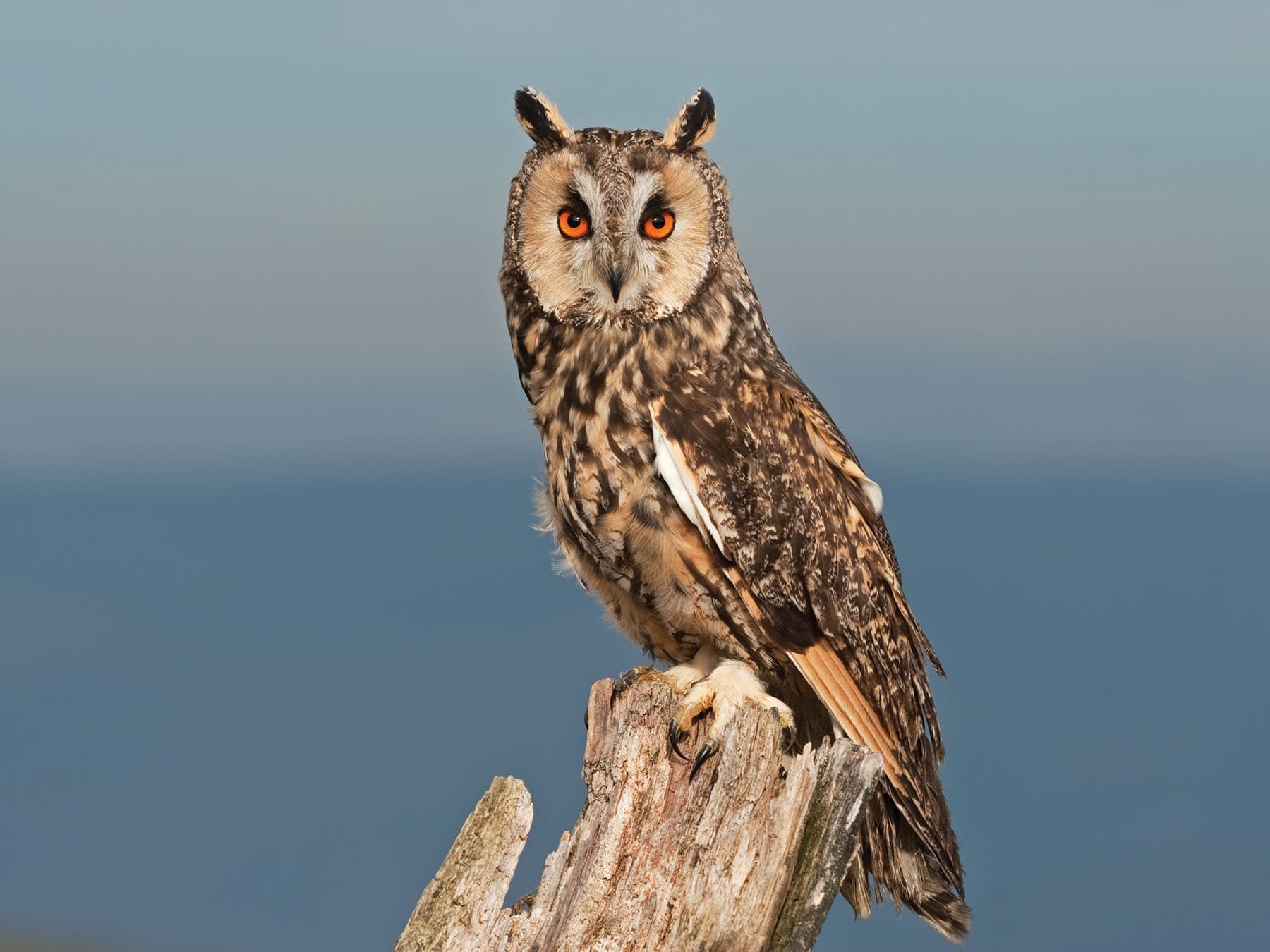
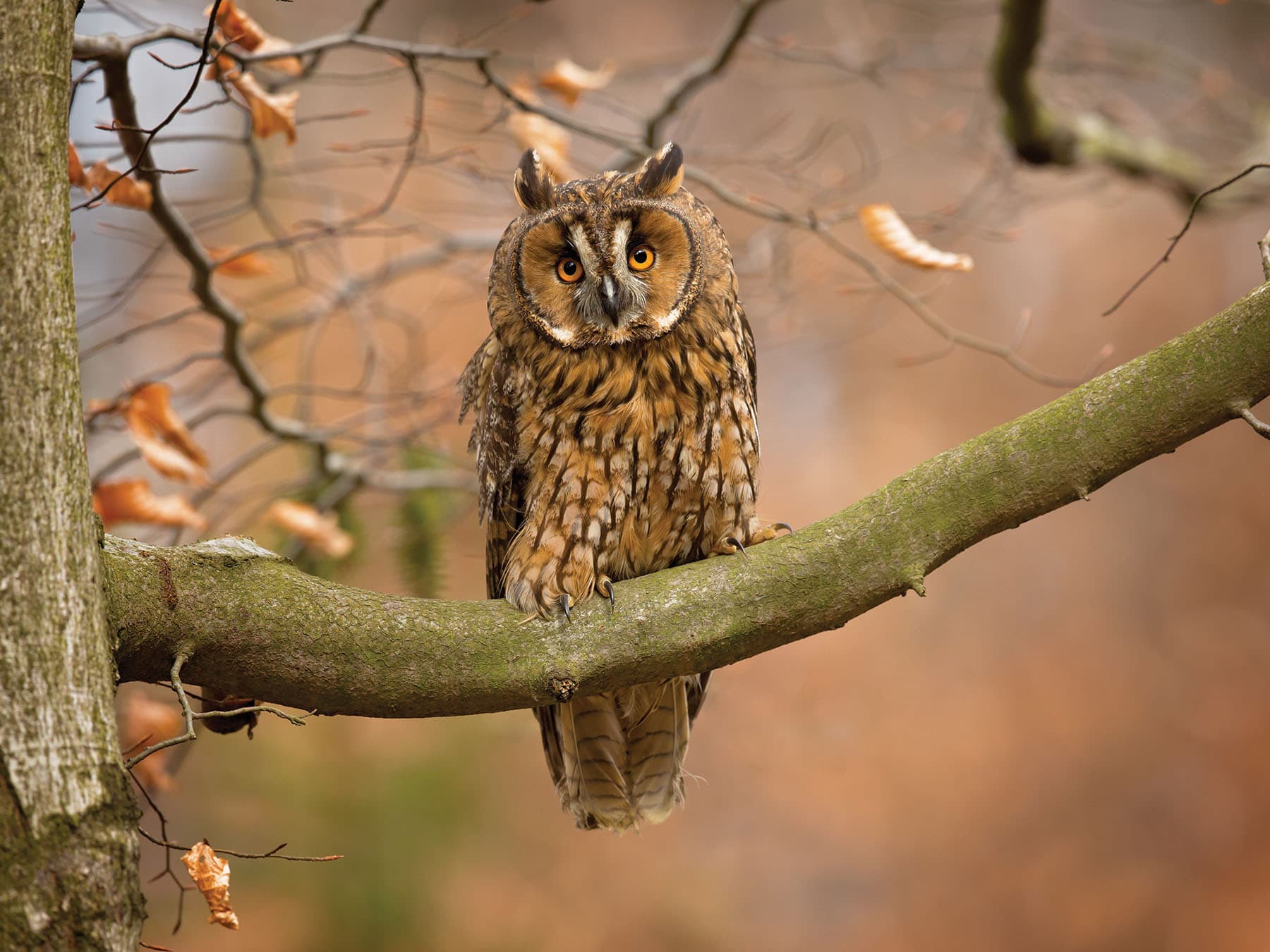
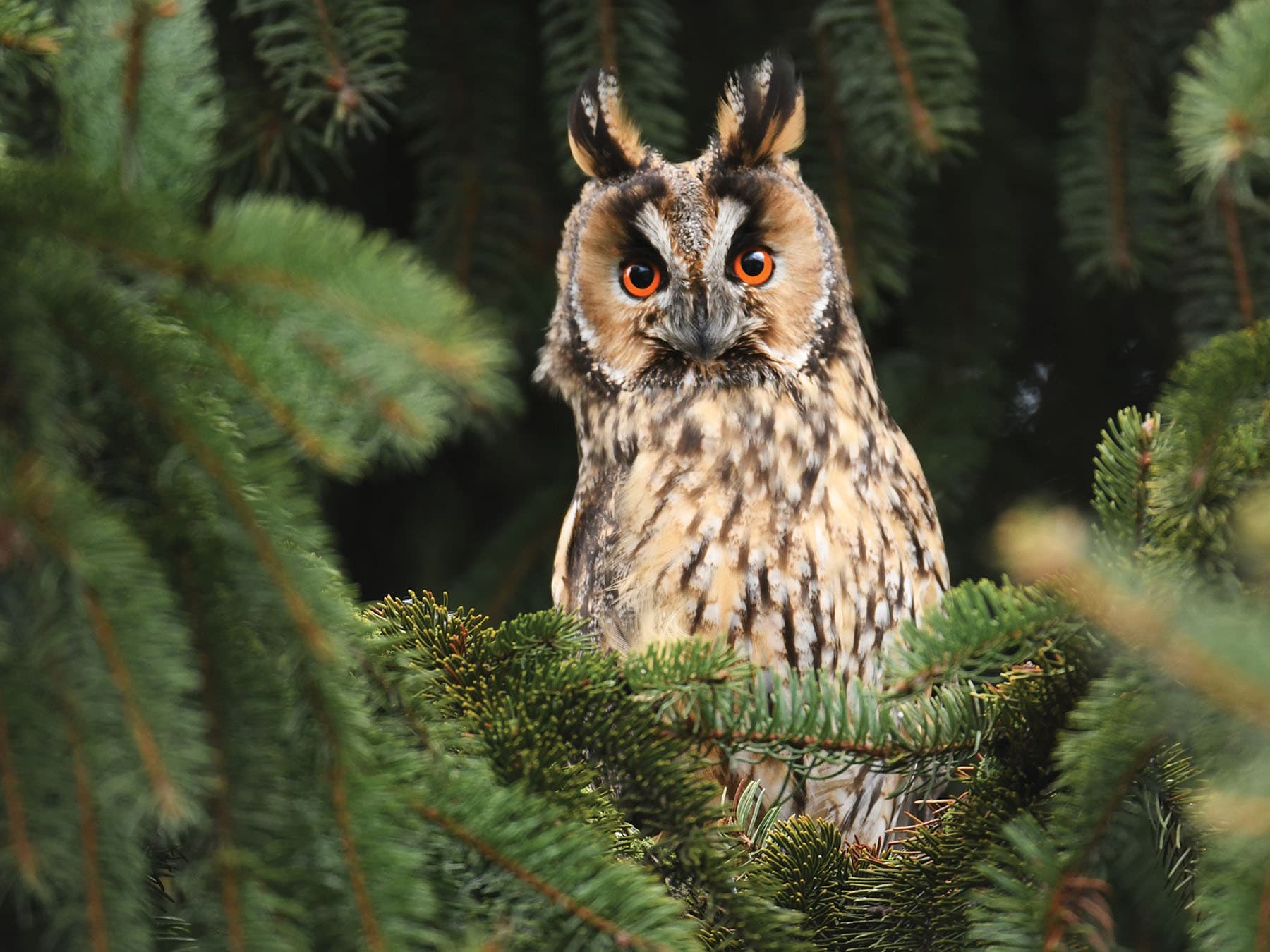
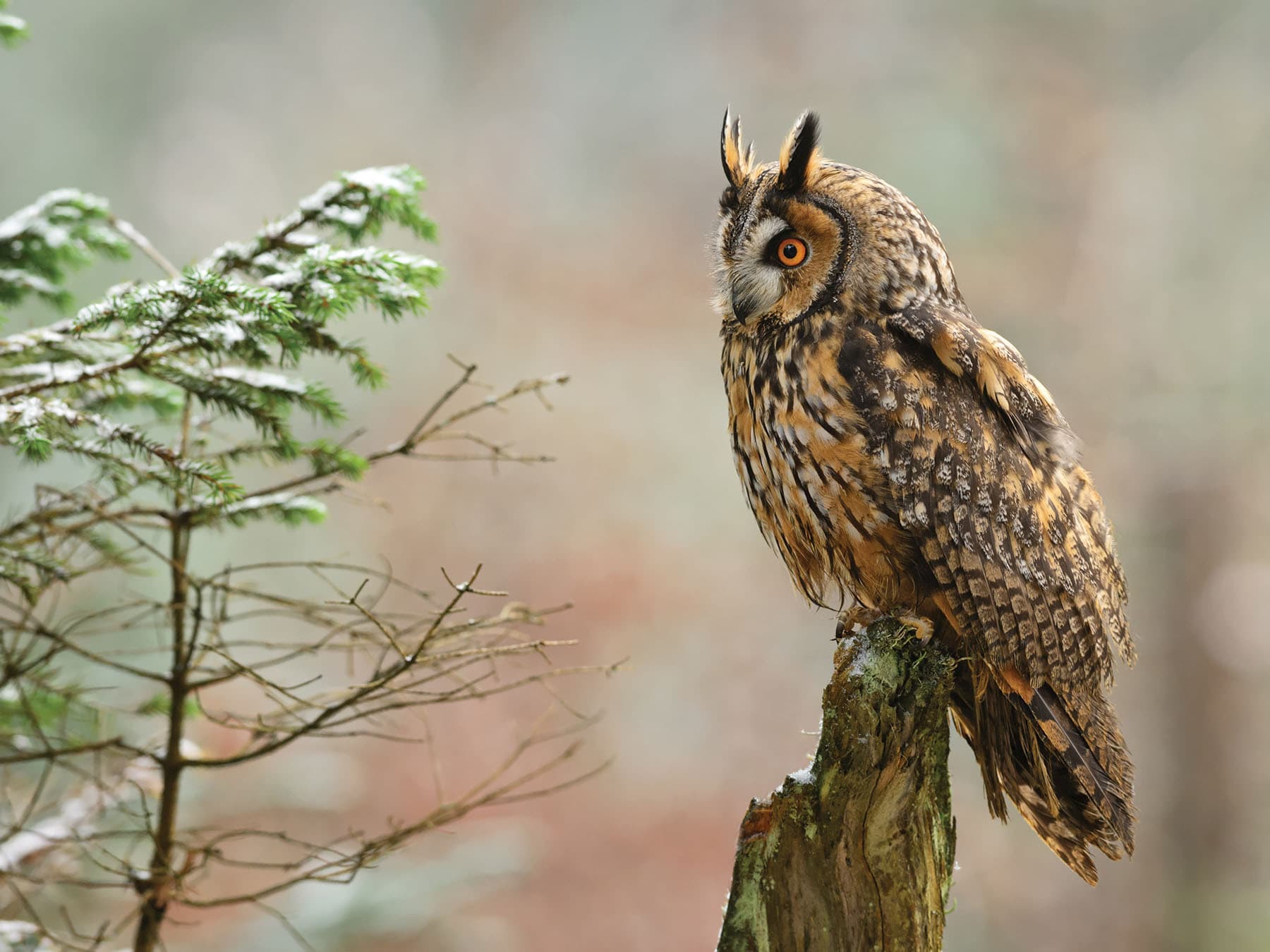
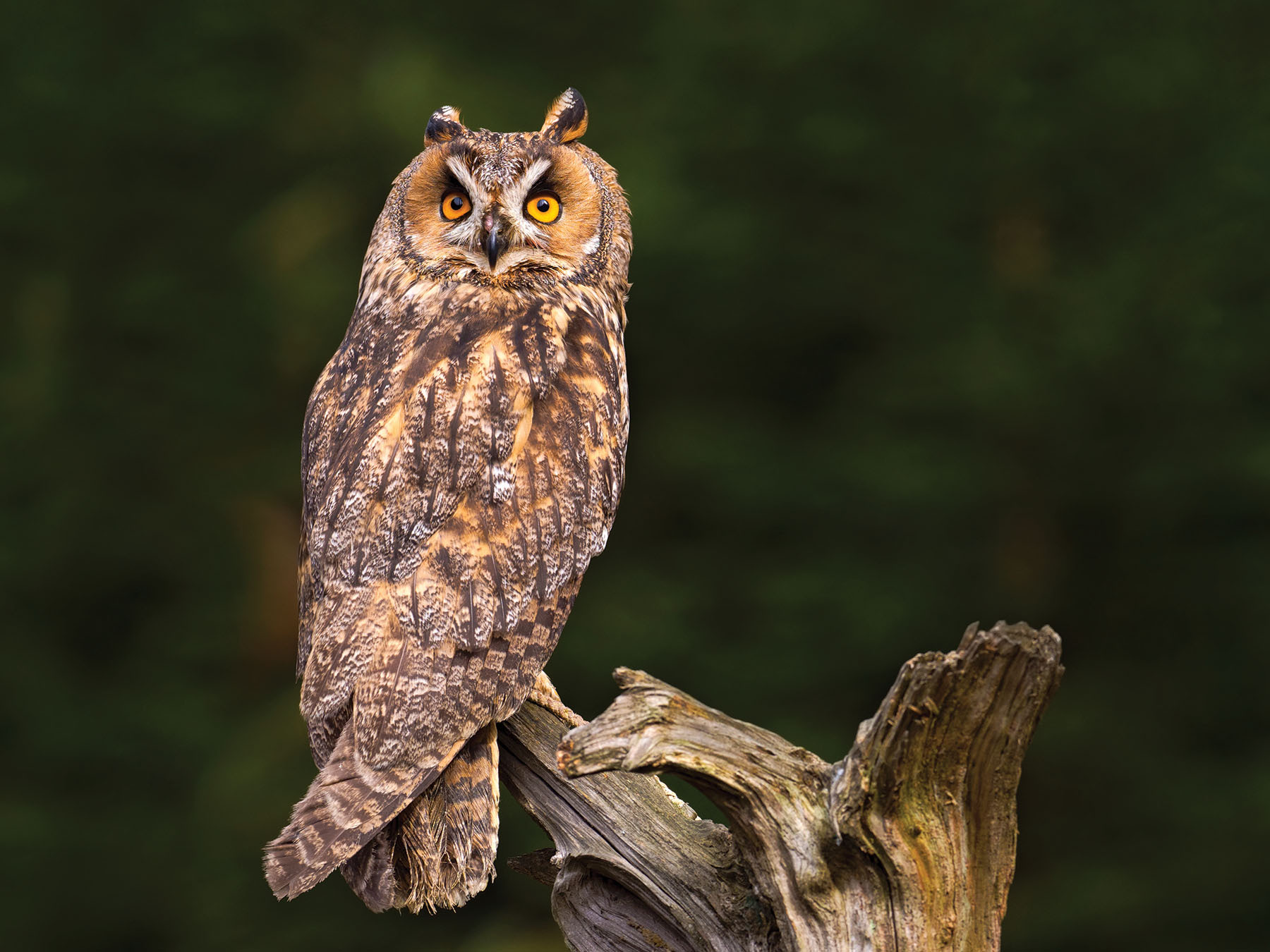
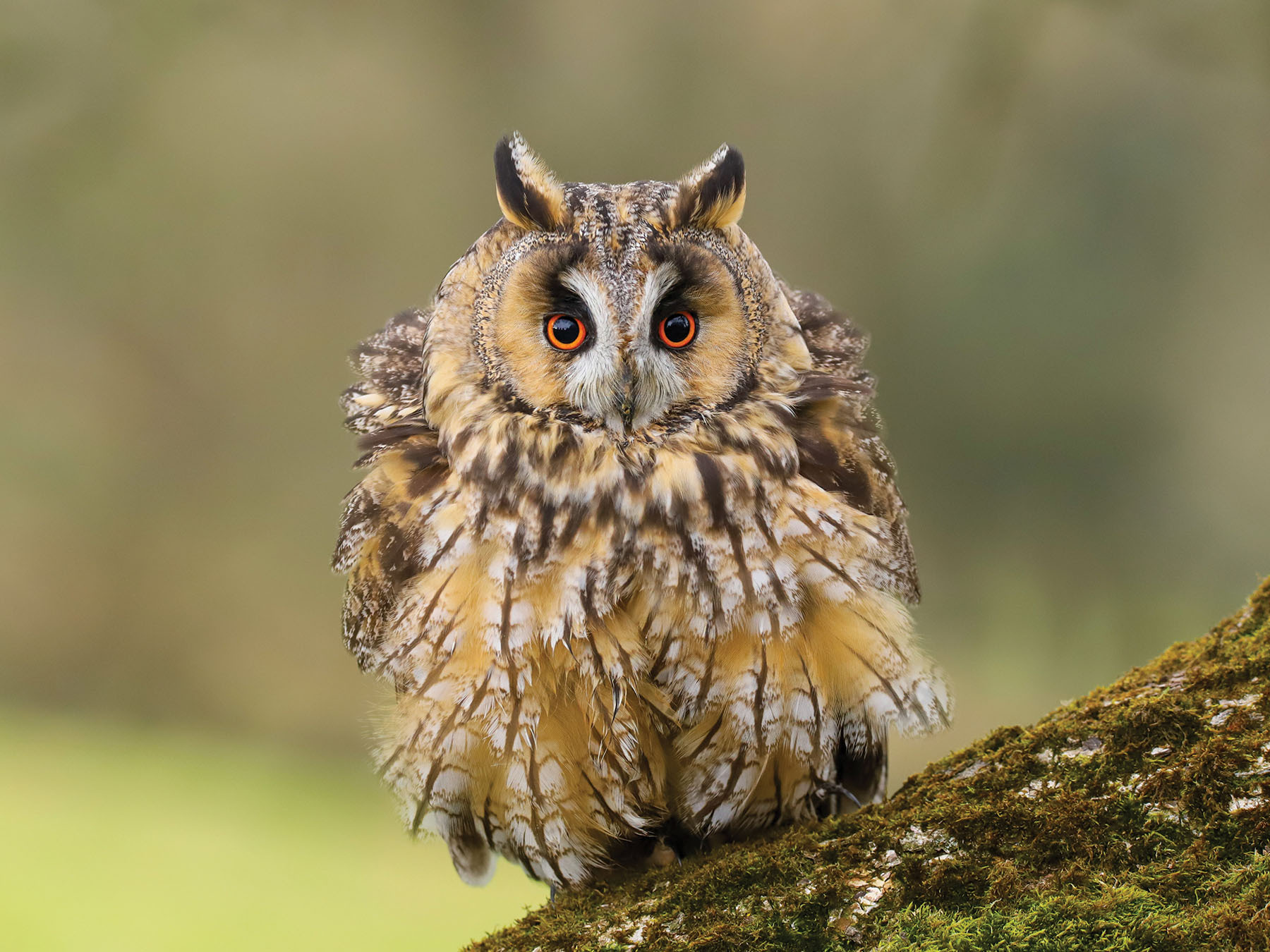
Long-eared owls have mottled orange-brown feathers, which allow them to blend into their woodland habitats with ease. Facial markings include a buff-brown round facial disc, with pale “eyebrows” and large, bright orange eyes.
When alarmed, its prominent ear tufts, from which the species takes its name, are visible, but these are normally flattened and cannot be seen in flight.
Wings are long and rounded, and barred with dark brown and buff markings and a darker wingtip. The underside of the wings is pale, with a distinctive block of dark patterning along the upper edge. The tail feathers are also marked with dark brown and buff barring.
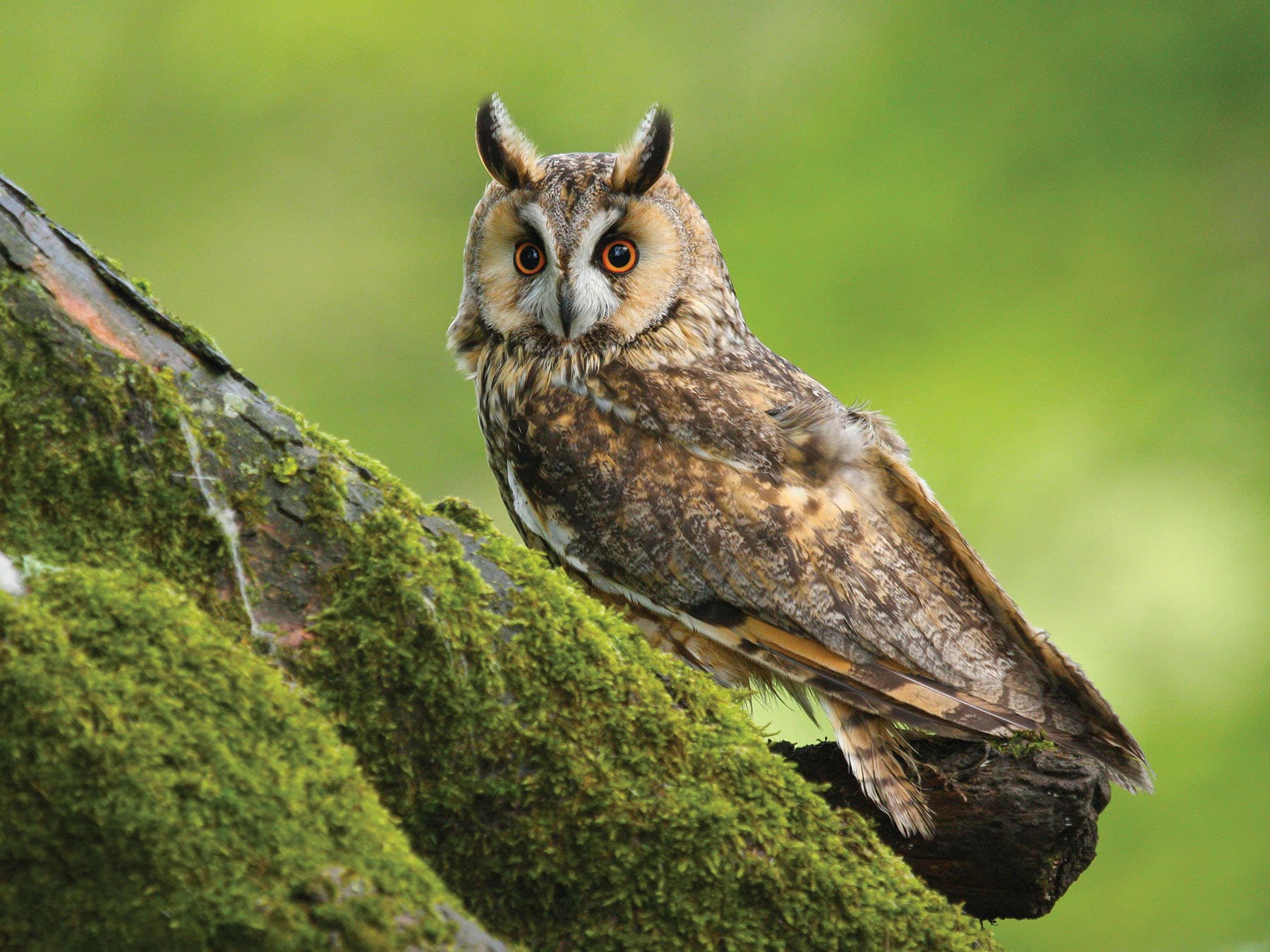
Female long-eared owls are generally darker than males, and also larger. Their plumage is more colourful, with more marked contrasting between the streaky shades of darker brown and richer buff-orange.
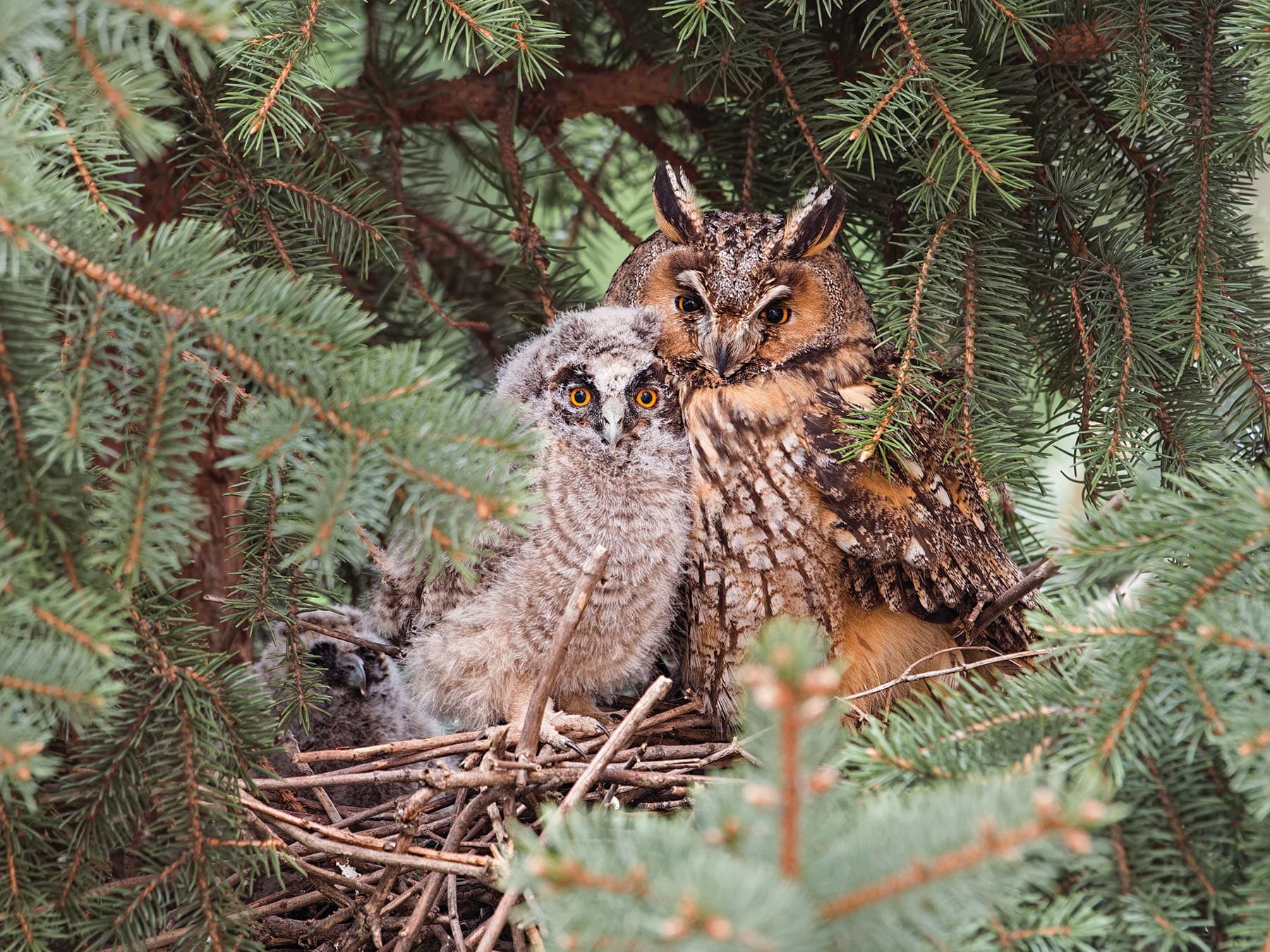
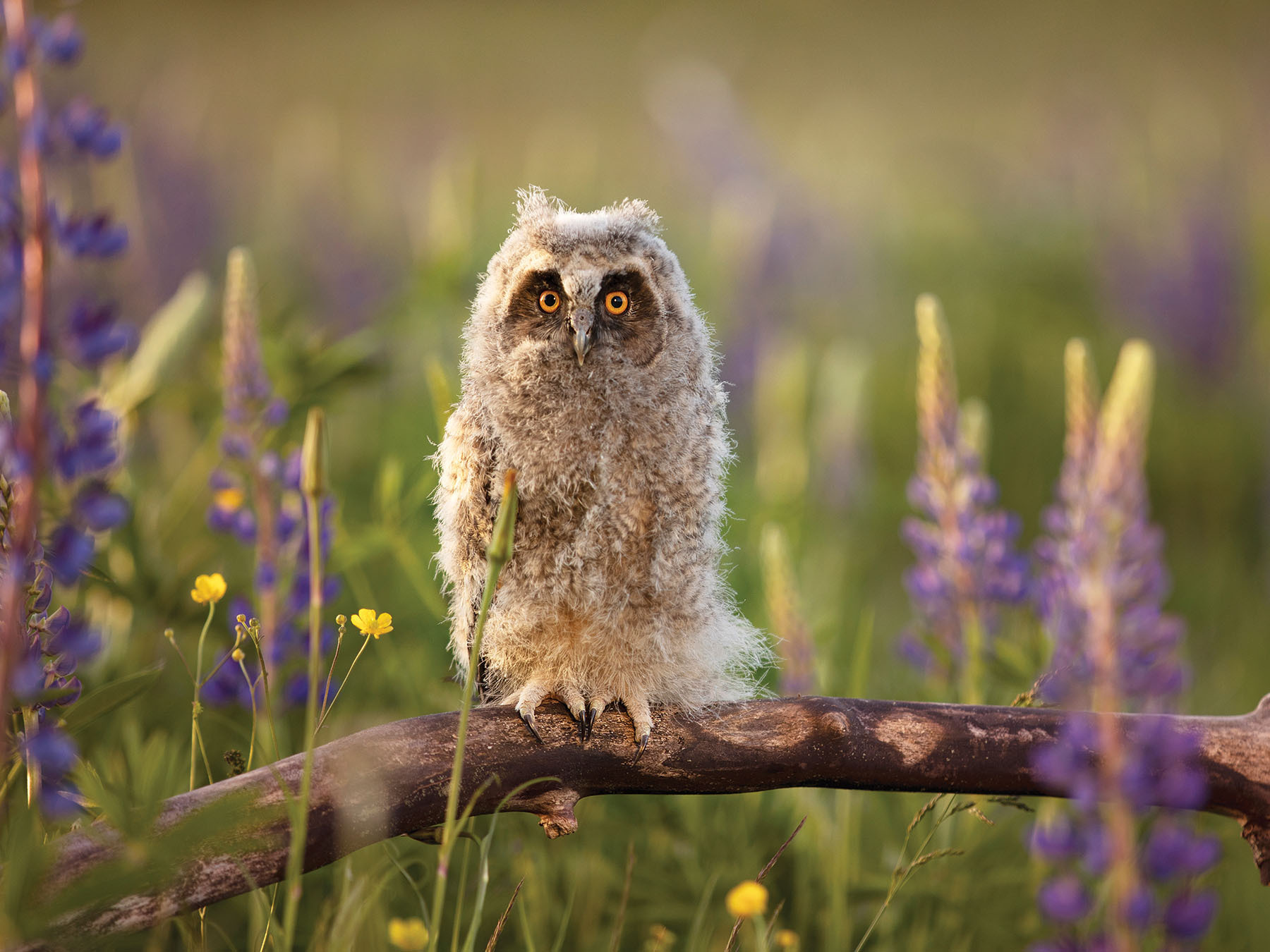
Juvenile long-eared owls have the same round, buff facial disc as adults and the same barred wings and tail, but their bodies are mottled with grey and buff rather than the browner tones seen in adult birds.
How big are Long-Eared Owls?
A medium sized-owl, long-eared owls are slightly larger than barn owls and marginally smaller than short-eared owls. Females are larger and heavier than males. Despite looking long and sleek in flight, long-eared owls are actually smaller than woodpigeons.
Length
- Male: 35 cm to 37.5 cm (13.8 in to 14.8 in)
- Female: 37 cm to 40 cm (14.6 in to 15.7 in)
Weight
- Male: 220 g to 305 g (7.8 oz to 10.8 oz)
- Female: 260 g to 435 g (9.2 oz to 15.3 oz)
Wingspan
- 90 cm to 100 cm (35 in to 29 in)
Its size
Adults- Length
- 35–40 cm
- Wingspan
- 90–100 cm
- Weight
- 220–435 g
Its song and calls
What sound does a Long-Eared Owl make?
Male long-eared owls make a low-pitched “whoop” call, initially at a relatively quiet hoot but rising gradually in volume and intensity. The song of female long-eared owls is weaker and higher in pitch and is heard most frequently during courtship and in the early stages of nest construction and nest defence.
- Song0:00 / 0:33
Recorded in Östergötland County, Sweden · April 2026
- Call0:00 / 3:02
Recorded in Hauts-de-France, France · August 2023
When and where to see it
OctoberIn season
Most recorded in October
- 1. Carlow0.11%
- 2. Wicklowunder 0.1%
- 3. Wexfordunder 0.1%
- 4. Kerryunder 0.1%
- 5. Galwayunder 0.1%
Each dot is a county, state or province: the bigger and darker, the larger the bird’s share of that place’s bird records that month. Grey dots: no regular records. The ringed point is the centre of the bird’s records this month; the arrow shows how it moved since last month, and the dashed loop its path through the year. “Arrivals” colours places where it becomes regular this month (orange) or is in its last regular month (grey). GBIF eBird Observation Dataset, 2019–2024. Map data: Natural Earth, US Census Bureau; place centres © OpenStreetMap contributors.
In your area
See when the Long-eared Owl is recorded in your county, state or province.
How often the Long-eared Owl turns up in the UK, Ireland and Canada through the year, from birdwatchers' records.
Ireland
Resident · regularly Oct–Aug · most records in February
Canada
Winter visitor · regularly Jul–May · most records in January
Show as a table
| Month | Ireland | Canada |
|---|---|---|
| January | 0.016% (regular) | 0.035% (regular) |
| February | 0.036% (regular) | 0.025% (regular) |
| March | 0.013% (regular) | 0.015% (regular) |
| April | 0.013% (regular) | 0.006% (regular) |
| May | 0.016% (regular) | 0.002% (regular) |
| June | 0.025% (regular) | 0.002% |
| July | 0.035% (regular) | 0.003% (regular) |
| August | 0.004% (regular) | 0.003% (regular) |
| September | 0.004% | 0.002% (regular) |
| October | 0.012% (regular) | 0.004% (regular) |
| November | 0.014% (regular) | 0.013% (regular) |
| December | 0.005% (regular) | 0.024% (regular) |
Recorded in United Kingdom, but eBird withholds many records of this sensitive species to protect it, so no months are shown.
Recorded regularly in
Worldwide: recorded regularly in 58 countries
Countries where it was recorded in at least 3 of the 6 years 2019–2024. Linked countries have their own bird list.
Europe (36)
Asia (18)
Data: EOD – eBird Observation Dataset (Cornell Lab of Ornithology), accessed via GBIF.org, CC BY 4.0. Records from 2019–2024, aggregated and filtered by Birdfact. How these lists are made
What is the habitat of a Long-Eared Owl?
Long-eared owls nest and roost in dense vegetation, particularly forested landscapes with mixed or coniferous woodland.
Roosting and nesting spots are usually selected close to open areas of grassland or shrubland, where they can forage for a wealth of small mammals, particularly voles.
What is the range of a Long-Eared Owl?
In Europe, long-eared owls are resident from the UK, Spain and Portugal in the west, across Europe and as far as eastern China, Japan and Korea.
Breeding also takes place across southern Norway, Sweden, Finland and Russia, with migration from these regions further south into Europe, Asia and parts of North Africa (Egypt, the Persian Gulf and parts of India).
Long-eared owls are also native to North America, breeding across central and southern Canada and the northern United States, and wintering across much of the central and southern U.S.
Where do Long-Eared Owls live?
2004 population figures for Europe estimated between 380,000 and 800,000 long-eared owls, with Russia, Romania, Ukraine and Germany having the largest populations.
How rare are Long-Eared Owls?
Known as perhaps the UK’s most secretive owl, long-eared owls are notoriously hard to spot, due to their well camouflaged plumage and nocturnal hunting habits.
The most recent population estimates state there are up to 6,000 breeding pairs in the UK, joined by overwintering birds from Scandinavia each autumn. It’s certainly not the UK’s rarest bird, but it ranks right up there with the hardest-to-spot species.
Where can you see Long-Eared Owls in the UK?
Long-eared owls are not the easiest birds to track down, due to their secretive nature, nocturnal activity and highly effective camouflaged plumage.
During migration is the best opportunity for a chance sighting during the daytime, as they break their journeys with brief stopovers in coastal areas.
In winter months, the south of England welcomes an influx of visiting long-eared owls from Russia, eastern Europe, Sweden and Finland, as well as those who are temporarily seeking a milder climate than their usual northern breeding spots offer.
Long-eared owls breed throughout most of the UK, but are particularly rare in Wales and the south-west.
Migration
Do Long-Eared Owls migrate?
The long-eared owl is a partially migratory species: in the UK, birds that breed in the south of the country remain resident throughout the year (although are relatively nomadic and do not stay in one particular territory).
Northern birds tend to shift southwards once the weather becomes colder, and long-eared owls from northern Europe arrive to temporarily swell the UK’s numbers each autumn.
Are Long-Eared Owls native to the UK?
Long-eared owls are native to the UK and have established breeding grounds in various parts of the UK, including north-east, west-central and south-east England, and in the coastal regions around the Severn estuary.
Tips for seeing it
- Look for Long-eared Owls in dense coniferous or mixed woodlands adjacent to open areas.
- Listen for their low, repeated 'hoo' calls at night, especially during the breeding season.
- Search for pellets and whitewash beneath potential roosting sites.
- In the UK and parts of the US, check known communal roost sites during winter months.
What it eats
What do Long-Eared Owls eat?
Long-eared owls are nocturnal hunters, searching for prey in open country, and locating it mainly by ear.
For long-eared owls resident in Britain, field voles, wood mice, bank voles and common rats are the chief prey.
Out of the breeding season, small birds represent a larger share of a long-eared owl’s diet, particularly finches, buntings and thrushes which are caught while they roost overnight.
What do Long-Eared Owl chicks eat?
For the initial post-hatching period, young long-eared owls are fed prey that is ripped into smaller pieces by the female. While the female is incubating, the male brings her food to the nest, and as hatching approaches, prey is stockpiled so the young can be fed instantly.
Prey items are the same as those eaten by adult long-eared owls, with field voles being of top importance. Once the young have reached around two weeks of age, prey is swallowed whole.

Nesting and breeding
Where do Long-Eared Owls nest?
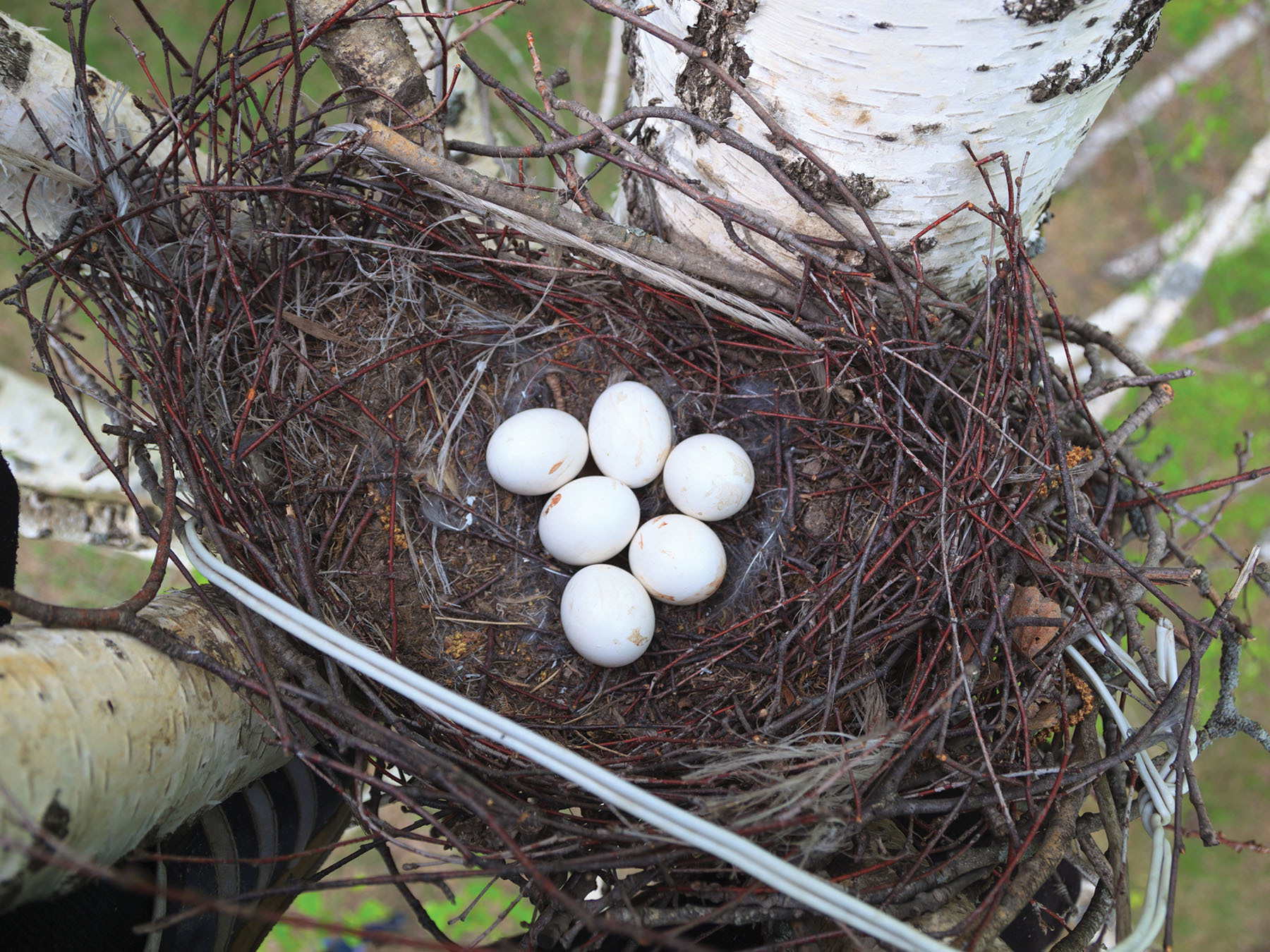
Nest sites selected by long-eared owls are frequently the abandoned stick nests of crows, magpies, hawks, ravens and buzzards, high in trees largely concealed by dense vegetation and foliage.
They do not construct their own nest and are not thought to add any kind of lining before laying their eggs. Less commonly, long-eared owls will use cavities or ledges.
Occasionally ground-level nests may be built, under shrubbery or at the base of a tree, but these are far less common than a nest at a higher altitude.
Nests may sometimes be reused if a second brood is attempted in the same season, and may also be used in subsequent years, although it’s more usual for a new nest to be chosen.New nests are usually built fairly close to a territory where pairs successfully raised young in the past.
What do Long-Eared Owl eggs look like?
Long-eared owls’ eggs are glossy, smooth and plain white. They measure around 4.1 cm by 3.3 cm (1.6 in by 1.3 in).
An average clutch contains between 1 and 9 eggs, with 4 to 5 being most common, and typically one brood is raised each year. The female incubates alone, for 26 to 28 days, and is brought food by her mate.
Do Long-Eared Owls mate for life?
Long-eared owls pair up at the start of the breeding season, and raise their young together before they separate at the end of the summer. New pairs form each year, from winter onwards, with the breeding season lasting from February until mid-July.
Behaviour
Are Long-Eared Owls aggressive?
In contrast to many of their fellow owl species, long-eared owls are not particularly aggressive or territorial. They will defend their nest site and the area surrounding it while they are raising young, but otherwise do not restrict themselves to a particular location or territory for foraging or roosting.
Where do Long-Eared Owls sleep during the day?
Long-eared owls spend daylight hours resting, after hunting during hours of darkness. Their chosen roosting spots are deep in foliage, where they can remain well hidden among the branches of trees.

Lifespan and predators
How long do Long-Eared Owls live?
The average lifespan for a long-eared owl is thought to be around 4 years, although several much older individuals have been recorded, including one of 27 years and 9 months. Long-eared owls usually breed for the first time when they are one year old.
What are the predators of Long-Eared Owls?
Despite being feared hunters themselves, long-eared owls are frequently predated by larger birds of prey and other owl species. Throughout its European range, the leading predators of long-eared owls include Eurasian eagle-owls and northern goshawks.
Are Long-Eared Owls protected?
The Wildlife and Countryside Act, 1981, protects long-eared owls from being killed, injured or captured.
Are Long-Eared Owls endangered?
Long-eared owl numbers are in decline, yet the species is rated Green on the Birds of Conservation Concern list. Habitat loss is a threat to the long-term stability of long-eared owl populations.
However the elusive nature of the species, and their nomadic habits make it quite hard to accurately estimate the population status.

Conservation
While listed as Least Concern globally, Long-eared Owl populations face threats from habitat loss due to deforestation and agricultural intensification. Conservation efforts focus on preserving suitable woodland habitats and maintaining adjacent open areas for hunting.
More photos
5 photos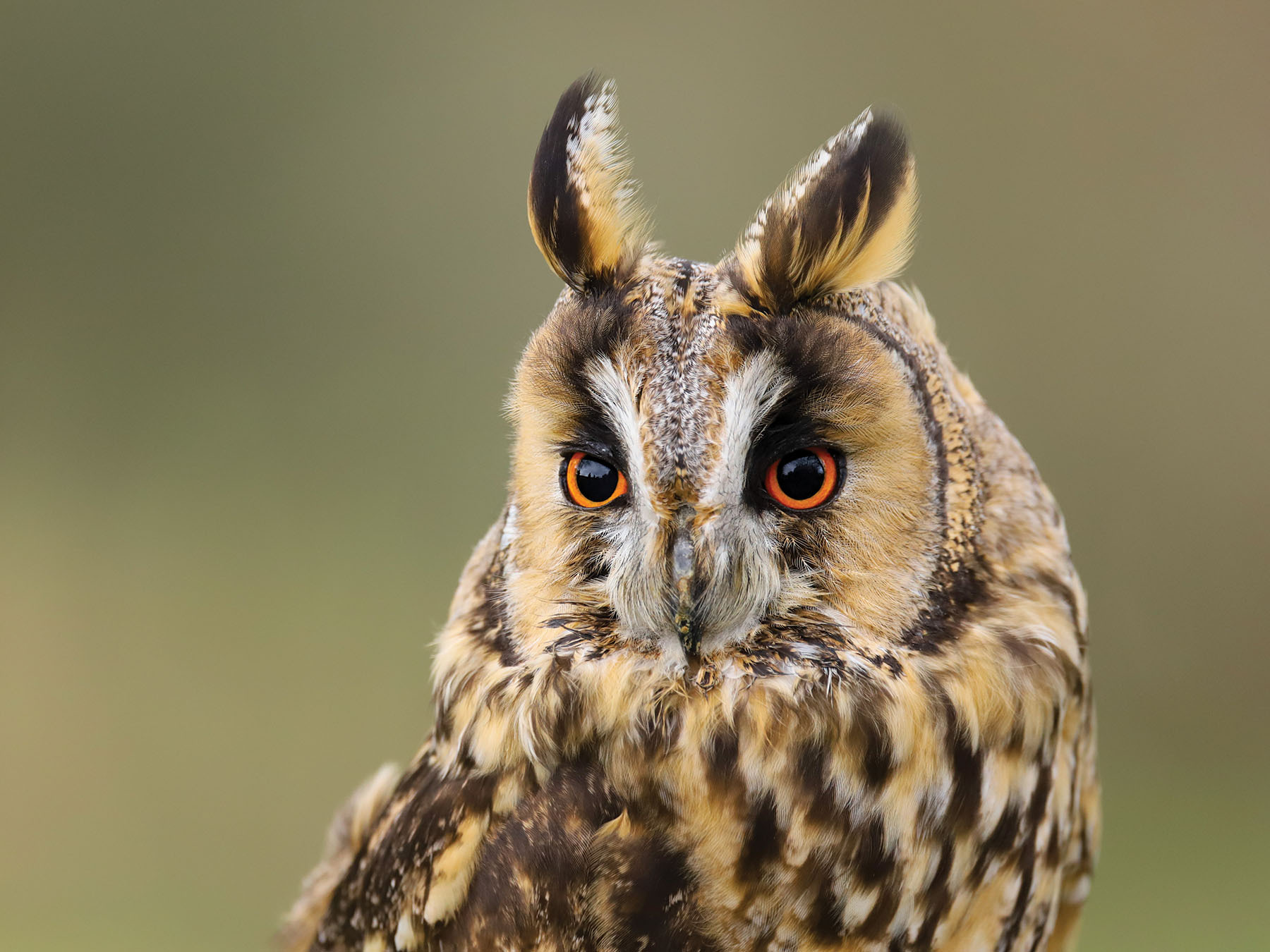
Long-eared Owl guides
5 guidesQuick facts
- Length
- 35–40 cm
- Wingspan
- 90–100 cm
- Weight
- 220–435 g
- Lifespan
- 10–15 years · oldest recorded 12.8 years
- Family
- Owls
- Migration
- Partial migrant
- Global status (IUCN)
- Least Concern
- World population
- 2,230,000 - 3,680,000 mature individuals
- Population trend
- Decreasing
- Also called
- Northern Long-eared Owl
- Scientific name
- Asio otus
Sources
4- 1BirdLife International. 2021. Asio otus. The IUCN Red List of Threatened Species 2021: e.T22689507A201150685. Source (opens in a new tab)
- 2Partners in Flight (2020)
- 3BirdLife International. 2021. Asio otus. The IUCN Red List of Threatened Species 2021: e.T22689507A201150685. Source (opens in a new tab)
- 4BTO longevity records: maximum age from a ringed bird, 12 years, 10 months, 12 days (set in 1987), BirdFacts: Long-eared Owl (1987) Source (opens in a new tab)

Checked by
Nathan Cope, founder and editor
Nathan founded Birdfact and leads its writers and contributors in the UK, the US and Canada. He has watched and studied birds for more than ten years, and checks every article and species guide before it’s published.