


Cooper's Hawk
Astur cooperii
By the Birdfact teamChecked by Nathan Cope
See it in 3D
4 plumages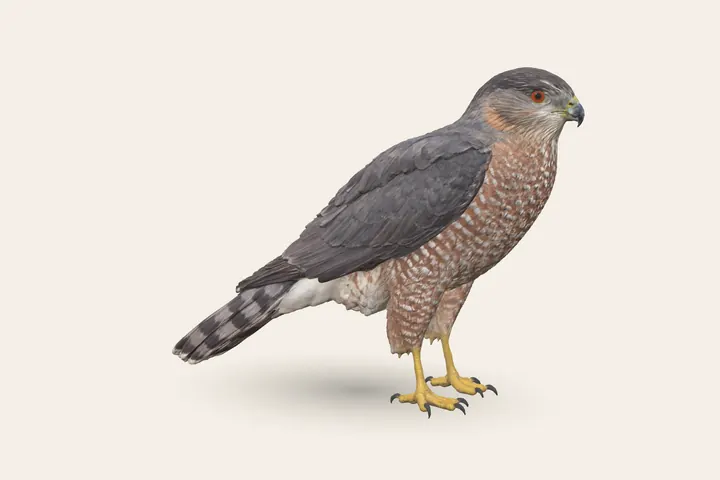 3D model
A Cooper's Hawk (Adult male) is 14.5–15.5 in (37–39 cm) long, bill to tail.
3D model · Adult male · Length 14.5–15.5 in (37–39 cm) · How we make our birds · Report a problem
© 2026 NC Digital Limited (Birdfact). All rights reserved. This 3D model may be viewed on this page and shared by link only. Downloading, extracting, copying or reusing it, or using it to train machine-learning models, is not permitted without our written permission. Using our models
On this page16 sections
How to recognise it
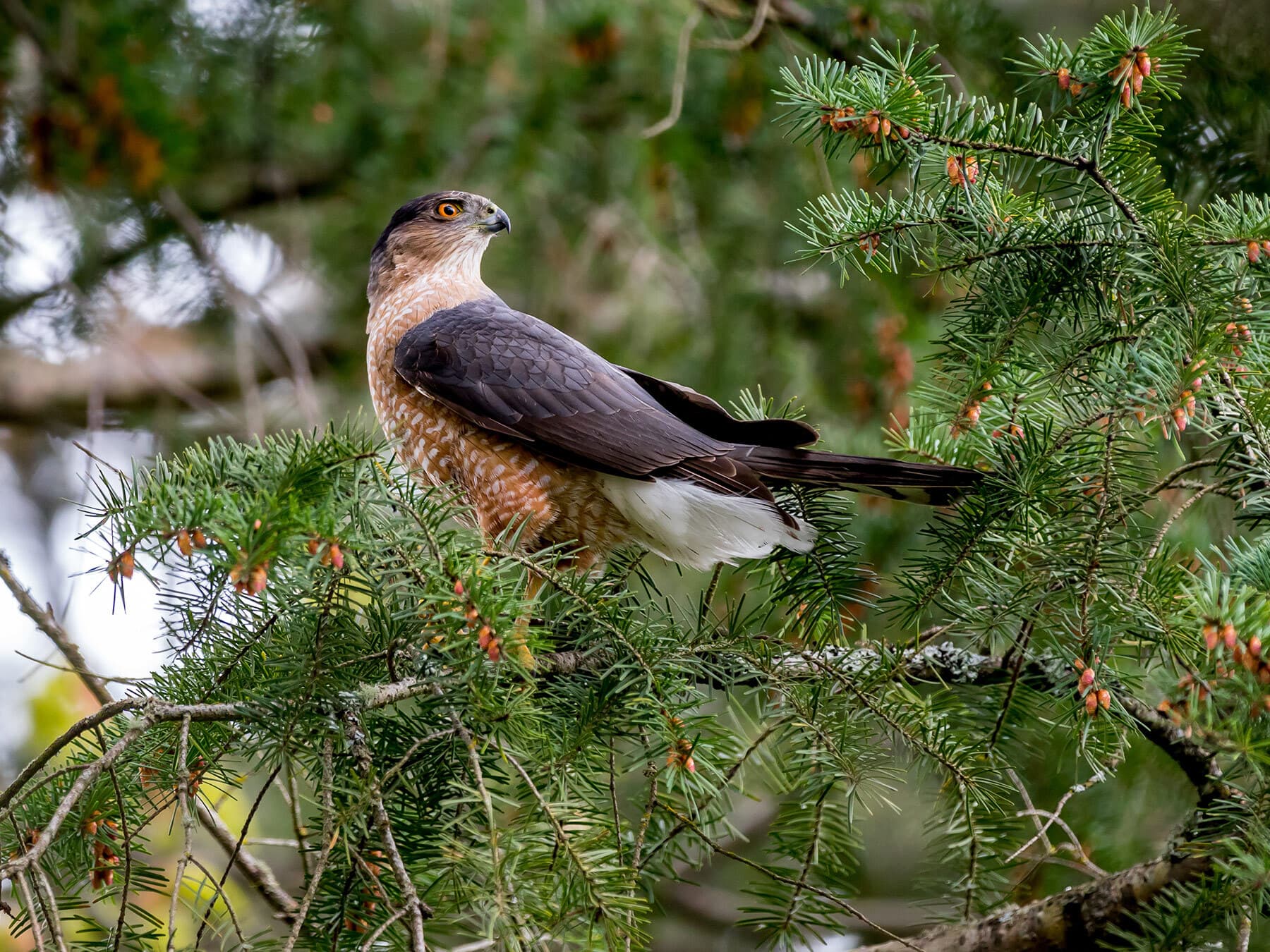
Cooper's Hawk is a crow-sized hawk of woods, towns and backyards, built for chasing birds through trees: short, rounded wings, a long tail, usually rounded at the tip, and a big head on a thick body. Adults are blue-gray to brownish gray above, with a dark cap that stands out against a paler gray nape, white underparts barred with reddish brown, plain white feathers under the base of the tail and an orange to red eye. The long tail has dark bands and a broad white tip.1, 2, 3
In flight it shows a few quick wingbeats and a glide, the flap-flap-glide typical of accipiters, the bird-hunting hawks, and the head juts well ahead of the wings. Perched, it often raises the long feathers on the back of its head, which makes the head look almost triangular.3
Size: male and female
A Cooper's Hawk is 14.6 to 17.7 inches (37-45 cm) long, with a wingspan of 24.4 to 35.4 inches (62-90 cm). Females are much bigger than males: a male is 14.6 to 15.3 inches (37-39 cm) long and weighs 7.8 to 14.5 ounces (220-410 g), a female 16.5 to 17.7 inches (42-45 cm) and 11.6 to 24 ounces (330-680 g).1, 2 The female is about a third bigger, one of the largest size gaps between the sexes in the hawk family, and birds in the West are smaller and lighter than those in the East.3
Plumage differs less. Males are bluer and brighter, with a blacker cap, and older males have gray cheeks; females are browner above, with brown or reddish cheeks.
Juveniles
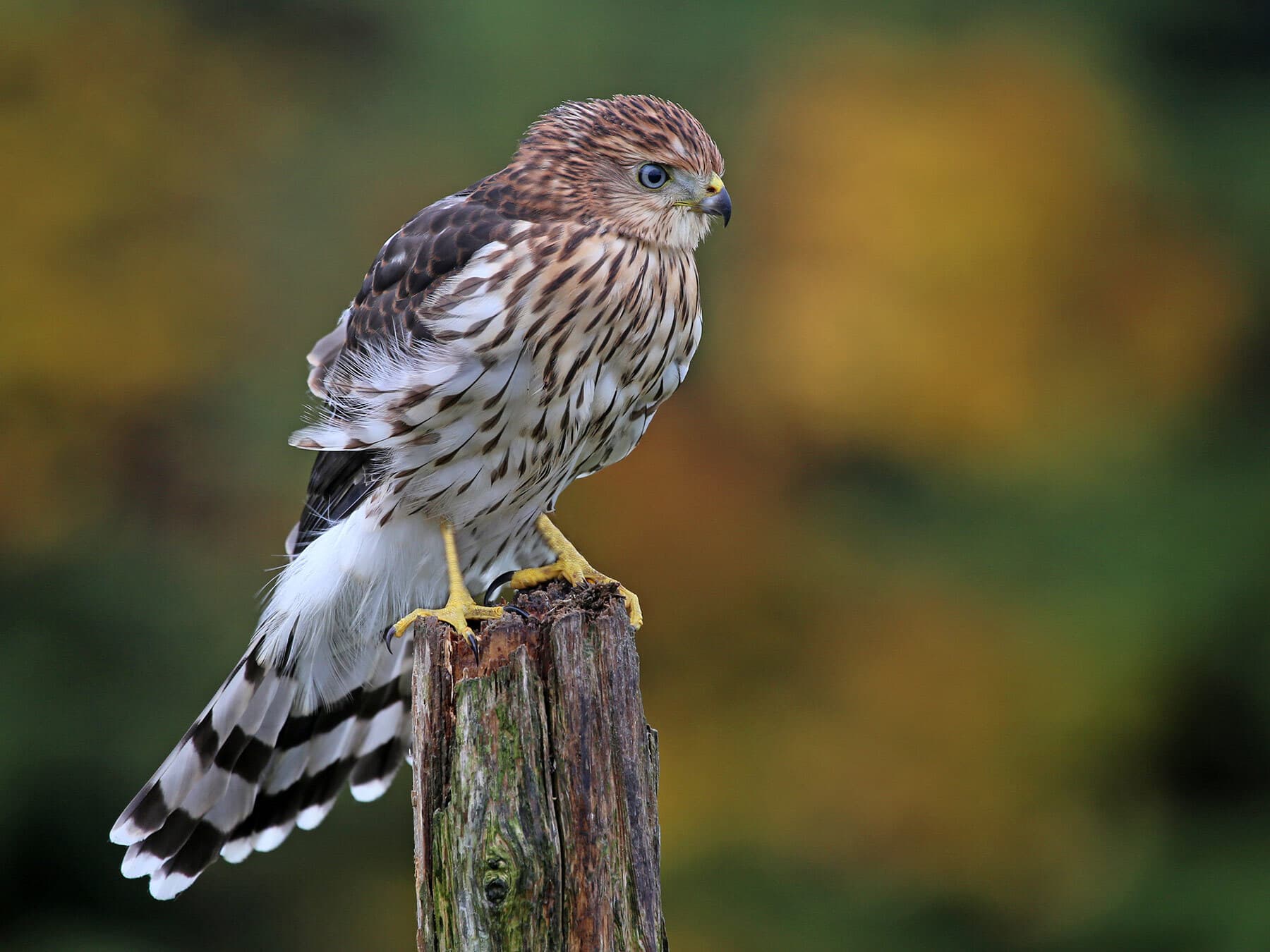
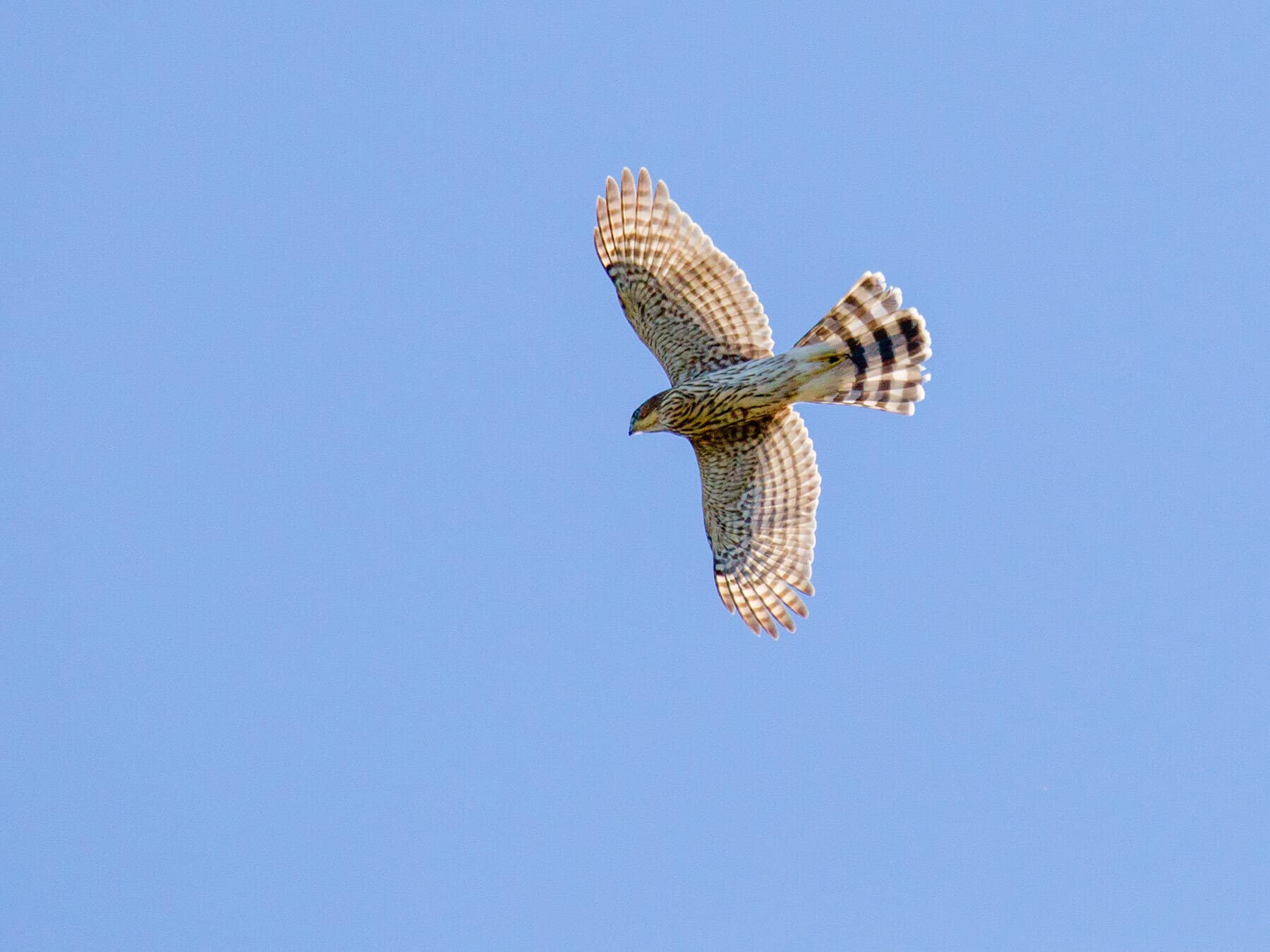
Young Cooper's Hawks look like a different bird. Through their first year they are brown above, often with white spots on the shoulders, and white below with fine, crisp, dark brown streaks that mostly stop on the upper belly, leaving the lower belly white. The eye is pale yellow. The tail is long and banded like the adult's.4, 3 They keep this brown plumage through their first winter and into their second summer, when they molt into adult colors. More: juvenile Cooper's Hawks.
Identification: similar hawks
Sharp-shinned Hawk. The real puzzle: same colors, same shape, often at the same feeders. The Sharp-shinned is smaller, about 10 to 14 inches (25-36 cm), with a small head, pencil-thin legs and a tail that usually looks square-tipped, with a narrow white tip; adults look hooded, with the dark color running down the back of the neck.5, 4, 3 Size overlaps: a female Sharp-shinned can be as big as a male Cooper's Hawk, and some adult male Cooper's Hawks have nearly square tails, so no single mark settles it: look at the head, legs and tail together. In a glide, a Sharp-shinned's head barely reaches past the bend of the wings, while a Cooper's Hawk's sticks out well ahead. If you cannot be sure, "Sharp-shinned or Cooper's Hawk" is a fair answer: even experienced birders find these two hard.
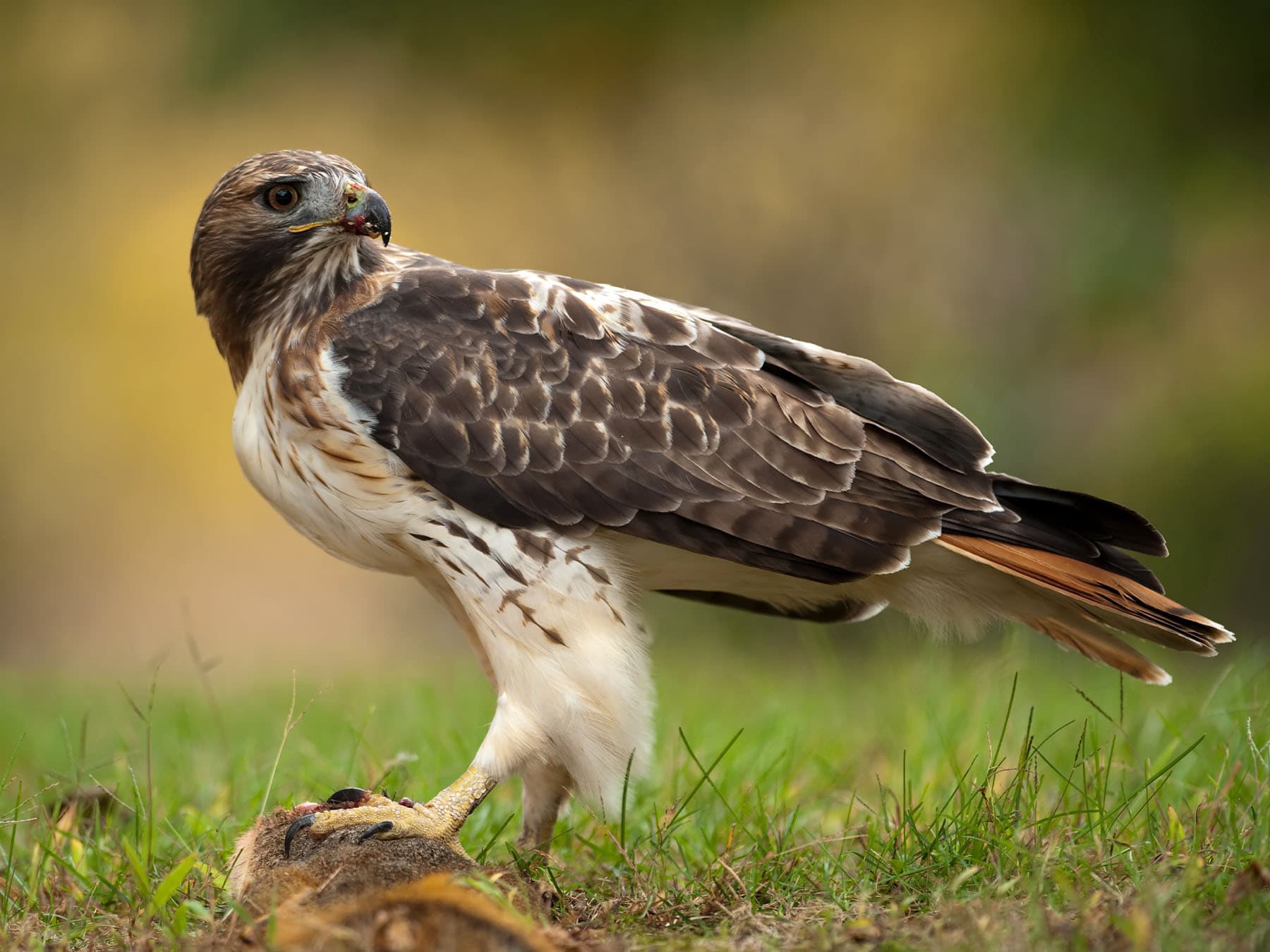
Red-tailed Hawk. Bigger and bulkier, with very broad wings and a short, wide tail, reddish above on adults; most eastern birds have a band of dark streaks across a pale belly.6, 7 More: Cooper's Hawk or Red-tailed Hawk?
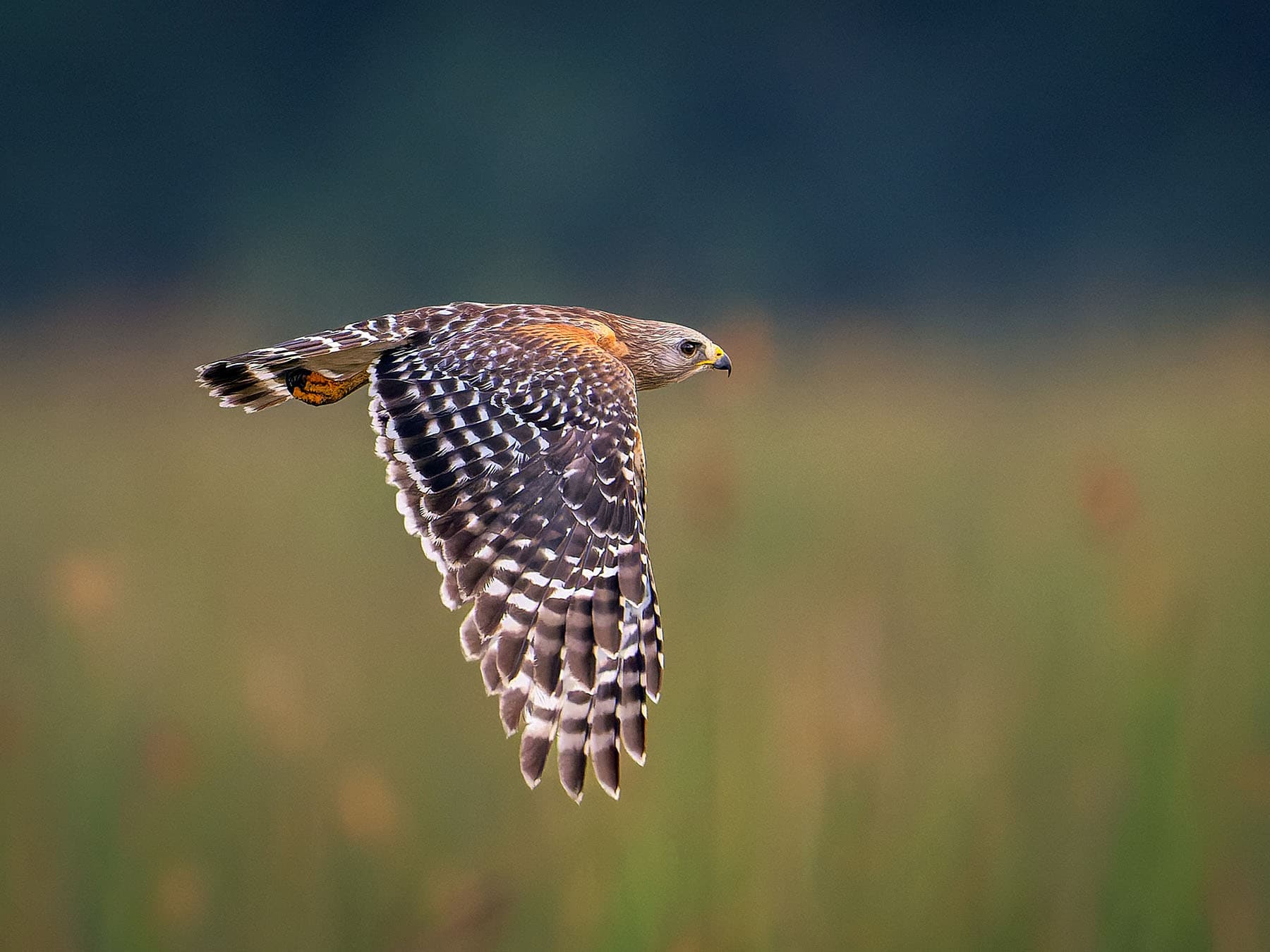
Red-shouldered Hawk. A young bird can look much like a Cooper's Hawk, but in flight it shows a pale crescent near each wingtip, buff in young birds and white in adults.8, 3
American Goshawk. Bigger, with a bold white eyebrow; adults are gray-barred below, and young birds have black streaks under the tail and zigzag bands across it.
Not sure it’s a Cooper's Hawk? Check your photo: Birdfact names the bird and shows the look-alike side by side.
Its size
Adults- Length
- 37–45 cm
- Wingspan
- 62–90 cm
- Weight
- 220–680 g
Its song and calls
For most of the year a Cooper's Hawk is silent. In spring and summer, near the nest, you will hear its alarm call: a loud, rapid kak-kak-kak lasting a few seconds, given by either parent at an intruder.2, 3 The male announces himself to his mate with a kik call, and the female calls whaaa when she flies to him for food. Fledglings beg with a thin, high whistle. No song has been described.
- Kak-kak-kak calls0:00 / 0:10
Recorded in California, United States · February 2020
- Calls of a female near her mate0:00 / 0:12
Recorded in Washington, United States · April 2020
Heard one and not sure? Let the bird song identifier listen.
When and where to see it
Cooper's Hawks breed across all of the lower 48 states, in southern Canada and in the highlands of Mexico. They live in woods of all kinds, from forest to small woodlots and pine plantations, and since the 1970s they have moved into suburbs and cities. Today it is probably the most common hawk nesting in backyards in North America, and in some cities it nests at higher densities than in natural habitat.3
Spotting tips
Watch your feeders, especially in winter: a sudden scatter of birds, then silence, often means a hawk is nearby. Look for a long-tailed hawk perched quietly in a tree near the feeders, or crossing the yard with a few quick flaps and a glide. In fall, hawkwatches on ridges and coasts, such as Cape May in New Jersey and Hawk Mountain in Pennsylvania, are good places to see them on migration.

Do they migrate?
Partly. Birds from roughly the northern third of the range fly south for the winter, while many others stay near their nesting areas all year. Fall migration runs from late August to early November, peaking at eastern hawkwatches from late September to mid-October; young birds pass about a week ahead of adults. They come back north from March to May. Most winter in the US and Mexico.
What it eats
Birds, mostly. A Cooper's Hawk hunts medium-sized birds that feed on or near the ground: Mourning Doves, feral pigeons, European Starlings, American Robins, Blue Jays and flickers. In cities, House Sparrows can be common prey. It also takes chipmunks, squirrels, mice, bats and now and then hares, more often in the West, and now and then lizards and insects.1, 2, 3 Most prey weighs about 1 to 4.6 ounces (30-130 g), and in the breeding season much of it is young birds and mammals of the year.
Females, being bigger, often take bigger prey. A Cooper's Hawk hunts live prey rather than scavenging. It grips its catch in its feet and squeezes, and has been seen holding prey under water until it drowned.
Hawks at bird feeders
Feeders draw birds, and birds draw hawks. Project FeederWatch participants recorded 1,186 cases of a Cooper's Hawk eating a bird at their feeders between October 2015 and April 2022. Most were medium to larger birds such as starlings and pigeons; Sharp-shinned Hawks took mostly smaller birds such as juncos and siskins.9, 10
If a hawk starts visiting every day, take the feeders down for a few days; it will usually move on, and your birds will come back.

Nesting and breeding
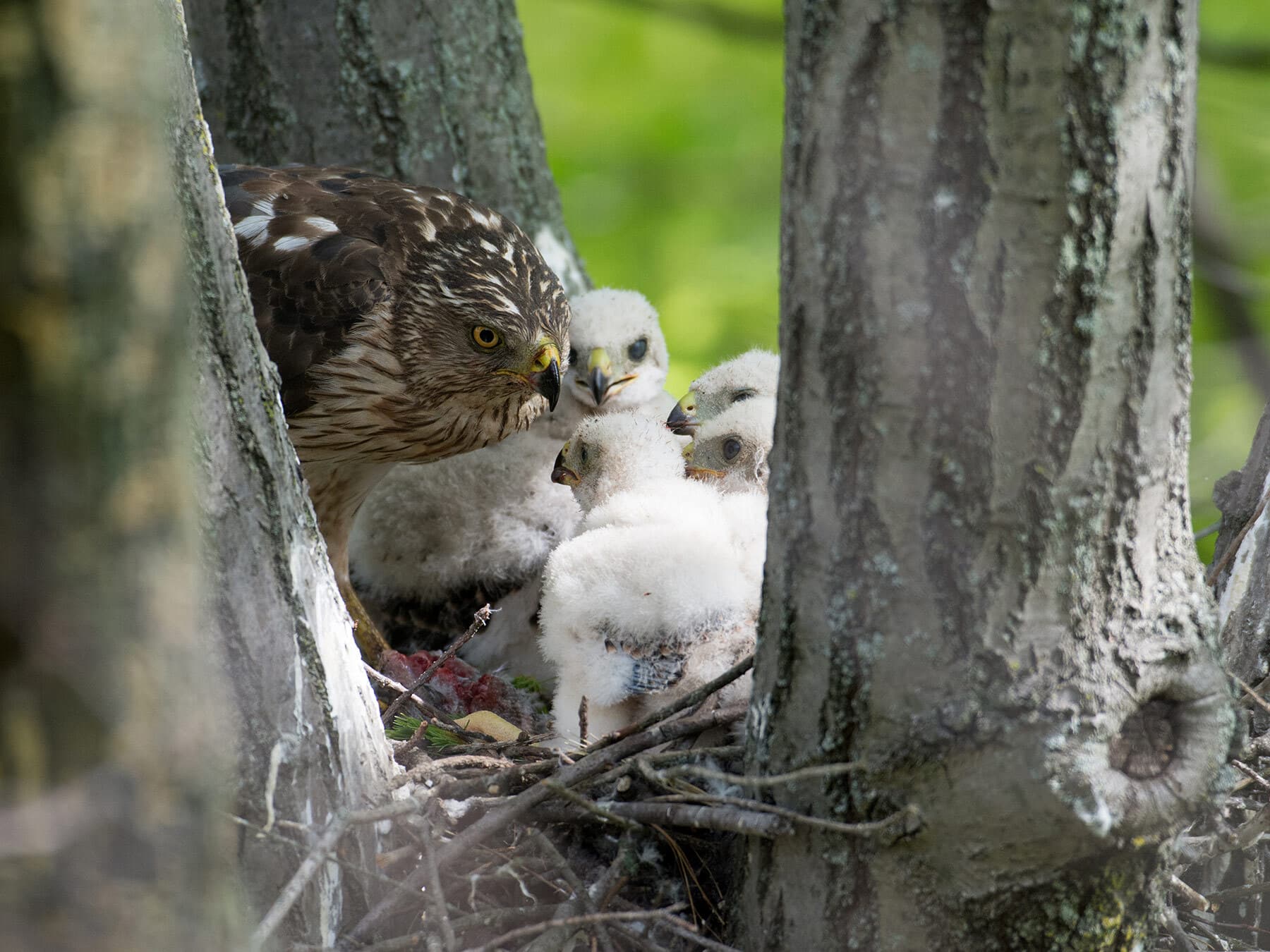
In the north, pairs are back at their nest areas by early March, and some city pairs stay all year. In courtship flights, a hawk flies high and slowly over the trees with exaggerated wingbeats, the white feathers under the tail fluffed out. The male builds most of the nest, over about two weeks: a platform of sticks with a shallow cup lined with flakes of bark, 25 to 50 feet (8-15 m) up in a fork or on a branch against the trunk, often on top of an old squirrel or hawk nest.1, 2, 3
Eggs are laid mostly in April and May. The female lays usually 3 to 5 pale bluish eggs and does nearly all the incubating, for 30 to 36 days. From about a month before laying until about halfway through the nestling period, the male brings almost all the food, passing it to the female near the nest. The young fly at about 4 to 5 weeks old, and the parents, mostly the male, keep feeding them for up to seven weeks. Pairs raise one brood a year. More: Cooper's Hawk nesting.
Behaviour
A Cooper's Hawk hunts by surprise. It waits on a perch inside cover, watches, moves to the next perch, and when it sees a chance it bursts out at speed, often flying fast and low behind a hedge or a building and then up and over it to catch birds on the other side. It sometimes chases prey on foot.2, 3
A study of eight hawks in Indiana towns found they attacked only birds and caught one in five of those they went after; about 95% of attacks were on starlings, Mourning Doves and pigeons, and House Sparrows were mostly ignored. Radio-tagged hawks there also hunted roosting birds at night, by city lights and moonlight.3
Outside the nesting season it is a loner. Small birds often mob it, and Blue Jays sometimes imitate its call.

Lifespan and predators
The oldest known wild Cooper's Hawk lived at least 20 years 4 months: a male banded in California in 1986 as a bird of the year and found dead in Washington in 2006, according to the US Bird Banding Laboratory's longevity list.11 That is exceptional. The first year is the hardest: in one New Mexico city, only 27 to 38% of juveniles survived each year. Breeding birds do much better: 69 to 88% survive each year in studies in Wisconsin, Florida, Arizona and New Mexico.3
Predators and dangers
Raccoons and Great Horned Owls raid nests, and Great Horned Owls, Red-tailed Hawks and American Goshawks sometimes kill Cooper's Hawks. In towns, windows and cars are the big danger: in one Arizona city study, collisions with windows, vehicles and other structures caused 70% of deaths.
Conservation
Cooper's Hawk is not threatened (Least Concern) and is increasing: the North American Breeding Bird Survey shows a rise of about 2.2% a year from 1966 to 2015, and Partners in Flight estimates about a million breeding birds.1, 3 That is a comeback. Shooting and the pesticide DDT cut numbers in the mid-1900s, and by the mid-1980s it was on imperiled or special-concern lists in 15 of 48 states; it was on none by the early 2000s.
Cooper's Hawk is protected under the Migratory Bird Treaty Act: it is illegal to kill, capture or keep one, or to take its nest or eggs, without a federal permit.12, 13
Eye color and age
Young birds have yellow eyes, which turn orange and then red as they age and stop changing at about 5 years old. Males average darker than females of the same age, and many females never reach deep red. Eyes vary so much within each age, though, that eye color alone is only a rough guide to a bird's age.
Similar birds
Often mistaken for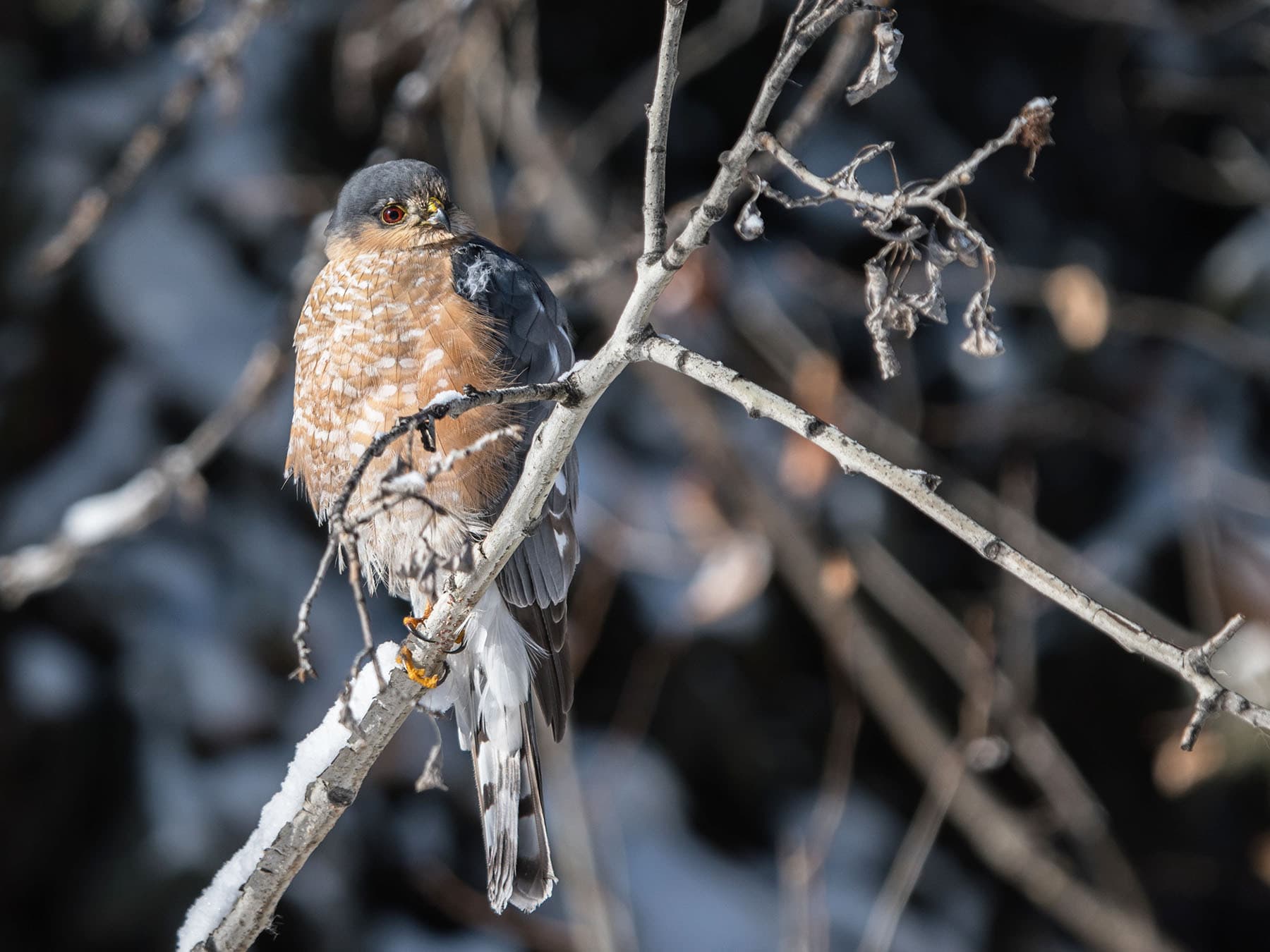
Cooper's Hawk guides
4 guidesQuick facts
- Length
- 37–45 cm
- Wingspan
- 62–90 cm
- Weight
- 220–680 g
- Lifespan
- oldest recorded 20 years · North American record 20 years 4 months
- Family
- Hawks & Eagles
- Global status (IUCN)
- Least Concern
- World population
- About 1 million breeding birds (Partners in Flight)
- Population trend
- Increasing across most of its range since the 1970s
- Scientific name
- Astur cooperii
Questions
5Why do Cooper's Hawks have red eyes?
The eyes darken with age, from yellow in young birds through orange to red in adults, and stop changing at about 5 years old. Males tend to be redder than females.
Is a Cooper's Hawk a chicken hawk?
That was its old name. It does take chickens and other poultry now and then, and the reputation made it a target for shooting. Most of what it eats is wild birds.
Do Cooper's Hawks mate for life?
Not reliably. Some pairs stay together from year to year and others change partners, and in a Wisconsin study about 1 in 5 chicks (19.3%) had a father other than the male raising them.
Are Cooper's Hawks dangerous to people?
No. They defend their nests with alarm calls and chases, but they rarely strike people; in one New Mexico study, incubating females almost never reacted to people nearby.
Who was Cooper?
William C. Cooper, a New York naturalist. Charles Bonaparte named the hawk after his friend in 1828.
Sources
13- 1Cornell Lab of Ornithology. Cooper's Hawk. All About Birds. Accessed 30 October 2026. Source (opens in a new tab)
- 2National Audubon Society. Cooper's Hawk. Guide to North American Birds. Accessed 30 October 2026. Source (opens in a new tab)
- 3Rosenfield, R. N., Madden, K. K., Bielefeldt, J. and Curtis-Scott, O. E. (2025). Cooper's Hawk (Astur cooperii), version 1.2. Birds of the World (P. G. Rodewald, editor). Cornell Lab of Ornithology. doi:10.2173/bow.coohaw.01.2 (opens in a new tab)
- 4Project FeederWatch. Tricky Bird ID: Sharp-shinned Hawk and Cooper's Hawk. Project FeederWatch (Cornell Lab of Ornithology and Birds Canada). Accessed 30 October 2026. Source (opens in a new tab)
- 5National Audubon Society. Sharp-shinned Hawk. Guide to North American Birds. Accessed 30 October 2026. Source (opens in a new tab)
- 6Cornell Lab of Ornithology. Red-tailed Hawk identification. All About Birds. Accessed 30 October 2026. Source (opens in a new tab)
- 7National Audubon Society. Red-tailed Hawk. Guide to North American Birds. Accessed 30 October 2026. Source (opens in a new tab)
- 8National Audubon Society. Red-shouldered Hawk. Guide to North American Birds. Accessed 30 October 2026. Source (opens in a new tab)
- 9Miller, E. T. et al. (2022). Congeneric predators fill niches created by the relative abundance of their prey species. Journal of Avian Biology: e02934. doi:10.1111/jav.02934 (opens in a new tab)
- 10Borgmann, K.. What's for dinner? Sharp-shinned and Cooper's Hawks pick different foods. Project FeederWatch (Cornell Lab of Ornithology and Birds Canada). Accessed 30 October 2026. Source (opens in a new tab)
- 11USGS Bird Banding Laboratory. Longevity records of North American birds. USGS Eastern Ecological Science Center, Bird Banding Laboratory. Accessed 30 October 2026. Source (opens in a new tab)
- 12United States Code. 16 U.S.C. 703: Taking, killing, or possessing migratory birds unlawful. Legal Information Institute, Cornell Law School. Accessed 30 October 2026. Source (opens in a new tab)
- 13U.S. Fish and Wildlife Service. 50 CFR 10.13: List of birds protected by the Migratory Bird Treaty Act. Electronic Code of Federal Regulations. Accessed 30 October 2026. Source (opens in a new tab)

Checked by
Nathan Cope, founder and editor
Nathan founded Birdfact and leads its writers and contributors in the UK, the US and Canada. He has watched and studied birds for more than ten years, and checks every article and species guide before it’s published.