


Mourning Dove
Zenaida macroura
By the Birdfact teamChecked by Nathan Cope
On this page15 sections
How to recognise it
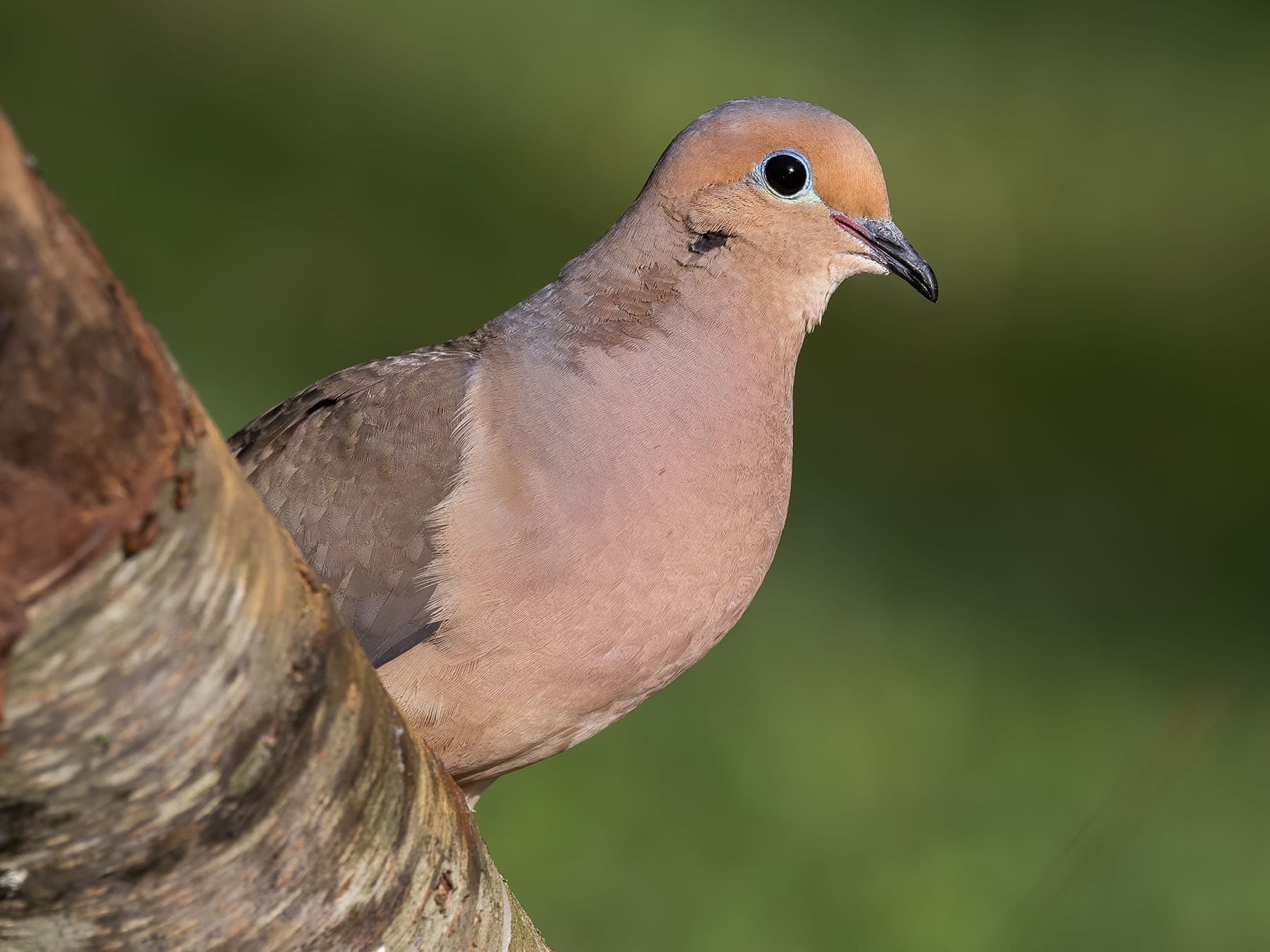
A Mourning Dove is a slender, medium-sized dove, 9.1 to 13.4 inches (23-34 cm) long and 3 to 6 ounces (86-170 g),1 smaller and slimmer than a city pigeon. It has a small, round head, short legs, a thin dark bill and a long, tapering tail.
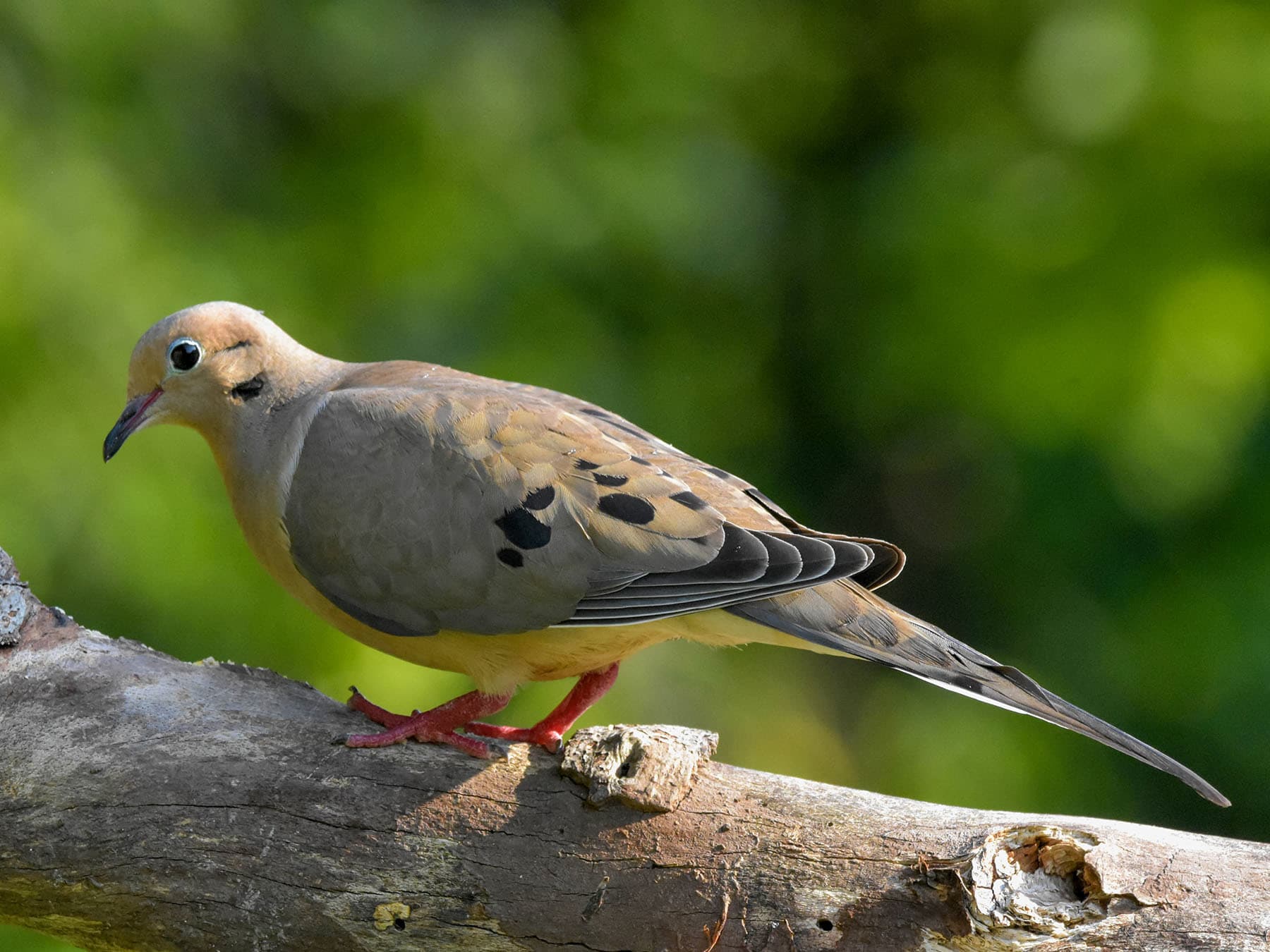
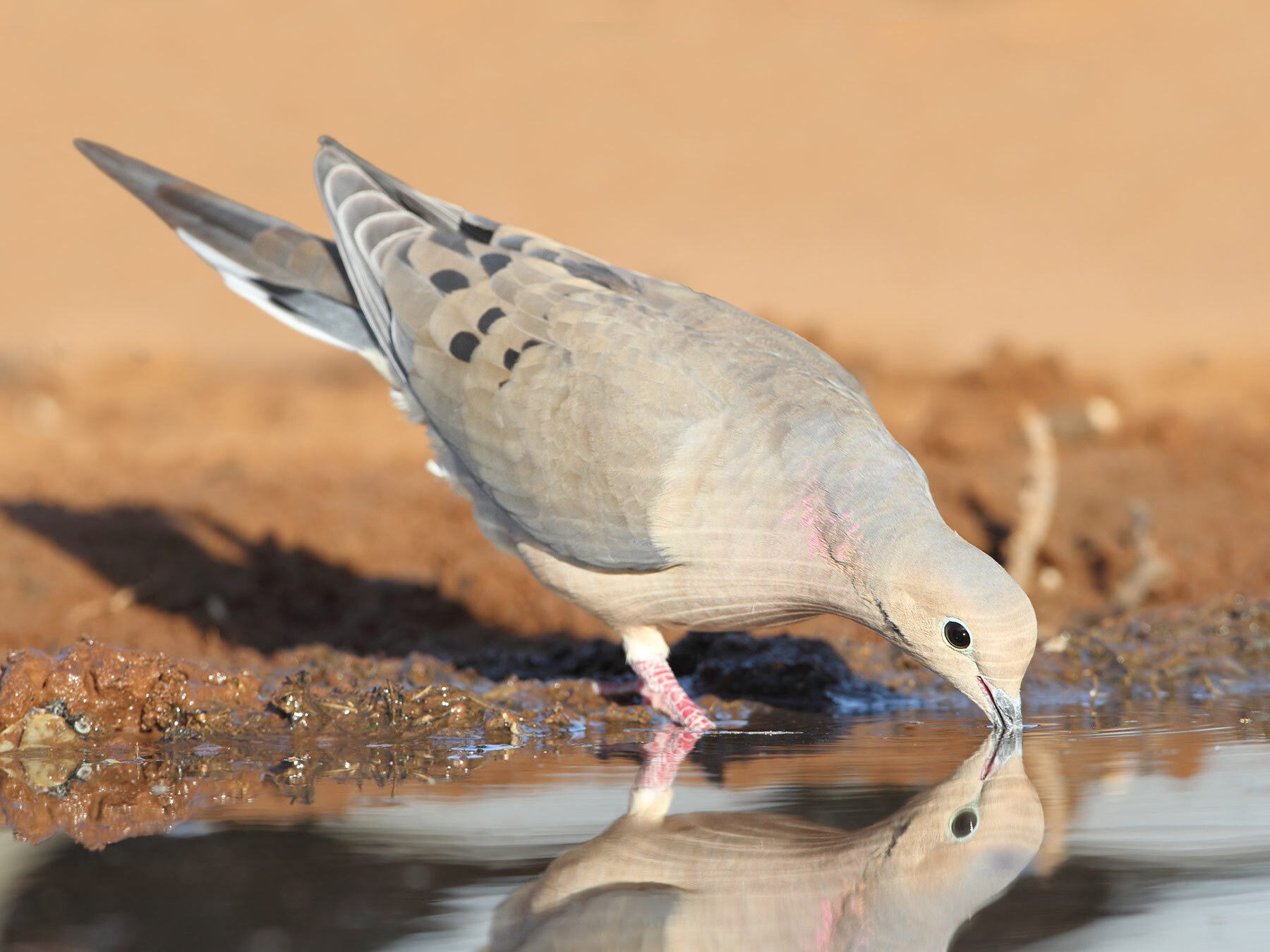
From a distance it looks plain soft brown. Closer, it is grayish brown to buffy tan above and peach-colored below, with a scatter of black spots on the folded wing and a small black mark below and behind the eye. The eye is dark, set in a ring of bare bluish skin (greener in females), and the legs are pinkish red. In flight the long, pointed tail opens into a fan with black bars and white tips on the outer feathers, and the wings make a whistling sound as the bird takes off.2
That tail is the giveaway. All About Birds calls the long, pointed tail unique among North American doves.
Male, female and young
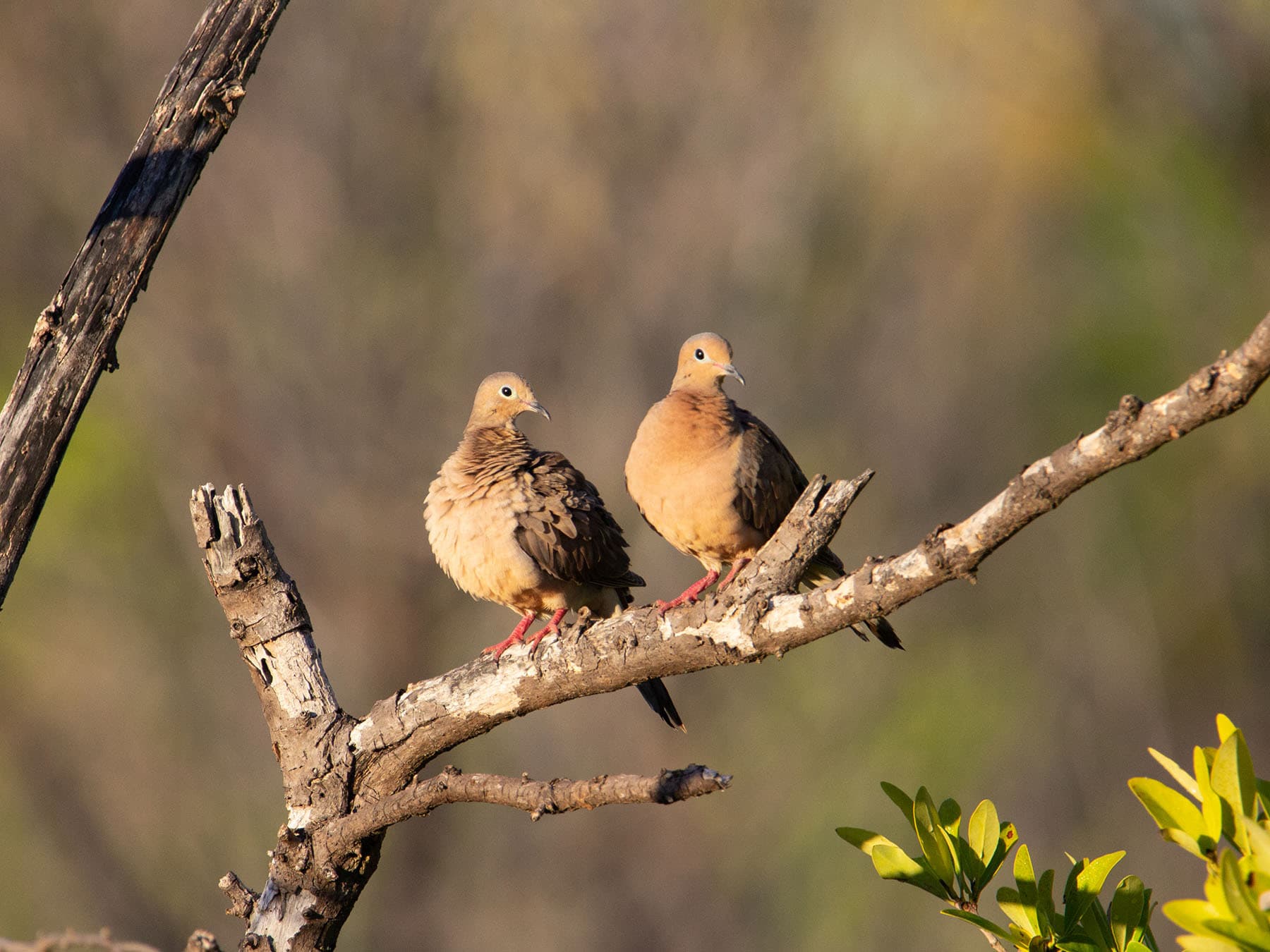
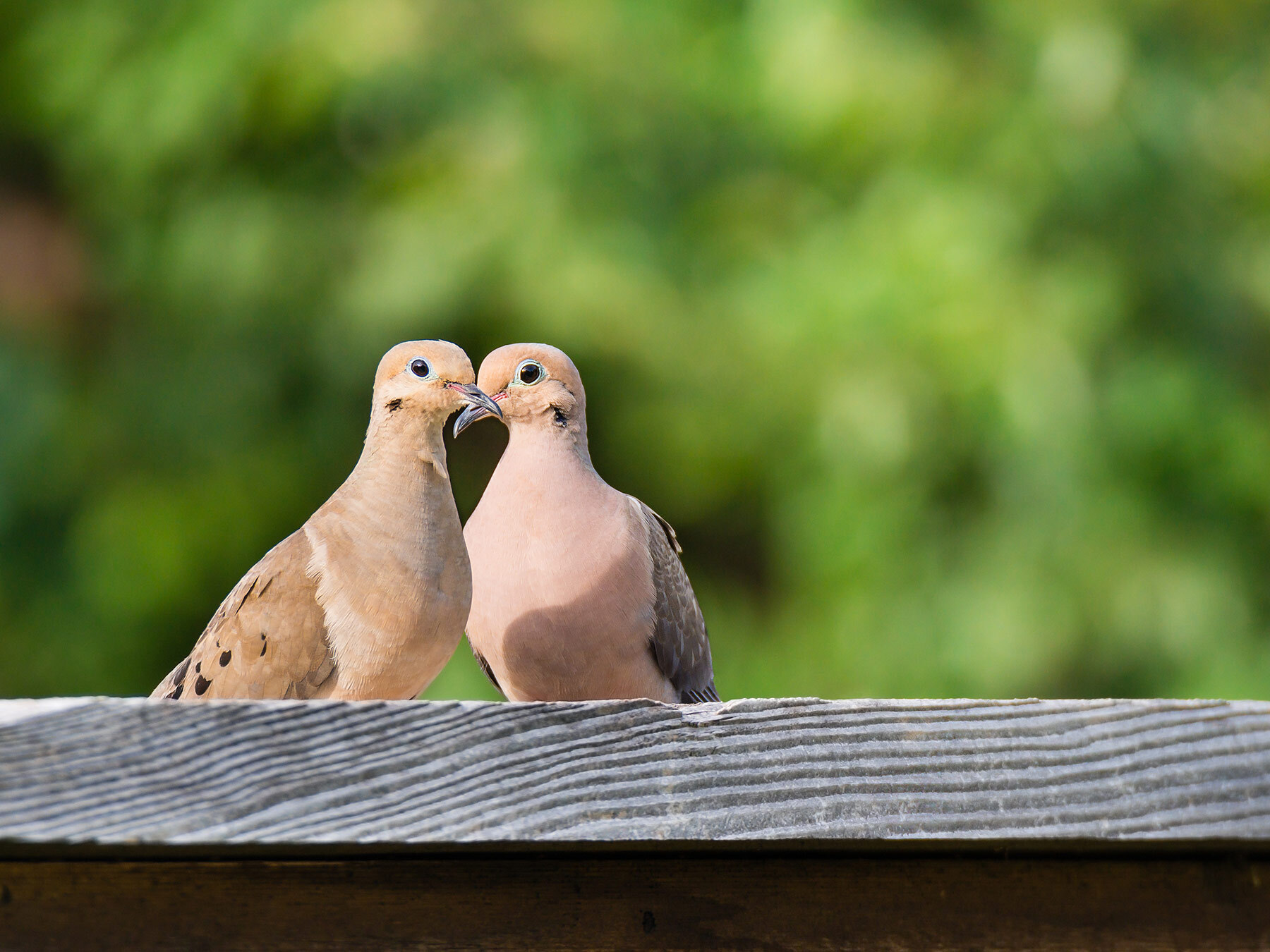
Males and females look much alike. A male is a little brighter, with a bluish-gray crown and nape, a rosy breast and pink iridescence on the side of the neck; a female is browner on the head, tan on the breast, and her neck gloss is usually greenish. The difference is subtle, and Birds of the World warns that sexing doves on plumage alone can easily go wrong.2 Males also look drabber in fall, when new feathers have olive tips that wear off by spring.
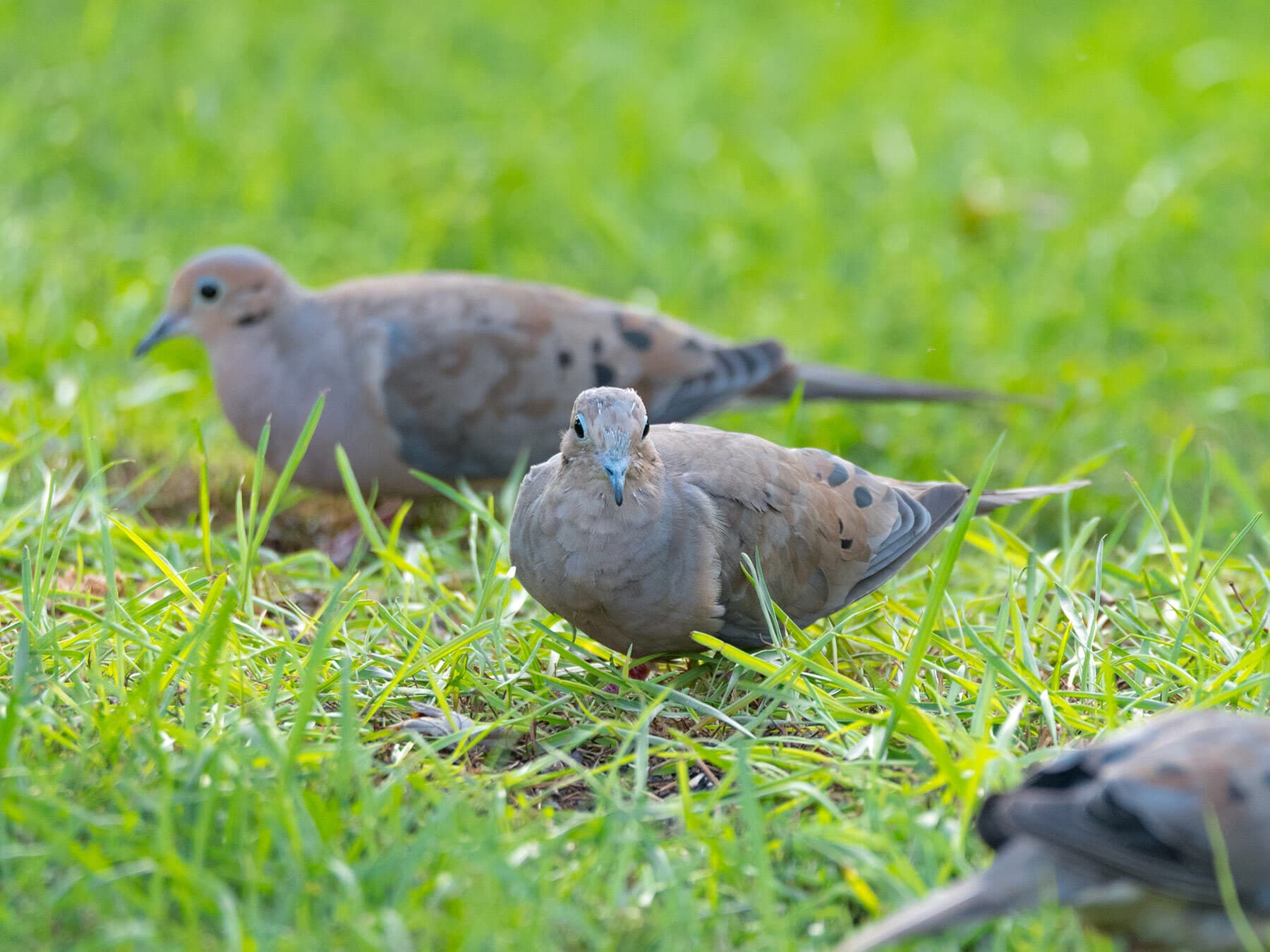
Young doves are easier. A juvenile has pale buff or whitish edges to the feathers of its breast, back and wings, which give it a scaly look, white marks on the face, and no black spot below the eye. Scaly young are sometimes taken for an Inca Dove or a Common Ground Dove.3 They look like adults after a molt that starts at about a month old and takes three to four months. More on the young: baby Mourning Doves. How to tell the sexes apart, and how often plumage misleads: male vs female Mourning Doves.
Identification: similar birds
Eurasian Collared-Dove. The introduced dove, now found across much of the US, is paler and heavier, with a black half-collar on the back of its neck and a blunt, square-ended tail. Mourning Doves have no collar and a pointed tail.4 Side by side: Collared-Dove or Mourning Dove?
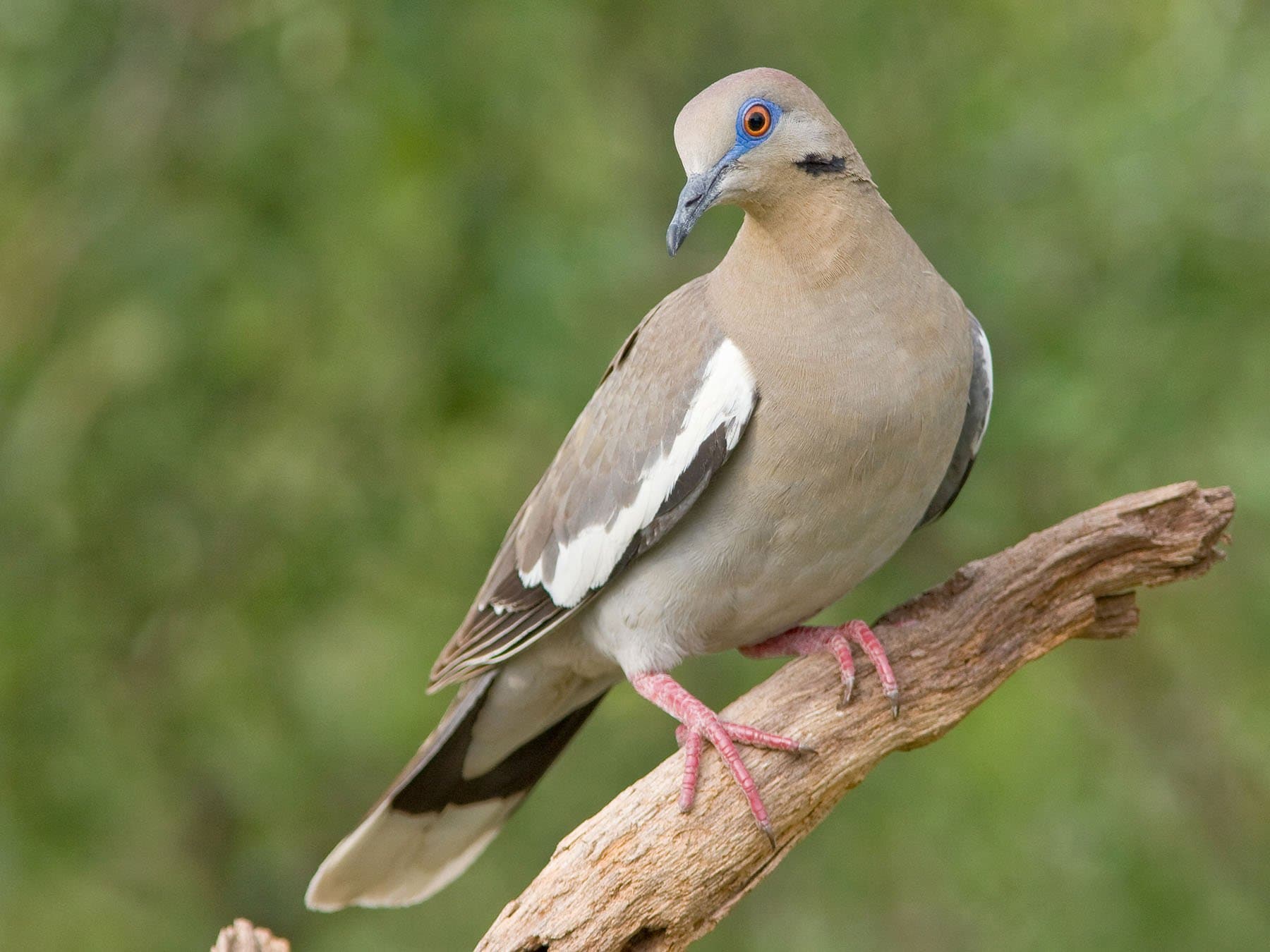
White-winged Dove. A bulkier dove of the South and Southwest, spreading north, with a shorter, rounded tail and big white wing patches that show best in flight.5
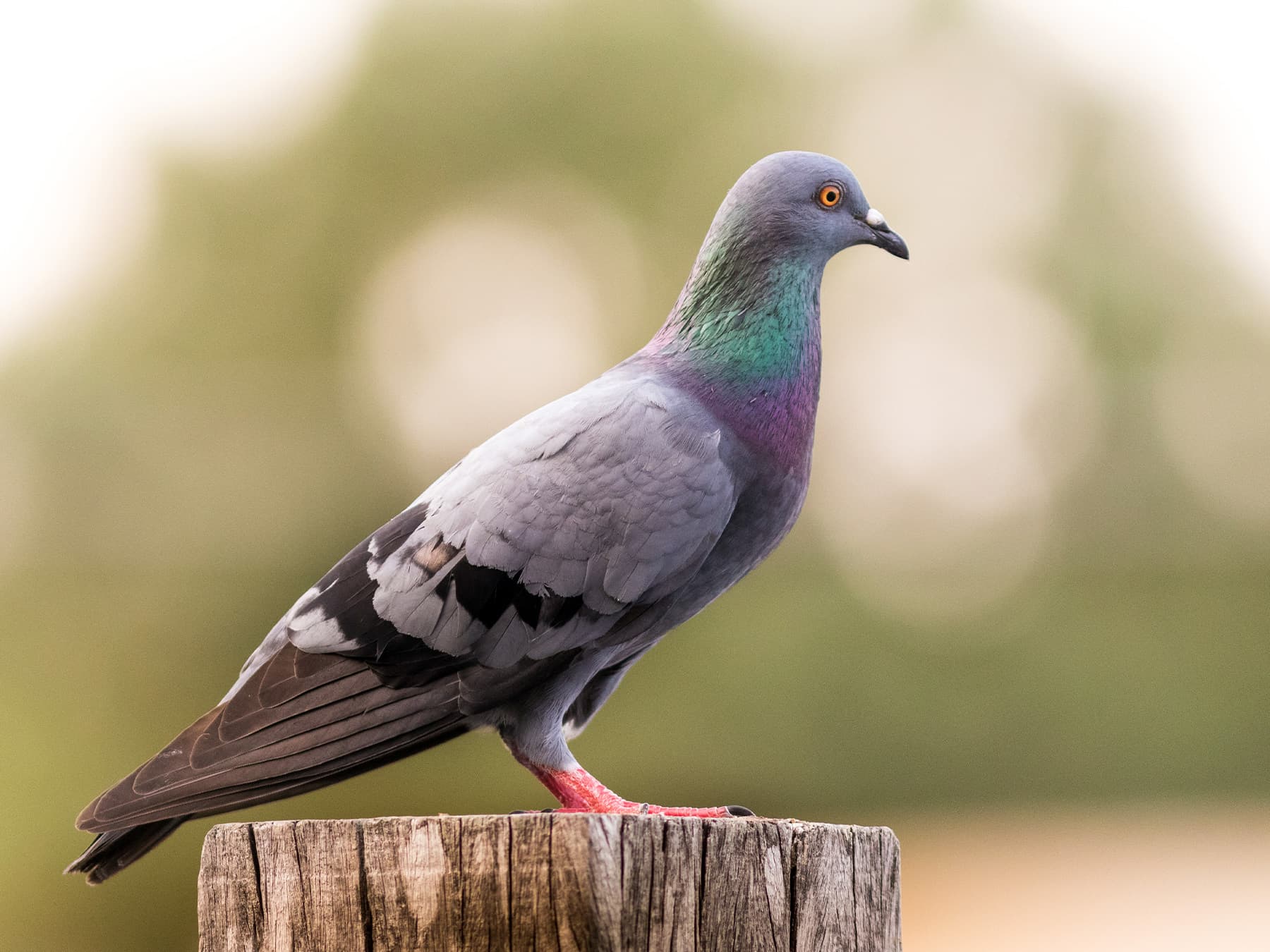
Rock Pigeon. The city pigeon is bigger and stockier with a shorter, square tail, and the wild type is pale gray with two black bars across the wing.
Inca Dove and Common Ground Dove. Audubon's guide notes that scaly young Mourning Doves are sometimes taken for these small doves.
Its size
Adults- Length
- 23–34 cm
- Wingspan
- 43–45 cm
- Weight
- 86–170 g
Its song and calls
The song is the sound that gave the bird its name: a low, mournful two-part coo followed by two or three louder coos, written "coo-oo, OO, OO, OO". It is called the perch coo, and it comes mostly from unmated males in the breeding season, often from a wire or treetop, seemingly to attract a mate. Females sometimes give a faint version. Cooing builds through spring, peaks from mid-May to mid-June in much of the range, and is most frequent from about half an hour before sunrise to an hour and a half after.2
A paired male has a shorter nest call, three distinct notes, low-high-low, which he uses to call his mate to a possible nest site. Mourning Doves also have a soft greeting "ork" and an alarm call. Not every sound is a voice: the wings whistle in flight, loudest at take-off and landing, and a displaying male claps his wings as he leaves his perch.
Hear the song and the wing whistle, see the song drawn as a spectrogram, and tell the coo from an owl: Mourning Dove sounds. Their song is easy to compare with the Collared-Dove's three-note coo: Collared-Dove call.
- Song0:00 / 0:30
Recorded in Minnesota, United States · March 2013
When and where to see it
OctoberLeaving
Most recorded in October
- 1. Arizona2.8%
- 2. Alabama2.5%
- 3. District of Columbia2.5%
- 4. Kentucky2.5%
- 5. Missouri2.4%
Each dot is a county, state or province: the bigger and darker, the larger the bird’s share of that place’s bird records that month. Grey dots: no regular records. The ringed point is the centre of the bird’s records this month; the arrow shows how it moved since last month, and the dashed loop its path through the year. “Arrivals” colours places where it becomes regular this month (orange) or is in its last regular month (grey). GBIF eBird Observation Dataset, 2019–2024. Map data: Natural Earth, US Census Bureau; place centres © OpenStreetMap contributors.
In your area
See when the Mourning Dove is recorded in your county, state or province.
How often the Mourning Dove turns up in the United States and Canada through the year, from birdwatchers' records.
United States
Resident · all year · most records in August
Canada
Resident · all year · most records in February
Show as a table
| Month | United States | Canada |
|---|---|---|
| January | 2.0% (regular) | 2.2% (regular) |
| February | 2.4% (regular) | 2.3% (regular) |
| March | 2.5% (regular) | 2.1% (regular) |
| April | 2.3% (regular) | 1.7% (regular) |
| May | 2.1% (regular) | 1.4% (regular) |
| June | 2.5% (regular) | 1.4% (regular) |
| July | 2.8% (regular) | 1.6% (regular) |
| August | 2.9% (regular) | 1.6% (regular) |
| September | 2.3% (regular) | 1.3% (regular) |
| October | 1.8% (regular) | 1.1% (regular) |
| November | 1.7% (regular) | 1.4% (regular) |
| December | 1.9% (regular) | 2.1% (regular) |
Worldwide: recorded regularly in 19 countries
Countries where it was recorded in at least 3 of the 6 years 2019–2024. Linked countries have their own bird list.
North America (19)
- Bahamas
- Belize
- Bermuda
- Canada
- Costa Rica
- Cuba
- Dominican Republic
- El Salvador
- Guatemala
- Haiti
- Honduras
- Jamaica
- Mexico
- Nicaragua
- Panama
- Puerto Rico
- St Pierre & Miquelon
- Turks & Caicos Islands
- United States
Data: EOD – eBird Observation Dataset (Cornell Lab of Ornithology), accessed via GBIF.org, CC BY 4.0. Records from 2019–2024, aggregated and filtered by Birdfact. How these lists are made
Mourning Doves breed across southern Canada, in every one of the lower 48 states, into Mexico, and locally in Central America and the Caribbean. They were introduced to Hawaii in the 1960s, and small populations now live on several of the islands.
They are birds of open country of almost every kind: farmland and grassland, open woodland and its edges, roadsides, towns, suburbs and backyards. They avoid only extensive forest and wetlands, and they have no aversion to nesting close to people. In much of the US you can see them in any month.
Spotting tips
Look along telephone wires and fences, and on patches of bare ground where doves gather to pick up seeds and grit. Listen at dawn in spring for the slow coo, and for the whistle of wings when a dove takes off.
Do they migrate?
Some do. Mourning Doves are partial migrants: most breeders on the northern edge of the range fly south for the winter, birds at middle latitudes partly so, and southern birds mostly stay put. In winter they are found through most of the breeding range except central Canada and the north-central US, and south through Mexico and Central America. Young birds tend to set off first, in late summer, and most migration is done by day, in flocks.2 More: Mourning Dove migration.
What it eats
Seeds, almost nothing else: about 99% of the diet. Where farmers grow them, doves take waste grain and crop seeds such as corn, wheat, sorghum, millet and sunflower; elsewhere, seeds of weedy plants of open ground, from foxtail grasses and crotons to ragweed and pigweed. Animal food is incidental, mainly snails, and they swallow grit, which may also supply calcium.
They feed almost entirely on the ground, in the open, without scratching, and eat fast: a dove fills its crop, a pouch in the throat, then flies off to digest at a safe perch. The record from one crop is 17,200 bluegrass seeds. A dove eats about 16% of its body weight a day, and it drinks by suction, without lifting its head to swallow.2 More: what Mourning Doves eat.
Feeding them in your yard
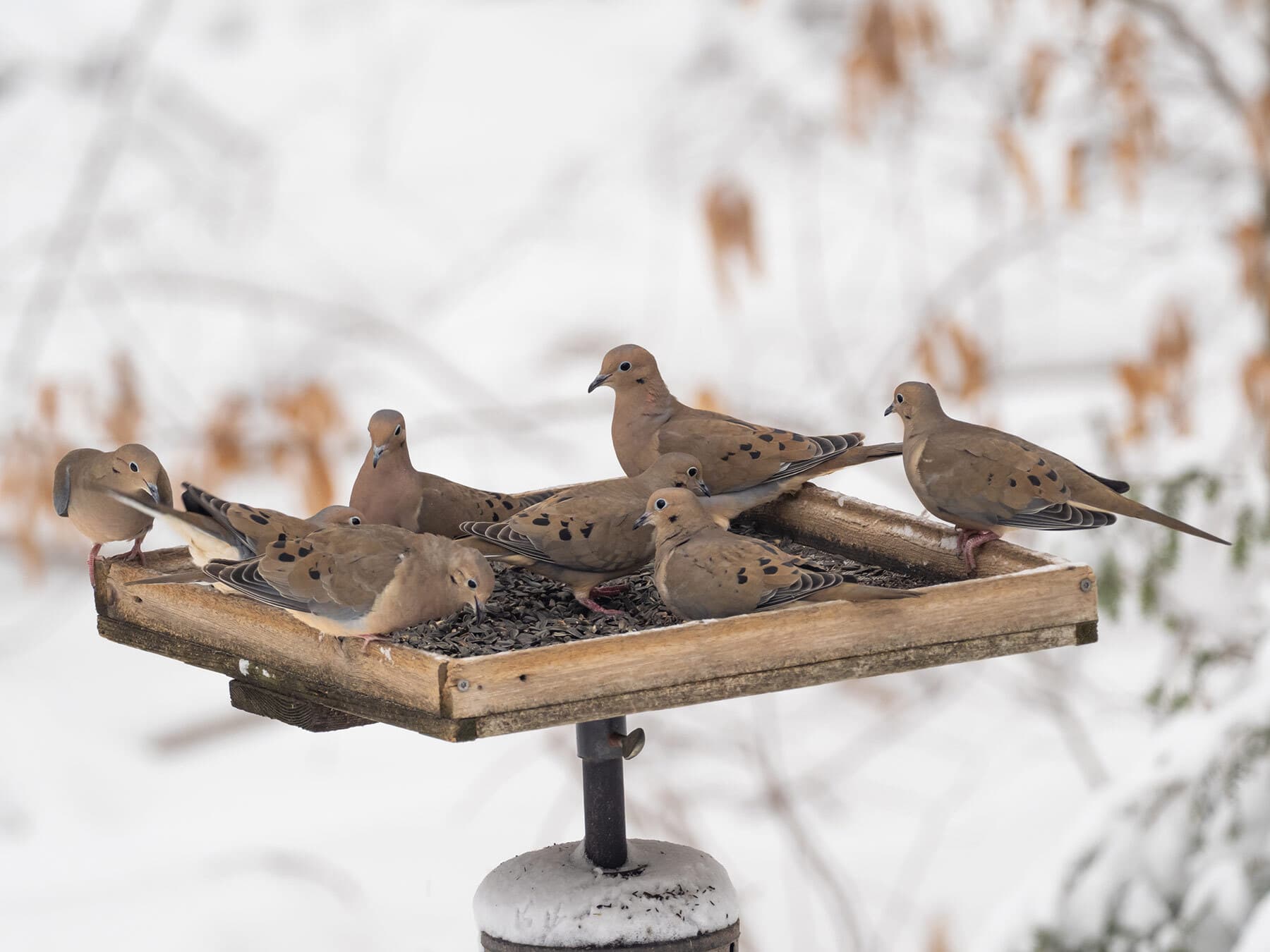
All About Birds suggests putting out seed, especially millet, either on the ground or on a platform feeder. Project FeederWatch also lists cracked corn, black-oil and hulled sunflower, safflower, milo, nyjer, oats and peanut hearts, at ground, large hopper and platform feeders.6 Keep cats indoors: birds that feed on the ground are especially at risk.
Keep feeders and baths clean. Doves and pigeons can catch trichomonosis, caused by a parasite, which brings cheesy growths in the mouth and throat, and it spreads through shared food and water. The Pennsylvania Game Commission advises changing food and water daily, discouraging large crowds at feeders and baths, and disinfecting them with one part bleach to nine parts water.7
Nesting and breeding
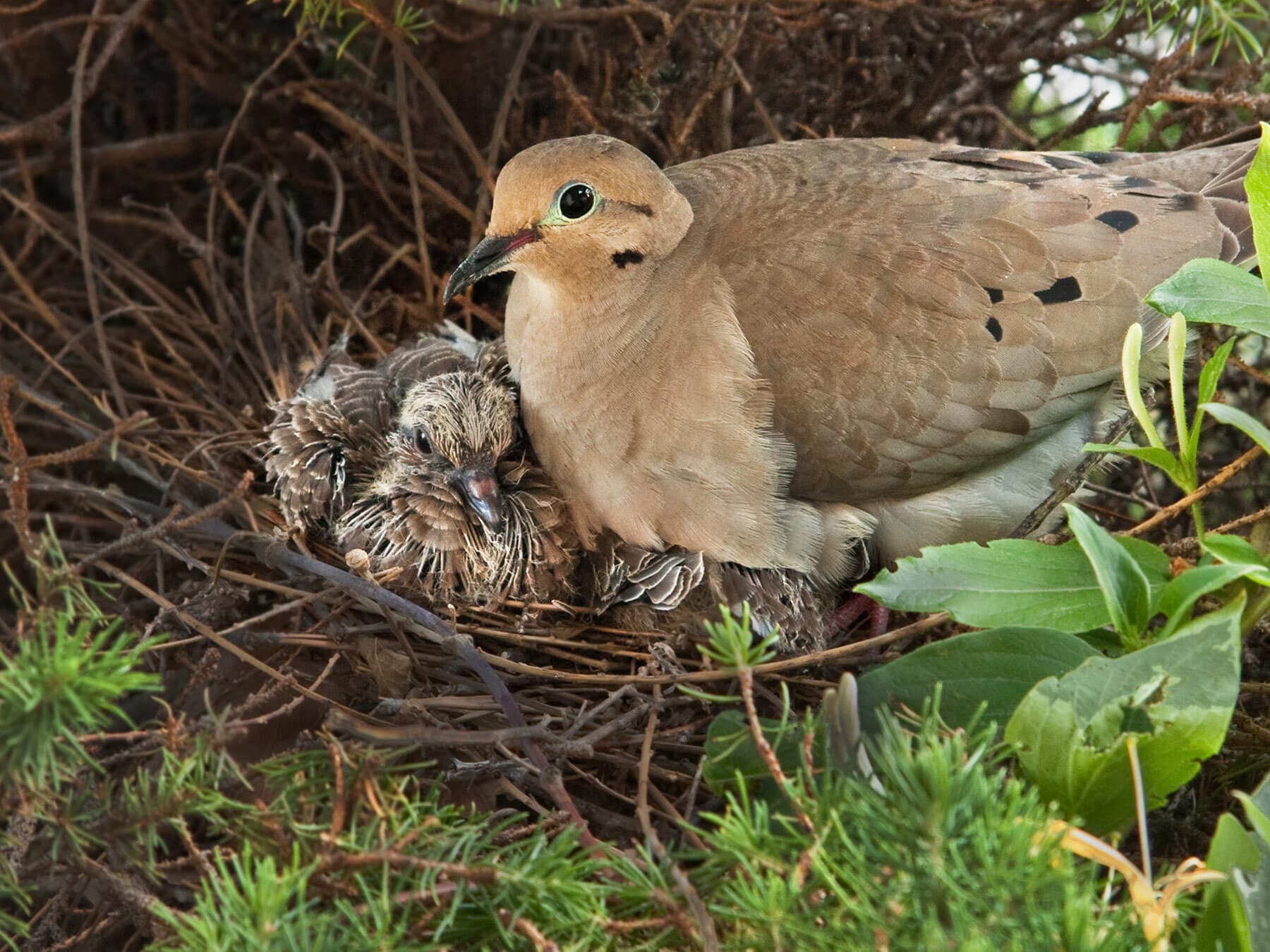
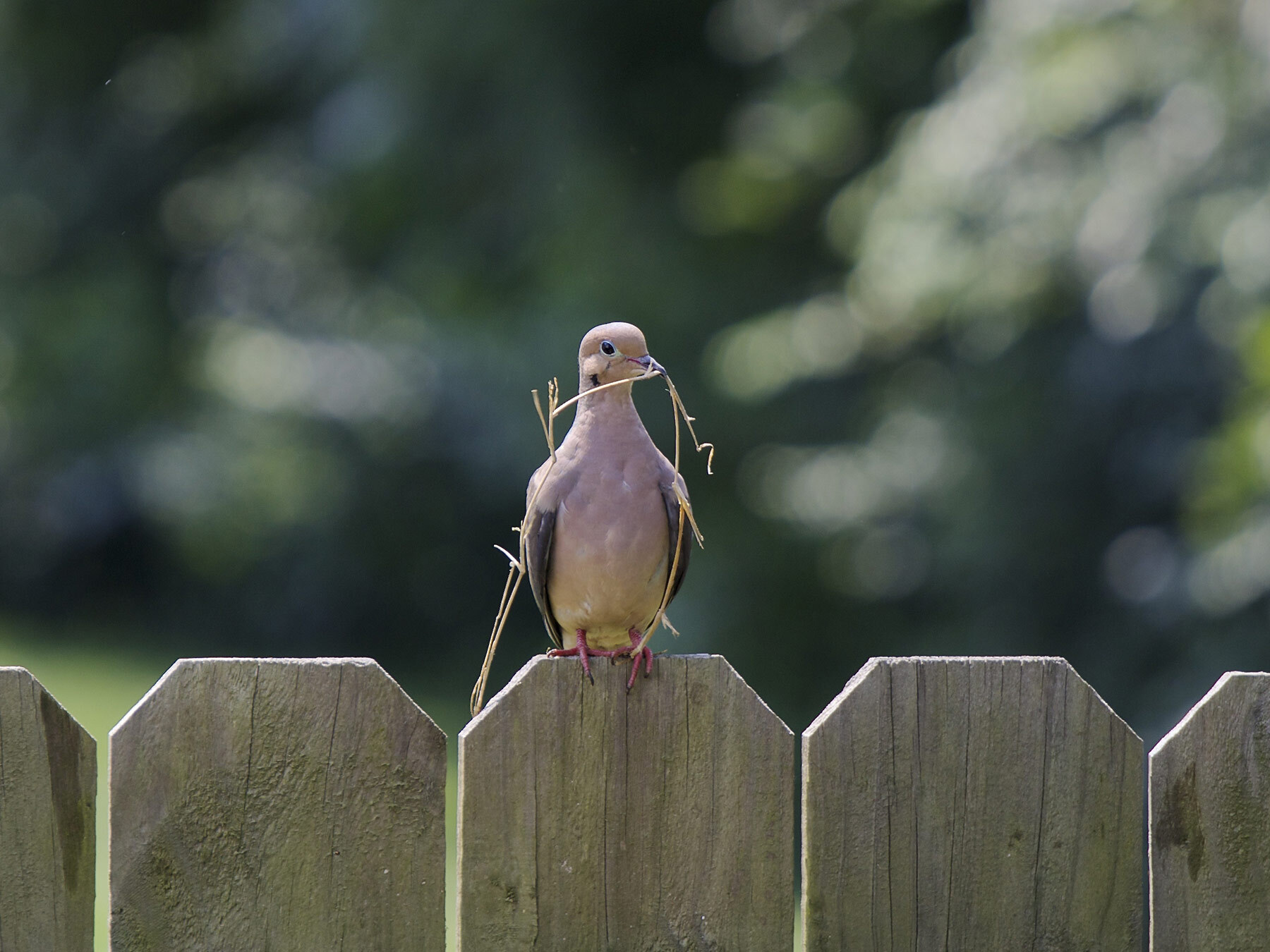
Mourning Doves nest in trees, shrubs and vines, on buildings and in gutters and hanging flower pots, and readily on the ground where trees are scarce. The male brings twigs and passes each one down to his mate from a perch on her back, and she arranges them into a flimsy platform about 8 inches (20 cm) across, sometimes on top of an old nest.
The clutch is normally two white eggs. Both parents incubate for 14 days, the male from mid-morning to late afternoon and the female the rest of the day and night, and both feed the chicks crop milk, a rich secretion from the lining of the crop. The young leave the nest at about two weeks old, and the male feeds them for about 12 days more while the female lays again. Pairs can start a new nest every 30 days or so, two to seven times a year. In the South nesting starts in late February or early March, and nests have been found in every month.2 More: nests and eggs and baby doves.
Nest cones
Mourning Doves do not use nest boxes. If you want to give a pair a firmer base, NestWatch suggests a wire-mesh nest cone, wired into a horizontal fork of a live tree in shade, 6 to 10 feet up.8 Put it up well before spring.
Behaviour
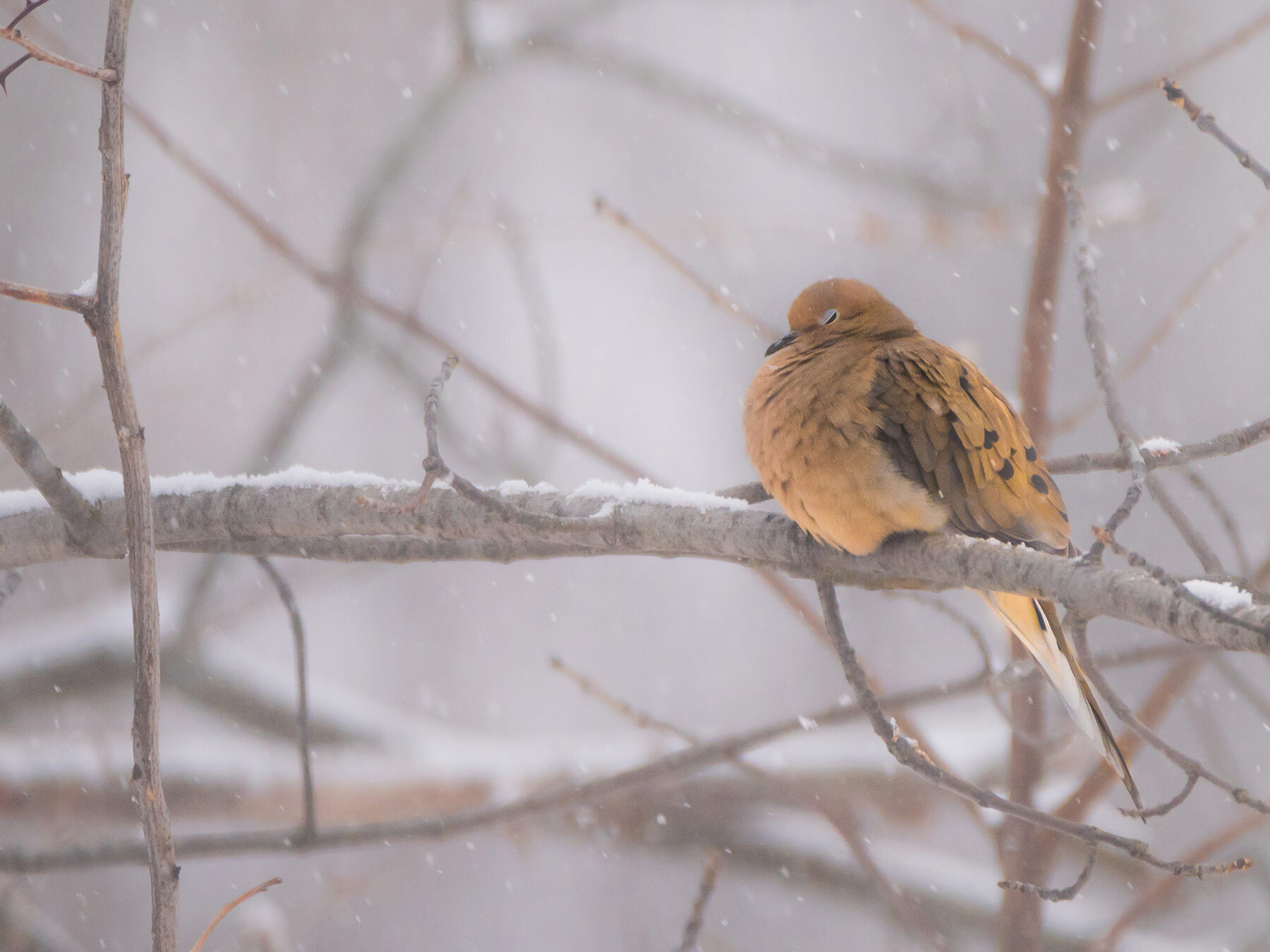
Mourning Doves fly fast and straight, with sudden climbs, drops and dodges; on the ground they walk rather than hop and flick the tail up after landing. They forage in pairs when nesting and in flocks, sometimes of thousands, from late summer through winter, and roost at night in dense trees, heads drawn in.
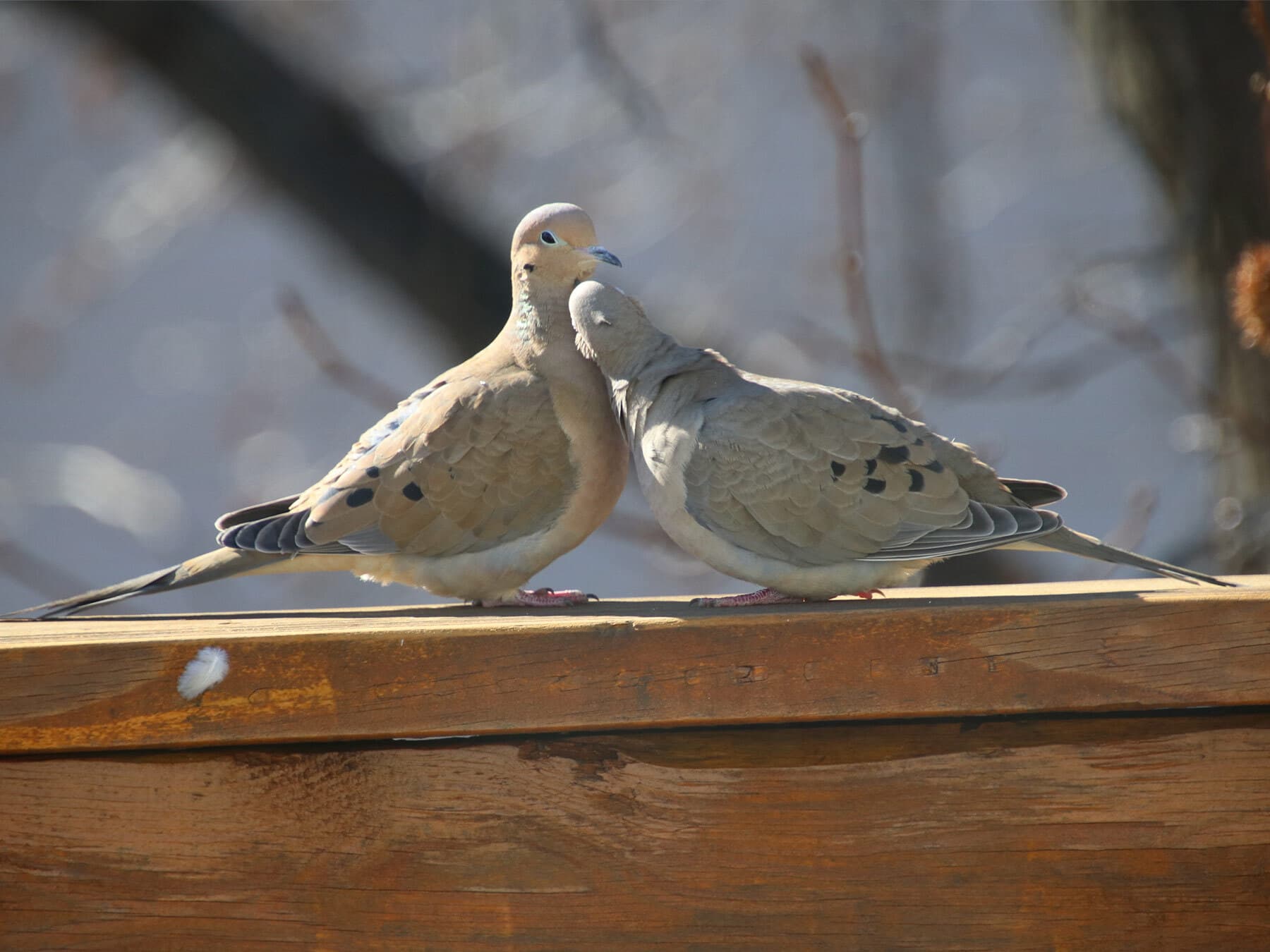
In spring an unmated male advertises with a display flight: he leaves his cooing perch with loud wing claps, climbs 100 feet (30 m) or more, then glides down in a long spiral on wings held below his body. In the breeding season you may also see three doves chasing in a tight line, usually two males and a female, often an unmated male chasing a pair. Mates preen each other's heads and necks with gentle nibbles and "bill" before mating.
Lifespan and predators
Mourning Doves are short-lived: Birds of the World puts an average adult's expected life at only about a year. In the US Fish and Wildlife Service's population model, built on banding, each year about 40 to 49% of adults and 28 to 31% of young birds survive.9
A few live much longer. The oldest on the US Bird Banding Laboratory's list was a male at least 30 years 4 months old, banded in Georgia in June 1968 and shot in Florida in October 1998. The next was 27 years 3 months, from California.10
Predators and disease
Birds of prey, mammals and snakes all take Mourning Doves, though there are few numbers on which matter most. Falcons and the bird-hunting accipiters are probably the most effective birds of prey; raccoons, cats and dogs the likeliest mammals; and rat snakes are a main nest predator;2 in an Iowa study Blue Jays, fox squirrels and cats took the most eggs and chicks. Nests and young are also often lost in high winds and heavy rain.
Probably the most important disease is trichomonosis, caused by a parasite, which has killed tens of thousands of doves in outbreaks; it was the commonest diagnosis, at 40%, in necropsies of 135 doves from the southeastern US.11 Some doves feeding in fields planted for hunting also swallow spent lead shot.
Conservation
The Mourning Dove is of Least Concern. Partners in Flight estimates about 150 million breeding birds, 130 million of them in the US and Canada, and scores the species 7 out of 20 for continental concern, which is low.12 The North American Breeding Bird Survey shows a small long-term decline, about 0.2% a year from 1966 to 2025, with increases in Canada and the Northeast and declines in the West.13
Population and hunting
The Mourning Dove is protected under the Migratory Bird Treaty Act and managed as a migratory game bird: federal frameworks set the outer limits for seasons and bag limits, and states set their own within them. Birds of the World calls it the leading game bird in North America.2 The US Fish and Wildlife Service estimated about 329 million Mourning Doves in the US on September 1, 2025, counting that year's young, and hunters took about 15.5 million in the 2025-26 season, about 3 to 8% of the population a year.9 As of 2024-25, eight northern states, Michigan, New York, New Jersey and all of New England except Rhode Island, did not allow dove hunting.
Similar birds
Often mistaken for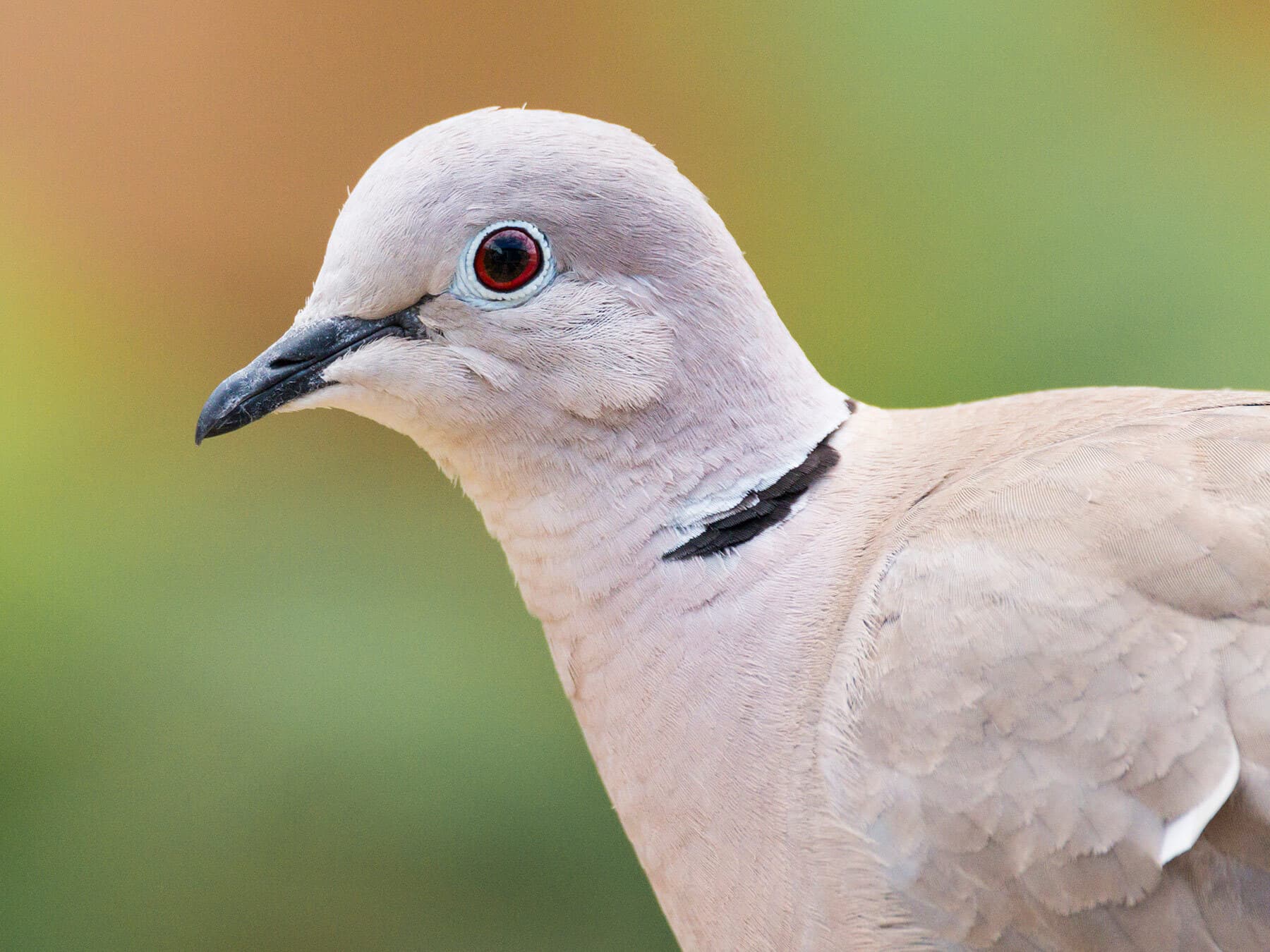
More photos
5 photos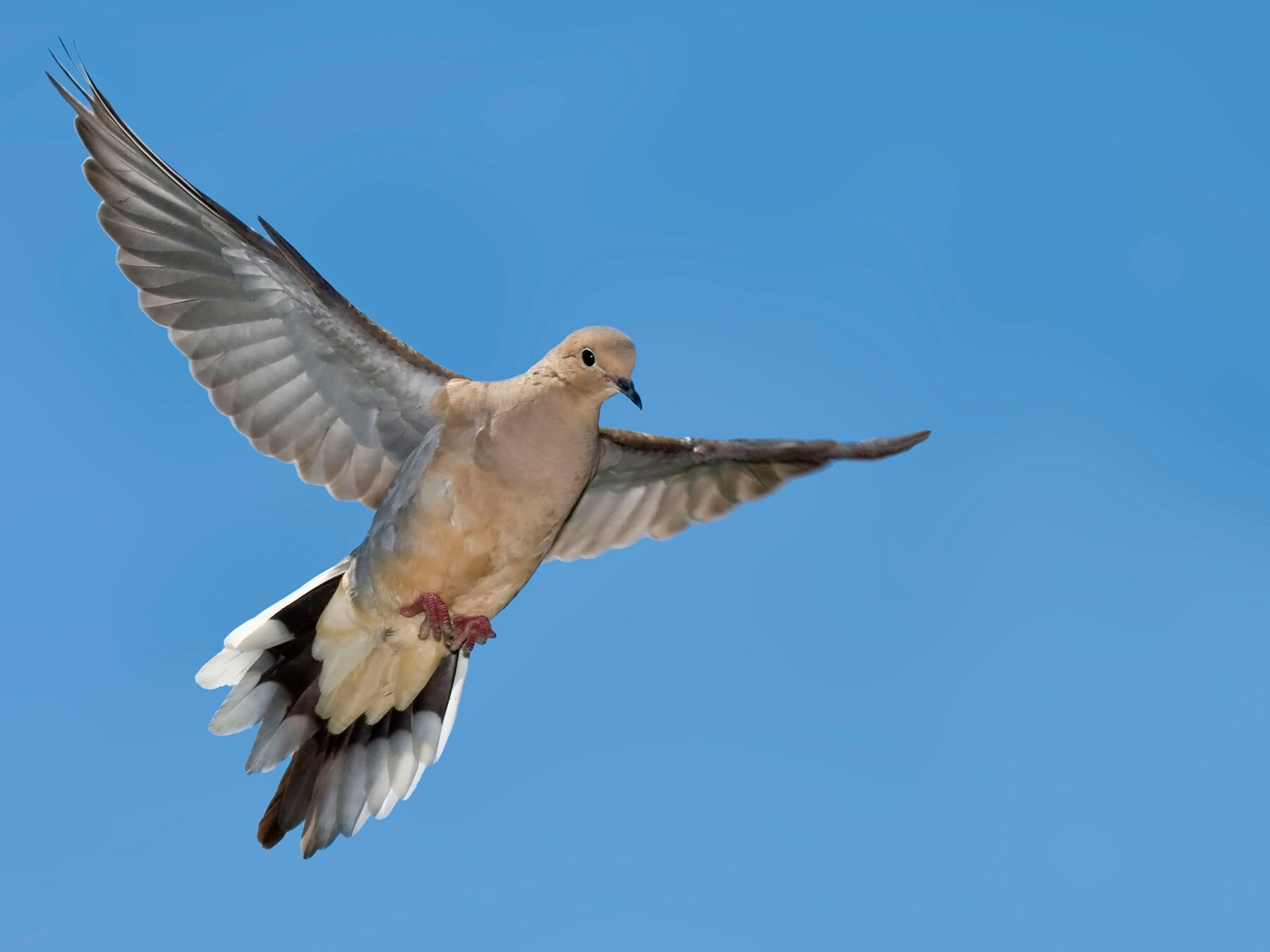
Mourning Dove guides
6 guides- Mourning Dove Meaning and Symbolism: The Name, Folklore and History
- Mourning Dove Sounds: Song, Calls and Wing Whistle
- What Do Mourning Doves Eat? Diet, Feeding and Feeders
- Male vs Female Mourning Doves: How to Tell Them Apart (and Juveniles)
- Mourning Dove Nesting: Nests, Eggs and How Often They Breed
- Baby Mourning Doves: Stages, Feeding and Fledglings (with Pictures)
Quick facts
- Length
- 23–34 cm
- Wingspan
- 43–45 cm
- Weight
- 86–170 g
- Lifespan
- oldest recorded 30 years 4 months
- Family
- Pigeons & Doves
- Migration
- Partial migrant
- Global status (IUCN)
- Least Concern
- World population
- About 150 million breeding birds (Partners in Flight)
- Population trend
- Breeding Bird Survey counts show a small long-term decline across the US and Canada, with increases in Canada and the Northeast and declines in the West (USGS BBS 1966-2025)
- Scientific name
- Zenaida macroura
Questions
4Do Mourning Doves mate for life?
Not necessarily. Birds of the World describes them as seasonally monogamous: a pair stays together through the nesting season and sometimes through winter, and there are some signs that birds may pair again the next year, but pairs can also change between nesting attempts. No source we read shows doves pairing for life. More: do Mourning Doves mate for life?
Why is it called a Mourning Dove?
For its song, a low, sad-sounding coo. The genus name, Zenaida, honors Zénaïde Bonaparte, wife of the naturalist Charles Lucien Bonaparte; macroura means "long-tailed". More on the name, the folklore and the symbolism: Mourning Dove meaning.14
Are Mourning Doves pigeons?
Yes, in the sense that pigeons and doves are one family, the Columbidae; the names mark no scientific divide. The Mourning Dove is a cousin of the city Rock Pigeon, smaller and slimmer with a long, pointed tail. More: pigeons and doves.
Are Mourning Doves endangered?
No. They are among the most abundant birds in North America and of Least Concern, though the Breeding Bird Survey shows a slow decline.
Sources
20- 1Cornell Lab of Ornithology. Mourning Dove. All About Birds. Accessed 12 October 2026. Source (opens in a new tab)
- 2Otis, D. L. et al. (2020). Mourning Dove (Zenaida macroura), version 1.0. Birds of the World (A. F. Poole, editor). Cornell Lab of Ornithology. doi:10.2173/bow.moudov.01 (opens in a new tab)
- 3National Audubon Society. Mourning Dove. Guide to North American Birds (text adapted from Kaufman 1996). Accessed 12 October 2026. Source (opens in a new tab)
- 4Project FeederWatch (Cornell Lab of Ornithology and Birds Canada). Tricky Bird ID: Common Doves. Project FeederWatch. Accessed 12 October 2026. Source (opens in a new tab)
- 5National Audubon Society. White-winged Dove. Guide to North American Birds (text adapted from Kaufman 1996). Accessed 12 October 2026. Source (opens in a new tab)
- 6Project FeederWatch (Cornell Lab of Ornithology and Birds Canada). Common Feeder Birds: Mourning Dove. Project FeederWatch. Accessed 12 October 2026. Source (opens in a new tab)
- 7Pennsylvania Game Commission. Trichomoniasis. Pennsylvania Game Commission, Wildlife Diseases. Accessed 12 October 2026. Source (opens in a new tab)
- 8NestWatch (Cornell Lab of Ornithology). Right Bird, Right House: Mourning Dove. NestWatch, All About Birdhouses. Accessed 12 October 2026. Source (opens in a new tab)
- 9Seamans, M. E. (2026). Mourning Dove Population Status, 2026. U.S. Fish and Wildlife Service, Division of Migratory Bird Management, Laurel, Maryland. Accessed 12 October 2026. Source (opens in a new tab)
- 10USGS Bird Banding Laboratory. Longevity records of North American birds. USGS Patuxent Wildlife Research Center, Bird Banding Laboratory. Accessed 12 October 2026. Source (opens in a new tab)
- 11Gerhold, R. W. et al. (2007). Necropsy findings and arbovirus surveillance in mourning doves from the southeastern United States. Journal of Wildlife Diseases 43(1): 129-135. doi:10.7589/0090-3558-43.1.129 (opens in a new tab)
- 12Partners in Flight (2024). Avian Conservation Assessment Database, version 2024 (and Population Estimates Database, version 2020). Bird Conservancy of the Rockies. Accessed 12 October 2026. Source (opens in a new tab)
- 13USGS Eastern Ecological Science Center (2026). North American Breeding Bird Survey: trend estimates 1966-2025. USGS. Accessed 12 October 2026. Source (opens in a new tab)
- 14Jobling, J. A.. The Key to Scientific Names: Zenaida; macroura. Birds of the World, Cornell Lab of Ornithology. Accessed 12 October 2026. Source (opens in a new tab)
- 15National Audubon Society. Rock Pigeon. Guide to North American Birds (text adapted from Kaufman 1996). Accessed 12 October 2026. Source (opens in a new tab)
- 16BirdLife International. Mourning Dove Zenaida macroura: species factsheet (IUCN Red List assessment 2024). BirdLife DataZone. Accessed 12 October 2026. Source (opens in a new tab)
- 17RSPB (2025). Doves vs Pigeons. What's the difference?. RSPB, Identifying birds. Accessed 12 October 2026. Source (opens in a new tab)
- 18Pyle, R. L. and Pyle, P. (2017). The Birds of the Hawaiian Islands: Occurrence, History, Distribution, and Status, version 2. B. P. Bishop Museum, Honolulu. Accessed 12 October 2026. Source (opens in a new tab)
- 19NestWatch (Cornell Lab of Ornithology). Mourning Dove. NestWatch focal species. Accessed 12 October 2026. Source (opens in a new tab)
- 20Project FeederWatch (Cornell Lab of Ornithology and Birds Canada). Sick Birds and Bird Diseases. Project FeederWatch. Accessed 12 October 2026. Source (opens in a new tab)

Checked by
Nathan Cope, founder and editor
Nathan founded Birdfact and leads its writers and contributors in the UK, the US and Canada. He has watched and studied birds for more than ten years, and checks every article and species guide before it’s published.