


Magpie
Eurasian Magpie · Pica pica
By the Birdfact teamChecked by Nathan Cope
On this page15 sections
How to recognise it
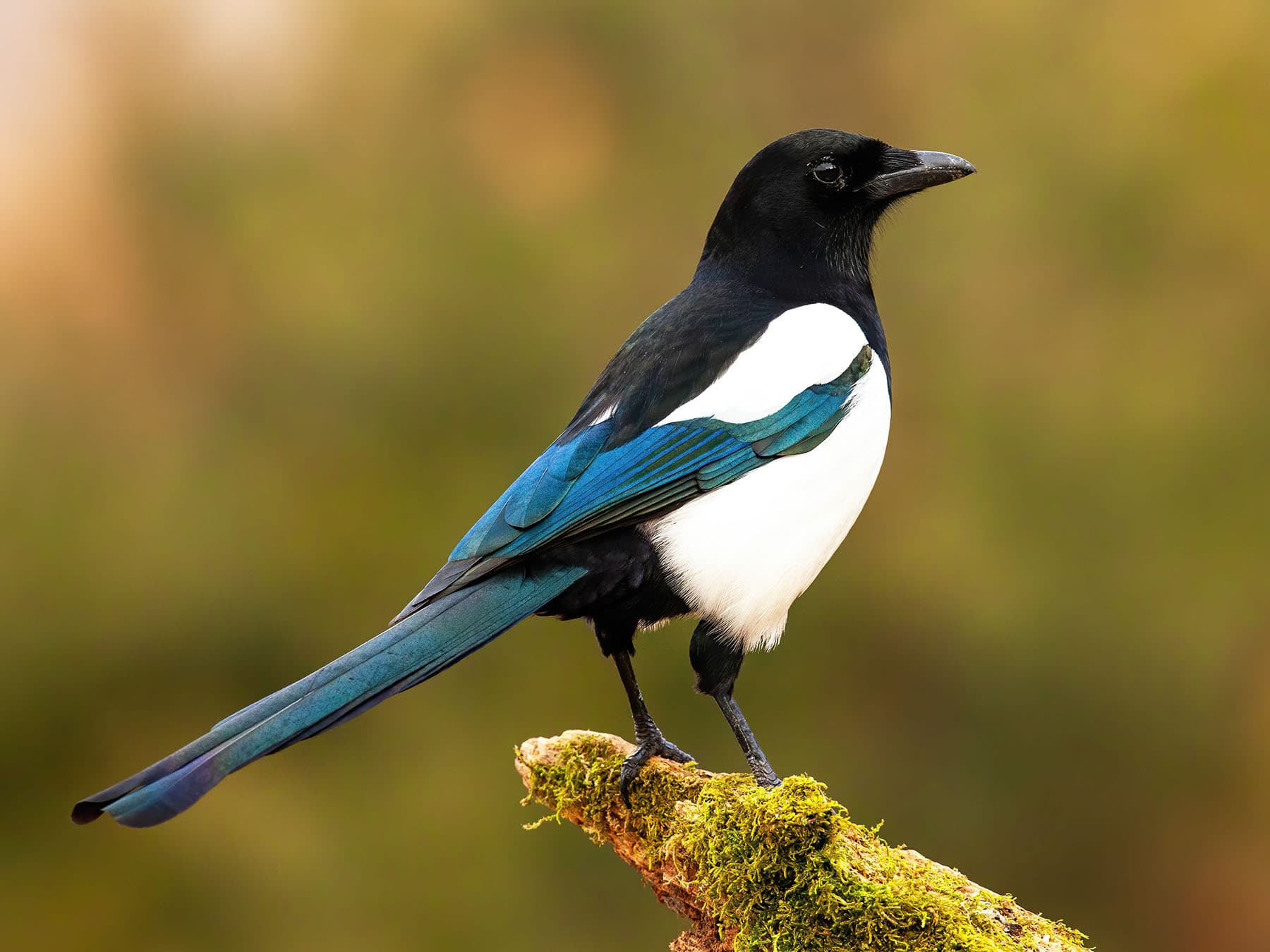
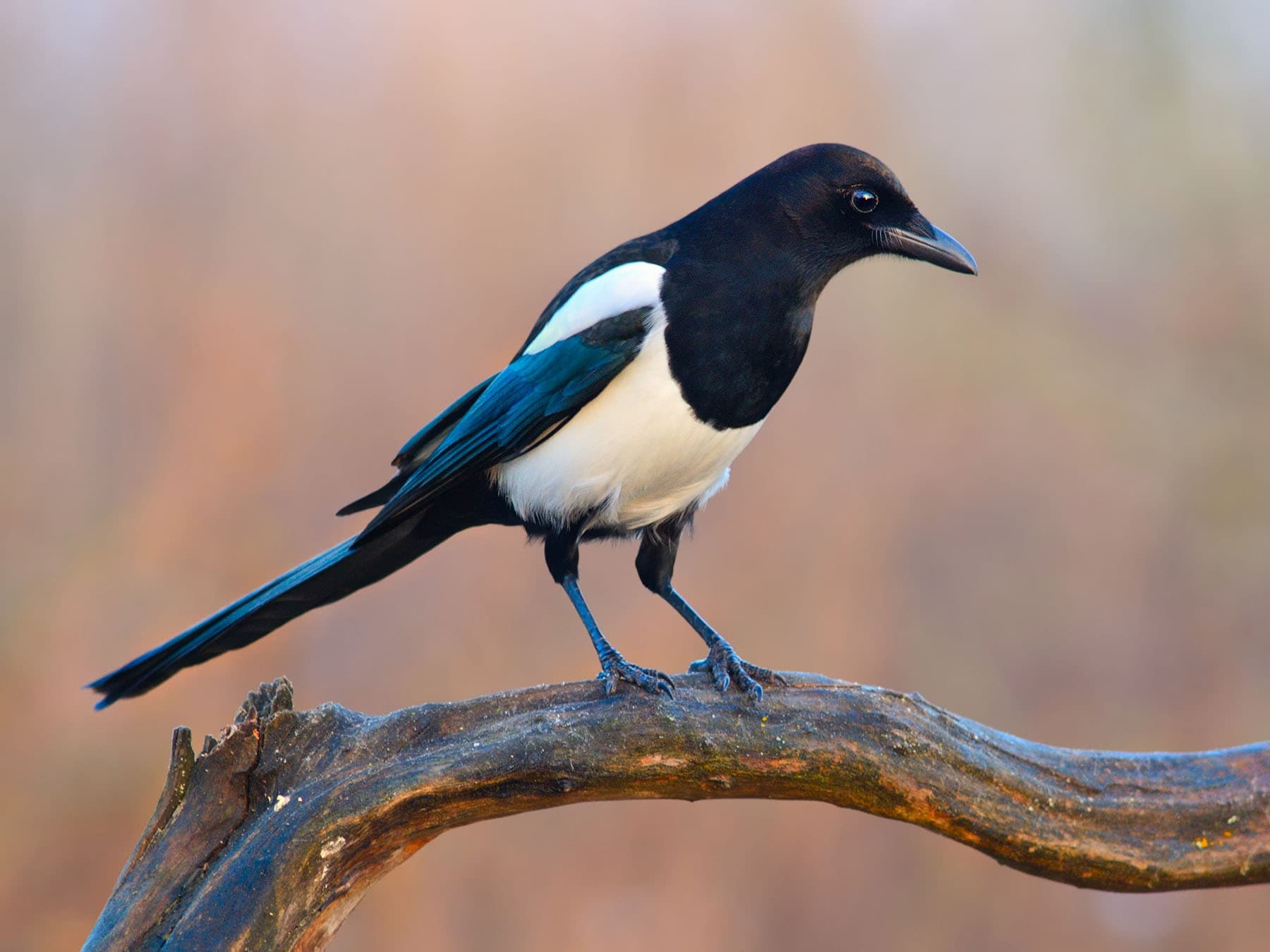
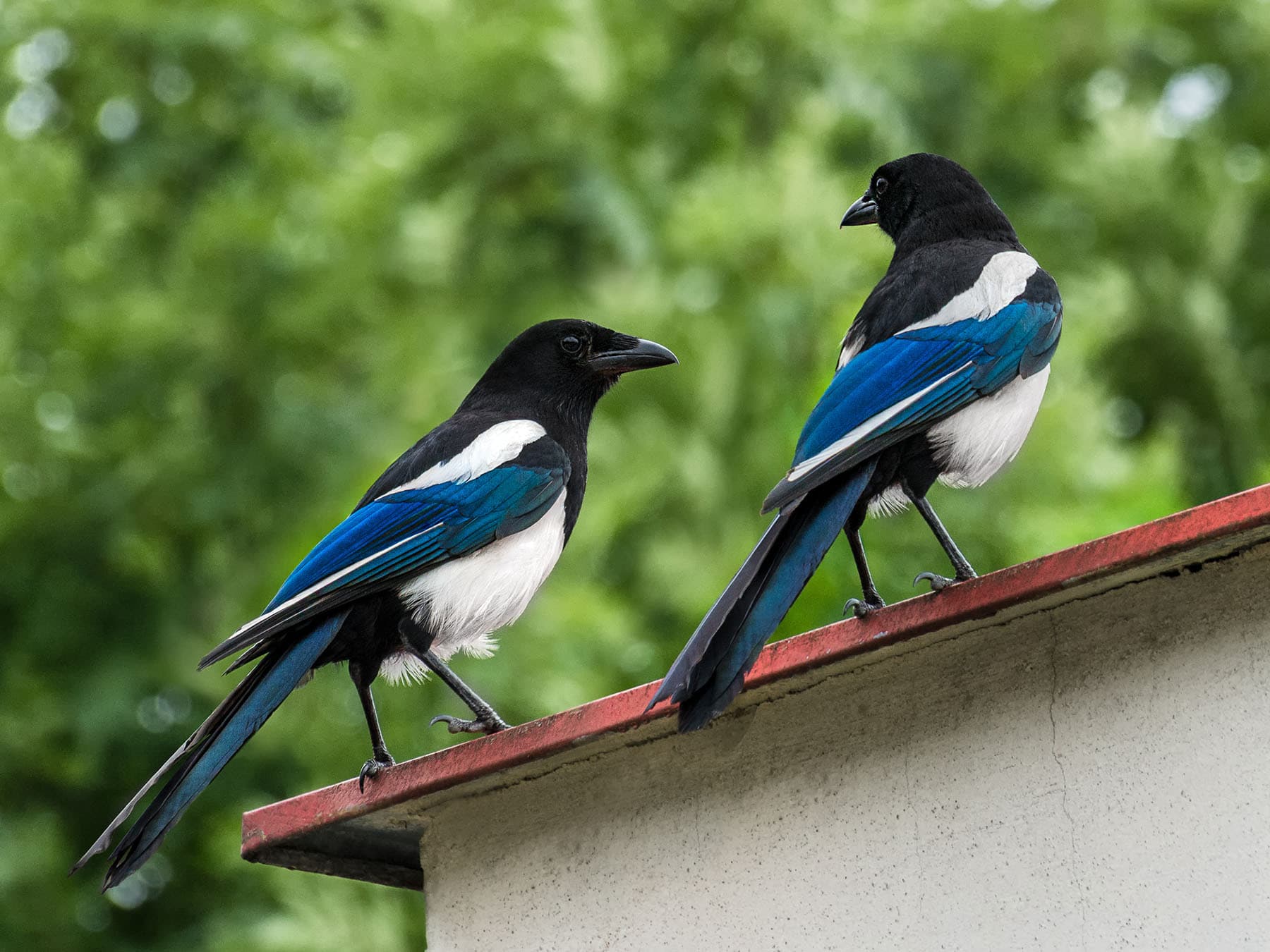
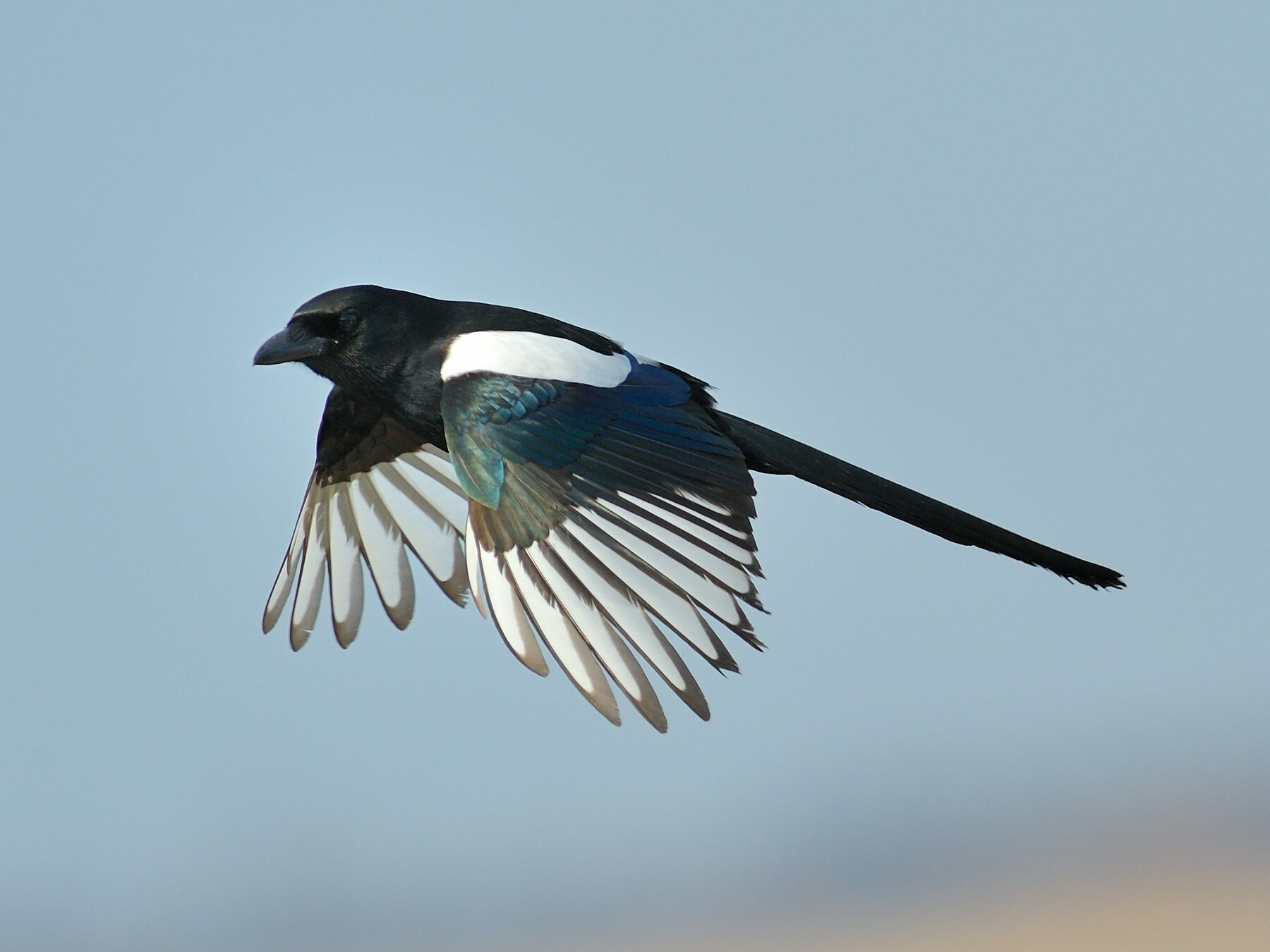
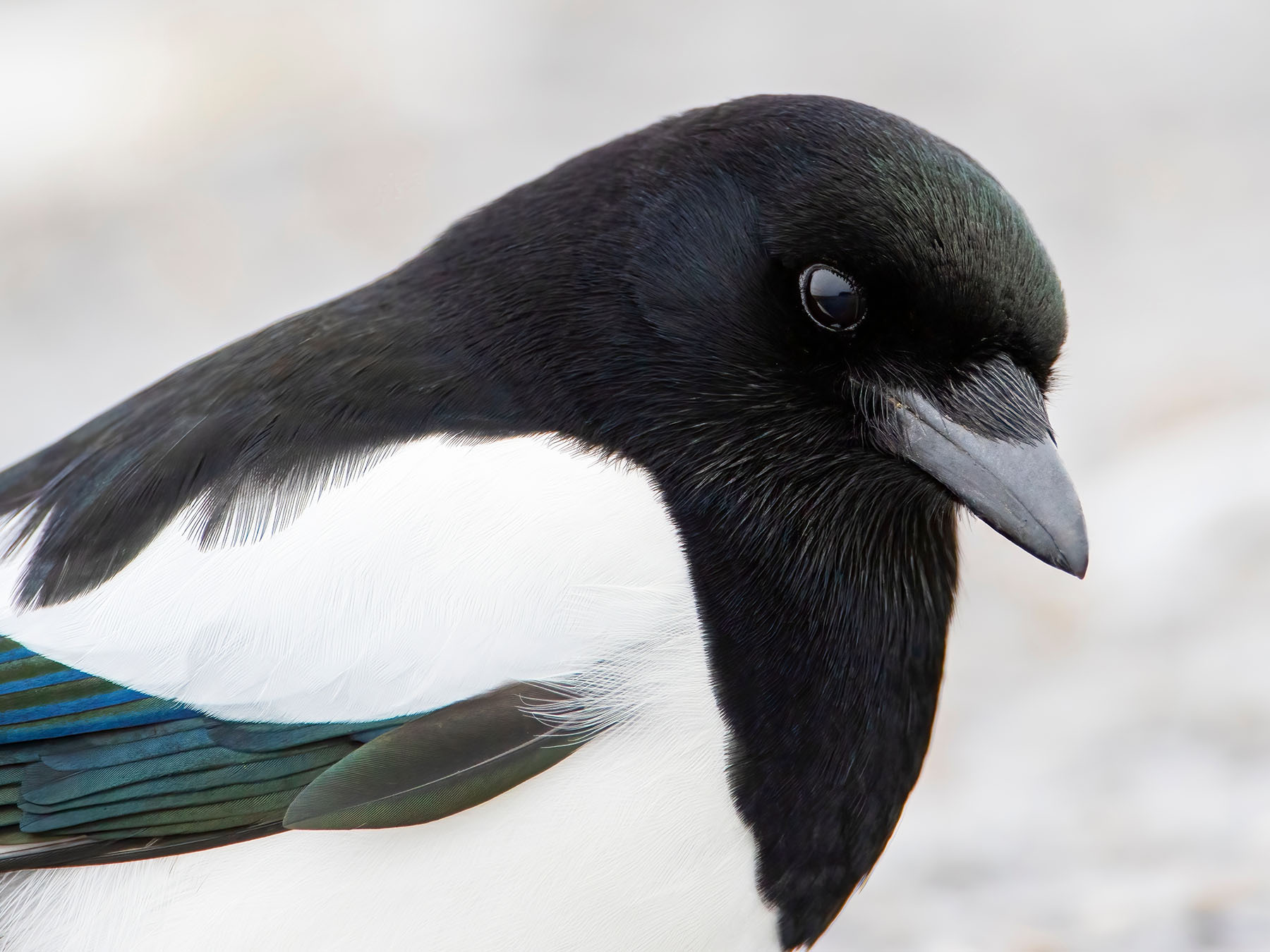
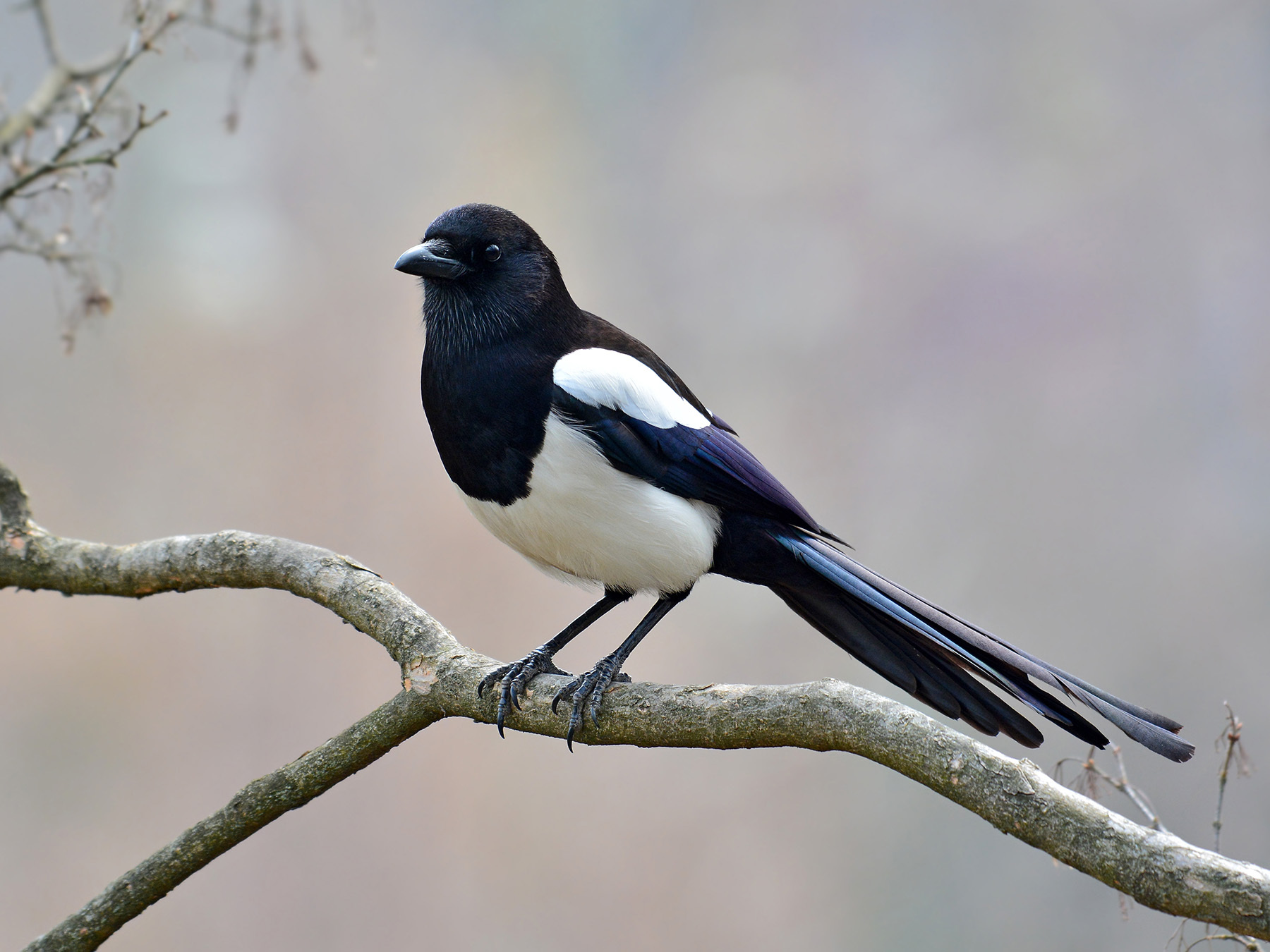
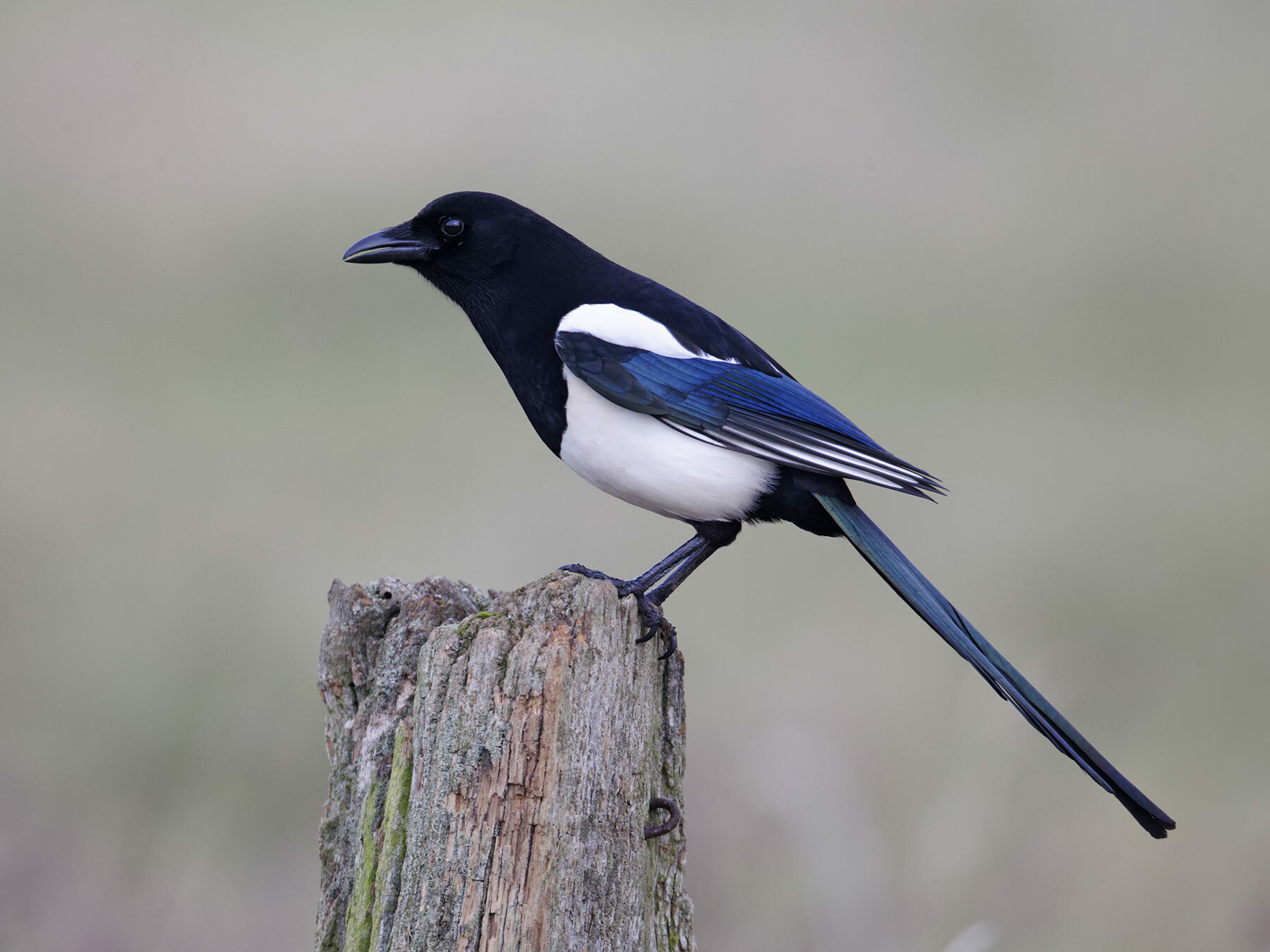
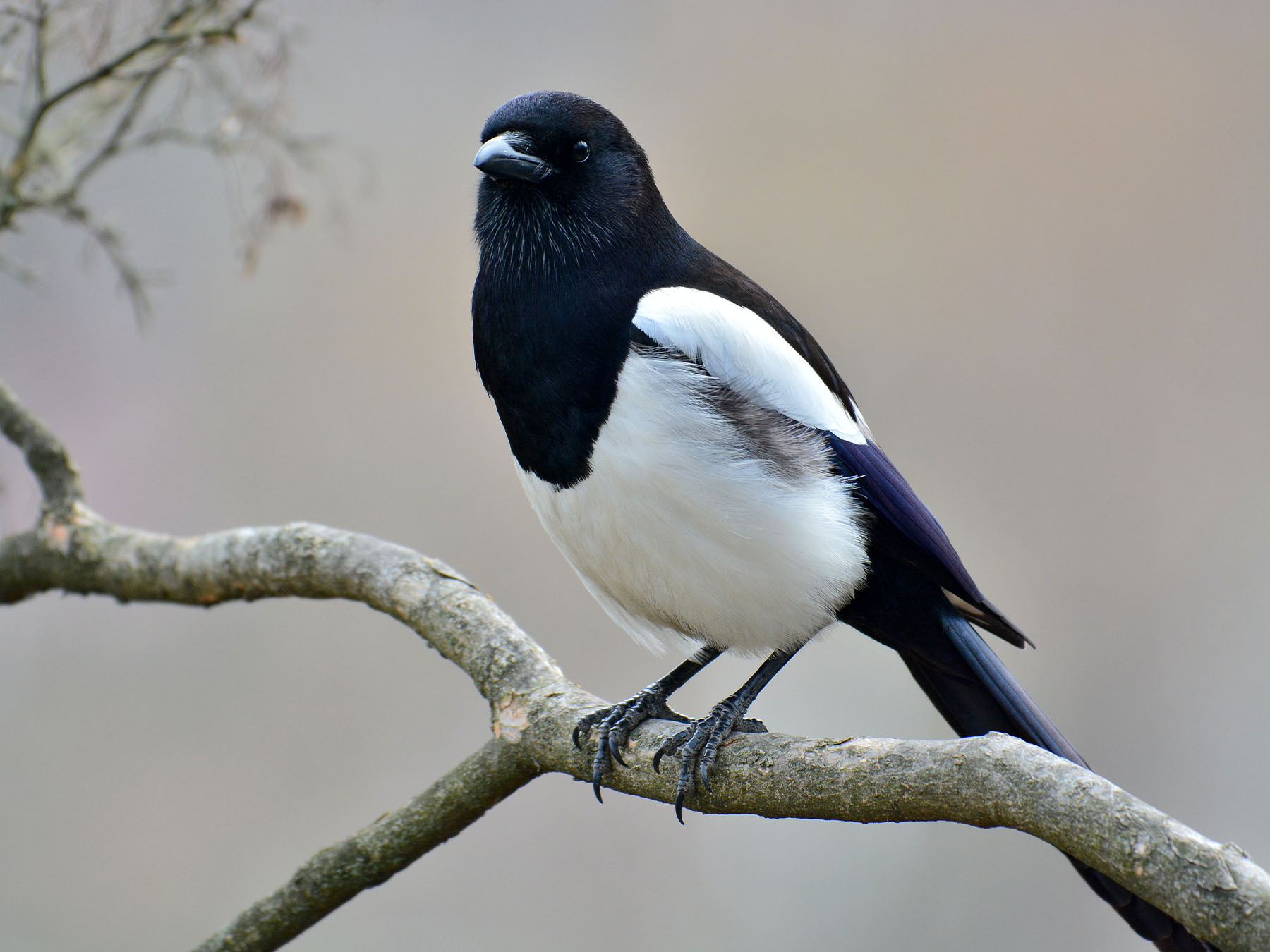
This is the Eurasian Magpie, the magpie of Britain and Europe. It is a black-and-white bird: black head, breast and back, a white belly and flanks, and a white patch on each shoulder. Close to, the black is far from plain: the wings have a purplish-blue sheen and the tail a green gloss.1
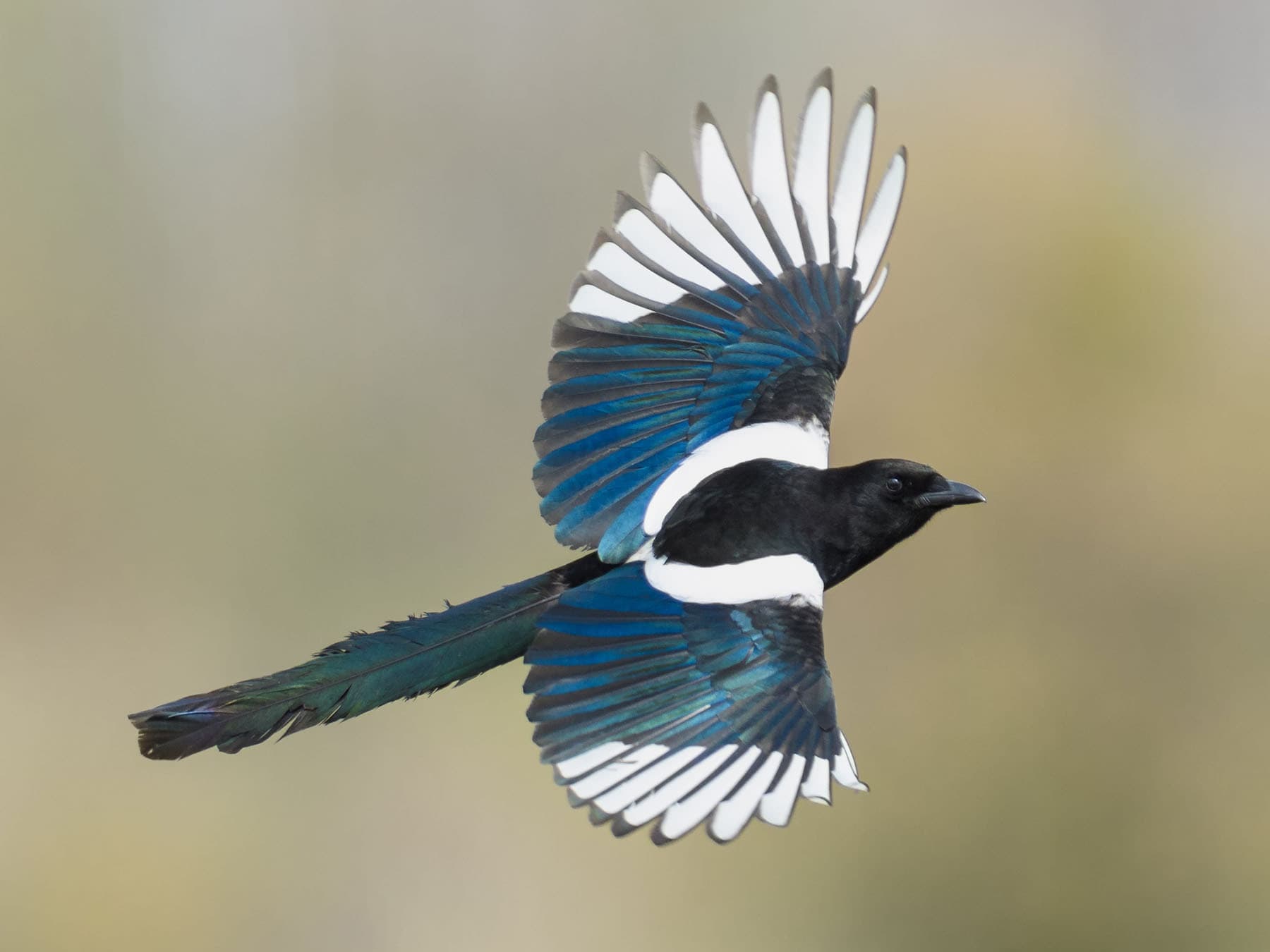
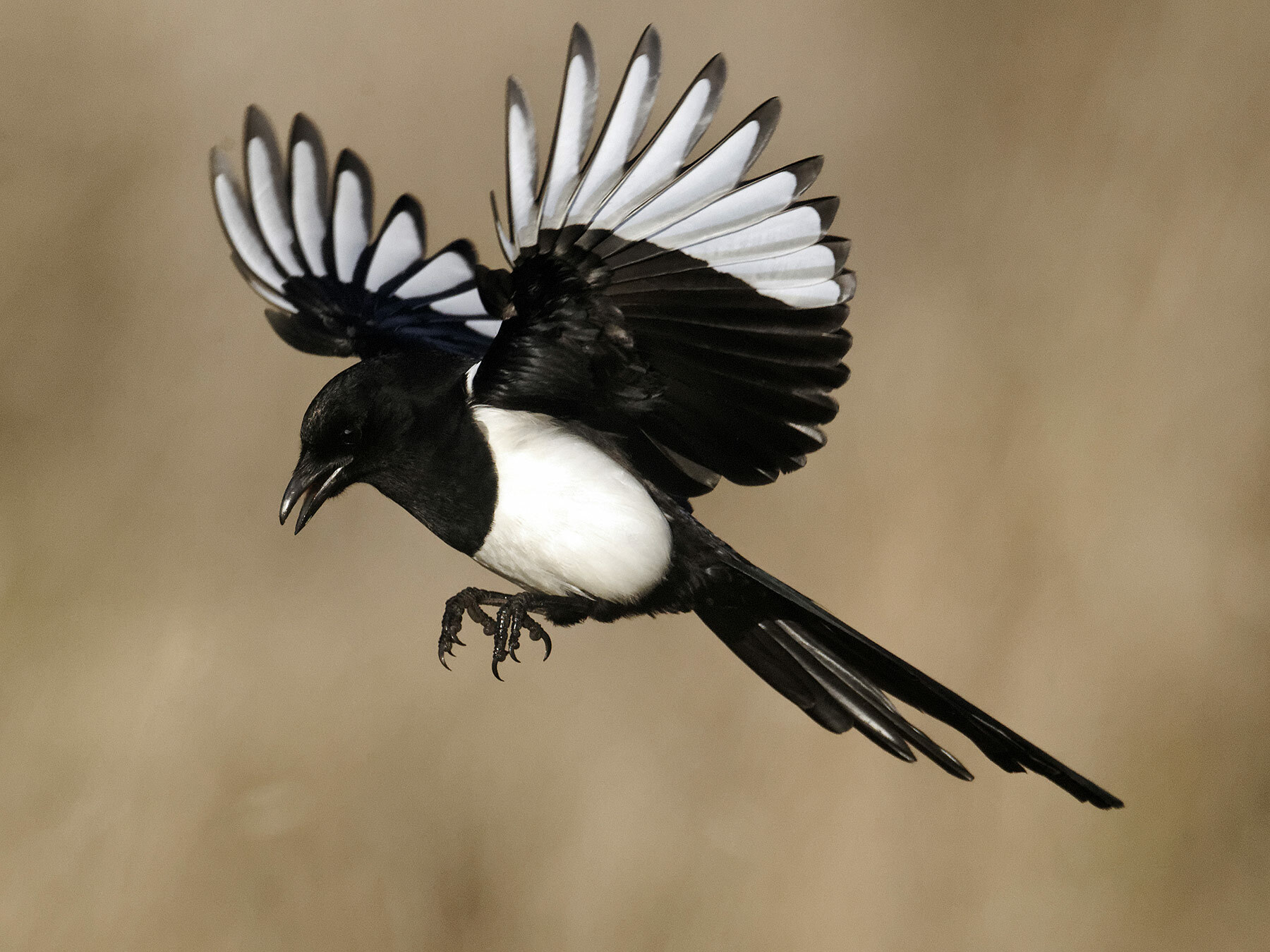
The tail is long and stiff, the longest feathers in the middle, and makes up at least a third of the bird's length.2 The wings are short; their outer flight feathers are white on the inner side, which is usually hidden when the bird perches but shows as a broad white band on the open wing.3 The bill and legs are black.
Size
Male, female and young
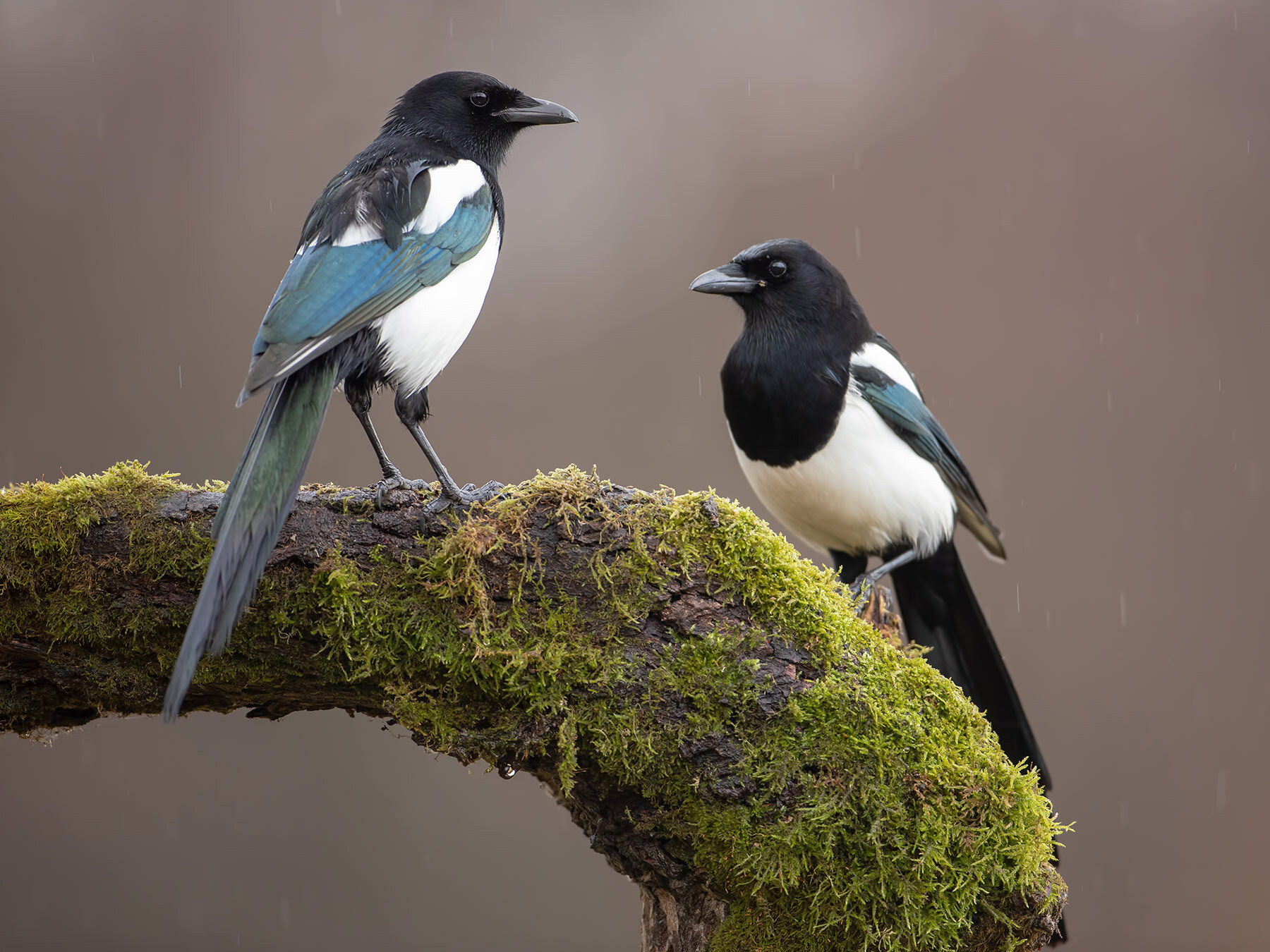
Males and females look alike.3 Males are the bigger birds on average: in BTO ringing data they weigh about 236 g (8.3 oz) against 204 g (7.2 oz) for females, and their wings are longer.
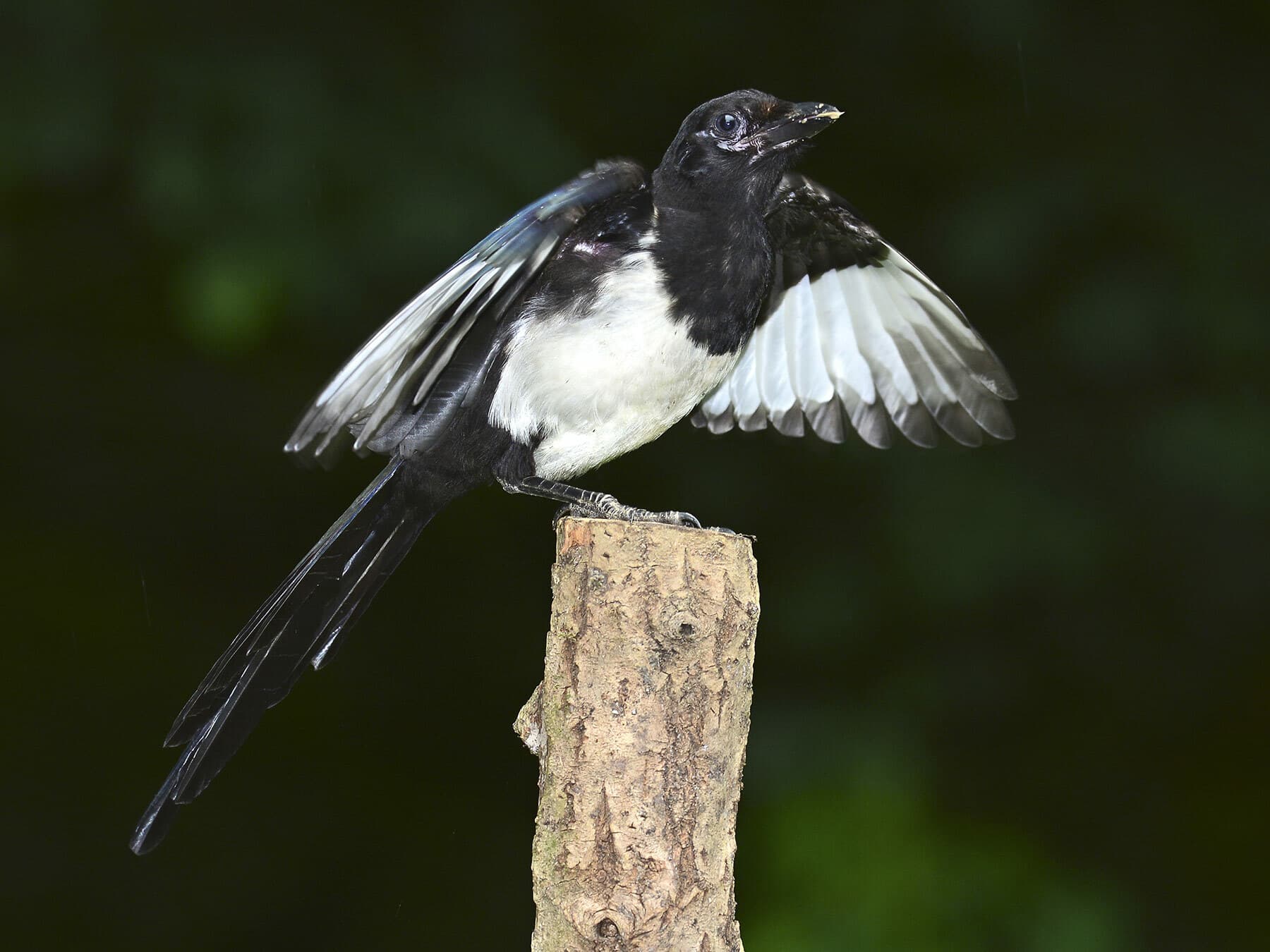
Young magpies just out of the nest are duller than their parents: the black has no gloss and looks sooty, the white is tinged buff, and they have bare skin, grey or grey-blue, round the eye and on the cheek. By late summer they look much like adults.
Identification: similar birds
In the UK nothing else looks quite like a Magpie, as the RSPB puts it. Several birds abroad share the name, though. The Australian Magpie is not a crow at all but a relative of the butcherbirds, from Australia and New Guinea, with a short, square-ended tail; adult males have a pale bill tipped with black.4 The Black-billed Magpie of western North America is a separate species of the same genus, as are the Oriental Magpie of East Asia and the Maghreb Magpie of North Africa.5 Until recently many lists counted the Old World birds as one species, and some still treat most magpies of the genus that way.3
Its size
Adults- Length
- 44–46 cm
- Wingspan
- 52–60 cm
- Weight
- 200–250 g
Its song and calls
The sound everyone knows is the chatter: a loud, harsh, rapid "chac-chac-chac", often given when a magpie is agitated. It also has a single, more relaxed call that sounds almost like a question, "ch-tak?", and a high, squealed "keee-uk".3
Magpies do sing, though few people hear it: a quiet warbling song with high notes and some mimicry, given mainly by unpaired birds and audible only close by. The BTO notes that captive magpies have been shown to be capable mimics, and a 2025 review of mimicry in the crow family lists records, from a handbook and from sound recordings, of Eurasian Magpies copying the human voice, Song Thrushes, starlings, cats and chickens.6
Songbird populations
Magpies take eggs and chicks, and they are often blamed for the loss of garden and farmland songbirds. Large studies in Britain have not found that they caused it. A national analysis of 23 songbird species found that year-to-year population changes did not differ between sites with and without magpies and Sparrowhawks.22 A study of 29 bird populations in England found no evidence, for 22 of them, that the rise in magpies, crows, jays and other predators had held their numbers down; for the other seven it could not rule an effect out, and as a study of patterns it could not prove cause either way.23 The BTO's summary is that magpies taking eggs and chicks does not lower songbird numbers across whole populations.2
Locally, magpies can still take many nests: in a study of urban Blackbirds, most of the nest predation that could be identified was by magpies, though most failed nests had no known cause.24 Yet when magpies were removed from suburbs near Paris for three years, it made very little difference to how many young the songbirds raised.25 A review of 42 studies found no negative effect of crows and magpies on other birds in 81% of the 326 comparisons, and magpies were less likely than crows to cut other birds' breeding success.26
The full evidence, study by study, with protecting nests in a garden: Do magpies kill songbirds?
- Chatter call0:00 / 1:31
Recorded in Gloucestershire, England · May 1975
Aubrey John Williams / The British Library Board · Wikimedia Commons · CC BY-SA 4.0
- Call0:00 / 0:43
Recorded in Normandie, France · June 2023
When and where to see it
OctoberHere all year
Most recorded in October
- 1. Glasgow7.0%
- 2. Dundee6.8%
- 3. Blaenau Gwent5.5%
- 4. Bristol5.3%
- 5. Meath5.1%
Each dot is a county, state or province: the bigger and darker, the larger the bird’s share of that place’s bird records that month. Grey dots: no regular records. The ringed point is the centre of the bird’s records this month; the arrow shows how it moved since last month, and the dashed loop its path through the year. “Arrivals” colours places where it becomes regular this month (orange) or is in its last regular month (grey). GBIF eBird Observation Dataset, 2019–2024. Map data: Natural Earth, US Census Bureau; place centres © OpenStreetMap contributors.
In your area
See when the Magpie is recorded in your county, state or province.
How often the Magpie turns up in the UK and Ireland through the year, from birdwatchers' records.
United Kingdom
Resident · all year · most records in December
Ireland
Resident · all year · most records in December
Show as a table
| Month | United Kingdom | Ireland |
|---|---|---|
| January | 2.8% (regular) | 2.6% (regular) |
| February | 2.8% (regular) | 2.5% (regular) |
| March | 2.7% (regular) | 2.7% (regular) |
| April | 2.3% (regular) | 2.5% (regular) |
| May | 2.1% (regular) | 2.4% (regular) |
| June | 2.3% (regular) | 2.5% (regular) |
| July | 2.3% (regular) | 2.3% (regular) |
| August | 2.3% (regular) | 2.1% (regular) |
| September | 2.4% (regular) | 2.3% (regular) |
| October | 2.5% (regular) | 2.6% (regular) |
| November | 2.8% (regular) | 2.7% (regular) |
| December | 3.0% (regular) | 2.7% (regular) |
Recorded regularly in
Worldwide: recorded regularly in 64 countries
Countries where it was recorded in at least 3 of the 6 years 2019–2024. Linked countries have their own bird list.
Europe (46)
- Åland Islands
- Albania
- Andorra
- Austria
- Belarus
- Belgium
- Bosnia & Herzegovina
- Bulgaria
- Croatia
- Czechia
- Denmark
- Estonia
- Finland
- France
- Germany
- Greece
- Guernsey
- Hungary
- Ireland
- Isle of Man
- Italy
- Jersey
- Kosovo
- Latvia
- Liechtenstein
- Lithuania
- Luxembourg
- Moldova
- Monaco
- Montenegro
- Netherlands
- North Macedonia
- Norway
- Poland
- Portugal
- Romania
- Russia
- San Marino
- Serbia
- Slovakia
- Slovenia
- Spain
- Sweden
- Switzerland
- Ukraine
- United Kingdom
Asia (18)
- Afghanistan
- Armenia
- Azerbaijan
- China
- Cyprus
- Georgia
- India
- Iran
- Iraq
- Kazakhstan
- Kyrgyzstan
- Mongolia
- Pakistan
- Syria
- Tajikistan
- Turkey
- Turkmenistan
- Uzbekistan
Data: EOD – eBird Observation Dataset (Cornell Lab of Ornithology), accessed via GBIF.org, CC BY 4.0. Records from 2019–2024, aggregated and filtered by Birdfact. How these lists are made
Magpies live in Britain and Ireland all year; the one big gap is the northern half of Scotland and the islands off it. In the last national atlas they were found in 75% of the UK's 10-km squares in the breeding season and 76% in winter, and in recent decades they have spread into upland southern Scotland, eastern Scotland and the edges of the Highlands.2
They like open country with at least some trees: farmland with hedges, parks, gardens and the edges of woods, but not treeless ground or large forests.3 In the breeding season the Breeding Bird Survey finds them most often in towns, and they are at their densest in towns and suburbs from south-east England through the Midlands to Lancashire and West Yorkshire; they have moved into many towns and suburbs since the 1960s. In one British city, the urban magpies' distribution matched the number and variety of trees better than anything else measured.7
Spotting tips
Listen for the chatter, then look along hedges, in treetops and on lawns and verges, where magpies walk with a bold, strutting gait, tail raised, and hop sideways after prey. Look too for groups gathering in trees to roost.
Do they migrate?
No. Magpies are resident and stay remarkably close to home: across their range few ringed birds have moved more than 30 km (19 miles).3 Among the BTO's 1,850 recoveries of ringed magpies, none involves a bird ringed in Britain or Ireland and found abroad, or ringed abroad and found here. The longest move within Britain and Ireland was 204 km (127 miles), from Basildon in Essex to near Bath.8
What it eats
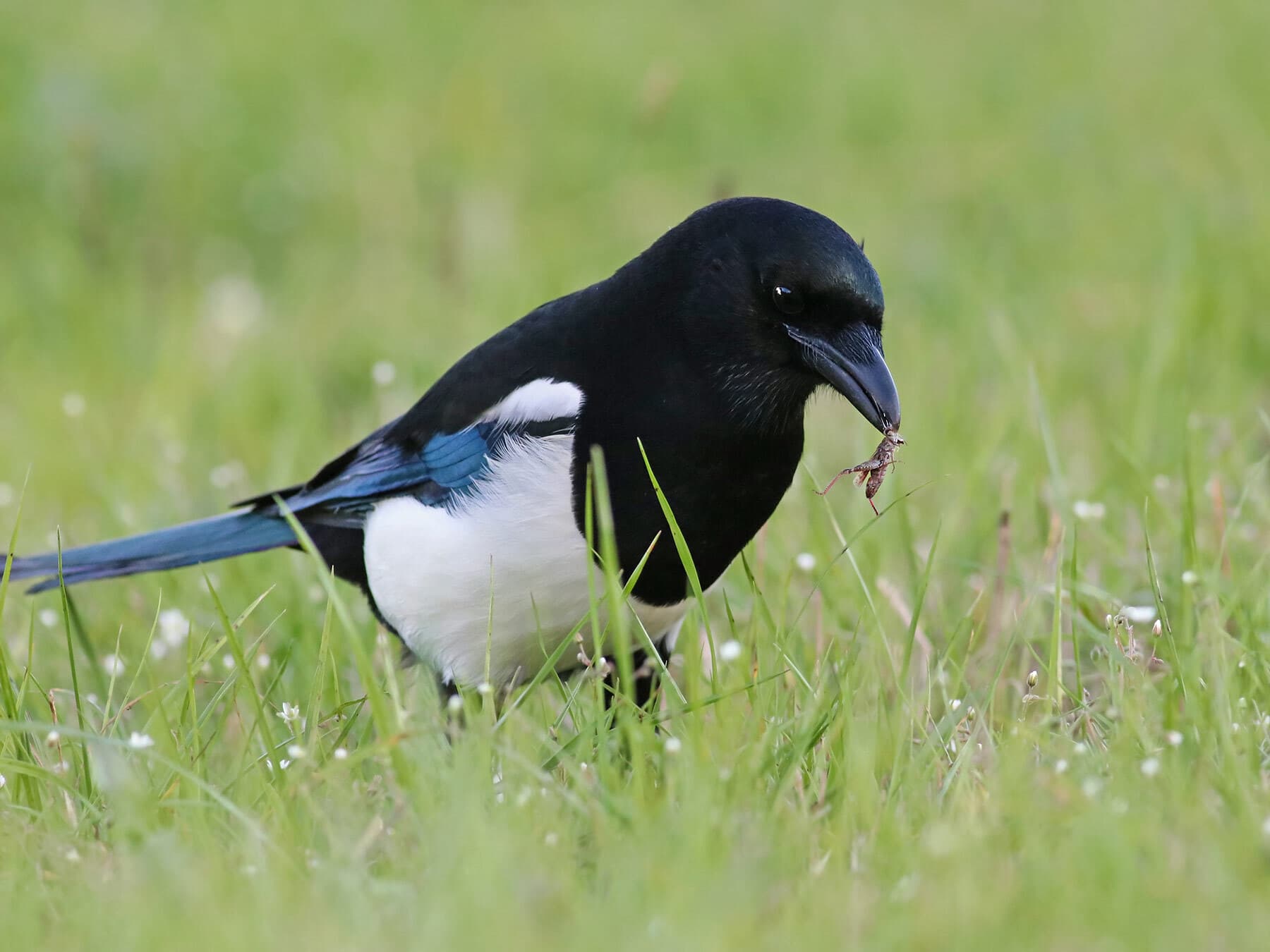
Almost anything. Magpies are omnivores, but chiefly carnivorous scavengers. Their food includes invertebrates, especially beetles, small mammals, lizards and frogs, carrion, and birds' eggs and nestlings, and they add seeds, berries and fruit in season.3 A study of urban magpies in Manchester found mostly ground-living invertebrates in their diet, from weevils and beetles to leatherjackets and worms, and a diet largely of plants in winter.9
They feed almost entirely on the ground, and pairs check roadsides early in the morning for animals killed overnight. They also hide food to eat later, usually collecting it within a few days.
More on their food through the year, what they feed their chicks and magpies in gardens: What do magpies eat?
Do they eat other birds?
Sometimes. Magpies take the eggs and chicks of other birds and, very occasionally, an adult bird.3 Even so, the summer diet of the Manchester magpies, adults and chicks alike, held few eggs or nestlings.9 Whether magpies change the number of songbirds is a different question, answered under songbird populations.
Nesting and breeding
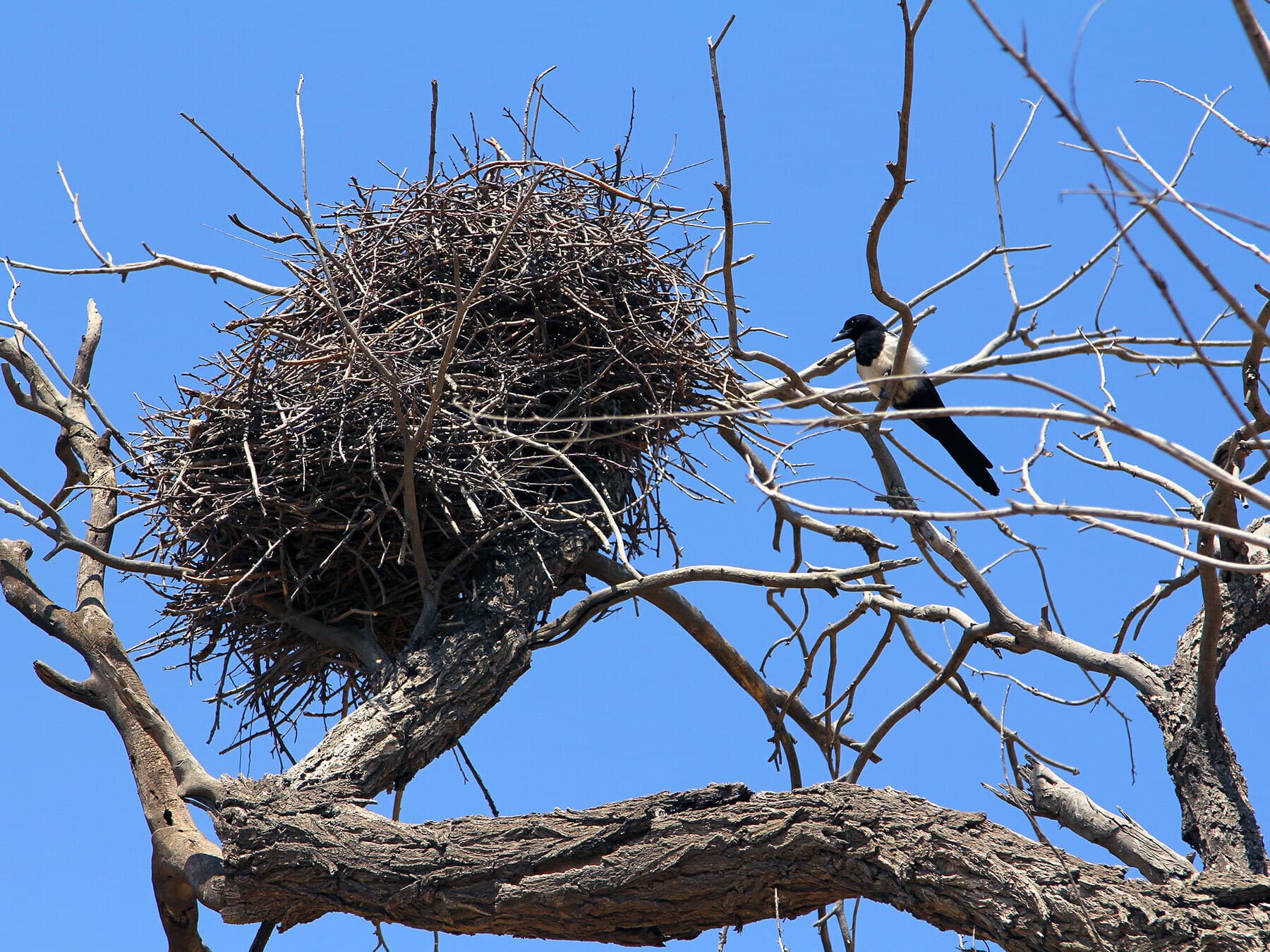
Magpies build a large domed nest of sticks, usually high in a tall tree, with a side entrance guarded by thorny twigs and a deep cup inside lined with soft material such as wool, fur, grass and feathers. Both birds build it, and work can start as early as December.3 In Britain the first eggs are laid, on average, on 22 April.
A clutch is usually 5 or 6 pale blue or greenish-blue eggs, speckled olive or buff. The female incubates them for about 20 days while the male brings her food, and the chicks leave the nest at about 26 to 31 days old. Magpies raise one brood a year.2
Where they nest, how the dome is built, eggs, chicks and the young after they leave: Magpie nesting.
Behaviour
Magpies will perch on cattle and sheep to pick off ticks and other parasites, and chase other birds to make them drop or bring up food.3
They are food-hoarders. In an experiment at Newcastle University, magpies remembered which food they had hidden where, and when.10 In a holm-oak plantation in central Spain, magpies cached between 41% and 56% of the trees' yearly acorn crop, pushing them one at a time into the ground; between 0.6% and 2.4% of the cached acorns produced seedlings.11
Social behaviour
Breeding pairs form a long-term bond and stay together all year, even when they join a flock.3 In a study in the Cotswolds, pairs defended their territories throughout the year.12 Not every magpie has a territory: in one colour-marked population about 40% were non-breeders, most of which spent the winter in a flock, and most first-year birds stayed within 1 km (0.6 mile) of where they hatched.13 Within the flock there is a pecking order, and the lower-ranking birds are less likely to survive and breed.
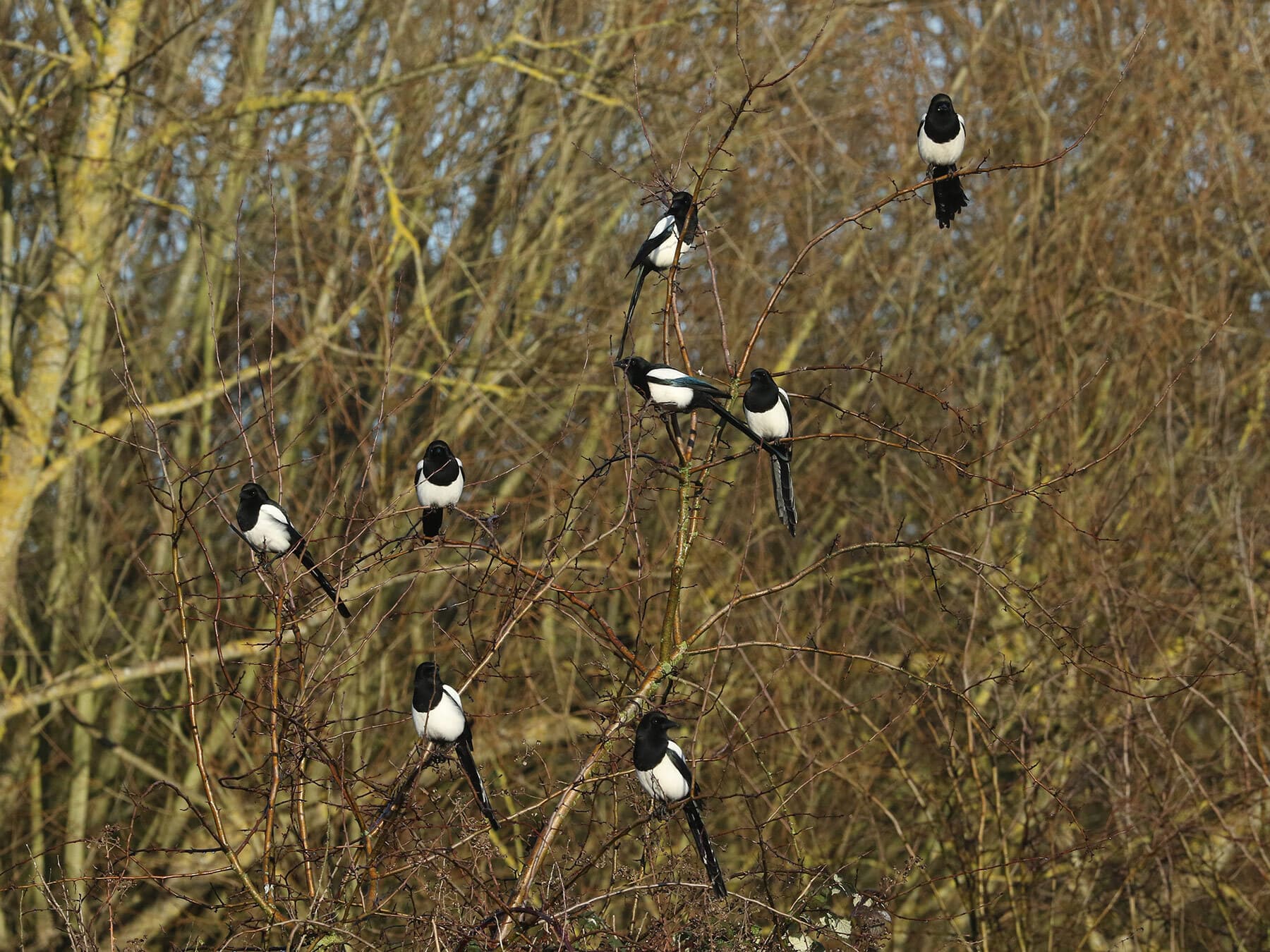
Magpies are known for "ceremonial gatherings", mainly in the three months before breeding. A seven-year study found they are started by high-ranking birds without territories: most are chased off, but about 30% of territories were won this way.14 Twenty or more magpies may gather at a communal roost; the largest roost known in a town, in Lviv in Ukraine, held 1,700.
Behaviour: shiny things and mirrors
Do magpies go for shiny things? A study at the University of Exeter found no sign of it. None of eight captive magpies touched shiny or matt objects placed beside their food, and wild magpies on the campus touched a shiny object just twice in 64 tests. They were wary of all the new objects, shiny or not. The researchers suggest the "thieving magpie" may owe its reputation to people noticing and retelling the odd story.15 (Crows: do crows like shiny things?)
Magpies are also known for a mirror test. In a 2008 German study, two of five hand-raised magpies tried to remove a coloured mark from their throat that they could see only in a mirror, which the researchers took as evidence that the birds recognised themselves.16 A 2020 repeat of the test in Spain, with eight wild-caught magpies, found no such evidence, so the question is still open.17
The experiment showing that magpies learn to recognise individual people was done in South Korea18, on birds now treated as a separate species, the Oriental Magpie.5
Lifespan and predators
A Magpie that survives to breed typically lives about 5 years. About 69% of adults survive from one year to the next, males more often than females (75% against 60%), but only 40% of young birds survive their first year.2
The oldest wild Magpie on the BTO's list for Britain and Ireland was ringed as a nestling at Bubbenhall, near Coventry, in May 1925 and shot there in February 1947, at 21 years 8 months and 23 days old.19 Because it was ringed in the nest its age is exact, and it is also the oldest magpie on EURING's European list.20
Carrion Crows are among the predators of magpie nests: in the Cotswolds, crows ate magpie eggs and chicks, and pairs nesting near crows raised fewer young.12
Conservation
The Magpie is on the UK Green List and is of Least Concern worldwide. There were about 610,000 territories in the UK in 2016. Numbers more than doubled between 1967 and 2024 (up 104%), rising steadily until the late 1980s and then levelling off.2 The Breeding Bird Survey shows no overall change in the UK between 1995 and 2024, with different stories by country: up 98% in Scotland (from a small sample of 77 survey squares), down 25% in Wales and down 30% in Northern Ireland (1997 to 2024), while England changed little.21
Magpies were once heavily persecuted in Britain, and their numbers rose through the late 20th century as that eased. The rise matches the fall in gamekeeping from the First World War, though the BTO finds no direct evidence that one caused the other. More young fledged from each nesting attempt until the 1990s, and magpies spread into towns and suburbs.
Legal status
Like all wild birds, magpies, their eggs and their nests in use are protected by law in Great Britain27 and Northern Ireland.28 General licences allow authorised people to kill or take magpies for set purposes: in England, to conserve wild birds of conservation concern or to prevent serious damage through attacks on livestock, making reasonable efforts with other lawful methods before and while using them29, 30; in Scotland, to conserve wild birds or prevent serious damage31, 32; in Northern Ireland, to prevent disease and serious damage and, from March to August, to conserve wild birds.33, 34 None of the Welsh general licences for 2026 names the magpie.35
Similar birds
Often mistaken for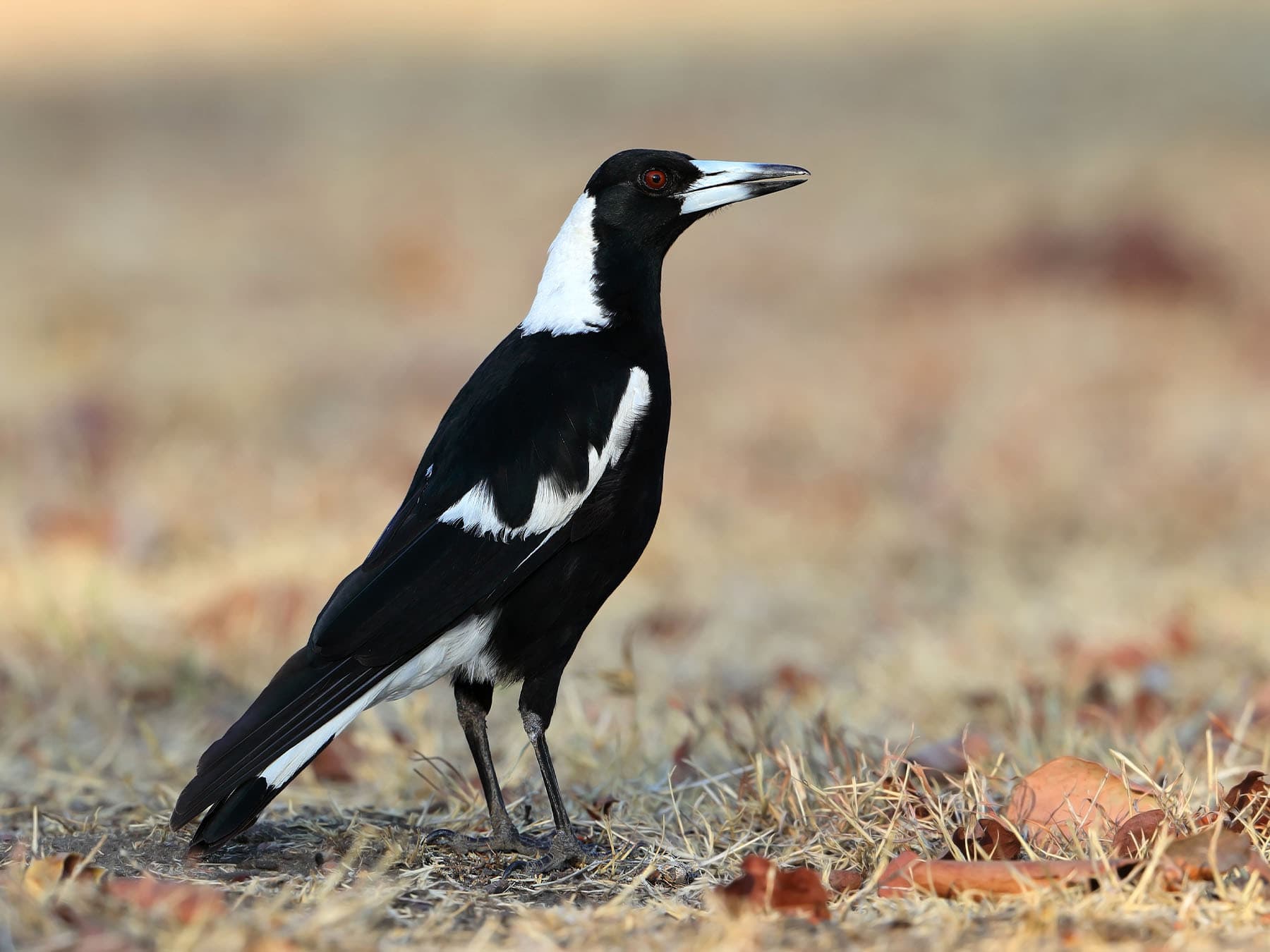
More photos
8 photos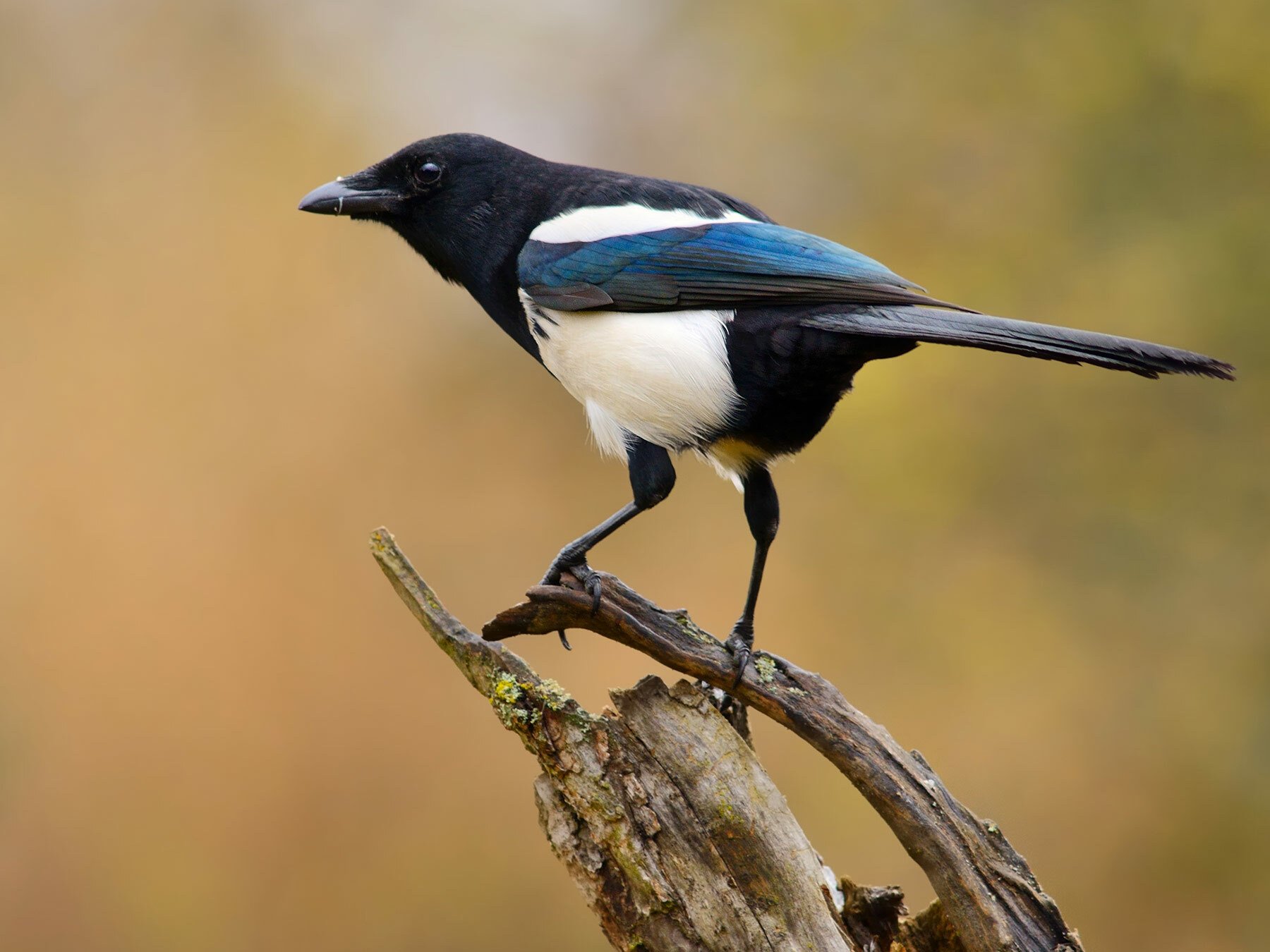
Magpie guides
6 guidesQuick facts
- Length
- 44–46 cm
- Wingspan
- 52–60 cm
- Weight
- 200–250 g
- Lifespan
- 5 years · oldest recorded 21 years 8 months
- Family
- Crows & Jays
- Migration
- Resident
- Global status (IUCN)
- Least Concern
- Population trend
- UK numbers up 104% since 1967 (BTO), stable since the late 1980s
- Also called
- Eurasian Magpie
- Scientific name
- Pica pica
Questions
4Do magpies mate for life?
Pairs form a long-term bond and stay together all year, even inside a flock. How often pairs split up has not been measured in the studies we read. See social behaviour.
Are magpies crows?
They belong to the crow family, the Corvidae, along with crows, jays and jackdaws. The Australian Magpie, despite its name, is not a member.
Is a magpie bad luck?
Only in folklore: magpies feature in superstitions across Europe, and the old rhyme counts them for sorrow or joy. See One for sorrow, the magpie rhyme.
What is a group of magpies called?
Traditionally a tidings: it is the only magpie term in the medieval lists of group names, first written down around 1452. To birdwatchers it is simply a flock. More on what a group of magpies is called.
Sources
40- 1RSPB. Magpie. RSPB Birds A-Z. Accessed 11 October 2026. Source (opens in a new tab)
- 2BTO. Magpie (Pica pica). BTO BirdFacts. Accessed 11 October 2026. Source (opens in a new tab)
- 3Kirwan, G. M., Madge, S., Christie, D. A. and Perlman, Y. (2025). Eurasian Magpie (Pica pica), version 1.1. Birds of the World (G. M. Kirwan, editor). Cornell Lab of Ornithology. doi:10.2173/bow.eurmag1.01.1 (opens in a new tab)
- 4Russell, E., Rowley, I. and Christie, D. A. (2020). Australian Magpie (Gymnorhina tibicen), version 1.0. Birds of the World (J. del Hoyo, A. Elliott, J. Sargatal, D. A. Christie and E. de Juana, editors). Cornell Lab of Ornithology. doi:10.2173/bow.ausmag2.01 (opens in a new tab)
- 5AviList Core Team (2025). AviList: The Global Avian Checklist, v2025b. doi:10.2173/avilist.v2025b (opens in a new tab)
- 6Wascher, C. A. F., Waterhouse, G. and Beheim, B. A. (2025). Vocal mimicry in corvids. Animal Cognition 28: 88. doi:10.1007/s10071-025-02006-4 (opens in a new tab)
- 7Tatner, P. (1982). Factors influencing the distribution of Magpies Pica pica in an urban environment. Bird Study 29(3): 227-234. doi:10.1080/00063658209476763 (opens in a new tab)
- 8Robinson, R. A., Leech, D. I. and Clark, J. A. (2025). Summary of all recoveries for Magpie (Pica pica). The Online Demography Report: bird ringing and nest recording in Britain & Ireland in 2024 (BTO). Accessed 11 October 2026. Source (opens in a new tab)
- 9Tatner, P. (1983). The diet of urban Magpies Pica pica. Ibis 125(1): 90-107. doi:10.1111/j.1474-919x.1983.tb03086.x (opens in a new tab)
- 10Zinkivskay, A., Nazir, F. and Smulders, T. V. (2009). What-where-when memory in magpies (Pica pica). Animal Cognition 12(1): 119-125. doi:10.1007/s10071-008-0176-x (opens in a new tab)
- 11Martínez-Baroja, L. et al. (2019). Massive and effective acorn dispersal into agroforestry systems by an overlooked vector, the Eurasian magpie (Pica pica). Ecosphere 10(12): e02989. doi:10.1002/ecs2.2989 (opens in a new tab)
- 12Vines, G. (1981). A socio-ecology of magpies Pica pica. Ibis 123(2): 190-202. doi:10.1111/j.1474-919x.1981.tb00924.x (opens in a new tab)
- 13Eden, S. F. (1987). Natal philopatry of the Magpie Pica pica. Ibis 129(s2): 477-490. doi:10.1111/j.1474-919x.1987.tb08235.x (opens in a new tab)
- 14Birkhead, T. R. and Clarkson, K. (1985). Ceremonial gatherings of the Magpie Pica pica: territory probing and acquisition. Behaviour 94(3-4): 324-332. doi:10.1163/156853985x00244 (opens in a new tab)
- 15Shephard, T. V., Lea, S. E. G. and Hempel de Ibarra, N. (2015). 'The thieving magpie'? No evidence for attraction to shiny objects. Animal Cognition 18(1): 393-397. doi:10.1007/s10071-014-0794-4 (opens in a new tab)
- 16Prior, H., Schwarz, A. and Güntürkün, O. (2008). Mirror-induced behavior in the magpie (Pica pica): evidence of self-recognition. PLoS Biology 6(8): e202. doi:10.1371/journal.pbio.0060202 (opens in a new tab)
- 17Soler, M., Colmenero, J. M., Pérez-Contreras, T. and Peralta-Sánchez, J. M. (2020). Replication of the mirror mark test experiment in the magpie (Pica pica) does not provide evidence of self-recognition. Journal of Comparative Psychology 134(4): 363-371. doi:10.1037/com0000223 (opens in a new tab)
- 18Lee, W. Y., Lee, S., Choe, J. C. and Jablonski, P. G. (2011). Wild birds recognize individual humans: experiments on magpies, Pica pica. Animal Cognition 14(6): 817-825. doi:10.1007/s10071-011-0415-4 (opens in a new tab)
- 19BTO. Longevity records for Britain & Ireland in 2024. BTO Online Ringing and Nest Recording Report. Accessed 11 October 2026. Source (opens in a new tab)
- 20Fransson, T., Kolehmainen, T., Moss, D. and Robinson, R. (2023). EURING list of longevity records for European birds (1 September 2023). EURING. Accessed 11 October 2026. Source (opens in a new tab)
- 21Heywood, J. J. N., Massimino, D., Baker, L., Balmer, D. E. et al. (2026). The Breeding Bird Survey 2025. BTO Research Report 802. British Trust for Ornithology, Thetford. Accessed 11 October 2026. Source (opens in a new tab)
- 22Thomson, D. L., Green, R. E., Gregory, R. D. and Baillie, S. R. (1998). The widespread declines of songbirds in rural Britain do not correlate with the spread of their avian predators. Proceedings of the Royal Society B 265(1410): 2057-2062. doi:10.1098/rspb.1998.0540 (opens in a new tab)
- 23Newson, S. E. et al. (2010). Population change of avian predators and grey squirrels in England: is there evidence for an impact on avian prey populations?. Journal of Applied Ecology 47(2): 244-252. doi:10.1111/j.1365-2664.2010.01771.x (opens in a new tab)
- 24Groom, D. W. (1993). Magpie Pica pica predation on Blackbird Turdus merula nests in urban areas. Bird Study 40(1): 55-62. doi:10.1080/00063659309477129 (opens in a new tab)
- 25Chiron, F. and Julliard, R. (2007). Responses of songbirds to magpie reduction in an urban habitat. Journal of Wildlife Management 71(8): 2624-2631. doi:10.2193/2006-105 (opens in a new tab)
- 26Madden, C. F., Arroyo, B. and Amar, A. (2015). A review of the impacts of corvids on bird productivity and abundance. Ibis 157(1): 1-16. doi:10.1111/ibi.12223 (opens in a new tab)
- 27UK Parliament (1981). Wildlife and Countryside Act 1981, section 1. Accessed 11 October 2026. Source (opens in a new tab)
- 28UK Government (1985). The Wildlife (Northern Ireland) Order 1985, Article 4. Accessed 11 October 2026. Source (opens in a new tab)
- 29Natural England (2026). GL40: general licence to kill or take certain species of wild birds to conserve wild birds, flora or fauna. Accessed 11 October 2026. Source (opens in a new tab)
- 30Natural England (2026). GL42: general licence to kill or take certain species of wild birds to prevent serious damage. Accessed 11 October 2026. Source (opens in a new tab)
- 31NatureScot (2026). General licence for birds GL01/2026: conservation of wild birds. Accessed 11 October 2026. Source (opens in a new tab)
- 32NatureScot (2026). General licence for birds GL02/2026: prevention of serious damage to livestock, foodstuffs for livestock, crops, vegetables and fruit. Accessed 11 October 2026. Source (opens in a new tab)
- 33Department of Agriculture, Environment and Rural Affairs (2026). General licence TPG/2/2026 (Wildlife (Northern Ireland) Order 1985). Accessed 11 October 2026. Source (opens in a new tab)
- 34Department of Agriculture, Environment and Rural Affairs (2026). General licence TPG/3/2026 (Wildlife (Northern Ireland) Order 1985). Accessed 11 October 2026. Source (opens in a new tab)
- 35Natural Resources Wales. General licences for birds 2026. Natural Resources Wales. Accessed 11 October 2026. Source (opens in a new tab)
- 36Trost, C. H. (2020). Black-billed Magpie (Pica hudsonia), version 1.0. Birds of the World (S. M. Billerman, editor). Cornell Lab of Ornithology. doi:10.2173/bow.bkbmag1.01 (opens in a new tab)
- 37Gregory, R. D. and Marchant, J. H. (1996). Population trends of Jays, Magpies, Jackdaws and Carrion Crows in the United Kingdom. Bird Study 43(1): 28-37. doi:10.1080/00063659609460993 (opens in a new tab)
- 38Eden, S. F. (1989). The social organization of non-breeding Magpies Pica pica. Ibis 131(1): 141-153. doi:10.1111/j.1474-919x.1989.tb02753.x (opens in a new tab)
- 39BTO. Nest boxes for birds. BTO, Helping birds. Accessed 11 October 2026. Source (opens in a new tab)
- 40Hodgkin, J. (1909). Proper terms: an attempt at a rational explanation of the meanings of the collection of phrases in 'The Book of St Albans,' 1486, entitled 'The Compaynys of beestys and fowlys' and similar lists. Transactions of the Philological Society 1907-1910, Supplement: 1-187. Accessed 12 October 2026. Source (opens in a new tab)

Checked by
Nathan Cope, founder and editor
Nathan founded Birdfact and leads its writers and contributors in the UK, the US and Canada. He has watched and studied birds for more than ten years, and checks every article and species guide before it’s published.