



On this page14 sections
How to recognise it
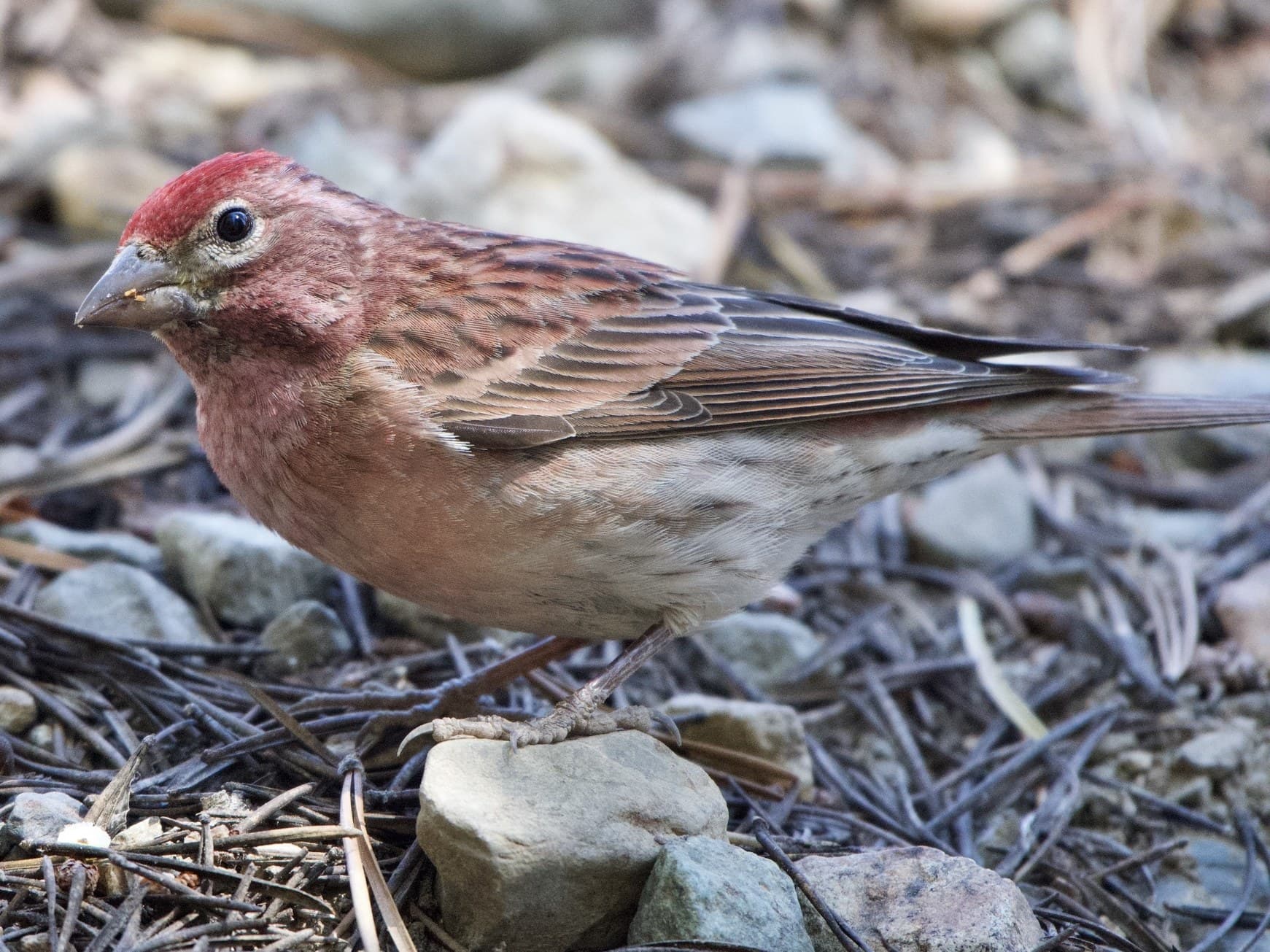
A Cassin's Finch is about 5.9 to 6.7 inches (15-17 cm) long and weighs 0.8 to 1.2 ounces (24-34 g),1 a little heftier than a House Finch.2 It is the largest of the three finches in its genus, alongside the Purple and House Finches, with a long, pointed bill whose top edge is almost straight.3 It has a peaked crown, and its long wings reach well down the short, notched tail.2
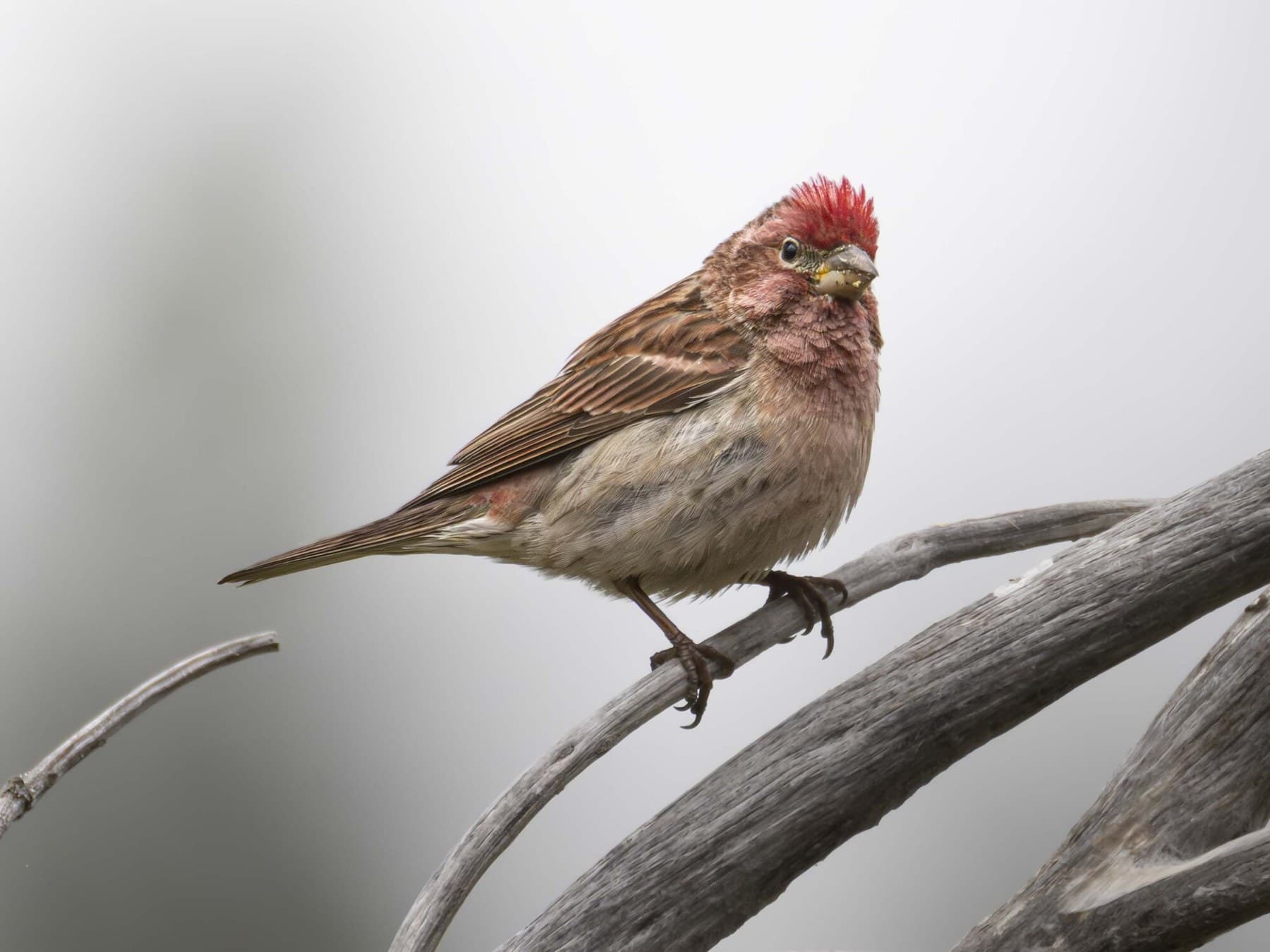
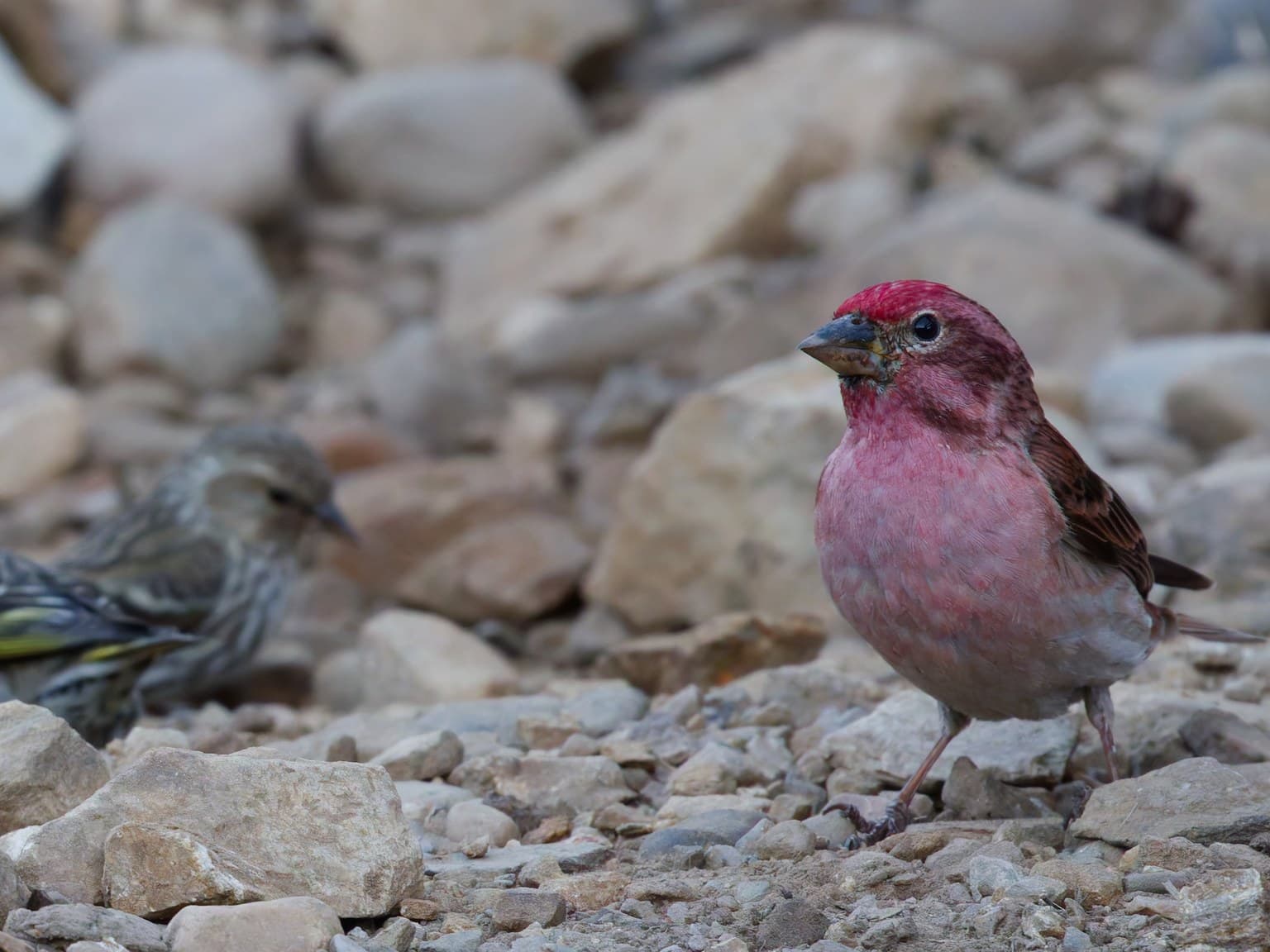
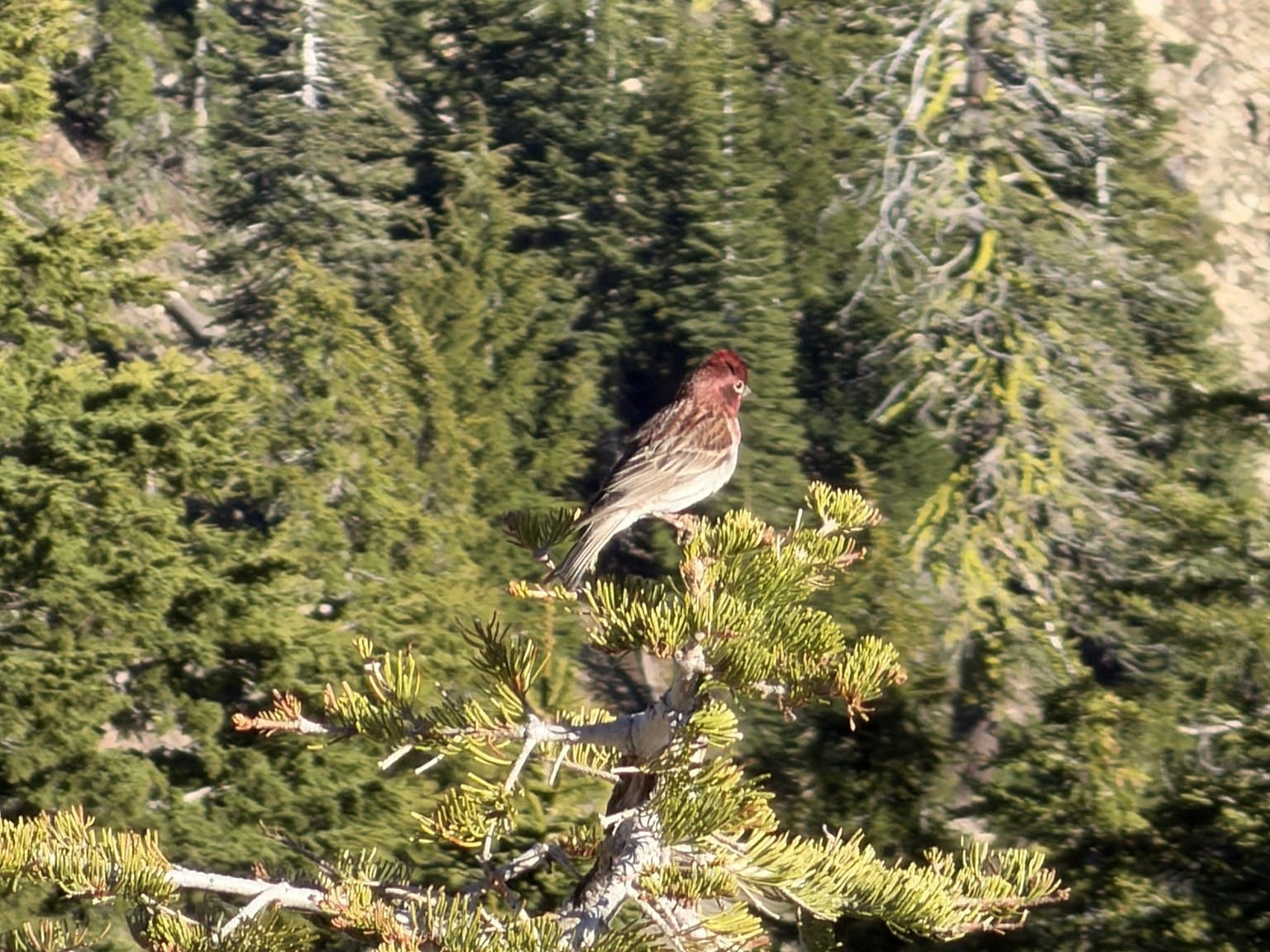
The adult male's red is mostly on his cap, which is the brightest part of him and often raised into a crest. It stands out against a browner nape and a grayish-brown back with only a faint rosy wash. His throat and breast are a softer rose pink that fades to white on the belly, and fine dark streaks usually run along his flanks and under his tail.4
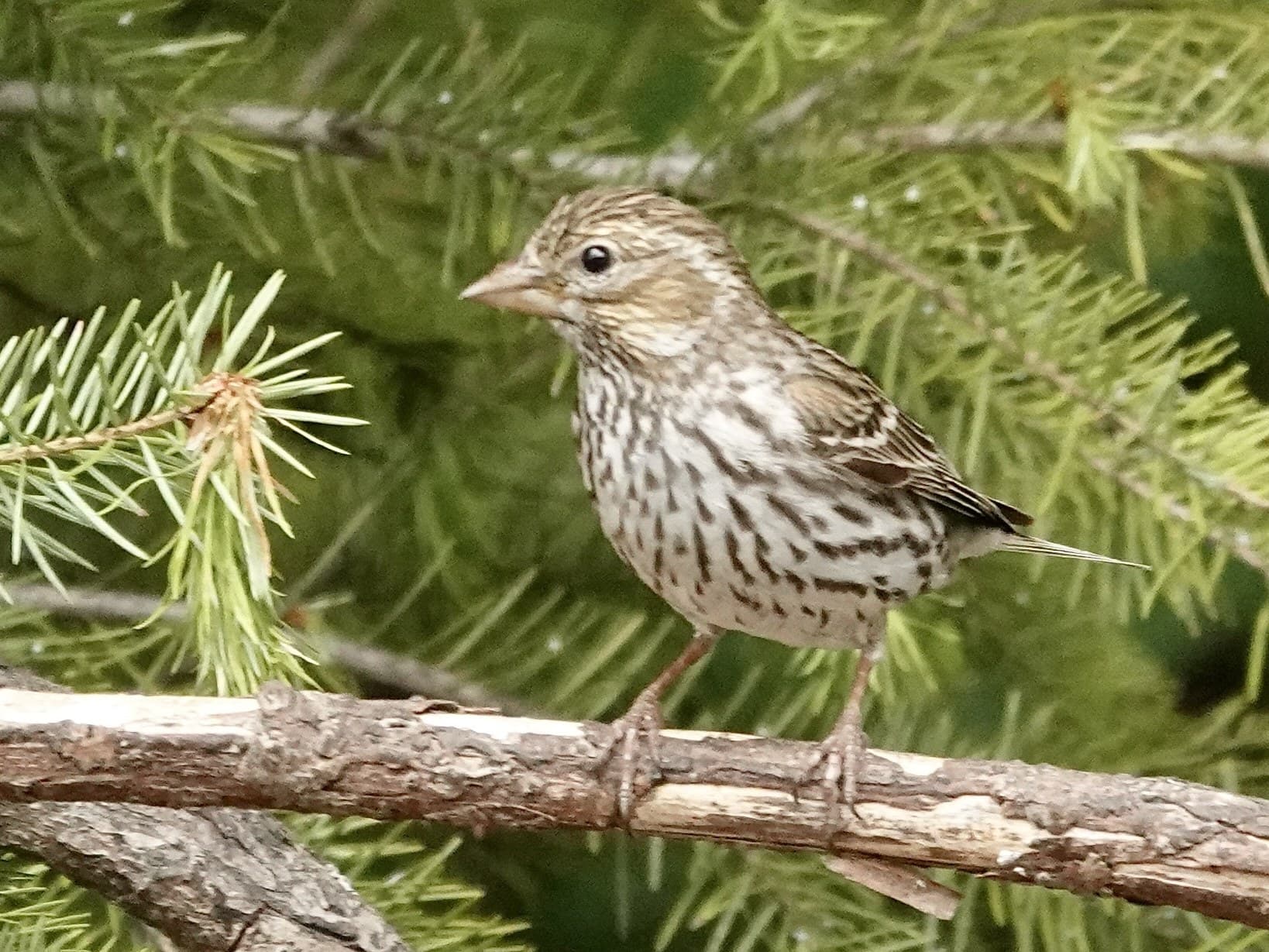
The female has no red. She is brown above and clean white below with narrow, sharp, dark streaks that carry on under the tail, and her face is fairly plain, often with a thin white ring around the eye.
Male, female and young
Only adult males are red, and young males take their time. A male's first year is spent in brown, female-like plumage, and he gets his red only at his first full molt, at about 14 months old. These brown young males can breed, and they sing much like older males, which can make it look as if both sexes sing with equal complexity. Their songs are in fact simpler, with fewer kinds of notes.5
How often young males find a mate depends on the place. In a northern Utah study only 4% of males in nest-building pairs were yearlings, while in Oregon yearling males were in 44% of probable pairs; Utah's birds included far more males than females. Unpaired young males gather in "bachelor flocks" of 7 to 50 birds in the breeding season.
Juveniles, this year's young, are like females but fluffier, grayish or olive-gray above, with blurrier streaks on buff-white below. Adults molt once a year, starting in early July and finishing by late September, before they leave the breeding grounds. In winter flocks, a female squaring up to a rival fluffs up her forehead, breast and back, which sets her apart from a young male.
Identification: similar birds
Purple Finch. Its closest relative, from which it differs only subtly. A male Purple Finch is raspberry over most of the head and onto the nape and back, so his crown does not stand out, and the feathers under his tail are usually plain white. A female Purple Finch has a bold, striped face and broader, blurrier streaks, and in brown birds the wing and tail feathers are edged greenish, where a Cassin's are edged whitish. The top edge of a Purple Finch's bill is slightly curved.6 Western Purple Finches breed mostly from the Cascades and the Sierra Nevada west to the coast, while Cassin's Finches favor higher ground. More: female, male and young Purple Finches.
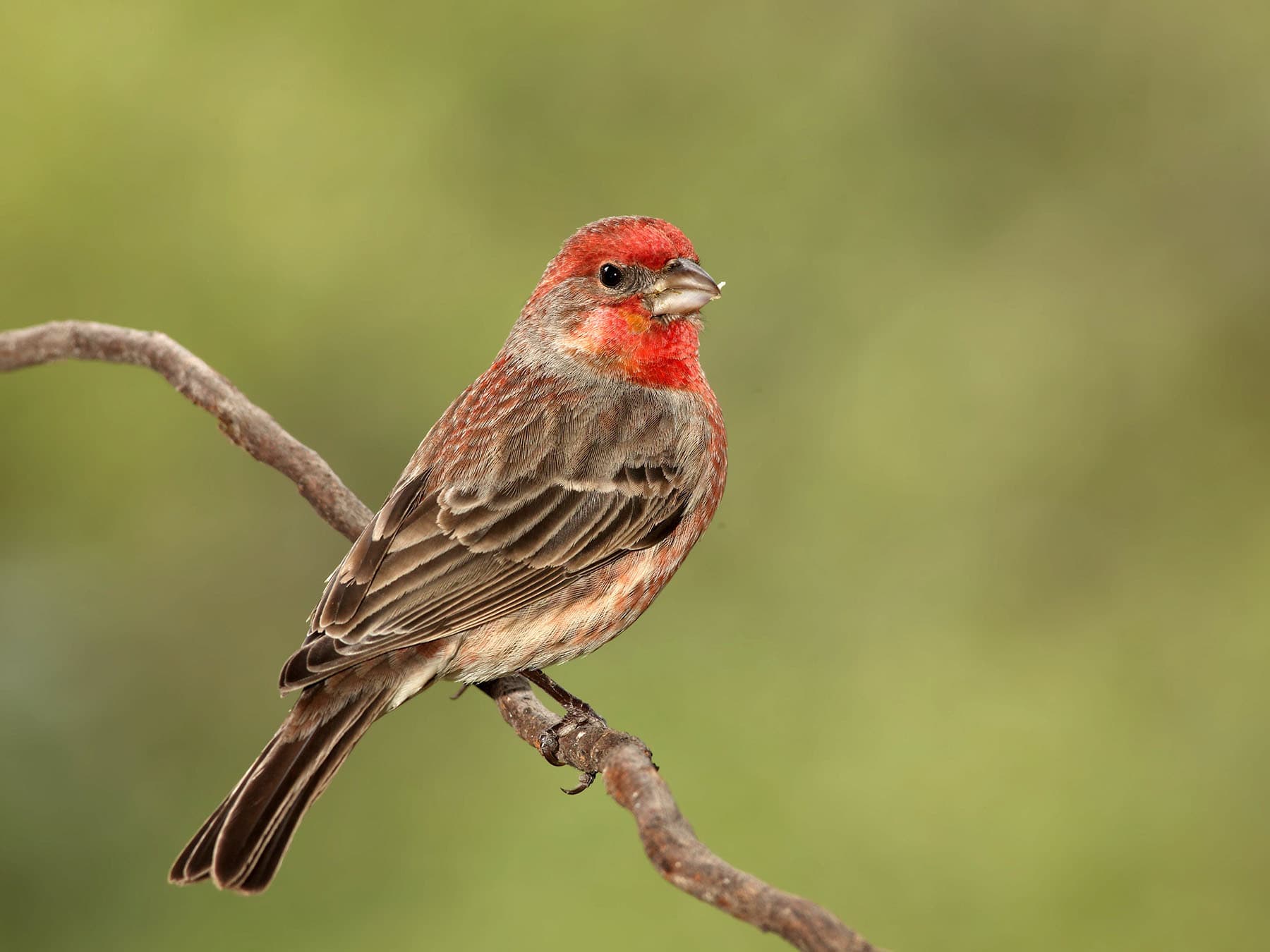
House Finch. In parts of the West all three can turn up together, though House Finches are usually lower down. A male House Finch has red on the forehead, the stripe over the eye, the throat and the breast, set against a brown cap, with heavy brown streaks down his sides and broad dark streaks under the tail. A female House Finch has a plain face and long, blurry streaks on a dull white breast. House Finches are slimmer and longer-tailed, with a short, curved bill.4 Side by side, with photos: House Finch or Purple Finch?
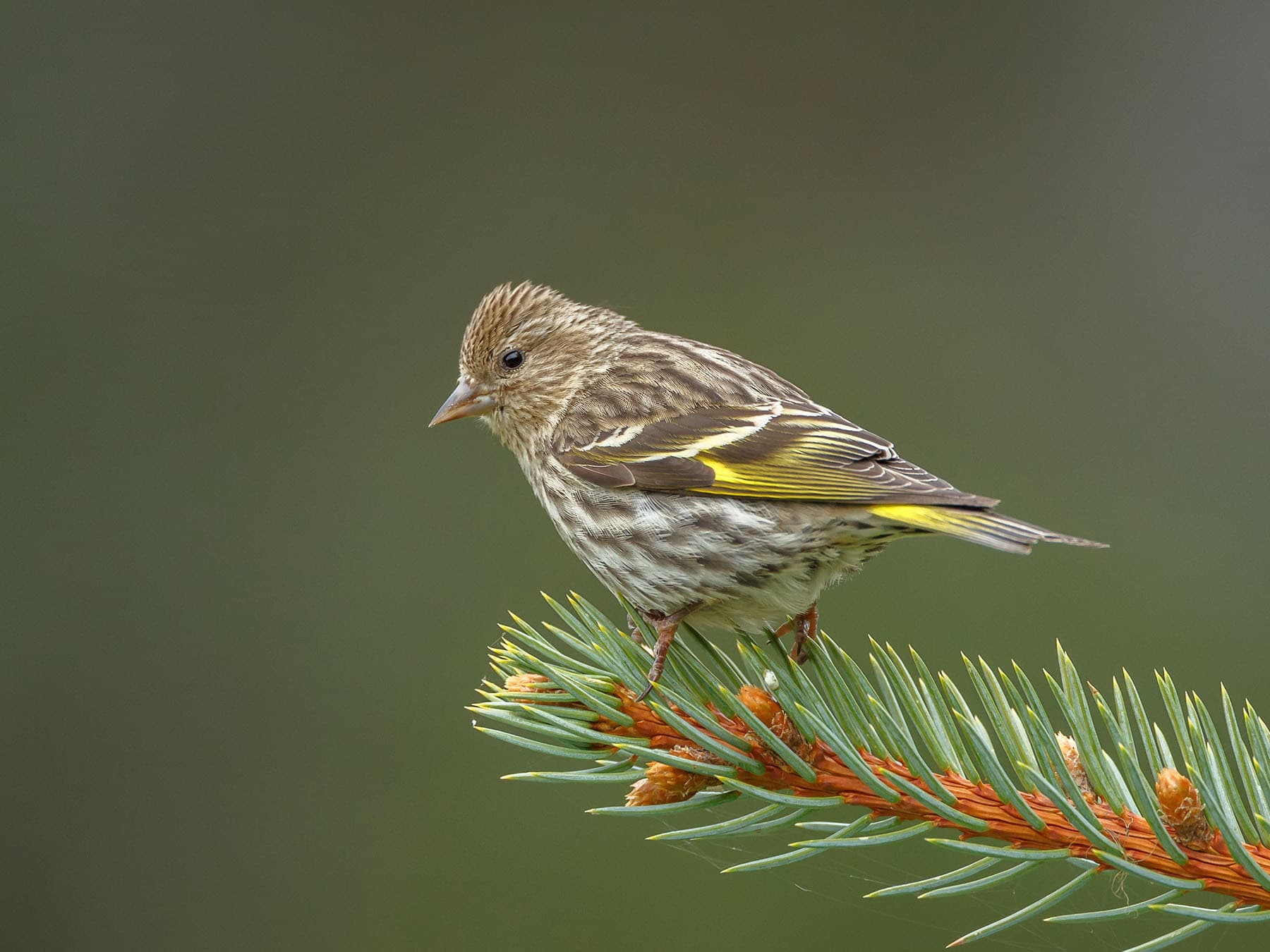
Pine Siskin. A common companion in mountain flocks. It is smaller,2 with a thinner, sharper bill and yellow edges in the wings and tail.7 A Cassin's bill is Siskin-like in profile, unlike the more curved bills of Purple and House Finches.
By ear, a Cassin's gives a liquid "tidilip" and never the very short "tick" a Purple Finch gives in flight.
Its size
Adults- Length
- 15–17 cm
- Wingspan
- 25–27 cm
- Weight
- 24–34 g
Its song and calls
The male sings a fast, rolling warble of short notes that run into one another, between about 2 and 6 kHz.3 Some songs are short and all his own; longer ones often finish with a string of other birds' calls, copied so well that fieldworkers have gone looking for the bird being imitated. Townsend's Solitaire turns up in songs from Washington, California and Wyoming, and one recorded Washington song held Red Crossbill, Pine Siskin, Evening Grosbeak, Western Tanager, Steller's Jay, Northern Flicker and Pygmy Nuthatch sounds. To some ears the song is like a Purple Finch's but flutier and more varied.1 More on the Purple Finch side: Purple Finch song and calls.
Both sexes call: a liquid "tidilip" (Audubon writes it "pwee-de-lip"), a "keeup", and a very high call given from a perch. A paired male gives a loud call as he comes back to a perch near the nest with food, and his mate answers only his.
Song is for courting. Males arrive on the breeding grounds already singing, sing from dawn through the day in April, May and early June, and paired adult males stop within a day or two of their mates starting a nest; unpaired young males carry on for another 1 to 3 weeks, and by mid to late July the woods are quiet. Males also sing in a slow-winged, level song flight. In a laboratory study, males used to a female's company sang little while she was with them and much more after she was taken away.8 In northern Utah, the opening notes of songs were shared by the males at one site and differed between nearby sites, a local dialect.
Females sing too, less often and more simply, but a brown bird singing may be a young male. The species player has three recordings: a bird in British Columbia in March singing four songs of about 2 to 2.5 seconds each, a song of about 2 seconds from Washington in May, and a bird in brown, female-type plumage singing in British Columbia, which its recordist thought might be a first-year male.
- Song0:00 / 0:38
Recorded in British Columbia, Canada · March 2026
- Song0:00 / 0:02
Recorded in Washington, United States · May 2021
- Song (female-plumaged bird)0:00 / 0:06
Recorded in British Columbia, Canada · March 2026
When and where to see it
Cassin's Finches breed in the mountains of the West, generally between about 3,300 and 9,800 feet (1,000-3,000 m), higher in the south: from south-central British Columbia and western Montana and Wyoming south through the Rockies of Colorado, and across the mountains of Idaho, Utah and Nevada to the Cascades, the Sierra Nevada and the mountains of southern California and northern Baja California. They are scarcer in northern New Mexico and Arizona.
In summer they live in open conifer forest: often mature lodgepole and ponderosa pine, but also fir, spruce, Douglas-fir, pinyon and bristlecone pine and groves of quaking aspen. In Washington the densest populations are in dry, open ponderosa pine around 3,300 feet (1,000 m); in Nevada they breed at 7,900 to 9,800 feet (2,400-3,000 m), and Audubon notes them near treeline. In winter they use the same kind of forest, mostly lower down, and some come to feeders in mountain towns.
Spotting tips
In spring, listen in open pine woods for a rushing warble from the top of a tall conifer, then look for a red cap. Late in summer, check flocks of crossbills, siskins and grosbeaks, and mineral deposits on the ground, where finches come down to eat salty soil. In winter, check every brown finch at a mountain feeder for sharp, narrow streaks on bright white, a faint face pattern and a long, straight-edged bill.
Migration
Partly, and unpredictably. In fall many move downhill, and some south as far as the mountains of northern and central Mexico, but some stay on the breeding grounds all winter. In northern Utah, adult males and all the females leave in mid-September and young males about 2 weeks later. Spring movements can start in late February, and most birds are back on the breeding grounds in April or May.
Winter is a lottery. Numbers at one place swing from many to none between years, and the birds can wander well out onto the plains. Of 288 birds banded at northern Utah feeders one winter, only one was caught there the next, though a later study there found more returning. Birds of the World's account (1996) suggested it may be spreading northwest: a singing male visited a feeder in Homer, Alaska, from April 20 to May 14, 1985.
What it eats
Mostly buds, seeds and fruit. In a northern Utah study, the flower buds of quaking aspen made up as much as 94% of what was in the birds' guts early in the nesting season, and conifer buds are probably its main winter food. It takes seeds from pine cones, especially ponderosa pine, sometimes straight from cones as they open or from green cones that crossbills have pried apart, and picks fallen seeds off the ground.
It eats berries such as cotoneaster and mulberries, and in summer some caterpillars from conifer needles, including Douglas-fir tussock moth larvae. It craves salt, and gathers at mineral deposits to eat soil rich in sodium, calcium, magnesium and potassium.
Feeding them in your yard
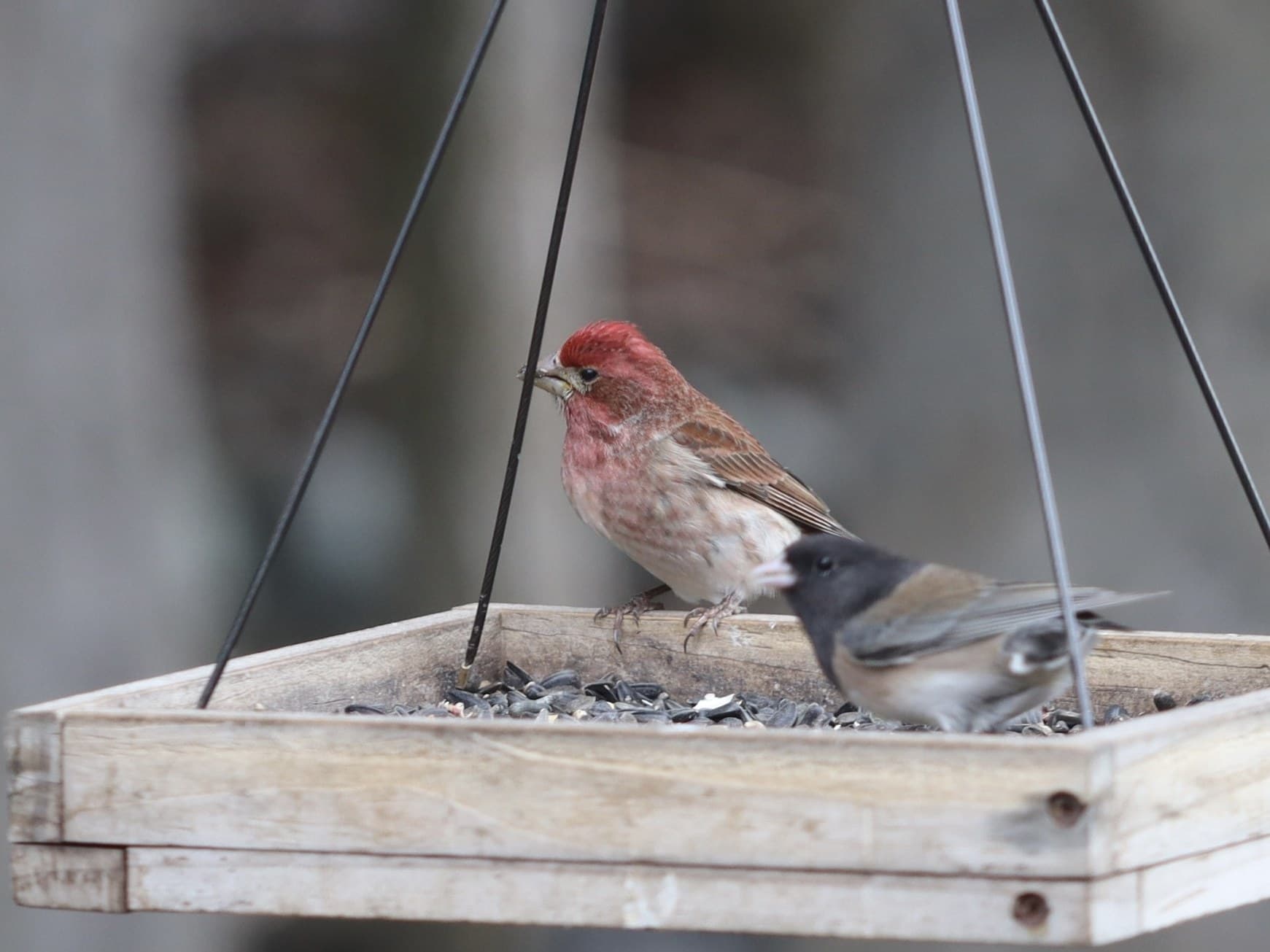
If you live in or near the western mountains, Project FeederWatch lists black-oil sunflower seed, hulled sunflower seed and nyjer for Cassin's Finches, at hopper, tube or platform feeders.9 They come mainly in winter, and not every winter. Fruiting shrubs such as cotoneaster, firethorn and mulberry may also draw them in.
Nesting and breeding
Cassin's Finches nest in loose colonies. In a small grove of ponderosa pine on Hart Mountain, Oregon, nests averaged about 80 feet (25 m) apart, at about 8 to 10 pairs per acre (20-25 per hectare).10 Of 141 nest records, 91% were in conifers, more than half of them in lodgepole pine (though many of those records come from the high Sierra Nevada), usually well out on a side branch or close to the top of the tree. Nests averaged about 36 feet (11 m) up, though a few have been found in big sagebrush only about 2 feet (60 cm) off the ground.
The male holds no territory in the usual sense. Once the female begins hunting for a place to build, he cuts back his singing and chases other males away from her wherever she goes, guarding a zone that grows from about 13 feet (4.1 m) around her to about 51 feet (15.6 m) by the end of nest building. He stops when she starts incubating, and then tolerates another pair building only a few yards away.
The female, apparently alone, builds a cup of fine twigs, rootlets and weed stems, often with lichen, lined with rootlets, grass, plant fibers, bark shreds and hair, in just a few days, mostly in May and June. She lays 3 to 6 eggs, most often 4 or 5, light blue to bluish green, speckled with black, brown and purplish, and incubates them for about 12 days while the male feeds her. Both parents feed the young, and in four Oregon nests the young left 16 days after hatching. Families leave the breeding area almost at once, and pairs generally raise one brood a year, though they apparently lay again if snow or a predator destroys the first.
Behaviour
Outside the nesting season Cassin's Finches live in flocks, often with Evening Grosbeaks, Red Crossbills and Pine Siskins, whose calls turn up in their songs. Winter gatherings can be large: up to 5,000 birds were reported in Colorado one December. On the ground they hop, never walk, and their flight bounds up and down; coming down from a height, they drop into the treetops in steep, wings-closed plunges.
At northern Utah feeders in winter, the pecking order put females first, older males second and young males in their first winter last. The disputes are silent: a bird points its closed bill at a rival, and in a stronger threat opens its bill and may raise its wings.
Lifespan and predators
The oldest Cassin's Finch on the Bird Banding Laboratory's list was at least 7 years old: a male banded as an adult in Oregon on June 13, 1974, and caught and released there on June 22, 1979.11 The next oldest, from Utah, was 6 years 10 months. Most live far less: on Hart Mountain, Oregon, at least 64 in 100 males and 60 in 100 females survived from one year to the next,10 and Birds of the World, citing the same study, puts the average life expectancy at about 2.3 years. Males outlive females.
Predators and other dangers
Sharp-shinned and Cooper's Hawks and Northern Shrikes catch Cassin's Finches, and Northern Pygmy-Owls take them in California; pygmy-owl calls set them mobbing. When a hawk is near, a finch freezes in a crouch, moving only its throat. Canada Jays raid nests in Colorado. Near feeders, even a Black-billed Magpie has been seen killing an adult female, in a Missoula, Montana, backyard in 2021.12
Weather is a danger in the mountains: snowstorms in the nesting season can kill incubating females, and June snow destroyed most nests on Hart Mountain in 1975 and 1979. In the winter of 1996-1997, a big influx of Cassin's Finches into New Mexico came with an outbreak of salmonellosis that killed finches, House Finches among them.13
Conservation
Cassin's Finch is still common and widespread, with about 3.2 million breeding birds, and is of Least Concern worldwide. Partners in Flight scores it 12 out of 20 for continental concern and formerly had it on its Watch List.14 The North American Breeding Bird Survey shows it decreased somewhat from 1967 to 2019,2 and the U.S. Fish and Wildlife Service lists it as a Bird of Conservation Concern.15
Its nomadic habits make trends hard to read: breeding numbers can swing more than tenfold between years, as on one Utah study area, which held about 93, then 1,548, then 177 birds in 1971-1973. Open forest suits it, so selective logging and small clear-cuts are thought to do it little harm. It is protected under the Migratory Bird Treaty Act.16
Similar birds
Often mistaken for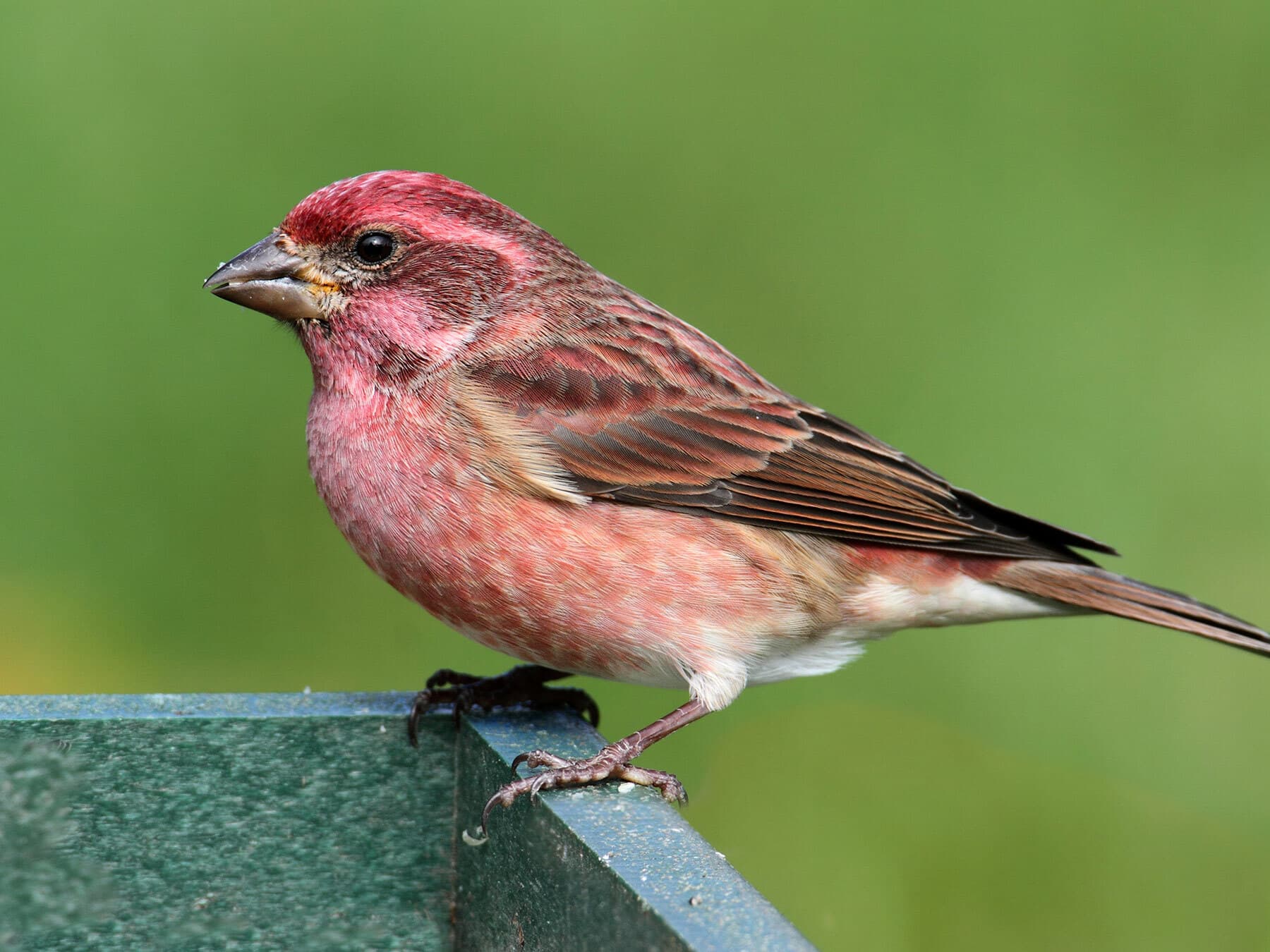
More photos
1 photos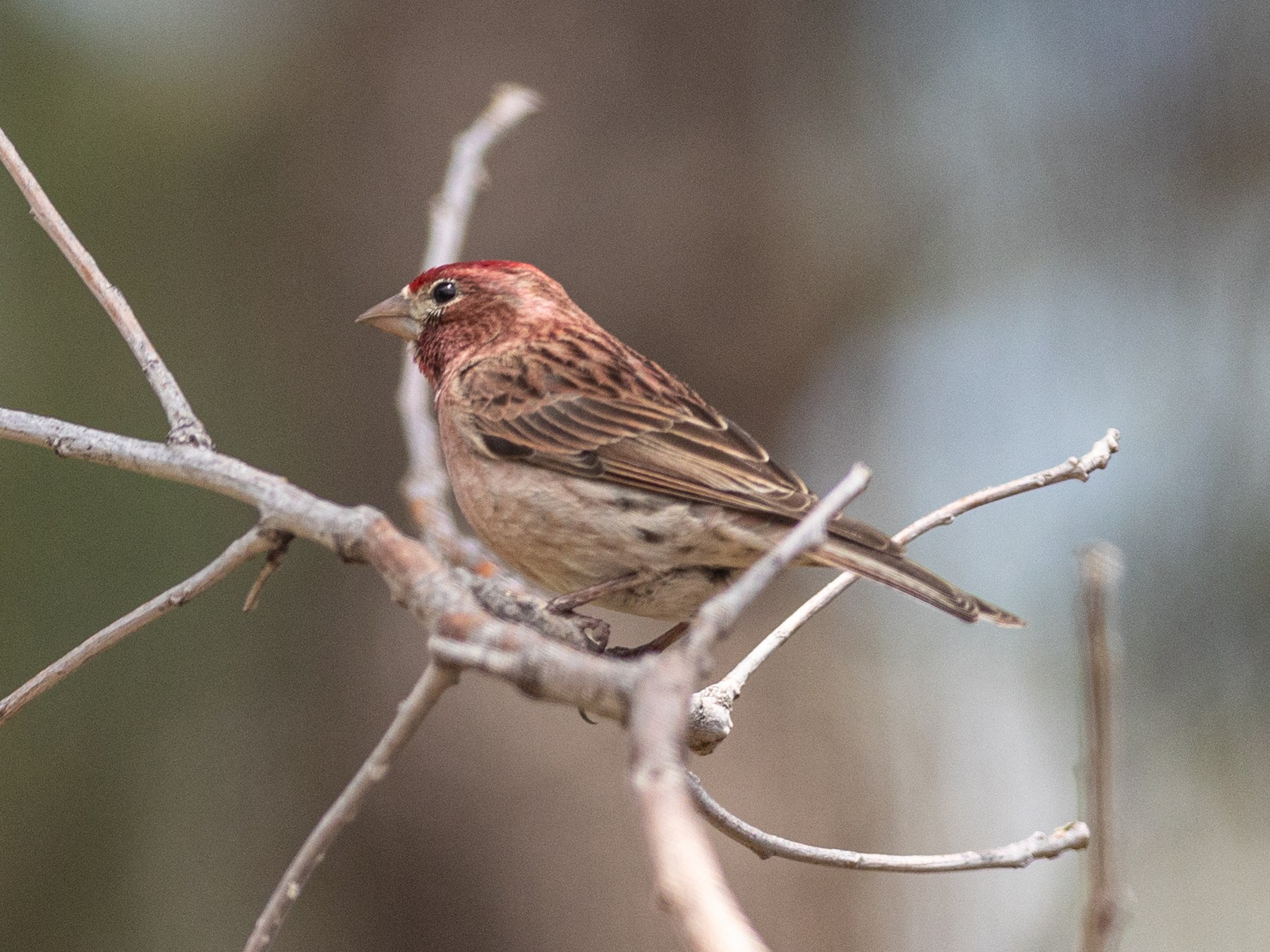
Quick facts
- Length
- 15–17 cm
- Wingspan
- 25–27 cm
- Weight
- 24–34 g
- Lifespan
- oldest recorded 7 years
- Family
- Finches
- World population
- About 3.2 million (Partners in Flight)
- Population trend
- Declining slightly: down somewhat from 1967 to 2019 (North American Breeding Bird Survey); a U.S. Bird of Conservation Concern (2021)
- Scientific name
- Haemorhous cassinii
Questions
1Why is it called Cassin's Finch?
It is named for John Cassin (1813-1869) of the Academy of Natural Sciences of Philadelphia. Cassin, who made illustrations for the Pacific Railroad Survey, picked it out from a collection the survey made in the southwestern mountains in the early 1850s, calling it the "greatest bird in the lot"; at his request, Spencer Baird named it after him in 1854.
Sources
22- 1National Audubon Society (text: Kaufman, Lives of North American Birds). Cassin's Finch. Audubon Guide to North American Birds. Accessed 11 October 2026. Source (opens in a new tab)
- 2Cornell Lab of Ornithology. Cassin's Finch: Overview, Identification, Life History and Sounds. All About Birds. Accessed 11 October 2026. Source (opens in a new tab)
- 3Hahn, T. P. (2020). Cassin's Finch (Haemorhous cassinii), version 1.0. Birds of the World (A. F. Poole and F. B. Gill, editors). Cornell Lab of Ornithology. doi:10.2173/bow.casfin.01 (opens in a new tab)
- 4Project FeederWatch (Cornell Lab of Ornithology and Birds Canada). Tricky Bird IDs: Cassin's Finch, House Finch and Purple Finch. Project FeederWatch. Accessed 11 October 2026. Source (opens in a new tab)
- 5MacDougall-Shackleton, S. A. et al. (2005). Age- and sex-related variation in song-control regions in Cassin's finches, Carpodacus cassinii. Brain, Behavior and Evolution 65(4): 262-267. doi:10.1159/000084644 (opens in a new tab)
- 6Wootton, J. T. (2020). Purple Finch (Haemorhous purpureus), version 1.0. Birds of the World (A. F. Poole and F. B. Gill, editors). Cornell Lab of Ornithology. doi:10.2173/bow.purfin.01 (opens in a new tab)
- 7National Audubon Society (text: Kaufman, Lives of North American Birds). Pine Siskin. Audubon Guide to North American Birds. Accessed 11 October 2026. Source (opens in a new tab)
- 8Sockman, K. W., Sewall, K. B., Ball, G. F. and Hahn, T. P. (2005). Economy of mate attraction in the Cassin's finch. Biology Letters 1(1): 34-37. doi:10.1098/rsbl.2004.0257 (opens in a new tab)
- 9Project FeederWatch (Cornell Lab of Ornithology and Birds Canada). Common Feeder Birds: Cassin's Finch. Project FeederWatch. Accessed 11 October 2026. Source (opens in a new tab)
- 10Mewaldt, L. R. and King, J. R. (1985). Breeding site faithfulness, reproductive biology, and adult survivorship in an isolated population of Cassin's Finches. The Condor 87(4): 494-510. doi:10.2307/1367946 (opens in a new tab)
- 11USGS Bird Banding Laboratory. Longevity records of North American birds. Accessed 11 October 2026. Source (opens in a new tab)
- 12Hendricks, P. and Hendricks, L. M. (2022). Predatory attacks by Black-billed Magpies (Pica hudsonia) on Cassin's Finch (Haemorhous cassinii) and other adult birds. Northwestern Naturalist 103(1): 76-80. doi:10.1898/1051-1733-103.1.76 (opens in a new tab)
- 13Dickerman, R. W. (2015). Haemorhous cassinii vinifer is valid. Western Birds 46: 66-68. doi:10.21199/wb46.1.5 (opens in a new tab)
- 14Partners in Flight (2024). Avian Conservation Assessment Database, global scores (ACAD version 2024.05.23; population estimates 2020.04.29). Partners in Flight Databases (Bird Conservancy of the Rockies). Accessed 11 October 2026. Source (opens in a new tab)
- 15U.S. Fish and Wildlife Service (2021). Birds of Conservation Concern 2021. U.S. Fish and Wildlife Service, Migratory Birds. Accessed 11 October 2026. Source (opens in a new tab)
- 16U.S. Fish and Wildlife Service. List of birds protected by the Migratory Bird Treaty Act. Code of Federal Regulations, 50 CFR 10.13. Accessed 11 October 2026. Source (opens in a new tab)
- 17National Audubon Society (text: Kaufman, Lives of North American Birds). House Finch. Audubon Guide to North American Birds. Accessed 11 October 2026. Source (opens in a new tab)
- 18National Audubon Society (text: Kaufman, Lives of North American Birds). Purple Finch. Audubon Guide to North American Birds. Accessed 11 October 2026. Source (opens in a new tab)
- 19AviList Core Team (2025). AviList: The Global Avian Checklist, v2025b. doi:10.2173/avilist.v2025b (opens in a new tab)
- 20Chan, K. (2026). Cassin's Finch song, Okanagan-Similkameen, British Columbia (iNaturalist observation 346013777). iNaturalist. Accessed 11 October 2026. Source (opens in a new tab)
- 21Gerig, S. (2021). Cassin's Finch song, Jasper Mountain, Columbia County, Washington (iNaturalist observation 82796271). iNaturalist. Accessed 11 October 2026. Source (opens in a new tab)
- 22Chan, K. (2026). Cassin's Finch song from a female-plumaged bird, Lake Country, British Columbia (iNaturalist observation 346013709). iNaturalist. Accessed 11 October 2026. Source (opens in a new tab)

Checked by
Nathan Cope, founder and editor
Nathan founded Birdfact and leads its writers and contributors in the UK, the US and Canada. He has watched and studied birds for more than ten years, and checks every article and species guide before it’s published.