Facts · Published 11 Oct 2026
House Finch vs Purple Finch: How to Tell Them Apart
By the Birdfact teamChecked by Nathan Cope
A male Purple Finch is washed raspberry over the head, nape and back, with a plain belly; a male House Finch is red mainly on the head and breast, with a brown back and streaked flanks. Female Purple Finches have a striped face; female House Finches a plain one. Compare shape, songs, range and nests, with photos and recordings.
On this page14 sections
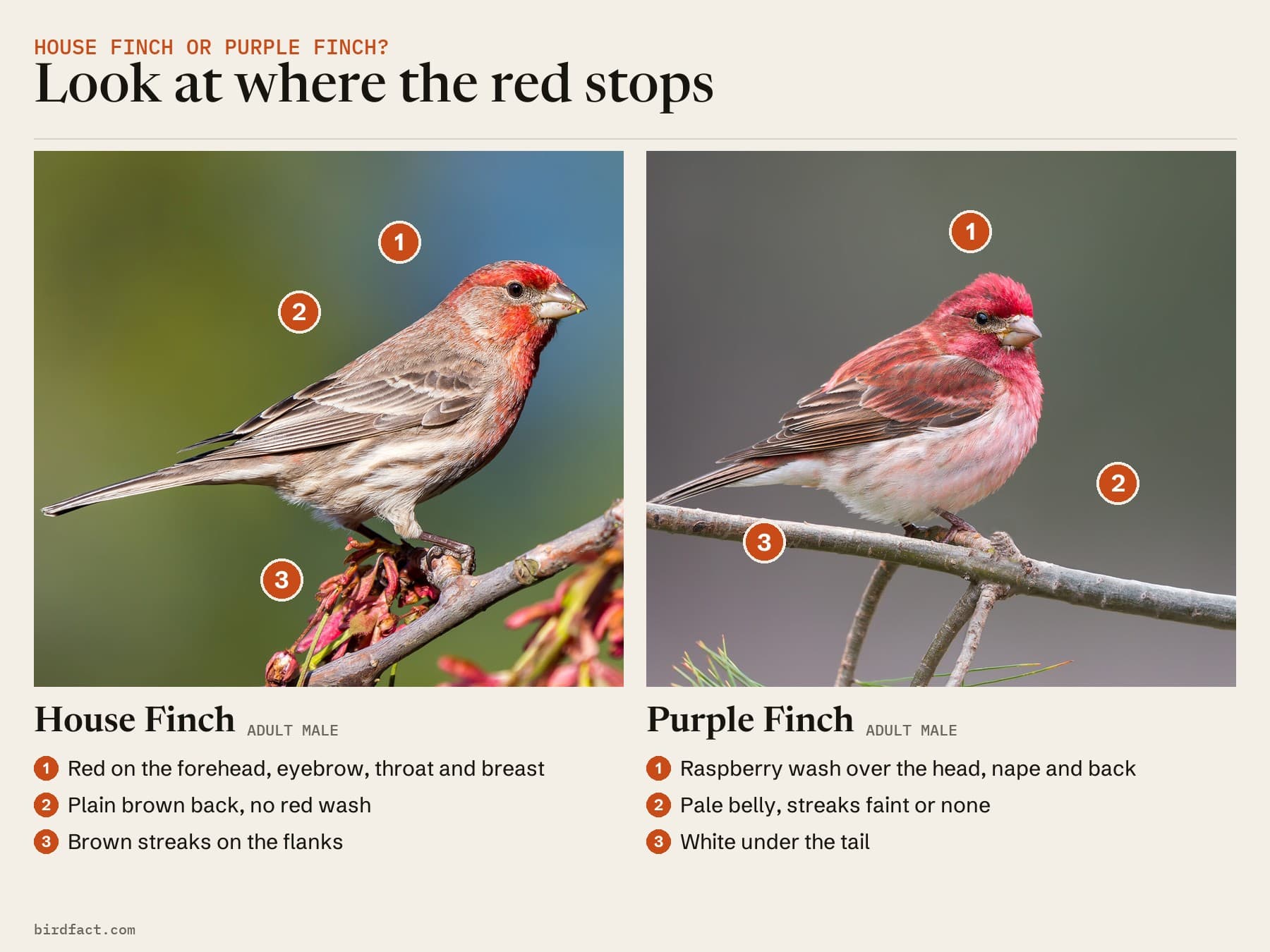
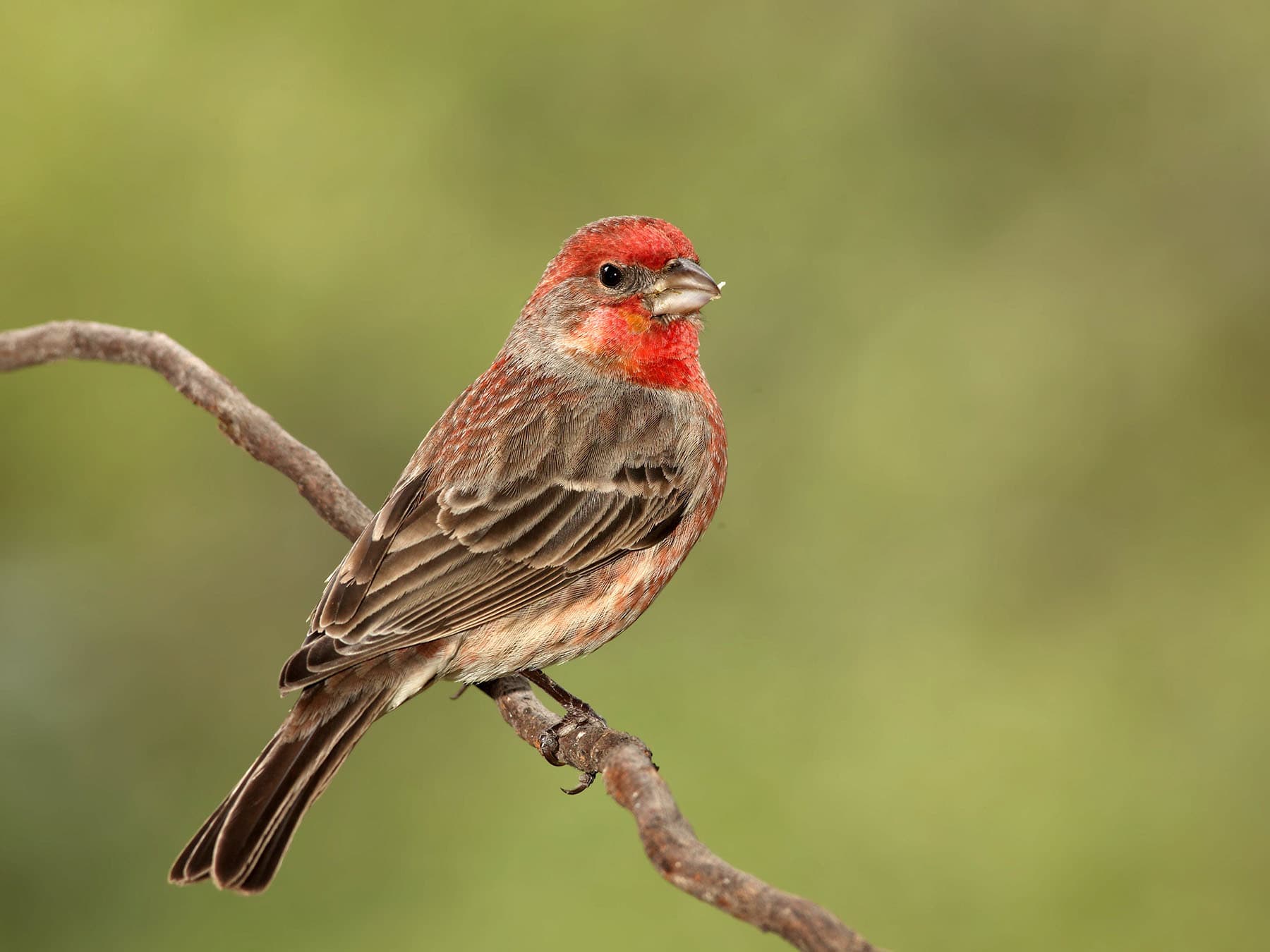
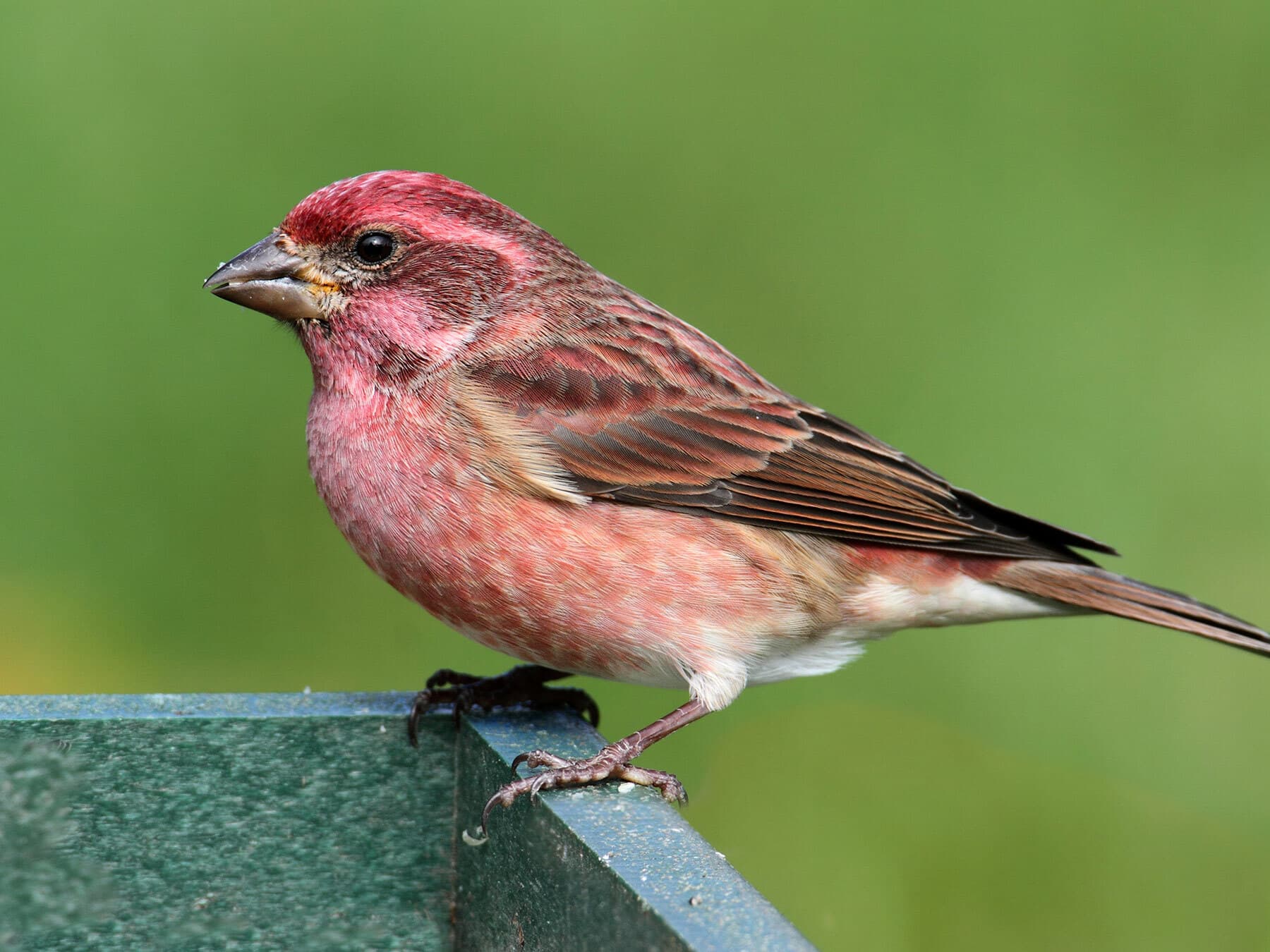
Look at where the red stops. On a male Purple Finch a raspberry-pink wash covers the whole head, the back of the neck and the back, and the belly is plain whitish. On a male House Finch the red is mainly on the forehead, the stripe over the eye, the throat and the breast (and the rump), with no red wash on his brown back and brown streaks down the flanks.1 Females have little or no red: a female Purple Finch has a bold white eyebrow and a dark cheek patch, a female House Finch a plain, unmarked face.
Where and when helps too. House Finches live in towns and backyards across most of the US all year. Purple Finches breed in northern and Pacific Coast forests and turn up in eastern and southern backyards mostly in winter, common one year and scarce the next.2
The quickest clues
- Male color: raspberry over head, nape and back (Purple); red mainly on the head and breast, brown back (House).
- Flanks and belly: plain or faintly streaked (Purple); clear brown streaks (House).
- Female face: white eyebrow, dark cheek, white stripe below it (Purple); plain (House).
- Female streaks: short, thick streaks on bright white (Purple); long, thin, blurry streaks on dull white (House).
- Under the tail: usually plain white (Purple); broad dark streaks (House).
- Shape: plumper, with a short, deeply notched tail (Purple); slimmer, with a longer, barely notched tail (House).
- Bill: larger, with a top edge that is only slightly curved (Purple); small and stubby, with a strongly curved top edge (House).
- Call: a sharp pik (Purple); a chirpy cheep (House).
Size and shape
They are almost the same size, so size alone will not settle it. All About Birds gives the Purple Finch as 4.7 to 6.3 inches (12-16 cm) long and 0.6 to 1.1 oz (18-32 g).3 Audubon gives the House Finch as 5 to 6 inches (13-15 cm) and 0.6 to 1 oz (17-28 g).4
Shape is more useful. A Purple Finch is plump, with a fairly large head that can look peaked at the back and a short tail with a deep notch. A House Finch is slimmer, with a rounder head and a longer tail that is only slightly notched.1 Look at the bill in profile, too: the House Finch's is small, with a top edge that curves down strongly, while the Purple Finch's is bigger, with a top edge that is only slightly curved.2
Males
A male Purple Finch looks evenly washed with raspberry pink-red, from the crown down the back of the neck and over the back, with the darker cheek and the pale stripe over the eye both tinted the same color. The wash fades into a whitish belly that is plain or only faintly streaked; Birds of the World reports 98% of adult males with no brown streaks below.2
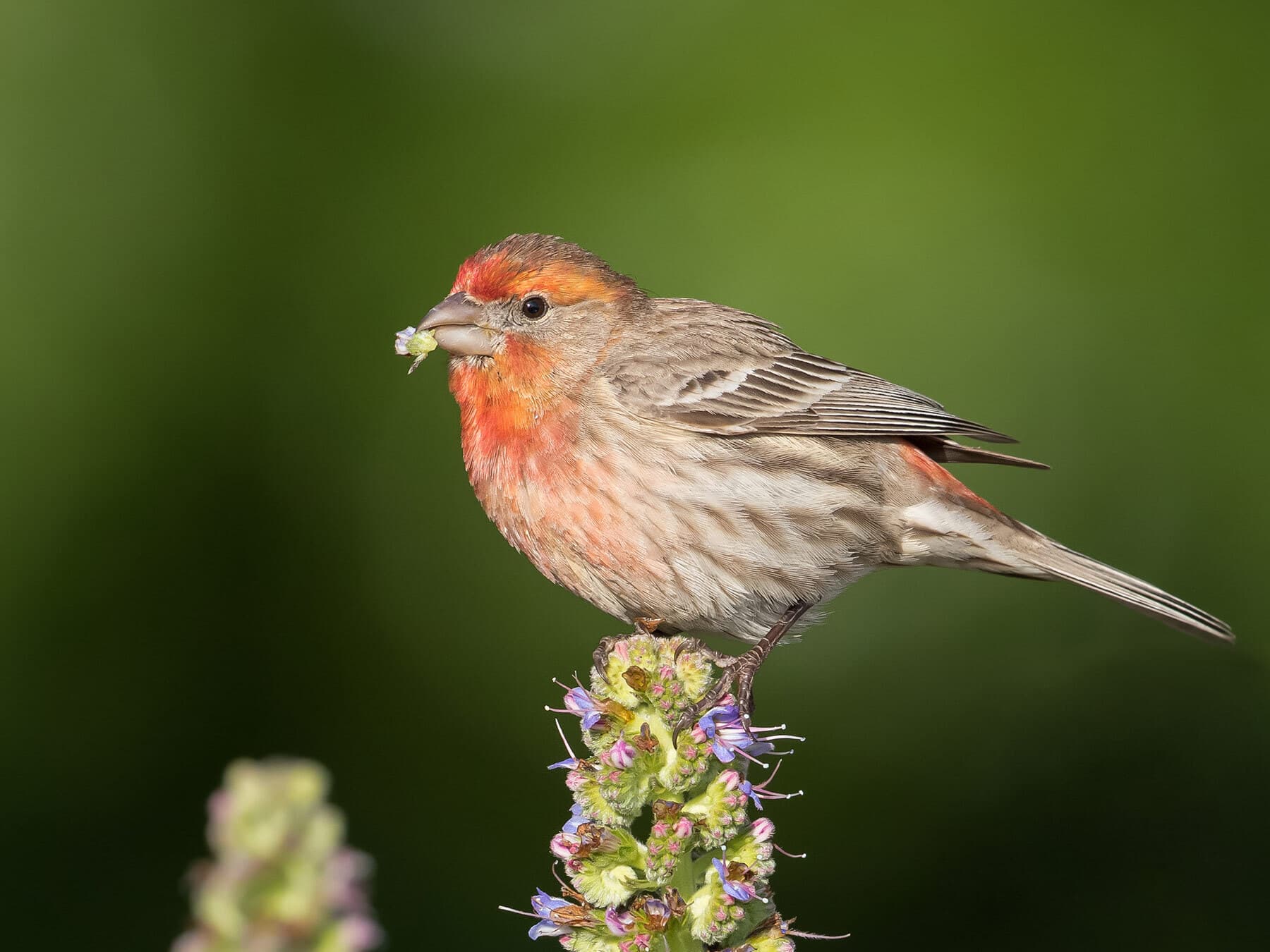
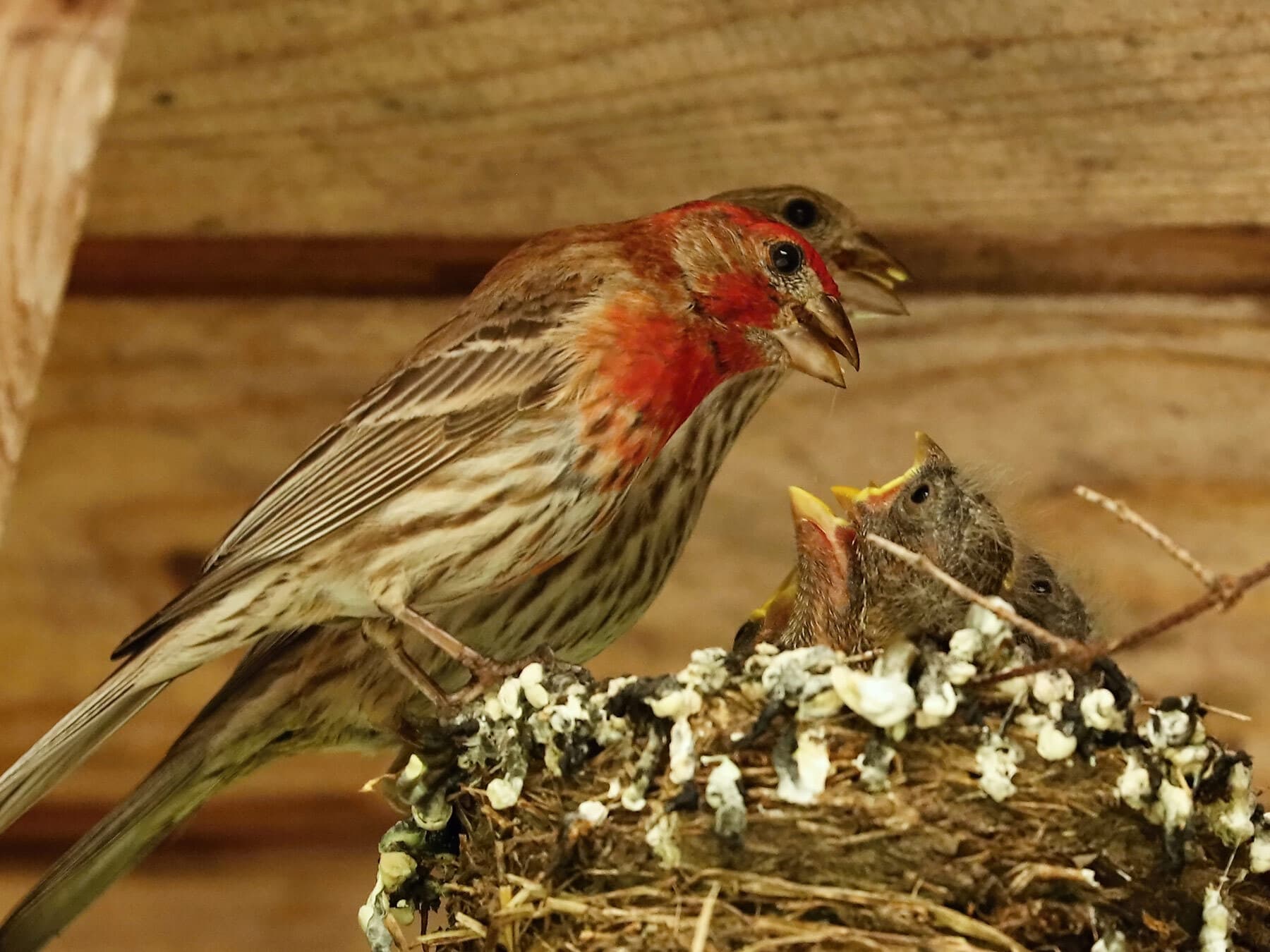
A male House Finch is red, orange or sometimes yellow on the forehead, the eyebrow, the throat and the upper breast, often with a browner crown and cheeks.1 His back and wings are brown, sometimes lightly washed red, and brown streaks run down his sides and belly. His red is usually brighter and more orange than a Purple Finch's rosy tone, though not always.2 His rump is red too, which shows when he flies.5
Females
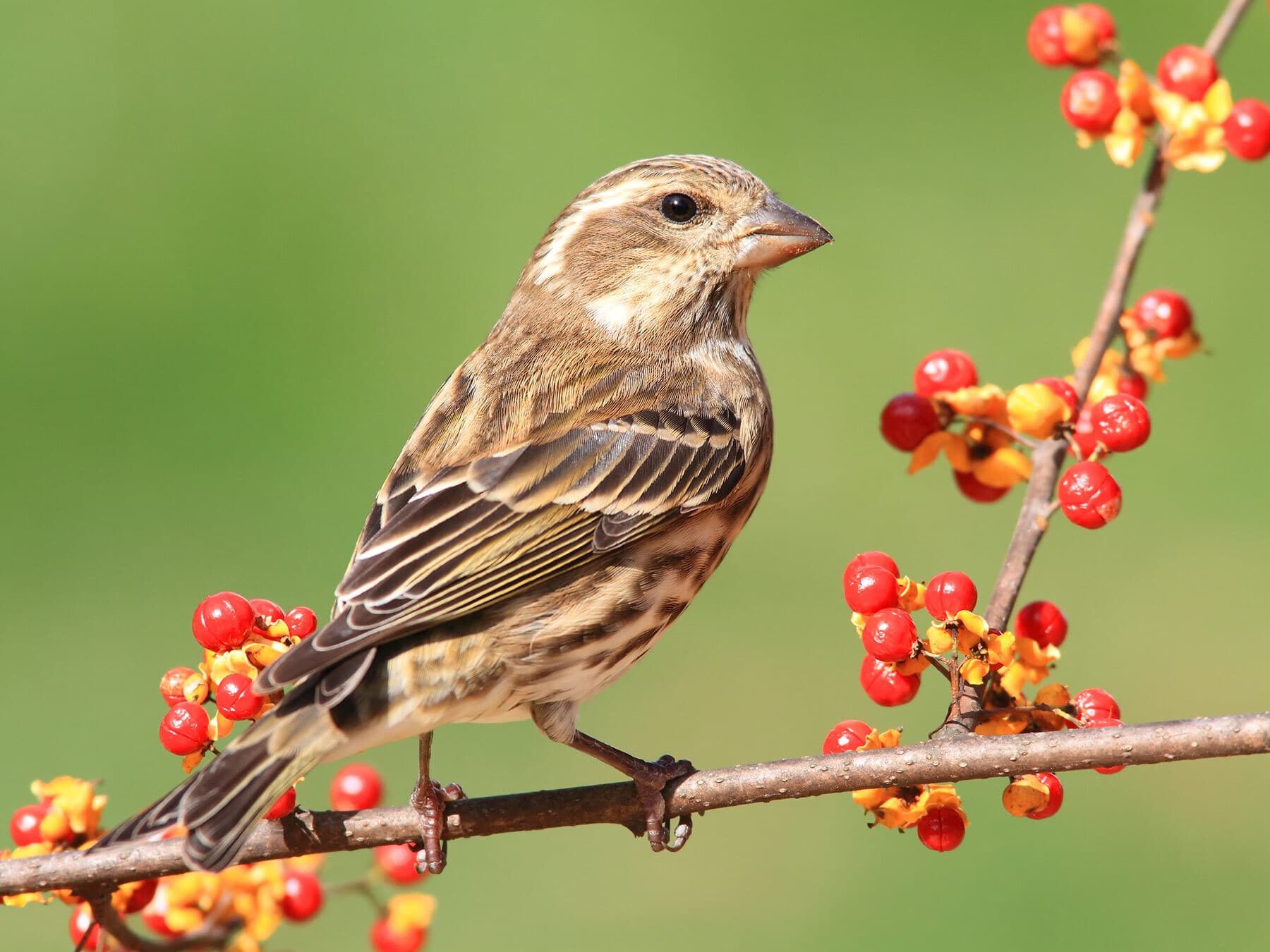
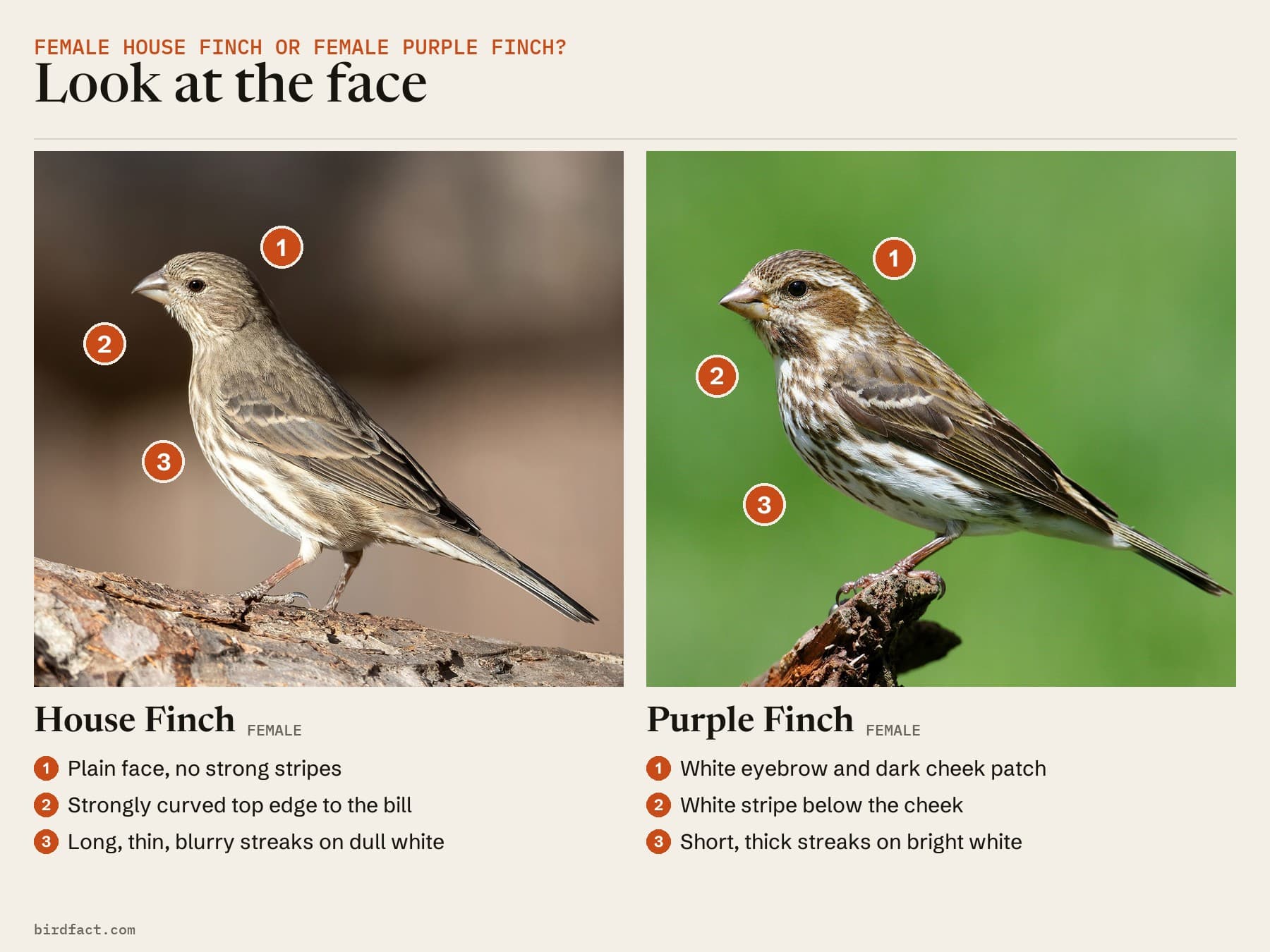
Females are the harder pair. A female Purple Finch has a striped face: a bold white stripe over the eye, a dark brown patch on the cheek, a white stripe below it and a dark stripe running down each side of the throat. Her underparts are bright white, marked with short, thick brown streaks.3, 1
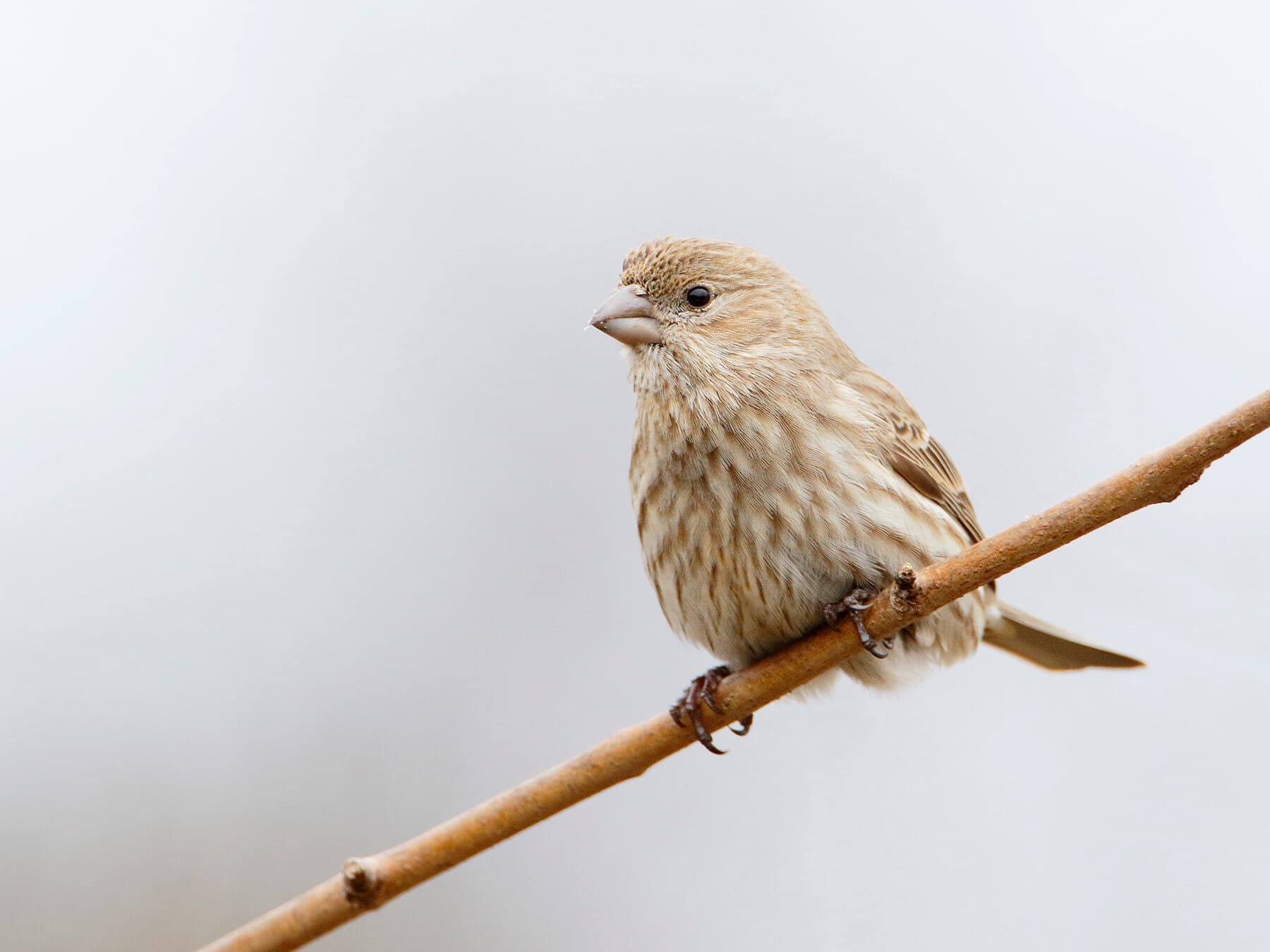
A female House Finch has no strong face pattern at all: her head is plain grayish-brown. Her underparts are a duller white, covered in long, thin, blurry streaks.
On the Pacific Coast, female Purple Finches are duskier and more olive, with less sharply marked streaks and a weaker face pattern, so look harder at the face and under the tail there.
Under the tail
If a bird sits facing away from you, look at the feathers under the tail. On a House Finch they carry broad dark streaks. On a Purple Finch they are usually plain white,1 though Birds of the World notes that about 2% of female Purple Finches have strong streaks there.
Brown "females" that are young males
A first-year male Purple Finch looks like a female: brown, streaked and with the same striped face. He does not turn raspberry until his second summer and fall.2 So a brown Purple Finch singing in spring may be a young male.
House Finches work the other way. In most populations young males molt into red in their first fall, so a brown House Finch in adult plumage is usually a female.6 More on the sexes: male, female and young House Finches.
Songs and calls
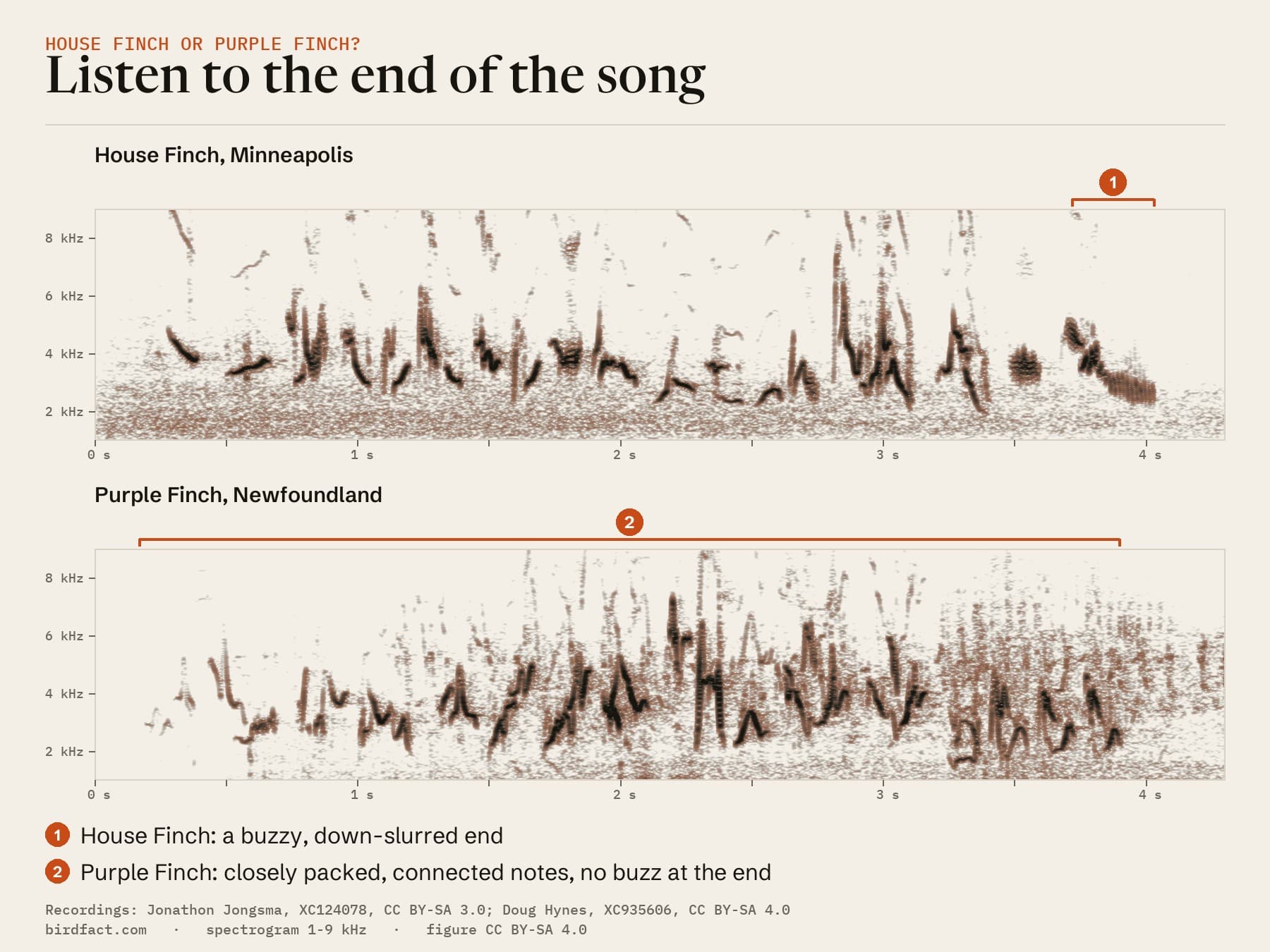
Both sing long, warbling songs, so the song takes practice. Birds of the World describes the House Finch's as slower, harsher and higher than a Purple Finch's, and the downward-slurred last note as the giveaway. In our recordings, the House Finch's songs often end in a buzzy note that slides down, while the Purple Finch's runs on as a fast, smooth warble of notes packed closely together.
The calls are easier. A Purple Finch gives a sharp, single pik, and a sharp tick in flight. A House Finch gives a chirpy cheep. More: House Finch song and calls.
Where and when you'll see each one
House Finch: all year in towns, suburbs, farms and open country across most of the United States and southern Canada, and in deserts and dry open country in the West. More: where House Finches live.
Purple Finch: breeds in cool, moist conifer and mixed forest across Canada, the northern states from Minnesota and Michigan to New England, south in the Appalachians to West Virginia, and in the Pacific states from the Cascades and the Sierra Nevada west. In winter it spreads across much of the eastern US, south to northern Florida and central Texas. In the East, its winter visits come in waves tied to northern conifer cone crops: common one winter and nearly absent the next, often in alternate years.2
So a red finch at a feeder in Texas in July is a House Finch; in Maine in summer, or anywhere in the East after a big flight year, it could be either. In much of the West, the House Finch shares the mountains with Cassin's Finch as well.
At the feeder
Both come to feeders for black-oil sunflower seed.3 Purple Finches also feed high in trees on buds and the seeds of evergreens, elms, tulip trees and maples, while House Finches often stay at a feeder in a noisy group, shelling seed after seed.
Where the two meet, the House Finch can dominate: at one Virginia feeder in winter 1985-86, Purple Finches lost 90.9% of 444 encounters with House Finches.7, 2
Both can catch the bacterial eye infection that has spread through House Finches since 1994, though it is rare in Purple Finches.8, 9 More: House Finch eye disease.
Nests and eggs side by side
Nesting habits differ more than looks do. Most Purple Finches build on a conifer branch, away from the trunk: 79% of 435 nests in one summary, though Pacific Coast birds nest away from conifers far more often than eastern ones.2 House Finches nest almost anywhere, in trees, shrubs, cacti, hanging plants and on buildings.6
| House Finch | Purple Finch | |
|---|---|---|
| Length | 5-6 in (13-15 cm) | 4.7-6.3 in (12-16 cm) |
| Body weight | 0.6-1 oz (16-28 g) | 0.6-1.1 oz (18-32 g) |
| Breeds in | towns, farms, deserts, open woods | conifer and mixed forest |
| Nest | trees, shrubs, cacti, buildings | usually a conifer branch (more varied on the Pacific Coast) |
| Eggs | 2-7, usually 4-5 | 2-7, usually 4 |
| Incubation | 13-14 days | 12-13 days |
| Young leave the nest | 12-15 days after hatching | 13-16 days after hatching |
| Call | cheep | pik; tick in flight |
Sources for the table: Birds of the World (both species), All About Birds and Audubon.6, 2, 3, 4 More: House Finch nesting.
Cassin's Finch, the third red finch
In the mountains of the West, check for Cassin's Finch too. The male has a bright red crown that stands out against a brown neck and a pinker face, and fine streaks on his flanks. The female is sharply streaked on white, with a weaker face pattern than a female Purple Finch, and streaks under the tail. Cassin's Finch has a longer, nearly straight-edged bill.1
When House Finches were sold as Purple Finches
The two have been mixed up on purpose. When dealers were shipping western House Finches east as cage birds around 1940, Richard Pough of the National Audubon Society phoned New York dealers, and one wholesaler said the birds could be sold as Purple Finches, a way around the migratory bird treaty, as Elliott and Arbib reported.10 The trade was stopped, and the eastern House Finches of today are thought to descend from birds released then.
About the recordings
Both songs in the figure were recorded by people who saw the bird singing and did not use playback.11 Western Purple Finches sing a faster song than eastern ones, so a Pacific Coast bird may sound different from the Newfoundland bird here.
Sources
- Project FeederWatch (Cornell Lab of Ornithology and Birds Canada). Tricky Bird IDs: Cassin's Finch, House Finch and Purple Finch. Project FeederWatch. Accessed 11 October 2026. Source
- Wootton, J. T. (2020). Purple Finch (Haemorhous purpureus), version 1.0. Birds of the World (A. F. Poole and F. B. Gill, editors). Cornell Lab of Ornithology. doi:10.2173/bow.purfin.01
- Cornell Lab of Ornithology. Purple Finch Identification. All About Birds. Accessed 11 October 2026. Source
- National Audubon Society (text: Kaufman, Lives of North American Birds). House Finch. Audubon Guide to North American Birds. Accessed 11 October 2026. Source
- Cornell Lab of Ornithology. House Finch: Overview, Identification and Life History. All About Birds. Accessed 11 October 2026. Source
- Badyaev, A. V., Belloni, V., Hill, G. E. (2020). House Finch (Haemorhous mexicanus), version 1.0. Birds of the World (A. F. Poole, editor). Cornell Lab of Ornithology. doi:10.2173/bow.houfin.01
- Shedd, D. H. (1990). Aggressive interactions in wintering House Finches and Purple Finches. Wilson Bulletin 102: 174-178. Accessed 11 October 2026.
- Hartup, B. K., Kollias, G. V., Ley, D. H. (2000). Mycoplasmal conjunctivitis in songbirds from New York. Journal of Wildlife Diseases 36(2): 257-264. doi:10.7589/0090-3558-36.2.257
- Heisman, R. (2017). House Finch Eye Disease: Outbreak, Then Understanding. Living Bird (All About Birds), Winter 2017. Accessed 11 October 2026. Source
- Elliott, J. J., Arbib, R. S., Jr. (1953). Origin and status of the House Finch in the eastern United States. The Auk 70: 31-37. doi:10.2307/4081056
- Jongsma, J., Hynes, D., Nolan, D., xeno-canto and iNaturalist contributors. Recordings used on the House Finch song and comparison pages. xeno-canto; iNaturalist. Accessed 11 October 2026. Source