Published 11 Oct 2026
House Finch Song and Calls: What They Sound Like
By the Birdfact teamChecked by Nathan Cope
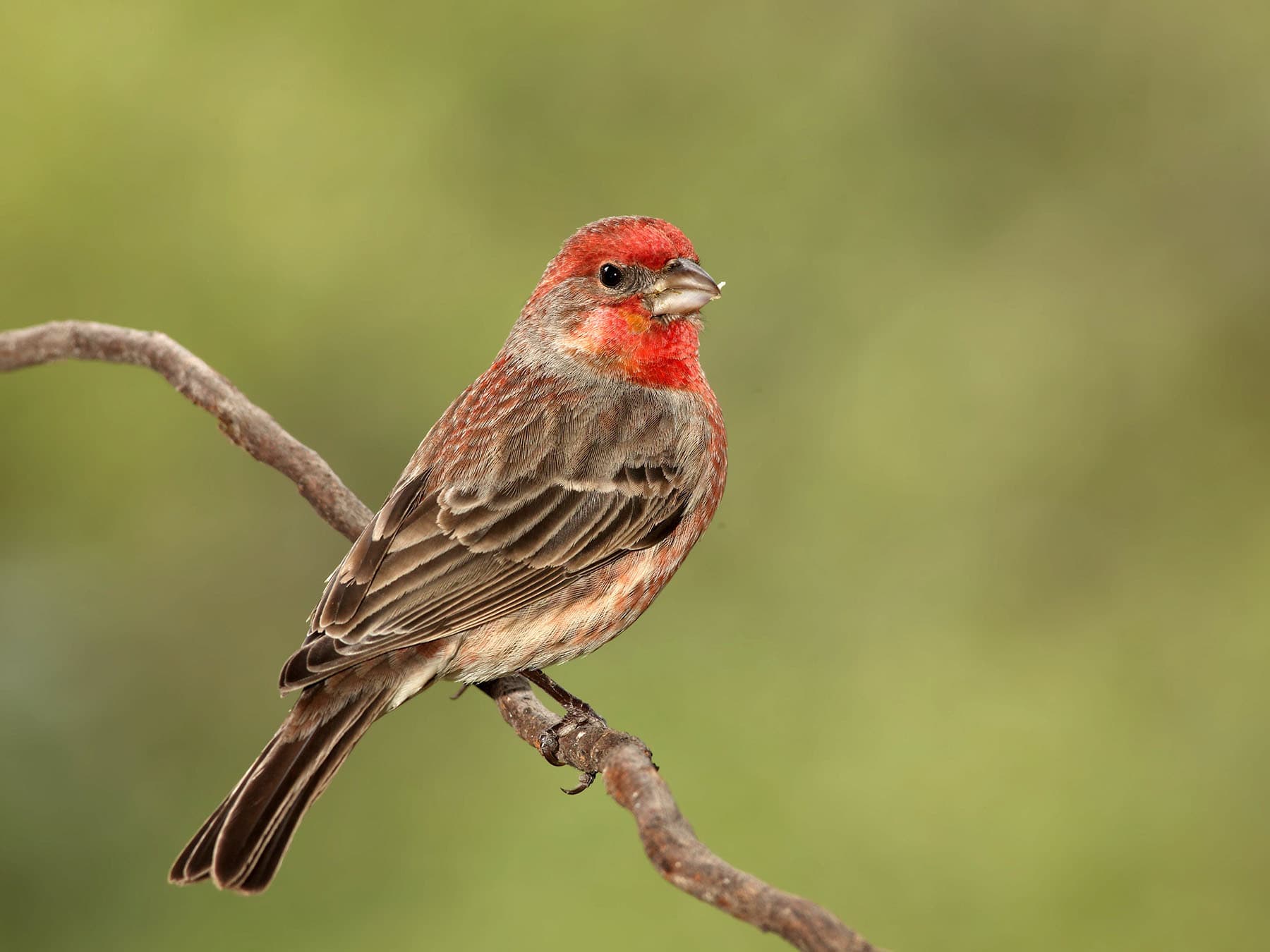
The House Finch sings a fast, jumbled warble of high and low notes, often ending in a buzzy note that slides down; its call is a chirpy cheep. Hear recordings, see the song drawn as a spectrogram, and learn when they sing, whether females sing, and how the song has changed.
On this page13 sections
- What the song sounds like
- Songs with and without a buzz
- Calls
- When House Finches sing
- Where they sing, and the courtship song
- Do female House Finches sing?
- Why the song matters to females
- Learning, neighbors and dialects
- Four decades of change on Long Island
- Singing in the city
- House Finch or Purple Finch?
- About the recordings
- Sources
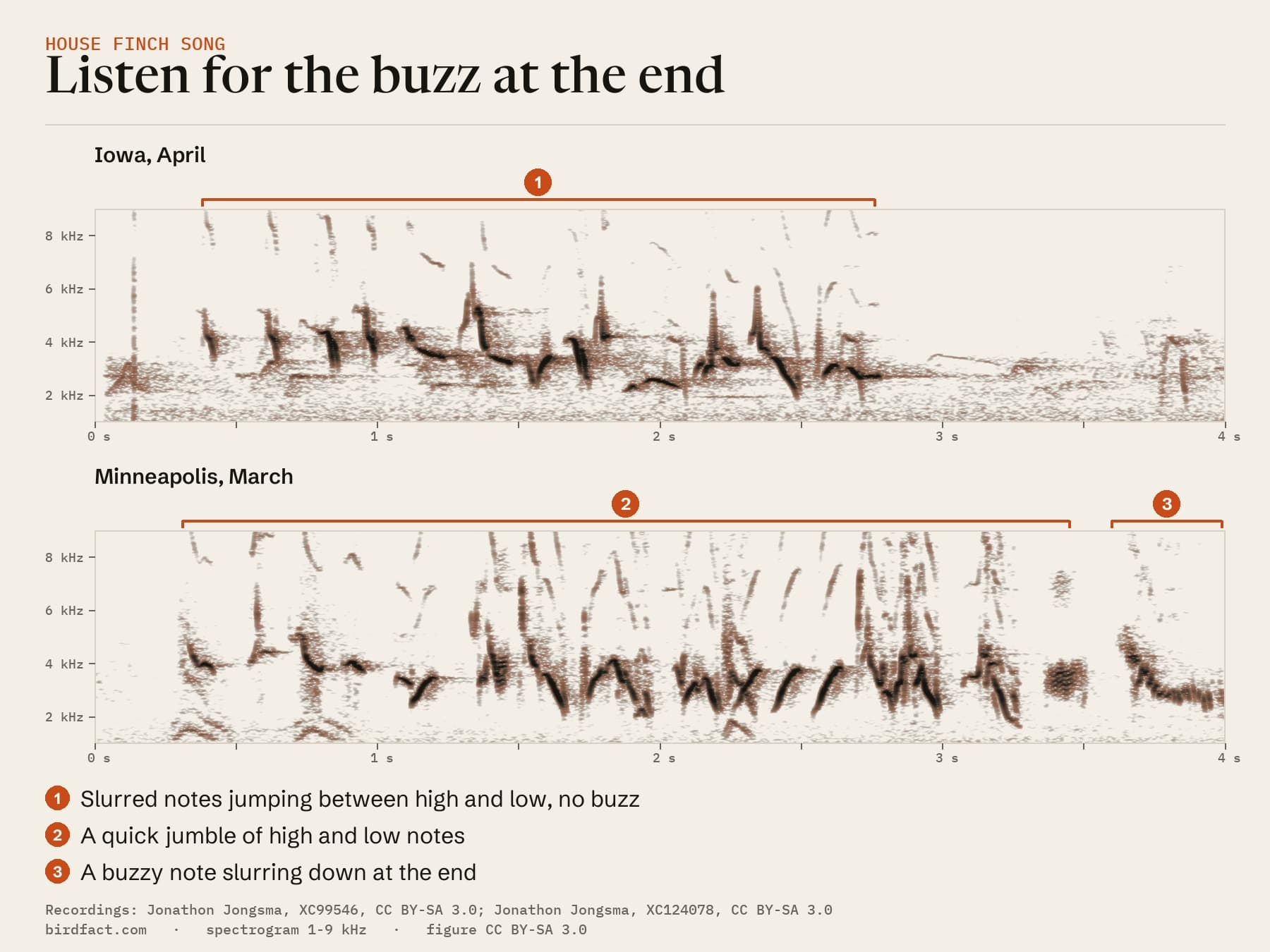
The House Finch's song is a long, fast warble that jumps between high and low notes, usually about 2 to 3 seconds long, and often ends in a buzzy note that slides downward. Males sing it from rooftops, wires and treetops all year except during the molt, from late July to October. The call, given by both sexes, is a short, chirpy cheep.1
What the song sounds like
Listen for a jumble of slurred notes, some high and thin, some low and burry, run together quickly. Birds of the World describes a hoarse warble that flips quickly from high notes to low, and often finishes on a note that slurs downward. The song varies a great deal, both between males and from one song to the next by the same male.
How long a song lasts depends on where you are. Typical songs last about 2 seconds in California and 2 to 3 seconds in Wisconsin; in central Alabama they ranged from half a second to 11.6 seconds, averaging just under 3, with 4 to 10 songs a minute.1 In our two recordings, the Iowa song lasts about 2.4 seconds and the Minneapolis songs about 3.7.
Songs with and without a buzz
House Finch songs come in two kinds: those with a buzzy syllable, usually the last one, and those without. In western Montana, 375 of 555 songs from 20 males had the buzz. Buzz songs were longer, about 14 syllables against 10.5, and were sung mainly in the breeding season and only from perches; songs without a buzz were heard all year and often in flight.1, 2 The two songs in the figure show one of each.
Calls
The common call is a sharp cheep, given singly or in a string by males and females, perched and in flight, mostly to keep in touch with a mate or flock. A bird flushed from the ground gives a sharper note.1 The recording below is a pair calling to each other in British Columbia.
When House Finches sing
Adult males sing in every month except during the molt, from late July to October, when only some young males keep singing. Song is quieter and less frequent from October to February, then builds and stays high through the nesting season. In the north, males often fall silent in cold, stormy weather in winter.
Song peaks early in the morning and again toward evening, though you can hear it at any time of day. They do not sing at night.1
Where they sing, and the courtship song
Males usually sing from an open perch: a roof, a wire, a treetop, often near the nest or even from it. Many may sing at once in a winter flock without fighting. Near a female, a male gives a high, excited song with his wings drooped and fluttering, hopping close to her. He also sings in a display flight, climbing on slow wingbeats and gliding back to a perch.
A male sings faster to a female than when no one is near: about 15 songs a minute against 5 to 10.1
Do female House Finches sing?
Yes, though less often than males, mainly early in the breeding season and most often when begging their mate for food. In two New York populations, recorded female songs were just as long and complex as males', though higher-pitched on average and spread over a narrower range of pitch.3 In an older experiment, captive females given testosterone sang 1 or 2 song themes.4
Why the song matters to females
Learning, neighbors and dialects
Young males learn their songs by copying, and late-summer young males often sing poor versions of adult song. Neighbors share many syllables: in Wisconsin, three-quarters of a male's repertoire was shared with at least one neighbor. A male's repertoire is small, 2 to 6 song types in New York and 2 to 10 in southern California. Wild House Finches have even copied the songs of canaries and of White-crowned Sparrows.1
Whether that adds up to dialects depends on the region. In New York, local dialects had sharp boundaries that held from year to year.1 In California there were no clear dialects, but more song types and more varied syllables.4 In northern Colorado, about 63% of 91 males had syllables that best matched those of birds at their own site, and fewer than 5% best matched a site more than 12 miles (20 km) away, a gradual change rather than sharp dialects.5
Four decades of change on Long Island
Western Long Island, thought to be where the eastern House Finches began, has a rare four-decade record of song. Comparing recordings from 1975 and 2012, 37 years apart, researchers found that the song types had completely turned over and only half the syllable types turned up in both years. Song length and pitch range had not changed, but songs in 2012 had fewer syllables, were less consistent from one rendition to the next and differed more between birds.6
Modeling of the same recordings suggests the birds copy syllables with very high accuracy and favor complex syllables.7 And House Finch song follows some of the same statistical laws found in human languages: common syllables are shorter, for example, and longer songs are built from shorter syllables.8
Singing in the city
Traffic noise is low-pitched, and House Finches adjust to it. In an experiment, singing males raised the lowest pitch of their songs when the noise played around them grew louder, and lowered it again when it fell.9 In Arizona, city House Finches had longer, narrower bills than birds in less disturbed areas and sang with a higher lowest note, and the longer a bird's bill, the lower its highest note.10
House Finch or Purple Finch?
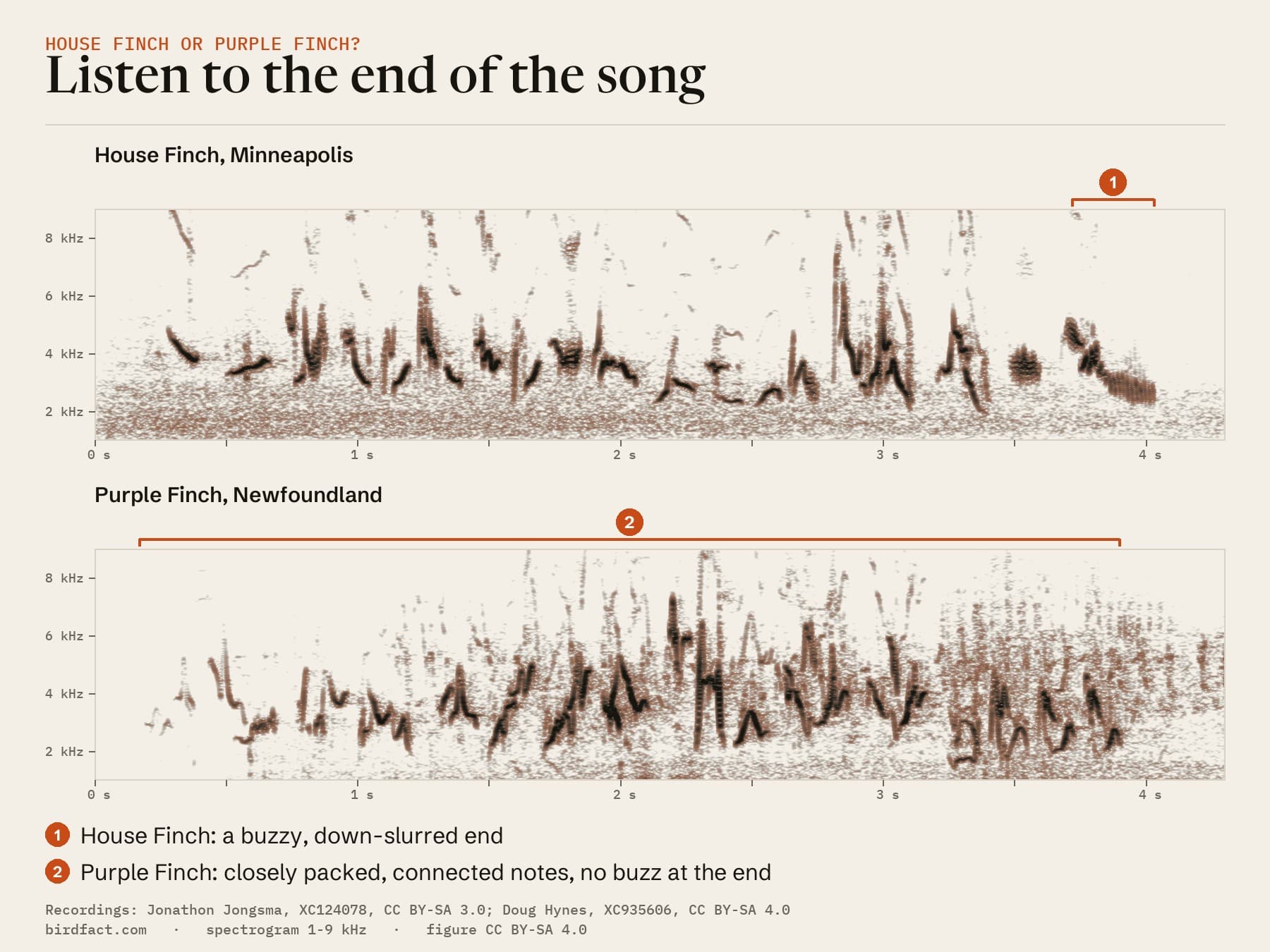
The Purple Finch also sings a long warble, so the two are easy to confuse by ear. Birds of the World describes the House Finch's song as higher and more strident.11 It also calls the House Finch's song slower, harsher and less fluid, with a down-slurred last note.1 In our recordings, the buzzy, downward ending helps; the Purple Finch's song runs on as a smooth, fast warble without it. Their calls differ more: a chirpy cheep from a House Finch, a sharp pik from a Purple Finch. More: House Finch vs Purple Finch and Purple Finch song and calls.
About the recordings
The Iowa and Minneapolis recordings were made by a recordist who saw each singer and did not use playback; the Minneapolis recording was filtered below 1.5 kHz to reduce traffic noise. The calls come from a pair that was also photographed.12 More about the bird: House Finch.
Sources
- Badyaev, A. V., Belloni, V., Hill, G. E. (2020). House Finch (Haemorhous mexicanus), version 1.0. Birds of the World (A. F. Poole, editor). Cornell Lab of Ornithology. doi:10.2173/bow.houfin.01
- Mennill, D. J., Badyaev, A. V., Jonart, L. M., Hill, G. E. (2006). Male House Finches with elaborate songs have higher reproductive performance. Ethology 112: 174-180. doi:10.1111/j.1439-0310.2006.01145.x
- Kornreich, A., Youngblood, M., Mundinger, P. C., Lahti, D. C. (2020). Female song can be as long and complex as male song in wild House Finches. Wilson Journal of Ornithology 132(4): 840-849. doi:10.1676/19-00126
- Bitterbaum, E., Baptista, L. F. (1979). Geographical variation in songs of California House Finches. The Auk 96: 462-474. doi:10.1093/auk/96.3.462
- Baker, M. C. (1999). Geographic variation in syllables of House Finch songs. The Auk 116: 666-676. doi:10.2307/4089328
- Ju, C., Geller, F. C., Mundinger, P. C., Lahti, D. C. (2019). Four decades of cultural evolution in House Finch songs. The Auk 136(1): uky012. doi:10.1093/auk/uky012
- Youngblood, M., Lahti, D. C. (2022). Content bias in the cultural evolution of house finch song. Animal Behaviour 185: 37-48. doi:10.1016/j.anbehav.2021.12.012
- Youngblood, M. (2024). Language-like efficiency and structure in house finch song. Proceedings of the Royal Society B 291: 20240250. doi:10.1098/rspb.2024.0250
- Bermúdez-Cuamatzin, E., Ríos-Chelén, A. A., Gil, D., Macías Garcia, C. (2011). Experimental evidence for real-time song frequency shift in response to urban noise in a passerine bird. Biology Letters 7(1): 36-38. doi:10.1098/rsbl.2010.0437
- Giraudeau, M., Nolan, P. M., Black, C. E., Earl, S. R., Hasegawa, M., McGraw, K. J. (2014). Song characteristics track bill morphology along a gradient of urbanization in house finches. Frontiers in Zoology 11: 83. doi:10.1186/s12983-014-0083-8
- Wootton, J. T. (2020). Purple Finch (Haemorhous purpureus), version 1.0. Birds of the World (A. F. Poole and F. B. Gill, editors). Cornell Lab of Ornithology. doi:10.2173/bow.purfin.01
- Jongsma, J., Hynes, D., Nolan, D., xeno-canto and iNaturalist contributors. Recordings used on the House Finch song and comparison pages. xeno-canto; iNaturalist. Accessed 11 October 2026. Source