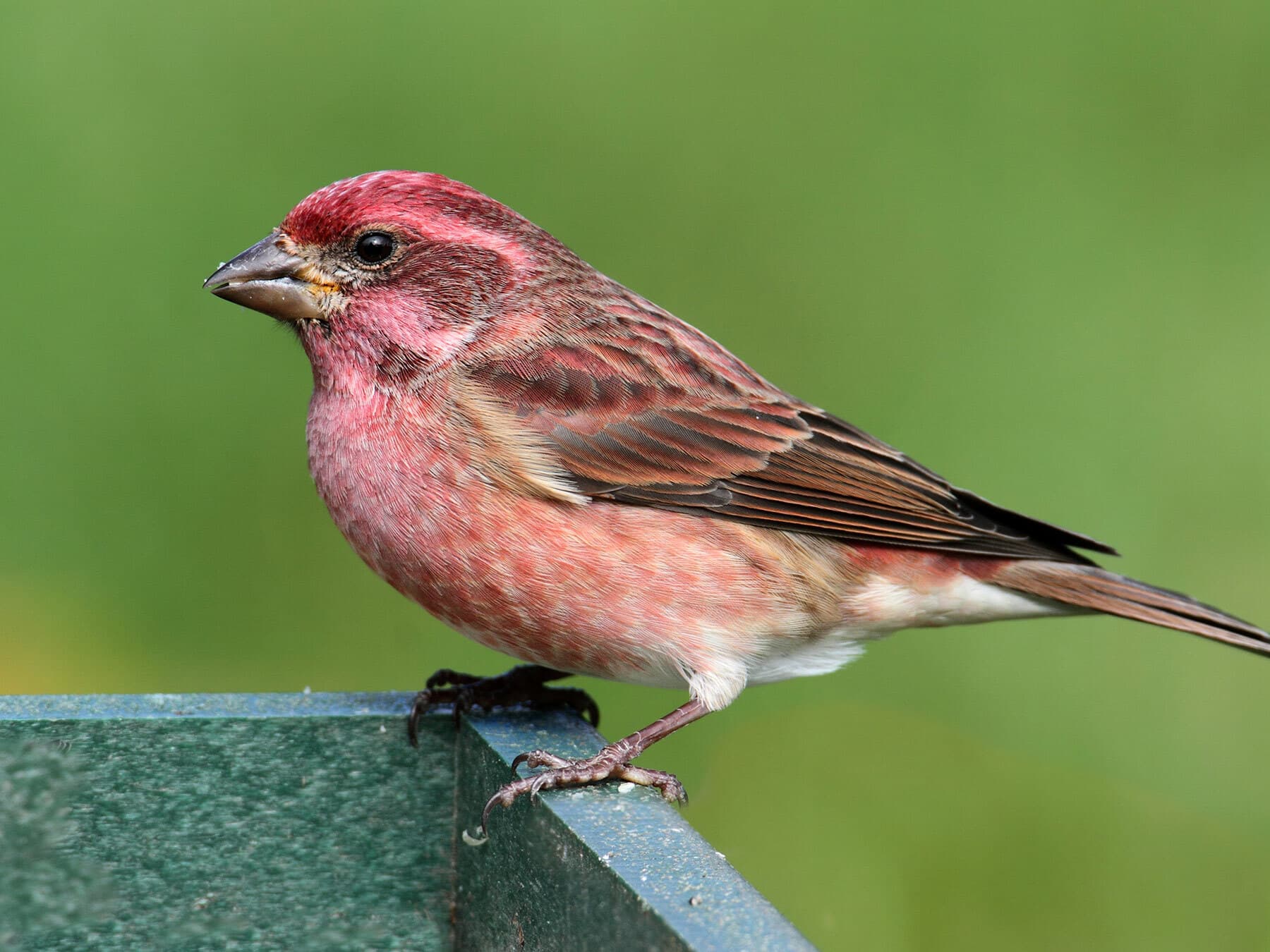
Published 11 Oct 2026
Purple Finch Song and Calls: What They Sound Like
By the Birdfact teamChecked by Nathan Cope
The Purple Finch sings a rich, fast warble of connected notes and calls a sharp pick or tick. Hear recordings, see the song drawn as spectrograms, and learn its three kinds of song, how eastern and western birds differ, whether females sing, and how to tell a House Finch or Cassin's Finch by ear.
On this page17 sections
- What the song sounds like
- The warbling song
- The territory song
- The vireo song
- Calls
- Eastern and western birds call differently
- Eastern and western songs
- When Purple Finches sing
- Where they sing
- Do female Purple Finches sing?
- Young birds
- Mimicry
- Purple Finch or House Finch?
- Purple Finch or Cassin's Finch?
- Song and the cage-bird trade
- About the recordings
- Sources
The Purple Finch sings a rich, musical warble1 of quick, connected notes,2 rising and falling.3 Males usually sing from the top of a tree.4 They sing mainly from late February or early March to July, with a little song again in October and early November. The call is a short, sharp tip or tick,2 and birds in flight give a distinctive tick.1
What the song sounds like
Aretas A. Saunders, whose notes on its song appear in Arthur Cleveland Bent's life histories (1968), called it loud, clear and highly musical, and found that Purple Finches sing in three different ways, more or less by season.2 Birds of the World lists the same three: the warbling song, the territory song and the "vireo" song.4 Saunders thought the warbling song probably the best known.
The warbling song
This is the song of late winter and spring, heard chiefly from February to April. It is a run of 6 to 23 very rapid notes, never two in a row on the same pitch, about seven notes a second, with liquid sounds linking them, so it rolls along as one phrase. The songs Saunders timed lasted 1 to 3.2 seconds. Each song is usually followed, after a short pause, by a different one, and he never heard a bird repeat one exactly.2
Purple Finches often sing it in flocks, with several singing together in a chorus. Birds of the World suggests the flock song may help settle who is dominant, or help females choose a mate.4
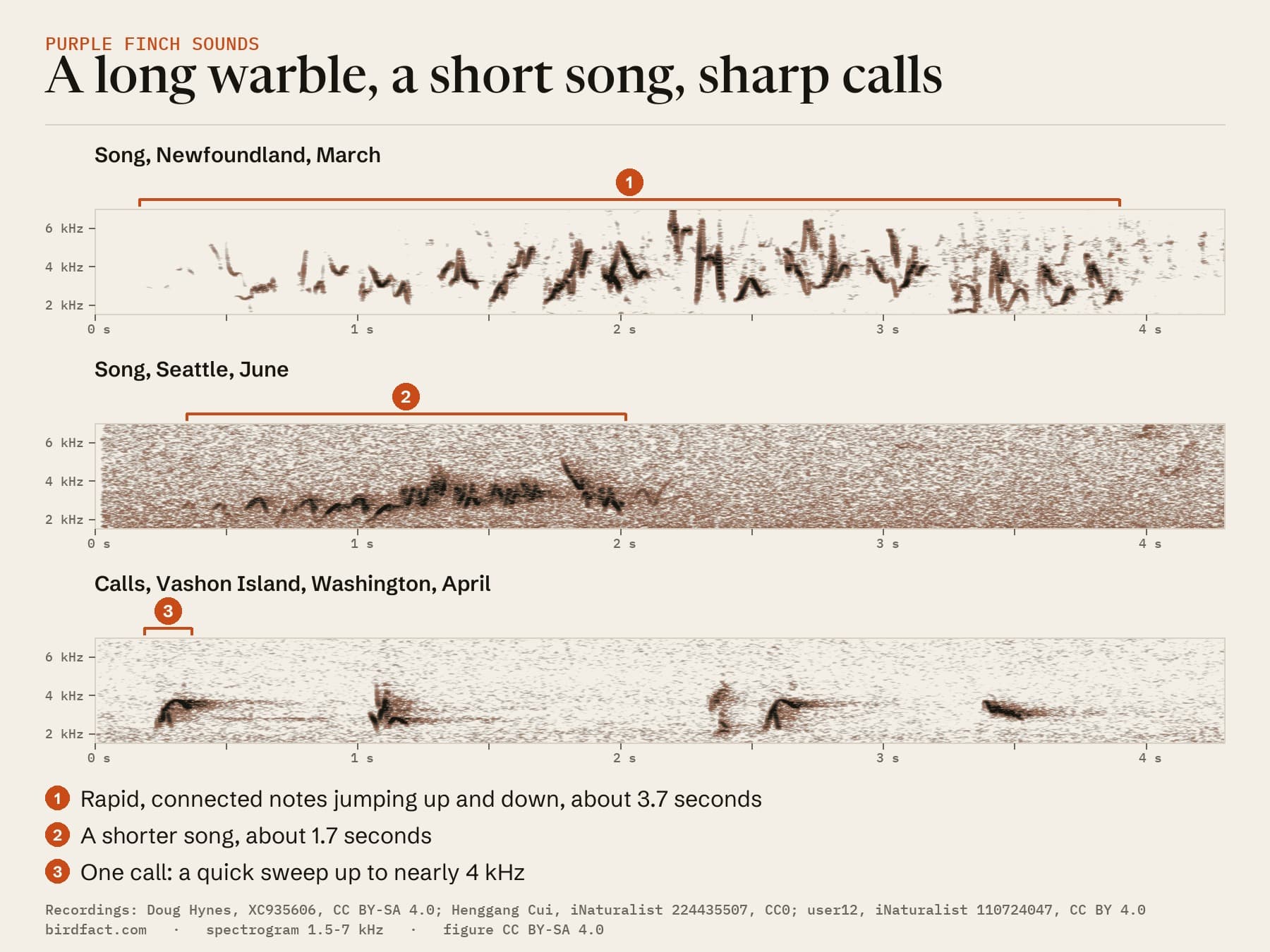
The Newfoundland recording at the top of the page was made in March, the warbling song's season. Its first song is about 3.7 seconds of rapid notes jumping mostly between about 2 and 6 kHz, a little longer than any song Saunders timed, and more runs of song follow.
The territory song
Once pairs split off from the flocks to nest, from late April to July, males switch to the territory song. Near the start it has a quick series of notes all on one pitch, then a few warbled notes, and usually near the end a high, strongly accented note. Unlike the warble, it does not change: a male repeats it the same way each time, often over and over without a pause, much as a Ruby-crowned Kinglet does. Saunders timed these songs at 2.6 to 3.2 seconds, and once watched a bird sing one in flight, wings held up as it floated through the air.2
It is usually sung by a lone male, apparently to mark the boundaries of the nesting territory.4
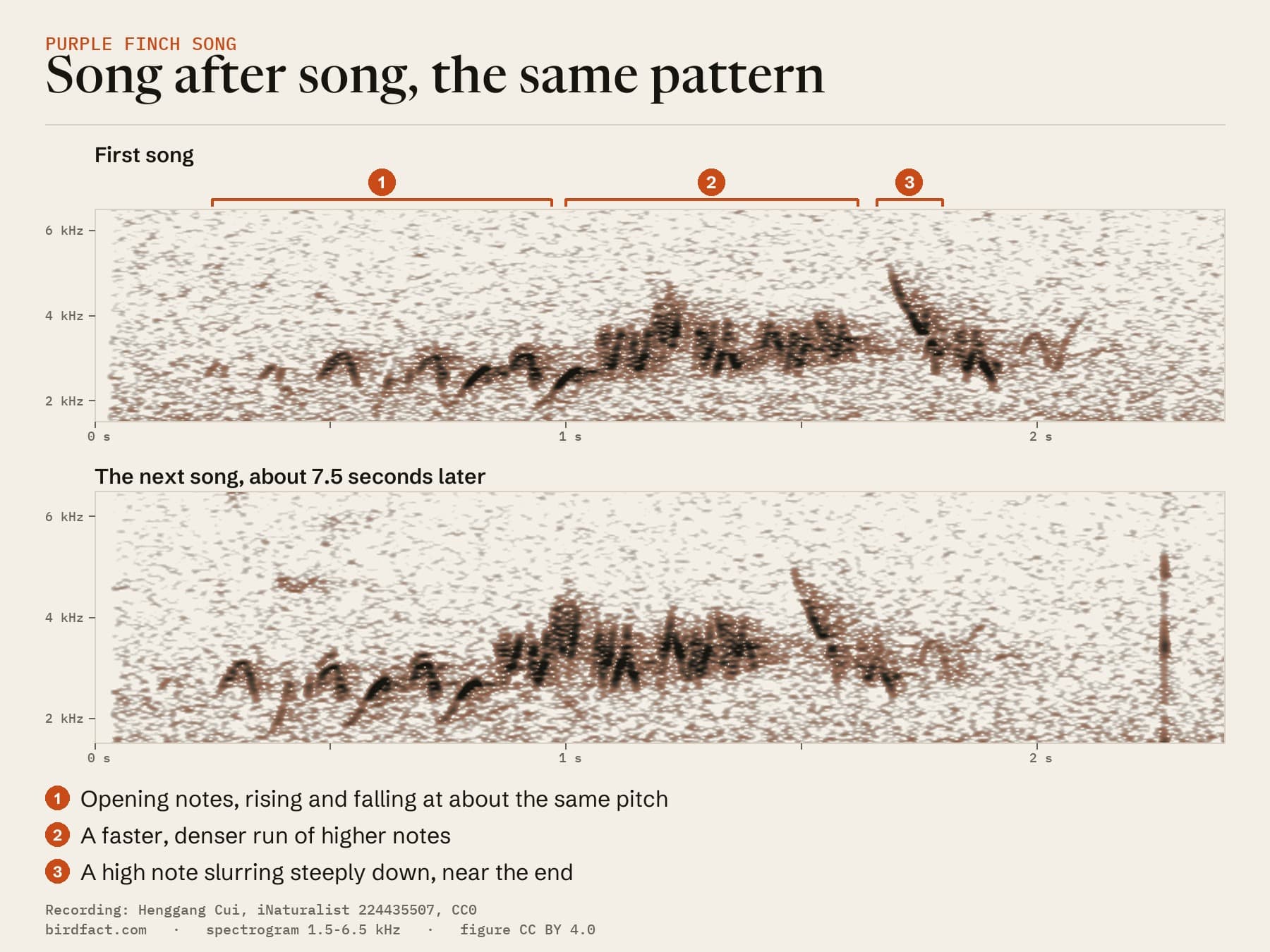
The Seattle male below, recorded in June, sang four songs in 29 seconds, starting every 7.5 to 8 seconds. Three lasted about 1.5 to 1.6 seconds; the third began with two high, down-slurred notes and ran to about 2 seconds. All share the same core pattern: arched notes at about the same pitch, a faster run of higher notes, then a high note slurring steeply down near the end. That resembles Saunders' description of the territory song, though he described eastern birds, and these songs are shorter than the ones he timed; western birds are said to sing faster (see below), but one male cannot show that.
The vireo song
The rarest of the three is made of short phrases of 2 to 5 notes, given one after another with short pauses, like the song of a Red-eyed Vireo. A bird usually alternates only about three different phrases. Saunders heard it mostly in early March and in late October and November.2
Calls
The common call is a single, sharp pick. Birds of the World likens it to the clack of two pairs of scissors struck together.4 Saunders wrote it as tip or tick, All About Birds as a short, low tek. Birds flying over give a sharp tick.4
The recording below is a Purple Finch calling on Vashon Island, Washington, in April. Some calls sweep up from about 2.3 kHz to nearly 4 kHz; others are a near-vertical stroke reaching about 4.5 kHz with a low hook, and a few slope down. Most leave a faint trail, probably an echo, and fainter, more distant notes can be heard too.
Eastern and western birds call differently
There are two forms (subspecies) of Purple Finch: an eastern form that breeds across Canada and the Northeast, and a western form along the Pacific Coast. In 2026 a study of 155 flight calls from 68 birds found that the two give clearly different calls. Eastern birds give a somewhat ringing peet that stays within a narrow band of about 3 to 5 kHz. Western birds give a drier pit that starts lower, at about 2.0 kHz on average against 3.2 kHz for eastern birds, and covers a much wider range of pitch: 1.2 to 11 kHz across the western calls measured. Both calls are very short, about two hundredths of a second.5
The difference is reliable enough that the call alone identified the form in 63 of 68 birds (93%). The five that did not match were all recorded in the West outside the nesting season and measured like eastern birds; the authors think eastern Purple Finches turn up in the Pacific states now and then. Birders had noticed the difference before: in 2013 an eastern Purple Finch on Southeast Farallon Island, off California, was first noticed by its call, a hard, wooden pik rather than the lower, liquid pit of western birds.6
The two forms also differ genetically, and the 2026 study suggests they may be separate species, proposing the names Northern Purple Finch and Pacific Purple Finch if they are split.5 Some of the Washington calls on this page look like the study's western flight calls, though we cannot tell whether they were given in flight, and we have no eastern call recording to set beside them.
Eastern and western songs
Songs differ too. Birds of the World reports that eastern birds' territory songs are slower, with their warbles covering a wider range of pitch, than western birds',4 and All About Birds that Pacific Coast birds sing a faster song.3 The authors of the 2026 call study knew of no formal comparison of the songs.5 Our two song recordings come from each side of the continent, but they are probably different song types, so they cannot show it either.
When Purple Finches sing
Song starts in late winter, often from flocks, and runs to July: the warbling song from February to April, the territory song from late April to July and the vireo song mostly in early March. There is a little song again in October and early November.2 Birds of the World has no information on when in the day they sing most.4
Where they sing
A male usually sings from the top of a tree, often from a regular song perch. One male was even reported singing from the nest.4
Courting males sing too. In one account in Bent's life histories, two males chasing a female landed beside her and sang at full volume with wings and tails spread; in another, a male with a pine needle in his bill, wings quivering, sang a soft, continuous warble for at least a minute and a half.2
Do female Purple Finches sing?
Yes, though female song has been reported only from the nest. A 1967 report describes a female singing a long, finch-like song from the nest, quite unlike the male's, that went on for 1 to 2 minutes. Females on the nest have also been heard giving a whit whewe call.4
Be careful with a brown, streaky bird singing in a treetop, though. First-year males look like females,4 and the one female-plumaged bird Saunders heard singing the vireo song in July was, he thought, probably a young male.2 More on telling them apart: female, male and young Purple Finches.
Young birds
Nestlings and young out of the nest beg with a two-note yo wee, the second note higher. An 1898 account describes young birds listening to their singing father soon after leaving the nest and trying to copy him, in a lower voice.4 Saunders once heard a young male sing a "primitive" song of warbles, trills and repeated notes lasting about 5 seconds.2 More: Purple Finch nesting.
Mimicry
Purple Finches sometimes slip other birds' songs into their own: bits of Barn Swallow, American Goldfinch, Eastern Towhee and Brown-headed Cowbird have all been reported.4 Francis H. Allen heard one male in West Roxbury, Massachusetts, on 9 May 1939, sing a medley of goldfinch notes with a towhee's call, a fast, beady trill like a towhee's and a long, high note like a cowbird's.2
Cassin's Finch, its western mountain cousin, goes further: its longer songs finish with a run of other birds' calls, imitated.7
Purple Finch or House Finch?
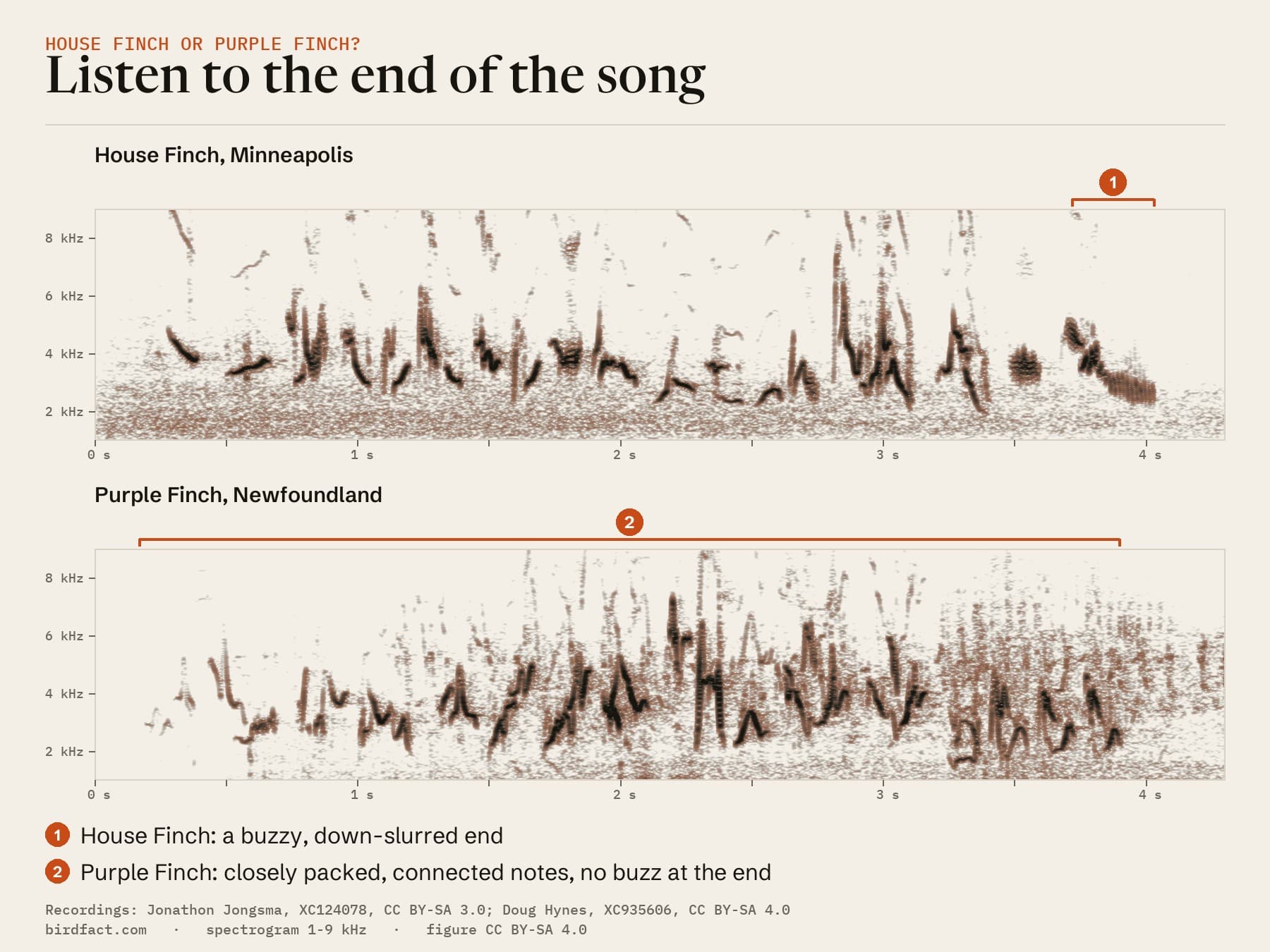
The House Finch also sings a long, warbling song. A House Finch's song is higher and more strident than a Purple Finch's,4 and slower, harsher and less fluid, often ending in a buzzy, down-slurred note;8 Audubon writes the ending as a zeee.9
The calls differ too: a sharp pick from a Purple Finch, a harsh whistled wheet4 or a chirp like a young House Sparrow's from a House Finch.9 More: House Finch song and calls and House Finch vs Purple Finch.
Purple Finch or Cassin's Finch?
In the mountains of the West, Cassin's Finch sings a longer, more varied warble than the Purple Finch,4 flutier to some ears,10 and its longer songs end with imitations of other birds' calls.7 Its call is a multi-note tidilip, though Purple Finches occasionally give a call like it too.4, 7 Cassin's Finch males stop singing within a day or two of their mates starting a nest, and populations seem to fall silent by mid to late July.7
Song and the cage-bird trade
Purple Finches were once trapped as cage birds. Bent recalled that when he was a boy, in the 1870s, they made attractive pets because they sang well in captivity, and that it was easy to catch every Purple Finch in the neighborhood in a cage trap baited with a singing male; the trade was later stopped in the United States.2 Today the Purple Finch is protected under the Migratory Bird Treaty Act.11
About the recordings
The Newfoundland song was recorded by someone who saw the bird and did not use playback. The Seattle male was identified by the recordist and two other users and photographed. The calls from Vashon Island were identified by the recordist, who described the observation (two sound files) as Purple Finch calls and songs, and by one other user; the bird was not photographed. The trill in the background is a Yellow-rumped Warbler, which the recordist saw (another user agreed). Other sounds can be heard faintly in the Seattle recording, including a whistle just before the third song.12 More about the bird: Purple Finch.
Sources
- National Audubon Society (text: Kaufman, Lives of North American Birds). Purple Finch. Audubon Guide to North American Birds. Accessed 11 October 2026. Source
- Bent, A. C. (1968). Eastern Purple Finch (voice by A. A. Saunders, pp. 273-274). In Life histories of North American cardinals, grosbeaks, buntings, towhees, finches, sparrows, and allies, part 1 (O. L. Austin Jr., editor). United States National Museum Bulletin 237. Smithsonian Institution Press. Accessed 11 October 2026. Source
- Cornell Lab of Ornithology. Purple Finch: Overview, Identification, Life History and Sounds. All About Birds. Accessed 11 October 2026. Source
- Wootton, J. T. (2020). Purple Finch (Haemorhous purpureus), version 1.0. Birds of the World (A. F. Poole and F. B. Gill, editors). Cornell Lab of Ornithology. doi:10.2173/bow.purfin.01
- Robinson, W. D., Kuang, Y., Wigger, L. M., Hahn, T. P., Young, M. A. (2026). Flight calls of Eastern and Western Purple Finches (Haemorhous purpureus) are diagnostically different. Frontiers in Bird Science 5: 1770303. doi:10.3389/fbirs.2026.1770303
- Rutt, C. L., Pyle, P., Collins, P. W., Brady, M. L., Tietz, J. R., Dunn, J. L. (2014). The nominate subspecies of the Purple Finch in California and western North America. Western Birds 45(4): 284-295. doi:10.21199/wb45.4.3
- Hahn, T. P. (2020). Cassin's Finch (Haemorhous cassinii), version 1.0. Birds of the World (A. F. Poole and F. B. Gill, editors). Cornell Lab of Ornithology. doi:10.2173/bow.casfin.01
- Badyaev, A. V., Belloni, V., Hill, G. E. (2020). House Finch (Haemorhous mexicanus), version 1.0. Birds of the World (A. F. Poole, editor). Cornell Lab of Ornithology. doi:10.2173/bow.houfin.01
- National Audubon Society (text: Kaufman, Lives of North American Birds). House Finch. Audubon Guide to North American Birds. Accessed 11 October 2026. Source
- National Audubon Society (text: Kaufman, Lives of North American Birds). Cassin's Finch. Audubon Guide to North American Birds. Accessed 11 October 2026. Source
- U.S. Fish and Wildlife Service. List of birds protected by the Migratory Bird Treaty Act. Code of Federal Regulations, 50 CFR 10.13. Accessed 11 October 2026. Source
- Hynes, D., Cui, H., user12, xeno-canto and iNaturalist contributors. Recordings used on the Purple Finch song page. xeno-canto; iNaturalist. Accessed 11 October 2026. Source