


Purple Finch
Haemorhous purpureus
By the Birdfact teamChecked by Nathan Cope
On this page15 sections
How to recognise it
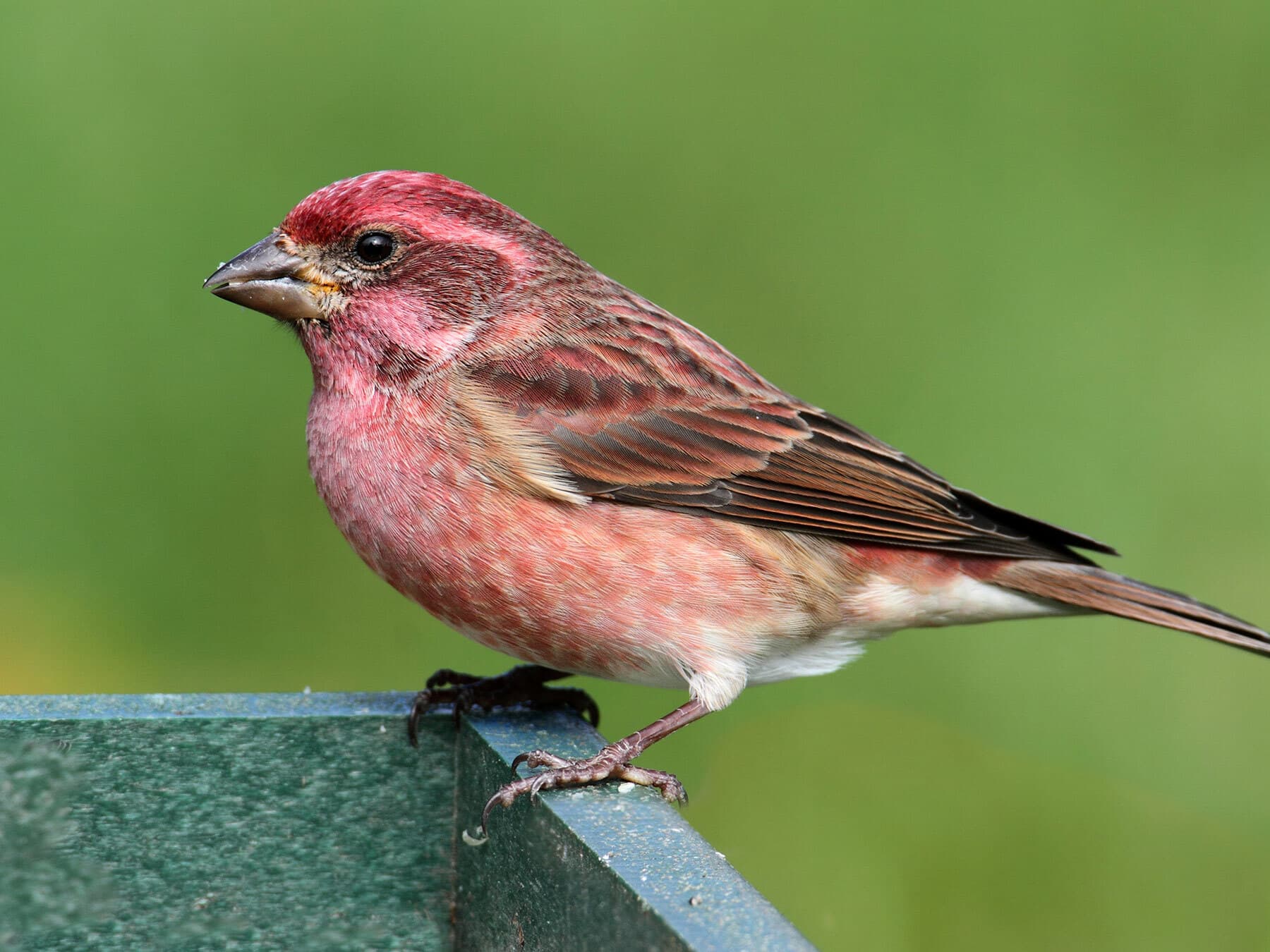
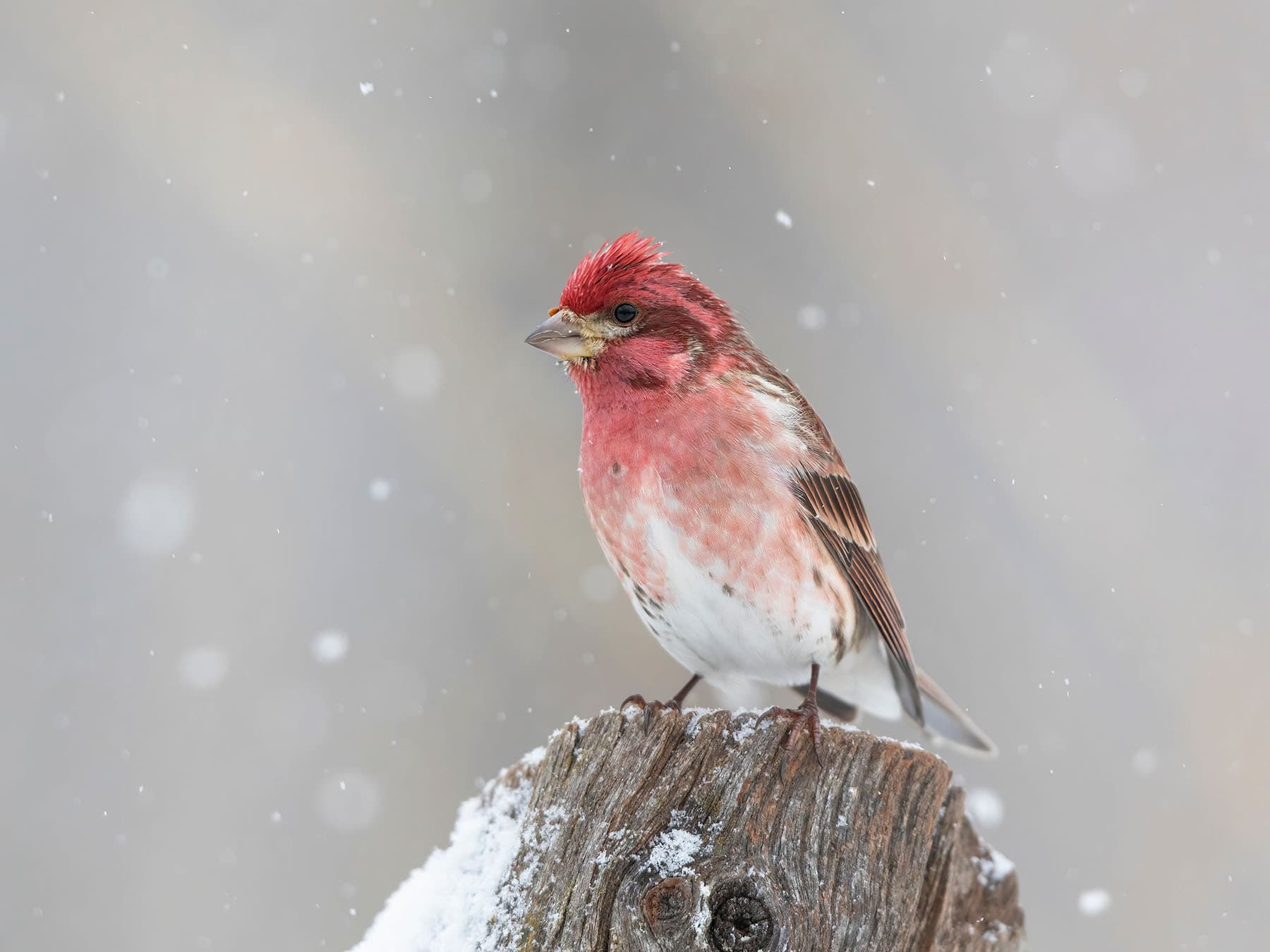
A Purple Finch is about the size of a House Finch or a House Sparrow: 4.7 to 6.3 inches (12-16 cm) long and 0.6 to 1.1 ounces (18-32 g).1 It is chunky for a small bird, with a fairly large head that can look peaked,2 a big conical bill with only a slight curve along the top, and a short, clearly notched tail.3
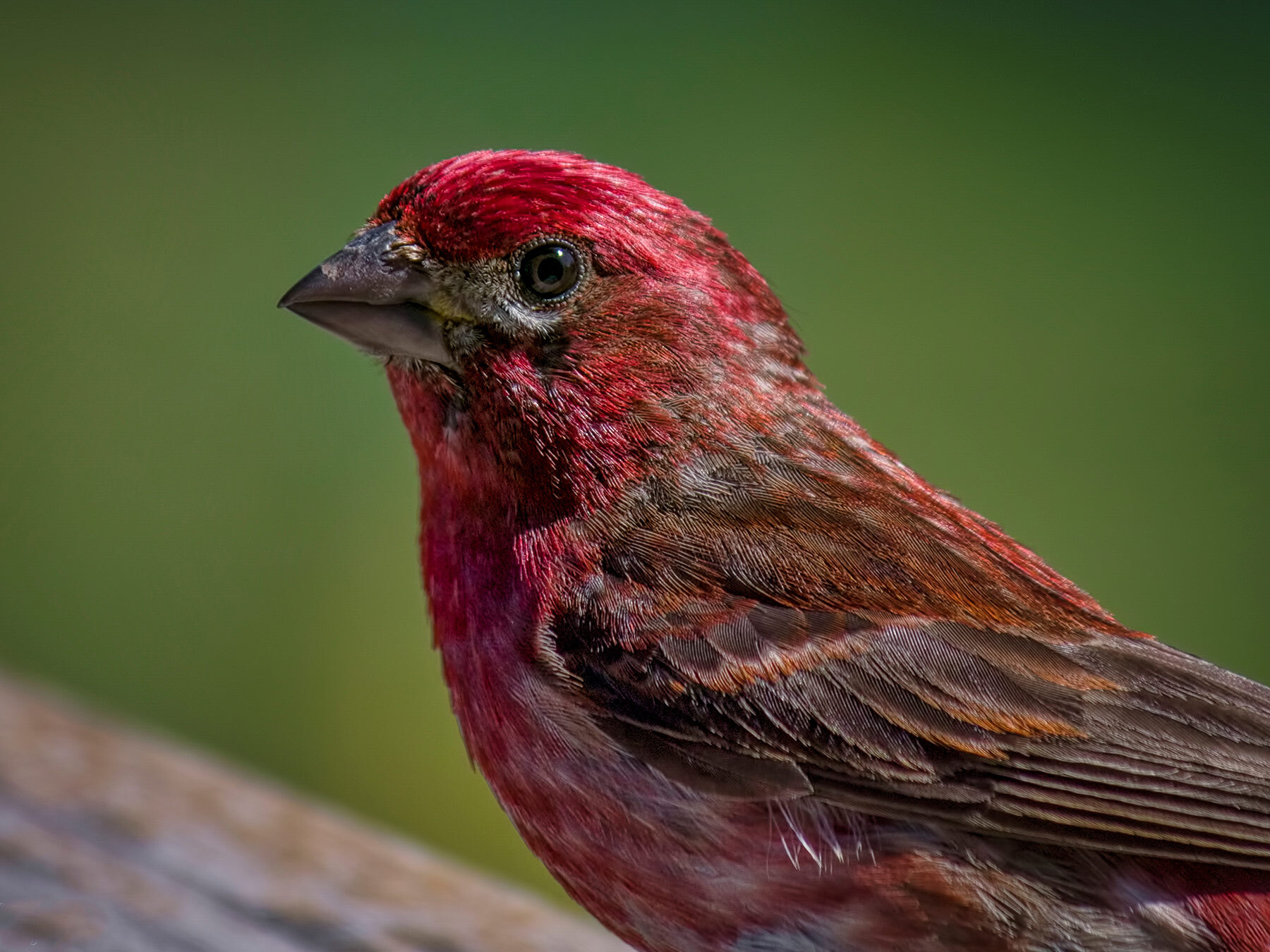
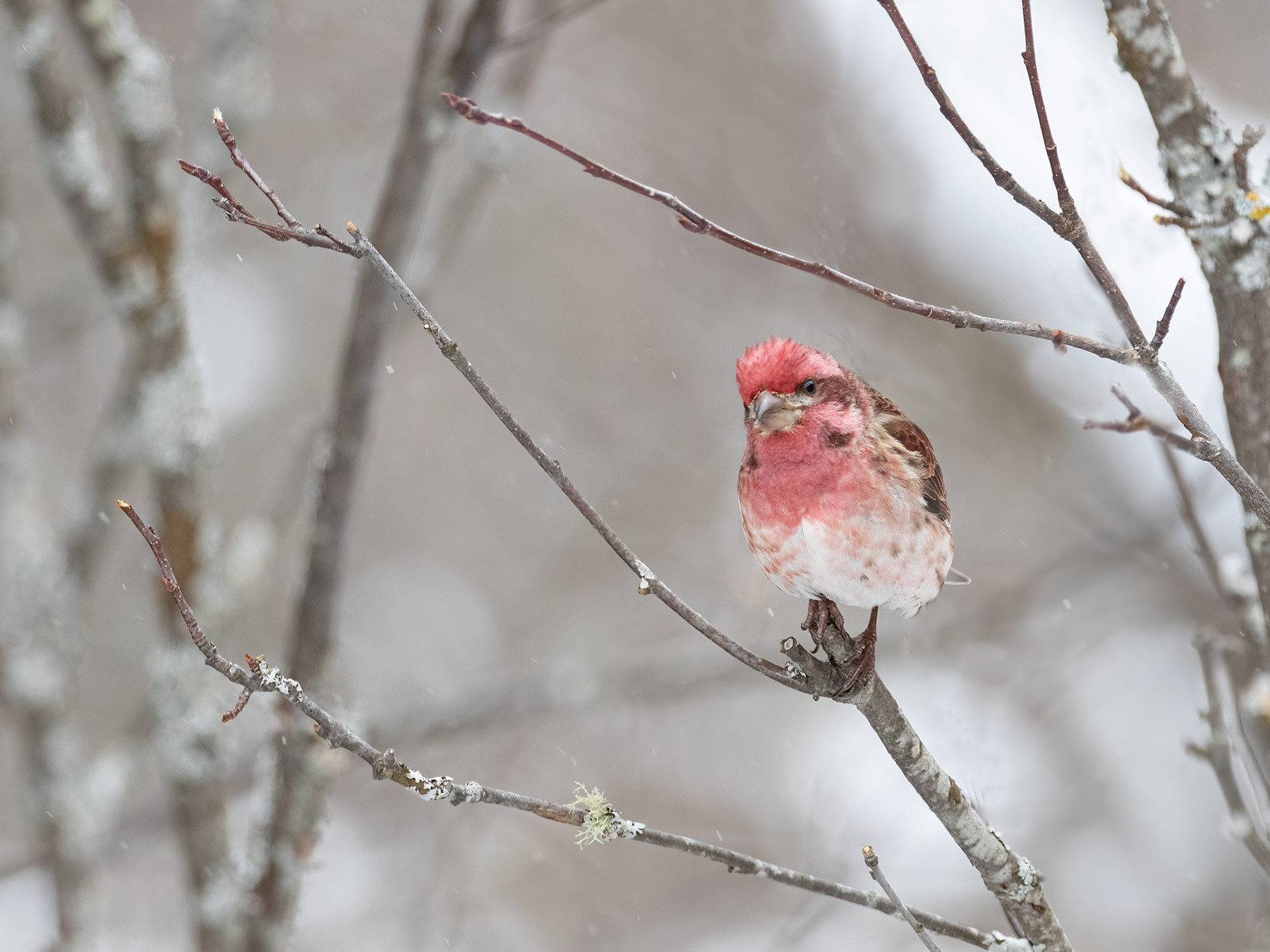
The adult male is washed rosy red over the whole head, the back of the neck, the back, the rump and the breast, and Roger Tory Peterson called it a sparrow dipped in raspberry juice.1 His cheek is a darker red-brown, his wings and tail are brown with pinkish edges, and his belly and the feathers under his tail are white, usually with few or no brown streaks.3
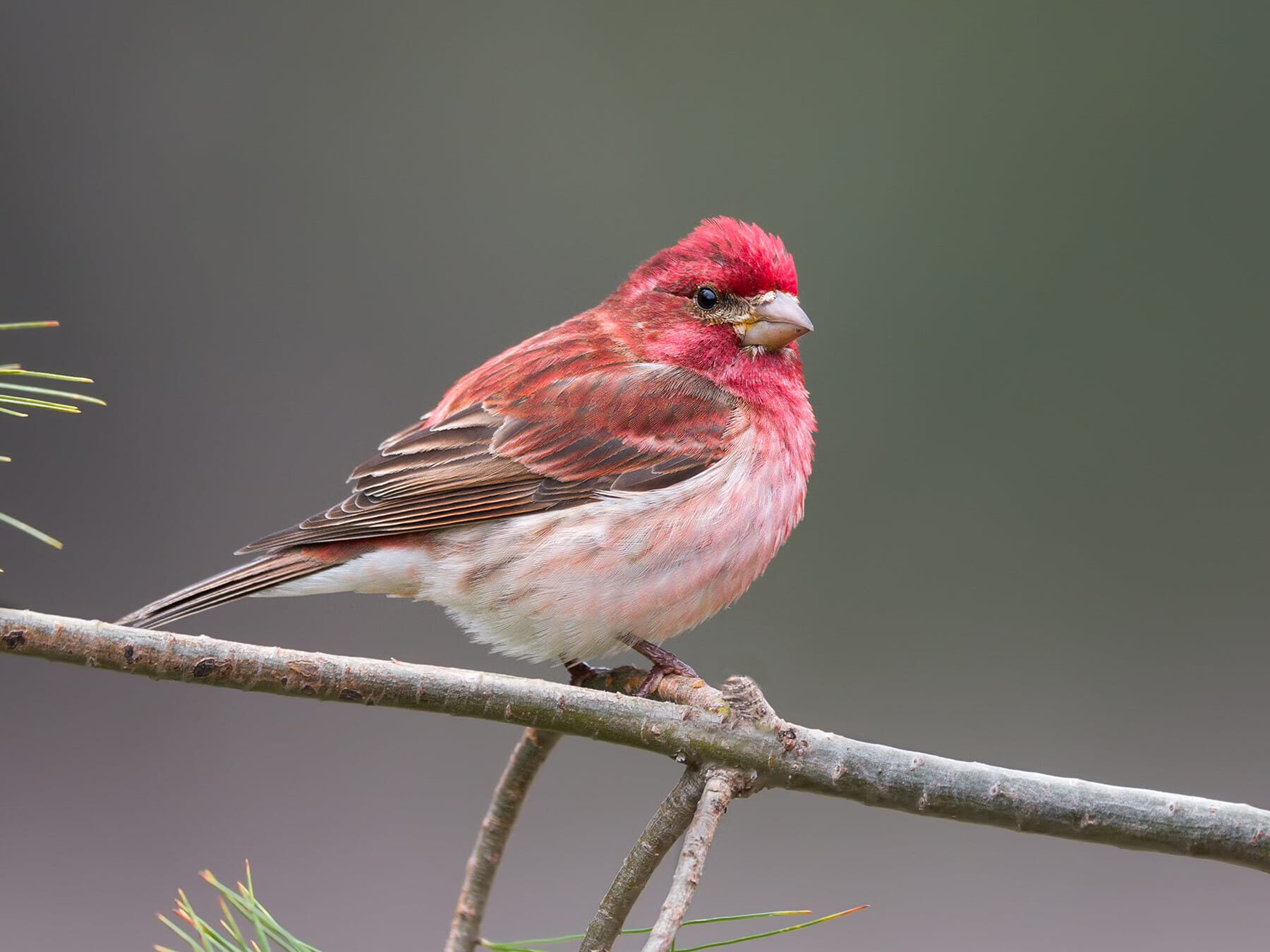
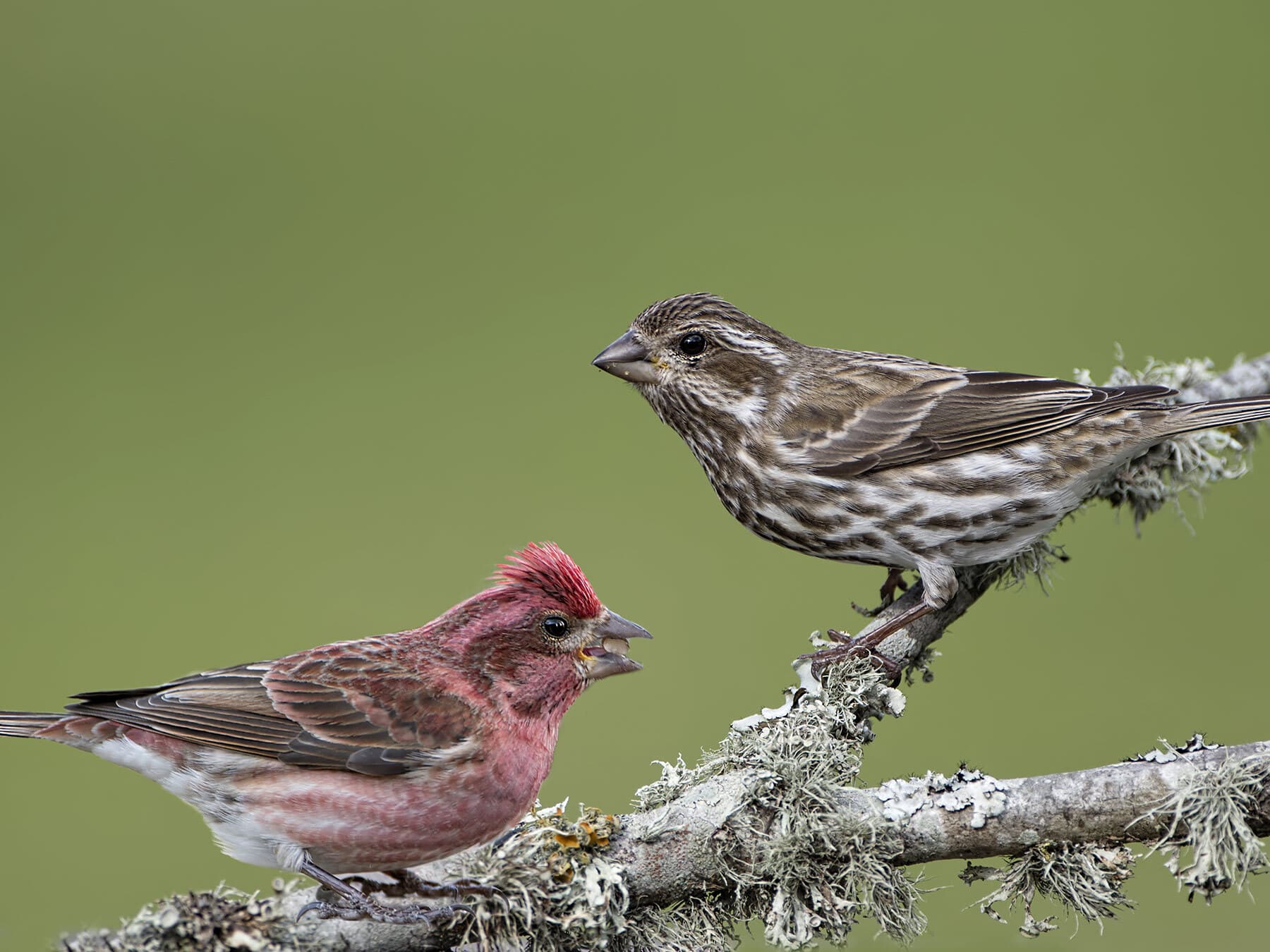
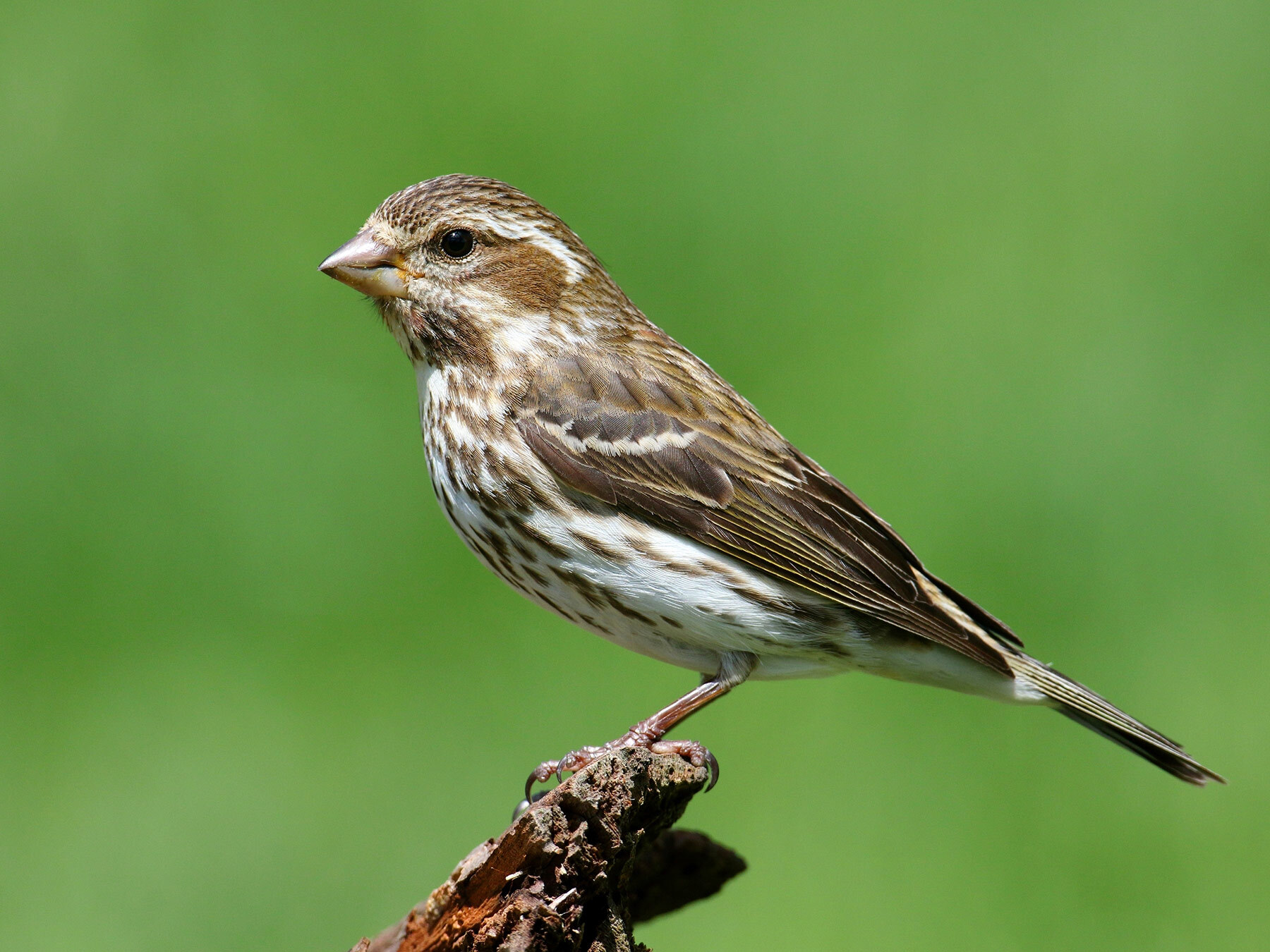
The female has no red. She is brown above and bright white below, with short, thick brown streaks, and she has a bold face: a white stripe over the eye, a dark brown cheek patch, and a white stripe below it.
Male, female and young
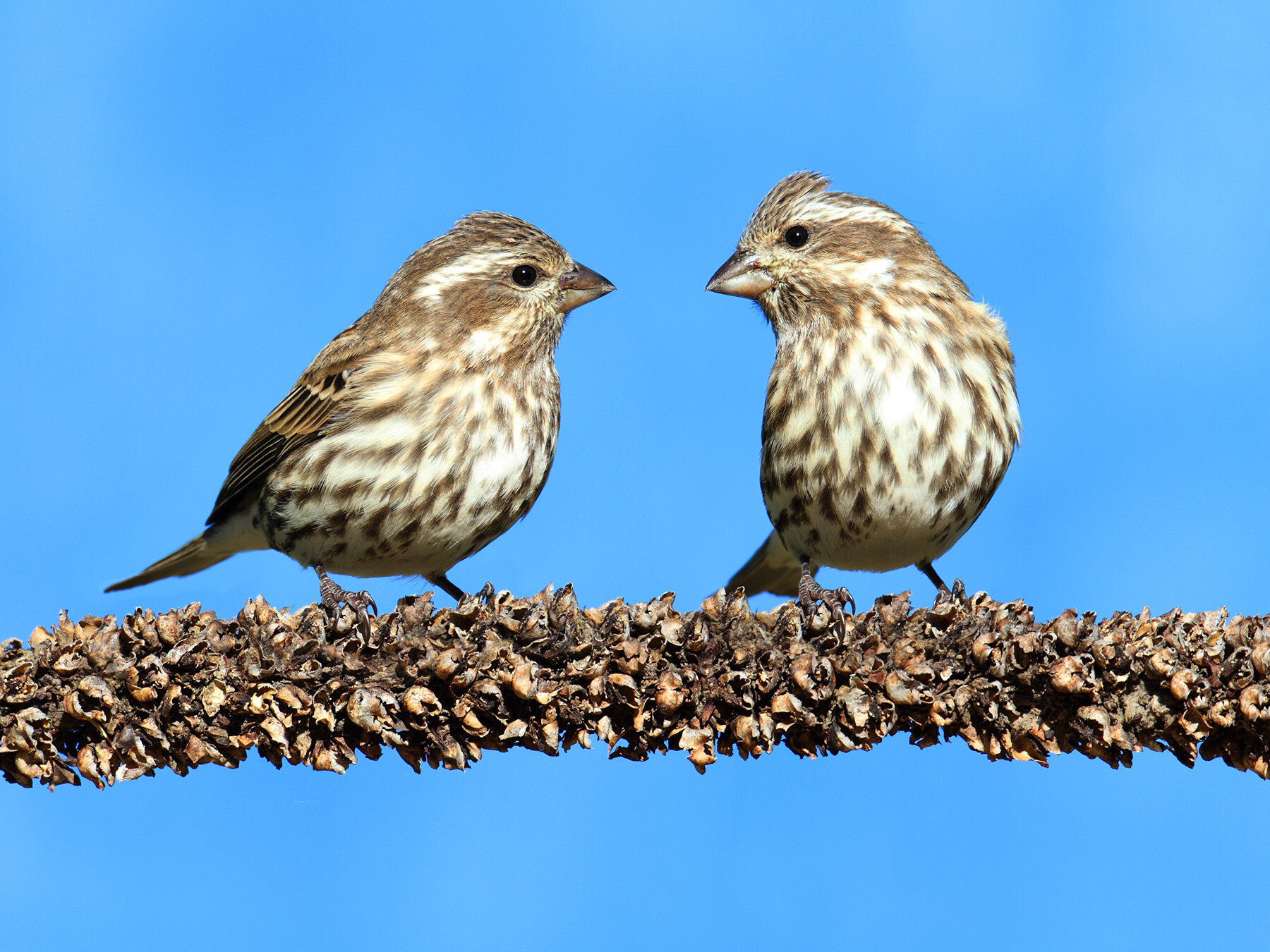
Only adult males are red. Young males spend their first year looking just like females, brown and streaky, and some of them breed in that plumage before they turn red in their second summer.
Juveniles, this year's young, are like females but fluffier, with heavier streaks and a mottled crown, from June to October. Birds on the Pacific Coast, the western subspecies, are duller: males have more brown on the sides, and females are more olive above with blurrier streaks and a weaker face pattern. More: female, male and young Purple Finches.
Identification: similar birds
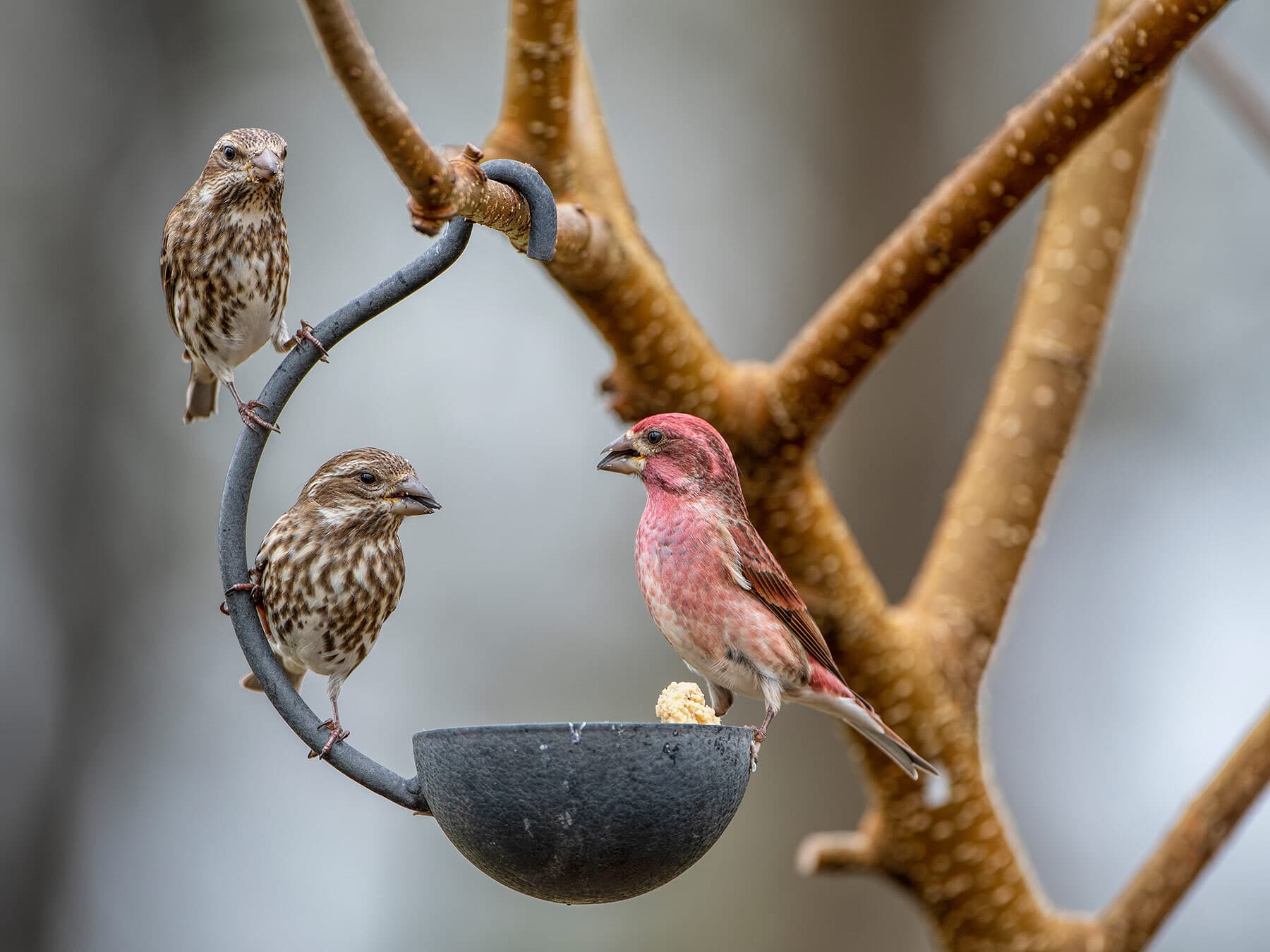
House Finch. The usual lookalike. A male House Finch is red only on the forehead, the stripe over the eye, the throat, the breast and the rump, with a brown cap, a plain brown back and brown streaks down the flanks; his red is often more orange. A female House Finch has a plain face and long, thin, blurry streaks on dull white, and House Finches are slimmer, with a longer tail and a smaller, more curved bill. Under the tail, a House Finch has broad dark streaks; a Purple Finch is usually plain white.2 Side by side, with photos: House Finch or Purple Finch?
Cassin's Finch. A western mountain bird of conifer forests. The male's bright red crown stands out against a brown nape, and the female has a weaker face pattern and sharper streaks that run down under the tail.
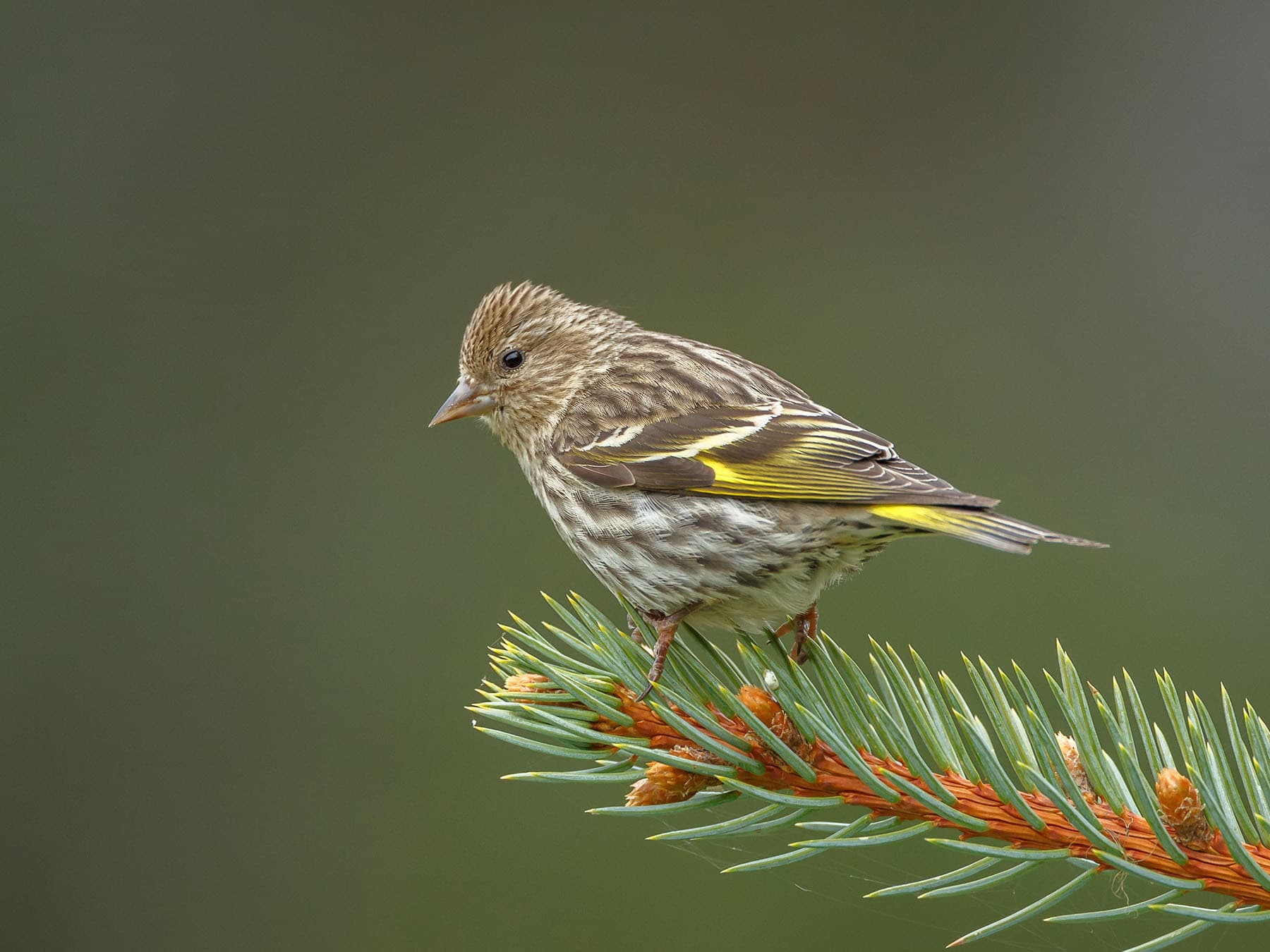
Pine Siskin. Smaller and streakier, with a thin, sharp-pointed bill and yellow edges in the wings and tail. Siskins and Purple Finches often feed together in winter.
Female Purple Finch or Song Sparrow? A Song Sparrow has a long, rounded tail, a slimmer bill and streaks that often run together into a spot in the middle of the breast.
Its size
Adults- Length
- 12–16 cm
- Wingspan
- 22–26 cm
- Weight
- 18–32 g
Its song and calls
The male sings a rich, fast warble of connected notes that rise and fall, usually from the top of a tree. A House Finch's song is higher and more strident,3 slower and less fluid, with a down-slurred last note4 that often sounds buzzy.5 Birds of the World describes three kinds of song: a warbling song of 6 to 23 notes, often sung by several birds in a flock in late winter and spring; a territory song in the breeding season, starting with a few quick notes on one pitch, with a high, accented note near the end; and a two-part phrase like a Red-eyed Vireo's in early spring and fall.
Purple Finches sometimes slip bits of other birds' songs into their own, among them Barn Swallow, American Goldfinch, Eastern Towhee and Brown-headed Cowbird. Females sing too: a long warble, 1 to 2 minutes, from the nest. The usual call is a sharp, short "pick" or "tek", and birds flying over give a sharp "tick".
Eastern and western birds sound different. Pacific Coast birds sing a faster song,1 and eastern birds give their territory song as a more leisurely run of warbles over a wider range of notes.3 The species player has one of each: a bird in Newfoundland singing about 3.7 seconds of closely packed warbling in March, and a male in Seattle singing short phrases of about 1.5 seconds in June. Two recordings, probably of different song types, cannot show the regional difference on their own. More, with spectrograms and a call recording: Purple Finch song and calls.
- Song0:00 / 0:26
Recorded in Newfoundland, Canada · March 2011
- Song (Pacific Coast)0:00 / 0:29
Recorded in Washington, United States · June 2024
- Calls0:00 / 0:29
Recorded in Washington, United States · April 2022
When and where to see it
Purple Finches breed across Canada, from the southern Yukon to Newfoundland, and in the northeastern US south to Long Island, New Jersey, Pennsylvania and the Appalachians of West Virginia, and west to Michigan, Wisconsin and Minnesota. A second population lives along the Pacific Coast, from British Columbia through Washington and Oregon from the Cascades west to the mountains of California.
In summer they live mostly in moist, cool conifer and mixed forests, along wooded streams, in orchards and in leafy suburbs with conifers. In winter they use almost any wooded or brushy place: forests, towns, weedy fields, hedgerows and backyards.6
Spotting tips
In summer, listen for the warble from a treetop in a conifer wood, then look for the male's raspberry head and back. In winter, check sunflower feeders and treetops with flocks of goldfinches and siskins, and look hard at every "female House Finch" for a bold white eyebrow.
Where they go in winter
In the East, Purple Finches are erratic in winter: common one year and almost absent the next. Large movements south, as far as northern Florida, the Gulf states and eastern Texas, come about every other year and are tied to the seed crops of northern trees, so a quiet winter at your feeder does not mean the birds have declined.3
Fall migration runs from late August to December, young birds first; spring migration from February to May, males first. Birds that winter in Arkansas have usually traveled about 1,000 miles (over 1,600 km), and birds that breed at Sault Ste. Marie, Michigan, winter as far south as Tennessee.
Do they migrate?
Partly. Canadian breeders winter in the US, those from west of the Rockies in California and Arizona and those from farther east across the eastern states, but some Purple Finches winter in the northern states and southern Canada, and Pacific Coast birds mostly just move downhill. Each winter is different, and in some years few reach the South at all.
What it eats
Mostly seeds, buds and flowers from trees, with fruit and a few insects. Purple Finches are often seen eating the buds and seeds of elms, tulip trees, maples, sweetgum, sycamores, ash, junipers and mountain ash, plus berries such as blackberries, grapes and crabapples, and in winter weed seeds such as dandelion and ragweed. They take some aphids, caterpillars and beetles, mainly in summer.3
They have a neat trick for nectar: crushing the base of a flower to get at it without eating the rest, and with fruit they often eat the seeds rather than the flesh. Oddly, for a bird whose winter movements follow cone crops, Birds of the World cites just one report of the birds feeding on spruce cones.
Feeding them in your yard
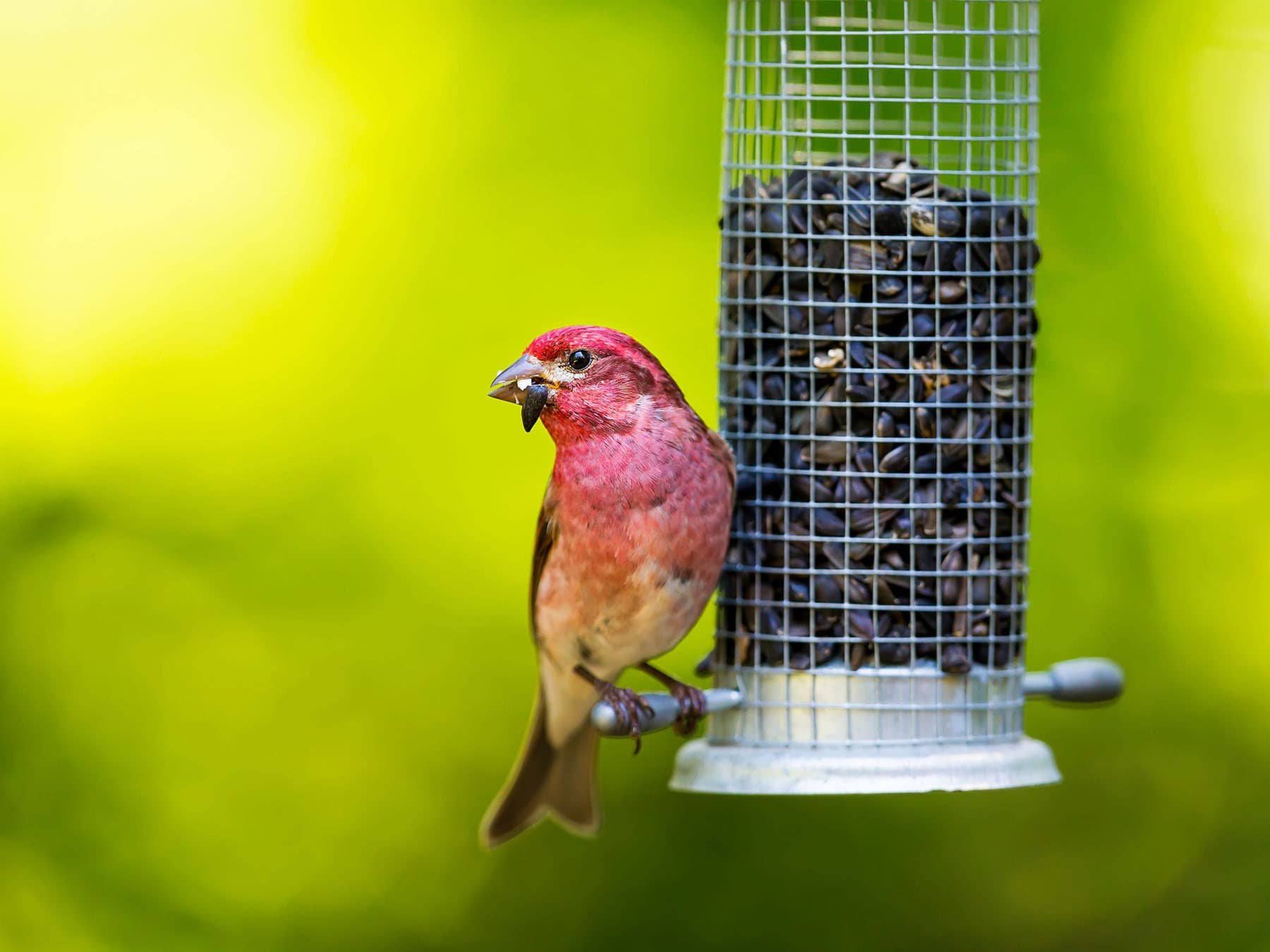
Project FeederWatch lists black-oil sunflower seed, hulled sunflower seed, nyjer and millet for Purple Finches, at hopper, tube or platform feeders.7 Black-oil sunflower seems to be the favorite, and in tests they chose thin sunflower seeds over fat ones. Conifers in your yard may help bring them in.
Purple Finches tend to give way to House Finches: at one Virginia feeder in the winter of 1985-86, House Finches won 404 of 444 squabbles between the two, though Purple Finches made up 43.7% of the birds there.8 Keep feeders clean, too: House Finch eye disease has been found in Purple Finches, though rarely. More: House Finch eye disease.
Nesting and breeding
Purple Finches nest in trees, usually far out on a conifer branch with another branch overhead: 79% of 435 nests were in conifers such as Douglas-fir, pines and spruces, and most of the rest in oaks, maples or fruit trees. Western birds use broadleaf trees far more often than eastern ones. Nests are 2.5 to 60 feet (0.75-18.3 m) up.1
The female builds a cup of twigs, roots and grasses lined with hair in 3 to 8 days and lays usually 4 eggs, pale greenish blue spotted with brown and black. She incubates them for 12 to 13 days while the male feeds her, and both parents feed the chicks on regurgitated seeds. The young leave the nest 13 to 16 days after hatching. Pairs raise one or two broods a year, between April and August. More: Purple Finch nests, eggs and young.
Behaviour
Outside the breeding season Purple Finches live in flocks of a few birds to more than 200, often with Pine Siskins and American Goldfinches, and roost together in dense conifers at night. On the ground they hop, and in the air their flight bounds up and down.
In disputes with red males, the brown birds usually win. At the Virginia feeder, female-plumaged Purple Finches beat adult males in 95.6% of 226 encounters, and All About Birds notes that females usually win disputes in flocks as well. Since young males look like females, some of those winners may have been young males.
In spring the male courts with a little dance: he hops around the female with fluttering wings, puffed-out breast, raised tail and crest, singing softly, often holding nest material, then flies up about a foot (30 cm), comes down, droops his wings, spreads his tail, points his bill at the sky and leans back. Unlike House Finches, which guard their mates, male Purple Finches seem to defend a territory around the nest.
Lifespan and predators
The oldest Purple Finch on the Bird Banding Laboratory's list was at least 12 years, 8 months old: banded in North Carolina in March 1960 and caught and released there in February 1972.9 Birds of the World cites a 1975 list with a male of about 14: about 2 years old when banded and recovered nearly 12 years later. Most live far less: an old Michigan banding study put the average lifespan at about 2 years, and in a North Carolina study at least 71 in 100 adults survived from one winter to the next.
Predators and other dangers
Sharp-shinned Hawks, Merlins, American Kestrels, Barn Owls, Blue Jays and house cats take adults, and jays, grackles, nutcrackers and red squirrels raid nests. In one large set of nest records, 31% of nests were lost to predators. Brown-headed Cowbirds lay eggs in some nests, but their eggs rarely produce fledglings, probably because Purple Finches feed their young on seeds. Window and vehicle collisions also kill some.
Conservation
The Purple Finch is still widespread, with about 6.5 million breeding birds, and is a species of low conservation concern, but it has been declining: by 0.73% a year from 1966 to 2019 on the North American Breeding Bird Survey, about 32% in all.1 It is a native songbird protected under the Migratory Bird Treaty Act.10
Population and the House Finch
Up to the mid-1990s the losses were in the East and the north: breeding numbers in the northeastern US and southern Canada fell by half from 1966 to 1994, northern Canadian numbers fell from 1989, and western birds held steady. Comparing survey counts across the East, J. T. Wootton found that Purple Finch numbers in summer were lower where and when House Finches, introduced from the West around 1940, were more numerous, and that weather and habitat change did not explain the pattern.11 He concluded that the two compete, though winter migration makes the picture less clear. This is not the first time: Purple Finches also seem to have declined in the Northeast after House Sparrows arrived in the late 19th century.
Similar birds
Often mistaken for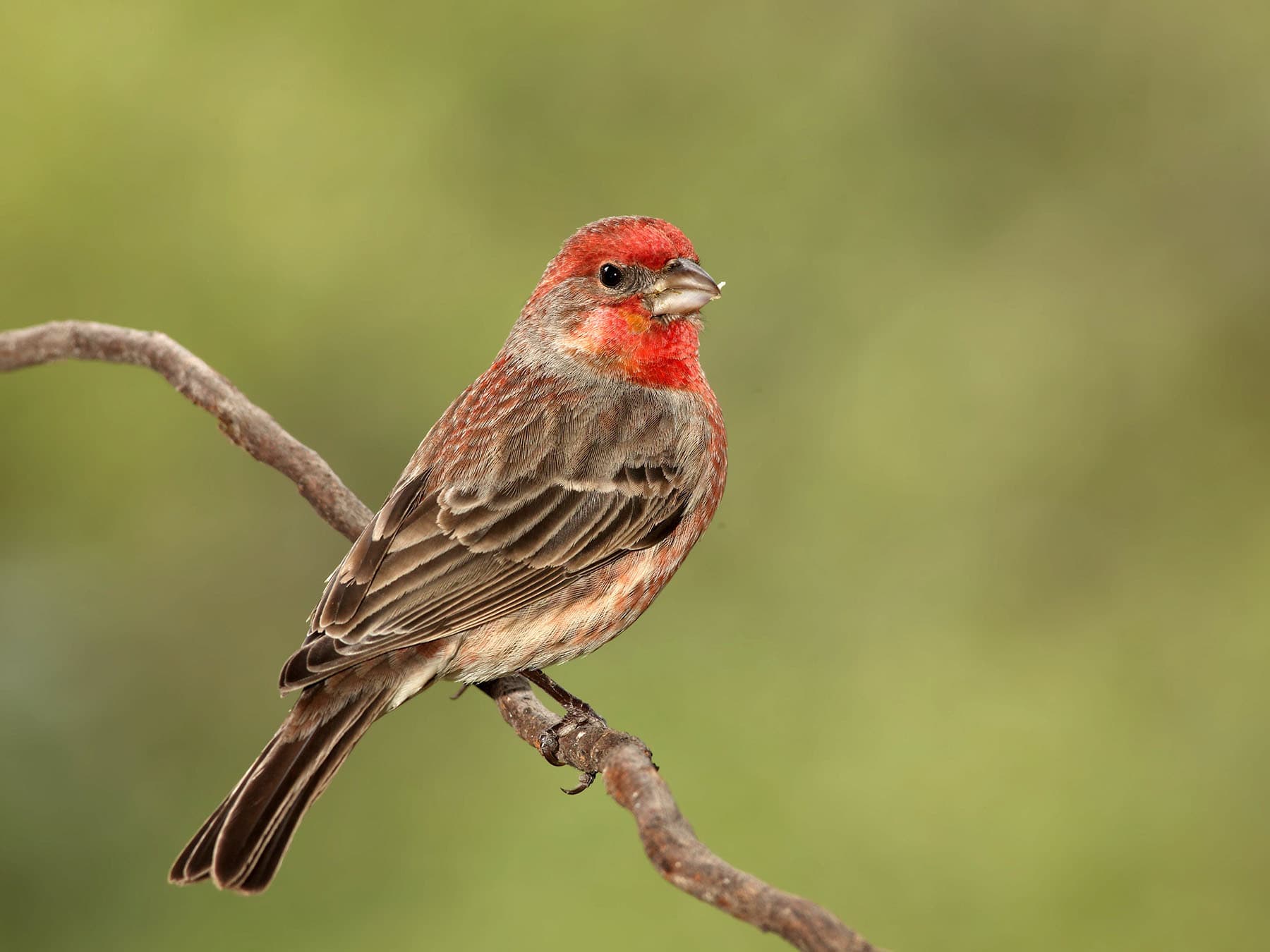
More photos
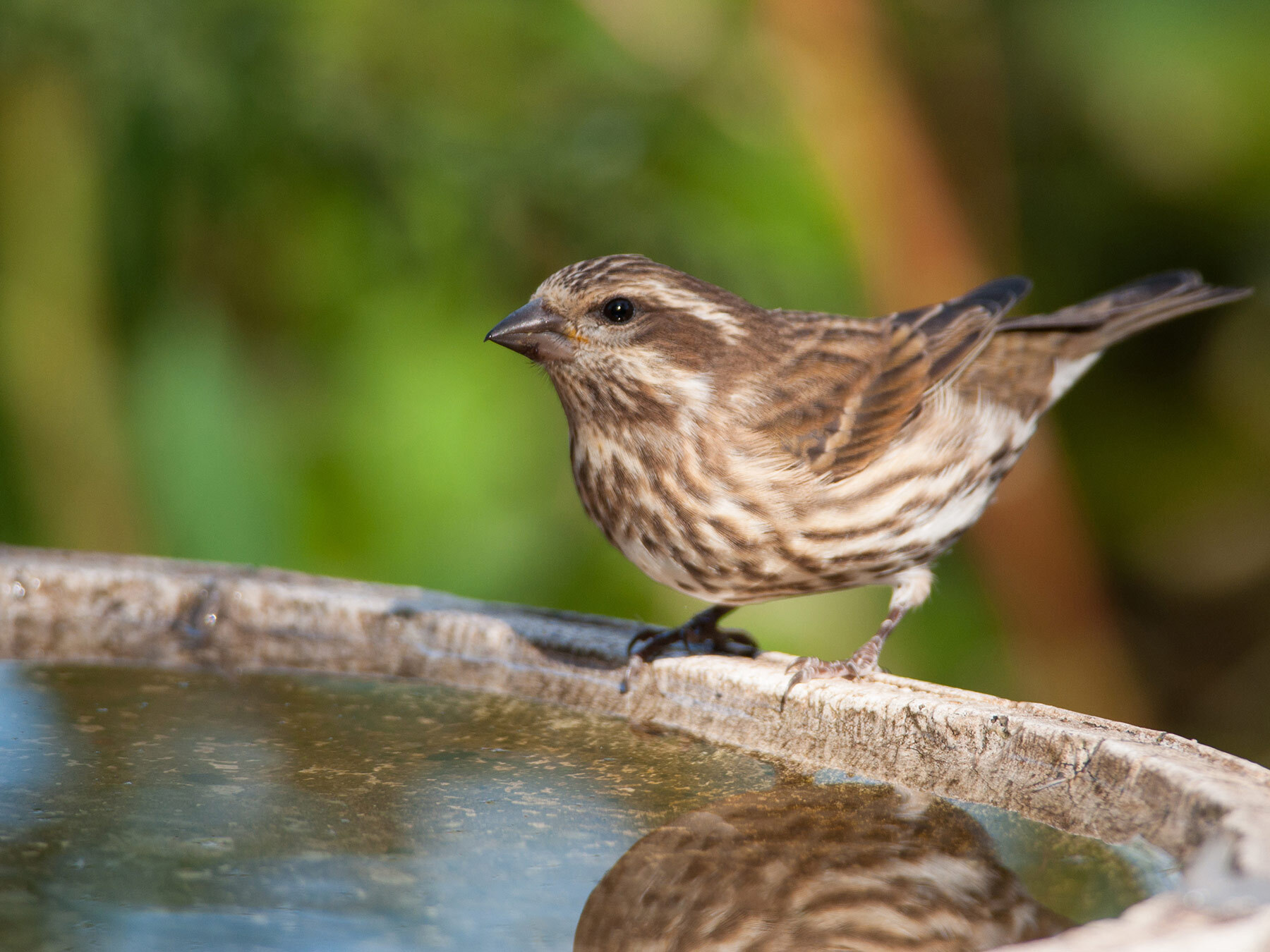
8 photos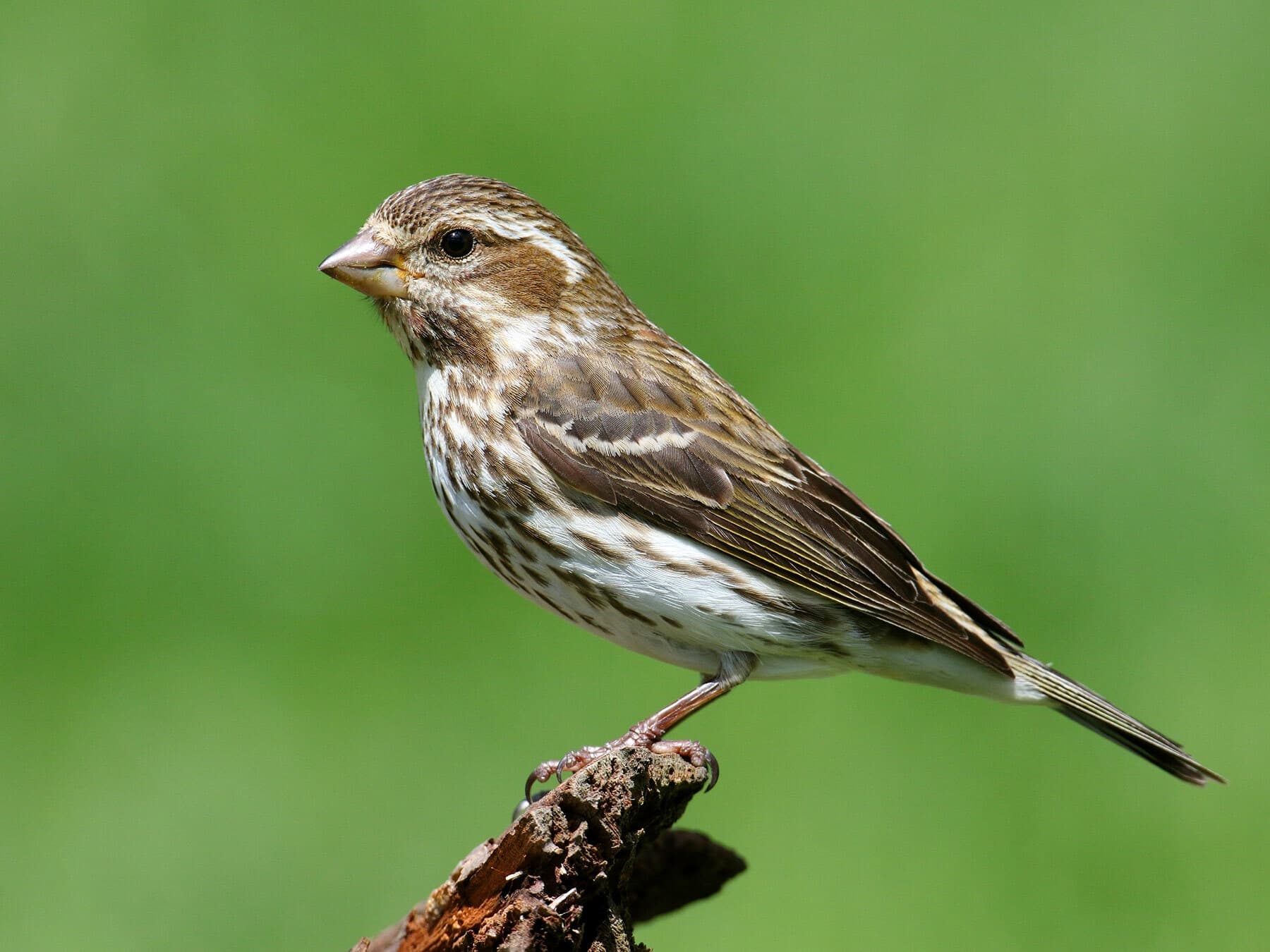 A female-plumaged Purple Finch: white eyebrow, dark cheek and short, thick streaks
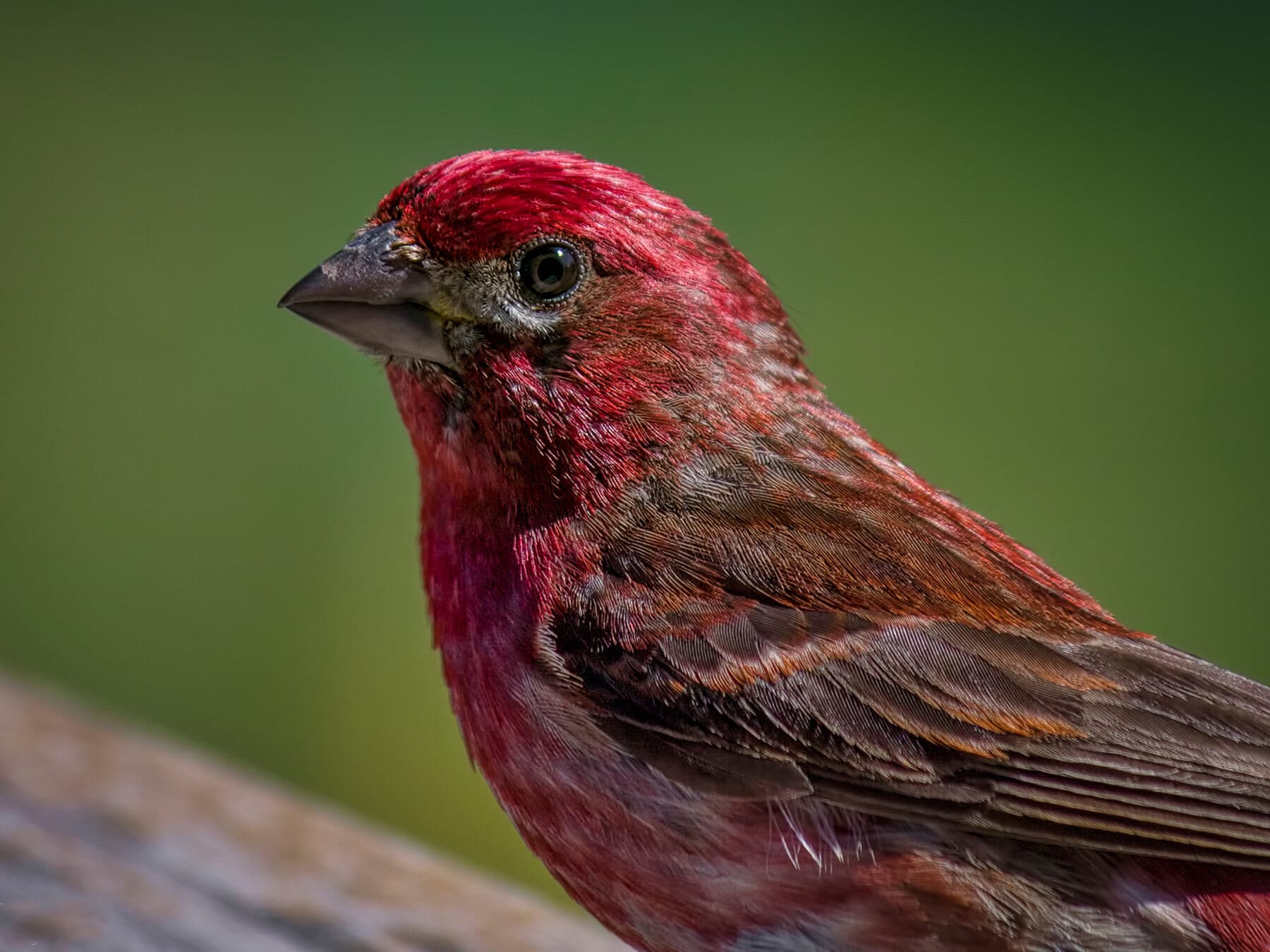 A male Purple Finch close up: raspberry head and a big conical bill
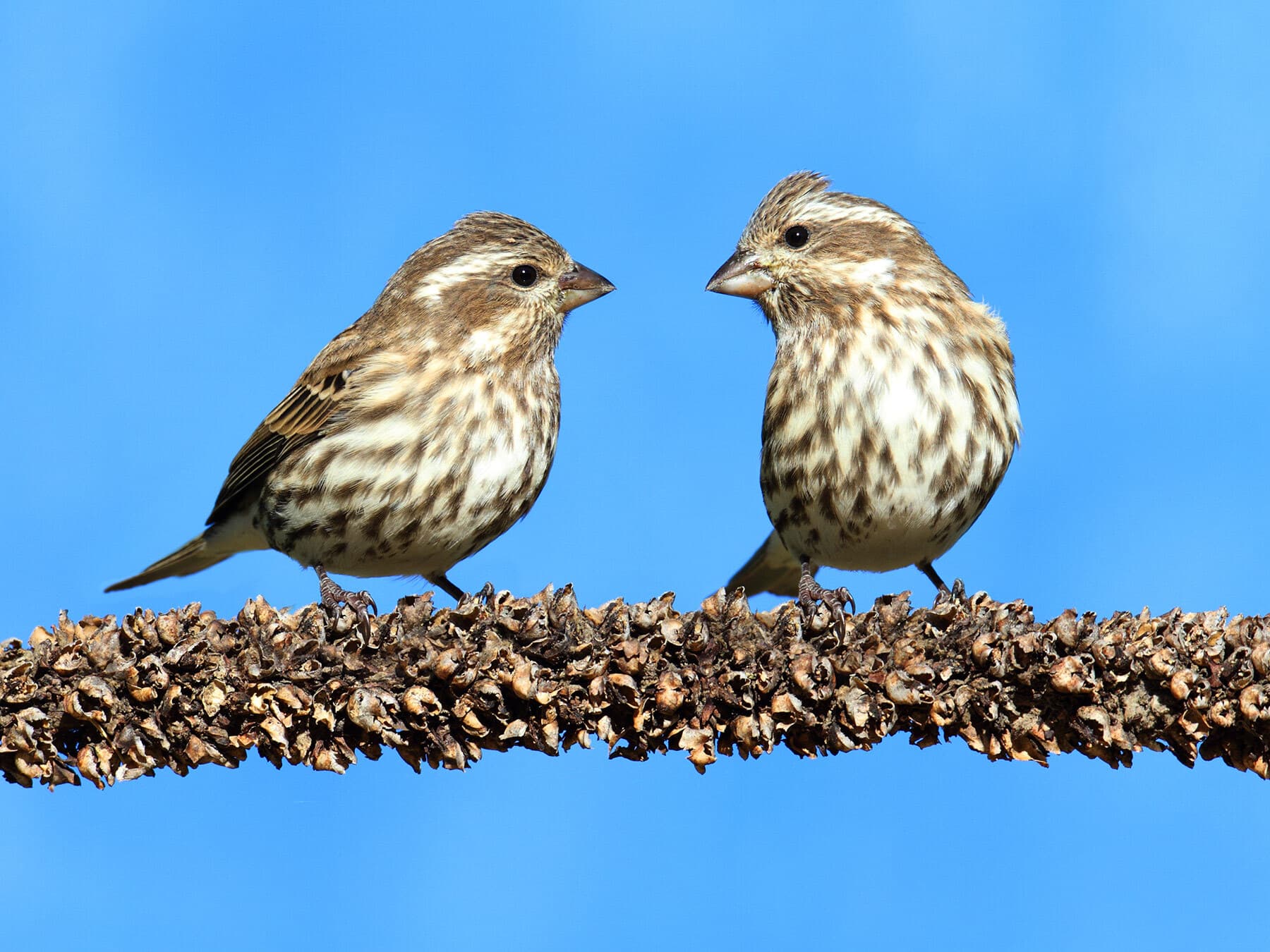 Two female-plumaged Purple Finches, which may be females or young males
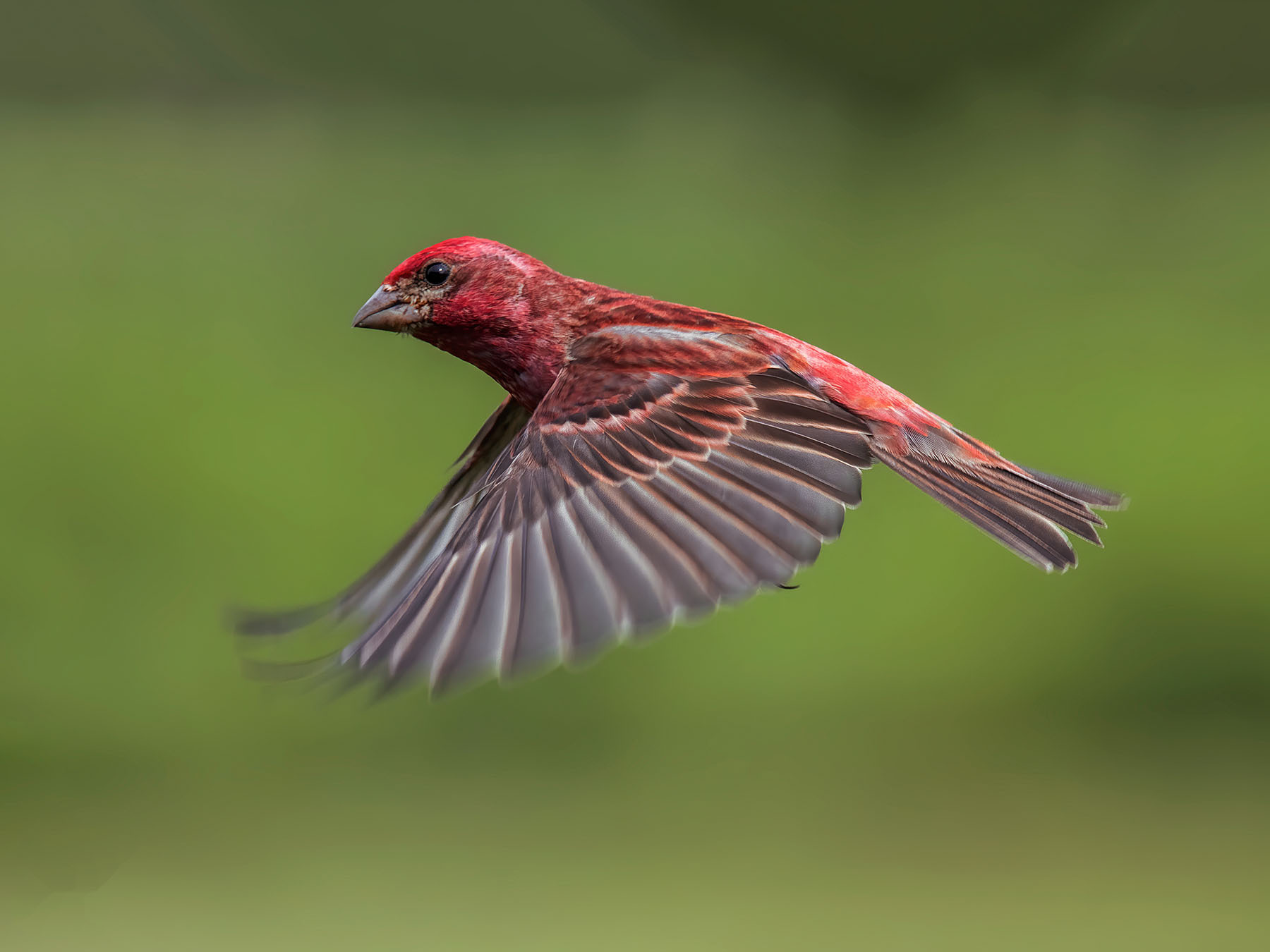
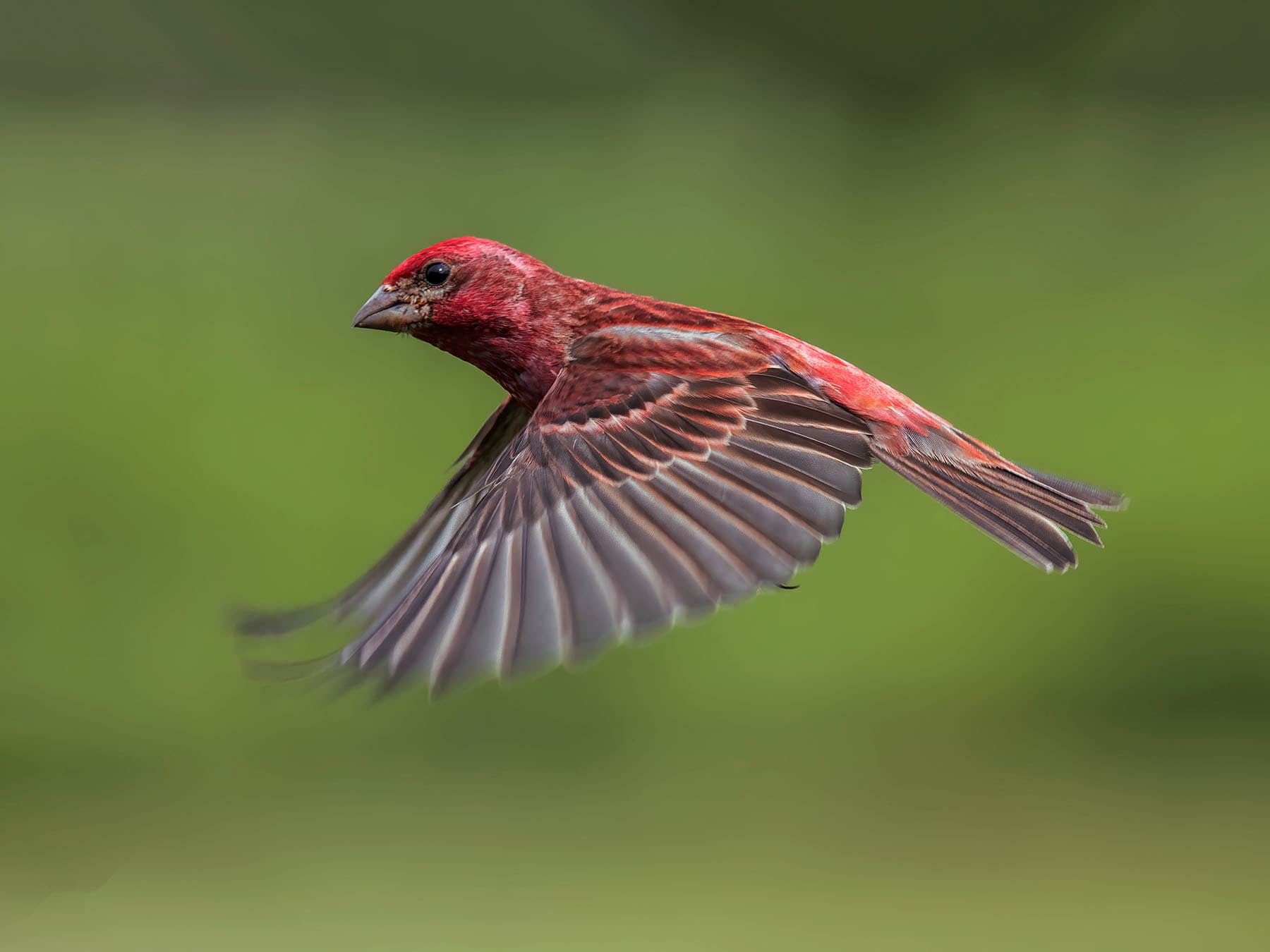 A male Purple Finch in flight, showing the red rump
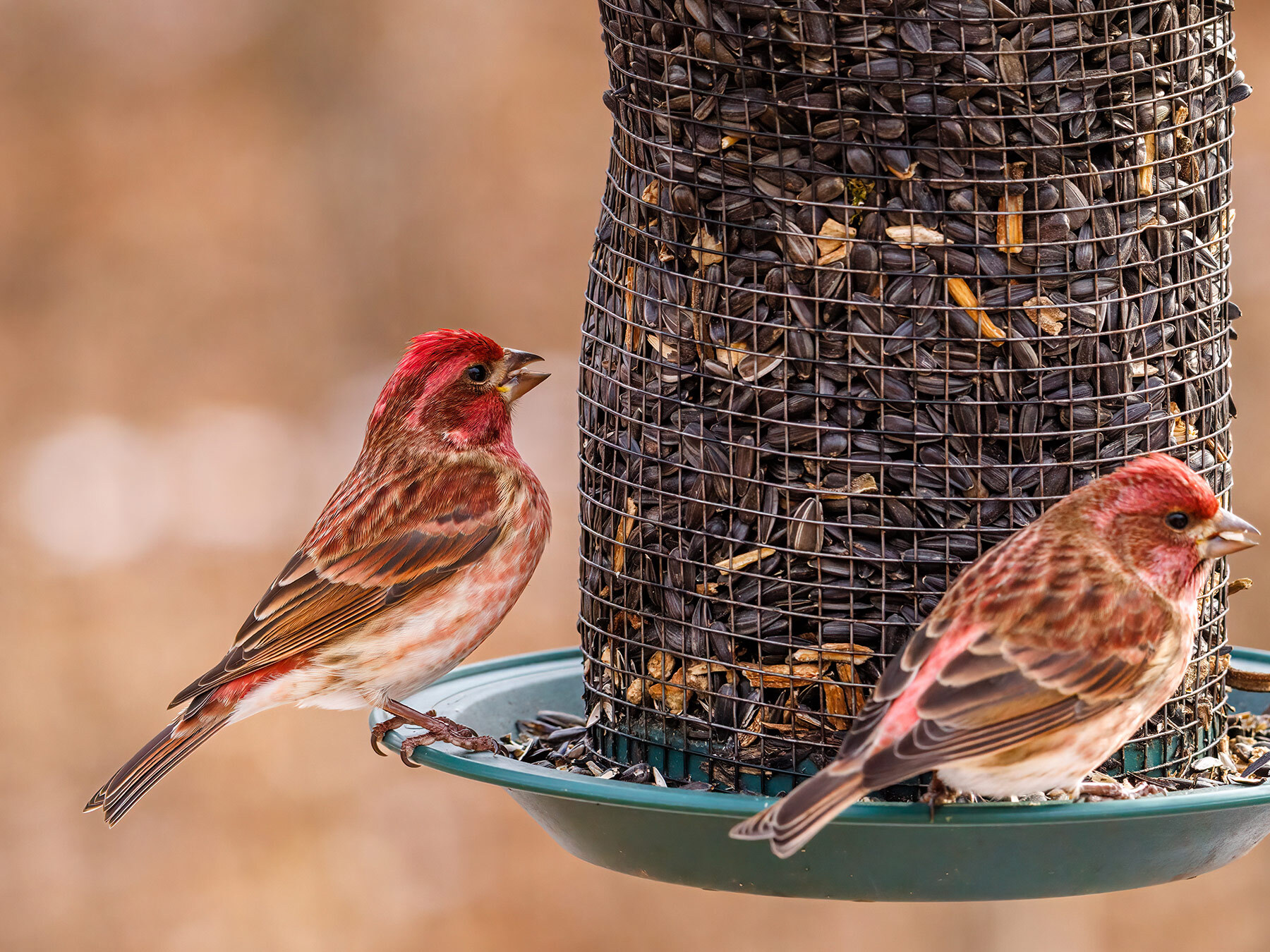
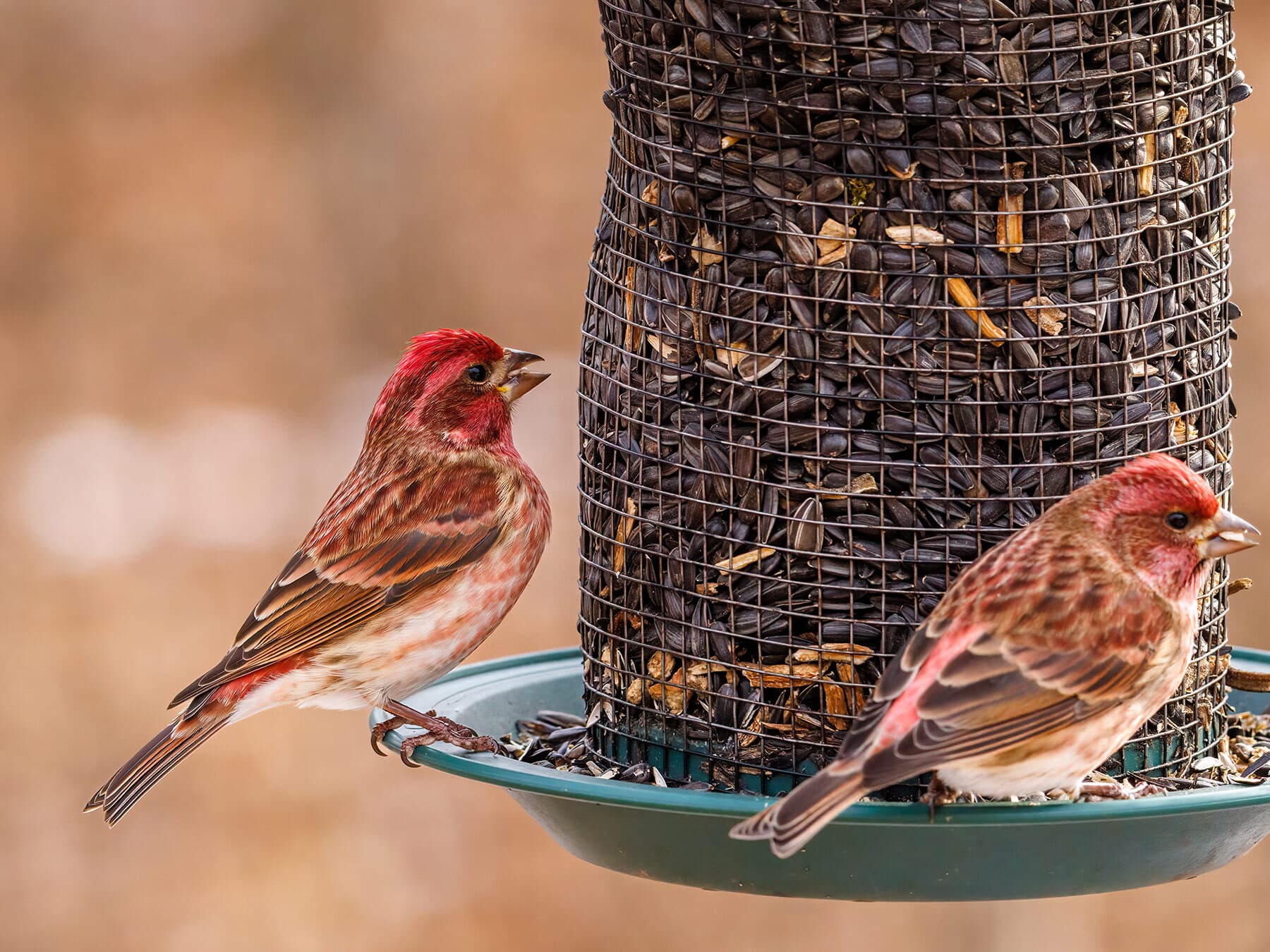 Two male Purple Finches at a sunflower feeder
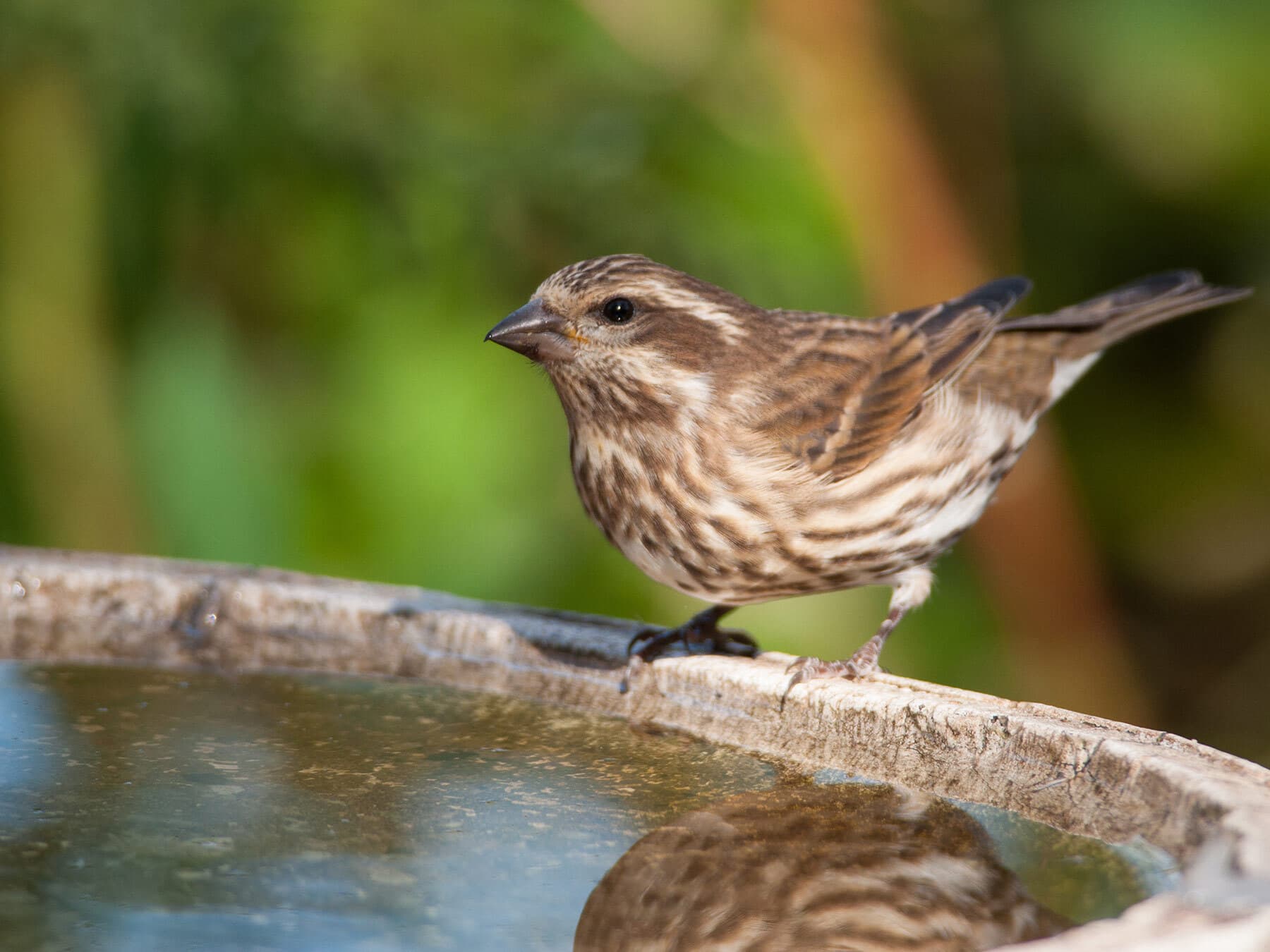 A female-plumaged Purple Finch at a birdbath
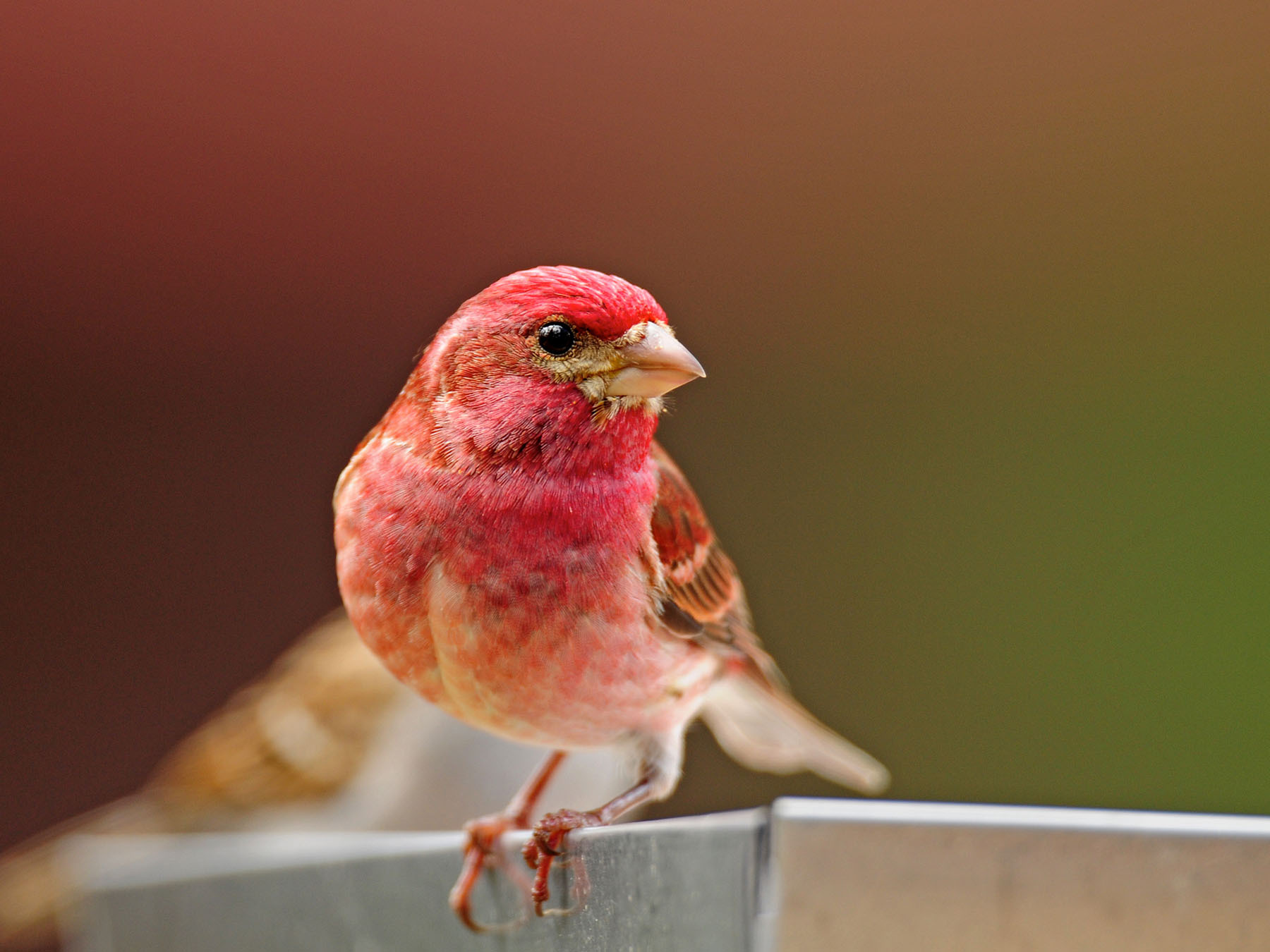
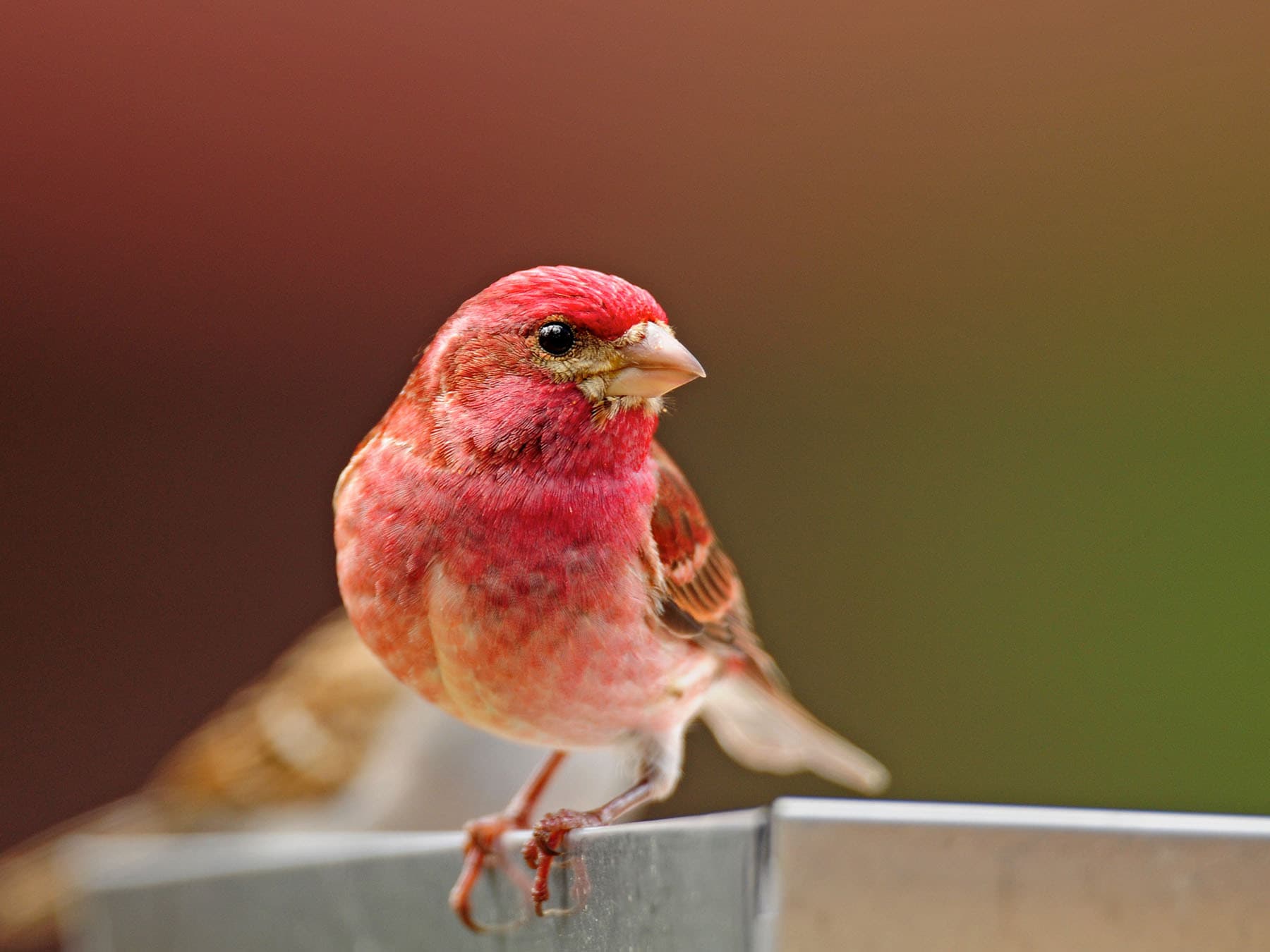 A male Purple Finch from the front: rosy face and breast
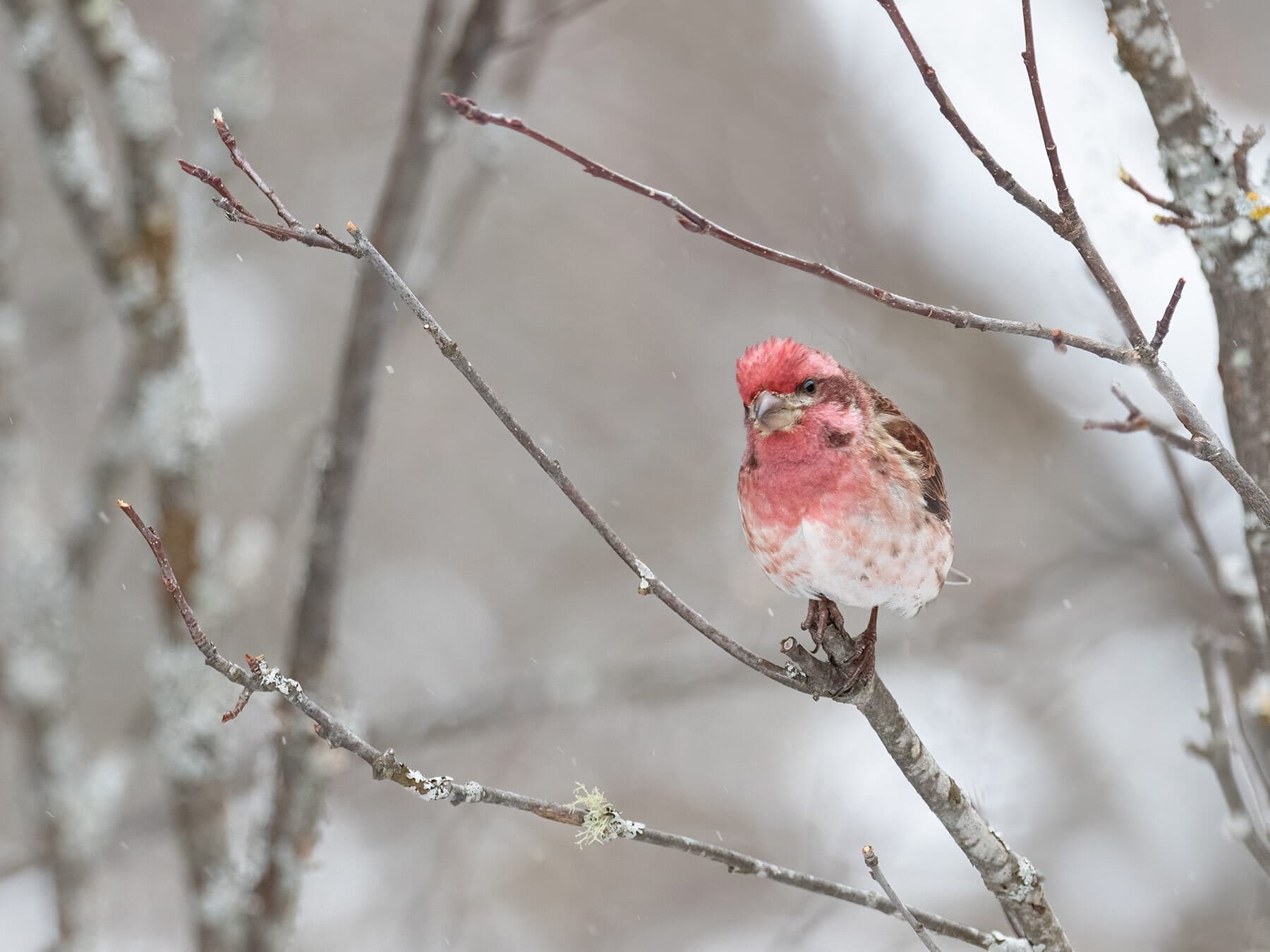 A male Purple Finch in winter, among bare branches
Purple Finch guides
4 guidesQuick facts
- Length
- 12–16 cm
- Wingspan
- 22–26 cm
- Weight
- 18–32 g
- Lifespan
- oldest recorded 12.7 years
- Family
- Finches
- Global status (IUCN)
- Least Concern
- World population
- About 6.5 million (Partners in Flight)
- Population trend
- Decreasing: down about 32% from 1966 to 2019 (North American Breeding Bird Survey); eastern declines linked to the spread of the House Finch
- Scientific name
- Haemorhous purpureus
Questions
4Is the Purple Finch the state bird of New Hampshire?
Yes. The 1957 legislature chose it over a breed of chicken, the New Hampshire hen, and Governor Lane Dwinell signed the law on April 25, 1957; its sponsor, Representative Robert Monahan of Hanover, urged lawmakers to act "before some other state beats us to it".12 See all the state birds.
Why is it called a Purple Finch if it is red?
Its scientific name says the same: Gmelin named it Fringilla purpurea in 1789, and the species name purpureus is Latin for purple-colored. In life the male is more raspberry or rose than purple, and the female is brown.
Are Purple Finches rare?
No, though they are less common than they were and easy to miss. They are moderately common in northern and western forests in summer, but in the East they come south in good numbers only in some winters, so many people see them at feeders only now and then.
Do Purple Finches mate for life?
It is not known. As far as anyone can tell they are monogamous, but Birds of the World, whose account was last revised in 1996, found no information on how long pairs last.
Sources
18- 1Cornell Lab of Ornithology. Purple Finch: Overview, Identification, Life History and Sounds. All About Birds. Accessed 11 October 2026. Source (opens in a new tab)
- 2Project FeederWatch (Cornell Lab of Ornithology and Birds Canada). Tricky Bird IDs: Cassin's Finch, House Finch and Purple Finch. Project FeederWatch. Accessed 11 October 2026. Source (opens in a new tab)
- 3Wootton, J. T. (2020). Purple Finch (Haemorhous purpureus), version 1.0. Birds of the World (A. F. Poole and F. B. Gill, editors). Cornell Lab of Ornithology. doi:10.2173/bow.purfin.01 (opens in a new tab)
- 4Badyaev, A. V., Belloni, V. and Hill, G. E. (2020). House Finch (Haemorhous mexicanus), version 1.0. Birds of the World (A. F. Poole, editor). Cornell Lab of Ornithology. doi:10.2173/bow.houfin.01 (opens in a new tab)
- 5National Audubon Society (text: Kaufman, Lives of North American Birds). House Finch. Audubon Guide to North American Birds. Accessed 11 October 2026. Source (opens in a new tab)
- 6National Audubon Society (text: Kaufman, Lives of North American Birds). Purple Finch. Audubon Guide to North American Birds. Accessed 11 October 2026. Source (opens in a new tab)
- 7Project FeederWatch (Cornell Lab of Ornithology and Birds Canada). Common Feeder Birds: Purple Finch. Project FeederWatch. Accessed 11 October 2026. Source (opens in a new tab)
- 8Shedd, D. H. (1990). Aggressive interactions in wintering House Finches and Purple Finches. Wilson Bulletin 102(1): 174-178. Accessed 11 October 2026. Source (opens in a new tab)
- 9USGS Bird Banding Laboratory. Longevity records of North American birds. Accessed 11 October 2026. Source (opens in a new tab)
- 10U.S. Fish and Wildlife Service. List of birds protected by the Migratory Bird Treaty Act. Code of Federal Regulations, 50 CFR 10.13. Accessed 11 October 2026. Source (opens in a new tab)
- 11Wootton, J. T. (1987). Interspecific competition between introduced house finch populations and two associated passerine species. Oecologia 71: 325-331. doi:10.1007/BF00378703 (opens in a new tab)
- 12State of New Hampshire. State Bird: Purple finch. NH.gov Almanac. Accessed 11 October 2026. Source (opens in a new tab)
- 13National Audubon Society (text: Kaufman, Lives of North American Birds). Cassin's Finch. Audubon Guide to North American Birds. Accessed 11 October 2026. Source (opens in a new tab)
- 14National Audubon Society (text: Kaufman, Lives of North American Birds). Pine Siskin. Audubon Guide to North American Birds. Accessed 11 October 2026. Source (opens in a new tab)
- 15National Audubon Society (text: Kaufman, Lives of North American Birds). Song Sparrow. Audubon Guide to North American Birds. Accessed 11 October 2026. Source (opens in a new tab)
- 16Hartup, B. K., Kollias, G. V. and Ley, D. H. (2000). Mycoplasmal conjunctivitis in songbirds from New York. Journal of Wildlife Diseases 36(2): 257-264. doi:10.7589/0090-3558-36.2.257 (opens in a new tab)
- 17Heisman, R.. House Finch Eye Disease: Outbreak, Then Understanding. Living Bird (All About Birds), Winter 2017. Accessed 11 October 2026. Source (opens in a new tab)
- 18AviList Core Team (2025). AviList: The Global Avian Checklist, v2025b. doi:10.2173/avilist.v2025b (opens in a new tab)

Checked by
Nathan Cope, founder and editor
Nathan founded Birdfact and leads its writers and contributors in the UK, the US and Canada. He has watched and studied birds for more than ten years, and checks every article and species guide before it’s published.