


Pine Siskin
Pine Finch · Spinus pinus
By the Birdfact teamChecked by Nathan Cope
On this page12 sections
How to recognise it
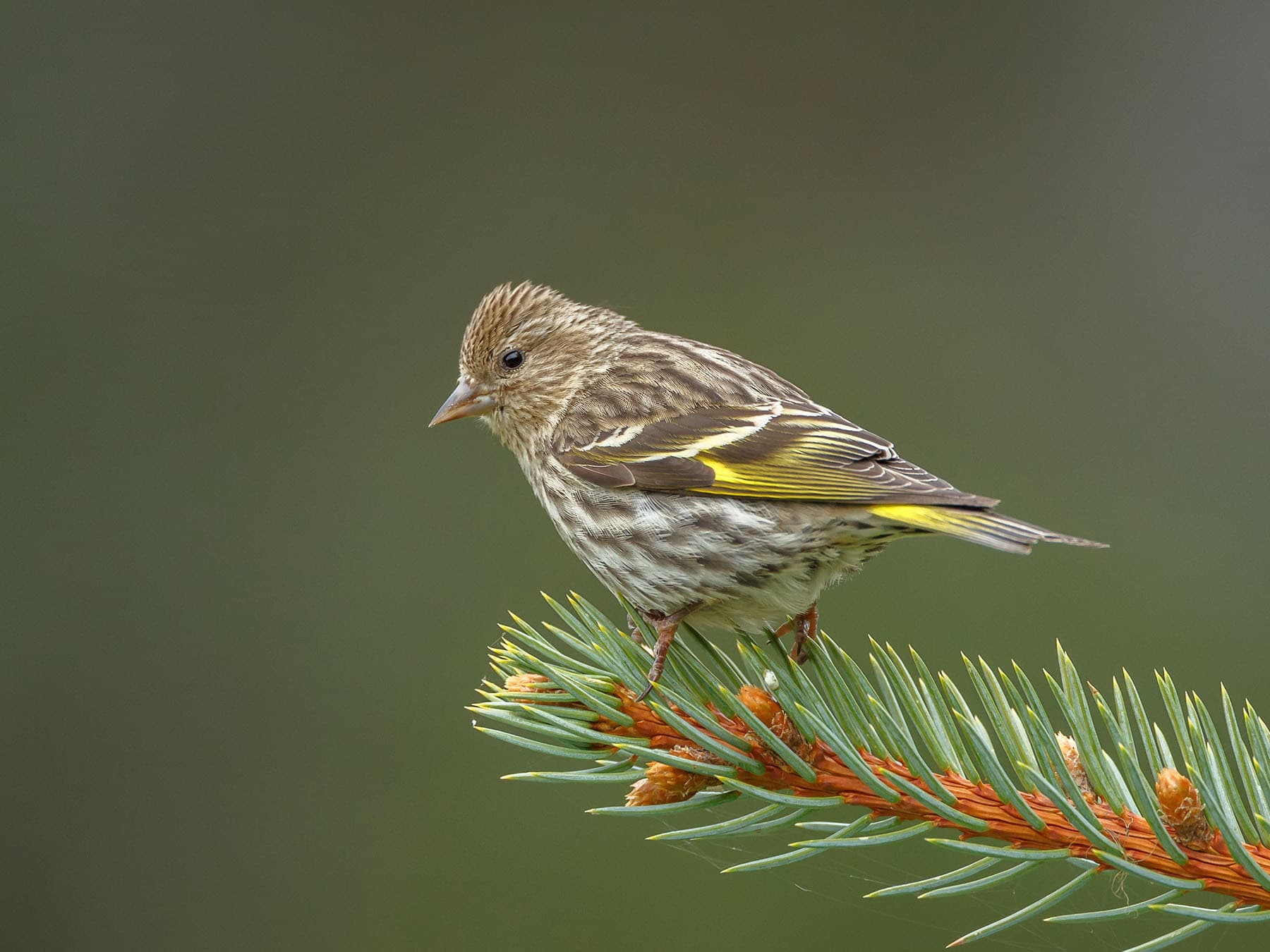
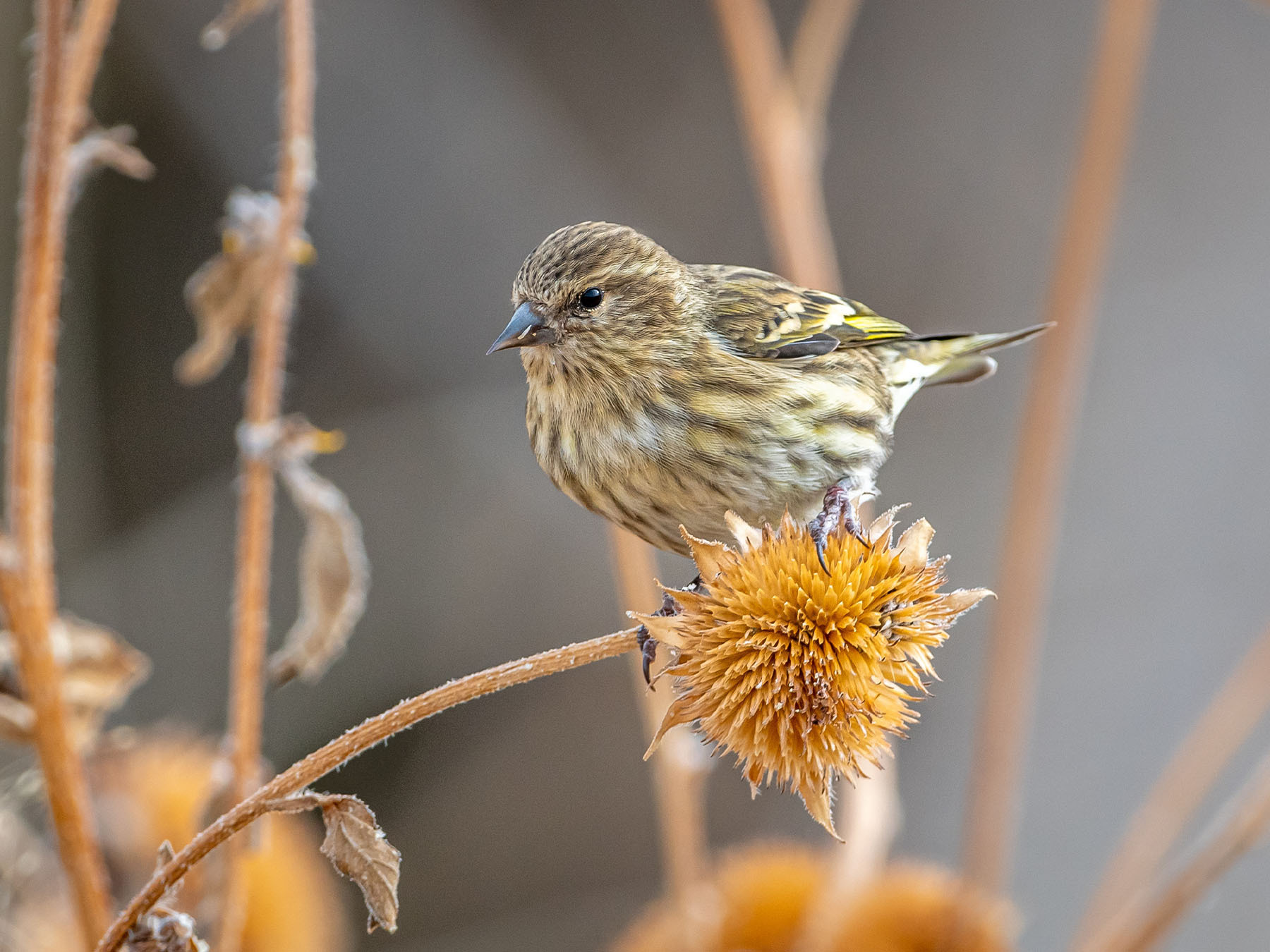
The Pine Siskin is a small, streaky finch with a sharp, pointed bill.
Its brown-streaked body is accented by yellow edges on the wings and tail, most visible in flight. The bird has a short, notched tail and a somewhat flattened head profile.
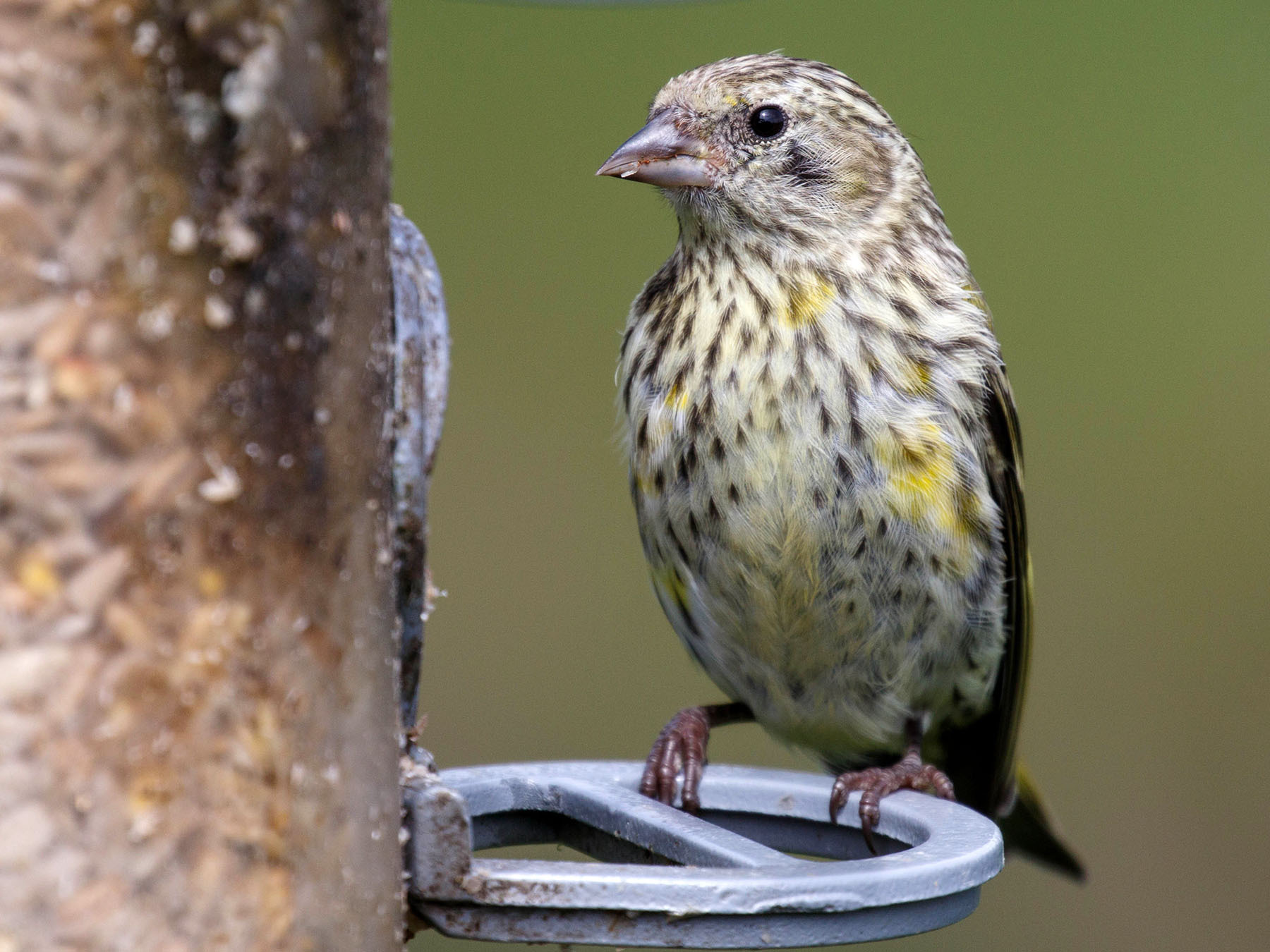
Both sexes look similar, with males having slightly more yellow in their plumage. Juveniles resemble adults but may have less distinct markings and duller coloration overall.
Its size
Adults- Length
- 11–14 cm
- Wingspan
- 18–22 cm
- Weight
- 12–18 g
Its song and calls
Pine Siskins are known for their high-pitched, buzzy calls, often described as a prolonged 'zreeee' or 'zree-e-e-e'.
Their song is a mix of warbles, twitters, and long buzzy notes, sometimes incorporating mimicry of other bird species. In flight, they make a distinctive 'tee-tee-tee' sound.
- Call0:00 / 0:17
Recorded in Newfoundland and Labrador, Canada · August 2011
When and where to see it
OctoberArriving
Most recorded in October
- 1. Montana1.3%
- 2. Idaho1.1%
- 3. New Mexico1.1%
- 4. Wyoming1.1%
- 5. British Columbia0.93%
Each dot is a county, state or province: the bigger and darker, the larger the bird’s share of that place’s bird records that month. Grey dots: no regular records. The ringed point is the centre of the bird’s records this month; the arrow shows how it moved since last month, and the dashed loop its path through the year. “Arrivals” colours places where it becomes regular this month (orange) or is in its last regular month (grey). GBIF eBird Observation Dataset, 2019–2024. Map data: Natural Earth, US Census Bureau; place centres © OpenStreetMap contributors.
In your area
See when the Pine Siskin is recorded in your county, state or province.
How often the Pine Siskin turns up in the United States and Canada through the year, from birdwatchers' records.
United States
Resident · all year · most records in February
Canada
Resident · all year · most records in February
Show as a table
| Month | United States | Canada |
|---|---|---|
| January | 0.29% (regular) | 0.62% (regular) |
| February | 0.34% (regular) | 0.98% (regular) |
| March | 0.31% (regular) | 0.93% (regular) |
| April | 0.25% (regular) | 0.63% (regular) |
| May | 0.19% (regular) | 0.44% (regular) |
| June | 0.19% (regular) | 0.46% (regular) |
| July | 0.21% (regular) | 0.49% (regular) |
| August | 0.16% (regular) | 0.48% (regular) |
| September | 0.13% (regular) | 0.39% (regular) |
| October | 0.28% (regular) | 0.57% (regular) |
| November | 0.33% (regular) | 0.57% (regular) |
| December | 0.29% (regular) | 0.60% (regular) |
Worldwide: recorded regularly in 5 countries
Countries where it was recorded in at least 3 of the 6 years 2019–2024. Linked countries have their own bird list.
North America (5)
Data: EOD – eBird Observation Dataset (Cornell Lab of Ornithology), accessed via GBIF.org, CC BY 4.0. Records from 2019–2024, aggregated and filtered by Birdfact. How these lists are made
Tips for seeing it
- Look for Pine Siskins in coniferous forests or mixed woodlands
- Listen for their distinctive, buzzy 'zreeee' call
- Check bird feeders, especially those offering nyjer or thistle seeds
- Observe their rapid, undulating flight pattern
What it eats
Pine Siskins primarily feed on seeds, especially those from conifers, alders, and birches. They also consume buds, tree flowers, and occasionally insects.
Their specialized bill allows them to extract seeds from tightly closed pine cones, giving them an advantage in coniferous habitats.
Nesting and breeding
Pine Siskins typically breed from April to August, with timing varying based on location and food availability. Males court females with aerial displays and feeding rituals, often presenting food as part of the pair bonding process.
Nests are built high in coniferous trees, usually on a horizontal branch. The female constructs a cup-shaped nest using twigs, grass, and plant fibers, lined with soft materials like fur or feathers.
The female lays 3-4 pale blue-green eggs with brown spots. Incubation lasts about 13 days, with the female incubating while the male brings food. Nestlings fledge after 13-17 days but may depend on parents for several weeks.
Behaviour
Pine Siskins are highly social, often seen in large, noisy flocks. They exhibit acrobatic feeding behaviors, hanging upside down on conifer cones or seed heads to extract seeds.
During the breeding season, males perform elaborate courtship flights, making wide circles while singing continuously.
Conservation
While currently listed as Least Concern, Pine Siskins face threats from habitat loss due to deforestation and climate change. They are also susceptible to salmonellosis outbreaks at bird feeders, highlighting the importance of feeder hygiene and responsible bird feeding practices.
Similar birds
Often mistaken for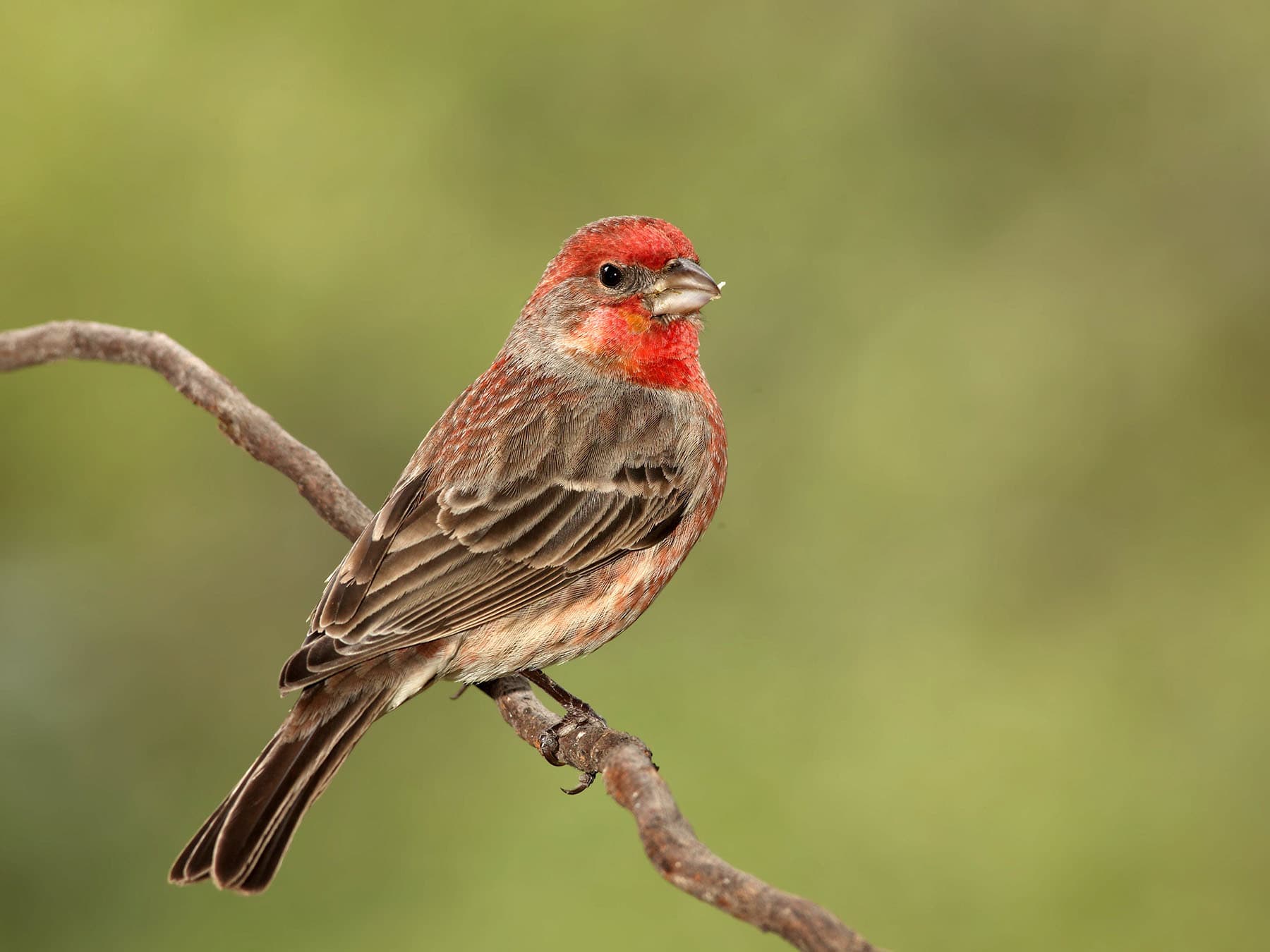
More photos
3 photos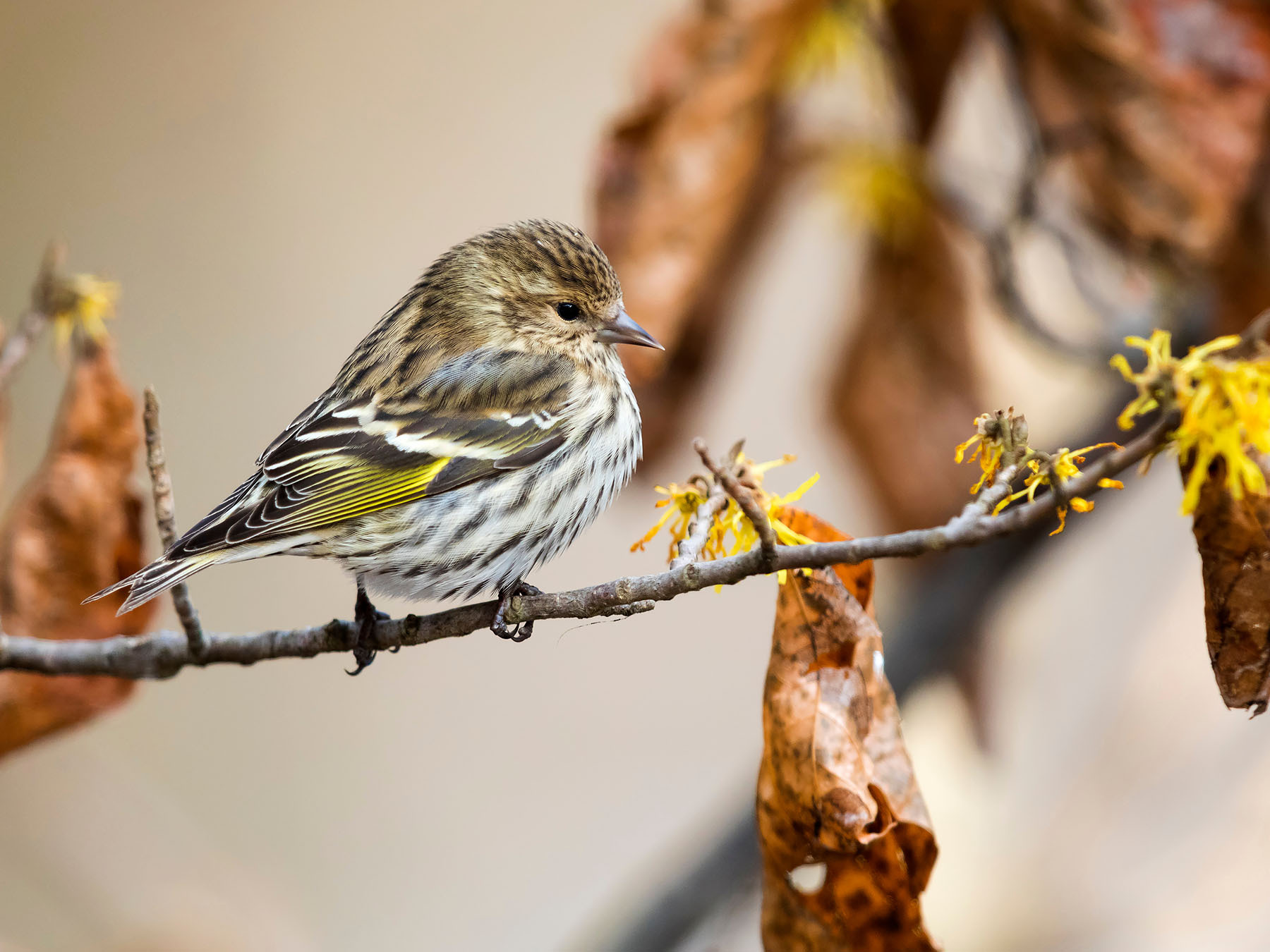
Quick facts
- Length
- 11–14 cm
- Wingspan
- 18–22 cm
- Weight
- 12–18 g
- Lifespan
- 3–5 years · oldest recorded 9 years
- Family
- Finches
- Migration
- Irruptive migrant
- Global status (IUCN)
- Least Concern
- World population
- 46,000,000 mature individuals
- Population trend
- Population considered stable die to large population size, however long-term decline due to habitat loss and climate change
- Also called
- Pine Finch
- Scientific name
- Spinus pinus
Sources
4- 1BirdLife International. 2016. Spinus pinus. The IUCN Red List of Threatened Species 2016: e.T22720359A94666039. Source (opens in a new tab)
- 2Breeding Bird Survey and/or Christmas Bird Count: Butcher and Niven (2007)
- 3Partners in Flight (2022) Source (opens in a new tab)
- 4BBL: Longevity Records Of North American Birds. Version 2023.1 (2023) Source (opens in a new tab)

Checked by
Nathan Cope, founder and editor
Nathan founded Birdfact and leads its writers and contributors in the UK, the US and Canada. He has watched and studied birds for more than ten years, and checks every article and species guide before it’s published.