Facts · Updated 11 Oct 2026
Purple Finch Nesting: Nests, Eggs and Young
By the Birdfact teamChecked by Nathan Cope
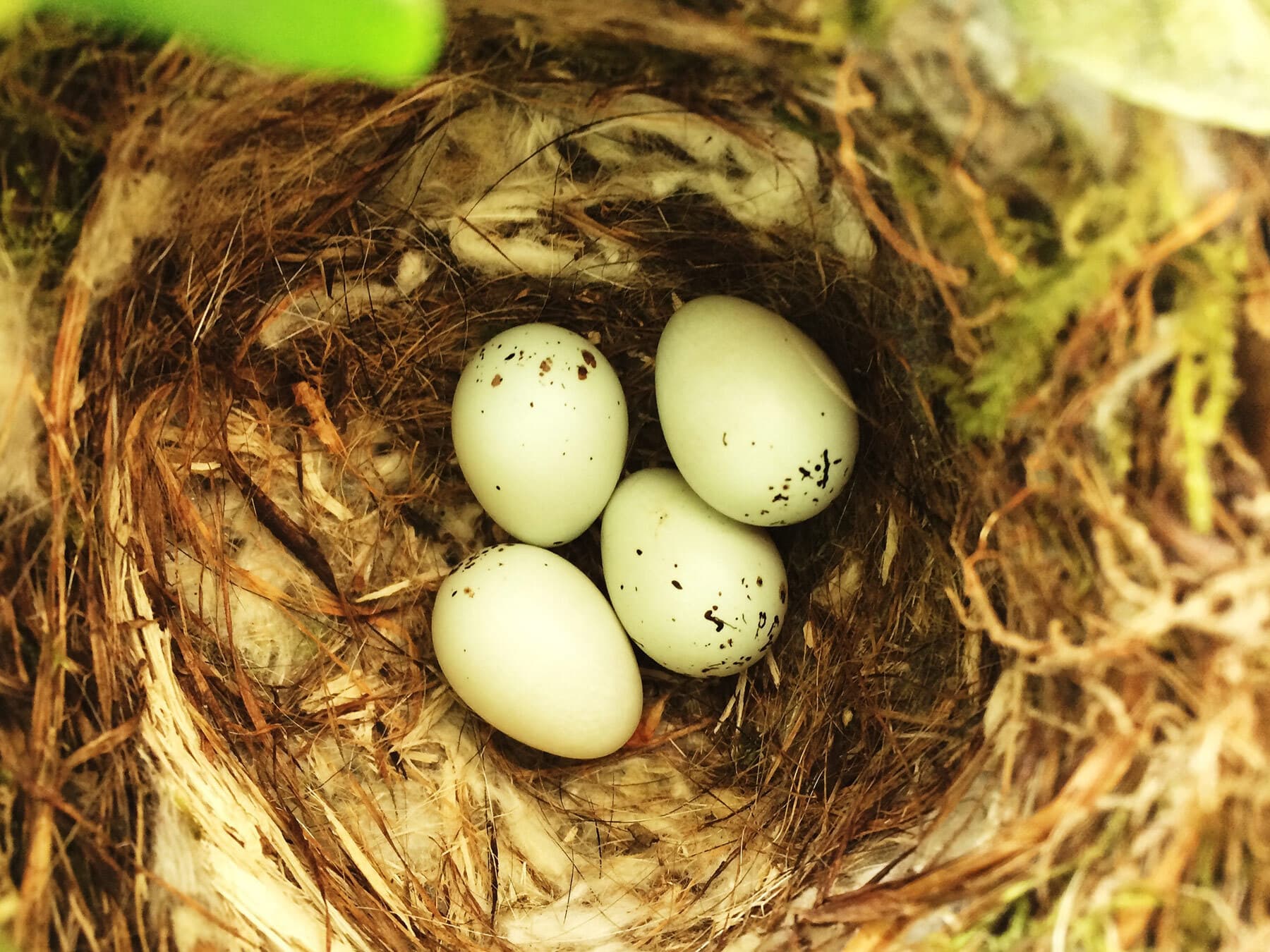
Purple Finches nest from April to August, usually far out on a conifer branch. The female builds a cup of twigs and roots and lays usually 4 pale greenish-blue eggs spotted brown and black, incubates them for 12 to 13 days, and the young leave the nest at 13 to 16 days.
On this page11 sections
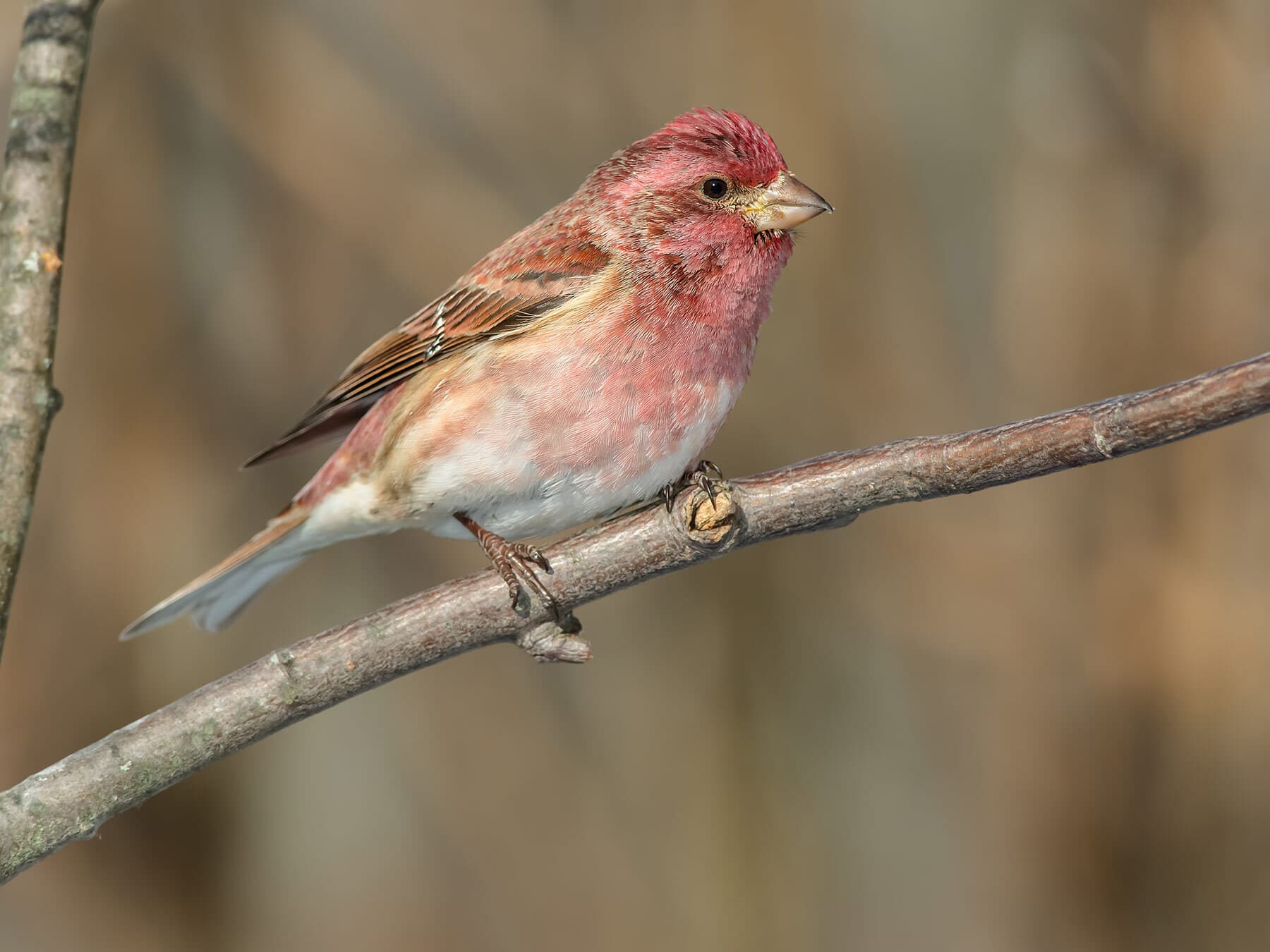
Where Purple Finches nest, what the nest and eggs look like, how long the eggs and chicks take, and what to do if you find a nest or a fledgling. For the bird itself, see Purple Finch identification, song and facts.
When do Purple Finches nest?
From April to August. Nest records give first eggs from April 1 to July 28 and young leaving nests from late April to late August, with nesting later farther north: in small samples, mid-May to late July in New York but April and May in Pennsylvania.1 Courtship, with the male's hopping, wing-fluttering dance, usually comes just before the female starts to build.
Where do Purple Finches nest?
In trees, usually well out along a branch with another branch above for cover. In a sample of 435 nests, 79% were in conifers, mostly Douglas-firs, Austrian and Scots pines and spruces, and 17% in broadleaf trees such as oaks, maples and fruit trees; a few were in shrubs or vines, and single nests were found in a conifer wreath, in rock-crushing machinery and on an airplane.
Where you live matters. Western birds, on the Pacific Coast, nest away from conifers far more often: 62% of 116 western nests, against 5% of 319 eastern ones. Nests range from 2.5 to 60 feet up,2 typically 15 to 20 feet.3 Both birds of the pair seem to take part in choosing the site.
The nest
The female does most or all of the building, which takes 3 to 8 days. She starts with a base of twigs, small sticks and roots and lines the cup with fine grasses, plant fibers, moss and animal hair. All About Birds gives the finished nest as roughly 7 inches across and 4 inches high. The male may come along while she builds, but in one account he carried nothing.
There is no evidence that Purple Finches reuse their nests: a pair raising a second brood builds a new one. Nor does any source we read describe them using nest boxes.
Purple Finch eggs
The eggs are pale greenish blue, marked with dots, spots and the odd scrawl of brown or black, mostly around the wide end, and slightly glossy. They average about 0.8 by 0.6 inches (20.2 by 14.6 mm).
A clutch is 2 to 7 eggs, most often 4: in 258 nests, 129 had 4, 57 had 3 and 56 had 5. Clutches tend to be bigger farther north, with an average of 4.5 in Canada against 3.8 in southern California. The female lays one egg a day, starting 1 to 5 days after the nest is finished.
Incubation
Incubation takes 12 to 13 days. The female does most of it and is often hard to flush off the nest; the male brings her food, feeding her both on the nest and away from it.1 The eggs hatch within a day of each other, and the parents carry the shells away.
Chicks
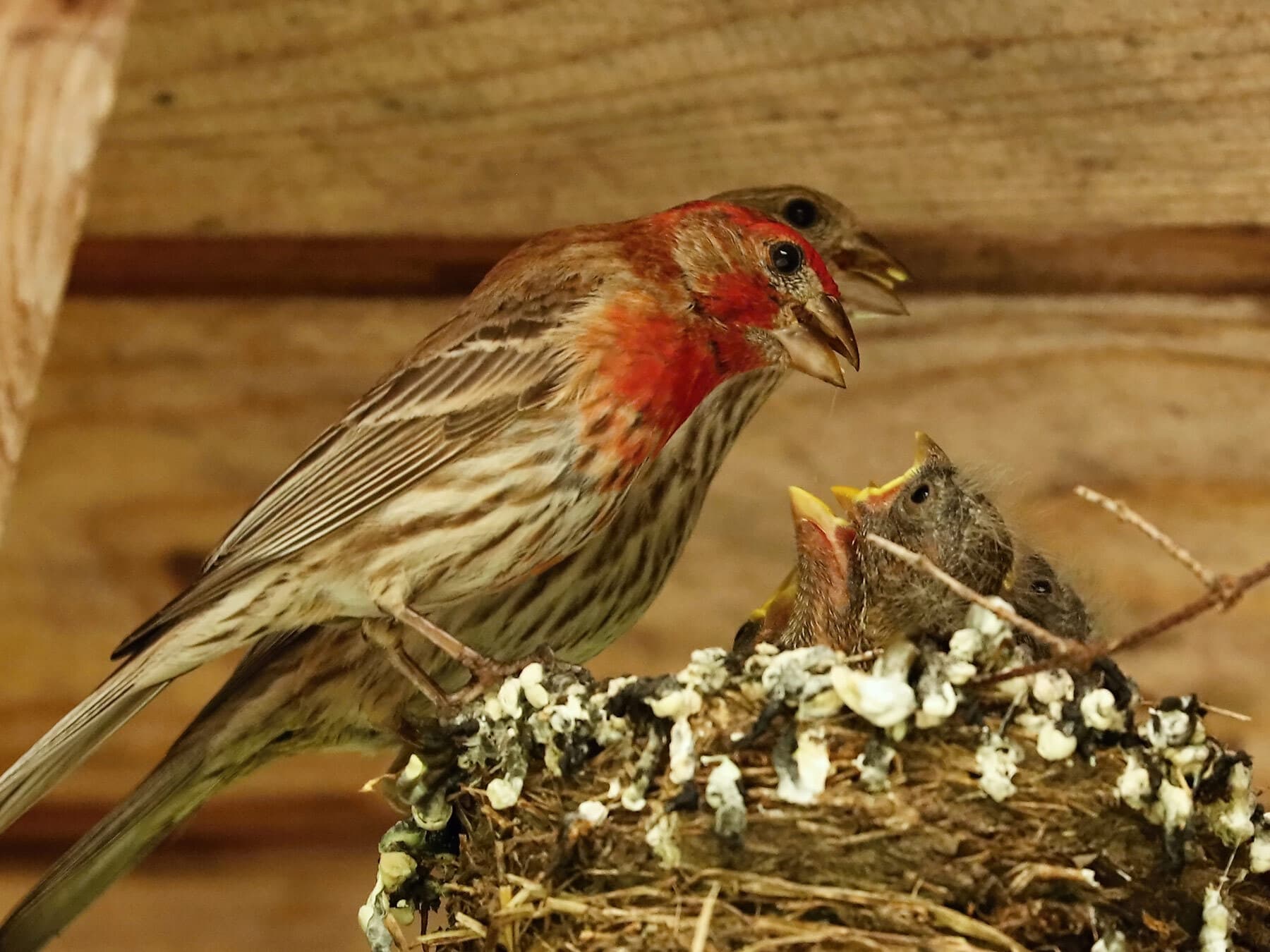
The chicks hatch naked or nearly so, with their eyes closed. The female broods them, and both parents feed them by bringing up food they have swallowed. Purple Finches feed their chicks mostly seeds.1 The parents keep the nest clean by taking the droppings away.
When do baby Purple Finches leave the nest?
At 13 to 16 days old.2 Fledglings leave fully feathered but fly weakly, and they stay near the nest for about the first week while both parents go on feeding them.
Second broods
Many pairs nest twice in a summer. Birds of the World, citing a New York study, says pairs generally raise two; All About Birds gives one or two, and the Audubon guide one, possibly two on the Pacific Coast. A second nest can follow quickly: as little as a day or two can pass between one brood leaving and the next clutch being laid, and a Pennsylvania pair may have raised a third brood in early August.
Cowbirds and nest predators
Brown-headed Cowbirds lay eggs in some Purple Finch nests: 5.9% of 372 nests, all of them in the East (none of 97 western nests). It rarely works for the cowbird: only 1 of 12 cowbird eggs produced a fledgling, probably because a cowbird chick needs insects and Purple Finch parents bring seeds.
Predators are a bigger danger. Of 202 nests with known outcomes, 31% were lost to predators. Blue Jays, California Scrub-Jays, Clark's Nutcrackers, Common Grackles and red squirrels take eggs and chicks. When a nest is raided, the parents often stay close by, calling. In nests that cowbirds left alone, an average of 1.88 young fledged per nest, and 3.46 per nest that fledged any young at all.
Finding a nest or a fledgling
Leave it be. Purple Finches are protected under the Migratory Bird Treaty Act,4 and it is illegal to destroy a nest with eggs or chicks in it, or while the young still depend on it; wait until the nest is empty.5 A fledgling on the ground or hopping in a shrub is normal: its parents are nearby, so give it space. A chick with no feathers or closed eyes can be put back in the nest if you can reach it; if a bird is hurt, call a licensed wildlife rehabilitator.6
Sources
- Wootton, J. T. (2020). Purple Finch (Haemorhous purpureus), version 1.0. Birds of the World (A. F. Poole and F. B. Gill, editors). Cornell Lab of Ornithology. doi:10.2173/bow.purfin.01
- Cornell Lab of Ornithology. Purple Finch: Overview, Identification, Life History and Sounds. All About Birds. Accessed October 11, 2026. Source
- National Audubon Society (text: Kaufman, Lives of North American Birds). Purple Finch. Audubon Guide to North American Birds. Accessed October 11, 2026. Source
- U.S. Fish and Wildlife Service. List of birds protected by the Migratory Bird Treaty Act. Code of Federal Regulations, 50 CFR 10.13. Accessed October 11, 2026. Source
- U.S. Fish and Wildlife Service. Bird nests. U.S. Fish and Wildlife Service. Accessed October 11, 2026. Source
- Shaw, T. What to do if you find a baby bird, injured or orphaned wildlife. U.S. Fish and Wildlife Service. Accessed October 11, 2026. Source