Facts · Published 11 Oct 2026
Female and Male Purple Finches: How to Tell Them Apart
By the Birdfact teamChecked by Nathan Cope
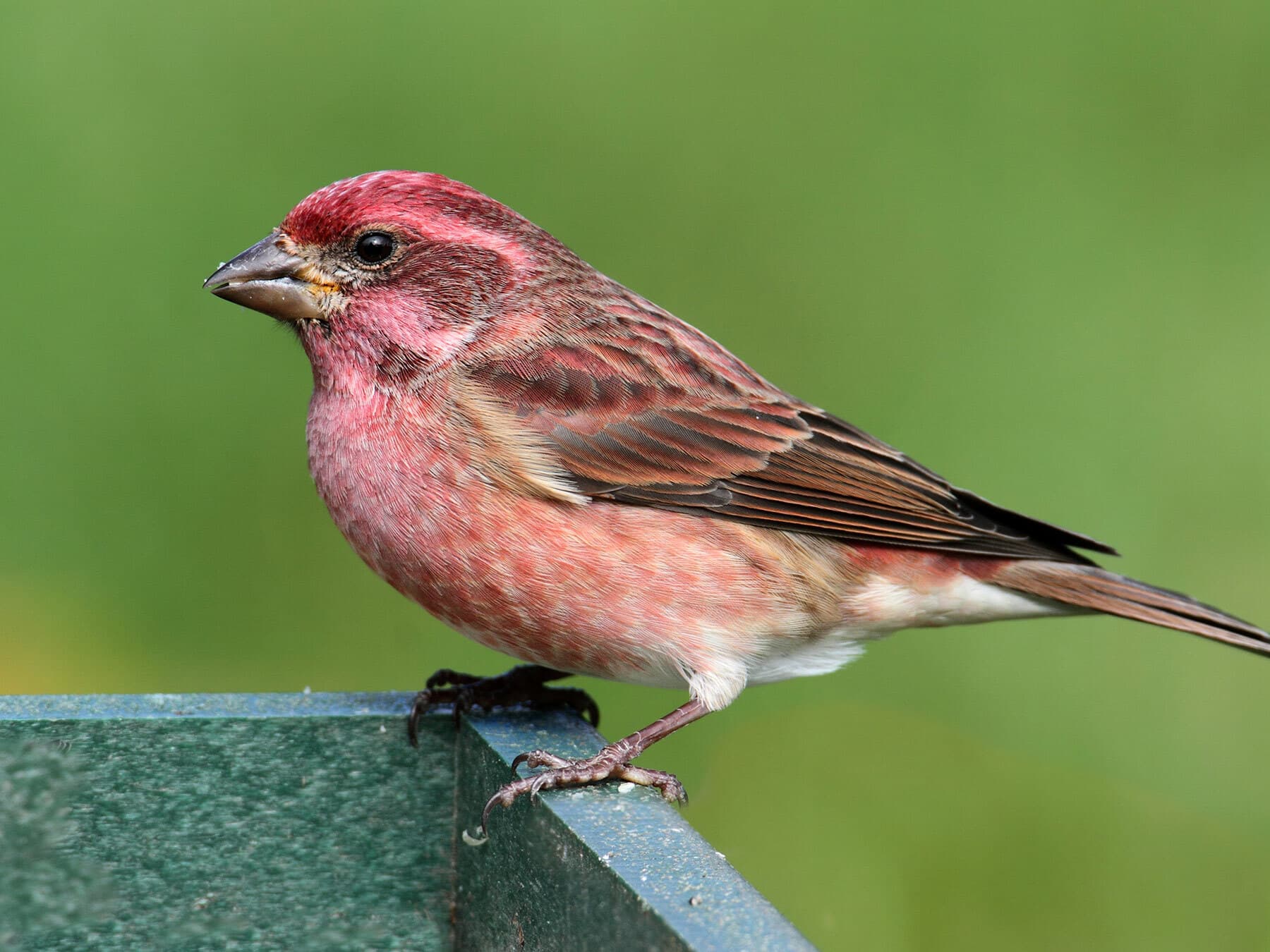
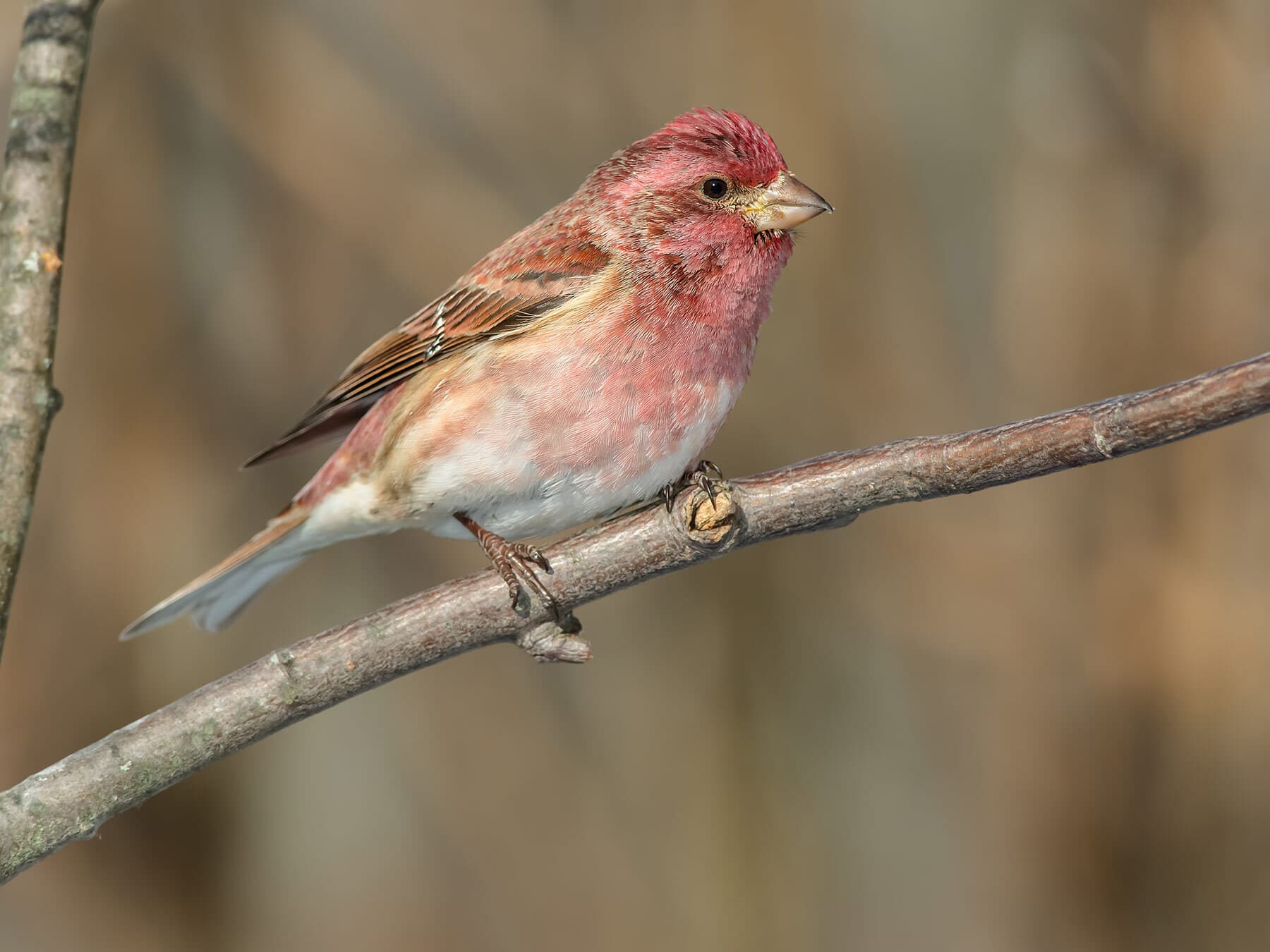
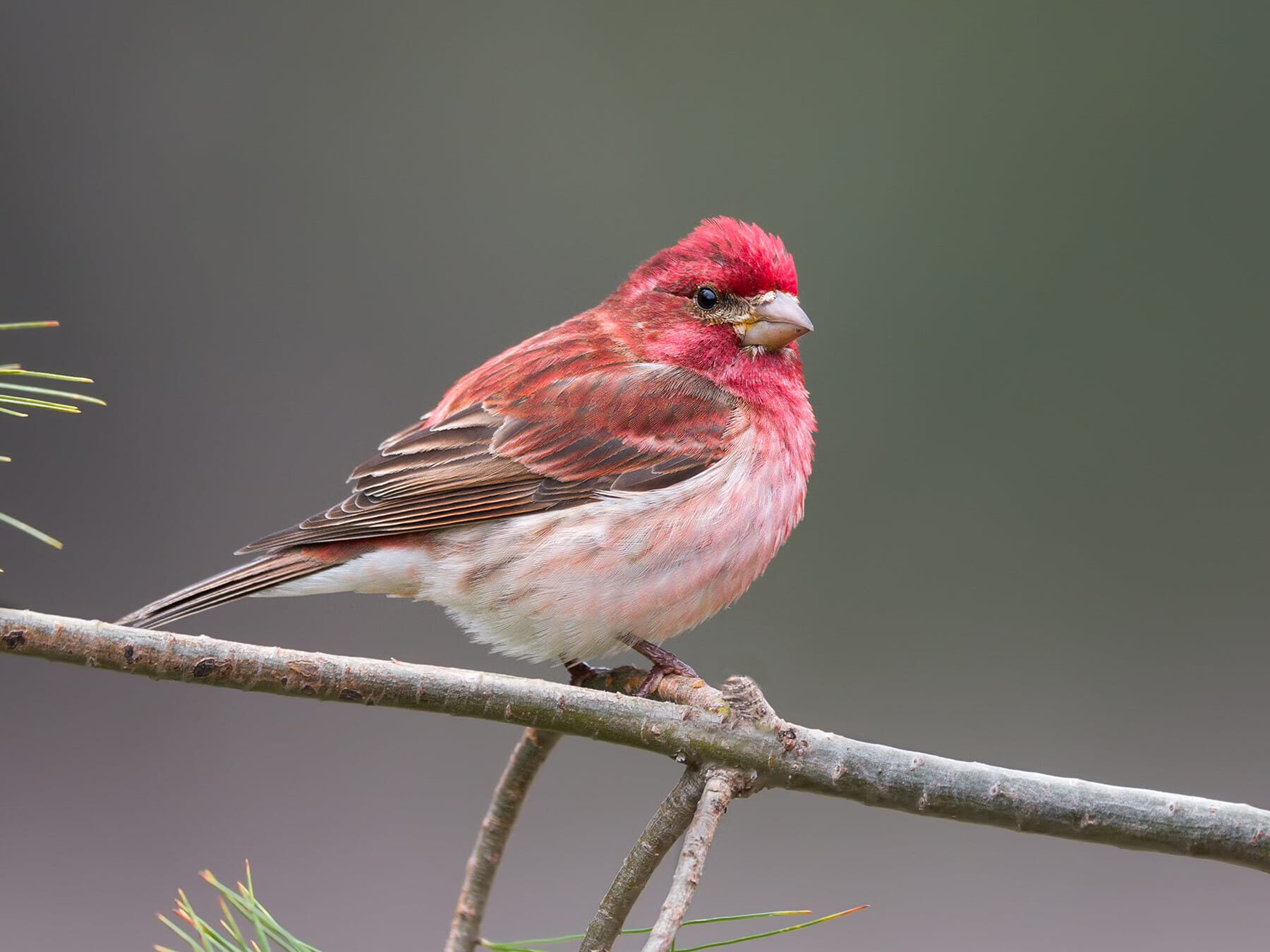
Only the adult male Purple Finch is red, washed rosy over the head, back and breast. The female is brown and streaky with a bold white eyebrow and dark cheek. Young males look like females for their first year, and some breed before they turn red.
On this page11 sections
How to tell a female Purple Finch from a male, from a young male, and from the brown birds she is most often mistaken for. For the bird itself, see Purple Finch identification, song and facts.
Male and female: the difference
Look for red. An adult male Purple Finch is washed rosy red over the whole head, the back, the rump and the breast, with a plain white belly. A female has no red, or almost never: she is a brown, streaky bird with a bold face.1
The catch is that young males look like females. For their first year, males are brown and streaky too, and in the field the two are virtually impossible to tell apart.2 That is why field guides and studies often say "female-plumaged" or "female or immature" rather than "female".
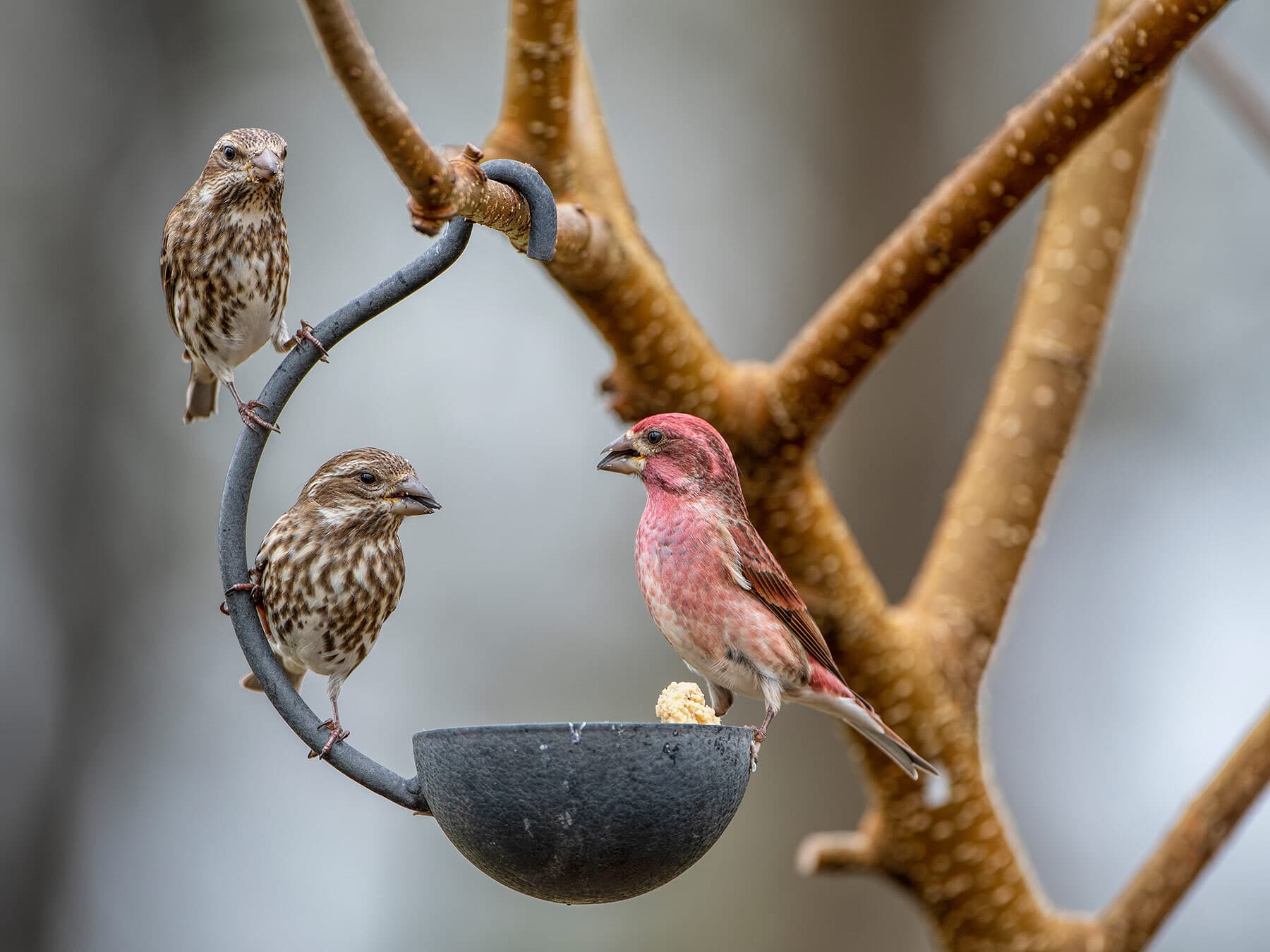
What does a female Purple Finch look like?
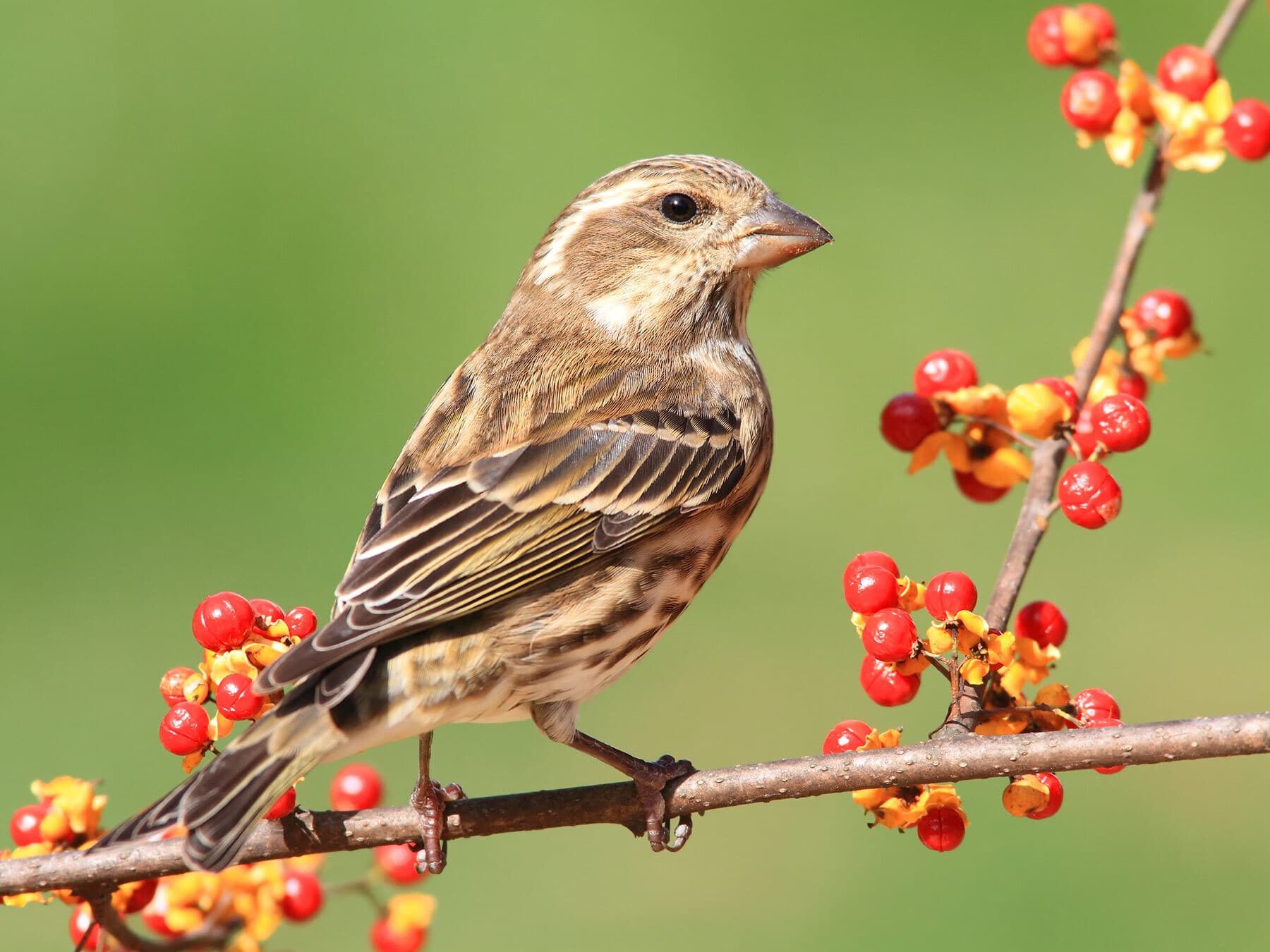
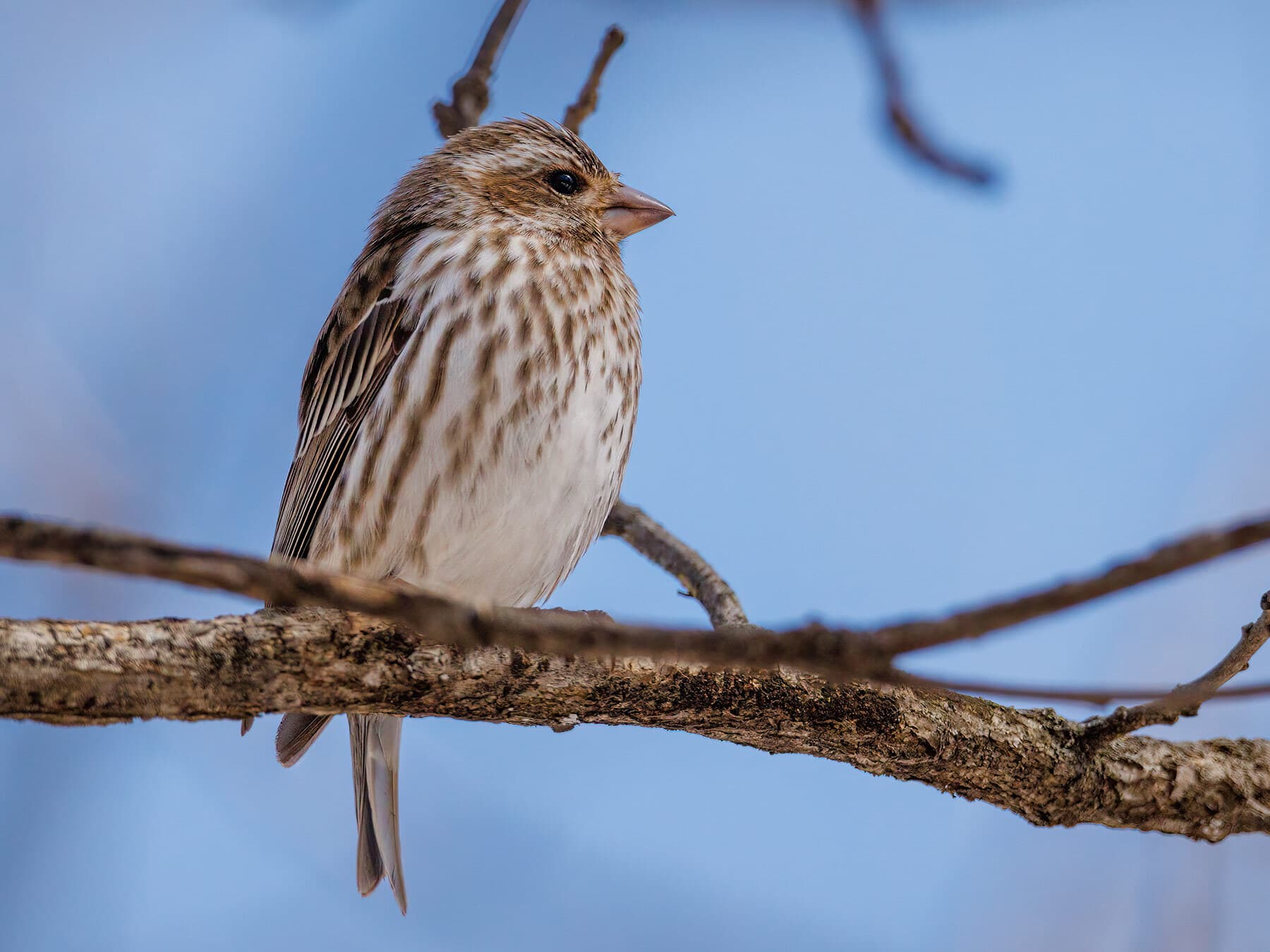
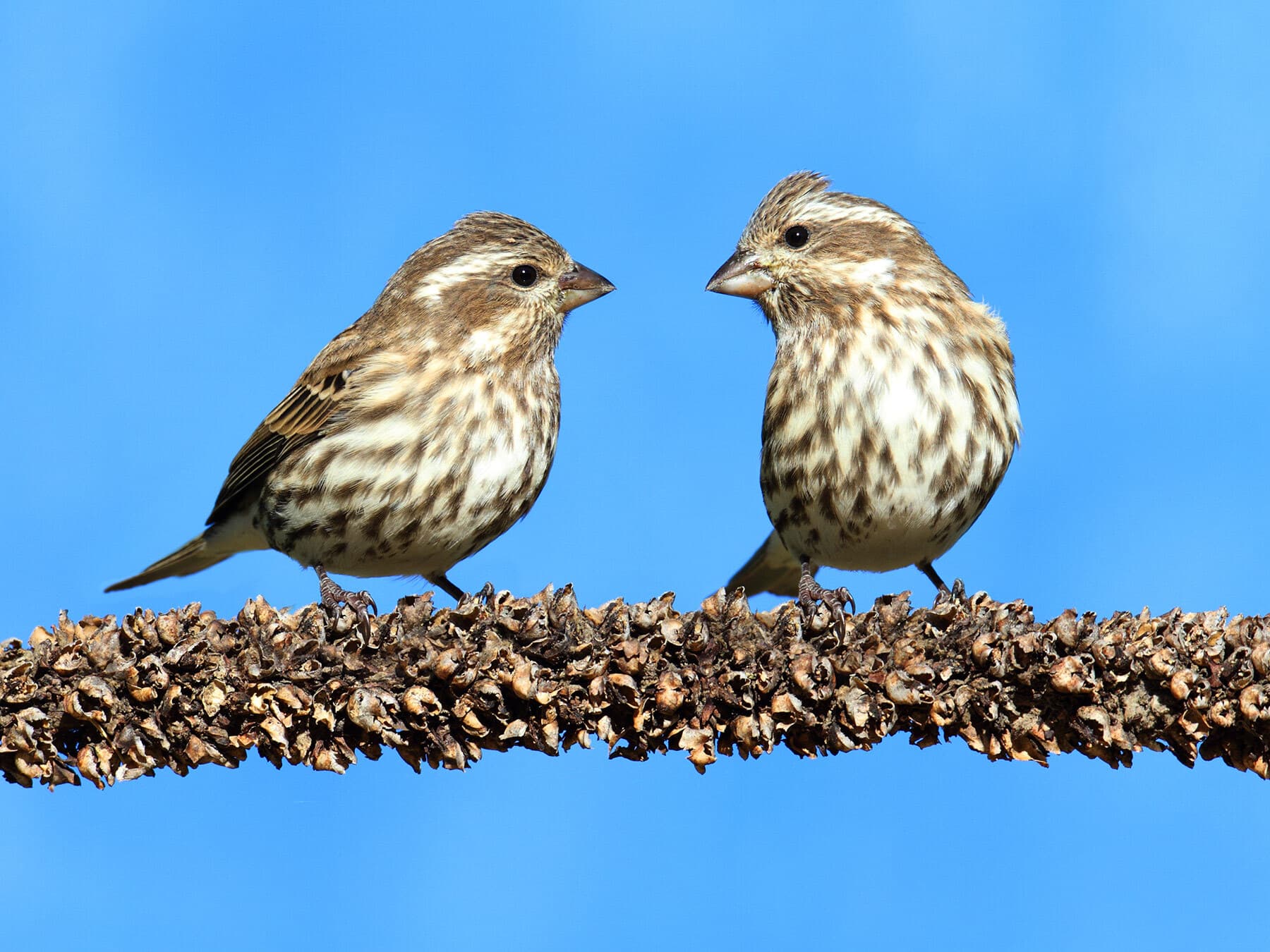
A female Purple Finch is a chunky, brown-backed finch with bright white underparts covered in short, thick brown streaks. Her face is the key: a bright white stripe over the eye, a dark brown patch on the cheek and a white stripe below the cheek,3 with a dark stripe running down each side of the throat, so the head looks striped.1 The lower belly and the feathers under the tail are usually plain white.
Close up, look at the wings: the edges of the flight and tail feathers have a greenish tinge. Rarely, an older female shows a hint of pink on the head, neck or rump.
Female Purple Finch or female House Finch?
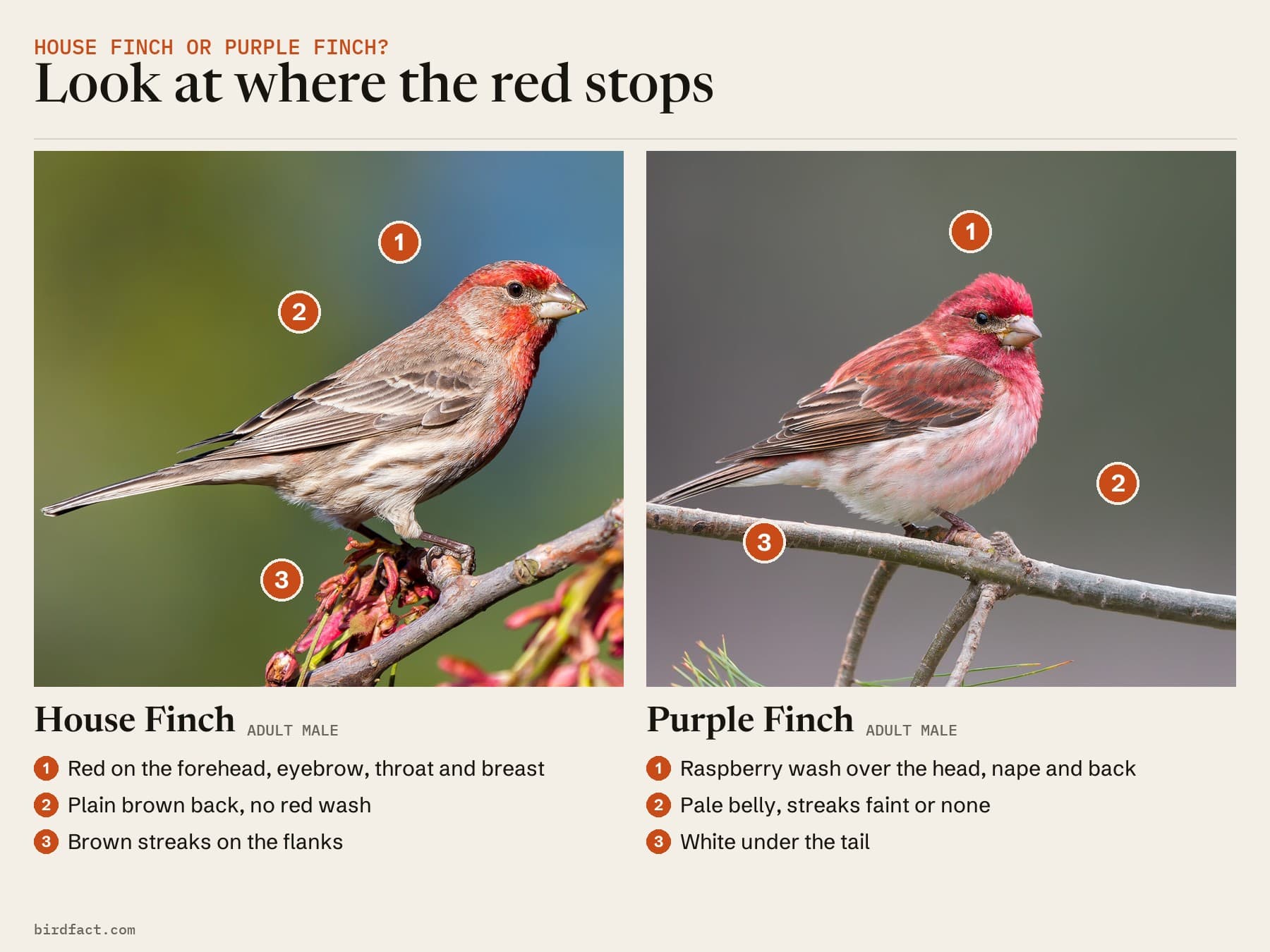
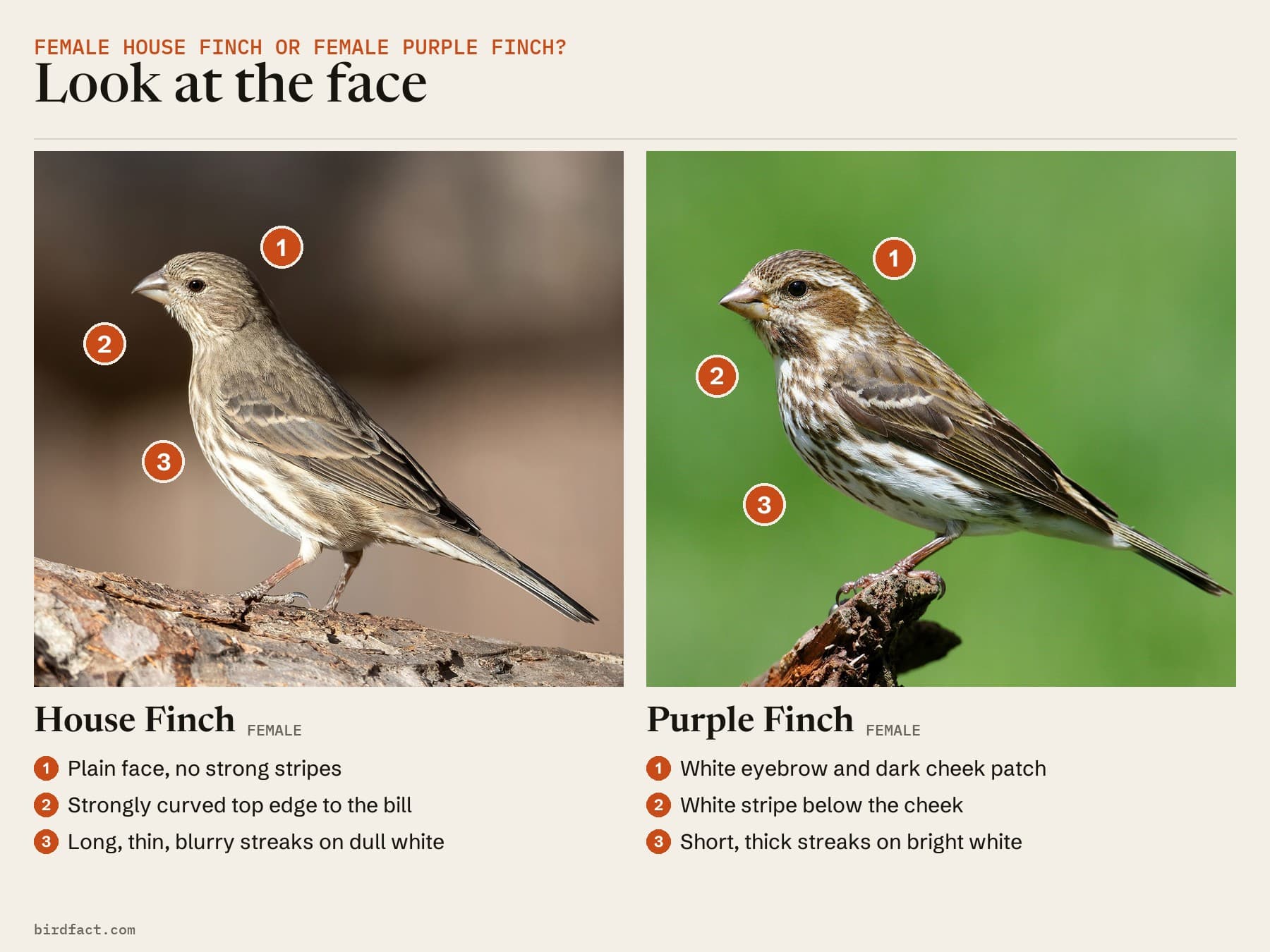
This is the hardest pair, and the one most people need. A female House Finch has a plain face, with no strong eyebrow or cheek patch; her streaks are long, thin and blurry on a dull, grayish white; and she usually has broad dark streaks under the tail. A female Purple Finch has the striped face, shorter and thicker streaks on bright white, and usually a plain white undertail.3
Shape helps too. The Purple Finch is plumper, with a bigger head and a short, deeply notched tail; the House Finch is slimmer, with a longer tail and a small bill with a strongly curved top. Side by side, with photos: House Finch or Purple Finch?
Other lookalikes
Song Sparrow. Brown and streaky like a female Purple Finch, but with a long, rounded tail, a slimmer bill, and streaks that often run together into a spot in the middle of the breast.
Pine Siskin. Smaller and streakier, with a thin, sharp-pointed bill and yellow edges in the wings and tail, brightest in flight. The two often feed together in winter flocks.
Female Cassin's Finch. A western mountain bird. She has a weaker face pattern than a female Purple Finch, with a streaked rather than solid cheek patch, sharper streaks that run down under the tail, and a paler, more spotted back.2
Female Purple Finches in the West
On the Pacific Coast, from British Columbia to California, Purple Finches belong to a duller western subspecies. Western females are more olive above, their streaks are blurrier, and their face pattern is weaker.1 With these birds, check the undertail and the shape as well as the face.
The adult male
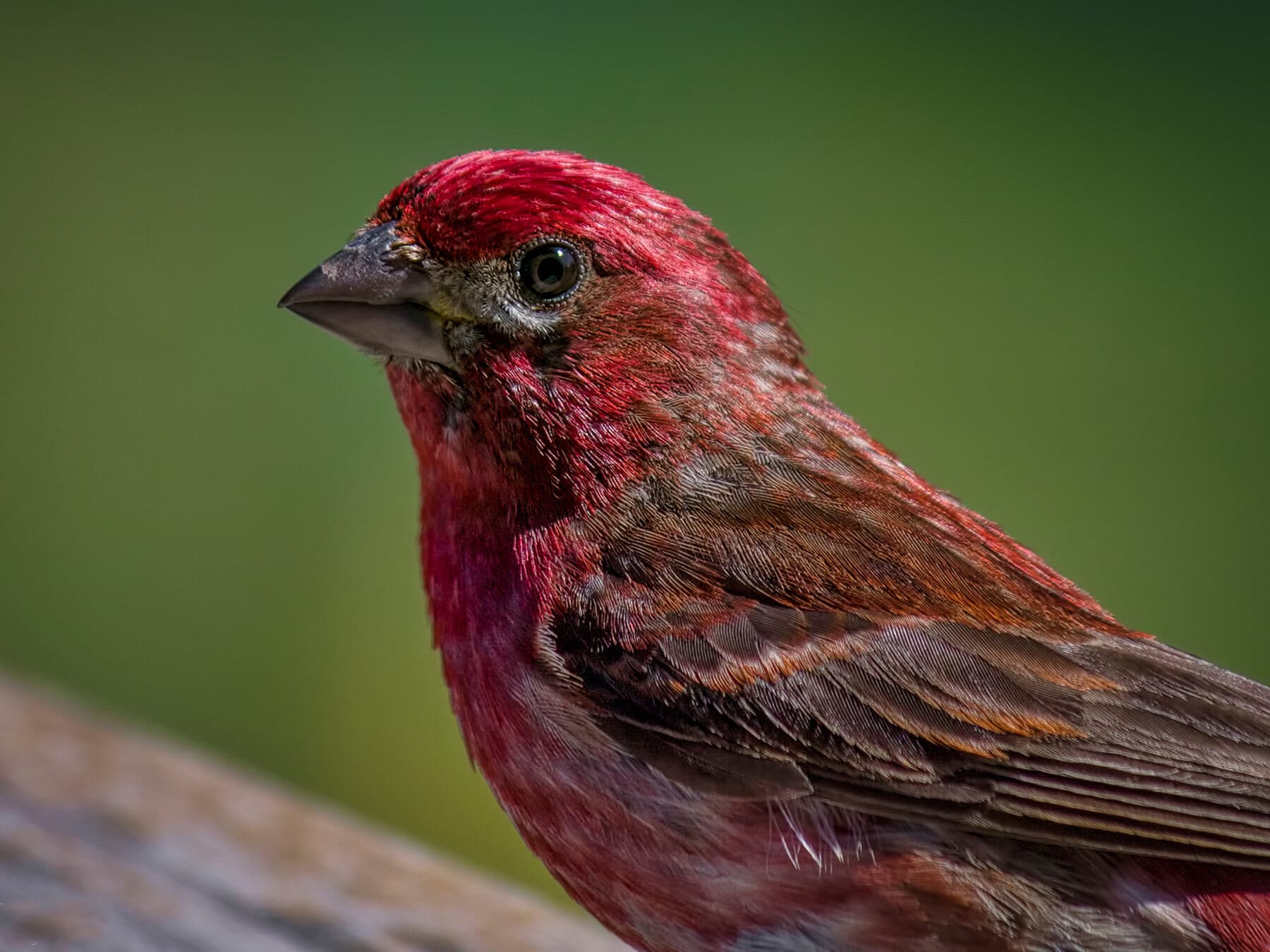
The adult male's rosy red covers the head, the back of the neck, the back, the rump and the breast, darkest on the cheek, with a paler stripe over the eye; his belly is white, and almost all adult males (98% in one sample) have no brown streaks below.2 A male House Finch, by contrast, is red only on the front of the head, the breast and the rump.
In related finches the red depends on carotenoid pigments in the food a male eats, and Birds of the World says the same is probably true of the Purple Finch. After the molt, which runs from July to November, the fresh feathers have tips that wear away over the winter, so males look redder by spring. They stay rosy all year.
Young males: brown for a year
Purple Finch males take more than a year to turn red. Young of both sexes molt from August to October into a brown, streaky first-year plumage that looks just like an adult female's. In their second summer the males replace it with rosy red, and by fall they look like adults.
Some young males do not wait. Purple Finches start breeding at a year old, and some males do it before they get their red. In one old record, a brown bird thought to be a male fed an incubating female and then her young after the territory's male disappeared.
Most young male House Finches, by contrast, turn red in their first fall, so a brown House Finch in adult plumage is usually a female.
Juveniles and fledglings
Juveniles, this year's young, are brown and streaky like females, but fluffier, with a mottled crown and eyebrow and heavy streaks on the throat, sides and belly. Birds in this plumage have been found from June to October. Young birds leave the nest fully feathered but flying weakly, and stay near it for about a week while both parents feed them. More: Purple Finch nests, eggs and young.
Do female Purple Finches sing?
Yes. Females have been recorded singing a long, finch-like warble from the nest, lasting 1 to 2 minutes, quite unlike the male's songs.
Who does what
The female builds the nest, mostly or entirely on her own, and does most of the incubating, while the male brings her food on and off the nest. Both parents feed the chicks and the fledglings. In winter flocks and at feeders, brown birds usually win disputes with red males: at one Virginia feeder, female-plumaged Purple Finches beat adult males in 95.6% of 226 encounters.4
Sources
- Cornell Lab of Ornithology. Purple Finch: Overview, Identification, Life History and Sounds. All About Birds. Accessed October 11, 2026. Source
- Wootton, J. T. (2020). Purple Finch (Haemorhous purpureus), version 1.0. Birds of the World (A. F. Poole and F. B. Gill, editors). Cornell Lab of Ornithology. doi:10.2173/bow.purfin.01
- Project FeederWatch (Cornell Lab of Ornithology and Birds Canada). Tricky Bird IDs: Cassin's Finch, House Finch and Purple Finch. Project FeederWatch. Accessed October 11, 2026. Source
- Shedd, D. H. (1990). Aggressive interactions in wintering House Finches and Purple Finches. Wilson Bulletin 102(1): 174-178. Accessed October 11, 2026. Source
- National Audubon Society (text: Kaufman, Lives of North American Birds). Purple Finch. Audubon Guide to North American Birds. Accessed October 11, 2026. Source
- Badyaev, A. V., Belloni, V., Hill, G. E. (2020). House Finch (Haemorhous mexicanus), version 1.0. Birds of the World (A. F. Poole, editor). Cornell Lab of Ornithology. doi:10.2173/bow.houfin.01
- National Audubon Society (text: Kaufman, Lives of North American Birds). House Finch. Audubon Guide to North American Birds. Accessed October 11, 2026. Source
- National Audubon Society (text: Kaufman, Lives of North American Birds). Cassin's Finch. Audubon Guide to North American Birds. Accessed October 11, 2026. Source
- National Audubon Society (text: Kaufman, Lives of North American Birds). Pine Siskin. Audubon Guide to North American Birds. Accessed October 11, 2026. Source
- National Audubon Society (text: Kaufman, Lives of North American Birds). Song Sparrow. Audubon Guide to North American Birds. Accessed October 11, 2026. Source