Facts · Updated 11 Oct 2026
House Finch Nesting: Nests, Eggs and Young
By the Birdfact teamChecked by Nathan Cope
House Finches nest from February to August in conifers, cactus, ivy, ledges and hanging planters, rarely in nest boxes. The female lays usually 4 or 5 pale blue, black-speckled eggs and incubates them for 13 to 14 days; the young leave the nest about 12 to 15 days after hatching, and most pairs nest more than once a year.
On this page15 sections
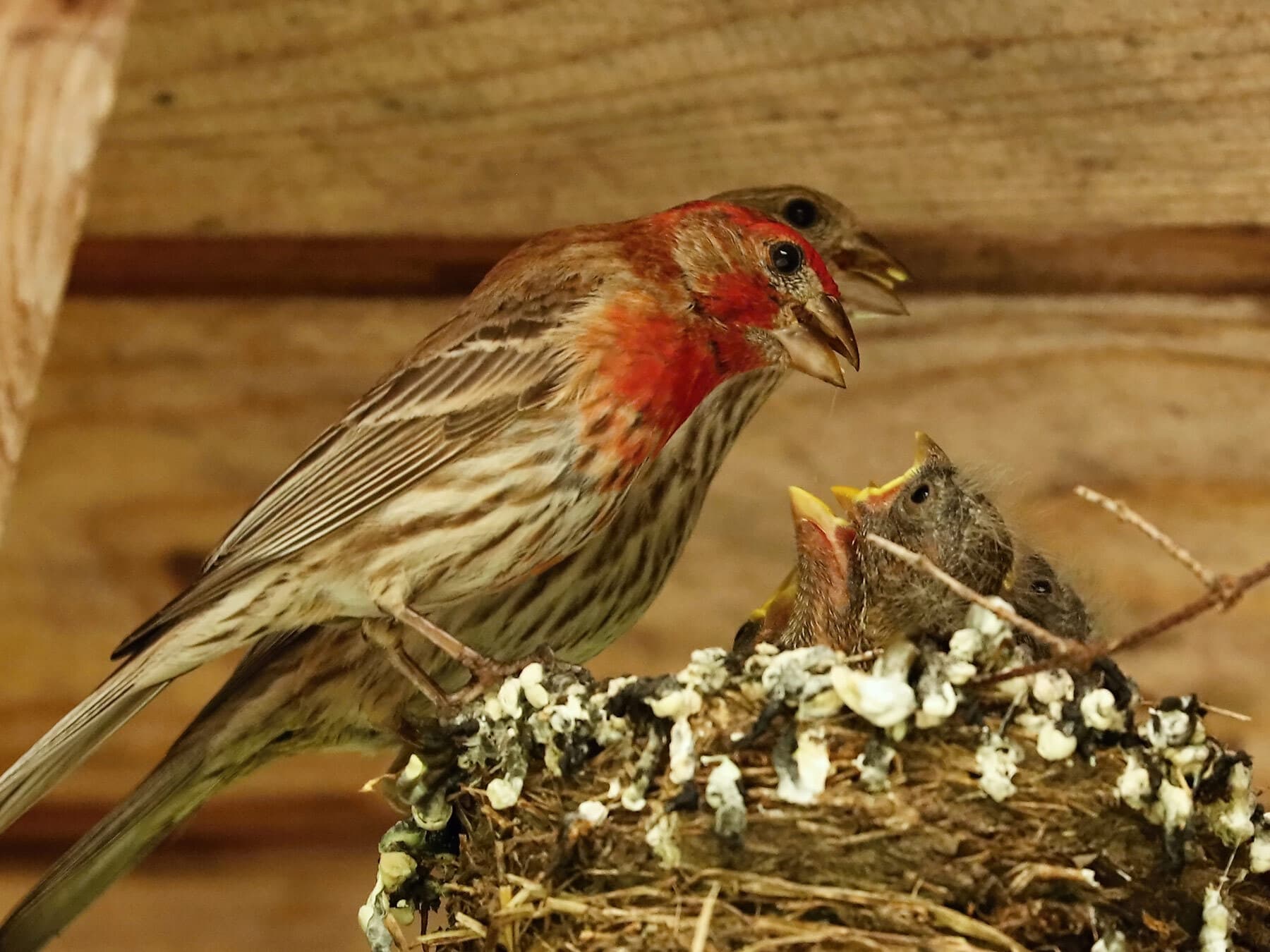
Everything about House Finch nests: when and where they nest, the nest, the eggs, the chicks and fledglings, and what to do if House Finches nest on your porch. For the bird itself, see House Finch identification, song and facts.
When do House Finches lay eggs?
From late winter to late summer. Building starts as early as February in Arizona and in late February or March farther north, and eggs are laid from early February in Arizona to August, and in one newly settled Montana population into early September. In Michigan the laying season ran from March 10 to July 20, and in California from February 28 to August 7. For a bird that lives from Mexico to Canada, the dates are remarkably similar.1
Warm springs bring nesting forward. In California nest records from 1895 to 2007, House Finches started laying 4.6 days earlier for every 1.8 °F (1 °C) rise in the average spring temperature.2
Nest sites
House Finches nest almost anywhere with a solid base and some cover overhead: in conifers, palms and olive trees, in cactus and on rock ledges, and on buildings: in vents, on ledges, in ivy, on street lamps, in hanging planters and on the windowsills of high-rise buildings. Now and then they use the old nest of another bird. They rarely nest in broad-leaved trees or in cavities.1 Audubon gives an average height of about 12 to 15 feet (3.7-4.6 m),3 but it varies: about 16 feet (4.8 m) on average in southeast Michigan, and only about 5-6 feet (1.5-1.9 m) in Arizona desert cholla and in Montana junipers.
Each region has its favorites. In southeast Michigan many early nests are in pines and spruces and most May nests in ivy on buildings, once the leaves are out; in the Sonoran Desert all 82 nests in one study were in cholla cactus; and in Montana towns 517 of 611 nests were in ornamental junipers or firs.
Nest boxes
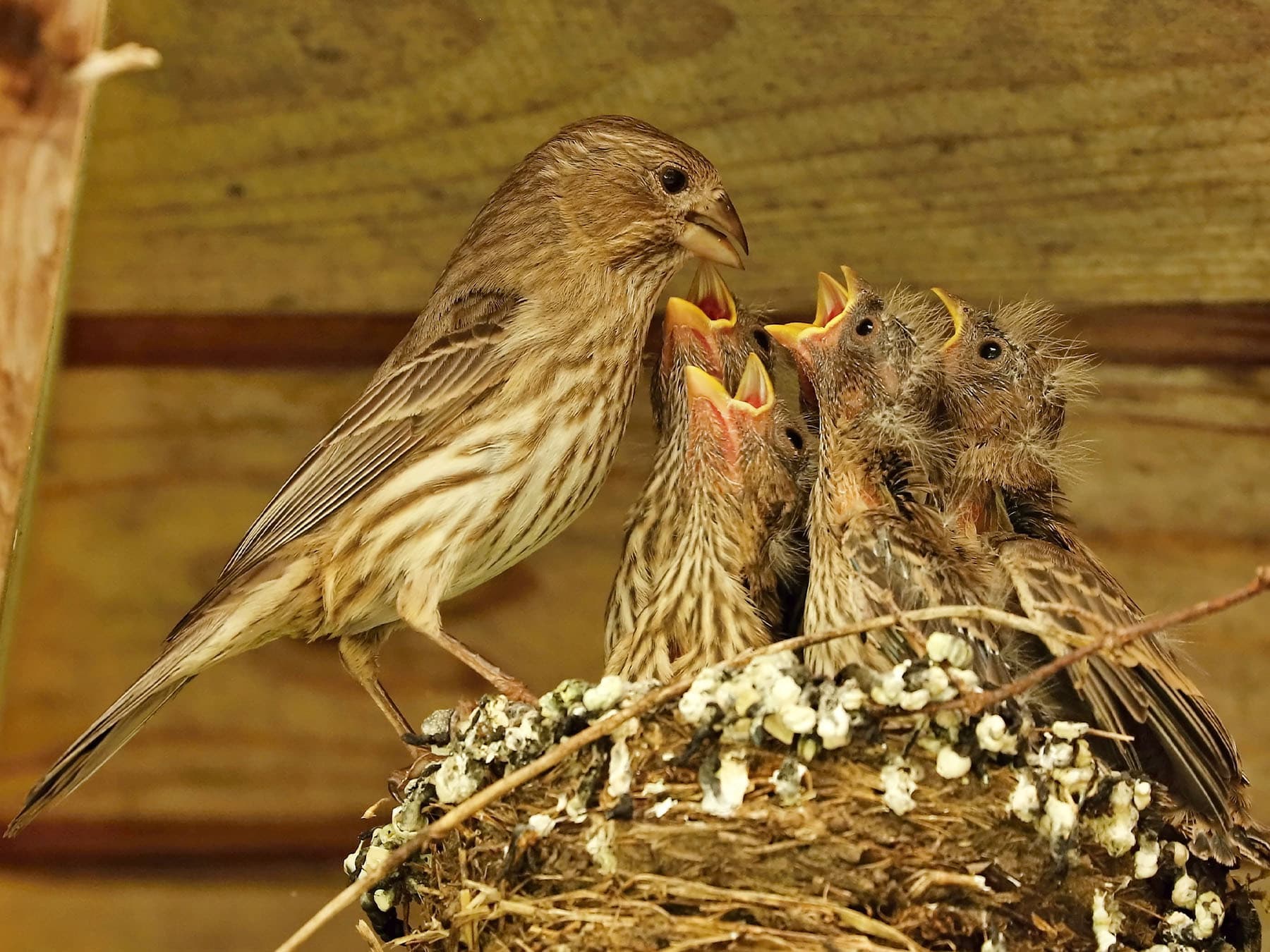
House Finches rarely use nest boxes. People have put up nest structures for House Finches since at least 1908, but a House Finch nesting in an enclosed nest box is unusual enough that NestWatch reports it as a novelty. House Finches do use nest shelves and shallow cavities put up for birds, and a few have nested in boxes: bluebird, kestrel and Barn Owl boxes in California and a box under the eaves in Colorado.4 If you want to offer a site, a nest shelf is the kind NestWatchers have found House Finches using.
The nest
Only the female builds. The male follows her on her trips and sometimes carries nest material, but he does not use it. Building takes from 2 to 6 days late in the season or in mild climates to three weeks or more early in the season in eastern Michigan.
The nest is an open cup woven from thin twigs, fine stems of grass and weeds, rootlets and leaves, with feathers, wool and string, lined with finer material, about 3 to 7 inches (8-18 cm) across with a cup 1 to 3 inches (2.5-7.5 cm) wide.5 Town nests can have twine, string, paper, dog and horse hair or cigarette filters in the lining, and in the Arizona desert females add fresh, leafy creosote twigs, which help keep nest mites down.
Building is partly learned. In western Montana, after an outbreak of eye disease killed many older females, first-time breeders struggled to anchor the nest lining.
Do House Finches reuse their nests?
It depends on where they live. In long studies of over 400 nests in Montana and over 200 in Arizona, no pair ever reused a nest, but in Michigan some pairs raised a second brood in the same nest after adding a new lining, or took over another pair's old nest. Females often pull material out of old nests nearby to build a new one. Pairs in the West tend to build again within 33-66 ft (10-20 m) of the last nest; in the East they often move more than half a mile (1 km) between attempts.1
What do House Finch eggs look like?
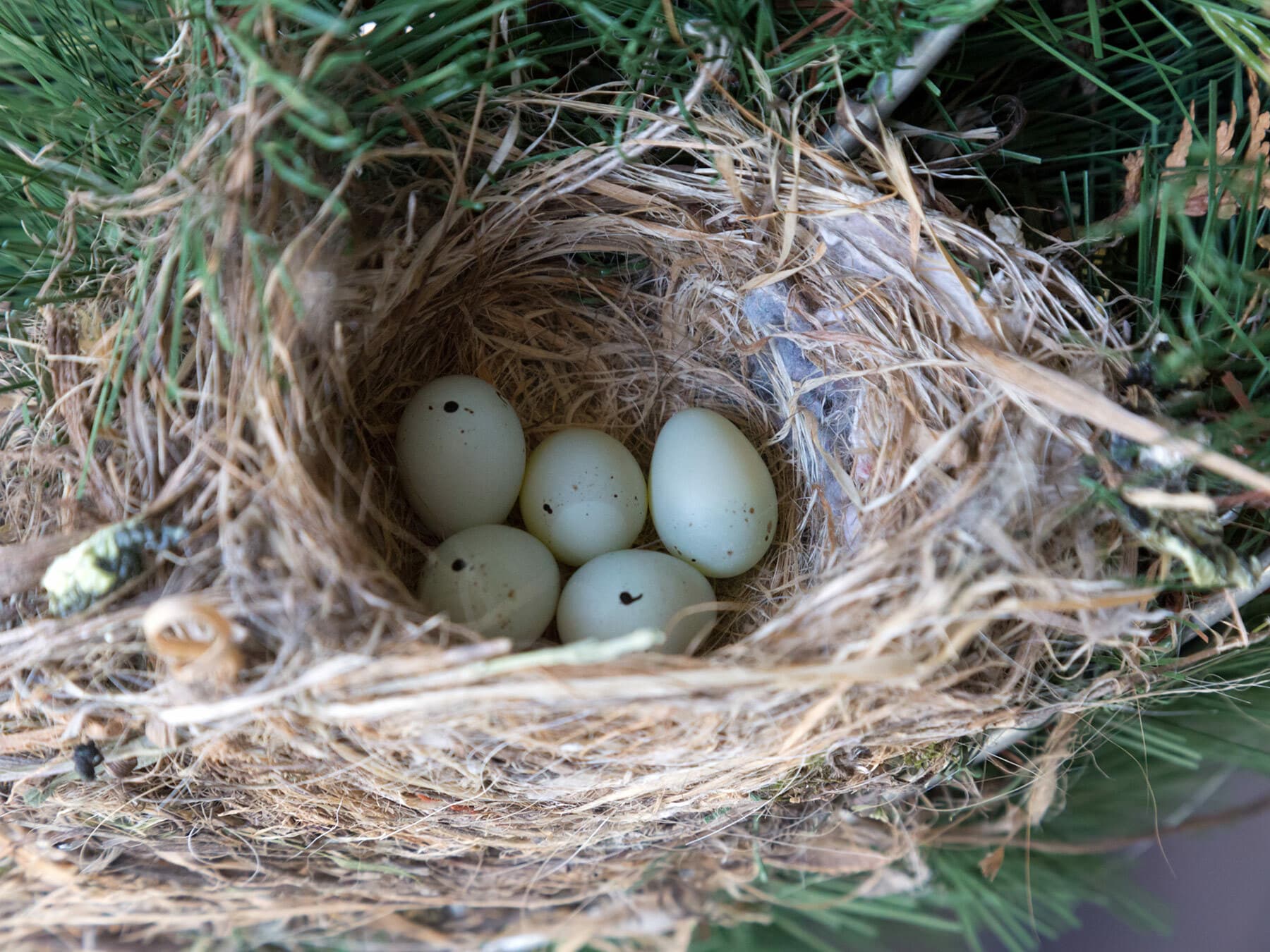
House Finch eggs are pale blue, finely speckled with black and pale purple, mostly around the larger end, and smooth and slightly glossy. The speckling varies a lot from nest to nest. They are about 0.75 by 0.55 in (19 by 14 mm).
Clutch size
A clutch is usually 4 or 5 eggs, but anywhere from 2 to 7. The female lays one egg a day, in the morning, and gives a loud, continuous "egg cry" while she lays. Clutch size changes a little with region and season: in Arizona later clutches were smaller than the first.
Incubation
The eggs hatch after about 13 to 14 days of incubation, or up to 17 in cold weather and as few as 12 in warm. Only the female incubates, and the male brings her food; in one Michigan study he fed her about every 39 minutes, though in Arizona and Montana many males did not. The first egg laid is the first to hatch, and hatching can spread over 4 or 5 days, so the chicks in a nest are different sizes. The female carries the empty shells 65-165 ft (20-50 m) away.
The chicks
Newly hatched House Finches are naked except for a little white down, with their eyes closed. Their eyes are fully open at about a week, and by about 12 days old they look fully feathered. The female broods them for the first few days.
Both parents feed the chicks by bringing up food from the crop. Unusually for a songbird, House Finches feed their young almost entirely on plant food: in a classic California study, 98% of what nestlings had eaten was plants, mostly weed seeds, with a few insect larvae and aphids. More: what House Finches eat. For the first five days or so the parents eat the chicks' droppings; after that the droppings pile up around the rim of the nest.
When do baby House Finches leave the nest?
Fledglings
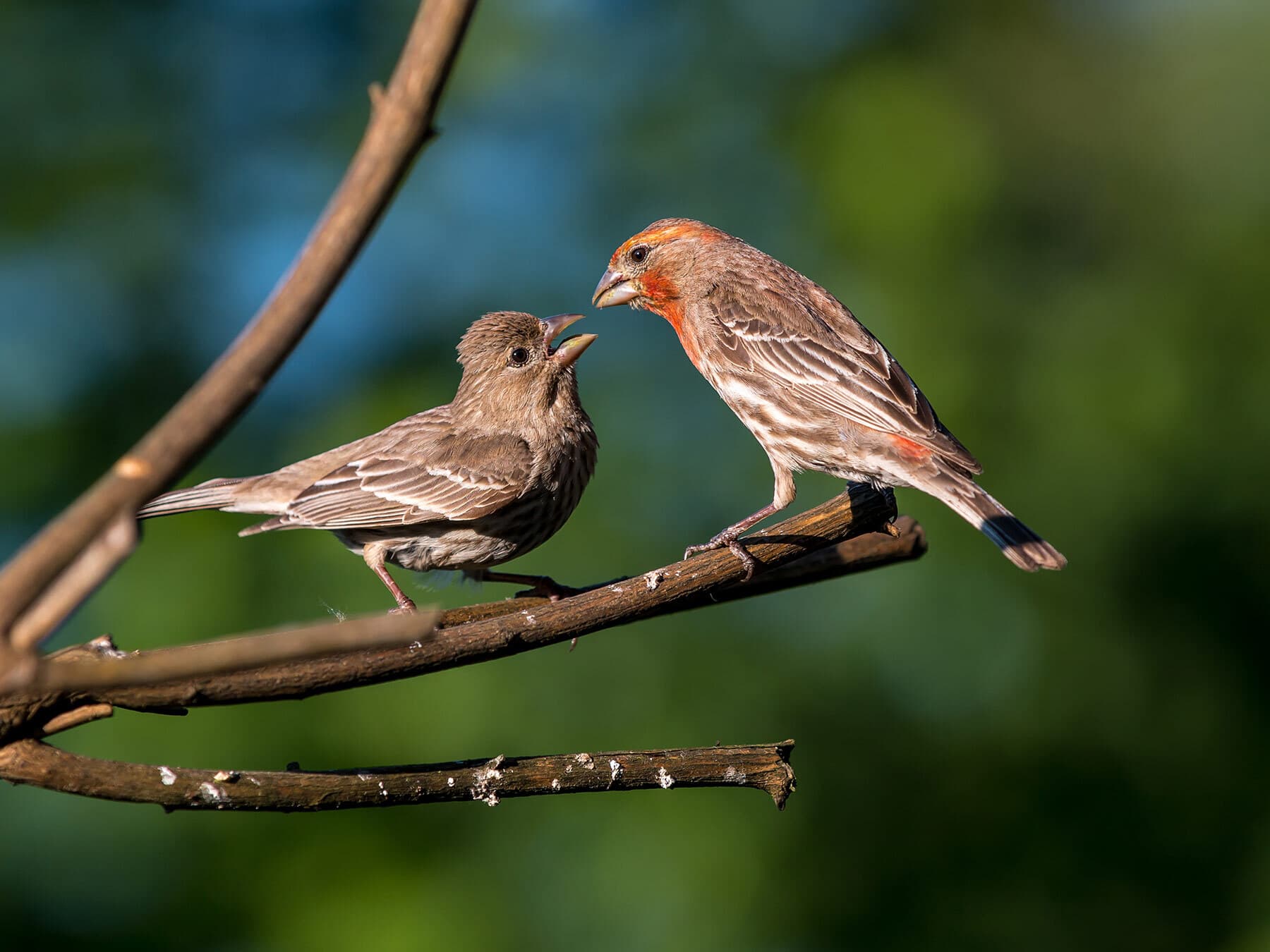
Fledglings stay in or near the nest tree or bush for 2 or 3 days, then follow their parents. The male does most of the feeding from here, still feeding them 16 to 18 days after they leave, while the female builds the next nest. Young House Finches try feeding themselves at 12 to 16 days out of the nest and are independent at 2.5 to 3 weeks; at feeders they beg from other adults too.
If you find a fledgling hopping on the ground, leave it: the parents are usually nearby. A chick with no feathers or with its eyes closed can be put back in the nest; the parents will not reject it because it was touched. If it is injured, call a licensed wildlife rehabilitator.6
Broods
Most pairs nest more than once a season. In Michigan a female built as many as six nests and laid six clutches in a season, but no pair raised more than three broods; in Montana and Alabama some pairs raised up to five broods in a row, though two was most common, and in the studies Birds of the World summarizes, pairs averaged between 1.3 and 1.9 broods a season. In Michigan, nests that succeeded fledged 3.5 young on average, but predators took 46% of nests.
Cowbirds
Brown-headed Cowbirds lay their eggs in House Finch nests in the north, especially in the first years of a new colony; in Michigan only two cowbird eggs turned up in 350 nests. It may do the cowbirds little good: in one Montana study, all 27 cowbird chicks that hatched died within a week. House Finches often abandon nests with more than two cowbird eggs.
A nest on your porch
A nest in a hanging planter, on a ledge or in a vent is common, and it is protected. The House Finch is covered by the Migratory Bird Treaty Act,7 and it is illegal to remove or destroy a nest that has eggs or chicks in it, or to keep a nest without a permit.8 Wait until the young have left; from the first egg to flying young takes about a month. NestWatch staff advise checking a nest no more than once or twice a week, because frequent disturbance can make the birds give up.4
Sources
- Badyaev, A. V., Belloni, V., Hill, G. E. (2020). House Finch (Haemorhous mexicanus), version 1.0. Birds of the World (A. F. Poole, editor). Cornell Lab of Ornithology. doi:10.2173/bow.houfin.01
- NestWatch, Cornell Lab of Ornithology (2019). Time traveling House Finches. NestWatch. Accessed October 11, 2026. Source
- National Audubon Society (text: Kaufman, Lives of North American Birds). House Finch. Audubon Guide to North American Birds. Accessed October 11, 2026. Source
- Bailey, R. (2022). NestWatchers document rare use of nest boxes by House Finches. NestWatch, Cornell Lab of Ornithology. Accessed October 11, 2026. Source
- Cornell Lab of Ornithology. House Finch: Overview, Identification and Life History. All About Birds. Accessed October 11, 2026. Source
- Shaw, T. What to do if you find a baby bird, injured or orphaned wildlife. U.S. Fish and Wildlife Service. Accessed October 11, 2026. Source
- U.S. Fish and Wildlife Service. List of birds protected by the Migratory Bird Treaty Act. Code of Federal Regulations, 50 CFR 10.13. Accessed October 11, 2026. Source
- U.S. Fish and Wildlife Service. Bird nests. U.S. Fish and Wildlife Service. Accessed October 11, 2026. Source
- Elliott, J. J., Arbib, R. S., Jr. (1953). Origin and status of the House Finch in the eastern United States. The Auk 70: 31-37. doi:10.2307/4081056