Facts · Updated 11 Oct 2026
What Do House Finches Eat? Diet and Feeders
By the Birdfact teamChecked by Nathan Cope
House Finches eat almost nothing but plants: in a classic California study seeds, buds, flowers and fruit made up 97% of their diet, and even their chicks are raised on seeds. At feeders they take black-oil and hulled sunflower seed, nyjer and safflower. Clean feeders often: House Finches are prone to an eye disease that spreads where they crowd.
On this page10 sections
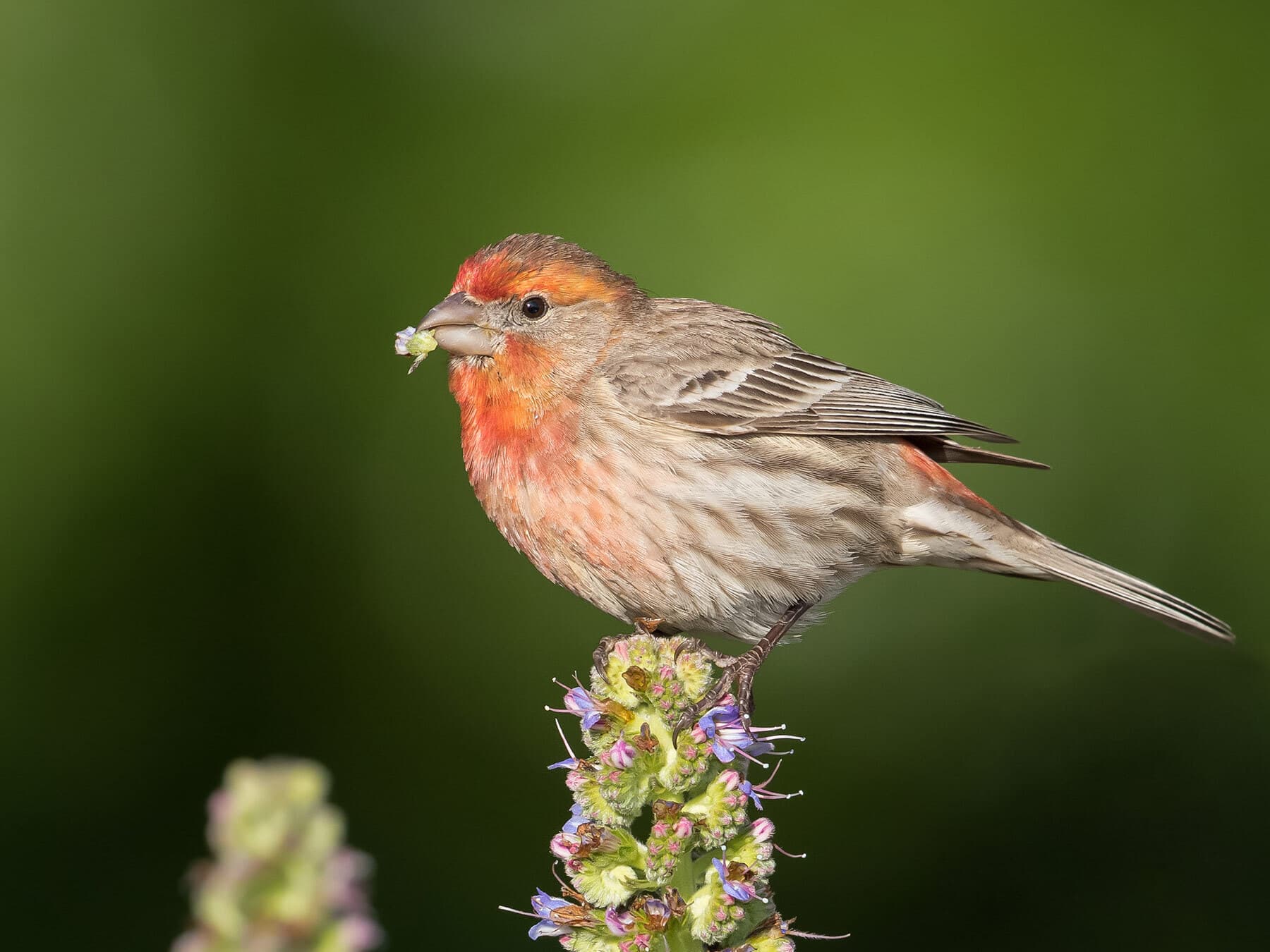
What House Finches eat in the wild, through the year, what they feed their chicks, and how to feed them in your yard, including keeping feeders clean. For the bird itself, see House Finch identification, song and facts.
What do House Finches eat?
Plants, almost entirely. In a classic California study, seeds, buds, flowers, leaves and fruit made up 97% of the diet in every season.1 Of 1,206 stomachs collected in California in every month of the year, plant matter made up 93.7-100% of the contents by weight, weed seeds 64-99.8% and fruit up to 27.4%.
The small amount of animal food is mostly aphids (plant lice).
Wild foods
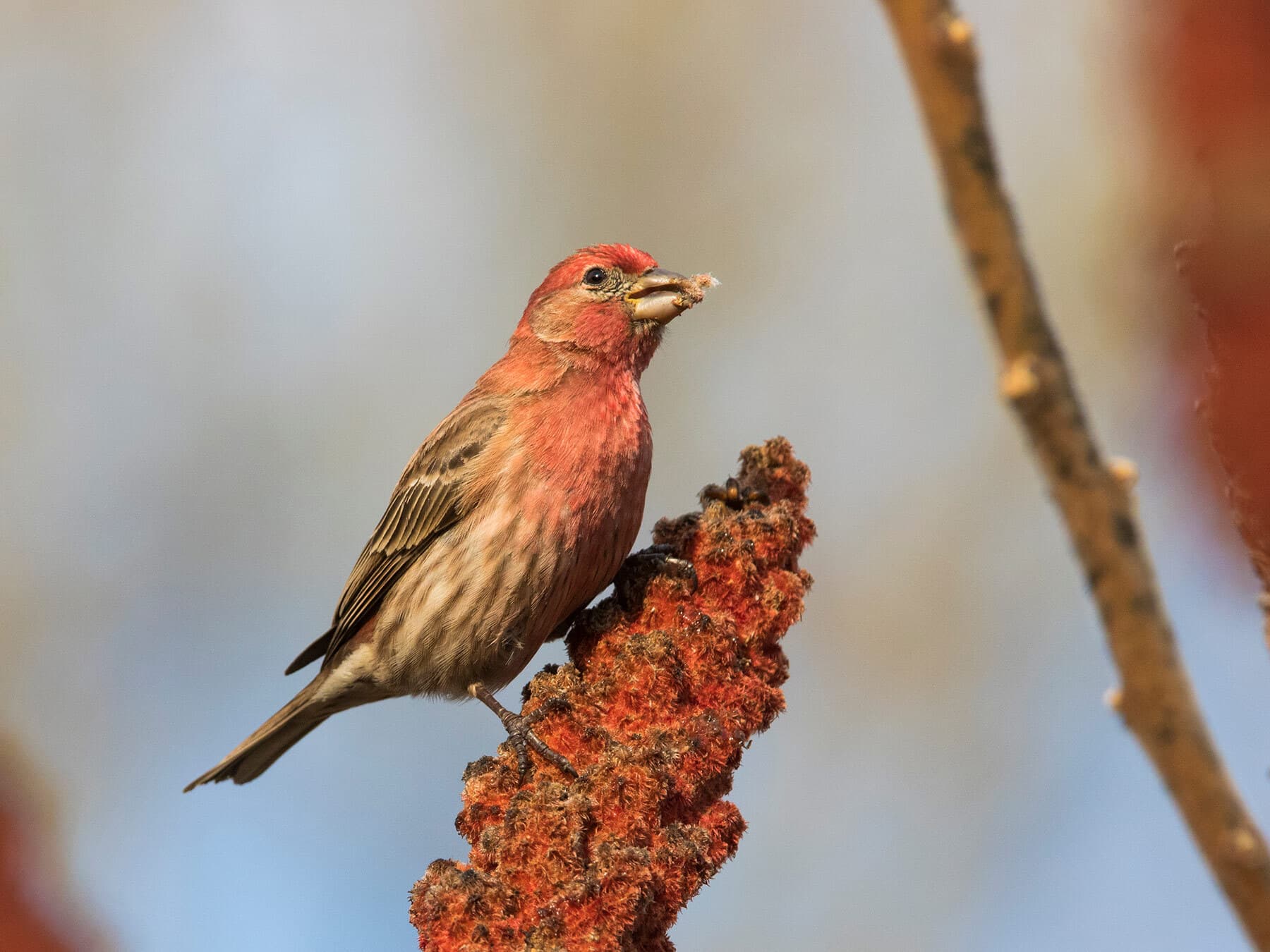
Weed seeds are the staple: star-thistle, mustards, amaranth, filaree, knotweed and turkey-mullein in California, and many more. Large numbers gather at ripe thistle in fall. House Finches pick seeds off the ground or cling to the plant and pick them out of the seed head.
In the desert they eat the fruit of prickly pear and other cactus and spend hours at the flowers of ocotillo, creosote and ironwood, and at the pollen and nectar of saguaro flowers. In western Montana, chokecherries made up as much as 70% of the diet in some weeks. In winter in the West they rely on weed seeds and grain spilled along railroads.
Through the year
Early spring: tree buds. Summer: seeds of weeds and grasses, and the first fruit, such as mulberries. Late summer and fall: fruit makes up as much as 20% of the diet in the West, along with ripe seeds. Winter: weed seeds and, where they can find them, feeders, which House Finches use more in winter, especially in the East.
Fruit
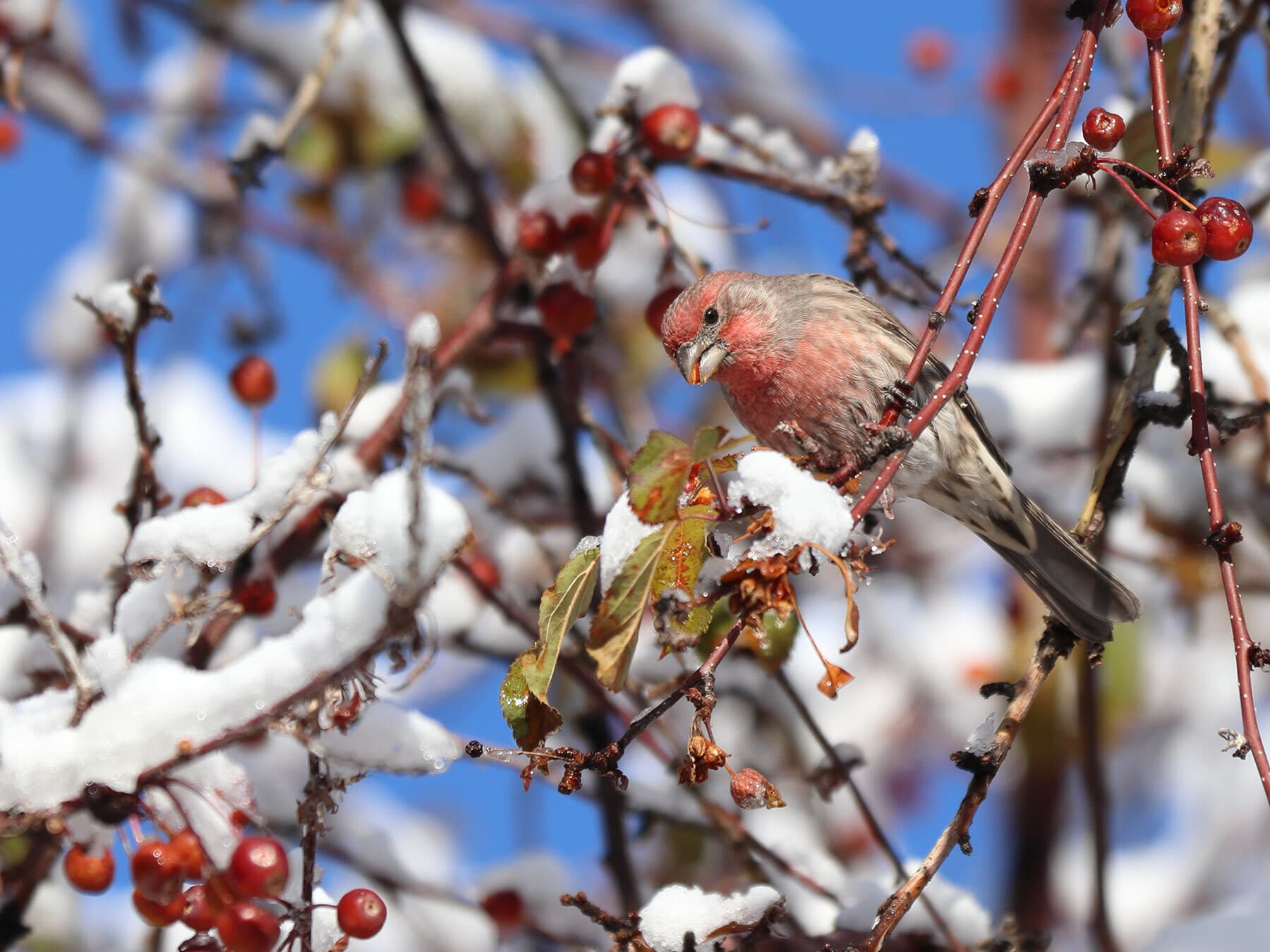
Fruit becomes more important in late summer and fall, up to about a fifth of the diet in the West. In orchards they eat figs, plums, cherries, pears, peaches, apricots, blackberries and strawberries.2 Birds of the World calls the House Finch a minor or insignificant pest of fruit in California and eastern Montana, with the damage mostly at orchard edges, and notes that it is not reported as an agricultural pest in the East.
Insects
House Finches eat very few insects. Animal food is a small part of the diet, chiefly aphids. Young nestlings get a few insect larvae, but even they are raised mostly on seeds.
What do House Finches feed their babies?
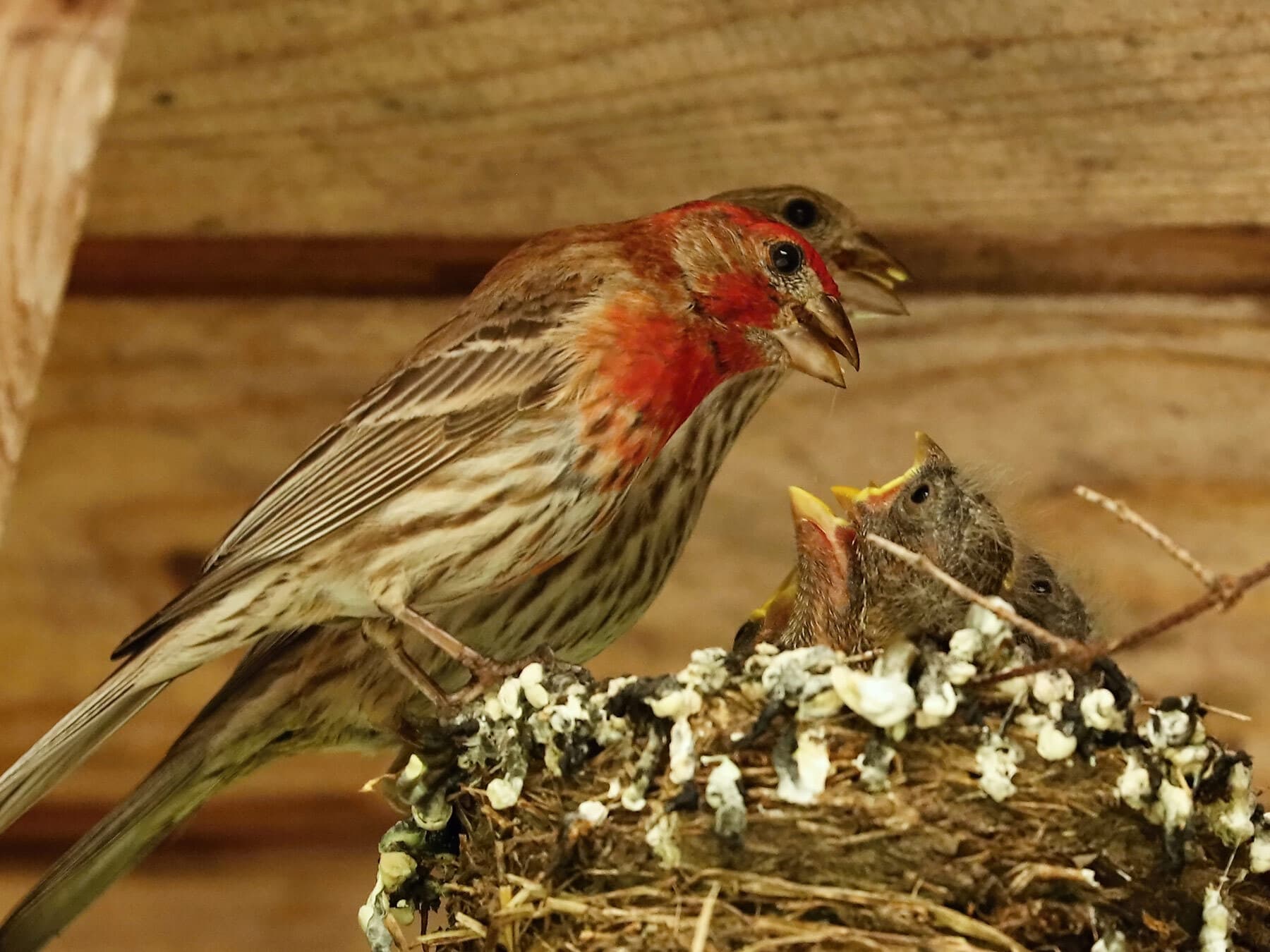
Seeds. Both parents feed the chicks by bringing up food from the crop, and it is almost all plant material: in a classic California study, 98% of what 46 nestlings had eaten was plants, mostly weed seeds such as sunflower, fiddleneck and milk thistle, with the rest beetle and fly larvae and aphids. In some areas the parents bring ripening dandelion seeds, and in Michigan tree buds in April and May.1 All About Birds calls this fairly rare in the bird world: many birds that eat plants as adults still feed their young on insects.2
What to put in your feeders
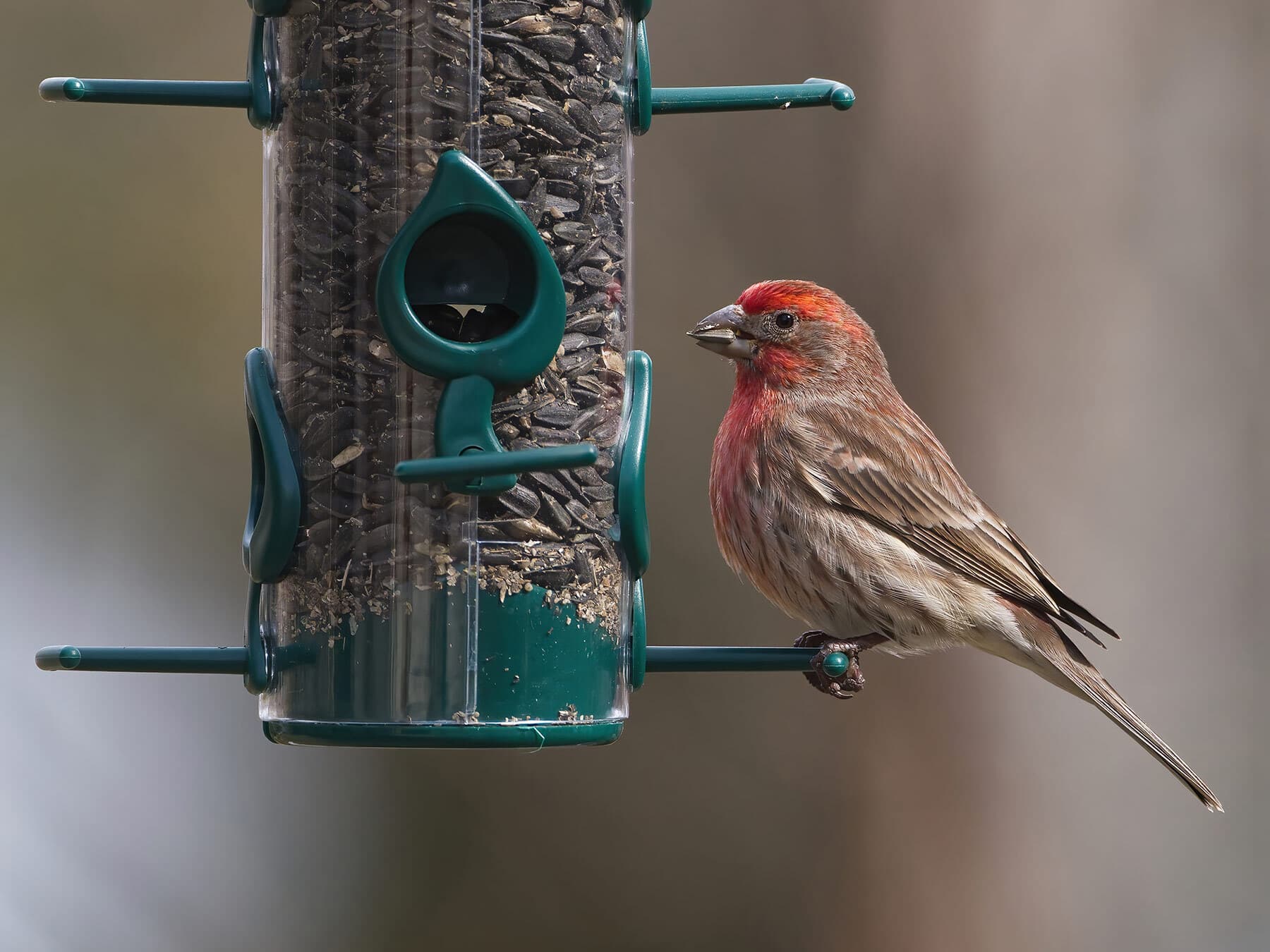
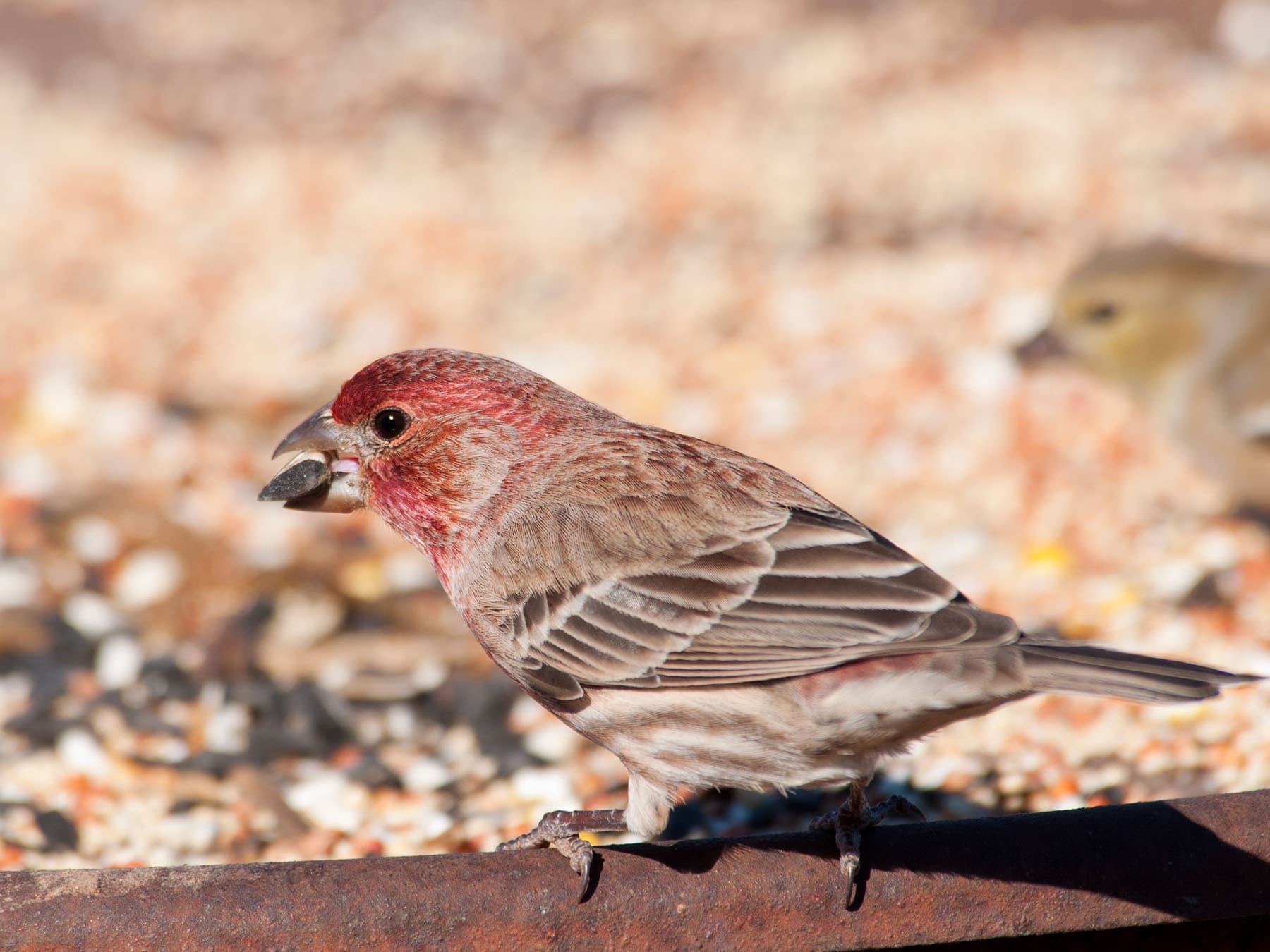
Project FeederWatch lists four foods for House Finches: black-oil sunflower seed, hulled sunflower seed, nyjer and safflower.3 All About Birds recommends small black-oil sunflower seed, and given a choice, House Finches take it over large striped sunflower, millet or milo. They usually sit at the feeder, shelling one seed after another with quick bites.
None of the sources we read recommends suet, mealworms, grape jelly or sugar water for House Finches, so we do not either. House Finches bathe in shallow water in warm weather and drink by scooping water and tipping the head back; in hot, dry country they need water every day.
Feeders
House Finches use tube feeders, hoppers and platform feeders. If they find your feeders, they may bring flocks of 50 or more.2 At feeders House Finches dominate American Goldfinches, and House Sparrows can dominate House Finches.
Keep feeders clean: eye disease
House Finches are prone to mycoplasmal conjunctivitis, known as House Finch eye disease. A sick bird's eyes turn red and swollen, runny or crusty; some sit quietly, scratching an eye against a perch, and badly affected birds cannot see. Most that die do so from starvation, exposure or predators, not from the infection itself.4
The bacteria spread when birds touch one another and through shared surfaces. Birds of the World gives them 12-24 hours on a feeder,1 but in a 2024 experiment they stayed infectious for up to a week at winter temperatures.5 Project FeederWatch's advice:
- Space feeders widely so birds do not crowd.
- Clean feeders regularly in one part bleach to nine parts water (a 10% solution), and let them dry completely before rehanging.
- Rake up old seed and droppings under feeders.
- If you see one or two sick birds, take the feeders down and clean them.
- Do not add medicine to seed or water.
The disease poses no known threat to people. More: House Finch eye disease.
Sources
- Badyaev, A. V., Belloni, V., Hill, G. E. (2020). House Finch (Haemorhous mexicanus), version 1.0. Birds of the World (A. F. Poole, editor). Cornell Lab of Ornithology. doi:10.2173/bow.houfin.01
- Cornell Lab of Ornithology. House Finch: Overview, Identification and Life History. All About Birds. Accessed October 11, 2026. Source
- Project FeederWatch (Cornell Lab of Ornithology and Birds Canada). Common Feeder Birds: House Finch. Project FeederWatch. Accessed October 11, 2026. Source
- Project FeederWatch (Cornell Lab of Ornithology and Birds Canada). House Finch eye disease. Project FeederWatch. Accessed October 11, 2026. Source
- Teemer, S., Tulman, E. R., Arneson, A., Geary, S. J., Hawley, D. M. (2024). Colder temperatures augment viability of an indirectly transmitted songbird pathogen on bird feeders. Ecosphere 15(12): e70139. doi:10.1002/ecs2.70139
- National Audubon Society (text: Kaufman, Lives of North American Birds). House Finch. Audubon Guide to North American Birds. Accessed October 11, 2026. Source