Published 11 Oct 2026
House Finch Eye Disease: Signs, Causes and What to Do
By the Birdfact teamChecked by Nathan Cope
Red, swollen, crusty eyes in a House Finch usually mean mycoplasmal conjunctivitis, a bacterial infection that has spread through North American finches since 1994. It is not known to infect people. What to do at your feeders, how it spreads, whether birds recover, and what research since then has found.
On this page15 sections
- Signs to look for
- What to do if you see a sick finch
- Can people or chickens catch it?
- Is it avian pox?
- What causes it
- How it spread from Maryland in 1994
- The crash in the East
- Why it comes back every fall and winter
- Feeders and how it spreads
- Can a finch recover?
- How finches and the bacterium have changed
- Eye disease in the West
- Other birds that get it
- Older advice to update
- Sources
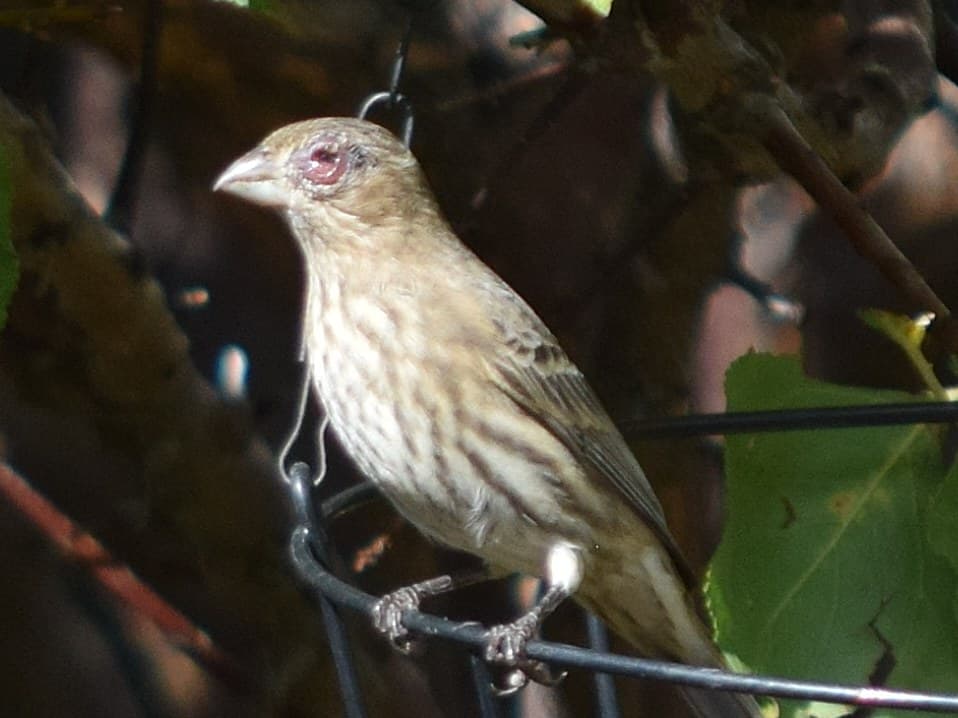
A House Finch with red, swollen, runny or crusty eyes most likely has mycoplasmal conjunctivitis, known as House Finch eye disease. It is caused by a bacterium, Mycoplasma gallisepticum, that spread from poultry to House Finches in the early 1990s and is now found across most of North America. It is not known to infect people.1
If you see a sick finch, take your feeders down, clean them with a dilute bleach solution and let them dry. Leave them down for at least a few days, and preferably a couple of weeks, so sick birds disperse.2, 3
Signs to look for
- Red, swollen eyelids, in one eye or both; in bad cases the eye swells shut and the bird cannot see on that side.
- A watery or crusty discharge around the eye, sometimes from the nostrils too.4
- A bird that sits quietly, rubbing an eye on its foot or a perch.1
- A bird that lingers on the feeder or on the ground beneath it.5
Early on, an infected bird may just look as if it is keeping one eye closed. In one New York study, 79% of cases affected only one eye.6
What to do if you see a sick finch
- Take the feeders the sick bird is using down and clean them in a 10% bleach solution (1 part bleach to 9 parts water).1 Rinse them well and let them dry completely.
- Leave them down for a couple of weeks if you can, so the disease is not spread there and sick birds disperse.2
- Rake up old seed and droppings under the feeders, and space feeders widely so birds do not crowd.
- Clean feeders regularly anyway, at least once a month, even if you see no sick birds.
- Do not put medicine in food or water. It can spread disease and may lead to new strains.1
- In the US, it is illegal to keep most wild birds unless you work under someone licensed to care for them. For a bird that is clearly suffering, contact a licensed wildlife rehabilitator.
Treating a single bird does little for the population as a whole, and it is not known whether treated birds stay infected.5
Can people or chickens catch it?
Not people, as far as anyone knows. Researchers call it a nonzoonotic poultry pathogen,5 and there is no evidence that it causes infections in people.7 FeederWatch says it poses no known health threat to humans.
Chickens can catch the finch strain, but not easily. In an experiment, chickens became infected only after 10 weeks of direct contact with sick finches, showed no signs of disease, and did not catch it across a wire mesh or across a room.8
Is it avian pox?
Not every swollen-eyed finch has conjunctivitis. Avian pox, a virus, causes wart-like growths on bare skin around the eyes, the base of the bill and the legs and feet. A growth on the eye itself points to pox, though the two can be hard to tell apart.1 Another bacterium, Mycoplasma sturni, has been found in the eyes of starlings, mockingbirds and a Blue Jay, and is worth keeping in mind too.7
What causes it
Mycoplasma gallisepticum is a bacterium long known for respiratory disease in chickens and turkeys. Before 1994 it had not been linked to disease in wild songbirds. Early samples from 17 House Finches, 2 American Goldfinches and a Blue Jay in 11 states all carried the same strain, which pointed to a single source,7 and later genome work suggests that strain came from turkeys rather than chickens.9 How it reached finches is not known; backyard poultry flocks and unknown wild hosts have both been suggested.5
How it spread from Maryland in 1994
Sick House Finches were first seen at feeders around Washington, DC, in the winter of 1993-94; one Montgomery County, Maryland, feeder had them from January 20, 1994.10 By October 1994 they had been reported in nine states.5
That fall, the Cornell Lab of Ornithology asked feeder watchers to report what they saw. The ornithologist André Dhondt used his whole $5,000 start-up fund to print 50,000 survey forms, and over 10 years the House Finch Disease Survey gathered almost 300,000 monthly reports from 10,000 people.3 The share of participants seeing sick finches rose from 11% of 1,413 in November 1994 to 35.8% of 1,047 in March 1996.5
The disease moved north first, probably with finches returning from migration, then southeast and west. It reached Ontario, Virginia and Ohio within a year, Indiana, Michigan and Illinois by fall 1995, and Wisconsin, Minnesota and Iowa by fall 1996.3 By March 1997 it had reached most of the eastern range.10
The crash in the East
Tens of millions are believed to have died between 1994 and 1996.11 Eastern numbers fell by up to 60%, and within three years of the disease arriving, House Finches were down to about 40% of their earlier numbers.12, 13 Then numbers settled at similar levels whatever they had been before, as expected if the disease spreads most easily where finches are dense.14
The disease did not strike evenly. In one study population it killed more males than females, turning a male-biased sex ratio female-biased, and the males that survived were redder than those that died.11
Why it comes back every fall and winter
The disease never went away. In the East it is now endemic, with outbreaks every fall and winter, peaking in October and February, and almost no cases from May to July; peak rates have been nearly three times higher in the South than in colder regions.15 Cases probably rise in the fall as young birds disperse,10 and the disease is rarely seen in the nesting season.12
Feeders and how it spreads
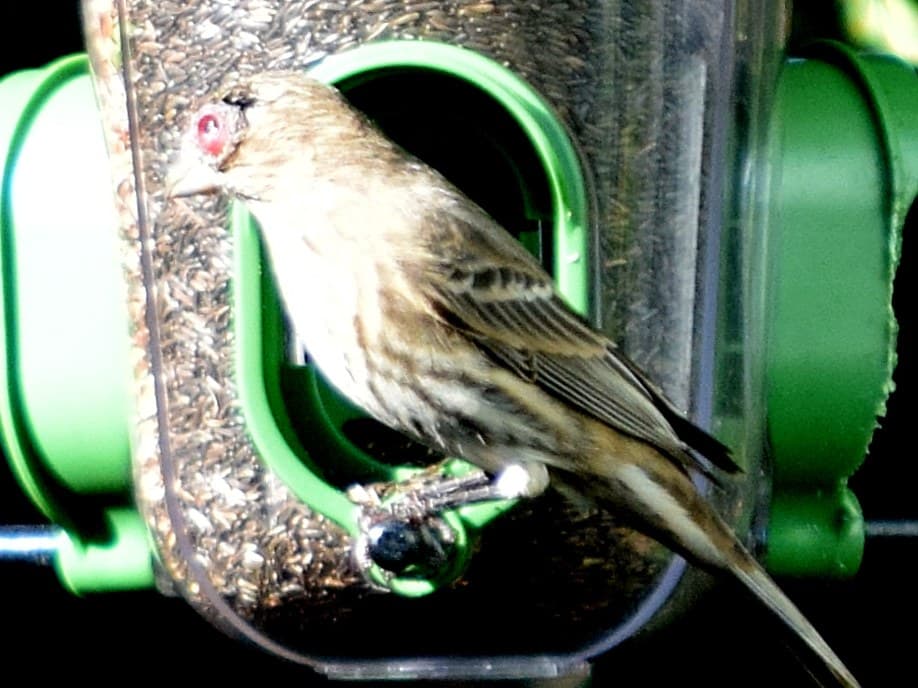
Feeders matter. Researchers think most transmission happens at feeders in the nonbreeding season,12 and experiments show why:
- Finches caught the disease from a feeder used by a sick bird, without touching it.16
- Birds that spent the most time on feeders were the most likely to catch it, and epidemics spread fastest when they were the first infected.17
- Flocks given more feeders had more transmission.18
- At winter temperatures of 39-48°F (4-9°C), the bacterium stayed infectious on feeder surfaces for up to a week.19
That is why the advice is to clean feeders often and spread them out. More on feeding: what House Finches eat.
Can a finch recover?
Yes, many do. In a captive experiment, 80% of 20 infected birds recovered within 21 weeks, 15% stayed chronically infected and 5% died; the authors suggest good food and space explain the high recovery rate.20 Wild finches recover too.
Recovery gives partial protection. Recovered birds can catch the disease again, but they stay partly resistant for at least 14 months and get over it faster.21, 22
Captive birds rarely die of it, but infected wild finches survive less well. When they die, it is usually from starvation, cold or predators because they cannot see, rather than from the infection itself.1 Infected finches also react less to predators, even before their eyes are visibly closed.23
How finches and the bacterium have changed
Both sides have evolved. The bacterium became more virulent on both coasts after it arrived; a California sample from 2010, four years after the earliest West Coast sample (California, 2006), caused eye disease as severe as the original 1994 Virginia isolate.12 The partial immunity of recovered birds may be part of what drives the bacterium to become more severe.22
The finches have adapted too. In a 2007 experiment, two weeks after infection, eastern House Finches from populations exposed for 12 years carried 33% less of the bacterium in their eyes than western birds from populations never exposed to it.24 And populations exposed longest now suffer less eye damage at the same level of infection, a change that took under 25 years.13
Eye disease in the West
The disease first appeared in the native western range in 2002, in Missoula, Montana. It spread more slowly in the West, and in Missoula it peaked at about half the rate seen in eastern towns, perhaps because western finches are more genetically diverse than the eastern birds, which descend from a few released cage birds.25 In southwestern Arizona in 2009, up to 70% of local adults died.26 It reached the Pacific Northwest around 2004, then spread down the West Coast and into parts of the Southwest; as of 2023 it had not been found in parts of northern Arizona or in Hawaii.13
Other birds that get it
House Finches suffer most, but American Goldfinches have caught it since 1995, and Purple Finches, Evening Grosbeaks and Pine Grosbeaks do so rarely.3 In Quebec in the winter of 1998-99, sick Evening and Pine Grosbeaks at feeders carried the same strain.27 In tests of 1,941 birds of 53 species around Ithaca, New York, 27 species showed signs of exposure, but eye disease was very rare outside finches.28 See also American Goldfinch.
Older advice to update
Some pages, including one of FeederWatch's own, still say that infected finches do not gain immunity, and that the disease crossed the Rocky Mountains only after 2006. Later studies show partial immunity lasting at least 14 months,22 and the disease was in Montana by 2002.25 The practical advice has not changed: keep feeders clean and spread out, and take them down when you see a sick bird.
More about the bird: House Finch.
Sources
- Project FeederWatch (Cornell Lab of Ornithology and Birds Canada). House Finch eye disease. Project FeederWatch. Accessed 11 October 2026. Source
- Project FeederWatch (Cornell Lab of Ornithology and Birds Canada). Sick Birds and Bird Diseases. Project FeederWatch. Accessed 11 October 2026. Source
- Heisman, R. (2017). House Finch Eye Disease: Outbreak, Then Understanding. Living Bird (All About Birds), Winter 2017. Accessed 11 October 2026. Source
- Ley, D. H., Berkhoff, J. E., McLaren, J. M. (1996). Mycoplasma gallisepticum isolated from house finches (Carpodacus mexicanus) with conjunctivitis. Avian Diseases 40(2): 480-483. doi:10.2307/1592250
- Fischer, J. R., Stallknecht, D. E., Luttrell, M. P., Dhondt, A. A., Converse, K. A. (1997). Mycoplasmal conjunctivitis in wild songbirds: the spread of a new contagious disease in a mobile host population. Emerging Infectious Diseases 3(1): 69-72. doi:10.3201/eid0301.970110
- Hartup, B. K., Kollias, G. V., Ley, D. H. (2000). Mycoplasmal conjunctivitis in songbirds from New York. Journal of Wildlife Diseases 36(2): 257-264. doi:10.7589/0090-3558-36.2.257
- Ley, D. H., Berkhoff, J. E., Levisohn, S. (1997). Molecular epidemiologic investigations of Mycoplasma gallisepticum conjunctivitis in songbirds by random amplified polymorphic DNA analyses. Emerging Infectious Diseases 3(3): 375-380. doi:10.3201/eid0303.970318
- Stallknecht, D. E., Luttrell, M. P., Fischer, J. R., Kleven, S. H. (1998). Potential for transmission of the finch strain of Mycoplasma gallisepticum between house finches and chickens. Avian Diseases 42(2): 352-358. doi:10.2307/1592485
- Delaney, N. F., Balenger, S., Bonneaud, C., Marx, C. J., Hill, G. E., Ferguson-Noel, N., Tsai, P., Rodrigo, A., Edwards, S. V. (2012). Ultrafast evolution and loss of CRISPRs following a host shift in a novel wildlife pathogen, Mycoplasma gallisepticum. PLoS Genetics 8(2): e1002511. doi:10.1371/journal.pgen.1002511
- Dhondt, A. A., Tessaglia, D. L., Slothower, R. L. (1998). Epidemic mycoplasmal conjunctivitis in house finches from eastern North America. Journal of Wildlife Diseases 34(2): 265-280. doi:10.7589/0090-3558-34.2.265
- Nolan, P. M., Hill, G. E., Stoehr, A. M. (1998). Sex, size, and plumage redness predict house finch survival in an epidemic. Proceedings of the Royal Society B 265(1400): 961-965. doi:10.1098/rspb.1998.0384
- Hawley, D. M., Osnas, E. E., Dobson, A. P., Hochachka, W. M., Ley, D. H., Dhondt, A. A. (2013). Parallel patterns of increased virulence in a recently emerged wildlife pathogen. PLoS Biology 11(5): e1001570. doi:10.1371/journal.pbio.1001570
- Henschen, A. E., Vinkler, M., Langager, M. M., Rowley, A. A., Dalloul, R. A., Hawley, D. M., Adelman, J. S. (2023). Rapid adaptation to a novel pathogen through disease tolerance in a wild songbird. PLoS Pathogens 19(6): e1011408. doi:10.1371/journal.ppat.1011408
- Hochachka, W. M., Dhondt, A. A. (2000). Density-dependent decline of host abundance resulting from a new infectious disease. Proceedings of the National Academy of Sciences 97(10): 5303-5306. doi:10.1073/pnas.080551197
- Altizer, S., Hochachka, W. M., Dhondt, A. A. (2004). Seasonal dynamics of mycoplasmal conjunctivitis in eastern North American house finches. Journal of Animal Ecology 73(2): 309-322. doi:10.1111/j.0021-8790.2004.00807.x
- Dhondt, A. A., Dhondt, K. V., Hawley, D. M., Jennelle, C. S. (2007). Experimental evidence for transmission of Mycoplasma gallisepticum in house finches by fomites. Avian Pathology 36(3): 205-208. doi:10.1080/03079450701286277
- Adelman, J. S., Moyers, S. C., Farine, D. R., Hawley, D. M. (2015). Feeder use predicts both acquisition and transmission of a contagious pathogen in a North American songbird. Proceedings of the Royal Society B 282(1815): 20151429. doi:10.1098/rspb.2015.1429
- Moyers, S. C., Adelman, J. S., Farine, D. R., Thomason, C. A., Hawley, D. M. (2018). Feeder density enhances house finch disease transmission in experimental epidemics. Philosophical Transactions of the Royal Society B 373(1745): 20170090. doi:10.1098/rstb.2017.0090
- Teemer, S., Tulman, E. R., Arneson, A., Geary, S. J., Hawley, D. M. (2024). Colder temperatures augment viability of an indirectly transmitted songbird pathogen on bird feeders. Ecosphere 15(12): e70139. doi:10.1002/ecs2.70139
- Kollias, G. V., Sydenstricker, K. V., Kollias, H. W., Ley, D. H., Hosseini, P. R., Connolly, V., Dhondt, A. A. (2004). Experimental infection of house finches with Mycoplasma gallisepticum. Journal of Wildlife Diseases 40(1): 79-86. doi:10.7589/0090-3558-40.1.79
- Sydenstricker, K. V., Dhondt, A. A., Ley, D. H., Kollias, G. V. (2005). Re-exposure of captive house finches that recovered from Mycoplasma gallisepticum infection. Journal of Wildlife Diseases 41(2): 326-333. doi:10.7589/0090-3558-41.2.326
- Dhondt, A. A., Dhondt, K. V., Hochachka, W. M., Ley, D. H., Hawley, D. M. (2017). Response of house finches recovered from Mycoplasma gallisepticum to reinfection with a heterologous strain. Avian Diseases 61(4): 437-441. doi:10.1637/11571-122016-reg.1
- Adelman, J. S., Mayer, C., Hawley, D. M. (2017). Infection reduces anti-predator behaviors in house finches. Journal of Avian Biology 48(4): 519-528. doi:10.1111/jav.01058
- Bonneaud, C., Balenger, S. L., Russell, A. F., Zhang, J., Hill, G. E., Edwards, S. V. (2011). Rapid evolution of disease resistance is accompanied by functional changes in gene expression in a wild bird. Proceedings of the National Academy of Sciences 108(19): 7866-7871. doi:10.1073/pnas.1018580108
- Dhondt, A. A., Badyaev, A. V., Dobson, A. P., Hawley, D. M., Driscoll, M. J. L., Hochachka, W. M., Ley, D. H. (2006). Dynamics of mycoplasmal conjunctivitis in the native and introduced range of the host. EcoHealth 3(2): 95-102. doi:10.1007/s10393-006-0019-7
- Badyaev, A. V., Belloni, V., Hill, G. E. (2020). House Finch (Haemorhous mexicanus), version 1.0. Birds of the World (A. F. Poole, editor). Cornell Lab of Ornithology. doi:10.2173/bow.houfin.01
- Mikaelian, I., Ley, D. H., Claveau, R., Lemieux, M., Bérubé, J. P. (2001). Mycoplasmosis in Evening and Pine Grosbeaks with conjunctivitis in Quebec. Journal of Wildlife Diseases 37(4): 826-830. doi:10.7589/0090-3558-37.4.826
- Dhondt, A. A., DeCoste, J. C., Ley, D. H., Hochachka, W. M. (2014). Diverse wild bird host range of Mycoplasma gallisepticum in eastern North America. PLoS ONE 9(7): e103553. doi:10.1371/journal.pone.0103553