Species Profile
Evening Grosbeak
Hesperiphona vespertina
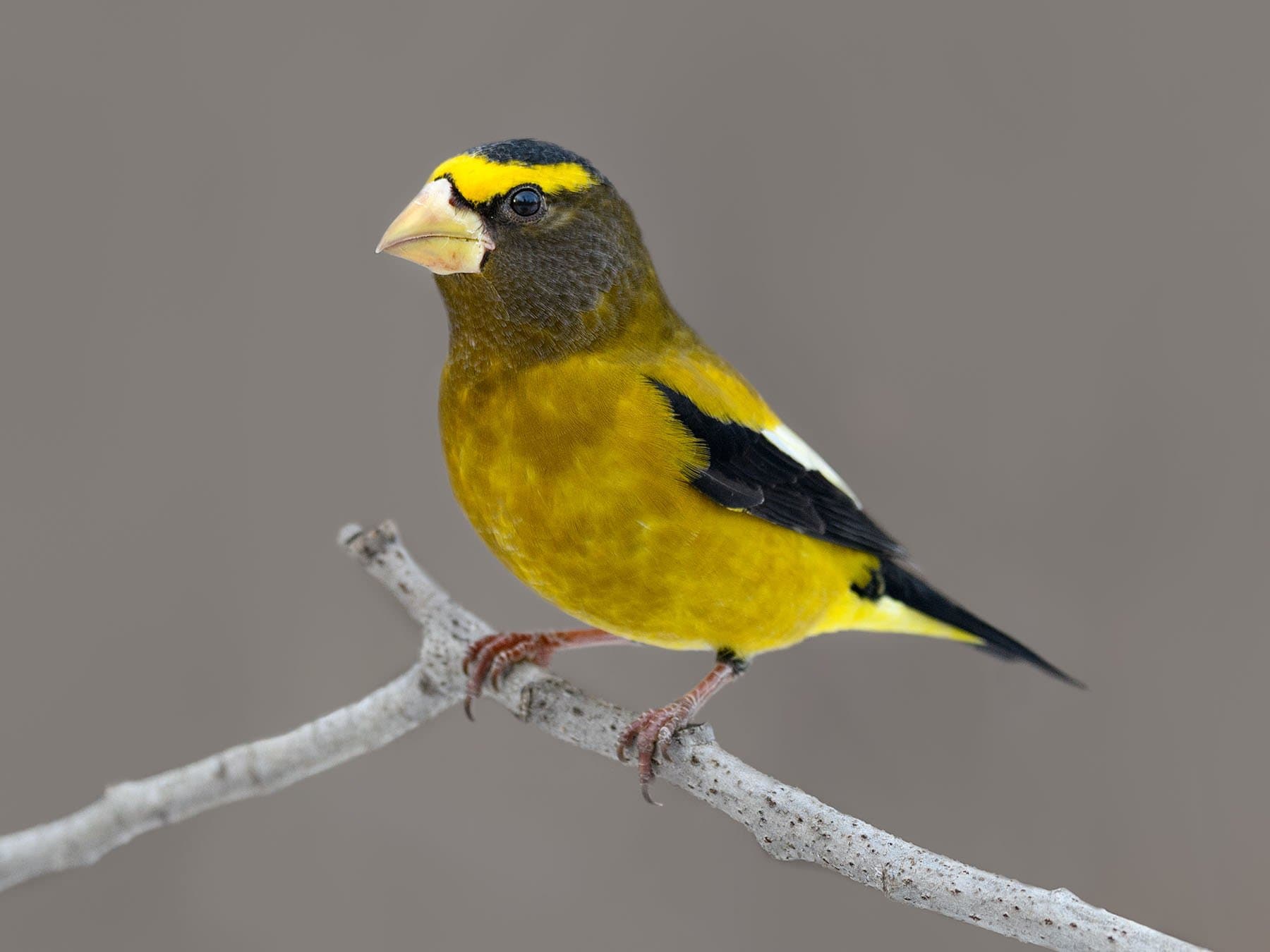
Evening Grosbeak perched on a bare branch, showing its bright yellow plumage, black wings with white patches, and large pale bill.
Quick Facts
Conservation
VUVulnerableLifespan
5–10 years
Length
16–22 cm
Weight
38.7–86.1 g
Wingspan
30–36 cm
Migration
Irruptive migrant
A chunky, bull-necked finch with a bill powerful enough to crack seeds that defeat every other finch in its range, the Evening Grosbeak is one of North America's most striking winter visitors — and one of its most rapidly disappearing. Males arrive at feeders in a blaze of mustard-yellow and black, their massive pale bills turning lime-green as spring approaches. Despite the name, they are just as active at noon as at dusk.
Think you've spotted a Evening Grosbeak?
Upload a photo and we'll confirm it instantly
Confirm with a PhotoAppearance
The Evening Grosbeak is a large, heavyset finch — roughly the size of a robin but noticeably thicker-bodied, with a short notched tail, a full chest, and a neck so thick it gives the bird an almost neckless silhouette. The bill is the defining feature: a massive, pale conical structure built for cracking seeds too large and hard for smaller finches such as Common Redpolls or Pine Siskins. It changes colour seasonally in both sexes — pale ivory through autumn and winter, then peeling away by late March to reveal a striking lime-green beneath.
Adult males are unmistakable. The head is dark brown, shading abruptly to a bright yellow forehead and a bold yellow supercilium that gives the bird an almost fierce, scowling expression. The body is rich mustard-yellow on the back and underparts, while the wings and tail are jet black, broken by a large, conspicuous white patch formed by the white secondary feathers. This white wing panel flashes prominently in flight.
Females are far more subtly marked: predominantly greyish-brown with a darker head, a greenish-yellow wash on the neck and flanks, and black-and-white wings with a smaller white rectangular patch. The tail is black with white tips. Immature males closely resemble females, and both are very similar to juveniles. The species is strongly sexually dimorphic, though the seasonal bill colour change is shared by both sexes.
In overall form, the Evening Grosbeak is most comparable to the Eurasian Hawfinch (Coccothraustes coccothraustes) — both are bulky, large-billed finches with short tails and powerful jaw muscles. It dwarfs the American Goldfinch, which has a far smaller bill and a slimmer build. There is little geographic variation in plumage across the range, though bill morphology differs subtly among the five call-type populations, most noticeably in females.
Identification & Characteristics
Male Colors
- Primary
- Yellow
- Secondary
- Black
- Beak
- Green
- Legs
- Pink
Female Colors
- Primary
- Grey
- Secondary
- Brown
- Beak
- Ivory
- Legs
- Pink
Male Markings
Bold bright-yellow forehead and supercilium contrasting with dark brown head; rich mustard-yellow body; jet-black wings and tail with large white secondary patch; massive pale ivory to lime-green conical bill
Tail: Short, notched, black tail
Female Markings
Greyish-brown overall with darker head; greenish-yellow wash on neck and flanks; black-and-white wings with white rectangular patch; black tail with white tips; large pale bill
Tail: Short, notched, black tail with white tips
Attributes
Understanding Attributes
Rated 0–100 based on research and observation. A score of 50 is average across all bird species. These attributes are relative and don't necessarily indicate superiority.
Habitat & Distribution
Evening Grosbeaks are forest specialists. During the breeding season they favour mature and second-growth coniferous and mixed forests — spruce-fir, pine-oak, pinyon-juniper, and aspen woodlands across northern North America and the Rocky Mountains. Spruce and fir are particularly important. In the mountains of Mexico, they breed in pine and pine-oak woodlands at elevations of 5,000–10,000 feet along the Sierra Madre.
The breeding range spans the boreal forest belt of Canada from British Columbia east through every province to Newfoundland and Labrador, as well as the Northwest Territories and Yukon. In the United States, breeding populations occur in the Pacific Northwest (Washington, Oregon), the Rocky Mountain states (Idaho, Montana, Wyoming, Colorado, Utah, Nevada), the Sierra Nevada of California, and the northeast (Maine, New Hampshire, Vermont, Massachusetts, New York, and Connecticut). Three subspecies are recognised: H. v. vespertina (central and eastern Canada, northeast USA), H. v. brooksi (western Canada and northwest USA), and H. v. montana (southwest USA to southwest Mexico). An estimated 45% of the global population breeds within the boreal forest, and Partners in Flight estimates that approximately 53% of all Evening Grosbeaks — around 2 million individuals — occur in Canada.
In winter, the species becomes an irruptive wanderer. In good irruption years, flocks push south and east far beyond the breeding range, reaching the Carolinas, Georgia, and occasionally Florida. Western populations tend to be altitudinal migrants, moving from mountain breeding areas into nearby lowlands. In the United States and Canada, winter visitors can appear almost anywhere with suitable seed trees or well-stocked feeders, though irruptions have become smaller and less frequent since the late 1980s.
In the United Kingdom, the Evening Grosbeak is an extreme rarity — only two records exist for the British Isles, and it is not expected as a regular visitor. For birders in the US and Canada, however, checking feeders stocked with sunflower seeds during irruption winters remains the most reliable way to encounter the species.
Where to See This Bird
Explore regional guides for locations where this bird has been recorded.
Diet
Seeds dominate the Evening Grosbeak's diet year-round, and the bill is the key to understanding why. That massive conical structure generates enough force to crack seeds that are simply too large and hard for smaller finches — a niche that gives the grosbeak access to food sources unavailable to most of its competitors. At bird feeders, sunflower seeds are the overwhelming favourite, consumed in prodigious quantities. In the wild, favoured seed sources include box elder (Acer negundo), ash, maple, locust, cherry, apple, tulip poplar, elm, pine, dock, bindweed, and goosefoot.
Fruits and berries supplement the seed diet: ash fruits, cherries, crabapples, snowberries, hawthorn, Russian olive, and juniper berries are all taken. The grosbeak handles fleshy fruits with notable dexterity, manipulating a cherry in its bill to strip away the skin and flesh before cracking and swallowing the stone. Buds of maple, elm, willow, oak, aspen, and cherry are eaten in early spring, and the birds will break off small maple twigs to drink the sap.
In summer, the diet shifts significantly towards invertebrates. Spruce budworm (Choristoneura fumiferana) larvae, caterpillars, and aphids become important protein sources for breeding adults and growing nestlings. The grosbeaks are so attuned to locating budworm outbreaks that their sudden appearance in an area can serve as an early warning of an infestation — a fact not lost on foresters.
Foraging takes place mostly in the tops of trees and shrubs, but birds will descend to the ground for fallen fruits and seeds, and occasionally make aerial sallies to catch insects in flight. Outside the nesting season, foraging is almost always a flock activity. The birds also swallow fine gravel and road salt for minerals and digestive grit — a habit that, unfortunately, increases their exposure to vehicle traffic.
Behaviour
Outside the breeding season, Evening Grosbeaks are intensely social. Flocks of dozens — sometimes hundreds — descend on seed-bearing trees or bird feeders, feeding noisily and moving on quickly once a food source is exhausted. They are nomadic by nature, and a flock that fills a garden one morning may be gone by afternoon. This restless quality is part of what makes them so exciting to encounter.
At feeding sites, they can be assertive. Dominant birds displace subordinates, and a visiting flock can empty a sunflower feeder in hours. Smaller finches have learned to exploit this: Common Redpolls and Pine Siskins follow grosbeak flocks and glean the seed fragments left behind, effectively using the grosbeaks as a mobile food-processing service.
During the breeding season, behaviour shifts markedly. Birds become secretive, moving in smaller groups and nesting high in the forest canopy. Males do not defend feeding territories — food sources during the breeding season are often so locally abundant (particularly spruce budworm outbreaks) that territorial defence would be counterproductive. Instead, males invest energy in feeding females during courtship and incubation.
The species also has an unusual and risky habit of gathering at roadsides and campground fire pits to forage for road salt, mineral grit, and ash. This behaviour brings them into close proximity with vehicles, and collision mortality is a recognised threat. They will also break off small maple twigs to drink the sap — a behaviour that requires some dexterity from a bird with such a large bill.
Calls & Sounds
Despite being classified as a passerine songbird, the Evening Grosbeak is often described as a "songbird without a song." Courtship is conducted quietly and without elaborate territorial vocalisation — the species appears not to use complex song to attract mates or defend territory. When a song is given at all, it is a short series of musical whistles, pleasant but brief.
The most important vocalisation is the flight call: a short (approximately 150 milliseconds), loud, ringing note used for flock cohesion. It has been variously described as a sharp "chew," "peeer," "kleerr," or a chirp similar to that of a House Sparrow but louder and more carrying. A separate trill call is also recognised, though it cannot yet be assigned to specific population types.
What makes the Evening Grosbeak's vocalisations scientifically compelling is the existence of five distinct flight call types, each geographically restricted to a different population. Research by Sewall, Kelsey, and Hahn (2004) established these types, and subsequent work by Aaron Haiman (2009) found that bill morphology also differs among call-type groups, particularly in females — a parallel to the situation in Red Crossbills, where call types are thought to influence mate choice and may be relevant to future taxonomic splits. Type 1 (brooksi, Pacific Northwest and northern Rockies) is a descending "chee-er" — clear, thin, and whistled. Type 2 (californicus, Sierra Nevada) is the most purely whistled, distinctly higher-pitched and piercing. Type 3 (vespertina, boreal Canada east of the Rockies and northeast USA) is slightly longer, lower-pitched, and distinctly burry — the type most familiar to eastern birders and the basis for most field guide descriptions. Type 4 (warreni, southern Rockies) is high-pitched and piercing, similar to Type 2 but slightly huskier. Type 5 (montana, Sierra Madre of Mexico north to southeast Arizona) is the longest and burrriest, but high-pitched like Types 2 and 4. Learning these call types is increasingly important for tracking population movements and understanding the species' complex biogeography.
Flight
In flight, the Evening Grosbeak is immediately recognisable by its bulk and its bold patterning. The large white wing patches of the male flash conspicuously against the black wings with every wingbeat, making the bird visible at considerable distance. Females show a smaller but still prominent white patch. The short, notched tail and thick neck give the bird a front-heavy silhouette that is distinctive even in silhouette against the sky.
The flight style is undulating — a series of powerful wingbeats followed by a brief closed-wing glide — typical of the finch family, though the grosbeak's greater mass makes the undulations deeper and more pronounced than those of smaller finches such as Pine Siskins or American Goldfinches. Flocks fly in loose, straggling formations, calling frequently with their loud flight calls to maintain cohesion.
The wingspan of 30–36 cm provides reasonable lift for a bird weighing up to 86 g, but the Evening Grosbeak is not built for sustained long-distance migration in the way that, say, a warbler is. Its movements are driven by food availability rather than fixed migratory instinct, and flocks will change direction or settle abruptly when they locate a productive food source. During irruption years, birds may cover hundreds of kilometres in a matter of days, but this is nomadic wandering rather than directed migration. Western populations tend to make shorter altitudinal movements, descending from mountain breeding areas to lowland valleys in winter rather than undertaking long southward flights.
Nesting & Breeding
Evening Grosbeaks breed in coniferous and mixed forests, and pairs typically form before the birds arrive on the breeding grounds. Courtship is notably quiet — there is no elaborate territorial song. Instead, the male performs a "dance" display: he raises his head and tail, droops and vibrates his wings, and swivels back and forth. In a second display, both members of a pair bow alternately to each other. Males feed females frequently during courtship and throughout incubation.
The mating system is typically monogamous, though polygyny can occur when food is unusually abundant — a flexibility that reflects the species' opportunistic relationship with boom-and-bust food supplies. Males do not defend feeding territories during the breeding season, likely because food sources such as spruce budworm outbreaks are so locally concentrated that defence would be impractical.
Nests are placed high in trees or large shrubs, typically 20–60 feet above ground (occasionally as low as 10 feet or as high as 100 feet). Preferred nest trees include spruce, fir, Douglas-fir, white cedar, paper birch, beech, sugar maple, and willow. The nest is usually positioned on a horizontal branch well out from the trunk, or in a vertical fork. The female does most of the building, constructing a flimsy, saucer-shaped cup of small twigs and roots lined with grasses, fine rootlets, lichens, or pine needles. It measures approximately 5 inches across and 5 inches high, with an inner cup of about 3 inches across and 1 inch deep.
Clutch size is 2–5 eggs, typically 3–4. Eggs are pale blue to blue-green, blotched with brown, grey, or purple, and measure approximately 0.8–1.0 inches long by 0.6–0.7 inches wide.
The female incubates alone for 12–14 days, fed by the male throughout. Nestlings hatch helpless, with eyes closed and dark skin partly covered with white down. Both parents feed the young, which fledge after 13–14 days and continue to be fed by the parents for a further 2–5 days. The species raises 1–2 broods per year. Because nesting takes place high in the canopy and birds are secretive during this period, the breeding biology of Evening Grosbeaks remains relatively poorly studied.
Lifespan
Evening Grosbeaks are relatively long-lived for finches. Typical lifespan in the wild is estimated at 5–10 years, though survival rates vary considerably with food availability, disease pressure, and collision risk. The oldest recorded individual was a male banded in Connecticut in 1959 and recovered in New Brunswick, Canada, in 1974 — a minimum age of 16 years and 3 months. The AnAge longevity database records a maximum of 17 years for the species, which is exceptional for a bird of this size.
For comparison, the closely related Hawfinch — the Evening Grosbeak's Eurasian ecological counterpart — has a recorded maximum longevity of around 12 years, making the grosbeak's 17-year record notably high. The Greenfinch, another Fringillidae member, averages just 2–3 years in the wild.
Key mortality factors include window and vehicle collisions (elevated by the species' road-salt foraging habit), predation, and disease — particularly salmonella, West Nile virus, and House Finch eye disease (Mycoplasmal conjunctivitis), which can spread rapidly through the dense winter flocks that gather at feeders.
Climate-driven changes to food availability, particularly the suppression of spruce budworm outbreaks through aerial spraying, may also affect survival and reproductive success by reducing the protein available to breeding adults and nestlings. Satellite tracking studies are beginning to identify where and when across the annual cycle losses are greatest.
Conservation
The Evening Grosbeak is listed as Vulnerable on the IUCN Red List (2018), with an estimated global population of approximately 3.4–3.8 million mature individuals. The decline is severe by any measure. The North American Breeding Bird Survey records an estimated 3.1% annual decline between 1966 and 2023, equating to a cumulative loss of around 84% over that period. The Road to Recovery initiative and the Finch Research Network cite a 92% decline since 1970 — making it the steepest declining landbird in the continental United States and Canada. In Canada specifically, long-term BBS data indicate an 82% decline since 1970, while Christmas Bird Count data show an 87% fall over a similar period.
A 2008 Project FeederWatch study found the winter range had contracted sharply: the species was reported at only half the number of sites compared to the late 1980s, and flock sizes had fallen by 27%. From being one of the most common feeder birds across North America in winter, the Evening Grosbeak has become a genuinely scarce visitor across much of its former winter range in under 40 years.
Multiple threats are implicated. Fluctuations in spruce budworm populations — including aerial spraying programmes designed to suppress outbreaks — remove a critical breeding-season food source. Loss and alteration of mature boreal and montane forests through logging and oil sands development reduces available nesting habitat. Climate change is projected to cause balsam fir to retreat from New England, potentially eliminating the species from that region entirely.
Vehicle and window collision mortality is elevated by the species' habit of foraging for road salt. Disease — including salmonella, West Nile virus, and House Finch eye disease — takes an additional toll. The relative contribution of each threat remains difficult to disentangle, and current conservation research is working to identify which parts of the annual cycle are most limiting.
The Evening Grosbeak is protected under the Migratory Birds Convention Act in Canada and the Migratory Bird Treaty Act in the USA. It is listed as a Species of Special Concern by COSEWIC (Canada, 2016) and as an Orange Alert Tipping Point Species in the 2025 State of the Birds report. It is one of four pilot species for the Road to Recovery conservation initiative, which uses satellite and radio tracking to study full annual-cycle movements and identify the limiting factors driving the decline.
Population
Estimated: 3,400,000 – 3,800,000 mature individuals
Trend: Decreasing
Steeply declining. The North American Breeding Bird Survey records an estimated 3.1% annual decline between 1966 and 2023, equating to a cumulative loss of approximately 84%. The Road to Recovery initiative cites a 92% decline since 1970 — the steepest of any landbird in the continental United States and Canada.
Elevation
Sea level to 10,000 ft (3,050 m); breeds at 5,000–10,000 ft in the Sierra Madre of Mexico
Additional Details
- Family:
- Fringillidae (Finches)
- Predators:
- Raptors including Sharp-shinned Hawk and Cooper's Hawk; nest predation by corvids and squirrels; elevated mortality from vehicle and window collisions
- Subspecies:
- Three recognised: H. v. vespertina (central and eastern Canada, northeast USA), H. v. brooksi (western Canada and northwest USA), H. v. montana (southwest USA to southwest Mexico)
- Similar species:
- Eurasian Hawfinch (Coccothraustes coccothraustes) — similar bulk and bill size but different range; American Goldfinch — much smaller with a far smaller bill
Call Types And Populations
Few North American birds have a more complex vocal geography than the Evening Grosbeak. Research by Sewall, Kelsey, and Hahn (2004) identified five distinct flight call types, each geographically restricted to a different population across the continent. These are not subtle regional accents — they are sufficiently different that experienced birders can identify the population origin of a bird from its call alone, and spectrograms show clear structural differences between types.
The Pacific Northwest and northern Rockies are home to Type 1 (brooksi), whose call is a descending "chee-er" — clear, thin, and whistled, starting at a high frequency with a sharp drop. The Sierra Nevada of California holds Type 2 (californicus), the most purely whistled of all five: distinctly higher-pitched and more piercing. Types 2 and 4 share a high-pitched, piercing quality — Type 4 (warreni), from the southern Rockies of Colorado and New Mexico, is essentially huskier and less clear than its Sierra counterpart. Boreal Canada east of the Rockies and the northeastern USA are the territory of Type 3 (vespertina): slightly longer, lower-pitched, and distinctly burry, it is the type most familiar to eastern birders and the basis of most field guide descriptions. At the southern extreme, Type 5 (montana) — found in the Sierra Madre of Mexico north to southeastern Arizona — is the longest and burrriest of all, yet shares the high pitch of Types 2 and 4.
Subsequent work by Aaron Haiman (2009) found that bill morphology also differs among call-type groups, particularly in females. This combination of vocal and morphological divergence is strikingly similar to the situation in Red Crossbills, where call-type populations are now considered potential species. The Cassia Crossbill — formerly Red Crossbill Type 9 — was formally split as a separate species in 2017. Whether one or more Evening Grosbeak call types will eventually receive the same treatment remains an open question, but the evidence is accumulating.
Relationship With Spruce Budworm
Few relationships between a bird and an insect are as ecologically intertwined as that between the Evening Grosbeak and the spruce budworm (Choristoneura fumiferana). The budworm is the most destructive forest insect in North America, periodically erupting in outbreaks that defoliate millions of hectares of spruce and fir across the boreal forest. For the Evening Grosbeak, these outbreaks are a bonanza: the larvae are protein-rich, locally superabundant, and available precisely when breeding adults and nestlings need high-quality food most.
During the major budworm outbreaks of 1945–1955 and 1968–1988, Evening Grosbeak populations tracked the infestations closely, with large irruptions of birds moving into affected areas. The grosbeaks became so reliably associated with budworm outbreaks that foresters learned to treat their sudden appearance as an early warning of an infestation — a biological indicator that preceded formal survey data. Banding stations in Pennsylvania recorded over 4,000 Evening Grosbeaks in the 1970s; by the 2000s, the same stations were recording near-zero.
The relationship has a darker side. Aerial spraying programmes designed to suppress budworm outbreaks remove a critical food source at the exact moment when grosbeaks need it most, and the collapse of budworm populations through chemical control may be one of the factors driving the grosbeak's long-term decline. The relative contribution of this threat compared to habitat loss, collision mortality, and disease remains difficult to disentangle.
Birdwatching Tips
In the United States and Canada, the best strategy is to be ready when irruptions happen. Evening Grosbeaks do not follow a predictable annual schedule — in some winters they are abundant, in others almost absent. Subscribe to eBird alerts or follow the Finch Research Network's annual winter finch forecast, which predicts irruption likelihood based on boreal seed crop assessments. When grosbeaks are moving, they can appear almost anywhere with suitable trees or feeders.
At feeders, sunflower seeds are the key. A well-stocked feeder with black-oil sunflower seeds is the single most reliable lure. Grosbeaks tend to arrive in noisy flocks and announce themselves with their loud, ringing flight calls — a sharp "chew" or "kleerr" — before you see them. Listen for this call overhead during irruption winters.
In the field, look for the species in mature coniferous and mixed forest, particularly near spruce, fir, and box elder. In winter, check fruiting trees such as ash, cherry, and crabapple. The large white wing patches of the male are visible at considerable distance, and the species' habit of foraging in the treetops means binoculars are essential. Scan the tops of spruces and firs rather than the understorey.
Distinguishing Evening Grosbeaks from other large finches is straightforward: no other North American finch combines the massive pale bill, the bold yellow-and-black male plumage, and the large white wing patch. Females are trickier but still distinctive — the greyish-brown body, greenish-yellow neck wash, and large bill set them apart from all other finches. The bill colour change (ivory in winter, lime-green by late March) is a useful seasonal marker. In the UK, any sighting would be extraordinary — check carefully against the research brief's two prior records and report immediately to county recorders.
Did You Know?
- The name "Evening Grosbeak" is based on a misconception. Early observers believed the birds only called at dusk, inspiring the name — and both the genus name Hesperiphona (from the Greek hesperos, evening, and phōnē, sound) and the species name vespertina (Latin for "of twilight") reflect this error. In reality, the birds are active and vocal throughout the day.
- The Ojibwe people knew this bird as Paushkundamo — a name derived from their word for breaking something such as a cherry or berry, directly referencing the grosbeak's seed-cracking feeding style. The first scientific specimen was collected near Sault Ste. Marie, Michigan, and sent to naturalist William Cooper by ethnologist Henry Schoolcraft, who recorded the Ojibwe name.
- The Evening Grosbeak's dramatic eastward range expansion in the late 19th and early 20th centuries was partly driven by humans. The widespread planting of box elder (Acer negundo) as an ornamental shade tree across the northern prairies created what one ornithologist called a "baited highway" of winter food, allowing grosbeaks to push steadily east until they reached New England and the Maritime Provinces by the 1920s.
- Five distinct flight call types — each geographically restricted to a different population — have been identified in the Evening Grosbeak. Bill morphology also differs among these call-type groups, particularly in females, raising the possibility that one or more types could eventually be recognised as separate species, just as Red Crossbill Type 9 was formally split as the Cassia Crossbill in 2017.
- Banding stations in Pennsylvania logged over 4,000 Evening Grosbeaks during the spruce budworm outbreaks of the 1970s. By the 2000s, the same stations were recording near-zero — a collapse that mirrors the species' 92% continent-wide population decline since 1970.
Records & Accolades
Steepest Declining Landbird
92% decline since 1970
Cited by the Road to Recovery initiative and the Finch Research Network as the most steeply declining landbird in the continental United States and Canada.
Longevity Record
17 years maximum
The oldest recorded Evening Grosbeak — a male banded in Connecticut in 1959 and recovered in New Brunswick in 1974 — lived at least 16 years and 3 months. The AnAge database records a species maximum of 17 years.
Most Powerful Bill
Cracks seeds too hard for all other finches in its range
The Evening Grosbeak's massive conical bill can crack seeds that defeat every other finch sharing its range, including Common Redpolls and Pine Siskins — which follow grosbeak flocks to glean the fragments left behind.
Community Photos
Be the first to share a photo of the Evening Grosbeak
Upload a PhotoIdentify Any Bird Instantly
- Upload a photo from your phone or camera
- Get an instant AI identification
- Ask follow-up questions about the bird
Monthly Birds in Your Area
- Personalised for your location
- Seasonal tips and garden advice
- Updated every month with new species