


Greenfinch
European Greenfinch · Chloris chloris
By the Birdfact teamChecked by Nathan Cope
See it in 3D
2 plumages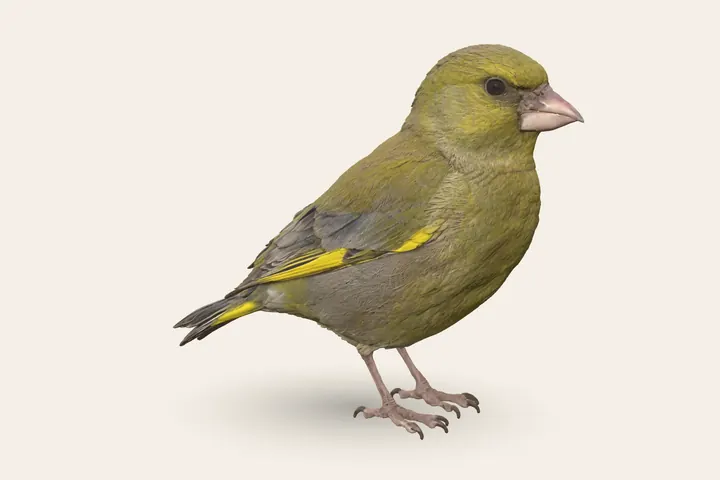 3D model
A Greenfinch is 14.5–16 cm (5.5–6.5 in) long, bill to tail.
3D model · Male · Length 14.5–16 cm (5.5–6.5 in) · How we make our birds · Report a problem
© 2026 NC Digital Limited (Birdfact). All rights reserved. This 3D model may be viewed on this page and shared by link only. Downloading, extracting, copying or reusing it, or using it to train machine-learning models, is not permitted without our written permission. Using our models
On this page16 sections
How to recognise it
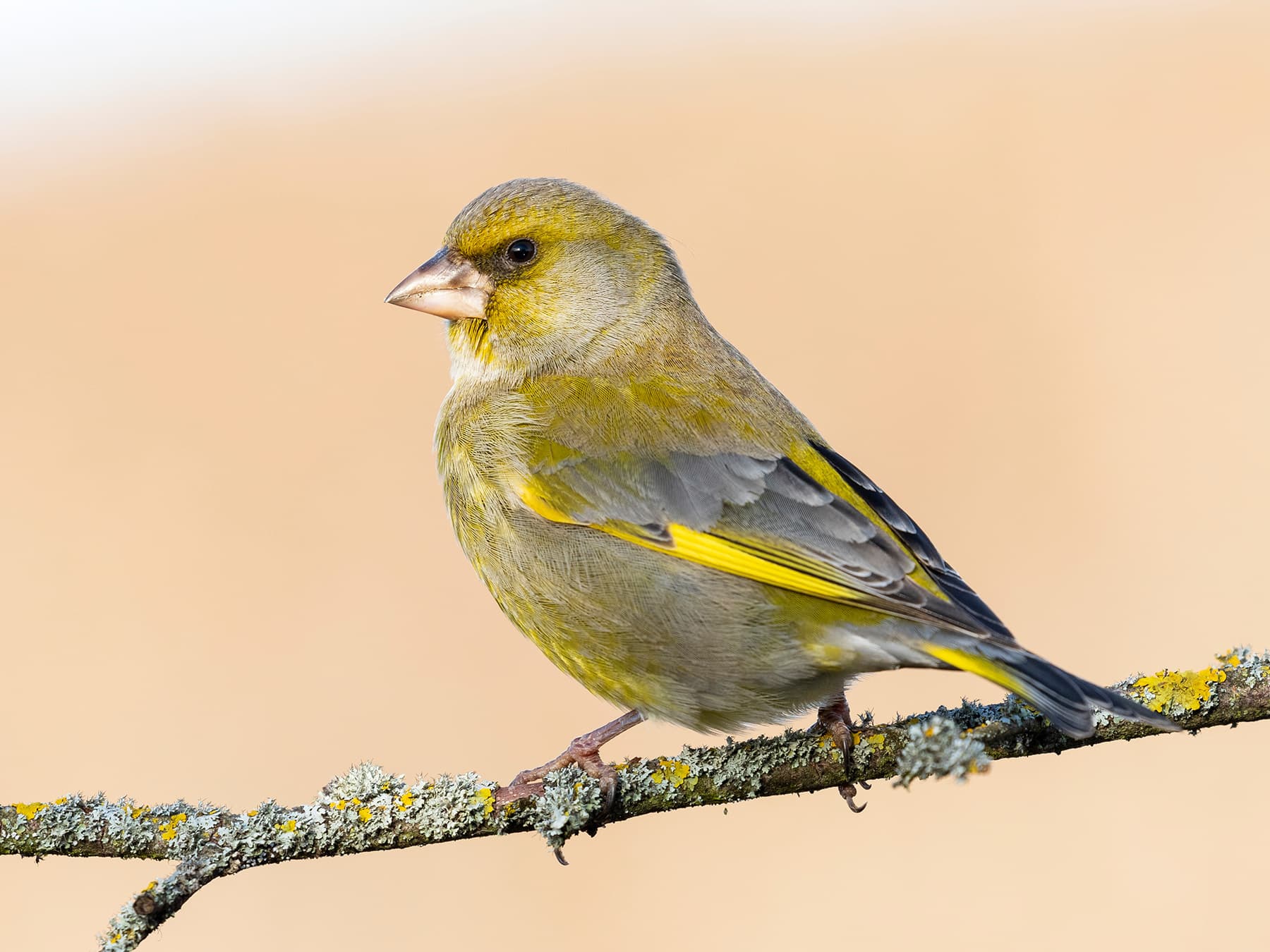
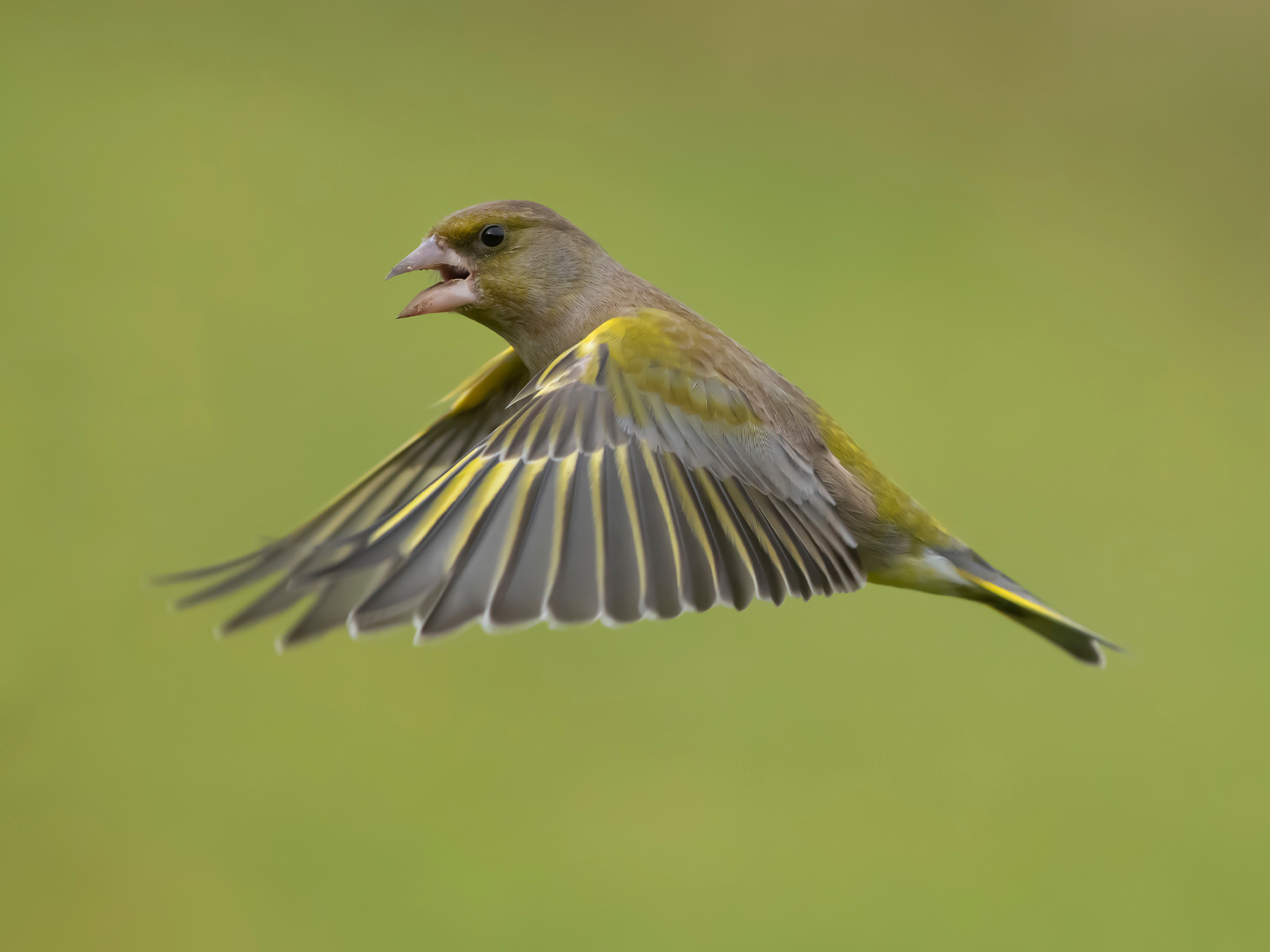
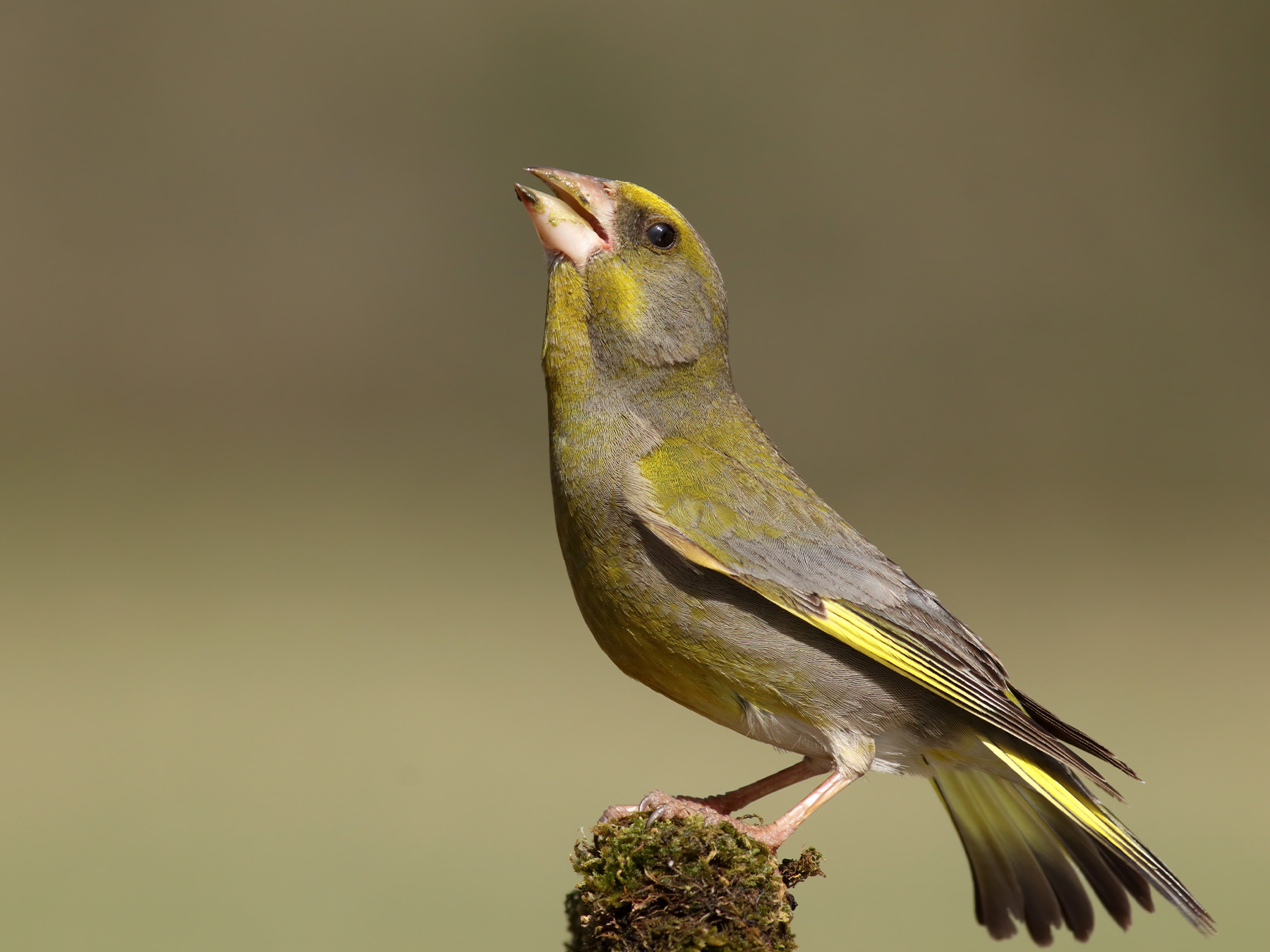
Look for the yellow. A Greenfinch is a chunky finch with a big, pale, cone-shaped bill, and whether it is sitting or flying it shows a bright yellow stripe along the edge of the wing and yellow patches at the sides of its short, forked tail.
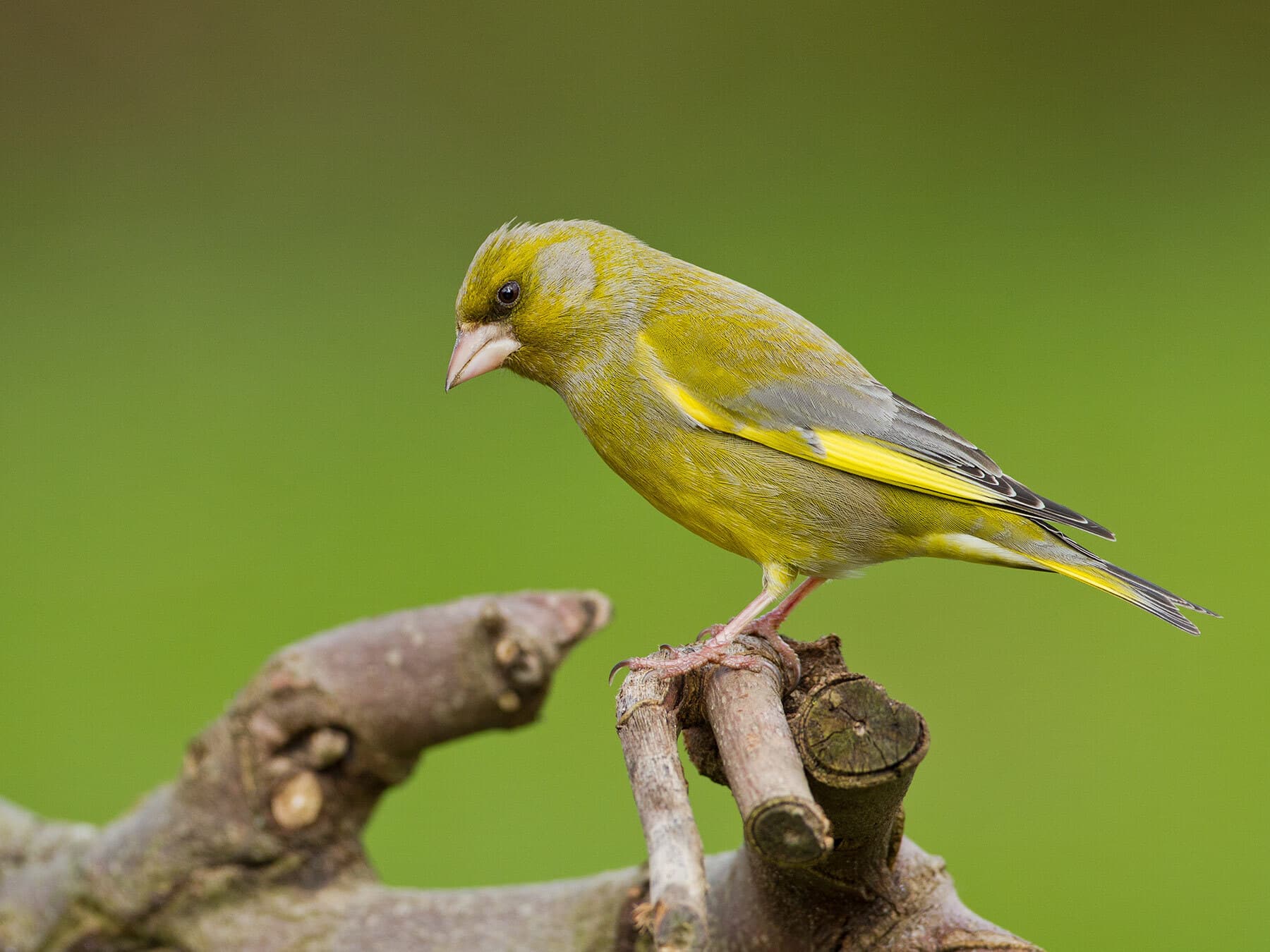
The male is olive-green all over, yellowish on the breast and belly and brighter yellow-green on the rump, with a grey panel in the wing and a little black between the bill and the eye. In winter he looks duller and browner. The bill is pinkish and the legs pale brown to pinkish.1
It is about 15 cm long with a wingspan of 26 cm.2 Live adults weighed by BTO ringers average 27.7 g, males and females much the same.3
Male, female and young
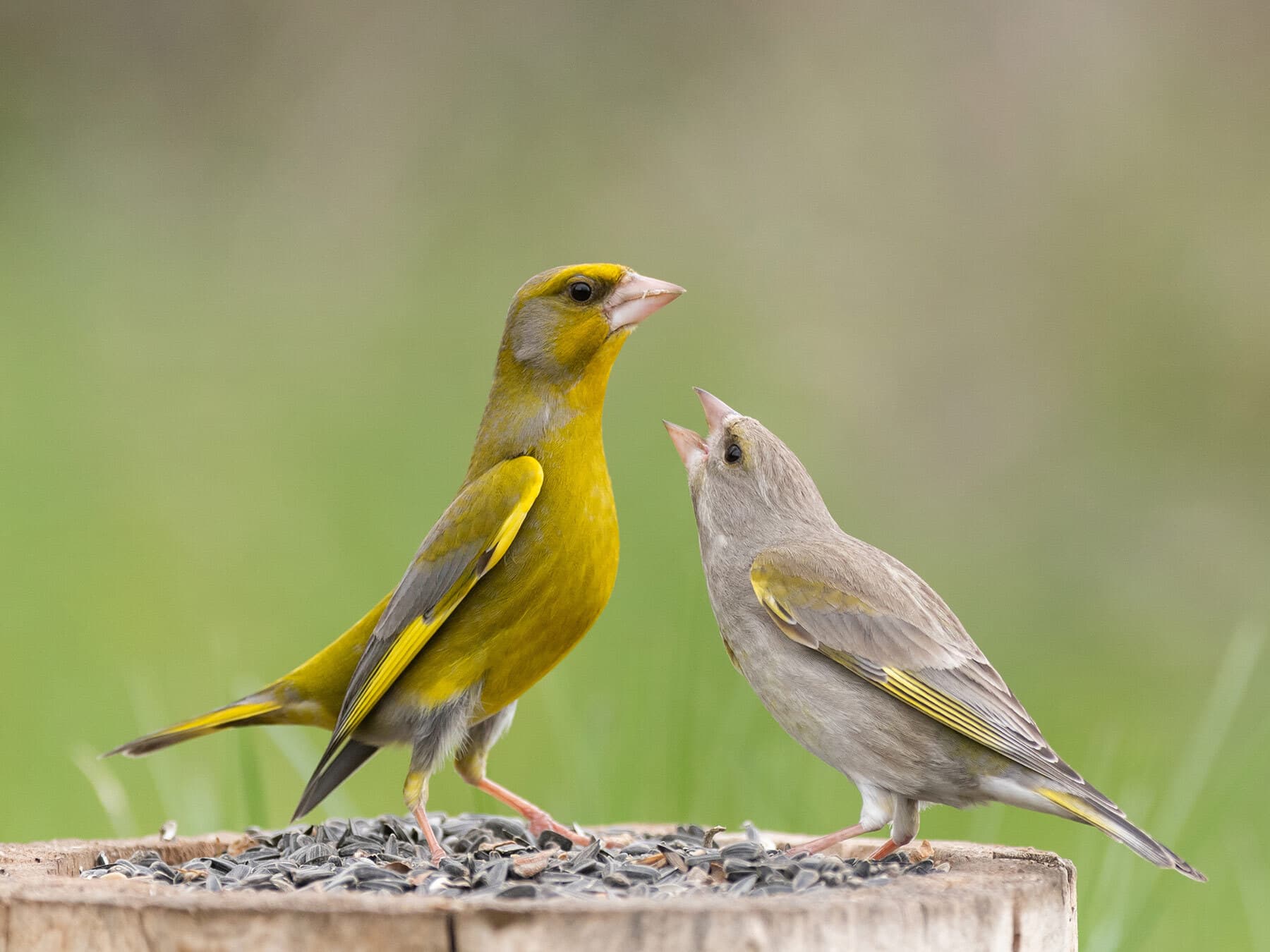
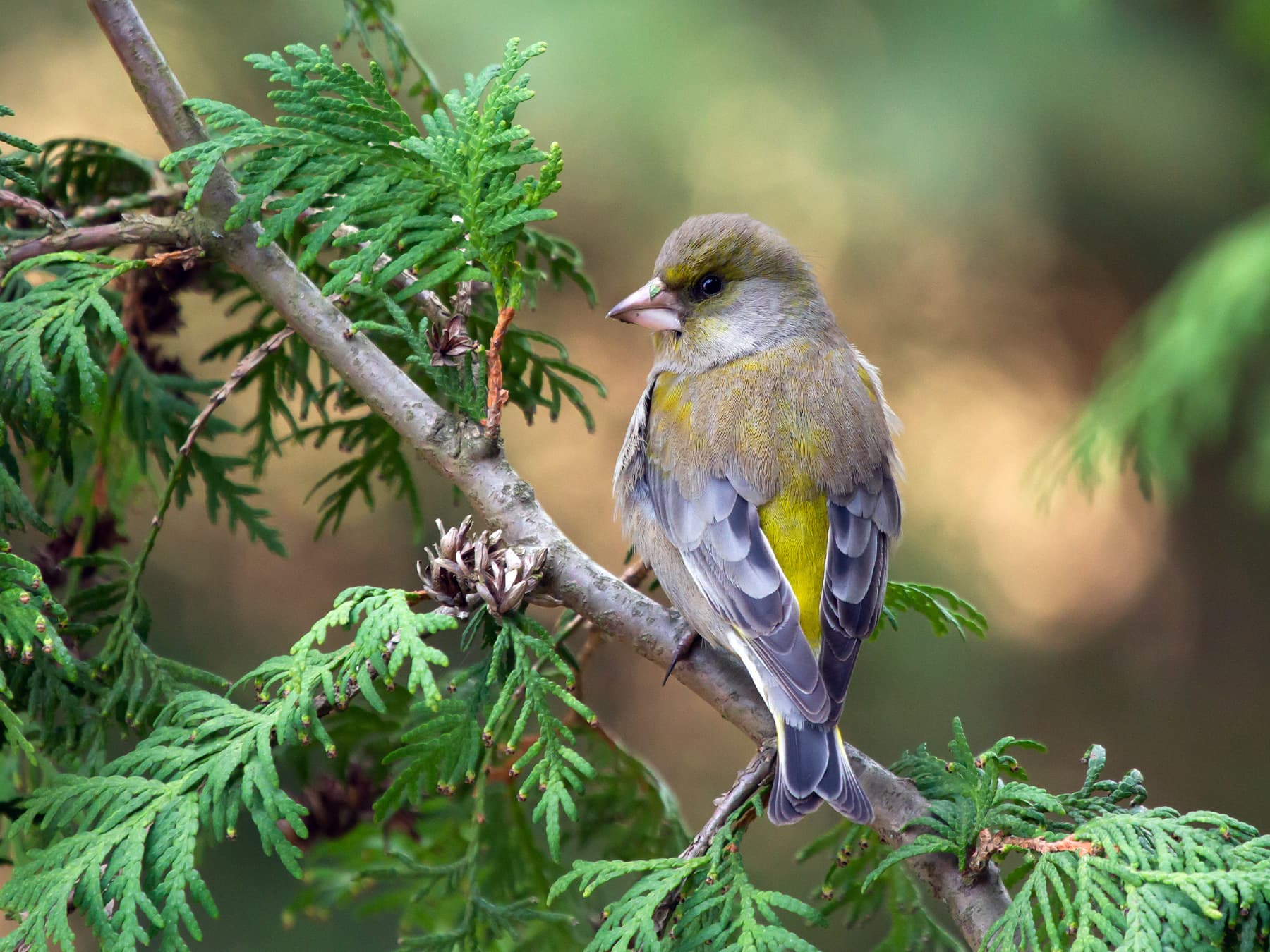
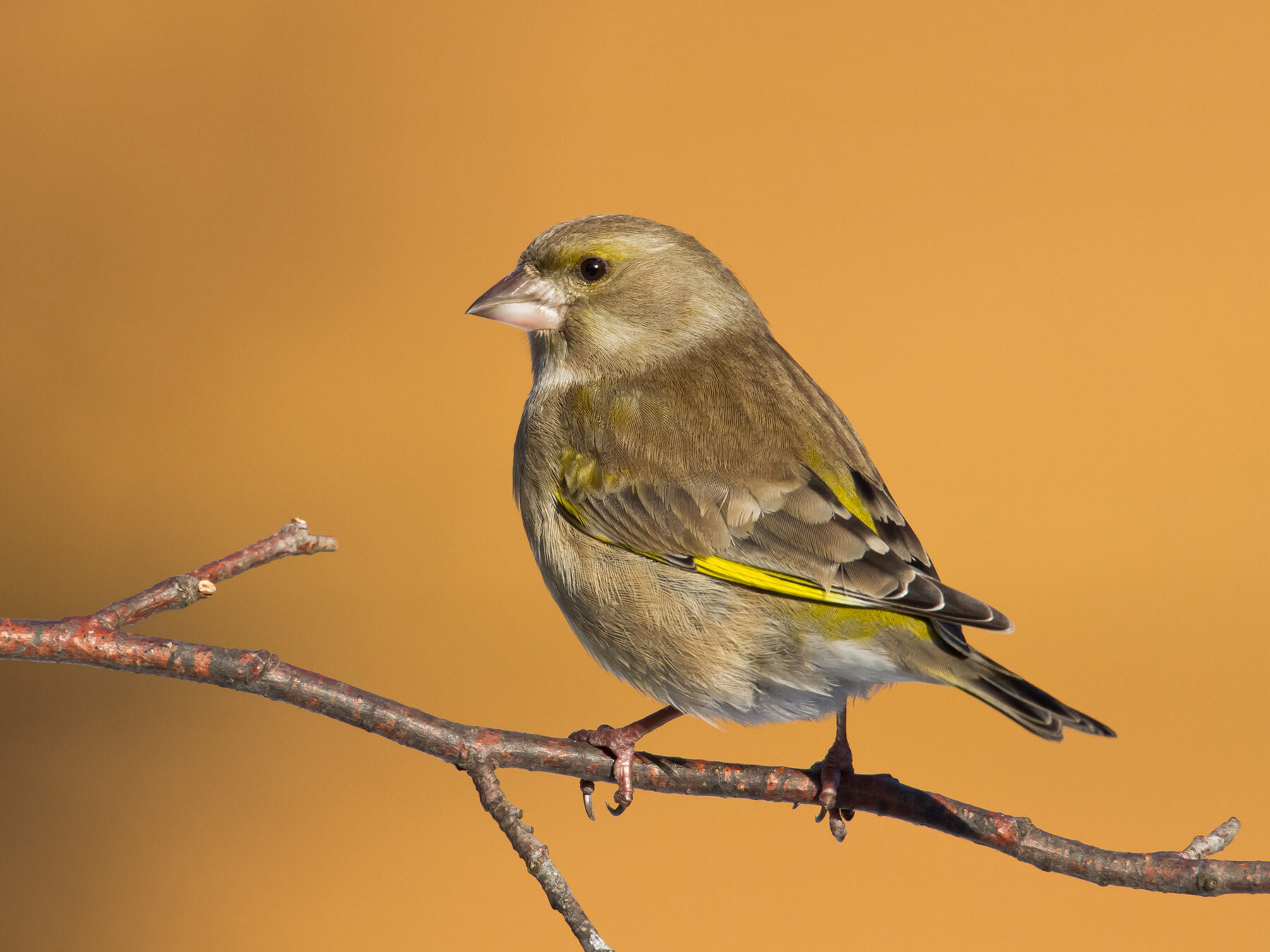
Despite the name, a female Greenfinch looks more brown than green: greyer on the head and back, with less yellow in the wing and tail than the male and white under the tail. Her bill is greyer than his.
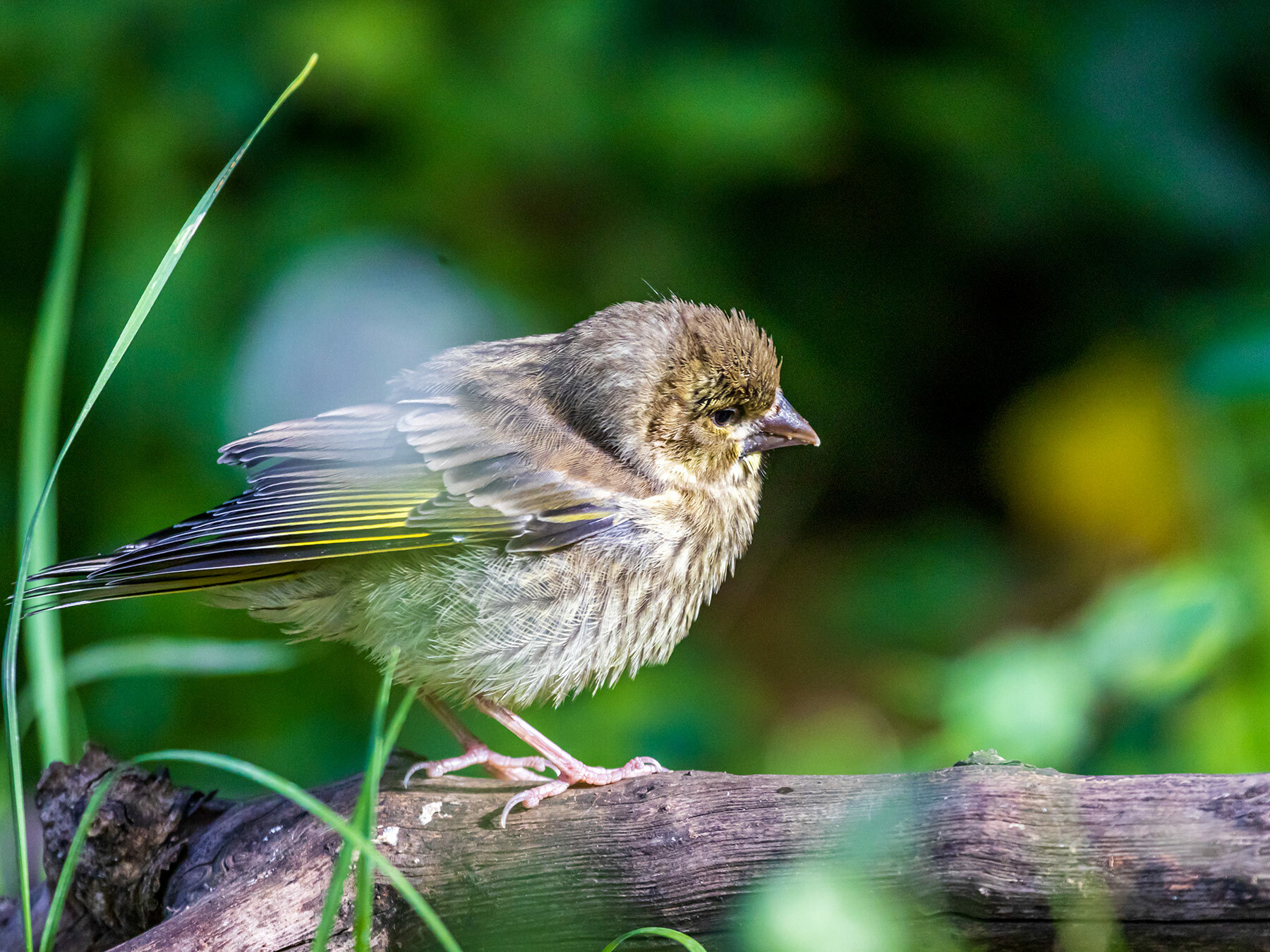
Young birds, seen from late spring, look like a female but are buffish-brown and streaked on the breast and flanks, with only thin yellow edges in the wing. Photos and how to tell them apart: female and young Greenfinches.
Identification: similar birds
The bird most often confused with it is the Siskin. A Siskin is smaller, 12 cm against 15, streaked, with a fine, sharp bill, and the male has a black cap and bib. A Greenfinch is bigger, plainer and heavy-billed. See Siskin or Greenfinch.
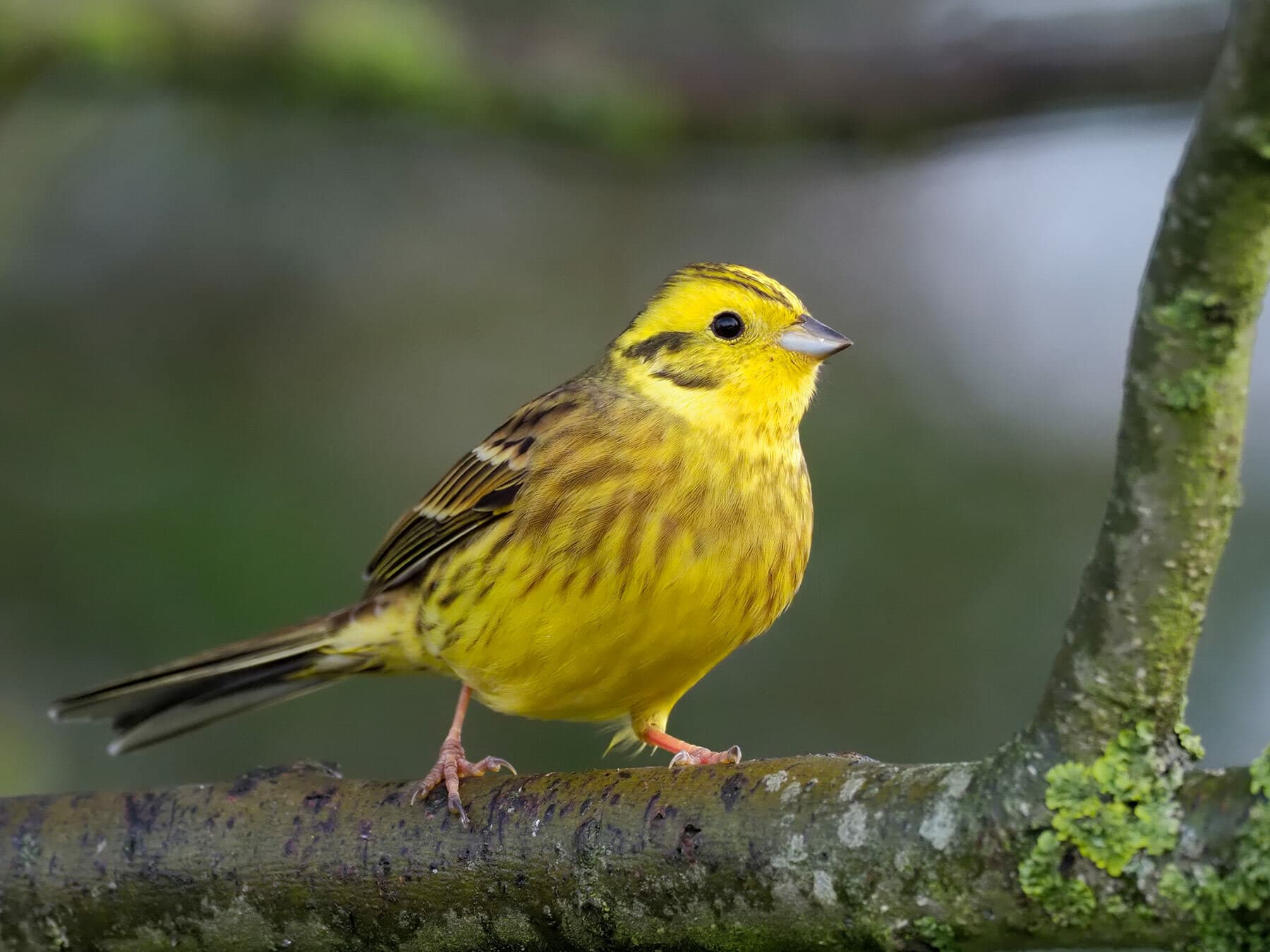
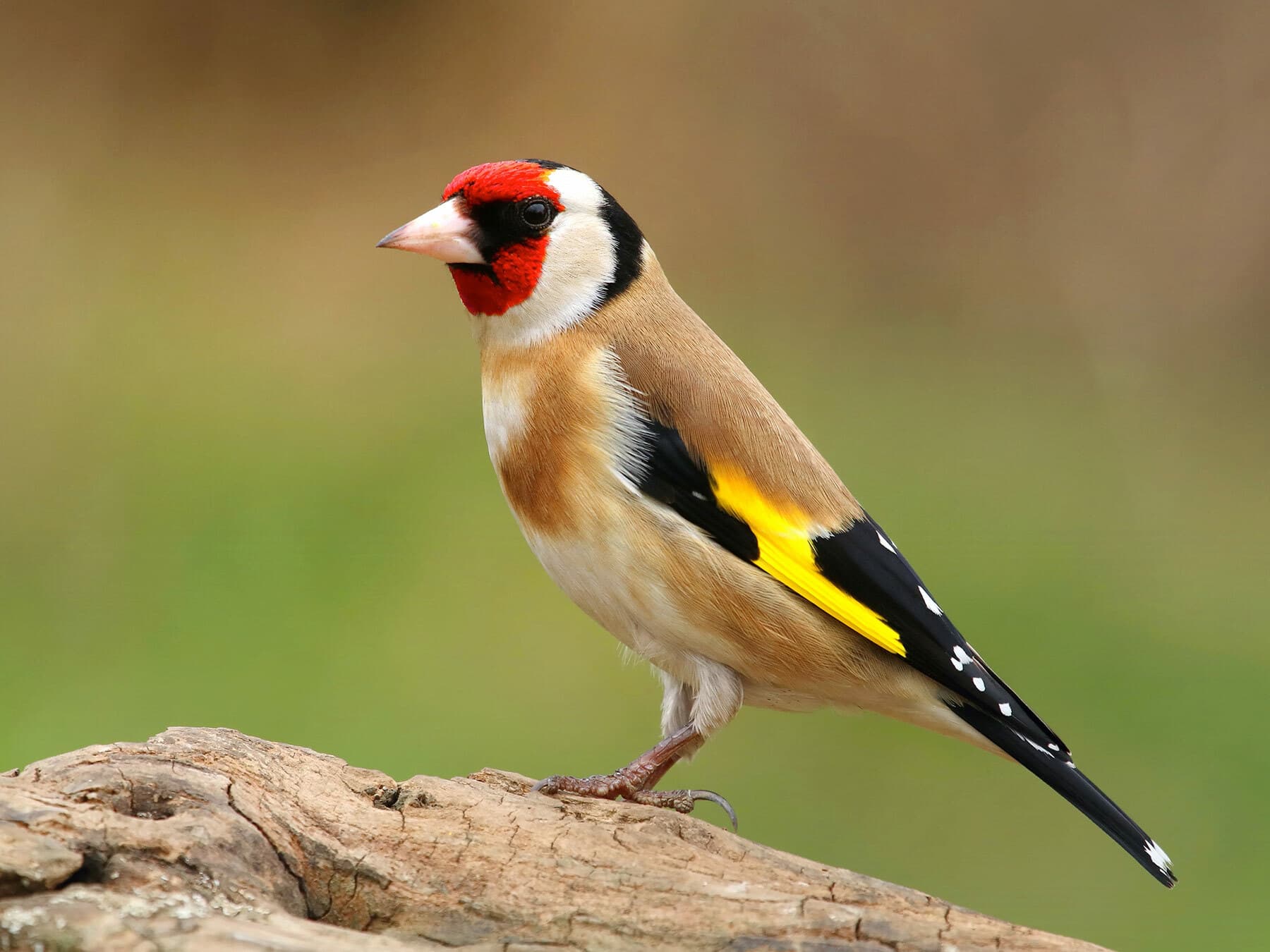
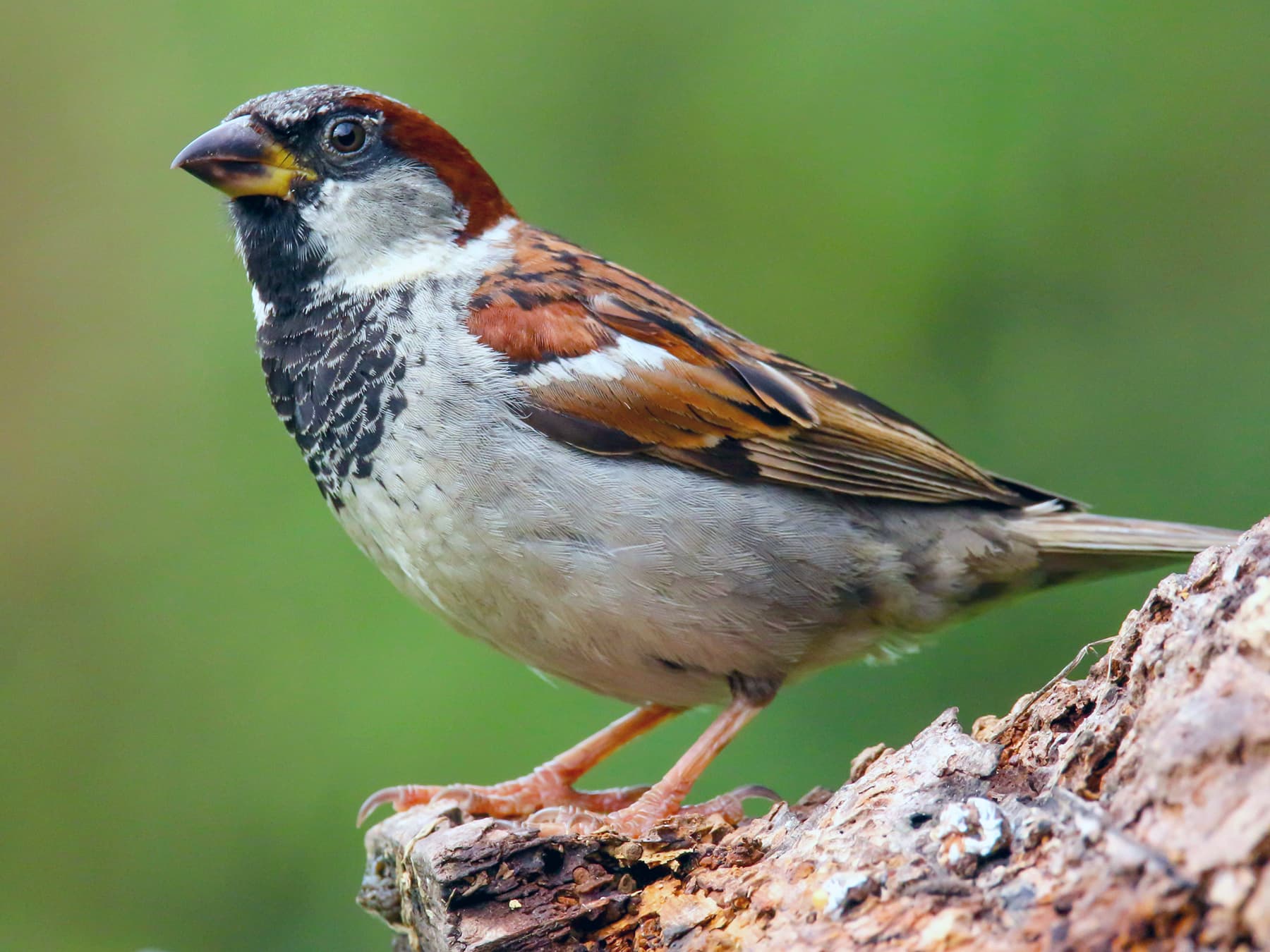
A young Goldfinch is streaky brown like a young Greenfinch, but it already has the adult's yellow wing patch on black wings, and white spots on its black tail.4 A male Yellowhammer has a much yellower head, a brown back streaked with black, a chestnut rump and white sides to the tail. A female House Sparrow has a pale stripe behind the eye, a striped back and no yellow at all.
Its size
Adults- Length
- 14.5–16 cm
- Wingspan
- 26 cm
- Weight
- 24.7–30.9 g
Its song and calls
In spring the male sings from a treetop or another high perch: a twittering, trilling song broken by a long, drawn-out nasal wheeze. Sometimes he sings in a slow, rolling song flight over the trees on stiff wings.
The full song mixes call notes, a dry nasal trill, a rolling run of notes that rises and speeds up, and the wheeze, written tsweee. Males sing from January, sometimes late December, to mid-August; females sing too, but much less often and more weakly.
The calls to know are a fast, twittering contact call, used to keep in touch, and a plaintive, rising alarm call. Young birds begging for food give soft, high notes. Hear the song, the wheeze and the calls: Greenfinch song and calls.
- Song0:00 / 1:33
Recorded in Netherlands · June 2014
- Call0:00 / 0:18
Recorded in Normandie, France · July 2023
When and where to see it
OctoberIn season
Most recorded in October
- 1. Wiltshire2.3%
- 2. Leicestershire1.6%
- 3. West Midlands1.2%
- 4. Tyne and Wear1.1%
- 5. Wrexham1.1%
Each dot is a county, state or province: the bigger and darker, the larger the bird’s share of that place’s bird records that month. Grey dots: no regular records. The ringed point is the centre of the bird’s records this month; the arrow shows how it moved since last month, and the dashed loop its path through the year. “Arrivals” colours places where it becomes regular this month (orange) or is in its last regular month (grey). GBIF eBird Observation Dataset, 2019–2024. Map data: Natural Earth, US Census Bureau; place centres © OpenStreetMap contributors.
In your area
See when the Greenfinch is recorded in your county, state or province.
How often the Greenfinch turns up in the UK and Ireland through the year, from birdwatchers' records.
United Kingdom
Resident · all year · most records in March
Ireland
Resident · all year · most records in March
Show as a table
| Month | United Kingdom | Ireland |
|---|---|---|
| January | 0.78% (regular) | 0.65% (regular) |
| February | 1.1% (regular) | 0.74% (regular) |
| March | 1.2% (regular) | 0.81% (regular) |
| April | 1.1% (regular) | 0.77% (regular) |
| May | 0.95% (regular) | 0.61% (regular) |
| June | 0.99% (regular) | 0.50% (regular) |
| July | 1.0% (regular) | 0.43% (regular) |
| August | 0.74% (regular) | 0.23% (regular) |
| September | 0.58% (regular) | 0.20% (regular) |
| October | 0.70% (regular) | 0.28% (regular) |
| November | 0.75% (regular) | 0.46% (regular) |
| December | 0.73% (regular) | 0.60% (regular) |
Recorded regularly in
Worldwide: recorded regularly in 74 countries
Countries where it was recorded in at least 3 of the 6 years 2019–2024. Linked countries have their own bird list.
Europe (48)
- Åland Islands
- Albania
- Andorra
- Austria
- Belarus
- Belgium
- Bosnia & Herzegovina
- Bulgaria
- Croatia
- Czechia
- Denmark
- Estonia
- Finland
- France
- Germany
- Gibraltar
- Greece
- Guernsey
- Hungary
- Ireland
- Isle of Man
- Italy
- Jersey
- Kosovo
- Latvia
- Liechtenstein
- Lithuania
- Luxembourg
- Malta
- Moldova
- Monaco
- Montenegro
- Netherlands
- North Macedonia
- Norway
- Poland
- Portugal
- Romania
- Russia
- San Marino
- Serbia
- Slovakia
- Slovenia
- Spain
- Sweden
- Switzerland
- Ukraine
- United Kingdom
Asia (17)
- Armenia
- Azerbaijan
- China
- Cyprus
- Georgia
- Iran
- Iraq
- Israel
- Jordan
- Kazakhstan
- Kyrgyzstan
- Lebanon
- Mongolia
- Palestinian Territories
- Tajikistan
- Turkey
- Uzbekistan
South America (2)
- Argentina
- Uruguay
Oceania (3)
- Australia
- New Zealand
- Norfolk Island
Data: EOD – eBird Observation Dataset (Cornell Lab of Ornithology), accessed via GBIF.org, CC BY 4.0. Records from 2019–2024, aggregated and filtered by Birdfact. How these lists are made
Greenfinches live throughout Britain and Ireland all year, everywhere except the highest hills, and are most at home around people: in BTO surveys they turn up most often in villages, and commonly in towns. In the last national atlas they bred in 90% of the UK's 10-km squares.
Away from houses, look along woodland edges, in hedgerows, parks, orchards and churchyards. In autumn and winter they feed in flocks on stubbles and weedy fields, often with Linnets, Tree Sparrows, Yellowhammers and Reed Buntings.
Spotting tips
In spring, listen for the wheeze and look up to the top of a tall tree or another high perch. When a Greenfinch flies off, watch for the yellow flashing in the wings and tail. In winter, check hedges and shrubs near a garden feeder.
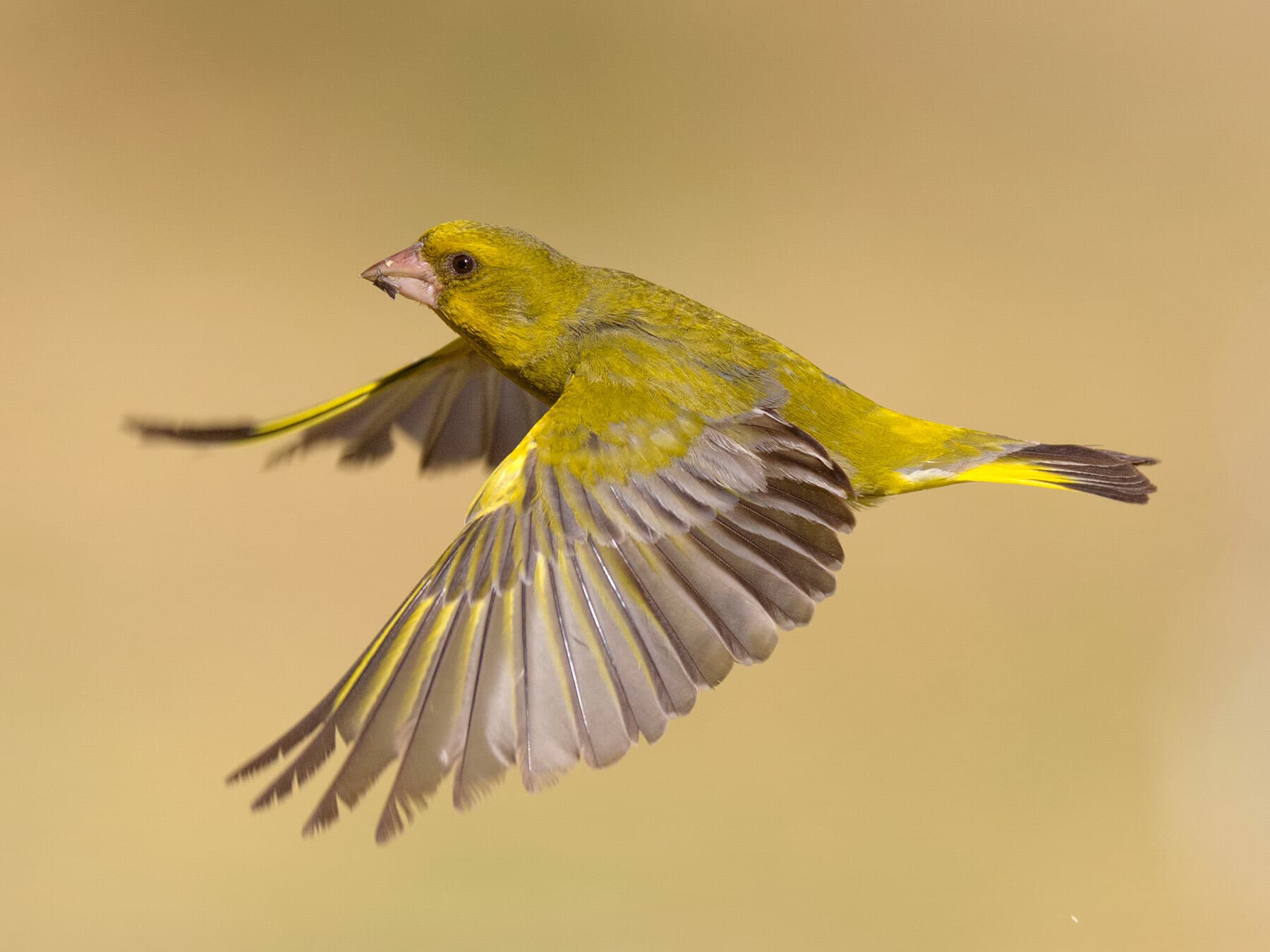
Do Greenfinches migrate?
British Greenfinches mostly stay put. Ringing shows most move no more than about 70 km, females further than males and young birds further than adults, often towards lowland and the coast.
Some come from abroad. Each winter, small numbers of Greenfinches from Fennoscandia, mostly from its western side such as Norway, add to our birds. BTO ringing records include 121 reports of Norwegian-ringed Greenfinches here, and one young male ringed at Mandal in southern Norway on 1 November 1997 was caught at Kilnsea, East Yorkshire, two days later, 667 km away.5
What it eats
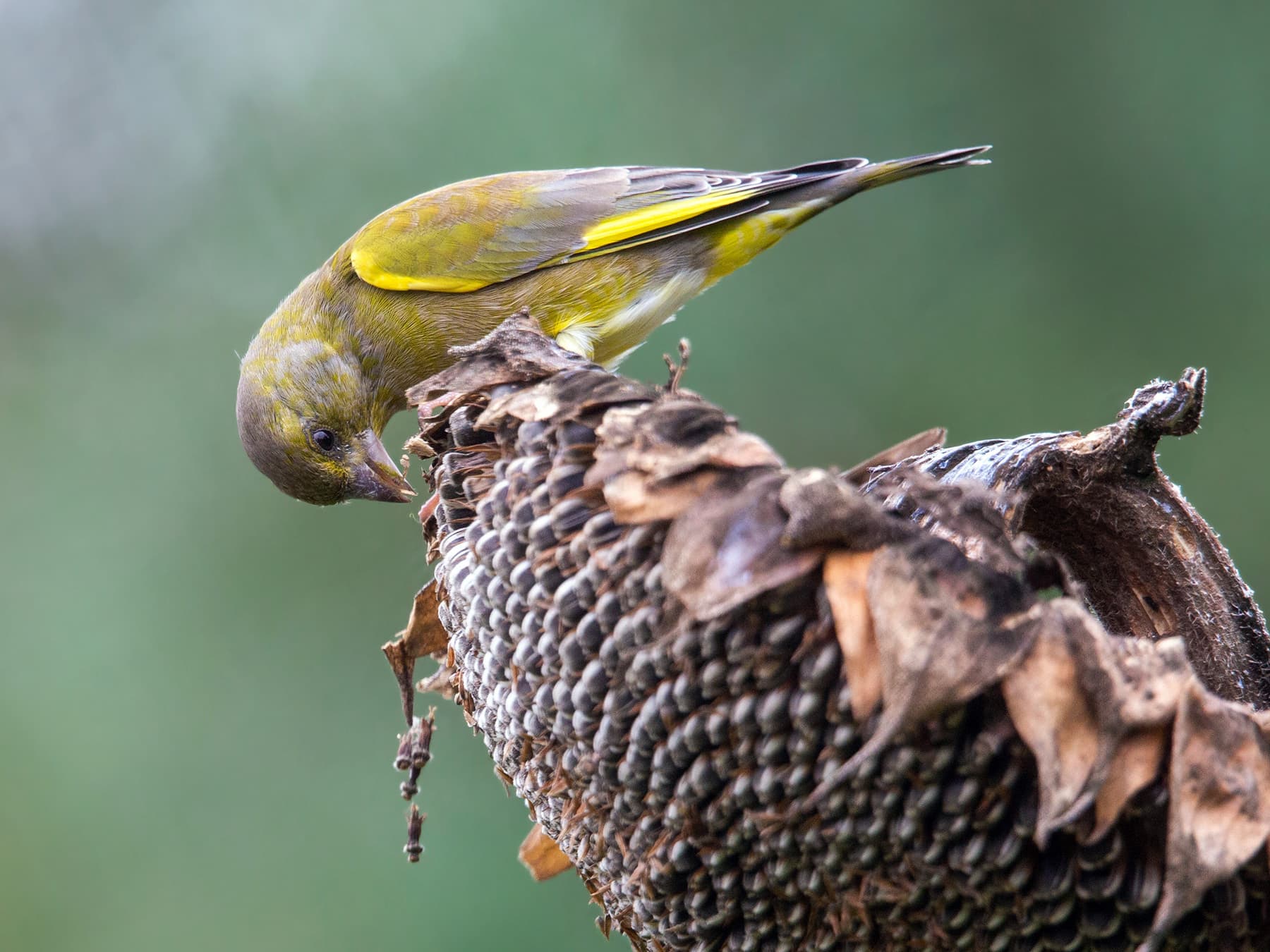
Seeds, above all. A Greenfinch's heavy bill is built for big seeds, and a classic study of British finches found it lives mainly on the large seeds of trees, crops and farmland weeds.6 It also eats buds, flowers and berries, and some insects and spiders. It has a neat trick with bramble and yew berries: it squeezes the fruit in its bill, drops the pulp and keeps the seeds.
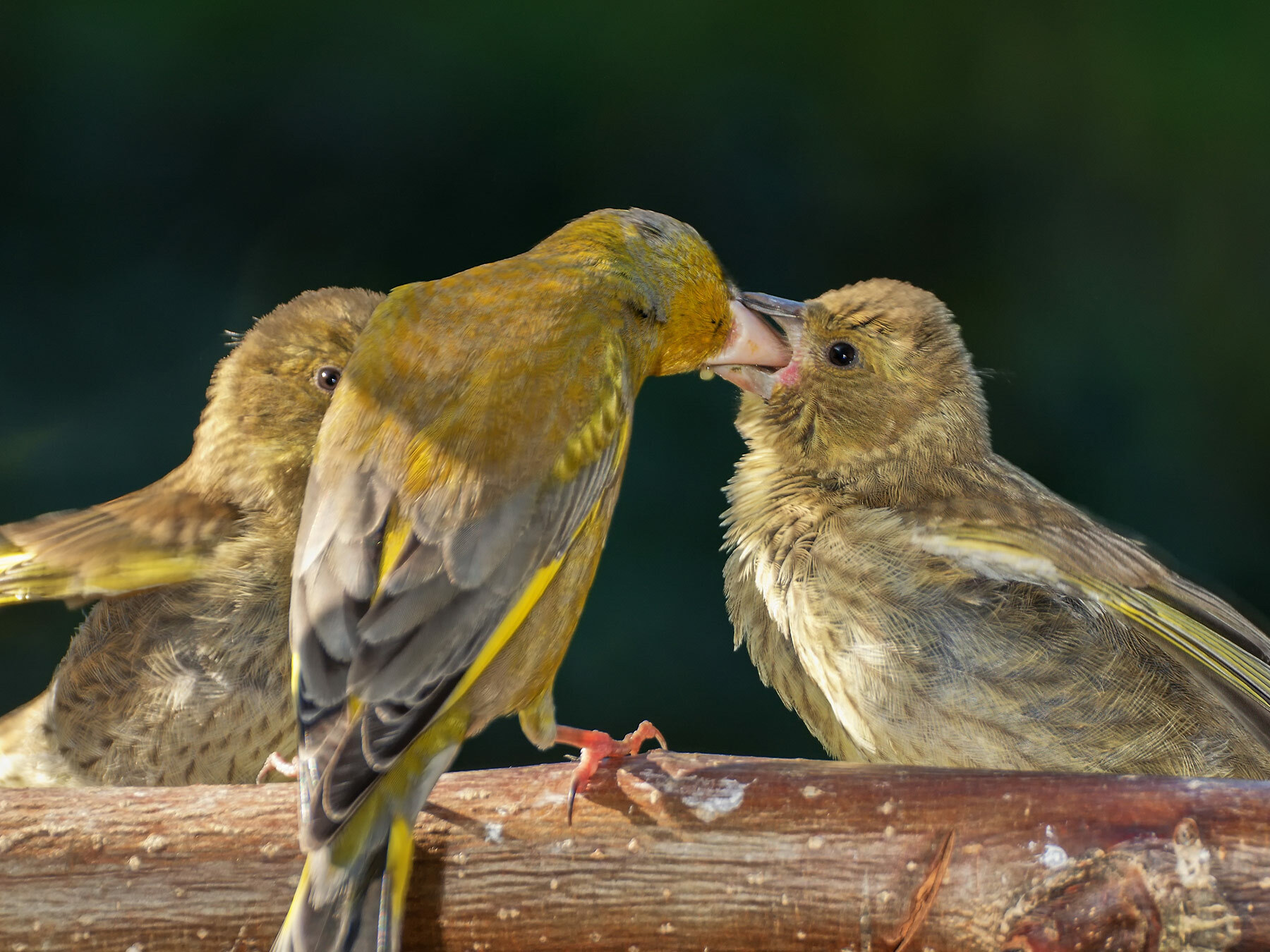
What the chicks eat is less settled. Birds of the World describes them as fed mostly on insect larvae, but a study of nestlings in Spain found mainly seeds, leaves and bulbs, with only a few aphids early in the season.7 Some finches are known to raise their young almost entirely on seeds, carried in the throat and brought up for the chicks. More: what Greenfinches eat.
Feeding them in your garden
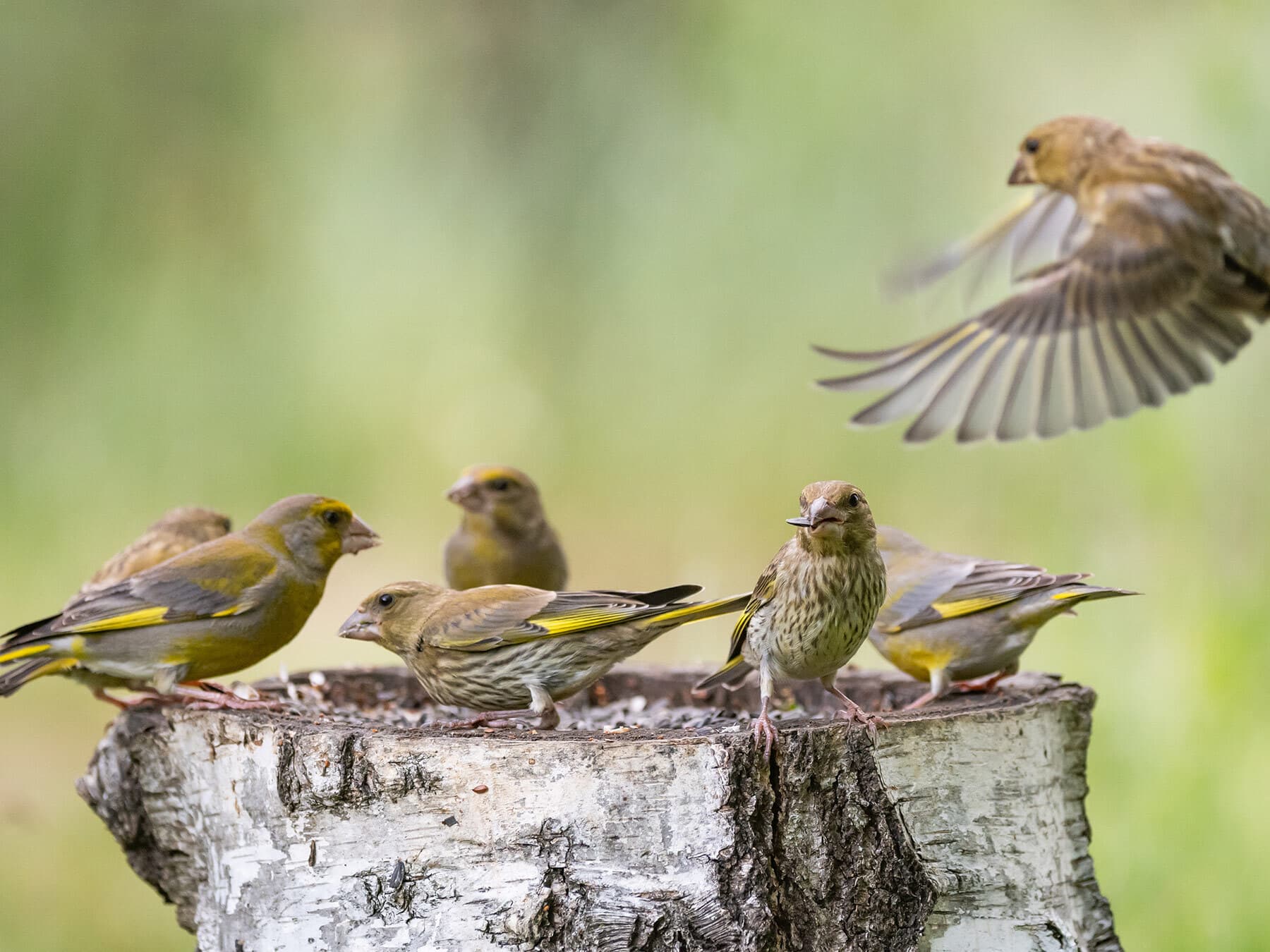
Greenfinches readily take sunflower seeds, black seeds or hearts, from a hanging feeder, and peanuts too. They are bold at feeders and squabble with each other and with other birds.
Because of the disease that has hit Greenfinches, how you feed matters. The RSPB now advises putting out seed and peanuts only from November to April and pausing from 1 May to 31 October, using hanging feeders rather than bird tables, trays or window feeders, cleaning feeders and water every week, and only offering water you can change every day.8 More: feeding Greenfinches safely.
Nesting and breeding
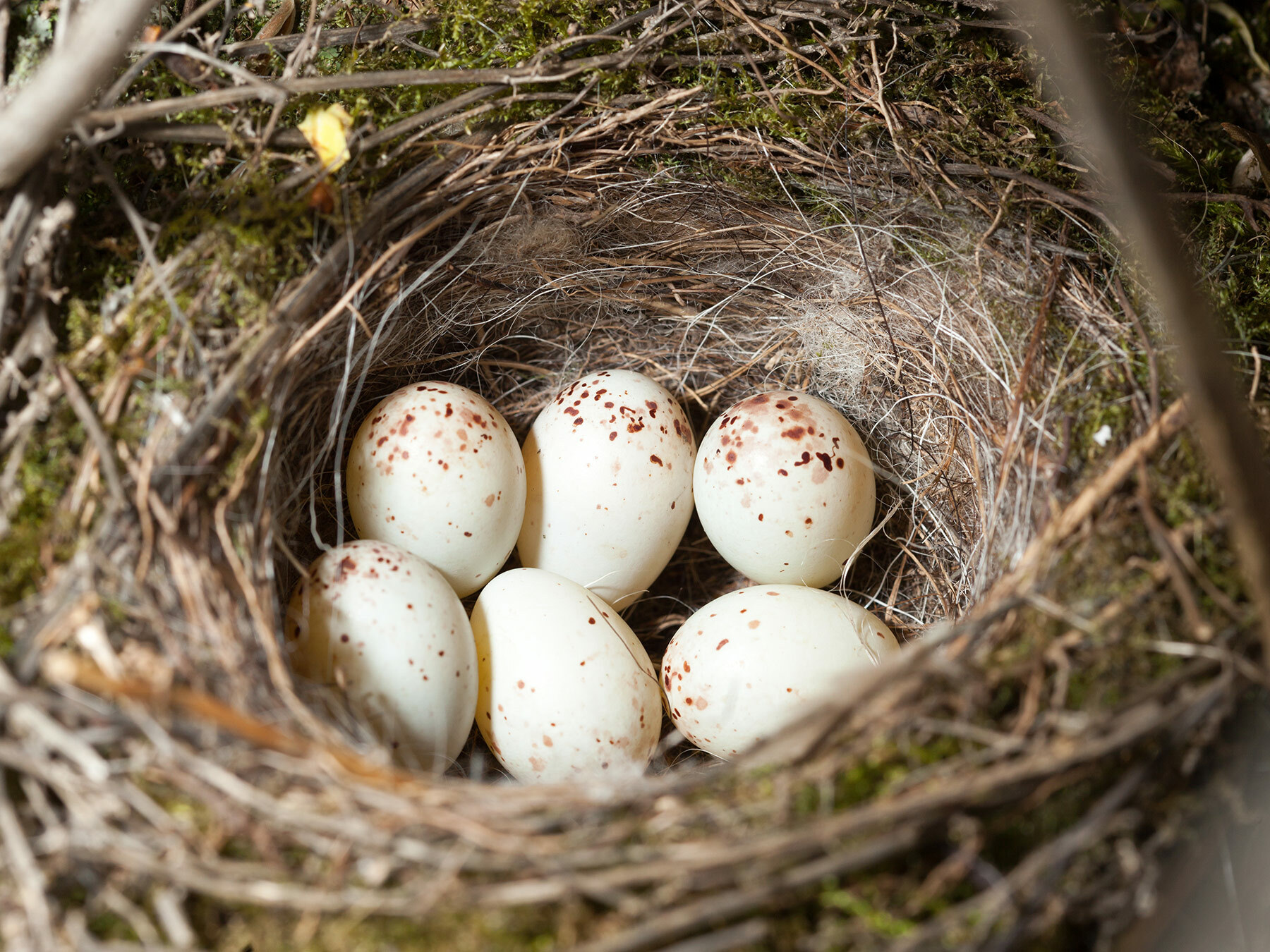
The female builds the nest, a neat cup of twigs, grass and moss with hair and feathers, usually in a dense bush, hedge or conifer. Greenfinches do not hold territories: some pairs nest alone, others in loose groups, with nests sometimes as little as 1.5 m apart.
In Britain the first eggs are laid on 10 May on average, in a season that runs from April into August. She lays 4 or 5 eggs and incubates them for about 14 days, while the male brings her food. The chicks leave the nest at 13.5 to 16 days old, and most pairs raise two broods.3 More: Greenfinch nests, eggs and young.
Behaviour
Greenfinches are sociable outside the breeding season. Late in summer they gather in flocks that can reach several thousand, and they are acrobatic feeders, hanging upside down on seed heads and feeders and sometimes holding a seed head under one foot to get at the seeds.
Before roosting, a Greenfinch fills its gullet with food to see it through the night: up to 2.5 cubic centimetres.
Lifespan and predators
A Greenfinch that survives to breed typically lives about 2 years. In BTO ringing data, about 44% of adults survive from one year to the next, and 42% of young birds survive their first year. They breed in their first year.3
Lifespan records
The oldest ringed Greenfinch in Britain and Ireland lived 11 years, 3 months and 24 days. It was ringed as a young male at Ormesby, Middlesbrough, in January 1987, and caught again by a ringer in Surrey in May 1998, 366 km to the south.9 The European list of ringing records includes a Portuguese-ringed bird found dead at 12 years and 5 months.10
Predators and other dangers
Many nests fail. In a British sample of 1,589 eggs, 68.6% hatched and 52.9% produced young that left the nest. Cats, rodents, crows, gulls, people and bad weather all took their toll.
Conservation
The Greenfinch is on the UK Red List. Its breeding population has fallen by 66% since 1967, and there were about 785,000 pairs in 2016.3 In the RSPB's Big Garden Birdwatch it was the seventh most-seen bird in 1979; in 2026 it was eighteenth. Worldwide it is still of Least Concern.
Numbers rose through the 1990s. Then, in 2005, a disease called trichomonosis, caused by a microscopic parasite, jumped into British finches, probably from pigeons and doves. It damages the throat so birds struggle to swallow, and it spreads where birds share food and water. By 2007, breeding Greenfinches had fallen by 35% in the region where the disease was worst, and more than half a million Greenfinches and Chaffinches had died.11 The breeding population of Great Britain fell from about 4.3 million to about 2.8 million birds, and the size of Greenfinch flocks in gardens halved.12
Garden Wildlife Health, the disease-monitoring partnership of ZSL, BTO, Froglife and the RSPB, calls it the largest die-off of British birds from an infectious disease on record.13 The BTO's species account says the decline had not yet slowed, and that it is unclear whether better garden hygiene will halt it. The latest Breeding Bird Survey report, from April 2026, says the Greenfinch appears to have stabilised in England.14 The full story: Greenfinch disease and decline.
Conservation: what you can do
Sick Greenfinches look fluffed up and lethargic, with wet, matted feathers around the face, and may drool or struggle to swallow. If you see one, empty your bird bath and stop feeding for at least 2 to 4 weeks so the birds disperse; if it keeps happening, stop for 3 to 6 months. The disease is no risk to people, dogs or cats.
All year: follow the RSPB's seasonal feeding advice, use hanging feeders and keep them clean. Details: feeder hygiene and disease.
Similar birds
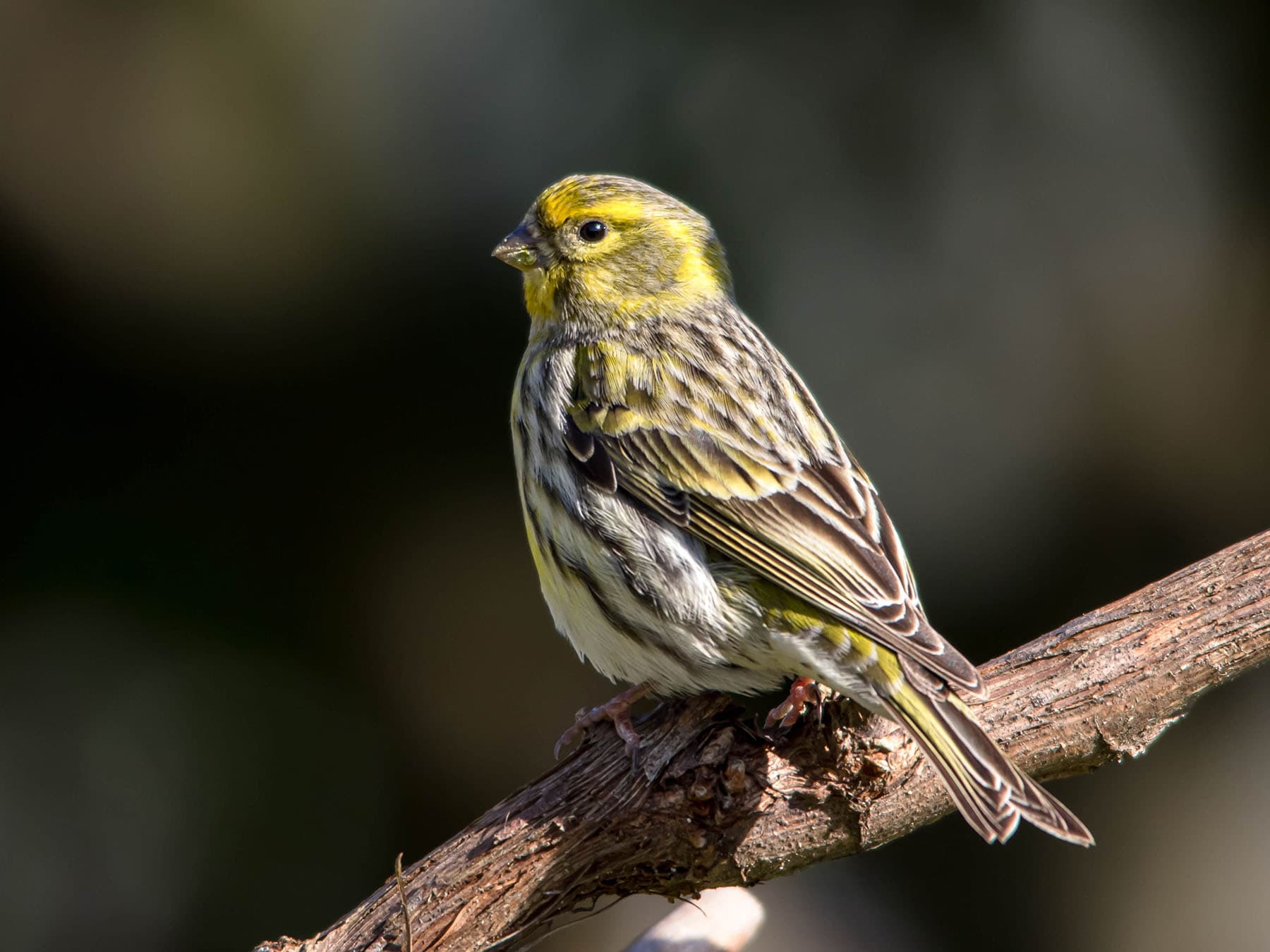
Often mistaken for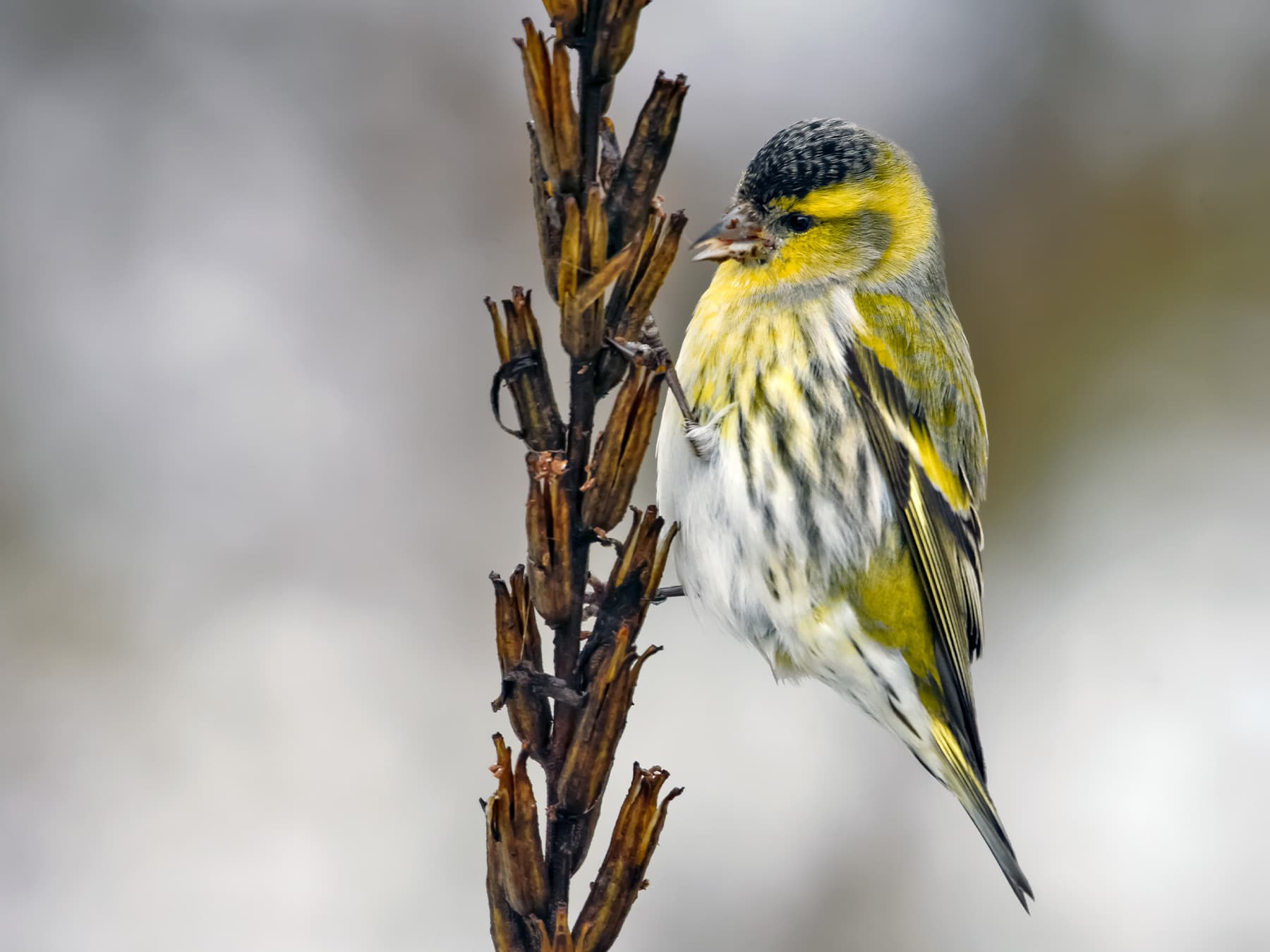
More photos
11 photos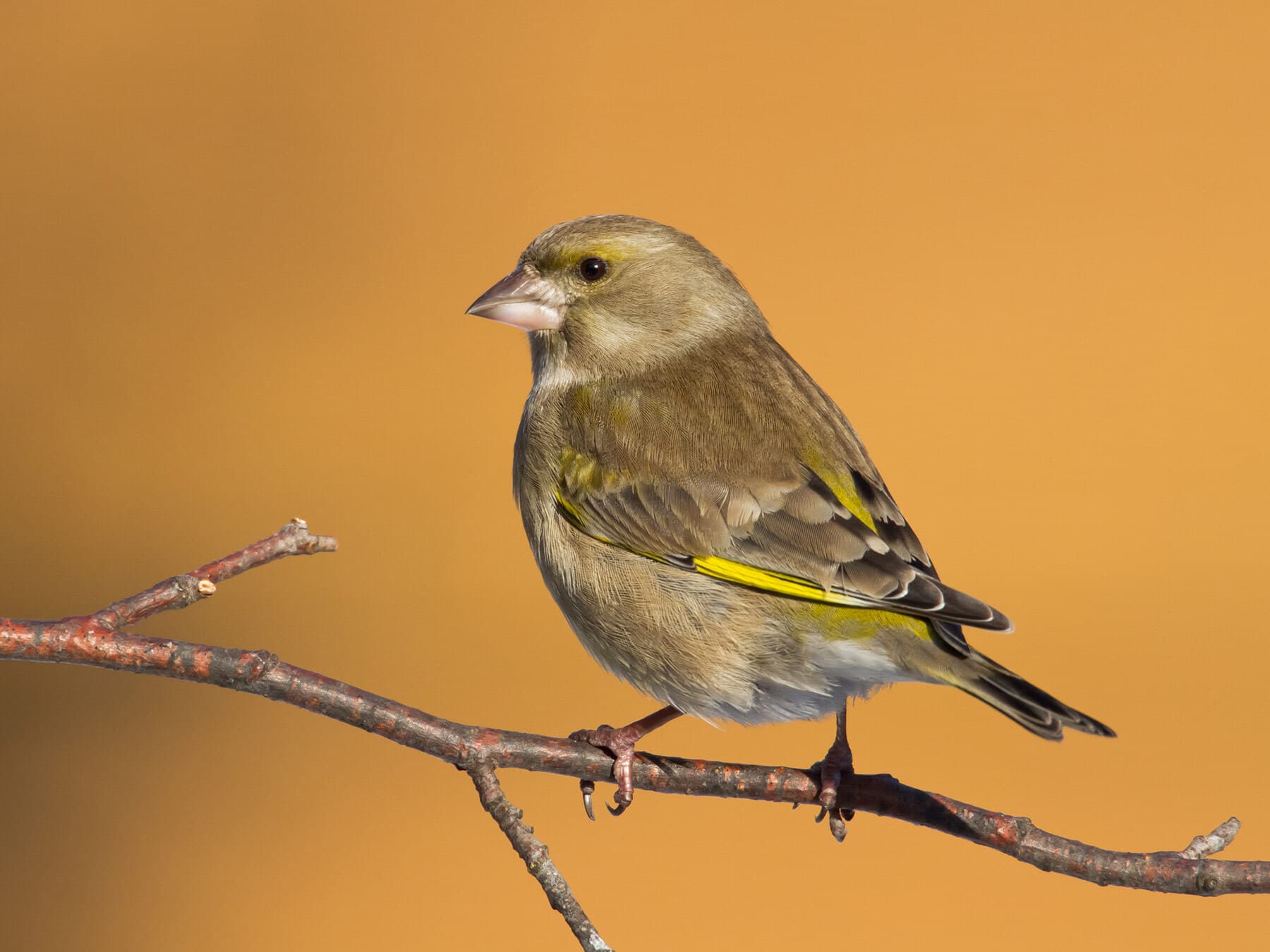 A female Greenfinch: grey-brown, with yellow along the wing
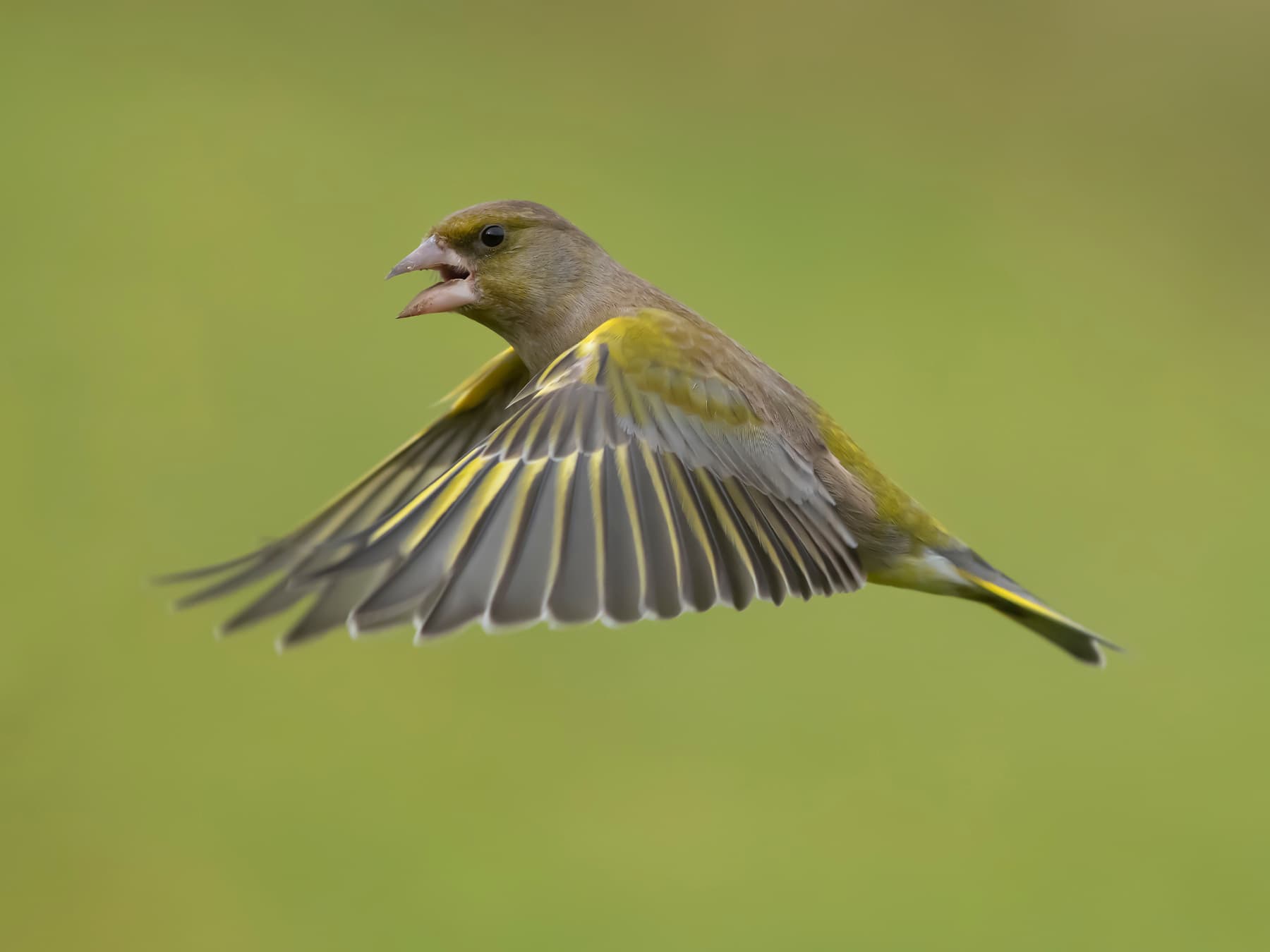 A female Greenfinch in flight
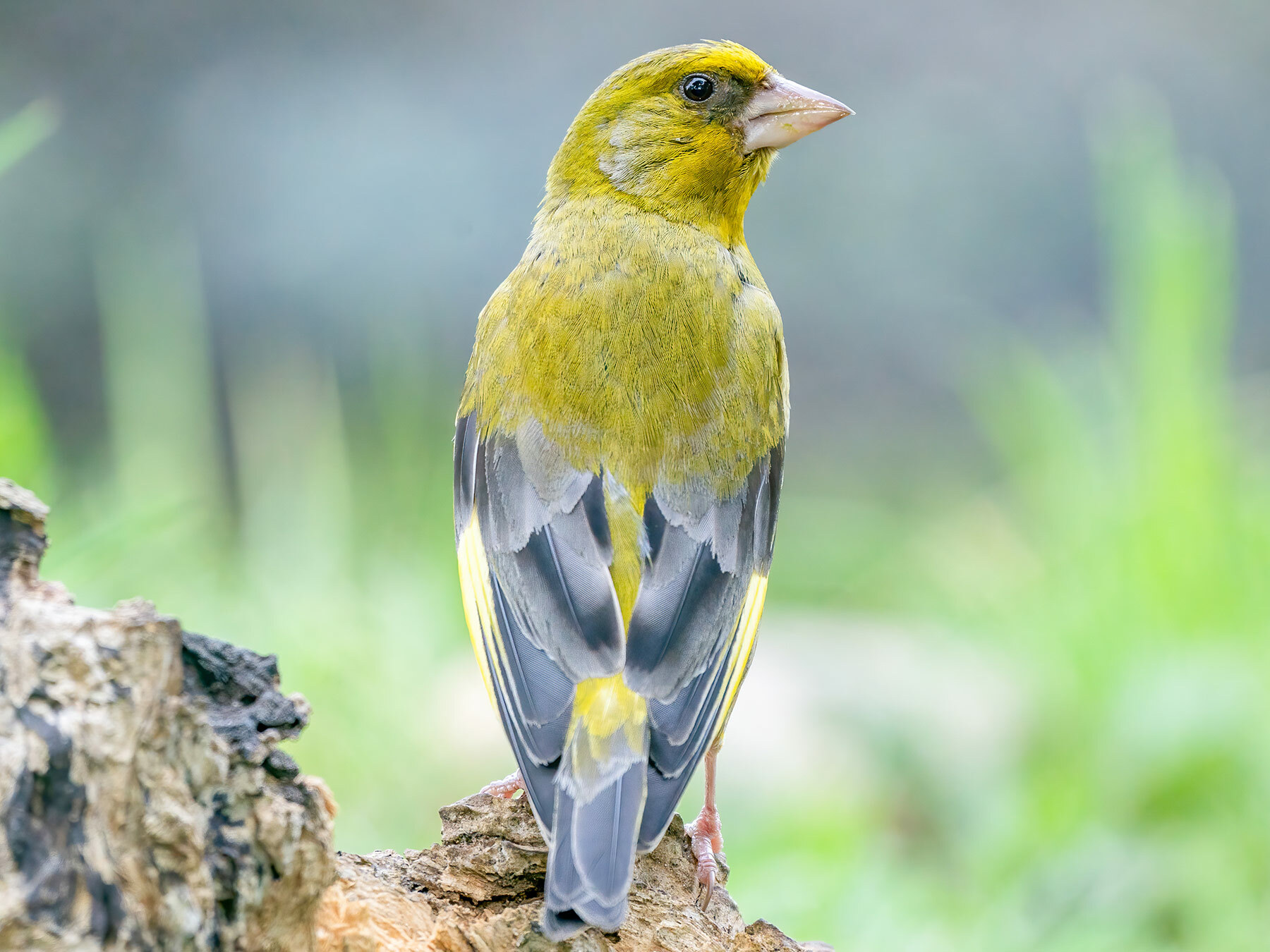
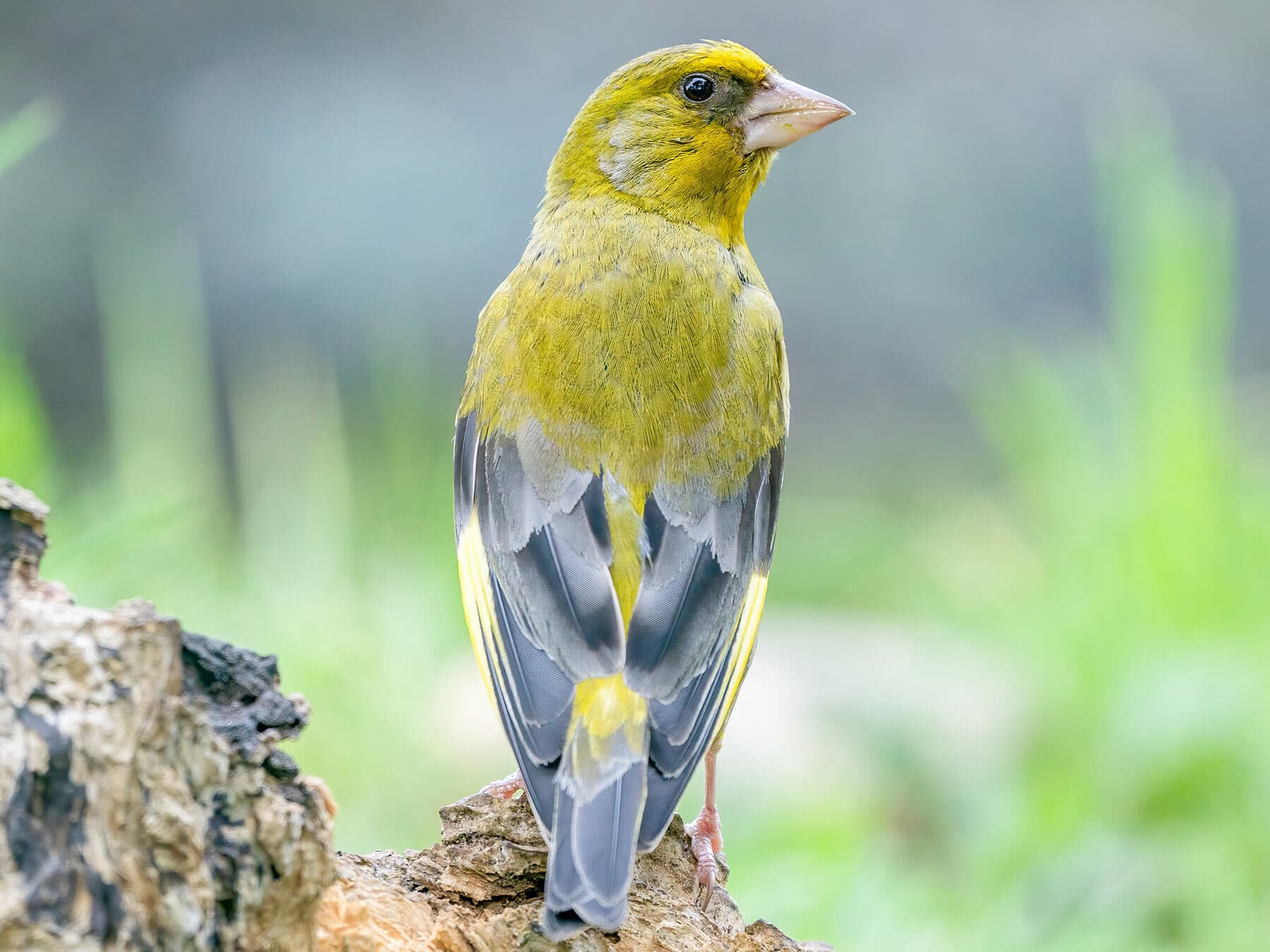 A male Greenfinch from behind, showing the yellow sides of the tail
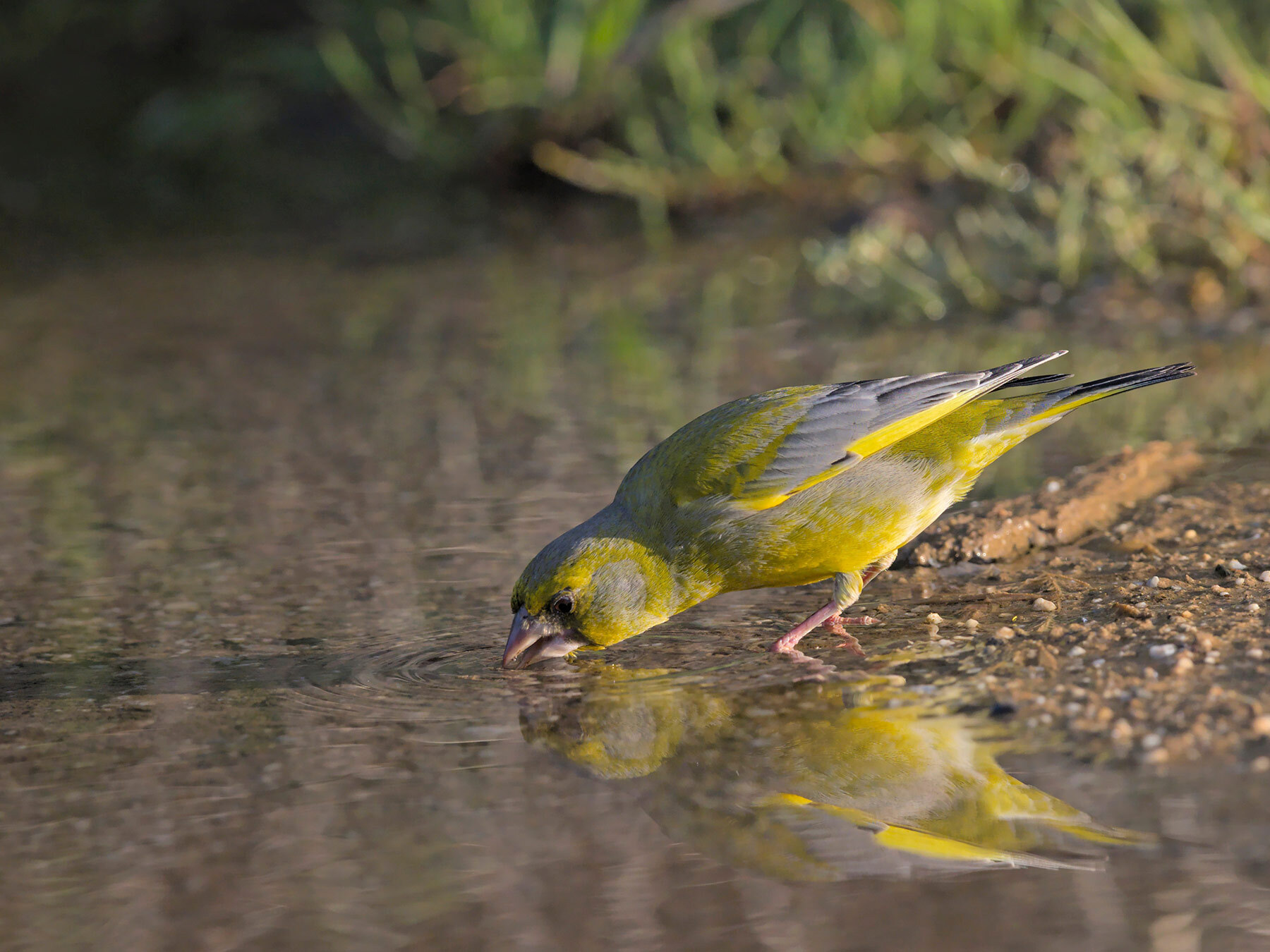
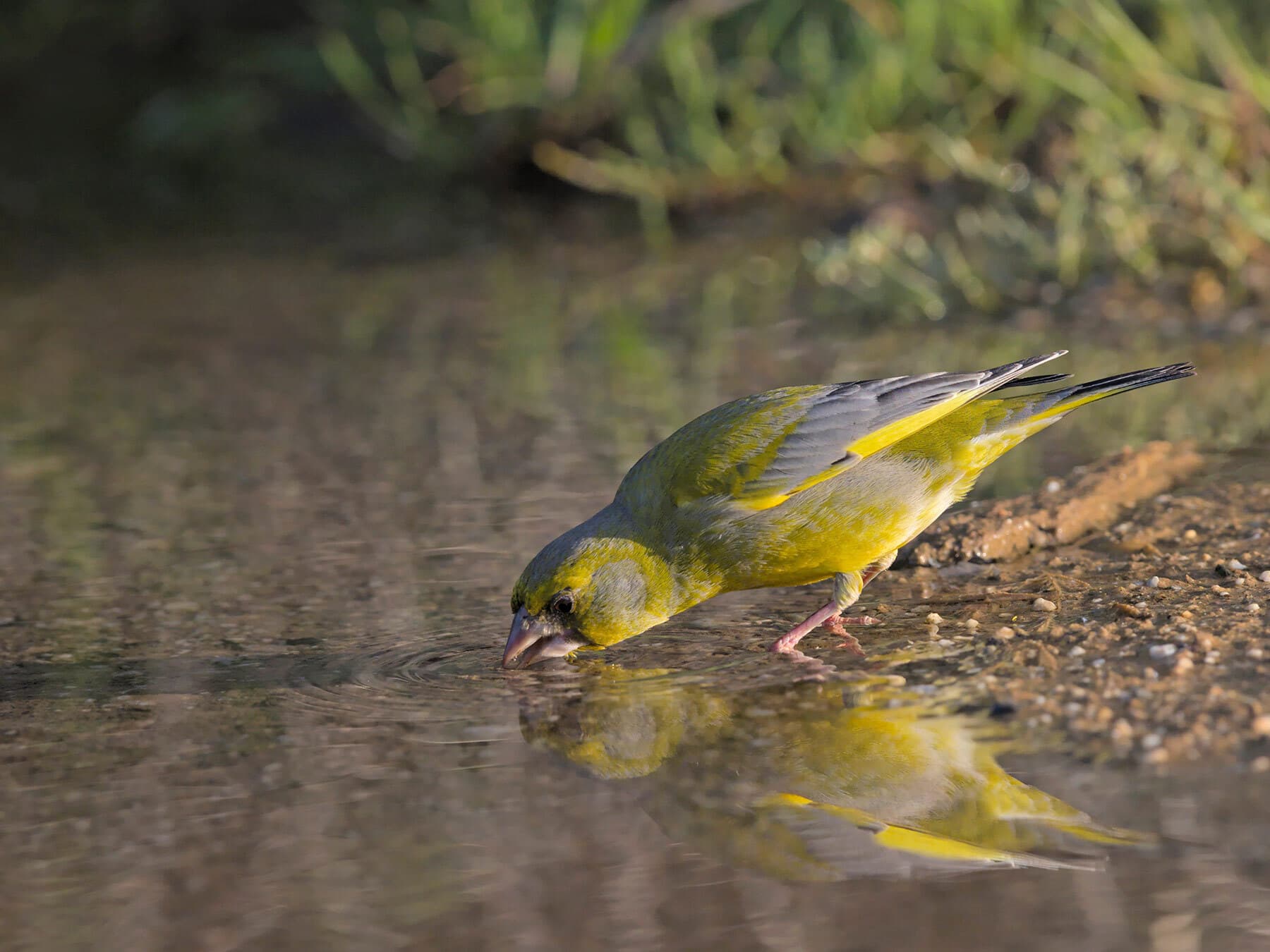 A male Greenfinch drinking at the edge of a puddle
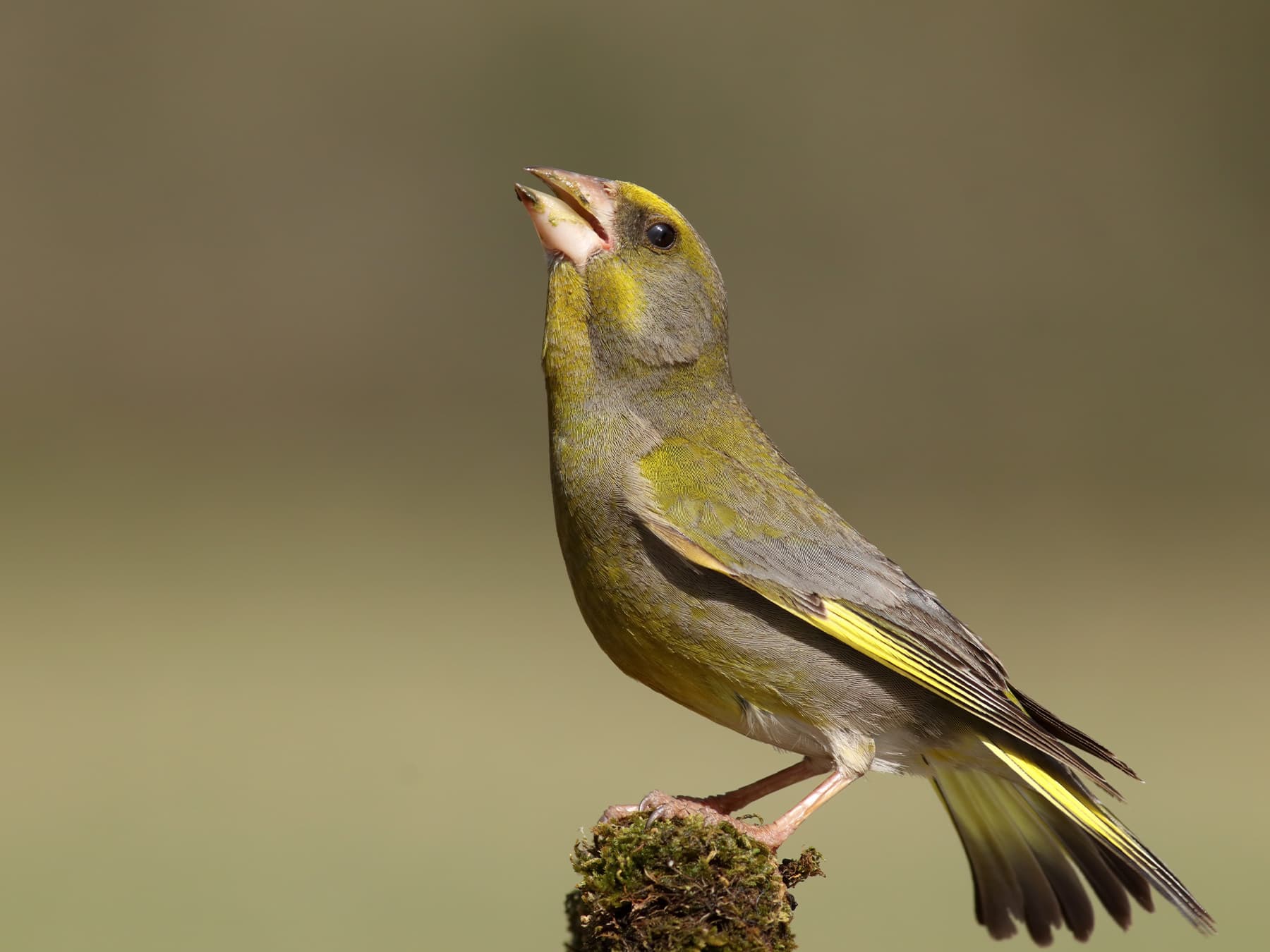 A male Greenfinch on a mossy post, bill open
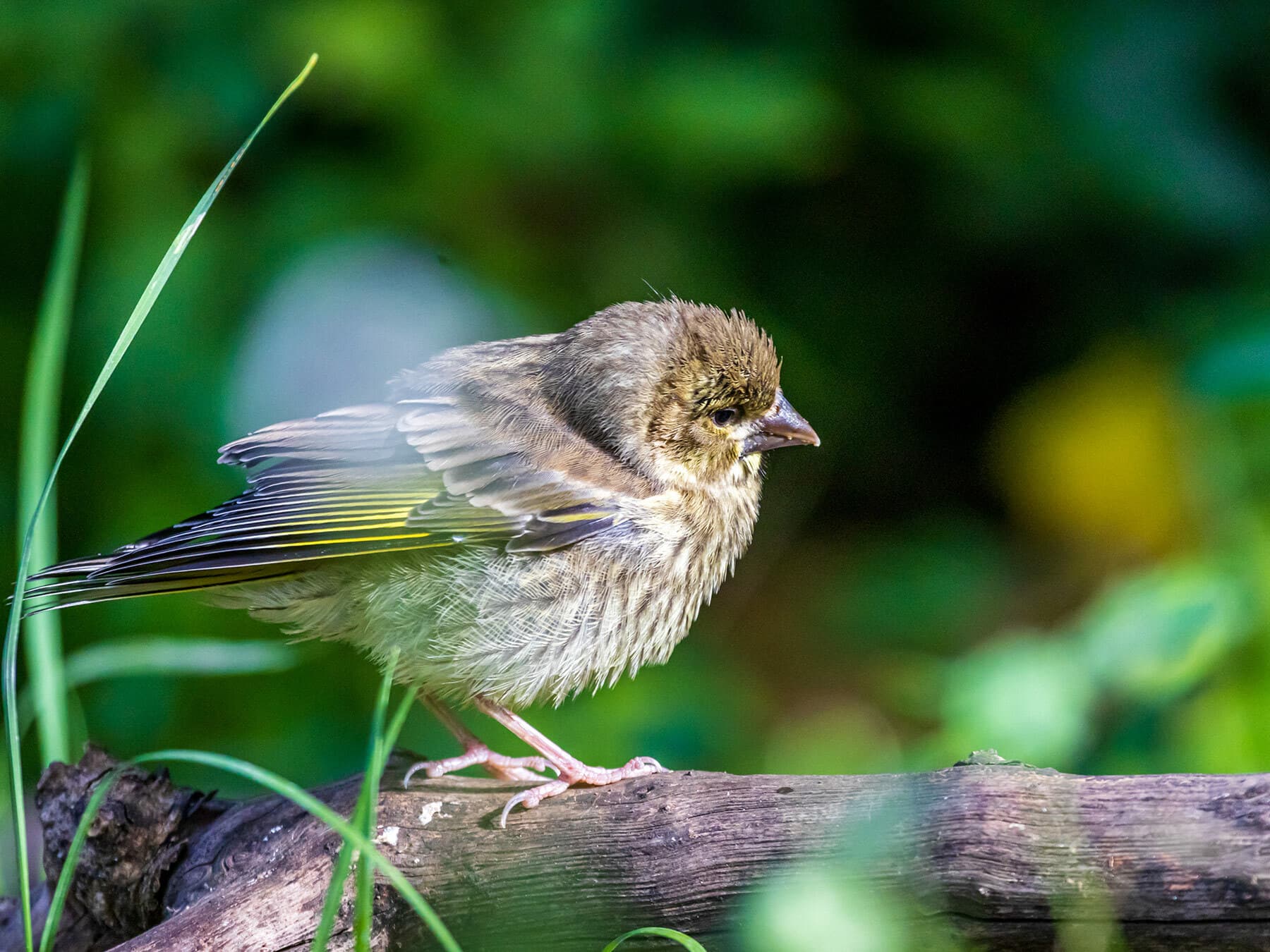 A young Greenfinch: buffish-brown and streaked
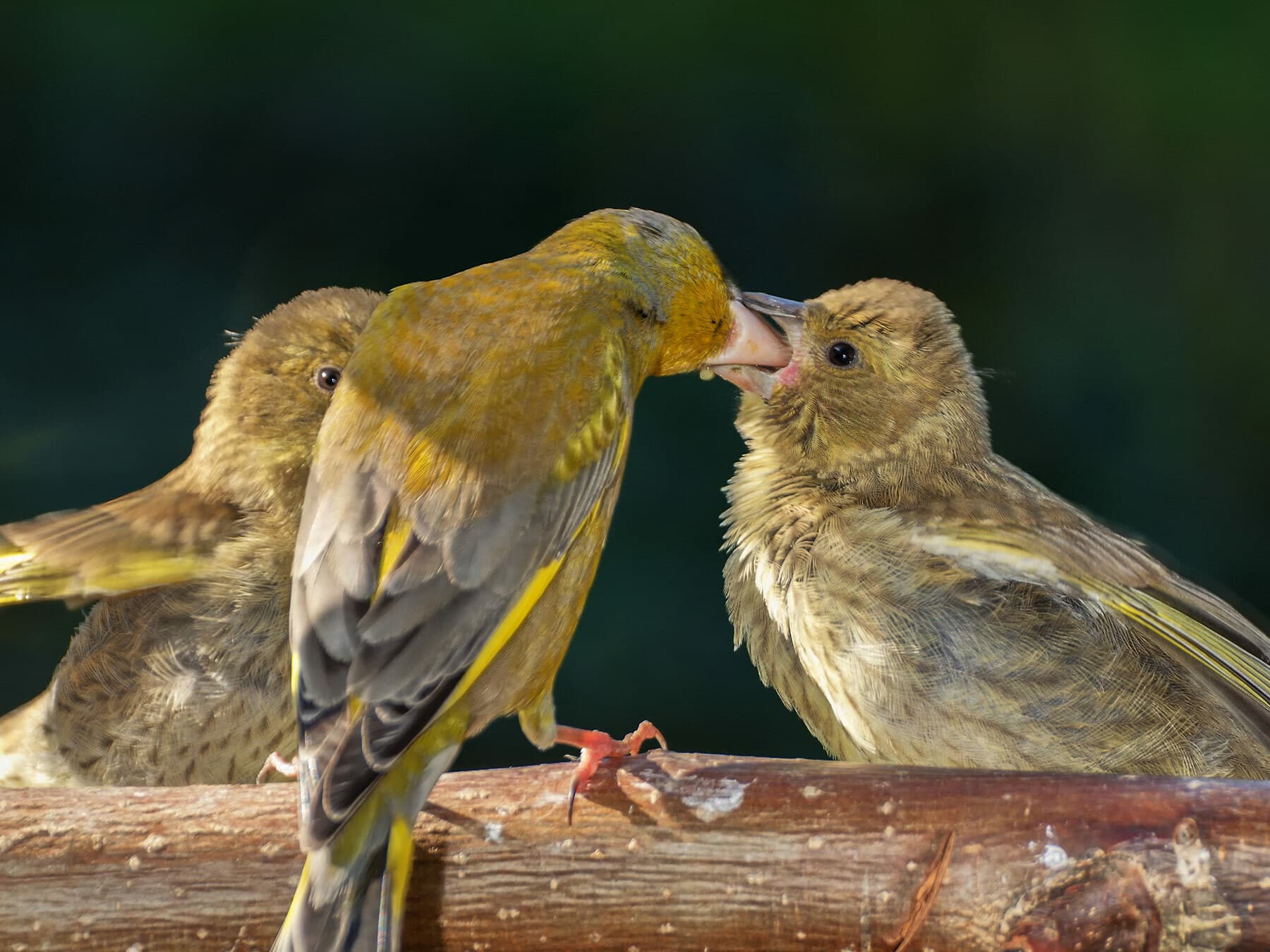 A male Greenfinch feeding a young bird
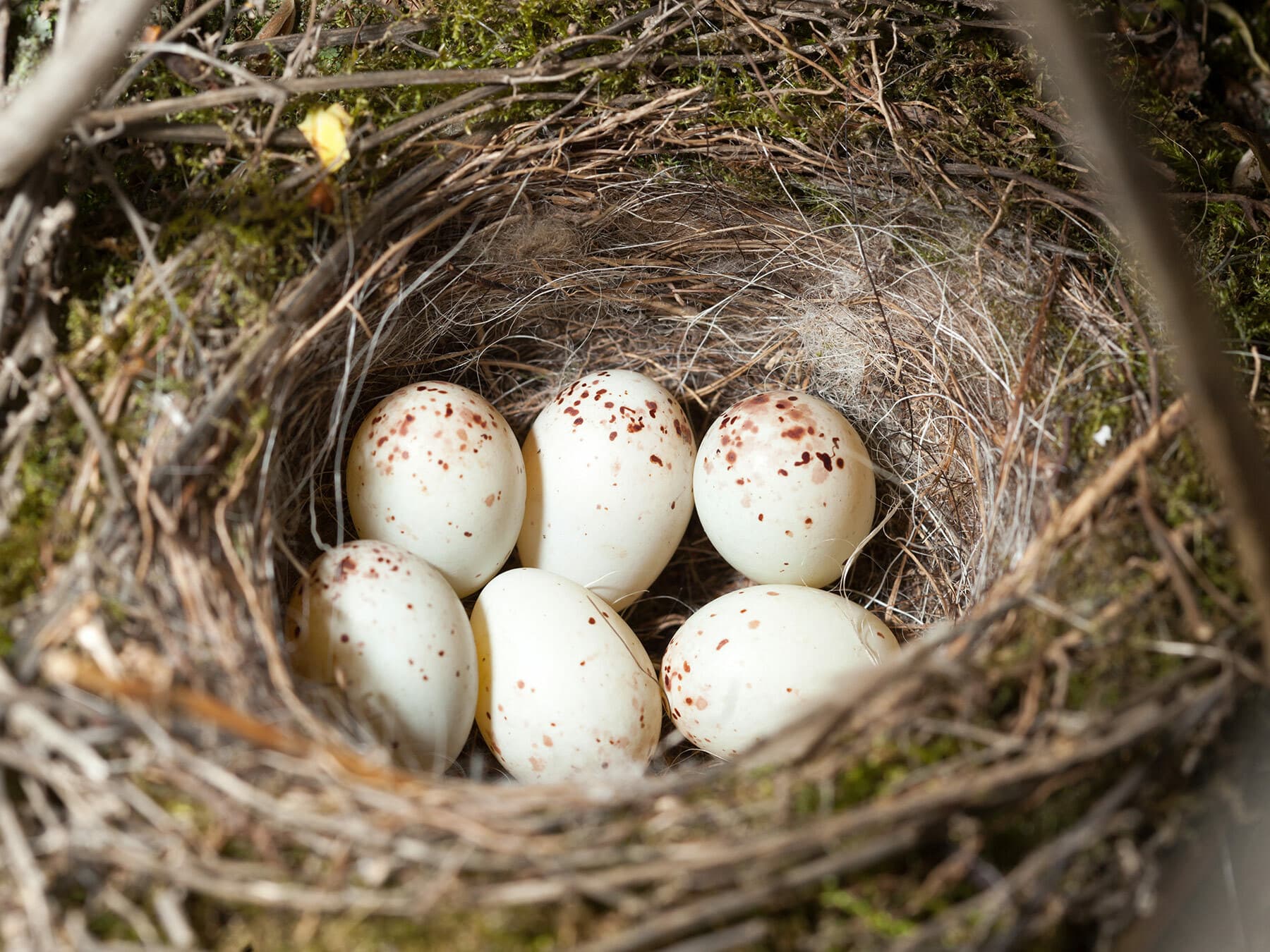 A Greenfinch nest with six pale, speckled eggs
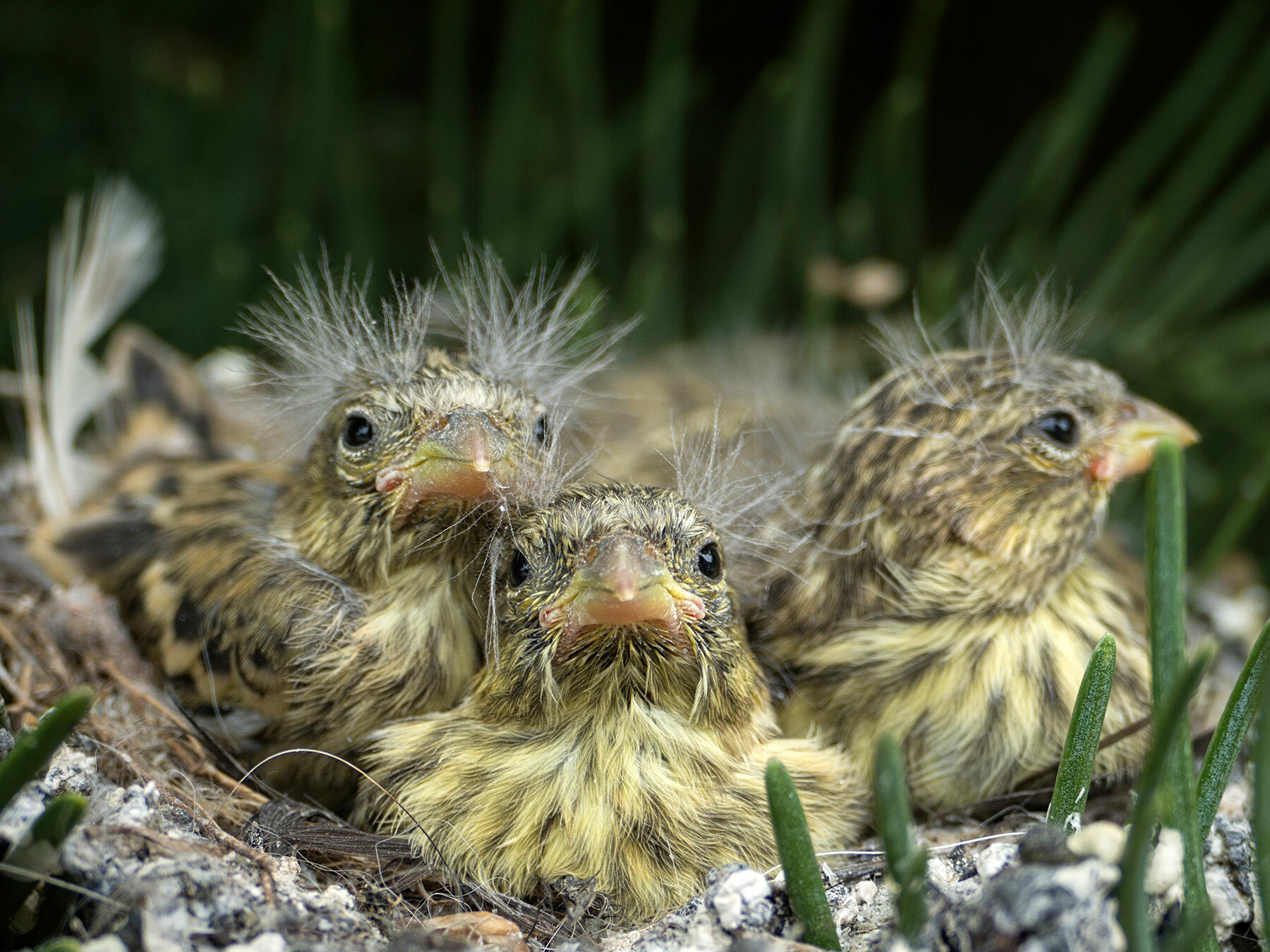
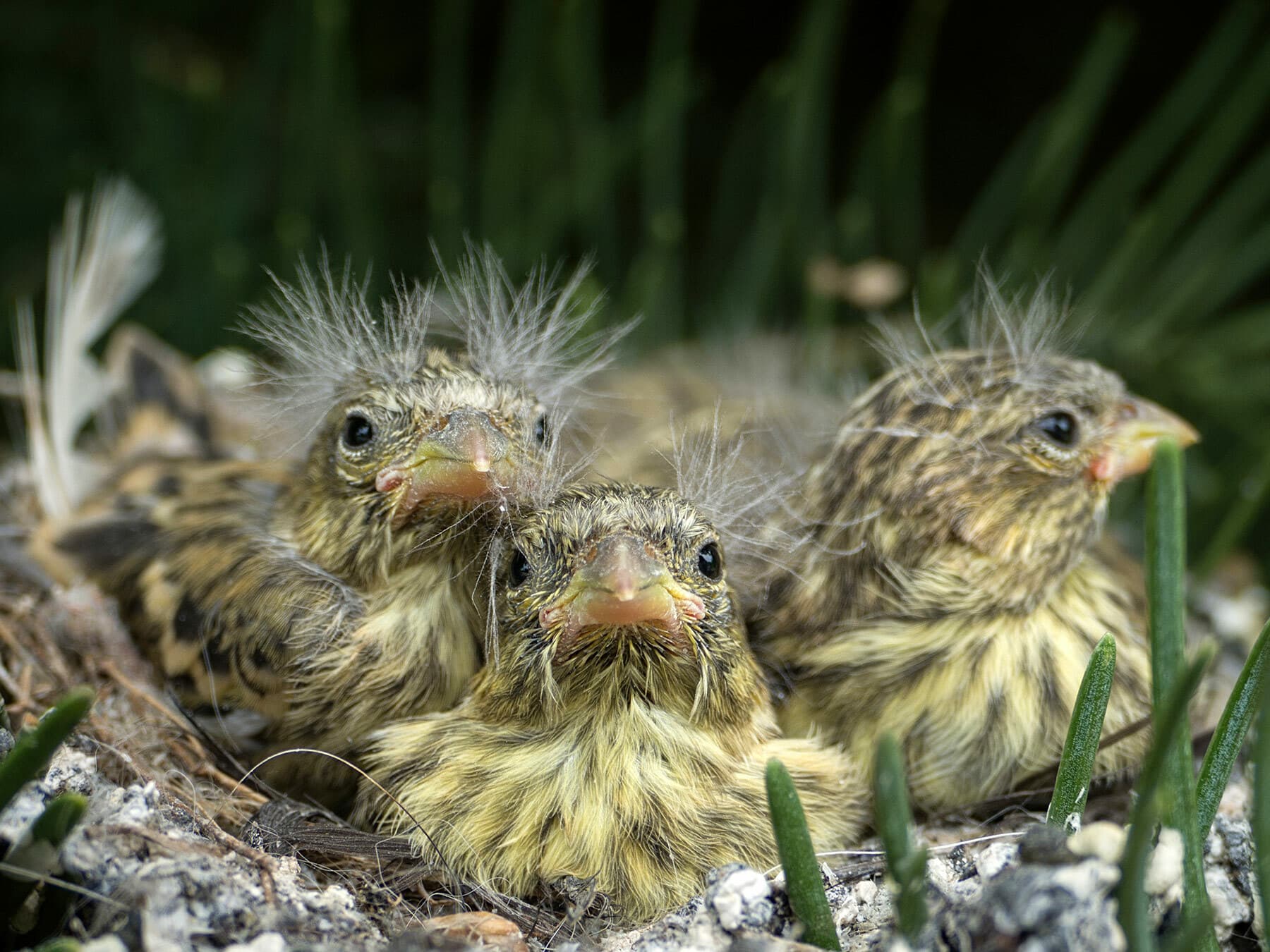 Greenfinch chicks, fluffy and streaked
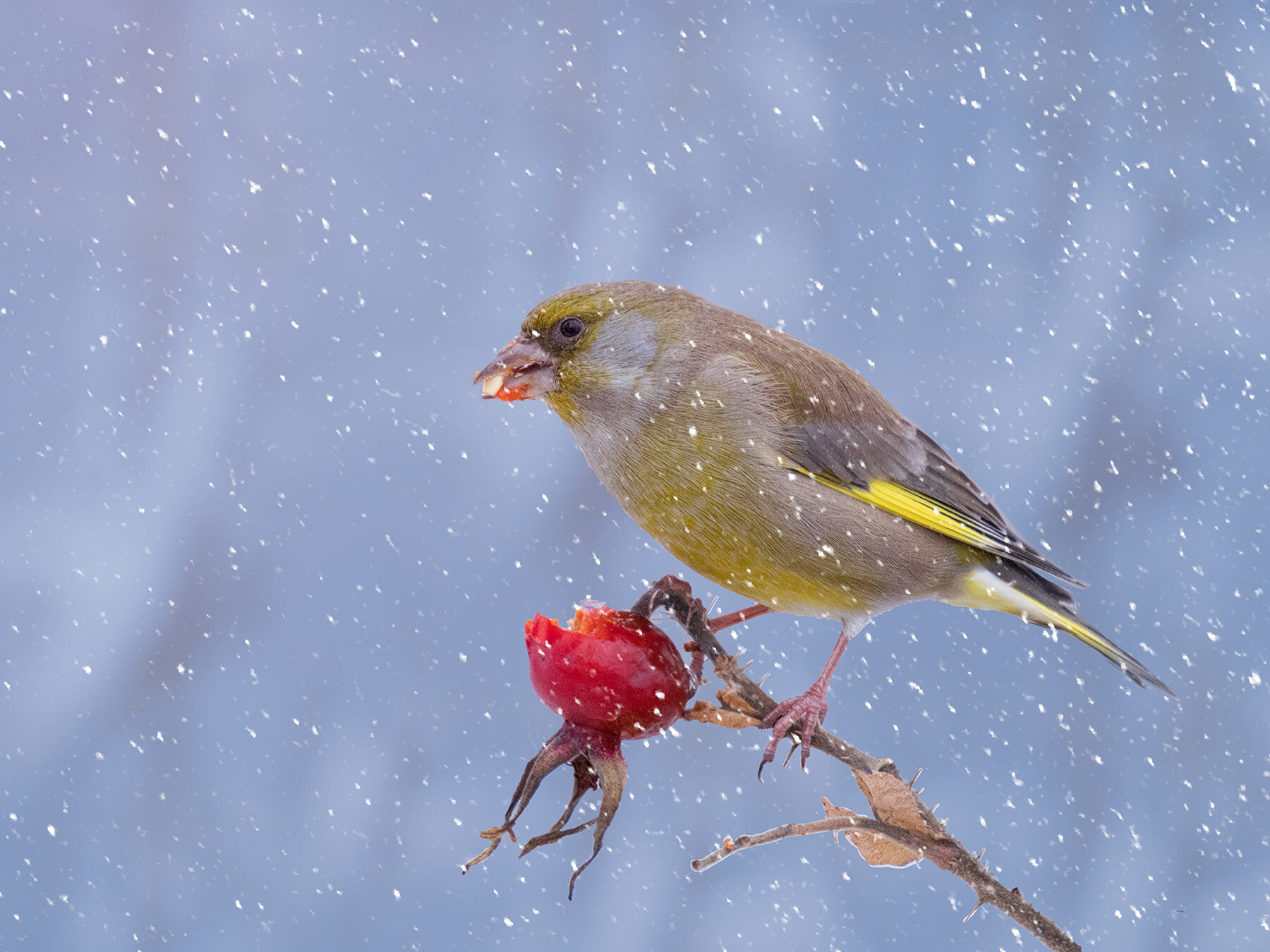
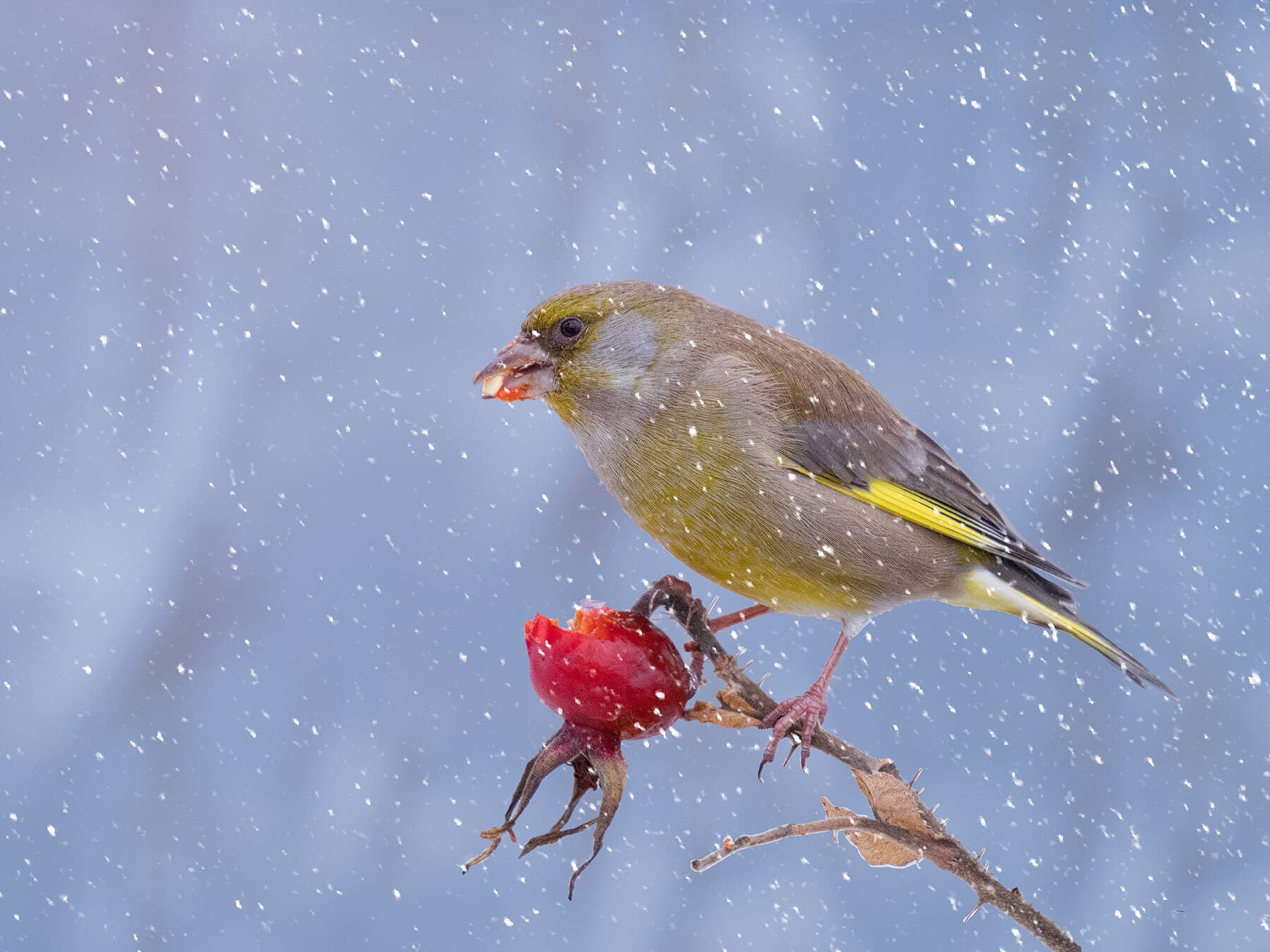 A male Greenfinch eating a rosehip in falling snow
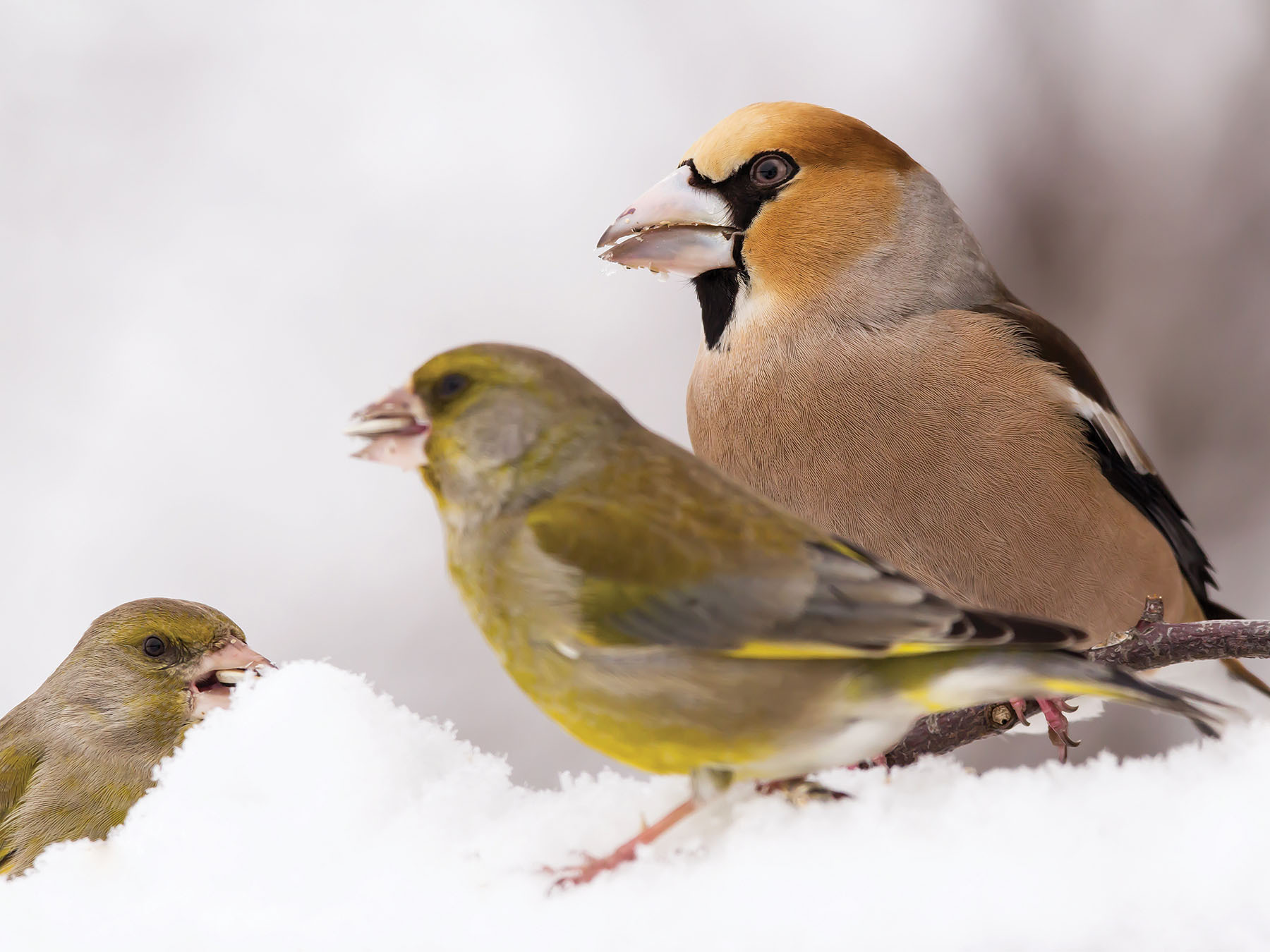
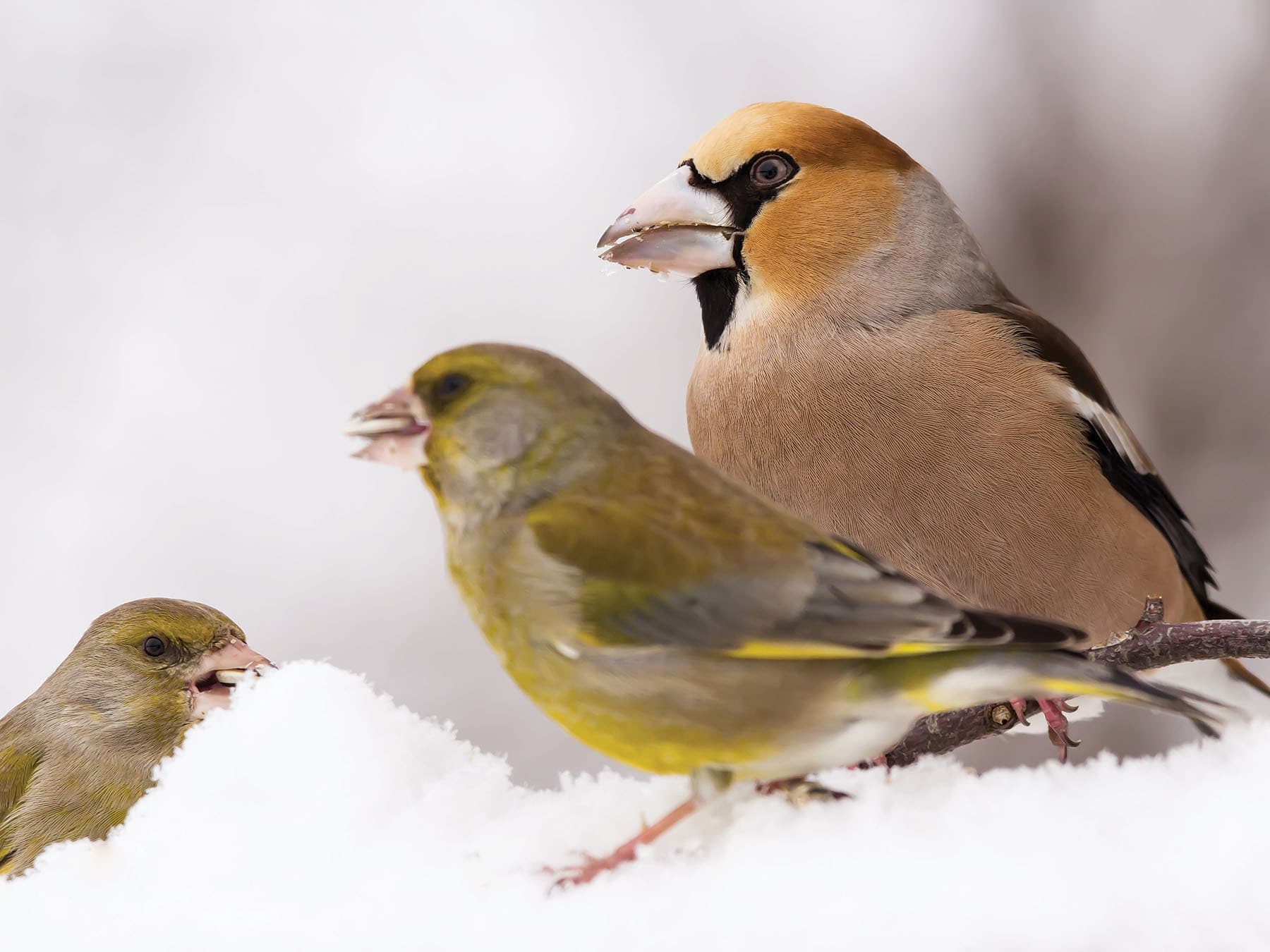 A Hawfinch with two Greenfinches in the snow
Greenfinch guides
6 guides- Greenfinch Song and Calls: What Greenfinches Sound Like
- Greenfinch Disease and Decline: Why Greenfinches Are Dying
- Female Greenfinch: How to Identify Her, Male vs Female and Young
- What Do Greenfinches Eat? Diet and Feeding Greenfinches Safely
- Greenfinch Nesting: Nests, Eggs and Baby Greenfinches
- Siskin or Greenfinch? How to Tell Them Apart
Quick facts
- Length
- 14.5–16 cm
- Wingspan
- 26 cm
- Weight
- 24.7–30.9 g
- Lifespan
- 2 years · oldest recorded 12.4 years · UK record 11 years 3 months
- Family
- Finches
- Migration
- Partial migrant
- Global status (IUCN)
- Least Concern
- Population trend
- Declining in the UK (66% since 1967, mostly since 2005, because of the disease trichomonosis); Red-listed in 2021
- Also called
- European Greenfinch
- Scientific name
- Chloris chloris
Questions
6How big is a Greenfinch?
About 15 cm long, with a wingspan of 26 cm, and around 28 g. See how to recognise it.
Are Greenfinches rare?
Not rare: there were about 785,000 pairs in the UK in 2016, and they breed almost everywhere. But numbers have fallen by two-thirds and the Greenfinch is on the UK Red List. See conservation status.
Why are Greenfinches dying?
Mostly because of trichomonosis, a parasite that damages the throat and spreads where birds share food and water. See Greenfinch disease and decline.
What does a female Greenfinch look like?
Grey-brown rather than green, with less yellow in the wing and tail than the male. See female Greenfinches.
What does a juvenile Greenfinch look like?
Buffish-brown and streaked, with thin yellow wing edges and a pale bill. See young Greenfinches.
Do Greenfinches use nest boxes?
Greenfinches build open cup nests in dense bushes, hedges and conifers, and they are not among the birds the BTO lists for nest boxes. See Greenfinch nesting.
Sources
25- 1Clement, P. and de Juana, E. (2020). European Greenfinch (Chloris chloris), version 1.0. Birds of the World (J. del Hoyo, A. Elliott, J. Sargatal, D. A. Christie and E. de Juana, editors). Cornell Lab of Ornithology. doi:10.2173/bow.eurgre1.01 (opens in a new tab)
- 2RSPB. Greenfinch. RSPB Birds A-Z. Accessed 7 October 2026. Source (opens in a new tab)
- 3BTO. Greenfinch (Chloris chloris). BTO BirdFacts. Accessed 7 October 2026. Source (opens in a new tab)
- 4RSPB. Goldfinch. RSPB Birds A-Z. Accessed 7 October 2026. Source (opens in a new tab)
- 5BTO. Summary of all recoveries for Greenfinch (Chloris chloris). BTO Online Ringing and Nest Recording Report. Accessed 7 October 2026. Source (opens in a new tab)
- 6Newton, I. (1967). The adaptive radiation and feeding ecology of some British finches. Ibis 109: 33-96. doi:10.1111/j.1474-919x.1967.tb00005.x (opens in a new tab)
- 7Gil-Delgado, J. A., Guijarro, D. and Vives-Ferrándiz, C. (2009). The nestling diet of greenfinch Carduelis chloris in orange groves of eastern Spain. Ardeola 56: 205-214. Accessed 7 October 2026.
- 8RSPB (2026). Our latest guidance on feeding garden birds. RSPB news. Accessed 7 October 2026. Source (opens in a new tab)
- 9BTO. Longevity records for Britain & Ireland in 2024. BTO Online Ringing and Nest Recording Report. Accessed 7 October 2026. Source (opens in a new tab)
- 10Fransson, T., Kolehmainen, T., Moss, D. and Robinson, R. (2023). EURING list of longevity records for European birds (1 September 2023). EURING. Accessed 7 October 2026. Source (opens in a new tab)
- 11Robinson, R. A., Lawson, B., Toms, M. P., Peck, K. M., Kirkwood, J. K., Chantrey, J. et al. (2010). Emerging infectious disease leads to rapid population declines of common British birds. PLoS ONE 5: e12215. doi:10.1371/journal.pone.0012215 (opens in a new tab)
- 12Lawson, B., Robinson, R. A., Colvile, K. M., Peck, K. M., Chantrey, J., Pennycott, T. W. et al. (2012). The emergence and spread of finch trichomonosis in the British Isles. Philosophical Transactions of the Royal Society B 367: 2852-2863. doi:10.1098/rstb.2012.0130 (opens in a new tab)
- 13Garden Wildlife Health. Trichomonosis in garden birds. Garden Wildlife Health (ZSL, BTO, Froglife, RSPB). Accessed 7 October 2026. Source (opens in a new tab)
- 14Heywood, J. J. N., Massimino, D., Baker, L., Balmer, D. E. et al. (2026). The Breeding Bird Survey 2025. BTO Research Report 802. British Trust for Ornithology, Thetford. Accessed 7 October 2026. Source (opens in a new tab)
- 15RSPB. How and what to feed your garden birds. RSPB. Accessed 7 October 2026. Source (opens in a new tab)
- 16Hanmer, H. J., Cunningham, A. A., John, S. K., Magregor, S. K., Robinson, R. A., Seilern-Moy, K. et al. (2022). Habitat-use influences severe disease-mediated population declines in two of the most common garden bird species in Great Britain. Scientific Reports 12: 15055. doi:10.1038/s41598-022-18880-8 (opens in a new tab)
- 17Stanbury, A. J. et al. (2021). The status of our bird populations: the fifth Birds of Conservation Concern in the United Kingdom, Channel Islands and Isle of Man and second IUCN Red List assessment of extinction risk for Great Britain. British Birds 114: 723-747. Accessed 7 October 2026.
- 18RSPB. Siskin. RSPB Birds A-Z. Accessed 7 October 2026. Source (opens in a new tab)
- 19Hernández, Á. (2022). Diet and grit characteristics in young Eurasian Bullfinches (Pyrrhula pyrrhula) inhabiting Iberian hedgerows. Ornis Fennica 99. doi:10.51812/of.124715 (opens in a new tab)
- 20RSPB. Yellowhammer. RSPB Birds A-Z. Accessed 7 October 2026. Source (opens in a new tab)
- 21Lowther, P. E. and Cink, C. L. (2020). House Sparrow (Passer domesticus), version 1.0. Birds of the World (S. M. Billerman, editor). Cornell Lab of Ornithology. doi:10.2173/bow.houspa.01 (opens in a new tab)
- 22BTO. Trichomonosis. BTO, Helping birds: disease. Accessed 7 October 2026. Source (opens in a new tab)
- 23BirdLife International (2018). Chloris chloris. The IUCN Red List of Threatened Species 2018: e.T22720330A132000123. doi:10.2305/IUCN.UK.2018-2.RLTS.T22720330A132000123.en (opens in a new tab)
- 24Clement, P. (2020). Eurasian Siskin (Spinus spinus), version 1.0. Birds of the World (J. del Hoyo et al., editors). Cornell Lab of Ornithology. doi:10.2173/bow.eursis.01 (opens in a new tab)
- 25RSPB. Serin. RSPB Birds A-Z. Accessed 9 October 2026. Source (opens in a new tab)

Checked by
Nathan Cope, founder and editor
Nathan founded Birdfact and leads its writers and contributors in the UK, the US and Canada. He has watched and studied birds for more than ten years, and checks every article and species guide before it’s published.