


American White Pelican
Pelecanus erythrorhynchos
By the Birdfact teamChecked by Nathan Cope
On this page15 sections
How to recognise it
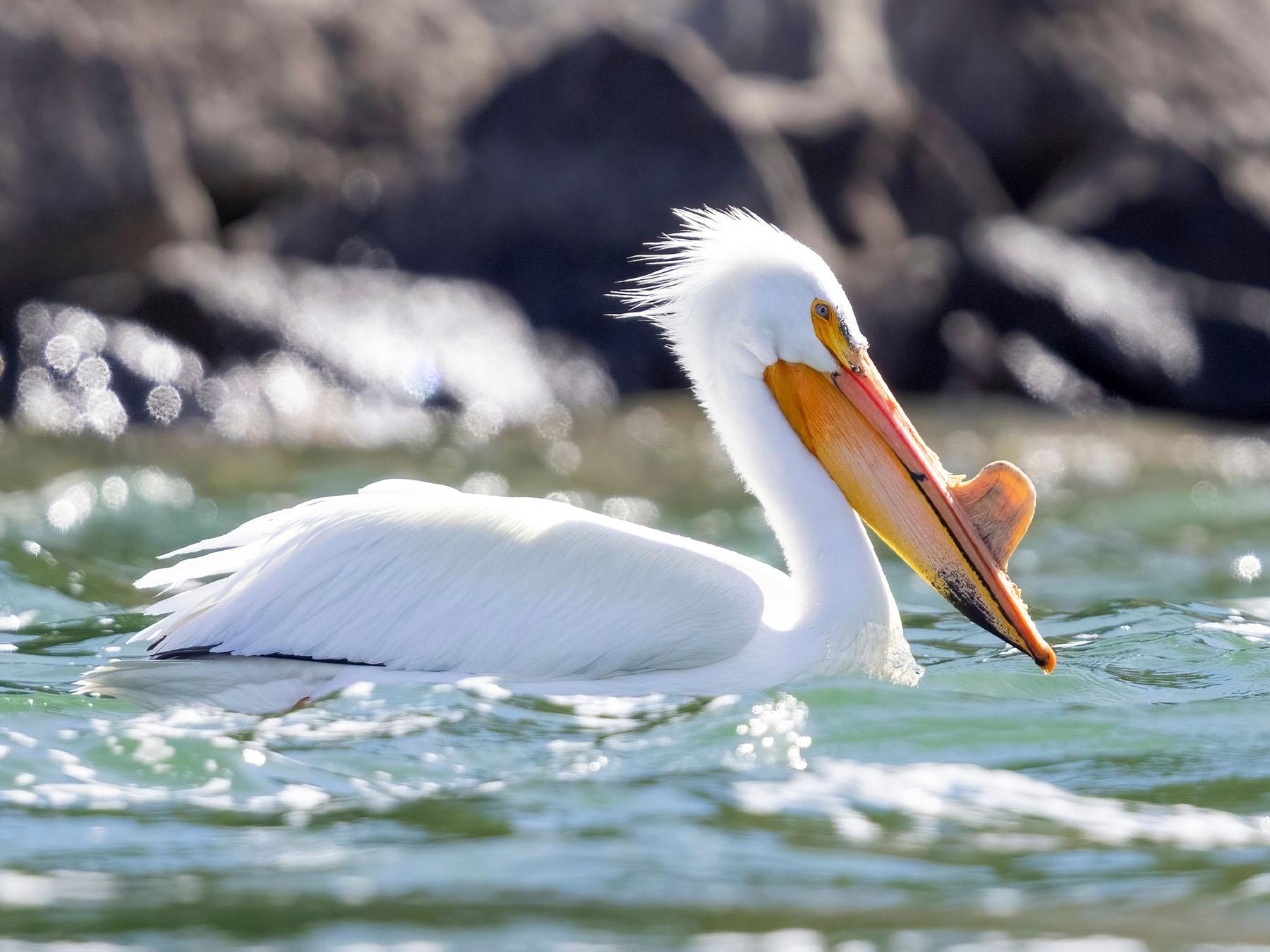
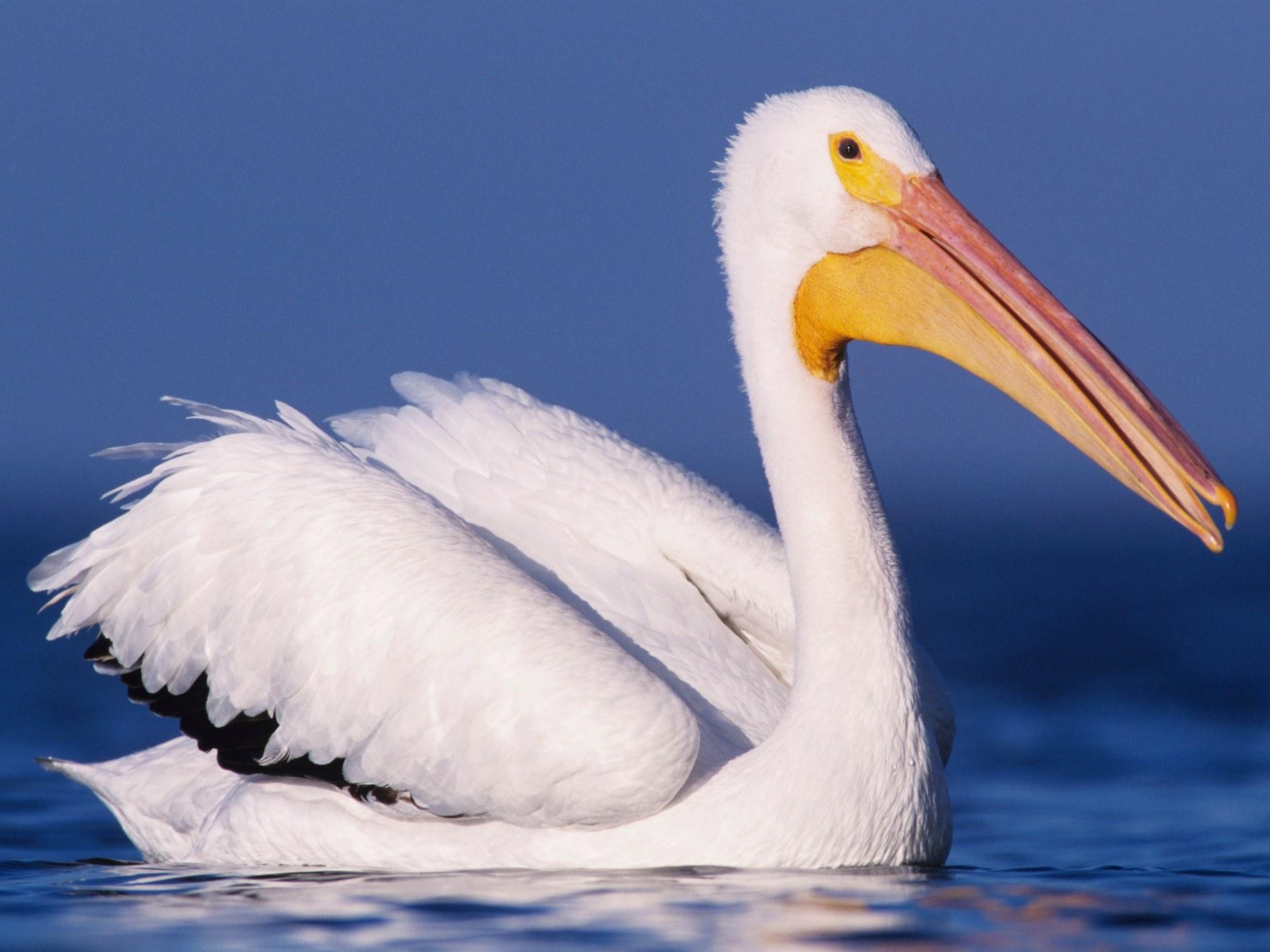
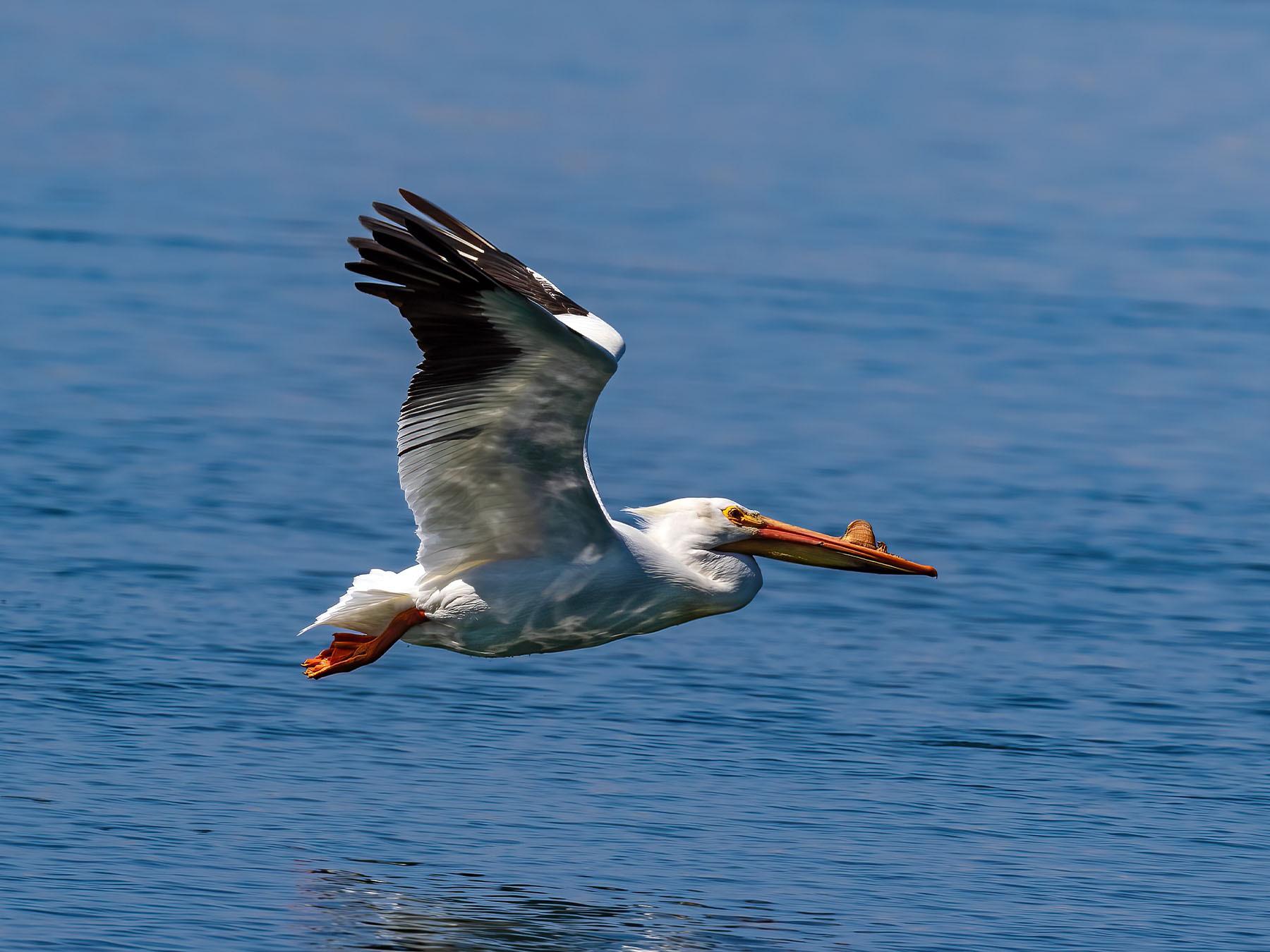
On the water an adult can look all white, with an enormous yellow-orange bill above a stretchy throat pouch. Once it opens its wings, the black flight feathers show: the black primaries and outer secondaries run along the rear edge of the outer wing and across the wingtip.
Seen closer, the black also covers the primary coverts and the alula, and from below a black bar runs along the leading edge of the wing. The tail and tertials are white. The legs are strong, with all four toes joined by webs. It has extensive air sacs under the skin of its breast, neck, head and wings, and it sits high on the water.
The bill plate and plumage through the year
Early in each breeding season, males and females alike grow a flat, upright plate on the upper bill, about a third of the way back from the tip. It is often called a horn, though it is really a plate grown from the outer skin. Its base is 1.6-3.1 in (40-80 mm) long, and it can stand more than 2.4 in (60 mm) tall. It regrows each year from December to March. Sources differ on when it is lost: Birds of the World's bare-parts account gives July and August, while its plumage account and a Utah study tie the loss to the head molt during incubation.1, 2
At one Utah colony in 1973, every bird had a plate in early April, most shed it in the fourth week of incubation, and by hatching 81-100% of the birds in each part of the colony had lost it.2 What the plate is for is not clearly known. It is probably used in courtship or aggression while pairs form and claim nest sites.1 At the same Utah colony, of 100 aggressive jabs, 95 were aimed at the bill tip near the plate, and the study suggested it works as a target that keeps jabs off the soft pouch. It added that the plate may not be needed once disputes are settled.2
Breeding adults also grow long white plumes on the back of the crown and on the breast, which preen oil can stain yellowish. Before nesting the bill and pouch often turn much brighter, even vivid, in April and May, the legs and feet redden from March to May, and the eyelids can turn scarlet beside the bare yellow to orange-yellow skin around the eye.
During incubation a molt of the head and neck replaces the white crest with short dark feathers, and at the Utah colony the plate was shed at about the same time. From July to October the bill and face turn duller and pinker and the legs a duller yellow, and some adults show brown mottling on the head and neck from June to September.
Size and weight
It ranks among the largest birds in North America.3 Adults are 50-65 in (127-165 cm) long, with a wingspan of 8 ft to 9 ft 6 in (244-290 cm), and weigh about 9 lb 4 oz to 17 lb 10 oz (4.2-8 kg).1 It is considerably larger than a Bald Eagle, though smaller than a California Condor.4
Males are usually slightly larger than females, and many birds can be sexed by measurements, chiefly bill length. In a sample of 188 sexed birds, females averaged 11 lb 6 oz (5,154 g) and males 14 lb 5 oz (6,486 g), and in two samples a male's bill averaged about 2.4 in (6 cm) longer than a female's.1
Male, female and young
The sexes look alike in every plumage; the male is usually slightly larger, with a longer bill.
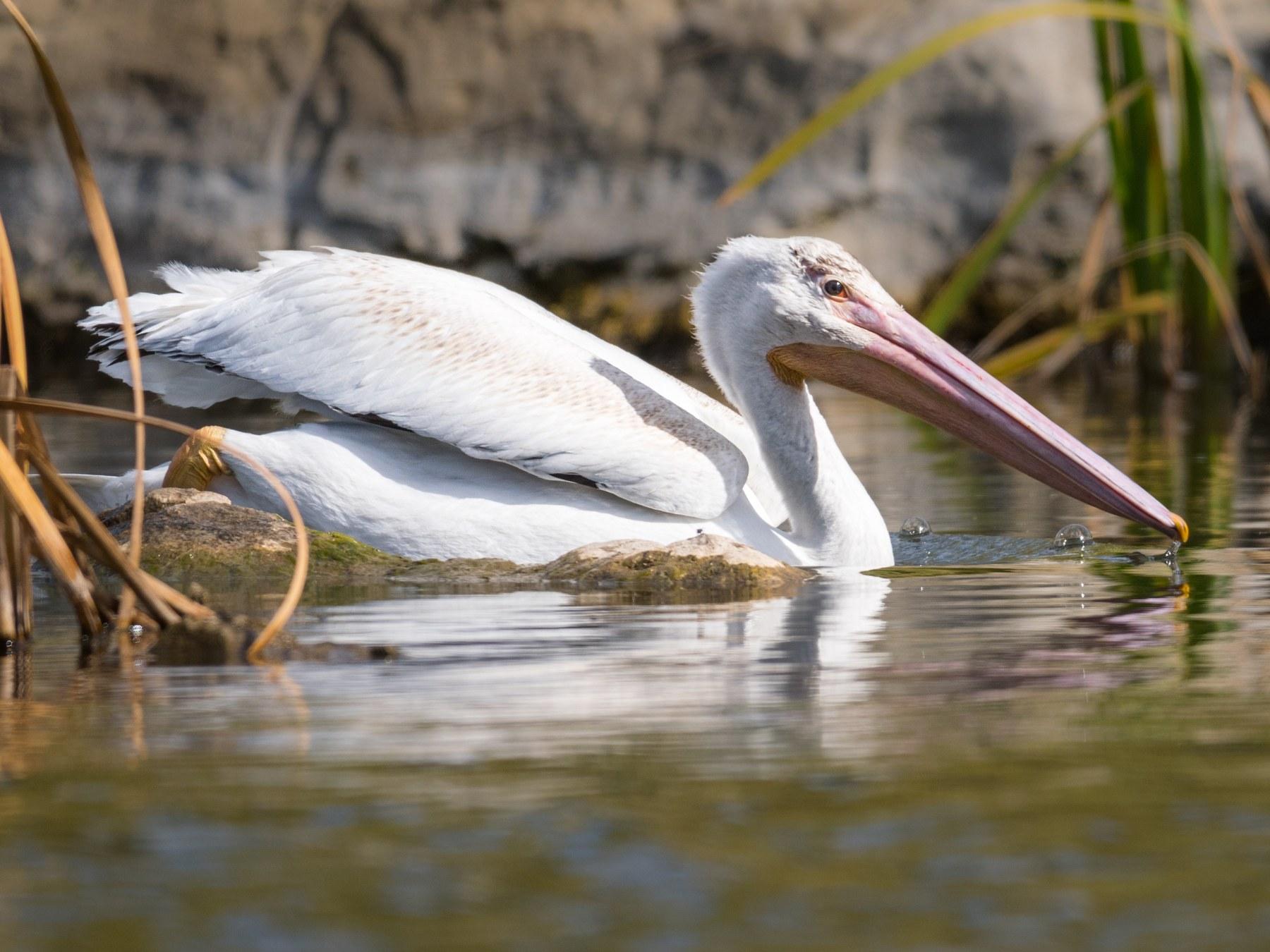
Juveniles, from about July to October, are whitish with a downy, grayish crown and neck that bleach whiter with time. They have no plate, a pinkish bill and pouch, and their legs can be duller than an adult's. On the upperwing the outer greater coverts have black centers and the lesser coverts brownish ones.
Through the first winter, from about October to June, more and more whiter feathers mix into the head and neck, a process well along by 5-8 months of age. There are still no long plumes and no plate, and by spring the worn outer primaries look brownish.
In the second year most birds keep a few narrow, worn, brownish juvenile flight feathers, have short plumes and at most a flat growth on the bill in April to June. By the third year most or all look like adults. Second-year birds and some summer adults can also show dark-centered lesser coverts and are often mistaken for juveniles, but their crown and neck usually look browner.
Identification: telling it from similar birds
The only other pelican in North America is the Brown Pelican. It is smaller, with a darker body, and is normally seen only on the coast. It often dives headfirst from the air for fish, which an American White Pelican almost never does.
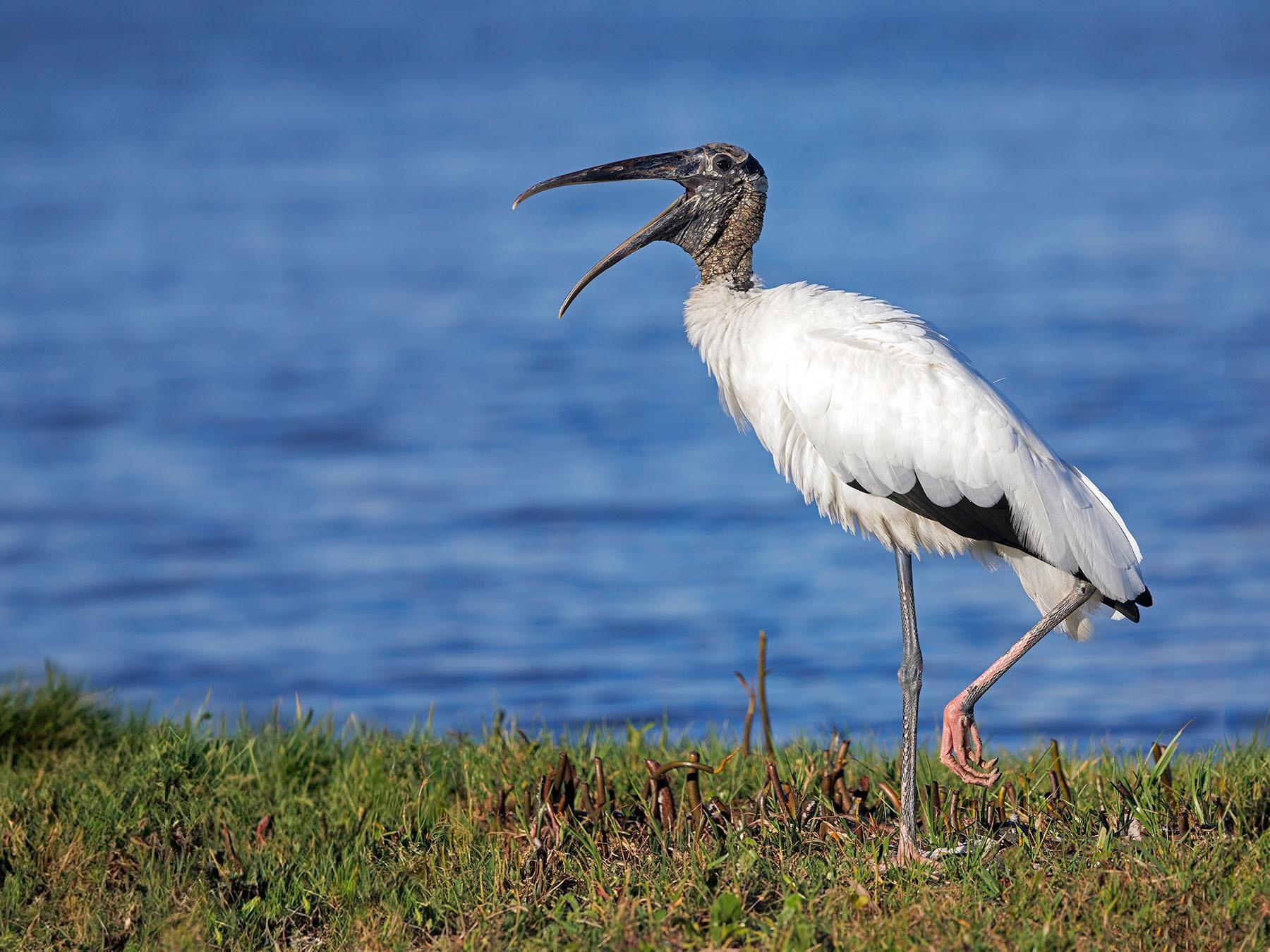
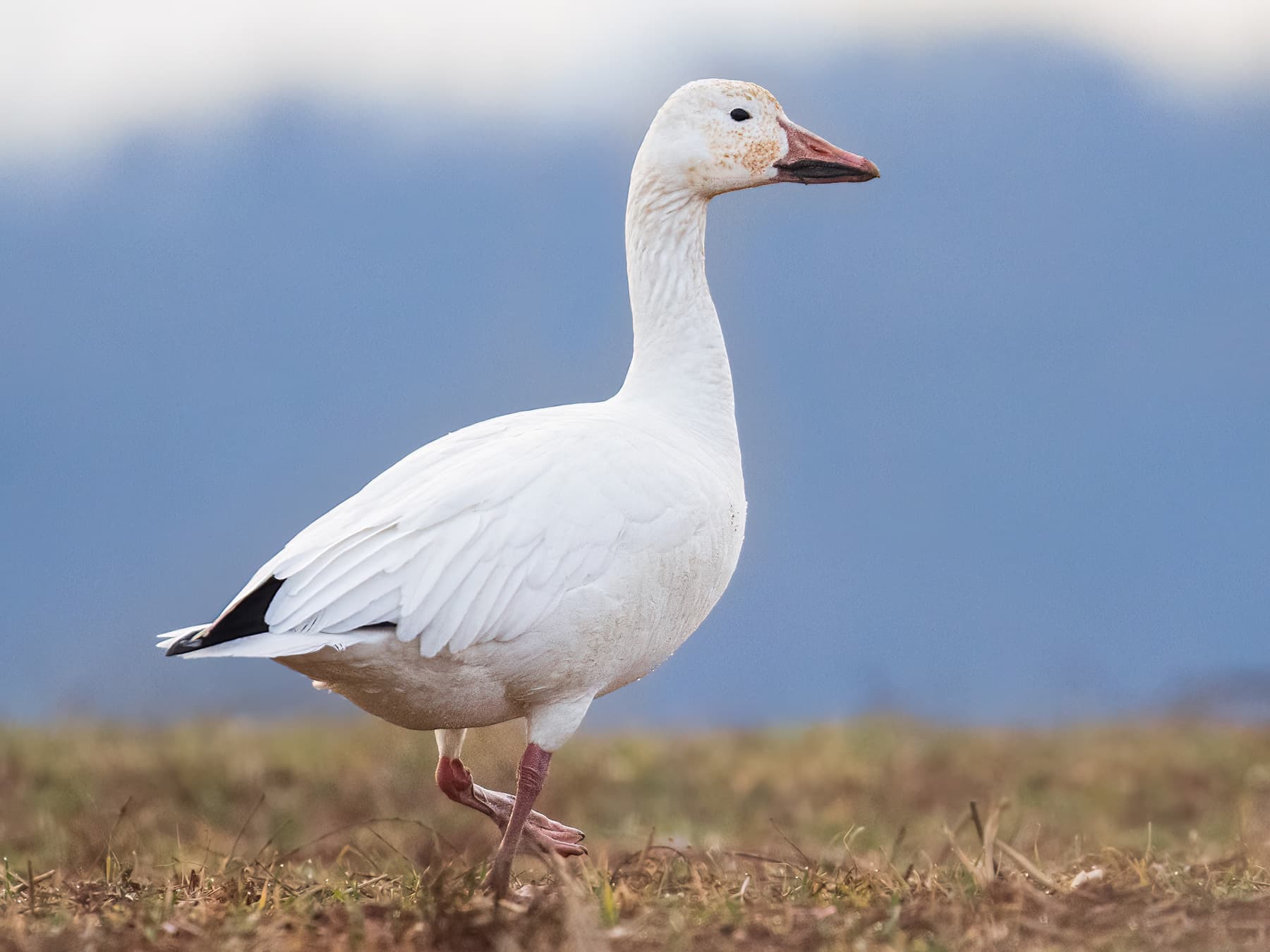
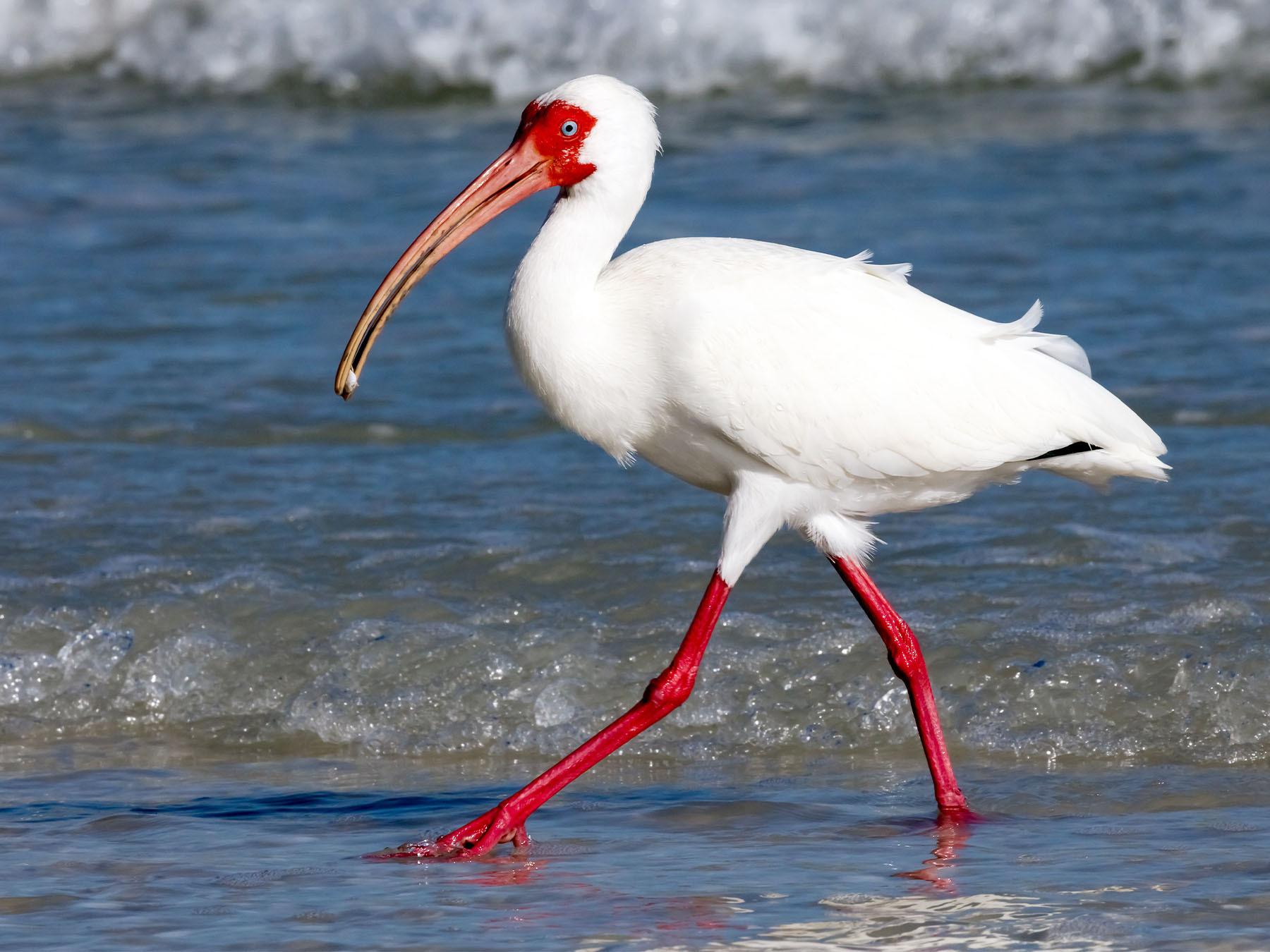
Overhead, several big white birds with black in the wings can look similar. A Wood Stork has a black tail as well as black flight feathers, a bare dark head and long legs that trail beyond the tail, and it flies with its neck stretched out. A Snow Goose is much smaller, with black only on the primaries and a small pink bill. A Whooping Crane also has black only on its primaries and usually trails its long legs in flight, and a White Ibis has black only at the tips of its primaries. An American White Pelican folds its neck back in flight, shows black along the outer secondaries as well as the primaries, shows no legs behind the tail and has a long yellow bill.

Not sure it’s a American White Pelican? Check your photo: Birdfact names the bird and shows the look-alike side by side.
Its size
Adults- Length
- 127–165 cm
- Wingspan
- 244–290 cm
- Weight
- 4200–8000 g
Its song and calls
Adults are usually silent and have no song in the songbird sense. At the colony they give frequent low, brief grunts during aggressive and sexual encounters.
The young are far noisier. Chicks squawk loudly from inside the egg before they hatch, mainly when too hot or too cold, which prompts the parent to adjust, and older young begging in their hundreds raise a loud din. Other sounds are wingbeats on the water, when birds bathe or drive fish, and bills clashing in fights; there is no bill-clapping display.
The recording on this page was made under a soaring flock passing over Minnesota in April, and the only pelican sound on it is the noise of their wings. Surprisingly little is known about how much this pelican relies on its voice.1
- Wing noise, flock overhead0:00 / 0:39
Recorded in Minnesota, United States · April 2014
Heard one and not sure? Let the bird song identifier listen.
When and where to see it
The American White Pelican breeds in the interior of North America, mostly on remote islands in freshwater lakes, and spends the winter on open inland waters and warm southern coasts.
In Canada it breeds from Ontario and central Manitoba west to northeastern Saskatchewan, northern Alberta and south-central British Columbia. In the US it breeds from northern Ohio and eastern Wisconsin through Minnesota and the Dakotas to Wyoming, northern Montana, Idaho, northern Colorado and northern Utah, and on to Oregon, southern Washington, northern California and western Nevada. A few small colonies also nest on the central Texas coast.
In the early 1900s it bred north to Great Slave Lake. Since the 1990s it has spread north into central Canada and east into the Great Lakes, nesting in western Lake Erie in 2016-2018, and its first documented nesting in Ohio was published in 2024.1
Habitat
Colonies are commonly 31 miles (50 km) or more from where the birds feed. Besides lake islands, some are on temporary islands in shallow wetlands of the northern Great Plains and the Texas coast, and birds from the big-lake colonies often fly 62 miles (100 km) or more to rivers and marshes. Breeding colonies range from sea level to 7,732 ft (2,357 m) at Yellowstone Lake, Wyoming.
In winter it is found on the Pacific side from central California and southern Arizona to Baja California, western Mexico and Nicaragua, and in the east from Florida, the Gulf states and southern Texas down through Mexico's central plateau to the northern Yucatan Peninsula. It prefers shallow coastal bays, inlets and estuaries where small fish are plentiful, but also uses inland rivers and lakes that stay unfrozen, resting on sandbars, mudflats, levees and flooded fields.

Do they migrate?
Most do. Birds that breed east of the Rockies head mainly south and east to the Gulf of Mexico coast, while western birds go mainly south to California and western Mexico, rarely east to the Gulf. Some from colonies near the Rockies may cross the Continental Divide to winter on the other side. A few small colonies on the central Texas coast, and now and then in east-central Mexico, stay all year. Our guide to how pelicans migrate covers the other species.
Spring arrival is sudden: early March in Utah, late February to early March in Nevada, mostly mid-April to early May in Manitoba and late April to May at Yellowstone, often before the ice has gone. Spring dates east of the Divide appear to be getting earlier. Fall departure is drawn out and hard to date locally, because of the birds passing through.1
In a GPS study of 24 birds that bred on the northern Great Plains and wintered in Alabama, Louisiana and Mississippi, tracked in 2002-2012, migration averaged 24.6 mph (39.5 km/h) in spring and 20.6 mph (33.2 km/h) in fall. Birds flew 21 of 22 routes faster in spring, and they chose tailwinds.5
They migrate by day, in flocks that fly in formation except when circling in thermals, and males and females travel together. Some birds stay on the wintering grounds through the summer, especially in Florida, and strays have reached Alaska, eastern Canada and the northeastern US, mainly in the warmer months.
Spotting tips
In summer look on large lakes and marshes in the breeding range, where flocks fish along the shallows and below rapids. In winter look on shallow coastal bays along the Gulf coast and in California, and on open southern rivers and lakes. On sunny days, scan the sky from mid-morning to mid-afternoon for flocks circling high in thermals.
What it eats
The American White Pelican eats mostly fish: chiefly small fish that move in schools through shallow wetlands and rivers, of little value to people, along with slow bottom-dwelling fish, salamanders, tadpoles and crayfish. Our guide to what pelicans eat compares the other species.
What it eats varies by place. Chick meals held minnows, carp and chub in Nevada and Utah studies, tiger salamander made up 59.7% by volume in North Dakota, and in Manitoba stickleback (44.2%), perch (30.1%), crayfish (11.2%) and dragonfly larvae (7.8%) were the commonest items by frequency. On the Mississippi River catfish made up over 99% of prey biomass, and in Louisiana shad made up 32.8%.1
Estimates published in 1925 from Pyramid Lake, Nevada, put a breeding adult's intake at about 4 lb (1.8 kg) of food a day, 20-40% of its body mass, and the food needed to raise one chick to flying at about 150 lb (68 kg).1 Food for chicks is swallowed and carried in the stomach, not the pouch, though birds near catfish ponds sometimes fly off with fish in the pouch, especially when chased.
How they feed: fishing together
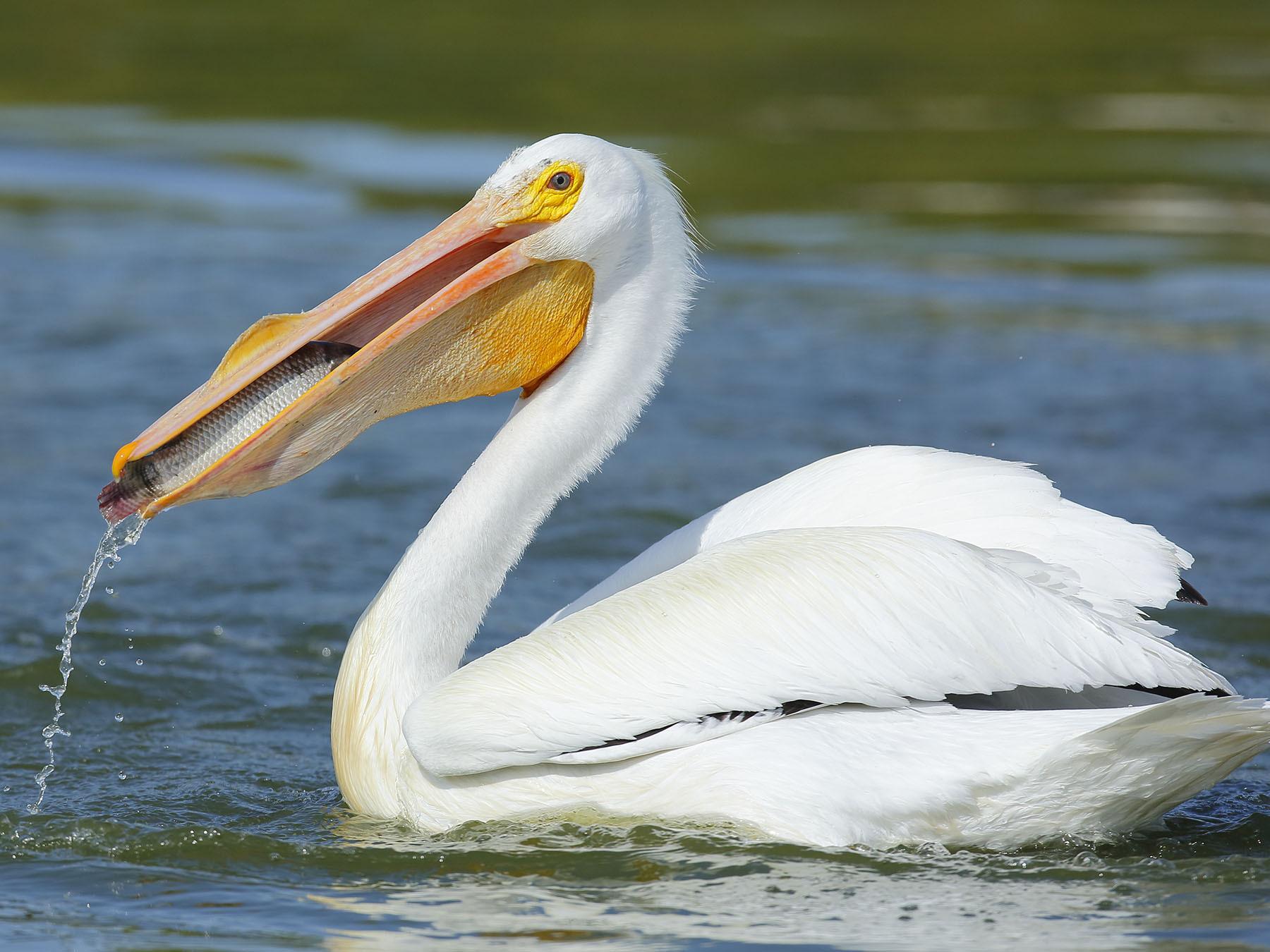
It fishes while swimming. It dips its bill to scoop fish into the pouch, then tips its head up to drain the water and swallow, and it can also tip up like a huge dabbling duck. Plunge-diving from the air is almost unknown: it has been seen only twice, both times at Pyramid Lake in reports from 1925.1
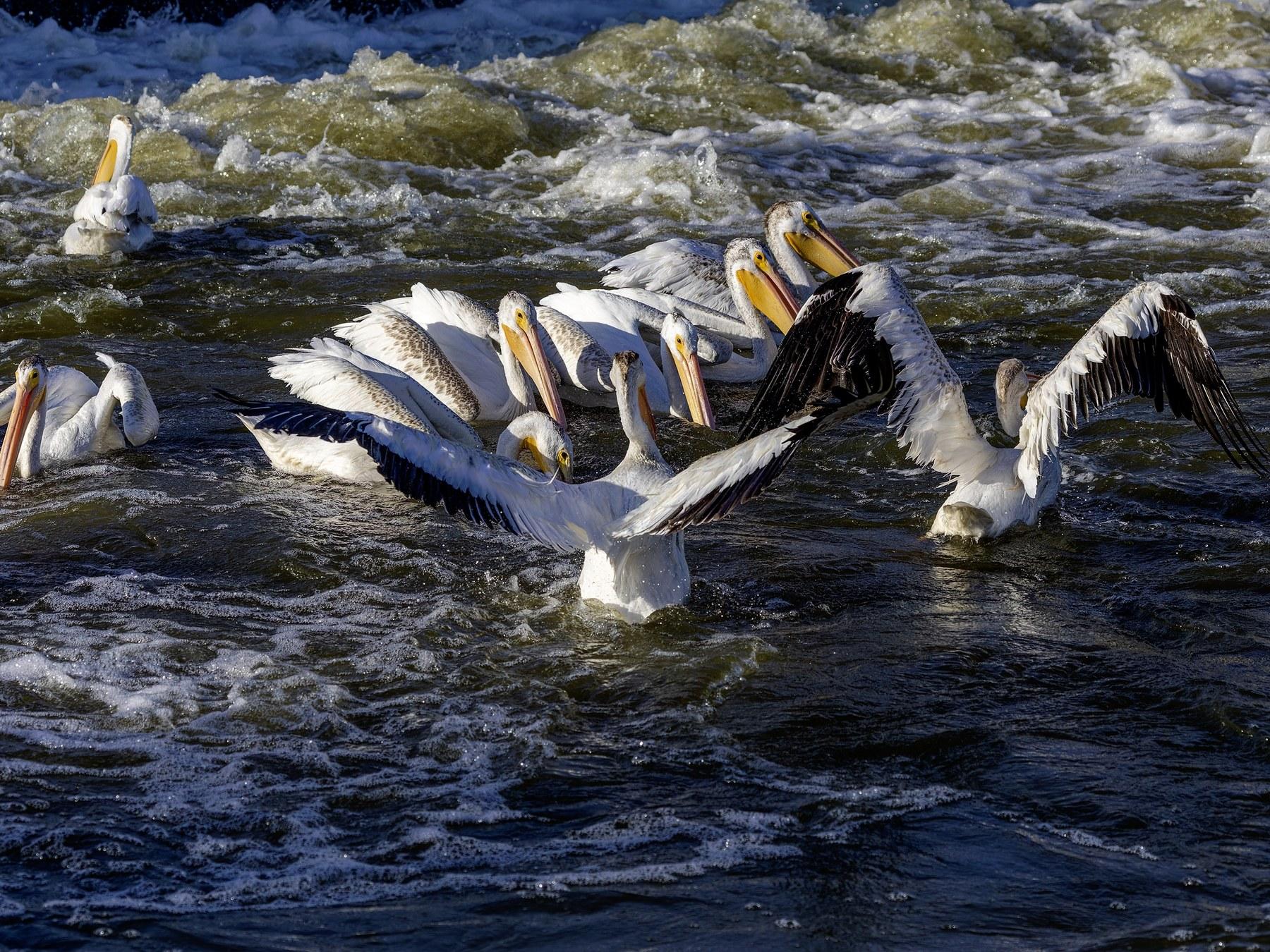
Group fishing ranges from loose gatherings to coordinated flocks that spread out and drive fish toward the shore by dipping their bills and beating their wings, or encircle them in open water. A drive lasts up to 10 minutes, and a flock may split in two and push the fish toward each other. The most coordinated flocks catch the most fish per bird.
In a 1984-1986 study of pelicans breeding at Pyramid Lake, Nevada, birds in groups of two to six caught significantly more fish each than lone birds or bigger groups, and decoy tests showed that pelicans are drawn to places where other pelicans are present.6 It feeds in shallow water in open marsh, along lake and river edges and below rapids, and in the same study it fished in water 1-8 ft (0.3-2.5 m) deep.1
In the breeding season it often fishes at night. On the Dauphin River in Manitoba, about 31 miles (50 km) from a colony, two to three times as many pelicans fished at night as by day, in bigger flocks. Catch rates were lower at night, but more of the prey were large fish, over three-quarters of the bill's length: 18% of prey at night against 2% by day.7, 1
It also steals fish in mixed feeding flocks, especially from Double-crested Cormorants, and from gulls and other pelicans. Studies put its success at a quarter to a half of attempts on other species and 37.5% on other pelicans.1
Feeding near fisheries and fish farms
Studies have generally found its competition with sport fisheries to be low, though losses can be notable where game fish crowd into shallows to spawn or other fish are scarce. Estimates include 3.5% of stream-spawning Yellowstone cutthroat trout in Wyoming, a projection, and under 2% of adult Bonneville cutthroat trout in Utah.1
Two single-site studies found heavy predation. At Pyramid Lake, where pelicans had the advantage of a shallow delta, dams and low river flows, a 13-year study found that pelicans had taken 90% of the tags put on adult Cui-ui, a sucker, during its first 7 years.8 In Silver Creek, Idaho, an estimated 34% of radio-tagged trout were taken in 2018-2019.9
It makes increasing use of catfish ponds in the Mississippi Delta, especially on spring migration, and wintering birds at fish ponds in Louisiana and Mississippi spent 4% of the day feeding, against 28% in natural areas. Birds of the World notes friction with fish farming in the southeastern US since the 2000s, and the pelican is the bird host of a trematode parasite implicated in mass deaths of farmed catfish there.1
Nesting and breeding
Nests are on the ground in colonies, usually on the higher central part of low islands, on flat or gently sloping gravel, sand or soil, and in forested regions under shrubs or trees. More on baby pelicans covers chicks of every species.
Pairing begins soon after the birds arrive: in the last week of March in Utah, April 15-26 in southern Manitoba and late April to early May in Wyoming, in studies published from 1964 to 1985. Courtship includes low, fast flights of small groups around the colony and, on the ground, a single-file strutting walk with bills pointed down, bowing and head swaying. Pairs are monogamous and stay together at least until their young leave the colony; how long after that is unknown.
Colonies can be very large. Counts of 42 North American colonies in 1998-2001 averaged about 1,600 nests, with a very wide spread, and the single-colony record is 17,733 nests, counted at the Chase Lake refuge in North Dakota in 2000.1
The nest and eggs
The nest is a shallow scrape with a low rim that the sitting bird rakes up with its bill, and it has no lining. Both sexes build it without leaving the site. It is usually about 2 ft (61 cm) across and 8 in (20 cm) high, neighboring nests sit about 3.5 ft (1.1 m) apart, center to center, and a nest is not reused.
The clutch is normally 2 eggs, laid about two days apart. They are chalky dull white and rough, and in Manitoba they averaged 3.4 by 2.25 in (87.1 by 57.1 mm) across 263 eggs. A lost egg is not replaced. Both parents incubate for about 30 days, holding the eggs under their webbed feet, since they have no brood patch. In Utah, nests were started over three months, from early April into June.1
Raising the young: two eggs, one chick
Chicks hatch naked and orange, with a grayish-white bill and pouch, and are soon covered in whitish down that grows thicker and grayer in the second week. In Manitoba the two eggs of a clutch hatched on average 2.5 days apart, across 45 nests, so the first chick has a head start.10
The older chick bites and pecks the younger: in one study, 69 of 125 younger chicks had bruises or cuts. Starvation of the bullied chick is the most likely cause of its death, usually within its first one to two weeks.1 In the Manitoba study the parents did not step in and fed the dominant chick selectively, and in marked broods the second-hatched chick was the survivor in 20% of successful nests.10
So pairs usually raise one chick. Nests where both young fledged made up 9.7% and 9.4% of two Utah samples, at most 3.15% of 127 nests in North Dakota and none of 70 in Manitoba.1 Experiments support the second egg as insurance: it gives the pair a chick that can survive if the first fails early.11
Young begin to leave the nest at about 17 days and gather in groups called creches. In a study published in 1984, all of a subcolony's young were in creches as early as 25 days, and by 35 days neighboring creches may merge into one large overnight group.1 Both parents feed the young on regurgitated fish, and older chicks reach right down the parent's throat. The young first fly at about 62-64 days and leave the colony in late August or early September, at about 10-11 weeks old.
Pairs raise one brood a year, and breeding generally begins at 3-5 years old. At Marsh Lake, Minnesota, birds were unlikely to nest before they were at least 5 years old.12 Breeding success varies widely between years and sites, from 0.34-0.68 young per nest in early-August counts at Chase Lake, North Dakota, to about 0.85-0.89 on Gunnison Island, Utah, in 1973-1974.1
Behaviour
American White Pelicans fly with the head drawn back, in long lines that are often shaped like a V or a J, flapping 60-75% of the time and gliding the rest, usually 39-49 ft (12-15 m) up. Birds in a line sometimes rise and fall in turn, like a wave.
On sunny days flocks soar for long spells in thermals, mostly from mid-morning to mid-afternoon, wheeling in circles, often so high they are out of sight even through 10x binoculars. Birds tracked in Utah have flown as high as 32,777 ft (9,990 m) above sea level, and 15 of 66 tracked birds went above 30,000 ft (9,144 m) at least once, in unpublished data from the state's wildlife agency.
Flapping flight has been clocked at up to 53 mph (85 km/h) in the Mississippi Delta, and speeds above 62 mph (100 km/h) have been recorded in Utah, both from unpublished telemetry data.1

Social behavior
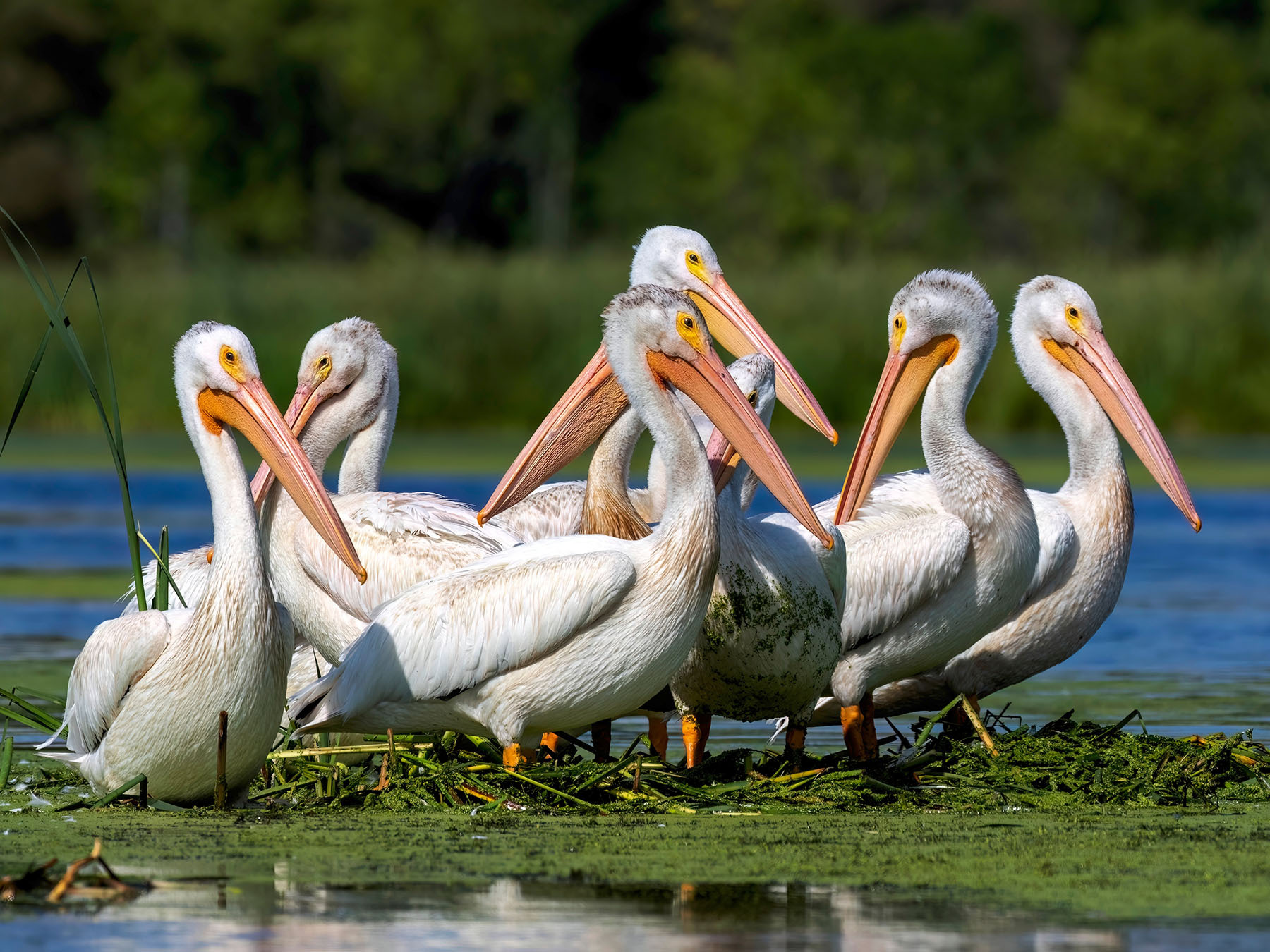
The species is highly gregarious all year. Colonies are dense and split into subcolonies, whose pairs breed more in step with each other than with the rest of the colony. A pair defends only the area right around its nest, and only until the young leave it at about three weeks, keeping nesting cormorants and gulls at bay.
It often shares nesting islands with gulls and Double-crested Cormorants, and the pelican and the cormorant take different sizes of fish at different depths. Flying flocks averaged about 10-13 birds at Gunnison Island, Utah, in a 1950 study; the largest flying flock reported was about 300 and the largest feeding flock about 2,000.1 Our guide to what a group of pelicans is called covers the collective nouns.
On land it walks fast or runs, often with its wings spread, and it lands on water feet first, its webs working like skis. To shed heat it turns its back to the sun and flutters its pouch.
Lifespan and predators
The oldest American White Pelican on the US Bird Banding Laboratory's current list was at least 27 years 1 month old. It was banded as a chick in Minnesota on June 25, 1994, and found injured in Iowa on July 25, 2021. An earlier record holder on the laboratory's historical table was at least 23 years 6 months old.13
In a North Dakota banding study published in 1974, 41% of young died between fledging and their first birthday and 16% in their second year, then about 21% a year from the third to the thirteenth year. Banding may overstate adult deaths, because bands fall off.1 At Marsh Lake, Minnesota, adult survival was estimated at 0.813 a year.12
Red foxes and coyotes are its mammal predators, mainly where low water or ice lets them reach an island colony. Large gulls take eggs and small young, worst when the parents have been flushed, ravens take eggs, and Great Horned Owls, Bald Eagles and Black-crowned Night Herons take young. Adults are rarely killed, though foxes killed 10 at one colony. Early in nesting a colony readily deserts when disturbed by coyotes or people, and parents do not chase predators away.
Conservation
Globally, the American White Pelican is not threatened. It is listed as Least Concern on the IUCN Red List in its 2025 assessment, and NatureServe ranks it G4, apparently secure (reviewed in 2016).14, 15 Partners in Flight estimates about 450,000 birds worldwide, 410,000 of them in the US and Canada, from Breeding Bird Survey and eBird data centered on 2010.16
Colony counts in 1998-2001 found about 134,000 breeding birds in North America, against more than 109,000 in 1979-81, and at 20 colonies counted both times the number of nests had more than doubled. Many colonies, much of Canada included, were not surveyed.17 A 2005 overview put adult numbers at about 30,000 in 1933 and over 100,000 by 1985, while warning that counting them had been difficult and tentative.18
The North American Breeding Bird Survey shows a rise of 3.20% a year in the lower 48 states from 1966 to 2025, with a 95% credible interval of +0.43% to +5.13%, so the increase is statistically clear. Across the whole survey area, Canada included, the estimate is 2.64% a year, but its interval, -0.13% to +4.43%, includes zero. The 20- and 10-year US trends are positive but not statistically clear, and the survey's 2025 index value is the highest of the series.19
Numbers fell for decades up to the 1960s, above all west of the Rockies, and the population was regarded as threatened until the early 1960s by shifting water levels, disturbance and possibly contaminants. It grew through the 1980s and has kept growing since.1
The West is the exception. There, breeding numbers have likely fallen because of long drought and farm water use at colonies.1 Western colonies dropped from 23-24 in the early 1900s to 5-8 in 1984.15 California's nests fell from about 4,500 in 1912 to 1,600-1,700 from the 1950s, and by 2005 regular breeding in California was confined to two Klamath Basin sites.20
At Great Salt Lake, 36 years of monitoring point to low lake levels, which let land predators reach the colony, as the probable driver of recent declines. A model projects that the colony could fall by about 37% by 2040 without local management.21
Conservation: disturbance, water and disease
Colonies are very sensitive to people walking in, especially during courtship and early incubation. Birds desert, leaving eggs and chicks exposed to heat, cold and gulls, and loud, close motorboats and low aircraft can flush a colony. Utah closed Gunnison Island in Great Salt Lake to access in 2005, and Anaho Island National Wildlife Refuge at Pyramid Lake is off-limits to visitors.1
Water levels matter too. Long-term loss of water to farms and cities in dry parts of the range threatens breeding and feeding sites, and changing water levels can flood nests or let predators walk out to islands. At Marsh Lake, Minnesota, in 2003-2012, chick production fell after high April river flows pushed nests onto high ground near the mainland, where predators were busier.22 At Pyramid Lake, a model put production up to 58% higher under natural river flows.23
By 2002 Chase Lake held nearly 34,000 breeding birds, up from about 500 pelicans on two islands in 1905.24 In 2003 more than 5,000 young died there, with West Nile virus the suspected cause, and in 2004 the colony was abandoned completely. A 2007 state report found that coyotes had wrecked many eggs at the subcolony on the mainland and saw no sign of human disturbance or disease, but it did not settle the cause; it called severe weather a more plausible cause on the north island.25
West Nile virus reached the northern plains in 2002. A 2013 study, citing earlier work, said it had caused unusually high chick deaths at the major northern-plains colonies every year since. In 2006-2008, 28-81% of the chicks alive in mid-July, when the virus season begins, were later infected, depending on year and colony, and the authors' data suggest that 60-75% of infected chicks survived and fledged.26
Type C botulism was implicated in many large die-offs from 1978 to 2003, including about 8,500 deaths at the Salton Sea in 1996, put at 15-20% of the western population. As of 2024, no large H5N1 bird-flu die-offs had been reported in this species, despite widespread effects on other pelicans.1 A 2005 overview judged that, overall, unusual mortality events had not threatened the species' numbers.18
Eggshells from 1965 and 1972 were significantly thinner than before 1940, though not significantly weakened, and after 1960 the pesticides toxaphene, endrin and dieldrin likely killed hundreds of pelicans a year. More than 400 died in Florida in 1998 when contaminated farmland was flooded to make a wetland, while North Dakota eggs in 2005 held little or no contamination.1 In the first winter after the 2010 Deepwater Horizon spill, 16.9% of the pelicans checked in the northern Gulf of Mexico were oiled, mostly with trace amounts.27
Legal status
In the United States the American White Pelican is protected under the Migratory Bird Treaty Act.28 It is not listed under the Endangered Species Act; the US Fish and Wildlife Service's species database marks it a Species of Concern, which is not a listing.29 As listed by Birds of the World in 2025, Montana, Nevada and Utah treat it as a Species of Greatest Conservation Need, Washington as a Sensitive Species and California as a Species of Special Concern. The same account lists British Columbia's status for it as Endangered and Ontario's as Threatened.1
In Canada, the pelican family is on the government's list of bird families that the Migratory Birds Convention Act, 1994, does not cover, and the list notes that such birds might be protected under other laws.30 COSEWIC assessed the species as Threatened in 1978 and Not at Risk in 1987.15 It is not on Mexico's list of species at risk, NOM-059-SEMARNAT-2010, or its 2019 update.31
In the past it was shot for sport and killed because it eats fish, although its diet is mostly rough fish of little value to people. Banding studies from the 1970s and 1980s named shooting as the largest single cause of reported deaths, and the scale of shooting losses linked to fish farms is not known.1
Similar birds
Often mistaken for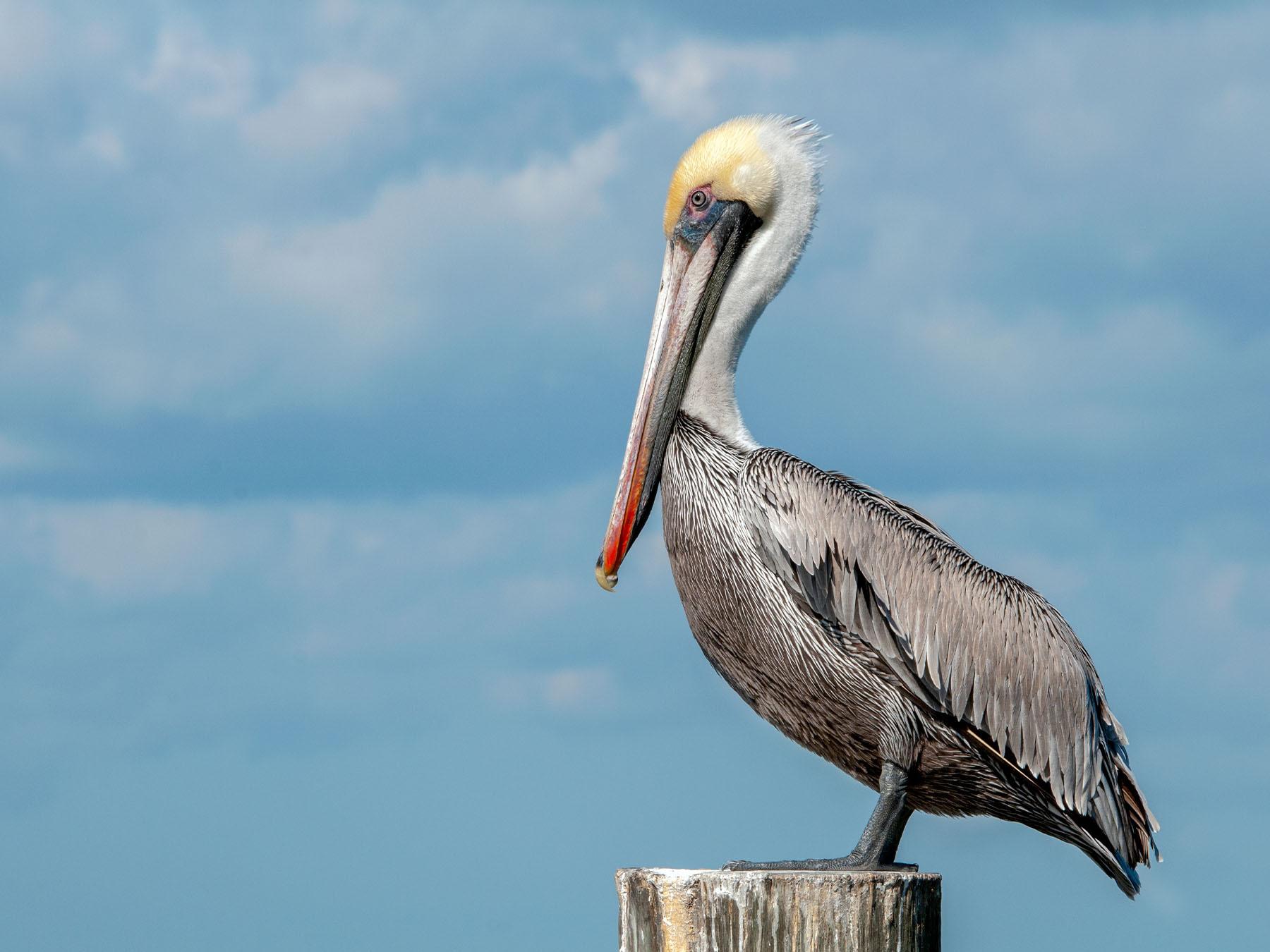
More photos
2 photos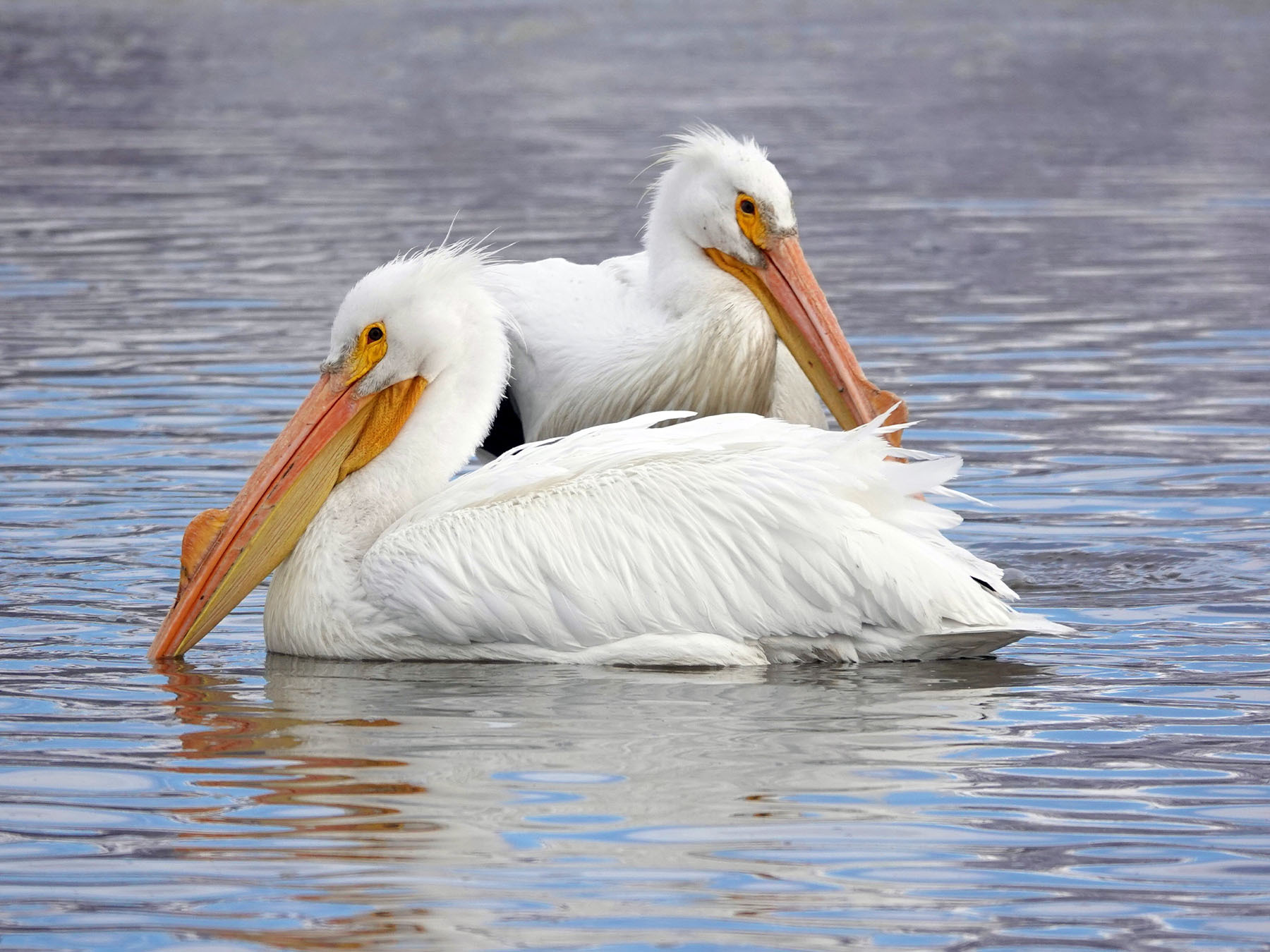
American White Pelican guides
4 guidesQuick facts
- Length
- 127–165 cm
- Wingspan
- 244–290 cm
- Weight
- 4200–8000 g
- Lifespan
- oldest recorded 27 years 1 month
- Family
- Pelicans
- Migration
- Partial migrant
- Global status (IUCN)
- Least Concern
- World population
- About 450,000 birds worldwide (Partners in Flight estimate from Breeding Bird Survey and eBird data, centered on 2010)
- Population trend
- Recovered from mid-20th-century lows; a clear long-term rise in the lower 48 states since 1966 (Breeding Bird Survey), not statistically clear survey-wide or over the last 20 and 10 years; western colonies have declined
- Scientific name
- Pelecanus erythrorhynchos
Questions
2What is the American White Pelican's scientific name?
Is it the same bird as the Great White Pelican?
Sources
39- 1Van Tatenhove, A. M. et al. (2025). American White Pelican (Pelecanus erythrorhynchos), version 2.0. Birds of the World (N. D. Sly, Editor). Cornell Lab of Ornithology. doi:10.2173/bow.amwpel.02 (opens in a new tab)
- 2Knopf, F. L. (1975). Schedule of Presupplemental Molt of White Pelicans with Notes on the Bill Horn. The Condor 77(3): 356-359. doi:10.2307/1366249 (opens in a new tab)
- 3National Audubon Society. American White Pelican. Guide to North American Birds. Accessed 22 November 2026. Source (opens in a new tab)
- 4Cornell Lab of Ornithology. American White Pelican. All About Birds. Accessed 22 November 2026. Source (opens in a new tab)
- 5Gutierrez Illan, J., Wang, G., Cunningham, F. L. and King, D. T. (2017). Seasonal effects of wind conditions on migration patterns of soaring American white pelican. PLOS ONE 12(10): e0186948. doi:10.1371/journal.pone.0186948 (opens in a new tab)
- 6Anderson, J. G. T. (1991). Foraging Behavior of the American White Pelican (Pelecanus erythrorhyncos) in Western Nevada. Colonial Waterbirds 14(2): 166. doi:10.2307/1521506 (opens in a new tab)
- 7McMahon, B. F. and Evans, R. M. (1992). Nocturnal Foraging in the American White Pelican. The Condor 94(1): 101-109. doi:10.2307/1368800 (opens in a new tab)
- 8Scoppettone, G. G., Rissler, P. H., Fabes, M. C. and Withers, D. (2014). American White Pelican Predation on Cui-ui in Pyramid Lake, Nevada. North American Journal of Fisheries Management 34(1): 57-67. doi:10.1080/02755947.2013.855278 (opens in a new tab)
- 9Thiessen, J. D., Brauer, T. A., Peterson, M. P. and Kozfkay, J. R. (2025). American white pelican predation of wild Rainbow Trout and Brown Trout in Silver Creek, Idaho. North American Journal of Fisheries Management 45(5): 958-966. doi:10.1093/najfmt/vqaf067 (opens in a new tab)
- 10Cash, K. J. and Evans, R. M. (1986). Brood reduction in the American white pelican (Pelecanus erythrohynchos). Behavioral Ecology and Sociobiology 18(6): 413-418. doi:10.1007/bf00300515 (opens in a new tab)
- 11Evans, R. M. (1996). Hatching asynchrony and survival of insurance offspring in an obligate brood reducing species, the American white pelican. Behavioral Ecology and Sociobiology 39(3): 203-209. doi:10.1007/s002650050282 (opens in a new tab)
- 12Clark, M. E. and DiMatteo, J. J. (2018). Age, nest initiation, and demographic characteristics of American White Pelicans (Pelecanus erythrorhynchos) breeding at Marsh Lake, Minnesota. The Wilson Journal of Ornithology 130(4): 881. doi:10.1676/1559-4491.130.4.881 (opens in a new tab)
- 13USGS Bird Banding Laboratory. Longevity records of North American birds: American White Pelican (AOU 1250). USGS Eastern Ecological Science Center, Bird Banding Laboratory. Accessed 22 November 2026. Source (opens in a new tab)
- 14BirdLife International (2025). Pelecanus erythrorhynchos. The IUCN Red List of Threatened Species 2025. IUCN Red List (read through GBIF's IUCN checklist, dataset 19491596-35ae-4a91-9a98-85cf505f1bd3). doi:10.2305/IUCN.UK.2025-2.RLTS.T22697611A281856383.en (opens in a new tab)
- 15NatureServe (2026). Pelecanus erythrorhynchos (American White Pelican). NatureServe Explorer. Accessed 22 November 2026. Source (opens in a new tab)
- 16Partners in Flight (2024). Avian Conservation Assessment Database, version 2024.05.23 (global). Partners in Flight / Bird Conservancy of the Rockies. Accessed 22 November 2026. Source (opens in a new tab)
- 17King, D. T. and Anderson, D. W. (2005). Recent Population Status of the American White Pelican: A Continental Perspective. Waterbirds 28(sp1): 48-54. doi:10.1675/1524-4695(2005)28[48:rpsota]2.0.co;2 (opens in a new tab)
- 18Keith, J. O. (2005). An Overview of the American White Pelican. Waterbirds 28(sp1): 9-17. doi:10.1675/1524-4695(2005)28[9:aootaw]2.0.co;2 (opens in a new tab)
- 19Hostetler, J. A. et al. (2026). The North American Breeding Bird Survey, Analysis Results 1966-2025. U.S. Geological Survey data release. doi:10.5066/P1OSNSFC (opens in a new tab)
- 20Shuford, W. D. (2005). Historic and Current Status of the American White Pelican Breeding in California. Waterbirds 28(sp1): 35-47. doi:10.1675/1524-4695(2005)28[35:hacsot]2.0.co;2 (opens in a new tab)
- 21Van Tatenhove, A. M. et al. (2024). Scale-dependent population drivers inform avian management in a declining saline lake ecosystem. Ecological Applications 34(7): e3021. doi:10.1002/eap.3021 (opens in a new tab)
- 22DiMatteo, J. J., Wollenberg, J. E. and Clark, M. E. (2015). Implications of spring water levels on the production of American white pelicans nesting at Marsh Lake, Minnesota. The Journal of Wildlife Management 79(7): 1129-1140. doi:10.1002/jwmg.923 (opens in a new tab)
- 23Murphy, E. C. and Tracy, J. C. (2005). Century-long Impacts of Increasing Human Water Use on Numbers and Production of the American White Pelican at Pyramid Lake, Nevada. Waterbirds 28(sp1): 61-72. doi:10.1675/1524-4695(2005)28[61:cioihw]2.0.co;2 (opens in a new tab)
- 24Sovada, M. A., King, D. T., Erickson, M. and Gray, C. (2005). Historic and Current Status of the American White Pelican Breeding at Chase Lake National Wildlife Refuge, North Dakota. Waterbirds 28(sp1): 27-34. doi:10.1675/1524-4695(2005)28[27:hacsot]2.0.co;2 (opens in a new tab)
- 25McKenna, M. G. (2007). Exploration of Factors That May Lead to Colony Abandonment or Reduced Productivity of American White Pelicans in the Northern Plains. Final Report, Project T-7-R. North Dakota Game and Fish Department (State Wildlife Grant report). Accessed 22 November 2026. Source (opens in a new tab)
- 26Sovada, M. A., Pietz, P. J., Hofmeister, E. K. and Bartos, A. J. (2013). West Nile Virus in American White Pelican Chicks: Transmission, Immunity, and Survival. The American Journal of Tropical Medicine and Hygiene 88(6): 1152-1158. doi:10.4269/ajtmh.12-0408 (opens in a new tab)
- 27Paruk, J. D. et al. (2019). Oiling of American white pelicans, common loons, and northern gannets in the winter following the Deepwater Horizon (MC252) oil spill. Environmental Monitoring and Assessment 191(S4). doi:10.1007/s10661-019-7925-y (opens in a new tab)
- 28U.S. Fish and Wildlife Service (2026). 50 CFR 10.13: List of Birds Protected by the Migratory Bird Treaty Act. Electronic Code of Federal Regulations (issue of 17 Nov 2026). Accessed 22 November 2026. Source (opens in a new tab)
- 29U.S. Fish and Wildlife Service. American White Pelican (Pelecanus erythrorhynchos), species 6886. Environmental Conservation Online System (ECOS). Accessed 22 November 2026. Source (opens in a new tab)
- 30Environment and Climate Change Canada. Birds protected in Canada. Government of Canada. Accessed 22 November 2026. Source (opens in a new tab)
- 31SEMARNAT (2010). NOM-059-SEMARNAT-2010 (DOF 30 Dec 2010) and the modification of its Anexo Normativo III (DOF 14 Nov 2019). Diario Oficial de la Federacion. Accessed 22 November 2026. Source (opens in a new tab)
- 32AviList Core Team (2026). AviList: The Global Avian Checklist, v2025b. AviList. doi:10.2173/avilist.v2025b (opens in a new tab)
- 33Dewey, T. (2009). Pelecanus erythrorhynchos (American white pelican). Animal Diversity Web. Accessed 22 November 2026. Source (opens in a new tab)
- 34Johnston, G. R. (2018). The role of hatching asynchrony and sibling rivalry in pelican brood reduction. Biological Journal of the Linnean Society 125(2): 441-451. doi:10.1093/biolinnean/bly112 (opens in a new tab)
- 35Shields, M. (2020). Brown Pelican (Pelecanus occidentalis), version 1.0. Birds of the World (A. F. Poole, Editor). Cornell Lab of Ornithology. Accessed 22 November 2026. Source (opens in a new tab)
- 36Coulter, M. C., Rodgers, J. A., Jr., Ogden, J. C. and Depkin, F. C. (2020). Wood Stork (Mycteria americana), version 1.0. Birds of the World (A. F. Poole and F. B. Gill, Editors). Cornell Lab of Ornithology. Accessed 22 November 2026. Source (opens in a new tab)
- 37Mlodinow, S. G., Mowbray, T. B., Cooke, F. and Ganter, B. (2024). Snow Goose (Anser caerulescens), version 2.0. Birds of the World (P. G. Rodewald and N. D. Sly, Editors). Cornell Lab of Ornithology. Accessed 22 November 2026. Source (opens in a new tab)
- 38Urbanek, R. P. and Lewis, J. C. (2020). Whooping Crane (Grus americana), version 1.0. Birds of the World (A. F. Poole, Editor). Cornell Lab of Ornithology. Accessed 22 November 2026. Source (opens in a new tab)
- 39Jongsma, J.. XC175255 American White Pelican (Pelecanus erythrorhynchos). xeno-canto. Accessed 22 November 2026. Source (opens in a new tab)

Checked by
Nathan Cope, founder and editor
Nathan founded Birdfact and leads its writers and contributors in the UK, the US and Canada. He has watched and studied birds for more than ten years, and checks every article and species guide before it’s published.