


Black-crowned Night-heron
Night Heron, Qua Bird, Black-crowned Night Heron, Nycticorax · Nycticorax nycticorax
By the Birdfact teamChecked by Nathan Cope
On this page15 sections
How to recognise it
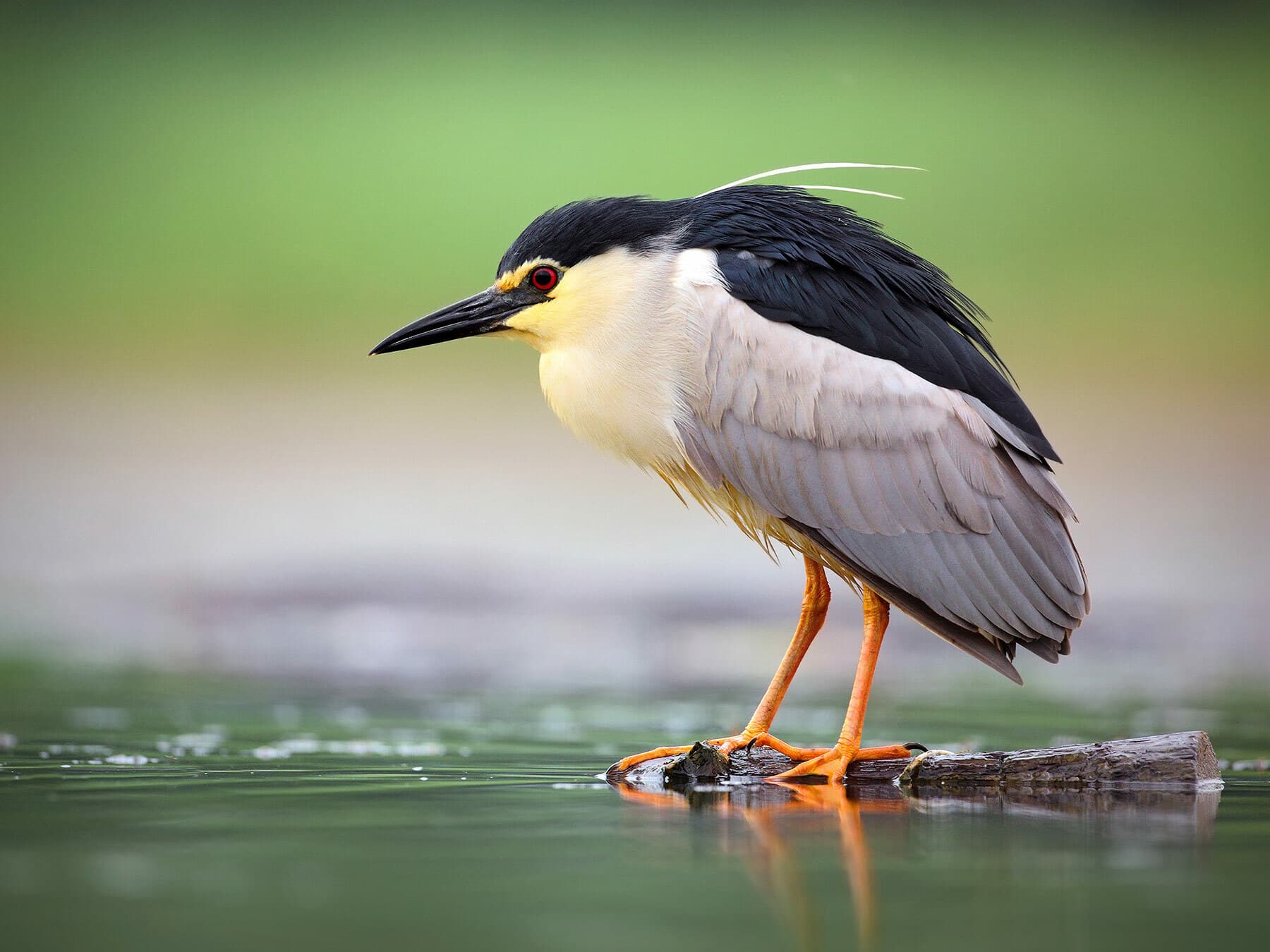
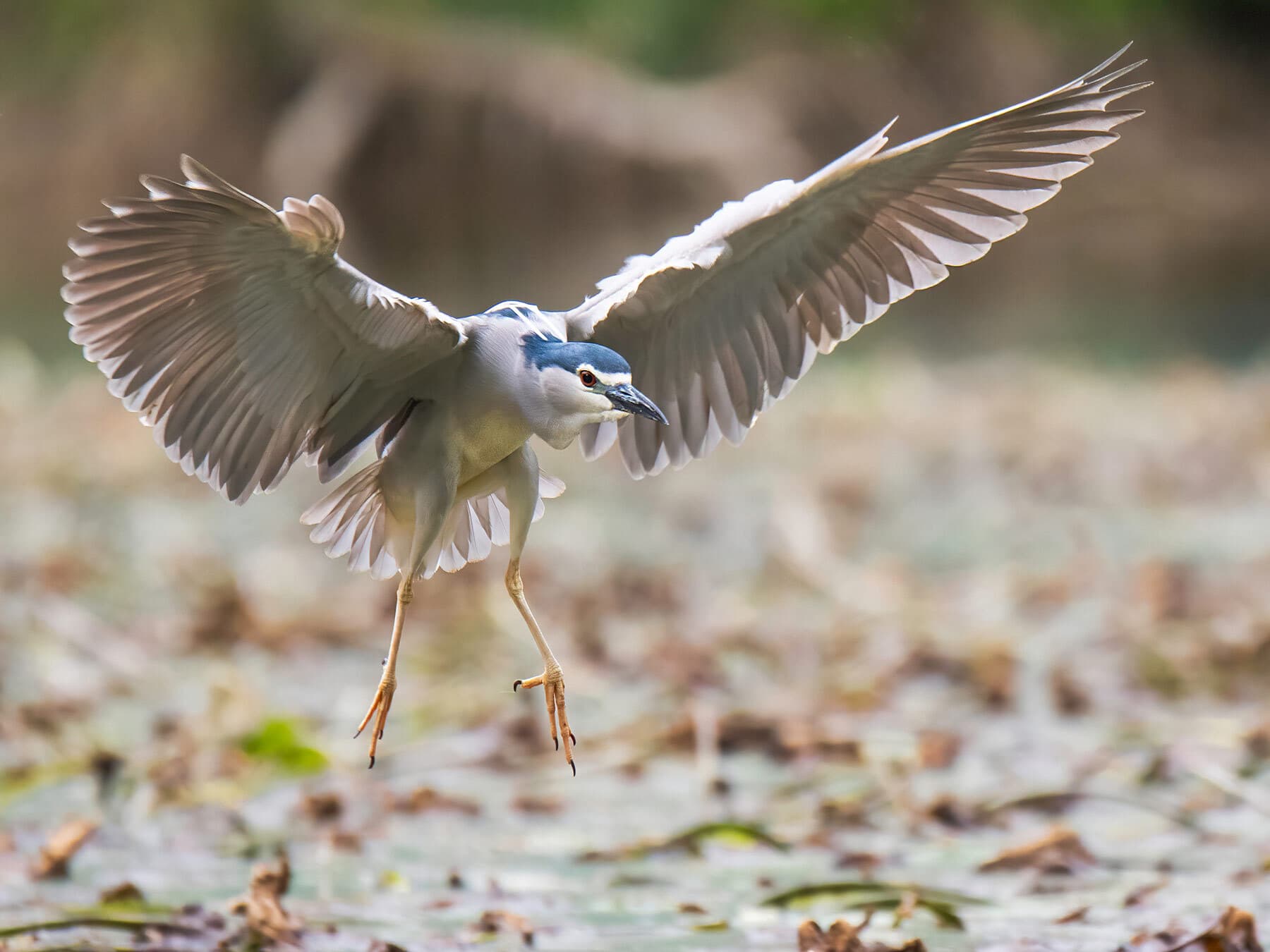
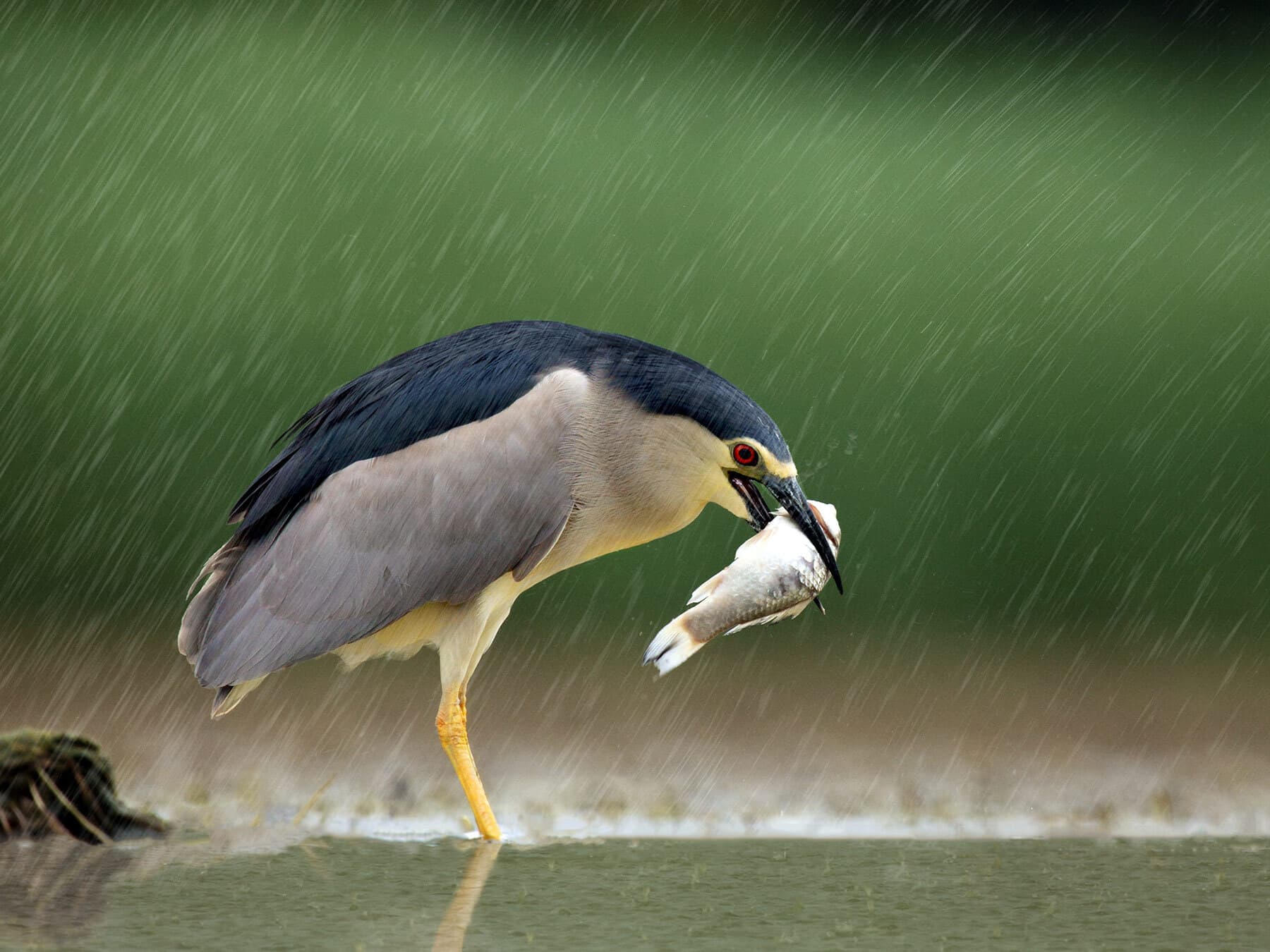
The Black-crowned Night-heron boasts a striking contrast of colours. Adults have a black crown and back, grey wings, and white underparts. Their eyes are a vivid red, complemented by a stout black bill and distinctive yellow legs.
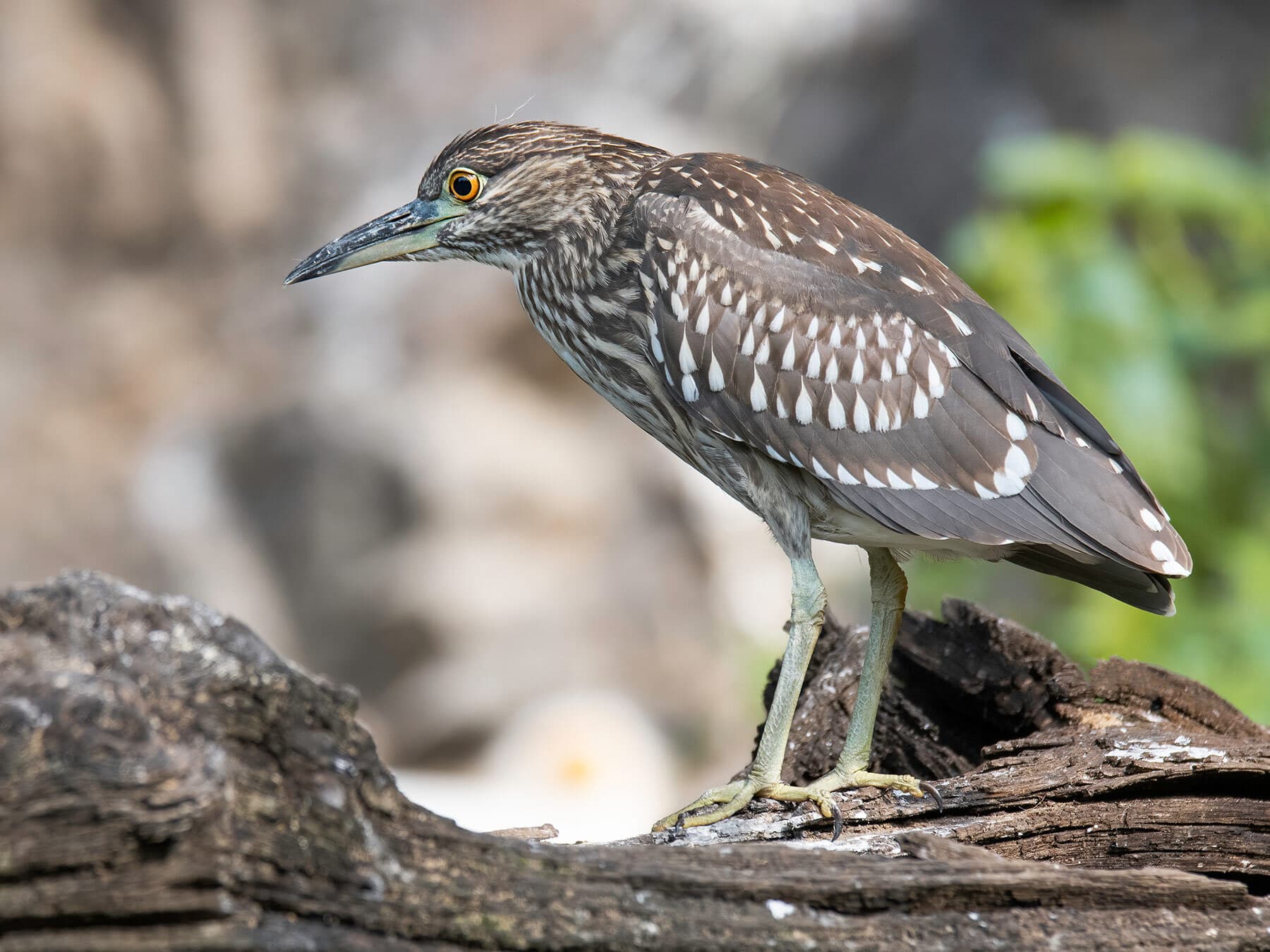
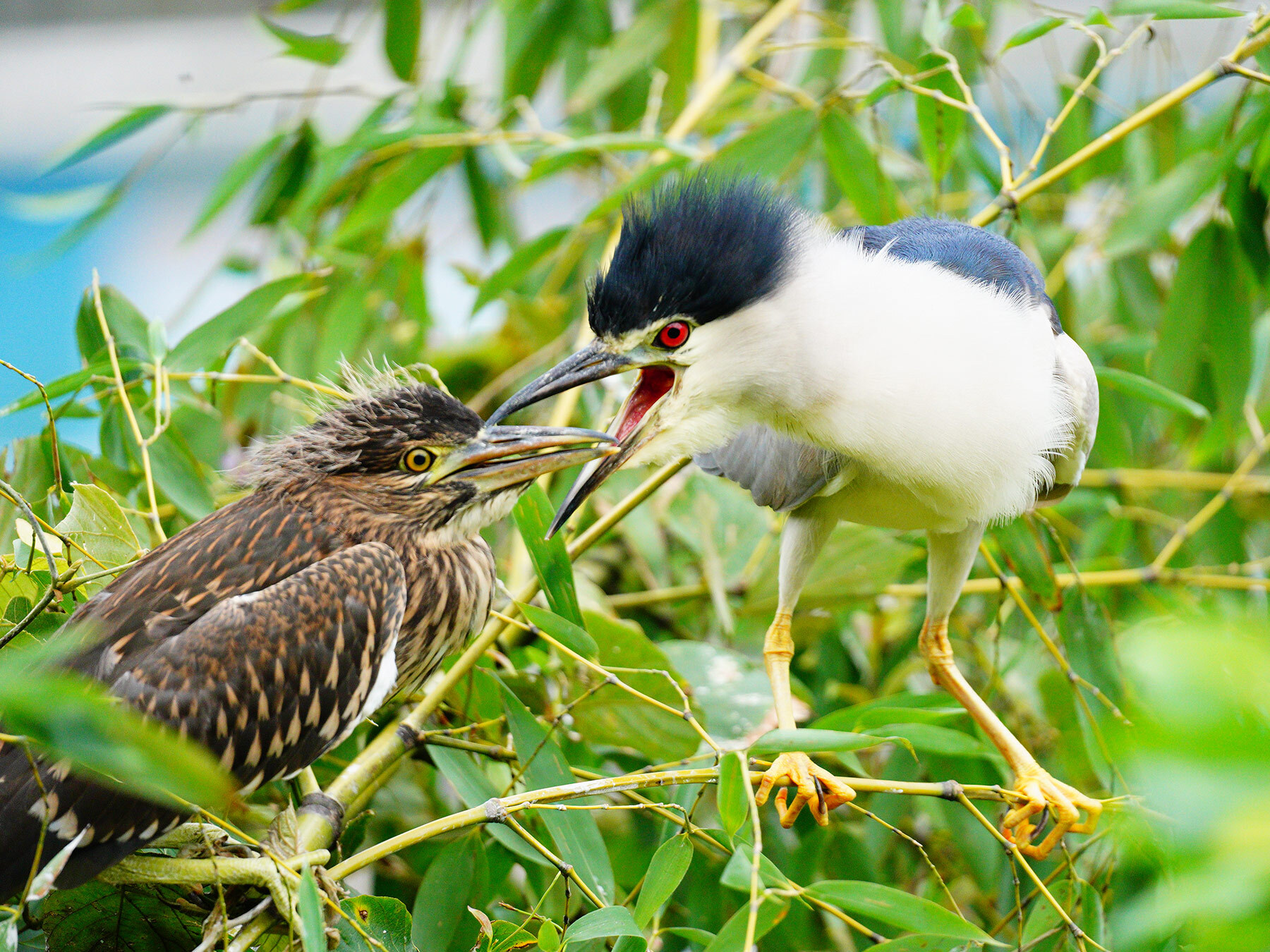
Juveniles differ significantly, displaying brown plumage streaked with white. During the breeding season, adults develop long white plumes extending from the back of the head, adding to their elegant appearance.
Males are females are alike in appearance, with females being slightly smaller.
Its size
Adults- Length
- 58–65 cm
- Wingspan
- 110–120 cm
- Weight
- 727–1014 g
Its song and calls
The voice of the black-crowned night heron is a deep, short, guttural croak similar to, ‘woc – woc’ or ‘kwok – kwok – kwok’.
- Flight call0:00 / 0:49
Recorded in Andalucía, Spain · August 2018
When and where to see it
OctoberMostly absent
Not regularly recorded in October
Each dot is a county, state or province: the bigger and darker, the larger the bird’s share of that place’s bird records that month. Grey dots: no regular records. The ringed point is the centre of the bird’s records this month; the arrow shows how it moved since last month, and the dashed loop its path through the year. “Arrivals” colours places where it becomes regular this month (orange) or is in its last regular month (grey). GBIF eBird Observation Dataset, 2019–2024. Map data: Natural Earth, US Census Bureau; place centres © OpenStreetMap contributors.
In your area
See when the Black-crowned Night-heron is recorded in your county, state or province.
How often the Black-crowned Night-heron turns up in the UK, the United States and Canada through the year, from birdwatchers' records.
United Kingdom
Summer visitor · regularly Apr–Aug · most records in April
United States
Resident · all year · most records in August
Canada
Summer visitor · all year · most records in August
Show as a table
| Month | United Kingdom | United States | Canada |
|---|---|---|---|
| January | – | 0.16% (regular) | 0.025% (regular) |
| February | – | 0.14% (regular) | 0.021% (regular) |
| March | <0.001% | 0.10% (regular) | 0.016% (regular) |
| April | 0.009% (regular) | 0.10% (regular) | 0.052% (regular) |
| May | 0.002% (regular) | 0.10% (regular) | 0.082% (regular) |
| June | 0.002% (regular) | 0.15% (regular) | 0.11% (regular) |
| July | 0.004% (regular) | 0.19% (regular) | 0.14% (regular) |
| August | <0.001% (regular) | 0.21% (regular) | 0.15% (regular) |
| September | <0.001% | 0.15% (regular) | 0.11% (regular) |
| October | – | 0.13% (regular) | 0.057% (regular) |
| November | – | 0.13% (regular) | 0.031% (regular) |
| December | – | 0.14% (regular) | 0.018% (regular) |
Recorded regularly in
Worldwide: recorded regularly in 163 countries
Countries where it was recorded in at least 3 of the 6 years 2019–2024. Linked countries have their own bird list.
Europe (29)
- Albania
- Austria
- Belgium
- Bosnia & Herzegovina
- Bulgaria
- Croatia
- Czechia
- France
- Germany
- Greece
- Hungary
- Italy
- Kosovo
- Malta
- Moldova
- Montenegro
- Netherlands
- North Macedonia
- Poland
- Portugal
- Romania
- Russia
- Serbia
- Slovakia
- Slovenia
- Spain
- Switzerland
- Ukraine
- United Kingdom
Africa (37)
Asia (47)
- Armenia
- Azerbaijan
- Bahrain
- Bangladesh
- Bhutan
- Brunei
- Cambodia
- China
- Cyprus
- Georgia
- Hong Kong SAR China
- India
- Indonesia
- Iran
- Iraq
- Israel
- Japan
- Jordan
- Kazakhstan
- Kuwait
- Kyrgyzstan
- Laos
- Lebanon
- Macao SAR China
- Malaysia
- Maldives
- Mongolia
- Myanmar (Burma)
- Nepal
- Oman
- Pakistan
- Palestinian Territories
- Philippines
- Qatar
- Saudi Arabia
- Singapore
- South Korea
- Sri Lanka
- Taiwan
- Tajikistan
- Thailand
- Timor-Leste
- Turkey
- United Arab Emirates
- Uzbekistan
- Vietnam
- Yemen
North America (35)
- Antigua & Barbuda
- Aruba
- Bahamas
- Barbados
- Belize
- Bermuda
- British Virgin Islands
- Canada
- Caribbean Netherlands
- Cayman Islands
- Costa Rica
- Cuba
- Curaçao
- Dominican Republic
- El Salvador
- Grenada
- Guadeloupe
- Guatemala
- Haiti
- Honduras
- Jamaica
- Martinique
- Mexico
- Nicaragua
- Panama
- Puerto Rico
- Sint Maarten
- St Kitts & Nevis
- St Lucia
- St Martin
- St Vincent & the Grenadines
- Trinidad & Tobago
- Turks & Caicos Islands
- United States
- US Virgin Islands
South America (14)
Oceania (1)
- Palau
Data: EOD – eBird Observation Dataset (Cornell Lab of Ornithology), accessed via GBIF.org, CC BY 4.0. Records from 2019–2024, aggregated and filtered by Birdfact. How these lists are made
Black-crowned night herons can be found in North and South America, Central Europe, sub-Saharan and East Africa and Central and Southern Asia. There are four sub-species which have defined habitats as follows:
Black-crowned Night-Heron (American) - Nycticorax nycticorax hoactli
Migratory across large areas of southern Canada, northern and central United States they are residents of the Hawaiian Islands, southern United States through central and south America to northern Chile and as far south as the Patagonia region of Argentina.
Black-crowned Night-Heron (Eurasian) - Nycticorax nycticorax nycticorax
Often overwintering south of their breeding range this sub-species can be found across central and southern Europe and from north Africa eastwards through central, south and eastern Asia, taking in Madagascar, Indonesia, the Philippines, China, Taiwan and Japan.
Black-crowned Night-Heron (Dusky) - Nycticorax nycticorax obscurus
This sub-species is resident throughout the year from southern Peru and the Atacama region of northern Chile bordered by the Pacific, through northern Argentina and south to the continent’s tip at Tierra del Fuego, an archipelago separated from the mainland by the Strait of Magellan.
Black-crowned Night-Heron (Falklands) - Nycticorax nycticorax falklandicus
Restricted solely to the Falkland Islands archipelago in the South Atlantic, located approximately 300 miles from Patagonia’s east coast.

Signs and Spotting tips
Although mainly a night feeder these birds can often be seen standing or perching motionless on the edge of water or wading in a slow hunched, stooped, strutting movement. They breed and roost in flocks and during the day will sit in a tree or bush close to the water’s edge not moving at all. Due to their high dependence on fish as the main diet staple they choose wet or marshy areas of brackish, salt or fresh water including mangrove swamps, lakes, ponds, paddy fields, reedbeds, rivers and tidal flats. They are easily distinguishable from other herons who, in the main, have long necks and legs, slim bodies and long thin beaks.
What it eats
The preferred diet is fish but also, dependent upon habitat, squid, crustaceans, large insects, frogs, snakes and rodents, all of which are captured near the water’s edge mostly during the night.
For more information on what herons eat, check out this article.
Nesting and breeding
Due to the widespread geographical range of the black-crowned night heron breeding can take place in almost every month climate allowing, but within temperate zones is generally in the spring and early summer. Birds often breed in colonies frequently choosing isolated islands in the middle of lakes or reservoirs where nests are built at ground level or alternatively off the ground in trees or bushes. The male normally chooses a nesting site and starts to construct a nest which is completed by the female who is furnished with the necessary materials by the scavenging male. One brood averaging 3 – 5 pale greenish blue eggs is laid annually and incubated for up to twenty six days with both parents taking turns. Chicks fledge approximately six weeks from hatching.
Behaviour
Black-crowned Night-herons are primarily nocturnal, becoming active at dusk. They often stand motionless at the water's edge, waiting to strike at prey with lightning-fast precision.
During the day, they roost in groups in trees near water, sometimes forming mixed colonies with other heron species.
Lifespan and predators
The average life expectancy is between ten to fifteen years although twenty years is not unusual.
Conservation
While globally listed as Least Concern, Black-crowned Night-herons face localised threats from habitat loss and water pollution.
Conservation efforts focus on protecting wetlands and improving water quality in urban and suburban areas where these adaptable birds often reside.
What does a Black-crowned Night Heron look like?
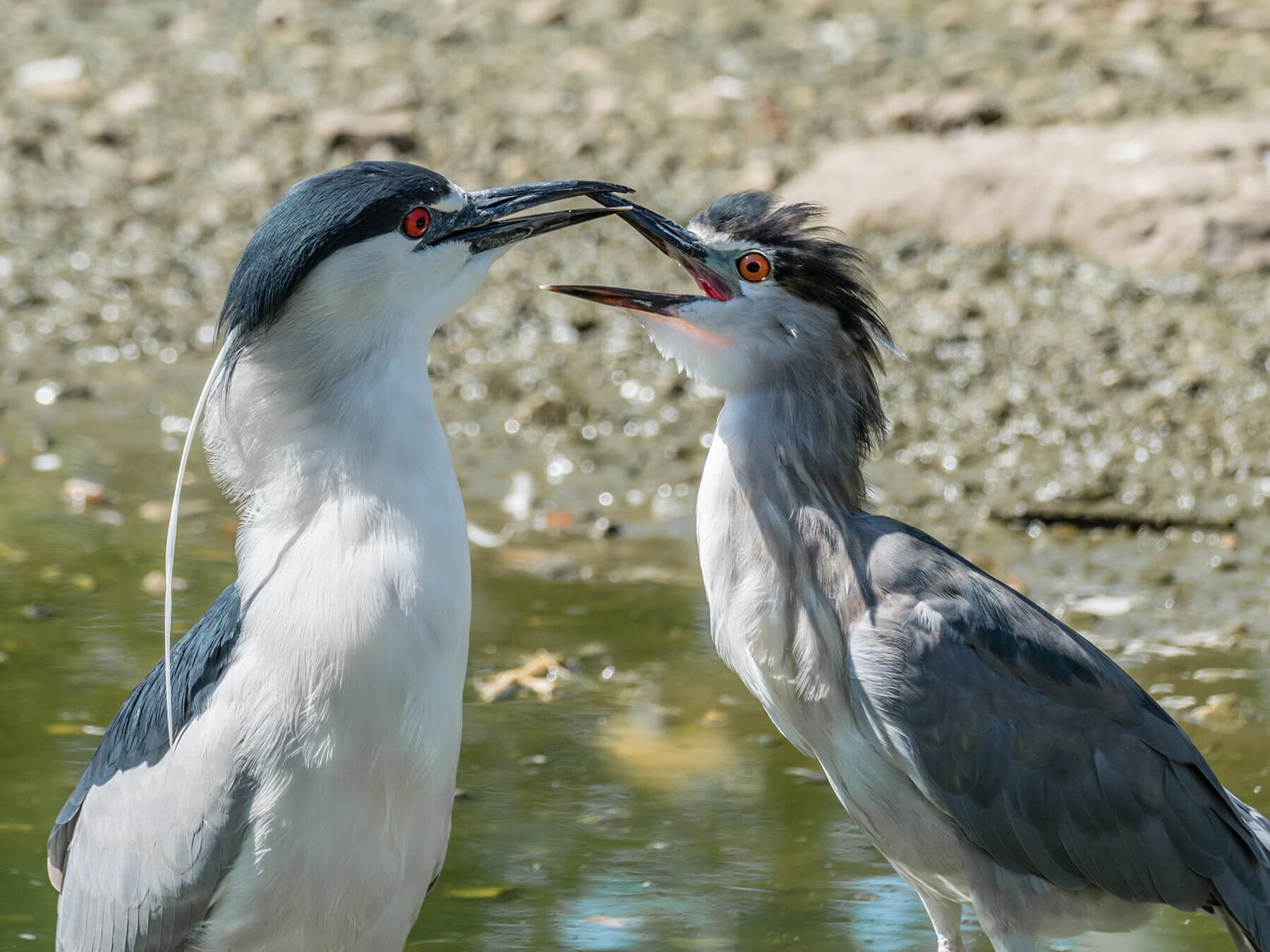
Unlike most herons the black-crowned night heron is stocky with a short neck and legs. The adult has a black back and cap or crown with pale grey wings and white underparts. The forehead is white which extends in a thin white bar over the top of the eye in contrast to the deep red iris. From the back of the head a number of thin white plumes emerge which stand proud during courtship rituals but otherwise lay flat down the bird’s back. The bill, which is short and thick, is black and the legs yellow, changing to a pinkish red during the breeding season. Males and females are identical apart from the female being generally smaller in overall size. Juvenile birds are predominantly brown over all with a darker shade to the upperparts and upperwings with pale spots and a lighter beige, streaked white, chest and underparts. The bill is a pale yellow along the sides and the iris of the eye orange.
Similar birds
Often mistaken for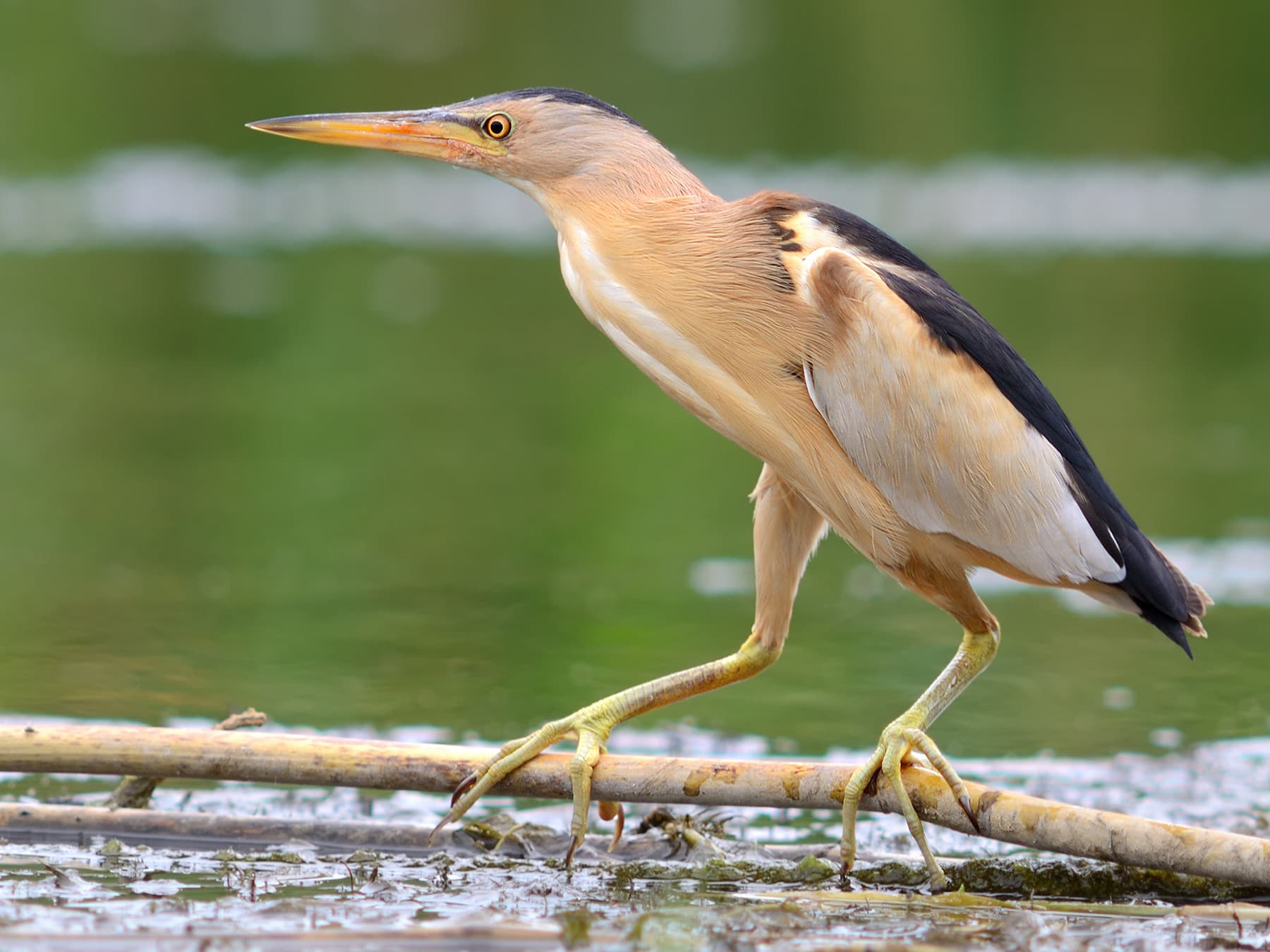
More photos
2 photos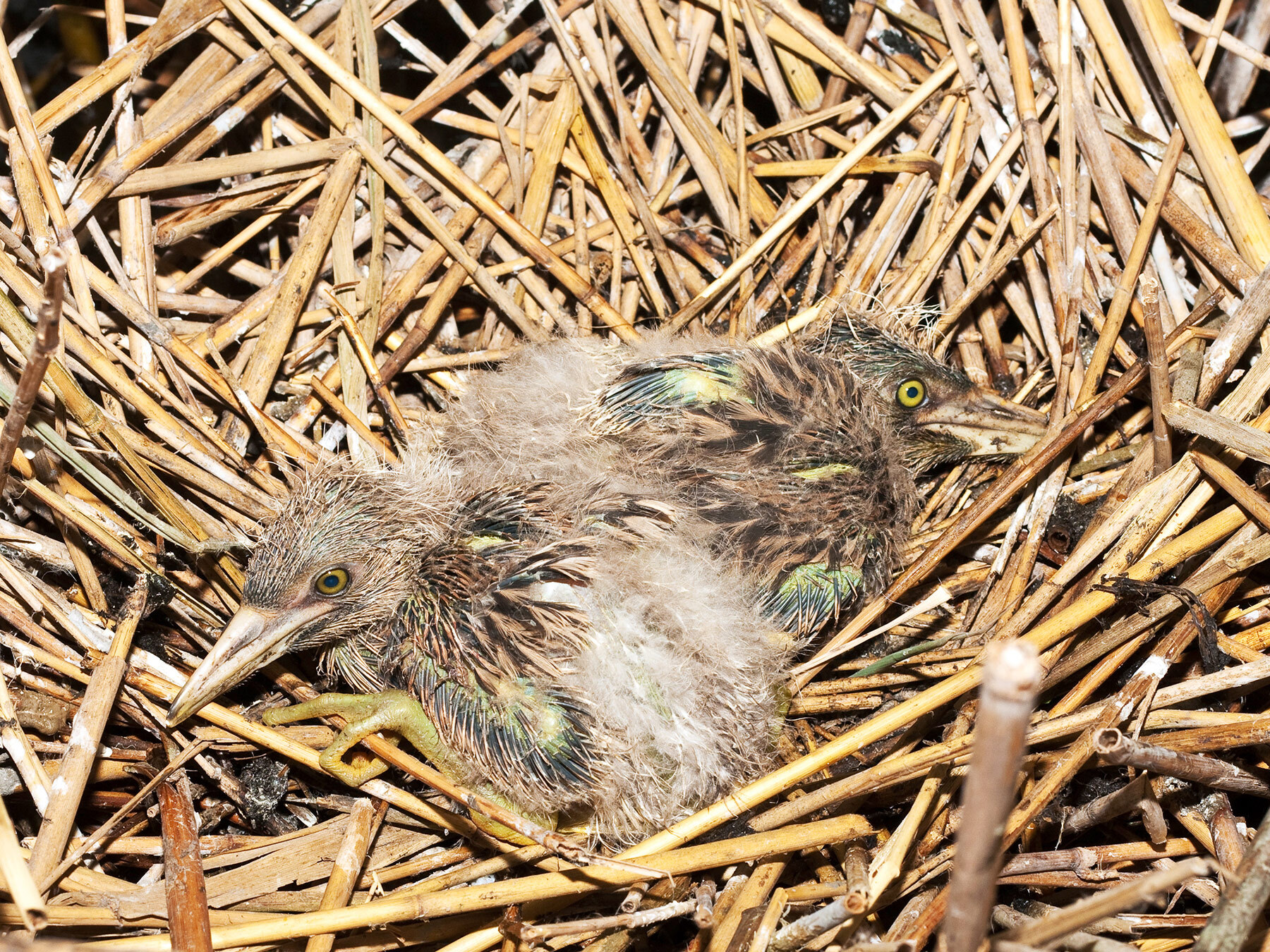
Black-crowned Night-heron guides
1 guidesQuick facts
- Length
- 58–65 cm
- Wingspan
- 110–120 cm
- Weight
- 727–1014 g
- Lifespan
- 3–15 years · oldest recorded 21.1 years
- Family
- Herons & Egrets
- Migration
- Partial migrant
- Global status (IUCN)
- Least Concern
- World population
- 570,000 - 3,730,000 mature individuals
- Population trend
- Decreasing
- Also called
- Night Heron, Qua Bird, Black-crowned Night Heron, Nycticorax
- Scientific name
- Nycticorax nycticorax
Sources
4- 1BirdLife International. 2019. Nycticorax nycticorax (amended version of 2016 assessment). The IUCN Red List of Threatened Species 2019: e.T22697211A155515762. Source (opens in a new tab)
- 2BirdLife International. 2019. Nycticorax nycticorax (amended version of 2016 assessment). The IUCN Red List of Threatened Species 2019: e.T22697211A155515762. Source (opens in a new tab)
- 3Wetlands International (2015)
- 4Carey and Judge, Longevity Records: Life Spans of Mammals, Birds, Amphibians, Reptiles, and Fish (2000) Source (opens in a new tab)

Checked by
Nathan Cope, founder and editor
Nathan founded Birdfact and leads its writers and contributors in the UK, the US and Canada. He has watched and studied birds for more than ten years, and checks every article and species guide before it’s published.