


Wood Stork
Wood Ibis, Flinthead, Ironhead · Mycteria americana
By the Birdfact teamChecked by Nathan Cope
On this page13 sections
How to recognise it
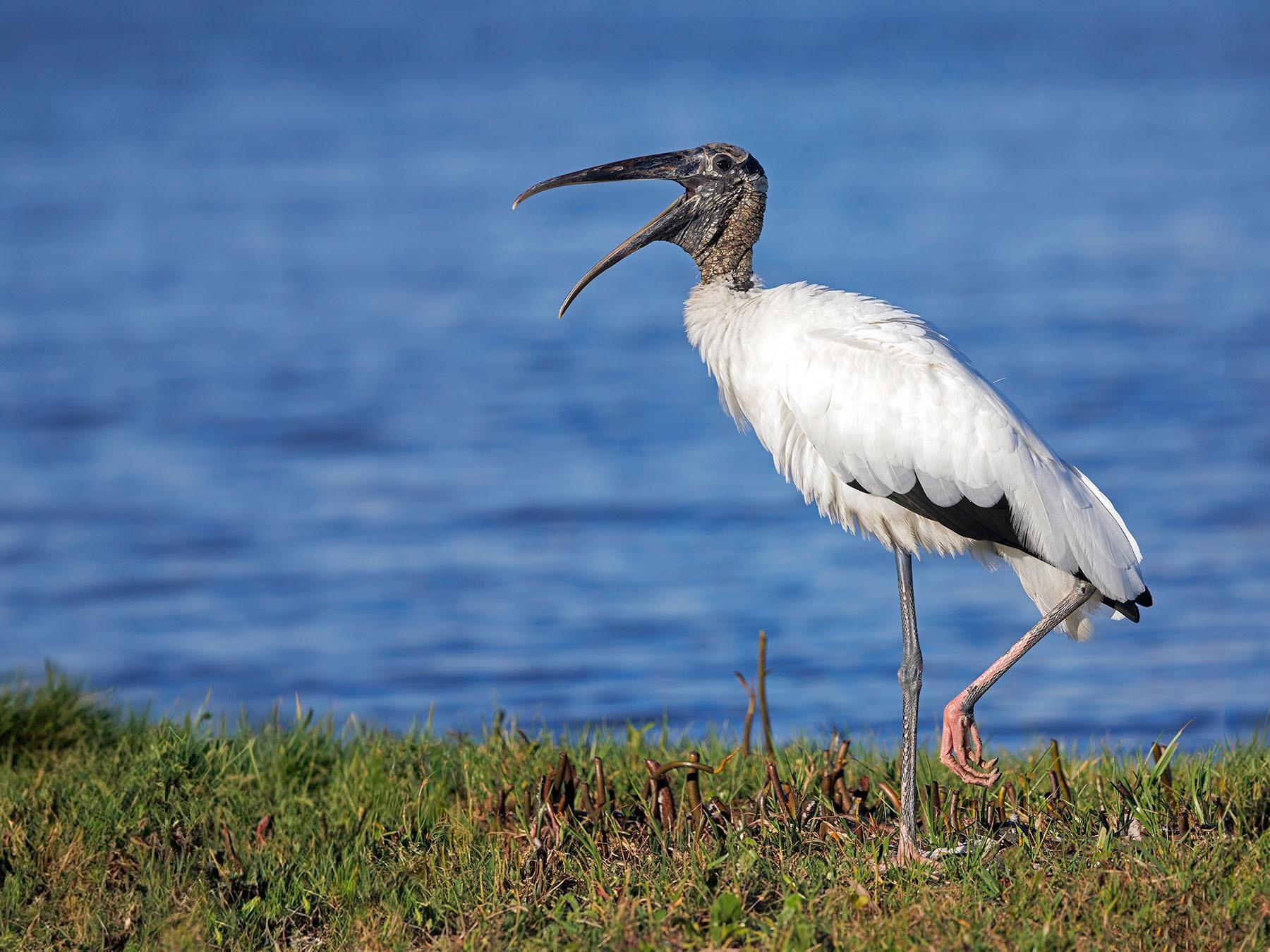
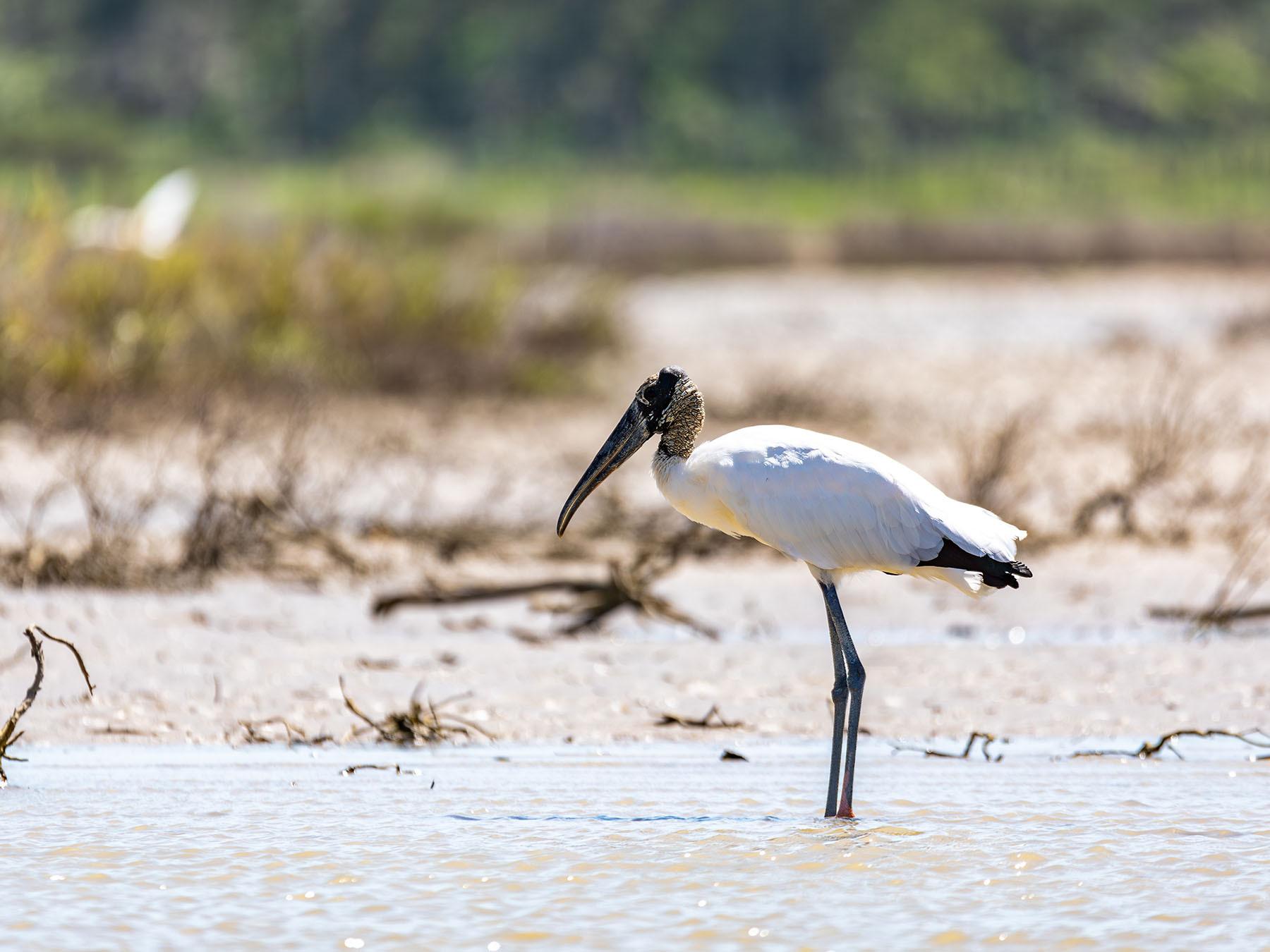
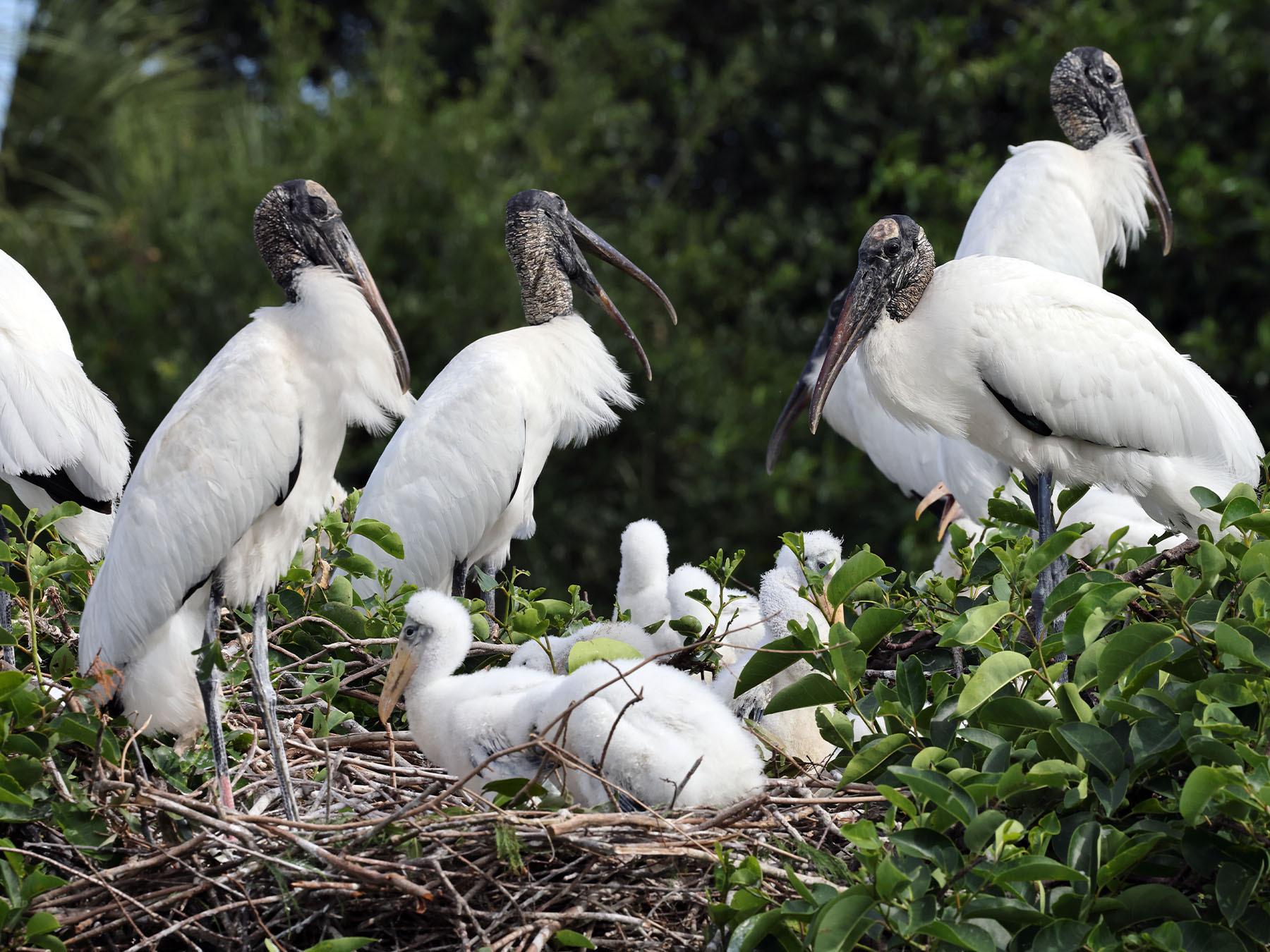
An adult is a big white wading bird with a bare, dark gray, scaly head and upper neck. Its long black bill is very thick at the base and curves down toward the tip. The flight feathers and the short tail are black, with a green and purple gloss.
It stands on long legs and often perches with its neck drawn in, which gives it a hunched look.
In the breeding season the toes turn pink, sometimes most of the way up the leg, the feathers under the tail grow long and plume-like, and a salmon-pink band shows on the underwing. Outside the breeding season the toes fade to pinkish.
Seen close, the bare skin of the head and upper neck is covered in raised grayish scales. A band of smooth black skin about 1.6–2 in (4–5 cm) wide crosses the back of the head, and the crown is a single smooth gray-tan plate.
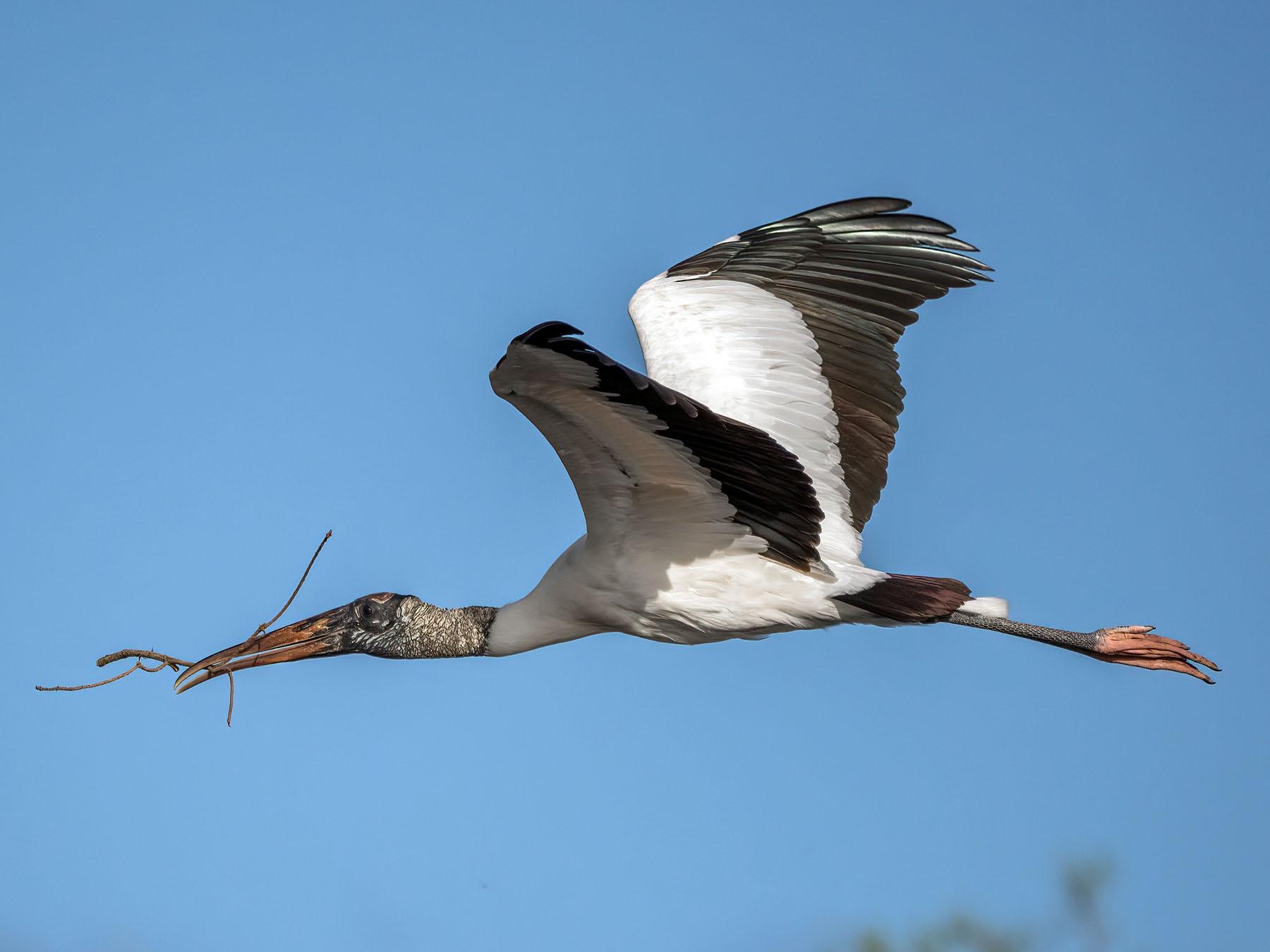
A standing bird is hard to mistake for anything else in its range. In flight look for a white body and underwing with all the flight feathers black, the neck stretched out and the long legs trailing beyond the tail.

Size and weight
It stands 33–45 in (85–115 cm) tall, and the same figures are often given as its length. The wingspan is 59–65 in (150–165 cm).
Males are heavier. In the ranges published from two studies, females weighed 4.5–4.8 lb (2.05–2.18 kg) and males 6.0–6.8 lb (2.70–3.09 kg); sample sizes are not given.1
Male, female and young
Males and females look alike. Males are slightly larger, with a heavier, longer bill.
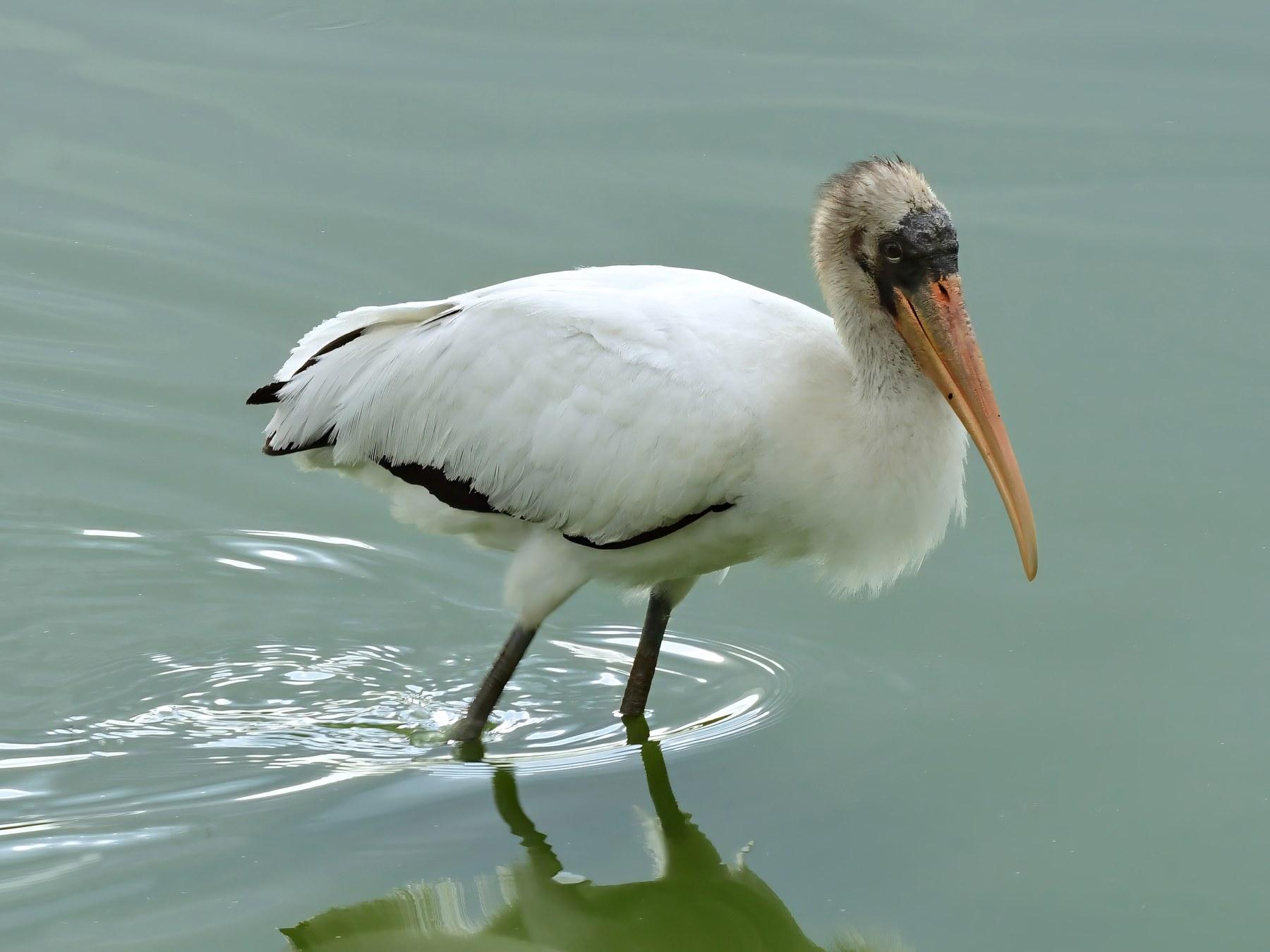
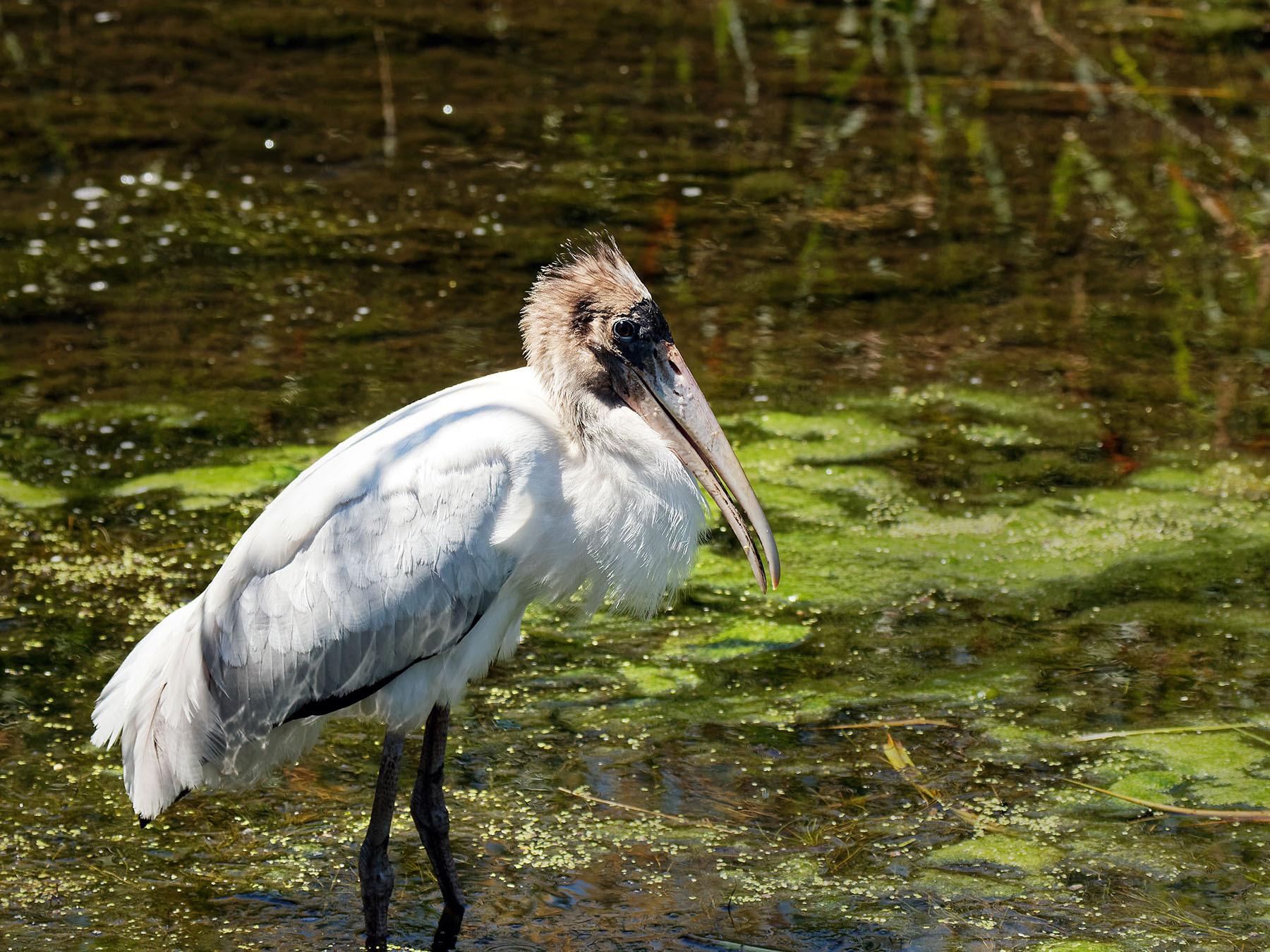
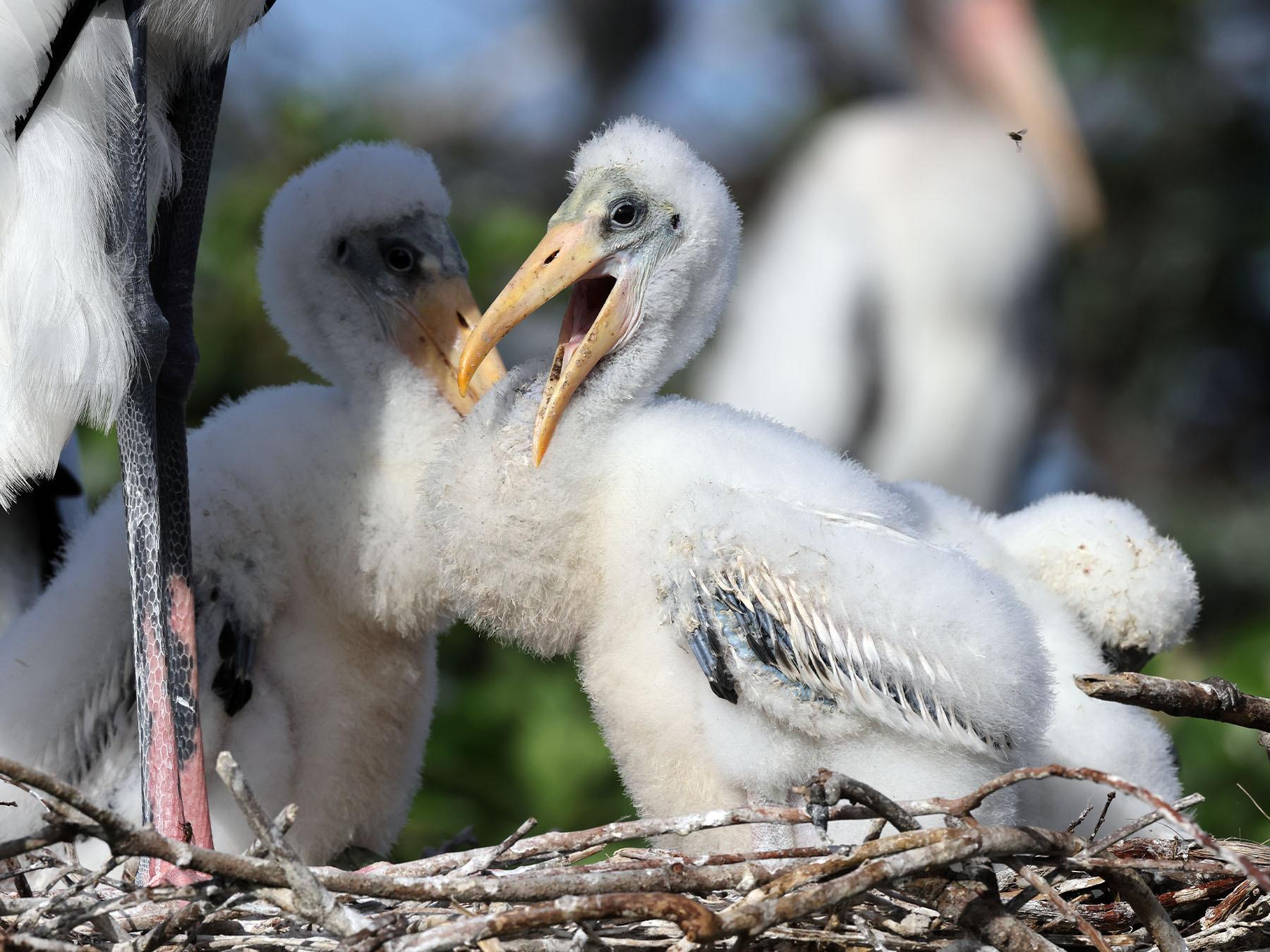
Young birds are easy to tell from adults. A juvenile has a feathered gray to gray-brown head and neck and a yellowish bill, and its body is a duller white, with black-brown flight feathers. First-year birds have an all straw-yellow bill and are known as “yellow-bills.”
The head feathers are lost and the bill darkens gradually over about three to four years. By two years old most of the upper third of the neck is already bare, though the scaly skin is less well defined than an adult's, and full adult plumage comes by the fourth calendar year at the latest.
Identification: similar birds
Most confusion comes in flight, with other big white birds that show black in the wings.
A White Ibis also flies with its neck out, but it is much smaller, 22–27 in (56–68 cm) long, with a pink, strongly down-curved bill and a bare pink to red face. In flight it shows black only at the wingtips, not along the whole trailing edge of the wing.
An American White Pelican also soars in flocks with black in the wings, but the black is only on the primaries and outer secondaries. Its tail is white, its legs do not trail beyond the tail, and it flies with its head drawn back over its huge bill.
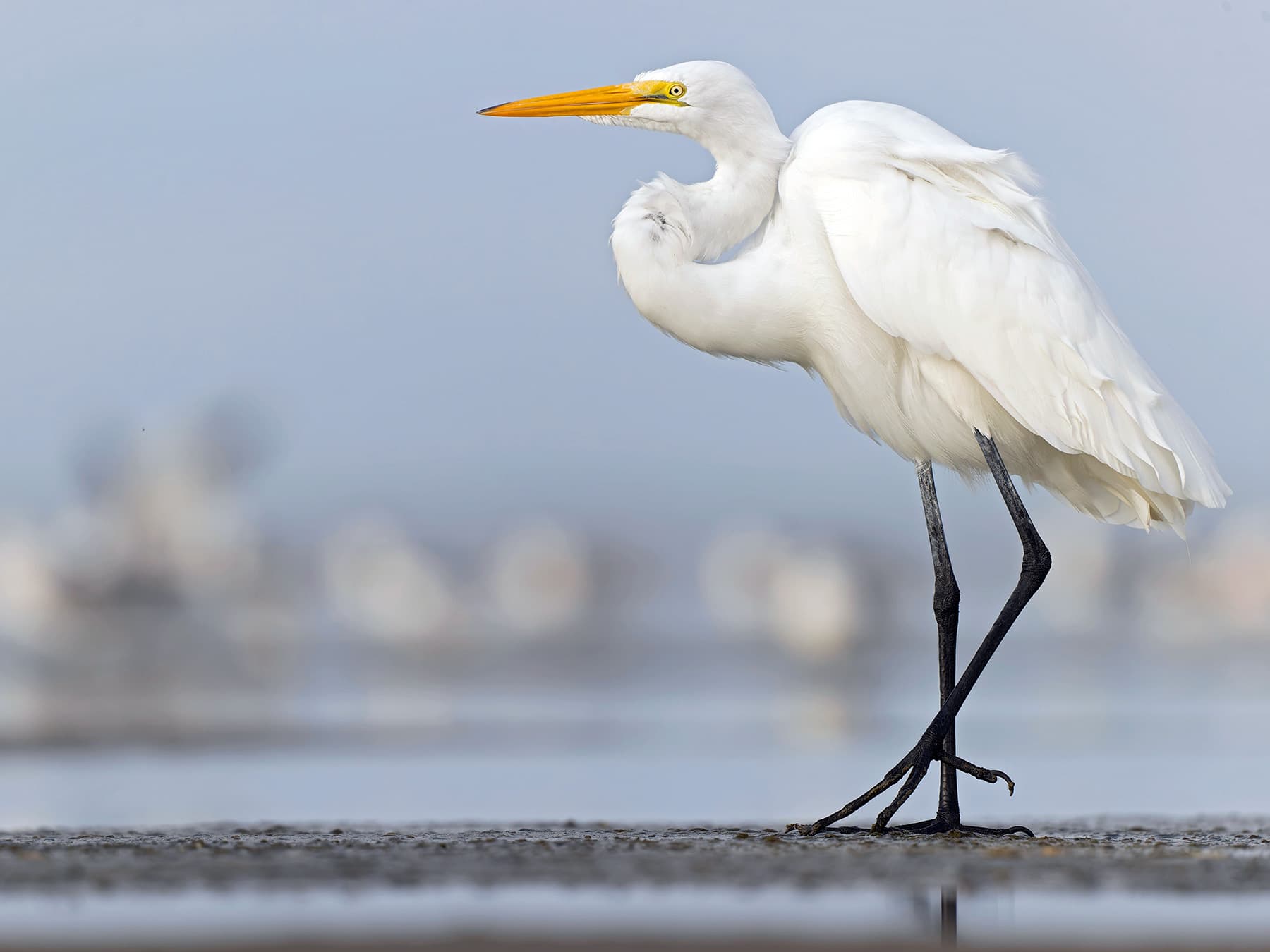
A Great Egret is all white with no black in the wings. It has a slim, dagger-like bill, yellow outside the breeding season, black legs and an S-shaped neck, which it folds when flying, as herons and egrets do.
A Whooping Crane is taller, nearly 5 ft (1.5 m), with a red crown and a white head and neck, and only its primaries are black. A Jabiru is a much larger stork, 48–55 in (122–140 cm) long, with white wings and tail and a bare black head and neck with a red band at the base. It is a rare visitor to the US, mostly to Texas.
Not sure it’s a Wood Stork? Check your photo: Birdfact names the bird and shows the look-alike side by side.
Its size
Adults- Length
- 85–115 cm
- Wingspan
- 150–165 cm
- Weight
- 2050–3090 g
Its song and calls
Adults are usually silent away from the nest. At the nest they clatter and snap their bills in courtship, mating and nest defense. Now and then they give a low, airy, rasping sound that recalls a Turkey Vulture.
Chicks are noisy. They beg with a nasal, braying nyah, and the begging of many chicks together carries hundreds of yards from a colony. At about two weeks old they add a loud, nasal wonk. Distressed young give a short, hiccuping call, and young birds taking flight give a loud, goose-like call of three syllables.
Storks coming back to a colony often drop from over 1,600 ft (500 m) in circling glides, or sometimes in steep dives, rolling from side to side, and the air rushing through their wings makes a loud sound.1
The recording on this page was made in Florida in July beside a recently fledged young bird, as other storks flew in.
- Calls of a young bird0:00 / 0:47
Recorded in Florida, United States · July 2020
Heard one and not sure? Let the bird song identifier listen.
When and where to see it
It lives from the southern United States through Mexico, Central America, Cuba and Hispaniola to northern Argentina. It is the one stork that breeds in the US, where it nests in Florida and Georgia and in North and South Carolina.
Look for it in shallow fresh and salt water: marshes, swamps, ponds, ditches, flooded fields, tidal creeks and managed impoundments. It usually feeds where the water is less than 20 in (50 cm) deep, often 4–12 in (10–30 cm).
Colonies are in forested wetlands, fresh or coastal: cypress and mixed swamps, mangroves and islands. Trees standing in water are thought to keep raccoons and other mammals away. It also nests in places people have made or changed, such as impoundments, islands of dredged material and wetlands built to treat wastewater, and at a zoo and an alligator farm in Florida.
In 2022 there were 51 active colonies in Florida, 28 in South Carolina, 22 in Georgia and 5 in North Carolina.2
The breeding range has shifted north. Before the early 1970s more than three-quarters of US nesting pairs were in south Florida, south of Lake Okeechobee. By the late 1980s more than half nested from central Florida through Georgia and coastal South Carolina.1 Modern nesting began in Georgia in 1976 and in South Carolina in 1981, and reached North Carolina in 2005.3
Do they migrate?
Not in the usual sense. Florida birds are present all year. After breeding, many storks of all ages spread north and along coasts and rivers from late May, then move south in late fall, and northern birds mostly retreat to Florida and south Georgia in midwinter.
Florida's Everglades held many storks outside the nesting colonies in the late 1980s. In 1985–89, peak counts in the Water Conservation Areas were 1,233–7,874 storks in February or March, significantly higher in dry years, and most were non-breeders.4
Satellite tracking found that home ranges varied greatly between birds and between years, which the US Fish and Wildlife Service reads as no set migration pattern.3 Of nestlings color-marked in two Everglades colonies in 1974–79, all those reported outside Florida were seen between May 12 and August 18, in Georgia and South Carolina; one sighting came from Alabama and two birds together from Mississippi. Young birds from two central Florida colonies were reported in Georgia between July 6 and November 10.1
Storks seen in Texas, Louisiana, the lower Mississippi Valley and the West, such as at the Salton Sea in summer, are thought to come from Mexico rather than from the Southeast's colonies. In Arkansas, where it does not breed, it has been recorded in 34 of the 75 counties, mostly in August and September; records fell in the mid-1900s and have risen since 2000.5
Wanderers have turned up as far away as British Columbia, Idaho, Montana, northern California, Colorado, Nebraska, Michigan, Illinois, New York, Maine, Massachusetts, southern Ontario and New Brunswick. It travels by soaring on thermals, and the lack of thermals over the sea may limit its movement from Florida to the Caribbean islands.
Tips for seeing it
What it eats
Mostly fish, generally the larger ones on offer, and mostly fish at least a year old. It also takes crayfish, shrimp, crabs, tadpoles and frogs, insects, snakes and small alligators, and occasionally young birds and small mammals. Sunfish are important prey in the US, though as of 1999 it was uncertain whether storks prefer them or whether something about the fish or the wetlands explains it.
It feeds mainly by touch. It wades slowly with its bill open about 3 in (7–8 cm) and dipped in the water, sweeping it from side to side until it touches prey. The bill then snaps shut in about 25 milliseconds: 25.08 ms on average in 25 trials with two birds.1 A US Fish and Wildlife Service profile counts it among the fastest reflexes known in vertebrates.6
Because it hunts by feel, it can feed in muddy water and at night. In captivity, storks with their vision blocked fed just as efficiently as storks that could see.1 It also stirs the bottom with a foot and flicks one wing open over the water.
Mosquitofish are abundant but taken relatively rarely, perhaps because fish that small do not set off the snap.


Diet and falling water
It breeds when wetlands are drying down, because falling water concentrates fish. In south Florida, when the rains come before the young fledge, the prey scatters and the young do not survive.
Parents may fly a long way to feed. Birds of the World gives feeding flights of 6–31 miles (10–50 km) from south Florida colonies, and the US Fish and Wildlife Service 6–46 miles (10–74 km). Both put most at 16–31 miles (25–50 km), and flights of up to 60–81 miles (97–130 km) have been recorded.1, 3 In north Florida (4 tracked storks) and east-central Georgia (130 flights), flights averaged about 7.5–8 miles (12–13 km).1
A nesting pair and its young are estimated to need about 440 lb (200 kg) of fish in a season, based on an average of 2.25 young raised per nest.6 Energy studies from the 1960s put an adult of about 5.5 lb (2.5 kg) at roughly 1.1 lb (520 g) of food a day, and a chick at about 36 lb (16.5 kg) in all before it flies. The chick figure comes from the food eaten by captive young.1
Diet studies
In the Everglades in 1974, flagfish made up 32% of 1,952 prey items by number, sailfin mollies 20% and marsh killifish 18%. Sunfish were 14% by number but 44% by weight. Prey averaged 1.6 and 2.1 in (41 and 54 mm) long at two colonies.1
Nestlings in east-central Georgia were fed mostly sunfish, 74% of 304 items and 54% by weight, and their prey averaged 3.3 in (84.7 mm).1 Studies in south Florida since 2013, summarized by the US Fish and Wildlife Service, found spotted sunfish the most common prey (53%) and African jewelfish next (26%).3
In Georgia, feather chemistry showed that some coastal parents fed their chicks freshwater prey even with saltwater food close by.7 Chicks from inland colonies in Georgia and South Carolina generally carried more mercury than coastal ones in 1996–99, which the authors suggest is linked to feeding in fresh water.8
A study of roadside created wetlands found that prey biomass in permanently flooded ponds and canals was 9 times that of natural wetlands. The authors say these may give storks, often seen by roads, extra feeding habitat.9 In Georgia, in a dry year with little prey, storks were seen eating cow and bison dung.1
Nesting and breeding
It nests in colonies, often mixed with Anhingas, Great Egrets and Great Blue Herons, with nests often within 3 ft (1 m) of each other. Colonies range from a few nests to over 1,000, and most in the US in recent years have held 50–400.3
Timing depends on place. In south Florida colonies start from November to March, mostly from January to March since the 1970s. In north Florida, Georgia and the Carolinas they start from about February to May. In Florida eggs have been found from October to June. South Florida storks began breeding later after water flows there were altered in the 1950s and early 1960s.
The nest is a large, bulky platform of sticks, 3–5 ft (1–1.5 m) across, lined with green leaves and with no clear cup. It is built anew each year, high in trees over water or on islands. Nests may be 10–15 ft (3–4.6 m) above water in mangroves, and 80 ft (24 m) or more up in cypress.
Males bring most of the sticks: about twice as many trips as females in Georgia, and 90% of 41 trips at a Florida site, where they also stole twigs from neighbors.1
Eggs and chicks
A clutch is usually 3 creamy white eggs, from 1 to 5, each about 2.7 by 1.8 in (68 by 46 mm). In 3,024 Florida nests, clutches averaged 3.06 eggs.1
Both parents incubate, almost equally, for about four weeks, 27–32 days. Incubation starts with the first egg, so the chicks hatch at different times.
Chicks are covered in white down, with bare yellowish-gray faces and yellow bills. One parent stays at the nest until the chicks are about three weeks old; after that both go to feed. On hot days the parents shade the chicks with their wings and pour water over them.
The young make their first flights at about 50–55 days but come back to the nest to be fed for another 15–30 days. Pairs raise one brood a season, though a pair that fails early may try again. Most breed for the first time at about four years old.
Nesting success
Success swings with the water. Colony fledging rates range from total failure to over 2.5 young per nest in the best conditions. Nesting in peninsular Florida and inland, and in south Florida in particular, is boom or bust, while colonies on the Georgia and Carolina coast are steadier because tidal marshes and impoundments supply food more reliably.3
In central and north Florida in 1981–85, nests raised 1.29 young on average and successful nests about 2. Most losses came before hatching and in the first two weeks.1, 10 In the same region in 2003–05, fledging success was most closely linked to rainfall over the previous one to two years.11
Cold, wet spells can make storks abandon their nests. In April 1985 one such spell caused 28% of nests at one Florida colony and 46% at another to fail.1
Behaviour
It is a sociable bird. It nests in colonies, often feeds in groups and lines in open wetlands, and flocks soar together. In east-central Georgia, groups at feeding sites ranged from 1 to 171 birds, with a median of 2.1
It flies with its neck and legs stretched out, flapping about 177 times a minute or soaring. On warm days it climbs on thermals to 3,300 ft (1,000 m) or more and then glides for a few miles. Soaring was estimated to cost about a tenth of the energy of flapping.1
It walks rather than hops and sleeps standing on one leg. In hot weather it cools off by spreading its wings and squirting liquid droppings on its legs. Great Blue Herons, Great Egrets and Brown Pelicans sometimes follow storks as they feed, probably to catch fish the storks disturb.
After breeding, some storks fed more at night at inland impoundments. At a coastal roost fewer birds stayed during low tides at night, presumably because they had left to feed in the draining creeks.12
Nests are sometimes taken over. In two Palm Beach County colonies, other storks took over 32% of the monitored pairs' nests, mostly early in incubation and more often for late breeders.13
Lifespan and predators
The US Fish and Wildlife Service gives a life span of 10–18 years, “possibly over 22,” noting that storks aged 10–18 are often seen by their bands.3
The oldest on record was at least 22 years 4 months old. It was banded as a chick in Georgia on June 3, 1994, and seen alive in Florida, identified by its color marker, in November 2016.14
Adult survival is estimated at 0.86 a year. First-year survival is far lower and varies: 0.29 for satellite-tagged juveniles in one study,3 and 44% in 2002 against 6% in 2003 in another.15
Predators
Eggs and chicks are taken mainly by raccoons, especially when the water dries up under the nest trees. Crows occasionally take eggs or small chicks, especially when people flush the adults off the nest, and Turkey and Black Vultures may take them at unattended nests. Alligators below a colony may keep raccoons away. Adults are less vulnerable.
In Florida, raccoons caused 32% of nest failures on average, from none to 90% between years.1
People cause losses too. Boat landings and picnicking, with crows taking eggs at one site, caused nest losses at two Florida colonies in 1985. Researchers recommended keeping at least 200 ft (60–65 m) from nests and 330 ft (100 m) from feeding sites, and buffer zones of up to about 1,000 ft (300 m) around colonies have also been recommended.1
Conservation
Worldwide it is rated Least Concern on the IUCN Red List.16 Its world population is uncertain. Partners in Flight's best guess is 450,000 breeding-age birds, from 2001–2011 data,17 while older estimates quoted by the US Fish and Wildlife Service are 50,000–100,000 storks for South America and, for Central and North America together, 64,000–92,000 breeding adults.
In the US it has recovered from a steep decline. The population in the 1930s was probably 15,000–20,000 breeding pairs, and about 10,000 pairs in 1960. It was at its lowest, 2,700–5,700 pairs a year, in 1977–80. The smallest, about 2,700 pairs in 1978, came in a severe drought when many storks probably did not breed.18
South of Lake Okeechobee, where most of the population once nested, pairs fell from about 8,500 in 1961 to fewer than 500 in the late 1980s.3 The decline is generally put down to the loss of wetlands and to drainage, canals and levees that changed south Florida's water flows and reduced the fish that colonies need.
US nest counts rose by about 153 pairs a year from 1974 to 2019, and by about 344 pairs a year in the five-year averages for 2010–2019. Averaged over the survey years to 2022 (four, as no full survey was possible in 2020), the US breeding population was about 11,200 nesting pairs.2 Yearly counts in 2013–22 ran from about 8,700 to 12,450 pairs.3
The North American Breeding Bird Survey shows no clear long-term change: 0.00% a year from 1966 to 2025 (95% credible interval −2.24 to +1.31), on 181 routes. By state, it shows a clear rise in Georgia, +2.4% a year, and no clear trend in Florida.19
Everglades restoration aims for 1,500–2,500 nesting pairs in the mainland Everglades, a target the US Fish and Wildlife Service says is frequently achieved, and 6,452 pairs nested in south Florida in 2009.2 Birds of the World's account, written in 1999, says the south Florida decline made the stork a focus of attention as a sign of how well the Everglades and similar shallow wetlands are doing.
NatureServe ranks it apparently secure worldwide and imperiled in Florida and South Carolina. These are conservation ranks, not legal status.20
Legal status
The US breeding population was taken off the federal list of threatened and endangered wildlife, as recovered, by a rule that took effect on March 12, 2026. It had been listed under the Endangered Species Act in 1984, as endangered, after a decline of more than 75% over about 50 years from the 1930s,2 and reclassified as threatened in 2014.18
The rule says the recovery plan's first criterion, 10,000 nesting pairs averaged over five years, has been reached since 2016. Breeding success in the South Breeding Region, the Everglades and Big Cypress, stayed below the plan's target of 1.5 chicks per nest, and the rule concludes that the essential intent of that goal has still been achieved.2
The rule also says Endangered Species Act protections no longer apply to this population, that the US Fish and Wildlife Service will monitor it for at least 10 years, and that delisting does not mean no threats remain.2
It is still protected under the Migratory Bird Treaty Act. It is on the federal list of migratory birds, and the 2026 rule says delisting does not change that.21, 2 In Mexico it is listed under special protection (Pr) on the 2019 list of species at risk.22 We had not confirmed its current status on state lists when this page was written in November 2026.
Similar birds
Often mistaken for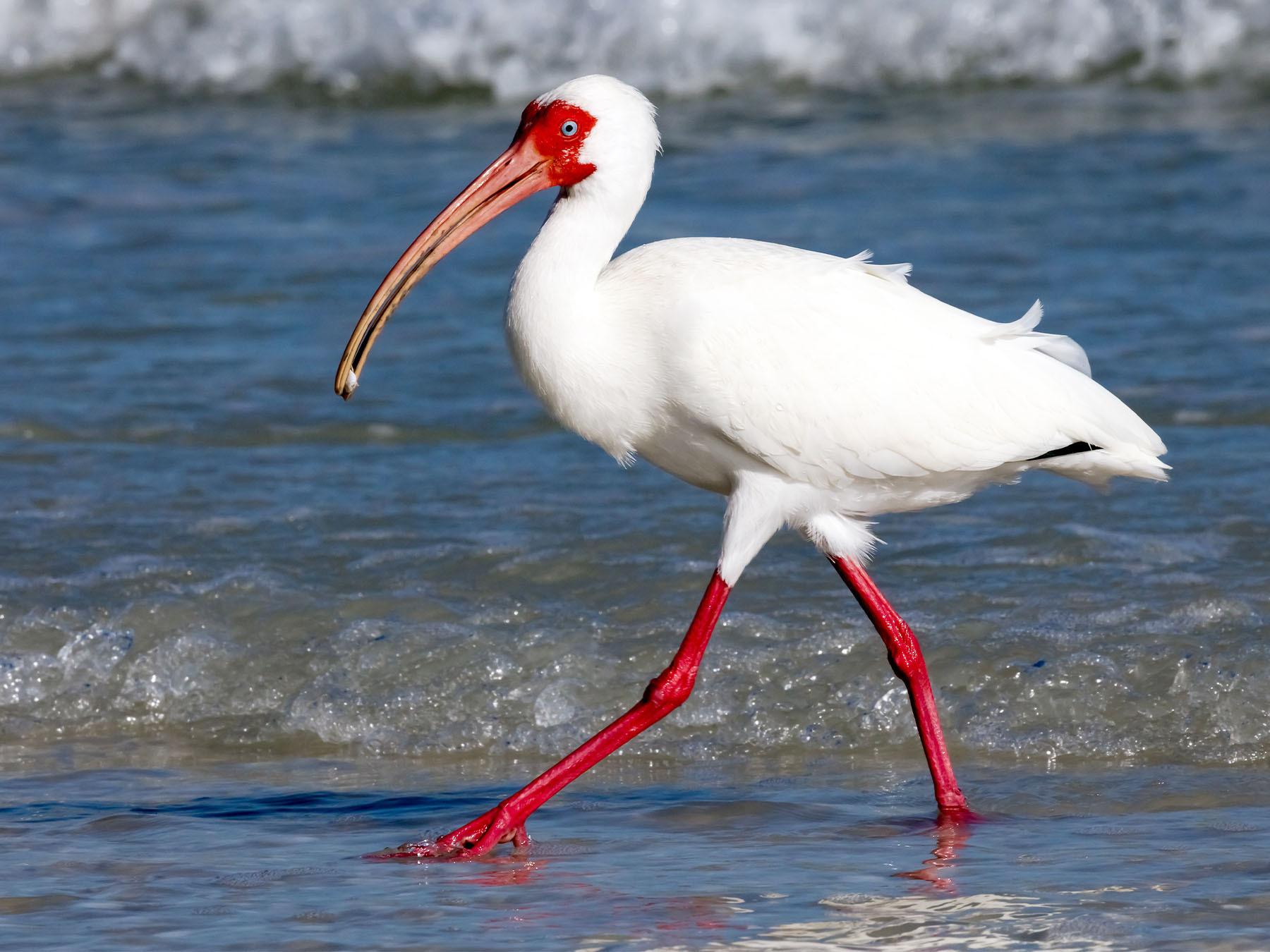
Quick facts
- Length
- 85–115 cm
- Wingspan
- 150–165 cm
- Weight
- 2050–3090 g
- Lifespan
- oldest recorded 22 years 4 months
- Family
- Storks
- Migration
- Partial migrant
- Global status (IUCN)
- Least Concern
- World population
- US breeding population about 11,200 nesting pairs (USFWS moving average to 2022, four survey years); world population uncertain (Partners in Flight best guess 450,000 breeding-age birds)
- Population trend
- Stable in the Breeding Bird Survey (no clear change since 1966), while US Fish and Wildlife Service nest counts have risen from a late-1970s low to about 11,200 pairs; the US breeding population, judged recovered, was taken off the federal list of threatened and endangered wildlife in 2026
- Also called
- Wood Ibis, Flinthead, Ironhead
- Scientific name
- Mycteria americana
Questions
3Is it an ibis?
No, it is a stork. An older English name is Wood Ibis, the name used in Bent's 1926 handbook, said to come from its blunt-tipped, down-curved bill. Regional names include Flinthead and Ironhead, which reflect its striking look.
Are wood storks rare?
Not in Florida, where it is present all year and nested in 51 colonies in 2022, or in Georgia and the Carolinas, where it also nests. Elsewhere in the US it is mostly a summer and fall wanderer. The US breeding population averaged about 11,200 nesting pairs in the years to 2022, up from a low in the late 1970s; see conservation for the numbers.
Do they mate for life?
Apparently not. Pairs seem to stay together for one breeding season only.
Sources
40- 1Coulter, M. C., Rodgers, J. A., Jr., Ogden, J. C. and Depkin, F. C. (2020). Wood Stork (Mycteria americana), version 1.0. Birds of the World (A. F. Poole and F. B. Gill, editors). Cornell Lab of Ornithology. doi:10.2173/bow.woosto.01 (opens in a new tab)
- 2U.S. Fish and Wildlife Service (2026). Endangered and Threatened Wildlife and Plants; Removal of the Southeast U.S. Distinct Population Segment of the Wood Stork From the List of Endangered and Threatened Wildlife (final rule). Federal Register 91 FR 5826, 10 Feb 2026, document 2026-02588. Accessed 20 November 2026. Source (opens in a new tab)
- 3Brooks, W. B. and Bryan, A. L. (2025). Species Status Assessment Report for the Wood Stork (Mycteria americana), Version 1.1. U.S. Fish and Wildlife Service, Southeast Region, Atlanta. Accessed 20 November 2026. Source (opens in a new tab)
- 4Bancroft, G. T., Hoffman, W., Sawicki, R. J. and Ogden, J. C. (1992). The Importance of the Water Conservation Areas in the Everglades to the Endangered Wood Stork (Mycteria americana). Conservation Biology 6: 392-398. doi:10.1046/j.1523-1739.1992.06030392.x (opens in a new tab)
- 5Tumlison, R. and Serviss, L. (2024). History and Distribution of the Wood Stork (Mycteria americana) in Arkansas. Journal of the Arkansas Academy of Science 78. doi:10.54119/jaas.2024.7806 (opens in a new tab)
- 6U.S. Fish and Wildlife Service. Wood stork (Mycteria americana), species profile 8477. ECOS Environmental Conservation Online System. Accessed 20 November 2026. Source (opens in a new tab)
- 7Romanek, C. S., Gaines, K. F., Bryan, A. L. and Brisbin, I. L. (2000). Foraging ecology of the endangered wood stork recorded in the stable isotope signature of feathers. Oecologia 125: 584-594. doi:10.1007/s004420000471 (opens in a new tab)
- 8Gariboldi, J. C., Bryan, A. L. and Jagoe, C. H. (2001). Annual and regional variation in mercury concentrations in wood stork nestlings. Environmental Toxicology and Chemistry 20: 1551-1556. doi:10.1002/etc.5620200719 (opens in a new tab)
- 9Evans, B. A., Klassen, J. A., Gawlik, D. E. and Gottlieb, A. D. (2023). Factors Influencing Wood Stork Prey Biomass in Roadside Created Wetlands. Southeastern Naturalist 22: 1-20. doi:10.1656/058.022.0101 (opens in a new tab)
- 10Rodgers, J. A. and Schwikert, S. T. (1997). Breeding success and chronology of Wood Storks Mycteria americana in northern and central Florida, U.S.A.. Ibis 139: 76-91. doi:10.1111/j.1474-919x.1997.tb04506.x (opens in a new tab)
- 11Rodgers, J. A., Brooks, W. B. and Barrett, M. (2012). Productivity and Habitat Modeling of Wood Storks Nesting in North and Central Florida. Journal of Fish and Wildlife Management 3: 252-265. doi:10.3996/022012-jfwm-016 (opens in a new tab)
- 12Bryan, A. L., Jr. et al. (2001). Nocturnal Activities of Post-breeding Wood Storks. The Auk 118: 508-513. doi:10.1093/auk/118.2.508 (opens in a new tab)
- 13Bruant, A., Picardi, S., Frederick, P. and Basille, M. (2020). Effect of Foraging and Nest Defense Tradeoffs on the Reproductive Success of Wood Storks (Mycteria americana). Waterbirds 43: 134-146. doi:10.1675/063.043.0202 (opens in a new tab)
- 14USGS Bird Banding Laboratory (2026). Longevity records of North American birds: Wood Stork (AOU 1880). USGS Patuxent Wildlife Research Center, Bird Banding Laboratory. Accessed 20 November 2026. Source (opens in a new tab)
- 15Hylton, R. A., Frederick, P. C., De La Fuente, T. E. and Spalding, M. G. (2006). Effects of Nestling Health on Postfledging Survival of Wood Storks. The Condor 108: 97-106. doi:10.1093/condor/108.1.97 (opens in a new tab)
- 16BirdLife International (2025). Mycteria americana. The IUCN Red List of Threatened Species 2025. IUCN Red List, via the GBIF IUCN Red List checklist dataset. Accessed 20 November 2026. Source (opens in a new tab)
- 17Partners in Flight (2024). Avian Conservation Assessment Database, global, version 2024.05.23. Bird Conservancy of the Rockies. Accessed 20 November 2026. Source (opens in a new tab)
- 18U.S. Fish and Wildlife Service (2014). Endangered and Threatened Wildlife and Plants; Reclassification of the U.S. Breeding Population of the Wood Stork From Endangered to Threatened (final rule). Federal Register 79 FR 37078, 30 Jun 2014, document 2014-14761. Accessed 20 November 2026. Source (opens in a new tab)
- 19Hostetler, J. A. et al. (2026). The North American Breeding Bird Survey, analysis results 1966-2025. USGS. Accessed 20 November 2026. Source (opens in a new tab)
- 20NatureServe. Mycteria americana (Wood Stork). NatureServe Explorer (public API). Accessed 20 November 2026. Source (opens in a new tab)
- 21U.S. Fish and Wildlife Service. 50 CFR 10.13: List of Migratory Birds. Electronic Code of Federal Regulations (title 50 issue date 17 Nov 2026). Accessed 20 November 2026. Source (opens in a new tab)
- 22SEMARNAT (2019). Modificación del Anexo Normativo III, Lista de especies en riesgo de la Norma Oficial Mexicana NOM-059-SEMARNAT-2010. Diario Oficial de la Federación, 14 Nov 2019. Accessed 20 November 2026. Source (opens in a new tab)
- 23National Audubon Society. Wood Stork. Audubon Guide to North American Birds. Accessed 20 November 2026. Source (opens in a new tab)
- 24Cornell Lab of Ornithology. Wood Stork: overview, identification and life history. All About Birds. Accessed 20 November 2026. Source (opens in a new tab)
- 25National Park Service (2021). Wood Stork: Species Profile. Everglades National Park. Accessed 20 November 2026. Source (opens in a new tab)
- 26Florida Fish and Wildlife Conservation Commission. Wood Stork (Mycteria americana). FWC species profiles. Accessed 20 November 2026. Source (opens in a new tab)
- 27Florida Natural Areas Inventory (2001). Wood Stork, Mycteria americana (field guide account). Florida Natural Areas Inventory, 2001. Accessed 20 November 2026. Source (opens in a new tab)
- 28AviList Core Team (2025). AviList: The Global Avian Checklist, v2025b. AviList. doi:10.2173/avilist.v2025b (opens in a new tab)
- 29Bent, A. C. (1926). Life Histories of North American Marsh Birds (U.S. National Museum Bulletin 135): Wood Ibis. Internet Archive (lifehistoriesofn0005bent). Accessed 20 November 2026. Source (opens in a new tab)
- 30U.S. Fish and Wildlife Service (2026). Wood Stork Final Post-Delisting Monitoring Plan 2026. U.S. Fish and Wildlife Service. Accessed 20 November 2026. Source (opens in a new tab)
- 31U.S. Fish and Wildlife Service (2023). Proposed rule to remove the Southeast U.S. DPS of the Wood Stork from the List. Federal Register 88 FR 9830, 15 Feb 2023, document 2023-03123. Accessed 20 November 2026. Source (opens in a new tab)
- 32U.S. Fish and Wildlife Service. 50 CFR 17.11: Endangered and threatened wildlife. Electronic Code of Federal Regulations (title 50 issue date 17 Nov 2026). Accessed 20 November 2026. Source (opens in a new tab)
- 33Alfonso-González, M., Llanes-Quevedo, A., Navarro-Sigüenza, A. G. and Espinosa López, G. (2021). Genetic Evidence Documents Extra-Pair Paternity in Breeding Colonies of the Wood Stork Mycteria americana (Ciconiidae) in Cuba. Caribbean Journal of Science 51: 175-183. doi:10.18475/cjos.v51i2.a3 (opens in a new tab)
- 34Heath, J. A., Frederick, P. C., Kushlan, J. A. and Bildstein, K. L. (2020). White Ibis (Eudocimus albus), version 1.0. Birds of the World (A. F. Poole, editor). Cornell Lab of Ornithology. doi:10.2173/bow.whiibi.01 (opens in a new tab)
- 35McCrimmon, D. A., Jr. et al. (2025). Great Egret (Ardea alba), version 2.0. Birds of the World (G. D. Engelbrecht, B. K. Keeney and G. M. Kirwan, editors). Cornell Lab of Ornithology. doi:10.2173/bow.greegr.02 (opens in a new tab)
- 36Van Tatenhove, A. M. et al. (2025). American White Pelican (Pelecanus erythrorhynchos), version 2.0. Birds of the World (N. D. Sly, editor). Cornell Lab of Ornithology. doi:10.2173/bow.amwpel.02 (opens in a new tab)
- 37Urbanek, R. P. and Lewis, J. C. (2020). Whooping Crane (Grus americana), version 1.0. Birds of the World (A. F. Poole, editor). Cornell Lab of Ornithology. doi:10.2173/bow.whocra.01 (opens in a new tab)
- 38Elliott, A., Garcia, E., Kirwan, G. M. and Boesman, P. F. D. (2020). Jabiru (Jabiru mycteria), version 1.0. Birds of the World (J. del Hoyo, A. Elliott, J. Sargatal, D. A. Christie and E. de Juana, editors). Cornell Lab of Ornithology. doi:10.2173/bow.jabiru.01 (opens in a new tab)
- 39van Dort, J. (2022). Maguari Stork (Ciconia maguari), version 2.0. Birds of the World (S. M. Billerman, editor). Cornell Lab of Ornithology. doi:10.2173/bow.magsto1.02 (opens in a new tab)
- 40Lyndsey (iNaturalist anhingas) (2020). Wood Stork fledgling with parent, calls, Florida, 28 July 2020. iNaturalist observation 54671904 (sound 125203). Accessed 20 November 2026. Source (opens in a new tab)

Checked by
Nathan Cope, founder and editor
Nathan founded Birdfact and leads its writers and contributors in the UK, the US and Canada. He has watched and studied birds for more than ten years, and checks every article and species guide before it’s published.