


White Ibis
American White Ibis · Eudocimus albus
By the Birdfact teamChecked by Nathan Cope
On this page14 sections
How to recognise it
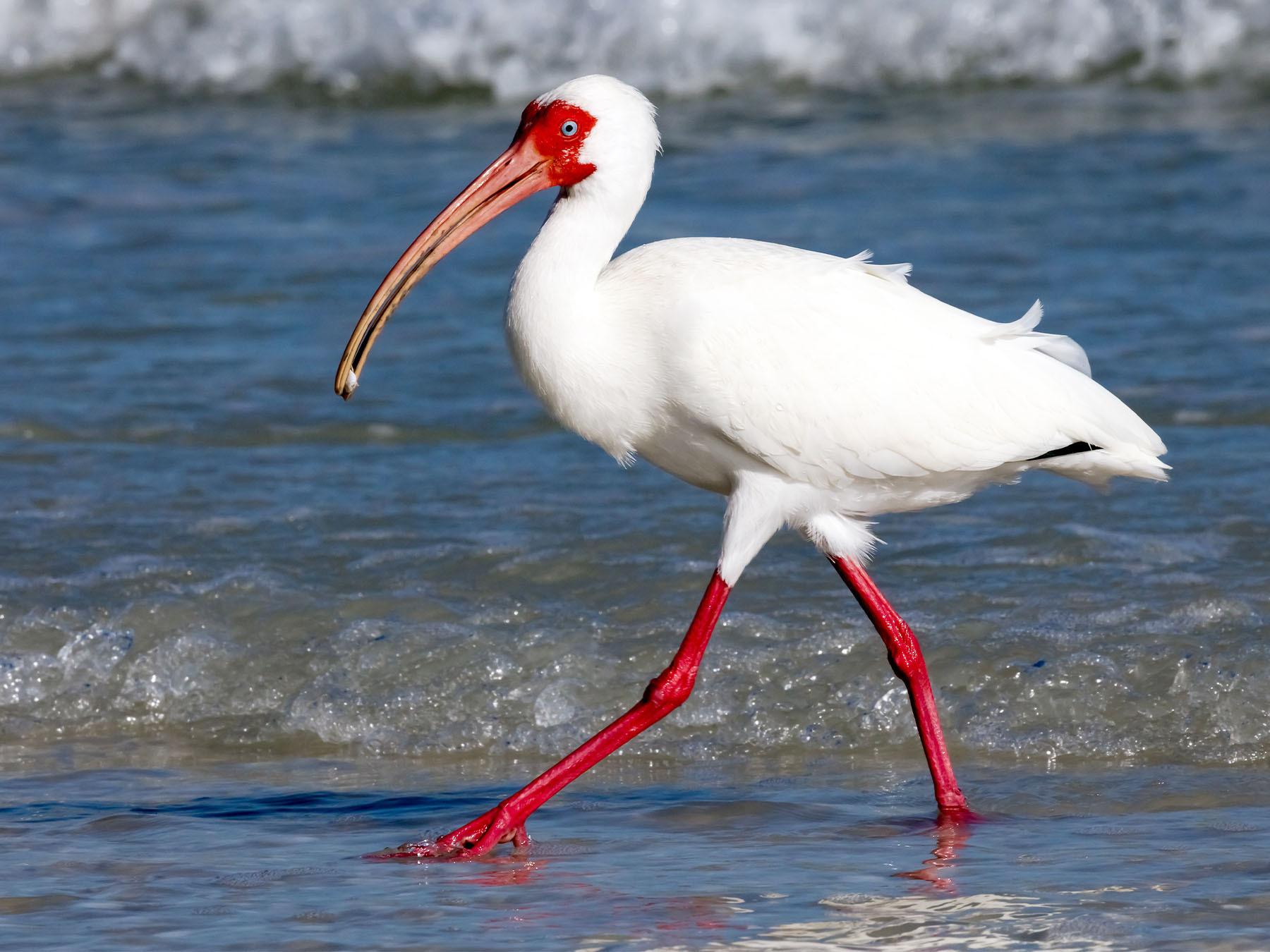
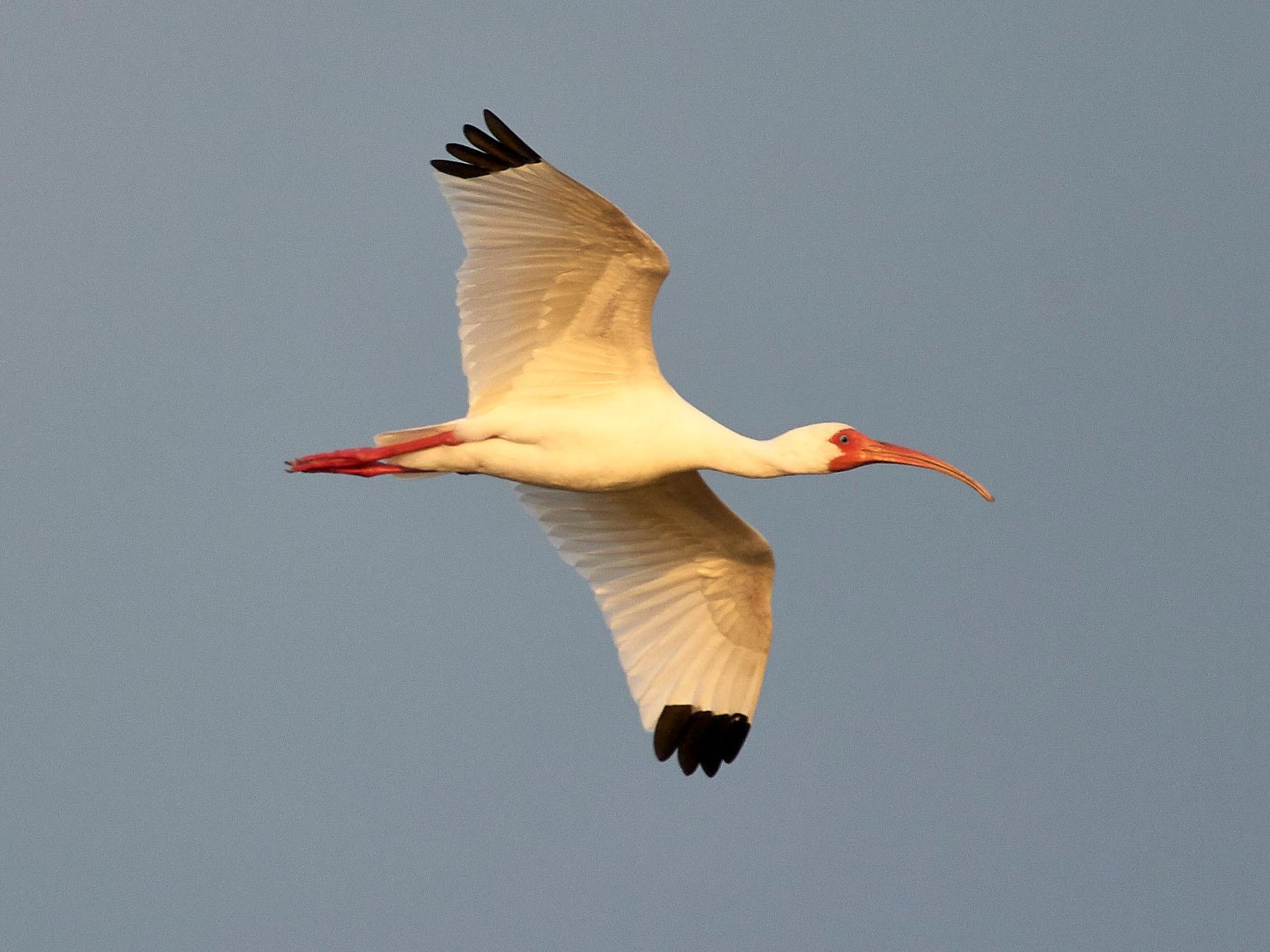
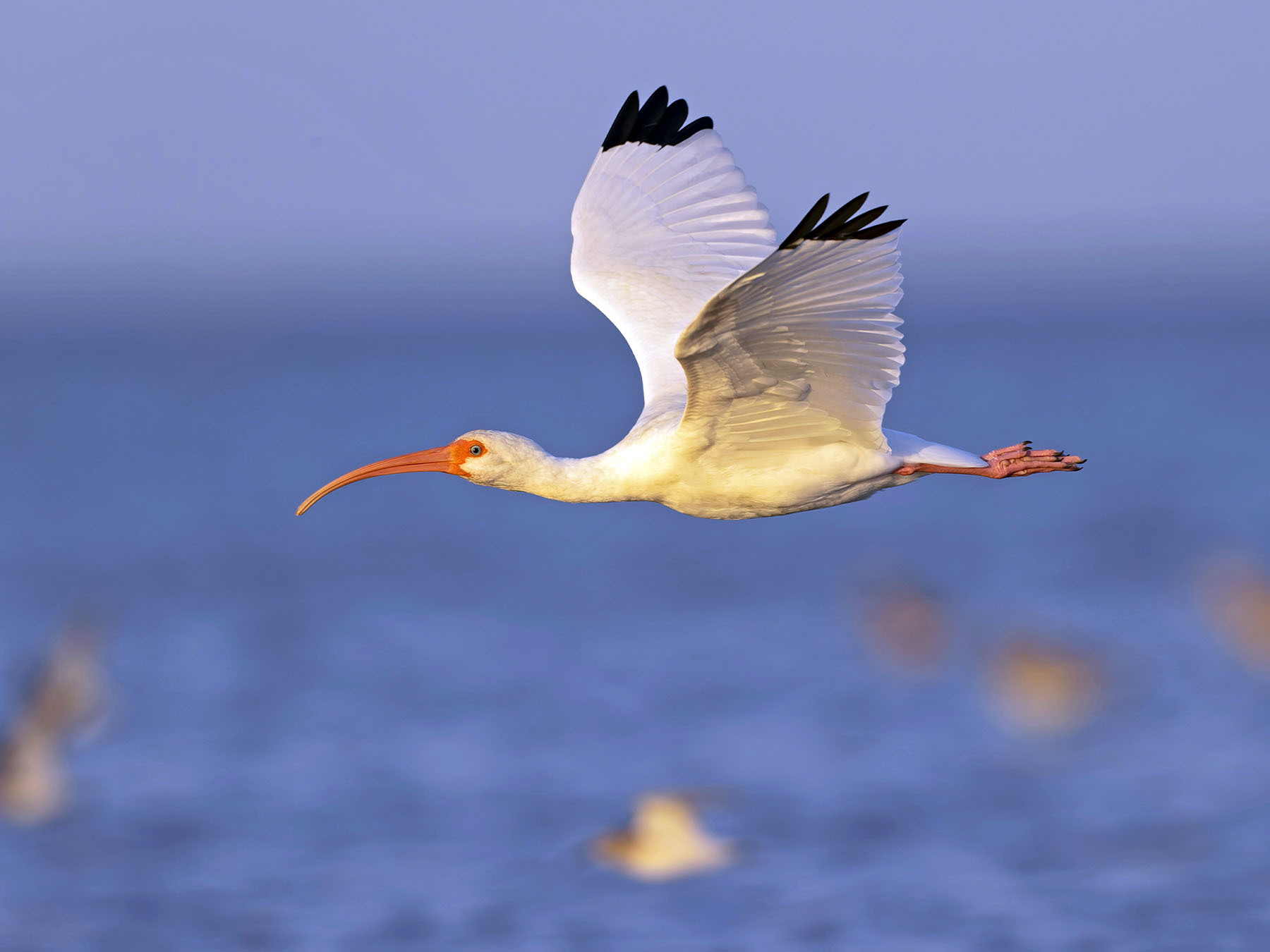
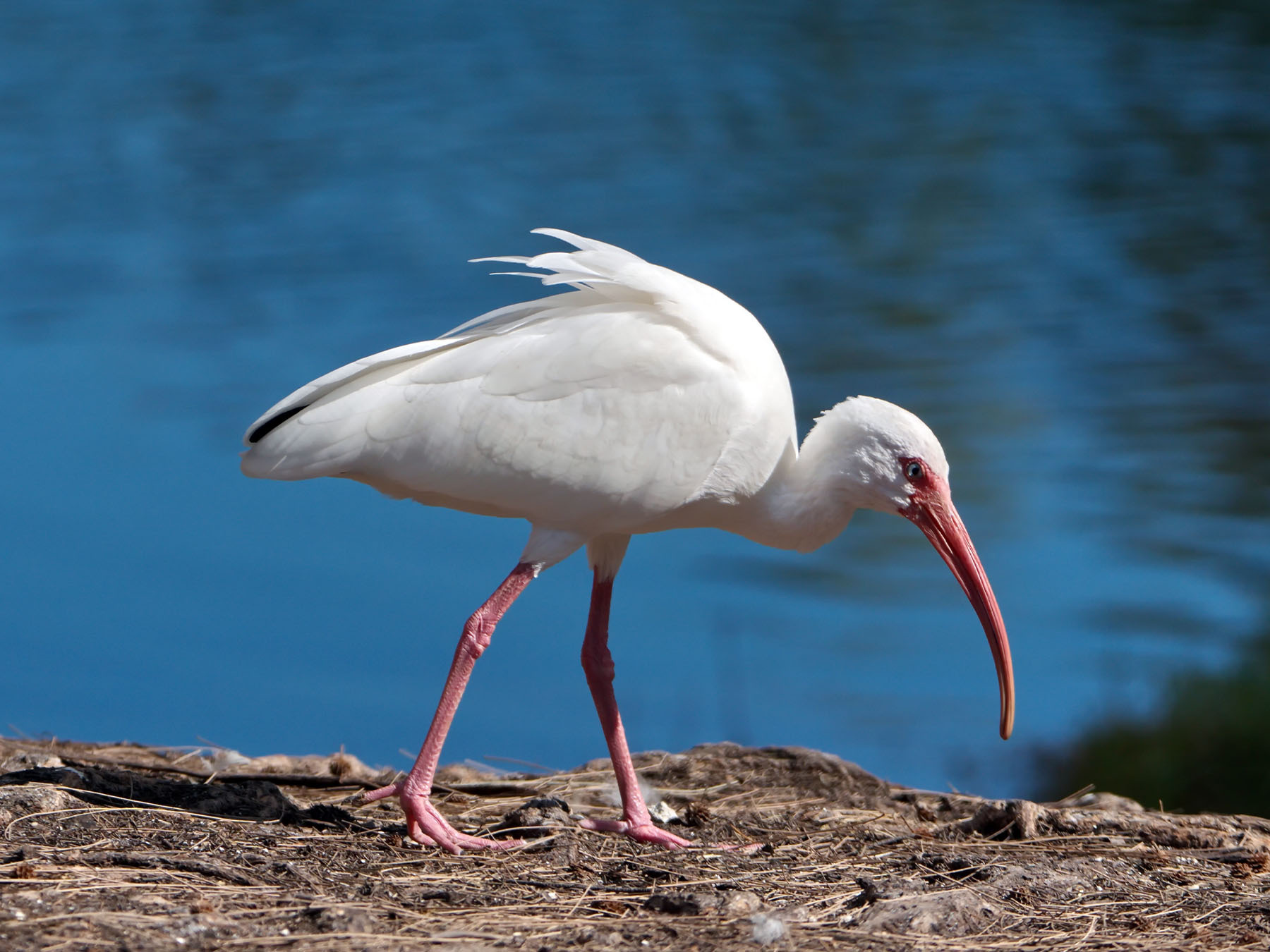
The White Ibis is a crow-sized wading bird with a deep, rounded body, long legs and a long neck that it holds straight out in flight. An adult is white all over except for black wingtips, and has a long, strongly down-curved bill and bare skin on the face and legs. Outside the breeding season the bill is pinkish to salmon and the bare face and legs pink; the eye is a pale blue.
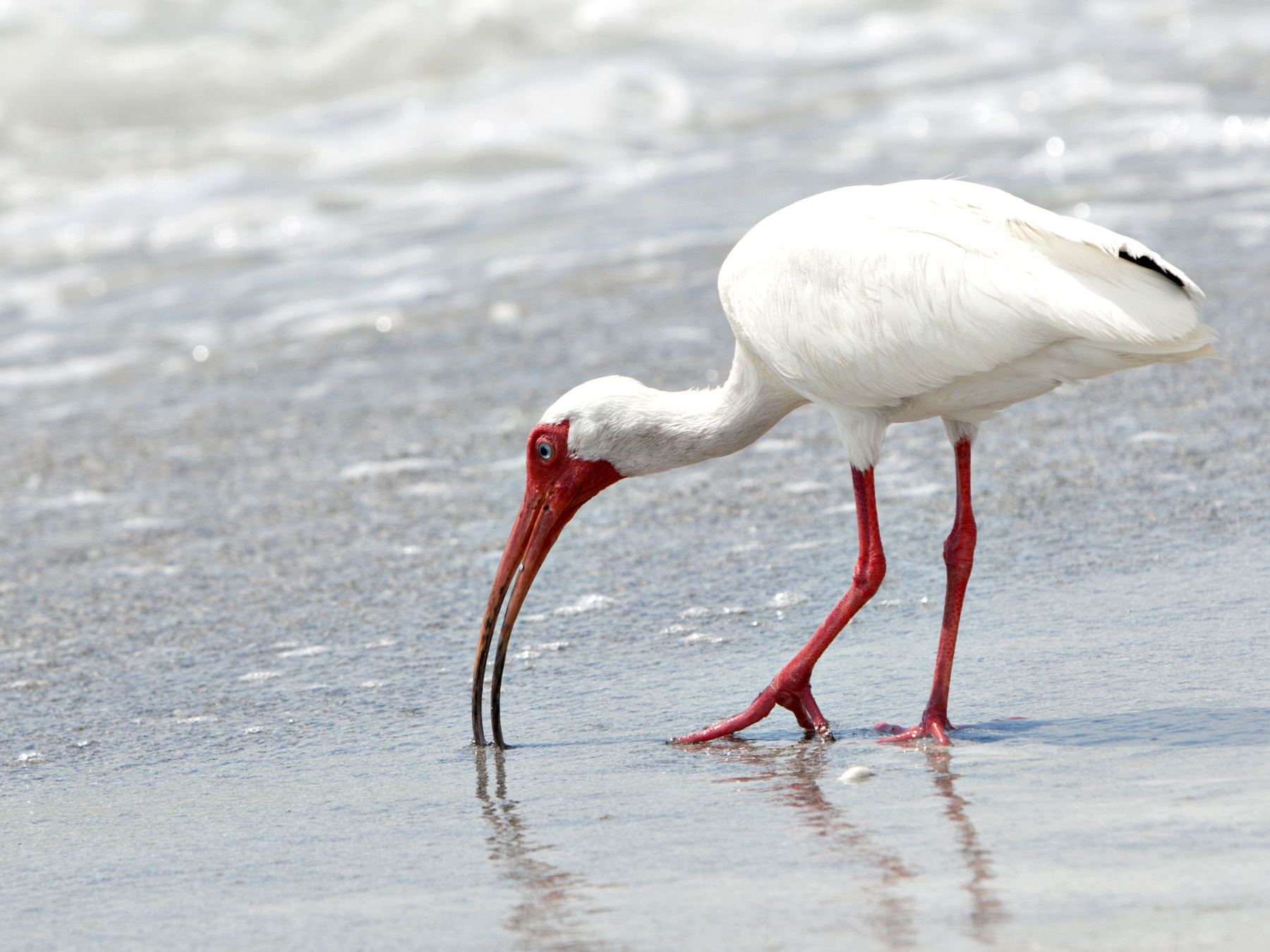
In spring the look changes. The bare face, the base of the bill and the legs and feet turn red, and the outer part of the bill goes black in North America, usually the outer two-thirds and sometimes the whole bill. Both sexes also grow a bright red throat pouch, not the male alone as is often written, usually larger in females, which swells to 0.8-1.2 in (2-3 cm) across when pairs form.1 In the Everglades, birds in the display stage had dark pink bills and scarlet legs that faded to a muted pink as breeding went on, and bare-part color together with black on the bill told the breeding stage 94% of the time.2 By summer the head, neck and back can be stained buff or brown.
The black wingtips are the tips of the three or four longest wing feathers.
Size and weight
A White Ibis is 22.0-26.8 in (56-68 cm) long, bigger than a Cattle Egret and smaller than a Great Egret, with a wingspan of about 37-38 in (96-97 cm). The usual weight range is 1.7-2.3 lb (750-1,050 g). Males are clearly bigger than females and have longer bills, with little overlap between the sexes.
In one set of Florida museum specimens, males averaged 2.3 lb (1,036 g) and females 1.7 lb (764 g), and the male bill averaged 5.6 in (142 mm) against 4.4 in (111 mm) for the female.1
| Florida museum specimens, mean | Males | Females |
|---|---|---|
| Weight (12 males, 16 females) | 2.3 lb (1,036 g) | 1.7 lb (764 g) |
| Bill length (12 males, 16 females) | 5.6 in (142 mm) | 4.4 in (111 mm) |
| Wing length (12 males, 12 females) | 11.9 in (302 mm) | 10.9 in (277 mm) |
The bill difference is larger than body size explains. In both the White and the Scarlet Ibis, male bills average 22% longer than females', and only about half of that is explained by body size. In a captive flock of 350 Scarlet Ibises, a close relative, males with longer bills won bill-sparring contests and nest take-overs and bred earlier.3
Male, female and young
The two sexes look alike in plumage. A male is simply the larger bird of a pair, with the heavier, longer bill, and the difference is hard to judge from a single bird. The young are another matter: they look nothing like adults.
The juvenile and the immature bird
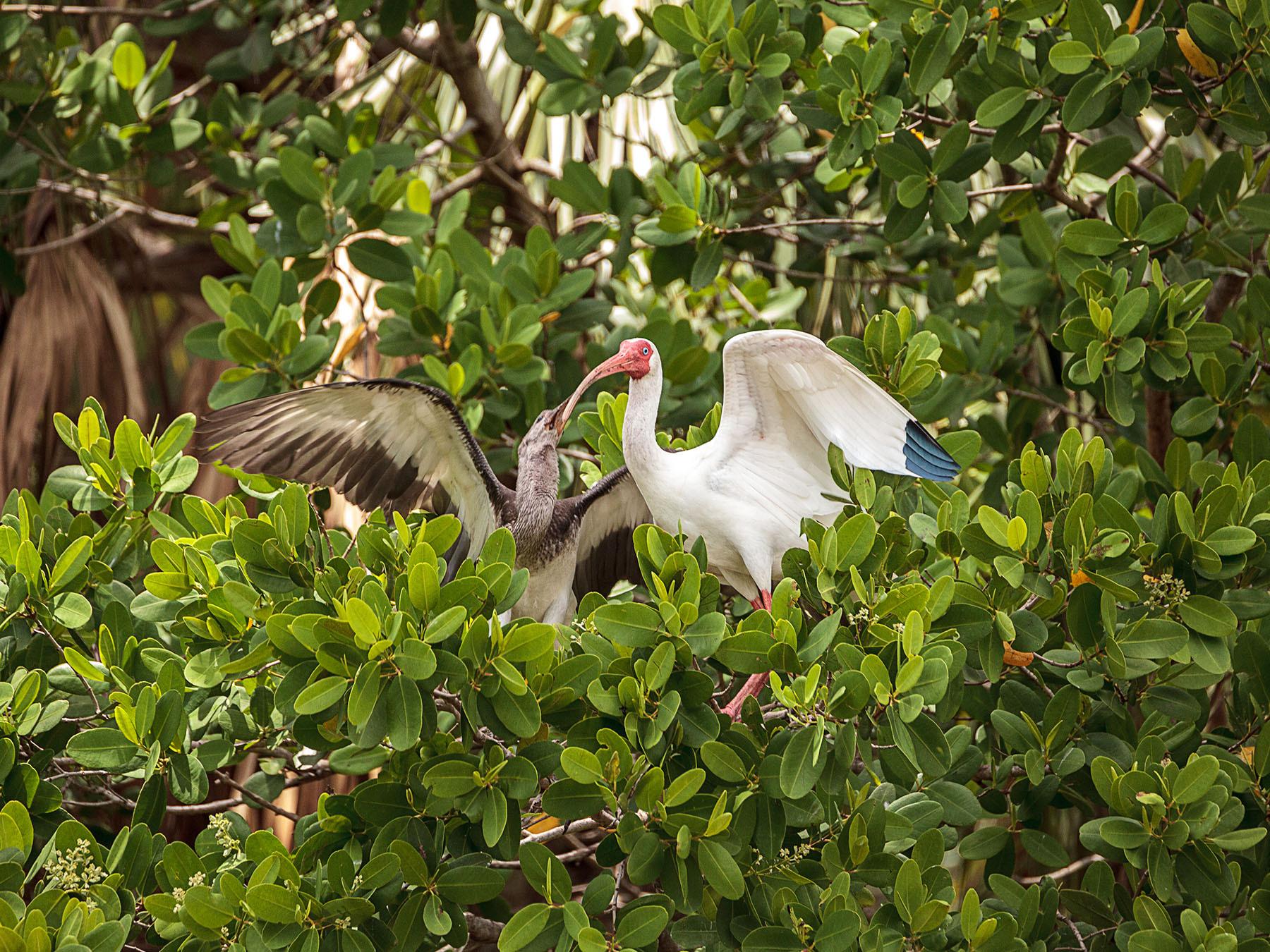
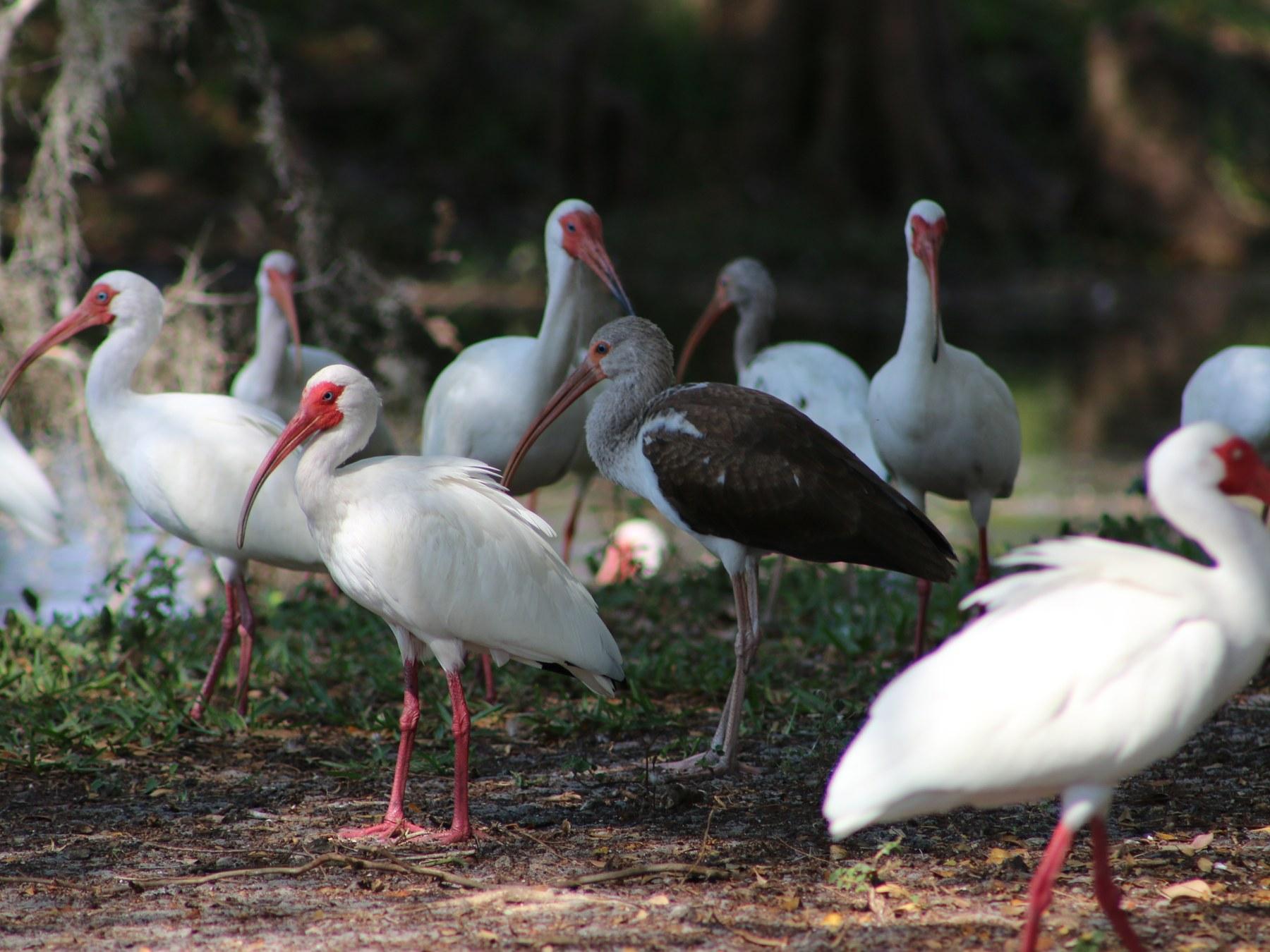
A juvenile, from about June to December of its first year, has a sandy gray-brown head and neck streaked with pale lines, a blackish-gray back and wings that fade to brown, and a white rump and belly. Its bill is pinkish and already strongly curved, its eye is dark, and its legs are gray to dusky pink; the sources differ on the leg color. A brown ibis with a pink, curved bill is a young White Ibis, not a different species.
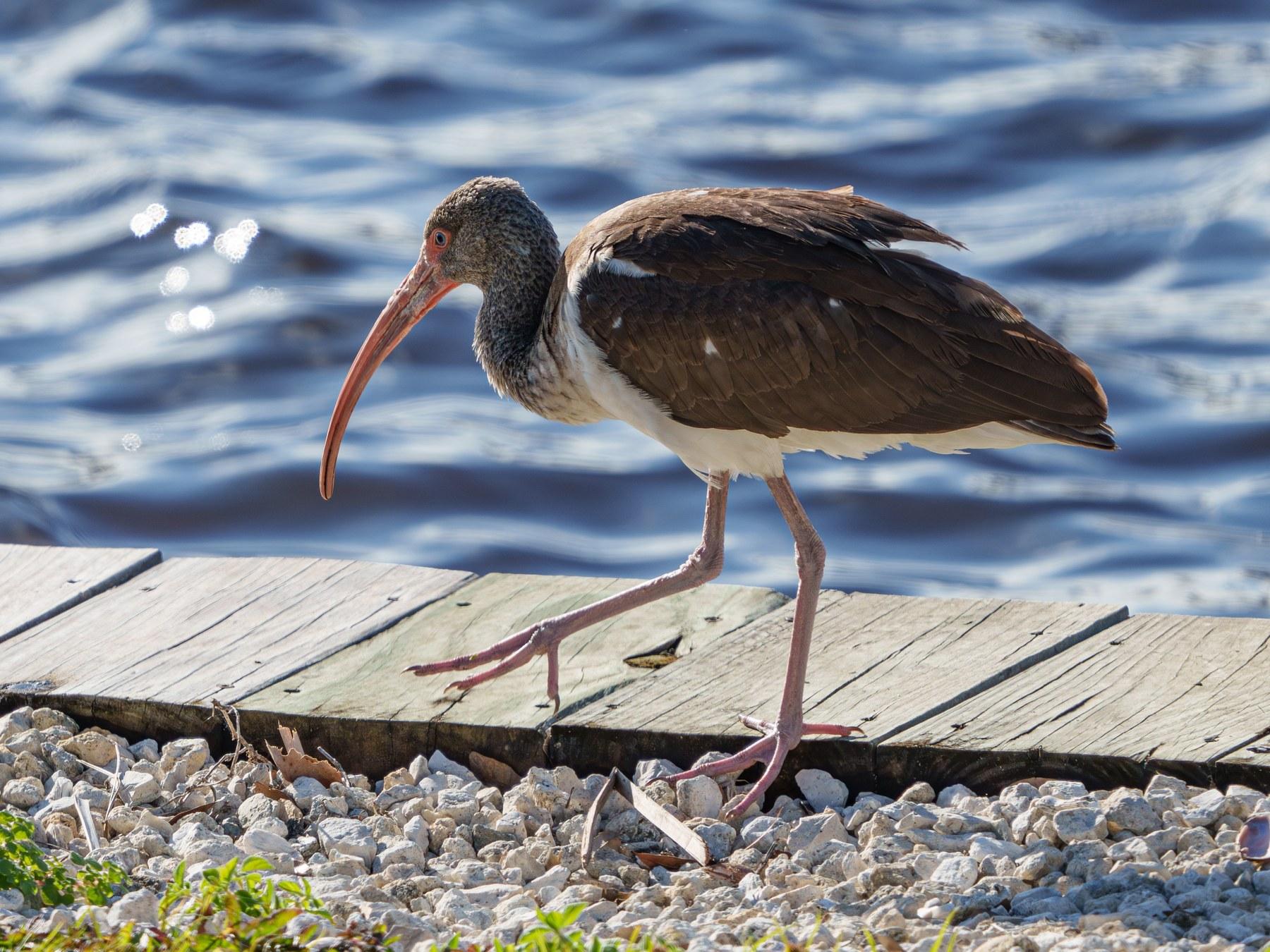
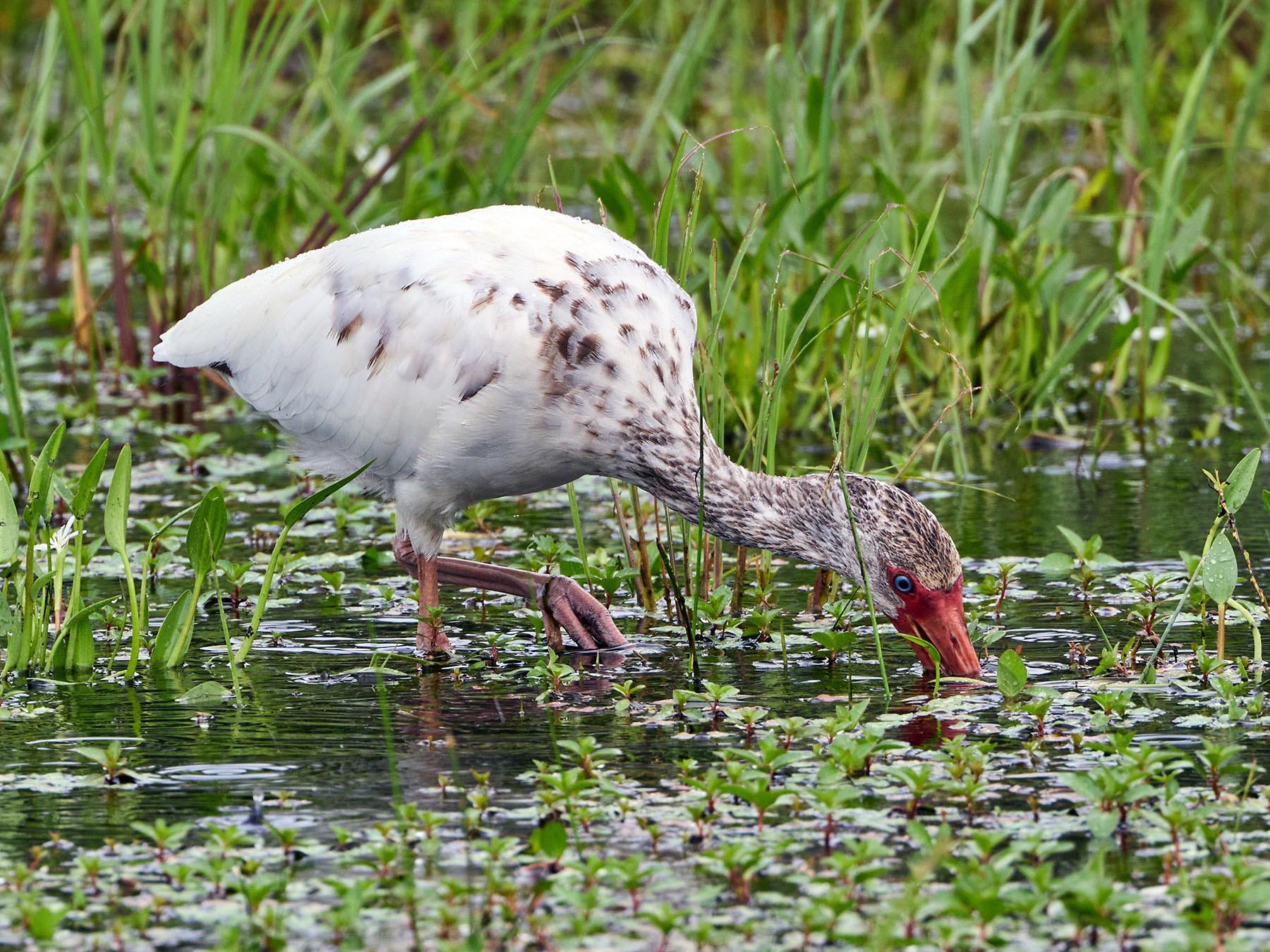
Over the next two years the brown gives way to white. An immature bird is a patchwork: a body that is mostly white but patchy above, with brown wing coverts and flight feathers kept (brown primaries and secondaries show from below in a white wing) and sandy-brown streaks on the head and neck. Through its second winter the head and neck stay brown-fringed; most of those feathers are replaced with white between February and June of its third calendar year, when it is about two years old, and some then look like adults. By then the eye is sky blue and the legs dusky pink, and after that a bird cannot be aged by its plumage.
Identification: telling it from similar birds
A young White Ibis is the bird most likely to be taken for a Glossy Ibis or a White-faced Ibis, which are dark all over. The giveaway is the white rump and white underparts, which the dark ibises lack. Adults, being almost entirely white, are not confused with either.
The Scarlet Ibis is a separate species in AviList 2026, and the youngest Scarlet Ibises look almost the same as young White Ibises until pink tinges appear on the rump and elsewhere. In Florida, Scarlet Ibises were introduced in the 1950s and others have escaped from captivity since; Birds of the World reported, in a text of 2009, that individual scarlet birds and pink hybrids have nested in the wild there, so a pink ibis in Florida may be one of those.1 A genetic study of 10 birds of each species, from Florida and Brazil, found two lineages, although its authors also say the two hybridize in nature.4
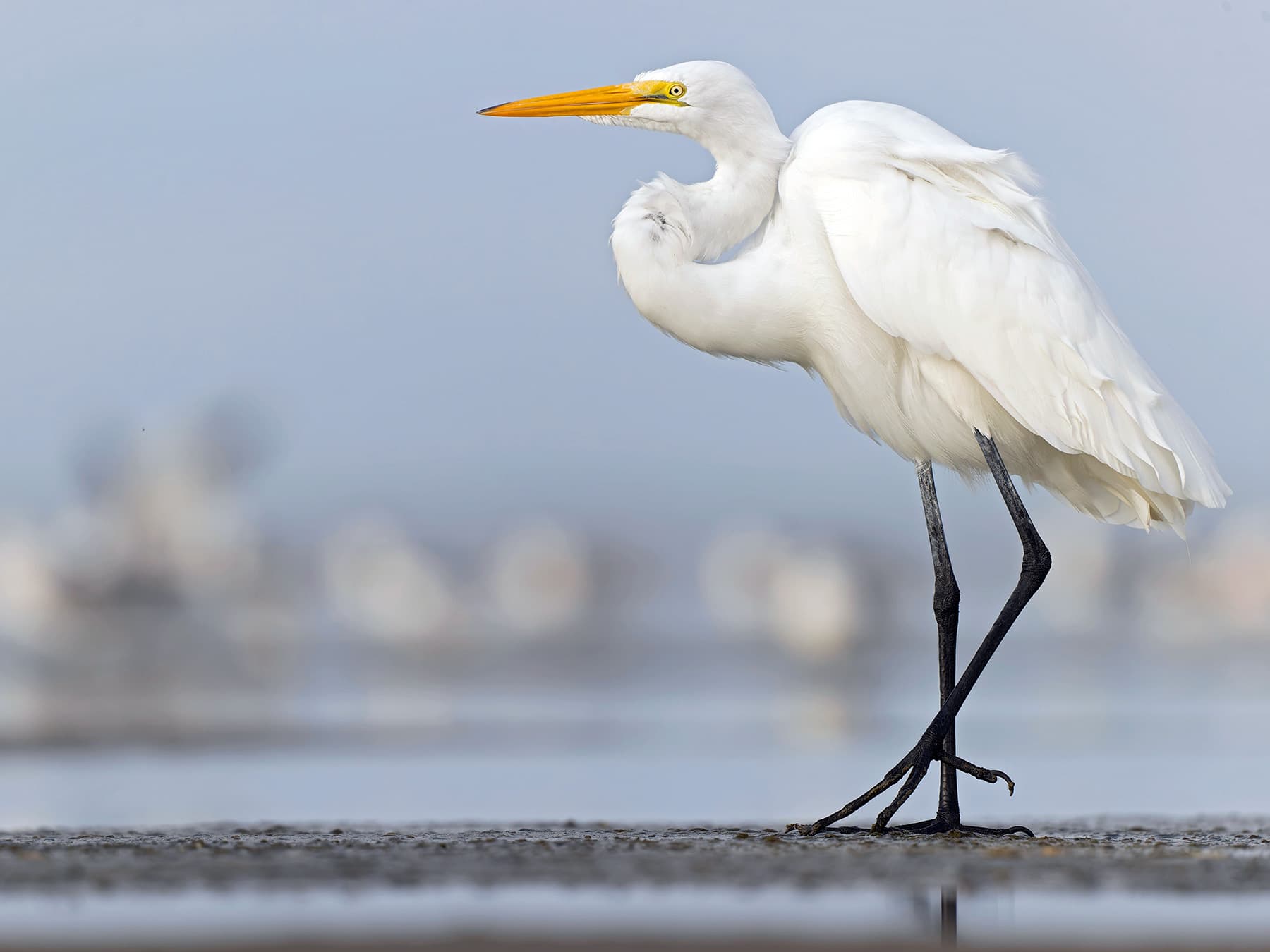
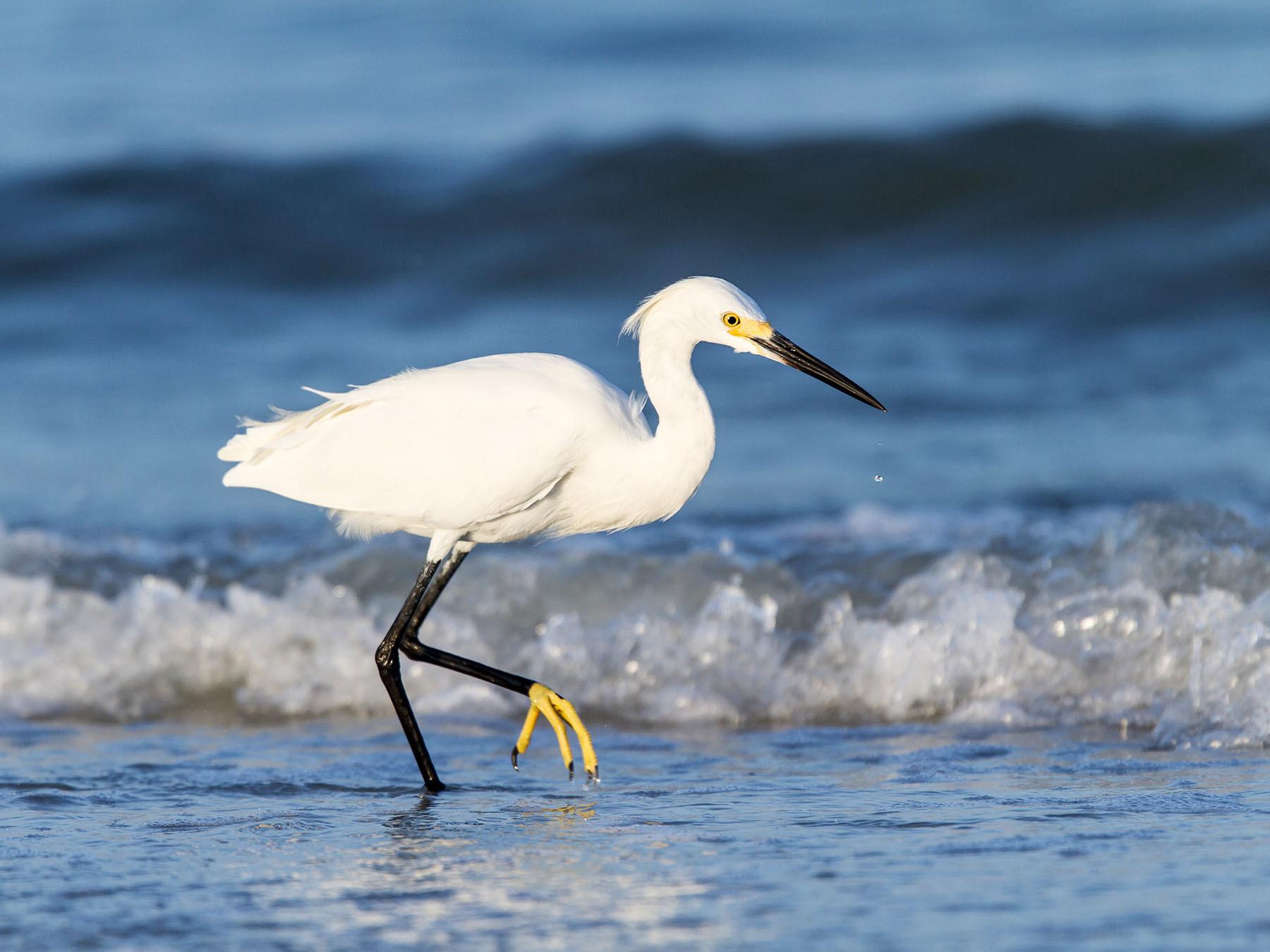
The other all-white waders are the egrets. They have straight, dagger-like bills, while the ibis's bill curves down and its neck is stretched out in flight. A Great Egret flies with its neck folded back and has a yellow bill and mostly dark legs, and a Snowy Egret a slim black bill, black legs and yellow feet.
Not sure it’s a White Ibis? Check your photo: Birdfact names the bird and shows the look-alike side by side.
Its size
Adults- Length
- 56–68 cm
- Wingspan
- 96–97 cm
- Weight
- 750–1050 g
Its song and calls
The White Ibis is not a vocal bird. The call heard most is a coarse, nasal hunk-hunk-hunk, given in flight by both sexes and used by males to advertise at the colony. Foraging flocks give softer honks, birds at a roost make soft, high-pitched notes, and females squeal during courtship. Nestlings give a high trill that varies from chick to chick and grows louder and longer through the first four weeks.
Heard one and not sure? Let the bird song identifier listen.
When and where to see it
November
In season
The year across North America
Choose a place on the map to see its year, or find yours.
Most recorded in November
Up to 2.1% of a place’s bird records that monthHere in other months
How this map is made
Each county, state or province is shaded by the White Ibis’s share of all the bird records there that month: the darker, the larger the share. A place with only a trace of records in a month is left unshaded. Shades compare places on this map with each other, not one bird with another. Records: GBIF eBird Observation Dataset, 2019–2024. Map: Natural Earth; place centres © OpenStreetMap contributors.
How often the White Ibis turns up in the United States through the year, from birdwatchers' records.
United States
Resident · all year · most records in January
Show as a table
| Month | United States |
|---|---|
| January | 0.32% (regular) |
| February | 0.30% (regular) |
| March | 0.23% (regular) |
| April | 0.17% (regular) |
| May | 0.076% (regular) |
| June | 0.12% (regular) |
| July | 0.15% (regular) |
| August | 0.19% (regular) |
| September | 0.17% (regular) |
| October | 0.22% (regular) |
| November | 0.27% (regular) |
| December | 0.30% (regular) |
Worldwide: recorded regularly in 20 countries
Countries where it was recorded in at least 3 of the 6 years 2019–2024. Linked countries have their own bird list.
North America (16)
- Bahamas
- Belize
- Cayman Islands
- Costa Rica
- Cuba
- Dominican Republic
- El Salvador
- Guatemala
- Haiti
- Honduras
- Jamaica
- Mexico
- Nicaragua
- Panama
- Puerto Rico
- United States
South America (4)
- Colombia
- Ecuador
- Peru
- Venezuela
Data: EOD – eBird Observation Dataset (Cornell Lab of Ornithology), accessed via GBIF.org, CC BY 4.0. Records from 2019–2024, aggregated and filtered by Birdfact. How these lists are made
The White Ibis breeds mainly along the coast from Virginia round to Texas, most densely in the Carolinas, Florida, Louisiana and Texas, and inland in a band from coastal South Carolina through Florida. It also breeds locally in the Caribbean, commonly in Cuba and Hispaniola, on both the Atlantic and Pacific sides of Mexico and Central America, and south to northern South America. The breeding range shifts from year to year, because the birds move between colonies (text of 2009).
AviList 2026 lists two subspecies: albus, which covers the southeastern United States and so every US bird, and ramobustorum of Panama and northern South America, named in 2012.5
Habitat: wetlands, lawns and parks
Look for it wherever shallow, soft-bottomed water or wet ground gives it something to probe: freshwater marshes, flooded pastures, shallow ponds, cypress swamps, mangroves, estuaries, mudflats and salt marsh. It usually feeds in water less than 8 in (20 cm) deep, generally 2-4 in (5-10 cm). Colonies sit on barrier, marsh and spoil islands along the coast, on islands in lakes inland, in tree clumps in marshes and in mangrove swamps. It also feeds on lawns and in parks, most often in southern Florida, where the birds are used to people.
Florida's 2011 review of the species noted it was increasingly seen in towns and suburbs, especially in south Florida.6 Among 41 GPS-tracked ibises, those that spent more of the non-breeding season in urban habitat had longer non-breeding periods than wetland-based birds, and their breeding periods were shorter but started sooner.7 In a network analysis of movements, birds using urban sites kept to a narrower range of habitat than the rest, and the few that used both urban and natural sites did most to link the two.8
Do they migrate?
Partly. Northern birds move south for the winter, but the White Ibis is mostly nomadic: it is present all year in most of its range, with far fewer in the north in winter, and it moves with rainfall and food, shifting between inland and coastal wetlands. Records of large nestings across the United States from 1930 to 1993 show at least four big shifts in where the breeding population was centered, none of them migrations, and the authors say nomadism appears to be an obligate feature of the species' life history.9
There are seasonal rhythms. Large flocks move south through south Florida in October and November, and birds wintering in south Florida set out for northern nesting areas from mid-March through April. Many South Carolina nestlings banded in the 1950s and 1960s were recovered in Cuba, and one South Carolina nestling was recovered in Colombia.1
A spreading range
After breeding, birds disperse, often northward in late summer and fall, regularly reaching Delaware and southeastern New York (Long Island), and juveniles in particular have wandered across the Midwest and as far as southern California. A rare bird alert of 1 May 2026 reported Quebec's fifth White Ibis.10
Breeding has also crept north, and the first nests in each state are dated. The first nesting in the Carolinas was in 1922, in Charleston County, South Carolina; North Carolina's was in 1950, with no permanent colony, and Battery Island in that state held about six pairs in 1963 and 3,737 in 1983, when nests at Pea Island and Roanoke Sound extended the breeding range in North Carolina nearly 93 mi (150 km) to the northeast.11 Virginia's first confirmed nesting was in 1977 on Fisherman Island, and the count on the state's seaside barrier islands rose from 3 pairs in 1993 to 1,746 in 2018, a rise Virginia's colonial waterbird survey says has been driven by immigration.12 New Jersey's first nesting was in 2020, at a rookery in Ocean City, according to a New Jersey nonprofit, and in 2021 multiple nests raised at least 43 young.13
Tips for seeing it
What it eats
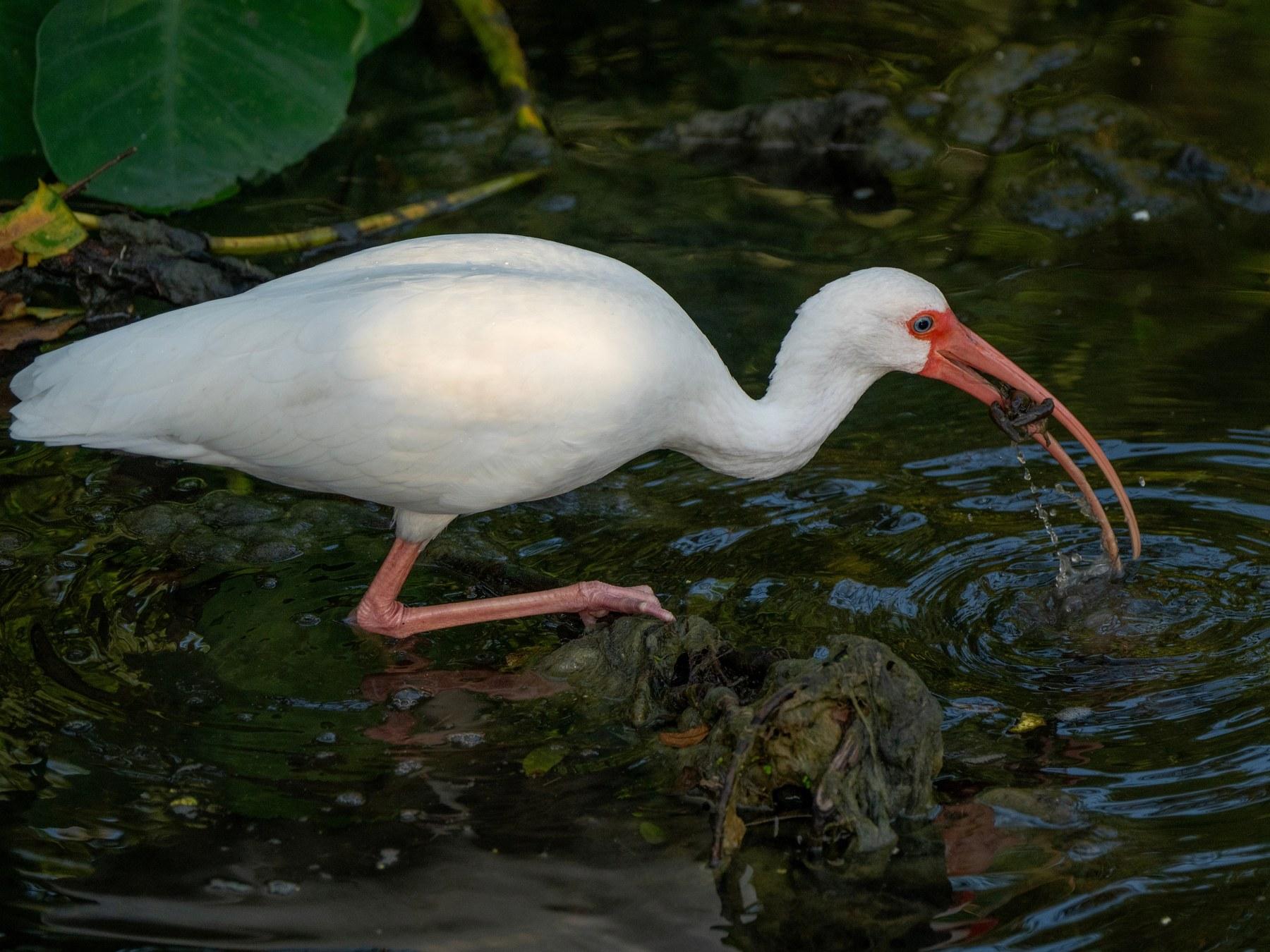
The White Ibis eats mostly crayfish, crabs and insects, and is a generalist that takes whatever its bill touches: freshwater crayfish, fiddler and mud crabs, earthworms, snails, frogs, lizards, newts, young snakes and small fish. It is the commonest wading bird in Everglades National Park, where crayfish are its main food. In three northern Everglades colonies in 2008 and 2009, crayfish were in 58-88% of chick regurgitations and gave 55-65% of the energy.14
The mix depends on place and season. In inland south Florida, crayfish made up 52% of the biomass of prey in one sample and fish 19%; on the south Florida coast, crayfish were 11%, fiddler crabs 20% and fish 31%.1 On a Florida lawn in the non-breeding season, especially in the wet season, it picks up earthworms, cockroaches and other insects.
Feeding by touch
The White Ibis finds most food by touch, not sight. The tip of its bill appears to be well supplied with nerves, and it walks slowly with the bill held closed or open a fraction of an inch (1-2 cm) at the tip, probing mud, shallow water and soft ground and sweeping the bill from side to side. Flocks feed together, and the white plumage draws others in.
Water level decides where the food is. In the Everglades, a study using time-lapse cameras for 61 days in 2017 found most foraging in two or three days, on days when the ridges were nearly dry and slough water averaged 11 in (29 cm) or more, with the birds feeding along slough edges as crayfish moved between habitats.15
Why nestlings need freshwater food
Coastal colonies are a puzzle: adults nest on coastal islands but fly inland to feed their chicks. A study in South Carolina took 28 nestlings at 21 days and hand-reared them for 3 weeks on freshwater crayfish (12 birds), brackish-water fiddler crabs (12) or salt-loaded crayfish (4). The crayfish birds gained mass like parent-reared nestlings, while both high-salt groups shed weight at about 3% a day until fresh water replaced brackish water 7 days in, and then regained.16 The authors concluded that a salt constraint is why coastal ibises fly long distances inland to freshwater prey.
It shows in the colonies' numbers. At two South Carolina colonies, pairs fell from more than 12,000 at each site in 1984, a very wet year, to fewer than 2,000 at each in 1985, a very dry one, and Drum Island's egg-to-fledgling success fell from 39% to 3%; the authors suggest the declines came from crayfish being unavailable.17 In the Everglades, nestling food shifted from crayfish toward fish and urban food at low water, and nesting success appeared to suffer.18
What they eat in towns and parks
In south Florida, ibises have become birds of lawns, golf courses and parks, and people sometimes feed them. The research on what that does is mixed, and mostly from one region. Along a gradient from wetland to city, ibises whose tissues showed more handed-out food were found more often at urban sites, were lighter for their length and carried fewer ectoparasites; the authors read it as easy but poor-quality calories that might leave more time for preening.19
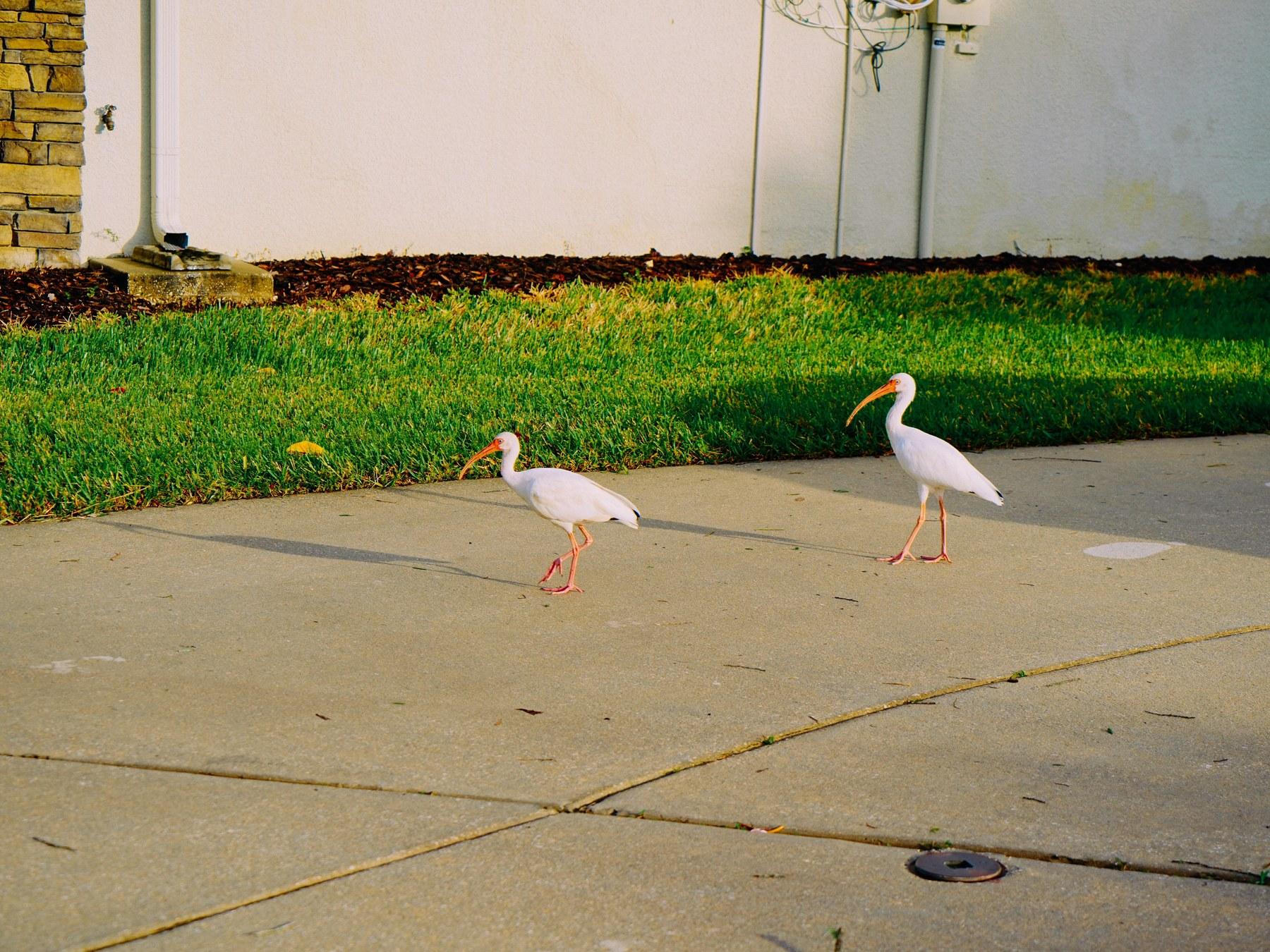
Some urban ibises in south Florida also carry Salmonella. In 2010-2013, 13% of 261 adults and subadults and 35% of 72 nestlings were shedding it, less where there was more wetland and grassland and more where there was open developed land such as parks, lawns and golf courses; 44% of the strain patterns matched profiles in the CDC's PulseNet database, and the authors write that ibises have the potential and opportunity to pass Salmonella to people.20 A later study found it in 27% of 233 birds at 15 sites: birds eating more human food stayed at the same sites more, and Salmonella was commoner where site fidelity was higher and where soil and water carried it, and its authors suggest limiting feeding in parks.21 A study of urbanized Florida landscapes put adult prevalence at 26% and found 58% of 24 captured chicks shedding at capture, with urban nestlings higher than those in natural rookeries; the young birds with the infection showed no clinical disease apart from one chick that showed signs for about 24 hours.22
The picture has a second side. In captive nestlings, a diet imitating human-provided food, with white bread added and less seafood, blunted how well the birds could kill Salmonella in culture, with little effect on stress indicators and other immune measures, while in wild adults blood plasma of urban-caught birds was better at killing E. coli than that of natural-site birds, and urban adults had lower baseline corticosterone after breeding, the opposite of what the authors predicted.23, 24 Flocks became more than twice as dense while people were handing out food, though foraging behavior differed little from that at natural wetlands.25
Nesting and breeding
The White Ibis nests in dense colonies, often shared with herons, egrets and other waders. Colonies grow from roost sites, where males gather in displaying groups. The female chooses the nest site and builds, and the male brings most of the sticks, some of them stolen from neighbors. The nest is a platform of dead twigs lined with grasses, moss or leaves, built in under a week on a fork of a tree or shrub, in mangroves, in clumps of grass or occasionally on the ground. Most nests are from under a foot to about 15 ft (4.6 m) up, and FWC gives as high as 50 ft (15 m).26
Timing varies with place and water. Nest building begins between late February and June in interior south Florida, between March and June on the Florida coast, between early March and early June in South Carolina and in late March to early April in North Carolina, and in Florida a colony may wait months for good feeding conditions before nesting.
The eggs, 2-5 per clutch and averaging 2-3 depending on place, are cream to blue-green with brown splotches and about 2.3 by 1.5 in (58 by 39 mm). They are laid every other day, and both parents incubate for about 21 days. They hatch a day or two apart, and the pair feeds the young from the second day. Chicks gather in groups of similar age by week 3, make short flights in weeks 4-5 and fly beyond 164 ft (50 m) by week 6, and can leave mainland colonies from about 40 days, 1-2 weeks later from islands. Radio-tagged young in the Everglades left at 51-70 days.1 Pairs probably raise one brood a season, and the birds first breed at 2 years old.
Nest success: water, hurricanes and tides
What decides a colony's year is mostly water and food. Nest success, counted as at least one young to 20 days, has ranged from under 5% to 70% across studies with no geographic pattern; in the Everglades abandonment caused 47% to 97% of failed nests in the years the handbook lists, as rising water disperses prey; and in years of plentiful food fledging success was 86.8%, against under 20% in poor ones.1 In the Everglades, between 2006, a year of high prey, and 2007, a below-average one, clutch size fell about 19% and daily nest survival fell from 0.999 to 0.979.27
The swings are huge. The coastal southern Everglades held over 100,000 nests in the 1930s and were usually under 5% of that size in later years; 2017 had 1,075 nests and 2018 had 30,420, the highest count in 87 years, when crayfish featured in the food after extensive flooding of seasonal wetlands.28 Tides matter on the coast: in a South Carolina estuarine colony studied over five seasons, 61% of nesting starts were abandoned during tidal washovers, a conservative figure, and the birds kept using the site.29 The handbook also reports that a South Carolina colony went from more than 10,000 breeding pairs in 1989 to none in 1990 after a category 4 hurricane flooded its freshwater feeding sites with salt water; the paper it cites is titled for Hurricane Hugo, of September 1989.1
Behaviour
The White Ibis is highly social. It roosts in treetops with other waders, feeds in flocks and travels in V shapes or long lines. Flying, it holds its neck straight out with the feet trailing, alternating quick wingbeats and glides, sometimes at more than 28 mph (45 km/h); now and then, mostly on long trips, it soars to 1,600-3,300 ft (500-1,000 m), and it dives from height into a colony. Feeding flights from one coastal South Carolina colony covered 2.5-20 mi (4-32 km).1
Social behavior: followers and pirates
A walking flock stirs up prey, and other birds make use of it. Egrets and other visual feeders follow behind, catching what the ibises flush, and in mixed feeding flocks ibises are the main victims of piracy by larger birds. At colonies ibises also steal food from each other, mostly males taking it from females. In coastal South Carolina, wary flocks lift at a Great Blue Heron, an Osprey, a Red-tailed Hawk or an aircraft.
Lifespan and predators
The oldest wild White Ibis on the US banding records was at least 19 years 11 months old: a male banded in Florida on 2 February 2006 as an after-second-year bird and found dead in Florida on 27 May 2024, with the banding laboratory counting a minimum age from the hatching year. The earlier record, 16 years 4 months, was a bird banded as a nestling in Alabama in 1956 and collected in Florida in 1972, and the longest captive bird in one database lived 27.6 years.30, 31
The handbook text of 2009 had no data on survival in the wild. Eggs and young suffer most. Fish Crows took as many as 44% of eggs at some colonies, while at others there was little or no nest predation, and 7-75% of eggs were lost to birds among colonies; Boat-tailed Grackles, Black-crowned Night-Herons, gulls, raccoons, opossums and rat snakes also take eggs or young. Alligators take some adults, and predation on adults is probably not important.1
Most of the disease work has been on urban birds in south Florida. A 2020 urban colony in south Florida lost 3 nestlings to West Nile virus, and 4 of 36 healthy chicks carried antibodies.32 Avian influenza virus was not isolated from any of 115 nestlings sampled in 2020 and 2021, and 95% carried maternal antibodies.33
Conservation
The White Ibis is common and listed as Least Concern, but its numbers move around. In the Breeding Bird Survey, the long-term trend across the survey is stable to rising: up 2.62% a year from 1966 to 2025, with a credible interval from -0.73% to +5.28% that spans zero, so the rise is not statistically clear. For 1970 to 2025 the rise is 2.76% a year (0.68 to 5.39) and does exclude zero.34 The survey's own caution is a credibility code of 2 for the survey-wide row and 1 for three southern states, and single-year estimates are very wide. Its yearly index was flat from 1966 to 1990, rose to a peak in 2009, dipped 36% by 2021 and was back at 98% of the peak in 2025.34
By state, North Carolina (up 6.87% a year, from near-absence in 1966) and Texas (up 6.30%) show clear long-term rises, while Florida shows no clear change (+0.29%), and its 2025 index was 63% of its 2009 peak. Texas's 2025 index was 29% of its 1998 peak.34
Partners in Flight estimates about 2.4 million worldwide and 1.2 million in the US and Canada, dated to around 2010.35 NatureServe ranks it G5 globally; its 1996 review noted it was still common over much of its range but had declined greatly in Florida in the decades before, and the IUCN lists it as Least Concern.36, 37
For the Everglades, nest counts are the better measure. South Florida's count was 100,784 nests in 2018, the most since system-wide surveys began in 1995 and more than double the previous survey-era high of 47,001 in 2009, then 21,667 in 2019 and 21,849 in 2020, and 68,335 in 2021.38, 39, 40, 41 Looking further back, estimates of the minimum breeding population of the United States ran from 125,000 pairs in 1933 to 170,000 in 1976 and a low of 51,000 in 1991.9 Florida's 2011 review cited an estimate that Everglades nest numbers had fallen 87% since the 1930s.6
Conservation: the Everglades and mercury
A handbook text of 2009 attributed the Everglades declines probably to water-management changes to the natural flow of water, and said freshwater wetlands need to stay within foraging range of both inland and coastal colonies.1
Mercury has been studied in this bird under controlled conditions. Captive White Ibises were fed methylmercury at 0.05, 0.1 or 0.3 parts per million (wet weight) in their food for 3 years; dosed males paired with other males more often (up to 55% of males), the dosed birds laid fewer eggs, and the high-dose group fledged on average 35% fewer young. The authors say this is a probably under-reported way contaminants may influence wild birds at levels wildlife commonly meet.42 Hormone changes were inconsistent from year to year and did not always show a clear dose-response, and in birds released after 43 months of dosing there was no effect on survival or resighting in the first 99 days.43, 44 As of the handbook text of 2009, no male-male pairs had been reported in the wild, though no study in south Florida could yet have detected them.1
In the wild the evidence is correlative. A seven-year comparison found White Ibis nest numbers in the Everglades negatively correlated with a mercury index from Great Egret chick feathers, and the authors call the results correlative and in need of follow-up.45 In feathers from 94 ibises in Palm Beach County, mercury ran from 0.22 to 8.47 mg/kg (average 1.96); it showed no link to Salmonella shedding and was lower in ibises caught at more urban sites.46
Legal status
The White Ibis, like the Scarlet Ibis, is named in the federal table of birds covered by the Migratory Bird Treaty Act. It is not a migratory game bird, because the federal game-bird list covers other families, and it is not federally listed under the Endangered Species Act.47, 48, 49
Florida had the White Ibis as a Species of Special Concern. A biological review group met on 3-4 November 2010 and reported on 31 March 2011 that it did not meet listing criteria, and staff recommended removing it from the list. It came off Florida's list on 11 January 2017 under the state's Imperiled Species Management Plan.6, 50, 51 FWC says it remains protected by the Migratory Bird Treaty Act and from take by state rule 68A-4.001.26 Environment and Climate Change Canada's species list names the Glossy and White-faced Ibis but not the White Ibis, though ibises as a family are on its Convention list, and the 2010 text of Mexico's NOM-059 has no White Ibis entry.52, 53
People have long eaten the bird. Audubon wrote in the 1830s that the eggs 'afford excellent eating' and that the birds were often sold in southern markets; Wilson, in 1814, described strings of them on sale in a market near New Orleans; and Bent noted in 1926 that they are seldom counted as game birds, yet many were shot for food where they were common.54, 55, 56 A handbook text of 2009 says the tradition continued across the bird's range but hunting was not considered an important threat, and that some Louisiana crayfish farmers have shot ibises.1
Similar birds
Often mistaken for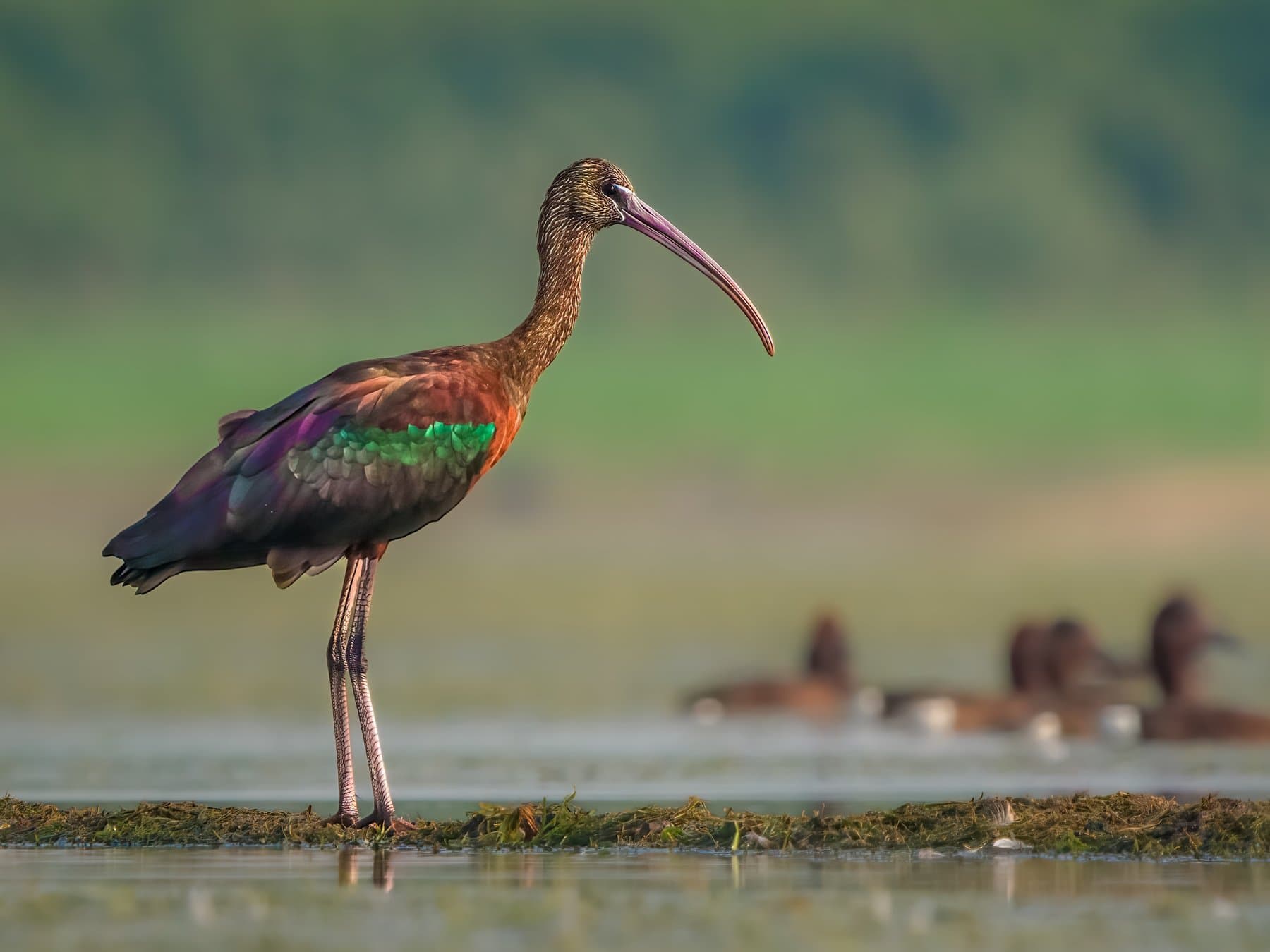
More photos
4 photos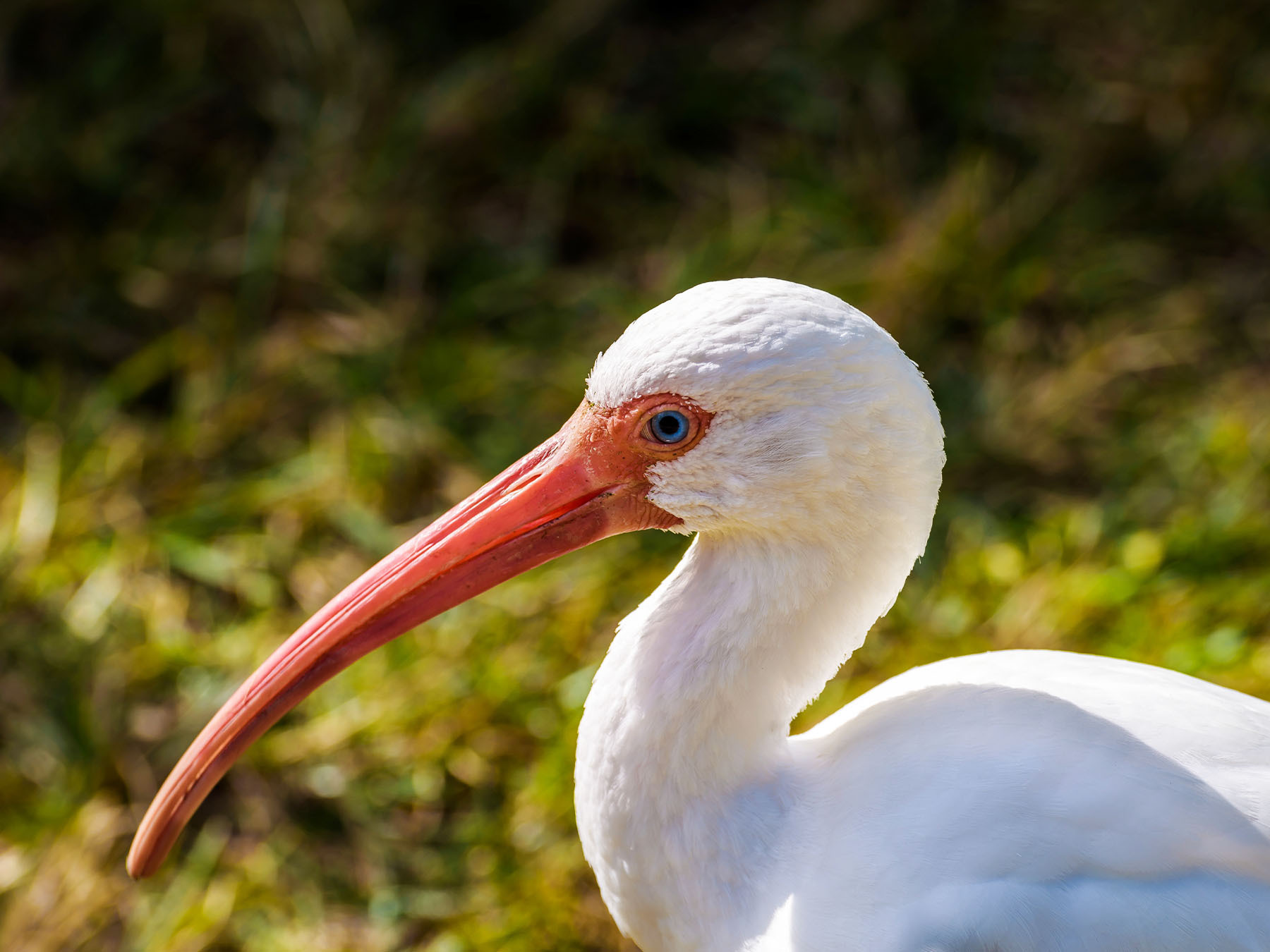
Quick facts
- Length
- 56–68 cm
- Wingspan
- 96–97 cm
- Weight
- 750–1050 g
- Lifespan
- oldest recorded 19 years 11 months
- Family
- Ibises & Spoonbills
- Migration
- Nomadic
- Global status (IUCN)
- Least Concern
- World population
- About 2.4 million worldwide (Partners in Flight, around 2010)
- Population trend
- Stable to rising in the Breeding Bird Survey since 1966, not statistically significant; nest counts in the Everglades swing from year to year
- Also called
- American White Ibis
- Scientific name
- Eudocimus albus
Questions
3Is it the White Ibis or the American White Ibis?
Both are in use. AviList 2026 calls it the American White Ibis, while Clements, BirdLife, the federal list and FWC call it the White Ibis.5, 47, 26 Older names include Spanish curlew (Wilson, in 1814, quotes William Bartram saying that was its usual name), white curlew (Bent, in 1926, gives it as a local name where many were shot for food) and, in Louisiana French, bec croche and petit flaman.
Do White Ibises mate for life?
No. A pair stays together for one nesting episode. Extra-pair copulations are frequent, and in one large South Carolina colony they were estimated to account for 6.05% of the eggs fertilized.57
Is the White Ibis a hurricane bird?
Only in folklore, and the folklore is about 'the Ibis'. The University of Miami's own traditions page presents it as folklore that the ibis is the last wildlife to shelter before a hurricane and the first back afterwards; the page calls the ibis a symbol of knowledge and a local marsh bird without naming the White Ibis, and says the yearbook took the name Ibis in 1926.58 The university's mascot is a White Ibis, and legend has it the bird was chosen for its ability to withstand hurricanes.59 Bartram described flocks of the birds wheeling high overhead in gales and thunderstorms. We found no study of ibises before a storm. The one documented hurricane effect is on nesting, as above.
Sources
66- 1Heath, J. A., Frederick, P. C., Kushlan, J. A. and Bildstein, K. L. (2020). White Ibis (Eudocimus albus), version 1.0. Birds of the World (A. F. Poole, editor). Cornell Lab of Ornithology. doi:10.2173/bow.whiibi.01 (opens in a new tab)
- 2Heath, J. A. and Frederick, P. C. (2006). White Ibis integument color during the breeding season. Journal of Field Ornithology 77(2): 141-150. doi:10.1111/j.1557-9263.2006.00034.x (opens in a new tab)
- 3Babbitt, G. A. and Frederick, P. C. (2007). Selection for sexual bill dimorphism in ibises: an evaluation of hypotheses. Waterbirds 30(2): 199-206. doi:10.1675/1524-4695(2007)30[199:sfsbdi]2.0.co;2 (opens in a new tab)
- 4Ramirez, J. L., Miyaki, C. Y., Frederick, P. C. and Del Lama, S. N. (2014). Species delimitation in the genus Eudocimus (Threskiornithidae: Pelecaniformes): first genetic approach. Waterbirds 37(4): 419-425. doi:10.1675/063.037.0409 (opens in a new tab)
- 5AviList Core Team (2026). AviList: The Global Avian Checklist, v2025b. doi:10.2173/avilist.v2025b (opens in a new tab)
- 6Florida Fish and Wildlife Conservation Commission (2011). Biological Status Review Report for the White Ibis (Eudocimus albus), 31 March 2011. FWC. Accessed 16 November 2026. Source (opens in a new tab)
- 7Kidd-Weaver, A. et al. (2020). The movements of a recently urbanized wading bird reveal changes in season timing and length related to resource use. PLOS ONE 15(3): e0230158. doi:10.1371/journal.pone.0230158 (opens in a new tab)
- 8Teitelbaum, C. S. et al. (2020). Urban specialization reduces habitat connectivity by a highly mobile wading bird. Movement Ecology 8: 49. doi:10.1186/s40462-020-00233-7 (opens in a new tab)
- 9Frederick, P. C., Bildstein, K. L., Fleury, B. and Ogden, J. (1996). Conservation of large, nomadic populations of White Ibises (Eudocimus albus) in the United States. Conservation Biology 10(1): 203-216. doi:10.1046/j.1523-1739.1996.10010203.x (opens in a new tab)
- 10American Birding Association (2026). Rare Bird Alert, 1 May 2026. ABA Rare Bird Alert. Accessed 16 November 2026. Source (opens in a new tab)
- 11Shields, M. A. and Parnell, J. F. (1983). Expansion of White Ibis nesting in North Carolina. The Chat 47(4). Accessed 16 November 2026. Source (opens in a new tab)
- 12Watts, B. D., Paxton, B. J., Boettcher, R. and Wilke, A. L. (2019). Status and distribution of colonial waterbirds in coastal Virginia: 2018 breeding season. Center for Conservation Biology Technical Report CCBTR-19-06. Accessed 16 November 2026. Source (opens in a new tab)
- 13Griffiths, D. (2022). A Newcomer Comes Home. The Wetlands Institute (New Jersey). Accessed 16 November 2026. Source (opens in a new tab)
- 14Boyle, R. A., Dorn, N. J. and Cook, M. I. (2014). Importance of crayfish prey to nesting White Ibis (Eudocimus albus). Waterbirds 37(1): 19-29. doi:10.1675/063.037.0105 (opens in a new tab)
- 15Binkley, E. E., Dorn, N. J. and Cook, M. I. (2019). Feeding on the edge: foraging White Ibis target inter-habitat prey fluxes. Journal of Field Ornithology 90(3): 235-247. doi:10.1111/jofo.12302 (opens in a new tab)
- 16Johnston, J. W. and Bildstein, K. L. (1990). Dietary salt as a physiological constraint in White Ibis breeding in an estuary. Physiological Zoology 63(1): 190-207. doi:10.1086/physzool.63.1.30158161 (opens in a new tab)
- 17Bildstein, K. L., Post, W., Johnston, J. W. and Frederick, P. C. (1990). Freshwater wetlands, rainfall, and the breeding ecology of White Ibises in coastal South Carolina. The Wilson Bulletin 102(1): 84-98. Accessed 16 November 2026.
- 18Dorn, N. J. et al. (2011). Aquatic prey switching and urban foraging by the White Ibis Eudocimus albus are determined by wetland hydrological conditions. Ibis 153(2): 323-335. doi:10.1111/j.1474-919x.2011.01101.x (opens in a new tab)
- 19Murray, M. H. et al. (2018). From wetland specialist to hand-fed generalist: shifts in diet and condition with provisioning for a recently urbanized wading bird. Philosophical Transactions of the Royal Society B 373(1745): 20170100. doi:10.1098/rstb.2017.0100 (opens in a new tab)
- 20Hernandez, S. M. et al. (2016). Urbanized White Ibises (Eudocimus albus) as carriers of Salmonella enterica of significance to public health and wildlife. PLOS ONE 11(10): e0164402. doi:10.1371/journal.pone.0164402 (opens in a new tab)
- 21Murray, M. H. et al. (2021). Site fidelity is associated with food provisioning and Salmonella in an urban wading bird. EcoHealth 18(3): 345-358. doi:10.1007/s10393-021-01543-x (opens in a new tab)
- 22Seixas, J. S. et al. (2025). Salmonella infections in white ibis nestlings in urban areas as a result of environmental contamination reveal a potential health risk to humans and animals. Journal of the American Veterinary Medical Association: 1-8. doi:10.2460/javma.25.03.0144 (opens in a new tab)
- 23Cummings, C. R. et al. (2020). Effects of an anthropogenic diet on indicators of physiological challenge and immunity of white ibis nestlings raised in captivity. Ecology and Evolution 10(15): 8416-8428. doi:10.1002/ece3.6548 (opens in a new tab)
- 24Cummings, C. R. et al. (2020). Foraging in urban environments increases bactericidal capacity in plasma and decreases corticosterone concentrations in White Ibises. Frontiers in Ecology and Evolution 8: 575980. doi:10.3389/fevo.2020.575980 (opens in a new tab)
- 25Wilson, C. A. et al. (2024). Human-provided food increases aggregation but does not change activity budgets in an urban wading bird. Journal of Urban Ecology 10(1). doi:10.1093/jue/juae017 (opens in a new tab)
- 26Florida Fish and Wildlife Conservation Commission. White Ibis. FWC species profiles. Accessed 16 November 2026. Source (opens in a new tab)
- 27Herring, G., Gawlik, D. E., Cook, M. I. and Beerens, J. M. (2010). Sensitivity of nesting Great Egrets (Ardea alba) and White Ibises (Eudocimus albus) to reduced prey availability. The Auk 127(3): 660-670. doi:10.1525/auk.2010.09144 (opens in a new tab)
- 28Cocoves, T. C. et al. (2021). Irruptive White Ibis breeding is associated with use of freshwater crayfish in the coastal Everglades. Ornithological Applications 123(1). doi:10.1093/ornithapp/duaa072 (opens in a new tab)
- 29Frederick, P. C. (1987). Chronic tidally-induced nest failure in a colony of White Ibises. The Condor 89(2): 413. doi:10.2307/1368495 (opens in a new tab)
- 30USGS Bird Banding Laboratory. Longevity records of North American birds: White Ibis. USGS Eastern Ecological Science Center, Bird Banding Laboratory. Accessed 16 November 2026. Source (opens in a new tab)
- 31Tacutu, R. et al. (2023). Eudocimus albus. AnAge: the Animal Ageing and Longevity Database (Build 15). Accessed 16 November 2026. Source (opens in a new tab)
- 32Seixas, J. S. et al. (2022). West Nile virus infections in an urban colony of American White Ibises (Eudocimus albus) in south Florida, USA. Journal of Wildlife Diseases 58(1): 205-210. doi:10.7589/jwd-d-21-00030 (opens in a new tab)
- 33Christie, K. F., Poulson, R. L., Seixas, J. S. and Hernandez, S. M. (2021). Avian influenza virus status and maternal antibodies in nestling White Ibis (Eudocimus albus). Microorganisms 9(12): 2468. doi:10.3390/microorganisms9122468 (opens in a new tab)
- 34Hostetler, J. A. et al. (2026). The North American Breeding Bird Survey, Analysis Results 1966-2025. U.S. Geological Survey data release. doi:10.5066/P1OSNSFC (opens in a new tab)
- 35Partners in Flight (2024). Avian Conservation Assessment Database, version 2024.05.23 (global). Partners in Flight. Accessed 16 November 2026. Source (opens in a new tab)
- 36NatureServe. Eudocimus albus: White Ibis. NatureServe Explorer. Accessed 16 November 2026. Source (opens in a new tab)
- 37BirdLife International (2021). Eudocimus albus. The IUCN Red List of Threatened Species 2021: e.T22697411A188454802. doi:10.2305/IUCN.UK.2021-3.RLTS.T22697411A188454802.en (opens in a new tab)
- 38Cook, M. I. and Baranski, M. (2019). South Florida Wading Bird Report, Volume 24 (2018 season, May 2019). South Florida Water Management District. Accessed 16 November 2026. Source (opens in a new tab)
- 39Cook, M. I. and Baranski, M. (2020). South Florida Wading Bird Report, Volume 25 (2019 season, September 2020). South Florida Water Management District. Accessed 16 November 2026. Source (opens in a new tab)
- 40Cook, M. I. and Baranski, M. (2021). South Florida Wading Bird Report, Volume 26 (2020 season, July 2021). South Florida Water Management District. Accessed 16 November 2026. Source (opens in a new tab)
- 41Cook, M. I. and Baranski, M. (2023). South Florida Wading Bird Report, Volume 27 (2021 season, March 2023). South Florida Water Management District. Accessed 16 November 2026. Source (opens in a new tab)
- 42Frederick, P. and Jayasena, N. (2011). Altered pairing behaviour and reproductive success in white ibises exposed to environmentally relevant concentrations of methylmercury. Proceedings of the Royal Society B 278(1713): 1851-1857. doi:10.1098/rspb.2010.2189 (opens in a new tab)
- 43Jayasena, N., Frederick, P. C. and Larkin, I. L. V. (2011). Endocrine disruption in white ibises (Eudocimus albus) caused by exposure to environmentally relevant levels of methylmercury. Aquatic Toxicology 105(3-4): 321-327. doi:10.1016/j.aquatox.2011.07.003 (opens in a new tab)
- 44Frederick, P., Campbell, A., Jayasena, N. and Borkhataria, R. (2011). Survival of White Ibises (Eudocimus albus) in response to chronic experimental methylmercury exposure. Ecotoxicology 20(2): 358-364. doi:10.1007/s10646-010-0586-9 (opens in a new tab)
- 45Heath, J. A. and Frederick, P. C. (2005). Relationships among mercury concentrations, hormones, and nesting effort of White Ibises (Eudocimus albus) in the Florida Everglades. The Auk 122(1): 255-267. doi:10.1093/auk/122.1.255 (opens in a new tab)
- 46Tatz, M. J., Lance, S. L. and Hernandez, S. M. (2024). Mercury exposure is associated with urbanization but not Salmonella status in White Ibis (Eudocimus albus). Journal of Wildlife Diseases 60(3): 769-773. doi:10.7589/jwd-d-24-00002 (opens in a new tab)
- 47U.S. Fish and Wildlife Service (2026). 50 CFR 10.13: List of Birds Protected by the Migratory Bird Treaty Act. Electronic Code of Federal Regulations. Accessed 16 November 2026. Source (opens in a new tab)
- 48U.S. Fish and Wildlife Service (2026). 50 CFR 20.11: Migratory game birds. Electronic Code of Federal Regulations. Accessed 16 November 2026. Source (opens in a new tab)
- 49U.S. Fish and Wildlife Service. Environmental Conservation Online System (ECOS): species search. USFWS ECOS. Accessed 16 November 2026. Source (opens in a new tab)
- 50State of Florida (2016). Rule 68A-27.005 F.A.C. (Species of Special Concern), amended effective 11 Jan 2017. Florida Administrative Code. Accessed 16 November 2026. Source (opens in a new tab)
- 51Florida Fish and Wildlife Conservation Commission (2016). Imperiled Species Management Plan (approved November 2016, effective January 2017). FWC. Accessed 16 November 2026. Source (opens in a new tab)
- 52Environment and Climate Change Canada. Birds protected in Canada. Government of Canada. Accessed 16 November 2026. Source (opens in a new tab)
- 53SEMARNAT (2010). NOM-059-SEMARNAT-2010, Lista de especies en riesgo. Diario Oficial de la Federacion. Accessed 16 November 2026. Source (opens in a new tab)
- 54Audubon, J. J. (1840). Ornithological Biography, volume 3 ('The White Ibis', pp. 173-180). Edinburgh: Adam Black. Accessed 16 November 2026. Source (opens in a new tab)
- 55Wilson, A. (1814). American Ornithology, volume 8 ('White Ibis, Tantalus albus', p. 43). Philadelphia: Bradford and Inskeep. Accessed 16 November 2026. Source (opens in a new tab)
- 56Bent, A. C. (1926). Life histories of North American marsh birds ('White Ibis', pp. 23-33). United States National Museum Bulletin 135. Washington: Government Printing Office. Accessed 16 November 2026. Source (opens in a new tab)
- 57Frederick, P. C. (1987). Extrapair copulations in the mating system of White Ibis (Eudocimus albus). Behaviour 100(1-4): 170-201. doi:10.1163/156853987x00125 (opens in a new tab)
- 58University of Miami. UM traditions. University of Miami (welcome.miami.edu). Accessed 16 November 2026. Source (opens in a new tab)
- 59Cornell Lab of Ornithology. White Ibis. All About Birds. Accessed 16 November 2026. Source (opens in a new tab)
- 60De Santo, T. L., McDowell, S. G. and Bildstein, K. L. (1990). Plumage and behavioral development of nestling White Ibises. The Wilson Bulletin 102(2): 226-238. Accessed 16 November 2026.
- 61National Audubon Society. White Ibis. Guide to North American Birds. Accessed 16 November 2026. Source (opens in a new tab)
- 62National Park Service. Birds of Everglades National Park. Everglades National Park. Accessed 16 November 2026. Source (opens in a new tab)
- 63McCrimmon Jr., D. A. et al. (2025). Great Egret (Ardea alba), version 2.0. Birds of the World (G. D. Engelbrecht, B. K. Keeney and G. M. Kirwan, editors). Cornell Lab of Ornithology. doi:10.2173/bow.greegr.02 (opens in a new tab)
- 64Cornell Lab of Ornithology. Great Egret. All About Birds. Accessed 10 November 2026. Source (opens in a new tab)
- 65Parsons, K. C. and Master, T. L. (2020). Snowy Egret (Egretta thula), version 1.0. Birds of the World (A. F. Poole and F. B. Gill, editors). Cornell Lab of Ornithology. doi:10.2173/bow.snoegr.01 (opens in a new tab)
- 66Cornell Lab of Ornithology. Snowy Egret: overview, identification, life history and sounds. All About Birds. Accessed 12 November 2026. Source (opens in a new tab)

Checked by
Nathan Cope, founder and editor
Nathan founded Birdfact and leads its writers and contributors in the UK, the US and Canada. He has watched and studied birds for more than ten years, and checks every article and species guide before it’s published.