


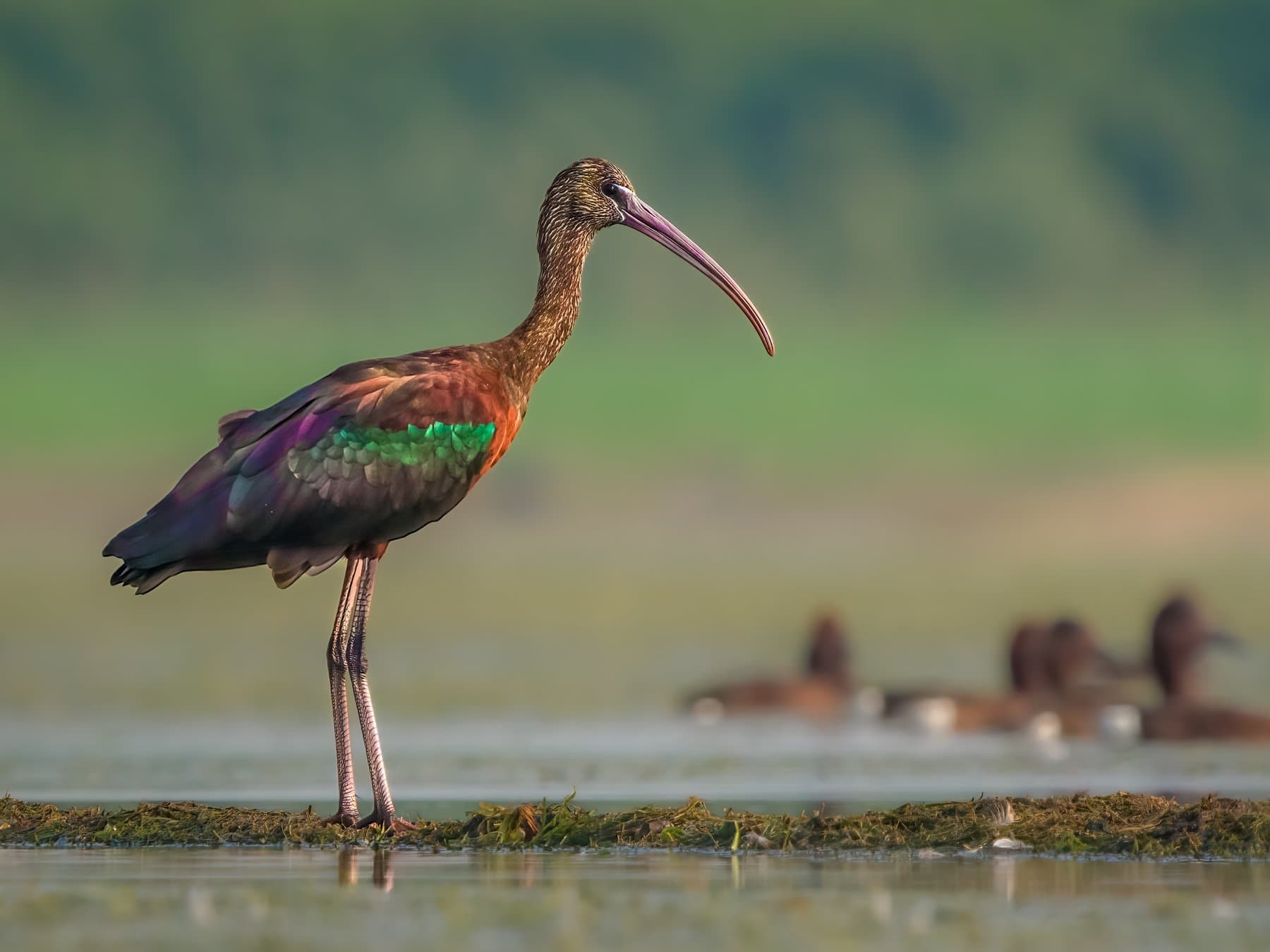
Glossy Ibis
Plegadis falcinellus
By the Birdfact teamChecked by Nathan Cope
At a distance the Glossy Ibis looks uniformly black, but catch one in good sunlight and the wings erupt in metallic bottle-green, bronze, purple, and violet — an iridescence that makes this long-billed wader one of the most visually striking birds in any wetland. It is also the only ibis to have colonised the Americas without human help, almost certainly riding the trade winds across the Atlantic from West Africa sometime before 1817.
On this page13 sections
How to recognise it
In poor light or at distance, the Glossy Ibis appears entirely dark — almost black — and can be mistaken for a large, dark curlew. Step into good sunlight and the transformation is dramatic. Breeding adults carry rich chestnut-brown on the head, neck, upper back, and underparts, while the wings, lower back, and tail shimmer with metallic bottle-green, bronze, purple, and violet tones that shift with every change of angle. The effect is produced by the microscopic structure of the feather barbules rather than pigment alone.
The long, strongly decurved bill is grey to brownish, measuring 9.7–14.4 cm along the culmen. The facial skin between the base of the bill and the eye is blue-black, bordered by a narrow line of pale blue skin that intensifies to vivid cobalt blue during the breeding season — one of the most reliable field marks at close range. The eyes are dark brown, and the legs and feet range from dark brown to olive-grey.
Non-breeding adults are noticeably duller. The body loses much of its chestnut warmth, the head and neck become dark brown with fine white streaking, and the pale blue facial border fades to near-invisibility. Juveniles resemble non-breeding adults but are browner on the head and neck, carry less iridescent sheen, and show variable white markings on the forehead, throat, and foreneck. Nestlings hatch covered in sooty-black down with a pink bill that gradually turns olive-brown from the tip outwards.
Females are essentially identical in plumage to males, making field separation by sex very difficult. The only consistent difference is body size: females are noticeably smaller, though this is hard to judge without a direct comparison. Both sexes undergo the same seasonal plumage changes. Wing length measures 24.8–30.6 cm, tail 9–11.2 cm, and tarsus 6.8–11.3 cm.
Not sure it’s a Glossy Ibis? Check your photo: Birdfact names the bird and shows the look-alike side by side.
Its size
Adults- Length
- 48–66 cm
- Wingspan
- 80–105 cm
- Weight
- 485–970 g
Its song and calls
Away from the breeding colony, the Glossy Ibis is largely silent — one of the quieter large waders. Its vocal repertoire consists of low croaks, grunts, and rattles rather than any melodic song. At the colony, adults produce a hoarse, guttural rolling "grrrr" in social interactions, while birds in flight utter a low-pitched grunt rendered as "graa…graa…graa" or "uhrr…uhrr…uhrr" — described around Chesapeake Bay as a low "kruk" or "ka-honk". A "thu-thu-thu-u" call has also been noted in Australian populations.
Courtship adds a different dimension to the vocal repertoire. Pairs rattle their bills together rapidly in a dry, mechanical clatter while simultaneously producing soft cooing sounds — a combination that serves as both a bonding display and a signal of readiness to breed. Feeding flocks produce a subdued, continuous babbling as birds jostle for position in productive patches of mud.
Chicks have a distinctive food-begging call: a cricket-like buzzing produced by modulating a carrier frequency of approximately 3,000 Hz, delivered while standing and wing-beating to solicit food from returning parents. Quite unlike the adult vocalisations, it can be heard from some distance within a busy colony. The species is most vocal during the breeding season and largely silent when foraging away from the colony — a pattern that makes it easy to overlook even when present in reasonable numbers.
- Flight call0:00 / 0:05
Recorded in Normandy, France · October 2025
Heard one and not sure? Let the bird song identifier listen.
When and where to see it
OctoberIn season
Most recorded in October
- 1. Wexford0.30%
- 2. Northamptonshire0.18%
- 3. Midlothian0.16%
- 4. Leicestershire0.11%
- 5. Devonunder 0.1%
Each dot is a county, state or province: the bigger and darker, the larger the bird’s share of that place’s bird records that month. Grey dots: no regular records. The ringed point is the centre of the bird’s records this month; the arrow shows how it moved since last month, and the dashed loop its path through the year. “Arrivals” colours places where it becomes regular this month (orange) or is in its last regular month (grey). GBIF eBird Observation Dataset, 2019–2024. Map data: Natural Earth, US Census Bureau; place centres © OpenStreetMap contributors.
In your area
See when the Glossy Ibis is recorded in your county, state or province.
How often the Glossy Ibis turns up in the UK, Ireland, the United States and Canada through the year, from birdwatchers' records.
United Kingdom
Resident · all year · most records in January
Ireland
Winter visitor · regularly Aug–Jun · most records in September
United States
Resident · all year · most records in January
Canada
Summer visitor · regularly Apr–Oct · most records in September
Show as a table
| Month | United Kingdom | Ireland | United States | Canada |
|---|---|---|---|---|
| January | 0.020% (regular) | 0.026% (regular) | 0.083% (regular) | – |
| February | 0.014% (regular) | 0.029% (regular) | 0.077% (regular) | – |
| March | 0.018% (regular) | 0.030% (regular) | 0.061% (regular) | – |
| April | 0.016% (regular) | 0.029% (regular) | 0.055% (regular) | 0.004% (regular) |
| May | 0.014% (regular) | 0.005% (regular) | 0.051% (regular) | 0.003% (regular) |
| June | 0.012% (regular) | 0.007% (regular) | 0.068% (regular) | <0.001% (regular) |
| July | 0.011% (regular) | 0.003% | 0.073% (regular) | 0.005% (regular) |
| August | 0.015% (regular) | 0.027% (regular) | 0.065% (regular) | 0.003% (regular) |
| September | 0.017% (regular) | 0.035% (regular) | 0.030% (regular) | 0.007% (regular) |
| October | 0.017% (regular) | 0.033% (regular) | 0.030% (regular) | 0.001% (regular) |
| November | 0.015% (regular) | 0.013% (regular) | 0.048% (regular) | <0.001% |
| December | 0.012% (regular) | 0.015% (regular) | 0.066% (regular) | – |
Recorded regularly in
Worldwide: recorded regularly in 130 countries
Countries where it was recorded in at least 3 of the 6 years 2019–2024. Linked countries have their own bird list.
Europe (28)
- Albania
- Belgium
- Bosnia & Herzegovina
- Bulgaria
- Croatia
- Czechia
- France
- Germany
- Greece
- Hungary
- Ireland
- Italy
- Malta
- Moldova
- Montenegro
- Netherlands
- North Macedonia
- Poland
- Portugal
- Romania
- Russia
- Serbia
- Slovakia
- Slovenia
- Spain
- Switzerland
- Ukraine
- United Kingdom
Africa (26)
Asia (36)
- Armenia
- Azerbaijan
- Bahrain
- Bangladesh
- Cambodia
- China
- Cyprus
- Georgia
- Hong Kong SAR China
- India
- Indonesia
- Iran
- Iraq
- Israel
- Jordan
- Kazakhstan
- Kuwait
- Kyrgyzstan
- Lebanon
- Malaysia
- Myanmar (Burma)
- Oman
- Pakistan
- Palestinian Territories
- Philippines
- Qatar
- Saudi Arabia
- Sri Lanka
- Taiwan
- Tajikistan
- Thailand
- Turkey
- United Arab Emirates
- Uzbekistan
- Vietnam
- Yemen
North America (32)
- Antigua & Barbuda
- Aruba
- Bahamas
- Barbados
- Belize
- Bermuda
- Canada
- Caribbean Netherlands
- Cayman Islands
- Costa Rica
- Cuba
- Curaçao
- Dominican Republic
- El Salvador
- Grenada
- Guadeloupe
- Guatemala
- Haiti
- Honduras
- Jamaica
- Mexico
- Montserrat
- Nicaragua
- Panama
- Puerto Rico
- Sint Maarten
- St Kitts & Nevis
- St Lucia
- St Martin
- Trinidad & Tobago
- Turks & Caicos Islands
- United States
Oceania (4)
- Australia
- Christmas Island
- New Zealand
- Papua New Guinea
Data: EOD – eBird Observation Dataset (Cornell Lab of Ornithology), accessed via GBIF.org, CC BY 4.0. Records from 2019–2024, aggregated and filtered by Birdfact. How these lists are made
Tips for seeing it
The Glossy Ibis's dark plumage makes it easy to overlook in a mixed wader flock, but its long, strongly decurved bill and characteristic hunched silhouette distinguish it from all similarly sized species at a glance. In flight, look for the outstretched neck and slightly drooping legs — unlike Grey Herons, which fold their necks back in flight, ibises fly with the neck fully extended. Flocks often travel in V-formations or diagonal lines, with rapid wingbeats interspersed with short glides.
In the UK, autumn is the peak season, with most records from southern England and Wales. Key sites include the Somerset Levels, the Norfolk Broads, and coastal wetlands in Suffolk and Kent. The growing breeding populations in Suffolk, Oxfordshire, and Rutland mean spring and summer sightings are increasingly possible. Scan mixed heron and egret roosts at dusk — Glossy Ibises often roost communally with these species and can be picked out by their darker, more compact silhouette.
In North America, the Gulf Coast and Florida offer the best year-round opportunities, with the Chesapeake Bay region productive in spring and summer. In Australia, the Murray-Darling Basin wetlands and the Macquarie Marshes in New South Wales are reliable sites, particularly after good rainfall when birds concentrate in large numbers.
The most common confusion species is the White-faced Ibis in North America, which is almost identical to the Glossy Ibis in non-breeding plumage. In breeding plumage, the White-faced Ibis shows a white border of feathers around the bare facial skin (rather than the Glossy's pale blue skin border) and typically has redder eyes and pinker legs. In Europe, no similar species occurs, making identification straightforward once the decurved bill is noted.
What it eats
Crayfish are the primary food source in parts of the southeastern United States, but the Glossy Ibis is broadly opportunistic, eating whatever the wetland offers. Its prey spans invertebrates, amphibians, and small reptiles — aquatic beetles, dragonfly larvae, leeches, earthworms, crabs, shrimp, and snails alongside frogs, toads, newts, salamanders, small snakes, and lizards. Insects such as crickets, grasshoppers, and locusts are also taken, as are small fish. When foraging in agricultural fields, birds additionally take grains and seeds including rice and sorghum.
The species hunts by two distinct methods. In open water and wet mud it probes with the bill tip, or sweeps the bill scythe-like through the substrate, relying on a sensory system called "remote-touch": thousands of mechanoreceptors known as Herbst corpuscles are packed into dense clusters of foramina in the distal beak bones, allowing the bird to detect the pressure and vibrations of buried prey without needing to see it. This is the same principle used by Woodcocks and kiwis. On drier ground, the ibis switches to visual hunting, picking and gleaning prey from the surface.
Foraging intensity varies with the tidal cycle in coastal areas, peaking as a falling tide exposes mudflats. In western India, birds show scale-dependent seasonal habitat use, preferring wetlands larger than 200 ha in summer. Larger water bodies likely support greater prey densities during the hot season. Feeding flocks can travel 30–40 km from the breeding colony to reach productive foraging sites, returning to roost in the evening.
Nesting and breeding
Breeding season timing varies enormously across the species' global range: April–July in Spain's Doñana, May around the Black Sea, March–May in eastern North America, June–September in Cuba, late January in southern India, and October–February in Australia. Tropical populations time nesting to coincide with the rainy season, when shallow water and invertebrate prey are most abundant.
Colonies range from a few pairs to over 1,000, almost always in mixed-species assemblages with herons, egrets, storks, and spoonbills. The nest is a bulky platform of sticks, twigs, or reeds — the material depending on what is locally available — with a shallow central depression approximately 30 cm in diameter. It is positioned at least 1 m above water, and sometimes up to 7 m high in dense emergent vegetation, low trees, or bushes. The male collects most of the material; the female does most of the construction. Both sexes continue adding fresh green leaves and grasses after the eggs are laid.
Clutch size is typically 3–4 eggs, occasionally 1–5. The eggs are pale blue or pale green, measuring approximately 4.7–5.8 cm × 3.3–4.3 cm. Both parents incubate, with the female sitting more often — all night and for part of the day. Incubation lasts 20–23 days.
Chicks hatch covered in sooty-black down and are fed regurgitated food by both parents. At 2–3 weeks they begin leaving the nest to wander and climb nearby branches. First flight attempts occur at 4–5 weeks, and young fly well by 6–7 weeks. At this point they may accompany parents to feeding areas. Sexual maturity is not reached until approximately 3 years of age. One brood per year is typical.
Behaviour
The Glossy Ibis flies with its neck fully outstretched and legs trailing slightly below the body line — a posture that immediately separates it from herons, which retract the neck into an S-curve in flight. The wings are relatively broad and rounded for a wader of this size, and the wingbeat is rapid and direct, with periodic short glides that give the flight a distinctive pulsing rhythm. Wingspan ranges from 80 to 105 cm.
Flocks typically organise into V-formations or diagonal lines, with individuals taking turns at the front to reduce wind resistance — a pattern shared with many long-distance migrants. When commuting between roost and feeding sites, birds fly at moderate height in tight formation. On longer migratory journeys, European breeders cross the Sahara Desert on a broad front, a crossing that requires sustained endurance flight over hundreds of kilometres of inhospitable terrain.
At close range in flight, the iridescent wing surfaces catch the light with each wingbeat, producing brief flashes of green and bronze that are visible at surprising distances in good conditions. When taking flight from water or mud, birds utter a short call and run briefly across the surface before becoming airborne. Landing is precise: birds drop steeply into reedbeds or onto branches, braking with spread wings and fanned tail in the final moments of descent.
Lifespan and predators
In the wild, Glossy Ibises typically live 10–15 years, though survival rates vary considerably between populations and age classes. First-year birds face the highest mortality, particularly during their first southward migration and first winter in sub-Saharan Africa. Adults that survive to breeding age — reached at approximately 3 years — have significantly better annual survival prospects. The oldest confirmed wild individual in North America was at least 21 years old, banded in Virginia in 1971 and last recorded in 1992. In captivity, the maximum recorded lifespan is 26.8 years (AnAge database, Brouwer et al. 1994).
The main mortality factors include predation of eggs and chicks at the colony by large gulls, foxes, and raccoons; hunting pressure in parts of southern Europe (particularly Italy, despite legal protection since 1977); and collision with power lines and fences during migration. Pesticide and heavy metal contamination has also been recorded at elevated levels in Glossy Ibis tissues compared to some co-occurring species.
Wetland drainage that reduces food availability can affect body condition and survival, particularly in drought years. Compared to the closely related Eurasian Spoonbill, which can reach 30 years in captivity, the Glossy Ibis appears somewhat shorter-lived, though the difference may partly reflect the smaller number of long-term ringing studies. Sexual maturity at 3 years is relatively late for a bird of this size, suggesting the species invests in a prolonged period of learning and development before committing to breeding.
Conservation
The Glossy Ibis is listed as Least Concern on the IUCN Red List, supported by an enormous global range — an extent of occurrence of roughly 180,000,000 km² — and a total population estimated at 1.1–3.3 million individuals (Wetlands International 2002). Partners in Flight estimates a global breeding population of approximately 820,000. Despite this, BirdLife International assessed the overall population trend as decreasing in 2024, though the species does not approach the thresholds for a threatened category.
Regional trends diverge sharply. Western Europe and North America are success stories: Spanish and French colonies have expanded strongly since legal protection was introduced, and North American populations grew by roughly 4.2% per year between 1966 and 2015. By contrast, populations in parts of south-eastern Europe and New York State have declined, and illegal hunting in Italy — despite the species being legally protected since 1977 — has kept breeding numbers there to just 10–50 pairs.
The primary threat globally is wetland loss and degradation: drainage for irrigation and hydroelectric schemes, grazing, burning, and increasing salinity all reduce the shallow-water habitat the species depends on. In Australia, diversion of water for irrigation has disrupted breeding in the Macquarie Marshes by restricting areas of shallow water.
Oil spills, pesticide contamination (studies have recorded elevated heavy metals and pesticides in Glossy Ibis tissues compared to some co-occurring species), and ditching of marshes for mosquito control add further pressure. Human disturbance of nesting colonies — from boating, fishing, and dredge spoil deposition — and predation by gulls, foxes, and raccoons also affect breeding success. Climate change is projected to alter wetland availability across the range and may drive further northward range shifts, particularly in Europe.
Courtship & Display
Courtship in the Glossy Ibis is an intimate, tactile affair conducted at close quarters within the colony. Males arrive at the breeding site first and establish small territories centred on a prospective nest site, defending these vigorously against rival males with upright threat postures and occasional bill-jabbing. Once a female approaches, the male's behaviour shifts from aggression to display: he bows repeatedly, stretching the neck downward and then sweeping it upward in a slow arc, while simultaneously erecting the scapular feathers to show off the iridescent wing surfaces to maximum effect.
If the female remains, the pair progresses to mutual neck-intertwining — each bird draping its long neck over the other's in a slow, synchronised movement — followed by allopreening, in which the birds groom each other's head and neck feathers with the bill tip. The head and neck are the one area a bird cannot easily preen itself, so this contact serves a practical function. It also reinforces the pair bond through repeated physical contact. Bill-rattling, in which the pair clatter their bills together rapidly while cooing, is the final stage of courtship and appears to signal mutual readiness to mate.
The cobalt-blue facial skin border intensifies noticeably during the breeding season, and this colour change is thought to function as a visual signal of breeding condition — the brighter the blue, the more physiologically ready the individual. Pairs are monogamous within a season, though long-term pair fidelity has not been well studied; both sexes do, however, show strong site fidelity, returning to successful colonies in subsequent years.
Uk Status And Records
For most of British ornithological history, the Glossy Ibis was a trophy. Known in Norfolk as the "black curlew" — a name with roots in Anglo-Saxon literature — it appeared occasionally on the coasts and marshes of southern England, where it was routinely shot by collectors until the 1920s. The species was considered a rare vagrant throughout the 20th century, with records numbering in the tens most years.
The turnaround has been striking. From around 50 birds per year in the 1990s, annual totals climbed steadily, reaching over 220 individuals from 50 recording areas in 2022. Most sightings remain concentrated in southern England and Wales, with autumn the peak season, when post-breeding dispersal brings birds north from Iberian and French colonies. Ringed birds have been traced directly to Doñana in Spain and the Petite Camargue in France, confirming the source populations.
Breeding milestones have followed in quick succession. A pair attempted to nest in Lincolnshire in 2014 — the first such attempt in Britain — though the attempt was unsuccessful. In 2022, a pair fledged one chick at a Cambridgeshire wetland, the first confirmed successful breeding in recorded British history.
Small breeding groups are now established in Suffolk, Oxfordshire, and Rutland, and the species is on a clear trajectory of range expansion into Britain. Climate projections suggest this trend will continue as suitable wetland habitat becomes available further north. In Ireland, a few birds spend most summers at wetland sites, but breeding has not yet been confirmed.
Quick facts
- Length
- 48–66 cm
- Wingspan
- 80–105 cm
- Weight
- 485–970 g
- Lifespan
- 10–15 years · oldest recorded 26.8 years
- Family
- Ibises & Spoonbills
- Migration
- Partial migrant
- Global status (IUCN)
- Least Concern
- World population
- 1,100,000–3,300,000 individuals
- Population trend
- Decreasing globally (BirdLife International 2024), with significant regional variation: increasing in western Europe (especially Spain and France) and North America; declining in parts of south-eastern Europe and New York State.
- Scientific name
- Plegadis falcinellus
Sources
18- 1Glossy ibis - Wikipedia Source (opens in a new tab)
- 2Glossy Ibis Species Factsheet - BirdLife International DataZone (2024) Source (opens in a new tab)
- 3Glossy Ibis Text Factsheet - BirdLife International Source (opens in a new tab)
- 4Glossy Ibis Life History - All About Birds, Cornell Lab of Ornithology Source (opens in a new tab)
- 5Glossy Ibis - BTO BirdFacts Source (opens in a new tab)
- 6Glossy Ibis - Audubon Field Guide Source (opens in a new tab)
- 7Glossy ibis - The Wildlife Trusts Source (opens in a new tab)
- 8Glossy Ibis Identification Guide - Bird Spot Source (opens in a new tab)
- 9Glossy ibis longevity - AnAge Database (Brouwer et al. 1994) (1994) Source (opens in a new tab)
- 10Plegadis falcinellus - Australian SPRAT Database Source (opens in a new tab)
- 11Glossy Ibis - Birds in Backyards Source (opens in a new tab)
- 12Glossy Ibis - Oiseaux-Birds Source (opens in a new tab)
- 13Glossy Ibis Guide - New York Natural Heritage Program Source (opens in a new tab)
- 14Glossy Ibis - US Fish & Wildlife Service (2022) Source (opens in a new tab)
- 15Glossy Ibis - Planet of Birds Source (opens in a new tab)
- 16Remote-touch bill-tip organ in ibis species - Journal of Anatomy (Wiley) Source (opens in a new tab)
- 17XC98707 Glossy Ibis call - Xeno-canto (Fraser Simpson) Source (opens in a new tab)
- 18XC145799 Glossy Ibis call - Xeno-canto (Paul Marvin) Source (opens in a new tab)

Checked by
Nathan Cope, founder and editor
Nathan founded Birdfact and leads its writers and contributors in the UK, the US and Canada. He has watched and studied birds for more than ten years, and checks every article and species guide before it’s published.