


Anhinga
Snakebird, Water Turkey, American Darter · Anhinga anhinga
By the Birdfact teamChecked by Nathan Cope
On this page13 sections
How to recognise it
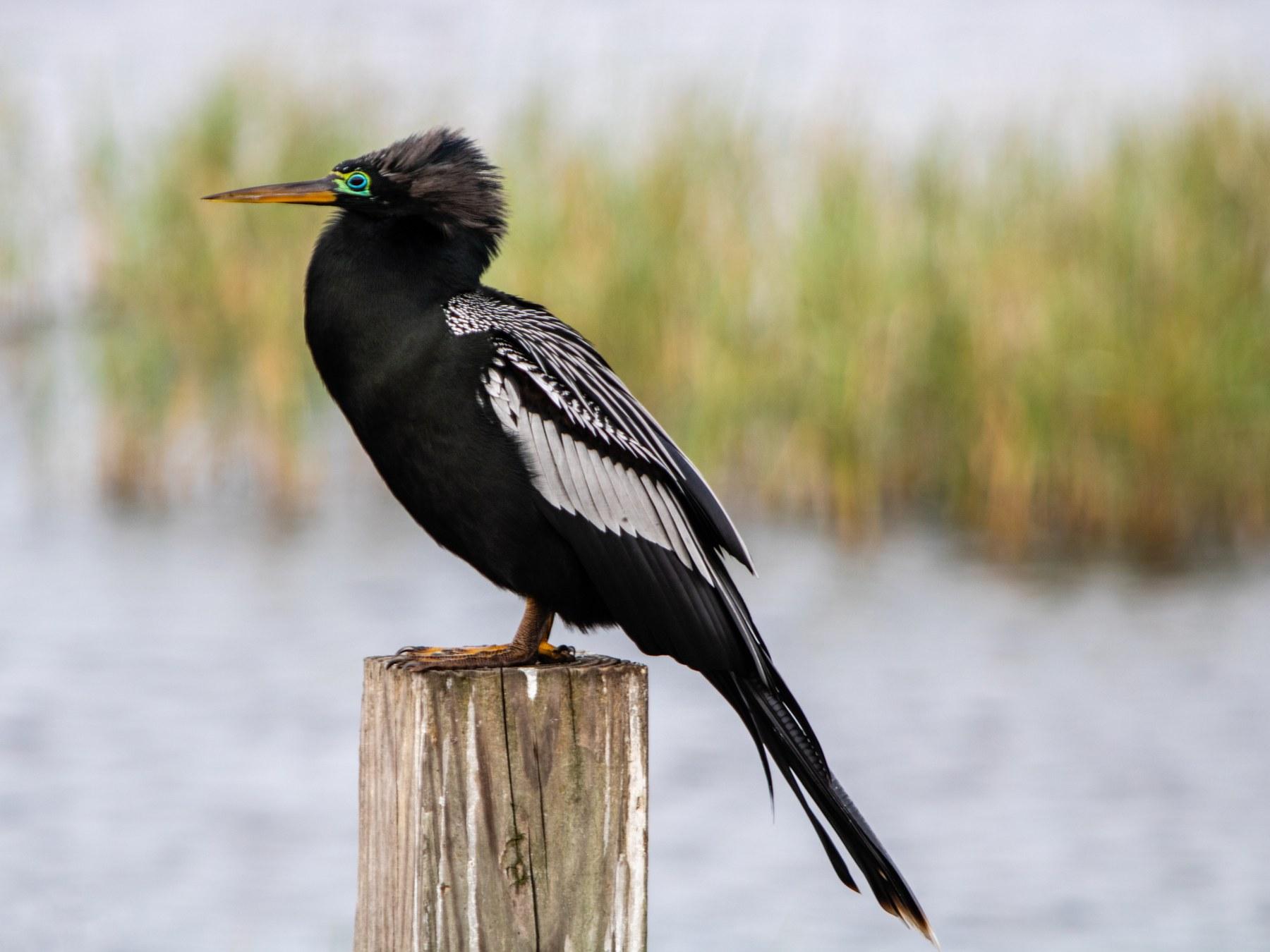
The Anhinga is a large, slender waterbird of warm southern swamps, built like a stretched-out cormorant: a small head, a very long, thin neck that often hangs in an S or a sharp kink, a straight, sharply pointed bill and a long tail that opens into a broad fan. Adult males are black with silvery-white streaks and spots across the back and wings; females and young birds have a buff head, neck and breast.
You will most often see one in one of three poses. Swimming, it rides so low that only its head and snake-like neck show above the water. Perched on a snag or branch over the water, it sits with its wings held wide open and its tail fanned. In the air, it soars on flat wings with its neck stretched out in front and its tail spread, a shape like a cross.
Up close, the bill is the giveaway. It is long and dagger-like, with no hook at the tip and fine, backward-pointing serrations near the point, and it is yellowish outside the breeding season. All four toes are joined by webs, as in pelicans and cormorants. The silvery wing streaks are a trick of feather structure: barbules that are glossy black at the base and white at the tip, lying side by side, most likely produce the silver sheen.1
Size and weight
An Anhinga is 29.5-37.4 in (75-95 cm) long, about the size of a small to medium heron, and up to about 30% of that is tail. Its wingspan is about 42.9 in (109 cm). It is bigger than an American Coot and about as long as a Double-crested Cormorant, but much slimmer and lighter.
Weights in the handbooks vary. In a sample of 16 birds collected in south Florida, the birds weighed 2.3-3.1 lb (1,057-1,420 g): the 9 males averaged 2.7 lb (1,245 g) and the 7 females 2.6 lb (1,174 g).2 In North America the sexes are much the same size; only in South America are males clearly larger.3
Male, female and young
The adult male is black with a green gloss on the head, neck and body. Silvery-white streaks and spots run across the upper back, along the long, pointed shoulder feathers and over a broad panel on the wing, and the dark tail has a pale tip. In the breeding season he grows a mane on the back of the neck and fine pale plumes on the sides of the head and neck, the bare skin around his eye turns an iridescent blue-green, and his bill brightens toward orange-yellow.
The adult female has the same silvery wings, but her head, neck and upper breast are buff to tawny, darker on the crown and paler on the face, and a chestnut band, fainter in North American birds than farther south, divides the buff breast from her blackish belly. Her dark parts are browner than a male's and her tail tip is buff. Breeding females show a few whitish plumes on the head and neck and duller, greenish skin around the eye.
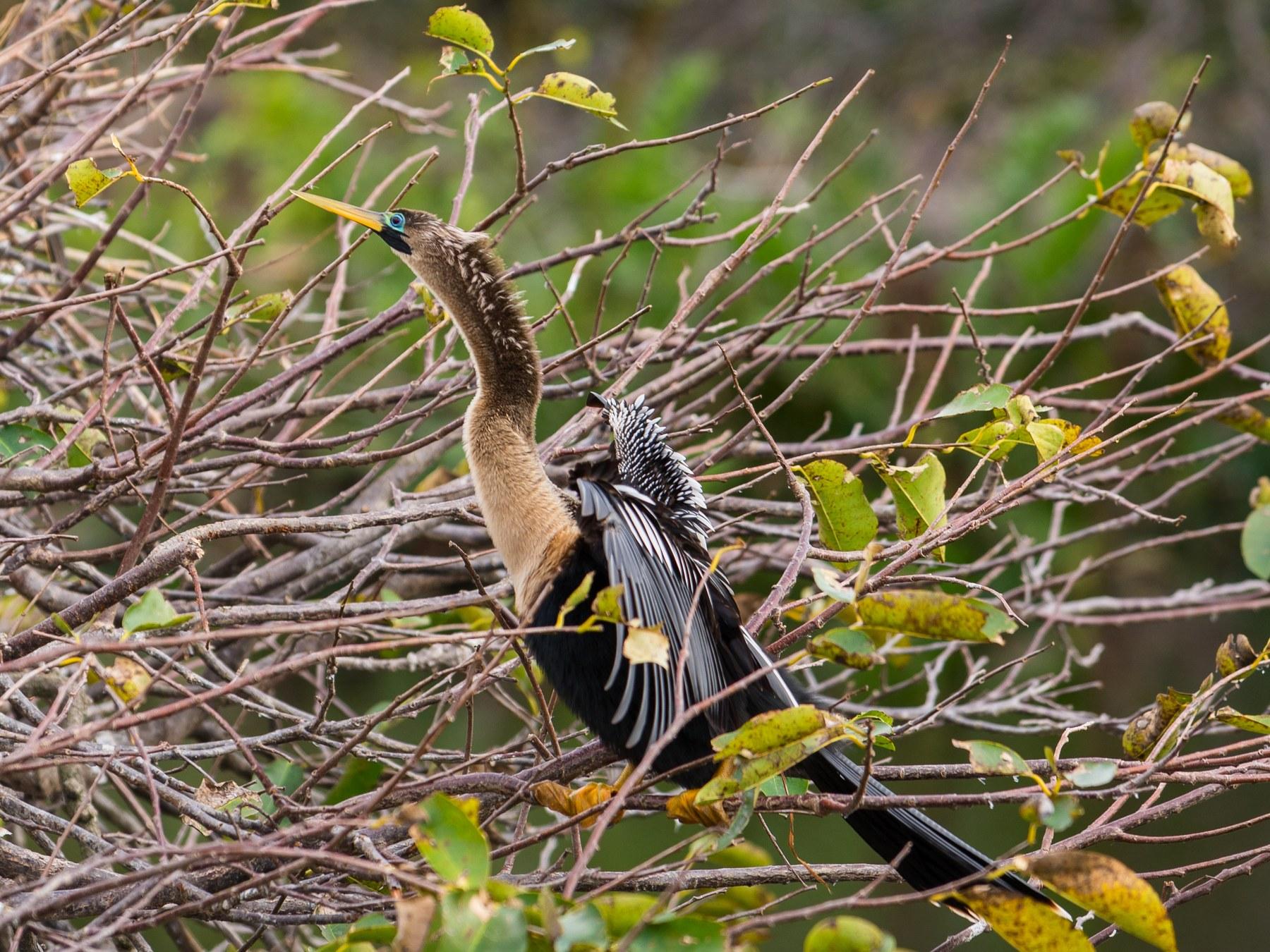
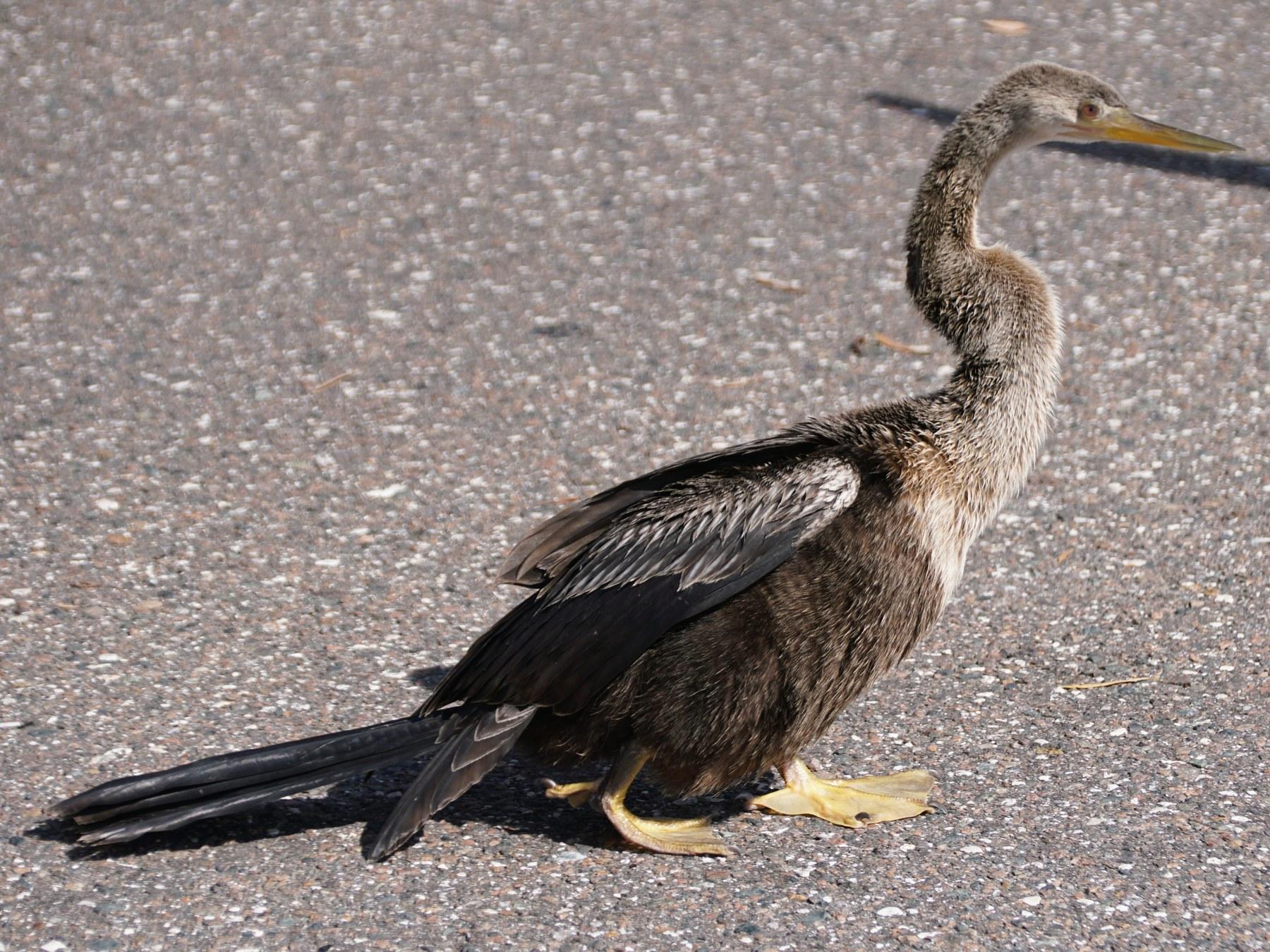
Young birds in their first year look like females but browner overall: a cinnamon-buff head and neck, a dusky back whose feathers have paler brown edges, and only faint, diffuse grayish marks on the wings instead of bright silvery streaks. Males and females first look different in their second calendar year, and full adult plumage comes in the third, so a buff-necked bird with dull wings is more likely a young one, while one with bright silvery wings is more likely an adult female.
Identification: telling it from a cormorant
The only birds in the Americas you are likely to confuse with an Anhinga are cormorants, especially the Double-crested Cormorant, which shares its southern lakes and rivers. Look at four things. An Anhinga's bill is straight and sharply pointed; a cormorant's is blunter, with a hooked tip. An Anhinga's neck is much longer and thinner, and its tail much longer. Its back and wings carry silvery-white streaks that no North American cormorant has, and females and young have a buff head and neck. A Double-crested Cormorant also has orange-yellow bare skin on the face and throat all year.4
Behavior helps too. An Anhinga swims with its body under water and only the head and neck showing; cormorants rarely do. In flight a cormorant looks chunkier, while an Anhinga often soars high with its long tail fanned, something cormorants seldom do. Both perch with their wings spread, for partly different reasons (see Spread-wing behavior, below).
In Texas and Louisiana, the smaller Neotropic Cormorant is another cormorant to rule out. It has a shorter neck and tail than an Anhinga, a hooked bill and a pale yellow throat pouch outlined by a white V of feathers, sharpest in breeding birds, no silvery wing patches, and it does not usually swim with its body submerged.
Not sure it’s a Anhinga? Check your photo: Birdfact names the bird and shows the look-alike side by side.
Its size
Adults- Length
- 75–95 cm
- Wingspan
- 109 cm
- Weight
- 1057–1420 g
Its song and calls
The Anhinga is a quiet bird with nothing like a song, and away from the nest you will rarely hear it. Its commonest call, from both sexes, is a fast, rolling run of clicks or chatters that rises and falls and can harden into a harsh cruk-cruk-cruk. Birds also give clicks and rattles from a perch or in flight, and a dispute over a perch brings longer, harder clicking.
The nest is where it is noisiest. Mates call to each other at every changeover on the eggs, and at San Blas, Mexico, each changeover came with the same chattering call from both birds as they touched and entwined necks.5 A calling bird draws its head up and back, arches its neck and opens its mouth, and at the nest the repertoire widens to croaks, rattles and grunts. A displaying male may end with a low, guttural rolling note, and nestlings give a low, wheezing call like a young heron's.
Below are the clicking calls of an adult male at Noxubee National Wildlife Refuge, Mississippi, recorded as he called with his bill open, and a rattling call from Mendenhall, Mississippi.
- Clicking calls of a male0:00 / 0:24
Recorded in Mississippi, United States · July 2026
- Rattling call0:00 / 0:31
Recorded in Mississippi, United States · September 2022
Heard one and not sure? Let the bird song identifier listen.
When and where to see it
In the United States the Anhinga is a bird of the southeastern coastal plain. It breeds from eastern Texas and Louisiana east through Mississippi, Alabama and Georgia to Florida, and north up the coastal plain of the Carolinas, more locally inland in southern Arkansas, easternmost Oklahoma and western Tennessee. Beyond the US it breeds from Mexico through Central America to Panama, on Cuba, and across the humid lowlands of South America to northern Argentina. Every US bird belongs to the northern subspecies, leucogaster, described from Florida.
Look for it on shallow, slow, sheltered fresh water with trees, snags or banks close by for perching: cypress swamps, wooded ponds, slow rivers, marshes with willow clumps and lakes full of dead trees. It also uses mangrove-lined bays and lagoons on the coast, but it avoids big open water and usually fishes where the water is less than about 20 in (0.5 m) deep. In Everglades National Park it is one of the most photographed birds, often perched over the water with its wings open.6
Migration and winter
The Anhinga is a short-distance partial migrant. Birds that breed farther north in the US leave in fall for the Gulf Coast, Florida and Mexico, while much of Florida's population seems to stay all year. Many travel to Mexico around the Gulf of Mexico rather than across it, and flocks of migrants pass along the Texas coast in spring and fall.7 On migration in south Texas they soar in flocks, sometimes with Turkey Vultures and hawks, and banding shows little mixing between the Mississippi Valley and Florida: all 49 band returns from birds banded in the Mississippi Valley came from the Mississippi Valley, Texas or Mexico.3
In Florida, birds move in September and October and again in March and April; in breeding-only states such as Arkansas and Alabama they are present from about March to October. Cold sets the winter limit: in the Southeast it winters mostly where the mean December temperature is above 50°F (10°C) and the sun shines for more than 160 hours a month.3 In spring and summer, wanderers turn up far to the north, from California and Colorado to Wisconsin, southern Ontario and New York.
A spreading range
The edges of the Anhinga's range have moved both ways. By 2000, Birds of the World's account recorded losses over the 20th century: it no longer bred in southern Illinois or southeastern Missouri, the Reelfoot Lake colony was gone by the early 1950s, Oklahoma's McCurtain County birds of 1937 had vanished, and the Texas and Arkansas breeding ranges had shrunk. The same account noted gains: Florida's winter range had spread north after the 1970s, South Carolina birds nested farther inland in 1987-1993, and more birds turned up north of the range in the 1990s, including 30 in one flock in Maryland in 1996.3
Since then the spread has continued. In North Carolina the Anhinga has increased noticeably in recent decades and now nests across the Coastal Plain; inland, a nest at Jordan Lake in the Piedmont failed in 2006, and nesting at High Point Lake succeeded in 2023.8 The Breeding Bird Survey shows significant long-term rises in North Carolina (11.65% a year), Mississippi (6.64%), Arkansas (5.30%), Alabama and South Carolina (4.33%) and Louisiana (3.27%), though the North Carolina, Arkansas and Alabama figures carry the survey's lowest credibility code; Florida, where survey counts are highest, shows no significant change.9 eBird's modelled estimate for the breeding season rose 15.6% across its range from 2012 to 2022 (80% confidence interval 11.9% to 19.9%).10
Tips for seeing it
What it eats
Anhingas eat mainly fish: small to medium fish of shallow fresh water, especially slow, flat-sided ones such as sunfish and livebearers. They also take crayfish, shrimp, tadpoles and other amphibians, small snakes, aquatic insects and leeches. They are not birds of the backyard feeder: they catch live fish in the water.
In stomachs from south Florida, more than 98% of 151 prey items were fish: 56.3% livebearers, 31.7% sunfishes and bass and 8.0% killifishes, and the largest was a warmouth 5.2 in (132 mm) long, though Anhingas commonly take fish up to about 8 in (21 cm).2, 3 A fish too big to toss, such as a large catfish, is dragged ashore and wiped off the bill against branches.
Feeding: how it spears fish
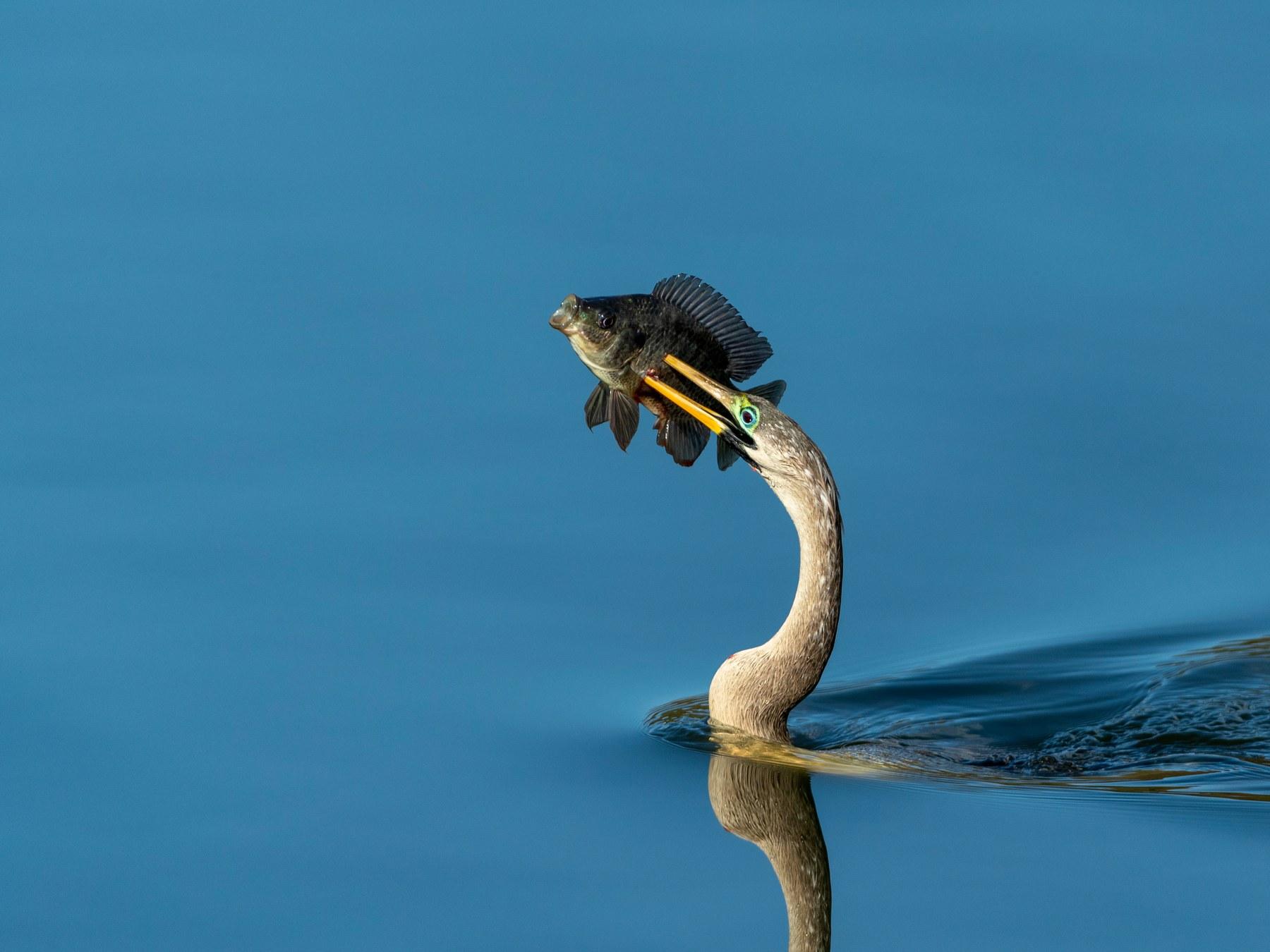
An Anhinga usually hunts alone, under water. It swims slowly through the weeds, stalking rather than chasing, then shoots its neck forward and spears a fish with the slightly open bill, usually straight through the side with both halves of the bill. Back at the surface it shakes the fish loose, tosses it into the air and swallows it head first. The punctures tell the story: fish taken by Anhingas carry one or two holes running from side to side, the mark of a stalker rather than a pursuer.2
The neck is built for it: two vertebrae partway down let it bend at a right angle, giving a fulcrum for a straight, sudden stab. A 2026 study found its neck vertebrae organized much like a heron's, consistent with the two groups evolving their necks this way separately, though Anhingas were described from only a few specimens.11 The fine serrations near the bill tip probably help hold a slippery catch.
Nesting and breeding
Anhingas nest alone or in loose groups of a few to hundreds of pairs, often among herons, egrets, ibises, storks and cormorants. The nest is nearly always over water, in a tree or shrub such as a cypress, buttonbush, willow, red maple, mangrove, live oak or water tupelo, at a height that depends on the trees: most reported nests are a few feet to about 15 ft (1-4.6 m) above the water, though one Florida account gives up to 98 ft (30 m).3 It is a bulky stick platform, more compact than a heron's and often lined with fresh green leaves and twigs, which generally mark an active nest as an Anhinga's. The male starts it and brings nearly all the material, and the female does the building; it can be finished in 1-3 days. A pair will sometimes take over a newly built heron or egret nest.
Courtship happens at the nest site. A male claims a spot and displays there, waving his wings to flash the silvery patches, raising his tail and bowing deeply; a pair cross necks, preen each other and pass twigs.12 At the peak of breeding, the bare skin in front of the eye turns blue to match the ring around it.13 In peninsular Florida most eggs are laid from February to July, and in south Florida nesting goes on in almost every month; farther north, eggs are laid from April to June or July.
Eggs and young
The clutch is usually 4 eggs, sometimes 2-5, pale bluish green under a chalky coat that soon becomes stained in the nest. The chalk is calcium carbonate in the vaterite form, laid over the normal shell.14 Both parents incubate, for 26-30 days. At San Blas, Mexico, in 1975, the first egg hatched after an average of 27.8 days, and males did 55% of the sitting to the females' 45%, a difference too small to be significant.5
The chicks hatch naked with their eyes open, and soon grow white and buff down. Both parents feed them on regurgitated food, at first dribbled into the chick's bill and later taken straight from the parent's throat. From about two weeks old, a disturbed chick will jump from the nest into the water, swim off and climb back up later. At about three weeks the young start leaving the nest to perch nearby, and they first fly at about six weeks. Pairs in the north raise one brood a year; in south Florida's long season a second is possible, and Birds of the World's account tells of a second brood near Lakeland, Florida, killed by a freeze in December 1962. On the Florida coast, 71% of 21 nesting attempts raised at least one young, and most losses were to Fish Crows and Boat-tailed Grackles.3
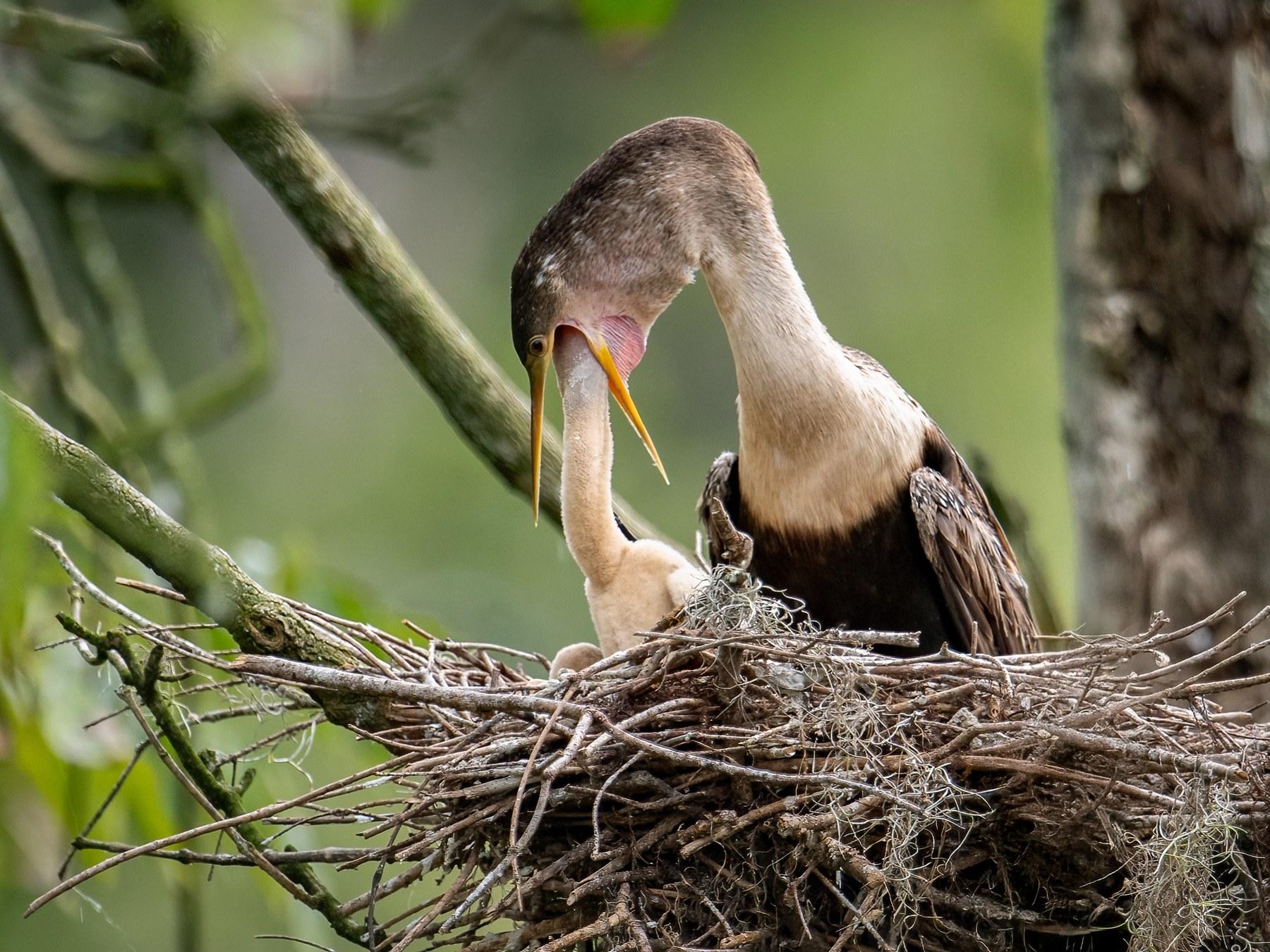
Behaviour
Most waterbirds float high; the Anhinga is built to swim low. Its breast feathers have none of the tiny hooks that zip other birds' feathers together, so water soaks right through to the skin, and no air sacs reach into its bones.15 Wet plumage and dense bones bring it close to neutral buoyancy, so it can sink slowly and hang in the water while it stalks, though the anatomist who described those bones thought they explain less of its difference from a cormorant than a full stomach does.3, 15 It swims with its webbed feet, holding its wings loosely half open but not using them to swim, and it can travel with only its head and neck, or even just its bill, above the surface. In tests on Florida-caught birds kept in an aviary, Anhinga plumage took up water equal to 3% of the bird's weight against 1% in a cormorant, and a wet Anhinga lost body heat 32% faster than a dry one.16
Its dives are short. In a study published in 2024, 11 birds on a suburban lake in southwest Florida made 75 timed foraging dives that averaged 24 seconds and the longest lasted 71 seconds; shallow dives at the weedy edge averaged 18 seconds and mid-lake ones 42 seconds. The researchers found no earlier published dive times for the species.17
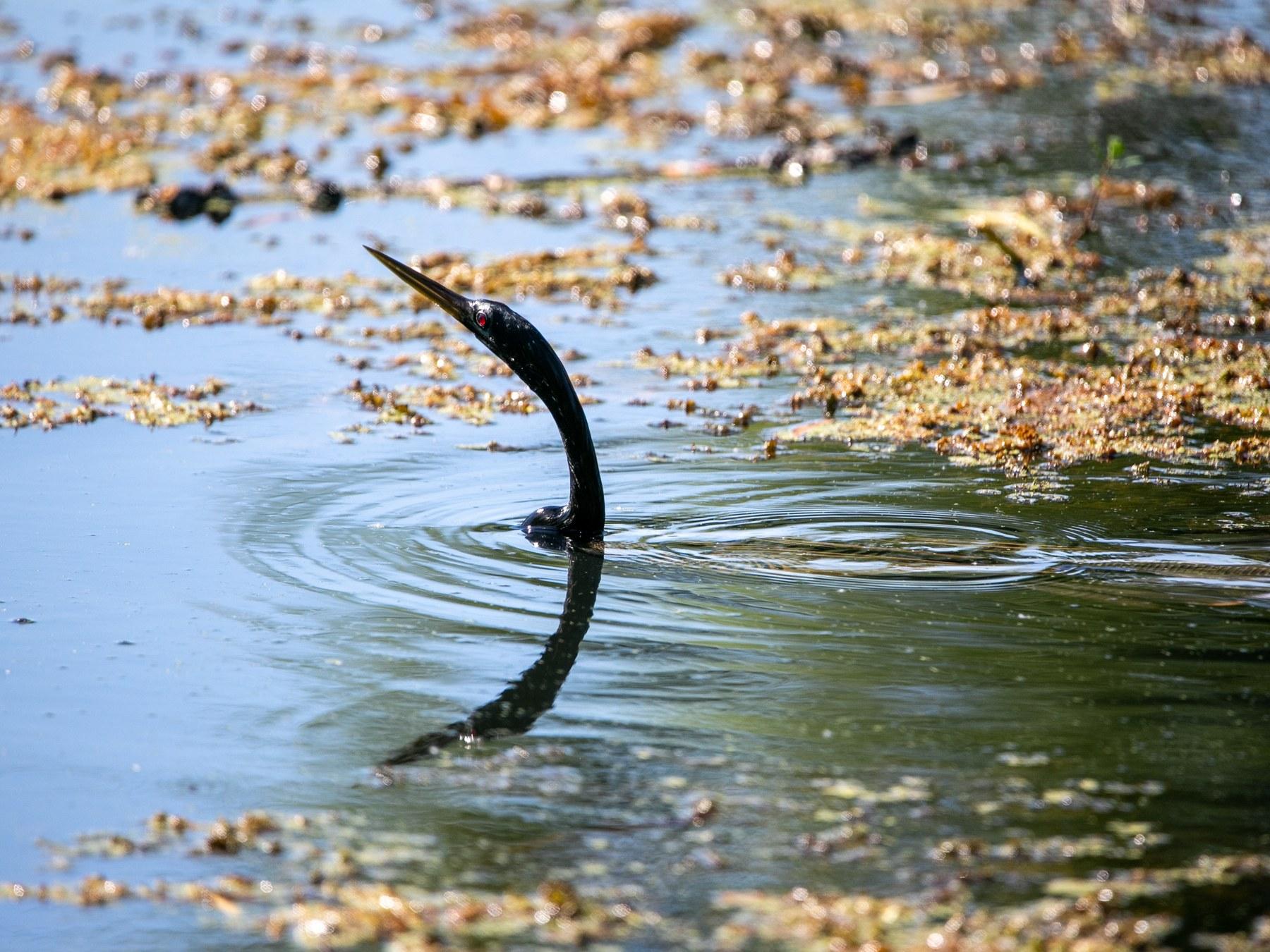
Spread-wing behavior
After a swim, an Anhinga climbs onto a perch, spreads its wings, fans its tail and sits, usually with its back to the sun. The pose does two jobs: it dries the soaked feathers and it soaks up the sun's heat. The heat matters because the Anhinga runs cool. Four hand-raised birds tested in an aviary had a resting metabolic rate only 74-77% of the value expected for their size and lost heat at 177-190% of the expected rate.18
At Lake Alice in Gainesville, Florida, in 1978-1979, spread-winging below 86°F (30°C) took up 47.1% of the birds' time in sunshine but only 3.8% under cloud. Only 16 of 468 records had a bird facing the sun rather than away from it, and 34% of the birds with spread wings looked wet while 49% looked dry. The study concluded that the posture serves both warming and drying.18 One passage of the standard handbook account goes further, calling warming the main job; another gives it both roles.3 Cormorants differ: they spread their wings only when wet, while Anhingas do it wet or dry, using it to take in sunlight.19, 20
When there is no sun, Anhingas may make their own breeze. On a gray, drizzly evening at Wakulla Springs in March 1980, two birds flapped their spread wings and tail for 11 and at least 20 minutes, possibly to dry off.21 In cool weather an Anhinga tucks its neck into a tight S against its body or lays its head and neck along its back, and below about 50°F (10°C) it becomes inactive and its body temperature drops.3

Flight and soaring
Anhingas are strong fliers, mixing flaps with glides, and they soar on rising warm air like hawks, sometimes to several thousand feet, and may drop fast from height. The long tail helps them steer among trees. They rarely take off from the water: the old idea that an Anhinga must dry its wings before it can fly is not borne out, since wet birds can fly, weakly, but a bird normally climbs out, dries off and launches from a perch.18, 2 On land and on branches it is clumsy, walking with a high-stepping waddle and often holding its wings half open for balance.
After breeding, an Anhinga drops all its wing flight feathers at once and cannot fly until the new ones grow. Molting birds keep low and close to water, and this is probably when they are most at risk.2, 3
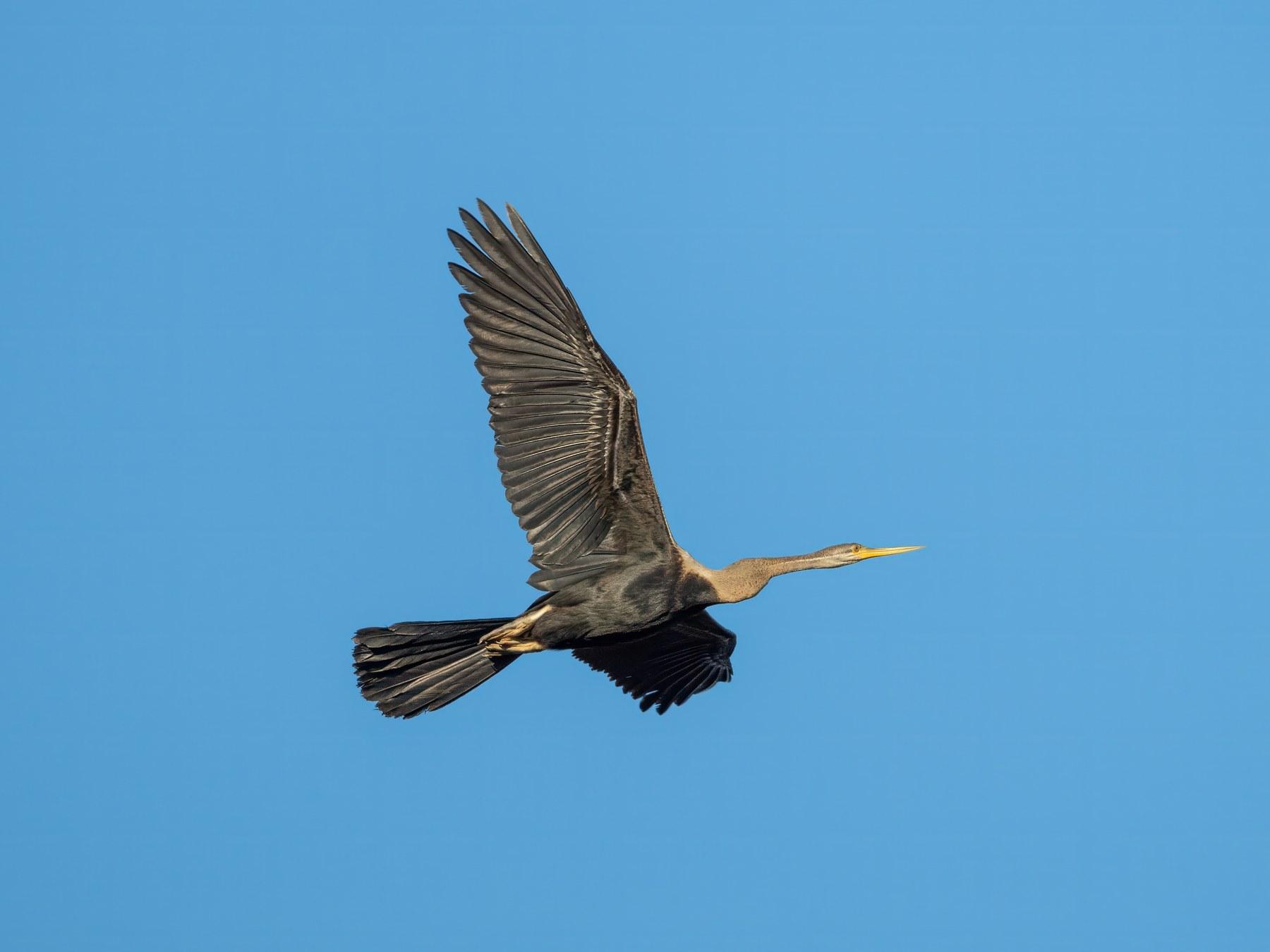
Social behavior
Anhingas nest and roost in company and gather in flocks of up to several hundred, especially in winter, moving to roosts in dead trees and snags half an hour to over an hour before sunset. They are active by day. Each bird usually feeds alone, though, often keeping to a patch of water around one fishing perch. Anhingas are among the most territorial of their order toward their own kind, defending nest sites and, in winter, roosts and feeding sites, but rarely aggressive toward other species. Young birds a few weeks old practice tossing sticks into the air and catching them.
Some tolerate people well. At J. N. "Ding" Darling National Wildlife Refuge in Florida, Anhingas were among the waterbirds most likely to stay close to busy areas.22 In another Florida study, though, birds that were not nesting flushed from an approaching boat at a greater distance than any other waterbird tested.3
Lifespan and predators
Anhingas seem to be long-lived, though we found no study of how many survive each year in the standard handbook account or the papers we read. The oldest wild bird on the USGS Bird Banding Laboratory's current longevity table was at least 12 years 7 months old: banded in Florida in December 2011 in its first year, it was caught injured in Florida in January 2024 and released with its band.23 The laboratory's earlier record-holder, banded in Mississippi in 1936, was shot in Louisiana in 1948 at 12 years.24 Birds of the World's account gave 9 years 8 months for a Mississippi bird found dead in Veracruz, Mexico, and a captive Anhinga lived 16.5 years at the National Zoo.3
Predators and dangers
Adults have few known predators: in north-central Florida, Anhinga remains turned up in less than 1% of the stomachs of 350 American Alligators.3 Eggs and chicks are taken by Fish Crows, Boat-tailed Grackles, rat snakes and raccoons.
Fishing line and hooks may be another hazard: Birds of the World's account, written in 2000, judged entanglement and swallowed hooks probably a threat but had no figures.3 The Florida Fish and Wildlife Conservation Commission asks anglers who hook a bird to leave the line uncut, reel the bird in, take off the hook and line and let it go, and to get a bird that has swallowed a hook or is badly hurt to a wildlife rehabilitator.25 The serrated bill can catch litter too: at a city park pond in Campinas, Brazil, Anhingas were seen 21 times between 2010 and 2015 with plastic, cloth or rope speared on the bill; they freed themselves in 17 cases, and the two that speared a knotted rope end died.26
Pesticides left a mark in the past. Eggs collected in the 1970s from seven places held DDE, the breakdown product of DDT, in 45 of 46, and the Louisiana and Mississippi shells were 7.5% thinner than museum eggs from before 1947, while Florida shells showed no significant change.27 In laboratory tests, Anhinga embryos were moderately sensitive to methylmercury.28
Conservation
The Anhinga is not rare. Partners in Flight puts the world population at roughly 2 million, a figure taken from the middle of a broad estimate band.29 It is hard to count, because it is dark and nests in small groups, and the US had an estimated 10,000-17,000 breeding pairs in the mid to late 1970s; statewide Florida surveys found 6,050 breeding pairs in 1976-1978 and 9,095 in 1986-1989.3 It is listed as Least Concern on the IUCN Red List (2025).30
In the US it is increasing. The North American Breeding Bird Survey shows a significant rise of 1.68% a year from 1966 to 2025 (95% credible interval 0.77% to 2.56%), about a 2.7-fold increase, almost all of it since the mid-1990s. The last ten years, 2015-2025, show no significant change, and neither does Florida, the heart of its US range.9 At the edges it is still scarce as a breeder: NatureServe ranks it critically imperiled as a breeder in Tennessee and Oklahoma and imperiled in Arkansas, and it no longer breeds in Kentucky.31
Wetland loss has likely cost it: Birds of the World's account thought it had probably declined to some degree as the US lost about half its wetlands in the 20th century. Anhingas turn up at fish farms in the South, but the same account judged their impact there much smaller than that of cormorants, herons or egrets, probably because the ponds rarely have the trees and shrubs they need for perches. Of 53 band returns it listed, 39% were of birds that had been shot, most in the US.3
Legal status
In the United States the Anhinga is protected under the Migratory Bird Treaty Act. It is on the federal list of protected birds (50 CFR 10.13), so killing, capturing or keeping one, or taking its nest or eggs, is illegal without a federal permit, and no depredation or control order covers it.32, 33, 34
Federal cormorant rules have long named the Anhinga as a look-alike. The 1998 rule picked it out, with the Neotropic Cormorant, as the birds easiest to mistake for a Double-crested Cormorant, and the 2003 depredation order stated that taking Anhingas was not authorized; a federal court vacated both orders in 2016.35, 36, 37 The cormorant permit in force since 2021 covers no other migratory bird, and its rule restricts who can work under it, in part because the Anhinga and other look-alikes share cormorants' waters in some areas.34, 37
In Canada, where it is only a rare stray, the darter family falls outside the Migratory Birds Convention Act, 1994, so any protection comes from other federal, provincial or territorial laws.38
Similar birds
Often mistaken for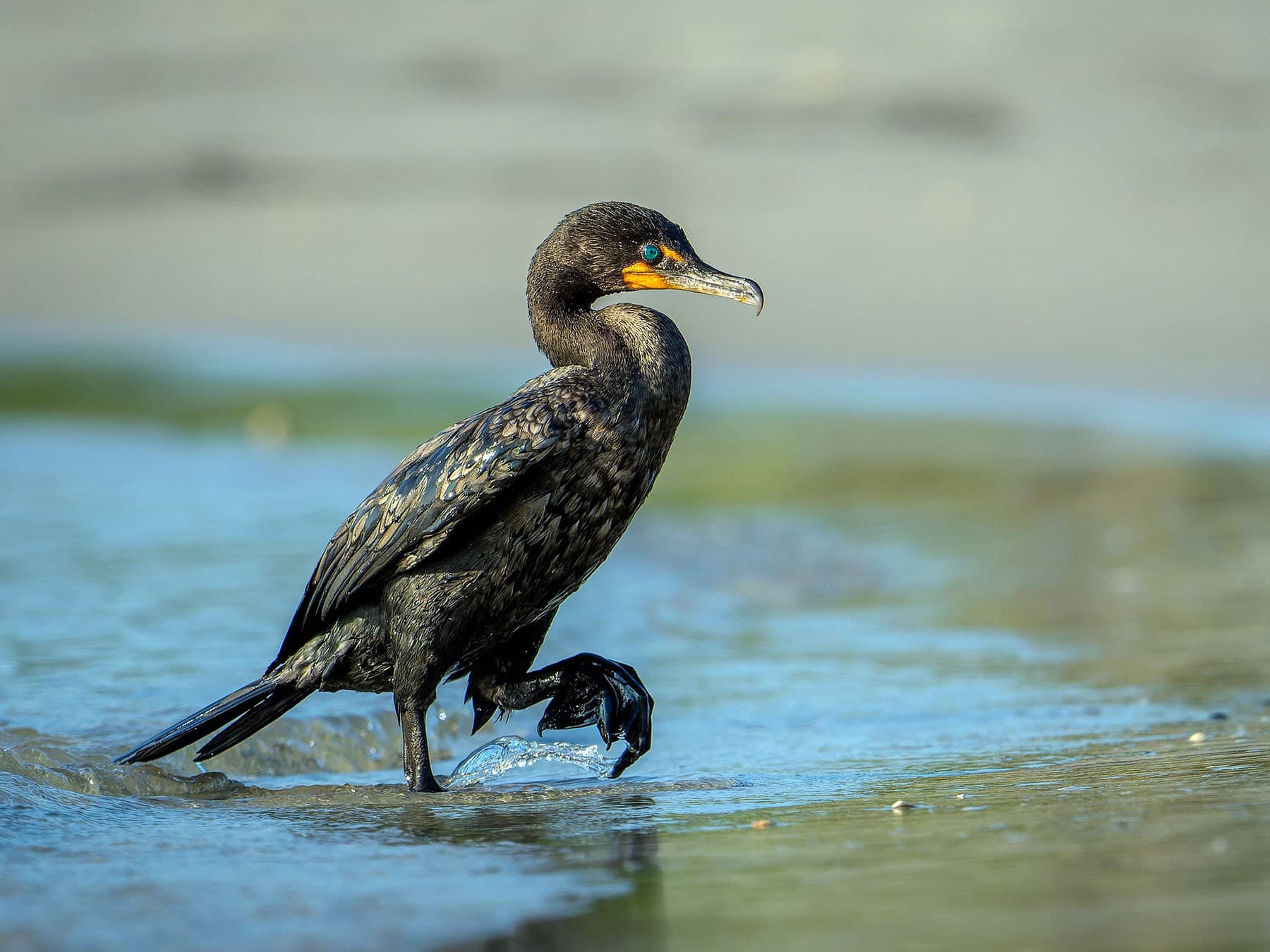
Quick facts
- Length
- 75–95 cm
- Wingspan
- 109 cm
- Weight
- 1057–1420 g
- Lifespan
- oldest recorded 12 years 7 months
- Migration
- Partial migrant
- Global status (IUCN)
- Least Concern
- World population
- Roughly 2 million worldwide (Partners in Flight's rough estimate)
- Population trend
- Increasing in the US: rising in the Breeding Bird Survey since 1966, mostly since the mid-1990s; no significant change in 2015-2025 or in Florida
- Also called
- Snakebird, Water Turkey, American Darter
- Scientific name
- Anhinga anhinga
Questions
5Why is it called the snakebird?
Because of the way it swims, with its body under water and only its slender head and neck showing, like a snake. It has had other names too: in 1838 Audubon heard it called Bec à Lancette (lancet bill) by Louisiana Creoles, Water Crow at the mouths of the Mississippi and Grecian Lady in southern Florida.39
Why is it called the water turkey?
For its long, broad tail, which opens into a fan like a Wild Turkey's. Not everyone saw it: Bent, writing in 1922, used the name Water-turkey but said he could never see any likeness to a turkey.40
What does anhinga mean, and why is it called the devil bird?
Is an Anhinga a cormorant?
No, but they are close relatives. Anhingas belong to their own family, the darters, and cormorants are the sister family. The Anhinga is the only darter in the Americas; the other three live in Africa, southern Asia and Australasia, and DNA suggests the American line split from them an estimated 19-22 million years ago.42
Do Anhingas mate for life?
Sources
52- 1Shawkey, M. D., Maia, R. and D'Alba, L. (2011). Proximate bases of silver color in anhinga (Anhinga anhinga) feathers. Journal of Morphology 272: 1399-1407. doi:10.1002/jmor.10993 (opens in a new tab)
- 2Owre, O. T. (1967). Adaptations for locomotion and feeding in the Anhinga and the Double-crested Cormorant. Ornithological Monographs 6: 1-138. doi:10.2307/40166666 (opens in a new tab)
- 3Frederick, P. C. and Causey, D. (2020). Anhinga (Anhinga anhinga), version 1.0. Birds of the World (A. F. Poole and F. B. Gill, editors). Cornell Lab of Ornithology. doi:10.2173/bow.anhing.01 (opens in a new tab)
- 4Dorr, B. S., Hatch, J. J. and Weseloh, D. V. (2021). Double-crested Cormorant (Nannopterum auritum), version 1.1. Birds of the World (A. F. Poole, editor). Cornell Lab of Ornithology. doi:10.2173/bow.doccor.01.1 (opens in a new tab)
- 5Burger, J., Miller, L. M. and Hahn, D. C. (1978). Behavior and sex roles of nesting Anhingas at San Blas, Mexico. The Wilson Bulletin 90: 359-375. Accessed 15 November 2026. Source (opens in a new tab)
- 6National Park Service (2018). Anhinga: Species Profile. Everglades National Park. Accessed 15 November 2026. Source (opens in a new tab)
- 7National Audubon Society. Anhinga. Guide to North American Birds. Accessed 15 November 2026. Source (opens in a new tab)
- 8LeGrand, H. et al. (2026). Birds of North Carolina: their Distribution and Abundance: Anhinga. North Carolina Biodiversity Project and North Carolina State Parks. Accessed 15 November 2026. Source (opens in a new tab)
- 9Hostetler, J. A. et al. (2026). The North American Breeding Bird Survey, Analysis Results 1966-2025. U.S. Geological Survey data release. doi:10.5066/P1OSNSFC (opens in a new tab)
- 10Fink, D. et al. (2023). eBird Status and Trends, Data Version: 2022; Released: 2023. Cornell Lab of Ornithology. doi:10.2173/ebirdst.2022 (opens in a new tab)
- 11Fleming, R. C. and Black, C. R. (2026). The peculiar necks of herons and anhingas: a study of cervical morphology in pelecanimorph birds. Integrative Organismal Biology 8. doi:10.1093/iob/obag004 (opens in a new tab)
- 12Allen, T. T. (1961). Notes on the breeding behavior of the Anhinga. The Wilson Bulletin 73: 115-125. Accessed 15 November 2026. Source (opens in a new tab)
- 13Owre, O. T. (1962). Letter to the editor. The Wilson Bulletin 74: 194-196. Accessed 15 November 2026. Source (opens in a new tab)
- 14Colacino, J. M. et al. (1985). The vaterite cover on the eggs of Anhinga anhinga and its effect on gas conductance (Aves: Anhingidae). Journal of Zoology 205: 425-433. doi:10.1111/j.1469-7998.1985.tb05627.x (opens in a new tab)
- 15Casler, C. L. (1973). The air-sac systems and buoyancy of the Anhinga and Double-crested Cormorant. The Auk 90: 324-340. Accessed 15 November 2026. Source (opens in a new tab)
- 16Mahoney, S. A. (1984). Plumage wettability of aquatic birds. The Auk 101: 181-185. doi:10.1093/auk/101.1.181 (opens in a new tab)
- 17White, J., Schell, E. R., Dawson, N. J. and McCracken, K. G. (2024). Comparative mechanisms for O2 storage and metabolism in two Florida diving birds: the anhinga (Anhinga anhinga) and the double-crested cormorant (Nannopterum auritum). Journal of Comparative Physiology B 195: 191-208. doi:10.1007/s00360-024-01593-x (opens in a new tab)
- 18Hennemann, W. W., III (1982). Energetics and spread-winged behavior of Anhingas in Florida. The Condor 84: 91-96. doi:10.2307/1367827 (opens in a new tab)
- 19Hennemann, W. W., III (1983). Environmental influences on the energetics and behavior of Anhingas and Double-Crested Cormorants. Physiological Zoology 56: 201-216. doi:10.1086/physzool.56.2.30156052 (opens in a new tab)
- 20Hennemann, W. W., III (1988). Energetics and spread-winged behavior in Anhingas and Double-crested Cormorants: the risks of generalization. American Zoologist 28: 845-851. doi:10.1093/icb/28.3.845 (opens in a new tab)
- 21Francis, A. M. (1981). Wing- and tail-flapping in Anhingas: a possible method for drying in the absence of sun. The Auk 98: 834. doi:10.1093/auk/98.4.834 (opens in a new tab)
- 22Klein, M. L., Humphrey, S. R. and Percival, H. F. (1995). Effects of ecotourism on distribution of waterbirds in a wildlife refuge. Conservation Biology 9: 1454-1465. doi:10.1046/j.1523-1739.1995.09061454.x (opens in a new tab)
- 23USGS Bird Banding Laboratory. Longevity records of North American birds: Anhinga. USGS Eastern Ecological Science Center, Bird Banding Laboratory. Accessed 15 November 2026. Source (opens in a new tab)
- 24USGS Bird Banding Laboratory. Longevity records of North American birds: historical record succession, Anhinga. USGS Eastern Ecological Science Center, Bird Banding Laboratory. Accessed 15 November 2026. Source (opens in a new tab)
- 25Florida Fish and Wildlife Conservation Commission. Hooked a Bird?. FWC. Accessed 15 November 2026. Source (opens in a new tab)
- 26Sazima, I. and D'Angelo, G. B. (2015). Dangerous traps: Anhingas mistake anthropogenic debris for prey fish at an urban site in South-eastern Brazil. Revista Brasileira de Ornitologia 23: 380-384. doi:10.1007/bf03544312 (opens in a new tab)
- 27Ohlendorf, H. M., Klaas, E. E. and Kaiser, T. E. (1978). Organochlorine residues and eggshell thinning in Wood Storks and Anhingas. The Wilson Bulletin 90: 608-618. doi:10.5281/zenodo.16112550 (opens in a new tab)
- 28Heinz, G. H. et al. (2009). Species differences in the sensitivity of avian embryos to methylmercury. Archives of Environmental Contamination and Toxicology 56: 129-138. doi:10.1007/s00244-008-9160-3 (opens in a new tab)
- 29Partners in Flight (2024). Avian Conservation Assessment Database, version 2024.05.23 (global). Partners in Flight. Accessed 15 November 2026. Source (opens in a new tab)
- 30BirdLife International (2025). Anhinga anhinga. The IUCN Red List of Threatened Species 2025: e.T22696702A281836797. doi:10.2305/IUCN.UK.2025-2.RLTS.T22696702A281836797.en (opens in a new tab)
- 31NatureServe. Anhinga anhinga: Anhinga. NatureServe Explorer. Accessed 15 November 2026. Source (opens in a new tab)
- 32U.S. Fish and Wildlife Service (2026). 50 CFR 10.13: List of Birds Protected by the Migratory Bird Treaty Act. Electronic Code of Federal Regulations. Accessed 15 November 2026. Source (opens in a new tab)
- 33United States Code (2023). 16 U.S.C. 703: Taking, killing, or possessing migratory birds unlawful. U.S. Code (GovInfo). Accessed 15 November 2026. Source (opens in a new tab)
- 34U.S. Fish and Wildlife Service (2026). 50 CFR 21.123: Special double-crested cormorant permit. Electronic Code of Federal Regulations. Accessed 15 November 2026. Source (opens in a new tab)
- 35U.S. Fish and Wildlife Service (1998). Migratory Bird Permits; Establishment of Depredation Order for the Double-Crested Cormorant (final rule). Federal Register 63: 10550 (4 March 1998). Accessed 15 November 2026. Source (opens in a new tab)
- 36U.S. Fish and Wildlife Service (2003). Migratory Bird Permits; Regulations for Double-Crested Cormorant Management (final rule). Federal Register 68: 58022 (8 October 2003). Accessed 15 November 2026. Source (opens in a new tab)
- 37U.S. Fish and Wildlife Service (2020). Migratory Bird Permits; Management of Conflicts Associated With Double-Crested Cormorants (Phalacrocorax auritus) Throughout the United States (final rule). Federal Register 85: 85535-85556 (29 December 2020). Accessed 15 November 2026. Source (opens in a new tab)
- 38Environment and Climate Change Canada. Birds protected in Canada. Government of Canada. Accessed 15 November 2026. Source (opens in a new tab)
- 39Audubon, J. J. (1838). Ornithological Biography, volume 4 ('Anhinga or Snake-Bird', pp. 136-160). Edinburgh: Adam Black. Accessed 15 November 2026. Source (opens in a new tab)
- 40Bent, A. C. (1922). Life histories of North American petrels and pelicans and their allies. United States National Museum Bulletin 121. Washington: Government Printing Office. Accessed 15 November 2026. Source (opens in a new tab)
- 41Dictionary.com. anhinga. Dictionary.com (Random House Unabridged Dictionary). Accessed 15 November 2026. Source (opens in a new tab)
- 42Kennedy, M., Seneviratne, S. S., Mendis, U. K. and Spencer, H. G. (2019). Sorting out the Snakebirds: the species status, phylogeny, and biogeography of the Darters (Aves: Anhingidae). Journal of Zoological Systematics and Evolutionary Research 57: 892-899. doi:10.1111/jzs.12299 (opens in a new tab)
- 43Cornell Lab of Ornithology. Anhinga. All About Birds. Accessed 15 November 2026. Source (opens in a new tab)
- 44Florida Fish and Wildlife Conservation Commission. Anhinga. FWC species profiles. Accessed 15 November 2026. Source (opens in a new tab)
- 45Tennessee Wildlife Resources Agency. Anhinga. TWRA birds. Accessed 15 November 2026. Source (opens in a new tab)
- 46AviList Core Team (2026). AviList: The Global Avian Checklist, v2025b. doi:10.2173/avilist.v2025b (opens in a new tab)
- 47Chesser, R. T. et al. (2026). Check-list of North American Birds (online). American Ornithological Society. Accessed 15 November 2026. Source (opens in a new tab)
- 48Telfair, R. C., II and Morrison, M. L. (2022). Neotropic Cormorant (Nannopterum brasilianum), version 2.2. Birds of the World (P. G. Rodewald and B. K. Keeney, editors). Cornell Lab of Ornithology. doi:10.2173/bow.neocor.02.2 (opens in a new tab)
- 49National Audubon Society. Neotropic Cormorant. Guide to North American Birds. Accessed 15 November 2026. Source (opens in a new tab)
- 50Wilson, A. (1814). American Ornithology, volume 9 ('Black-bellied Darter, or Snake-bird', pp. 79-81). Philadelphia: Bradford and Inskeep. Accessed 15 November 2026. Source (opens in a new tab)
- 51Areta, J. I., Noriega, J. I. and Agnolin, F. L. (2007). A giant darter (Pelecaniformes: Anhingidae) from the Upper Miocene of Argentina and weight calculation of fossil Anhingidae. Neues Jahrbuch fur Geologie und Palaontologie. doi:10.1127/0077-7749/2007/0243-0343 (opens in a new tab)
- 52National Audubon Society. Double-crested Cormorant. Guide to North American Birds. Accessed 15 November 2026. Source (opens in a new tab)

Checked by
Nathan Cope, founder and editor
Nathan founded Birdfact and leads its writers and contributors in the UK, the US and Canada. He has watched and studied birds for more than ten years, and checks every article and species guide before it’s published.