


Double-crested Cormorant
Nannopterum auritum
By the Birdfact teamChecked by Nathan Cope
On this page14 sections
How to recognise it
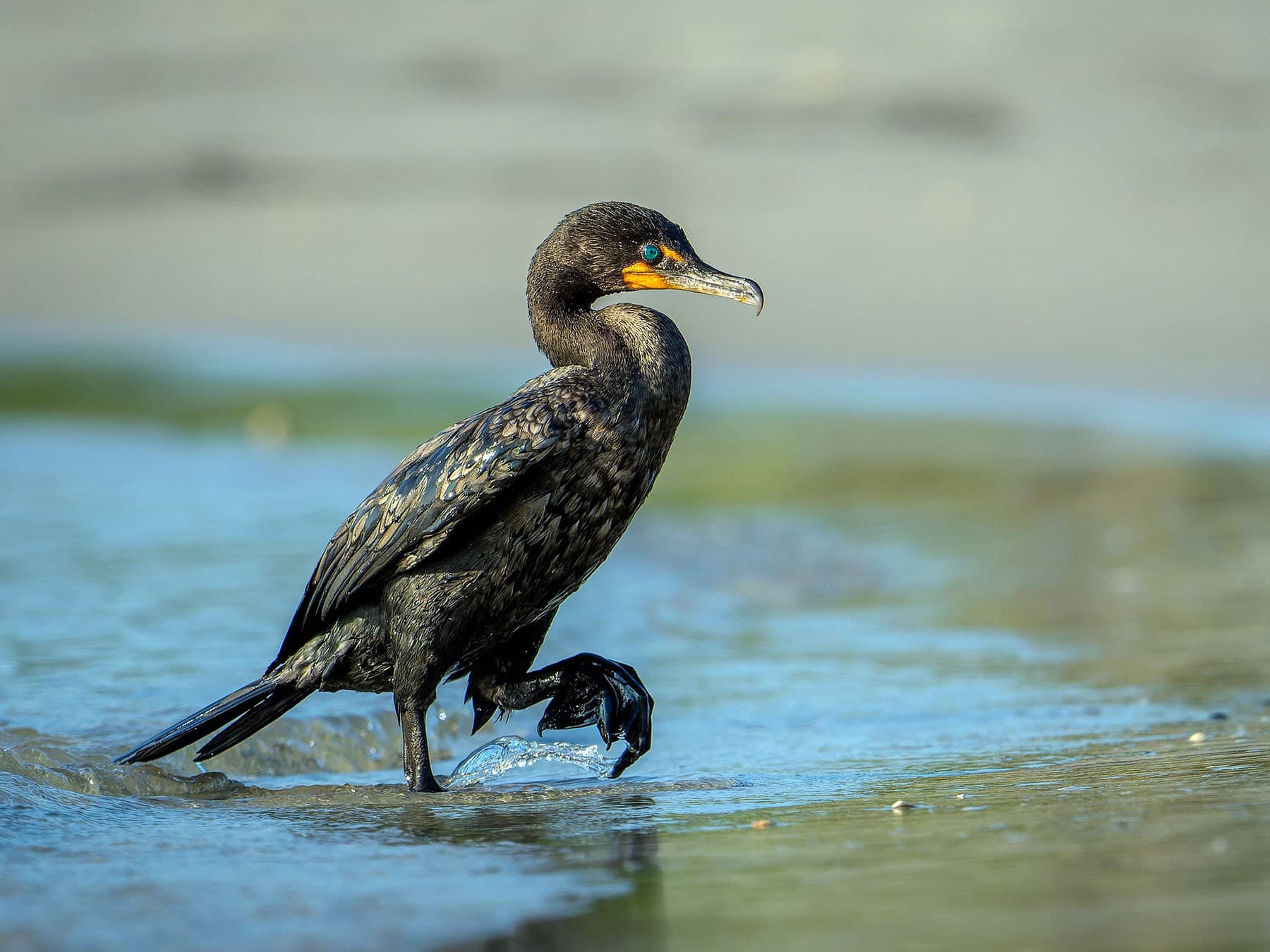
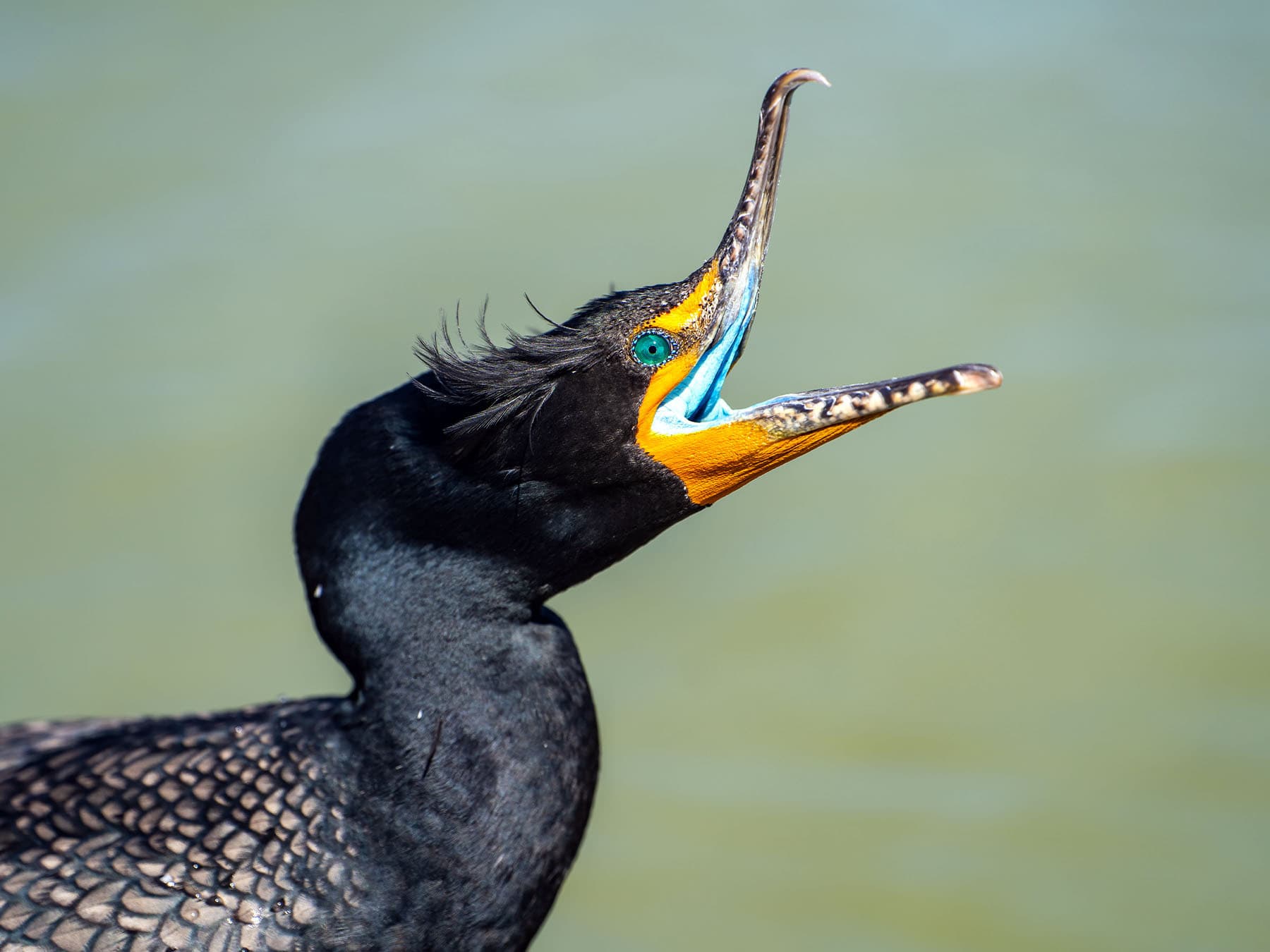
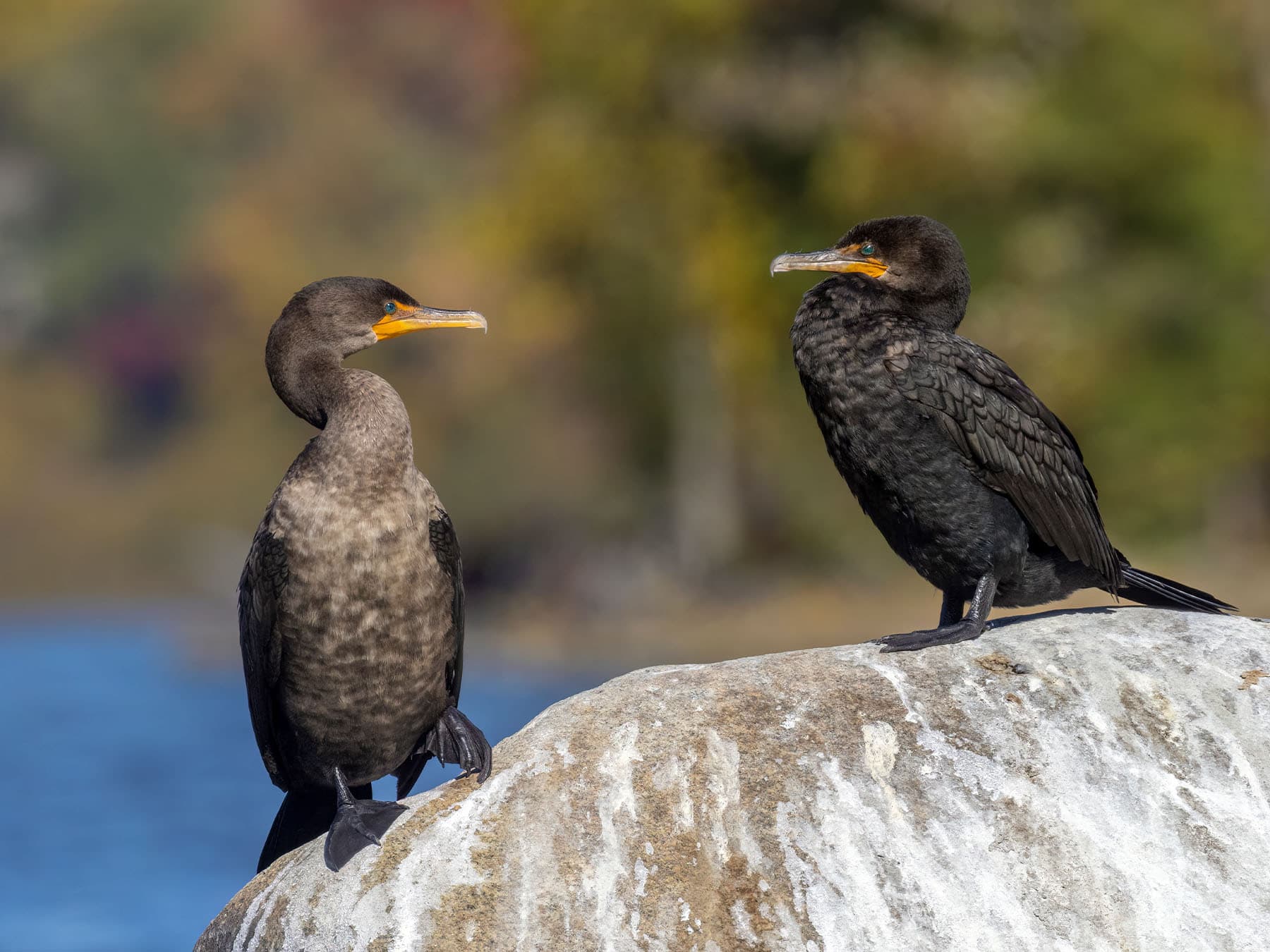
The Double-crested Cormorant is a big, dark waterbird with a long neck, a long tail and a thin, hooked bill. The quickest clue is the patch of bare orange-yellow skin at the base of the bill and on the throat, which it shows all year. Adults look black from a distance; close up they have a dull green or bronze gloss, back feathers edged in black that give a scaly look, and a turquoise eye.
On the water it rides low, often with only the head and snaky neck showing, the bill tilted slightly up, and then it slips under. Out of the water it stands upright on short legs on rocks, posts, docks and dead trees, often with its wings held open to dry.
Size and shape
Double-crested Cormorants are 28 to 35 inches (70-90 cm) long, with a wingspan of 45 to 48 inches (114-123 cm), and weigh 2.6 to 5.5 pounds (1.2-2.5 kg): the size of a small goose. Size varies a lot across the range. Birds in Alaska are the biggest and those in the Bahamas the smallest, and small southeastern birds weigh barely half as much as northern and western ones.
The head is small for the body, the neck long with a kink in it, and the bill about as long as the head, with a hook at the tip for gripping fish.
Breeding plumage and the double crest
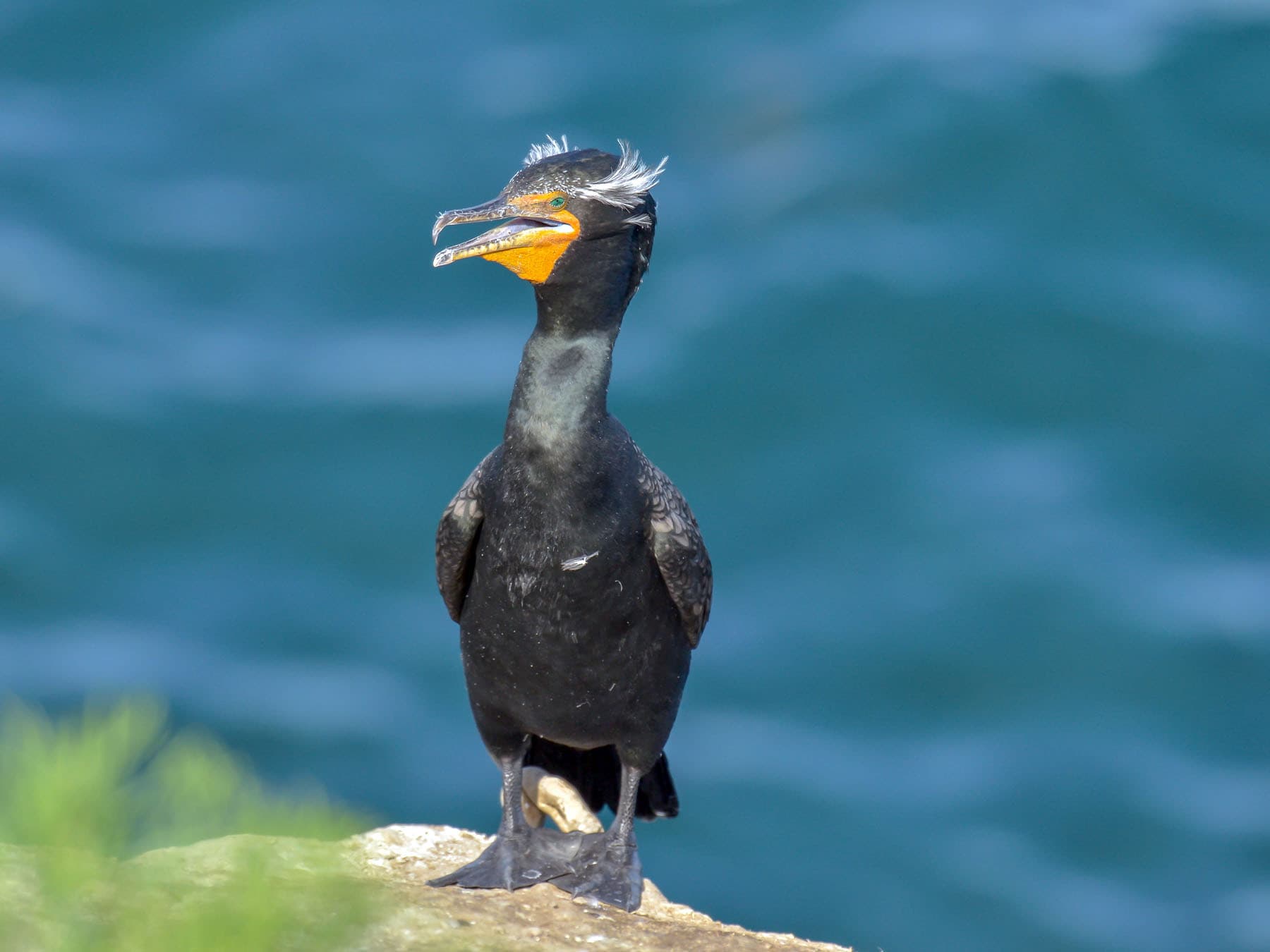
The name comes from two tufts of feathers that grow above and behind the eyes early in the breeding season. They are black in the East and white, or mixed white and black, in the West and Alaska, where they are longer, up to 3 inches (78 mm) against about 1.5 inches (38 mm) in the East.1 They are lost by June and are seldom easy to see, so they are a poor field mark. The scientific name refers to them too: auritum means "eared".
A breeding adult also has brighter orange skin on the face and throat, and when it opens its bill it shows a bright cobalt-blue mouth. After nesting the skin turns duller and more yellow and the blue fades.
Males, females and young
Males and females look alike. Males average a little larger, about 2 to 6% in measurements and 12 to 15% in weight, but the ranges overlap, so you cannot sex a lone bird by eye.
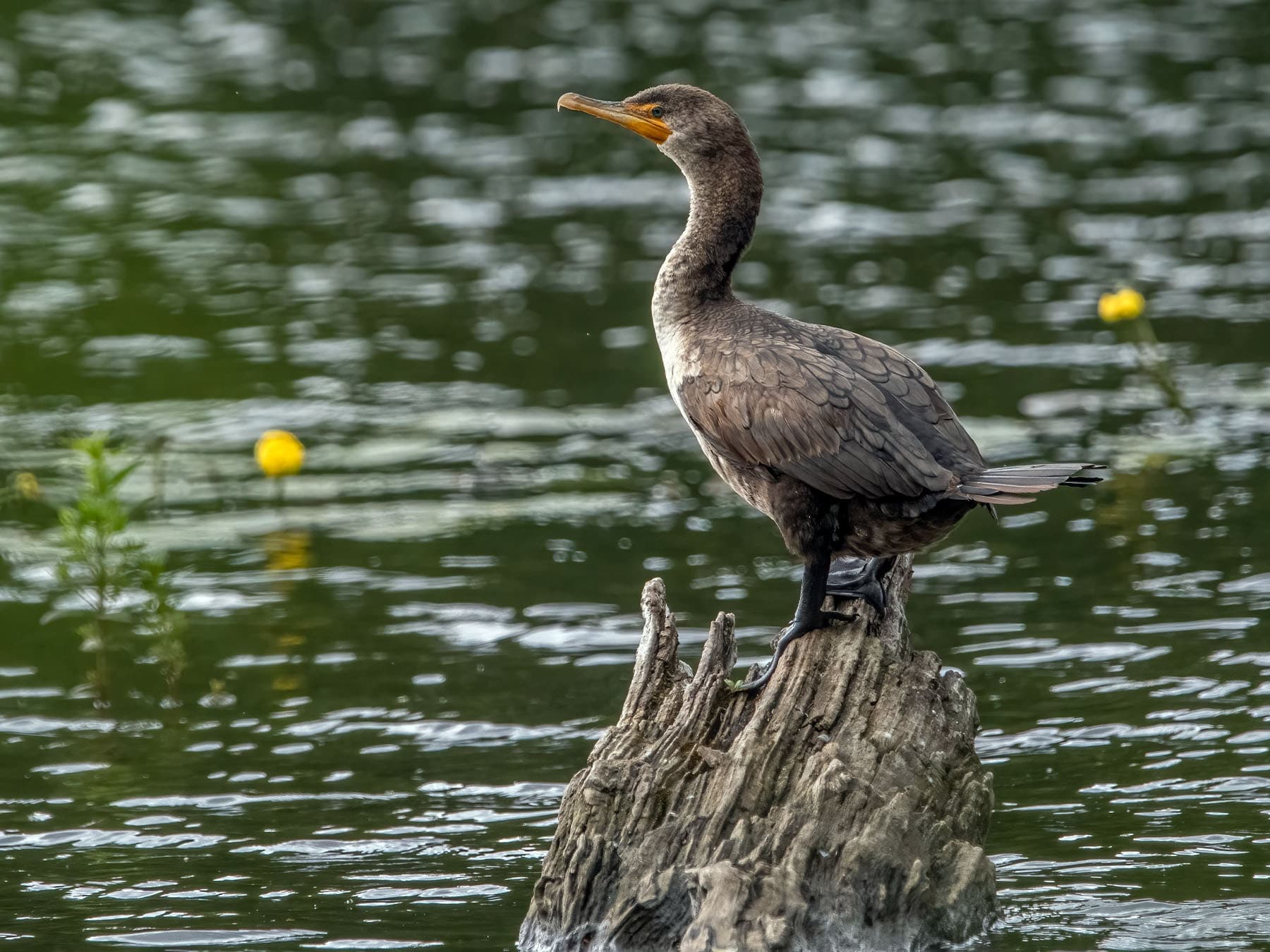
Young birds are brown, not black. In their first year they are palest on the throat, neck and breast and darker on the belly, and the pale front bleaches to almost white by spring. The bill is paler and the face skin yellow. They stay brownish for two or three years and usually reach full adult plumage in their third or fourth year.
Identification in flight
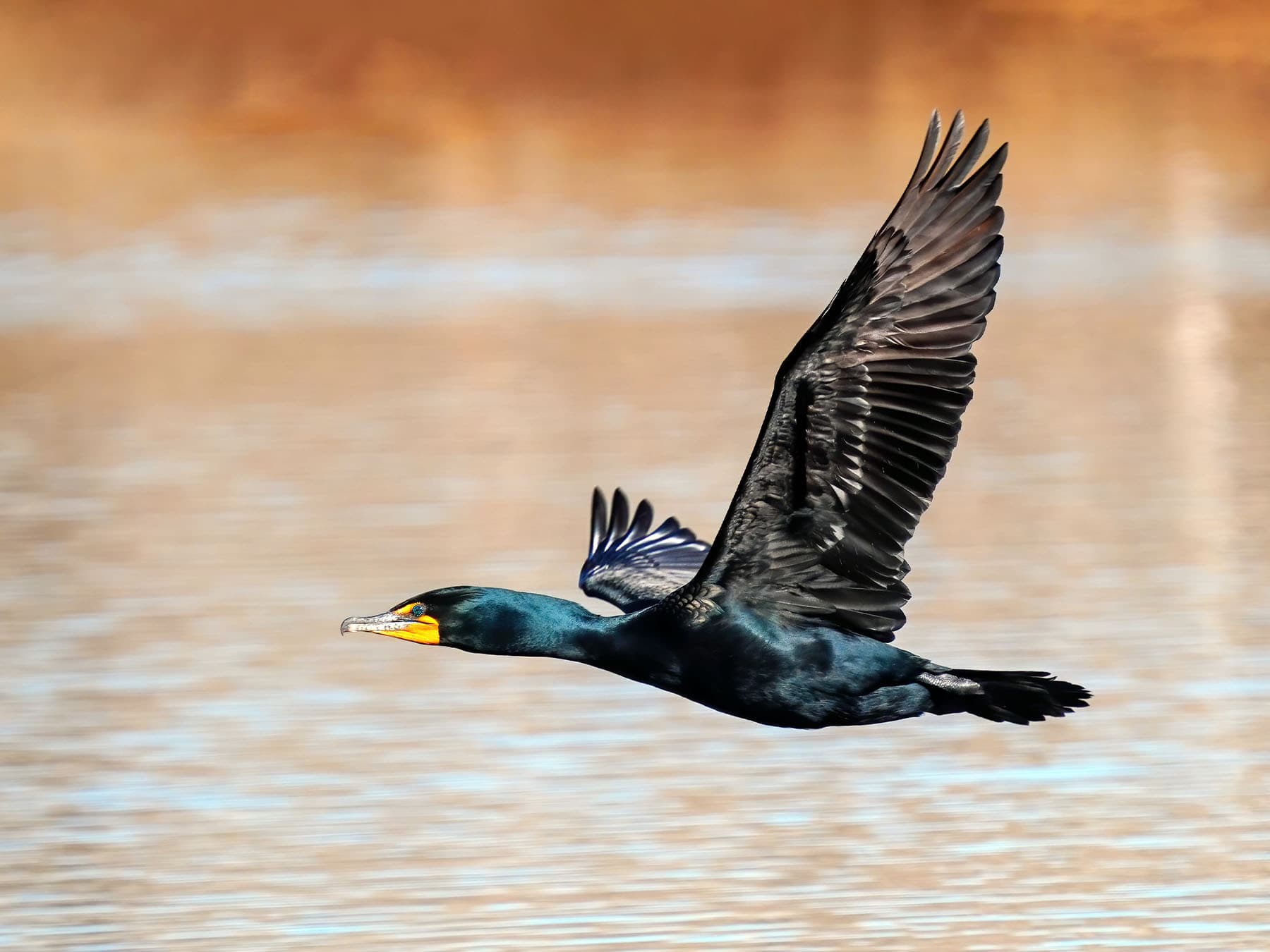
In flight a Double-crested Cormorant shows a slight kink in the neck just behind the head, where most cormorants fly with a straight neck.2 It flaps steadily, with only brief glides, and flocks travel in loose lines or ragged V's. Over water it usually flies low, close to the surface; over land it flies much higher, up to about 3,300 feet (1,000 m) on migration.
Identification: similar birds
Great Cormorant. Bigger, 33 to 39 inches (84-100 cm), with a thicker bill. Adults have a white band across the throat behind the yellow skin.3 Young birds are the reverse of young Double-cresteds: pale on the belly, not the breast. In North America it nests in Maine and eastern Canada, and winters on the Atlantic seaboard of the US.
Neotropic Cormorant. Smaller, 25 to 28 inches (63-71 cm), with a longer tail. Its throat pouch is duller and yellowish, and its back edge comes to a point, edged with white in breeding birds; the Double-crested's is rounder and brighter.4 The two meet in the southwestern and southeastern US, Mexico and the Caribbean, especially after the breeding season.
Anhinga. An Anhinga has a straight, dagger-pointed bill, a long fan-shaped tail and white streaks on the upper wings; females and young have a pale tan head, neck and breast.
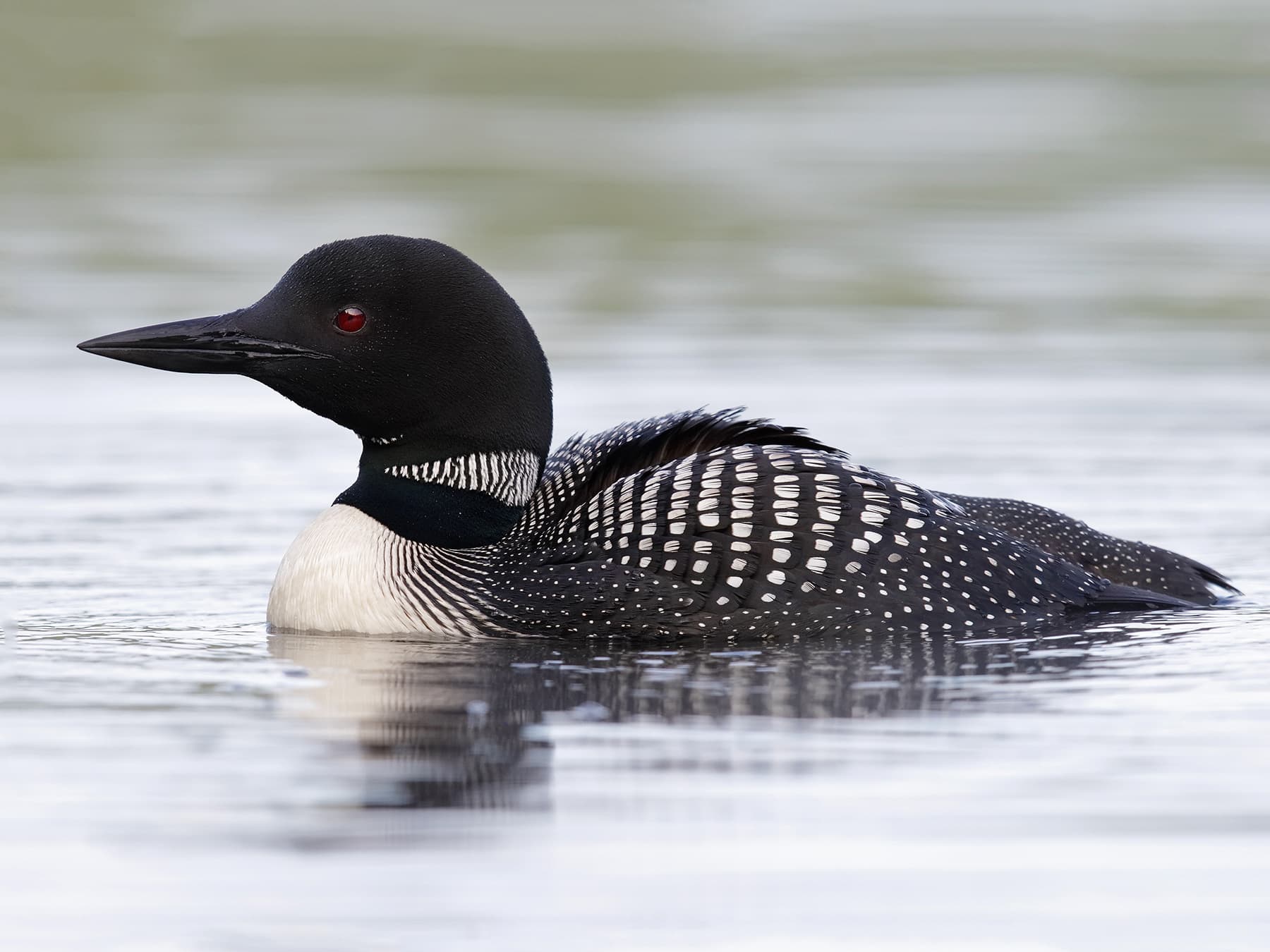
Common Loon. A loon has a straight, dagger-like bill and, from September to March, a plain gray back and head with a white throat. A cormorant's bill is hooked, with orange-yellow skin at its base.
Brandt's Cormorant. On the Pacific coast, Brandt's is a similar size but has a less obvious blue or violet throat pouch with a band of buff feathers behind it, and it is strictly coastal.
Not sure it’s a Double-crested Cormorant? Check your photo: Birdfact names the bird and shows the look-alike side by side.
Its size
Adults- Length
- 70–90 cm
- Wingspan
- 114–123 cm
- Weight
- 1200–2500 g
Its song and calls
Away from its colonies and roosts the Double-crested Cormorant is usually silent. At the nest it makes deep, guttural grunts, and large fishing flocks grunt too. Different calls go with take-off, landing and threats; a bird threatening another stretches its neck, gapes and hisses. The male's courtship call, given as he waves his wings at the nest site, is a run of loud ugh notes, the one call that differs between the sexes.1 Chicks chirp when they beg and hiss when threatened.
- Calls at a tree nest0:00 / 0:26
Recorded in Ontario, Canada · August 2022
- Grunts at a colony0:00 / 0:15
Recorded in Michigan, United States · August 2025
Heard one and not sure? Let the bird song identifier listen.
When and where to see it
No other cormorant in North America is as widespread, and over most of the interior it is the only one. It breeds from Alaska and the Canadian prairies through the Great Lakes and the interior to the Atlantic coast from Newfoundland south, along the Pacific coast to Mexico, and in Florida, Cuba and the Bahamas. It is found on lakes, ponds, reservoirs, slow rivers, lagoons, estuaries and open coasts, and is rarely seen out of sight of land.
Look for it resting on rocks, sandbars, pilings, docks, wires and dead trees near the water, often with its wings spread. It spends far more of the day resting than fishing: radio-tagged birds wintering in Mississippi spent 57% of daylight loafing and 18% actively fishing.1
Do they migrate?
Many do. Nesting birds of the interior and the Atlantic seaboard head south in fall, and spend the winter mostly on the coast from North Carolina to the western Gulf of Mexico, and inland on southern lakes, rivers and fish farms. Birds on the Pacific coast and in Florida and the Caribbean mostly stay put.
Spring migrants leave the Gulf from February and reach the northern breeding grounds between March and late April; first-year birds come back north about a month later than older ones. Fall migration runs from mid-August to November and peaks in October. Satellite-tagged birds from northern Lake Huron traveled on average 1,280 miles (2,060 km) to their wintering sites. Migrating flocks can be huge: on April 24, 1926, an estimated 100,000 to 1,000,000 cormorants flew up the Mississippi past La Crosse, Wisconsin.1
Tips for seeing it
What it eats
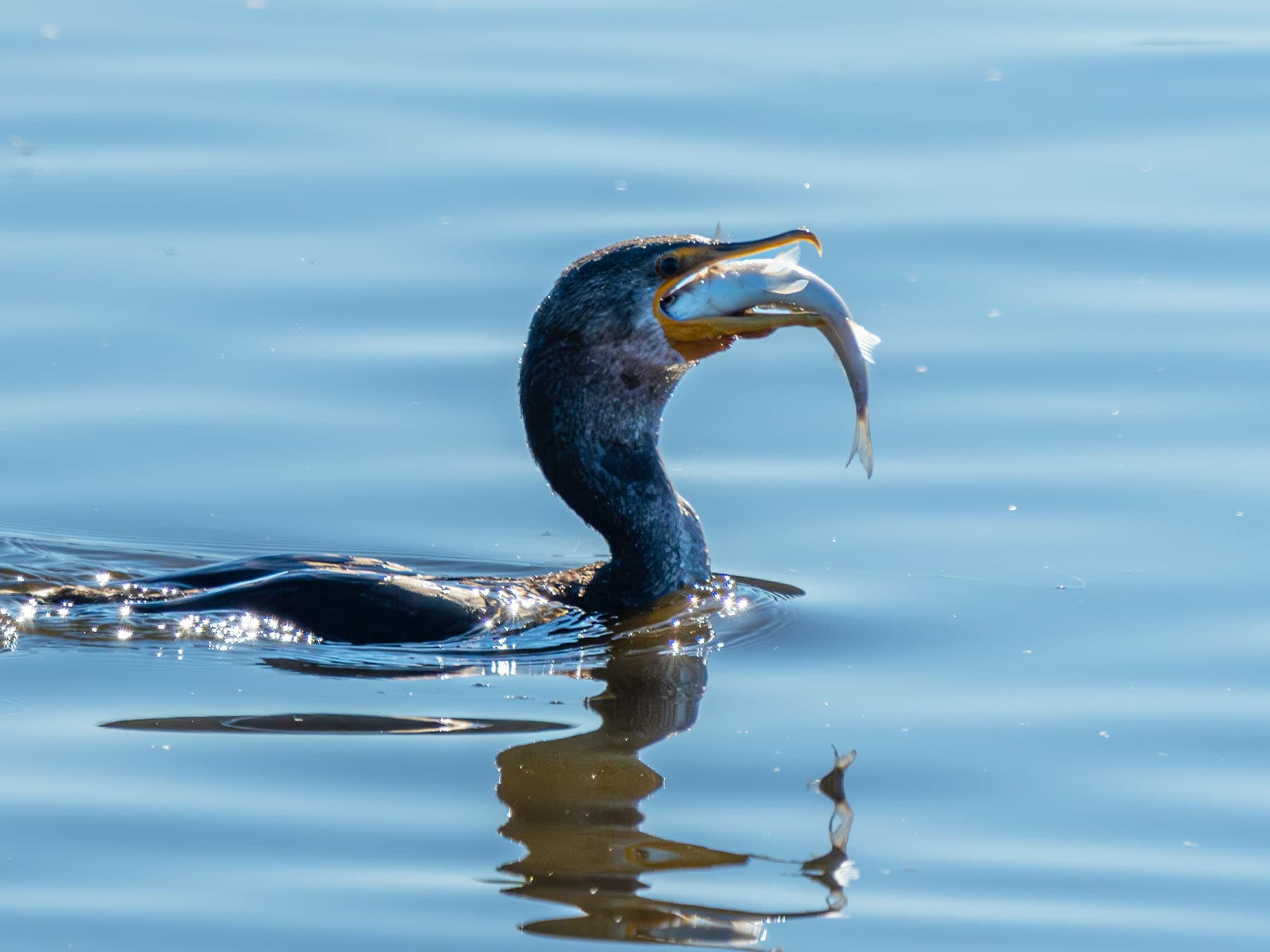
Double-crested Cormorants eat almost nothing but fish, mostly slow-moving or schooling kinds, from 1 to 16 inches (3-40 cm) long but usually under 6 inches (15 cm). More than 250 species of fish have been recorded. Now and then they take crayfish, shrimp, aquatic insects, frogs and salamanders. What they eat depends on what is easy to catch: in different studies, alewife, yellow perch, gizzard shad, sticklebacks, round goby, sculpins and sunfish.
An adult eats on average about 19 ounces (542 g) of fish a day in the nesting season and 15 ounces (436 g) outside it; estimates range from about 18 to 28% of its body weight a day.5 Claims that a cormorant eats more than its own weight in a day are wrong.
Feeding underwater
A cormorant dives from the surface and chases fish underwater, driving itself with both webbed feet together and keeping its wings against its sides. All four toes are joined by webs. Its feathers get wet rather than shedding water, and trap little air, which makes it less buoyant; this is seen as an adaptation for diving. Small fish are swallowed underwater. A big or awkward one is brought up, shaken, beaten on the water and tossed so it can be swallowed head first; crayfish have their legs shaken off first.
Most dives are short and shallow, usually 20 to 25 seconds. In a Nova Scotia study they averaged 15 feet (4.7 m).1 On Oneida Lake and Lake Ontario in New York, about 7 to 15% of dives went below 33 feet (10 m), some to 49 feet (15 m) or more, and the deepest recorded was 85 feet (25.8 m) in Lake Ontario.6 Most fishing is in water under 33 feet deep, close to shore, and almost only by day. On schools of fish, loose flocks fish in lines that roll forward as birds at the back fly ahead of the divers.
Nesting and breeding
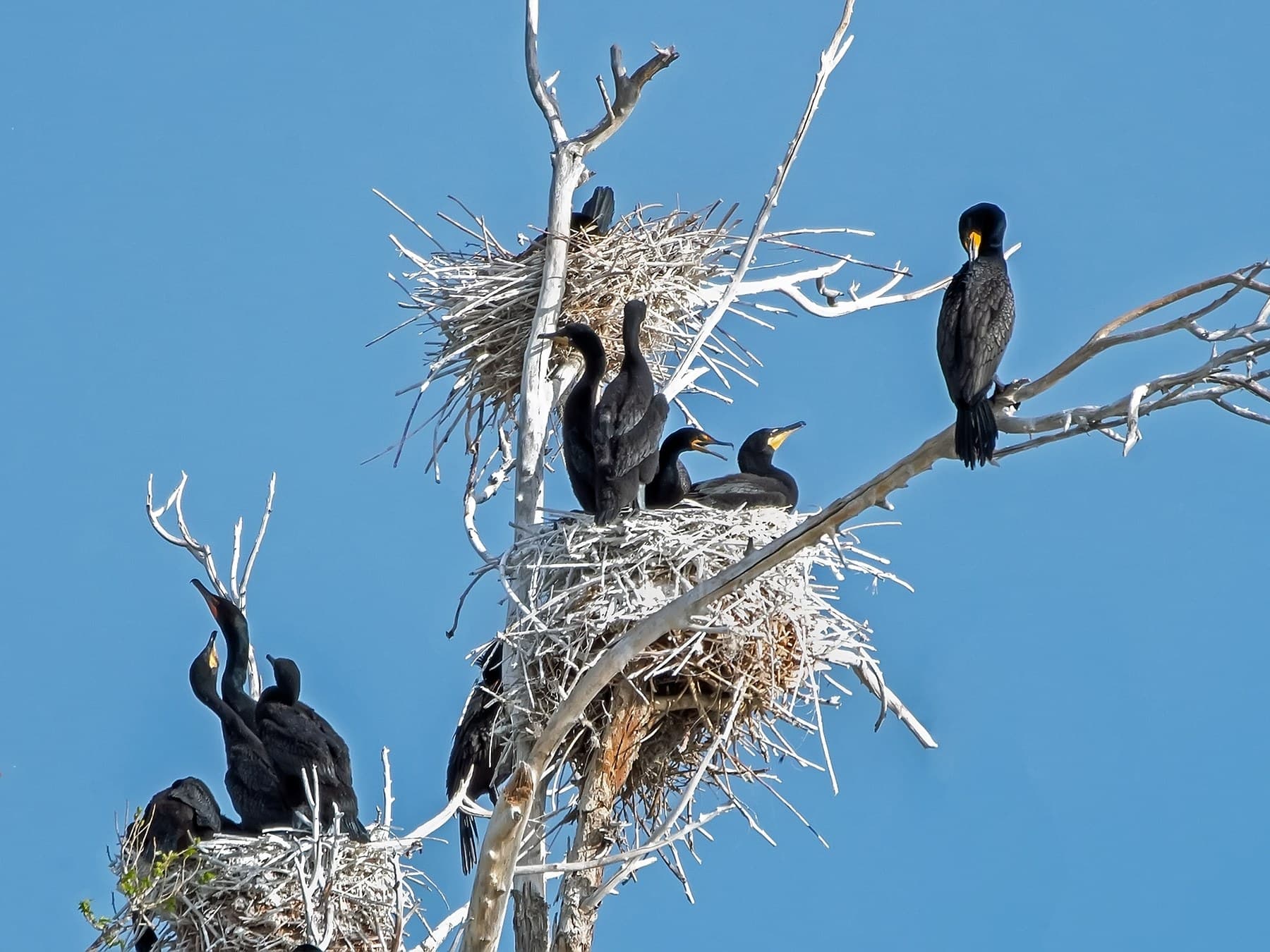
Double-crested Cormorants nest in colonies of a few pairs to thousands: on the ground on islands safe from predators, in trees standing in or near water, on cliffs, and on bridges, towers and old docks. Males arrive first. A male picks a nest site and displays there, breast down, tail cocked and bill up, waving his wingtips and grunting, then greets a female with his bright blue mouth open. Pairs seem to be monogamous for the season; whether they reunite in later years is not known.
The nest is a bulky platform of finger-thick sticks, seaweed and flotsam, lined with grass and cemented with droppings. The male brings most of the material and the female builds. Nests are about 18 to 36 inches (45-91 cm) across, and a ground nest used year after year can build up to over 6.5 feet (2 m) tall. They often hold rope, fishing net, balloons, plastic and parts of dead birds: in the Gulf of Maine in 1987-88, 37% of 497 nests contained plastic debris.7

Eggs and young
Eggs are laid from late March in California to as late as September in British Columbia, mostly April to July; in southern Florida cormorants nest year-round. The clutch is usually 3 or 4 eggs (1-7), pale blue under a chalky white coat that soon stains brown. Both parents incubate for 25 to 28 days. There is no brood patch: the eggs rest on the parent's warm webbed feet.
Both parents feed and brood the chicks. Small chicks cannot control their own temperature for about two weeks, so on hot days the parents shade them and pour water from their own mouths into the chicks'. Young in ground nests leave at 3 to 4 weeks to gather in groups, called creches, and come back to be fed; tree-nest young may stay until they can fly, at 6 to 7 weeks. They first fly at about 6 weeks and are independent at about 10 weeks. Pairs raise one brood a year, but readily replace a lost clutch. Most first breed at 3 years old (79% in a British Columbia study), about one in six at 2 and a few at 1.8

Nest trees and colonies
Colonies in trees do not last forever. The droppings change the chemistry of the soil and, with the leaves and twigs the birds strip from the branches, can kill the nest trees within 3 to 10 years. The birds then nest on the dead trees or the ground, or move on. That can change islands that other waterbirds share: it has made life harder for some species, such as Black-crowned Night Herons on the St. Lawrence, and easier for open-ground nesters such as American White Pelicans and Herring Gulls.1
Behaviour
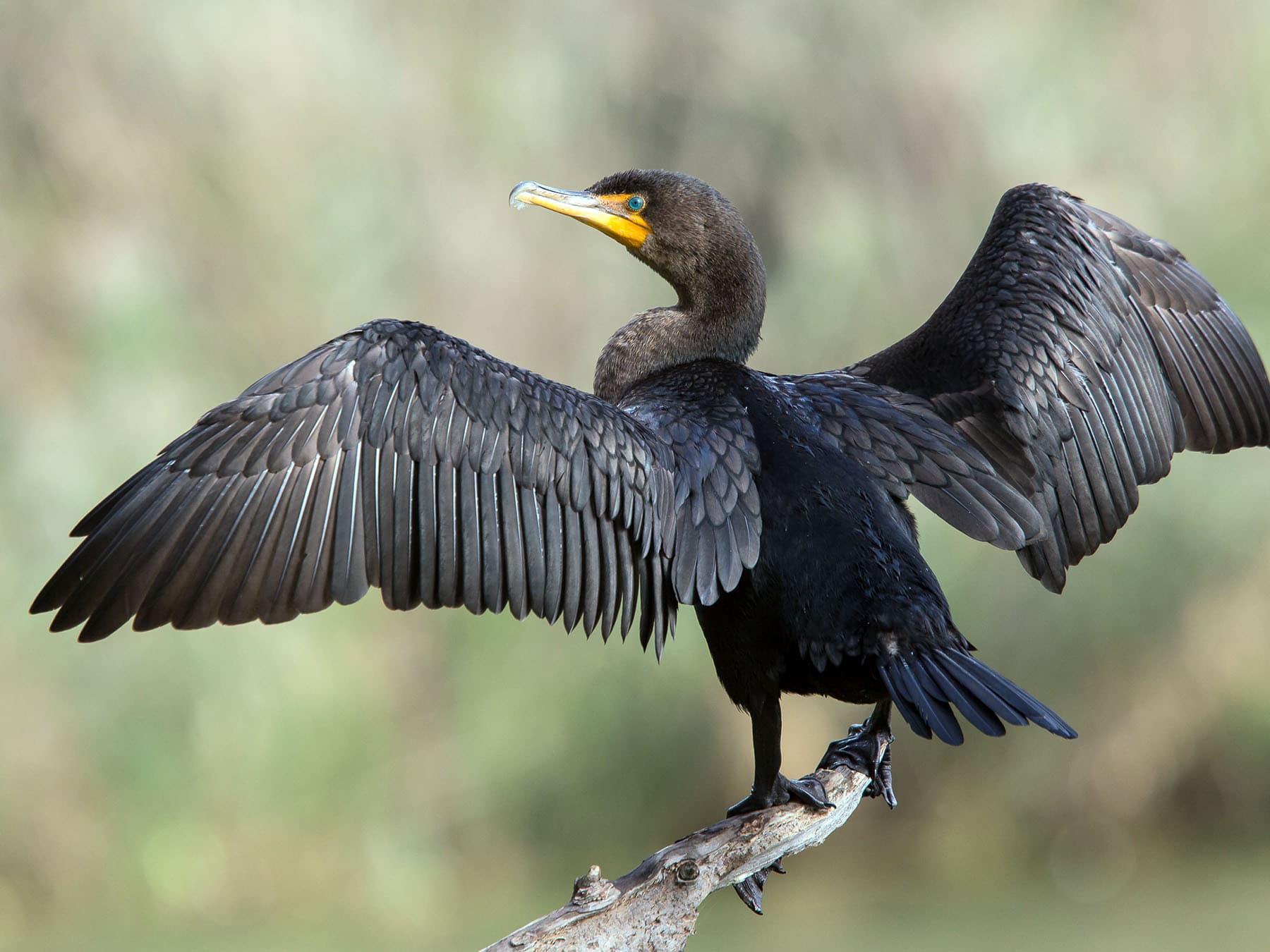
After fishing, a Double-crested Cormorant often perches with its wings held wide open. Drying the feathers is thought to be the main reason, and there is little evidence for the other ideas, such as balance or signaling. The birds face into the wind, and do it even in light rain. Unlike the Anhinga's, the pose does little to warm the bird.1
Behavior
Double-crested Cormorants are sociable all year, in roosts, resting spots and colonies of hundreds to thousands. They often fish alone but readily gather in feeding flocks, and on Georgian Bay, Ontario, flocks of up to 175 have been seen driving fish into narrow bays together.
Taking off from water needs a run-up, pushing with both feet together while flapping; with no wind, after fishing, it can need more than 33 feet (10 m). Before take-off a cormorant stretches its neck in the direction it means to fly; on landing it puffs out the orange throat skin and gives a little hop. On land it waddles and hops. In hot weather it flutters the orange throat skin to cool down, which is not panting. Defense of space is limited to the nest itself, within reach of the bill.
Lifespan and predators
Double-crested Cormorants commonly live more than 8 years in the wild. A British Columbia study estimated adult life expectancy at 6.1 years, with only about half of young birds surviving their first year.8 The oldest on the North American banding records was at least 23 years 8 months old: banded as a nestling in Oregon in 1997, it was seen alive in Washington, by its color marker, in 2021.9
Gulls and crows and other corvids take eggs and chicks, especially when people disturb a colony and the adults leave their nests. Coyotes, foxes and raccoons take chicks where they can reach them, Bald Eagles take large chicks and some adults, and Great Horned Owls are occasional predators. Of 295 banded birds recovered in Texas in 1971-1985, 28% had been tangled in fishing gear and 17% shot, and Newcastle disease, a virus, killed several thousand inland in the 1990s.1
Conservation
The Double-crested Cormorant is common and widespread. The U.S. Fish and Wildlife Service's 2020 estimate was about 871,000 to 1,032,000 birds in the continental United States and Canada.10 On the North American Breeding Bird Survey, numbers in the United States rose by about 2.3% a year from 1966 to 2025.11 Partners in Flight gives it a Continental Concern Score of 8 out of 20, a species of low concern.12 Worldwide, the IUCN Red List rates it Least Concern.
It has not always been so. Numbers fell steeply in the 1800s and early 1900s, probably mainly from shooting and the destruction of nests, eggs and young. They recovered from the 1920s to the 1950s, then dropped sharply in the 1960s, probably because of pesticides such as DDT.1 The Double-crested was one of the first birds to show DDT-thinned eggshells: museum eggs from Ontario were 27% thinner by 1959,13 and thinning reached 37% in southern California and Ontario in 1969-72. It was wiped out as a breeder from Lakes Michigan and Superior, probably by chemical contamination. After DDT was banned in 1972 numbers grew fast, with doubling times under five years for decades on the northern Great Plains, the Great Lakes and the Atlantic coast, and by the late 1980s eggshells were normal or near-normal again in most populations. By the late 2000s the Great Lakes population was stable or declining.1
It is a native bird, not an invasive one: it nested in New England in the 17th century, and its recent spread is mostly a return to its old range. New reservoirs have let it nest in drier regions, and southern fish farms may have changed where it winters.
Population, fisheries and the law
Because it eats fish and nests in big colonies, the cormorant has long been unpopular with many fishermen, and its comeback has led many to see it as a pest. The evidence is mixed. Lake-wide studies found it takes a small share of the fish: under 1% of the forage fish available in Lake Ontario in the early 1990s,14, 15 and fewer fish than Red-breasted Mergansers or Herring and Ring-billed Gulls in western Lake Erie.16 But it can hit particular age groups of fish in particular places, and where local control was carried out and monitored at several Great Lakes-area sites, fisheries improved, though the strength of evidence varied and other factors were at work. In winter, many fed at catfish farms in the South: near Mississippi catfish farms in 1989-91, farmed catfish rose from at most about a quarter of their diet by weight in fall to 90 to 96% in February to April. The southern catfish industry has since declined steeply. Cormorants are an important part of the food webs they live in, and a well-documented sentinel species for pollution.1
In the United States the Double-crested Cormorant is protected under the Migratory Bird Treaty Act.17 It was added in 1972 under the convention with Mexico; it was not in the 1916 convention with Canada, so in Canada it is managed by the provinces.1 Killing one needs federal authorization. A 1998 depredation order let fish farms and agencies in 13 states kill cormorants at aquaculture facilities without individual permits, and a 2003 order let state agencies, Tribes and USDA Wildlife Services in 24 states do so to protect public fish, wildlife and plants; a federal court vacated both in May 2016. Since February 2021, State and Tribal wildlife agencies in the lower 48 states can apply for a special permit for specific conflicts, such as with publicly managed fish, their own fish farms and hatcheries, human health and safety, or threatened species, and must first use non-lethal methods and find them insufficient.18 The U.S. Fish and Wildlife Service's 2020 rule set the total allowable take at up to 121,504 birds a year, divided among the breeding populations, with a lower cap at first for the western population, a level at which it expects the continental population to average about 830,000 birds.10
Similar birds
Often mistaken for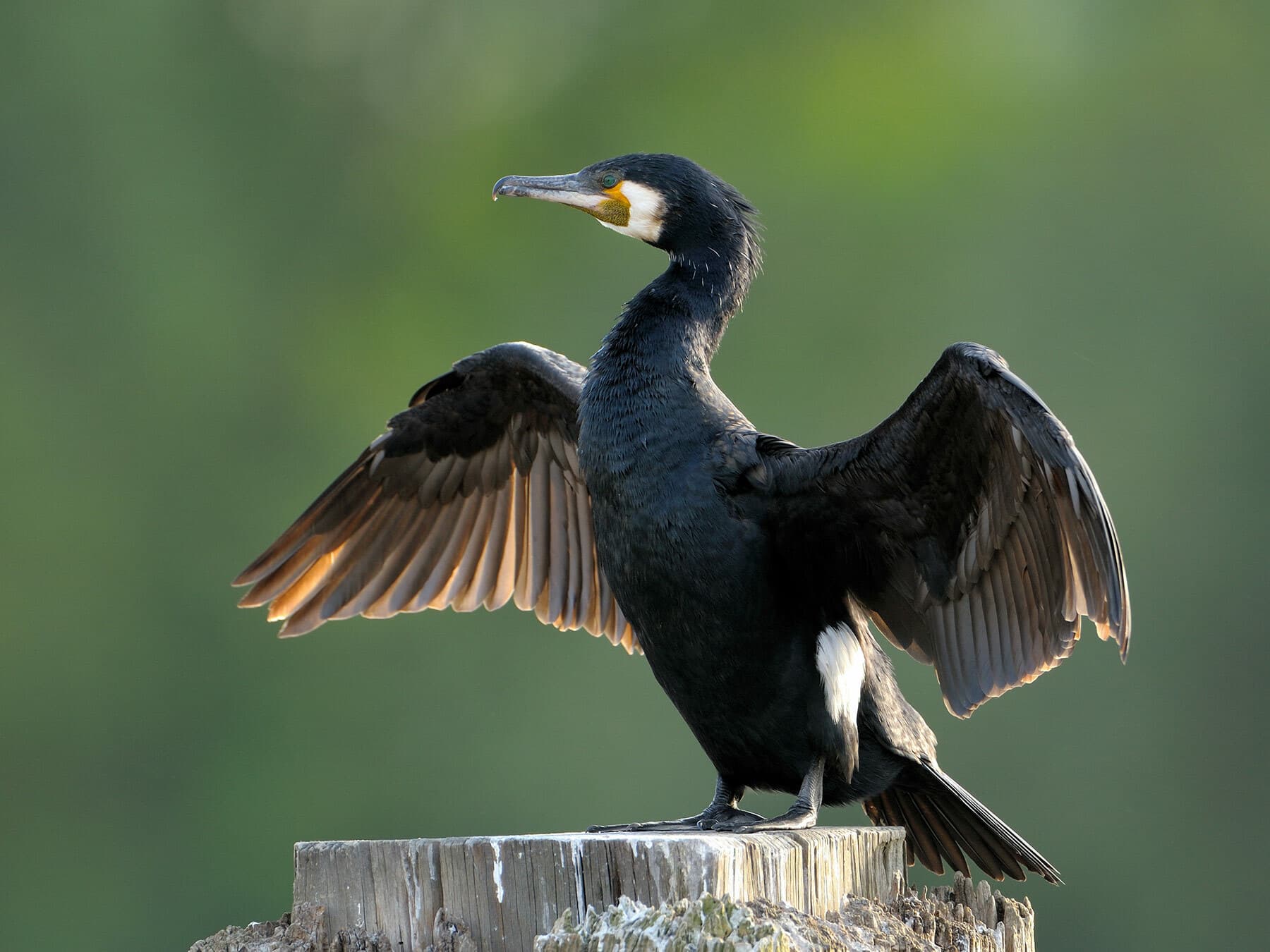
Double-crested Cormorant guides
1 guidesQuick facts
- Length
- 70–90 cm
- Wingspan
- 114–123 cm
- Weight
- 1200–2500 g
- Lifespan
- oldest recorded 23 years 8 months
- Family
- Cormorants & Shags
- Migration
- Partial migrant
- Global status (IUCN)
- Least Concern
- World population
- About 871,000 to 1,032,000 birds in the continental US and Canada (U.S. Fish and Wildlife Service, 2020)
- Population trend
- Common and widespread after a strong recovery; a species of low conservation concern
- Scientific name
- Nannopterum auritum
Questions
3Are Double-crested Cormorants invasive?
No. It is a native North American bird. Its numbers have grown a great deal since the 1970s, but mostly within its historical range. See conservation status.
What is the scientific name of the Double-crested Cormorant?
Nannopterum auritum. It was long placed in the genus Phalacrocorax, as Phalacrocorax auritus, and you will still see that name in older books. Its closest relative is the Neotropic Cormorant.
Has a Double-crested Cormorant been seen in Britain?
Yes, as a very rare vagrant from North America: it was recorded in England in 1989. It has also reached the Azores, in 1991.
Sources
31- 1Dorr, B. S., Hatch, J. J. and Weseloh, D. V. (2021). Double-crested Cormorant (Nannopterum auritum), version 1.1. Birds of the World (A. F. Poole, editor). Cornell Lab of Ornithology. doi:10.2173/bow.doccor.01.1 (opens in a new tab)
- 2National Audubon Society. Double-crested Cormorant. Guide to North American Birds. Accessed 2 November 2026. Source (opens in a new tab)
- 3National Audubon Society. Great Cormorant. Guide to North American Birds. Accessed 2 November 2026. Source (opens in a new tab)
- 4National Audubon Society. Neotropic Cormorant. Guide to North American Birds. Accessed 2 November 2026. Source (opens in a new tab)
- 5Ridgway, M. S. (2010). A review of estimates of daily energy expenditure and food intake in cormorants (Phalacrocorax spp.). Journal of Great Lakes Research 36: 93-99. doi:10.1016/j.jglr.2009.10.002 (opens in a new tab)
- 6Coleman, J. T. H. (2009). Diving behavior, predator-prey dynamics, and management efficacy of Double-crested Cormorants in New York State. Ph.D. dissertation, Cornell University. Accessed 2 November 2026.
- 7Podolsky, R. H. and Kress, S. W. (1989). Plastic debris incorporated into Double-crested Cormorant nests in the Gulf of Maine. Accessed 2 November 2026.
- 8van der Veen, H. E. (1973). Some aspects of the breeding biology and demography of the Double-crested Cormorants of Mandarte Island. Ph.D. thesis. Accessed 2 November 2026.
- 9USGS Bird Banding Laboratory. Longevity records of North American birds. USGS Eastern Ecological Science Center, Bird Banding Laboratory. Accessed 2 November 2026. Source (opens in a new tab)
- 10U.S. Fish and Wildlife Service (2020). Migratory Bird Permits; Management of Conflicts Associated With Double-Crested Cormorants (Phalacrocorax auritus) Throughout the United States (final rule). Federal Register 85: 85535-85556 (29 December 2020). Accessed 2 November 2026. Source (opens in a new tab)
- 11Hostetler, J. A. et al. (2026). The North American Breeding Bird Survey, Analysis Results 1966-2025. U.S. Geological Survey data release. doi:10.5066/P1OSNSFC (opens in a new tab)
- 12Partners in Flight (2023). Avian Conservation Assessment Database and Population Estimates Database. Bird Conservancy of the Rockies. Accessed 2 November 2026. Source (opens in a new tab)
- 13Anderson, D. W. and Hickey, J. J. (1972). Eggshell changes in certain North American birds. Proceedings of the XV International Ornithological Congress. Accessed 2 November 2026.
- 14Weseloh, D. V. C. and Casselman, J. (1992). Calculated fish consumption by Double-crested Cormorants in eastern Lake Ontario. Accessed 2 November 2026.
- 15Ross, R. M. and Johnson, J. H. (1995). Seasonal and annual changes in the diet of Double-crested Cormorants. Accessed 2 November 2026.
- 16Madenjian, C. P. and Gabrey, S. W. (1995). Waterbird predation on fish in western Lake Erie: a bioenergetics model application. The Condor 97: 141-153. doi:10.2307/1368992 (opens in a new tab)
- 17U.S. Fish and Wildlife Service (2026). 50 CFR 10.13: List of Birds Protected by the Migratory Bird Treaty Act. Electronic Code of Federal Regulations. Accessed 2 November 2026. Source (opens in a new tab)
- 18U.S. Fish and Wildlife Service (2026). 50 CFR 21.123: Special double-crested cormorant permit. Electronic Code of Federal Regulations. Accessed 2 November 2026. Source (opens in a new tab)
- 19Cornell Lab of Ornithology. Double-crested Cormorant. All About Birds. Accessed 2 November 2026. Source (opens in a new tab)
- 20National Audubon Society. Anhinga. Guide to North American Birds. Accessed 2 November 2026. Source (opens in a new tab)
- 21National Audubon Society. Common Loon. Guide to North American Birds. Accessed 2 November 2026. Source (opens in a new tab)
- 22U.S. Fish and Wildlife Service (2018). Migratory Bird Permits; Removal of Depredation Orders for Double-Crested Cormorants (final rule). Federal Register 83: 32805 (16 July 2018). Accessed 2 November 2026. Source (opens in a new tab)
- 23Hatch, J. J. (1995). Changing populations of Double-crested Cormorants. Colonial Waterbirds 18 (Special Publication 1): 8-24. Accessed 2 November 2026.
- 24Hennemann, W. W., III (1988). Energetics and spread-winged behavior in Anhingas and Double-crested Cormorants: the risks of generalization. American Zoologist 28: 845-851. doi:10.1093/icb/28.3.845 (opens in a new tab)
- 25Mendall, H. L. (1936). The home-life and economic status of the Double-crested Cormorant. University of Maine Studies 38. Accessed 2 November 2026.
- 26Lemmon, C. R., Bugbee, G. and Stephens, G. R. (1994). Tree damage by nesting Double-crested Cormorants in Connecticut. Accessed 2 November 2026.
- 27Hobson, K. A. (1989). Pebbles in nests of Double-crested Cormorants. Wilson Bulletin 101: 107-108. Accessed 2 November 2026.
- 28Peck, G. K. and James, R. D. (1983). Breeding Birds of Ontario: Nidiology and Distribution. Volume 1: Nonpasserines. Royal Ontario Museum. Accessed 2 November 2026.
- 29Dolbeer, R. A. (1991). Migration patterns of Double-crested Cormorants east of the Rocky Mountains. Journal of Field Ornithology 62: 83-93. Accessed 2 November 2026.
- 30Cornell Lab of Ornithology. Anhinga. All About Birds. Accessed 2 November 2026. Source (opens in a new tab)
- 31Cornell Lab of Ornithology. Common Loon. All About Birds. Accessed 2 November 2026. Source (opens in a new tab)

Checked by
Nathan Cope, founder and editor
Nathan founded Birdfact and leads its writers and contributors in the UK, the US and Canada. He has watched and studied birds for more than ten years, and checks every article and species guide before it’s published.