


Great Cormorant
Black Cormorant, Large Cormorant · Phalacrocorax carbo
By the Birdfact teamChecked by Nathan Cope
On this page14 sections
How to recognise it
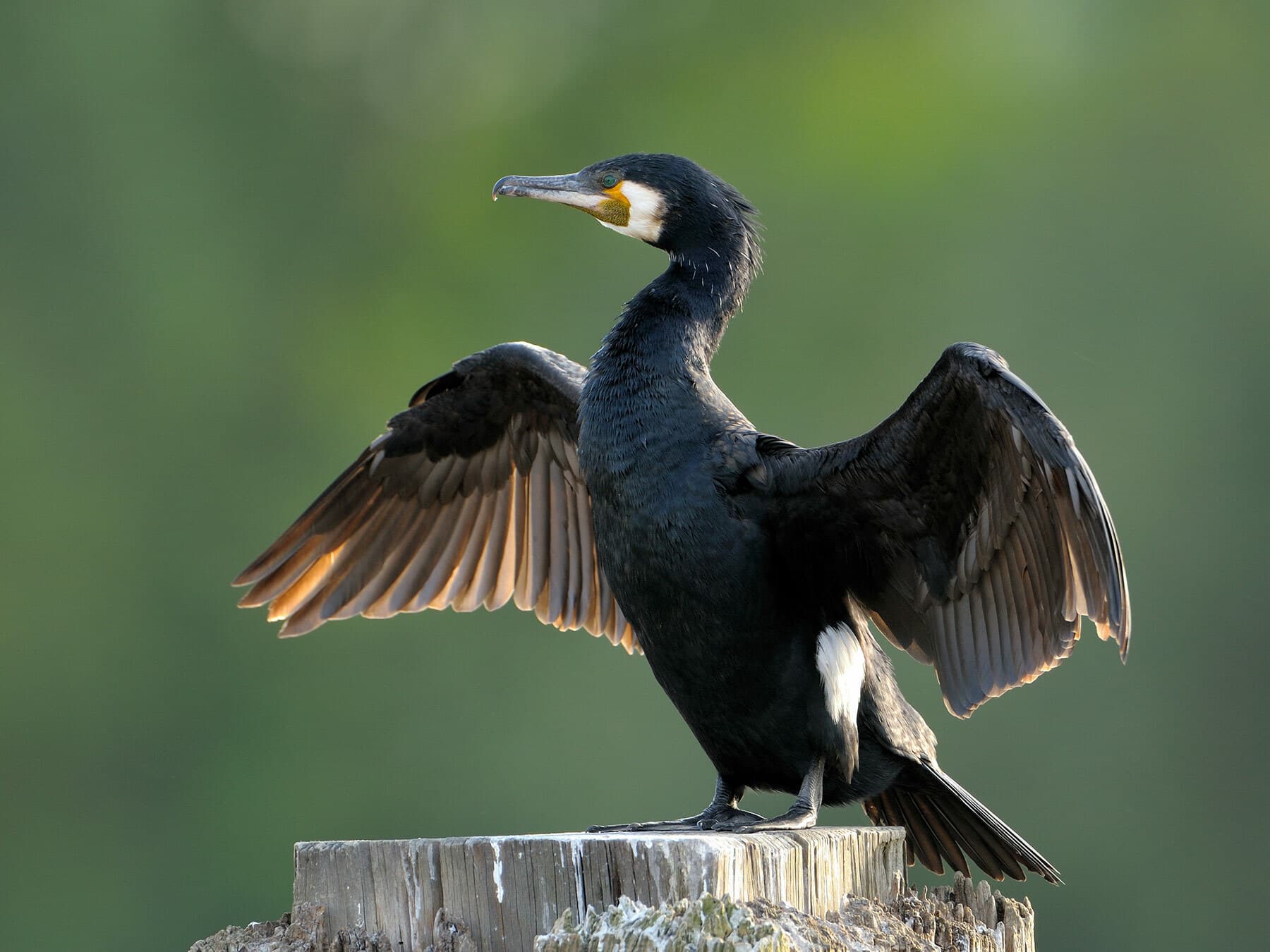
The Great Cormorant is a large waterbird with predominantly glossy black plumage, often with a greenish or bluish sheen. Adults have a white throat and cheek patch, and during the breeding season, they develop white thigh patches and fine white plumes on the head and neck.
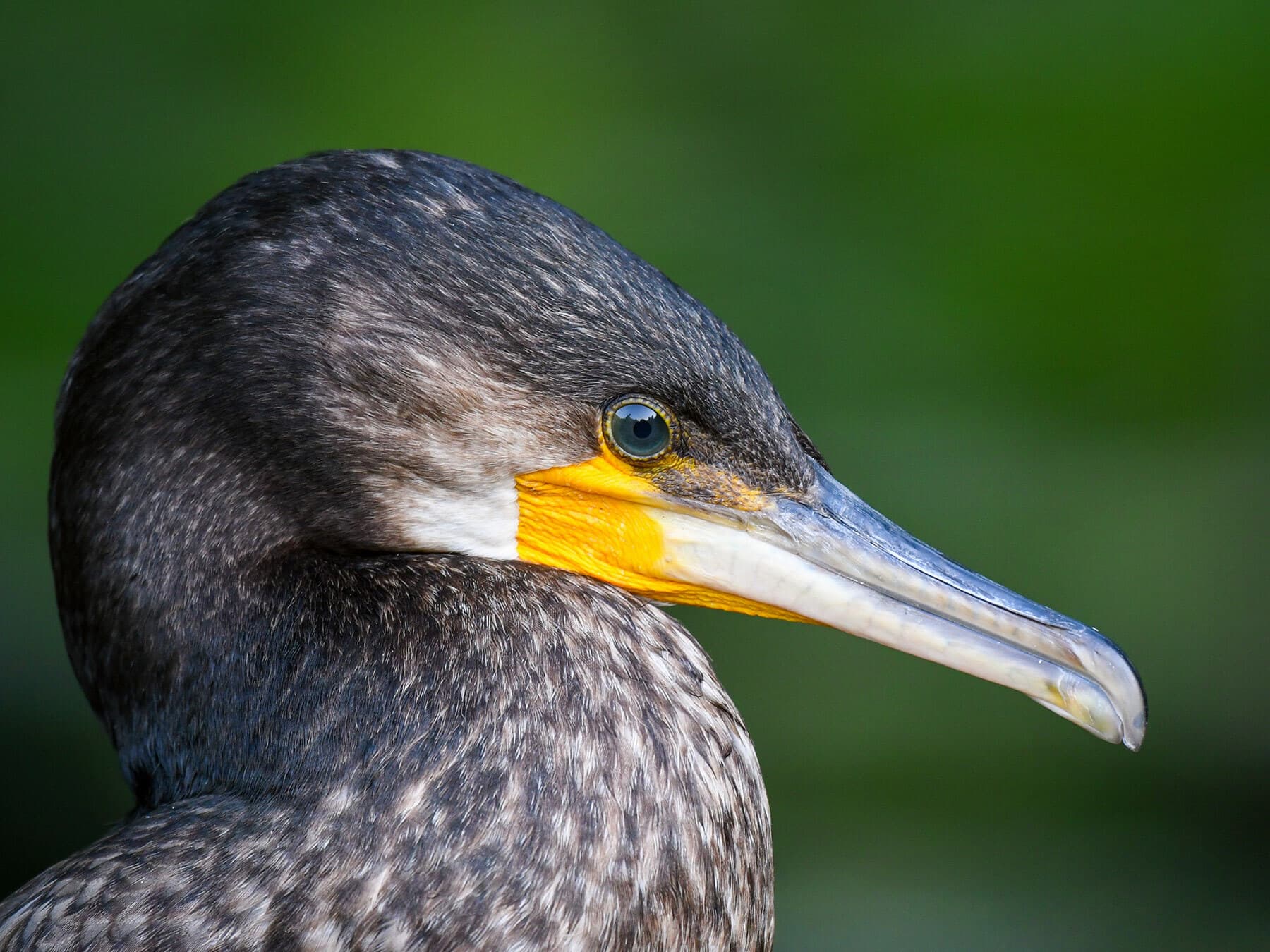
Juveniles are duller brown, with varying amounts of white on the underparts. The bird's distinctive features include its long, hooked bill, bright yellow-orange facial skin, and piercing turquoise-green eyes.
Its size
Adults- Length
- 80–100 cm
- Wingspan
- 130–160 cm
- Weight
- 1800–3000 g
Its song and calls
Alone, the cormorant is a relatively quiet bird but typically when nesting in a colony it issues a series of low guttural grunts.
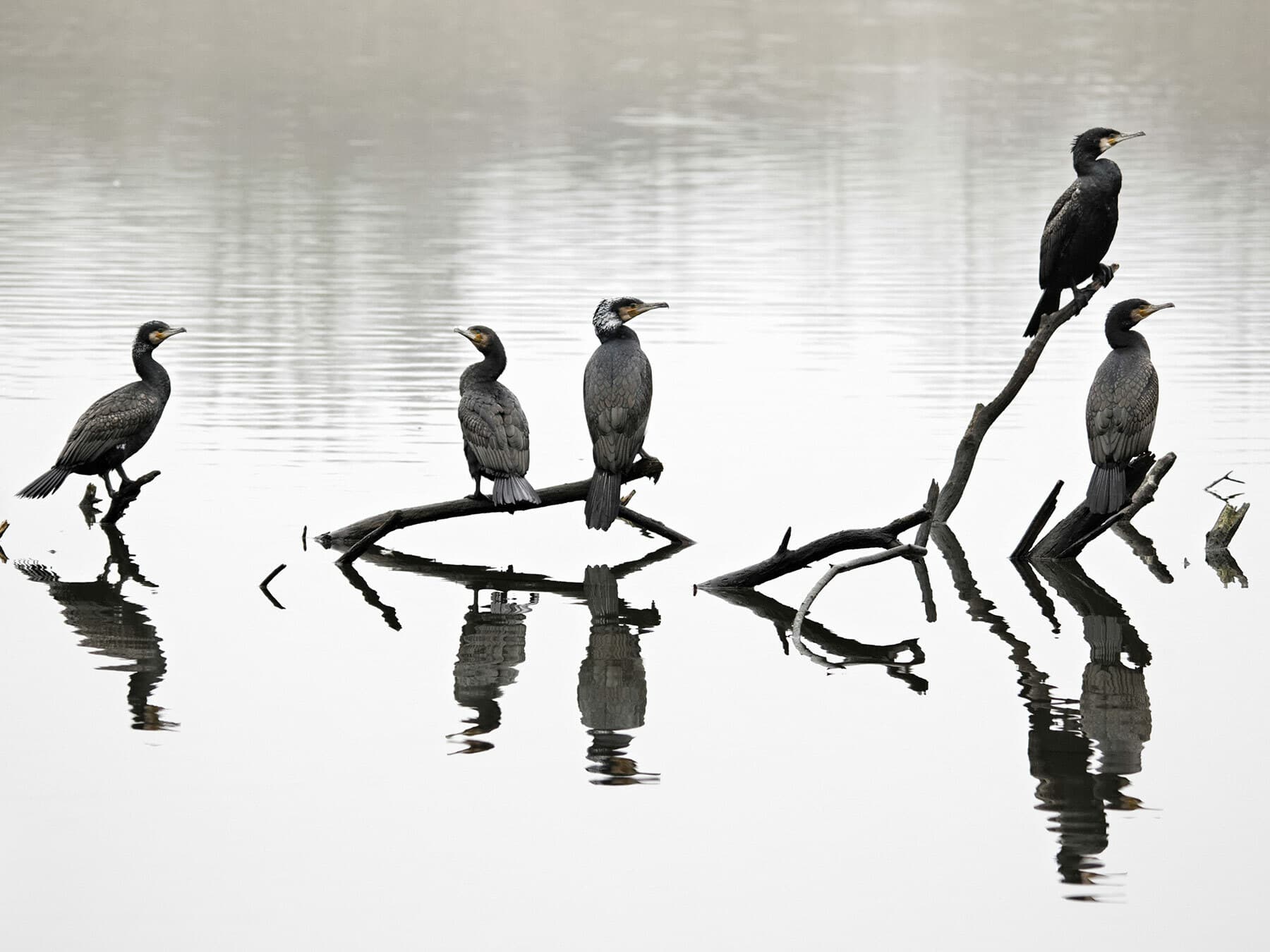
What is a group of Cormorants called?
The collective nouns to describe a group of cormorants are:
- a flight of cormorants
- a gulp of cormorants
- a “lett fli” of cormorants
- a paddling of cormorants
- a rookery of cormorants
- a swim of cormorants
- Song and calls0:00 / 0:11
Recorded in Normandy, France · March 2026
- Call0:00 / 0:13
Recorded in Bretagne, France · December 2024
When and where to see it
OctoberPeak season
Most recorded in October
- 1. Derry3.0%
- 2. Moray2.7%
- 3. Cork2.5%
- 4. Sligo2.4%
- 5. West Lothian2.4%
Each dot is a county, state or province: the bigger and darker, the larger the bird’s share of that place’s bird records that month. Grey dots: no regular records. The ringed point is the centre of the bird’s records this month; the arrow shows how it moved since last month, and the dashed loop its path through the year. “Arrivals” colours places where it becomes regular this month (orange) or is in its last regular month (grey). GBIF eBird Observation Dataset, 2019–2024. Map data: Natural Earth, US Census Bureau; place centres © OpenStreetMap contributors.
In your area
See when the Great Cormorant is recorded in your county, state or province.
How often the Great Cormorant turns up in the UK, Ireland, the United States and Canada through the year, from birdwatchers' records.
United Kingdom
Resident · all year · most records in December
Ireland
Resident · all year · most records in August
United States
Winter visitor · all year · most records in January
Canada
Winter visitor · all year · most records in January
Show as a table
| Month | United Kingdom | Ireland | United States | Canada |
|---|---|---|---|---|
| January | 1.6% (regular) | 1.8% (regular) | 0.037% (regular) | 0.053% (regular) |
| February | 1.5% (regular) | 1.9% (regular) | 0.034% (regular) | 0.042% (regular) |
| March | 1.3% (regular) | 1.8% (regular) | 0.019% (regular) | 0.027% (regular) |
| April | 1.1% (regular) | 1.6% (regular) | 0.003% (regular) | 0.009% (regular) |
| May | 0.99% (regular) | 1.5% (regular) | 0.002% (regular) | 0.003% (regular) |
| June | 1.0% (regular) | 1.7% (regular) | 0.003% (regular) | 0.010% (regular) |
| July | 1.3% (regular) | 2.1% (regular) | 0.003% (regular) | 0.014% (regular) |
| August | 1.5% (regular) | 2.2% (regular) | 0.003% (regular) | 0.021% (regular) |
| September | 1.6% (regular) | 2.1% (regular) | 0.008% (regular) | 0.026% (regular) |
| October | 1.6% (regular) | 1.8% (regular) | 0.013% (regular) | 0.018% (regular) |
| November | 1.6% (regular) | 1.9% (regular) | 0.017% (regular) | 0.021% (regular) |
| December | 1.7% (regular) | 1.9% (regular) | 0.024% (regular) | 0.040% (regular) |
Recorded regularly in
Worldwide: recorded regularly in 128 countries
Countries where it was recorded in at least 3 of the 6 years 2019–2024. Linked countries have their own bird list.
Europe (49)
- Åland Islands
- Albania
- Andorra
- Austria
- Belarus
- Belgium
- Bosnia & Herzegovina
- Bulgaria
- Croatia
- Czechia
- Denmark
- Estonia
- Faroe Islands
- Finland
- France
- Germany
- Gibraltar
- Greece
- Guernsey
- Hungary
- Iceland
- Ireland
- Isle of Man
- Italy
- Jersey
- Kosovo
- Latvia
- Liechtenstein
- Lithuania
- Luxembourg
- Malta
- Moldova
- Monaco
- Montenegro
- Netherlands
- North Macedonia
- Norway
- Poland
- Portugal
- Romania
- Russia
- Serbia
- Slovakia
- Slovenia
- Spain
- Sweden
- Switzerland
- Ukraine
- United Kingdom
Africa (30)
Asia (41)
- Armenia
- Azerbaijan
- Bahrain
- Bangladesh
- Bhutan
- Cambodia
- China
- Cyprus
- Georgia
- Hong Kong SAR China
- India
- Iran
- Iraq
- Israel
- Japan
- Jordan
- Kazakhstan
- Kuwait
- Kyrgyzstan
- Lebanon
- Macao SAR China
- Malaysia
- Mongolia
- Myanmar (Burma)
- Nepal
- Oman
- Pakistan
- Palestinian Territories
- Philippines
- Qatar
- Saudi Arabia
- Singapore
- South Korea
- Sri Lanka
- Taiwan
- Tajikistan
- Thailand
- Turkey
- United Arab Emirates
- Uzbekistan
- Vietnam
North America (4)
Oceania (4)
- Australia
- New Caledonia
- New Zealand
- Papua New Guinea
Data: EOD – eBird Observation Dataset (Cornell Lab of Ornithology), accessed via GBIF.org, CC BY 4.0. Records from 2019–2024, aggregated and filtered by Birdfact. How these lists are made
Cormorants generally inhabit coastal areas, rocky shores, estuaries and wetlands but are increasingly seen around freshwater lakes, reservoirs and occasionally rivers throughout the UK. They are, however, less likely to be found inland in central and northern Scotland. Coastal habitats, in particular, attract cormorants often seen gathering in flocks and nesting in large colonies. They are a social bird and spend a lot of time on the water with their long slim body almost submerged and their necks straight with their heads slightly uptilted.
Signs and Spotting tips
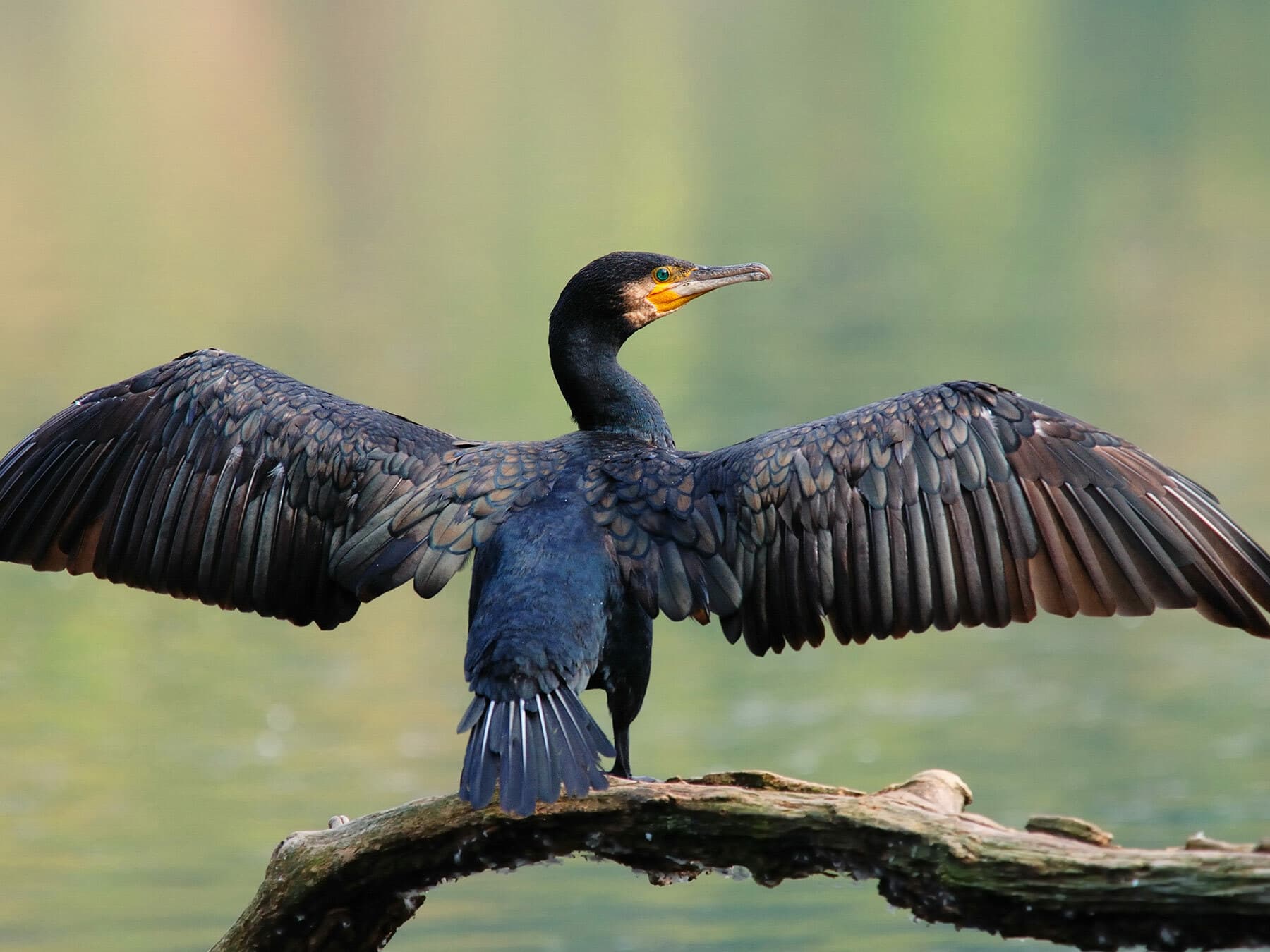
Sometimes easily mistaken for a common shag, cormorants are larger and with a gently sloping forehead they differ from the shag who can be identified with its steep forehead and feathered crest. Whilst cormorants are gregarious and will move inland and occupy freshwater lakes, it is unlikely that you will see shags, who are solitary birds, away from the coast. Like the shag though, the cormorant can often be seen perching or standing with its wings half open drying them following a period of diving and feeding.
What it eats
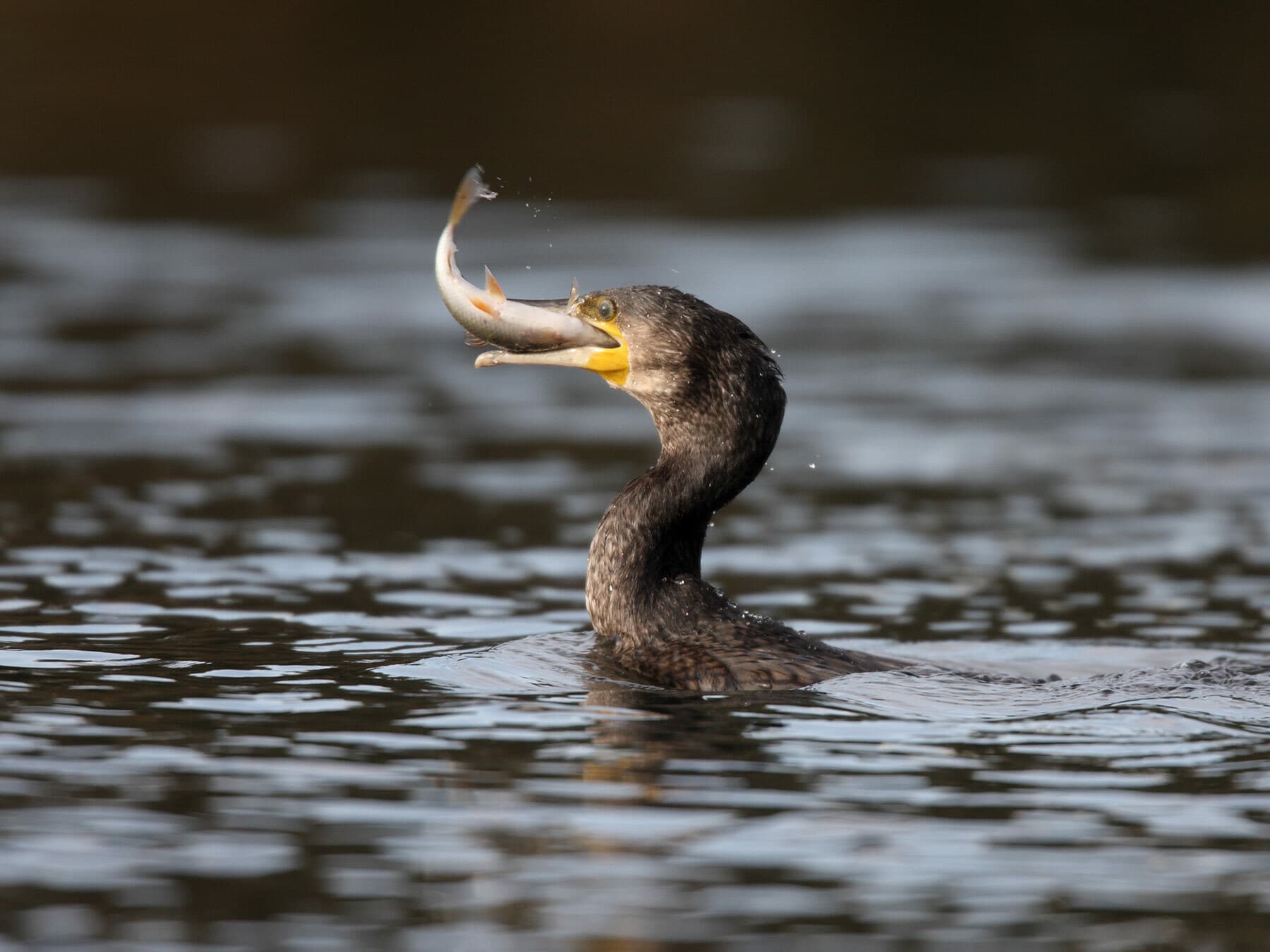
Cormorants feed almost entirely on fish. They will typically, individually consume up to half a kilo of fish a day. In fresh water their diets may be more varied. Cormorants ‘duck dive’ from the water’s surface and in addition to their webbed feet, use their short wings to propel themselves downwards to an average depth of 10 metres and catch fish using the sharp hook at the end of their beak.
For a full guide on what cormorants eat, check out this article.
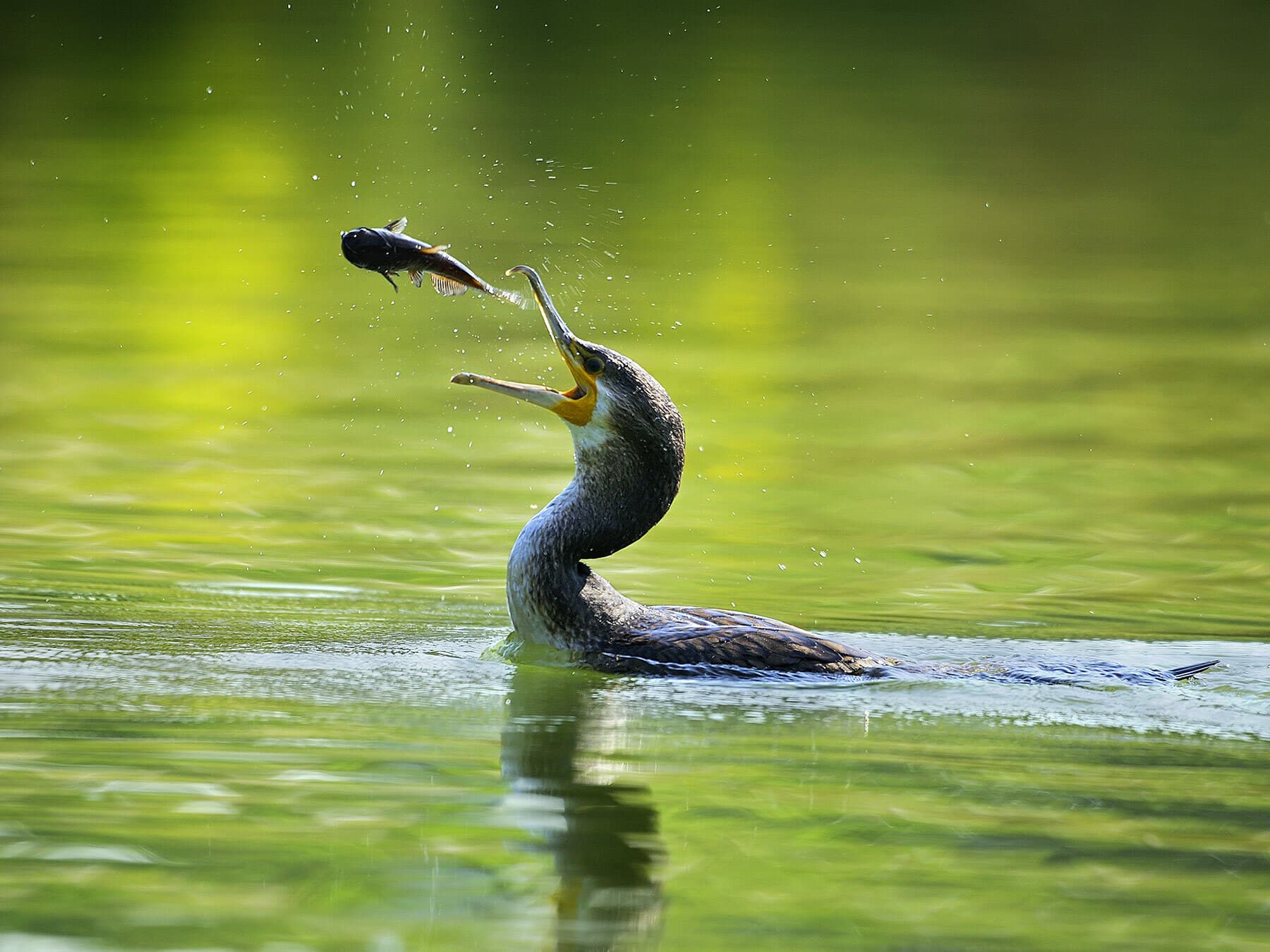
Nesting and breeding
Cliff ledges, small caves and even trees can be the base upon which they construct their often bulky, large nests. Generally constructed with seaweed, twigs, guano and reeds the female lays one clutch of 3 – 4 pale blue eggs between April to May which both adults take turns to incubate. The breeding season for cormorants inhabiting inland areas tends to be extended to those on the coast.
Behaviour
Great Cormorants are excellent swimmers and divers, propelling themselves underwater with powerful webbed feet to catch fish. They are often seen perched on rocks or posts with wings spread, drying their feathers after diving. These birds are generally social, forming large breeding colonies and sometimes fishing in groups.
Lifespan and predators
The typical lifespan for a greater cormorant is eleven years although ages of greater than twenty years have been recorded on ringed birds.
Conservation
While the Great Cormorant is listed as Least Concern globally, some local populations face threats from habitat loss and persecution due to perceived competition with fisheries. Conservation efforts focus on protecting breeding sites and managing human-wildlife conflicts in fishing areas.
What does a Cormorant look like?
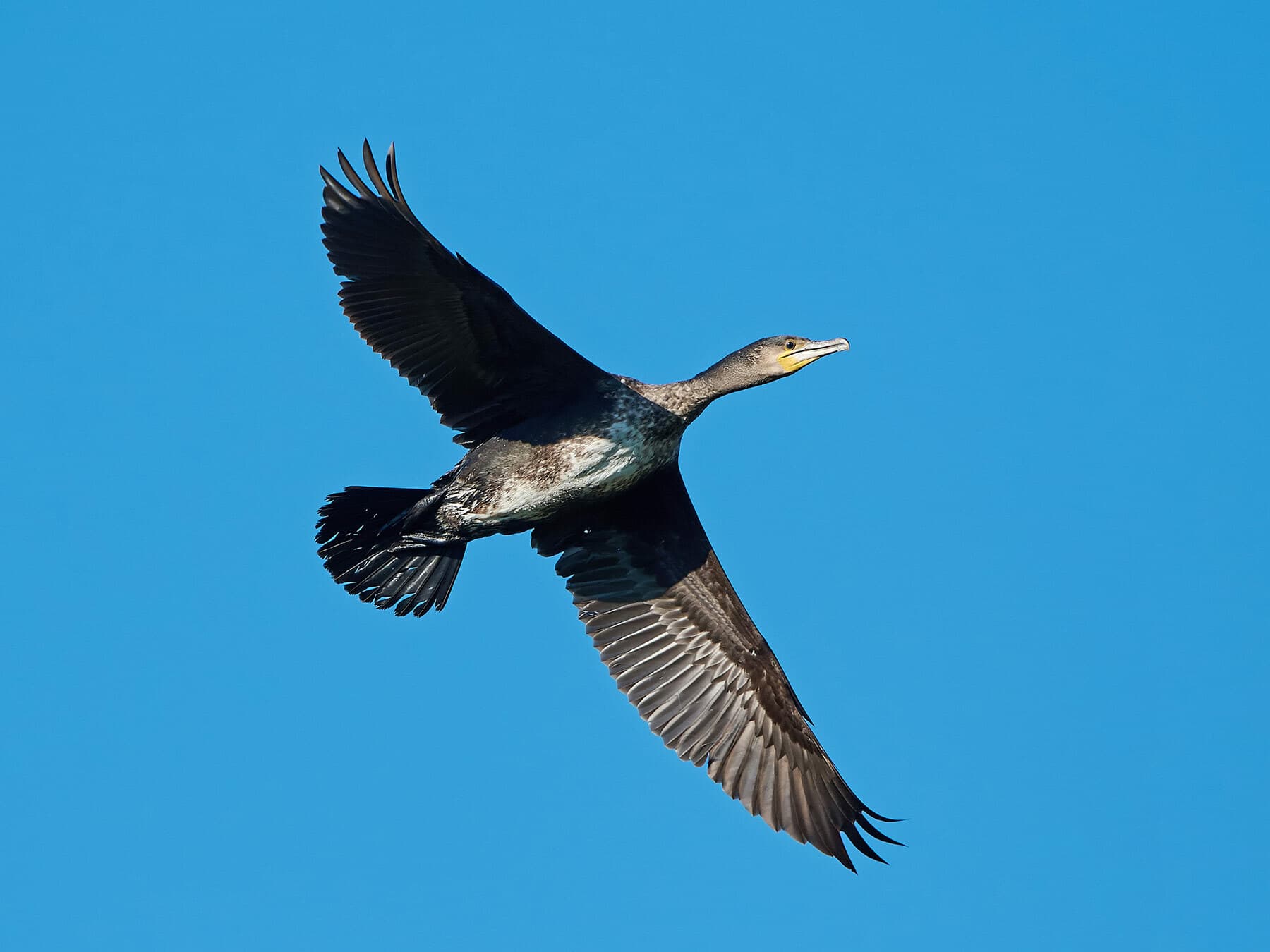
Adult cormorants are a large sea bird with a long broad tail, black underside and dark black brown broad wings, with a green blue sheen. It has a low forehead and a long powerful thick yellow and black bill with a hook at its tip. The lower part of the face and chin are white morphing into a yellow and orange hue close to the bill. It has short black legs and its four toes are webbed across each foot. During the breeding season white patches appear on the thighs of both males and females. Juvenile cormorants have a white under belly with a dark brown back and wings.
Similar birds
Often mistaken for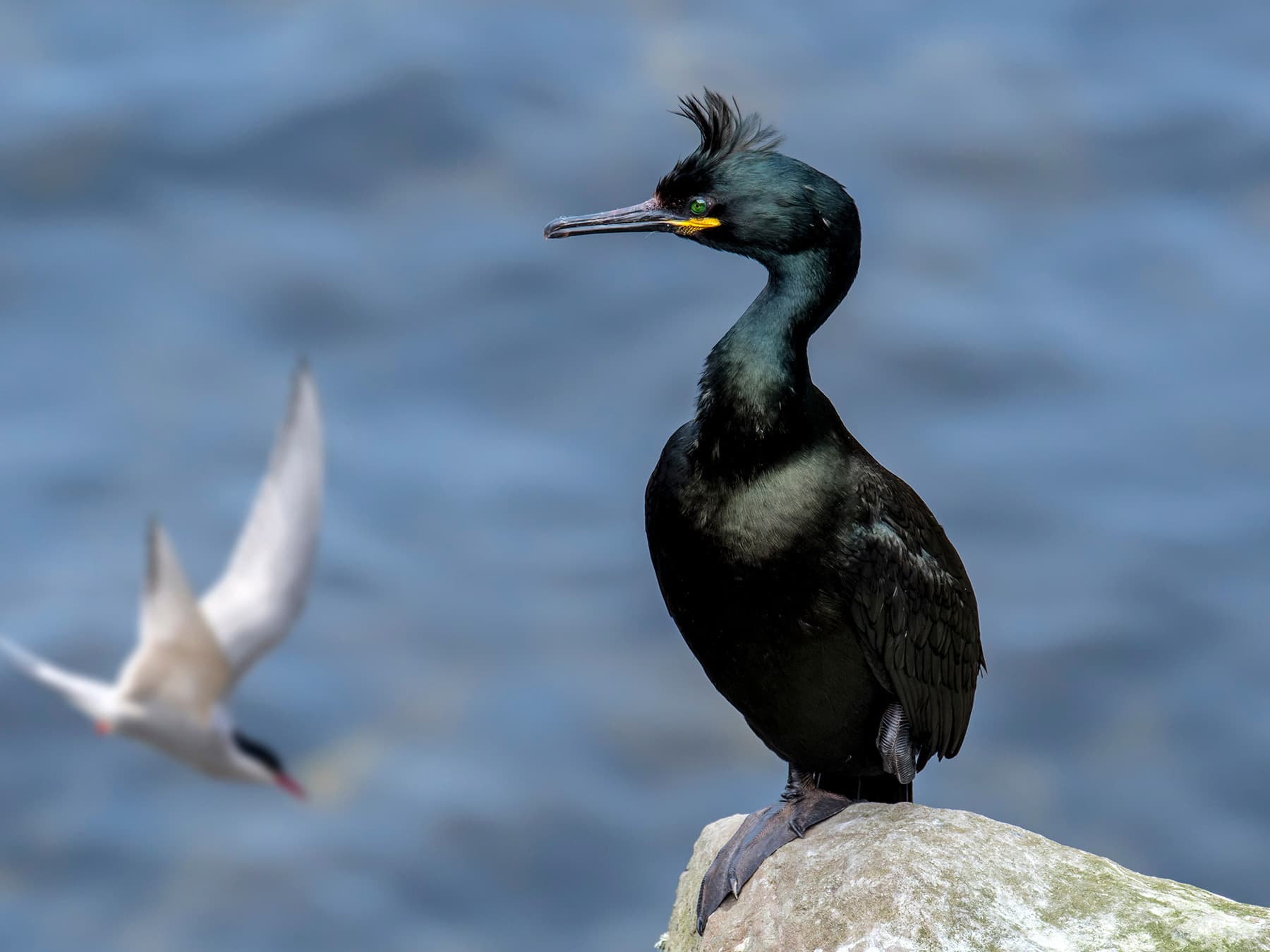
Great Cormorant guides
1 guidesQuick facts
- Length
- 80–100 cm
- Wingspan
- 130–160 cm
- Weight
- 1800–3000 g
- Lifespan
- 15–20 years · oldest recorded 21.5 years
- Family
- Cormorants & Shags
- Migration
- Partial migrant
- Global status (IUCN)
- Least Concern
- World population
- 1,400,000 - 2,100,000 mature individuals
- Population trend
- Increasing
- Also called
- Black Cormorant, Large Cormorant
- Scientific name
- Phalacrocorax carbo
Sources
4- 1BirdLife International. 2019. Phalacrocorax carbo (amended version of 2018 assessment). The IUCN Red List of Threatened Species 2019: e.T22696792A155523636. Source (opens in a new tab)
- 2Wetlands International (2015)
- 3Wetlands International (2015)
- 4BTO longevity records: maximum age from a ringed bird, 21 years, 6 months, 21 days (set in 1984), BirdFacts: Cormorant (1984) Source (opens in a new tab)

Checked by
Nathan Cope, founder and editor
Nathan founded Birdfact and leads its writers and contributors in the UK, the US and Canada. He has watched and studied birds for more than ten years, and checks every article and species guide before it’s published.