


Brown Pelican
Pelecanus occidentalis
By the Birdfact teamChecked by Nathan Cope
On this page14 sections
How to recognise it
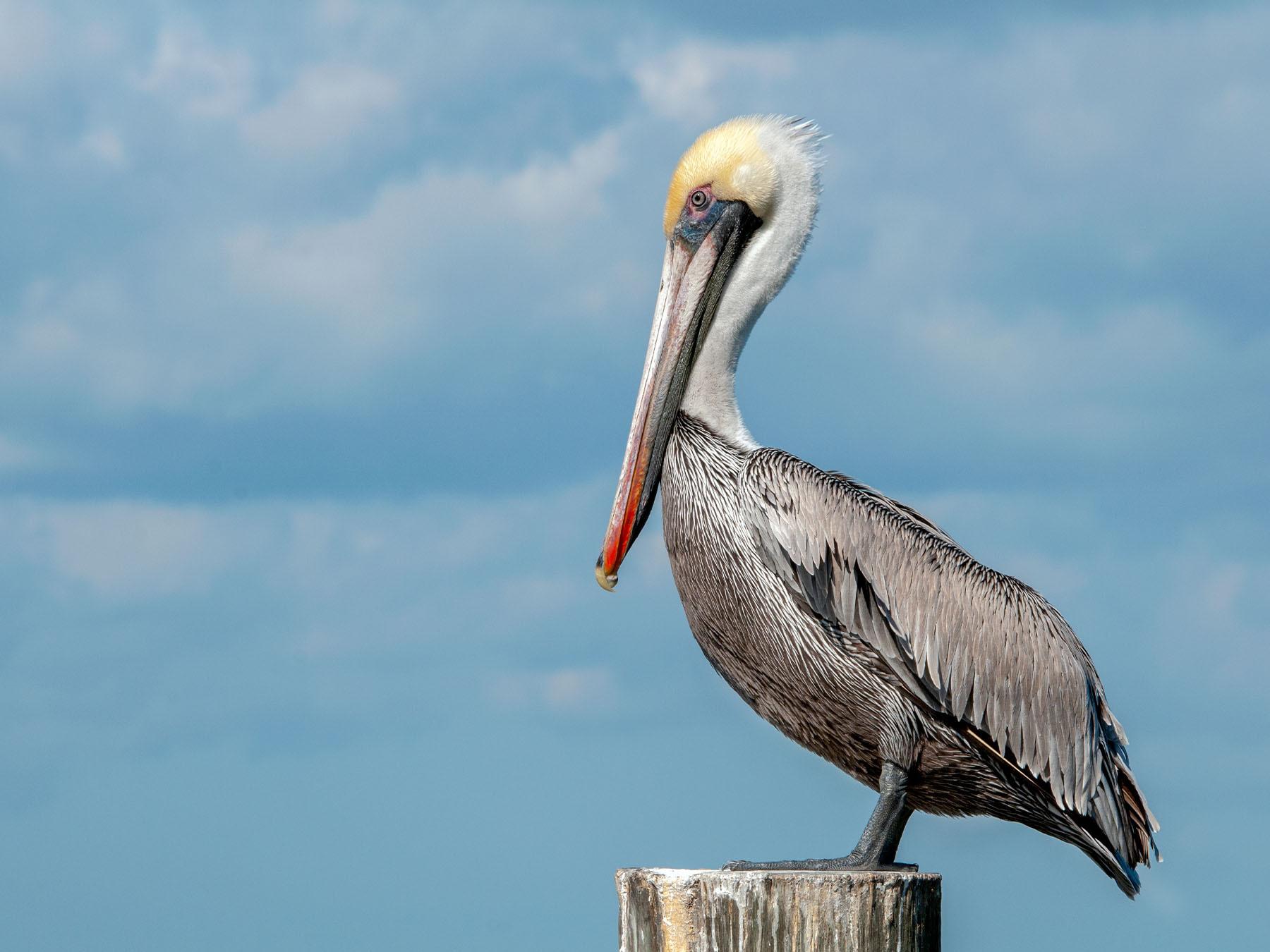
Adults are silvery gray to gray-brown above and blackish-brown on the belly, with a white or yellowish head and a stretchy pouch below the long bill. Young birds are brown above with a white belly.
Seen close, the rest of an adult's underside is streaked black and silver, and a patch of long yellow feathers sits at the base of the foreneck. The legs and feet are dark gray, turning black in the breeding season, and all four toes are joined by webs.
Plumage through the year: head, neck and pouch
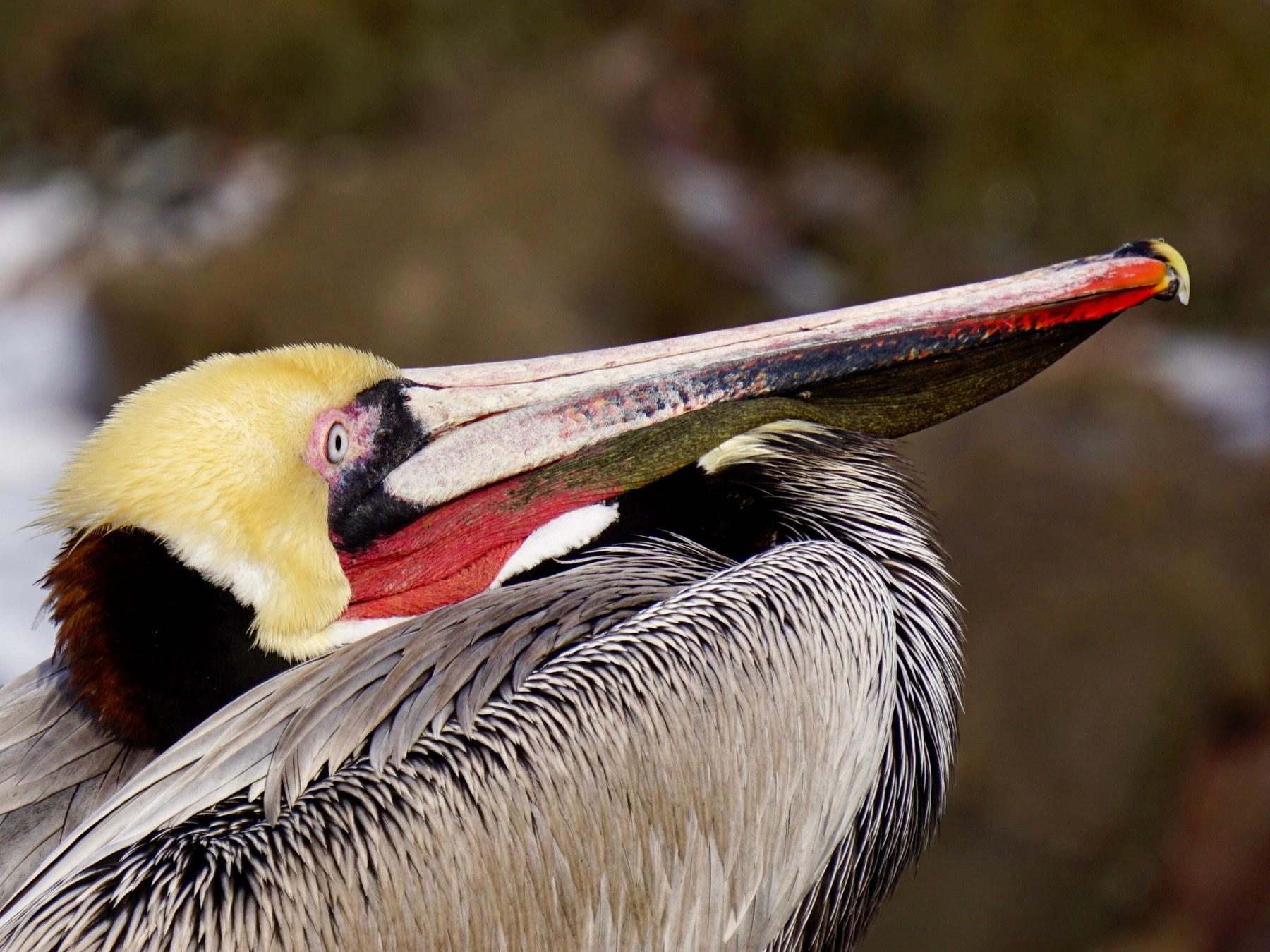
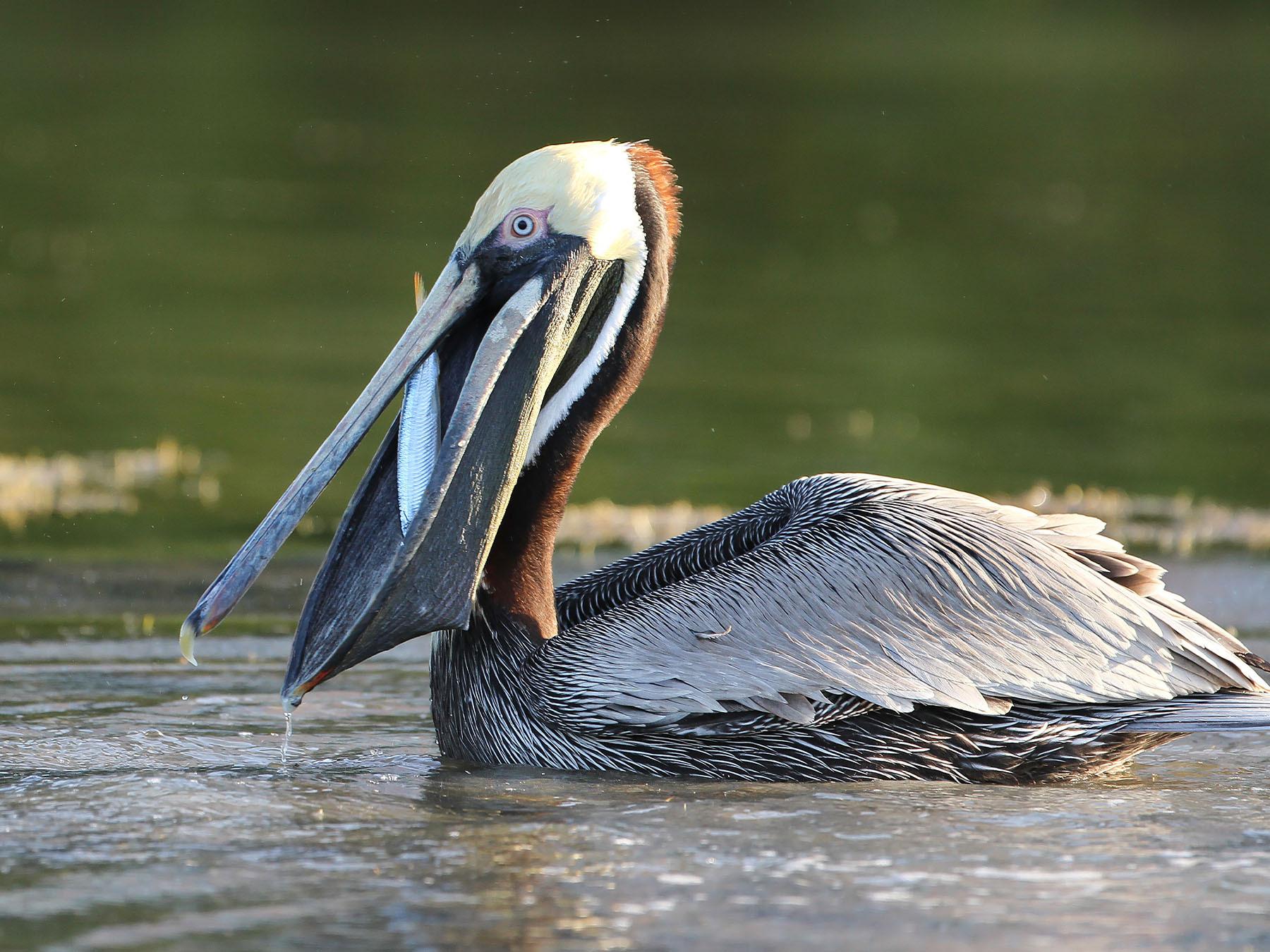
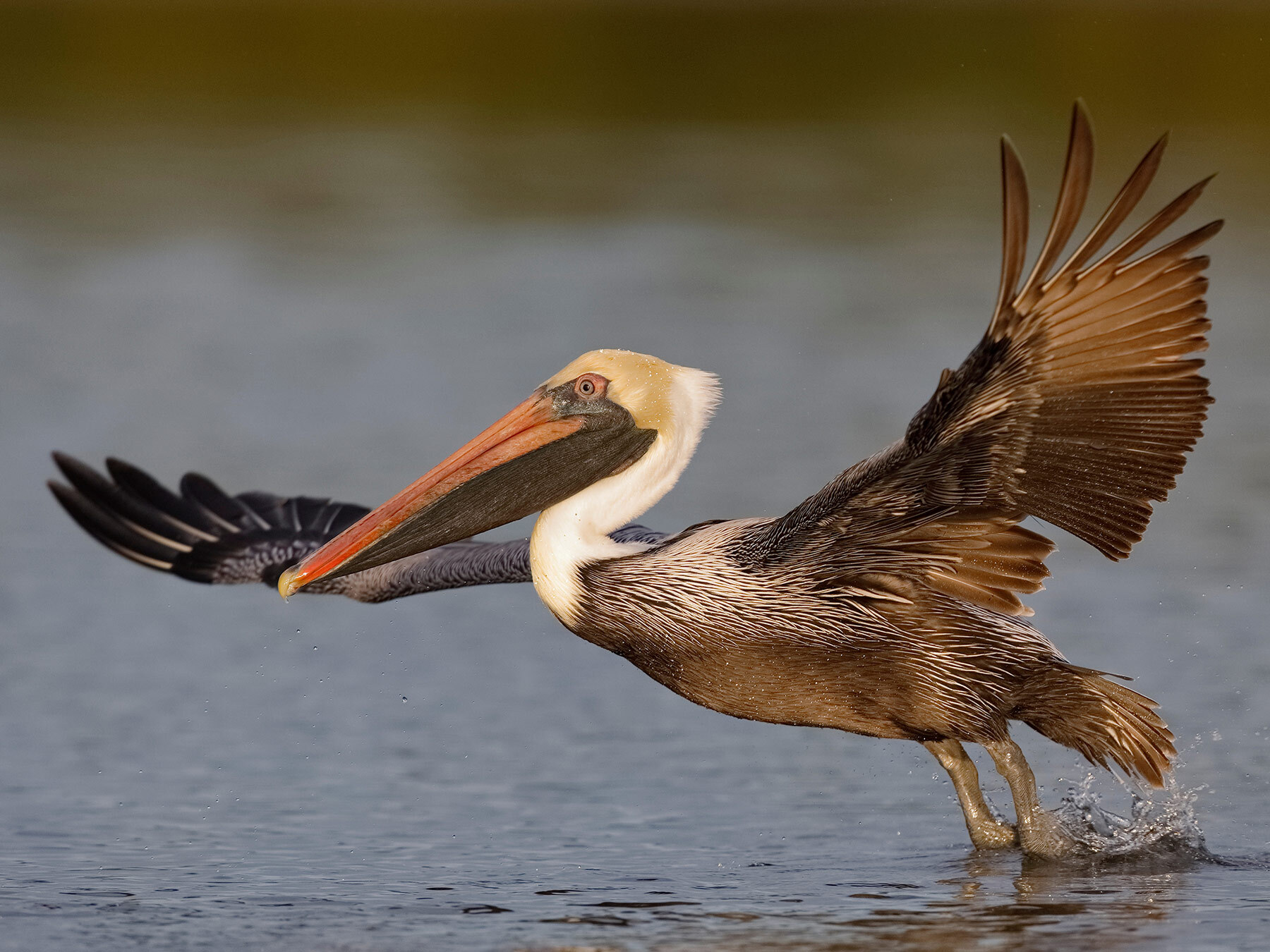
Adults change the look of the head and neck three times a year. After nesting the head is pale yellow and the whole neck white. Just before the next season the head turns yellow and the neck dark brown, with a narrow white stripe running from the head down the side of the pouch. While they are nesting, the head is white, sometimes flecked with dark, above a brown neck.
The eye is brown for most of the year but turns straw-white or pale sky-blue as courtship approaches, then darkens again once the eggs are being incubated.
In adults, the pouch shows which coast a bird comes from. In courtship the base of the pouch turns bright poppy red on Pacific birds, while on Atlantic and Gulf birds it is usually a blackish metallic green, and on both the color fades once incubation starts. Outside the nesting season the base of the pouch is reddish orange on Pacific birds and green-gray on Atlantic and Gulf birds, with the rest dark gray-green.
Size and weight
A Brown Pelican is 39.4-53.9 in (100-137 cm) long, with a wingspan of about 6 ft 7 in (2 m), and weighs about 4 lb to 8 lb 13 oz (1.8-4 kg). The bill alone is 9.8-15 in (25-38 cm). Beside an American White Pelican it looks a little smaller, and a Herring Gull looks small next to it.
Males are larger than females: 15-20% heavier, with bills 9-12% longer. In a Florida sample of 13 adults of each sex, males averaged 7.3 lb (3,290 g) and females 6.2 lb (2,824 g).1 Size also varies by region: the largest birds breed on the Pacific coast, mid-sized ones on the Gulf and Atlantic coasts and the smallest in the Caribbean.
Male, female and young
Males and females are similar in every plumage, and the male is simply the bigger bird with the longer bill. In breeding adults the white stripe below the pouch base averaged 1.8 in (46 mm) in 30 males and 1.3 in (33 mm) in 43 females; males always had it, while some females lacked it.1 Females may reach adult plumage a year sooner than males.
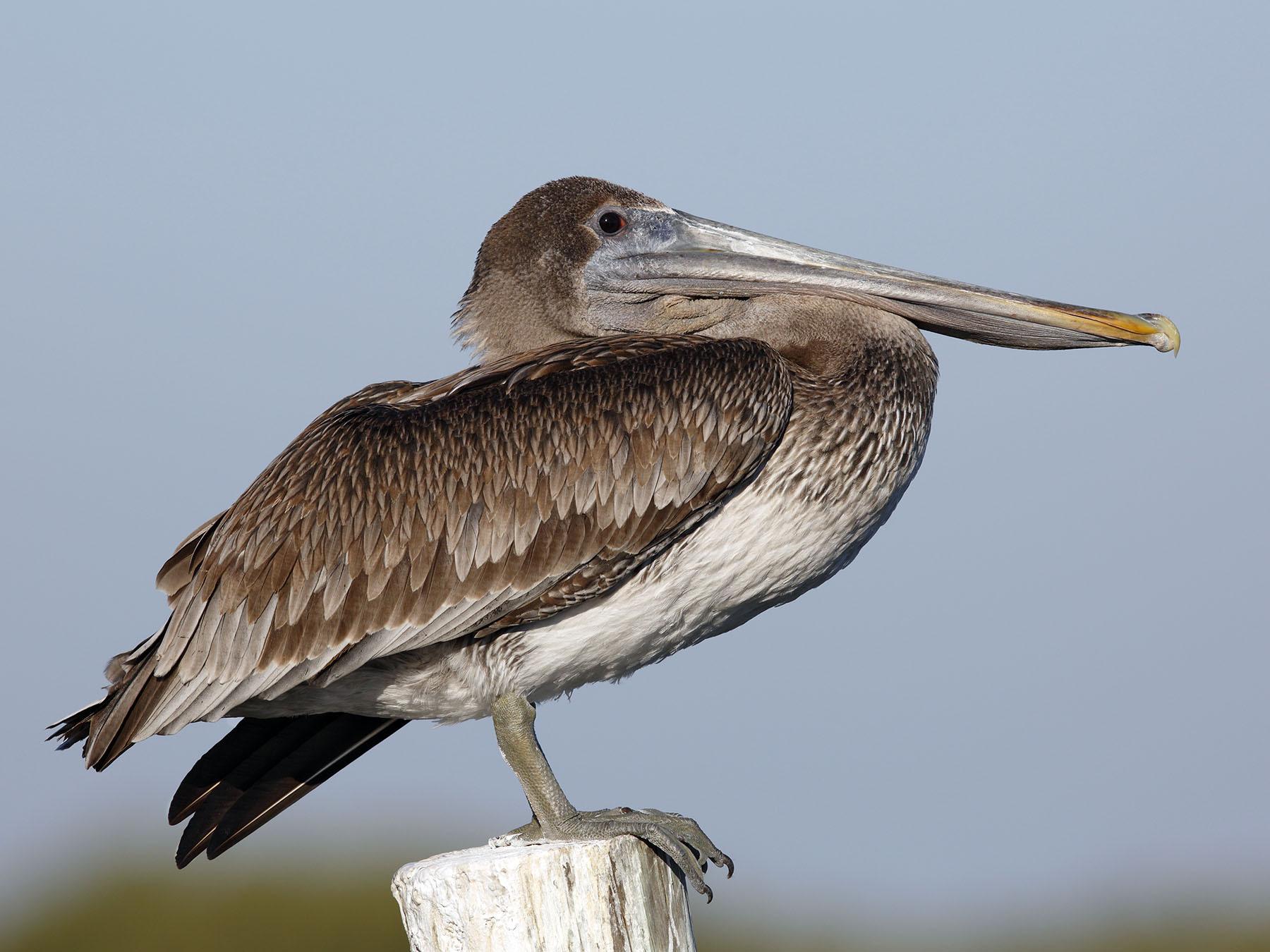
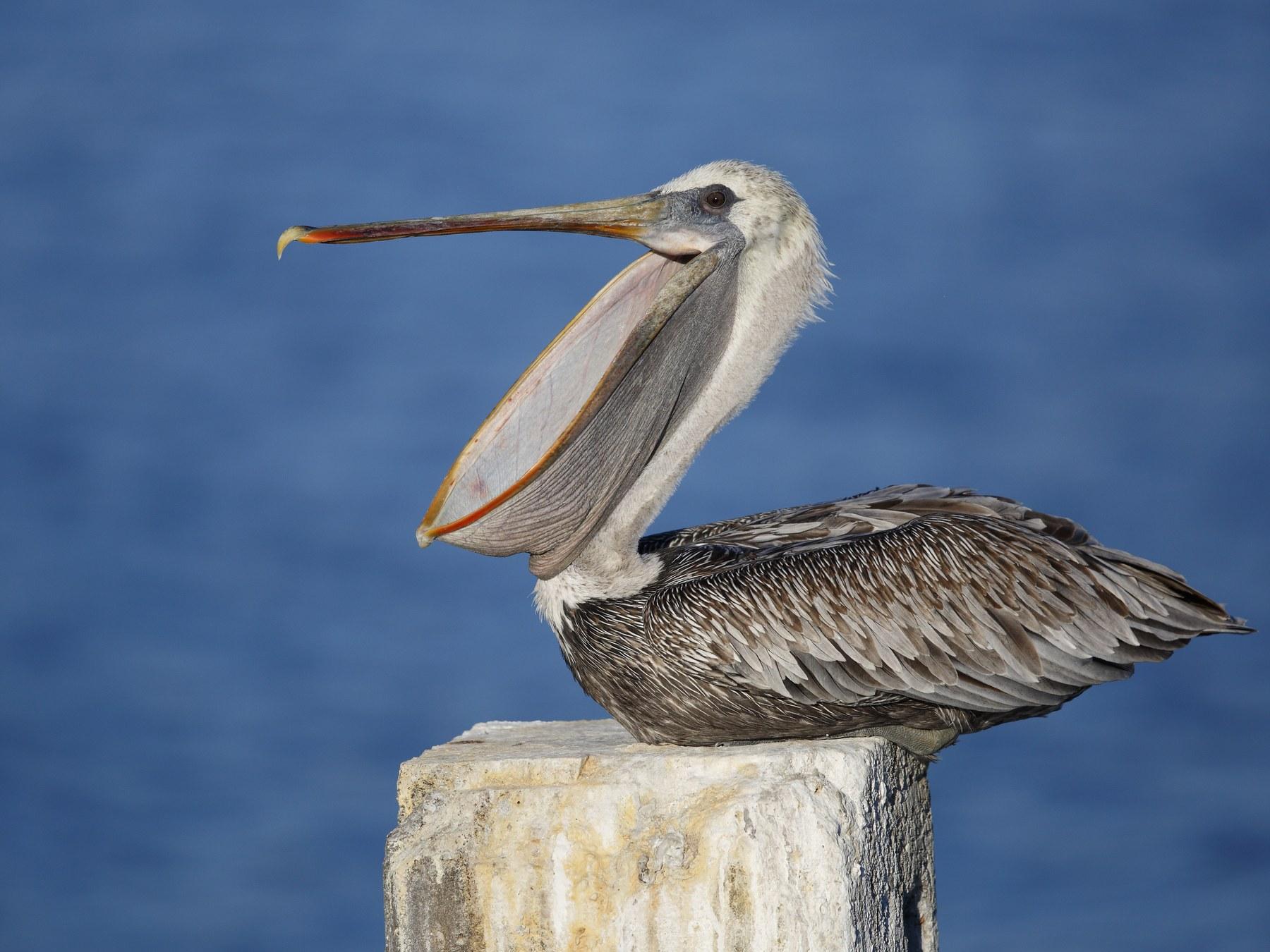
A juvenile, from about 10 weeks old, has a plain brown head, neck and back with pale tan feather tips, a white belly that grades to grayish brown on the sides, and a gray-brown bill. In flight, white tips to the brown underwing coverts make a pale stripe along the underwing. The white belly is the clearest difference from an adult.
For the next two to three years young birds molt almost continuously. White comes into the head, silvery feathers appear above and brown spreads onto the belly, and full adult plumage comes gradually at 3-5 years.
Identification: telling it from similar birds
The only other North American pelican is the American White Pelican. It is larger and white, with black primaries and outer secondaries, and it does not plunge-dive for its food. The Brown Pelican is darker and is normally found only on the coast.
The Peruvian Pelican of western South America was once treated as a subspecies of the Brown Pelican and is now a separate species. It is much larger, nearly twice the Brown's mass, with different plumage and bare-part colors, and the two do not interbreed where they meet. It breeds from northern Peru to central Chile and ranges from southern Ecuador to southern Chile, and Birds of the World lists no record of it from North America.2
Five subspecies are recognized. Two nest on the US mainland: the Eastern Brown Pelican of the Atlantic and Gulf coasts and the California Brown Pelican of the Pacific coast.

Not sure it’s a Brown Pelican? Check your photo: Birdfact names the bird and shows the look-alike side by side.
Its size
Adults- Length
- 100–137 cm
- Wingspan
- 200 cm
- Weight
- 1800–4000 g
Its song and calls
The Brown Pelican has no song, and adults are usually silent. During two displays they make a low, hoarse hrraa-hrraa, pushed out as air leaves the lungs,1 and low grunts are heard on the nesting grounds.3
Nestlings are much noisier. They call often, especially when begging, with a shrill, rasping squawk, and muffled squawks can be heard from inside the egg a day or two before the chick begins to break out. An adult that snaps its bill shut in a threat makes a loud pop from the pouch.
Heard one and not sure? Let the bird song identifier listen.
When and where to see it
The Brown Pelican is a bird of warm coasts in the Americas. On the Pacific it ranges from southern California to southern Ecuador and the Galapagos, and on the Atlantic side from Maryland around Florida to Texas, eastern Mexico, the West Indies, Venezuela and northern Colombia.
In the US it breeds in 10 coastal states: Maryland, Virginia, North Carolina, South Carolina, Georgia, Florida, Alabama, Louisiana, Texas and California. It has also nested inland, at Lake Okeechobee, Florida, in 1991 and 1992, and at the Salton Sea, California, where breeding was first recorded in 1996. It can be seen all year from central California and the lower Chesapeake Bay southward.1
Habitat
It lives over shallow water along the immediate coast, in estuaries and in sheltered bays, and it is generally rare inland, though it visits inland waters of the Southwest and central Florida after nesting. It roosts on sandbars, pilings, jetties, breakwaters, piers, docks, mangrove islets, offshore rocks and trees.
When nesting it usually fishes within 12 mi (20 km) of its island, and at other times up to 47 mi (75 km) from land. It cannot stay on the water for more than about an hour without becoming waterlogged, so it comes ashore to roost each night. Sensitivity to cold limits its winter range mainly to south of 38°N.

Do they migrate?
Partly. The Brown Pelican is resident through almost all of its breeding range, but parts of many populations move after nesting, and the pattern differs by coast. Our guide to how pelicans migrate covers the other species.
On the Atlantic coast some birds first spread north after nesting and then move south in the fall. Parts of the North and South Carolina populations leave in November and December, winter mainly on Florida's east coast and return in February and March, and most Virginia and Maryland birds presumably do the same. Florida birds tend to stay on their own coast all year.
On the Pacific coast, birds from the Gulf of California and southern California move north after nesting, from June to August, as far as southern British Columbia. Numbers there peak in September and October and fall as birds return south by December or January, though a few linger in the north through those months. Since 1985, thousands have moved up the coast each late summer and fall to northern Oregon and Washington, a shift that has been linked to ocean temperature.1
On the Gulf of Mexico, tracking shows that some birds stay near their colony all year while others leave. In a 2013-2015 tracking study of Gulf colonies, with 63 birds followed in winter, birds from bigger colonies were slightly more likely to migrate, 1% more for every 100 extra pairs, and wintered about 10 mi (16 km) farther away.4
Spotting tips
Look along beaches, piers, jetties and harbors, where pelicans rest on pilings and sandbars, and watch for lines of big dark birds flying low over the waves. They fish most in the early morning and evening and on rising tides, so those are good times to see them diving.
What it eats
The Brown Pelican eats almost nothing but fish, mostly small fish that school near the surface, with some crustaceans and other marine invertebrates. On the US Atlantic and Gulf coasts menhaden usually make up most of the diet, with mullet also important. In California and Pacific Mexico it depends heavily on northern anchovy, and in the Southern California Bight sardines have been as important as anchovies since 1993. Our guide to what pelicans eat compares the other species.
What the chicks are fed shows the same split by coast. Nestling meals were 86% Atlantic menhaden at a North Carolina colony (267 meals) and 92% northern anchovy in Southern California Bight samples from 1972-1979, while Florida meals were mixed, with 31 kinds of fish in 304 meals.1
In the Gulf of California, a three-species study of colonies from 1983 to 2005 found that sardine and anchovy made up 83% of the pelicans' diet. The anchovy share rose and fell with the fishing fleet's catch per unit of effort in the same season, but the link with sardine was not statistically significant.5
How they feed: the plunge dive
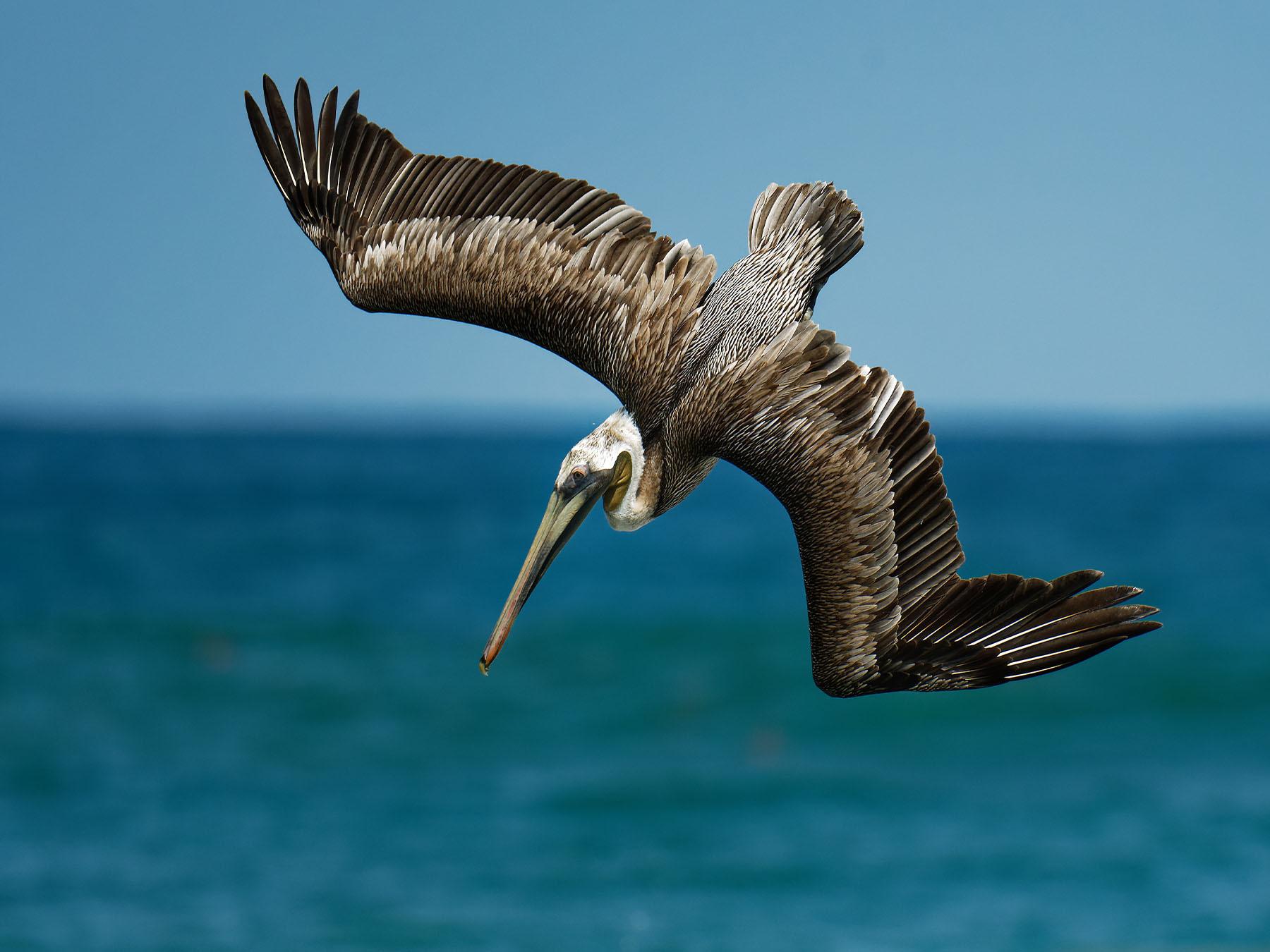
A Brown Pelican spots fish from the air and dives headfirst from as high as 65 ft (20 m). As it hits the water it turns its body to the left, probably to protect the windpipe and gullet on the right side of its neck.
Air spaces under the skin of its underside cushion the impact and stop it going fully under, and the length of its neck and bill means it can reach fish only in the top 3.3 ft (1 m) of water. The pouch can hold up to about 2.6 gallons (10 liters) of water. The bird lets the water drain out before swallowing its catch whole, usually in under 20 seconds, and it does not carry or store food in the pouch.
Older birds dive from higher, 20-59 ft (6-18 m), and at steeper angles. Adults catch fish more often than young birds: success rates were 84% against 75% in southwest Mexico, 83% against 49% in Belize, 73% against 58% in the US Virgin Islands and 70% against 56% in southwest Puerto Rico. A Florida study that aged birds by plumage found much lower rates, rising from 4% in first-year birds to 14% in adults.1
Occasionally, where the water is too shallow and muddy for diving, it grabs fish from the surface while sitting on the water. It also follows shrimp trawlers for the bycatch and visits marinas and piers for fish scraps.
Nesting and breeding
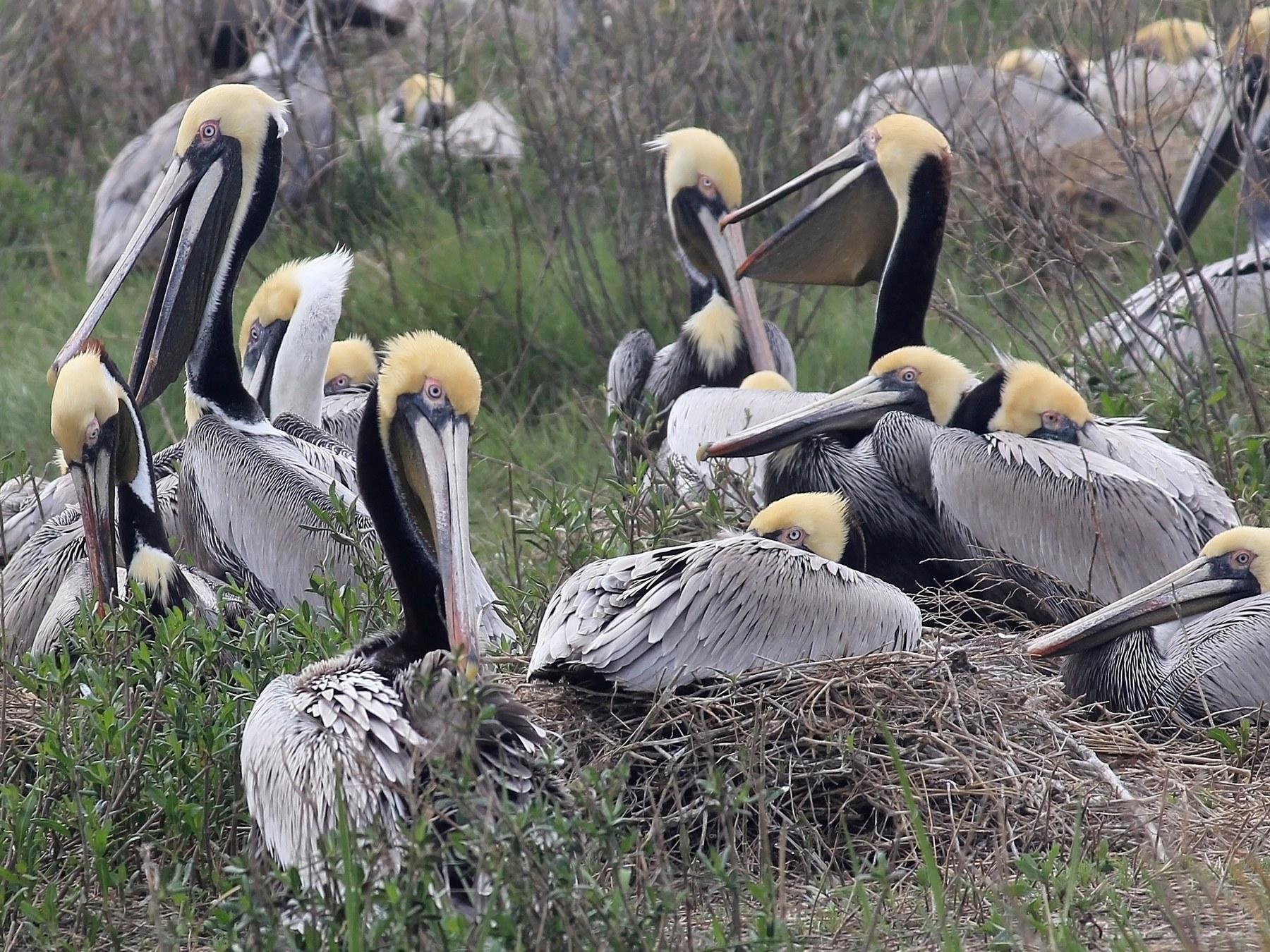
Brown Pelicans nest in colonies, usually on small coastal islands free of ground predators and within 19-31 mi (30-50 km) of a steady supply of food. On the Atlantic and Gulf coasts these are barrier, estuarine and dredge-spoil islands, with mangrove islets in Florida, and in California and Baja California they are dry, rocky islands. Colonies can hold several thousand pairs, and the median US colony in 1999 had 141 nests.1
On the Atlantic and Gulf coasts outside Florida, and in southern California and Baja California, it nests mainly on the ground. Elsewhere it nests mostly in trees, usually mangroves in Florida, from 1.6 to 98 ft (0.5-30 m) up.
The male chooses the site and advertises by swaying his head, and he usually finds a mate within 2-4 days. He then brings material while the female builds, usually over 7-10 days. The nest ranges from a shallow, grass-lined scrape on the ground to a bulky pile of sticks, grass and seaweed. Pairs are monogamous, but it is not known whether the same birds pair again in later years.
When eggs are laid depends on the place. On Florida's Atlantic coast laying runs from December to June, in Texas from March to June, and in the Southern California Bight from December to early August. Louisiana's restocked birds follow the timing of the Florida colonies they came from.
Eggs and incubation
Adults usually lay 3 chalky white eggs, which soon become stained; the range is 2-4, and birds breeding while still in immature plumage usually lay 2. In North Carolina, eggs averaged 3.0 by 2.0 in (76.4 by 50.0 mm) across 850 eggs, and 90% of 370 clutches studied in 1991-1993 held 3 eggs.
The Brown Pelican has no brood patch, so both parents incubate the eggs under the webs of their feet. Birds of the World gives incubation as 29-32 days in Pacific birds and 30-35.5 days in a North Carolina study; Audubon's guide gives roughly 28-30 days.1, 3 The eggs hatch in the order they were laid, the first about 25 hours before the second and the second about 40 hours before the third.1
Raising the young
Hatchlings are pink and naked, with their eyes open. White down appears at 10-12 days and covers the body by 21-25 days. Both parents feed them, at first by bringing up fish onto the floor of the nest, and from 3-4 weeks the chicks reach into the parent's throat for whole fish. In ground colonies the young leave their nests and gather in groups at 3-5 weeks. More on baby pelicans covers chicks of every species.
Chicks grow fast, and by independence they often outweigh their parents: Pacific fledglings from one-chick broods averaged 8.1 lb (3,659 g). In Florida, young make short flights at about 70 days if disturbed, and the first sustained flight comes at 76 days on average (range 71-88). First flights averaged 61 days in Panama, and 78 days in a study of the Pacific subspecies in Mexico. Young in tree nests are fed until they fly, at 11-12 weeks.
Fights between nestlings are common and often end with the weaker chick killed or starved; at Isla Isabel, Mexico, the first-hatched chick was the only survivor in 70% of broods.1 Pairs raise one brood a year, and birds typically first breed at 3-5 years old.
Behaviour
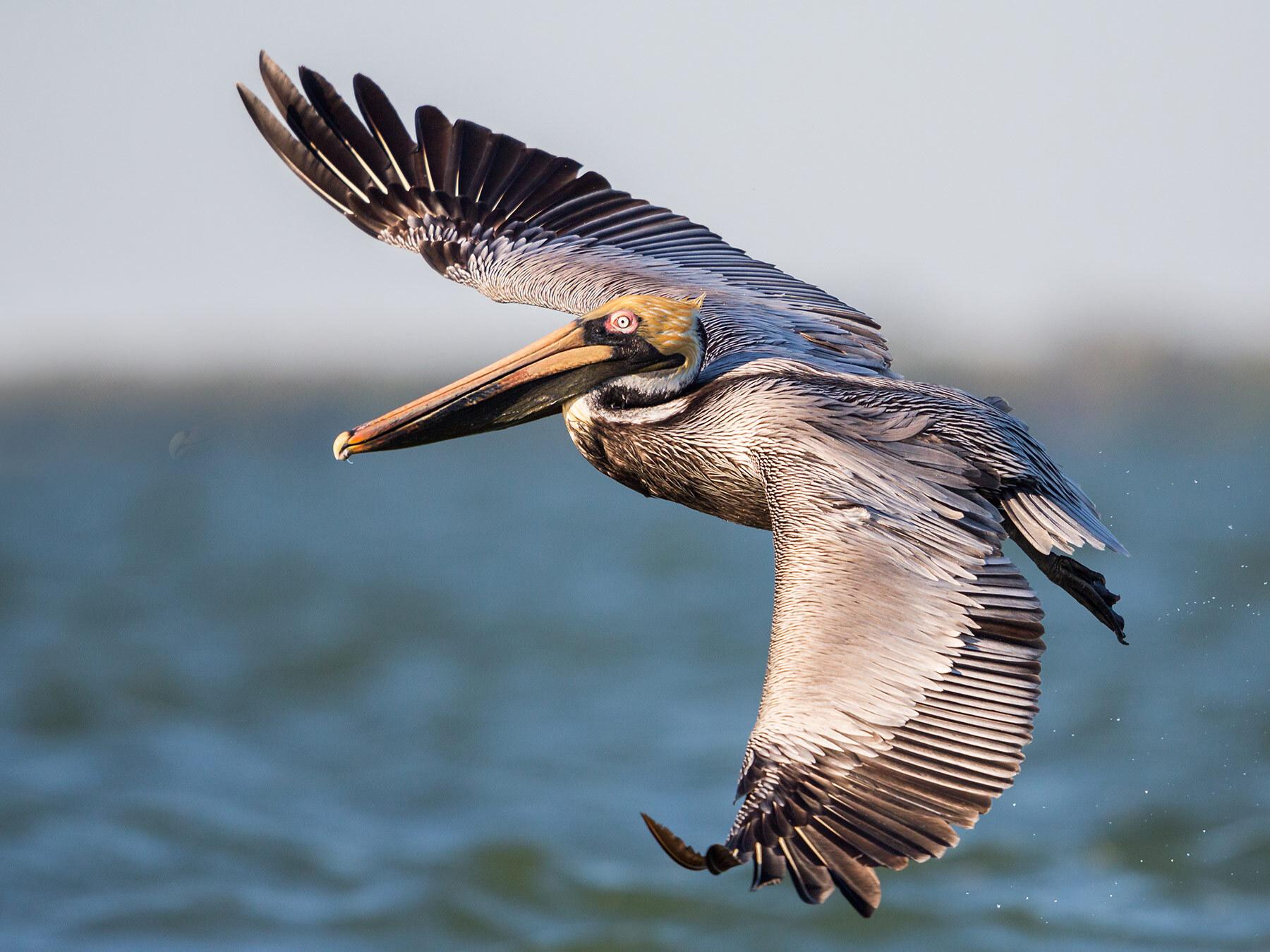
Brown Pelicans fly in lines or V's, alternating flaps and glides, often skimming just above the water or the wave tops, which saves energy through ground effect. They also soar on rising air. Gliding birds averaged 26 mph and flapping birds 21 mph, at about 3 wingbeats a second.1
A 2021 theoretical model, with no birds measured, calculated that skimming in ground effect could cut the cost of flight by about 15-25%, and riding the rising air over waves could save a further 60-70% compared with skimming, in calm air. The authors caution that it is theory.6
The species is highly sociable all year. It roosts in groups, and more than 5,000 birds have been counted at a single fall roost in California.1 On the water it swims high, paddling with alternate feet, and never goes completely under. Its webbed feet make it a strong swimmer and an awkward walker with a rolling gait. Our guide to what a group of pelicans is called covers the collective nouns.

Social behavior and gull thieves
A nesting pelican defends its site by thrusting its bill forward and snapping it, and adults sometimes attack and kill young that wander near their nest.
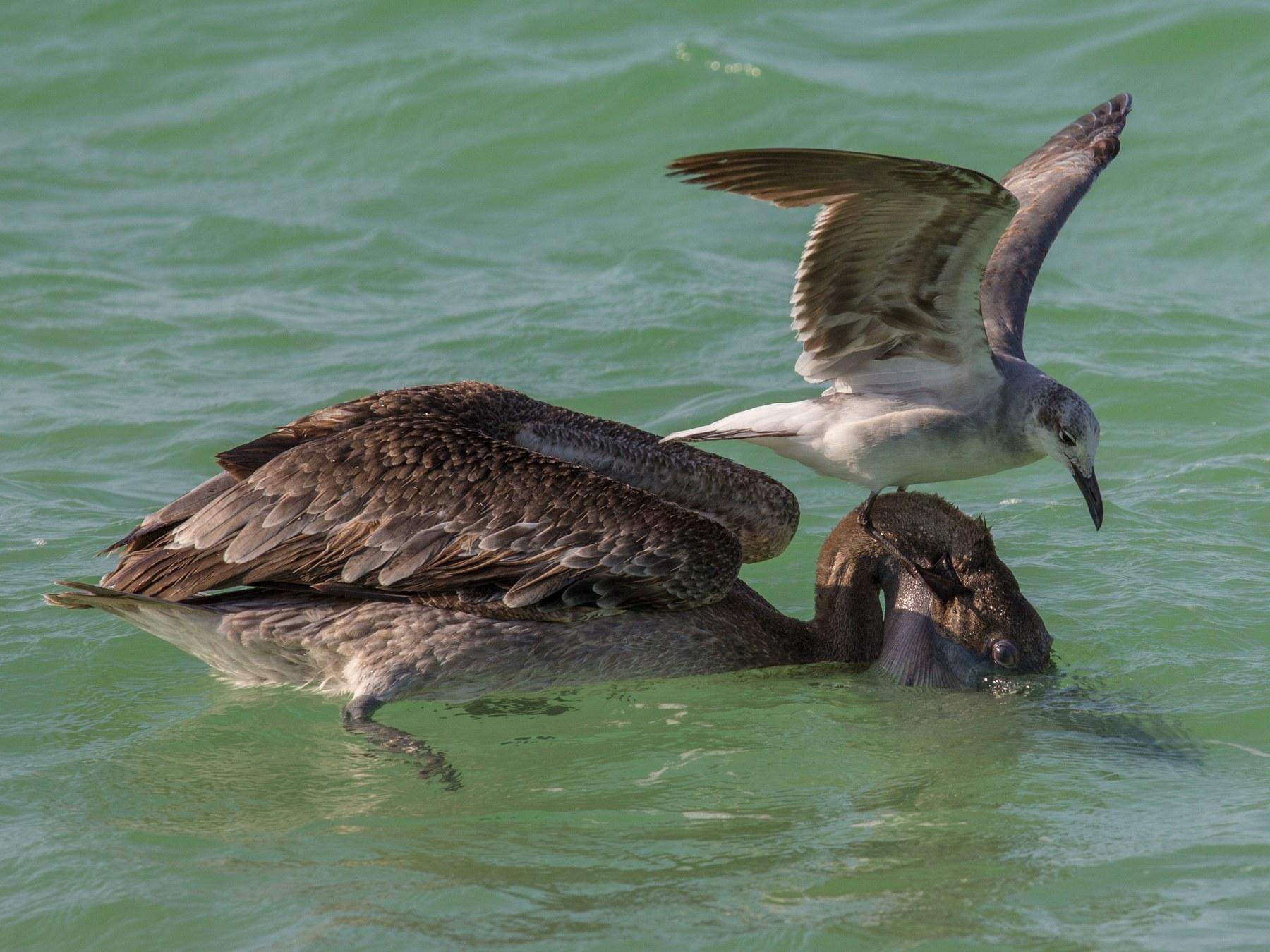
Laughing Gulls, Heermann's Gulls and some terns try to steal fish while a pelican drains its pouch, sometimes standing on its head. Laughing Gulls attempted theft on 67-87% of dives in southwest Mexico, and in southwest Puerto Rico gulls and terns tried on 55% of dives and succeeded on 15% of attempts.1 At one Mexican beach, Laughing Gulls targeted pelicans that had made a catch, young and old alike.7
Lifespan and predators
The oldest Brown Pelican on the US Bird Banding Laboratory's current list was at least 27 years 10 months old. It was banded as a chick in South Carolina in June 1972 and caught alive in Florida in April 2000, because of a parasite infestation, then released.8 Birds of the World gives a maximum of 43 years, citing a 1988 review of 60 years of banding of Eastern Brown Pelicans; that bird is not on the current list.1
Few live that long. Band recoveries point to only about 30% of young birds getting through their first year, and fewer than 2% living past 10 years, though no valid age-specific survival rates exist.
Eggs and chicks face the most danger. Gulls and members of the crow family are the most frequent nest predators, among them Laughing, Herring, Kelp and Yellow-footed Gulls, Fish Crows and Common Ravens, and small nestlings are also taken by Bald Eagles and Wood Storks. Raccoons, feral cats and dogs take eggs or chicks, and fire ants have accounted for as many as 60% of hatchlings at some Texas colonies. Adults are rarely taken, though Bald Eagles apparently killed incubating adults at one Georgia colony.1
Conservation
The Brown Pelican is not endangered. It is listed as Least Concern on the IUCN Red List in its 2018 assessment, and NatureServe ranks it G4 worldwide.9, 10 In the US it was taken off the endangered species list in 1985 and 2009, both times because of recovery (see Legal status).11 Wetlands International estimated about 345,000-400,000 birds worldwide from counts made in 1999-2011. In 2007-2013 the US had about 35,000-44,000 pairs of the Eastern subspecies nesting each year, two in every three of them along the Gulf of Mexico, and California had 9,110 nests at 5 colonies in 2006.1
The North American Breeding Bird Survey estimates a rise of 3.1% a year across the US from 1966 to 2025, but the 95% credible interval, -0.85% to +7.12%, includes zero, so the long-term trend is not statistically clear. From 1970 the estimate is +3.62% a year, with an interval above zero. Since 1995 the survey shows no clear change (+0.12% a year, interval -4.62% to +6.21%). It samples this coastal bird on only 61 routes, and its index peaked in 1999.12
Colony counts give the longer view. Nests in the eastern US rose from 8,394 at 25 colonies in 1970 to 45,638 at 81 colonies in 1999, and Birds of the World's account, written in 2014, says the US total now exceeds historical levels. The same account calls the California subspecies, across its whole range, stable since the early 1980s.1
Conservation: the pesticide years
Between the late 1950s and the early 1970s the Brown Pelican all but disappeared from North America. The collapse is traced to organochlorine pesticides in the marine food web: endrin killed birds outright, and DDT harmed breeding, as its breakdown product DDE left eggshells so thin that they broke under the incubating parents. The Pacific and Gulf coast colonies were hit hardest. Louisiana, the Pelican State, lost its birds entirely: the last natural nesting there was in 1961, and the species was gone by 1963.1
In the Southern California Bight the collapse was almost total: by the late 1960s and early 1970s there were fewer than 1,000 pairs, with nearly zero breeding success.13 In 1969-1970 the eggshells were 31-51% thinner than the pre-1943 average, and discharges of waste from a DDT plant into the Bight ended in April 1970. The species was added to the federal endangered list in 1970, and the US banned general use of DDT from the end of 1972.1
By 1974 the two northern colonies of the California subspecies fledged up to 0.9 young per nest, improving as DDE in anchovies declined, though still about 30% short of what holds a population steady.14
Louisiana was restocked. From 1968 to 1980, 1,276 nestlings were moved from Florida colonies to the Louisiana coast, and breeding resumed in 1971.1 By 2003 Louisiana's numbers equaled or exceeded their pre-pesticide level.15
DDT-related compounds are still found. In a 2025 study, seven livers from California brown pelicans held 183 halogenated compounds, 17 of them DDT-related, and DDT-related compounds were the largest class measured; the authors write of continuing exposure to these historical pollutants.16
Conservation today: fishing gear, oil and die-offs
Tangles in sport-fishing line and tackle are a major cause of death for pelicans in the southeastern US, and a 1980 estimate put deaths at more than 700 a year in Florida alone.1 Over 144 surveys at four Tampa Bay piers in 2019-2020, 254 of 3,766 pelicans counted (7%) showed fishing-line entanglement or injuries, and 17 were found dead; the same bird may have been counted more than once. During the 2020 pier closures, only 3 injured or dead birds were seen in 16 surveys.17 Around Monterey Bay, California, 59.6% of the pelicans rescued and taken to a rehabilitation center in 2001-2006 had been injured by fishing gear, and the authors note that counting stranded animals only may underestimate the true number.18
Brown Pelicans are highly susceptible to oil spills. After the 2010 Deepwater Horizon spill, oil coated many pelicans along the Louisiana coast. No one knows how many died, but 612 were cared for and set free.1 A 2014 model estimated that about 12% of the northern Gulf's Brown Pelicans were killed, with wide uncertainty, and its estimates have drawn a published comment.19 After the 2015 Refugio spill in California, a resighting study of 42 banded birds released after rehabilitation found at least 25 alive a year later.20
Food shortage and disease cause die-offs. About 1,500 starved along the Oregon and California coast in January and February 2010, and botulism killed more than 2,000 at the Salton Sea in 1994-2001.1 Toxic algae (domoic acid) killed about 150 at Cabo San Lucas, Mexico, in January 1996.21 Breeding depends mainly on ocean conditions that affect prey, and some Pacific populations skip breeding in strong El Niño years.1
Legal status
In the United States the Brown Pelican is on the federal list of birds protected under the Migratory Bird Treaty Act.22 The US Fish and Wildlife Service removed it from the endangered species list on the Atlantic coast and in Florida and Alabama in 1985. It removed it everywhere else by a final rule of 17 November 2009, effective 17 December 2009, and the rule says the bird remains protected by the Migratory Bird Treaty Act.13 The Service's species database records both removals as delisted because of recovery, and lists the Caribbean subspecies as a Species of Concern.11 The bird does not appear on the current federal list of endangered and threatened wildlife.23
In Mexico only the Pacific subspecies is listed in NOM-059-SEMARNAT-2010, as threatened (amenazada), unchanged in the 2019 update of the list.24 In Canada, the pelican family is on the government's list of bird families not covered by the Migratory Birds Convention Act, 1994, which notes that such birds may be protected under other laws.25
In the late 19th and early 20th centuries pelicans in the southern US were shot for hat feathers and by fishing interests.1 The Fish and Wildlife Service's 2009 rule says the Texas decline of the 1920s and 1930s was presumably due to shooting and nest destruction.13 Protection of colonies began when Pelican Island, Florida, became a federal bird preserve in 1903; it is now a national wildlife refuge. Birds of the World lists later shooting incidents, including more than 50 birds shot on the Texas coast in 1997, and rates the taking of eggs and young as a more serious threat in the Caribbean.1 Adults are still hunted and eggs taken on some coasts of Latin America and the Caribbean.26
More photos
2 photos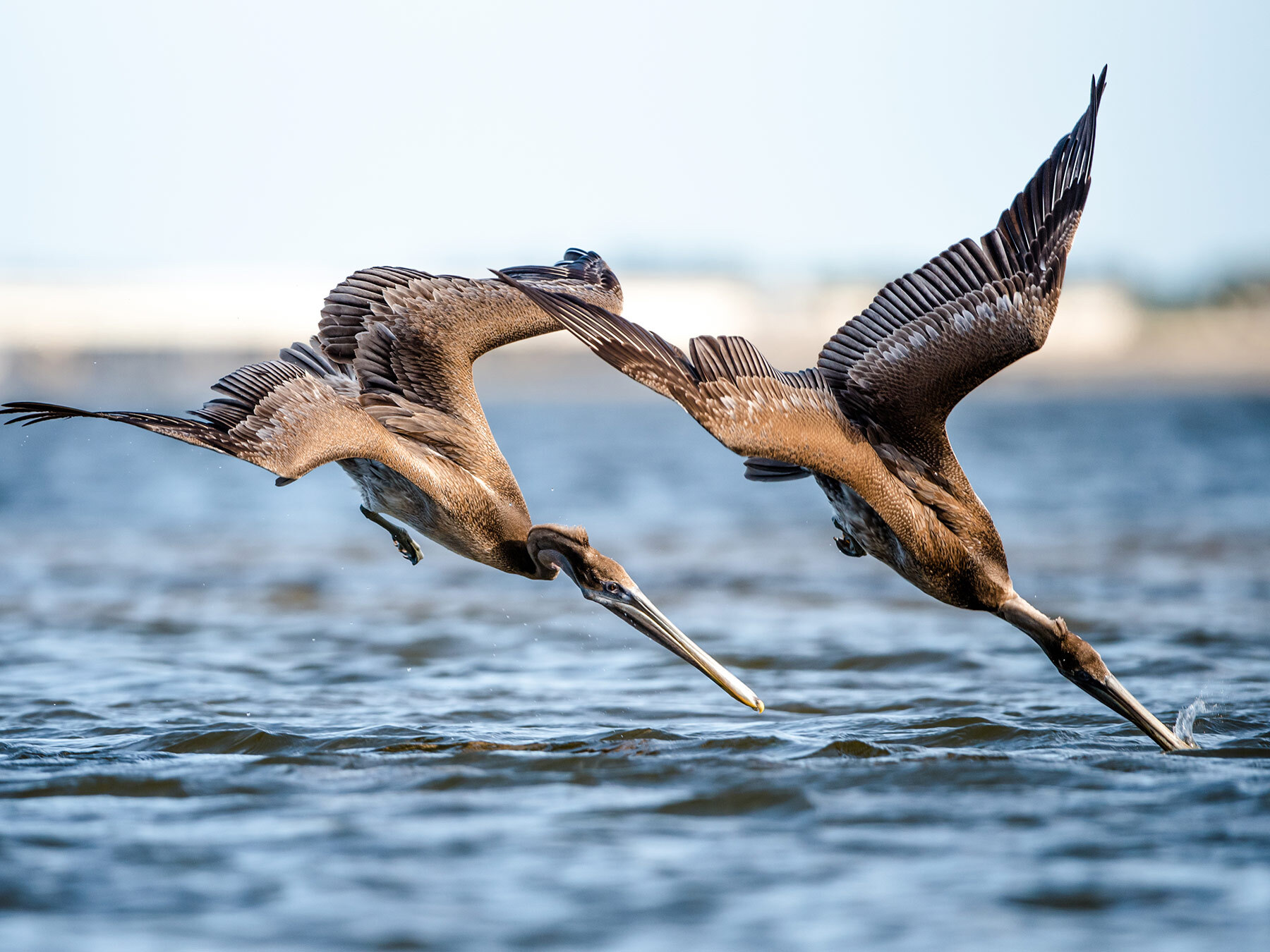
Brown Pelican guides
4 guidesQuick facts
- Length
- 100–137 cm
- Wingspan
- 200 cm
- Weight
- 1800–4000 g
- Lifespan
- oldest recorded 27 years 10 months
- Family
- Pelicans
- Migration
- Partial migrant
- Global status (IUCN)
- Least Concern
- World population
- About 345,000–400,000 birds worldwide (Wetlands International estimate from 1999–2011 counts)
- Population trend
- Recovered strongly from the pesticide era; the newest Breeding Bird Survey analysis shows a rise since 1966 that is not statistically clear
- Scientific name
- Pelecanus occidentalis
Questions
2Is the Brown Pelican Louisiana's state bird?
It is. Under Louisiana law the official state bird is the Brown Pelican, as it appears on the state seal.27 The seal law itself calls for 'the pelican tearing its breast to feed its young', without naming the species.28 Louisiana lost its pelicans by 1963 and restocked them from Florida (see Conservation).
What is the Brown Pelican's scientific name?
Pelecanus occidentalis. Linnaeus named it in 1766, with Jamaica as the type locality, and it belongs to the pelican family, Pelecanidae.29 The species name occidentalis is Latin for western; we found no source saying why Linnaeus chose it.
Sources
33- 1Shields, M. (2020). Brown Pelican (Pelecanus occidentalis), version 1.0. Birds of the World (A. F. Poole, Editor). Cornell Lab of Ornithology. doi:10.2173/bow.brnpel.01 (opens in a new tab)
- 2del Hoyo, J. et al. (2024). Peruvian Pelican (Pelecanus thagus), version 1.1. Birds of the World. Cornell Lab of Ornithology. Accessed 21 November 2026. Source (opens in a new tab)
- 3National Audubon Society. Brown Pelican. Guide to North American Birds. Accessed 21 November 2026. Source (opens in a new tab)
- 4Lamb, J. S., Satge, Y. G. and Jodice, P. G. R. (2017). Influence of density-dependent competition on foraging and migratory behavior of a subtropical colonial seabird. Ecology and Evolution 7(16): 6469-6481. doi:10.1002/ece3.3216 (opens in a new tab)
- 5Velarde, E., Ezcurra, E. and Anderson, D. W. (2013). Seabird diets provide early warning of sardine fishery declines in the Gulf of California. Scientific Reports 3: 1332. doi:10.1038/srep01332 (opens in a new tab)
- 6Stokes, I. A. and Lucas, A. J. (2021). Wave-slope soaring of the brown pelican. Movement Ecology 9(1): 13. doi:10.1186/s40462-021-00247-9 (opens in a new tab)
- 7Schnell, G. D., Woods, B. L. and Ploger, B. J. (1983). Brown Pelican Foraging Success and Kleptoparasitism by Laughing Gulls. The Auk 100(3): 636-644. doi:10.1093/auk/100.3.636 (opens in a new tab)
- 8USGS Bird Banding Laboratory. Longevity records of North American birds: Brown Pelican (AOU 1260). USGS Eastern Ecological Science Center, Bird Banding Laboratory. Accessed 21 November 2026. Source (opens in a new tab)
- 9BirdLife International (2018). Pelecanus occidentalis. The IUCN Red List of Threatened Species 2018 (read via GBIF's IUCN Red List checklist, key 176611059). Accessed 21 November 2026. Source (opens in a new tab)
- 10NatureServe (2026). Pelecanus occidentalis (Brown Pelican). NatureServe Explorer. Accessed 21 November 2026. Source (opens in a new tab)
- 11U.S. Fish and Wildlife Service. Brown Pelican (Pelecanus occidentalis), species 6034. Environmental Conservation Online System (ECOS). Accessed 21 November 2026. Source (opens in a new tab)
- 12Hostetler, J. A. et al. (2026). The North American Breeding Bird Survey, Analysis Results 1966-2025. U.S. Geological Survey data release. doi:10.5066/P1OSNSFC (opens in a new tab)
- 13U.S. Fish and Wildlife Service (2009). Endangered and Threatened Wildlife and Plants; Removal of the Brown Pelican (Pelecanus occidentalis) From the Federal List of Endangered and Threatened Wildlife; Final Rule. Federal Register 74: 59444-59472 (17 Nov 2009). Accessed 21 November 2026. Source (opens in a new tab)
- 14Anderson, D. W. et al. (1975). Brown Pelicans: Improved Reproduction Off the Southern California Coast. Science 190(4216): 806-808. doi:10.1126/science.1239078 (opens in a new tab)
- 15Holm, G. O. et al. (2003). Population recovery of the Eastern Brown Pelican following its extirpation in Louisiana. The Wilson Bulletin 115(4): 431-437. doi:10.1676/03-019 (opens in a new tab)
- 16Agas, A. N. et al. (2025). Targeted and nontargeted approaches to uncover complex halogenated pollutants in the historically endangered California brown pelican. Environmental Pollution 386: 127257. doi:10.1016/j.envpol.2025.127257 (opens in a new tab)
- 17Thomas, F. L. and Forys, E. A. (2022). The Role of Fishing Piers in Brown Pelican (Pelecanus occidentalis) Entanglement. Animals 12(18): 2352. doi:10.3390/ani12182352 (opens in a new tab)
- 18Dau, B. K. et al. (2009). Fishing gear-related injury in California marine wildlife. Journal of Wildlife Diseases 45(2): 355-362. doi:10.7589/0090-3558-45.2.355 (opens in a new tab)
- 19Haney, J. C., Geiger, H. J. and Short, J. W. (2014). Bird mortality from the Deepwater Horizon oil spill. II. Carcass sampling and exposure probability in the coastal Gulf of Mexico. Marine Ecology Progress Series 513: 239-252. doi:10.3354/meps10839 (opens in a new tab)
- 20Jaques, D. L. et al. (2019). Use of plumage and gular pouch color to evaluate condition of oil spill rehabilitated California brown pelicans (Pelecanus occidentalis californicus) post-release. PLOS ONE 14(2): e0211932. doi:10.1371/journal.pone.0211932 (opens in a new tab)
- 21Sierra Beltran, A. et al. (1997). Sea bird mortality at Cabo San Lucas, Mexico: evidence that toxic diatom blooms are spreading. Toxicon 35: 447-453. doi:10.1016/s0041-0101(96)00140-7 (opens in a new tab)
- 22U.S. Fish and Wildlife Service (2026). 50 CFR 10.13: List of Birds Protected by the Migratory Bird Treaty Act. Electronic Code of Federal Regulations (issue of 17 Nov 2026). Accessed 21 November 2026. Source (opens in a new tab)
- 23U.S. Fish and Wildlife Service (2026). 50 CFR 17.11: Endangered and threatened wildlife. Electronic Code of Federal Regulations (issue of 17 Nov 2026). Accessed 21 November 2026. Source (opens in a new tab)
- 24SEMARNAT (2010). NOM-059-SEMARNAT-2010 (DOF 30 Dec 2010) and the modification of its Anexo Normativo III (DOF 14 Nov 2019). Diario Oficial de la Federación. Accessed 21 November 2026. Source (opens in a new tab)
- 25Environment and Climate Change Canada. Birds protected in Canada. Government of Canada. Accessed 21 November 2026. Source (opens in a new tab)
- 26Cornell Lab of Ornithology. Brown Pelican. All About Birds. Accessed 21 November 2026. Source (opens in a new tab)
- 27Louisiana State Legislature (1966). La. R.S. 49:159, State bird. Louisiana Revised Statutes. Accessed 21 November 2026. Source (opens in a new tab)
- 28Louisiana State Legislature. La. R.S. 49:151, State seal. Louisiana Revised Statutes. Accessed 21 November 2026. Source (opens in a new tab)
- 29AviList Core Team (2026). AviList: The Global Avian Checklist, v2025b. AviList. doi:10.2173/avilist.v2025b (opens in a new tab)
- 30Scott, V.. Pelecanus occidentalis (brown pelican). Animal Diversity Web. Accessed 21 November 2026. Source (opens in a new tab)
- 31National Wildlife Federation. Brown Pelican. Wildlife Guide. Accessed 21 November 2026. Source (opens in a new tab)
- 32Human Ageing Genomic Resources (2023). AnAge entry for Pelecanus occidentalis (Build 15). Human Ageing Genomic Resources. Accessed 21 November 2026. Source (opens in a new tab)
- 33Van Tatenhove, A. et al. (2025). American White Pelican (Pelecanus erythrorhynchos), version 2.0. Birds of the World. Cornell Lab of Ornithology. Accessed 21 November 2026. Source (opens in a new tab)

Checked by
Nathan Cope, founder and editor
Nathan founded Birdfact and leads its writers and contributors in the UK, the US and Canada. He has watched and studied birds for more than ten years, and checks every article and species guide before it’s published.