


Common Pheasant
Ring-necked Pheasant · Phasianus colchicus
By the Birdfact teamChecked by Nathan Cope
On this page15 sections
How to recognise it
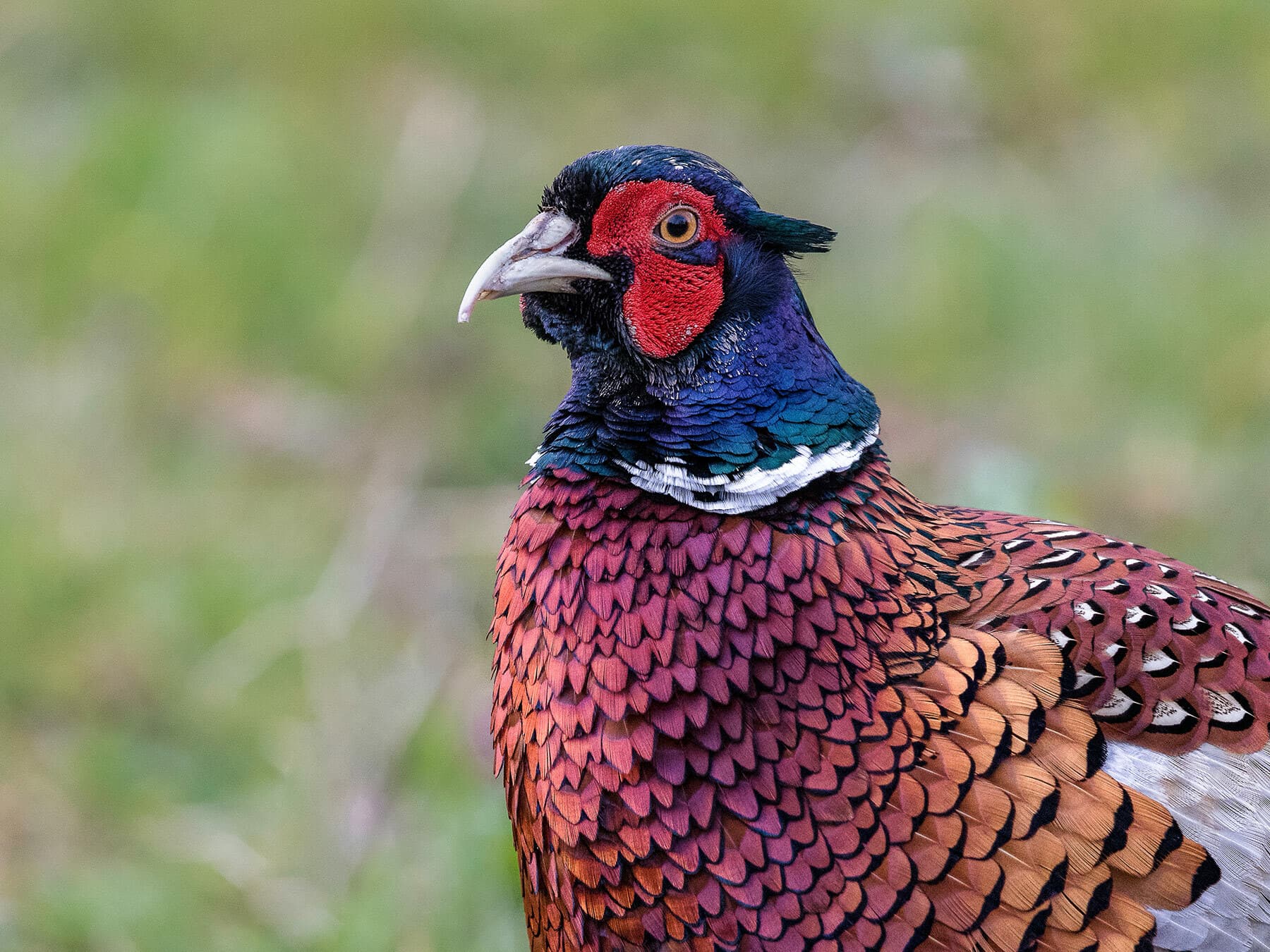
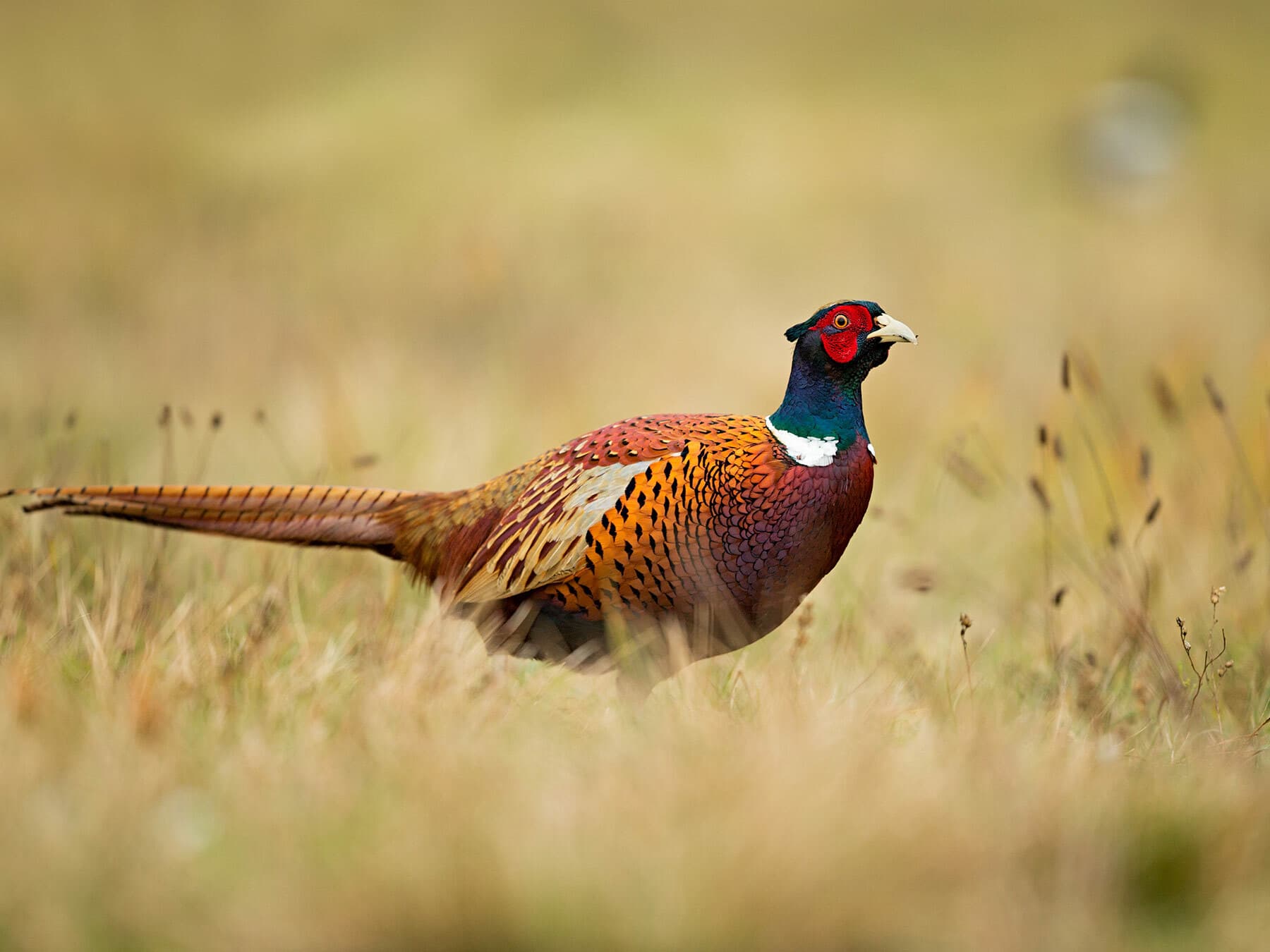
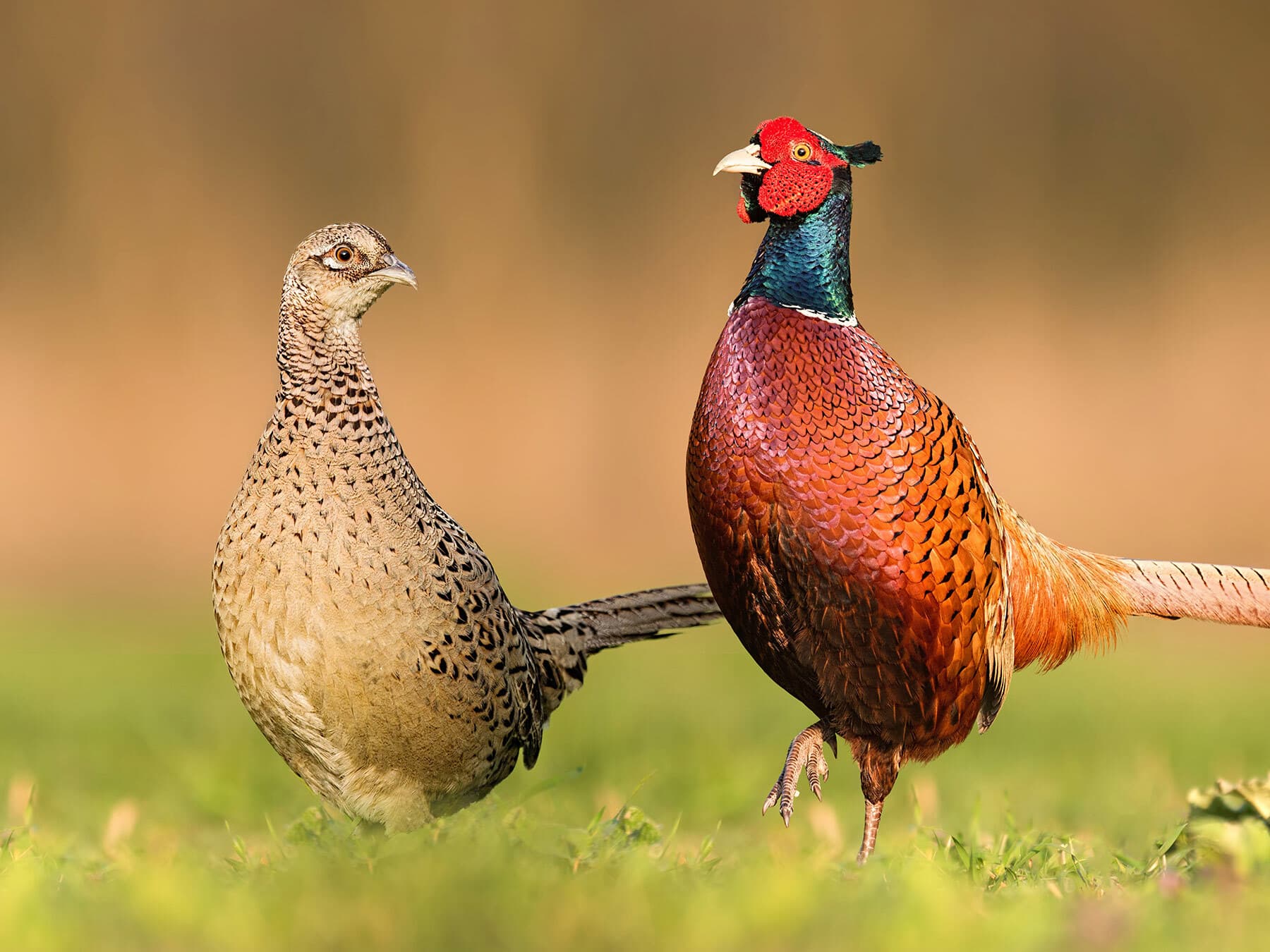
The male Common Pheasant is a spectacular bird. It boasts a vibrant green head, red facial wattles, and a white neck ring. Its body is decorated with golden-brown feathers, often with a coppery sheen, and it has a long, pointed tail.
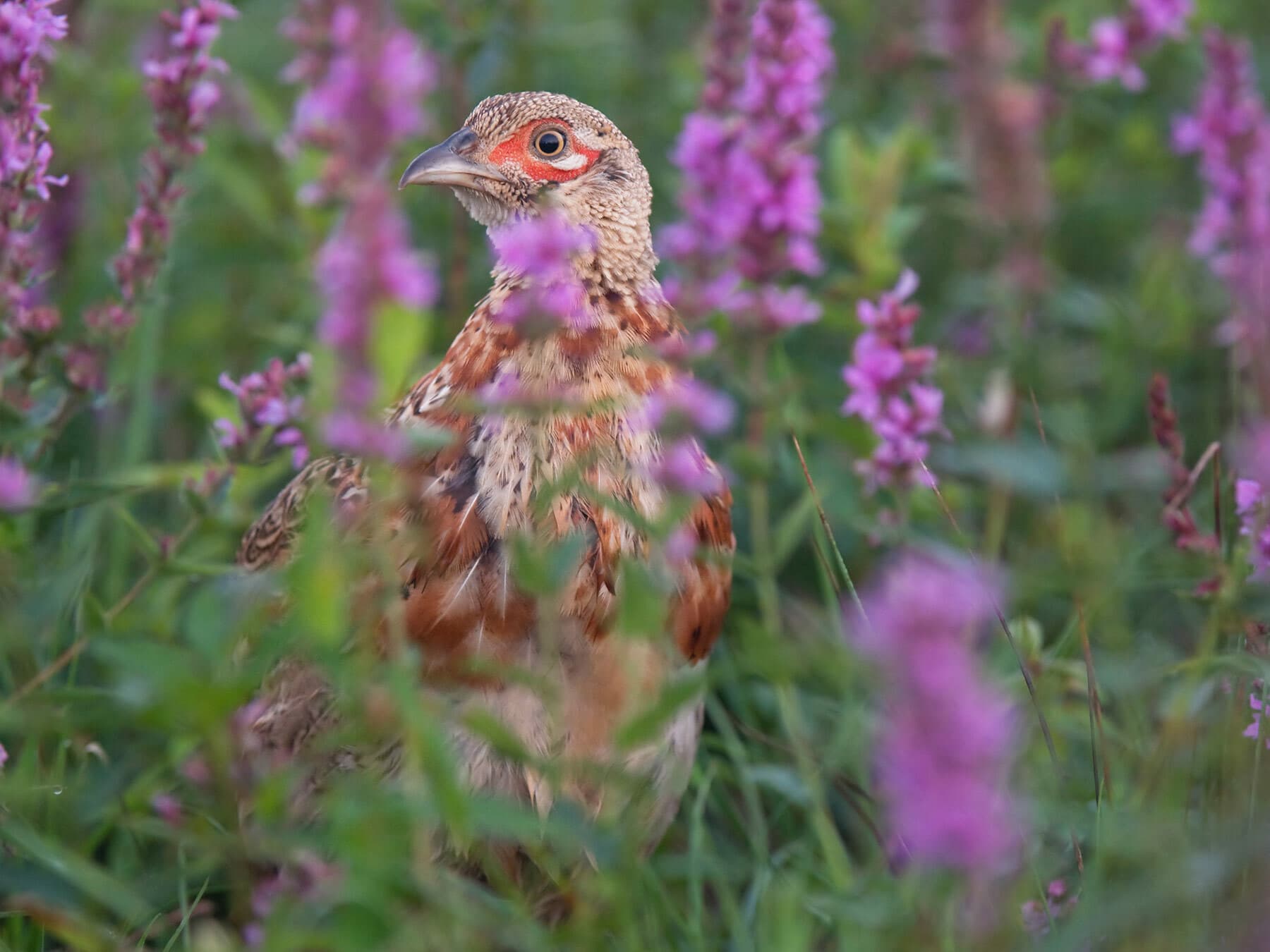
Females are much more subdued, with mottled brown plumage that provides excellent camouflage. Both sexes have strong legs and feet adapted for scratching and running.
Its size
Adults- Length
- 50–90 cm
- Wingspan
- 70–90 cm
- Weight
- 720–1600 g
Its song and calls
In flight the male will often issue a clucking sound but the cock pheasant’s usual call is a loud double syllable ‘kerr – kok’, often accompanied by a short frantic burst of wing beats which can produce a whirring noise.
- Song0:00 / 0:10
Recorded in Normandie, France · March 2026
- Call0:00 / 0:20
Recorded in Emilia-Romagna, Italy · August 2025
When and where to see it
OctoberArriving
Most recorded in October
- 1. Herefordshire2.7%
- 2. Carlow2.5%
- 3. Offaly2.2%
- 4. Shropshire2.0%
- 5. Perthshire and Kinross1.7%
Each dot is a county, state or province: the bigger and darker, the larger the bird’s share of that place’s bird records that month. Grey dots: no regular records. The ringed point is the centre of the bird’s records this month; the arrow shows how it moved since last month, and the dashed loop its path through the year. “Arrivals” colours places where it becomes regular this month (orange) or is in its last regular month (grey). GBIF eBird Observation Dataset, 2019–2024. Map data: Natural Earth, US Census Bureau; place centres © OpenStreetMap contributors.
In your area
See when the Common Pheasant is recorded in your county, state or province.
How often the Common Pheasant turns up in the UK, Ireland, the United States and Canada through the year, from birdwatchers' records.
United Kingdom
Resident · all year · most records in April
Ireland
Resident · all year · most records in April
United States
Resident · all year · most records in May
Canada
Resident · all year · most records in January
Show as a table
| Month | United Kingdom | Ireland | United States | Canada |
|---|---|---|---|---|
| January | 0.89% (regular) | 0.31% (regular) | 0.047% (regular) | 0.13% (regular) |
| February | 0.90% (regular) | 0.30% (regular) | 0.044% (regular) | 0.13% (regular) |
| March | 1.2% (regular) | 0.48% (regular) | 0.066% (regular) | 0.13% (regular) |
| April | 1.4% (regular) | 0.80% (regular) | 0.088% (regular) | 0.13% (regular) |
| May | 1.2% (regular) | 0.78% (regular) | 0.092% (regular) | 0.093% (regular) |
| June | 0.91% (regular) | 0.58% (regular) | 0.090% (regular) | 0.095% (regular) |
| July | 0.60% (regular) | 0.25% (regular) | 0.042% (regular) | 0.046% (regular) |
| August | 0.50% (regular) | 0.17% (regular) | 0.026% (regular) | 0.040% (regular) |
| September | 0.62% (regular) | 0.26% (regular) | 0.034% (regular) | 0.057% (regular) |
| October | 0.85% (regular) | 0.43% (regular) | 0.048% (regular) | 0.086% (regular) |
| November | 0.92% (regular) | 0.37% (regular) | 0.051% (regular) | 0.11% (regular) |
| December | 0.87% (regular) | 0.28% (regular) | 0.046% (regular) | 0.13% (regular) |
Recorded regularly in
Worldwide: recorded regularly in 59 countries
Countries where it was recorded in at least 3 of the 6 years 2019–2024. Linked countries have their own bird list.
Europe (37)
- Åland Islands
- Austria
- Belarus
- Belgium
- Bosnia & Herzegovina
- Bulgaria
- Croatia
- Czechia
- Denmark
- Finland
- France
- Germany
- Greece
- Guernsey
- Hungary
- Ireland
- Isle of Man
- Italy
- Jersey
- Lithuania
- Moldova
- Montenegro
- Netherlands
- North Macedonia
- Norway
- Poland
- Portugal
- Romania
- Russia
- Serbia
- Slovakia
- Slovenia
- Spain
- Sweden
- Switzerland
- Ukraine
- United Kingdom
Africa (3)
- Mauritius
- Réunion
- St Helena
Asia (13)
- Azerbaijan
- China
- Georgia
- Iran
- Japan
- Kazakhstan
- Kyrgyzstan
- South Korea
- Taiwan
- Tajikistan
- Turkey
- United Arab Emirates
- Uzbekistan
North America (3)
South America (1)
Oceania (2)
Data: EOD – eBird Observation Dataset (Cornell Lab of Ornithology), accessed via GBIF.org, CC BY 4.0. Records from 2019–2024, aggregated and filtered by Birdfact. How these lists are made
It is believed that pheasants were introduced into the UK in Norman times and there are few populations of wild birds to be seen as the vast majority are bred in captivity. Regions, where wild pheasants can still be spotted, are isolated areas of north east, central and southern England, Kent and some Scottish lowlands. Pheasants prefer open countryside adjacent to woodland fringes, hedgerows, arable land and small woods. It is likely that many sightings of pheasants are of those released or escaped captively bred specimens.
Signs and Spotting tips
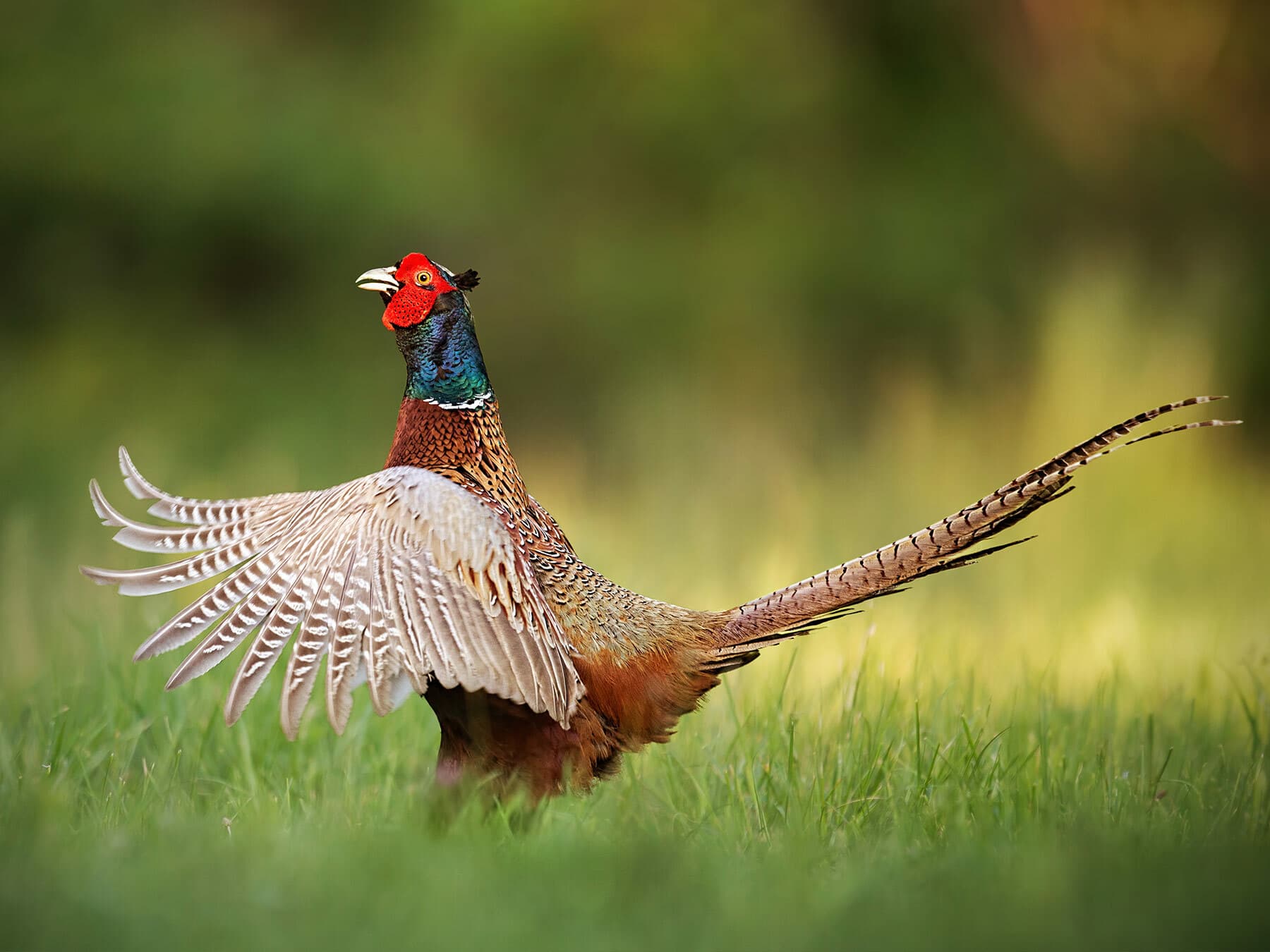
Pheasants are common throughout the UK countryside apart from north and west Scotland. They spend most of their life on the ground preferring to run away from danger unless startled when they may take flight, but generally only for very short distances. They have strong legs and a distinctive gait akin to a swaggering strutting motion and are able to run extremely fast and for long distances. They can easily be identified by their call as well as their appearance and in flight the long trailing ‘split’ tail of the male or pointed tail of the female can extend beyond the bird’s wingspan.
What it eats
Pheasants are predominantly ground feeders foraging for insects and worms in addition to berries, fruit, seeds and grass.
Check out this article for more information on a pheasants diet.
Nesting and breeding
Preferred nesting sites are on the ground under hedgerows or other low cover or in long grass. The female makes a hollow or scrape generally unlined in which she lays one brood of between around 7 to 15 matt olive brown eggs between April to July. Incubation is by the female alone and lasts for approximately twenty six days with the chicks fledging after about two weeks.
For a more in-depth guide to pheasant nesting, check out this article.
Behaviour
Common Pheasants are ground-dwelling birds that prefer to run rather than fly when disturbed. They are often seen strutting in open fields, with males displaying to females during breeding season.
These birds are typically solitary or found in small groups, except during winter when they may form larger flocks.
Lifespan and predators
Whilst wild birds have a life expectancy of up to seven years it is generally acknowledged that the majority of the UK’s pheasant population are not normally expected to survive past the age of one year due in the main to organised shooting.
For more information on the lifespans of pheasants, check out this article.
Conservation
While the Common Pheasant is not globally threatened, its populations can be affected by changes in farming practices and habitat loss. In many areas, populations are maintained through releases for hunting, which can have positive and negative impacts on local ecosystems.
What does a Pheasant look like?
As with most gamebirds the pheasant is a short billed, short legged bird with the adult male far surpassing the female in looks and physical appearance. The adult male comes in two variants a pale or dark. Both variants have a distinctive small purple head and narrow neck with a green and black crown and small black ‘ear tufts’. Around the eye there is a bold red wattle or comb which is a fleshy protuberance spreading down towards the cheek. At the base of the neck there is a thin white ring separating the head from the chest and back of the bird. The chest colour is predominantly bronze with dark or black spots and orange copper flanks. It has a long stiff brown tail with black streaks. The scapulars which are the feathers that cover the base of the wing on the upper side of the body are a pale buff or brown with the upperwing coverts being pale grey. The rump is a light blue grey. The bill is short and curved with a yellow or light brown colour and the legs are brown
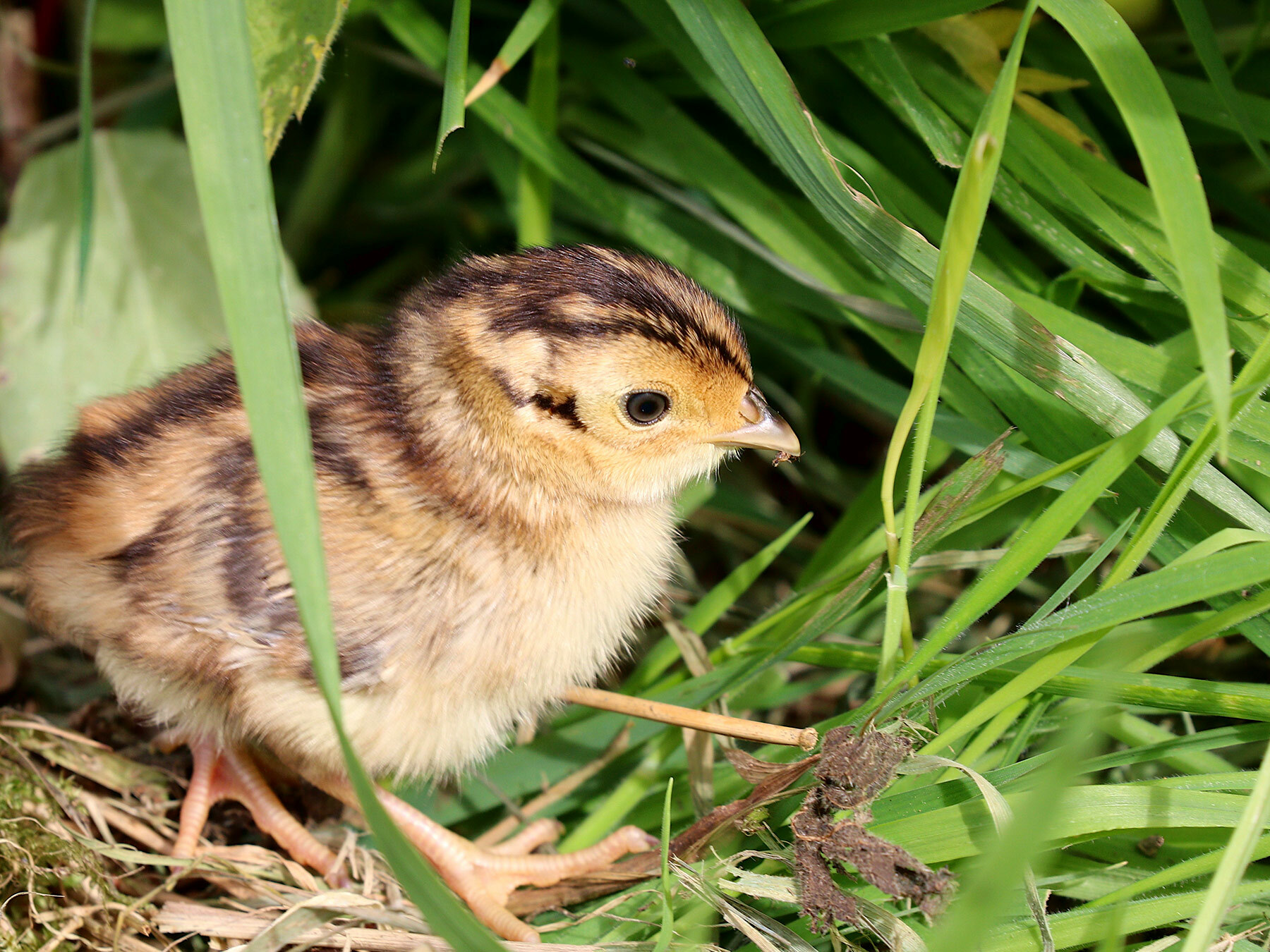
The adult female has a plain brown body mottled with black markings and no wattle. Juveniles are similar to the female although duller with a shorter tail.
Similar birds
Often mistaken for
More photos
2 photos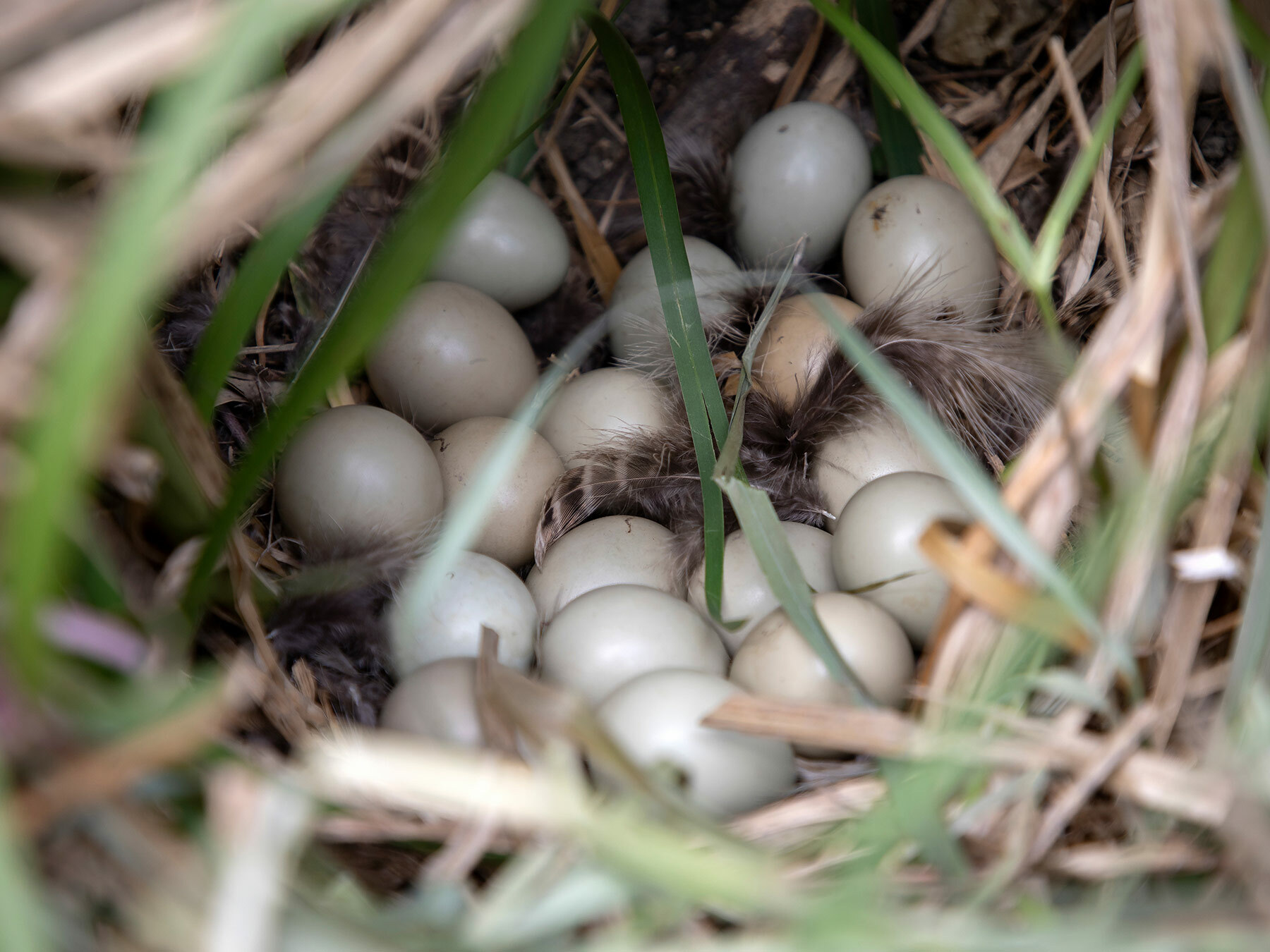
Common Pheasant guides
6 guidesQuick facts
- Length
- 50–90 cm
- Wingspan
- 70–90 cm
- Weight
- 720–1600 g
- Lifespan
- 3–7 years
- Family
- Pheasants & Grouse
- Migration
- Resident
- Global status (IUCN)
- Least Concern
- World population
- 160,000,000 - 219,999,999 mature individuals
- Population trend
- Decreasing
- Also called
- Ring-necked Pheasant
- Scientific name
- Phasianus colchicus
Sources
3- 1BirdLife International. 2016. Phasianus colchicus. The IUCN Red List of Threatened Species 2016: e.T45100023A85926819. Source (opens in a new tab)
- 2BirdLife International. 2016. Phasianus colchicus. The IUCN Red List of Threatened Species 2016: e.T45100023A85926819. Source (opens in a new tab)
- 3BirdLife International. 2016. Phasianus colchicus. The IUCN Red List of Threatened Species 2016: e.T45100023A85926819. Source (opens in a new tab)

Checked by
Nathan Cope, founder and editor
Nathan founded Birdfact and leads its writers and contributors in the UK, the US and Canada. He has watched and studied birds for more than ten years, and checks every article and species guide before it’s published.