


Grey Partridge
Hungarian Partridge, English Partridge · Perdix perdix
By the Birdfact teamChecked by Nathan Cope
On this page13 sections
How to recognise it
What do Grey Partridges look like?
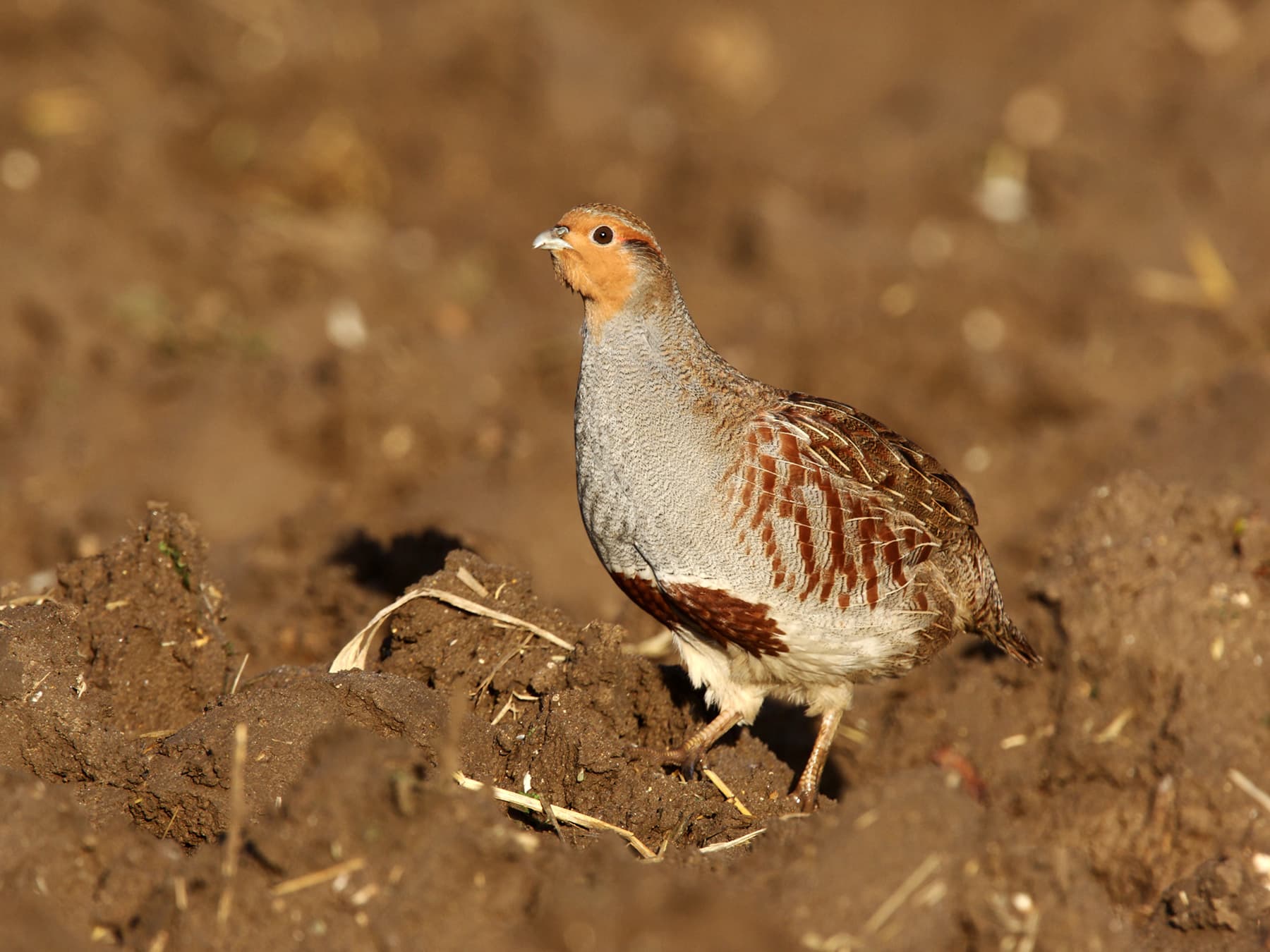
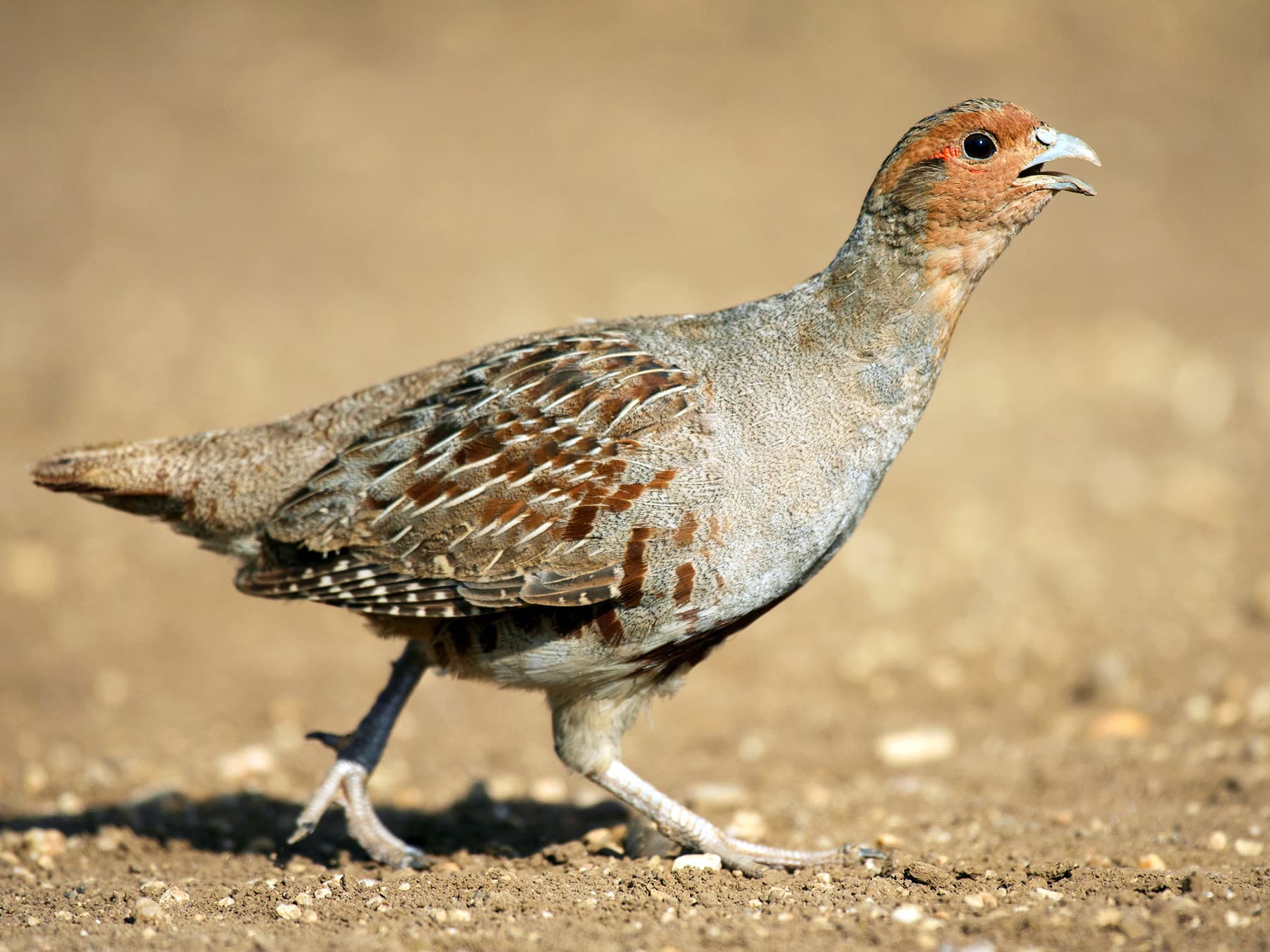
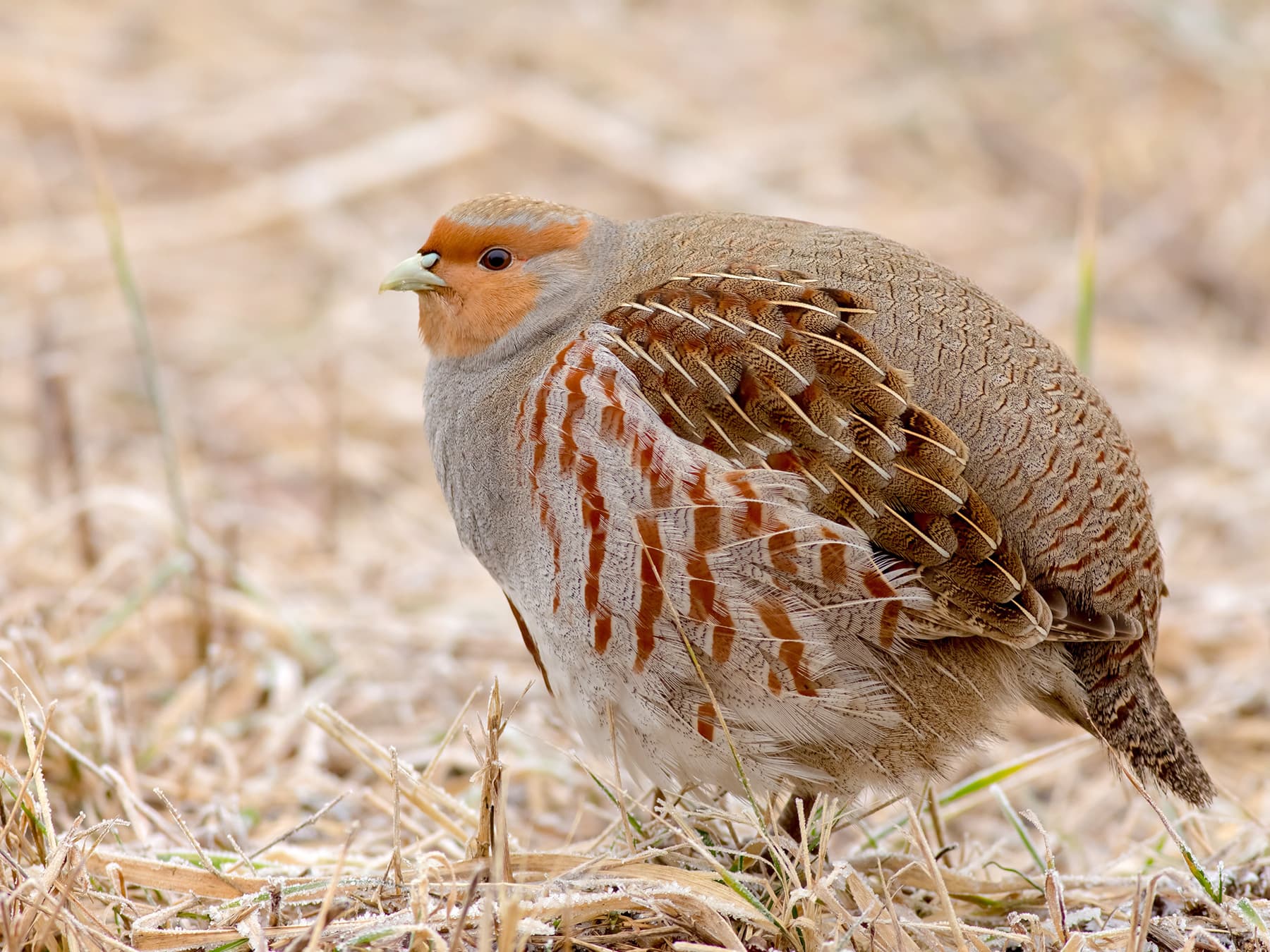
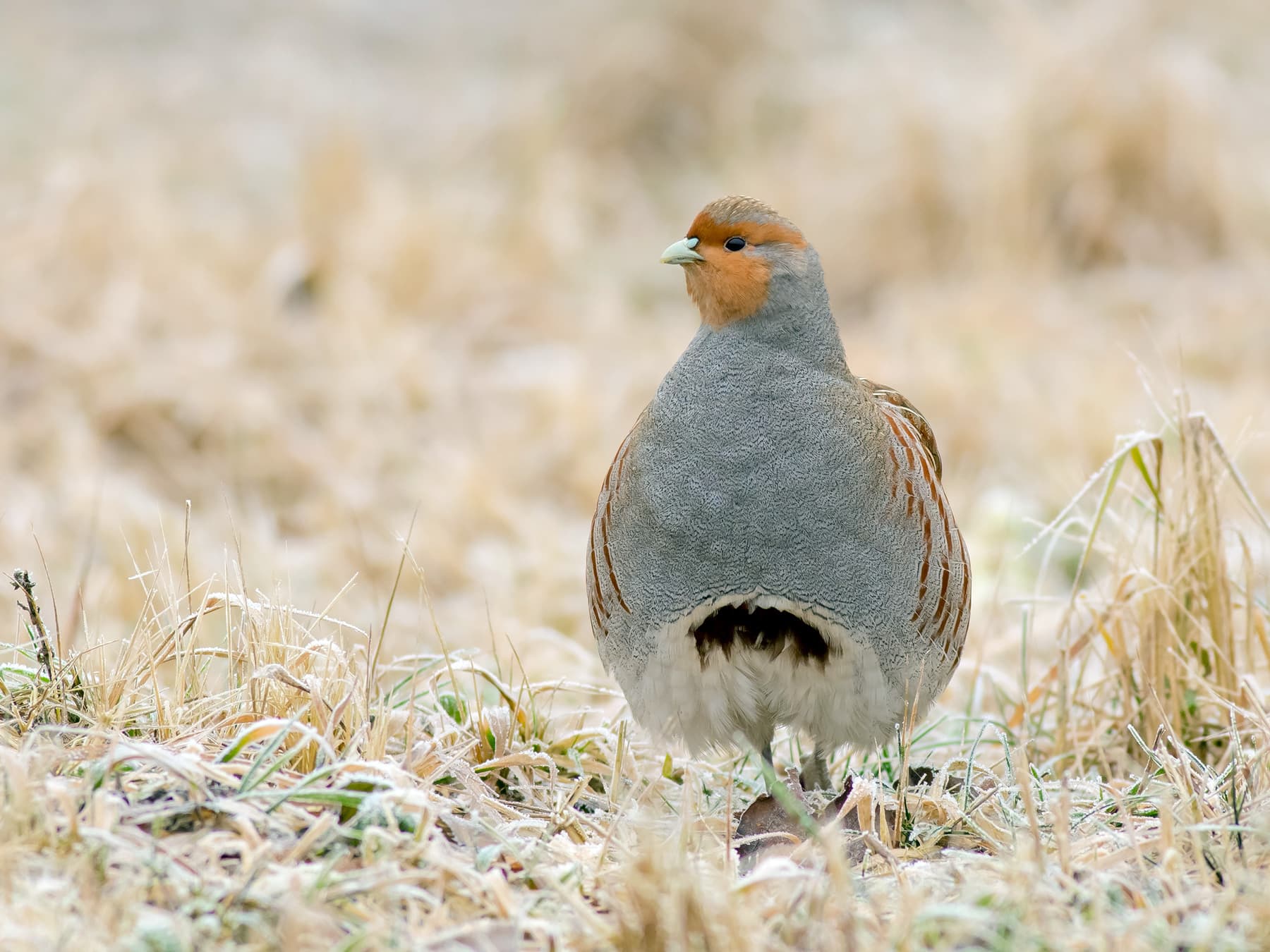
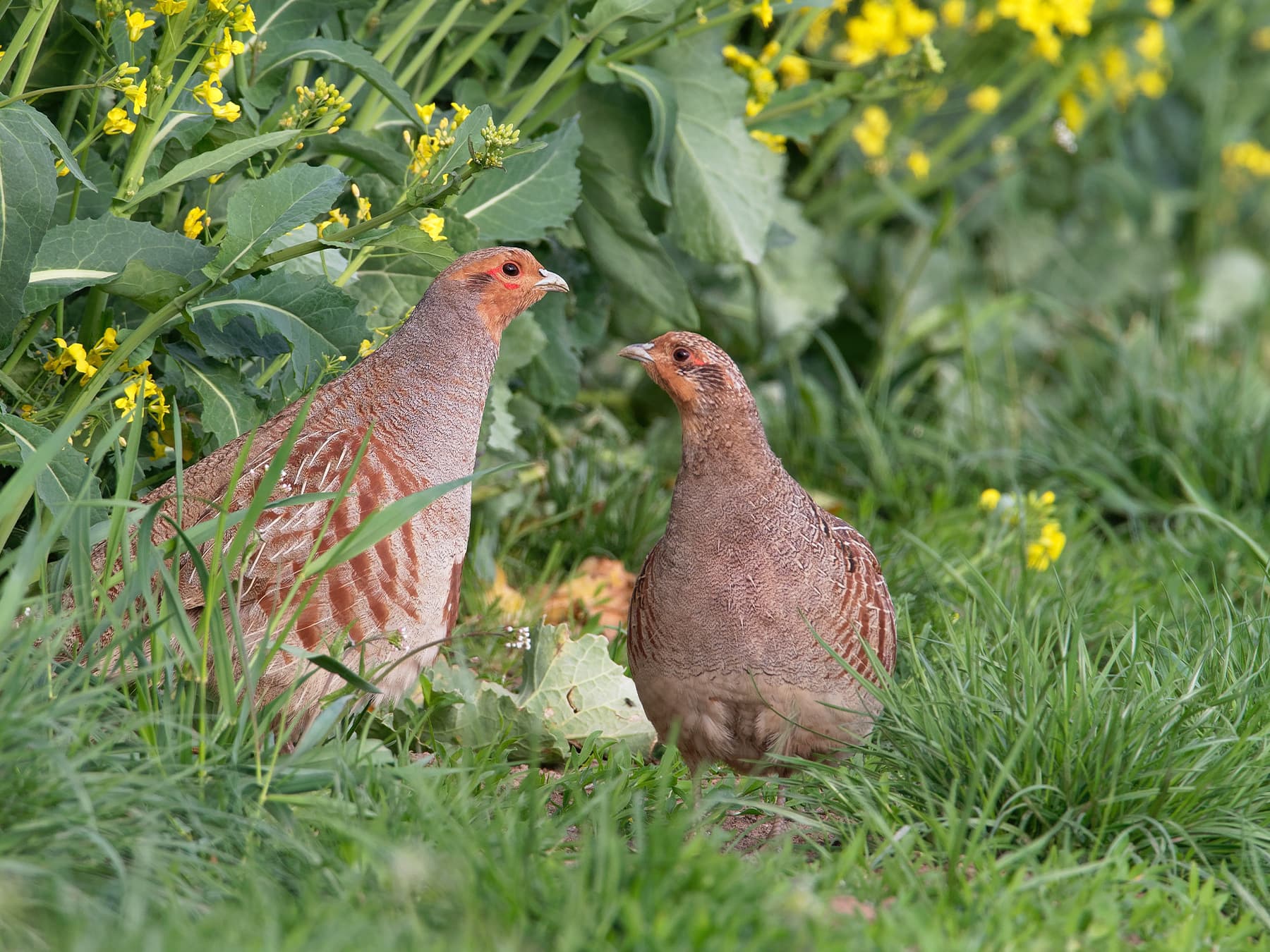
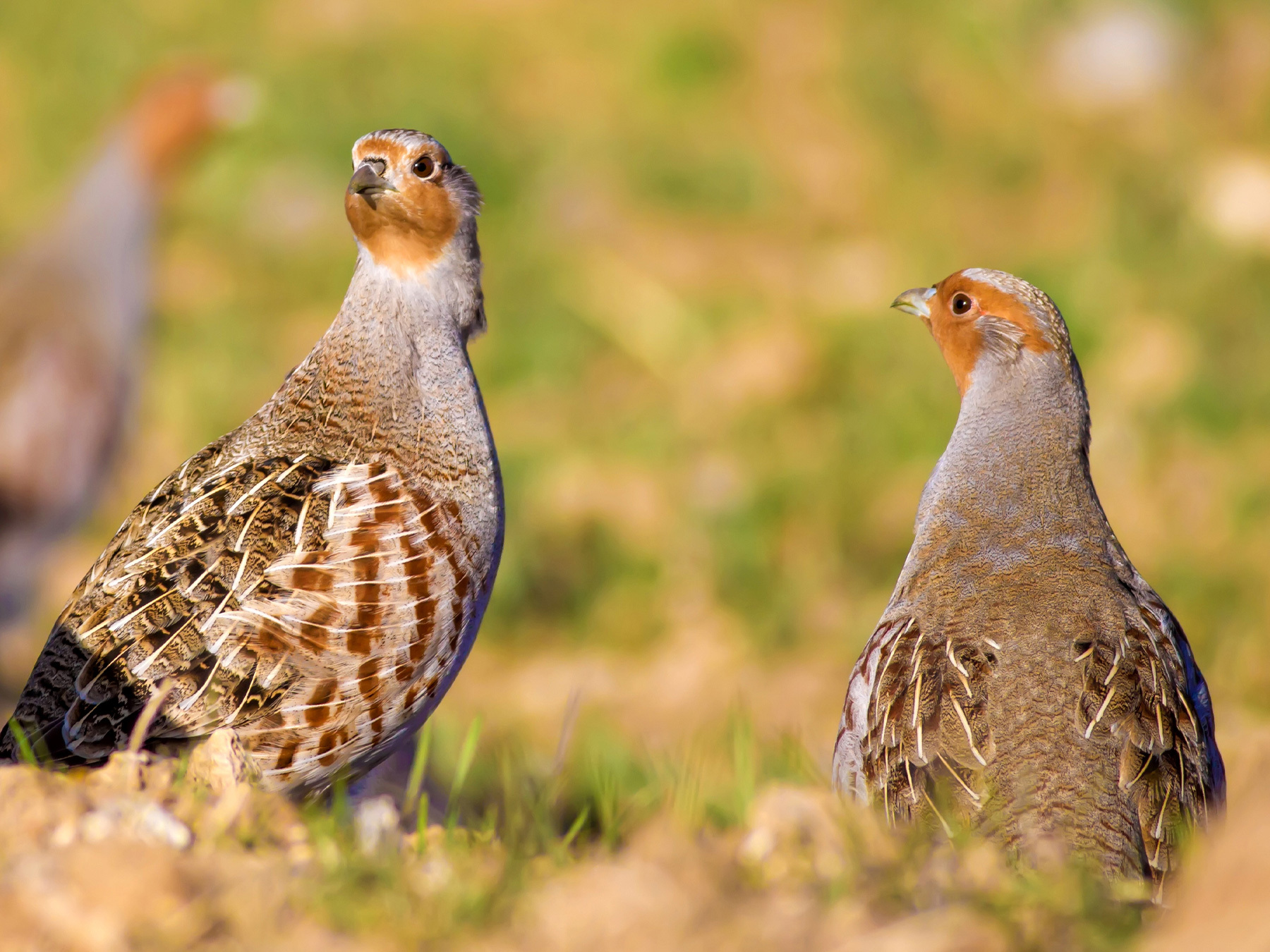
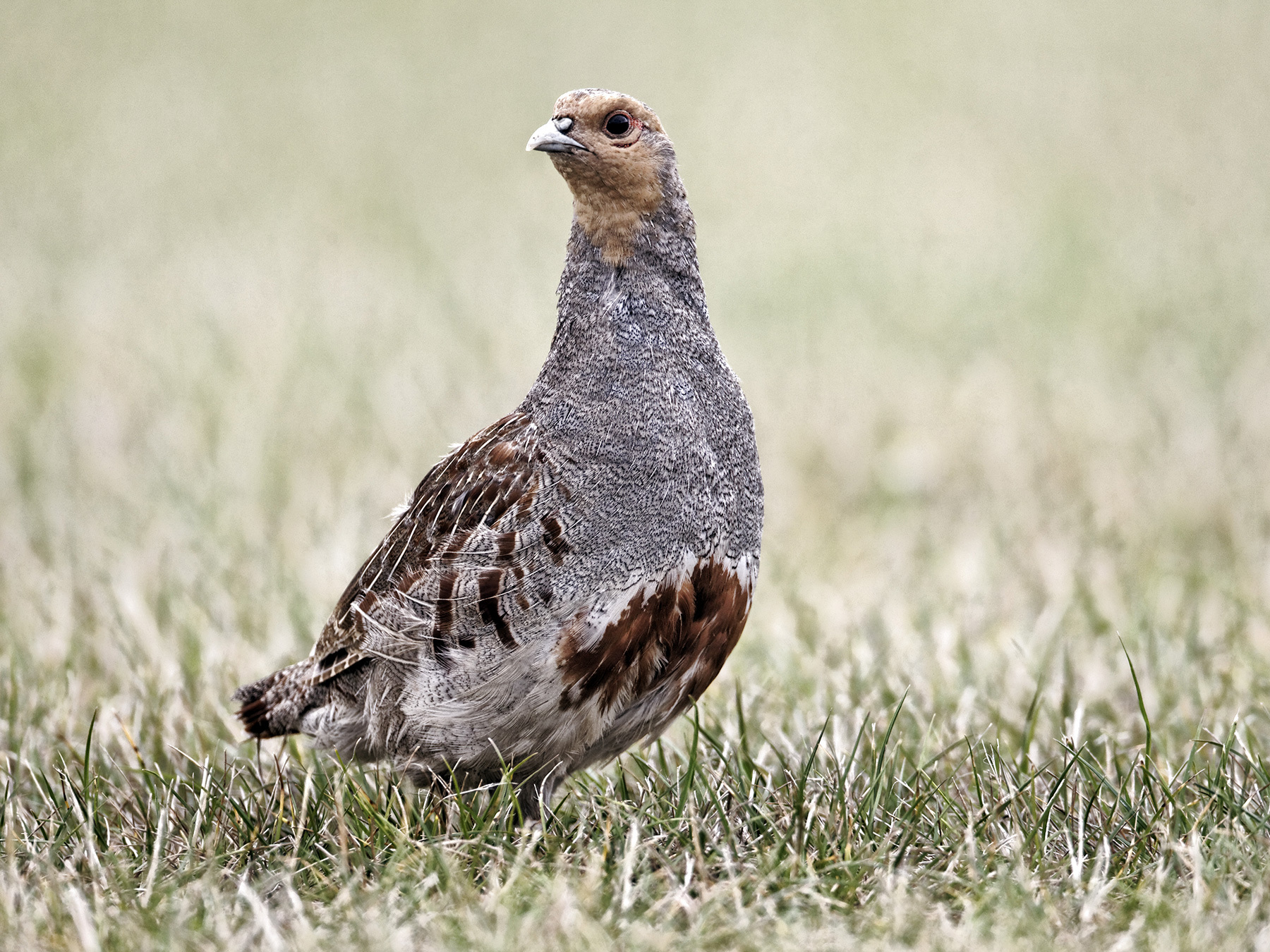
The Grey Partridge is a small, plump gamebird with mostly grey plumage. A rufous patch across the belly and an orange face are their most distinctive features, but whitish underparts and rusty steaks on the wings and flanks also identify these birds. Flying birds show orange outer tail feathers.
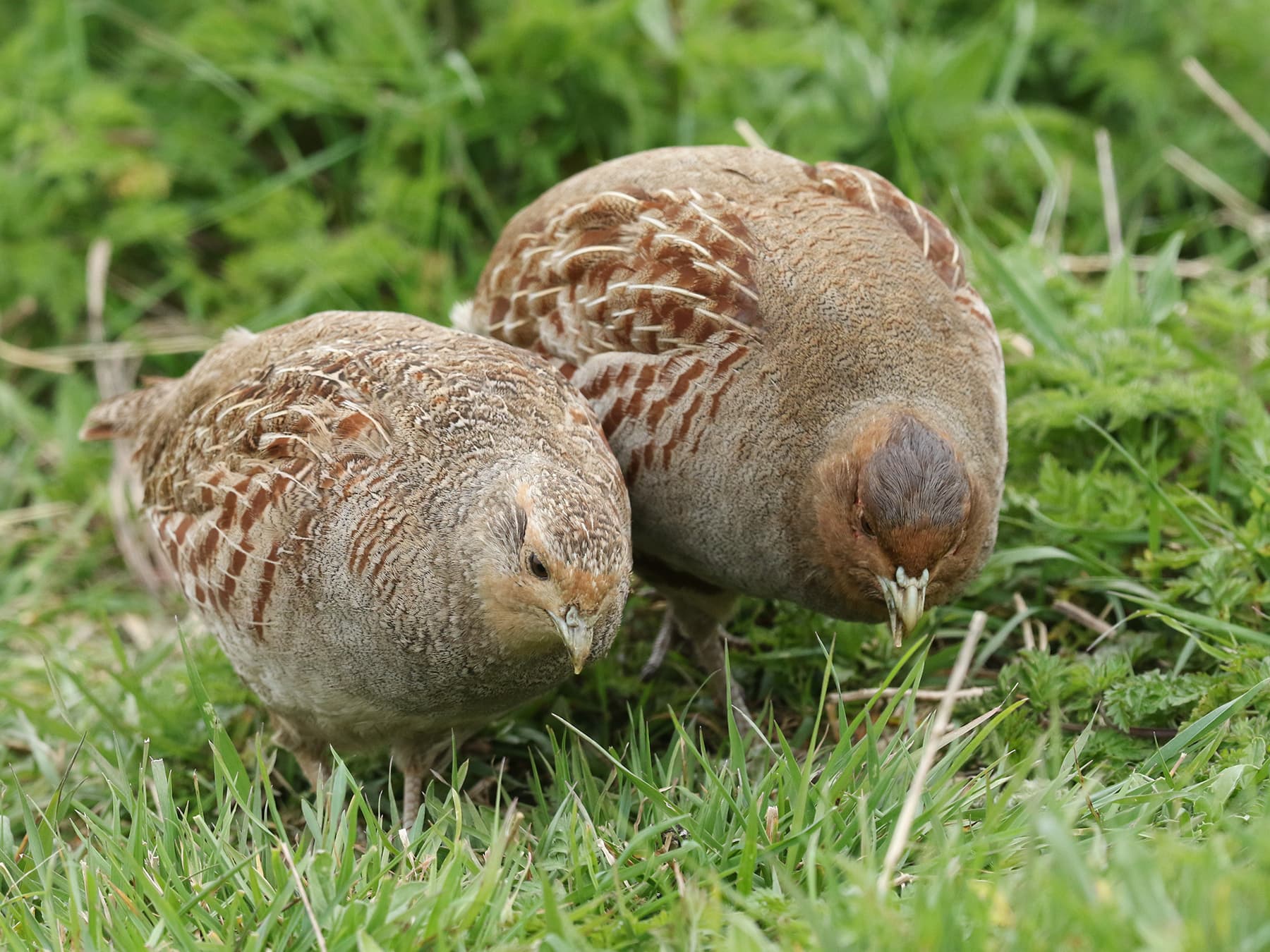
Females are similar to males, although slightly smaller. They also have less orange plumage around the face and a smaller horseshoe-shaped marking on the lower breast. Both sexes have white streaking on the scapulars (shoulder area), although these streaks include crossbars in females only, forming a marking known as ‘the Cross of Lorraine’.
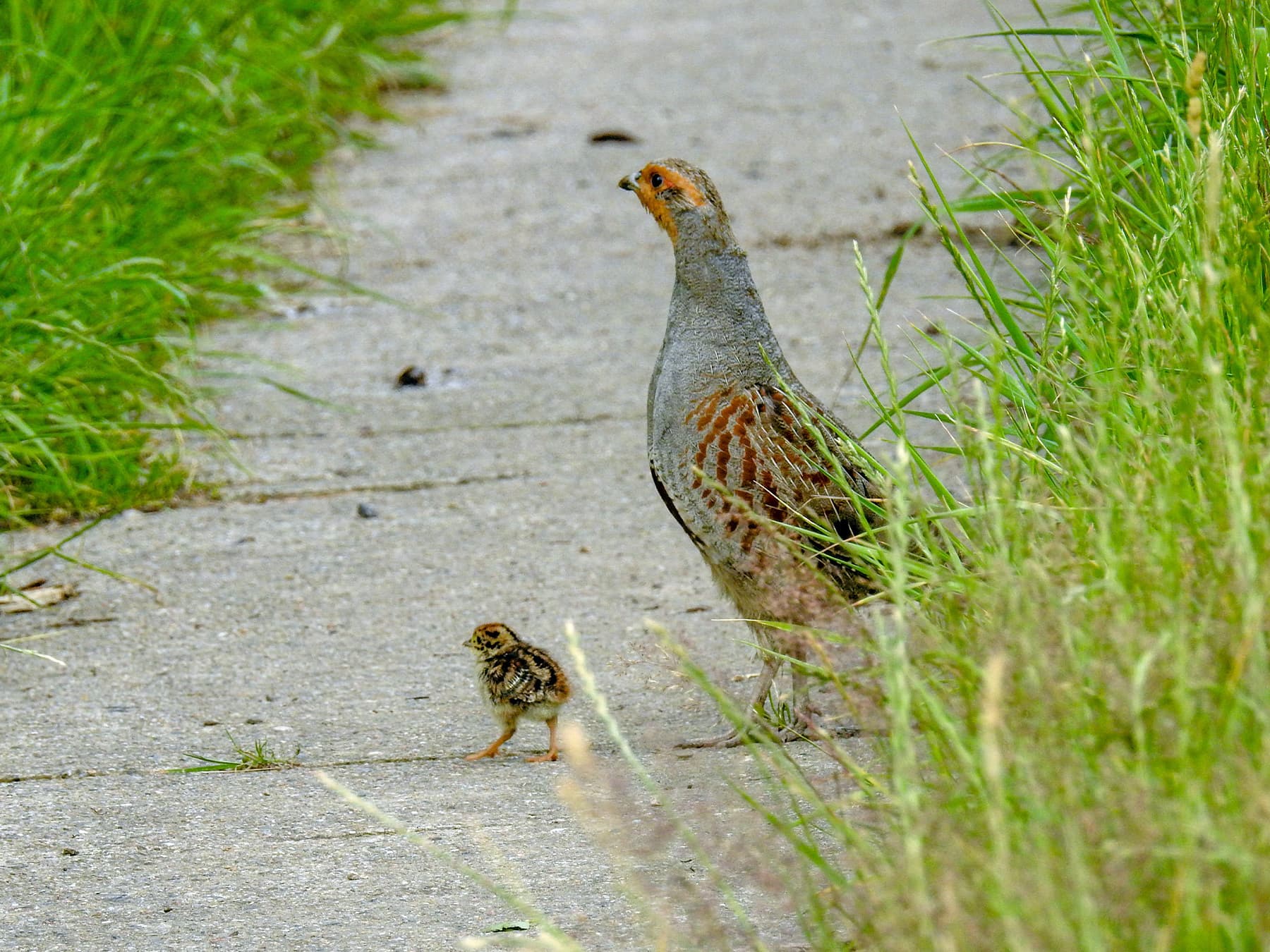
Juveniles of both sexes look similar to adult females, although they lack the chestnut marking across the breast and rust-coloured face plumage. Juveniles also have yellowish (not grey) legs.
These birds are most easily confused with the Red-legged Partridge in the UK and the Northern Bobwhite and Chukar in the United States.
How big are Grey Partridges?
Length
Adults measure 30 to 33 centimetres or 12 to 13 inches. Females are slightly smaller than males.
Weight
Most individuals weigh between 385 and 500 grams, although males can reach 600 grams, and smaller females may weigh just 310 grams.
Wingspan
Adults have a wingspan of 45 to 48 centimetres or 18 to 19 inches.
Its size
Adults- Length
- 28–32 cm
- Wingspan
- 45–48 cm
- Weight
- 290–475 g
Its song and calls
What sound does a Grey Partridge make?
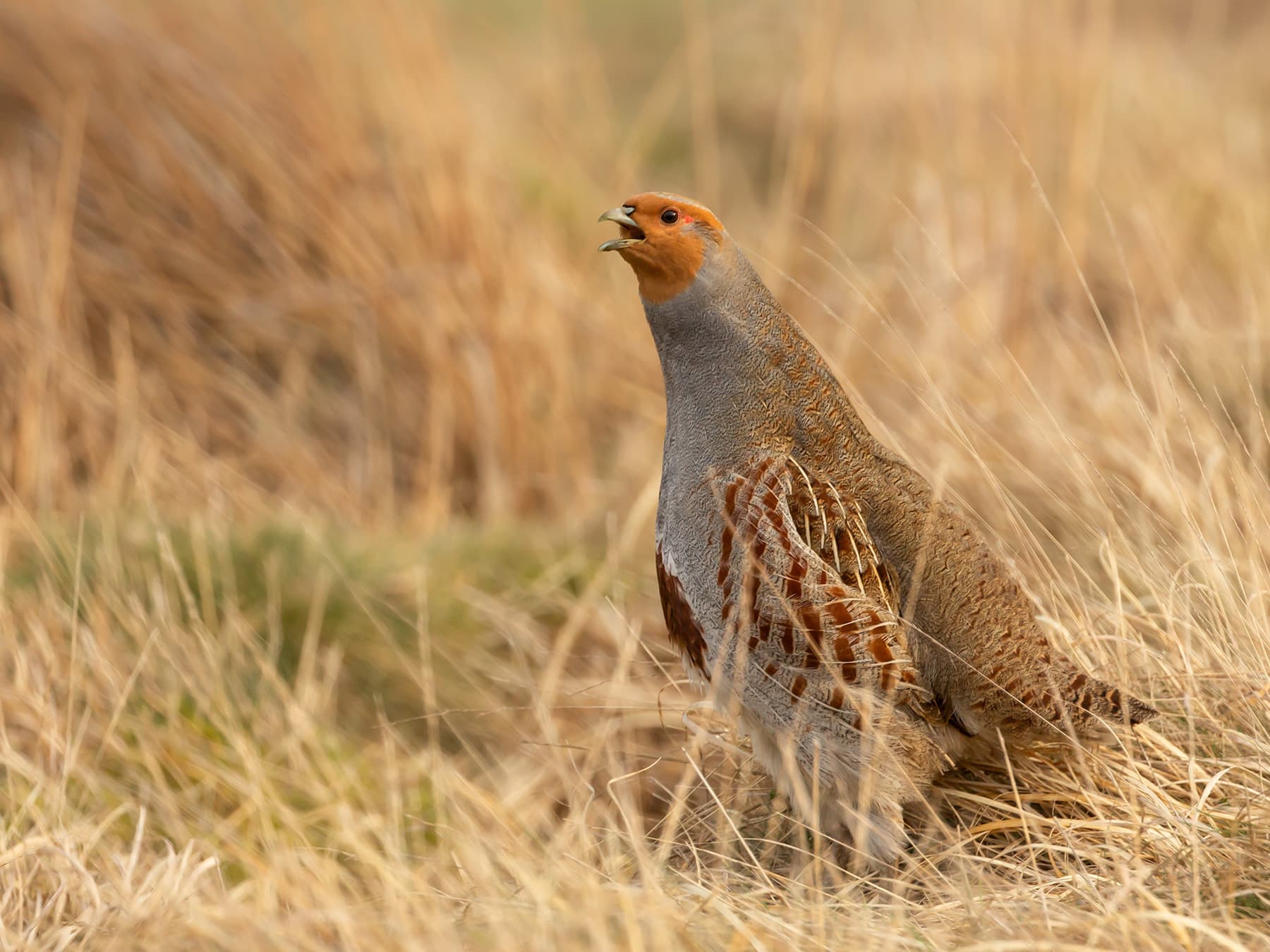
Grey Partridges have a high-pitched, scratchy voice, most similar to a Tern. They make a cackling ‘kut kut kut’ alarm call and a squeaky call likened to a rusty gate hinge in the twilight of dusk and dawn.
- Song and calls0:00 / 0:54
Recorded in Normandie, France · August 2024
- Call0:00 / 0:09
Recorded in Västra Götalands län, Sweden · March 2025
When and where to see it
OctoberIn season
Most recorded in October
- 1. Offaly0.67%
- 2. East Lothian0.30%
- 3. Moray0.28%
- 4. Fife0.25%
- 5. Angus0.24%
Each dot is a county, state or province: the bigger and darker, the larger the bird’s share of that place’s bird records that month. Grey dots: no regular records. The ringed point is the centre of the bird’s records this month; the arrow shows how it moved since last month, and the dashed loop its path through the year. “Arrivals” colours places where it becomes regular this month (orange) or is in its last regular month (grey). GBIF eBird Observation Dataset, 2019–2024. Map data: Natural Earth, US Census Bureau; place centres © OpenStreetMap contributors.
In your area
See when the Grey Partridge is recorded in your county, state or province.
How often the Grey Partridge turns up in the UK, Ireland, the United States and Canada through the year, from birdwatchers' records.
United Kingdom
Resident · all year · most records in January
Ireland
Passage migrant · regularly Apr–Jan · most records in July
United States
Resident · all year · most records in January
Canada
Winter visitor · all year · most records in February
Show as a table
| Month | United Kingdom | Ireland | United States | Canada |
|---|---|---|---|---|
| January | 0.079% (regular) | 0.008% (regular) | 0.005% (regular) | 0.069% (regular) |
| February | 0.072% (regular) | 0.005% | 0.005% (regular) | 0.071% (regular) |
| March | 0.064% (regular) | 0.006% | 0.003% (regular) | 0.049% (regular) |
| April | 0.073% (regular) | 0.005% (regular) | 0.002% (regular) | 0.025% (regular) |
| May | 0.073% (regular) | 0.007% (regular) | 0.003% (regular) | 0.017% (regular) |
| June | 0.050% (regular) | 0.004% | 0.004% (regular) | 0.019% (regular) |
| July | 0.036% (regular) | 0.009% (regular) | 0.003% (regular) | 0.013% (regular) |
| August | 0.043% (regular) | 0.003% | 0.004% (regular) | 0.014% (regular) |
| September | 0.046% (regular) | 0.003% | 0.003% (regular) | 0.015% (regular) |
| October | 0.058% (regular) | 0.004% (regular) | 0.003% (regular) | 0.028% (regular) |
| November | 0.056% (regular) | 0.009% (regular) | 0.004% (regular) | 0.039% (regular) |
| December | 0.052% (regular) | 0.003% (regular) | 0.004% (regular) | 0.061% (regular) |
Recorded regularly in
Worldwide: recorded regularly in 40 countries
Countries where it was recorded in at least 3 of the 6 years 2019–2024. Linked countries have their own bird list.
Data: EOD – eBird Observation Dataset (Cornell Lab of Ornithology), accessed via GBIF.org, CC BY 4.0. Records from 2019–2024, aggregated and filtered by Birdfact. How these lists are made
What is the habitat of a Grey Partridge?
Grey Partridges inhabit pasture, low arable croplands and stubble fields. They also inhabit short natural grasslands with patches of taller vegetation and occasionally forage in wooded areas.
What is the range of a Grey Partridge?
Grey Partridges are widespread in Europe and Asia, ranging from the Republic of Ireland in the west to Mongolia in the east. They are widespread in North America, particularly in Southern Canada and the West and Midwest of the USA, but also to Nova Scotia in the east.
Where do Grey Partridges live?
Grey Partridges are terrestrial birds that spend almost all their time on the ground. They are capable of flight, although they usually travel on foot, rarely flying more than a few hundred yards.
How rare are Grey Partridges?
Grey Partridges are shy and difficult to spot in their short but often dense habitat. They have become increasingly rare in the United Kingdom, although numbers have recovered somewhat on carefully managed farmland with predator control. They can be common in suitable farmland habitats in the United States and Canada.
Where can you see Grey Partridges in the US?
Grey Partridges are most common in open grassland and grain farming areas in the West and upper Midwest in states like Montana, North Dakota, and Idaho. They persist in some parts of the Northeast and Great Lakes region but have declined in the east of their range due to changing farming practices.
Where can you see Grey Partridges in the UK?
Grey Partridges are widespread in the United Kingdom, occurring in arable farmland from the south of England to eastern Scotland. They are rare in the southeast and southwest, however, and mostly absent from Wales and Northern Ireland.
Migration
Do Grey Partridges migrate?
Grey Partridges are generally non-migratory in the United Kingdom and North America, although Eastern European populations may move to lower altitudes in winter or move in response to weather conditions.
Are Grey Partridges native to North America?
Grey Partridges are not native to North America. Introductions began as early as the late 1700s and continue in some states today.
Are Grey Partridges native to the UK?
Grey Partridges are native to the United Kingdom, where they have been known since at least the Middle Ages.
Tips for seeing it
- Look for Grey Partridges in open farmland and grassland areas, especially near field edges.
- Listen for their distinctive 'kieerr-ik' call, often given at dawn and dusk.
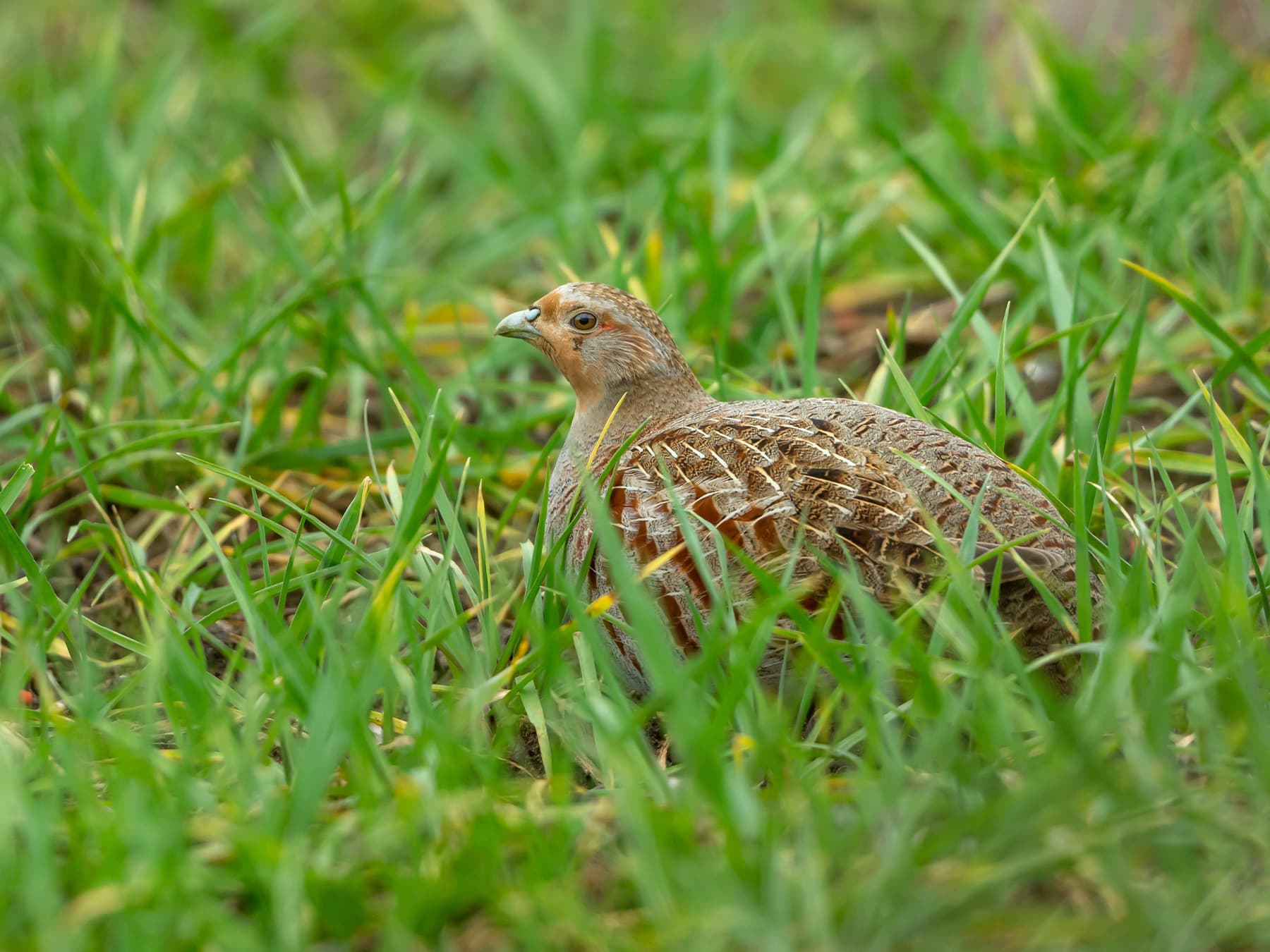
- Scan the ground carefully, as their camouflage makes them difficult to spot when stationary.
- In the UK, try visiting areas with set-aside fields or conservation headlands.
What it eats
What do Grey Partridges eat?
Grey Partridges are omnivorous, although seeds and green plant material form the bulk of their diet. Cereals and weeds are the most important food plants, but they also eat insects in the warmer months.
What do Grey Partridge chicks eat?
Grey Partridge chicks eat insects that they hunt themselves. Their parents may encourage them to eat by dropping morsels in front of them, but they do not feed the young birds directly.
Nesting and breeding
Where do Grey Partridges nest?
Grey Partridges nest on the ground, usually among hedgerows and along roadsides and fencelines. The nest is a scrape up to 30 centimetres or 12 inches in diameter and lined with grass and other available vegetation.
When do Grey Partridges nest?
These birds nest in the spring and summer months, with egg-laying starting in April. Females lay their eggs over a period of roughly two weeks, and incubation begins when the clutch is complete. The eggs hatch after about 25 days, and the hatchlings leave the nest soon after.
What do Grey Partridge eggs look like?
Grey Partridges lay a single large clutch of 15 to 17 pale brown/ olive eggs, each measuring approximately 36 millimetres long and 27 millimetres wide.
Do Grey Partridges mate for life?
Grey Partridges may mate for life, although they are short-lived birds, and they will seek another mate when they lose a partner.
Behaviour
Are Grey Partridges aggressive?
Grey Partridges are social gamebirds that live in coveys of up to 25 individuals. The birds within these groups are rarely aggressive toward each other, although they may fight with intruders from other coveys.
Where do Grey Partridges sleep at night?
Grey Partridges sleep on the ground in their coveys. In the winter, individuals will huddle close together in fine snow or at the base of vegetation to keep warm.
Lifespan and predators
How long do Grey Partridges live?
Grey Partridges are relatively short-lived birds with a maximum recorded lifespan of just five years.
What are the predators of Grey Partridges?
Grey Partridges are vulnerable to many predators as adults, chicks, and eggs. Adults fall prey to raptors like Sparrowhawks, Great-horned Owls, Red-tailed Hawks, and many others. Their eggs are often eaten by mammals like Foxes, Badgers, Raccoons, Stoats, Rats, Mink, and Skunks.
Are Grey Partridges protected?
Grey Partridges are protected by the Wildlife and Countryside Act in the United Kingdom. In the United States, these introduced birds are largely managed as non-native gamebirds but are protected in a handful of states.
Are Grey Partridges endangered?
Grey Partridges are globally listed as a ‘Least Concern’ species. In the UK, however, they have declined by over 80% since the early 1900s. Changing farming methods and pesticide use have dramatically impacted the wild population, and they are now red-listed as a species of conservation of concern.
They have disappeared from some eastern parts of their introduced range in North America but are faring better in the west, where their range continues to expand southwards.
Conservation
Despite being listed as Least Concern globally, Grey Partridge populations have declined significantly in many parts of their range, particularly in Western Europe. Agricultural intensification, pesticide use, and loss of suitable habitat are major threats. Conservation efforts focus on creating suitable habitats and promoting wildlife-friendly farming practices.
More photos
3 photos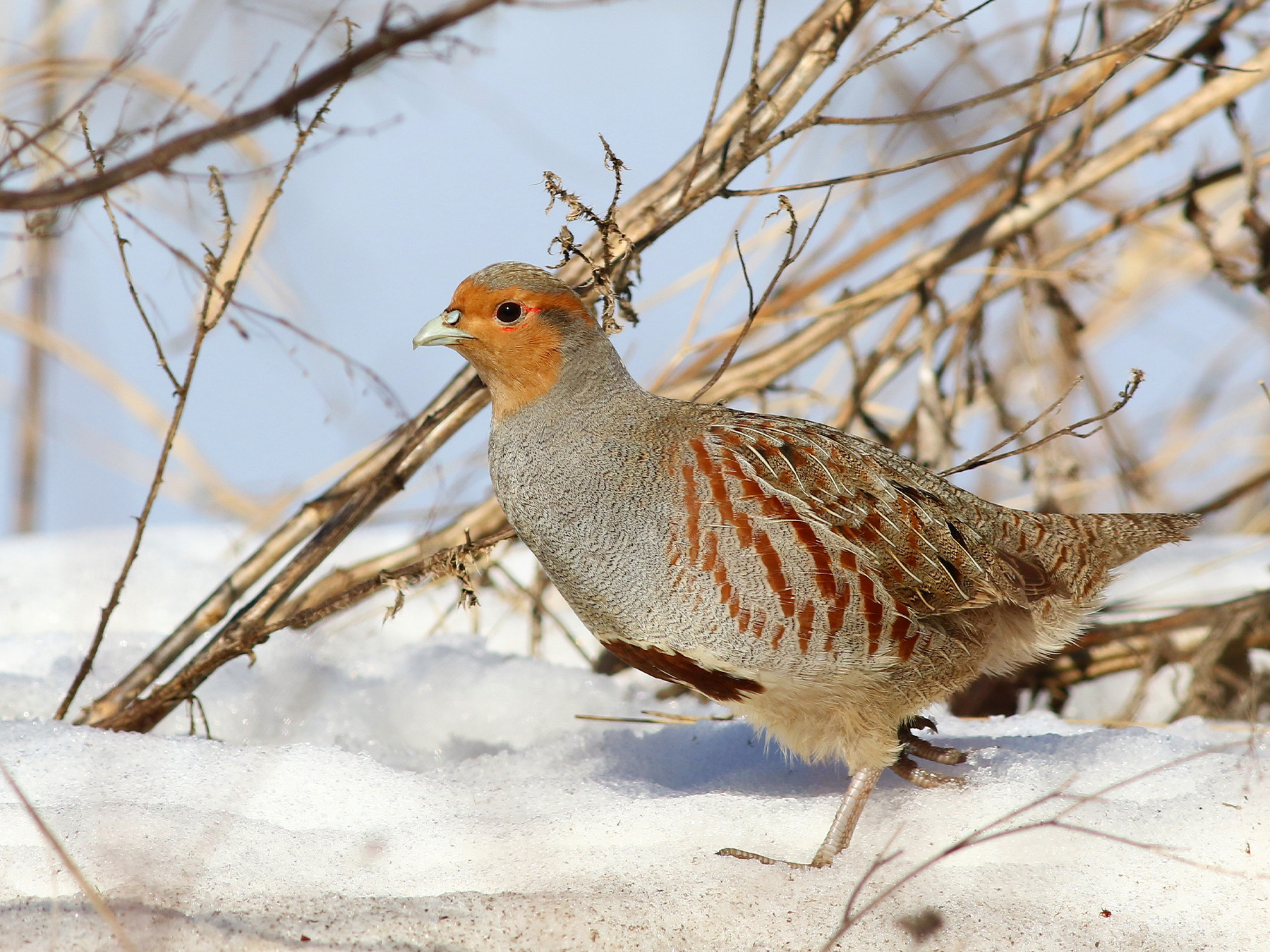
Quick facts
- Length
- 28–32 cm
- Wingspan
- 45–48 cm
- Weight
- 290–475 g
- Lifespan
- 3–5 years
- Family
- Pheasants & Grouse
- Migration
- Resident
- Global status (IUCN)
- Least Concern
- World population
- 3,300,000 - 5,300,000 mature individuals
- Population trend
- Decreasing
- Also called
- Hungarian Partridge, English Partridge
- Scientific name
- Perdix perdix
Questions
1Can you eat Grey Partridge?
The Grey Partridge is a popular gamebird among hunters. A quick internet search reveals no shortage of recipes for these small, intensely flavoured gamebirds.
Sources
3- 1BirdLife International. 2022. Perdix perdix. The IUCN Red List of Threatened Species 2022: e.T22678911A154496308. Source (opens in a new tab)
- 2BirdLife International. 2022. Perdix perdix. The IUCN Red List of Threatened Species 2022: e.T22678911A154496308. Source (opens in a new tab)
- 3BirdLife International. 2022. Perdix perdix. The IUCN Red List of Threatened Species 2022: e.T22678911A154496308. Source (opens in a new tab)

Checked by
Nathan Cope, founder and editor
Nathan founded Birdfact and leads its writers and contributors in the UK, the US and Canada. He has watched and studied birds for more than ten years, and checks every article and species guide before it’s published.