
Northern Parula
Parula Warbler · Setophaga americana
By the Birdfact teamChecked by Nathan Cope
On this page13 sections
How to recognise it
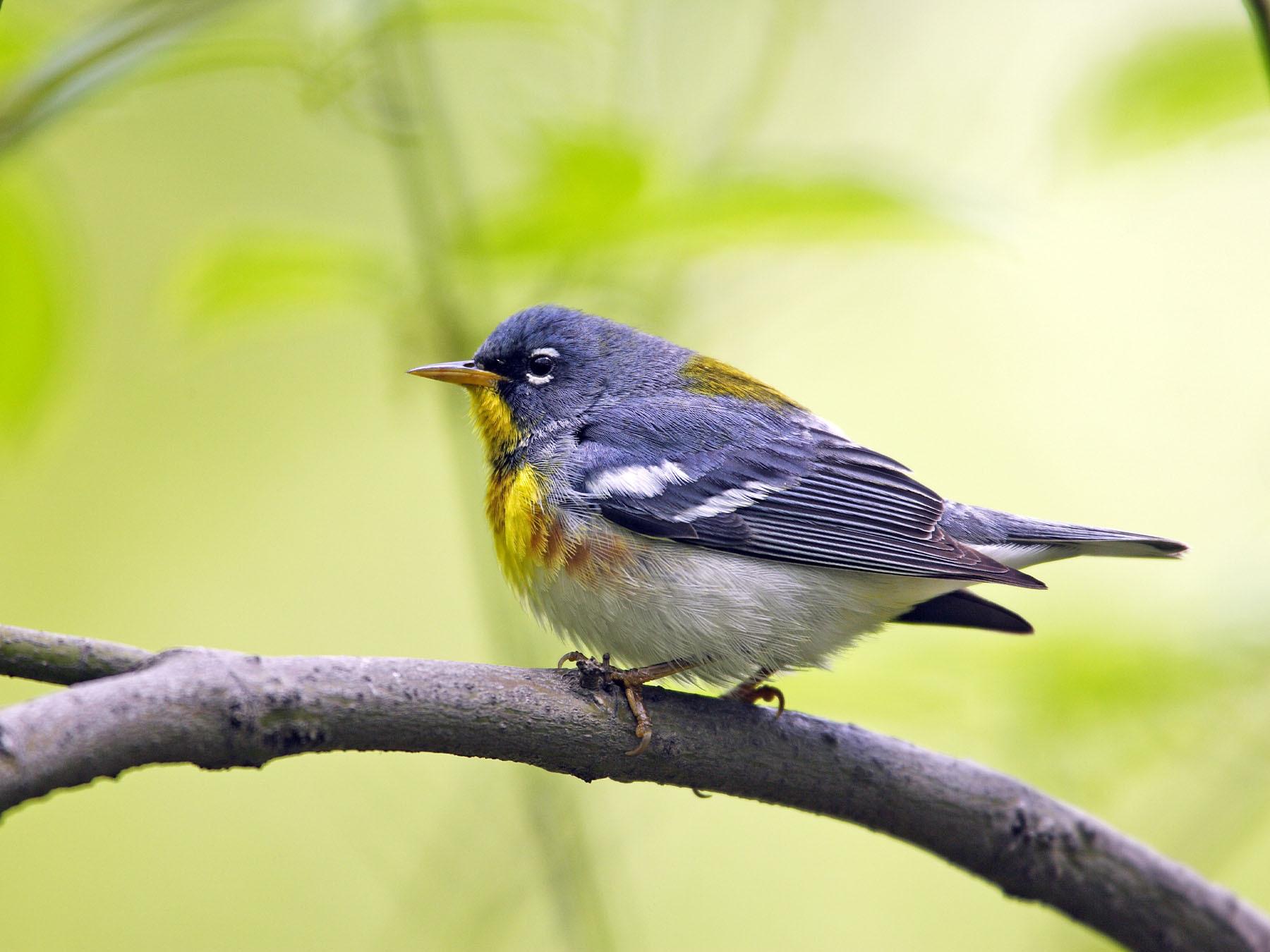
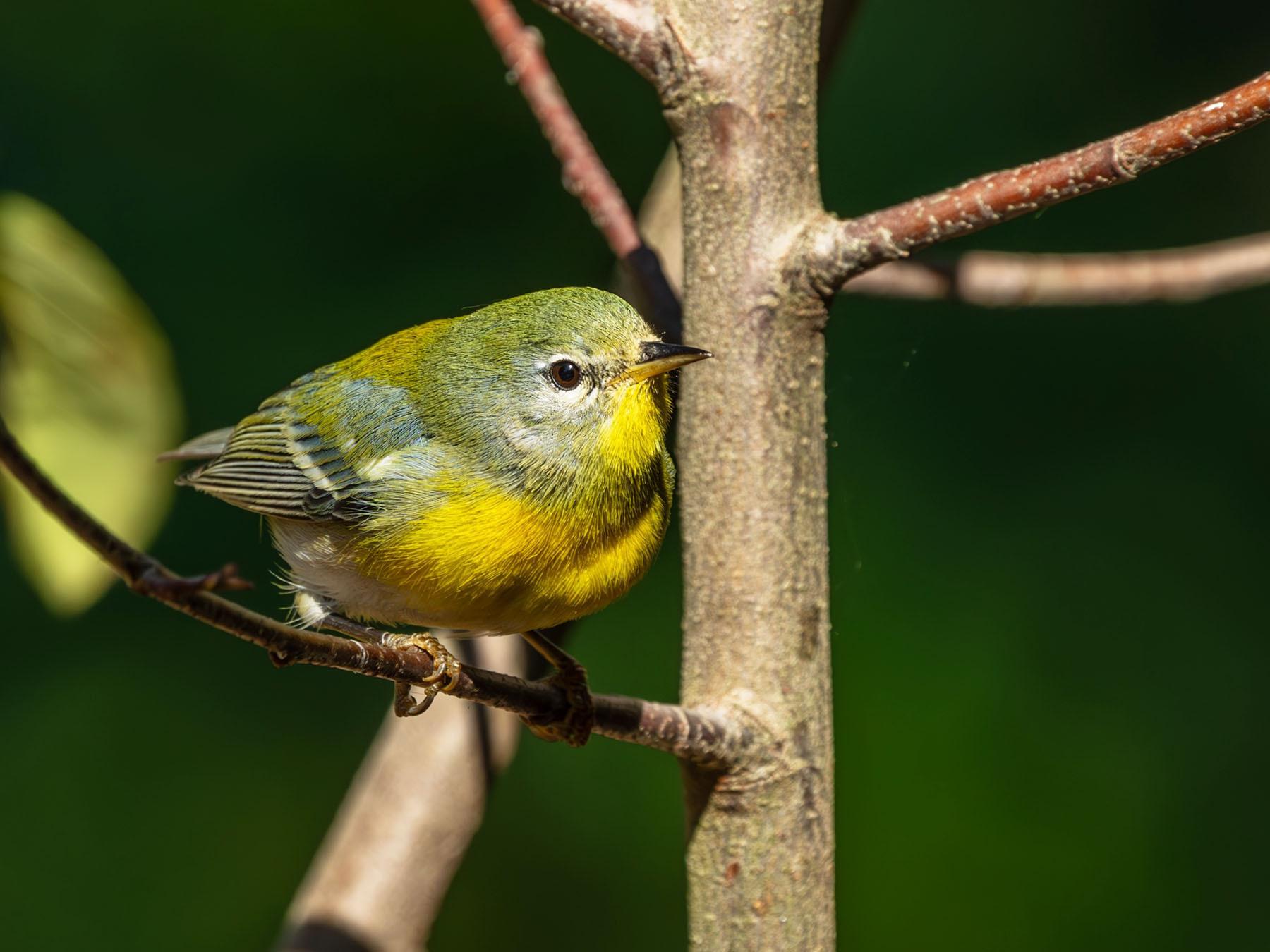
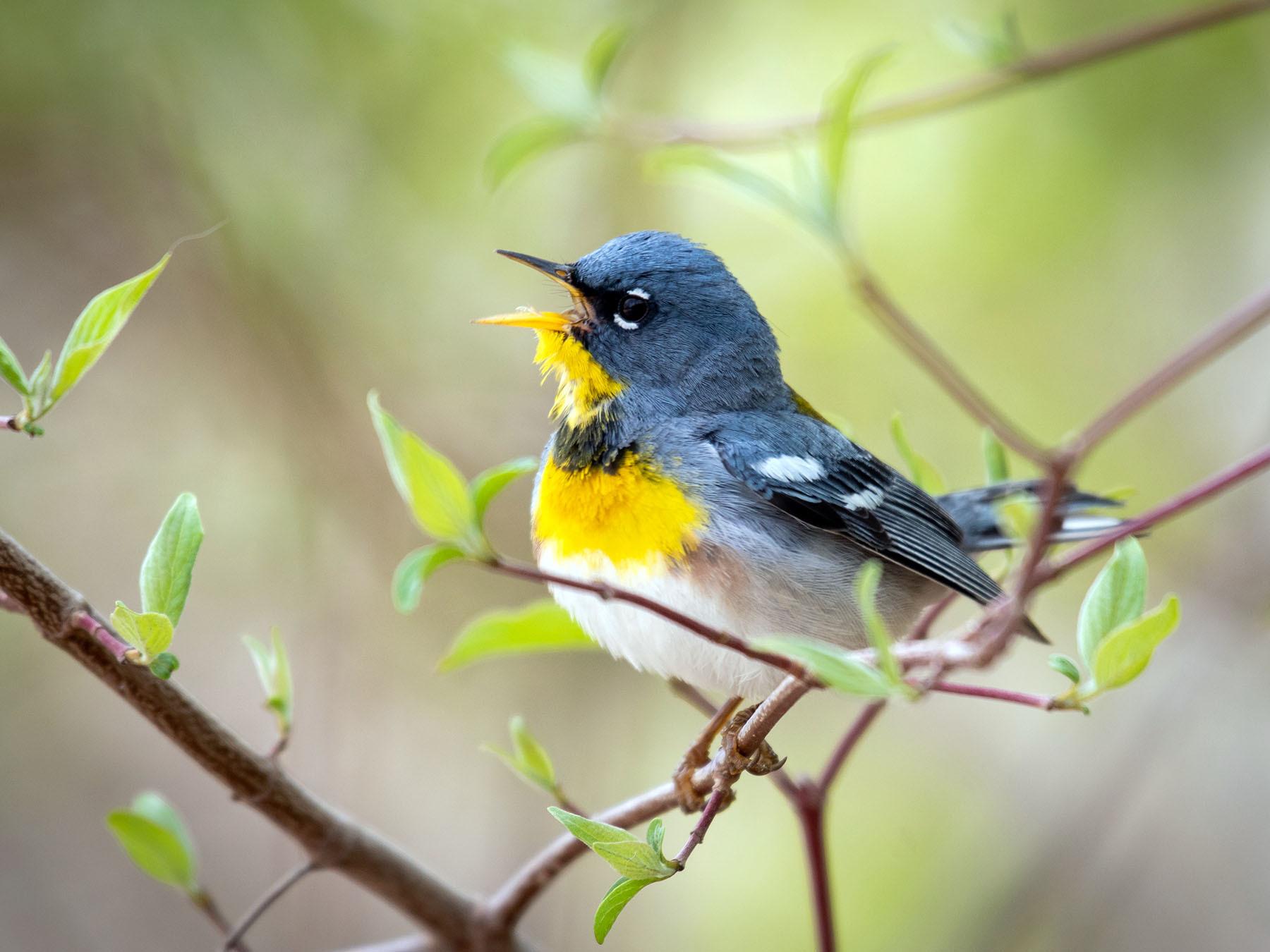
Adults are blue-gray above and yellow on the throat and breast, with a white belly. Look for three marks together: a yellow-green patch in the middle of the back, two bold white wing bars, and narrow white crescents above and below the eye.
It feeds high in the trees, out at the tips of the leaves. The bill is mostly black, with a yellow lower half, and the legs are yellowish brown to olive.
Size and weight
It is 4.3–4.7 in (11–12 cm) long, with a wingspan of 6.3–7.1 in (16–18 cm), and weighs 0.2–0.4 oz (5.5–11.2 g). In size it falls between a Ruby-crowned Kinglet, which is smaller, and a Red-eyed Vireo, which is larger. In a sample of 304 birds, weights averaged 0.27 oz (7.60 g).1 Males are slightly larger than females, and eastern birds average larger than western ones.
Male, female and young birds
The adult male has black lores and a yellow throat crossed by a broad black band, with a slightly narrower chestnut band below it. His sides are blue-gray streaked with chestnut. The bands vary: the black band is narrow or missing more often in southeastern birds, and is usual in the Northeast and, a little less so, west of the Mississippi Valley.
The adult female is duller, with an olive wash above and the same green back patch, wing bars and eye crescents. Most females show no black on the breast, and the chestnut varies: some have a little, some none.
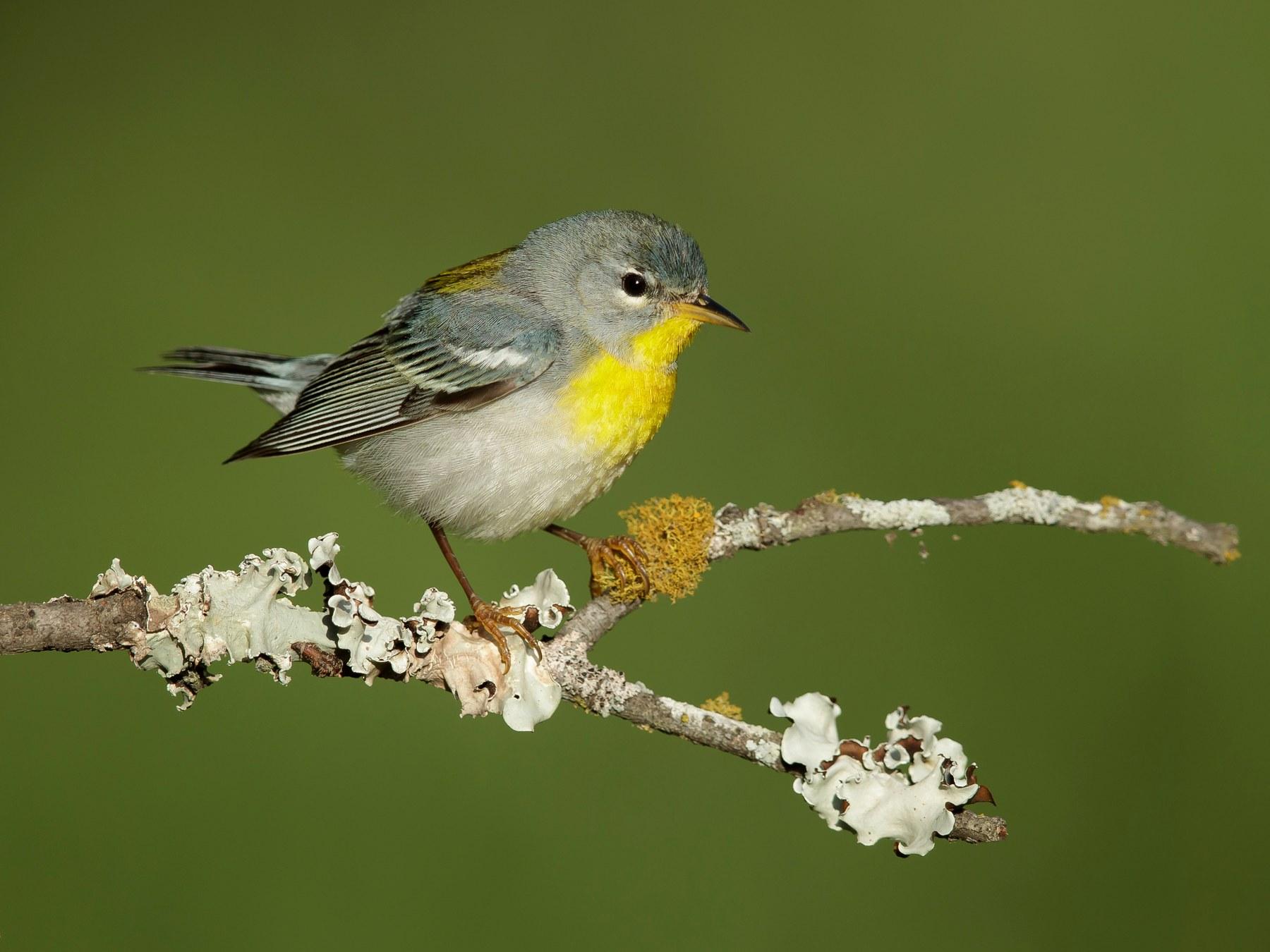
In their first fall and winter, young birds look much like adults of their own sex but are more olive green above. Young males show fainter breast bands, and young females are duller yellow below with more olive on the flanks. A dull adult female and a bright first-fall bird can look very alike: telling them apart takes a close look at the worn and fresh feathers on the wing.
The juvenile plumage, worn mainly from May to August, is brief and not well described. Juveniles are grayish above with little or no blue or olive, pale grayish to whitish below with little or no yellow, and have narrower, duller wing bars. Birds look brighter in spring, mostly because the dull tips of their fresh fall feathers wear away.
Identification: similar birds
The closest lookalike is its sister species, the Tropical Parula. Northern Parulas pass through the Tropical's range in south Texas on migration and have nested there at least once. A Tropical Parula lacks bold white eye crescents, though some show faint pale marks. Males have black on the face, more yellow below and no black or chestnut breast bands, and young Tropicals have a yellow, not gray, throat. Singing males can be told by how the main song ends: the Tropical's in a buzzy down-slur, the Northern's in a buzzy up-slur in western birds or in the upside-down V of eastern birds (see Song and calls).
A Yellow-throated Warbler is also blue-gray above, but it has a white eyeline and black sides to the face, where a Northern Parula has white eye crescents and a green back patch. Searchers often compare it with Magnolia, Pine, Nashville and Yellow-rumped Warblers, but within its breeding range the main handbook names the Tropical Parula as the only bird it can be confused with. The green back patch with white eye crescents and wing bars on a blue-gray bird is the combination to look for.
Not sure it’s a Northern Parula? Check your photo: Birdfact names the bird and shows the look-alike side by side.
Its size
Adults- Length
- 11–12 cm
- Wingspan
- 16–18 cm
- Weight
- 5.5–11.2 g
Its song and calls
The usual song is a rising, buzzy trill that ends in a short, separate note. Males have a second, less frequent song, a more complex string of buzzy notes. In one study, these songs averaged 1.4 seconds, and 54% of them had 11–14 syllables.1 Most males seem to have just two songs, one of each kind. Singing is almost all by males, though at least one female has been heard singing.
The common song differs between eastern and western birds. Eastern songs end in a note shaped like an upside-down V on a sonogram and average 1.19 seconds, while western songs end in a softer buzzy note that slurs upward and average 1.31 seconds. In playback trials, males respond more strongly to their own population's version.1 Eastern-song birds breed from central Ontario to Maine and south to southwestern Alabama and northern Florida. Western-song birds breed from western Ontario south to southeastern Texas and west, and the two meet in eastern Kentucky and southwestern Alabama.
The common song appears to be aimed at females and the complex song to serve in disputes between males, though other work suggests the two may do much the same job. In Maine the complex song is sung almost only at dawn and dusk.1
Males sing from mid-March through July, most strongly from April to mid-June in the South and May to mid-July in the North. They also sing on migration, mostly in spring, and on the wintering grounds, but are usually silent in fall. In the study that timed the complex songs, 66 song perches averaged 36 ft (10.9 m) up, about three-quarters of the way up the tree, and males sang the common song 4.5–11.3 times a minute.1
Both sexes give two calls, a sweet chip and a tseep. The chip may go with more aggressive encounters: in a Puerto Rico winter study, males gave it about twice as often as females.1 Some songs can sound like a Prairie Warbler's, though the parula's voice is buzzier with a sharp final note, and the complex song may closely resemble a Cerulean Warbler's.
- Song0:00 / 0:27
Recorded in Minnesota, United States · May 2011
- Song0:00 / 0:09
Recorded in Michigan, United States · May 2025
Heard one and not sure? Let the bird song identifier listen.
When and where to see it
November
Mostly absent
The year across North America
Choose a place on the map to see its year, or find yours.
Most recorded in November
Up to 1.5% of a place’s bird records that monthHere in other monthsThe way its records moved since last month
How this map is made
Each county, state or province is shaded by the Northern Parula’s share of all the bird records there that month: the darker, the larger the share. A place with only a trace of records in a month is left unshaded. The arrow follows the middle of the bird’s records from last month to this one, and the faint line its path through the year: it shows where the records move, not any one bird’s route. Shades compare places on this map with each other, not one bird with another. Records: GBIF eBird Observation Dataset, 2019–2024. Map: Natural Earth; place centres © OpenStreetMap contributors.
How often the Northern Parula turns up in the United States and Canada through the year, from birdwatchers' records.
United States
Summer visitor · regularly Feb–Oct · most records in May
Canada
Summer visitor · regularly May–Oct · most records in May
Show as a table
| Month | United States | Canada |
|---|---|---|
| January | 0.020% | 0.002% |
| February | 0.055% (regular) | <0.001% |
| March | 0.19% (regular) | – |
| April | 0.38% (regular) | 0.005% |
| May | 0.56% (regular) | 0.42% (regular) |
| June | 0.30% (regular) | 0.33% (regular) |
| July | 0.16% (regular) | 0.26% (regular) |
| August | 0.10% (regular) | 0.17% (regular) |
| September | 0.39% (regular) | 0.34% (regular) |
| October | 0.20% (regular) | 0.051% (regular) |
| November | 0.026% | 0.007% |
| December | 0.020% | 0.004% |
Worldwide: recorded regularly in 34 countries
Countries where it was recorded in at least 3 of the 6 years 2019–2024. Linked countries have their own bird list.
Europe (1)
North America (31)
- Anguilla
- Antigua & Barbuda
- Aruba
- Bahamas
- Belize
- Bermuda
- Canada
- Caribbean Netherlands
- Cayman Islands
- Costa Rica
- Cuba
- Curaçao
- Dominican Republic
- El Salvador
- Guadeloupe
- Guatemala
- Haiti
- Honduras
- Jamaica
- Mexico
- Montserrat
- Nicaragua
- Panama
- Puerto Rico
- Sint Maarten
- St Kitts & Nevis
- St Martin
- St Pierre & Miquelon
- Turks & Caicos Islands
- United States
- US Virgin Islands
South America (2)
- Colombia
- Venezuela
Data: EOD – eBird Observation Dataset (Cornell Lab of Ornithology), accessed via GBIF.org, CC BY 4.0. Records from 2019–2024, aggregated and filtered by Birdfact. How these lists are made
The Northern Parula breeds across the eastern US and southern Canada, from extreme southeastern Manitoba, south-central Ontario, southern Quebec and the Maritime Provinces south to the Gulf Coast and southern Florida, and west to northeastern Minnesota, southern Iowa, eastern Kansas, eastern Oklahoma and eastern Texas.
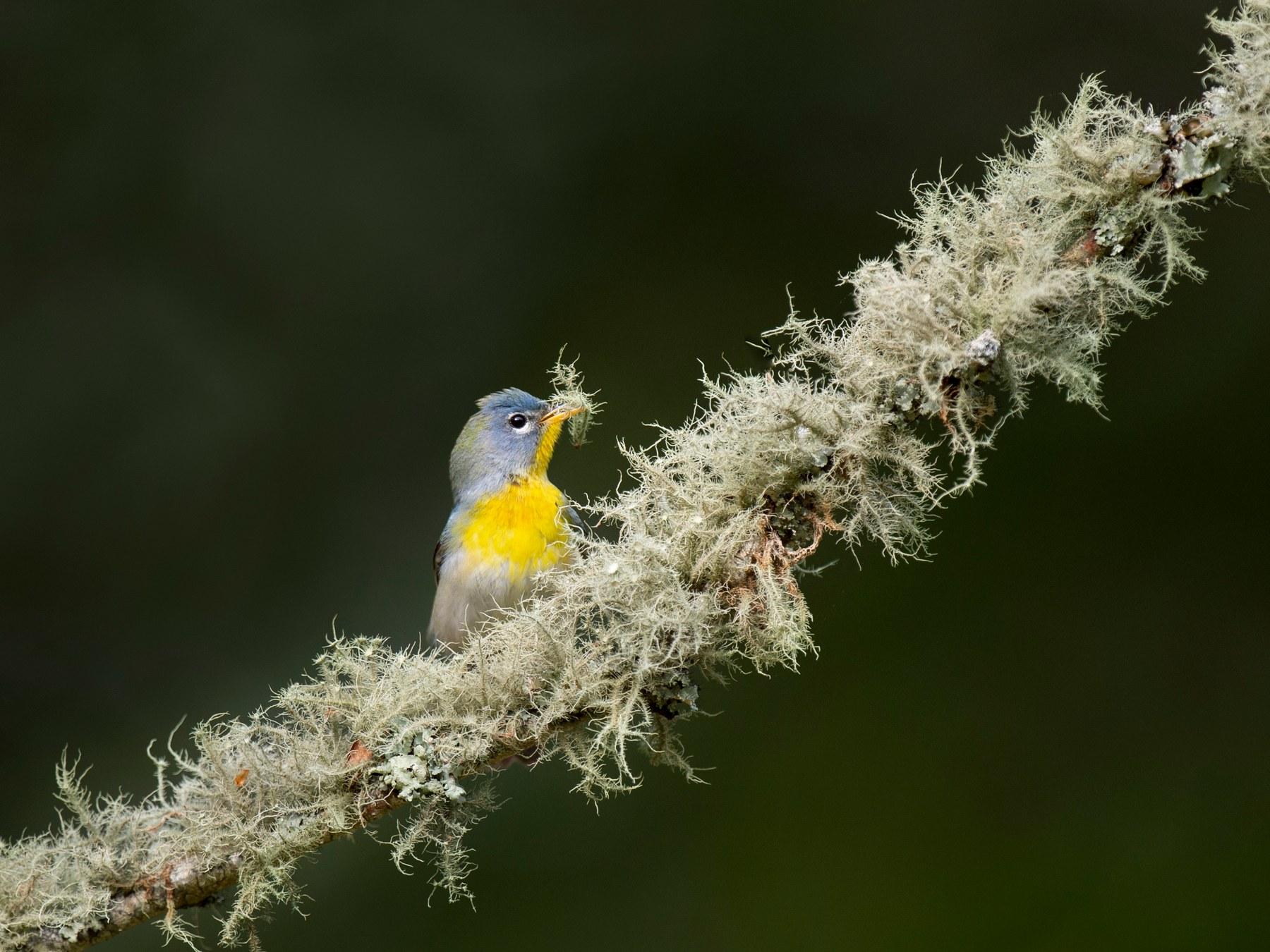
Look for it in tall, mature forest, usually near water. In the South it keeps to the treetops of river-bottom forest along streams, swamps and lakes, above all where Spanish moss hangs from the branches. In the North it favors tall conifer or mixed forest of spruce, hemlock and fir hung with beard lichen. Some birds breed in woods with neither.
The breeding range has a hole in it. Birds of the World's account was written in 2012 from state bird books and atlases of the 1980s and 1990s. It describes a band where the bird was absent, rare or gone, from southern Michigan and northwestern Ohio west to most of Iowa, and few or no breeders in southern New Hampshire, Massachusetts, Rhode Island, Connecticut, New Jersey and Delaware.1 Statewide Breeding Bird Survey trends for 1966–2025 are strongly positive in Indiana, Ohio and Michigan, though figures for whole states cannot show whether the gap itself has filled.2 Far to the west, small numbers breed now and then along the coast of west-central California, where none was recorded before 1952, and it has nested in New Mexico and Arizona.
Winter range
Most Northern Parulas winter in eastern Mexico and the West Indies, from the Bahamas, Cuba, Jamaica, Hispaniola and Puerto Rico east to Dominica. Others winter on Bermuda and on Mexico's Atlantic slope from southern Tamaulipas to northern Honduras. A few reach the Pacific slope of Mexico and El Salvador, and very rarely the Caribbean coast south to Panama.
In the US it is uncommon in winter in the Florida Keys and rare elsewhere in Florida, and single birds may winter in Louisiana, Texas, South Carolina and New Mexico. In winter it is described as a habitat generalist, found in forest, scrub, pastures and coffee and citrus plantations, though other studies suggest it is more choosy.1
Migration
It migrates at night. In spring, birds from the West Indies probably travel up the Florida peninsula, and birds from Mexico and Central America across the Gulf of Mexico or round through Texas. Southern breeders appear to arrive first: birds reach Florida as early as 11 February and Louisiana and Texas as early as mid to late February, and southern pairs can have young out of the nest in early May while northern birds are still passing through. Farther north, birds reach New York, New Jersey and Massachusetts within the first three weeks of May.1
In fall, birds leave from August, with the peak from September to mid-October, and by the end of October few remain north of the winter range. Banding has produced few recoveries: of 18,135 banded in 1955–1992, only 12 were reported again.1
A few go astray across the Atlantic, with at least 14 fall records for the British Isles by 1991.1 Feather chemistry of five vagrants, part of a wider study of North American landbirds that strayed to the Azores, Iceland and France, pointed mainly to origins in northeastern North America, though the results varied widely from bird to bird.3
Tips for seeing it
What it eats
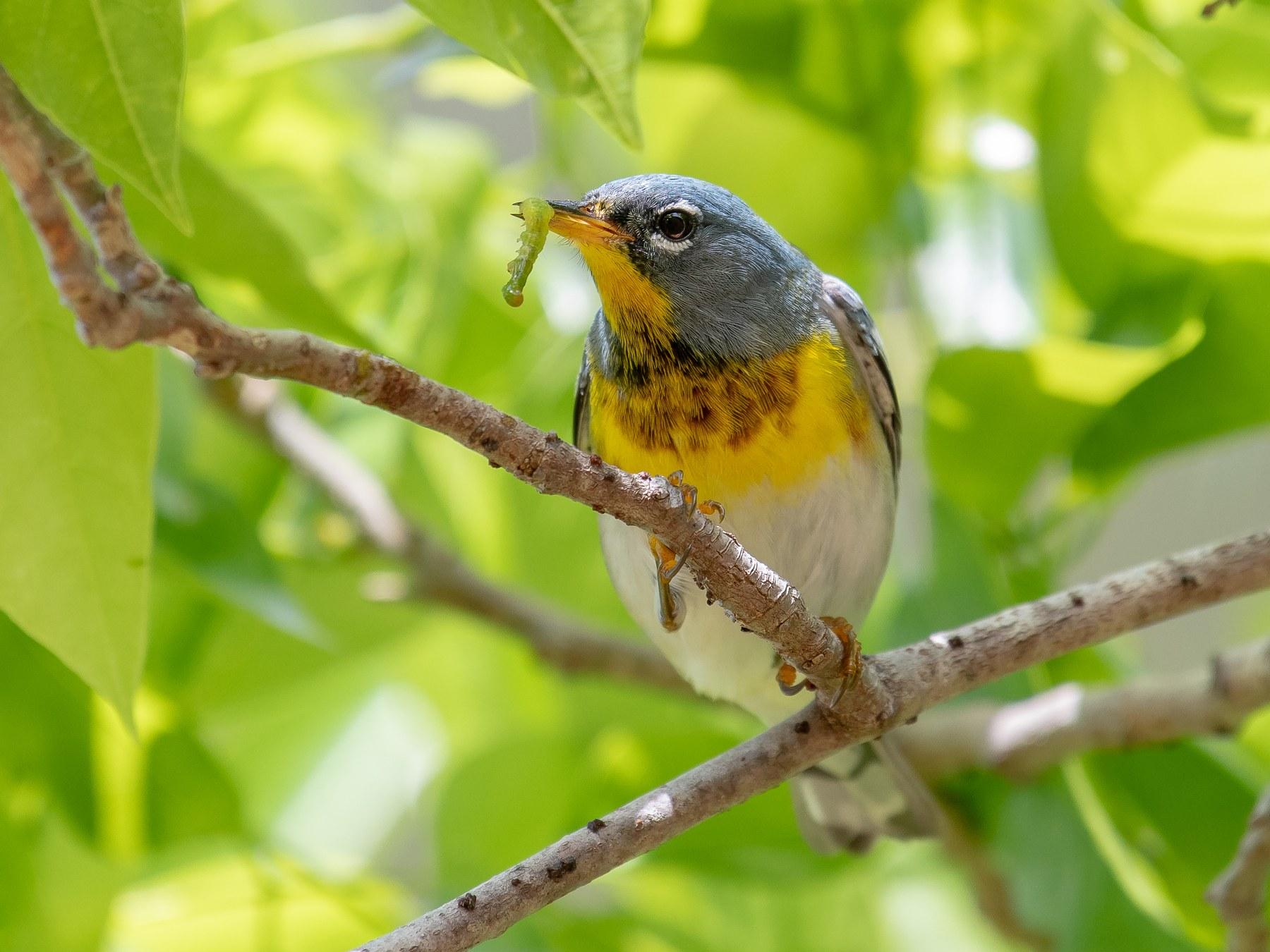
The Northern Parula eats mostly insects and spiders all year, and takes many caterpillars. It also takes beetles, moths, ants, wasps, bees, flies and scale insects. In winter, less often and mainly in poorer habitat, it adds berries, seeds and nectar.
It feeds mainly in the middle and upper canopy, out at the tips of the leaves rather than near the trunk, picking prey from leaves, twigs and small branches. It also stretches, hovers or hangs upside down to reach them, occasionally catches insects in flight, and rarely feeds on the ground. Breeding birds foraged at an average of about 33 ft (10 m) up in one study, and males tend to feed higher than females.1
On the wintering grounds, 61 birds' stomachs from Puerto Rico held 97.7% animal food; spiders made up 29.5% of that, beetles 22.5% and caterpillars and moths 21.6%.1 In Jamaica, insects made up 92% of the winter diet, fruit 6% and nectar 2%.1
Northern Parulas do not visit feeders, and we found no source that recommends a feeder food for them.4 You can still give migrants habitat in your yard by planting native trees and shrubs suited to your area.4
Nesting and breeding
The Northern Parula hides its nest inside a hanging clump of Spanish moss in the South or beard lichen in the North. It is usually placed near water, out at the end of a branch, mostly about 7 to 98 ft (2–30 m) up, though some are much lower. In Maine, 71 nests were 5–54 ft (1.6–16.5 m) up.1 At the Manitoba edge of the range, a 1979 nest sat in beard lichen about 26 ft (8 m) up a storm-damaged white spruce.5
The nest is a cup hollowed low in the hanging mass, with an entrance hole in the side, and the moss or lichen is sometimes worked into a curtain around and over it. It is lined with more fiber or with hair, fine grass, pine needles or plant down. The female brings most or all of the material, and the male often goes with her. One Michigan female built her nest in 4 days.1
Where neither moss nor lichen grows, it uses flood debris caught in branches over rivers, hanging clumps of twigs, pine needles or leaves, and once a burlap sack hanging from a branch. A nest may be used again: one in Maine for four seasons in a row.
Eggs and young
A clutch is usually 3–5 eggs, with a range of 2–7; 161 museum clutches averaged 3.94 eggs.1 The eggs are white or creamy white with reddish and brown speckles and spots and paler gray and purple marks, and average about 0.64 by 0.48 in (16.3 by 12.1 mm). Egg dates run from early April in the South to early July in the North.
The female incubates, usually alone, for 12–14 days, and the male often feeds her on the nest. The young leave the nest about 10–11 days after hatching, before they can fly, and stay near the parents, begging. Both parents feed the nestlings, but how the work is shared is unclear: the two studies disagree. Second broods are reported in the Carolinas and suspected in Florida.
Cowbirds and nest success
Its nesting is poorly documented. The only detailed nest study, from Michigan and published in 1951, followed 4 nests: of 9 eggs, 5 hatched and 3 young left the nest.1
Records of the Brown-headed Cowbird laying in its nests are few but widespread, and the closed nest probably makes it an uncommon host. Parulas have been seen building over cowbird eggs and also feeding young cowbirds.
Behaviour
The Northern Parula often hops through the branches and has not been seen to walk or climb. Its flight is quick and erratic, with rapid wingbeats. In the breeding season it travels alone or in pairs; on migration and in winter it joins mixed flocks of warblers, titmice and other small woodland birds.
Males defend breeding territories by singing and chasing. Rivals fight in tight, whirling aerial dogfights with loud chipping, and a bird often droops its wings as it chips. Territories averaged 0.8 acre (0.32 ha) in Nova Scotia and 1 acre (0.4 ha) in mainland Maine spruce forest.1 It is chased by other warblers more often than it chases them, perhaps because of its small size. Pairs are generally monogamous.
On small islands it shared the forest with Yellow-rumped Warblers and Black-throated Green Warblers, but where the Black-throated Green was missing it fed higher in the canopy, and alone it spread into the lower branches too.1 It even lives on offshore islands of only 0.4 acre (0.16 ha) that lack its main competitors, the Golden-crowned Kinglet and the Black-throated Green Warbler.1
In a Puerto Rico winter study, three-quarters of color-banded birds stayed put in small home ranges, and a quarter of those defended territories; others wandered widely.1 In winter it roosts communally with other migrant warblers.
Lifespan and predators
The oldest Northern Parula on the US banding records was at least 5 years 11 months old: a female banded as an adult in Maryland on 5 May 2010 and caught and released alive there on 5 May 2014.6 A published Puerto Rico study reported a bird recaptured 7 years after banding, but that case is not on the banding office's list.1
We found no source that gives a typical lifespan. Banding data give yearly survival rates of 0.22–0.48 depending on region, but the samples are small and the figures should be read with caution.1 Return to the same wintering site varies: in one Puerto Rico study, 49% of color-banded birds were seen again the next winter and 14% the winter after, but at another Puerto Rico site only 3% of 29 banded birds were caught again over eight years.1
Predators and dangers
Its predators are poorly known. Red squirrels and Blue Jays are probable nest predators, snakes may take eggs, young and adults, and adults are likely caught by small hawks and owls. Parents have been seen feigning injury to draw danger away from the nest.
In Puerto Rico in 2019, two Northern Parulas mobbed a Pearly-eyed Thrasher that was killing a Bananaquit, which suggests the thrasher may also prey on migrants.7
Like many night migrants, it often dies in collisions with towers and other structures. At one TV tower in Leon County, Florida, 1,469 Northern Parulas were killed in 1955–1985, 863 in fall and 606 in spring.1
Conservation
The Northern Parula is not rare, and its numbers have been rising. The IUCN Red List rates it Least Concern (2021).8 Partners in Flight estimates about 18 million breeding-age birds, all in the US and Canada, for a population year around 2010.9 About 7.7 million of them, some 43% of the world population, are in Canada, where the species is ranked Secure.10
NatureServe's state ranks put breeding birds at S1 in Rhode Island, Massachusetts, Connecticut and Delaware.11
Population trend
The North American Breeding Bird Survey shows an increase of 1.37% a year from 1966 to 2025 across the survey area, with a 95% credible interval of +1.09 to +1.62.2 The rise has continued: over 2015–2025 the survey-wide trend was +2.27% a year, and the index stood at its highest in 2025, about 2.2 times its 1966 level. In the lower 48 states alone, though, the last decade shows no clear change (+0.45% a year, with an interval spanning zero).
The fastest long-term rises are in the north and the interior East, with Ontario at +5.96% a year and Quebec at +5.27%. The southeastern coastal plain, at the core of the range, is flat, and Louisiana (−2.27% a year) and South Carolina (−1.81%) have declined.2 Canada's counts have risen strongly since 1970 and faster since the early 2000s.10
The range has shifted both ways. It had spread into southwestern Ohio by 1958 and into Great Smoky Mountains National Park by 1982–1983, and New York's breeding atlas blocks rose by about 50% from 1985 to 2005.1 Yet between Wisconsin's breeding atlases of 1995–2000 and 2015–2019, it was one of three species whose range boundary moved significantly south, by about 95 miles (153 km), while most moved north.12
Earlier losses were tied to its nest sites. Birds of the World's 2012 text says air pollution limited the moss and lichen it nests in, and so largely removed or reduced it as a breeder in several northeastern states. It adds that habitat loss removed it from parts of southern Michigan, southern Wisconsin and Missouri's Mississippi lowlands.1 A decline in the Maritime Provinces before 1966 was attributed to widespread DDT spraying in New Brunswick against spruce budworm from 1952 to 1967.
It may need large forests. In the Middle Atlantic states, the chance of finding it was highest in forests over 7,400 acres (3,000 ha), fell to 50% at 1,300 acres (520 ha), and it was rarely found in forests under 250 acres (100 ha).1 A 2026 study that modeled eBird records of 106 Appalachian bird species against satellite measurements of forest structure suggests that foraging specialists such as the Northern Parula rely on a well-layered canopy.13 In eastern Maine in 1984–85, it was among the forest-interior birds seen less often on heavily harvested sites.14
The risks named for it are the loss of hanging moss and lichen to air pollution, clearcutting and the draining of bogs. In the Maritime Provinces, forestry rotations may also be too short for enough lichen to grow. The advice for it is to keep big undisturbed tracts of forest, restrict the draining of swamps and bogs, and control air pollution and forestry that harm the moss and lichen.1
Legal status
In the United States the Northern Parula is on the federal list of birds protected under the Migratory Bird Treaty Act.15 The Act makes it unlawful to pursue, hunt, take, capture, kill or possess such birds, among other acts, except as its regulations permit.16 It has no Endangered Species Act status.17
In Canada it is protected under the Migratory Birds Convention Act, 1994, whose schedule names warblers among the migratory insectivorous birds, with a close season all year,18 and it is named on the Government of Canada's list of birds the Act protects.19 The Migratory Birds Regulations, 2022 bar harming the birds, their eggs and their nests unless a permit or the Regulations allow it.20 We found no status for it under Canada's Species at Risk Act in the sources we read.
Names and relatives
Parula is a diminutive of Parus, the tit genus in which Linnaeus first placed the bird, so the name means little titmouse. Linnaeus described it in 1758 as Parus americanus, and its type locality was later restricted to South Carolina. The name is said several ways: the main handbook gives PAR-a-la or PAR-ya-la, but par-OOH-la and PAR-eh-la are the commonest, and some say PAR-you-la. Parula Warbler is another English name for it.
Until 2011 it was Parula americana. A broad study of wood-warbler relationships found that Parula did not form a separate lineage, so it was merged into Setophaga, the oldest name in the group.1 The Northern and Tropical Parulas are each other's closest relatives and have hybridized or formed mixed pairs many times. No subspecies are recognized, because single birds cannot be assigned confidently to a population: measurements and plumage overlap too much. Hybrids with the Yellow-throated Warbler, known as Sutton's Warbler, have been reported from several eastern states, and crosses with the Yellow-rumped Warbler and American Redstart are also known.
More photos
1 photos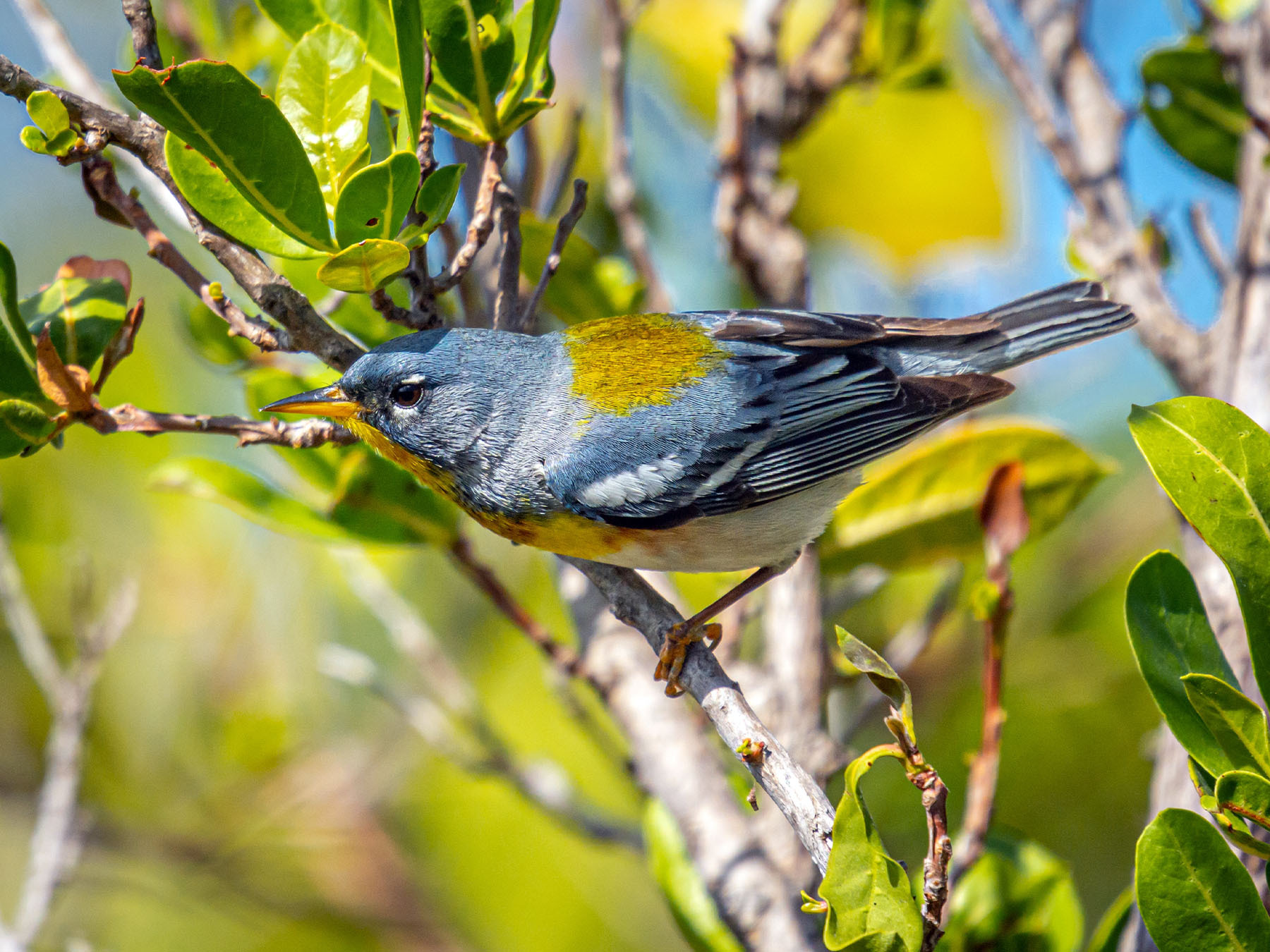
Quick facts
- Length
- 11–12 cm
- Wingspan
- 16–18 cm
- Weight
- 5.5–11.2 g
- Lifespan
- oldest recorded 5 years 11 months
- Family
- Warblers
- Migration
- Long-distance Migrant
- Global status (IUCN)
- Least Concern
- World population
- About 18 million (Partners in Flight, around 2010)
- Population trend
- A long-term increase in Breeding Bird Survey counts since 1966, fastest in Canada and the northern and interior states, with the highest counts in the latest years; the southeastern core is flat and Louisiana and South Carolina have declined
- Also called
- Parula Warbler
- Scientific name
- Setophaga americana
Sources
30- 1Moldenhauer, R. R. and Regelski, D. J. (2020). Northern Parula (Setophaga americana), version 1.0. Birds of the World (A. F. Poole, editor). Cornell Lab of Ornithology. doi:10.2173/bow.norpar.01 (opens in a new tab)
- 2Hostetler, J. A. et al. (2026). The North American Breeding Bird Survey, Analysis Results 1966 - 2025. U.S. Geological Survey. doi:10.5066/P1OSNSFC (opens in a new tab)
- 3Dufour, P., Kardynal, K. J., Hobson, K. A. et al. (2025). Origins of Nearctic migratory landbird vagrants recorded in Europe revealed by feather isotopic analysis. Scientific Reports 15. doi:10.1038/s41598-025-99765-4 (opens in a new tab)
- 4Cornell Lab of Ornithology. Northern Parula: Overview, Identification and Life History. All About Birds. Accessed 28 November 2026. Source (opens in a new tab)
- 5McNicholl, M. K. and Taylor, P. (1982). The Northern Parula in Manitoba. Blue Jay 40(2). doi:10.29173/bluejay4474 (opens in a new tab)
- 6USGS Bird Banding Laboratory. Longevity records, AOU 6480 (current and historical tables). U.S. Geological Survey, Eastern Ecological Science Center. Accessed 28 November 2026. Source (opens in a new tab)
- 7Gilliland, T. E. (2021). Northern Parulas (Setophaga americana) mobbing a Pearly-eyed Thrasher (Margarops fuscatus) depredating an adult Bananaquit (Coereba flaveola). Journal of Caribbean Ornithology 34: 29-31. doi:10.55431/jco.2021.34.29-31 (opens in a new tab)
- 8BirdLife International (2021). Setophaga americana. The IUCN Red List of Threatened Species 2021 (via GBIF's copy of the IUCN checklist). IUCN Red List / GBIF. doi:10.2305/IUCN.UK.2021-3.RLTS.T22721639A138880067.en (opens in a new tab)
- 9Partners in Flight (2024). Avian Conservation Assessment Database, Global (version 2024.05.23). Partners in Flight. Accessed 28 November 2026. Source (opens in a new tab)
- 10Environment and Climate Change Canada and Birds Canada (2024). The State of Canada's Birds - Northern Parula. NatureCounts, Birds Canada (Internet Archive capture of 19 Mar 2025). Accessed 28 November 2026. Source (opens in a new tab)
- 11NatureServe. Setophaga americana, Northern Parula (ELEMENT_GLOBAL.2.102108). NatureServe Explorer. Accessed 28 November 2026. Source (opens in a new tab)
- 12Stallworth, D. T., Anich, N. M. and Zuckerberg, B. (2025). Poleward range shifts of breeding birds in Wisconsin. Ecology and Evolution 15(8): e71796. doi:10.1002/ece3.71796 (opens in a new tab)
- 13Roberts, T., Jarzyna, M. A. et al. (2026). Functional traits explain responses of Appalachian birds to vertical and horizontal forest structure. Journal of Animal Ecology 95(9): 1598-1615. doi:10.1111/1365-2656.70326 (opens in a new tab)
- 14Johnson, W. N. and Brown, P. W. (1990). Avian use of a lakeshore buffer strip and an undisturbed lakeshore in Maine. Northern Journal of Applied Forestry 7(3): 114-117. doi:10.1093/njaf/7.3.114 (opens in a new tab)
- 15U.S. Fish and Wildlife Service (2023). 50 CFR 10.13, List of Migratory Birds. Electronic Code of Federal Regulations (version of 2026-11-18). Accessed 28 November 2026. Source (opens in a new tab)
- 16United States Congress (1918). 16 U.S.C. 703, Taking, killing, or possessing migratory birds unlawful. United States Code (Cornell LII copy). Accessed 28 November 2026. Source (opens in a new tab)
- 17U.S. Fish and Wildlife Service. ECOS species report, scientific name 'Setophaga americana'. Environmental Conservation Online System. Accessed 28 November 2026. Source (opens in a new tab)
- 18Parliament of Canada (1994). Migratory Birds Convention Act, 1994 (S.C. 1994, c. 22). Justice Laws Website (current to 2026-11-12). Accessed 28 November 2026. Source (opens in a new tab)
- 19Environment and Climate Change Canada. Birds protected in Canada under the Migratory Birds Convention Act, 1994 (partial list). Government of Canada (Internet Archive copy of 4 Oct 2026). Accessed 28 November 2026. Source (opens in a new tab)
- 20Government of Canada (2022). Migratory Birds Regulations, 2022 (SOR/2022-105). Justice Laws Website (current to 2026-11-12). Accessed 28 November 2026. Source (opens in a new tab)
- 21National Audubon Society and Kaufman, K.. Northern Parula. Audubon Guide to North American Birds. Accessed 28 November 2026. Source (opens in a new tab)
- 22Missouri Department of Conservation. Northern Parula. MDC Field Guide. Accessed 28 November 2026. Source (opens in a new tab)
- 23Regelski, D. J. and Moldenhauer, R. R. (2020). Tropical Parula (Setophaga pitiayumi), version 1.0: Introduction and Identification. Birds of the World (A. F. Poole, editor). Cornell Lab of Ornithology. doi:10.2173/bow.tropar.01 (opens in a new tab)
- 24Lovette, I. J. et al. (2010). A comprehensive multilocus phylogeny for the wood-warblers and a revised classification of the Parulidae (Aves). Molecular Phylogenetics and Evolution 57(2): 753-770. doi:10.1016/j.ympev.2010.07.018 (opens in a new tab)
- 25Mousley, H. (1926). A further study of the home life of the Northern Parula, and of the Yellow Warbler and Ovenbird. The Auk 43(2): 184-197. doi:10.2307/4074913 (opens in a new tab)
- 26Mousley, H. (1924). A study of the home life of the Northern Parula and other warblers at Hatley, Stanstead County, Quebec, 1921-1922. The Auk 41(2): 263-288. doi:10.2307/4074621 (opens in a new tab)
- 27Mousley, H. (1928). A further study of the home life of the Northern Parula Warbler (Compsothlypis americana usneae) 1925. The Auk 45(4): 475-479. doi:10.2307/4075635 (opens in a new tab)
- 28Sealy, S. G. (1970). Records of the Parula Warbler in Alberta and Saskatchewan. Blue Jay 28(4). doi:10.29173/bluejay3447 (opens in a new tab)
- 29AviList Core Team (2026). AviList: The Global Avian Checklist, v2025b. doi:10.2173/avilist.v2025b (opens in a new tab)
- 30GBIF (Catalogue of Life, ITIS, TAXREF, Clements, Taxonomy in Flux). Setophaga americana vernacular names. GBIF. Accessed 28 November 2026. Source (opens in a new tab)

Checked by
Nathan Cope, founder and editor
Nathan founded Birdfact and leads its writers and contributors in the UK, the US and Canada. He has watched and studied birds for more than ten years, and checks every article and species guide before it’s published.