Species Profile
Ruby-crowned Kinglet
Corthylio calendula
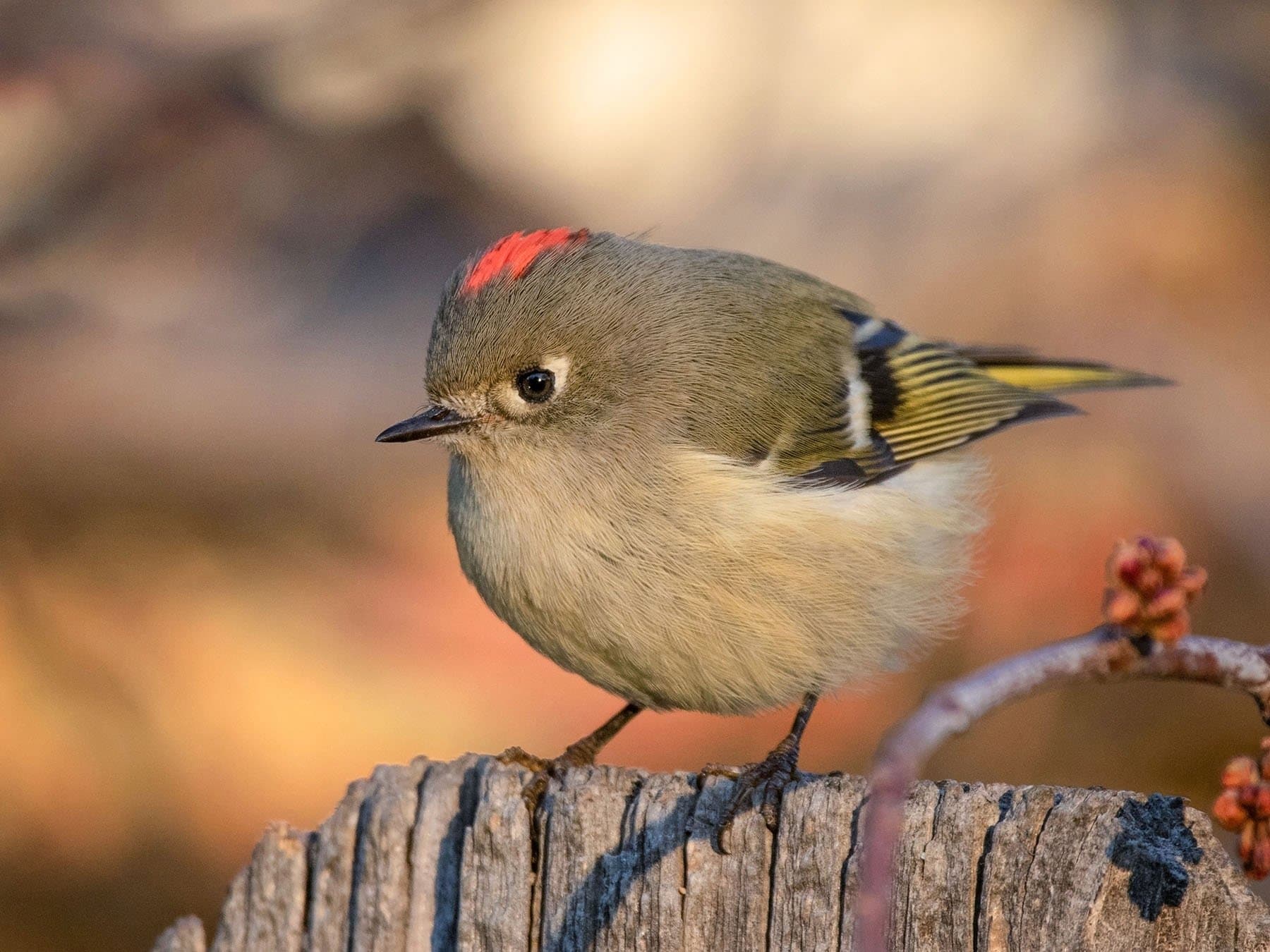
Ruby-crowned Kinglet perched on a weathered wooden stump, showing its red crown patch, olive-green back, and pale underside.
Quick Facts
Conservation
LCLeast ConcernLifespan
2–5 years
Length
9–11 cm
Weight
5–10 g
Wingspan
16–19 cm
Migration
Partial migrant
Barely larger than a ping-pong ball, the Ruby-crowned Kinglet carries a secret: beneath a plain cap of olive-green feathers, the male conceals a blazing scarlet crown patch that he reveals only in moments of excitement or agitation. This tiny North American songbird — weighing as little as 5 grams — produces a song so loud and complex it seems physically impossible from a bird this size.
Think you've spotted a Ruby-crowned Kinglet?
Upload a photo and we'll confirm it instantly
Confirm with a PhotoAppearance
At 9–11 cm long and weighing just 5–10 g, the Ruby-crowned Kinglet is among the smallest songbirds in North America. Both sexes share the same base plumage: olive-green to grey-green upperparts, olive-buff to off-white underparts, and a distinctive broken white eye-ring that is broader and more teardrop-shaped than that of the closely related Golden-crowned Kinglet. The wings carry two white wingbars; the lower bar is wider and bordered below by a conspicuous blackish band — one of the most reliable field marks for the species.
The bill is thin, pointed, and dark brown to black-tinged. The legs and feet are brown, paling to yellowish-brown near the toes. The eyes are dark brown. The tail is short and slightly notched. The species is in near-constant motion, and its characteristic wing-flicking behaviour — rapid, repeated flicks of both wings — is often the first thing observers notice.
The male's defining feature is his ruby-red crown patch, usually completely hidden beneath surrounding olive-green feathers. It is revealed only when the bird is aroused — during courtship, territorial disputes, or alarm — and can be flared into a vivid scarlet crest. In rare individuals, the crown patch may be orange, yellow, or entirely absent. Females are identical to males in all other respects but lack the red crown patch entirely. Immature birds resemble adult females; young males do not develop the red crown until after their first summer.
One measure of this species' biological peculiarity: individual Ruby-crowned Kinglets have been recorded carrying between 1,119 and 4,607 feathers — an extraordinarily wide range for a single species. The mouth lining is orange in adults and bright red in hatchlings.
Identification & Characteristics
Male Colors
- Primary
- Olive
- Secondary
- White
- Beak
- Black
- Legs
- Brown
Female Colors
- Primary
- Olive
- Secondary
- White
- Beak
- Black
- Legs
- Brown
Male Markings
Broken white eye-ring; two white wingbars with dark lower border; male has concealed ruby-red crown patch revealed only when excited
Tail: Short, slightly notched tail; dark brown
Female Markings
Identical to male in plumage but completely lacks the ruby-red crown patch; broken white eye-ring and double wingbars present
Tail: Short, slightly notched tail; dark brown; identical to male
Attributes
Understanding Attributes
Rated 0–100 based on research and observation. A score of 50 is average across all bird species. These attributes are relative and don't necessarily indicate superiority.
Habitat & Distribution
During the breeding season, Ruby-crowned Kinglets are strongly tied to mature coniferous forest. They favour spruce-fir and boreal forest habitats — particularly black spruce bogs, white spruce and balsam fir stands, and Douglas-fir and hemlock forests — with a preference for older, taller, and denser stands over younger growth. They also breed in mixed deciduous-coniferous forests, mountain-shrub habitats, and floodplain forests of oak, pine, spruce, or aspen.
The breeding range spans most of Alaska and Canada from Labrador and the Maritime Provinces west to British Columbia, extending south along the Rocky Mountains and Sierra Nevada into the western United States. Highest breeding densities occur in Labrador, the Colorado Rockies, and British Columbia. In the United States, breeding populations are found in northern New England, the Great Lakes region, and the mountain west.
In winter, the species is widespread across the southern and western United States, Mexico, and south to Guatemala. It is a common winter resident in the southeastern states — Georgia, North Carolina, Louisiana, Alabama, and Mississippi — and across California and Arizona. During migration and winter, it is highly adaptable, using open deciduous woods, coniferous and mixed woods, mesquite brush, streamside thickets, suburban yards, parks, and even cemeteries with exotic conifers.
For birders in Canada, this is a familiar breeding species across the boreal zone and a common migrant through every province. In the United States, it is one of the most widespread small songbirds during migration, passing through virtually every state from late September through May. Vagrant records exist from Greenland (two records), Iceland, the Bahamas, western Cuba, and the Yucatán Peninsula. The species is not found in the UK or Ireland. Elevational range extends from approximately 450 m to 3,000 m.
Where to See This Bird
Explore regional guides for locations where this bird has been recorded.
United States
Nebraska
Georgia
Montana
Idaho
Iowa
Illinois
Kansas
Nevada
Indiana
Kentucky
Massachusetts
Louisiana
Maryland
Maine
Michigan
New Mexico
New Jersey
North Carolina
Missouri
Mississippi
Minnesota
Alaska
Arizona
Alabama
Arkansas
California
Colorado
District of Columbia
Connecticut
Florida
New Hampshire
Delaware
New York
Oklahoma
Ohio
Utah
Oregon
Pennsylvania
Rhode Island
South Carolina
South Dakota
Texas
Virginia
Tennessee
Vermont
Washington
Wyoming
Wisconsin
West Virginia
Canada
Alberta
British Columbia
Manitoba
New Brunswick
Newfoundland and Labrador
Nova Scotia
Northwest Territories
Ontario
Prince Edward Island
Quebec
Saskatchewan
Yukon Territory
Diet
Insects dominate the Ruby-crowned Kinglet's diet year-round. The menu includes beetles (especially bark beetles), flies, leafhoppers, true bugs, caterpillars, aphids, wasps, and ants, along with spiders, pseudoscorpions, and the eggs of both insects and spiders. This breadth of invertebrate prey reflects the kinglet's opportunistic foraging style rather than any particular specialisation.
Foraging takes place at all levels of the vegetation, from treetops to low shrubs. The kinglet gleans prey from the surfaces of leaves, twigs, and bark, often hovering briefly to pluck insects from foliage — a technique it employs more frequently than the Golden-crowned Kinglet. It also hawks insects in mid-air, making short flycatching sallies from a perch. In boreal forests during the breeding season, it shows a preference for the outer branches toward the tops of white spruce trees.
In winter, the diet is supplemented with small amounts of plant material: poison-oak berries, dogwood berry pulp, and occasionally tree sap. There are records of birds visiting flowers, possibly for nectar. These plant-based foods are a minor but important supplement when insect availability drops in cold weather.
The energy economics of this diet are tight. Losing roughly 10% of body weight each night, a kinglet must forage efficiently from dawn to dusk simply to break even. During migration, joining mixed-species flocks helps maximise foraging efficiency in unfamiliar habitats.
Behaviour
The Ruby-crowned Kinglet is almost never still. It moves through foliage with rapid, jerky hops, constantly flicking its wings — a behaviour so consistent it functions as a field identification cue in its own right. Its flight has been described as swift, jerky, and erratic, with frequent short sallies into the air to catch insects.
Outside the breeding season, kinglets are sociable birds that regularly join mixed-species foraging flocks alongside chickadees, titmice, nuthatches, Brown Creepers, and warblers. These associations offer collective vigilance against predators while the kinglet exploits its small size to access foraging niches unavailable to larger flock members. Despite this sociability, males are aggressively territorial on the breeding grounds, using their crown display and persistent song to repel rivals.
The physiology underpinning this constant activity is extraordinary. According to David Allen Sibley, Ruby-crowned Kinglets have a resting heart rate of over 600 beats per minute, which more than doubles to over 1,200 beats per minute when active. Despite this metabolic intensity, studies show these birds use only approximately 10 kilocalories per day in total. They routinely lose around 10% of their body weight overnight and must recover it through the following day's foraging — a daily energy tightrope that leaves almost no margin for error in cold weather.
Predators include small raptors such as Sharp-shinned Hawks and Merlins, as well as domestic cats in suburban areas. Squirrels and corvids may raid nests for eggs and nestlings.
Calls & Sounds
For a bird weighing less than 10 grams, the Ruby-crowned Kinglet produces a song of startling power and complexity. The full song is structured in three distinct parts: first, a series of 2–3 very high-pitched, thin notes rendered as "zee-zee-zee" or "tsii-tsii-tsii"; second, two to five low, descending churring notes ("turr" or "chew-chew-chew"); and third, a repeated, loud, three-note "galloping" phrase — "tee-da-leet, tee-da-leet, tee-da-leet" — which is the loudest and most distinctive element. One popular mnemonic renders the whole sequence as "see see see see look-at-me look-at-me look-at-me." Only males sing the full version; females produce an abbreviated form.
Individual birds vary in which parts of the song they include, and some sing only one or two of the three sections. The song is delivered enthusiastically throughout the breeding season but is also given frequently during migration and occasionally in winter — a useful reminder that a singing kinglet in October is not unusual.
The most commonly heard call is a husky, emphatic two-syllable note — "ji-dit" or "chi-dit" — often doubled. This sharp contact call is frequently the first indication that a kinglet is present in a foraging flock, cutting through the background noise of a woodland edge. Other vocalisations include alarm calls and begging calls from chicks.
Research published in the Journal of Field Ornithology in 2022 confirmed that Ruby-crowned Kinglets have distinct regional song dialects: specific phrase types dominate in different parts of the breeding range — the Atlantic coast, Rocky Mountains, interior Alaska, and Pacific coast each have characteristic song signatures rarely heard elsewhere. Because the song is learned rather than innate, these dialects can be used to trace migratory routes and connectivity between breeding and wintering populations without capturing or tagging birds — a non-invasive tool with real conservation applications for monitoring declining regional populations such as those in the Sierra Nevada.
Flight
In flight, the Ruby-crowned Kinglet is swift, jerky, and erratic — a style that reflects both its tiny size and its constant need to change direction while pursuing insects. Direct flight between perches is rapid and slightly undulating, with quick wingbeats that blur the wings into near-invisibility. The short, slightly notched tail and rounded wings give the bird a compact, almost neckless silhouette in the air.
The species frequently makes short aerial sallies — flycatching forays from a perch to snatch insects mid-air — and hovers briefly to pluck prey from foliage, a technique it uses more often than the Golden-crowned Kinglet. These hovering bouts are typically very brief, lasting only a fraction of a second, but they are distinctive when observed.
During migration, Ruby-crowned Kinglets travel at night and are occasionally detected on radar as part of the broad nocturnal passerine movement across North America. They are not known for spectacular long-distance overwater crossings in the manner of some warblers, but vagrant records from Greenland and Iceland demonstrate that individuals occasionally undertake significant overwater flights, presumably wind-assisted. The coastal subspecies C. c. grinnellii is notably shorter-winged than the nominate, consistent with its shorter migration distances along the Pacific coast.
Nesting & Breeding
Females arrive on the breeding grounds in early May and nest site selection typically occurs within the first week. Nests are placed in conifers — most often spruce, but also fir, Douglas-fir, and hemlock — averaging 12–16 m above the ground, though nests can range from 8 m to as high as 27–30 m. The nest is attached to hanging twigs below a horizontal branch, close to the trunk and sheltered by overhanging foliage.
The female builds the nest alone over approximately five days, making trips roughly every five minutes to gather materials. The outer structure is composed of mosses, lichens, bark strips, spider webs, cocoon silk, twigs, rootlets, grasses, and conifer needles; the inner lining consists of feathers, fine plant material, and animal fur. The completed nest is globe-shaped — approximately 10 cm wide and 12–15 cm deep — with an interior cavity about 7.5 cm across and 5 cm deep. Crucially, the nest is elastic: it stretches as the brood grows, accommodating a clutch that can be startlingly large.
Clutch size ranges from 5 to 12 eggs, typically 7–9 in the east and 9–10 in the Pacific Northwest. This is the largest clutch of any North American passerine relative to body size — a full clutch can weigh as much as the female herself. Eggs are drab white to pale buff, smooth, and spotted with reddish-brown, often concentrated in a ring around the larger end. Egg dimensions are approximately 1.3–1.5 cm long by 1.0–1.2 cm wide.
Incubation is performed by the female alone and lasts 12–14 days; the male feeds her during this period, particularly in cold weather. Chicks hatch in mid-June, completely naked and helpless, with bright red mouth linings. Both parents feed the nestlings; in early stages the male feeds chicks by regurgitation while the female broods. The nestling period is 16–18 days, and young fledge in early July. Only one brood is raised per year. Both sexes reach sexual maturity at approximately one year of age.
Lifespan
Ruby-crowned Kinglets typically live 2–5 years in the wild, with most individuals not surviving beyond their third or fourth year. Annual survival rates are constrained by the species' small body size, high metabolic demands, and vulnerability to cold snaps — a single harsh winter can cause sharp regional population declines as birds exhaust their energy reserves overnight.
The maximum recorded lifespan stands at 8 years and 8 months, set by a female banded and recaptured in Texas between 2008 and 2017. This figure nearly doubled the previous record of 5 years and 7 months, suggesting that exceptional individuals can far outlive the typical expectation for the species.
By comparison, the closely related Goldcrest — Europe's smallest bird and the Ruby-crowned Kinglet's nearest Old World relative — has a similarly short typical lifespan of 2–3 years, reflecting the shared physiological constraints of extreme small body size. Both species face the same fundamental challenge: maintaining enough energy reserves to survive cold nights while sustaining the near-constant foraging activity that their metabolisms demand.
Both sexes reach sexual maturity at approximately one year of age, and the pair bond is monogamous within a season but typically does not persist between years — most birds take a new mate the following spring.
Conservation
The Ruby-crowned Kinglet is assessed as Least Concern by the IUCN, with a global population estimated at approximately 100 million mature individuals (Partners in Flight 2019; BirdLife International 2025). Breeding Bird Survey data from 1966 to 2019 show overall stable to increasing numbers across North America, and Partners in Flight rates the species just 6 out of 20 on the Continental Concern Score — indicating low conservation concern. The population is expanding northward into less-disturbed boreal territory.
No major threats face the overall population. However, regional declines can be sharp: populations in the Sierra Nevada have shown significant decreases since the early 20th century, linked to logging and wildfire. Exceptionally harsh winters can cause steep but temporary regional drops. Climate change poses a longer-term risk by altering migration timing and the availability of boreal breeding habitat.
Within this otherwise healthy species complex, one subspecies serves as a cautionary note. Corthylio calendula obscurus, endemic to Guadalupe Island off Baja California, Mexico, was last documented in 1953 and is now considered extinct — the victim of habitat destruction by introduced goats and feral cats on the island. It is the only confirmed extinction within this species complex, a reminder that even abundant species can harbour vulnerable island populations.
Conservation efforts for the broader species focus on maintaining mature coniferous forest structure in the breeding range and monitoring population trends through citizen science platforms such as eBird and the Breeding Bird Survey.
Population
Estimated: Approximately 100 million mature individuals
Trend: Increasing
Overall stable to increasing based on Breeding Bird Survey data (1966–2019); population expanding northward into boreal territory. Regional declines documented in the Sierra Nevada. Partners in Flight Continental Concern Score: 6/20 (low concern).
Elevation
450–3,000 m
Additional Details
- Predators:
- Main predators include Sharp-shinned Hawks, Merlins, and other small raptors. Domestic cats take birds in suburban areas. Squirrels and corvids may raid nests for eggs and nestlings.
- Subspecies:
- Three subspecies: C. c. calendula (nominate, widespread); C. c. grinnellii (Pacific coast); C. c. obscurus (Guadalupe Island — extinct c.1953)
Courtship & Display
Courtship begins as soon as the female arrives on the breeding grounds in early May. The male's display is built around his concealed crown patch: he hops from branch to branch around the female with his tail slightly raised, parting the surrounding olive-green feathers to expose the full brilliance of his scarlet crown. The effect is a sudden flash of vivid red against the muted greens of the boreal forest — a signal that is visible only at close range, which may explain why it functions as an honest indicator of male quality rather than a long-distance advertisement.
Throughout the display, the male sings continuously and persistently. The female responds by fluttering her wings — a solicitation behaviour that signals receptivity. The pair is monogamous within a season, but most individuals take a new mate the following year rather than reuniting with a previous partner.
The male's investment does not end at courtship. During the 12–14 day incubation period, he regularly brings food to the incubating female — a behaviour that becomes especially important during cold spells when the female cannot afford to leave the nest to forage. He continues to provision the brood in the early nestling stage, feeding chicks by regurgitation while the female broods the naked hatchlings. This sustained male provisioning is essential given the extraordinary clutch sizes this species produces.
Subspecies And Taxonomy
The Ruby-crowned Kinglet was long placed in the genus Regulus alongside the Goldcrest, Firecrest, and Golden-crowned Kinglet. In 2021, the American Ornithological Society moved it to its own monotypic genus, Corthylio, following phylogenetic analysis showing that its lineage diverged from the rest of Regulus during the mid- to late Miocene — approximately 10–15 million years ago. Despite superficial similarities in size and foraging behaviour, the Ruby-crowned Kinglet is more distantly related to the Goldcrest than it appears.
Three subspecies are recognised, though one no longer exists. The nominate subspecies, C. c. calendula, breeds from northwestern Alaska across Canada to the Maritime Provinces and undertakes long-distance migration to winter from the southern and southwestern United States south through Mexico to Guatemala. It is the most widespread and numerous form. The subspecies C. c. grinnellii breeds in the coastal temperate rainforests of southeastern Alaska south to British Columbia; it is darker and shorter-winged than the nominate, consistent with its shorter migration distances, and is a short-distance migrant or partial resident along the Pacific coast.
The third subspecies, C. c. obscurus, was endemic to Guadalupe Island, a remote volcanic island approximately 260 km off the coast of Baja California, Mexico. It was described as darker than the nominate with slightly different proportions. The last confirmed record dates to 1953. Habitat destruction by introduced goats — which stripped the island's cypress and oak woodland — combined with predation by feral cats drove the subspecies to extinction. It is the only confirmed extinction within this species complex, and its loss went largely unnoticed at the time, overshadowed by the abundance of the mainland populations.
Birdwatching Tips
The Ruby-crowned Kinglet's near-constant wing-flicking is your best identification cue — no other small North American songbird flicks both wings so rapidly and repeatedly. Learn this habit and you will pick kinglets out of mixed flocks before you even see the plumage details. The broken white eye-ring and the dark bar below the lower wingbar are the next things to look for.
In the United States and Canada, migration is the prime time to encounter this species. Peak fall passage runs from late September through mid-October across most of the country; spring migration peaks in late April to early May. During these windows, kinglets turn up almost anywhere with trees or shrubs — suburban gardens, city parks, hedgerows, and woodland edges are all productive. In the southeastern United States, they are common winter residents from October through March; check mixed flocks of chickadees and titmice in any wooded area.
The male's ruby crown is usually invisible in the field. Don't rely on it for identification — most birds you encounter will show no red at all. However, if a male is agitated (by a rival, a predator, or even a persistent observer), the crown can flare dramatically. Patience near a territorial male in spring may reward you with a full display.
The call — a husky, emphatic two-syllable "ji-dit" or "chi-dit," often doubled — is frequently the first sign that a kinglet is nearby. Learning this call is essential, as the birds often move through dense foliage faster than the eye can follow. In the breeding range (boreal Canada, the Rockies, northern New England), listen for the male's extraordinary three-part song from May onward.
The Ruby-crowned Kinglet can be confused with the Golden-crowned Kinglet, which shares similar habitats. The Golden-crowned has a bold striped head pattern with a yellow or orange crown stripe bordered by black — quite different from the Ruby-crowned's plain head with a broken eye-ring. The Ruby-crowned also tends to be slightly larger and more active in open foliage.
Did You Know?
- The Ruby-crowned Kinglet lays the largest clutch of any North American passerine relative to its body size — up to 12 eggs in a single nest. A full clutch can collectively weigh as much as the female herself, meaning she effectively doubles her own body weight in eggs during a single breeding season.
- The resting heart rate of a Ruby-crowned Kinglet exceeds 600 beats per minute, rising to over 1,200 beats per minute when active (David Allen Sibley). Despite this, the bird uses only around 10 kilocalories per day in total — roughly the energy in a single small grape.
- In 2021, the Ruby-crowned Kinglet was moved from the genus Regulus into its own genus, Corthylio. Phylogenetic analysis shows its lineage diverged from the rest of the kinglet family during the mid- to late Miocene, approximately 10–15 million years ago — making it more distantly related to the Goldcrest and Golden-crowned Kinglet than its appearance suggests.
- The oldest known Ruby-crowned Kinglet was a female banded in Texas in 2008 and recaptured in the same state in 2017, making her at least 8 years and 8 months old — nearly double the previously recorded maximum of 5 years and 7 months.
- Individual Ruby-crowned Kinglets have been recorded carrying between 1,119 and 4,607 feathers — an extraordinarily wide range for a single species, and a figure that highlights how much individual variation exists even in basic physical traits.
Records & Accolades
Largest Clutch-to-Body Ratio
Up to 12 eggs per clutch
The Ruby-crowned Kinglet lays the largest clutch of any North American passerine relative to its body size. A full clutch can collectively weigh as much as the female herself.
Fastest Resting Heart Rate
600+ beats per minute at rest
With a resting heart rate exceeding 600 bpm — rising to over 1,200 bpm when active — the Ruby-crowned Kinglet has one of the highest heart rates of any North American bird.
Loudest Song Relative to Size
Three-part song audible at long range
The Ruby-crowned Kinglet's song is considered disproportionately powerful for a bird weighing as little as 5 grams, with a loud three-note galloping phrase that carries far through boreal forest.
Community Photos
Be the first to share a photo of the Ruby-crowned Kinglet
Upload a PhotoIdentify Any Bird Instantly
- Upload a photo from your phone or camera
- Get an instant AI identification
- Ask follow-up questions about the bird
Monthly Birds in Your Area
- Personalised for your location
- Seasonal tips and garden advice
- Updated every month with new species